



If you are preparing for the Class 11 Geography annual exam, Composition and Structure of Atmosphere is a chapter you cannot skip past quickly. It sets up every climatology chapter that follows, from insolation to air masses. The NCERT Notes below cover the full gas mixture, all five atmospheric layers and the NCERT exercise pattern for the 2026-27 session.
- Weightage: a regular 3 to 5 mark chapter in the Class 11 annual exam, usually one diagram-based question on the layers.
- Foundation Chapter: every later chapter on temperature, pressure and winds builds directly on this one.
- Format: a 20-page PDF with a full gas-composition table, a labelled layer diagram and quick-answer practice for the NCERT exercises.
These NCERT Notes Class 11 Geography Chapter 7 Composition and Structure of Atmosphere are curated by subject experts, checked against the 2026-27 NCERT textbook, and organised the same way the chapter flows: composition, water vapour and dust, structure, the five layers, and weather elements.
Student Feedback: What 11,860 students told us about this chapter. In a Collegedunia poll of 11,860 Class 11 Geography students conducted before their 2026-27 annual exams, 61% placed ozone in the wrong layer, marking it in the troposphere instead of the stratosphere where the NCERT textbook places it.
|
Table of Contents |
Why Composition and Structure of Atmosphere Matters for Class 11 Geography
NCERT Notes Class 11 Geography Chapter 7 Composition and Structure of Atmosphere is the chapter that names the air students breathe and the layer names they will reuse all year. The Class 11 annual paper usually draws one short-answer question on the gas mixture and one diagram question on the five layers.
- Direct exam value: gas percentages, layer names and layer heights are asked almost every year, either as MCQs or as a labelled diagram.
- Builds later chapters: Solar Radiation and Heat Balance, Atmospheric Circulation, and Water in the Atmosphere all assume this chapter's terms are already known.
Composition and Structure of Atmosphere in 10 Minutes
Source: Next Toppers - 11th Humanities on YouTube
How Collegedunia's Notes Help You With Composition and Structure of Atmosphere
Collegedunia's notes split the chapter into two clean halves, what the air is made of and how it is stacked, so a jumbled topic turns into two short lists.
- 2026-27 NCERT Alignment: every gas percentage and layer height matches the current textbook edition.
- Gas-Mixture Table: all major and trace gases in one table, with the one line that explains why each one matters.
- Layer-by-Layer Cards: height, temperature trend and one real-world fact for each of the five layers.
- NCERT Exercise Practice: quick-answer prompts that mirror the textbook's MCQ, short-answer and long-answer sets.
Composition and Structure of Atmosphere Glossary
Twelve terms from this chapter cover almost every question the Class 11 exam asks on the atmosphere.
| Term | One-Line Definition |
|---|---|
| Atmosphere | The layer of gases held around the earth by gravity, extending several thousand kilometres upward. |
| Troposphere | The lowest layer, where all weather takes place and where temperature falls with height. |
| Tropopause | The boundary zone between the troposphere and the stratosphere, where the fall in temperature stops. |
| Stratosphere | The calm, weather-free layer above the troposphere that holds most of the ozone gas. |
| Ozone layer | A band of concentrated ozone gas, mainly between 10 and 50 km, that absorbs the sun's ultraviolet rays. |
| Mesosphere | The layer above the stratosphere where temperature falls again, reaching the coldest point in the whole atmosphere. |
| Ionosphere | A band of electrically charged particles inside the thermosphere that reflects radio waves back to earth. |
| Exosphere | The outermost layer, where light gases like helium and hydrogen slowly escape into space. |
| Lapse rate | The rate at which air temperature falls as height increases in the troposphere. |
| Hygroscopic nuclei | Tiny dust or salt particles around which water vapour condenses to form clouds. |
| Water vapour | Moisture held in the air as gas, ranging from about 4% by volume in the tropics to almost nil in polar air. |
| Weather elements | The measurable conditions of the atmosphere at a given time: temperature, pressure, wind, humidity and precipitation. |
What the Composition and Structure of Atmosphere Chapter Covers
The NCERT chapter moves in a fixed order: what the air contains, then how that air is stacked into layers. Both halves are equally exam-worthy.
- Composition: the permanent gases (nitrogen, oxygen, argon), the variable gases (carbon dioxide, ozone), water vapour and dust particles.
- Structure: why the atmosphere splits into layers at all, then a walk through the troposphere, tropopause, stratosphere, mesosphere, ionosphere, thermosphere and exosphere.
- Weather elements: the five measurable elements that turn composition and structure into day-to-day weather.
Composition of the Atmosphere: Gas Mixture, Carbon Dioxide and Ozone
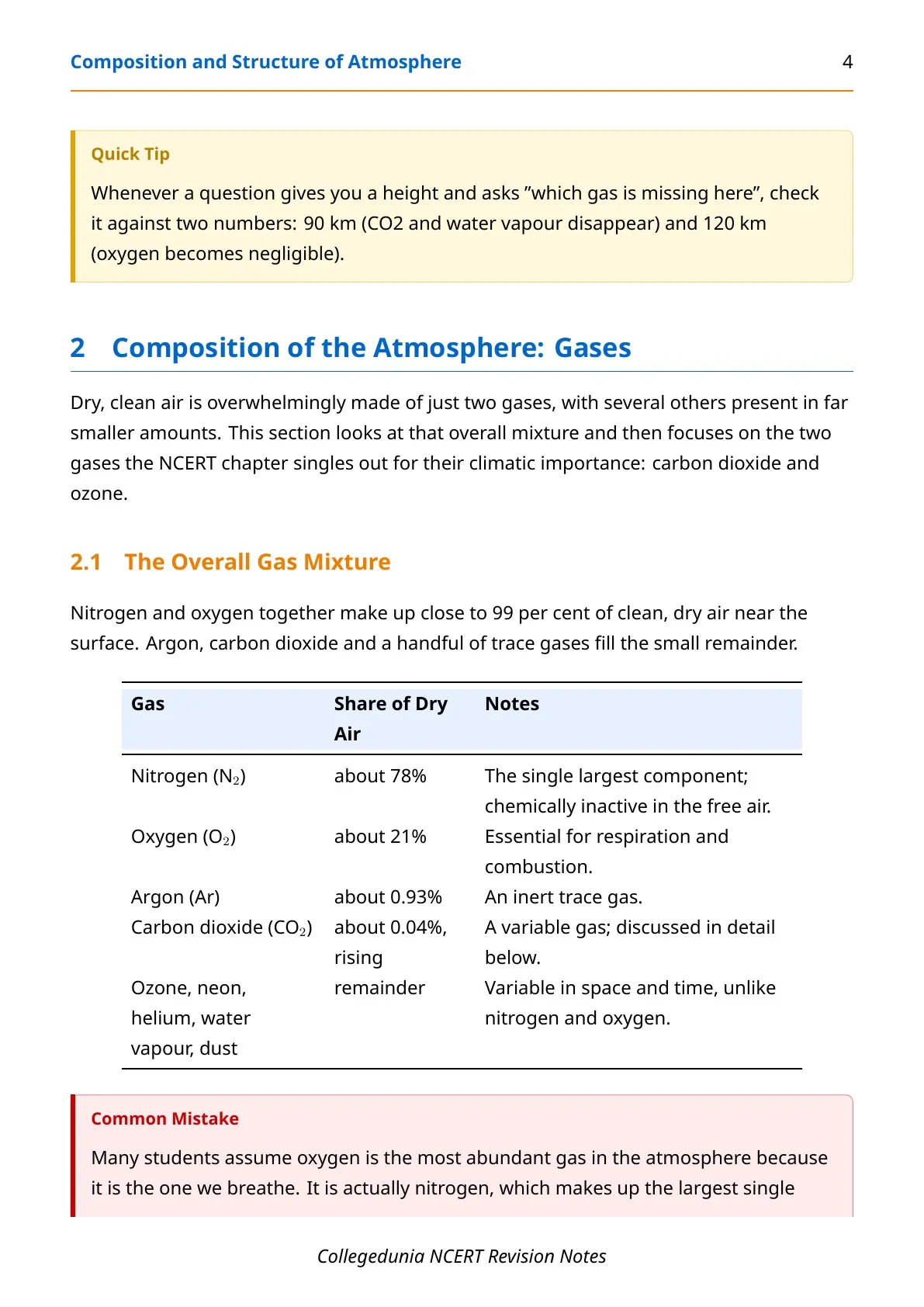
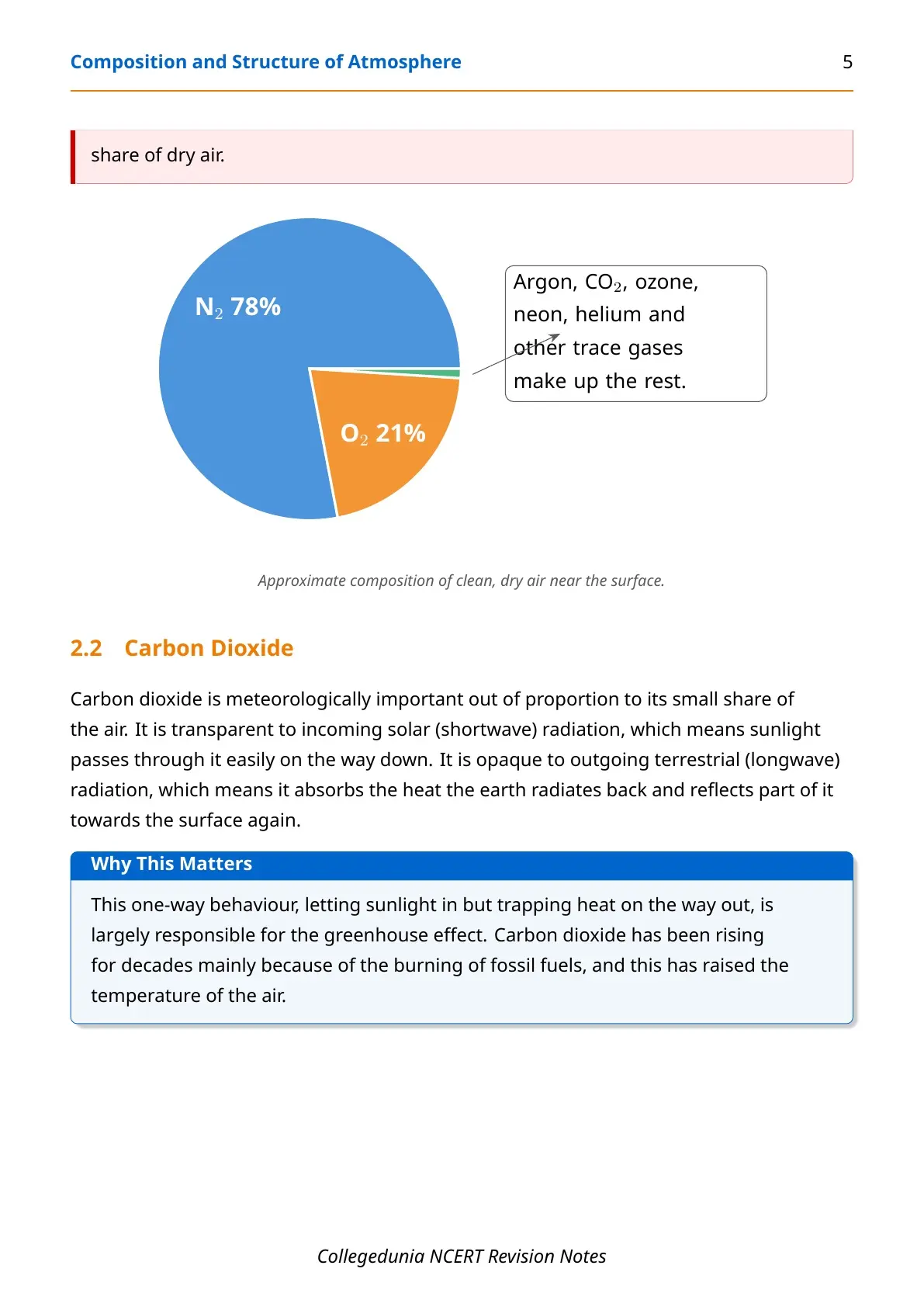
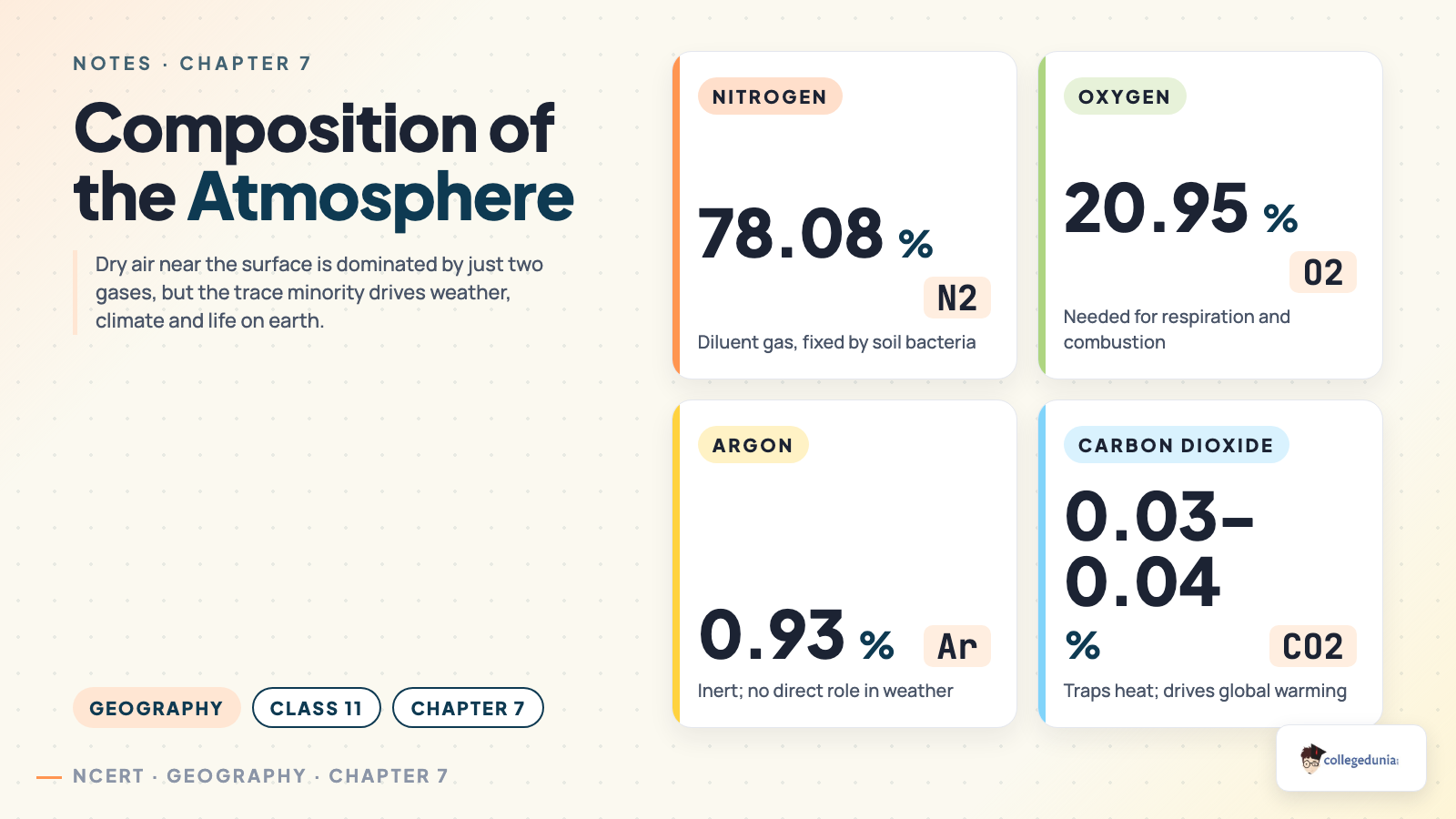
Dry air near the surface is almost entirely two gases. Nitrogen makes up 78.08% and oxygen 20.95% of the atmosphere by volume, with argon at 0.93% a distant third. Every other gas together adds up to less than 0.1%, yet two of them, carbon dioxide and ozone, matter far more than their tiny share suggests.
| Gas | Share by Volume | Why It Matters |
|---|---|---|
| Nitrogen | 78.08% | Dilutes oxygen and is fixed into the soil by bacteria for plant growth. |
| Oxygen | 20.95% | Needed for respiration and for combustion of every kind. |
| Argon | 0.93% | An inert gas with no direct role in weather or life processes. |
| Carbon dioxide | about 0.03 to 0.04% | Lets sunlight in but traps outgoing heat, the main greenhouse gas. |
| Ozone | trace, concentrated at 10 to 50 km | Absorbs harmful ultraviolet radiation before it reaches the surface. |
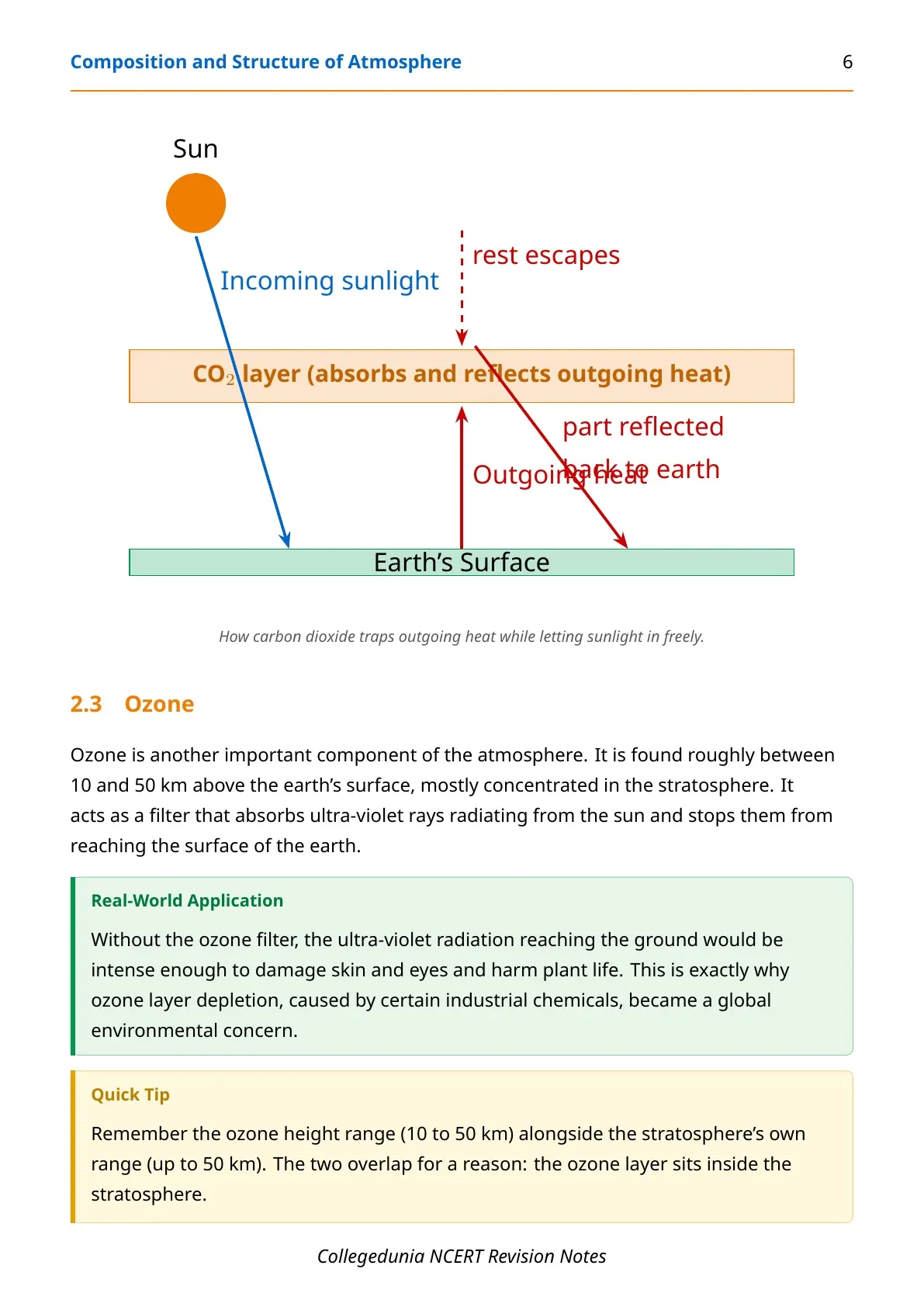
Carbon dioxide is transparent to incoming shortwave sunlight but opaque to outgoing longwave heat radiation, which is exactly why it is called a greenhouse gas. Its share has been rising steadily since large-scale fossil fuel burning began, and the NCERT textbook links this rise directly to global warming.
Ozone works the opposite way. It sits mostly between 10 and 50 km above the surface and filters out the sun's ultraviolet rays before they reach the ground. Without the ozone layer, UV radiation at the surface would be high enough to damage living tissue.
Water Vapour and Dust Particles in the Atmosphere
Water vapour and dust are the two variable ingredients of the atmosphere. Neither is fixed in amount, and both change sharply from place to place and with height.
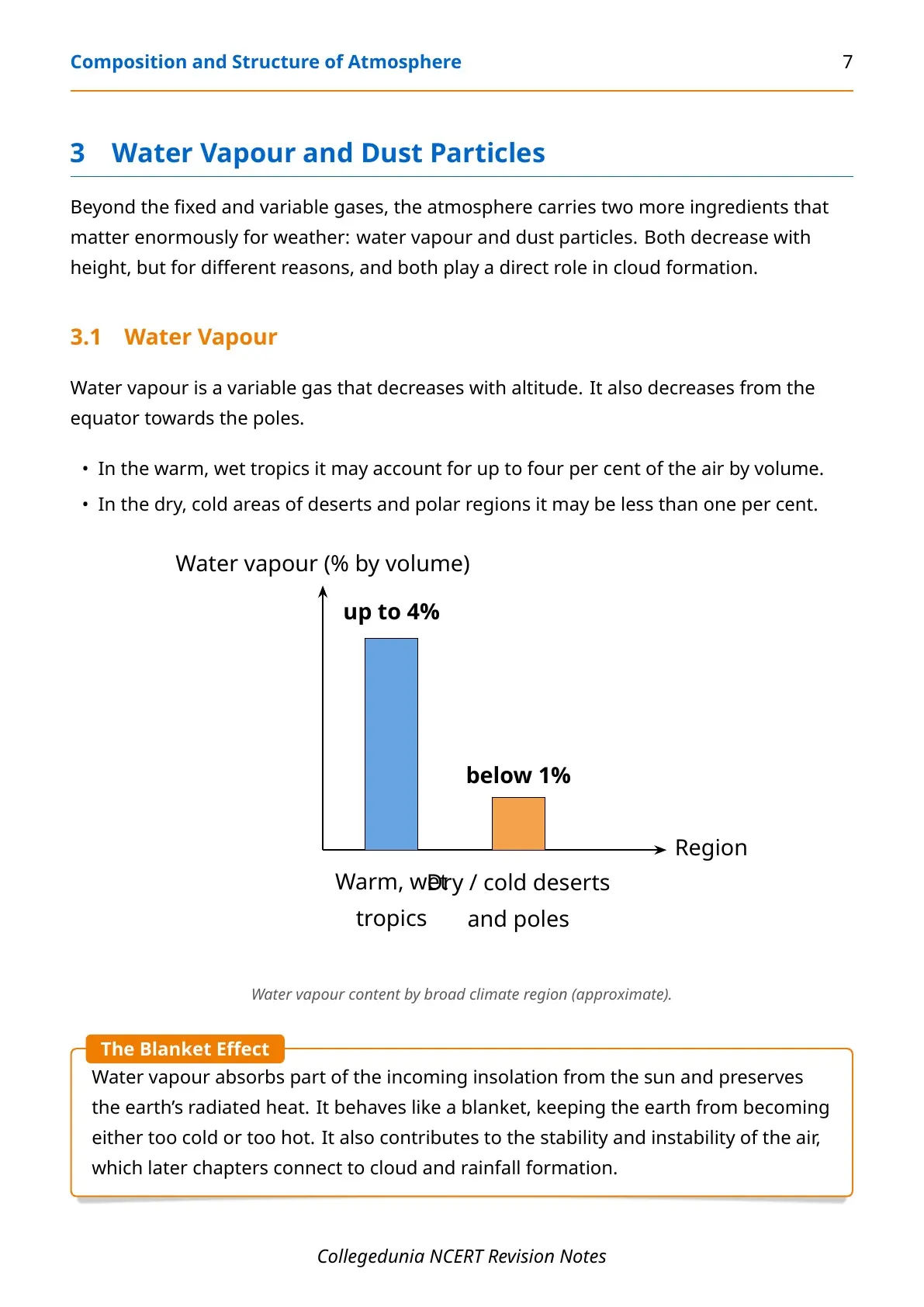
- Water vapour range: from about 4% by volume in warm, humid tropical air to almost none in cold, dry polar air.
- Two-way action: water vapour absorbs incoming solar radiation and also traps outgoing heat, acting as an insulating blanket around the earth.
- Storm fuel: condensing water vapour releases latent heat, which is the energy source that drives storms.
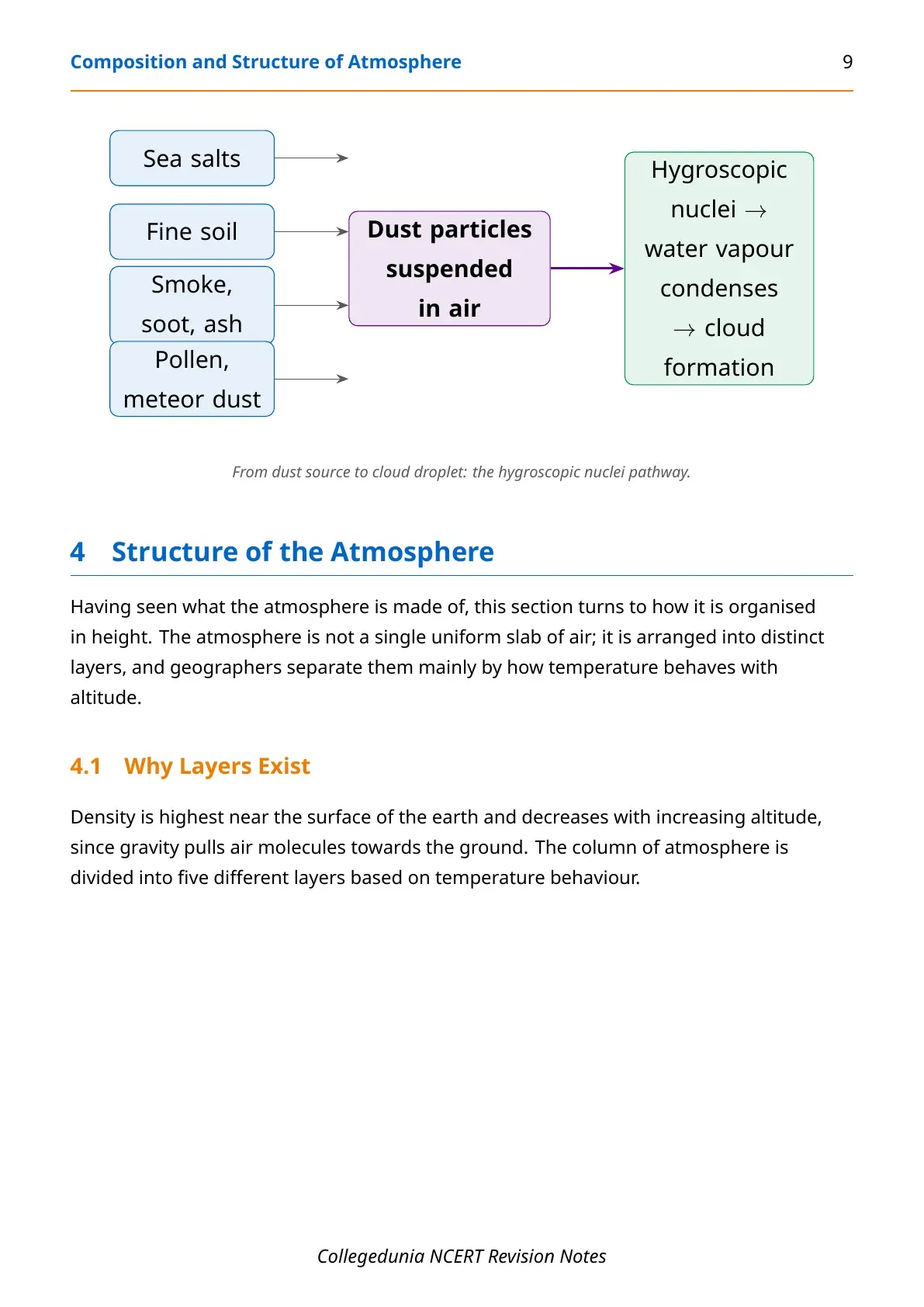
- Dust sources: sea salt, fine soil, smoke and soot, volcanic ash, pollen grains and even meteoric dust from space.
- Dust distribution: heaviest over dry, semi-arid and desert regions, lighter over the equatorial belt and the poles.
Dust particles do more than sit in the air. They act as hygroscopic nuclei, tiny surfaces that water vapour condenses around to form the water droplets that build clouds. Without dust particles in the air, cloud formation and rainfall would be far less efficient.
Structure of the Atmosphere: Why Layers Exist
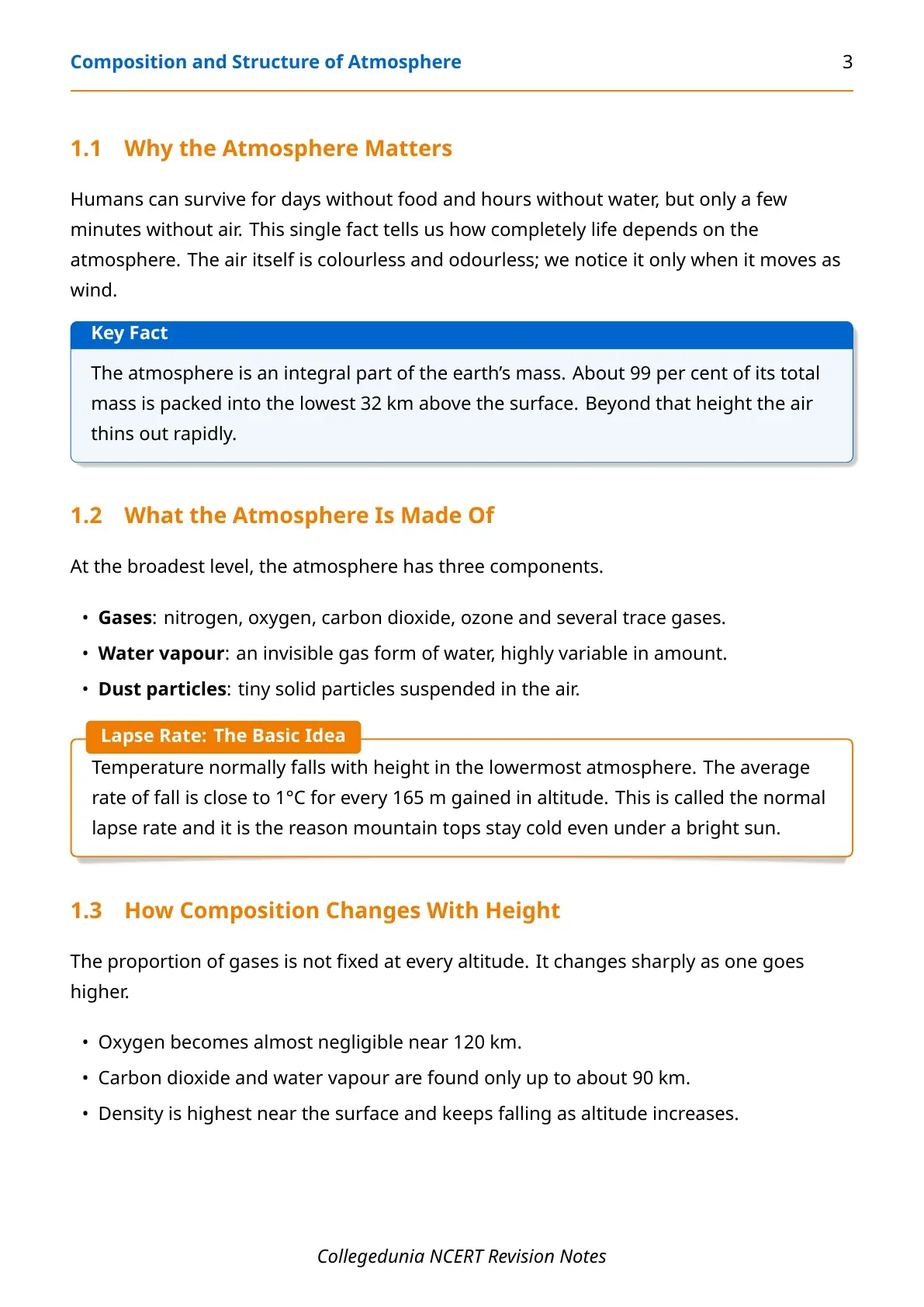
The atmosphere is not a single uniform blanket of gas. It splits into layers because temperature, pressure and gas density each change in their own pattern with height, and the pattern is not a straight line.
- Pressure falls continuously with height, since fewer gas molecules sit above you as you climb.
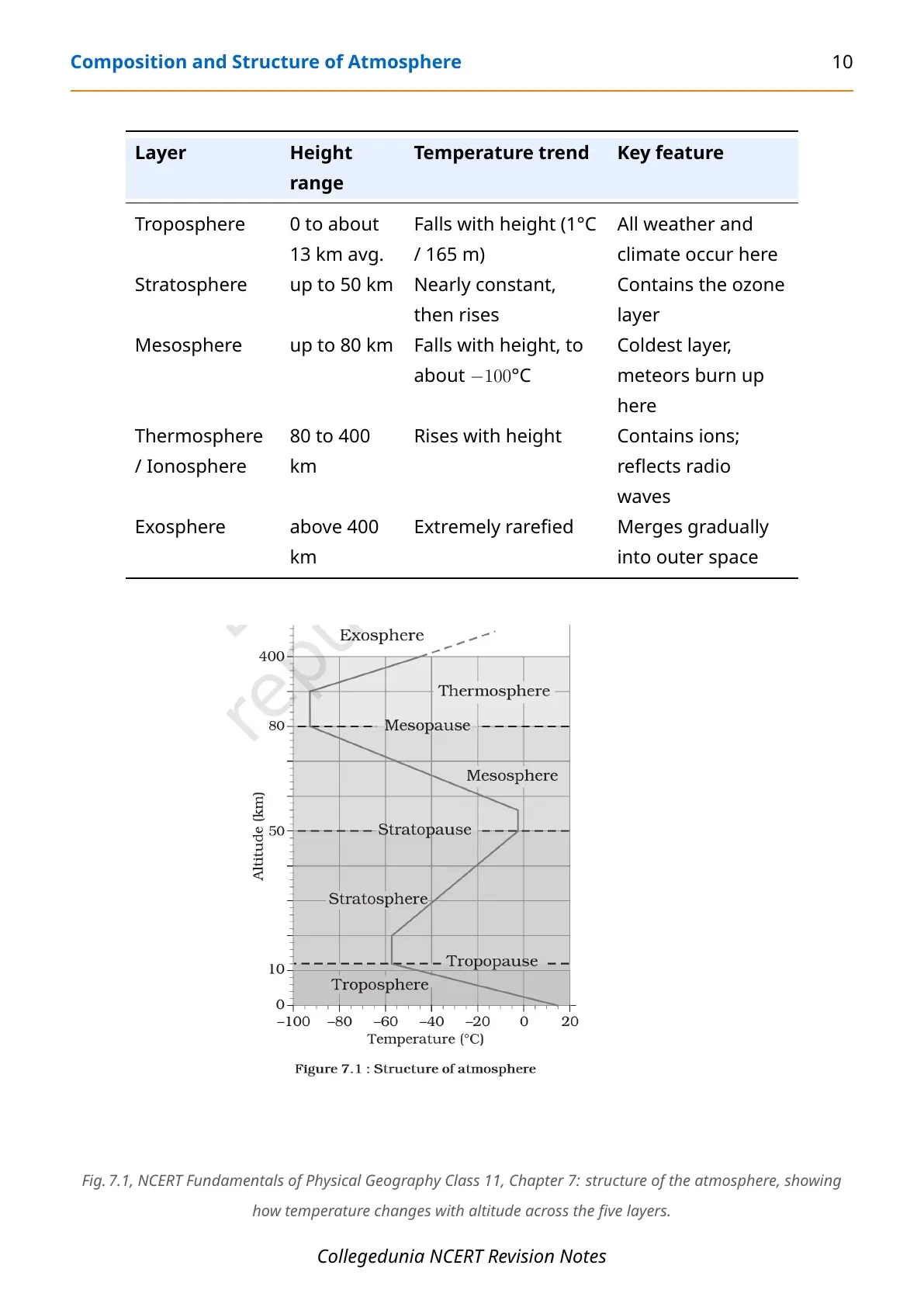
- Temperature does not fall continuously. It drops, then rises, then drops again, then rises once more, producing five distinct zones.
- Each turning point in temperature marks a boundary between two named layers, which is exactly how the five-layer structure is defined.
A vertical cut through the atmosphere, from the surface up to several thousand kilometres, shows this zig-zag temperature pattern clearly. The NCERT diagram plots height against temperature and marks each layer boundary where the line changes direction.
The Five Layers of the Atmosphere Explained
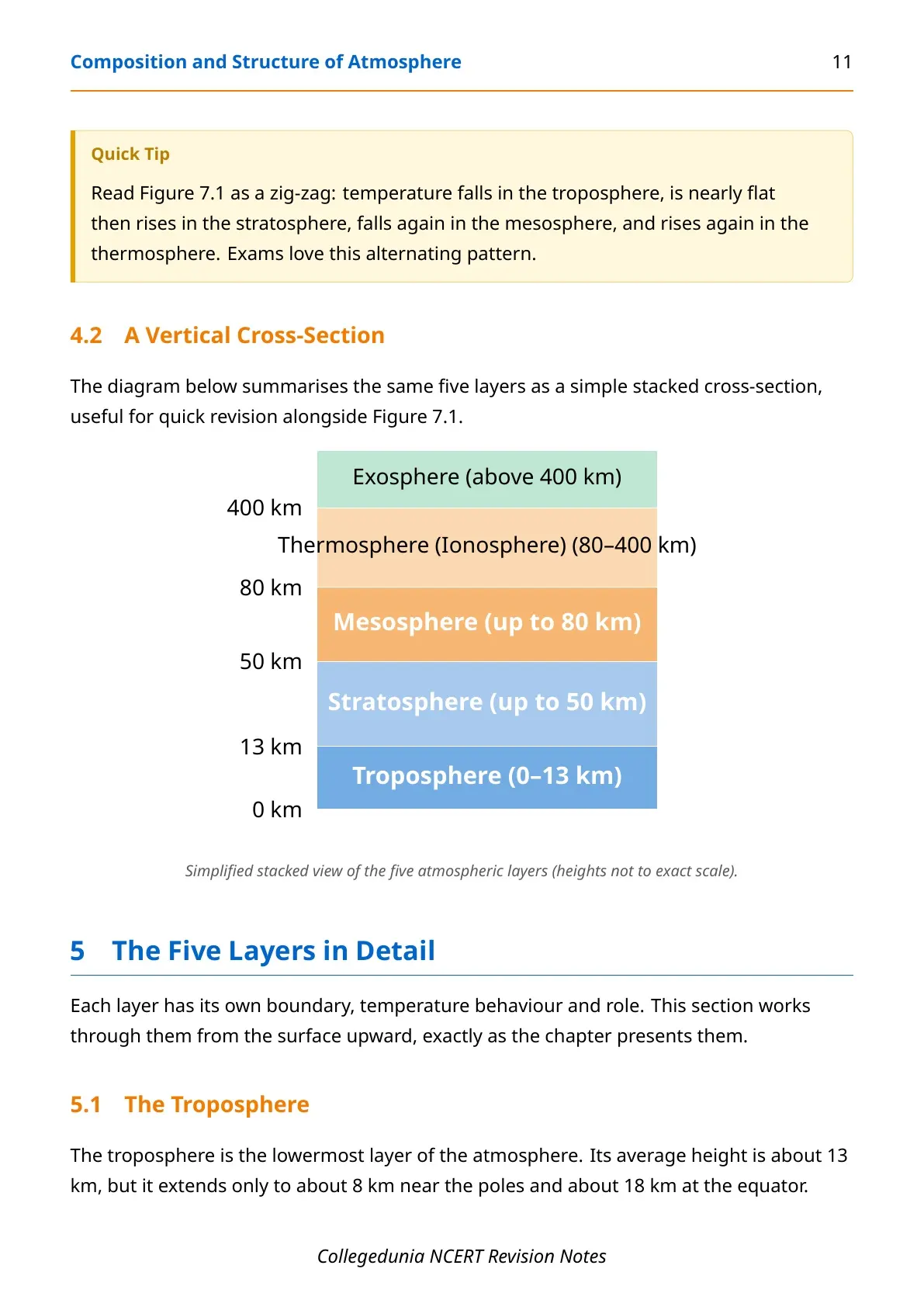
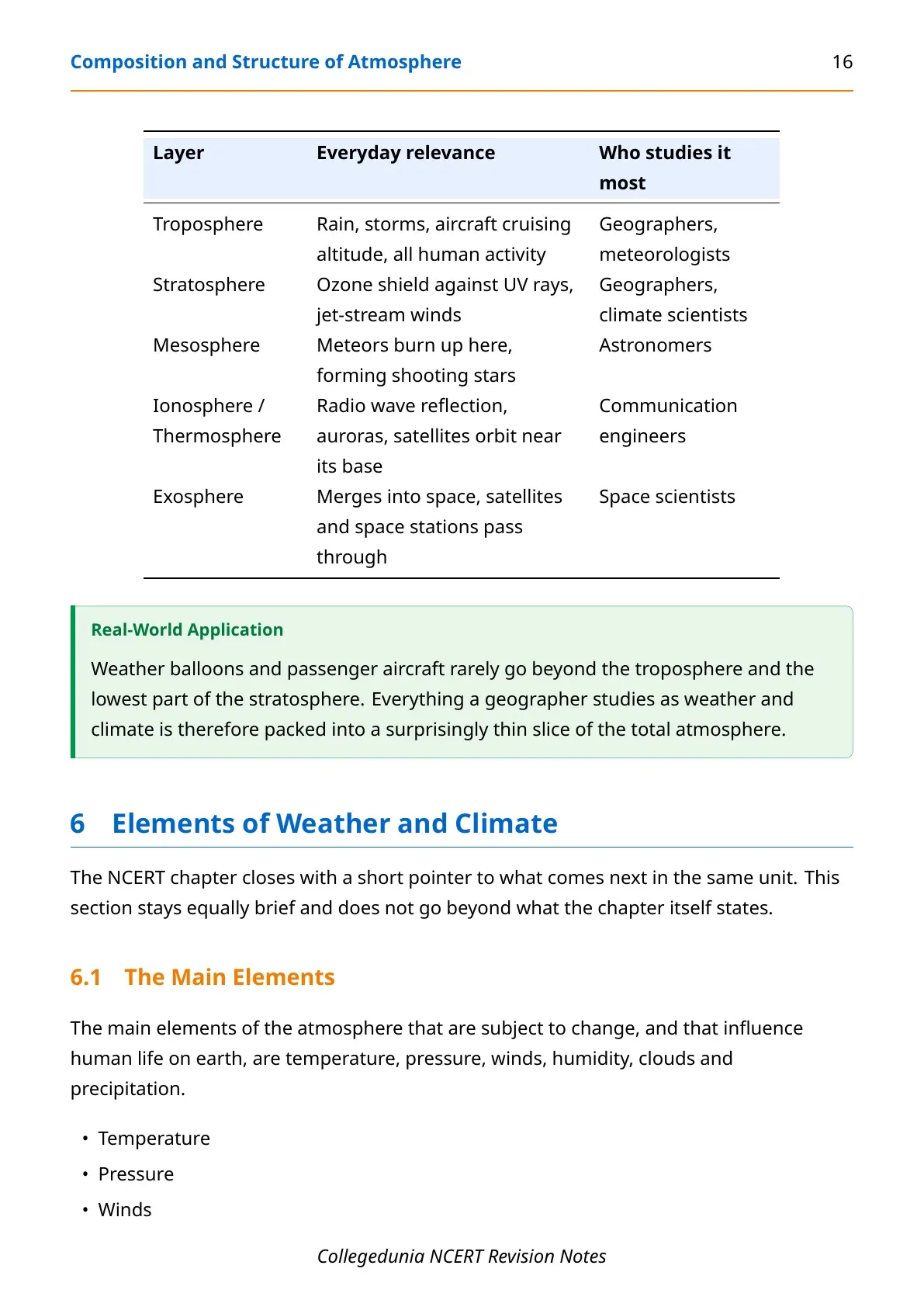
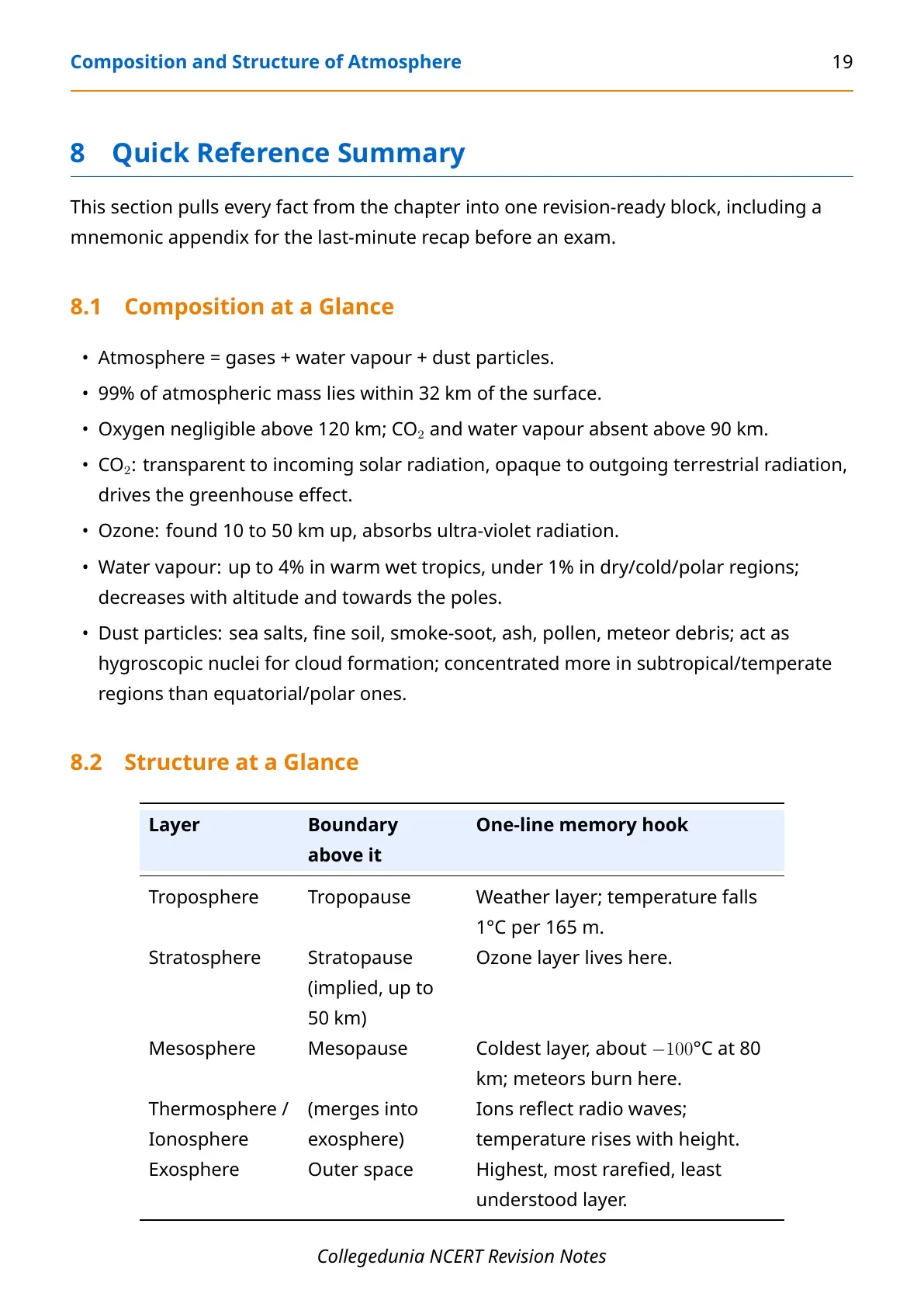
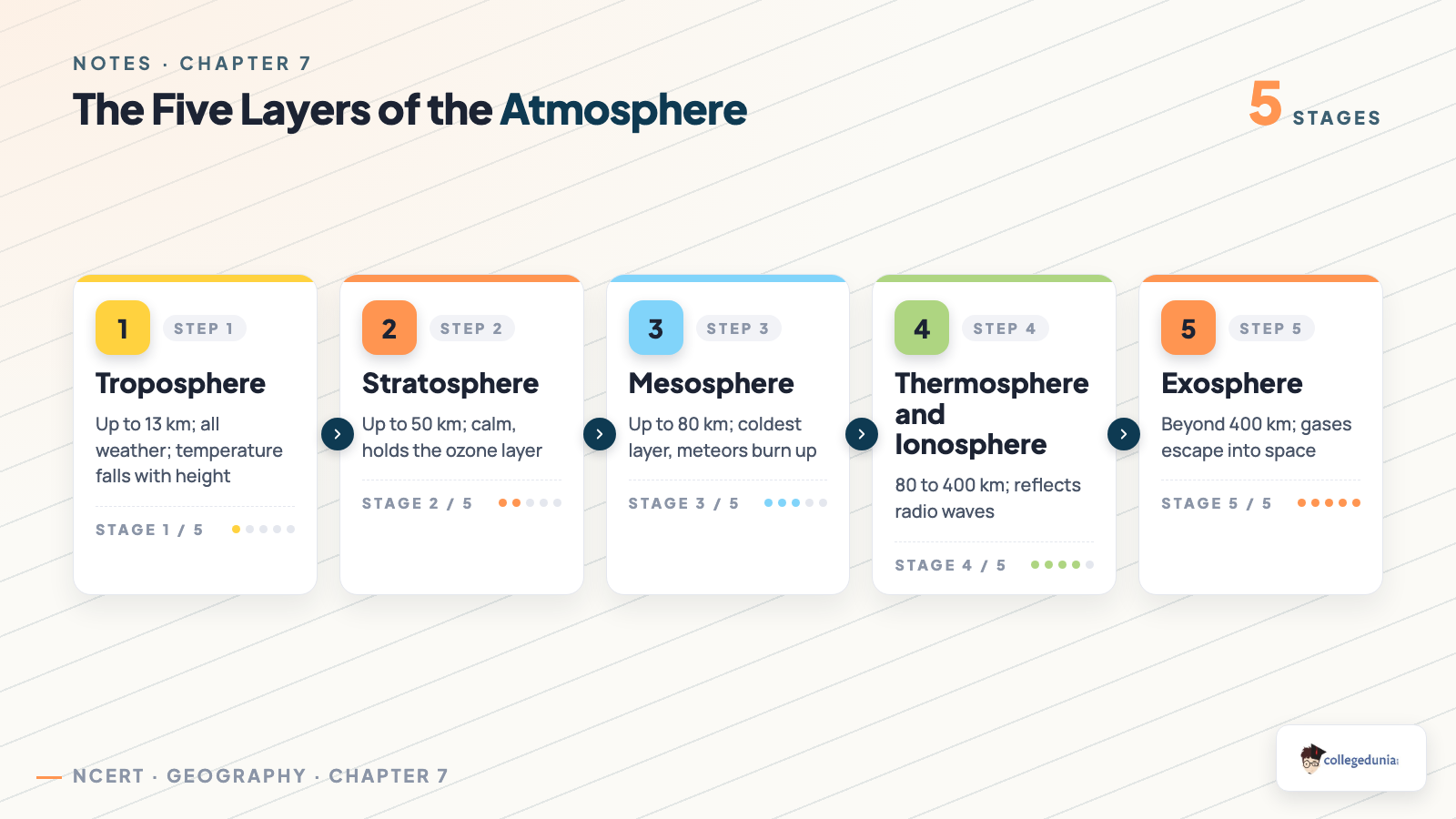
NCERT names five layers, moving outward from the surface: troposphere, stratosphere, mesosphere, thermosphere and exosphere. The tropopause and mesopause are the thin transition zones between them.
| Layer | Approximate Height | Key Feature |
|---|---|---|
| Troposphere | up to about 13 km | Holds 90% of atmospheric gases; all weather happens here; temperature falls with height. |
| Tropopause | boundary zone | Temperature stops falling; marks the ceiling of weather activity. |
| Stratosphere | up to about 50 km | Calm and weather-free, ideal for jet flight; hosts most of the ozone layer. |
| Mesosphere | up to about 80 km | Temperature falls again, reaching the coldest point in the atmosphere at its top. |
| Ionosphere and thermosphere | roughly 80 to 400 km | Charged particles reflect radio waves, enabling long-distance radio communication. |
| Exosphere | beyond about 400 km | Outermost, gas-thin layer where light gases gradually escape into space. |
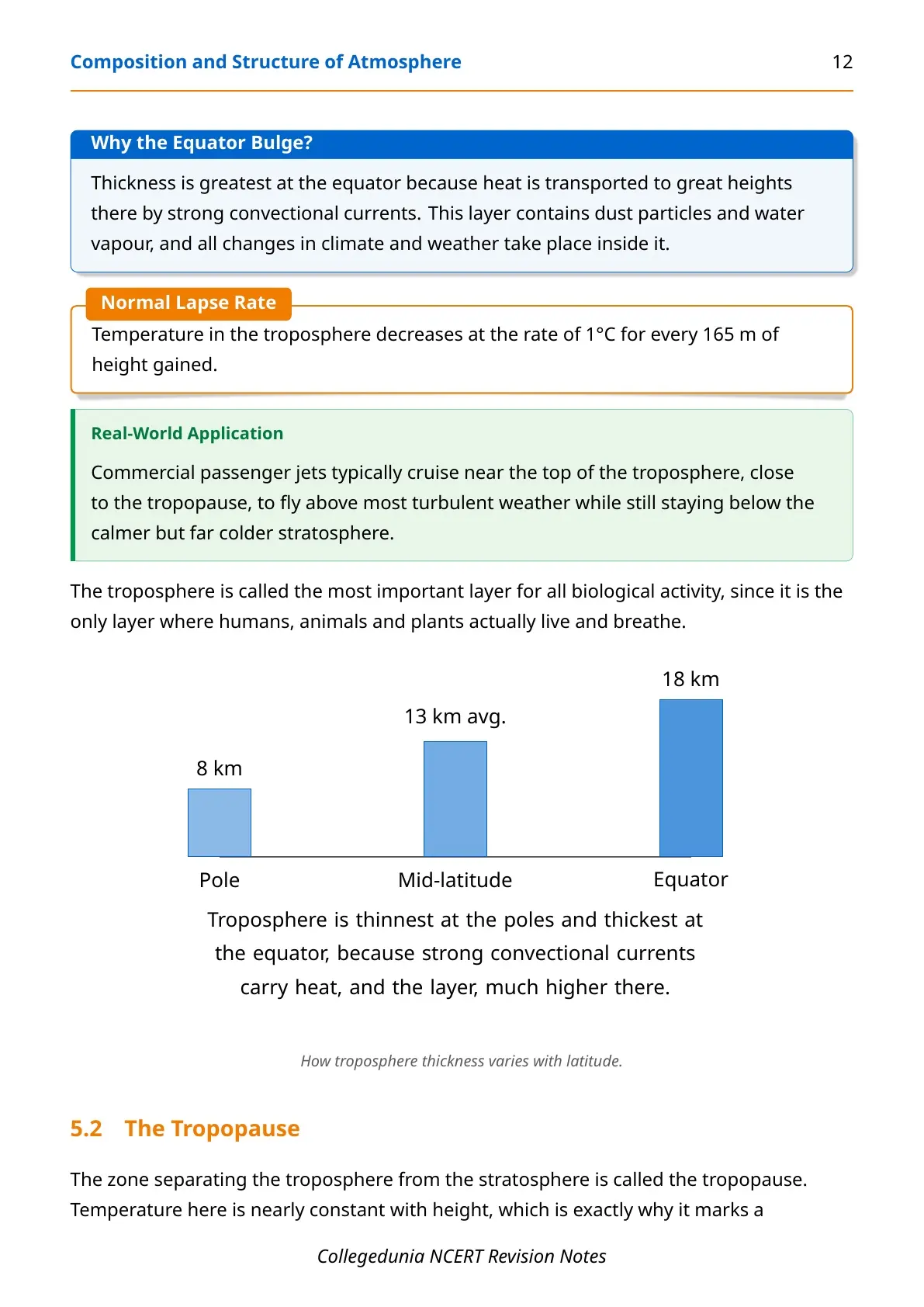
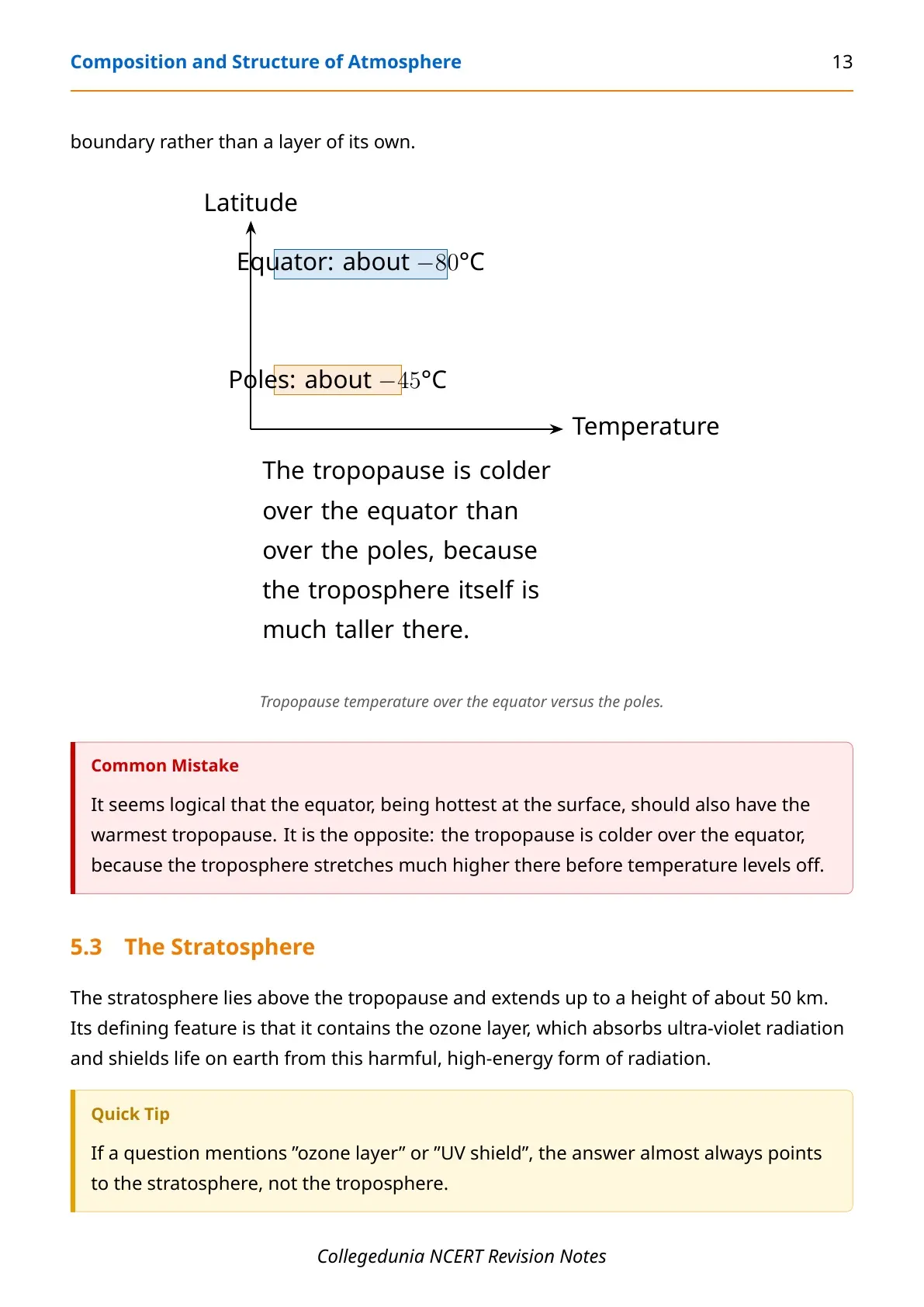
The troposphere is the layer that matters most for daily life. It holds almost all the atmosphere's water vapour and dust, and it thins out from about 18 km at the equator to about 8 km at the poles because warm air columns rise higher than cold ones.
Inside the troposphere, temperature falls at a normal rate of roughly 6.5°C for every kilometre of height, which is why mountain peaks stay snow-capped even in the tropics. At the tropopause, this fall stops, marking the ceiling that most weather systems cannot cross.
The stratosphere is calm because it has almost no water vapour and no vertical air currents, which is exactly why passenger aircraft cruise here. It also holds the ozone layer, so temperature actually rises with height in the upper stratosphere as ozone absorbs solar UV radiation.
The mesosphere is the coldest part of the entire atmosphere, with temperatures near the mesopause dropping close to -100°C. It is also the layer where most meteors burn up before they can reach the ground.
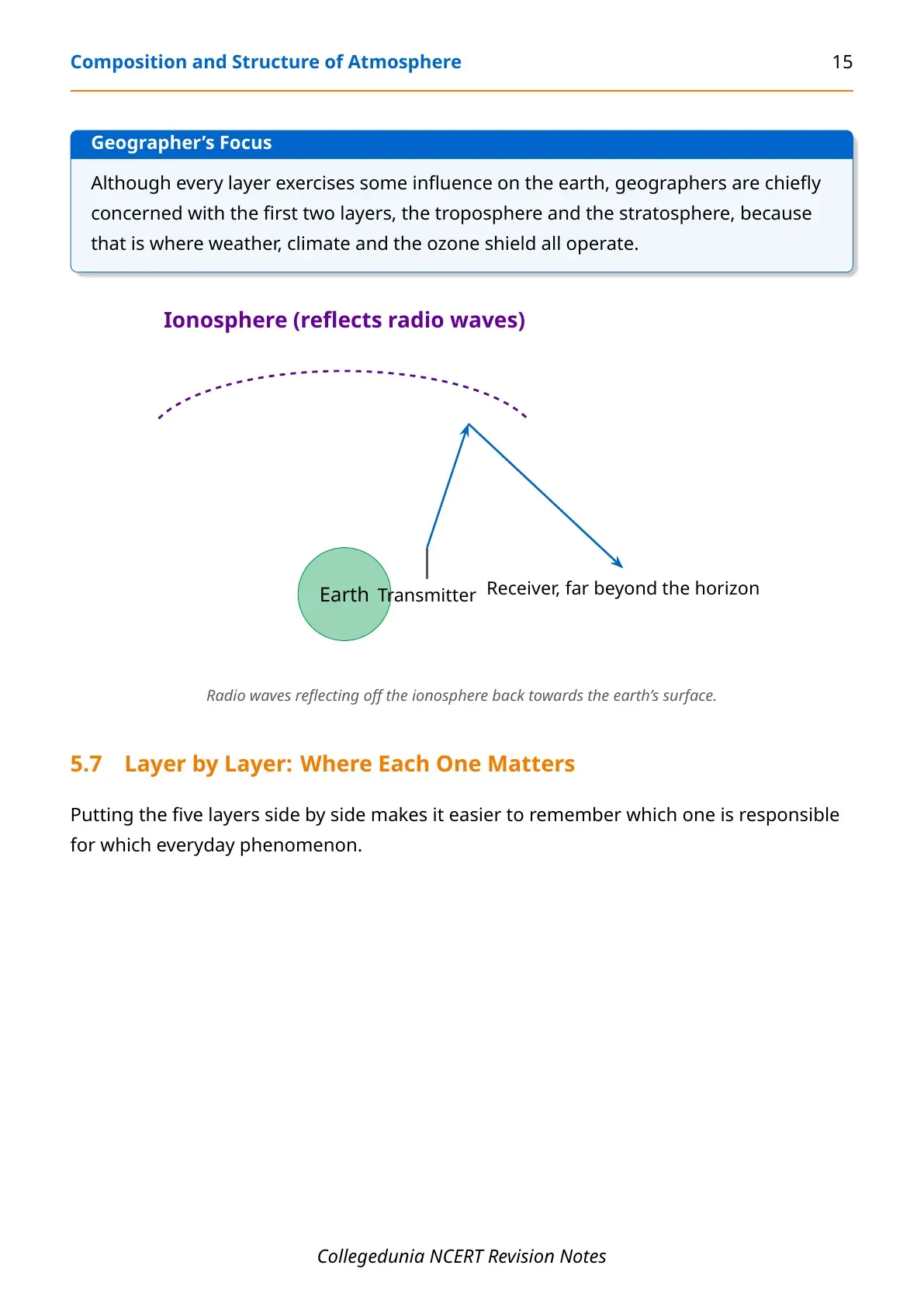
The ionosphere, part of the thermosphere, is named for its ions, electrically charged particles produced when solar radiation strips electrons from gas atoms. These charged layers bounce radio waves back toward earth, which is the basis of long-distance shortwave radio.
The exosphere is where the atmosphere effectively ends. Gas molecules are so sparse and so far apart that light gases like helium and hydrogen can gain enough speed to escape earth's gravity entirely.
Elements of Weather and Climate
The chapter closes by naming the five elements that turn atmospheric composition and structure into everyday weather and long-term climate.
- Temperature: how hot or cold the air is at a given place and time.
- Atmospheric pressure: the weight of the air column above a point on the surface.
- Wind: air moving from high pressure toward low pressure.
- Humidity: the amount of water vapour present in the air.
- Precipitation: rain, snow, sleet or hail falling from clouds.
Weather is the short-term state of these five elements on a given day; climate is their average pattern over many decades. Every later chapter in the Fundamentals of Physical Geography book expands one of these five elements into its own full topic.
NCERT Textbook Exercises for Composition and Structure of Atmosphere
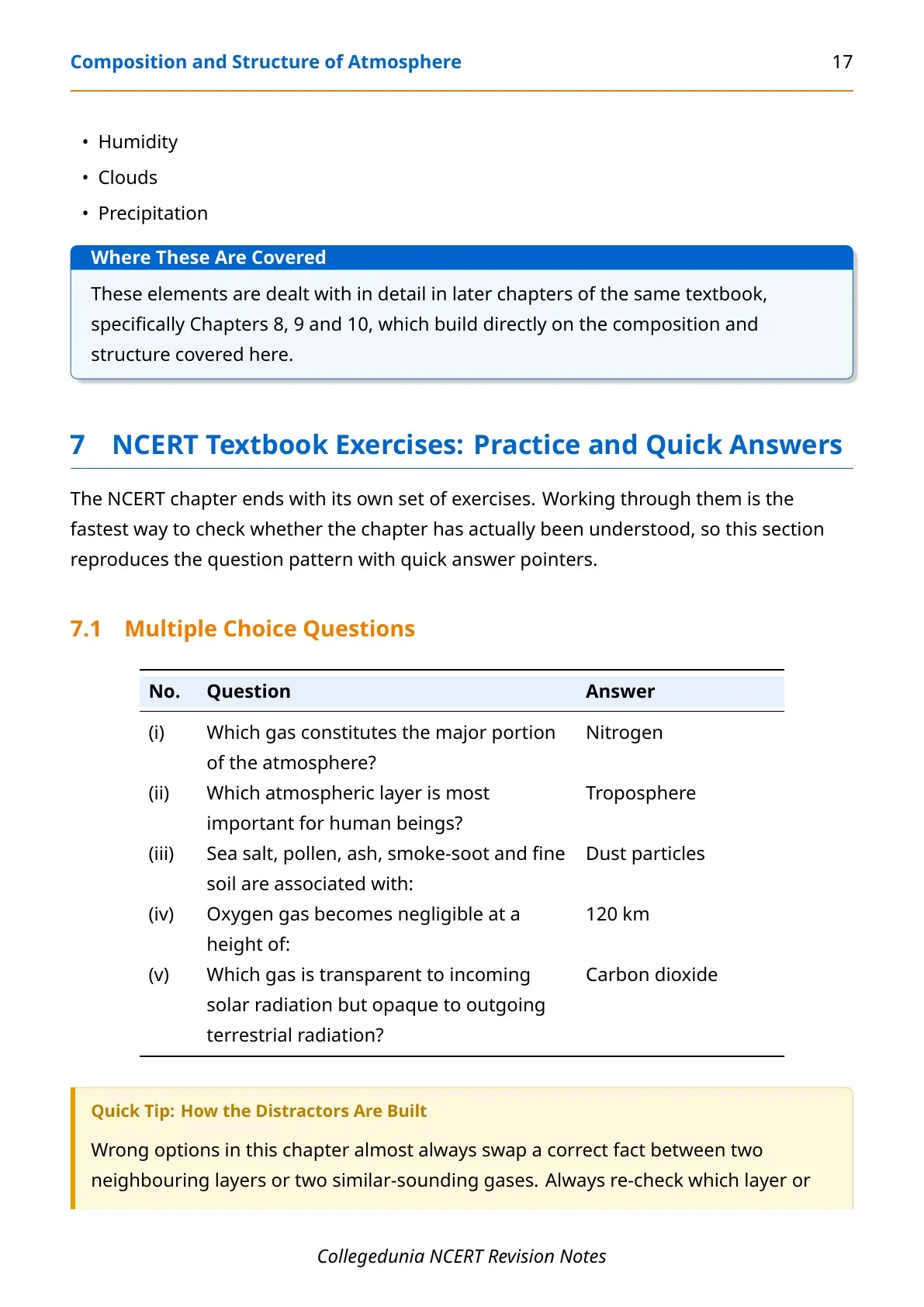
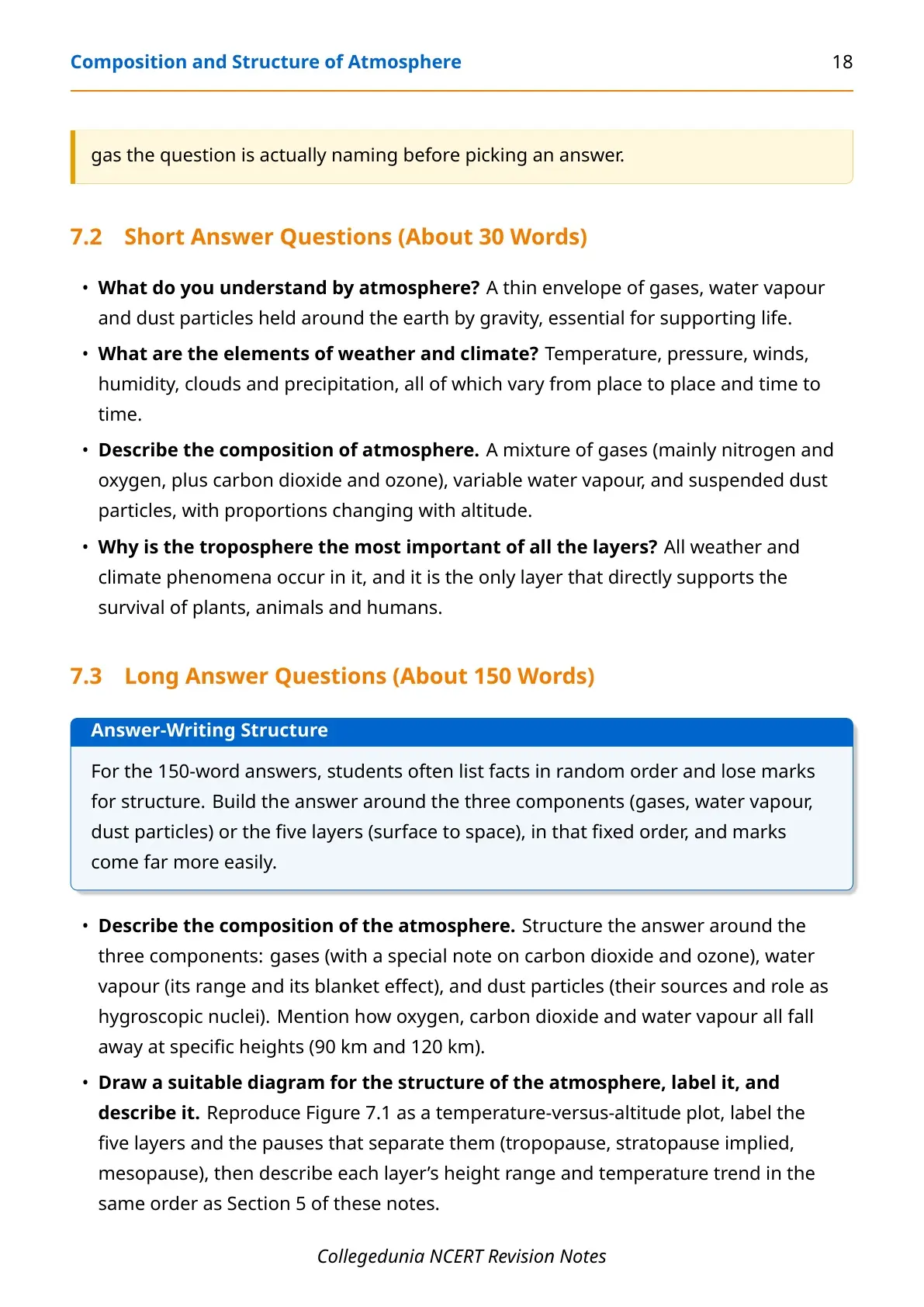
The NCERT chapter closes with three question types. Practising the pattern matters as much as knowing the facts, since the annual exam copies this exact structure.
| Question Type | What It Tests | Sample Prompt |
|---|---|---|
| Multiple Choice | Gas percentages, layer names and layer order | Which gas forms the second largest share of the atmosphere? |
| Short Answer (about 30 words) | One clear reason or one clear definition | Why is the ozone layer important for life on earth? |
| Long Answer (about 150 words) | Full explanation with structure or sequence | Discuss the composition of the atmosphere in detail. |
For the long-answer set, examiners reward answers that follow the textbook's own order: permanent gases first, then variable gases, then water vapour and dust. Answering out of sequence is the single most common reason marks are cut, even when every fact is correct.
Common Mistakes Students Make in Composition and Structure of Atmosphere
- Placing ozone in the wrong layer - ozone belongs mainly to the stratosphere (10 to 50 km), not the troposphere where weather happens.
- Mixing up rising and falling temperature - temperature falls in the troposphere and mesosphere, but rises in the stratosphere and thermosphere.
- Confusing the tropopause with the troposphere - the tropopause is the thin boundary zone, not a layer with its own thickness.
- Forgetting the ionosphere sits inside the thermosphere - it is a charged-particle zone within the thermosphere, not a separate sixth layer.
Real-World Uses of the Atmosphere's Layers
Each layer of the atmosphere already does real work outside the classroom, which makes the chapter easier to remember.
- Ozone layer: shields every living thing from harmful ultraviolet rays, which is why its depletion over Antarctica became a global concern.
- Stratosphere: chosen by commercial airlines for cruising altitude precisely because it has no turbulence-causing weather.
- Ionosphere: makes shortwave radio broadcasting possible by reflecting signals across continents.
- Mesosphere: burns up meteors before they reach the ground, protecting the surface from small space debris.
How to Use These Notes Most Effectively
NCERT Notes Class 11 Geography Chapter 7 Composition and Structure of Atmosphere rewards a fixed study order more than most Class 11 Geography chapters, since every later section builds on the one before it.
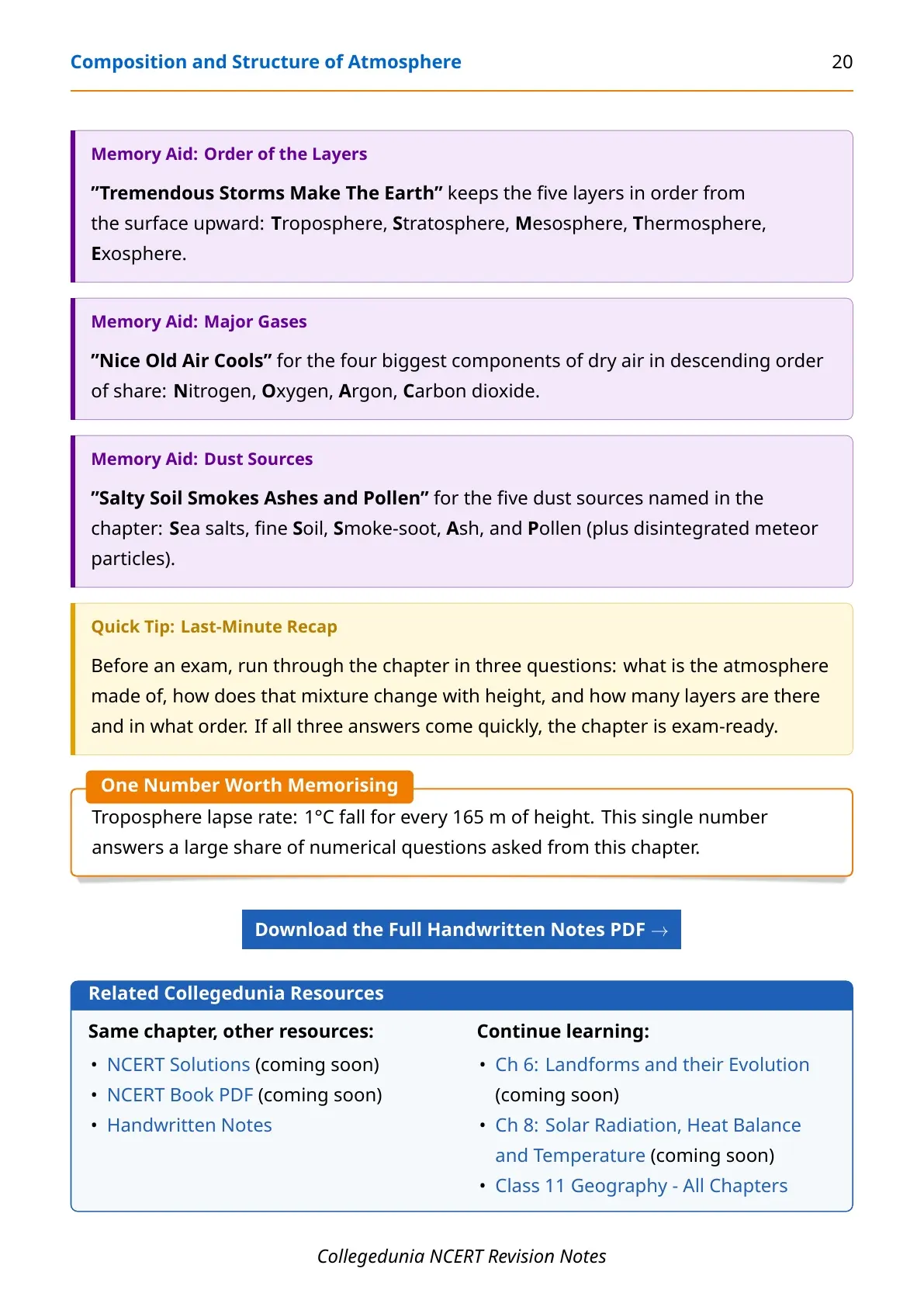
- Learn the gas table first. Nitrogen, oxygen and argon are fixed numbers worth memorising exactly.
- Draw the layer diagram from memory. Height on one axis, temperature on the other, five layers, two named boundaries.
- Recite the five weather elements last, since they connect this chapter to everything that follows in the book.
Other NCERT Resources for Composition and Structure of Atmosphere
This table lists every Collegedunia resource for the NCERT Notes Class 11 Geography Chapter 7 Composition and Structure of Atmosphere chapter.
| Resource | Link |
|---|---|
| Notes (this page) | Composition and Structure of Atmosphere Class 11 Geography Notes |
| Handwritten Notes | (coming soon) |
| NCERT Solutions | (coming soon) |
| NCERT Book PDF | (coming soon) |
Composition and Structure of Atmosphere: Topics Students Often Get Confused About
Three pairs of terms cause most of the confusion in this chapter, because the names sound similar but the ideas are different.
- Weather vs climate - weather is the state of the atmosphere on a given day; climate is the average of weather over roughly 30 years.
- Troposphere vs tropopause - the troposphere is a full layer up to about 13 km; the tropopause is the thin boundary zone that caps it.
- Ionosphere vs exosphere - the ionosphere reflects radio waves and sits inside the thermosphere; the exosphere is the outermost layer where gases escape into space.
NCERT Notes for Class 11 Geography: All Chapters
Use this table to move to any other Class 11 Geography chapter's notes once this chapter is done.
| Chapter | Resource |
|---|---|
| Chapter 1 | Geography as a Discipline Notes (Coming Soon) |
| Chapter 2 | The Origin and Evolution of the Earth Notes (Coming Soon) |
| Chapter 3 | Interior of the Earth Notes (Coming Soon) |
| Chapter 4 | Distribution of Oceans and Continents Notes (Coming Soon) |
| Chapter 5 | Geomorphic Processes Notes (Coming Soon) |
| Chapter 6 | Landforms and their Evolution Notes (Coming Soon) |
| Chapter 7 | Composition and Structure of Atmosphere Notes |
| All Chapters | Class 11 Geography, All Chapters (Coming Soon) |
Composition and Structure of Atmosphere Class 11 Geography Notes FAQs
Ques. Where can I download the Class 11 Geography Chapter 7 Notes PDF?
Ans. You can download the NCERT Notes Class 11 Geography Chapter 7 Composition and Structure of Atmosphere PDF directly from this page, free of cost.
Ques. Are these notes based on the 2026-27 NCERT syllabus?
Ans. Yes. These notes follow the current 2026-27 NCERT textbook for Class 11 Geography, chapter by chapter, in the same order as the printed book.
Ques. How many pages is the Class 11 Geography Chapter 7 Notes PDF?
Ans. The Notes PDF runs about 20 pages and covers the gas composition of the atmosphere, water vapour and dust particles, the five atmospheric layers, and the elements of weather and climate.
Ques. What is the composition of the atmosphere?
Ans. The atmosphere is about 78.08% nitrogen, 20.95% oxygen and 0.93% argon by volume. The rest is made up of carbon dioxide, ozone, water vapour and dust particles in much smaller amounts.
Ques. What are the five layers of the atmosphere?
Ans. The five layers, from the surface outward, are the troposphere, stratosphere, mesosphere, thermosphere and exosphere. The tropopause and mesopause are the transition zones between them.
Ques. Why is the ozone layer important?
Ans. The ozone layer, concentrated between 10 and 50 km above the surface, absorbs most of the sun's harmful ultraviolet radiation before it reaches the ground, protecting living organisms from damage.
Ques. Which layer of the atmosphere is most important for human beings?
Ans. The troposphere is most important, since it holds nearly 90% of the atmosphere's gases, all the water vapour and dust, and every weather phenomenon that affects daily life.
Ques. What are the elements of weather and climate?
Ans. The five elements are temperature, atmospheric pressure, wind, humidity and precipitation. Weather is their day-to-day state, and climate is their long-term average over about 30 years.



Comments