



Inside the NCERT Notes for Class 11 Geography Chapter 8 Solar Radiation, Heat Balance and Temperature, you will find the complete 100-unit heat budget breakdown, the five factors that control insolation, and the January-July isotherm patterns examiners return to most, all according to the latest 2026-27 CBSE syllabus.
- Weightage: a regular 3 to 5 mark chapter in the Class 11 annual exam, often a diagram or numerical question on the heat budget.
- Builds forward: the temperature ideas here feed directly into Atmospheric Circulation and World Climate later in the book.
- Format: a 22-page PDF with the full heat-budget figure, isotherm and inversion diagrams, and a quick-recall summary table.
These NCERT Notes Class 11 Geography Chapter 8 Solar Radiation, Heat Balance and Temperature are curated by subject experts, checked against the 2026-27 NCERT textbook, and organised the same way the chapter flows: insolation, heating and cooling of the atmosphere, the heat budget, temperature distribution, and temperature inversion.
Student Feedback: What 12,410 students told us about this chapter. In a Collegedunia poll of 12,410 Class 11 Geography students conducted before their 2026-27 annual exams, 58% could not redraw the heat budget diagram from memory, even though most could recite the definitions of insolation and albedo correctly.
Why Solar Radiation, Heat Balance and Temperature Matters for Class 11 Geography
NCERT Notes Class 11 Geography Chapter 8 Solar Radiation, Heat Balance and Temperature is the chapter that explains where the earth's heat comes from and where it goes. The Class 11 annual paper usually draws one numerical or diagram question on the heat budget and one short-answer question on temperature distribution.
- Direct exam value: the heat budget's 100-unit breakdown and the factors controlling temperature are asked almost every year, either as MCQs or as a labelled-diagram question.
- Builds later chapters: Atmospheric Circulation, World Climate and Climate Change all assume this chapter's temperature and pressure logic is already known.
Solar Radiation, Heat Balance and Temperature Explained
Source: Magnet Brains on YouTube
How Collegedunia's Notes Help You With Solar Radiation, Heat Balance and Temperature
Collegedunia's notes split this chapter into the parts students actually get tested on: how insolation varies, how the atmosphere heats up, how the heat budget balances, and how temperature spreads across the globe.
- 2026-27 NCERT Alignment: every figure, from the solar constant to the 100-unit heat budget, matches the current textbook edition.
- Heat-Budget Walkthrough: the full 35-65 split and the 17+48=65 balance explained step by step, not just stated.
- Isotherm Maps Simplified: the January and July patterns broken into short, memorable rules rather than one dense paragraph.
- NCERT Exercise Practice: quick-answer prompts that mirror the textbook's MCQ, short-answer and long-answer sets.
Solar Radiation, Heat Balance and Temperature Glossary
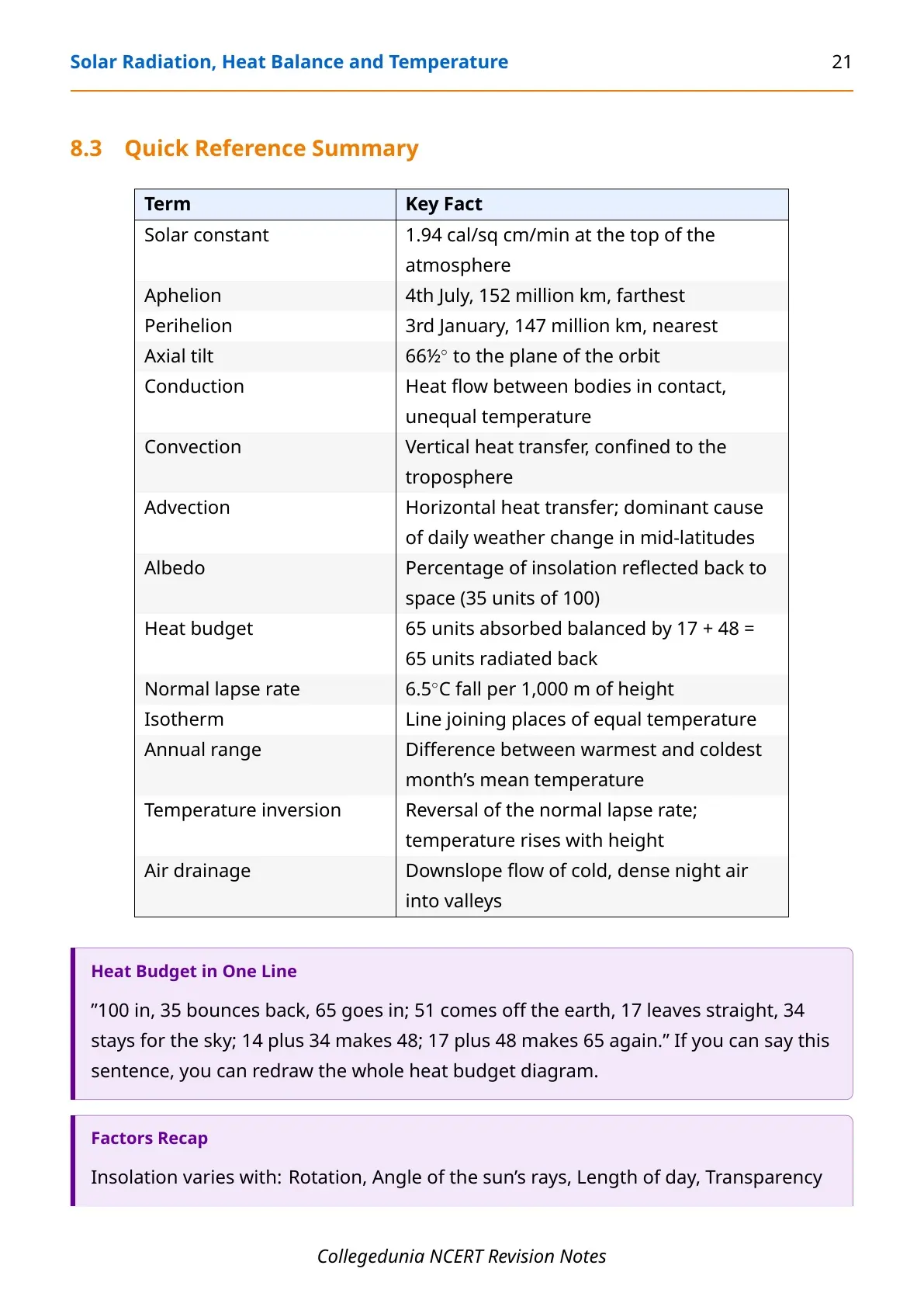
Fourteen terms from this chapter cover almost every question the Class 11 exam asks on solar radiation and temperature.
| Term | One-Line Definition |
|---|---|
| Insolation | The incoming solar radiation received by the earth, mostly in short wavelengths. |
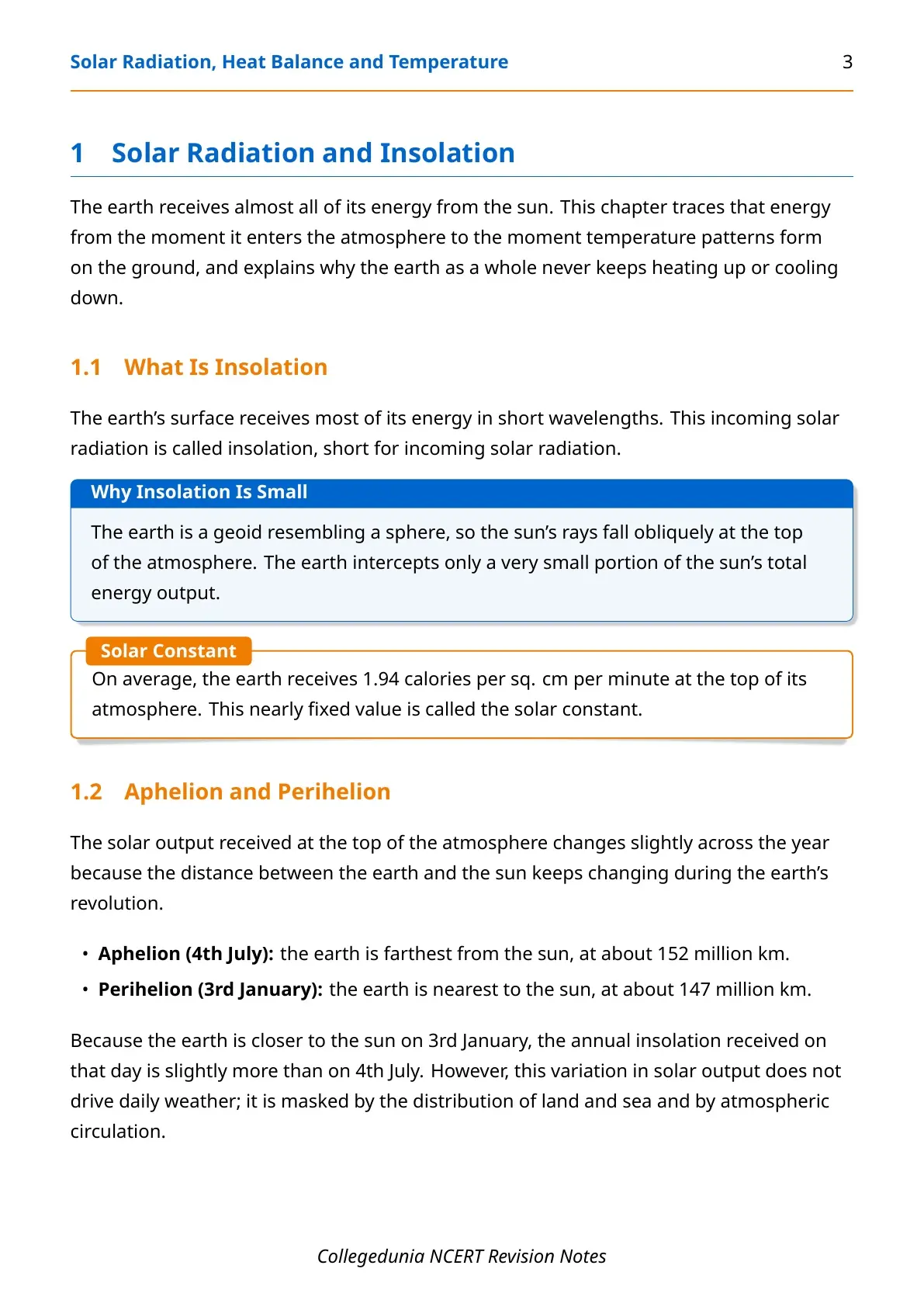
| Solar constant | The average energy the earth receives at the top of its atmosphere, about 1.94 cal/sq cm/min. |
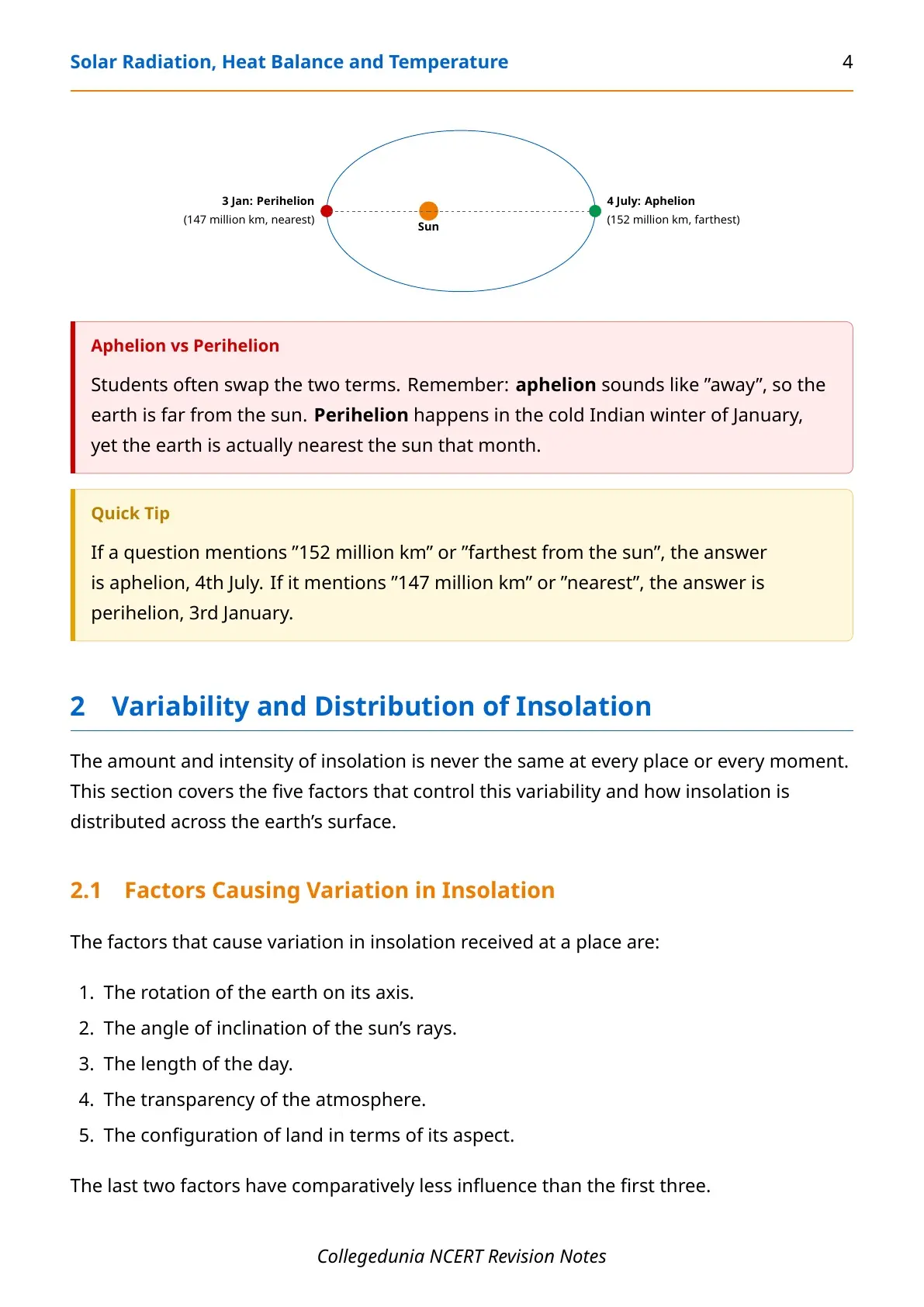
| Aphelion | 4th July, when the earth is farthest from the sun, at about 152 million km. |
| Perihelion | 3rd January, when the earth is nearest to the sun, at about 147 million km. |
| Conduction | Heat flow between two bodies of unequal temperature that are in direct contact. |
| Convection | Vertical heat transfer by rising air currents, confined to the troposphere. |
| Advection | Horizontal heat transfer by moving air; the main cause of daily weather change in mid-latitudes. |
| Terrestrial radiation | Long wave heat radiated by the earth after it has been warmed by insolation. |
| Albedo | The percentage of insolation reflected straight back to space by clouds, ice and snow. |
| Heat budget | The balance between the heat the earth receives and the heat it loses, keeping temperature constant. |
| Normal lapse rate | The average rate at which temperature falls with height, 6.5°C per 1,000 m. |
| Isotherm | A line on a map joining places that have the same temperature. |
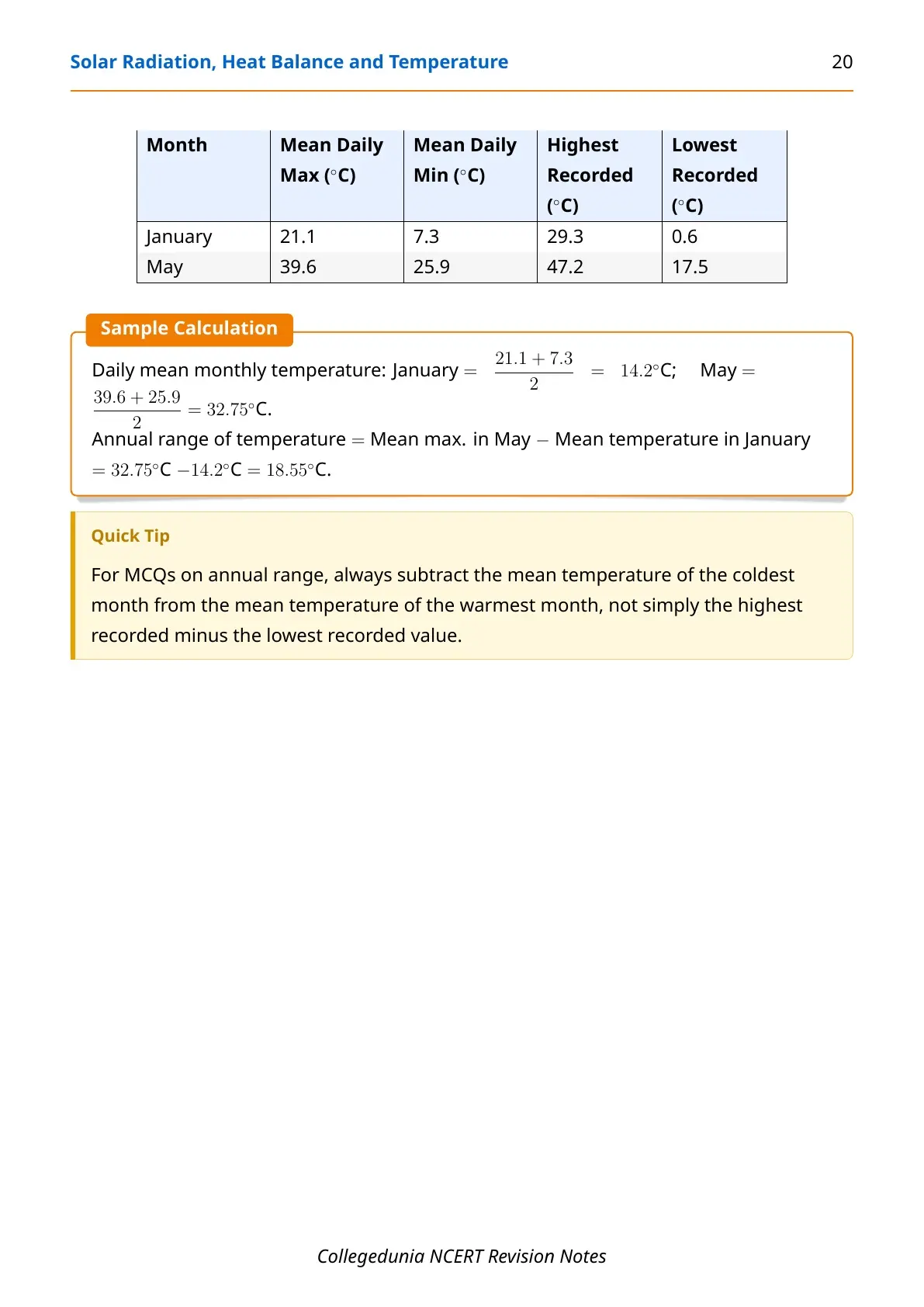
| Annual range of temperature | The difference between the mean temperature of the warmest and coldest months. |
| Temperature inversion | A reversal of the normal lapse rate, so temperature rises rather than falls with height. |
What the Solar Radiation, Heat Balance and Temperature Chapter Covers
The NCERT chapter moves in a fixed order: how insolation reaches the earth, how the atmosphere heats and cools, how the heat budget balances, and how temperature is finally distributed across the globe.
- Insolation: the solar constant, aphelion and perihelion, and the five factors that make insolation vary by place and season.
- Heating and cooling: conduction, convection, advection and terrestrial radiation, the four ways heat moves through the atmosphere.
- Heat budget: the full 100-unit accounting of what happens to insolation once it reaches the top of the atmosphere.
- Temperature: the five factors controlling its distribution, global isotherm patterns, and temperature inversion.
Insolation and the Solar Constant
The earth receives almost all of its energy from the sun in the form of short wave radiation, called insolation. Because the earth is a geoid resembling a sphere, the sun's rays fall obliquely at the top of the atmosphere, so the earth intercepts only a small share of the sun's total output.
| Term | Value | What It Means |
|---|---|---|
| Solar constant | 1.94 cal/sq cm/min | Average insolation received at the top of the atmosphere. |
| Aphelion | 4th July, 152 million km | The earth's farthest point from the sun in its yearly orbit. |
| Perihelion | 3rd January, 147 million km | The earth's nearest point to the sun in its yearly orbit. |
Because the earth is closer to the sun in January, insolation received on 3rd January is slightly higher than on 4th July. But this small variation does not drive daily weather. It is masked by the distribution of land and sea and by atmospheric circulation, a point the NCERT text states explicitly and that examiners like to test.
What Controls the Amount of Insolation a Place Receives
Insolation is never the same at every place or every moment. NCERT lists five factors, and the first three matter far more than the last two.
- Rotation of the earth on its axis, which decides day and night at any given place.
- Angle of inclination of the sun's rays, controlled by the earth's 66½° axial tilt, the single biggest factor.
- Length of the day, which varies with season and latitude.
- Transparency of the atmosphere, affected by cloud cover, dust and water vapour.
- Configuration of land in terms of its aspect, a comparatively minor factor.
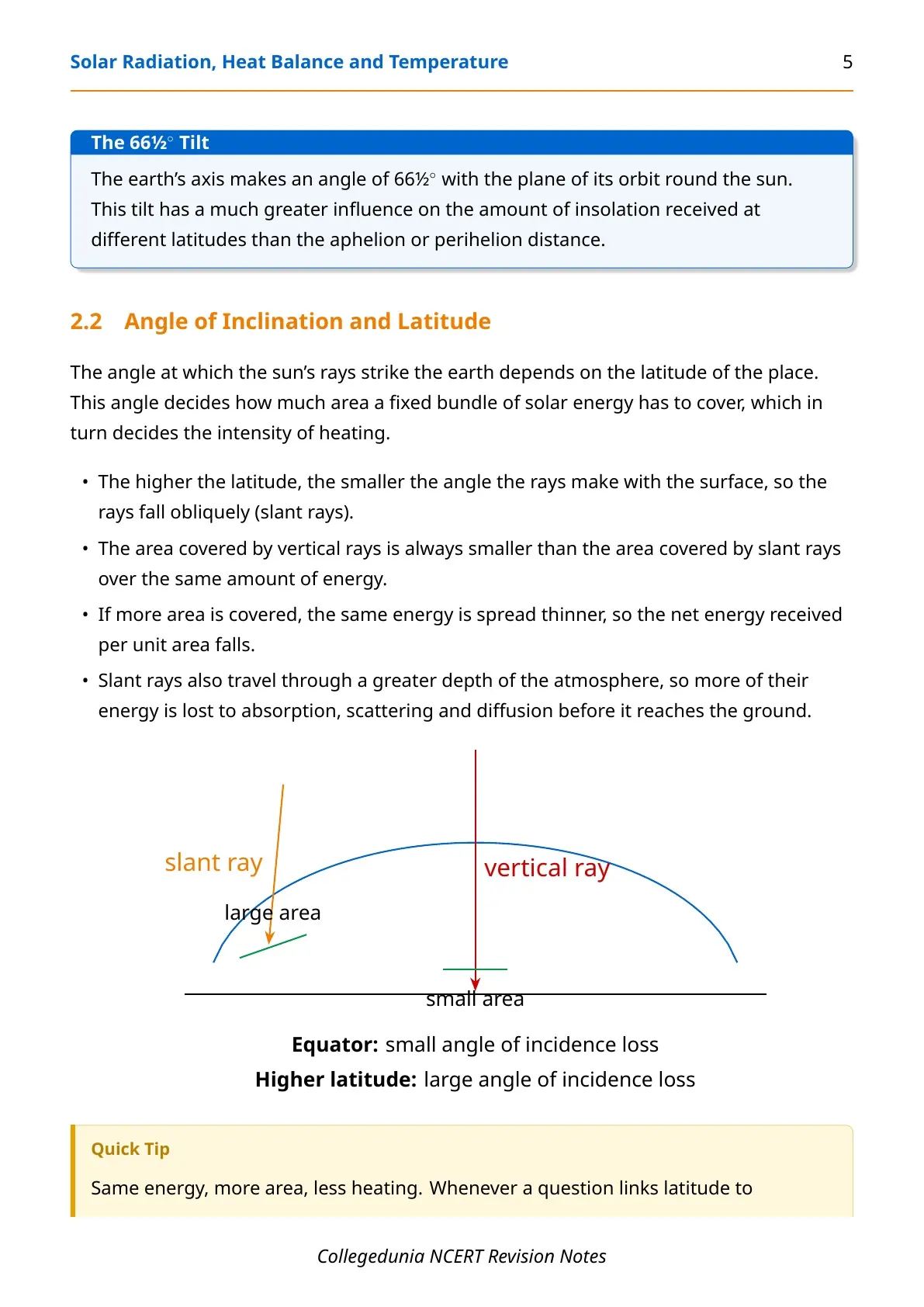
The angle of the sun's rays decides how much surface area a fixed bundle of energy has to cover. Vertical rays cover a smaller area than slant rays, so the same energy is packed tighter and heats the surface more intensely. Slant rays, common at higher latitudes, also pass through a greater depth of atmosphere and lose more energy to absorption and scattering on the way down.
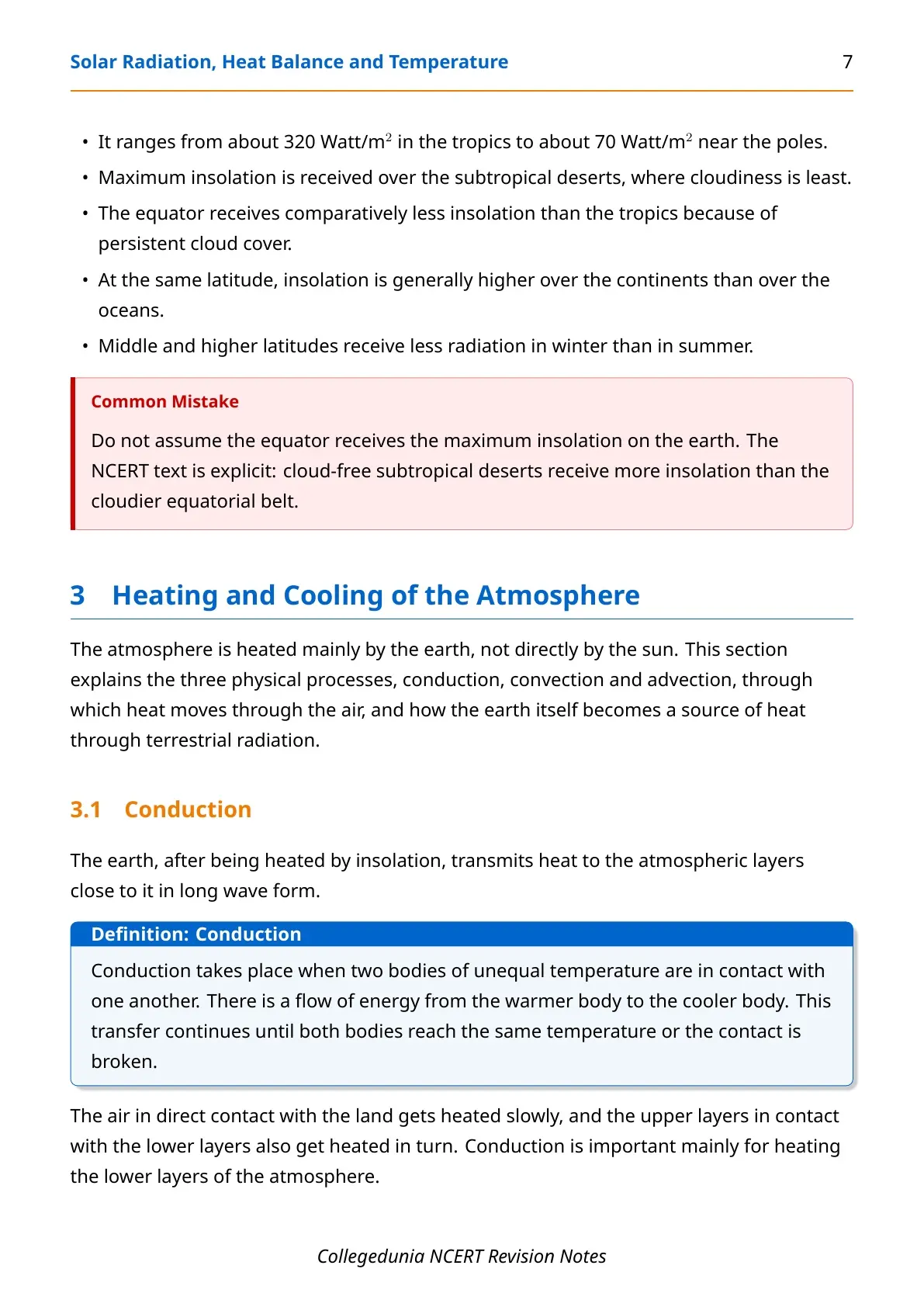
This is also why the insolation actually reaching the surface ranges from about 320 Watt/m² in the tropics to about 70 Watt/m² near the poles, with the cloud-free subtropical deserts, not the cloudier equator, receiving the maximum.
How the Atmosphere Heats and Cools: Conduction, Convection and Advection
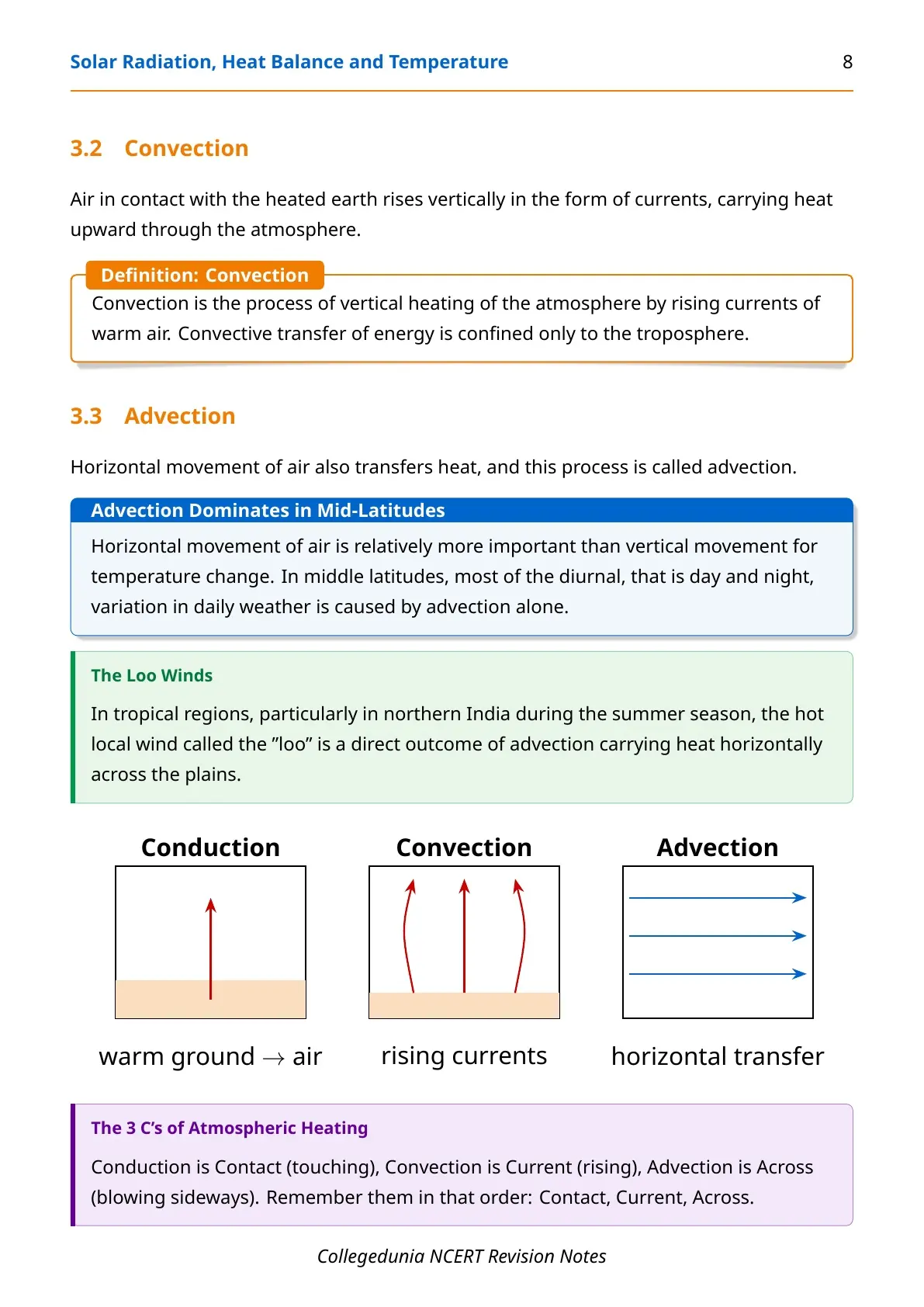
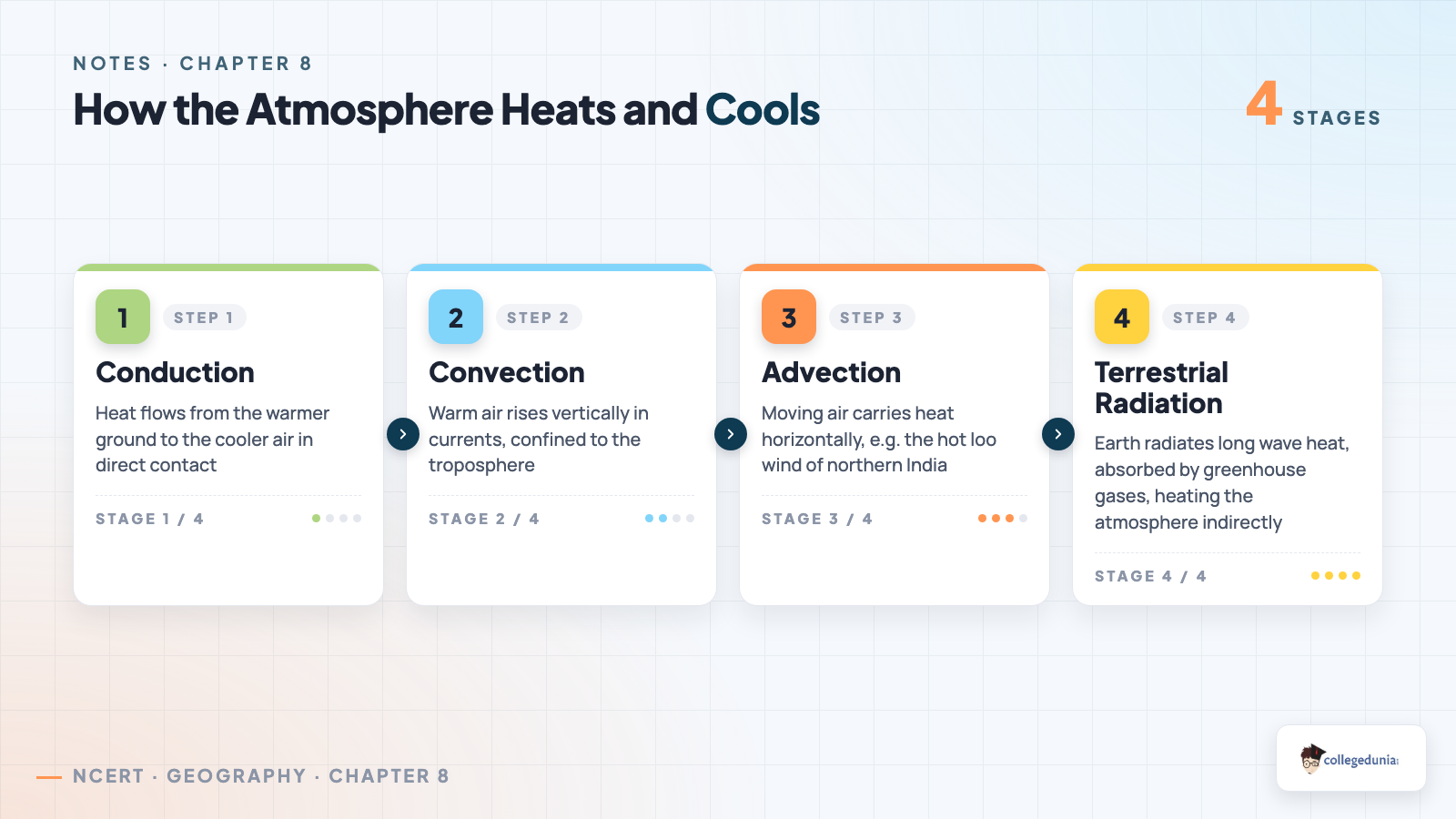
The atmosphere is not warmed directly by the sun. It is heated mainly from below, by the earth itself, through three physical processes.
| Process | Direction | What It Does |
|---|---|---|
| Conduction | Contact | Heat flows from the warmer ground to the cooler air touching it. |
| Convection | Vertical | Warm air rises in currents, confined only to the troposphere. |
| Advection | Horizontal | Moving air carries heat sideways; the main cause of day-to-day weather change in mid-latitudes. |
The hot, dry "loo" wind of northern India in summer is a textbook example of advection at work, carrying heat horizontally across the plains rather than up from the ground beneath it.
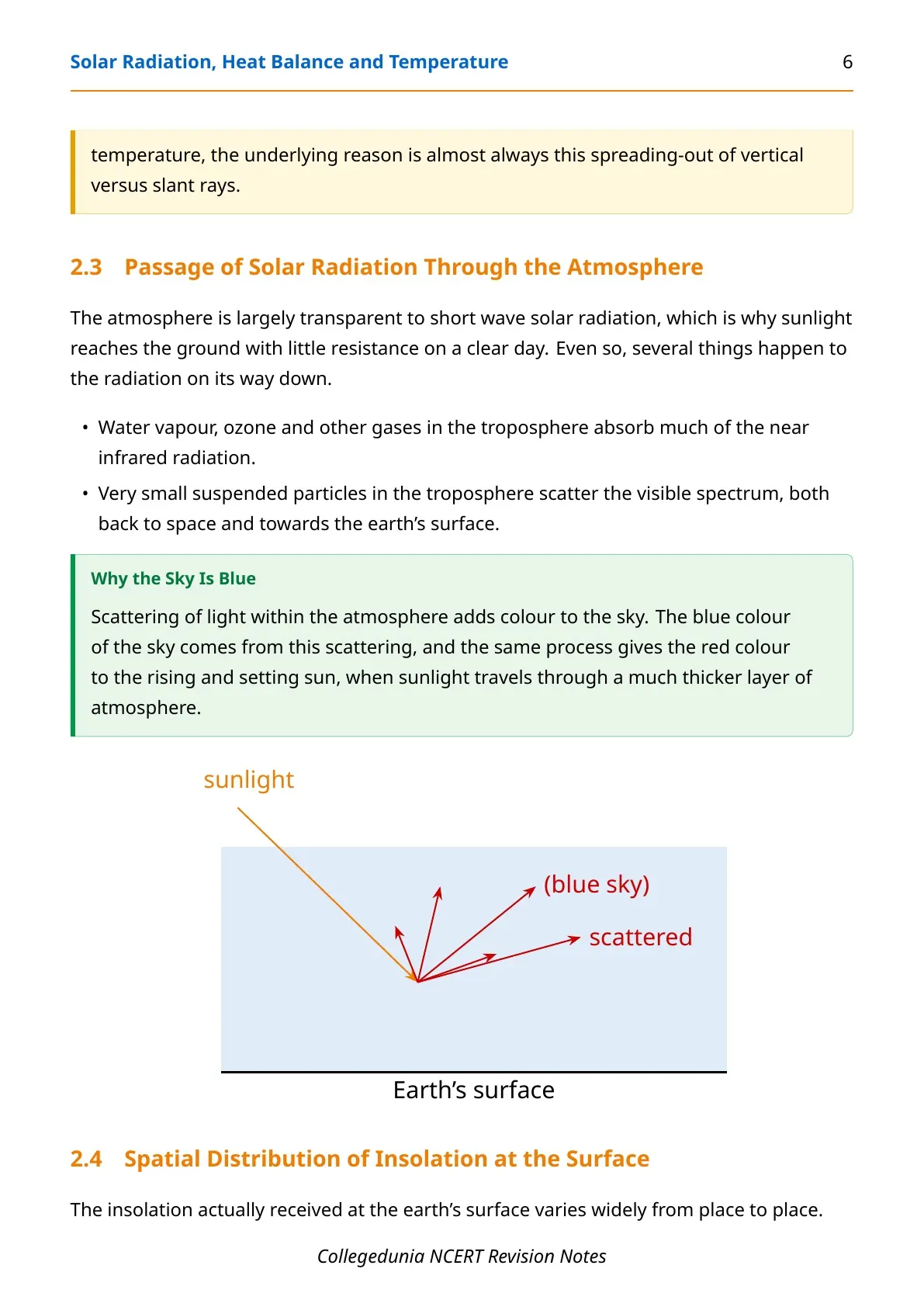
Once the earth has absorbed insolation, it becomes a radiating body in its own right. It sends long wave terrestrial radiation back into the atmosphere, which is then absorbed mainly by carbon dioxide and other greenhouse gases. The atmosphere is therefore heated indirectly, by the earth, not directly by the sun, a fact examiners test more often than any other line in this section.
The Heat Budget of the Earth: How the 100 Units Balance
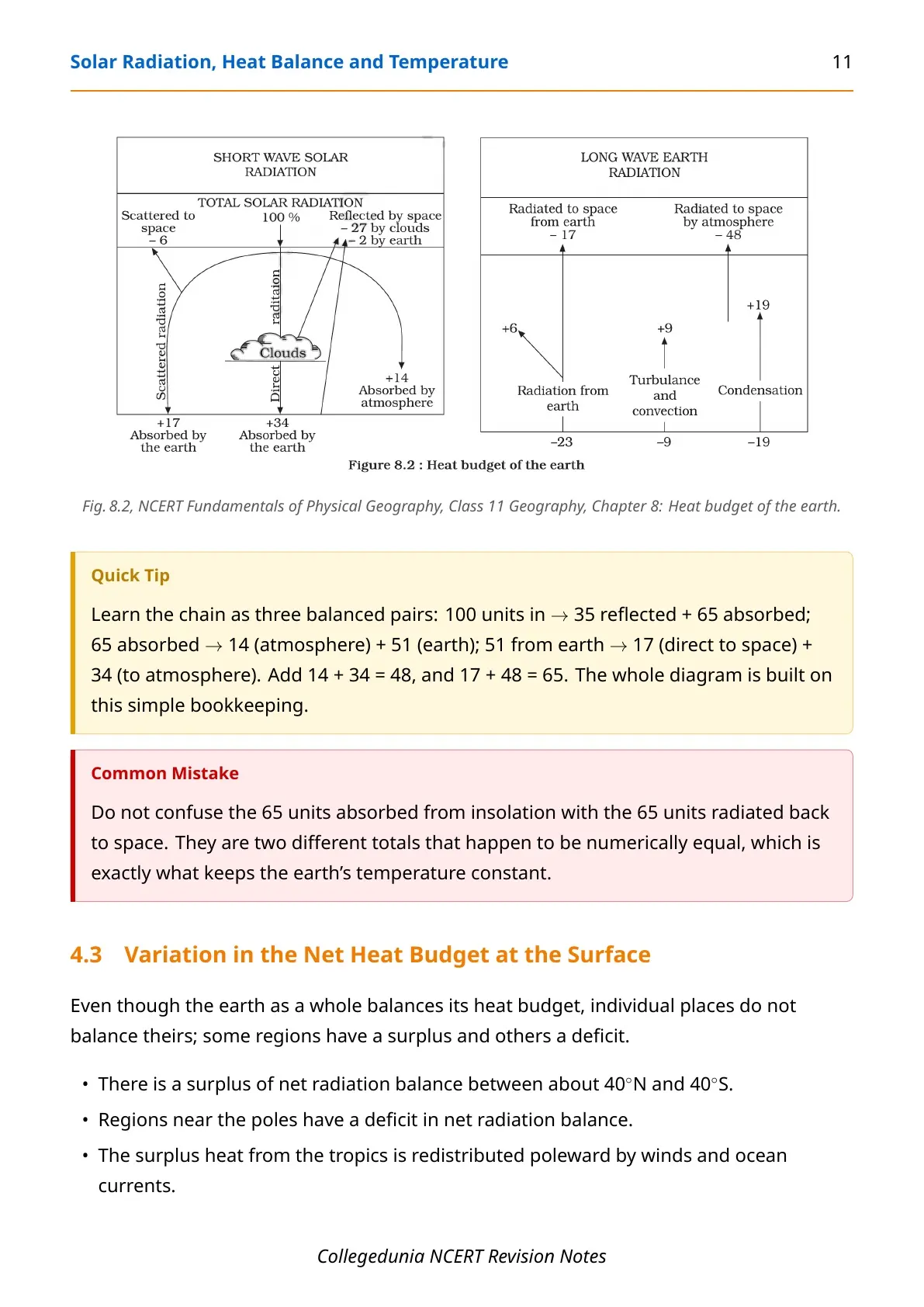
The earth as a whole never keeps warming up or cooling down. NCERT explains this with a simple accounting exercise: treat the insolation reaching the top of the atmosphere as 100 units, and track where every one of those units ends up.
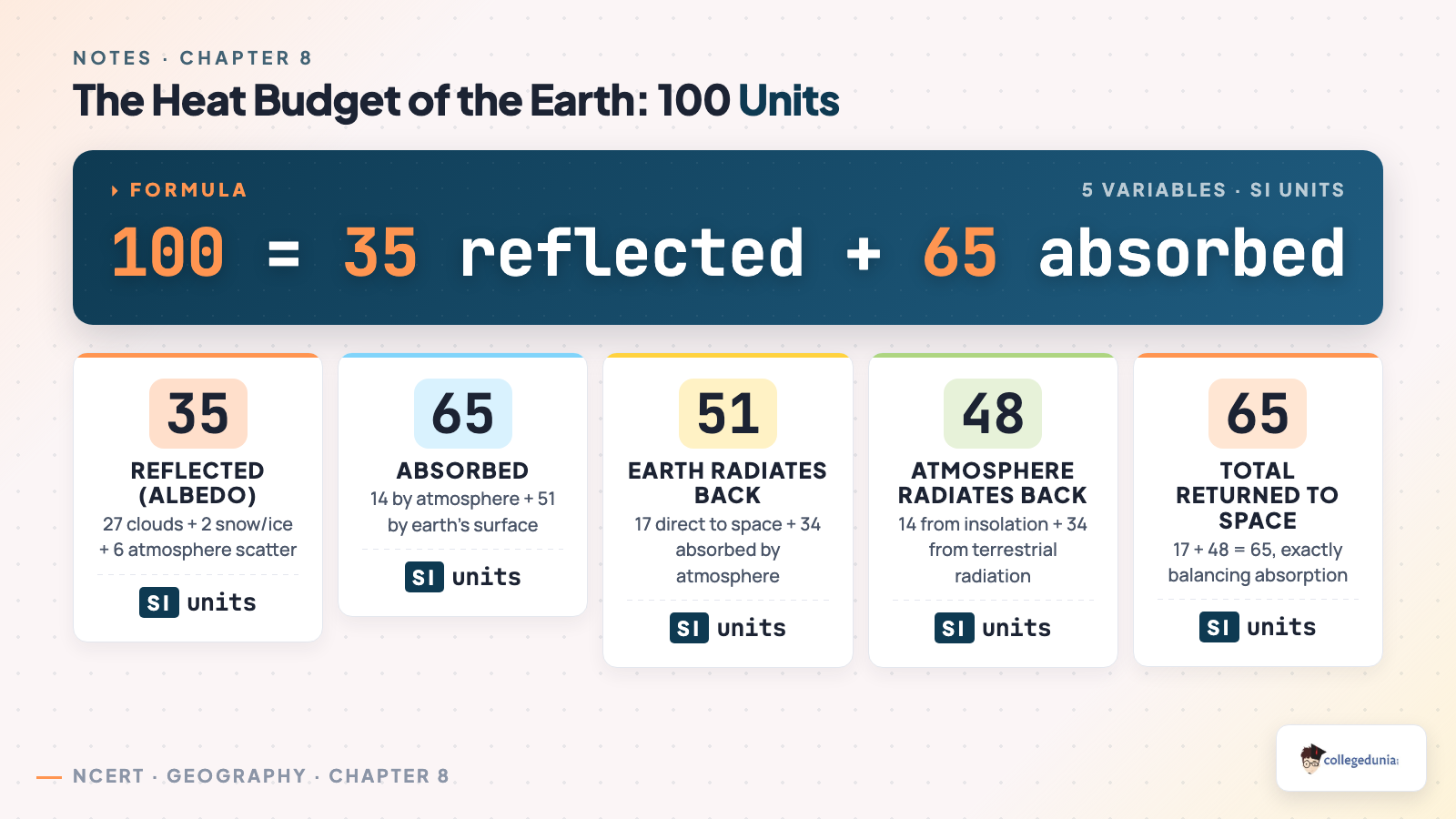
| Stage | Units | Breakdown |
|---|---|---|
| Reflected (albedo) | 35 | 27 from cloud tops, 2 from snow and ice, 6 scattered by the atmosphere. |
| Absorbed | 65 | 14 within the atmosphere, 51 by the earth's surface. |
| Earth radiates back | 51 | 17 straight to space, 34 absorbed by the atmosphere. |
| Atmosphere absorbs (of the 34) | 34 | 6 direct, 9 through convection and turbulence, 19 through latent heat of condensation. |
| Atmosphere radiates back | 48 | 14 (from insolation) + 34 (from terrestrial radiation). |
| Total returned to space | 17 + 48 = 65 | Exactly balances the 65 units originally absorbed. |
This 65-in, 65-out balance is the heat budget of the earth, and it is the reason the planet's overall temperature stays steady despite the huge transfer of heat happening every single day. Questions on this chapter often ask students to reproduce this table or to explain why 65 balances 65, so learning the chain of numbers, not just the final figure, pays off in the exam.
The chapter also notes that this balance is not equal everywhere. There is a surplus of net radiation between about 40°N and 40°S, and a deficit near the poles. Winds and ocean currents constantly move this surplus heat poleward, which is exactly why the tropics do not overheat and the poles do not freeze solid.
Temperature and the Factors That Control Its Distribution
Heat is the molecular movement of particles in a substance; temperature is simply the measurement in degrees of how hot or cold something is. NCERT names five factors that decide how temperature varies from place to place.
- Latitude: temperature falls as insolation falls, moving from the equator toward the poles.
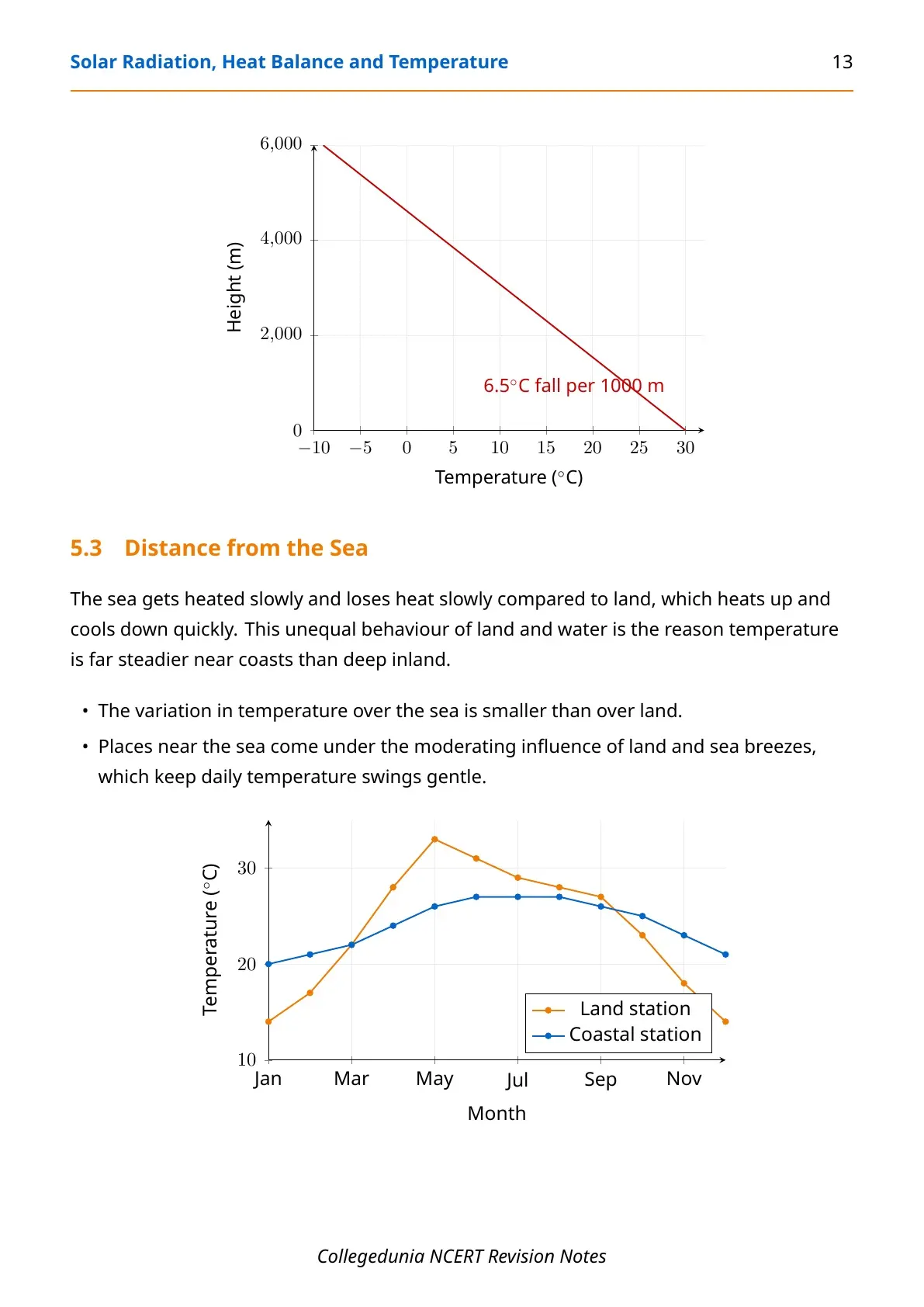
- Altitude: temperature falls with height, following the normal lapse rate of 6.5°C per 1,000 m.
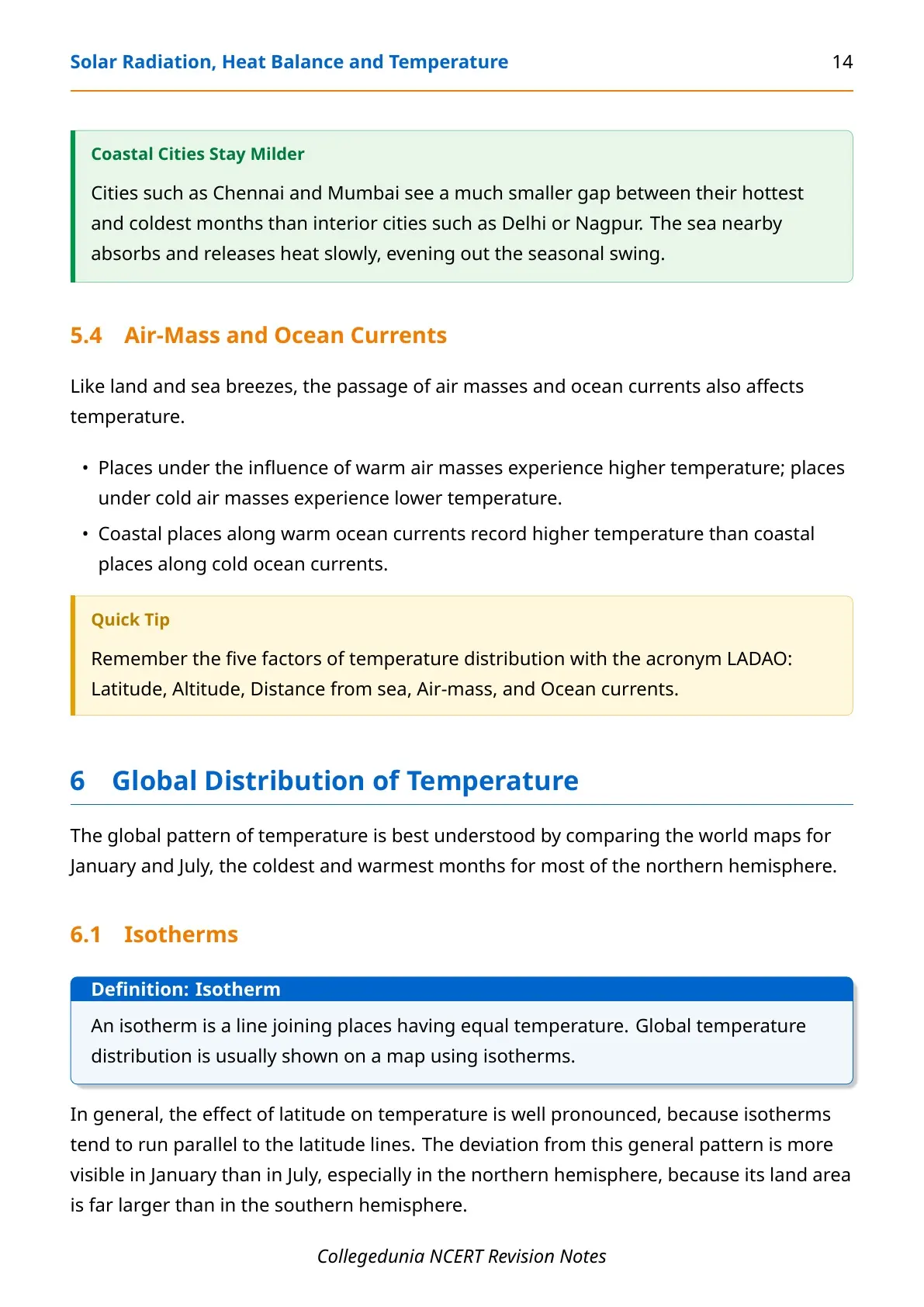
- Distance from the sea: the sea heats and cools slowly, so coastal places have milder, steadier temperatures than places deep inland.
- Air-mass movement: warm air masses raise temperature, cold air masses lower it.
- Ocean currents: coasts along warm currents run warmer than coasts along cold currents at the same latitude.
The altitude factor is heavily tested because the atmosphere is heated indirectly, from below, by terrestrial radiation. Places near sea level sit closer to this heat source, which is why mountain peaks stay cold even under a bright tropical sun.
How Temperature Is Distributed Across the Globe
Global temperature is shown on maps using isotherms, lines joining places of equal temperature. NCERT compares the world pattern in January and July, the coldest and warmest months for most of the northern hemisphere.
| Month | Pattern | Key Example |
|---|---|---|
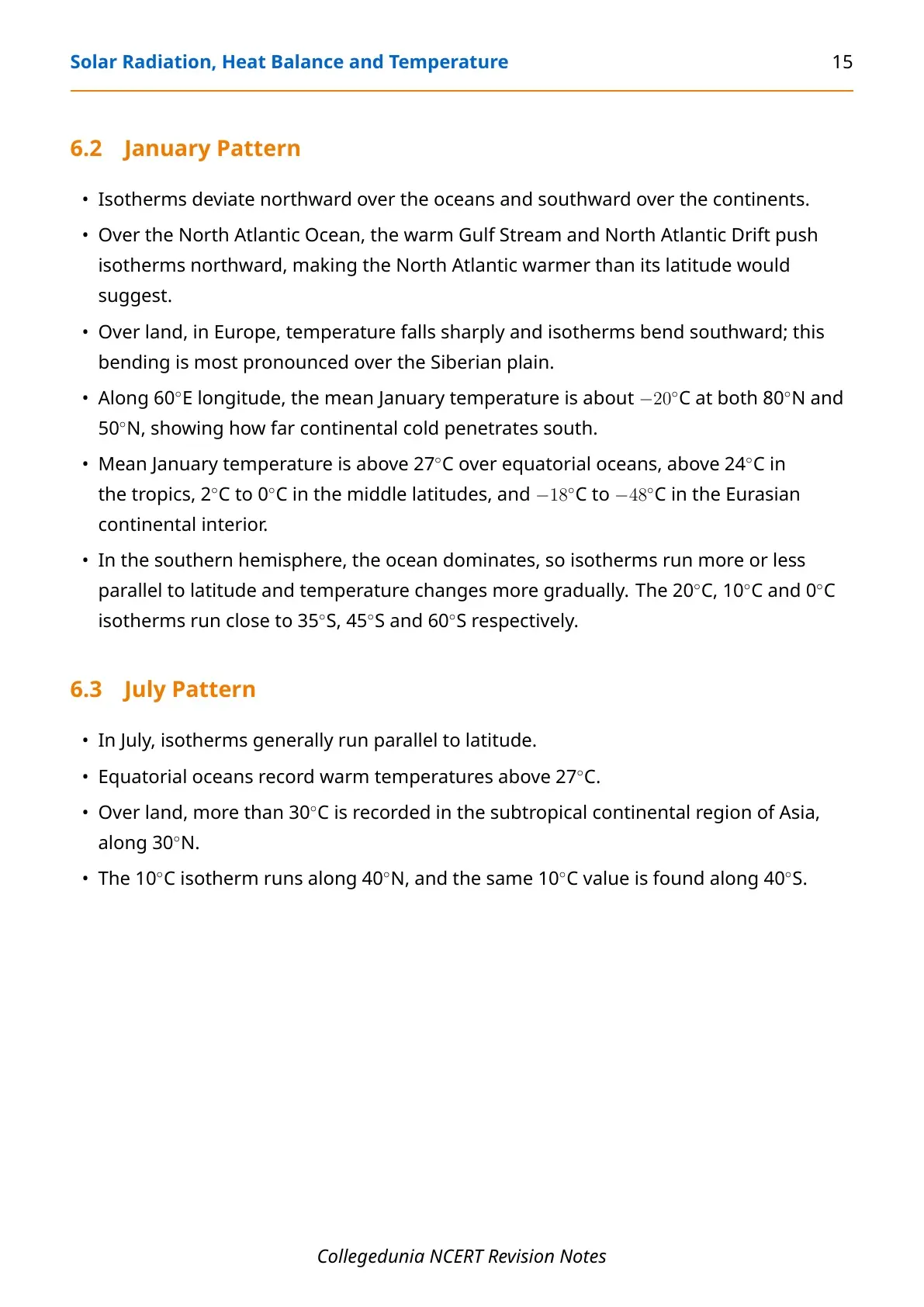
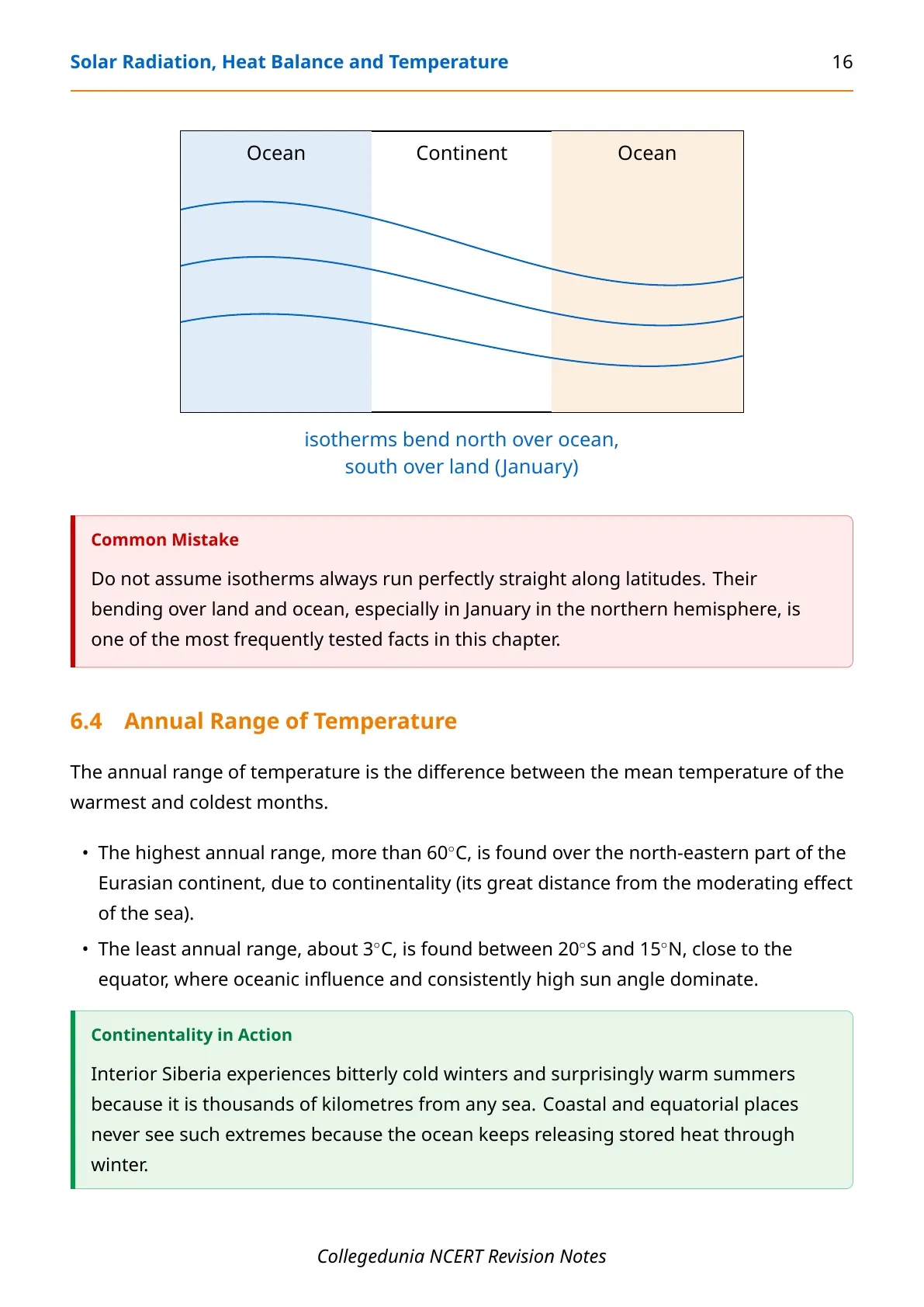
| January | Isotherms bend north over oceans, south over continents. | Along 60°E, the mean temperature is about -20°C at both 80°N and 50°N over the Siberian plain. |
| July | Isotherms run roughly parallel to latitude everywhere. | The 10°C isotherm runs along both 40°N and 40°S. |
The bending is most visible in the northern hemisphere in January because its land area is far larger than the southern hemisphere's. The Gulf Stream and North Atlantic Drift push the North Atlantic's isotherms northward, keeping it warmer than its latitude would otherwise suggest. In the southern hemisphere, where ocean dominates, isotherms run more evenly parallel to latitude all year.
The annual range of temperature, the gap between the warmest and coldest month's mean, tells the same story from another angle. It is more than 60°C over north-eastern Eurasia, far from any moderating sea, and only about 3°C near the equator, between 20°S and 15°N, where the ocean and a steady sun angle keep temperature almost flat all year.
Inversion of Temperature: When the Normal Lapse Rate Reverses
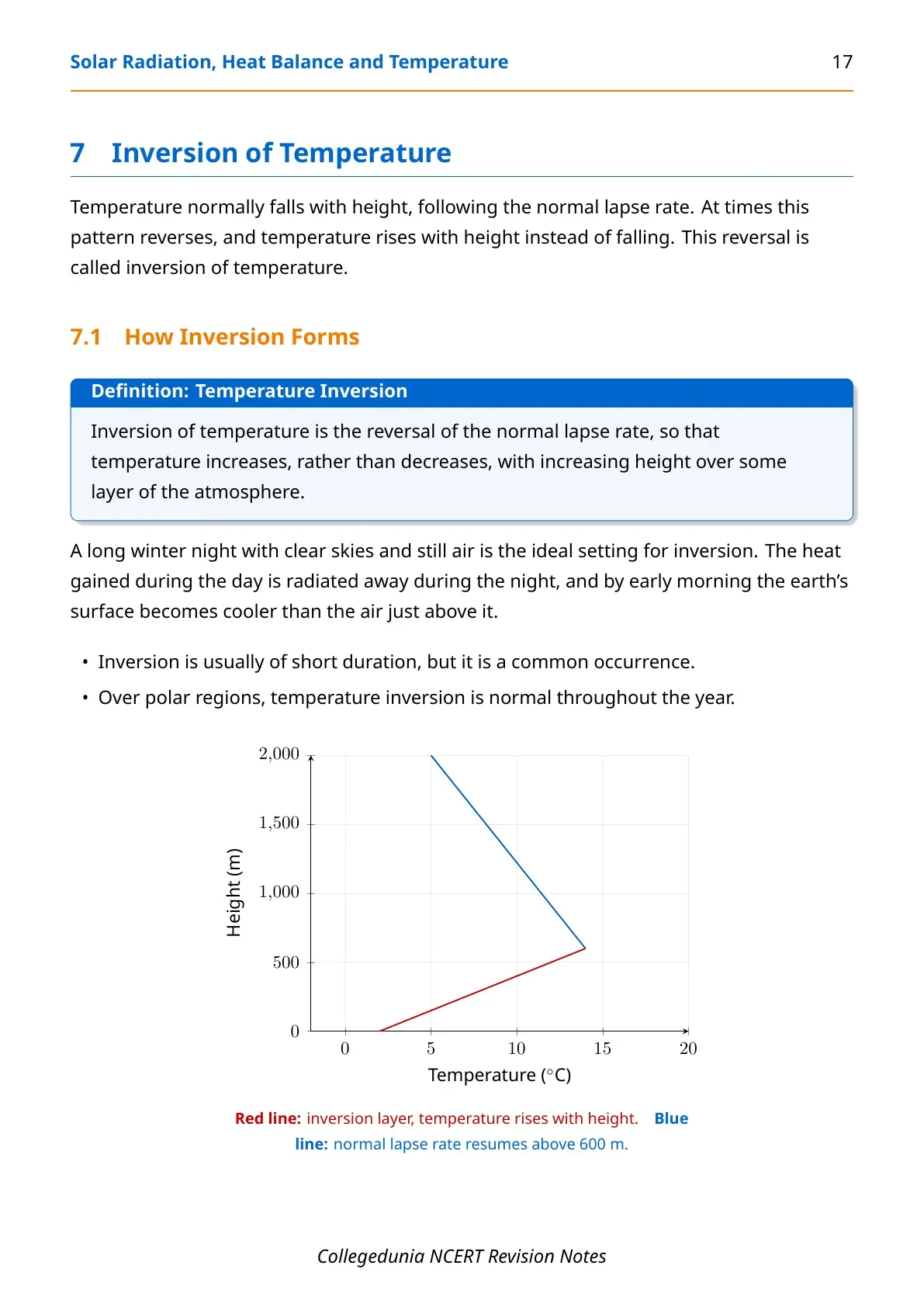
Temperature normally falls as height increases. When this pattern reverses and temperature rises with height instead, the result is called inversion of temperature.
- Ideal conditions: a long winter night, clear skies and still air let the ground lose heat fast and become cooler than the air above it.
- Surface inversion: traps smoke, dust and fog close to the ground, producing dense winter morning fog that clears within hours once the sun rises.
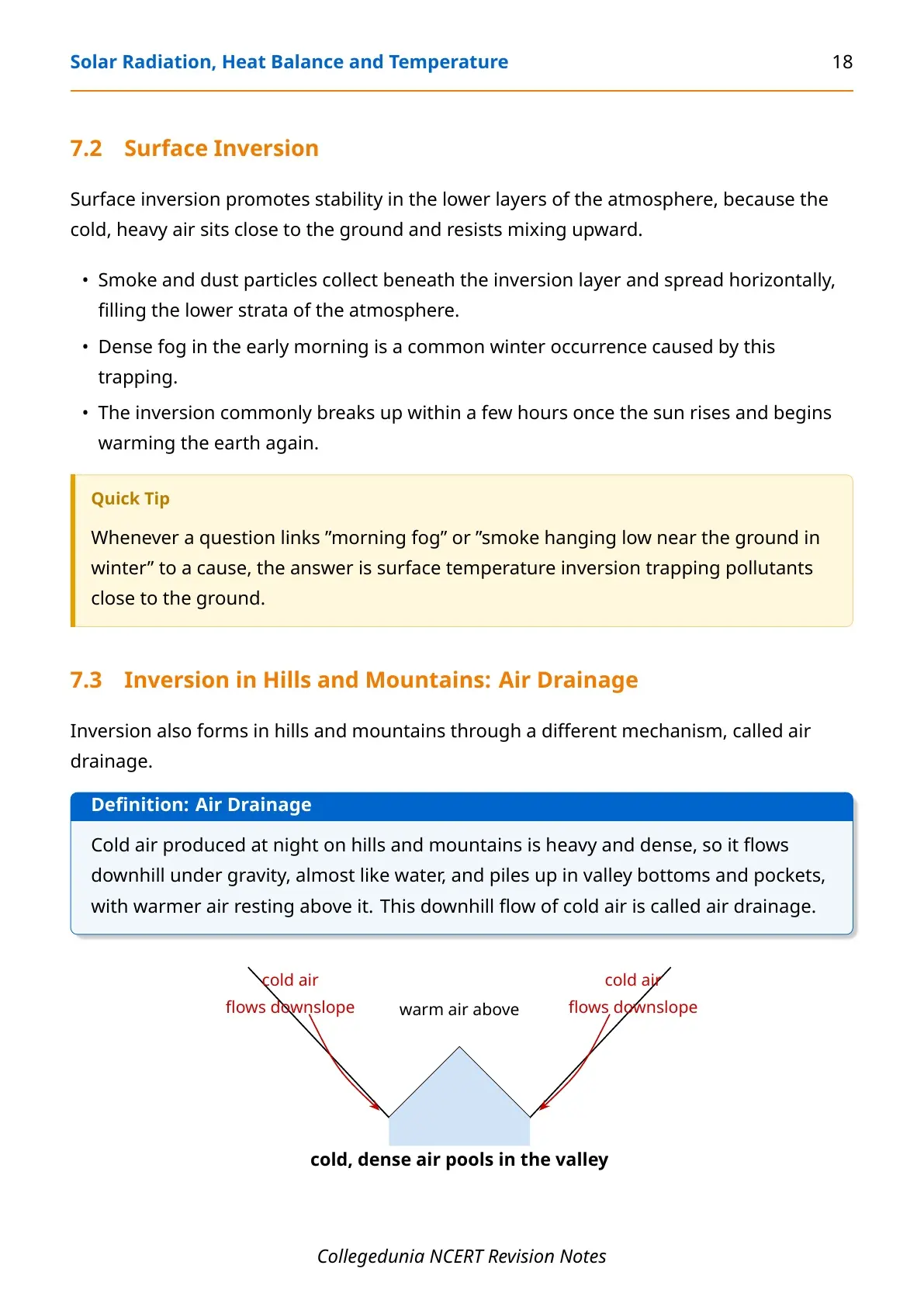
- Air drainage: in hills and mountains, cold night air flows downhill like water and pools in valley bottoms, leaving warmer air above.
- Polar inversion: over the poles, temperature inversion is normal throughout the year, not just at night.
Air drainage also has a practical use: fruit growers on hill slopes rely on it to carry the coldest air away from their orchards, which is why hill-slope plantations suffer less frost damage than crops planted low down in a valley.
NCERT also adds two related facts worth remembering. Planck's law states that the hotter a body is, the more energy it radiates and the shorter that radiation's wavelength, which is why the very hot sun radiates short waves while the cooler earth radiates long waves. Specific heat is the energy needed to raise one gram of a substance by one degree Celsius, and it is exactly why water, with its high specific heat, warms and cools far more slowly than land.
NCERT Textbook Exercises for Solar Radiation, Heat Balance and Temperature
The NCERT chapter closes with three question types. Practising the pattern matters as much as knowing the facts, since the annual exam copies this exact structure.
| Question Type | What It Tests | Sample Prompt |
|---|---|---|
| Multiple Choice | Solstice dates, heat budget figures, terms like isotherm and albedo | The atmosphere is mainly heated by which type of radiation? |
| Short Answer (about 30 words) | One clear reason or process | What are the factors that control temperature distribution on the earth's surface? |
| Long Answer (about 150 words) | Full explanation with structure or numbers | Discuss the processes through which the earth-atmosphere system maintains heat balance. |
For the heat-budget long answer, examiners reward responses that follow the textbook's own sequence: reflection first, then absorption, then the return journey through terrestrial radiation. Skipping straight to the final 65 = 65 balance without showing the steps is the most common reason marks are cut.
Common Mistakes Students Make in Solar Radiation, Heat Balance and Temperature
- Swapping aphelion and perihelion - aphelion is 4th July (farthest), perihelion is 3rd January (nearest), even though January feels colder in India.
- Assuming the equator gets maximum insolation - cloud-free subtropical deserts actually receive more than the cloudier equatorial belt.
- Mixing up the heat-budget numbers - 35 units are reflected and 65 absorbed, not the other way round; the atmosphere ends up radiating 48 units, not 51.
- Forgetting the atmosphere is heated indirectly - by long wave terrestrial radiation from the earth, not directly by short wave sunlight.
Real-World Uses of Heat Balance and Temperature Concepts
The ideas in this chapter show up well beyond the exam paper, which makes them easier to remember.
- Sea and land breezes: the sea's slow heating and cooling is why coastal cities feel milder than inland ones every single day.
- Morning fog forecasts: weather reports use surface temperature inversion to predict dense winter fog on highways and at airports.
- Orchard planning: hill farmers choose slope positions using air drainage, to keep the coldest night air away from fruit trees.
- Climate of coastal vs continental cities: Mumbai and Chennai stay milder year-round than Delhi or Nagpur for the same reason the sea moderates temperature.
How to Use These Notes Most Effectively
NCERT Notes Class 11 Geography Chapter 8 Solar Radiation, Heat Balance and Temperature rewards learning the heat budget numbers as a chain, not as isolated facts.
- Learn the heat-budget chain first. 100 in, 35 reflected, 65 absorbed, 51 from earth, 17+48=65 back out.
- Draw the isotherm bending pattern from memory. North over ocean, south over land, in January.
- Recite the five temperature factors last, since they connect this chapter to every climate chapter that follows.
Other NCERT Resources for Solar Radiation, Heat Balance and Temperature
This table lists every Collegedunia resource for the NCERT Notes Class 11 Geography Chapter 8 Solar Radiation, Heat Balance and Temperature chapter.
| Resource | Link |
|---|---|
| Notes (this page) | Solar Radiation, Heat Balance and Temperature Class 11 Geography Notes |
| Handwritten Notes | (coming soon) |
| NCERT Solutions | (coming soon) |
| NCERT Book PDF | (coming soon) |
Solar Radiation, Heat Balance and Temperature: Topics Students Often Get Confused About
Three pairs of terms cause most of the confusion in this chapter, because the names sound similar but the ideas are different.
- Aphelion vs perihelion - aphelion is 4th July, farthest from the sun; perihelion is 3rd January, nearest to the sun.
- Convection vs advection - convection moves heat vertically inside the troposphere; advection moves heat horizontally and drives most day-to-day mid-latitude weather change.
- Normal lapse rate vs temperature inversion - the normal lapse rate is temperature falling with height; inversion is the same pattern reversed, temperature rising with height.
NCERT Notes for Class 11 Geography: All Chapters
Use this table to move to any other Class 11 Geography chapter's notes once this chapter is done.
| Chapter | Resource |
|---|---|
| Chapter 1 | Geography as a Discipline Notes (Coming Soon) |
| Chapter 2 | The Origin and Evolution of the Earth Notes (Coming Soon) |
| Chapter 3 | Interior of the Earth Notes (Coming Soon) |
| Chapter 4 | Distribution of Oceans and Continents Notes (Coming Soon) |
| Chapter 5 | Geomorphic Processes Notes (Coming Soon) |
| Chapter 6 | Landforms and their Evolution Notes (Coming Soon) |
| Chapter 7 | Composition and Structure of Atmosphere Notes (Coming Soon) |
| Chapter 8 | Solar Radiation, Heat Balance and Temperature Notes |
| Chapter 9 | Atmospheric Circulation and Weather Systems Notes (Coming Soon) |
| All Chapters | Class 11 Geography, All Chapters (Coming Soon) |
Solar Radiation, Heat Balance and Temperature Class 11 Geography Notes FAQs
Ques. Where can I download the Class 11 Geography Chapter 8 Notes PDF?
Ans. You can download the NCERT Notes Class 11 Geography Chapter 8 Solar Radiation, Heat Balance and Temperature PDF directly from this page, free of cost.
Ques. Are these notes based on the 2026-27 NCERT syllabus?
Ans. Yes. These notes follow the current 2026-27 NCERT textbook for Class 11 Geography, chapter by chapter, in the same order as the printed book.
Ques. How many pages is the Class 11 Geography Chapter 8 Notes PDF?
Ans. The Notes PDF runs about 22 pages and covers insolation, the heating and cooling of the atmosphere, the heat budget of the earth, temperature distribution, and temperature inversion.
Ques. What is insolation?
Ans. Insolation is the incoming solar radiation received by the earth, mostly in short wavelengths. The earth receives about 1.94 calories per sq cm per minute at the top of its atmosphere, a value called the solar constant.
Ques. What is the heat budget of the earth?
Ans. The heat budget is the balance between the heat the earth receives from the sun and the heat it loses back to space. Of every 100 units of insolation, 35 are reflected and 65 are absorbed, and the earth-atmosphere system eventually radiates back exactly 65 units, keeping the planet's temperature steady.
Ques. What are the factors that control temperature distribution?
Ans. Five factors control temperature distribution: latitude, altitude, distance from the sea, air-mass movement, and ocean currents. Latitude and altitude are usually the two most heavily tested in Class 11 exams.
Ques. What is temperature inversion?
Ans. Temperature inversion is a reversal of the normal lapse rate, where temperature rises with height instead of falling. It commonly forms on long, clear winter nights with still air and is normal throughout the year over the poles.
Ques. What are isotherms?
Ans. Isotherms are lines on a map joining places that record equal temperature. NCERT uses January and July world isotherm maps to explain how latitude, land and ocean together shape global temperature patterns.



Comments