



NCERT Class 11 Home Science Chapter 4 Management of Resources Notes help students revise resource meaning, human and non-human resources, characteristics of resources and the management process for the 2026-27 syllabus.
- Covers the NCERT ideas of resources, utility, accessibility, planning, organising, controlling and evaluation.
- Useful for short answers, long answers and example-based questions on family and community resource use.
- Includes tables, process cues and quick revision points for school exam preparation.







Student Feedback: In a Collegedunia check-in with 10,840 Class 11 Home Science students preparing for 2026-27 exams, 64% said they could list resources but found it harder to connect resources with the management process.
Source: 2026-27 Class 11 Home Science student poll from CBSE school students using Collegedunia revision resources.
These Class 11 Home Science Chapter 4 notes are mapped to the NCERT chapter and organised for quick 2026-27 revision.
What Management of Resources Covers in Class 11 Home Science
Chapter 4 explains how individuals and families use available resources to reach goals. A resource is anything that helps a person satisfy a need or complete a task. Money, time, energy, knowledge, skills, materials, space and community facilities all become useful only when they are recognised, accessed and managed well.
The chapter is important because it connects Home Science with daily decision-making. Students should write answers with one everyday example, such as planning study time, using money for household needs, sharing work at home or conserving water and fuel.
- Goal: the result a person or family wants to achieve.
- Resource: a means used to achieve that goal.
- Management: planned use of resources to reduce waste and improve results.
Management of Resources Process Explained for Class 11
Source: Achieve it on YouTube
Types of Resources in Management of Resources

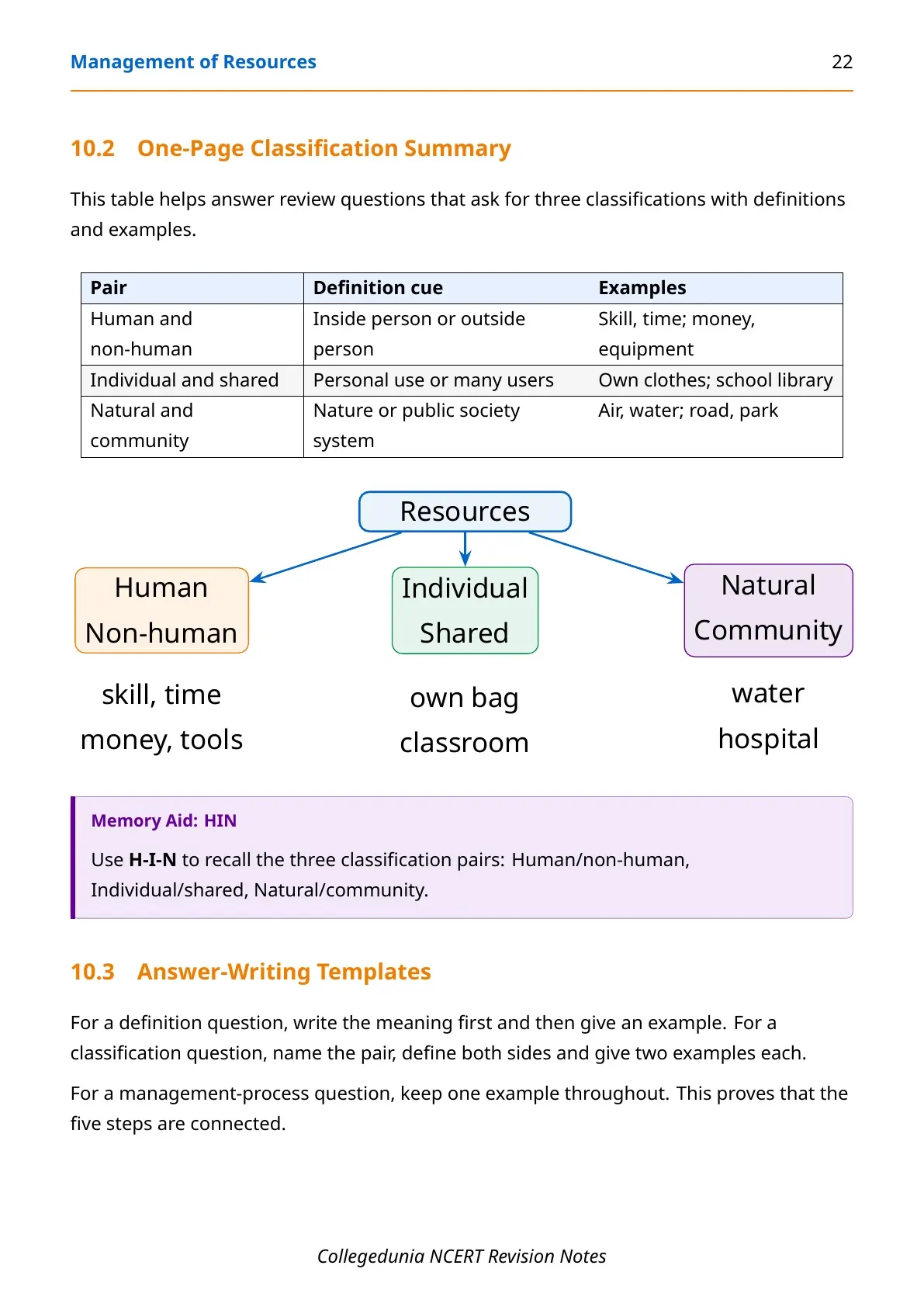
NCERT groups resources broadly into human and non-human resources. Human resources belong to the person and can improve with practice. Non-human resources are outside the person and need careful use, sharing and conservation.
| Resource type | Meaning | Examples |
|---|---|---|
| Human resources | Personal qualities and abilities used to achieve goals. | Knowledge, skill, aptitude, time, energy. |
| Non-human resources | Material or community resources available outside the person. | Money, tools, house, school, transport, water, fuel. |
| Community resources | Shared facilities available to many people. | Libraries, parks, hospitals, markets, public transport. |
Quick recall: human resources grow through learning and effort, while non-human resources must be selected, shared and conserved.
Characteristics of Resources Every Student Should Know
Resources have certain characteristics that decide how useful they are. A resource must have utility, which means it should help in achieving a goal. It must also be accessible, manageable and suitable for the situation. The same object may be a resource in one situation and not useful in another.
| Characteristic | What it means | Answer cue |
|---|---|---|
| Utility | The resource helps to meet a need or goal. | State how it is useful. |
| Accessibility | The person can actually obtain or use it. | Mention availability, time or cost. |
| Interchangeability | One resource can sometimes replace another. | Example: skill may reduce money spent. |
| Manageability | Resources need planning and control. | Link it with wise use and conservation. |
Management Process in Management of Resources

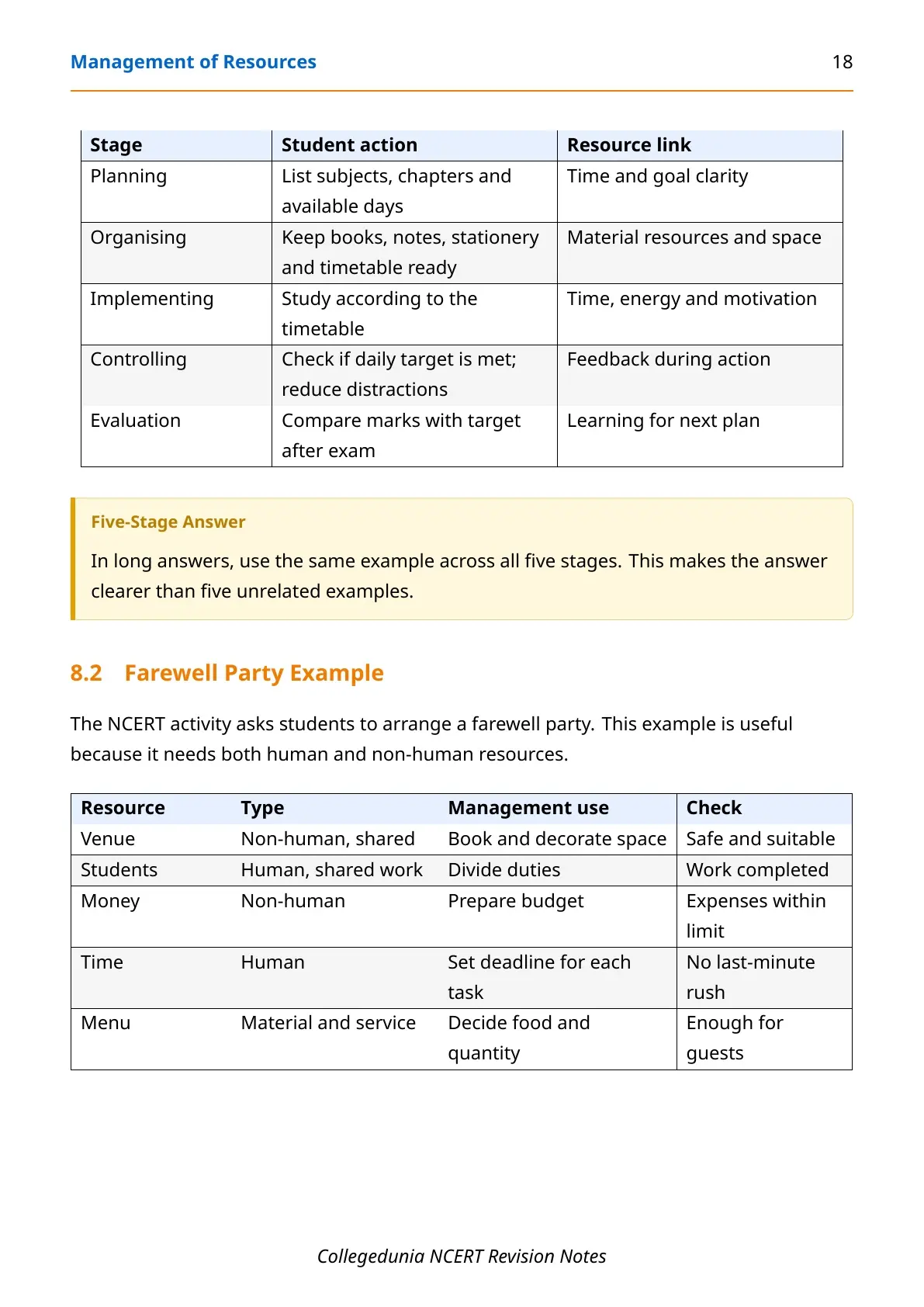
The management process is a cycle. It begins with planning and ends with evaluation, but the learning from evaluation improves the next plan. Students should remember that management is not only spending money carefully. It also includes arranging time, energy, skill and materials in a planned way.
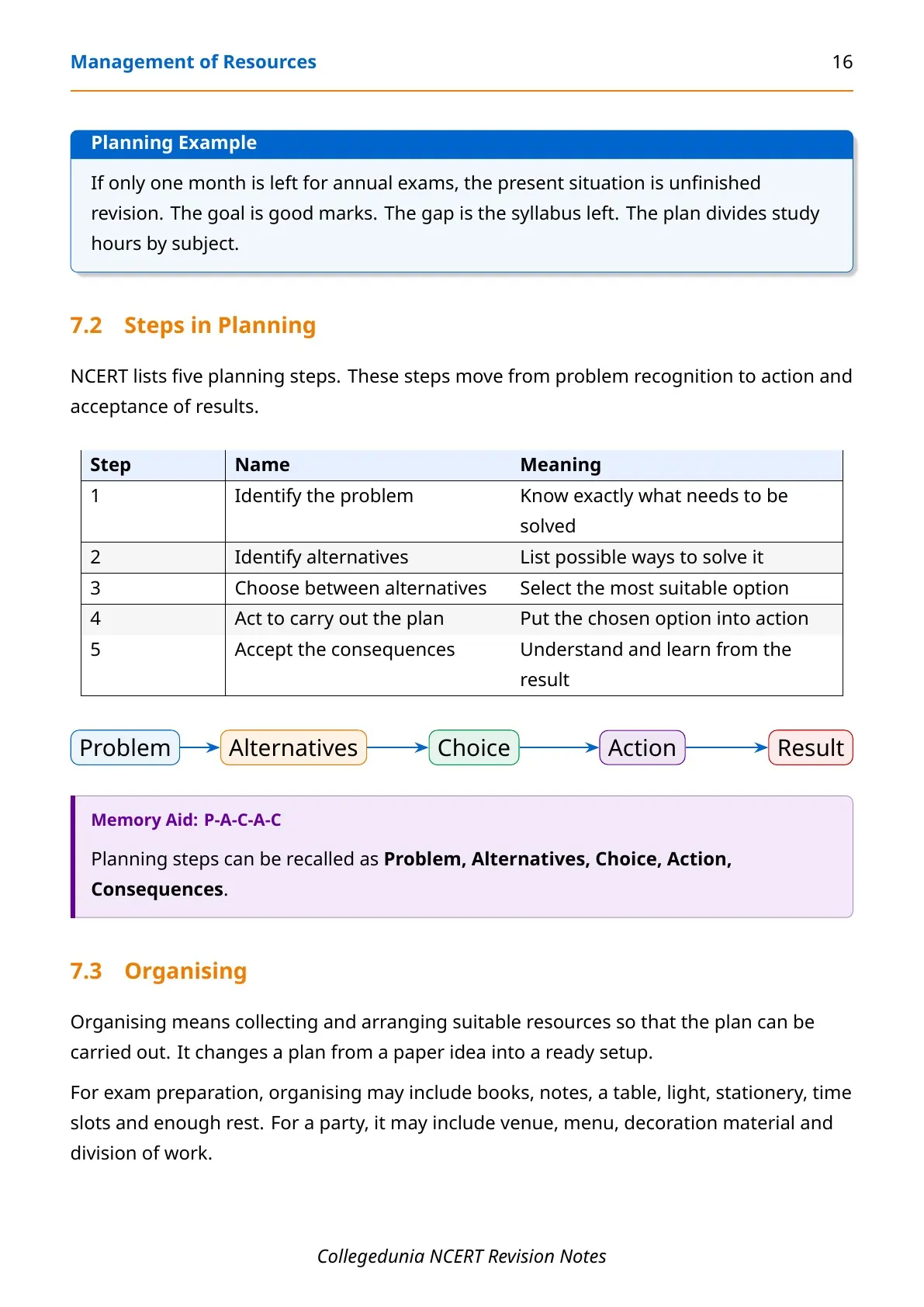
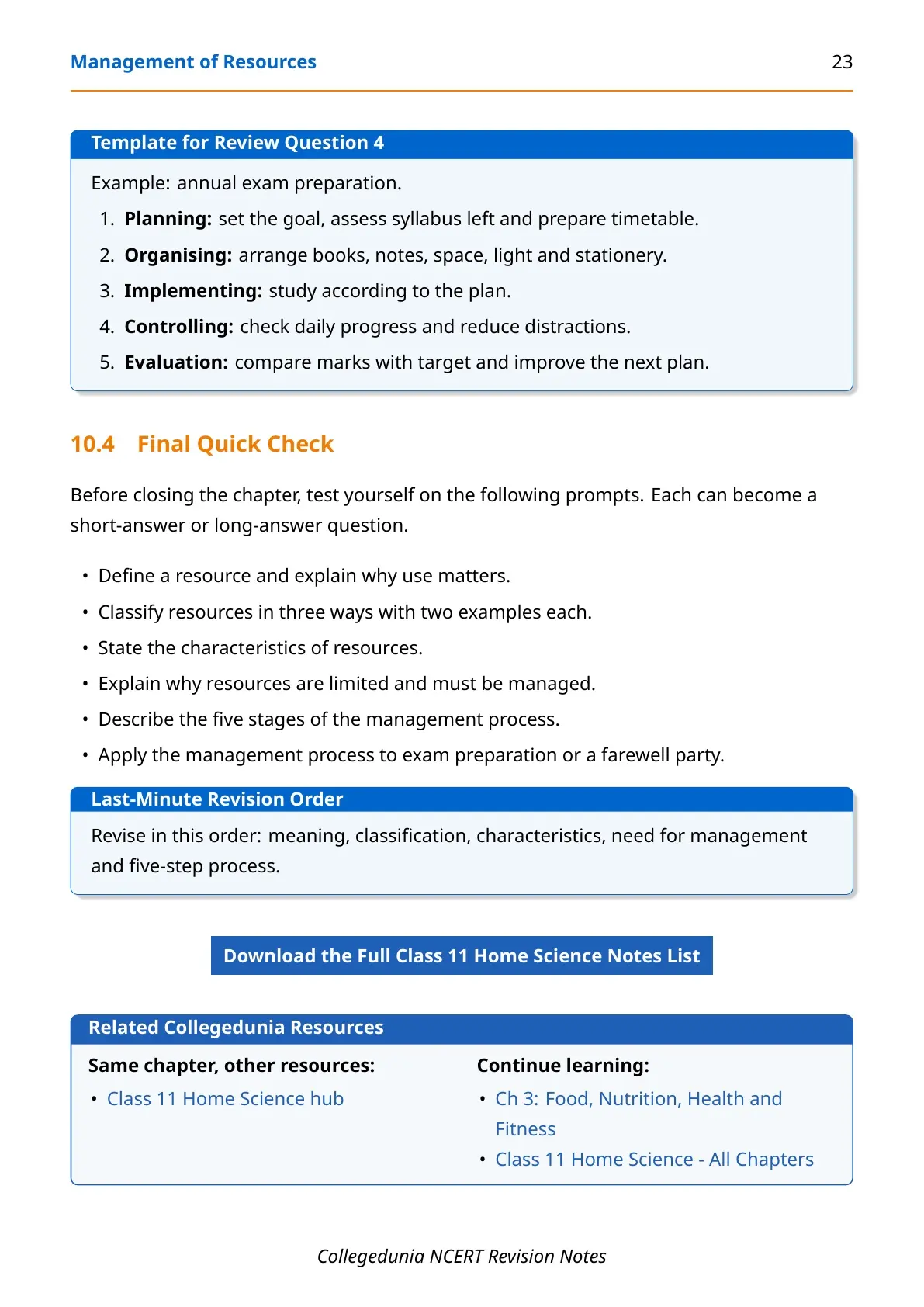
- Planning: decide the goal, list available resources and choose the best method.
- Organising: arrange resources and divide work according to ability and time.
- Implementing: carry out the plan with discipline and coordination.
- Controlling: check progress, adjust mistakes and prevent waste.
- Evaluating: compare the result with the goal and learn for future planning.
How to Write Management of Resources Answers in Exams
Good answers in this chapter are usually example-based. Start with the definition, add two important points and then show how the idea works in daily life. For example, when explaining time as a resource, mention that it is limited, cannot be stored and must be planned through routines or schedules.
| Question angle | What to include | Common mistake |
|---|---|---|
| Meaning of resources | Need, goal and usefulness. | Listing only money and materials. |
| Human resources | Knowledge, skill, time, energy and aptitude. | Forgetting time and energy. |
| Non-human resources | Money, goods, services and community facilities. | Ignoring community resources. |
| Management process | All five steps with one example. | Writing only planning and implementation. |
| Conservation | Wise use, reuse, repair and avoiding waste. | Writing conservation only for forests. |
More Resources for Class 11 Home Science Chapter 4
| Resource | Use it for | Link |
|---|---|---|
| Handwritten Notes | Quick visual revision after reading these typed notes. | Open handwritten notes |
| Official NCERT Book PDF | Read the source chapter in NCERT language. | Open NCERT chapter PDF |
NCERT Notes for All Class 11 Home Science Chapters
| Chapter | Topic | Notes link |
|---|---|---|
| Chapter 1 | Introduction: Evolution of the Discipline and its Relevance to Quality of Life | Read notes |
| Chapter 3 | Food, Nutrition, Health and Fitness | Read notes |
| Chapter 4 | Management of Resources | Read notes |
Class 11 Home Science Chapter 4 Notes FAQs
Ques. What is the main idea of Management of Resources in Class 11 Home Science?
Ans. The chapter explains how people use human and non-human resources in a planned way to achieve family and personal goals.
Ques. What are human resources?
Ans. Human resources are personal abilities such as knowledge, skill, time, energy, interest and aptitude that help a person complete tasks.
Ques. What are non-human resources?
Ans. Non-human resources are material and community resources such as money, tools, house, water, fuel, schools, hospitals and transport.
Ques. What are the steps in the management process?
Ans. The management process includes planning, organising, implementing, controlling and evaluating the use of resources.
Ques. How should students revise this chapter?
Ans. Revise definitions with examples, compare resource types, learn the five process steps and practise answers that connect resources with daily life.



Comments