



Class 11 Home Science Chapter 6 Media and Communication Technology notes help students revise communication meaning, media types and ICT tools from the 2026-27 NCERT syllabus. The chapter connects daily conversation with radio, television, e-mail, teleconferencing and other technologies used to share information across distance.








Student Feedback: More than 10,000 students use Collegedunia NCERT notes for compact chapter revision. Students usually find this chapter easier after the communication process, media categories and ICT examples are revised together.
- Best for quick revision: one place for meaning, process, media types, radio, television and modern communication tools.
- Aligned to 2026-27: follows the current Class 11 Home Science NCERT chapter scope.
- Exam-ready focus: includes answer tables, comparison points and short revision cues.
What Media and Communication Technology Covers in Class 11 Home Science
Media and Communication Technology explains how people create common meaning and how messages move from one person or group to another. In Home Science, this topic matters because family life, health awareness, consumer education, childcare support and community work all depend on clear communication. NCERT begins with the meaning of communication, then moves to classification, process, media and modern technology.
The chapter is not only about machines. It first asks students to understand everyday communication: speaking, listening, gestures, signs, symbols, feedback and shared meaning. Then it shows how traditional and modern media carry messages to a large scattered group. For answers, always connect the tool with the purpose of the message and the receiver group.
| Area | What to revise | Exam use |
|---|---|---|
| Communication | Meaning, nature and need | Definitions and short answers |
| Classification | Intra-personal, inter-personal, group and mass communication | Difference tables and examples |
| Process | Source, message, channel, receiver and effect or feedback | Flowchart-based answers |
| Media | Traditional and modern media | Functions and examples |
| Technology | Radio, television, Bluetooth, e-mail and conferencing | Long answers on changing communication |
Communication Meaning Nature and Need
Communication means sharing ideas, facts, emotions or experiences through a medium so that the intended meaning becomes common to the sender and receiver. NCERT links the word to the Latin root communis, which means common. This root is useful in answer writing because it reminds students that sending information alone is not enough. The message must be understood.
Good communication improves quality of life. A health worker explaining nutrition, a parent guiding a child, a teacher giving instructions and a consumer reading product information all depend on clear communication. It can be verbal, non-verbal, written, visual or audio-visual. It can also be one-way or two-way, depending on whether feedback is available.
- Purposeful: every message has an aim, such as informing, warning, teaching or persuading.
- Meaning-based: communication is complete only when meaning is shared.
- Context-linked: language, culture, setting, age and relationship change how a message is understood.
Media and Communication Technology Chapter Video
Source: Achieve it on YouTube
Communication Process and Feedback

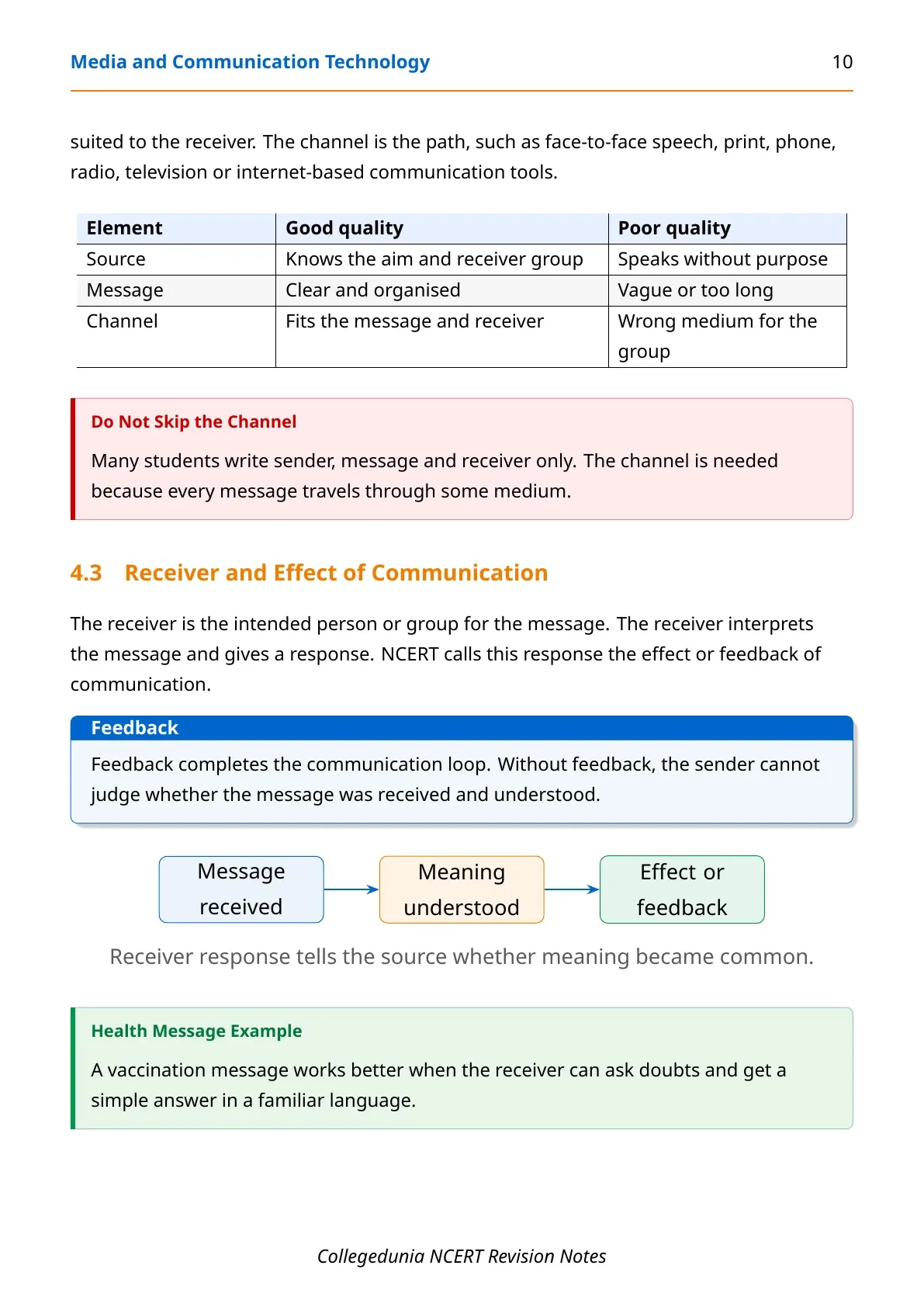
The communication process is usually written as a chain. The source starts communication, prepares a message, chooses a channel and sends it to the receiver. The receiver interprets the message and responds. The effect of communication is seen through feedback or receiver response.
For NCERT answers, remember the SMCRE sequence: source, message, channel, receiver and effect. A vaccination message, for example, works better when the receiver group can understand the words, connect the message with daily life and respond with questions.
| Element | Role in the process | Common error |
|---|---|---|
| Sender | Starts the message with a purpose | No clear aim |
| Message | Contains facts, feeling or instruction | Too vague or too long |
| Channel | Carries the message | Wrong medium for the group |
| Receiver | Interprets the message | Different language or context |
| Feedback | Shows whether meaning is common | No chance to reply |
Types and Modes of Communication
NCERT classifies communication by level, form and mode. Intra-personal communication is communication with oneself, such as self-talk or mental rehearsal. Inter-personal communication happens between two people or a small number of people. Group communication involves a class, meeting or discussion group. Mass communication sends messages to a large scattered group through media.
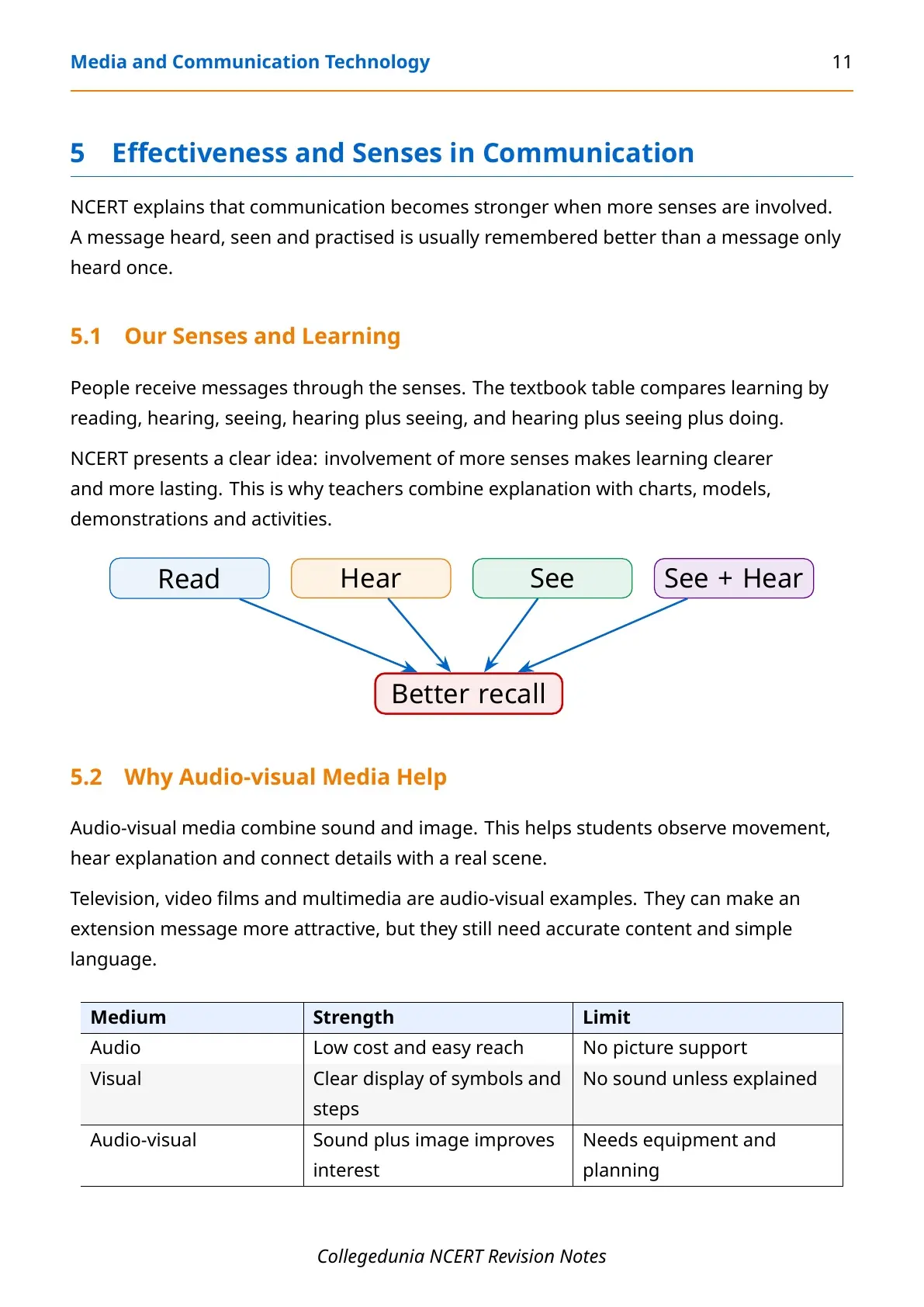
Forms describe how the message appears. Verbal communication mainly uses spoken words and voice. Non-verbal communication uses posture, gesture, facial expression, signs, symbols, writing, eye contact, silence and other visible cues. Modes describe the senses used by the receiver: audio, visual and audio-visual. A message using more than one sense is usually easier to remember.
| Type or mode | Meaning | Example |
|---|---|---|
| Intra-personal | Communication with oneself | Thinking through a decision |
| Inter-personal | Direct exchange between two people | Parent and child conversation |
| Group | Message shared within a group | Class discussion |
| Mass | Message sent to many people at once | Radio broadcast |
| Audio-visual | Uses sight and hearing together | Television or video lesson |
Media Classification in Home Science Chapter 6
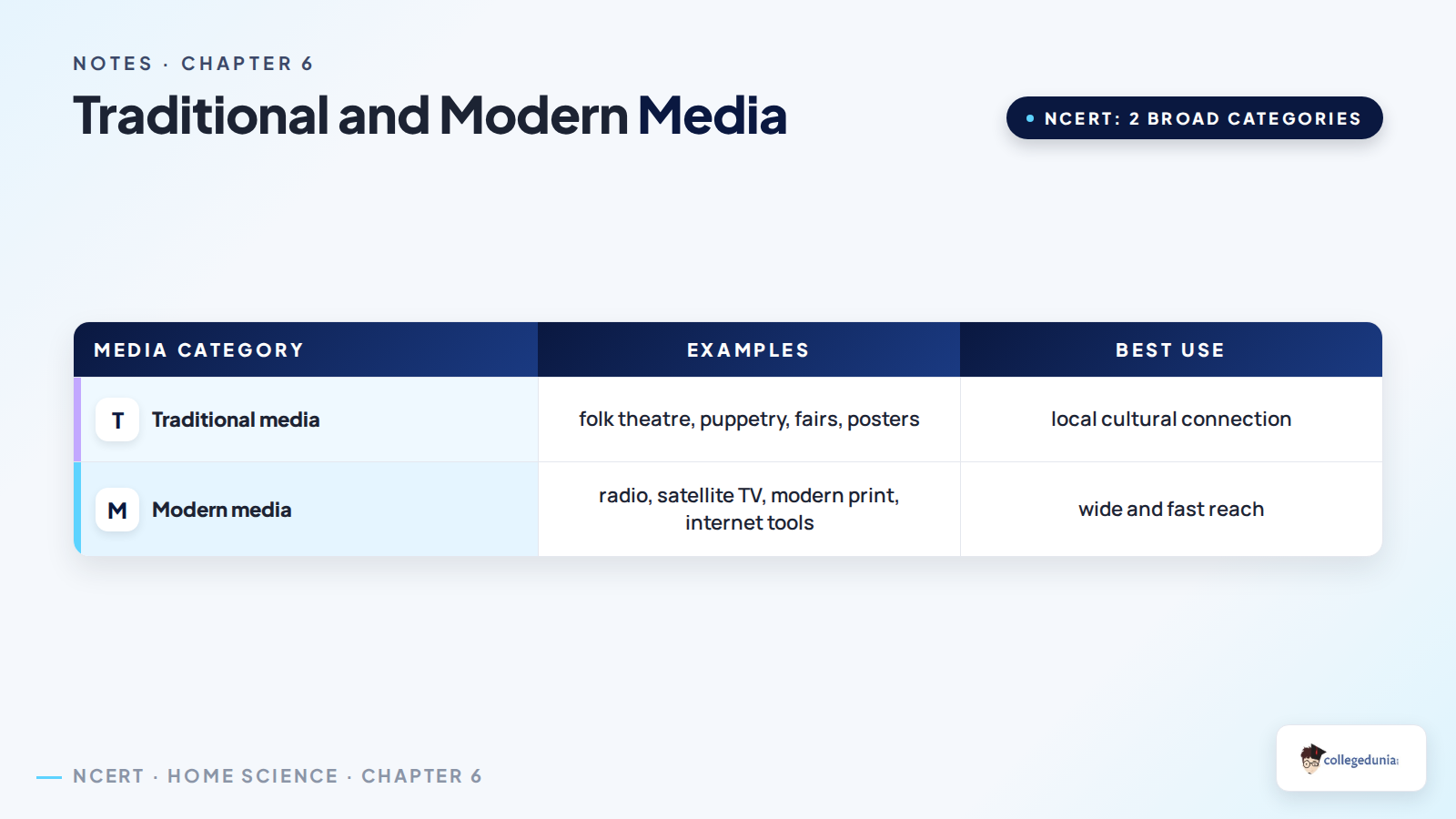
Media are the means used to carry messages. NCERT classifies media into two broad categories: traditional media and modern media. Traditional media include fairs, festivals, rituals, symbols, folk theatre, puppetry, folk dances, oral literature and long-used print material. Modern media include radio, satellite television, modern print, films, projectors, mobile phones, video conferencing, internet and computer-based tools.
Media influence daily life through nine functions: information, persuasion or motivation, entertainment, interpretation, transmission of values, education or training, coordination, behavioural change and development. In a community programme, media choice depends on the receiver group, cost, literacy level, language and feedback requirement.
- Traditional media: strong local connection and familiar cultural form.
- Modern media: wider and faster reach through radio, television, films, computers and mobile tools.
- Media functions: write all nine NCERT functions in long answers.
Communication Technology and ICT Tools
Communication technology means the use of scientific tools and systems to transmit information across distance. NCERT gives radio and television as important communication technologies, then introduces other modern tools. These tools reduce the limits of distance and time. They are useful in education, health communication, rural development, market information, family contact and professional coordination.
Radio supports audio messages and reaches places where print access is limited. Television combines sound, picture and movement, so it can demonstrate a process clearly. Computers and the internet support storage, searching, editing, e-mail and online exchange. Bluetooth, video text, interactive video and teleconferencing show how communication can become faster and more interactive.
| Technology | Main strength | Home Science use |
|---|---|---|
| Radio | Low-cost audio reach | Health, farming and public messages |
| Television | Sound plus moving picture | Nutrition, childcare and community demonstrations |
| Written digital exchange | Sending reports, notices and attachments | |
| Teleconference | Real-time group interaction | Distance discussion, training and guidance |
| Bluetooth | Short-range wireless exchange | Sharing files between nearby devices |
Radio Television E-mail and Teleconferencing Notes
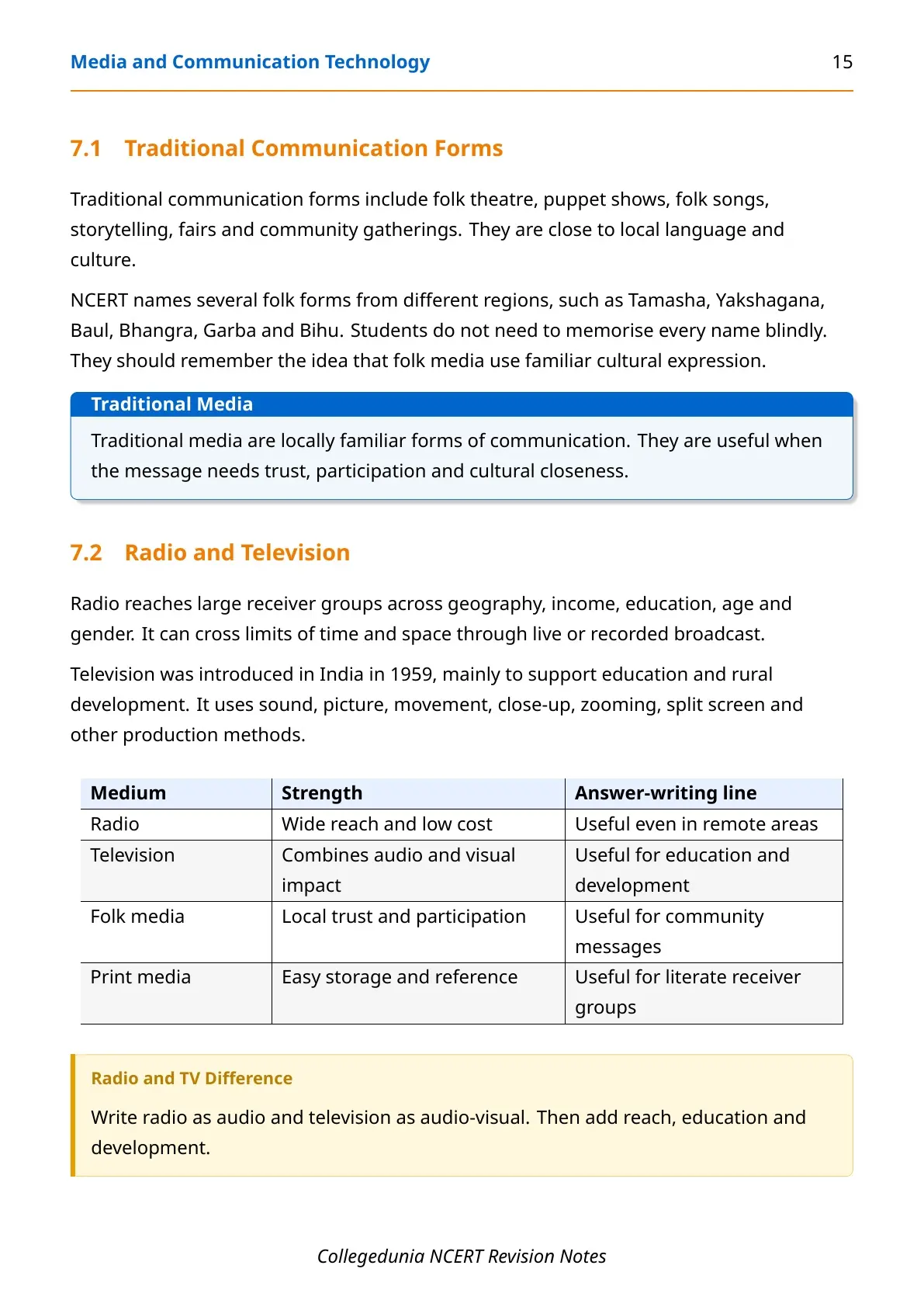
Radio and television changed communication because they could reach large groups quickly. Radio is portable, inexpensive and useful where electricity, reading ability or internet access may be limited. Television adds visual demonstration, so it is effective for cooking, health, sanitation, clothing care and family-resource messages. Students should write both reach and impact when explaining these media.
E-mail is a fast written message sent through a computer or mobile device using the internet. It can carry text and attachments. Teleconferencing allows people at different places to discuss the same topic at the same time. Interactive video adds a two-way element, where learners can watch, respond and clarify. These tools are important because they support education and communication without requiring all participants to be in one room.
- Radio: best for quick audio information and public awareness.
- Television: best when demonstration and visual memory are important.
- E-mail: best for written records, documents and formal exchange.
- Teleconference: best for distant groups that need live feedback.
How to Prepare Class 11 Home Science Chapter 6 Notes
Start revision with definitions: communication, media, feedback and communication technology. Then practise the SMCRE process diagram until each step can be explained in one line. After that, learn traditional and modern media with examples. Finally, revise the modern technologies and write two advantages for each.
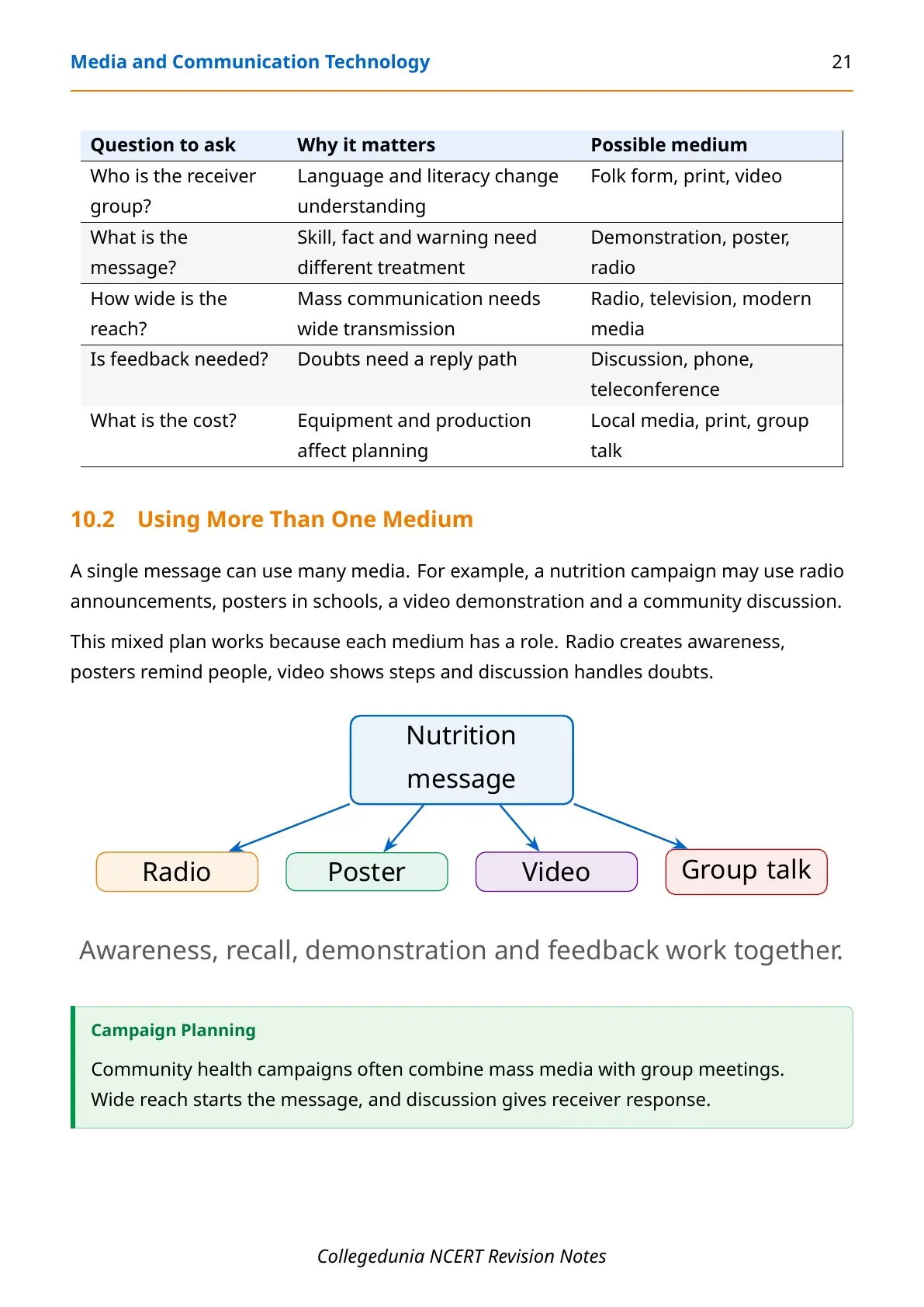
For long answers, use a simple order: definition, classification, explanation, example and conclusion. For comparison answers, use a table. For application questions, mention the receiver group, message purpose, medium selected and the reason for selecting that medium. This keeps the answer specific instead of becoming a general paragraph about technology.
| Question cue | Best answer format | Key point to include |
|---|---|---|
| Define communication | Short paragraph | Common meaning between sender and receiver |
| Explain process | Flowchart plus paragraph | Source, message, channel, receiver and feedback |
| Classify media | Table | Traditional and modern examples |
| Discuss technology | Point-wise answer | Radio, television, e-mail and conferencing |
Related Resources for Media and Communication Technology
| Resource | Use it for | Link |
|---|---|---|
| NCERT Book PDF | Official chapter reading and review questions | Media and Communication Technology Class 11 NCERT Book PDF |
| NCERT Solutions | Stepwise answers for NCERT review questions | Media and Communication Technology Class 11 NCERT Solutions |
| Handwritten Notes | Short visual recall before class tests | Media and Communication Technology Class 11 Handwritten Notes |
Class 11 Home Science Notes for All Chapters
| Chapter | NCERT Notes |
|---|---|
| Chapter 1 | Introduction Evolution of the Discipline and its Relevance to Quality of Life Notes |
| Chapter 2 | Understanding the Self Notes |
| Chapter 3 | Food Nutrition Health and Fitness Notes |
| Chapter 4 | Management of Resources Notes |
| Chapter 5 | Fabrics Around Us Notes |
| Chapter 6 | Media and Communication Technology Notes |
Media and Communication Technology Class 11 FAQs
Ques. What is communication in Class 11 Home Science Chapter 6?
Ans. Communication is the sharing of ideas, facts, feelings or experiences through a medium so that the intended meaning becomes common to the sender and receiver.
Ques. What are the main elements of the communication process?
Ans. The main elements are source, message, channel, receiver and effect or feedback. Feedback shows whether the message was understood correctly.
Ques. What are the two main categories of media in this chapter?
Ans. The chapter classifies media into traditional media and modern media, with examples such as folk theatre, posters, radio, television, mobile phones and internet tools.
Ques. Why are radio and television important communication technologies?
Ans. Radio reaches large groups through audio messages at low cost, while television combines sound and moving pictures for education, health awareness and development messages.



Comments