



NCERT Notes Class 11 Psychology Chapter 3 Human Development help students revise development across the life span, heredity, environment, contexts, prenatal growth, infancy, childhood, adolescence, adulthood and old age for the 2026-27 syllabus. The notes keep the chapter ready for school tests through definitions, concept maps, comparison tables and answer cues.
- Download the Human Development notes PDF for offline revision.
- Revise growth, maturation, evolution and life span development with NCERT terms.
- Use the tables to compare infancy, childhood, adolescence, adulthood and old age.

Student Feedback: In a Collegedunia poll of 9,120 Class 11 Psychology students, 74% said the hardest part of Human Development was linking each life stage with its developmental task.
Source: 2026-27 Class 11 Psychology student poll across CBSE schools.
|
Table of Contents |
Human Development Class 11 Notes: Chapter Overview
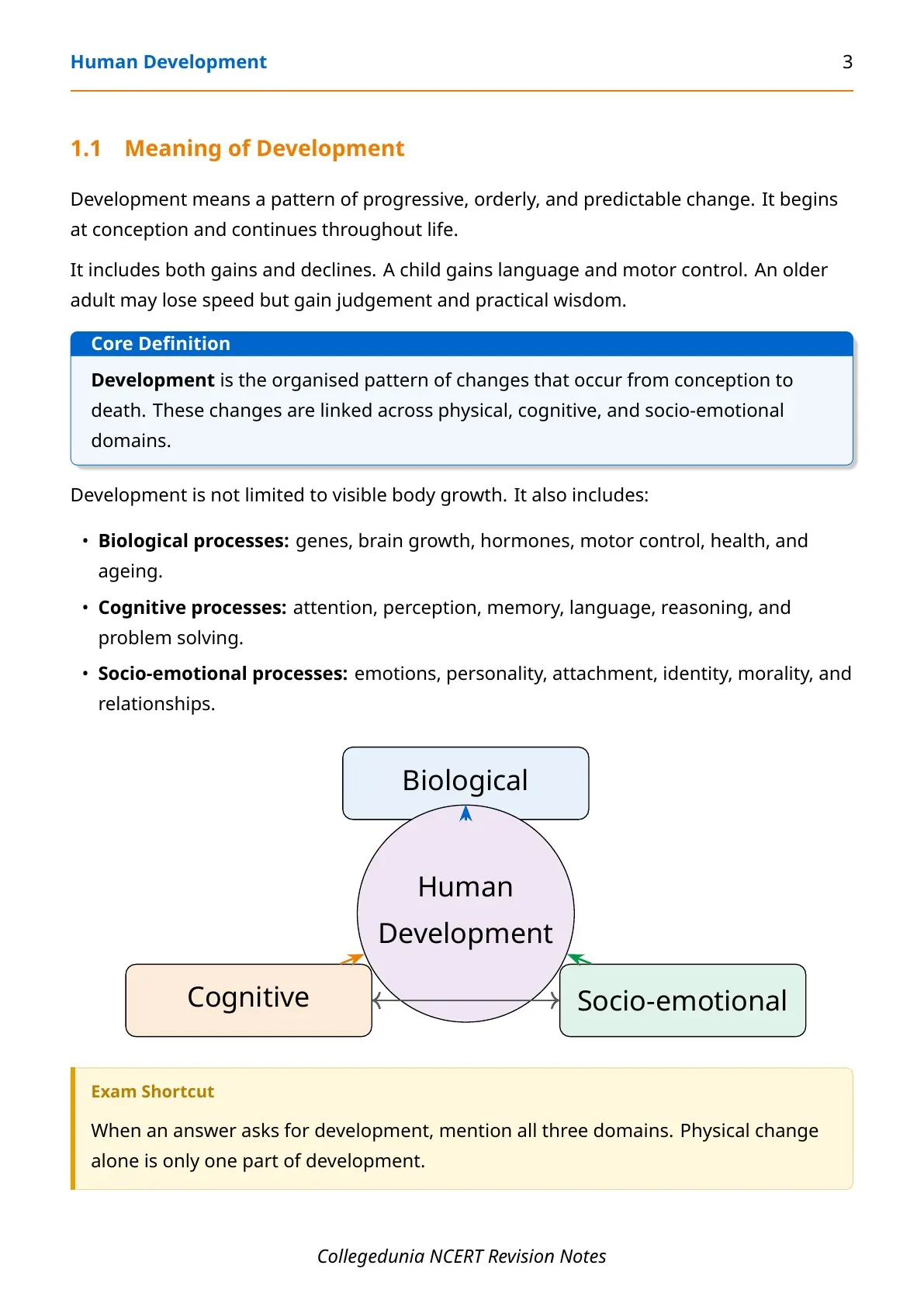
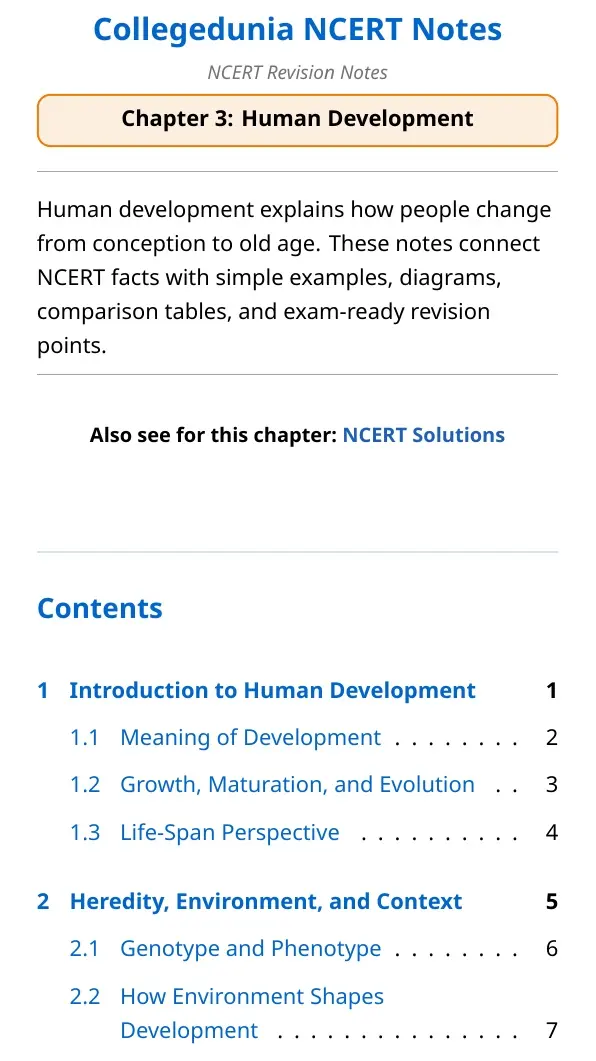
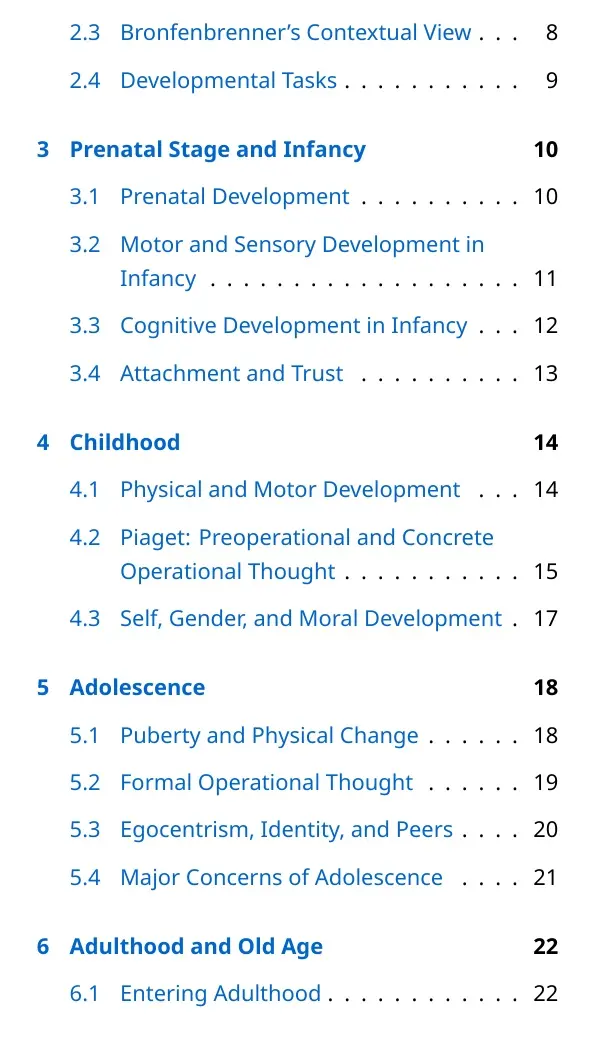
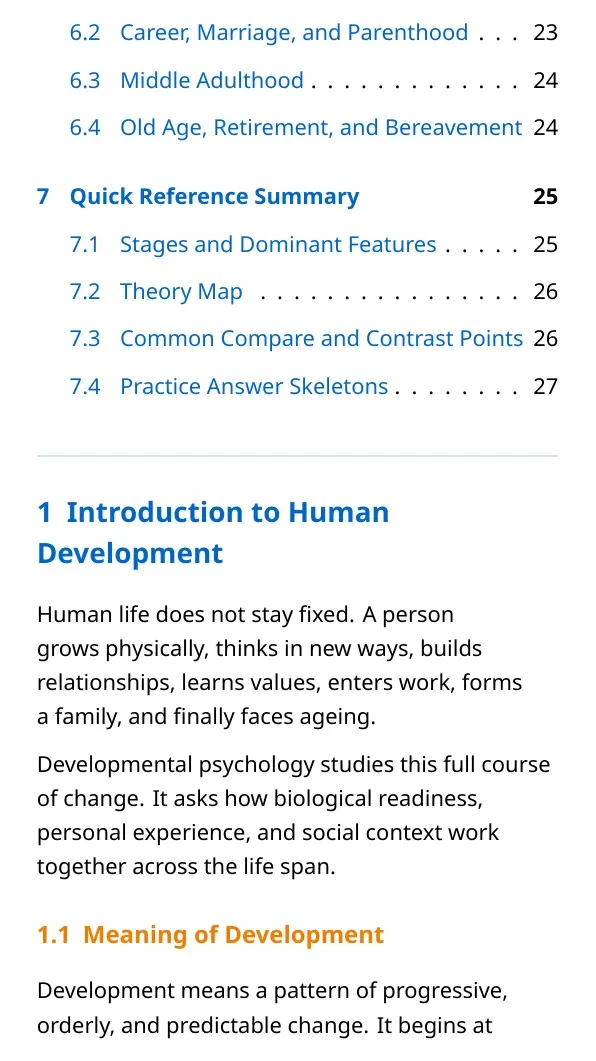
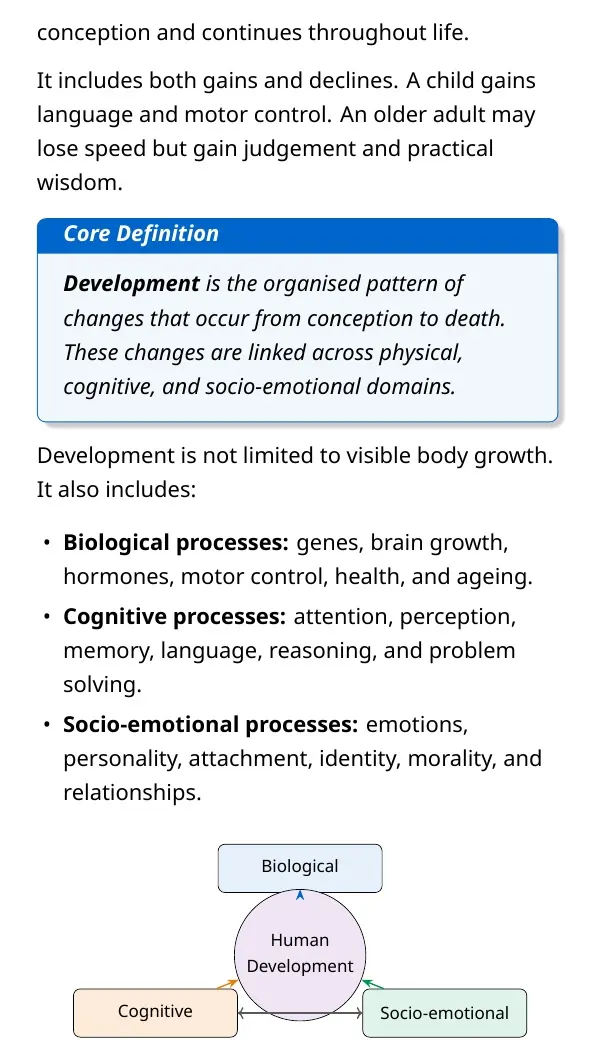
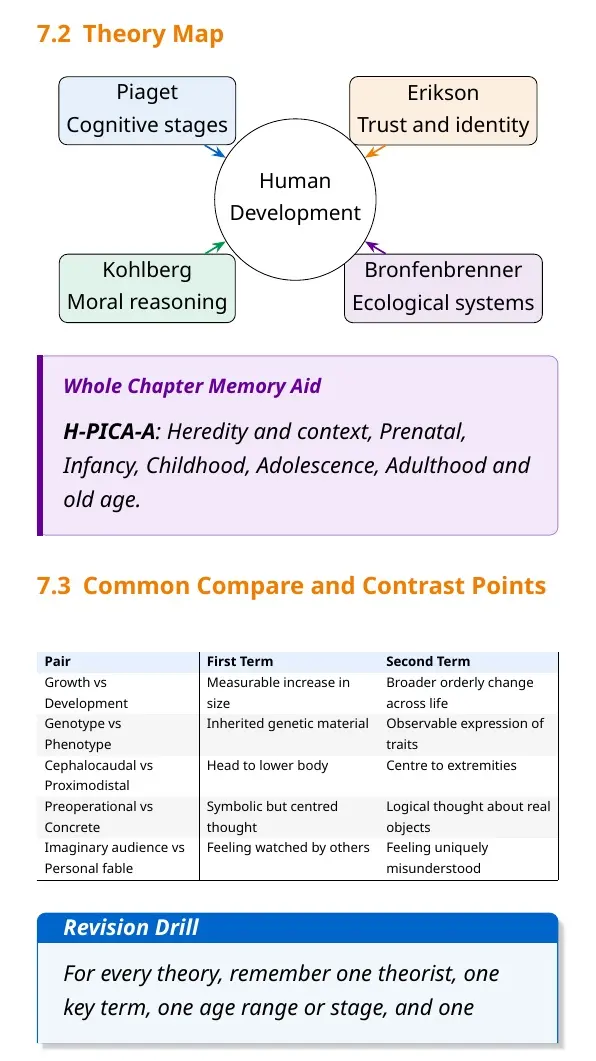
Chapter 3 explains development as a continuous and lifelong process. NCERT studies how human beings change in physical, cognitive, social and emotional ways from conception to old age. The safest exam line is simple: development means progressive, orderly and predictable changes across the life span.
| Chapter area | What to revise | Answer cue |
|---|---|---|
| Meaning of development | Growth, maturation, evolution and development | Define each term separately |
| Influences | Heredity, environment and context | Use examples from home, school and culture |
| Context model | Bronfenbrenner systems | Move from immediate setting to historical time |
| Life stages | Prenatal, infancy, childhood, adolescence, adulthood and old age | Write the main task of each stage |
Human Development Class 11 Video Revision
Source: Magnet Brains on YouTube
Growth, Development, Maturation and Evolution
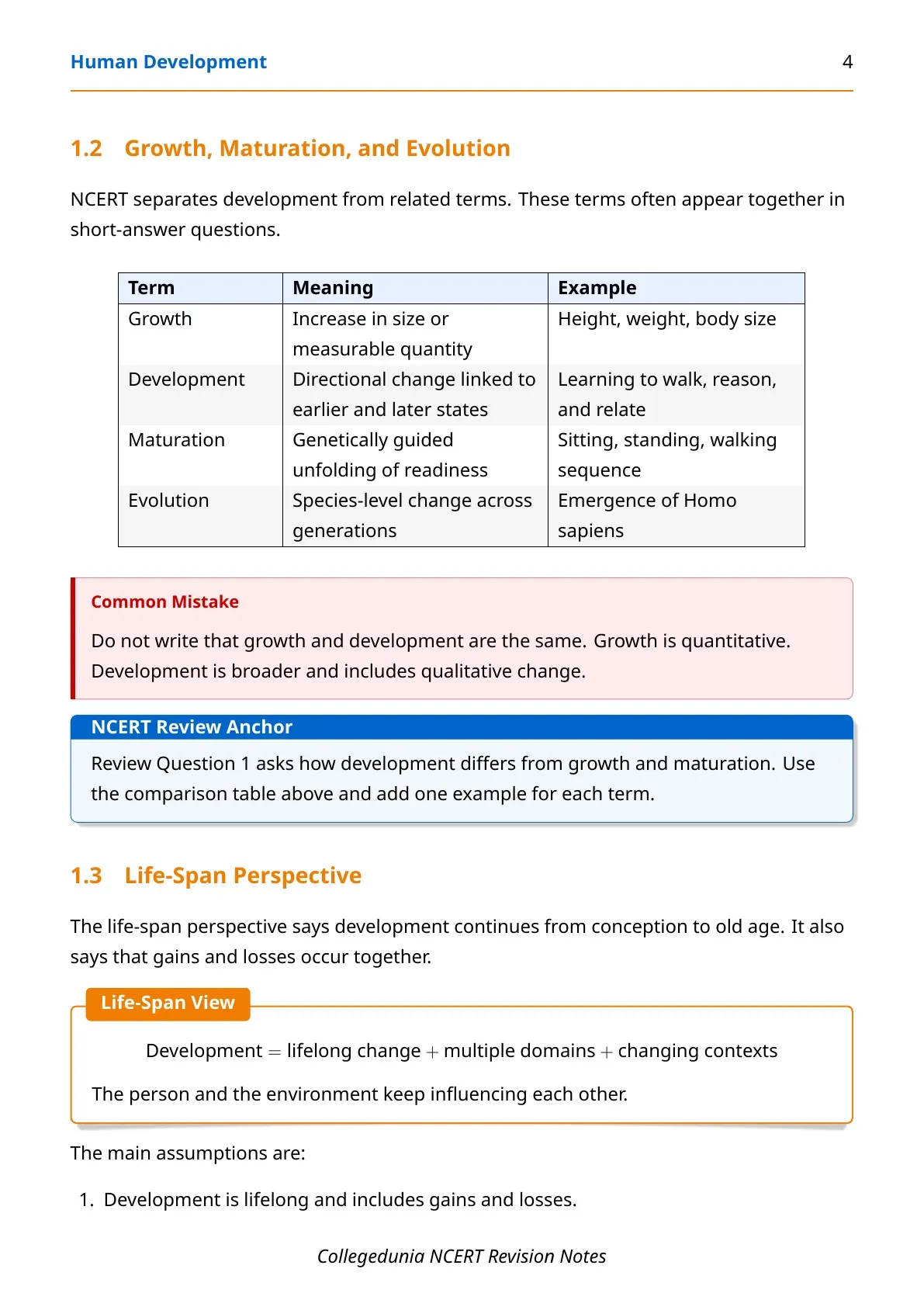
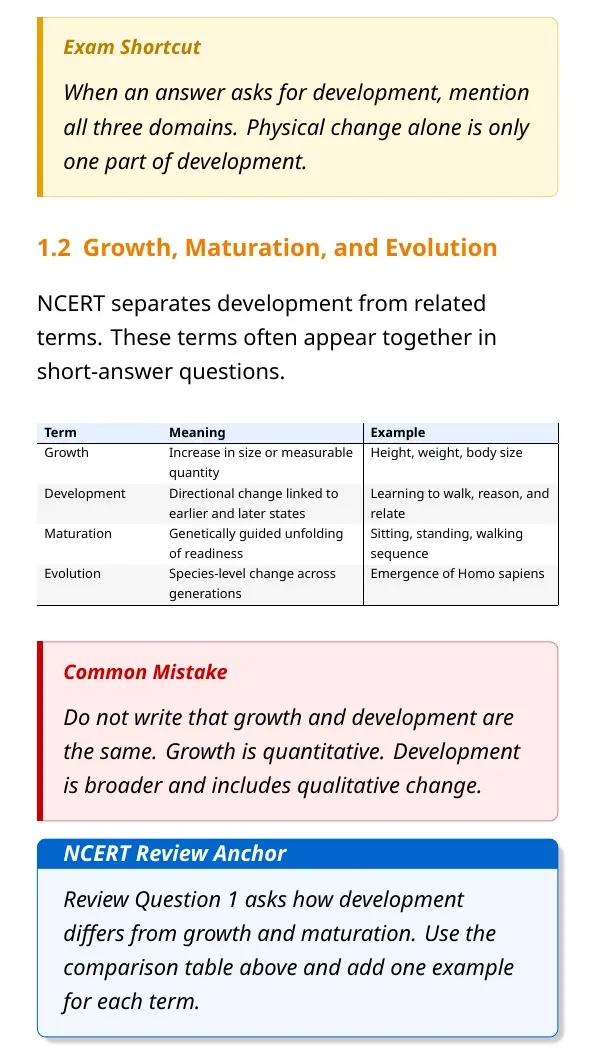
NCERT separates four linked ideas. Growth is a quantitative change such as height, weight or body size. Development is a wider qualitative change in abilities, behaviour and adjustment. Maturation refers to biologically guided changes that unfold with readiness. Evolution refers to species-level change across generations.
- Growth: increase in size or measurable body changes.
- Development: ordered and lasting change in functioning.
- Maturation: internal biological readiness for new abilities.
- Evolution: long-term change in the species over time.
Life Span Development Map
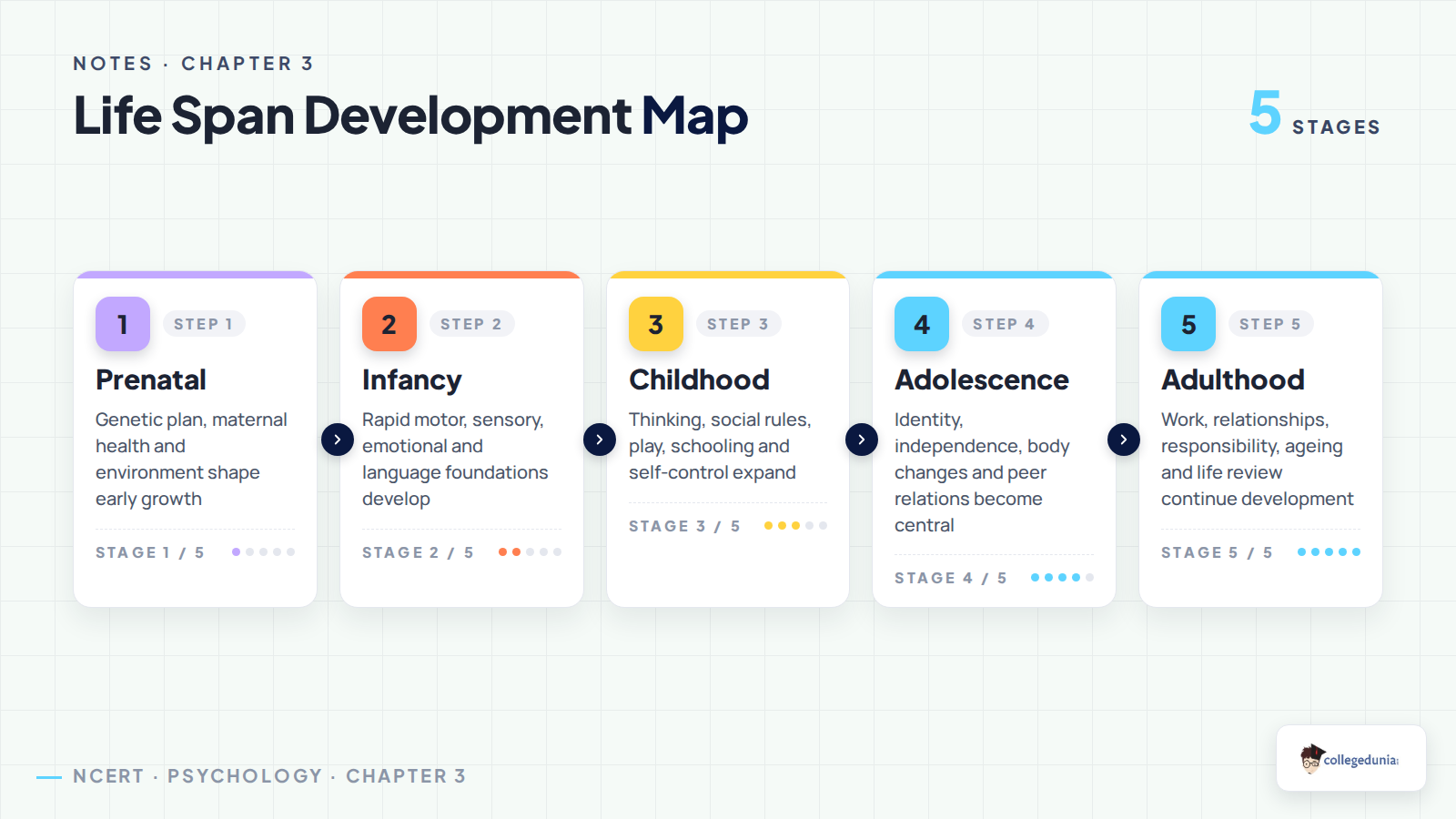
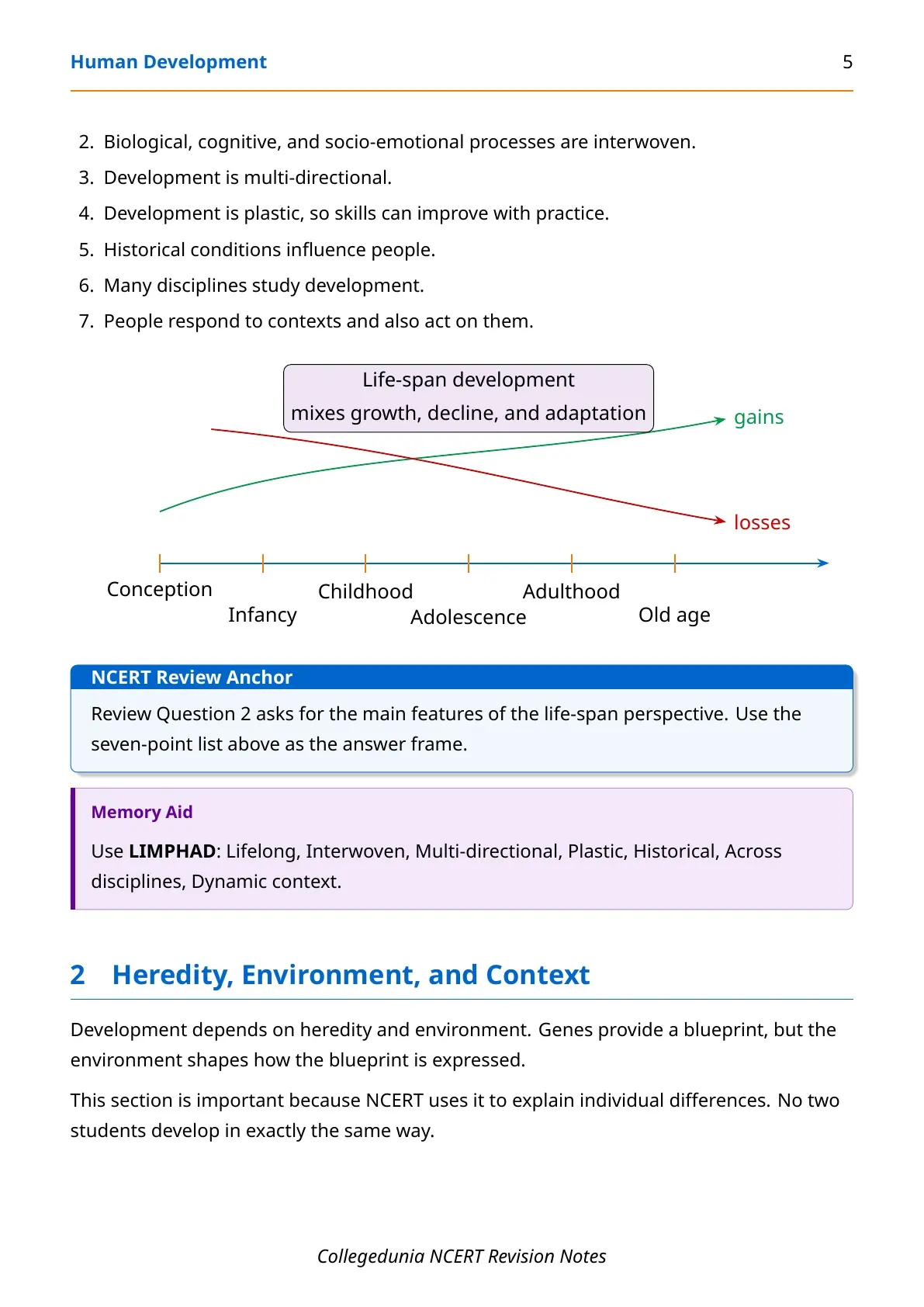
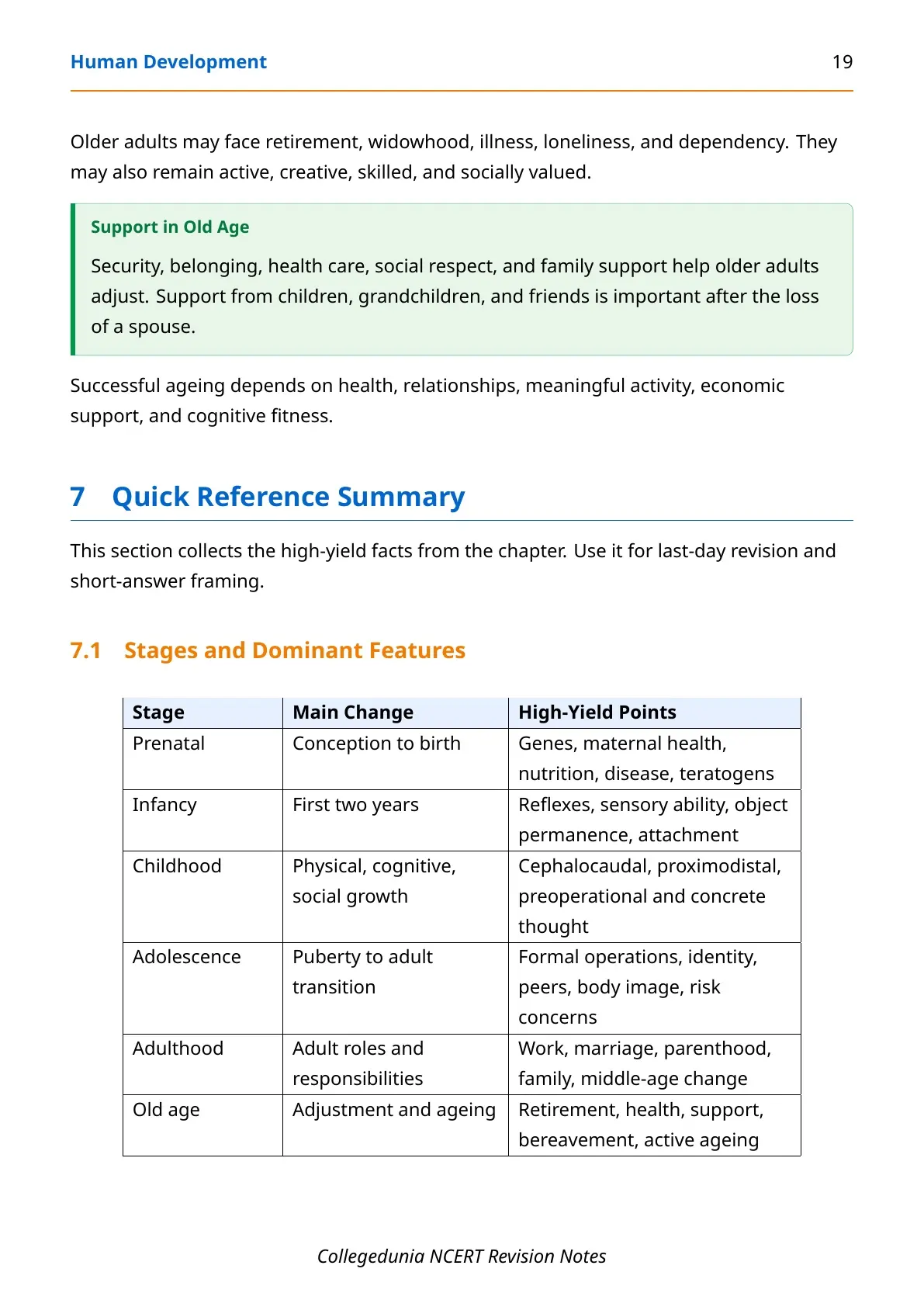
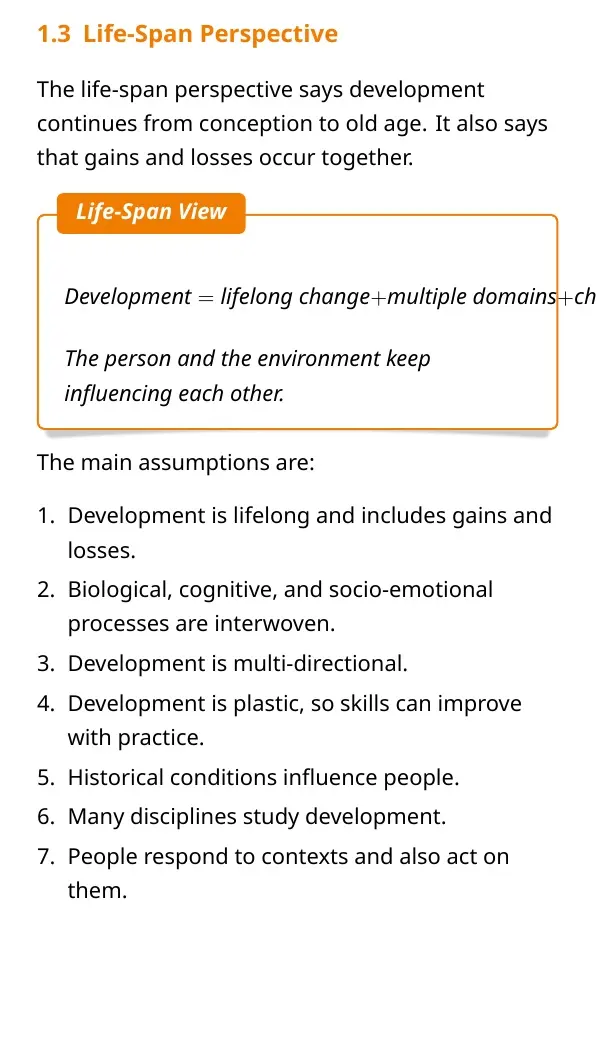
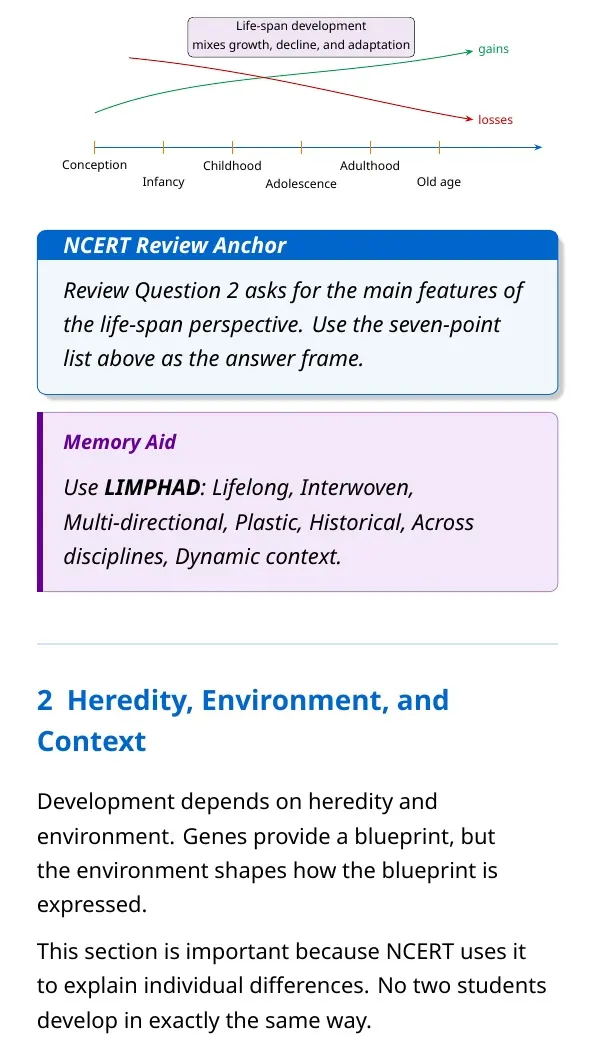
Life span development means development does not stop after childhood. It begins before birth and continues through old age. Every stage has typical changes, but people do not develop in exactly the same way because heredity, family, culture, nutrition, education and historical context interact.
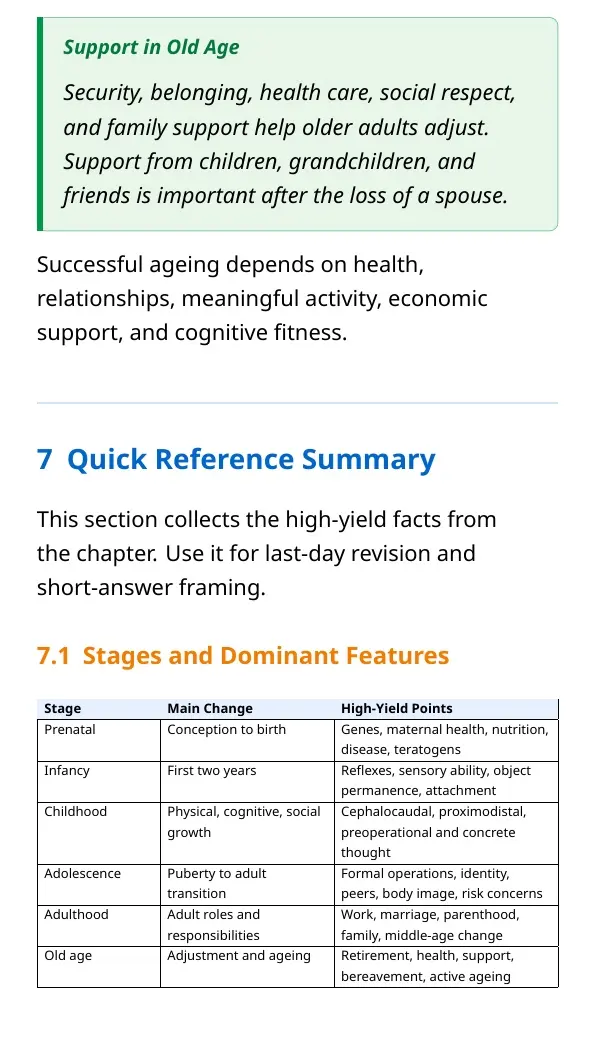
| Stage | Major change | Exam cue |
|---|---|---|
| Prenatal | Conception to birth; organ formation and rapid growth | Mention maternal health and environment |
| Infancy | Motor, sensory, attachment and early language development | Use reflexes and object permanence |
| Childhood | School readiness, play, self-control and social learning | Link to family and peers |
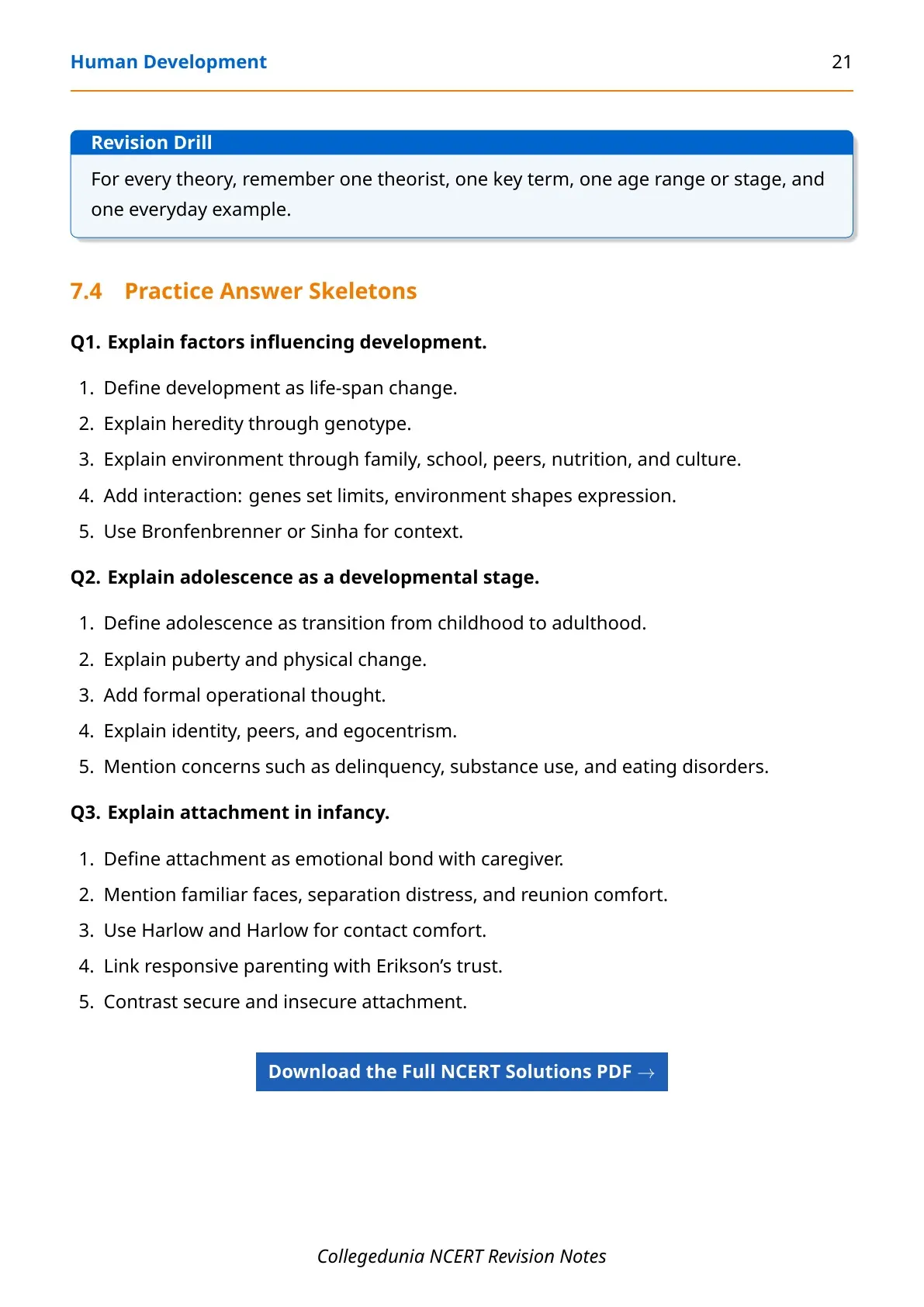
| Adolescence | Puberty, identity, independence and peer relations | Write biological and social changes together |
| Adulthood and old age | Work, intimacy, responsibility, ageing and life review | Avoid treating development as only childhood |
Heredity, Environment and Context
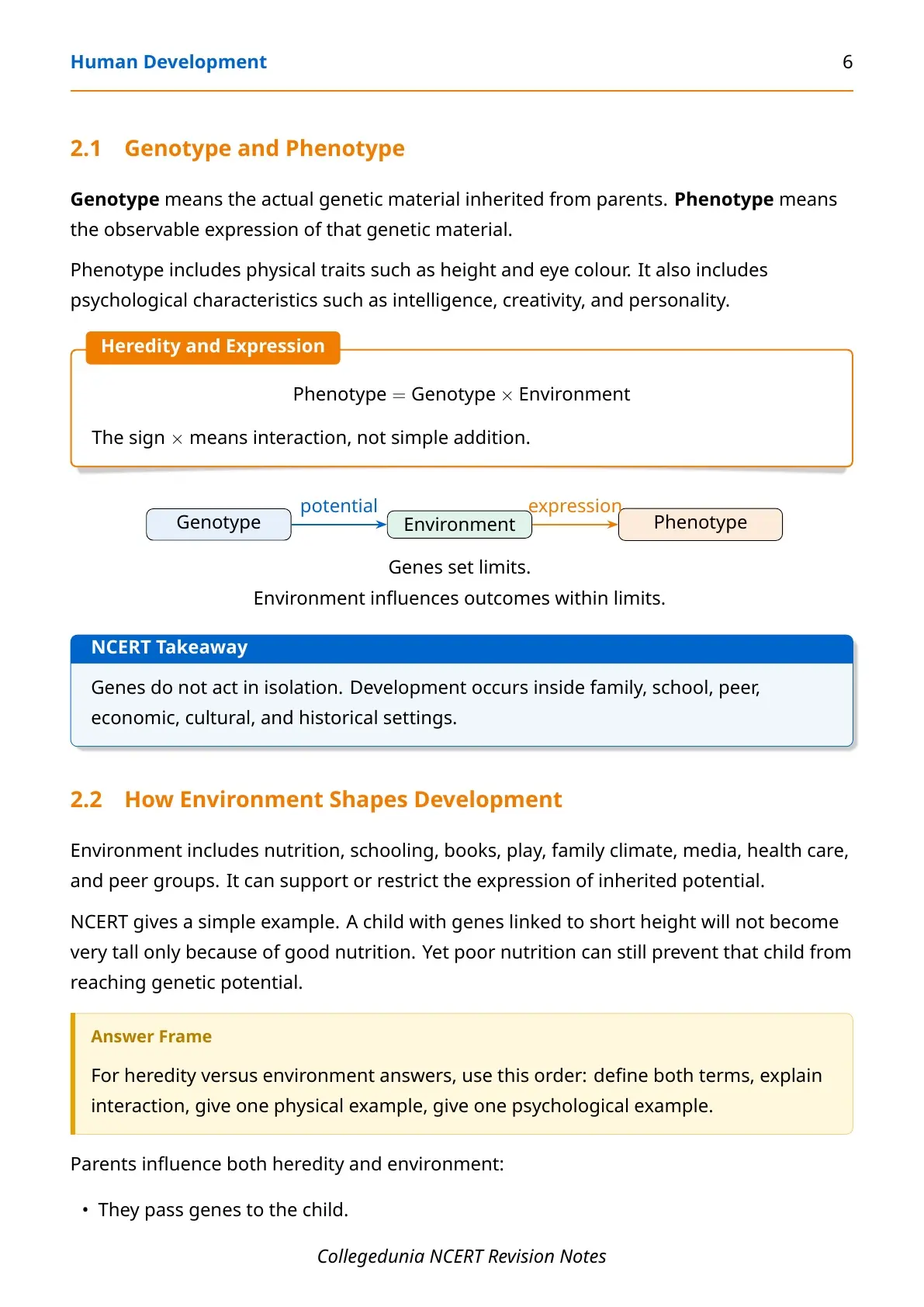
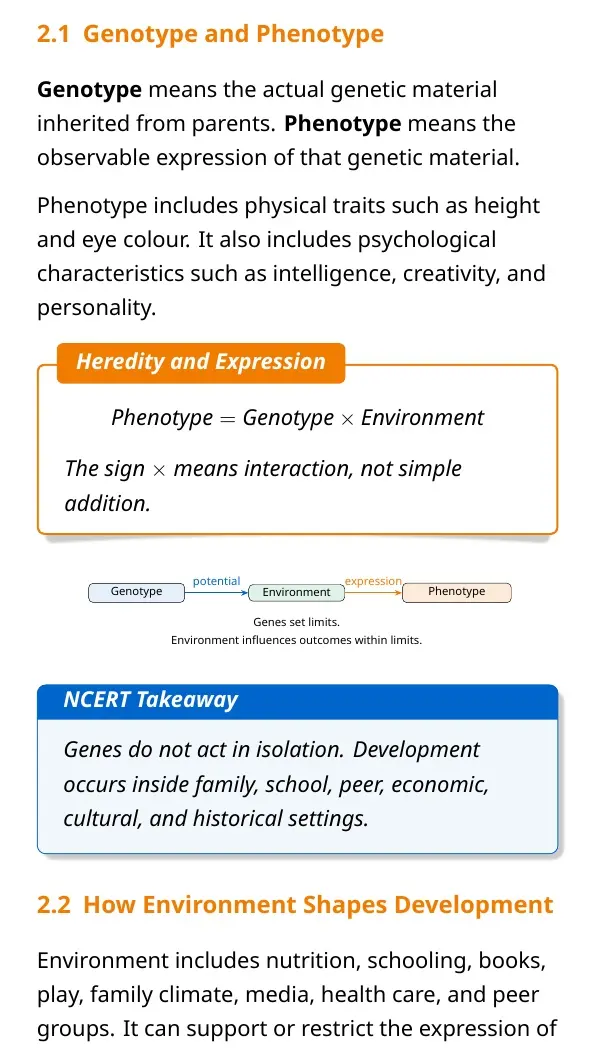
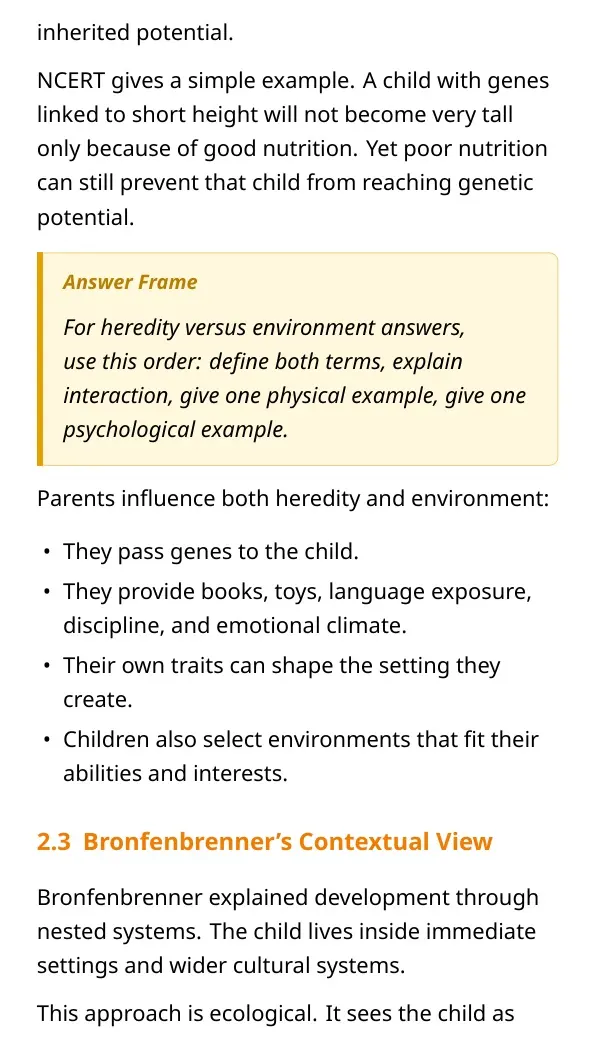
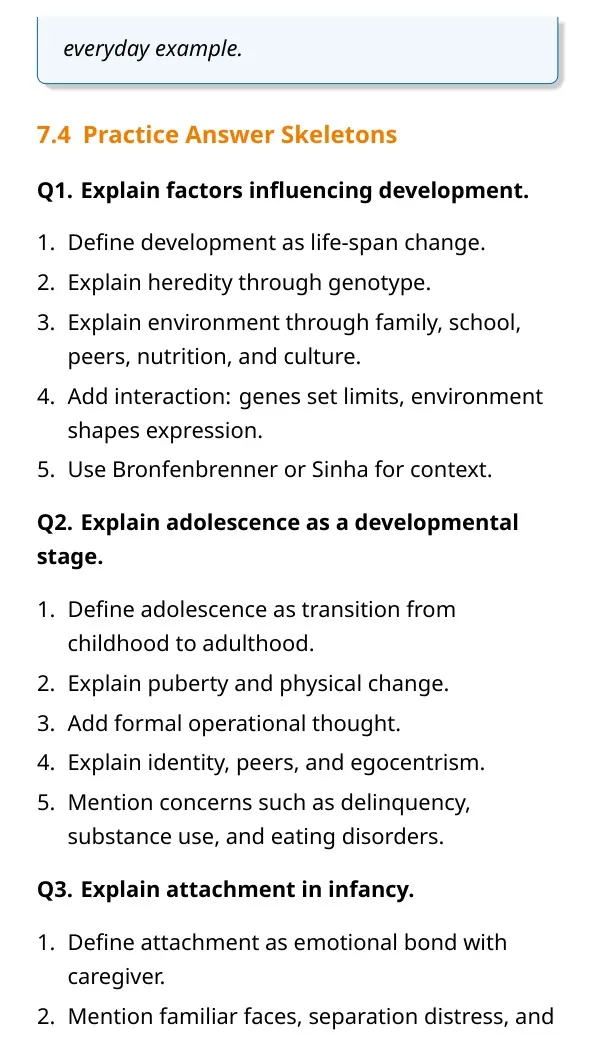
Human development is shaped by both heredity and environment. Heredity provides the biological potential through genes. Environment gives the conditions in which that potential is expressed. NCERT stresses that the two do not work separately. A child's nutrition, stimulation, safety, schooling and family support influence how inherited potential becomes actual behaviour.
- Heredity sets possibilities, not fixed outcomes.
- Environment supports, restricts or redirects development.
- Context includes family, school, culture, economy, media and historical time.
- The same event may affect two children differently because their contexts differ.
Bronfenbrenner's Context Systems
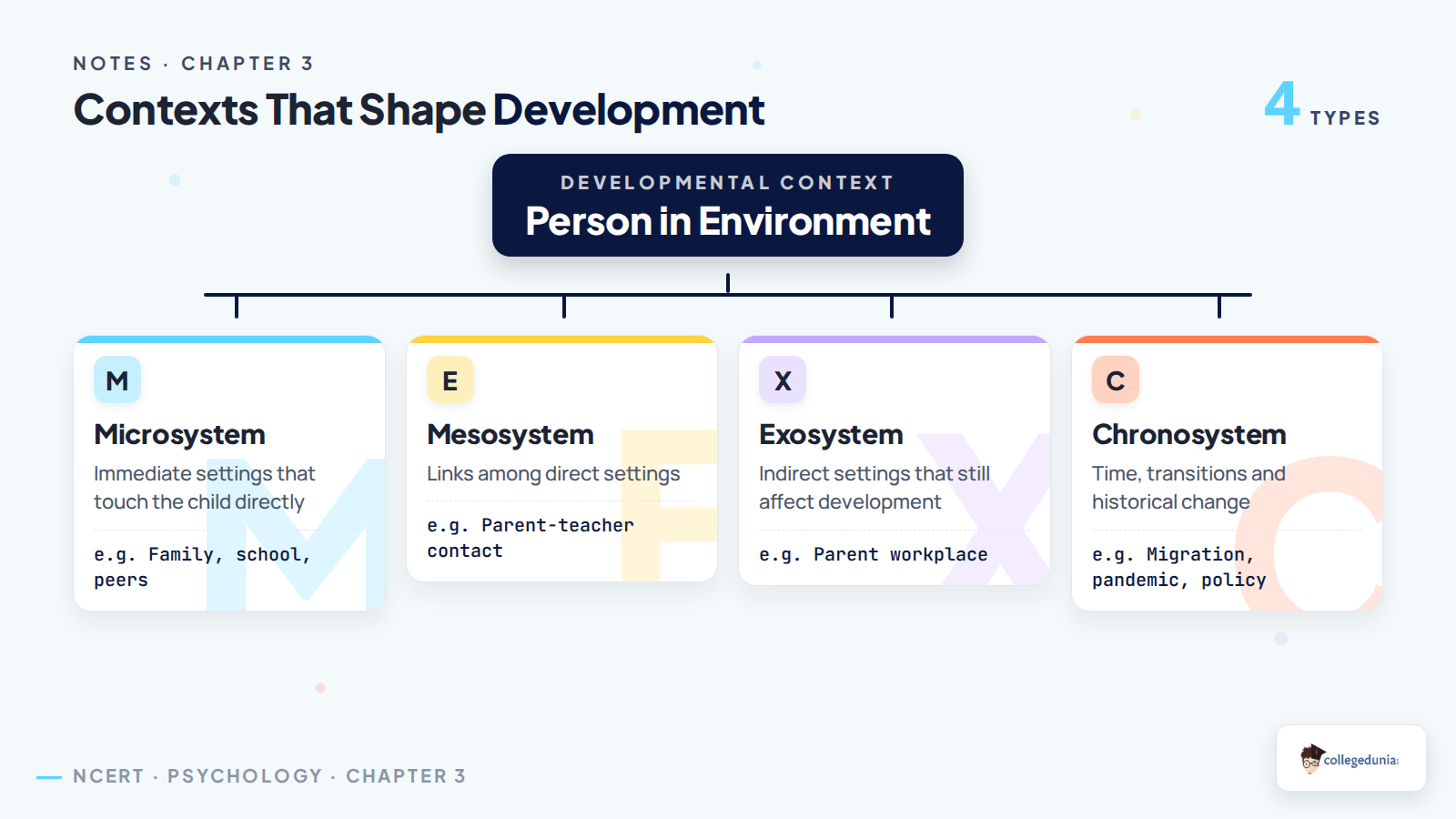
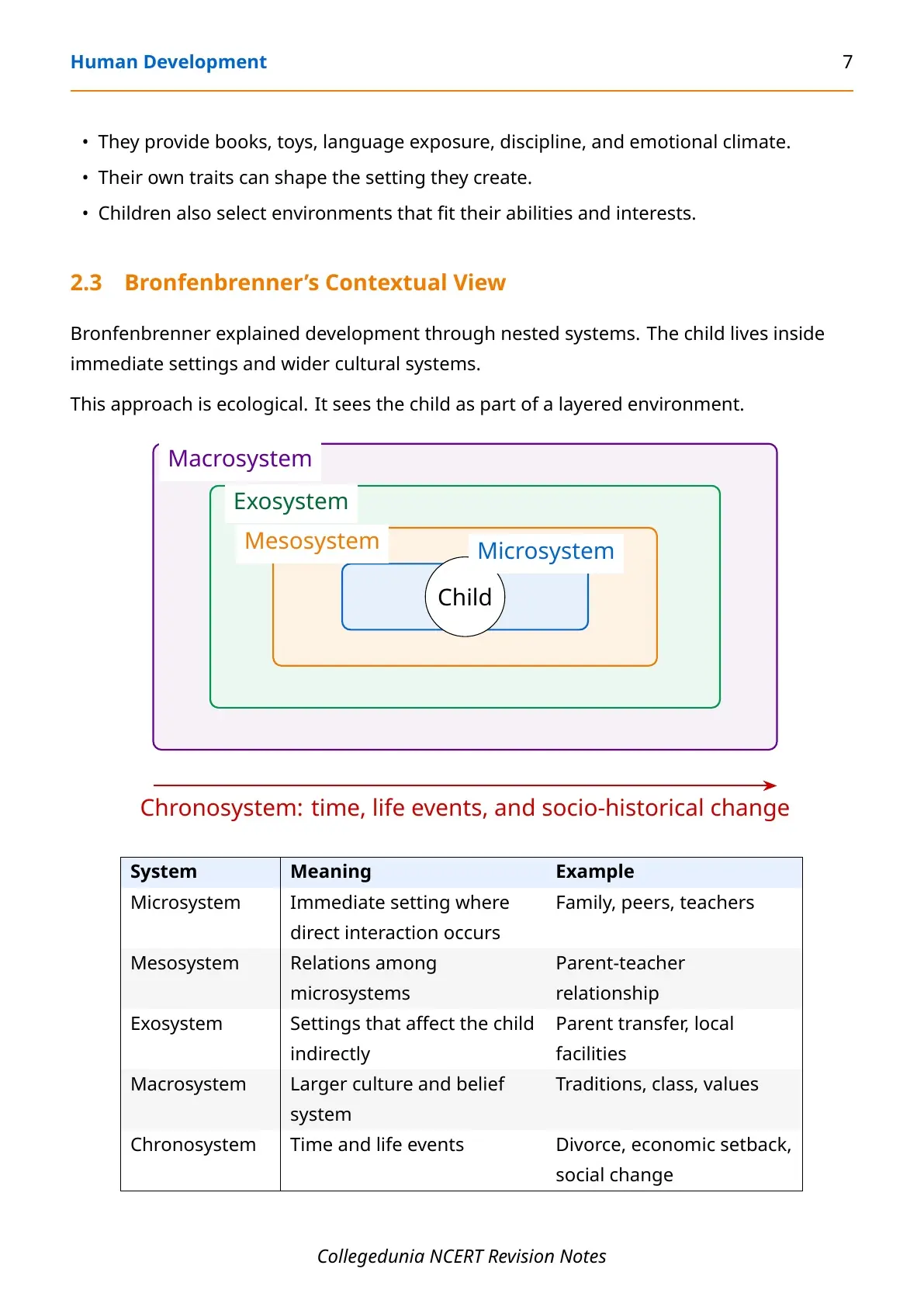
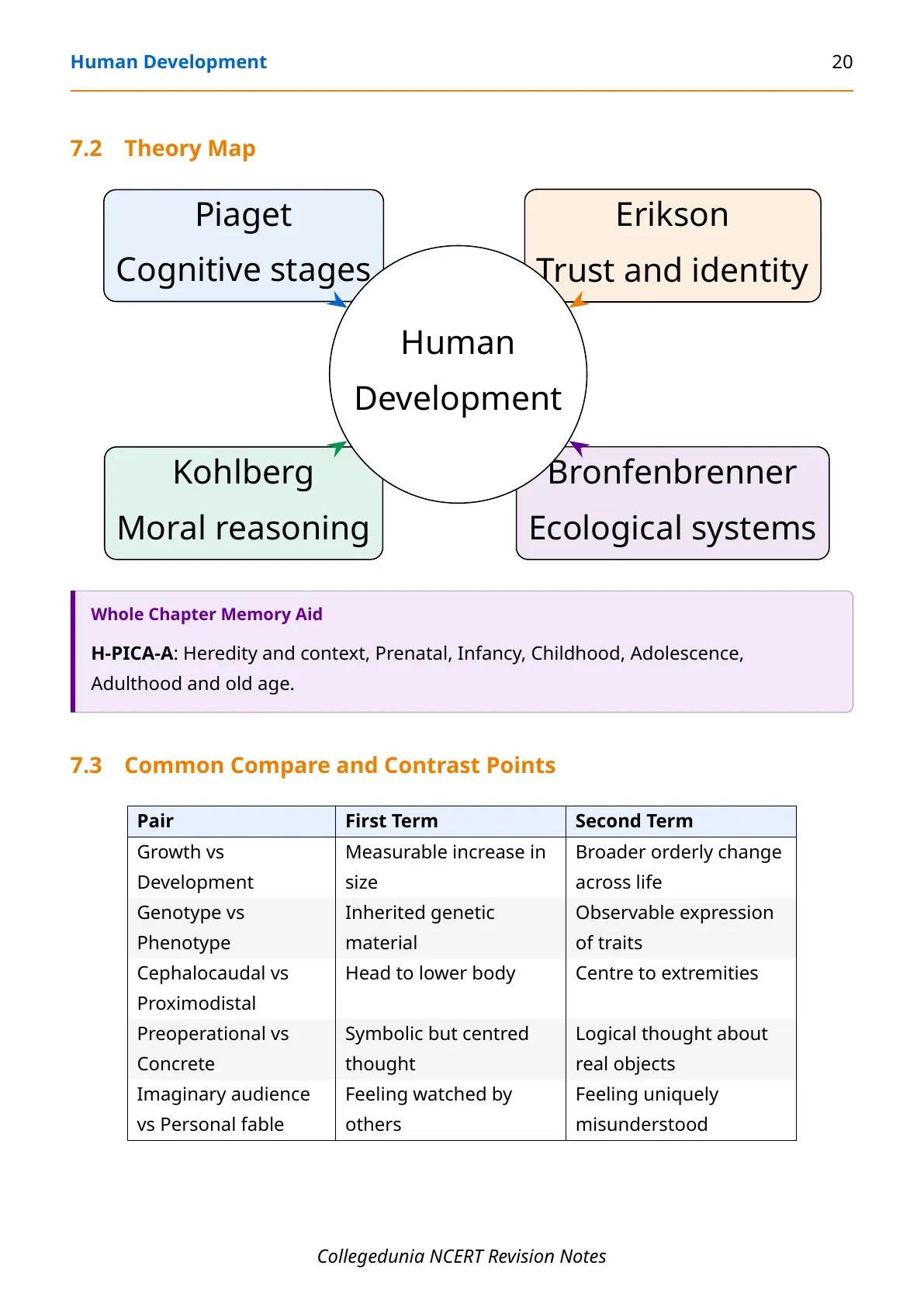
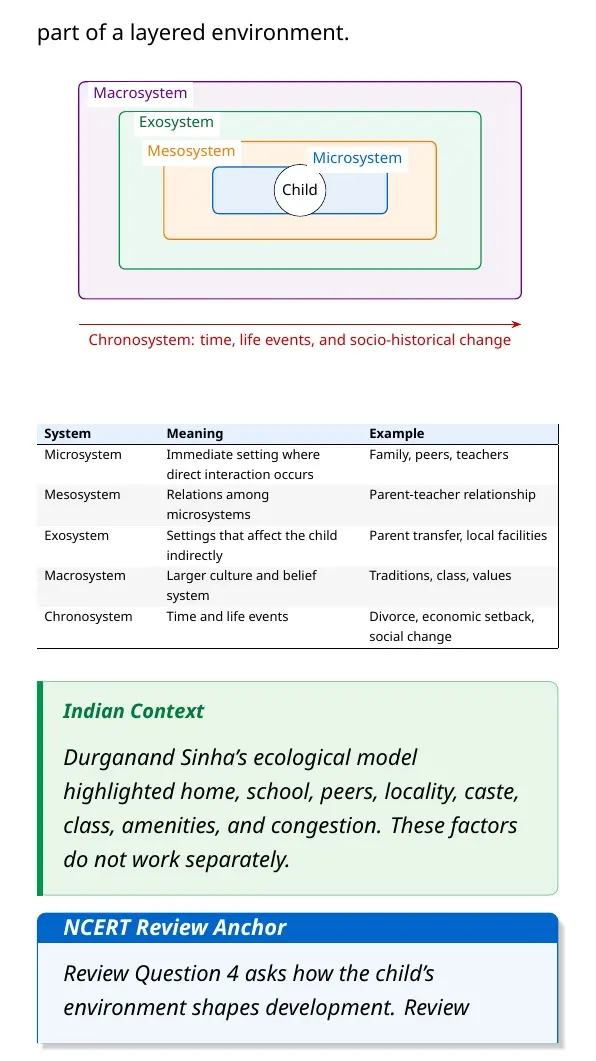
Bronfenbrenner explains development through nested contexts. The microsystem is the child's immediate world such as family, school and peers. The mesosystem links these immediate settings. The exosystem affects the child indirectly, such as a parent's workplace. The chronosystem includes time, life transitions and historical change.
| System | Meaning | Example |
|---|---|---|
| Microsystem | Direct setting of interaction | Home, classroom, friend group |
| Mesosystem | Links among direct settings | Parent-teacher communication |
| Exosystem | Indirect setting that affects development | Parent job stress affecting home routine |
| Chronosystem | Historical time and life transitions | School change, migration, digital learning |
Prenatal Development and Infancy
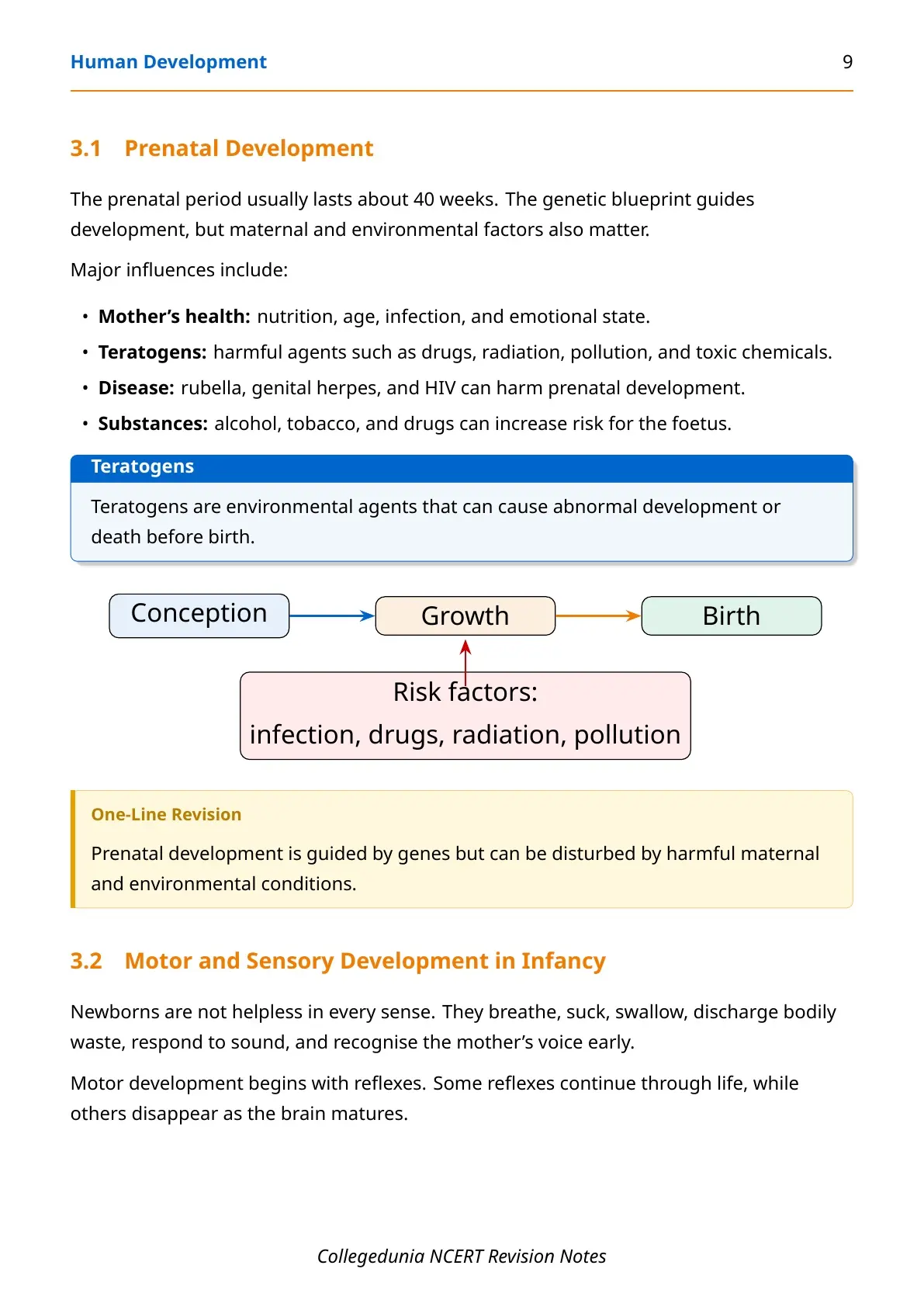
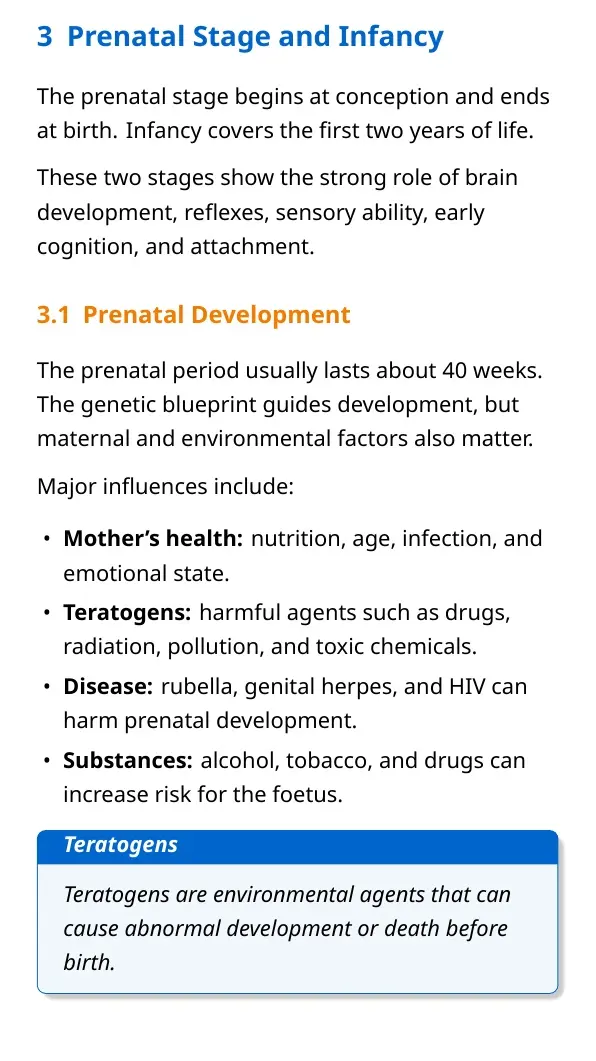
Prenatal development begins with conception and proceeds through rapid cell division, organ formation and body growth. NCERT highlights that maternal nutrition, illness, stress, drugs and environmental hazards can influence development before birth. After birth, infancy brings fast growth in motor coordination, sensory abilities, attachment and communication.
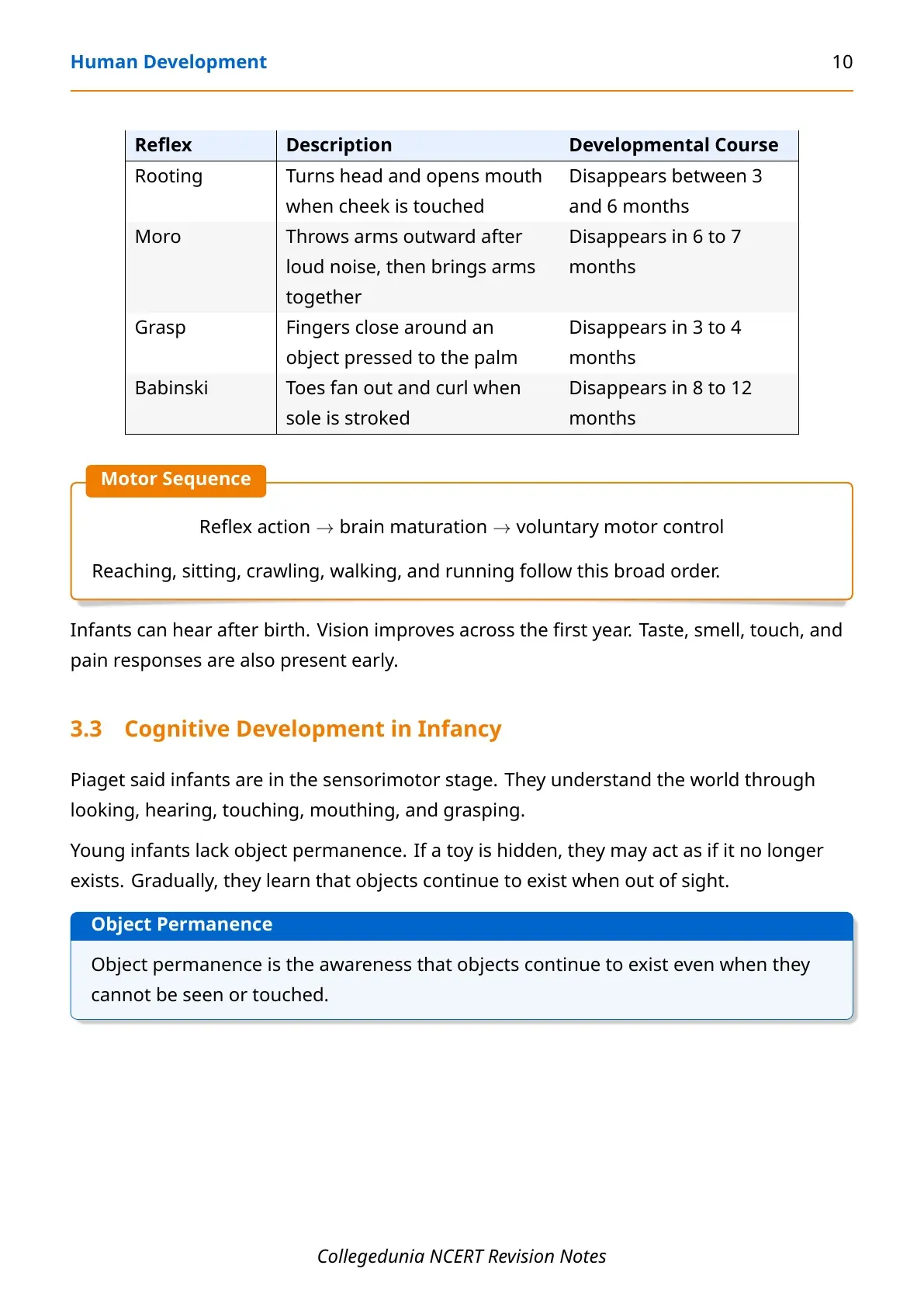
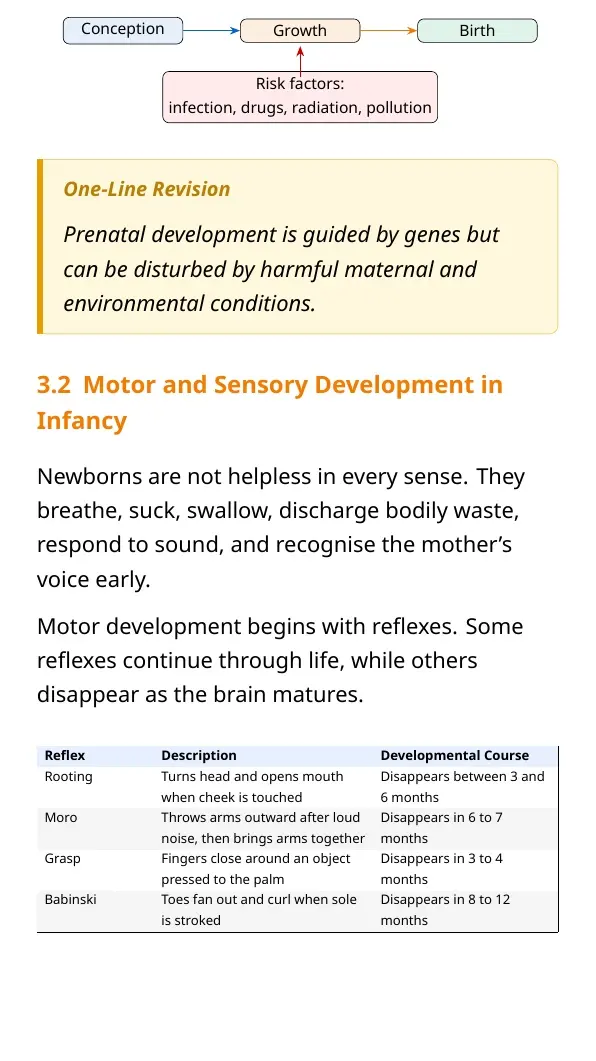
- Reflexes: automatic responses that support survival in early life.
- Motor development: movement becomes more controlled with maturation and practice.
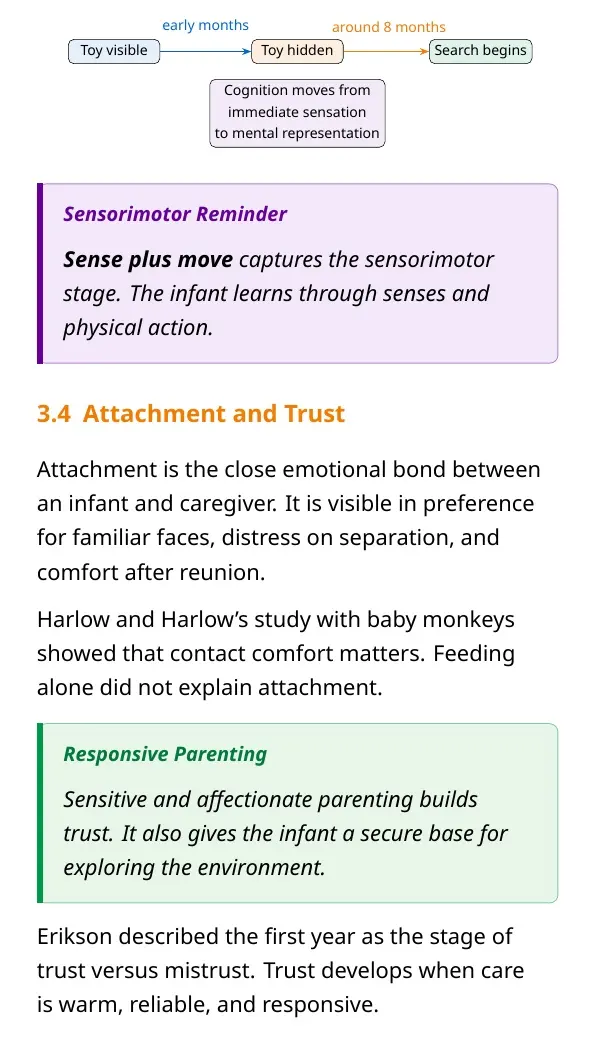
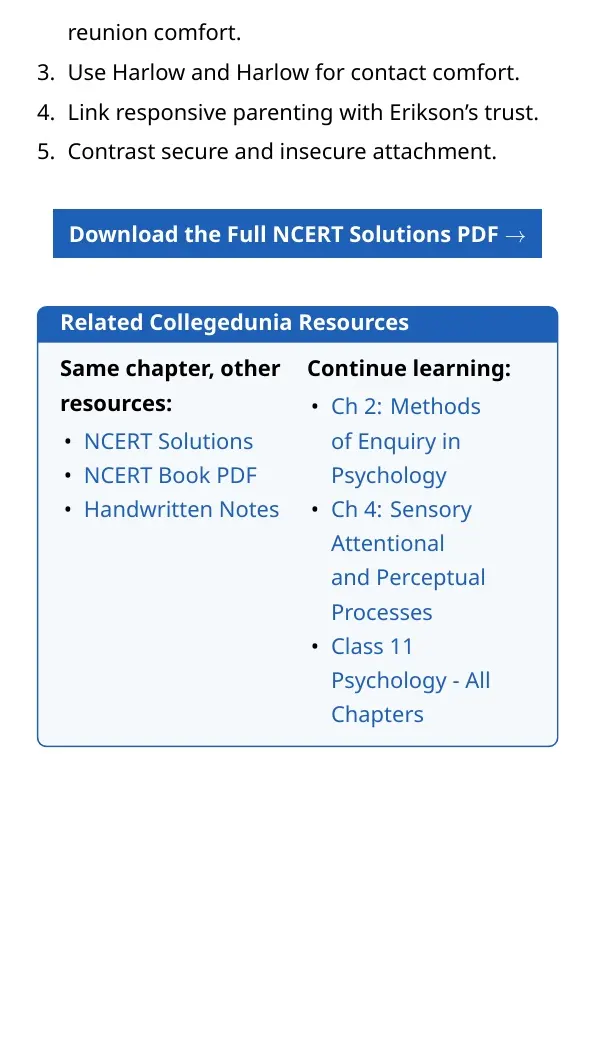
- Attachment: emotional bond with caregivers supports security.
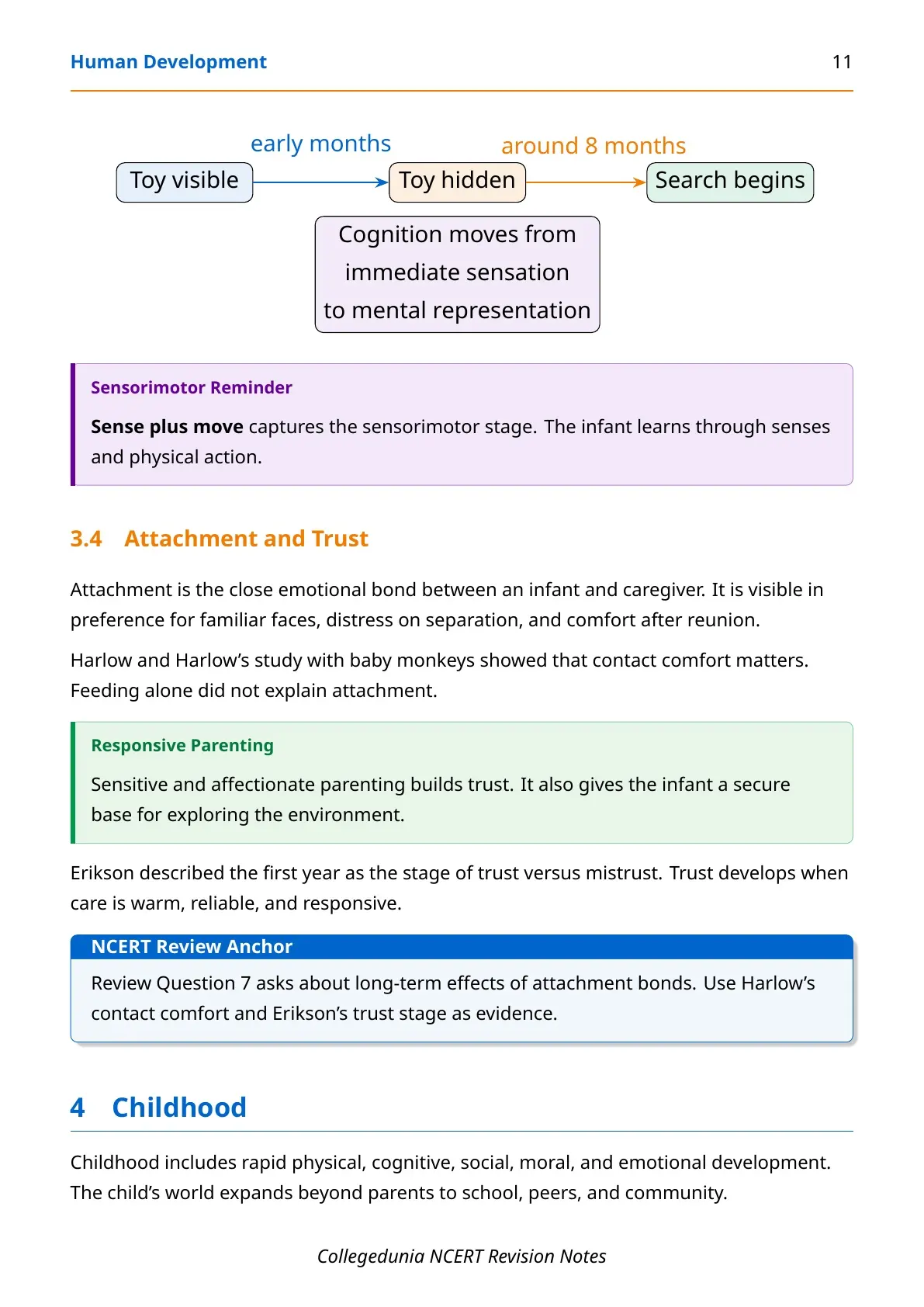
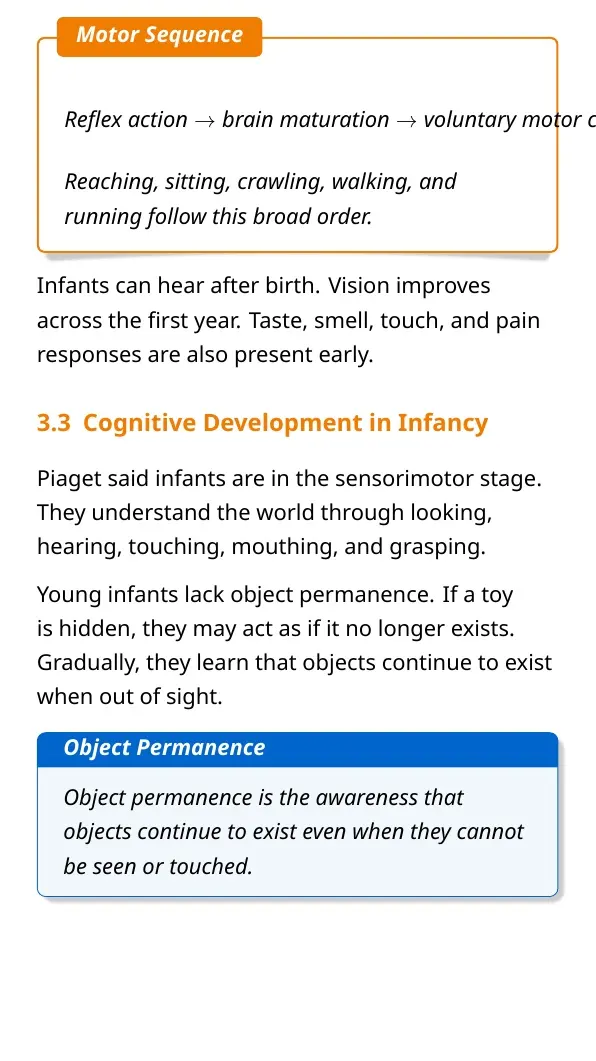
- Object permanence: the child begins to understand that objects exist even when hidden.
Childhood Development and Social Learning
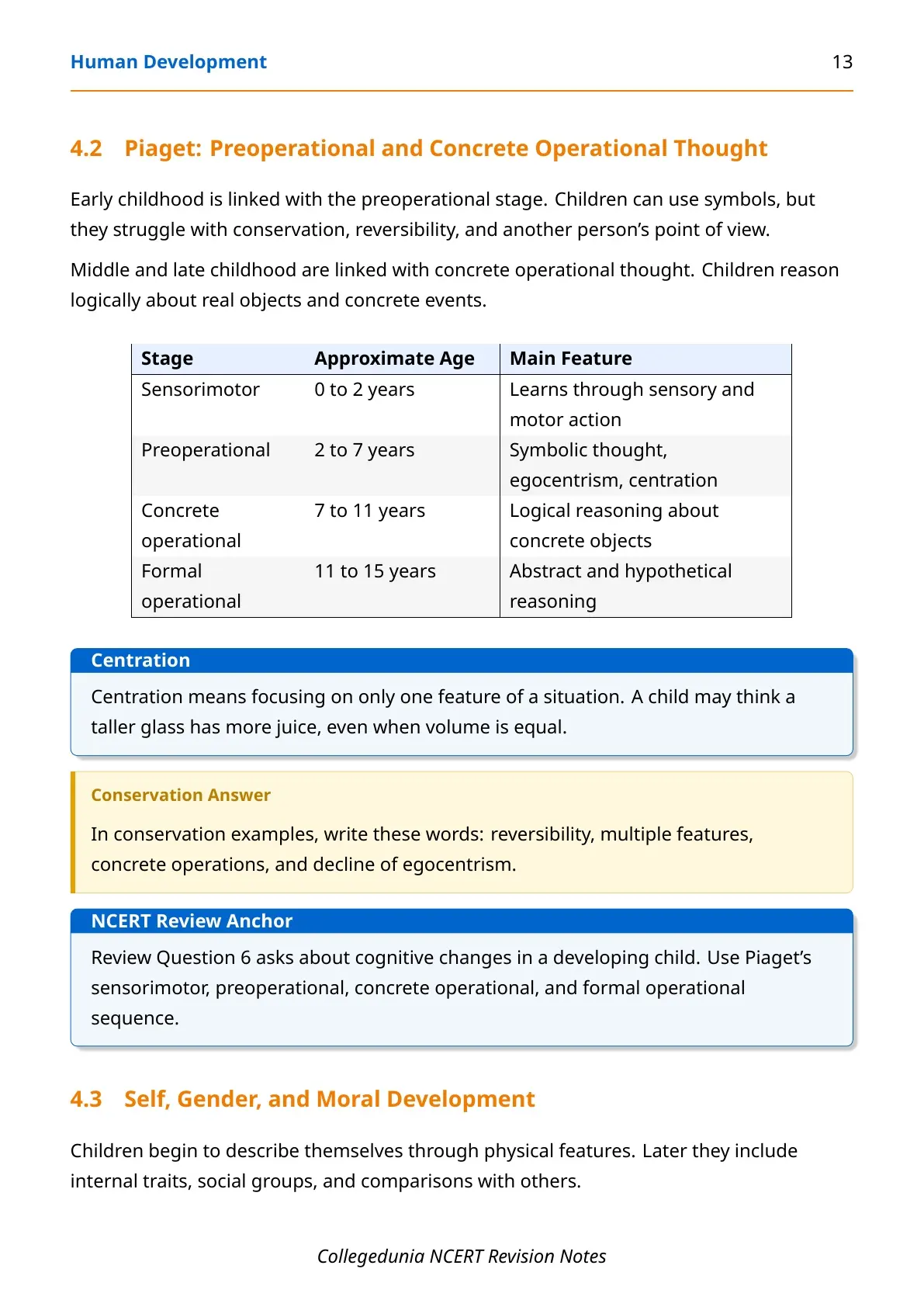
Childhood expands the child's world beyond home. Language grows, thinking becomes more organised, school habits develop and peer relationships become important. Children learn rules, cooperation, competition and self-control through play, family expectations and classroom routines.
| Area | Development in childhood | Revision example |
|---|---|---|
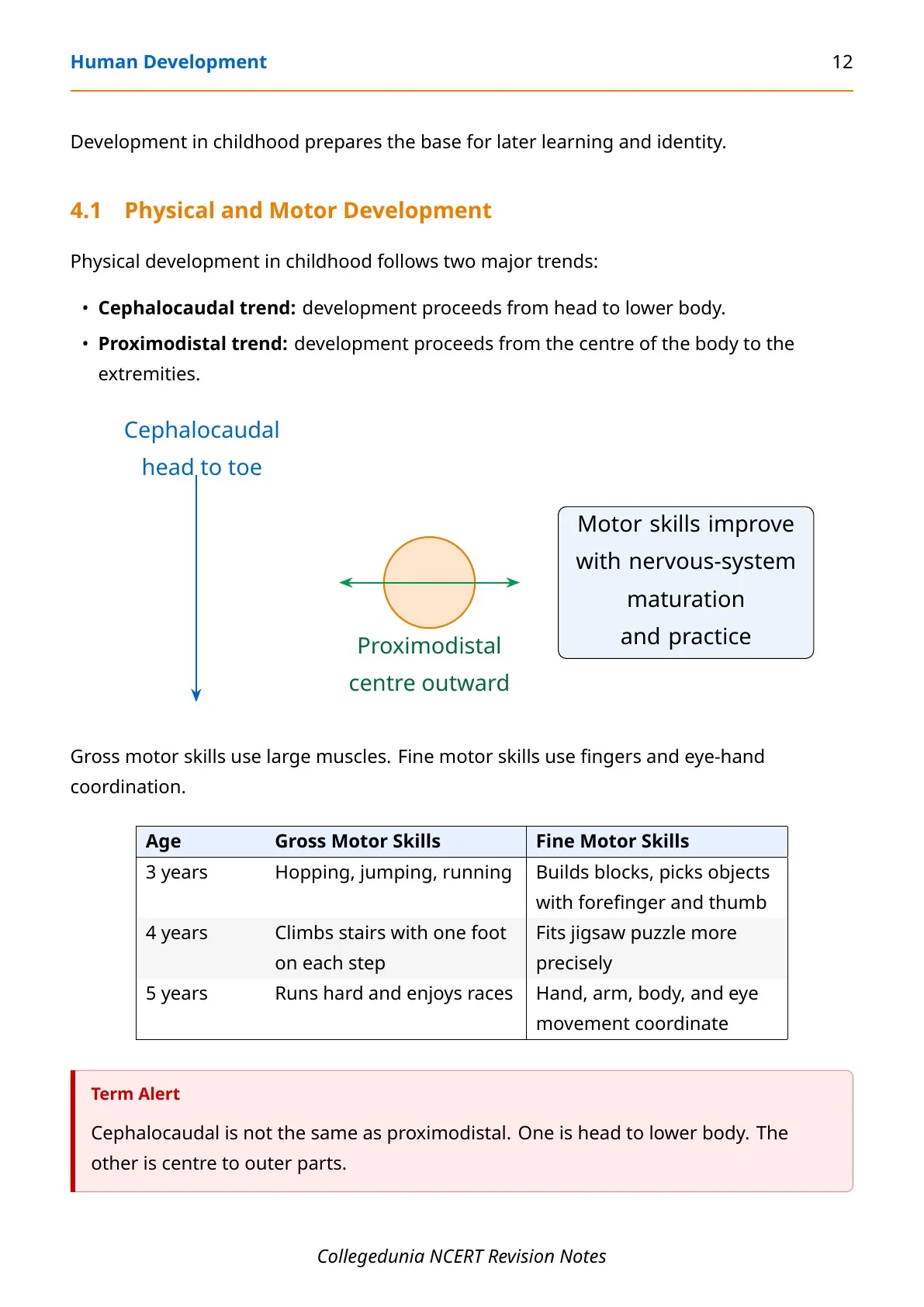
| Physical | Steady growth and better coordination | Writing, running, drawing |
| Cognitive | Memory, classification and problem solving improve | Following classroom instructions |
| Social | Friendship and group rules matter more | Sharing and team play |
| Emotional | Self-control and empathy improve gradually | Waiting for turn, helping peers |
Adolescence, Identity and Peer Relations
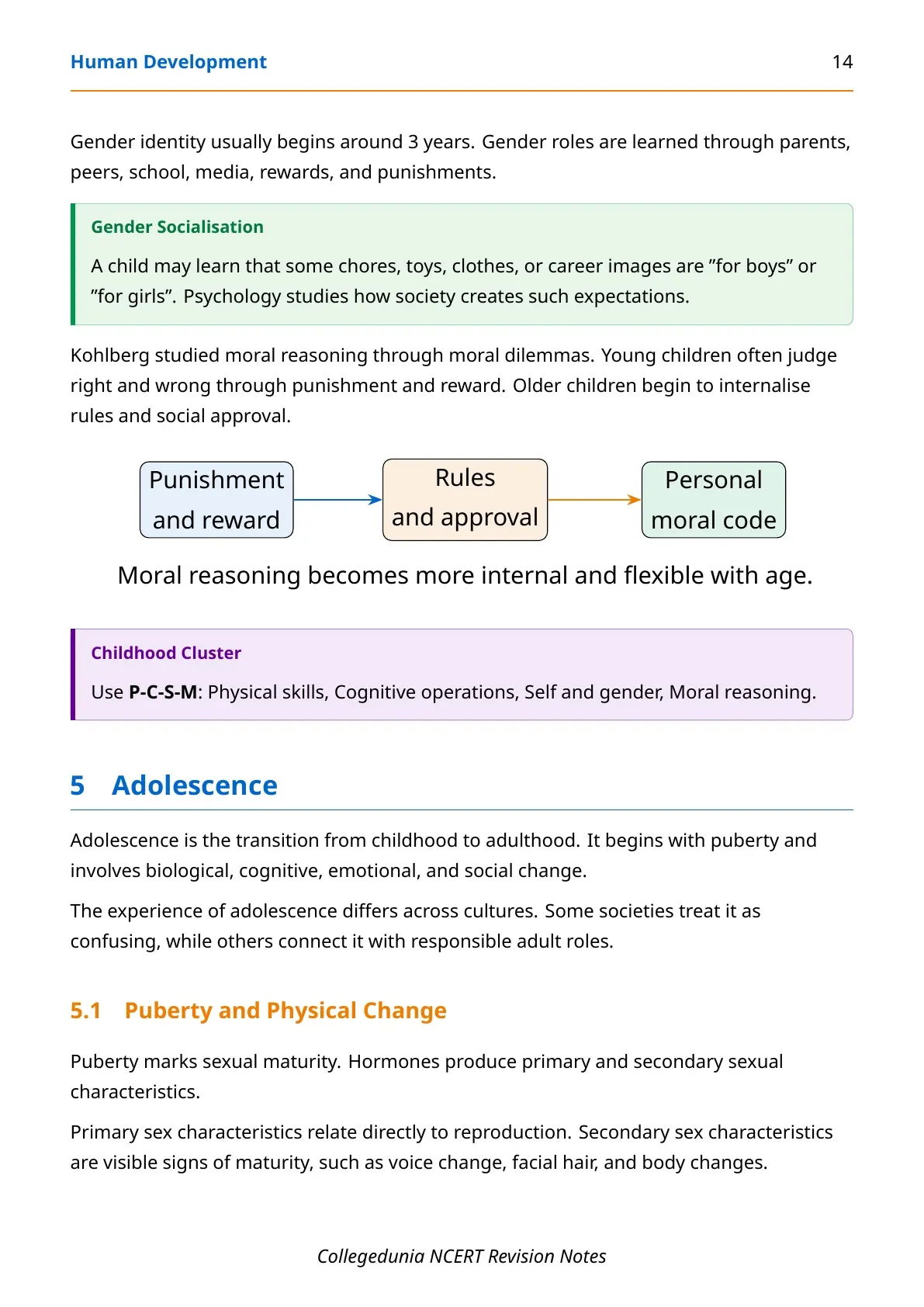
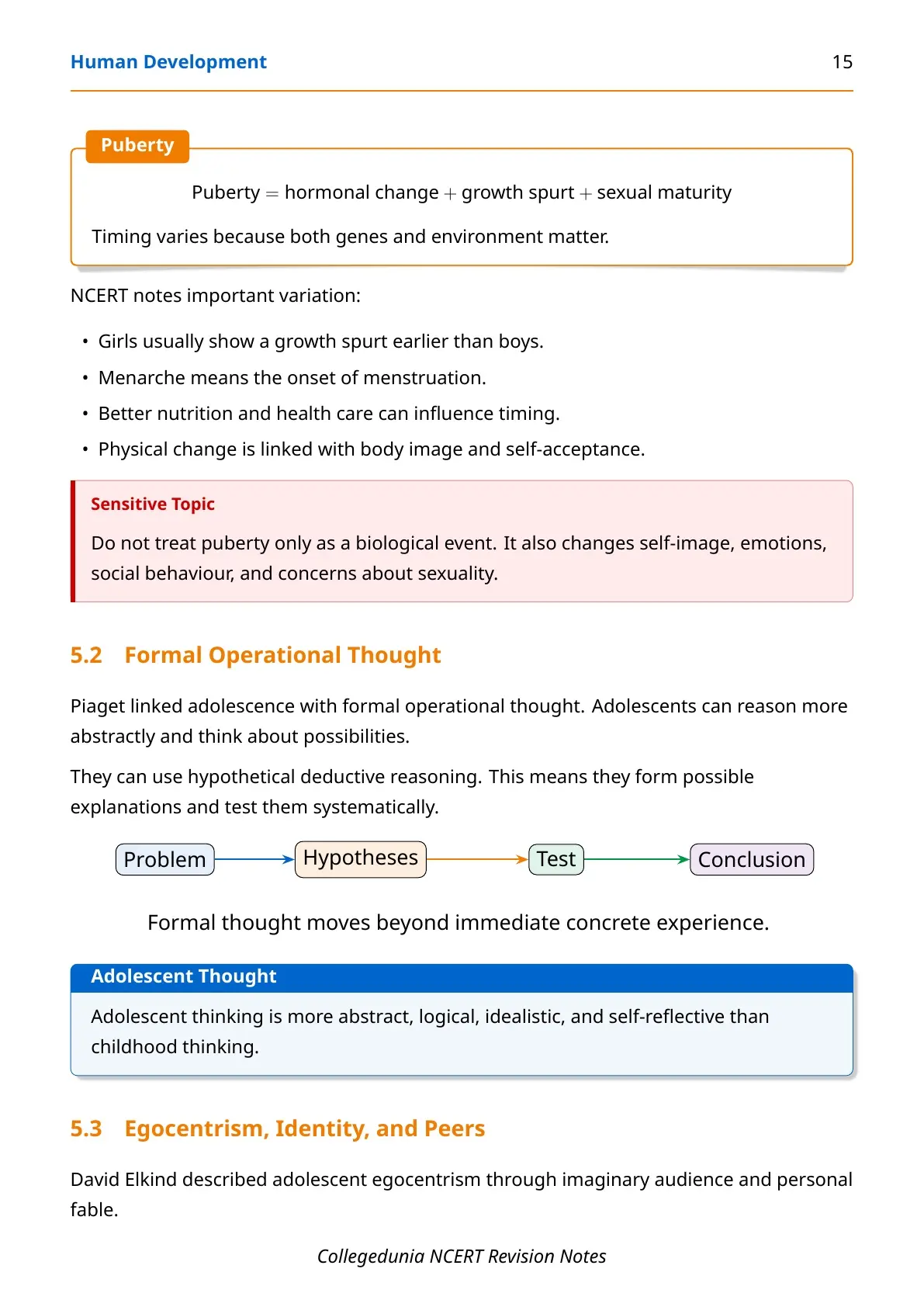
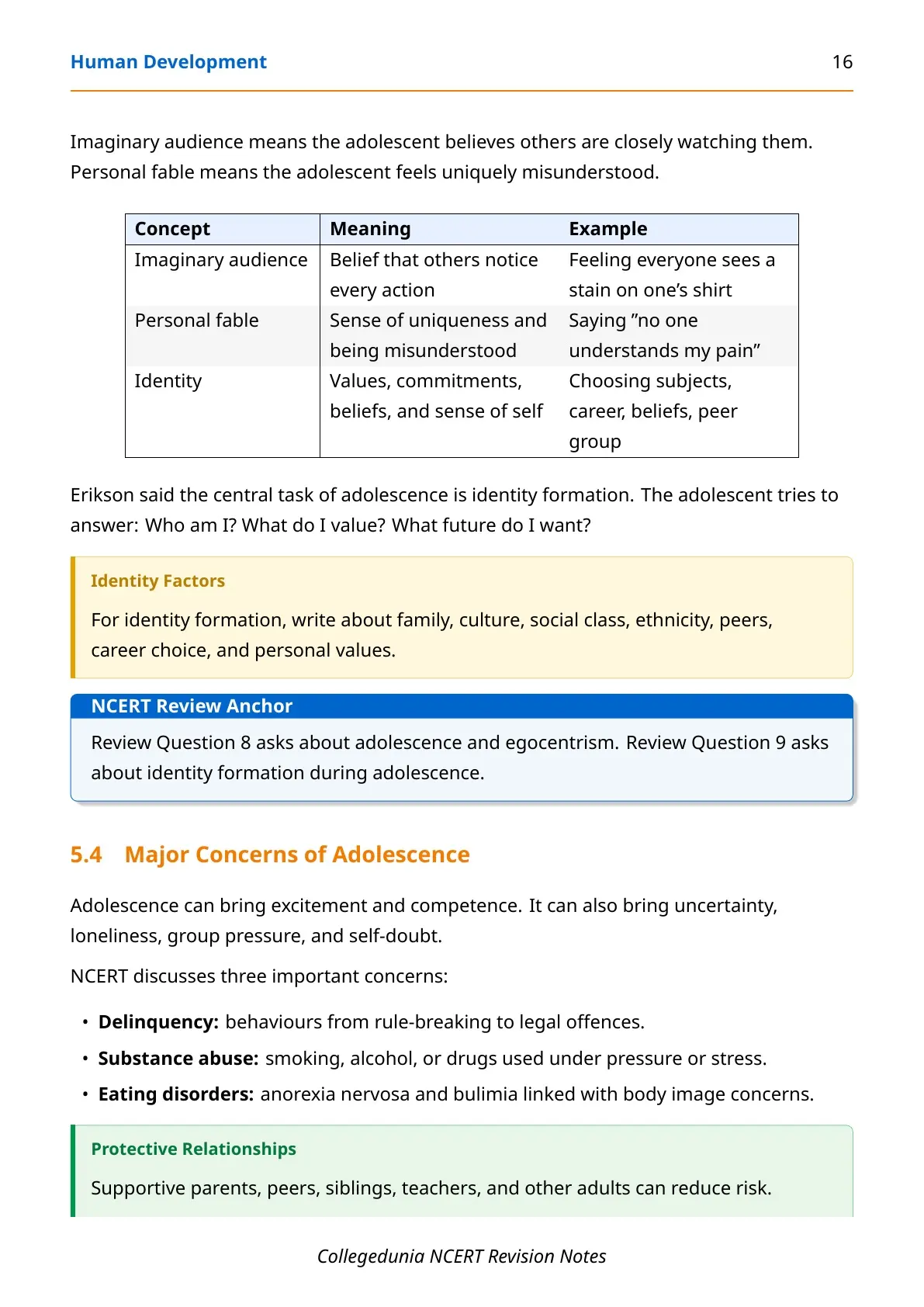
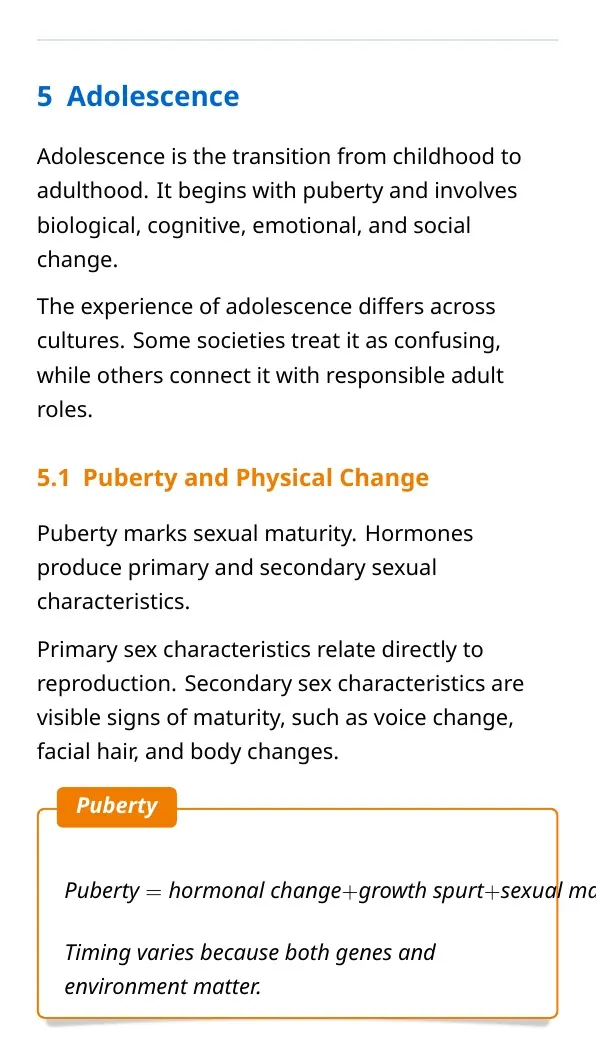
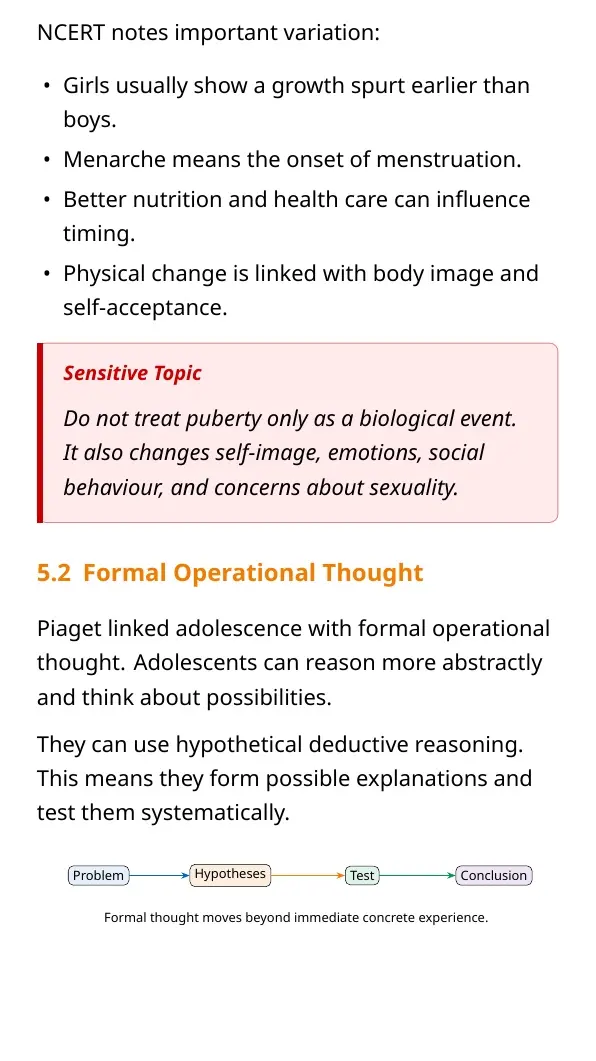
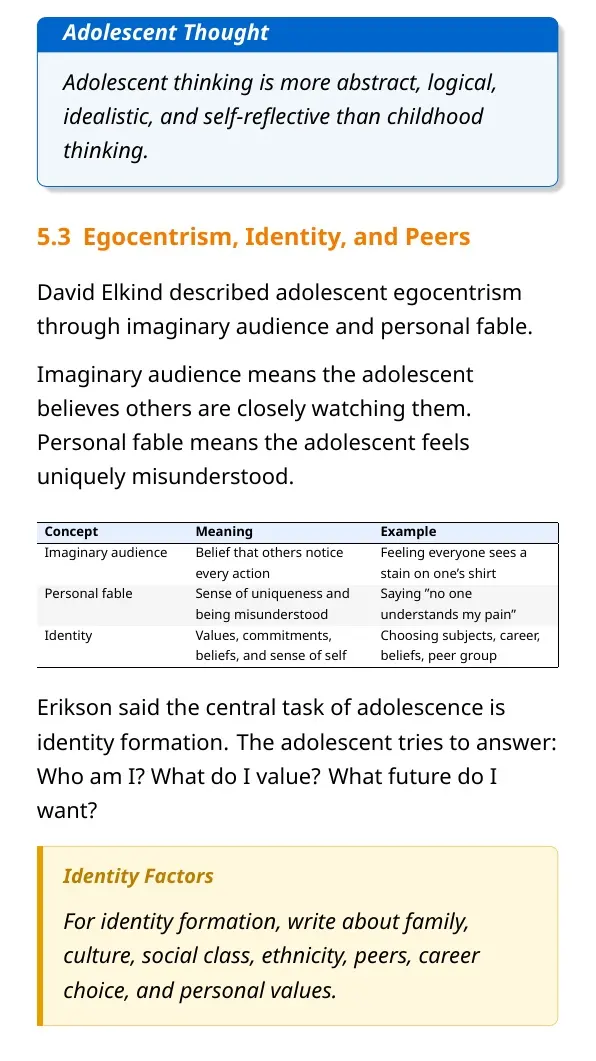
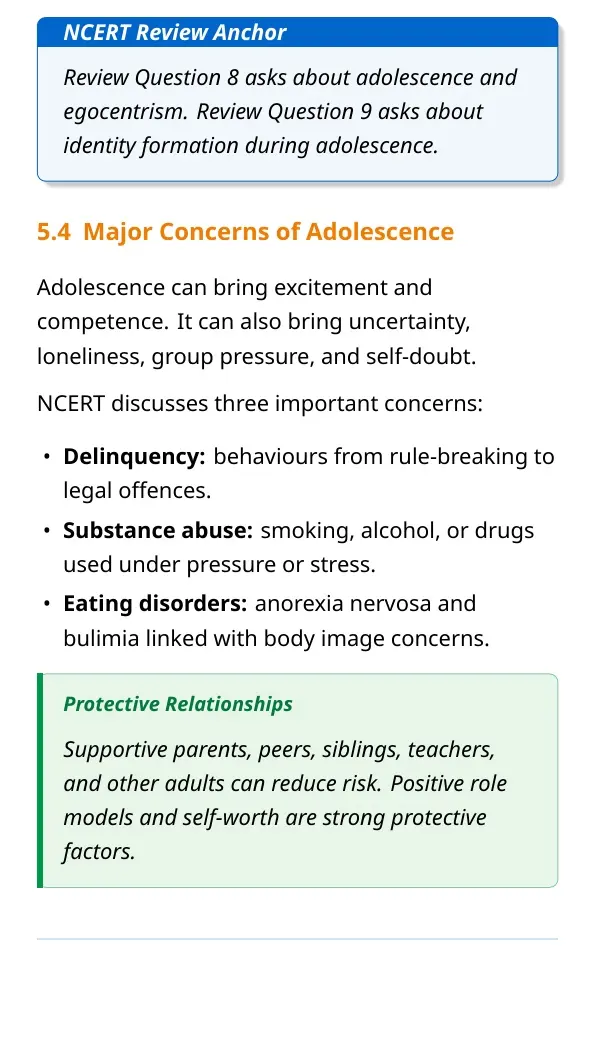
Adolescence is the transition from childhood to adulthood. Puberty brings biological change, while identity, independence, peer acceptance and future goals become psychologically important. Students should avoid reducing adolescence to only physical change. NCERT treats it as a stage with biological, cognitive, emotional and social dimensions.
- Puberty changes the body and creates new self-awareness.
- Thinking becomes more abstract and future-oriented.
- Identity questions become central to self-understanding.
- Peers become important, but family continues to influence values and support.
Adulthood, Old Age and Developmental Tasks
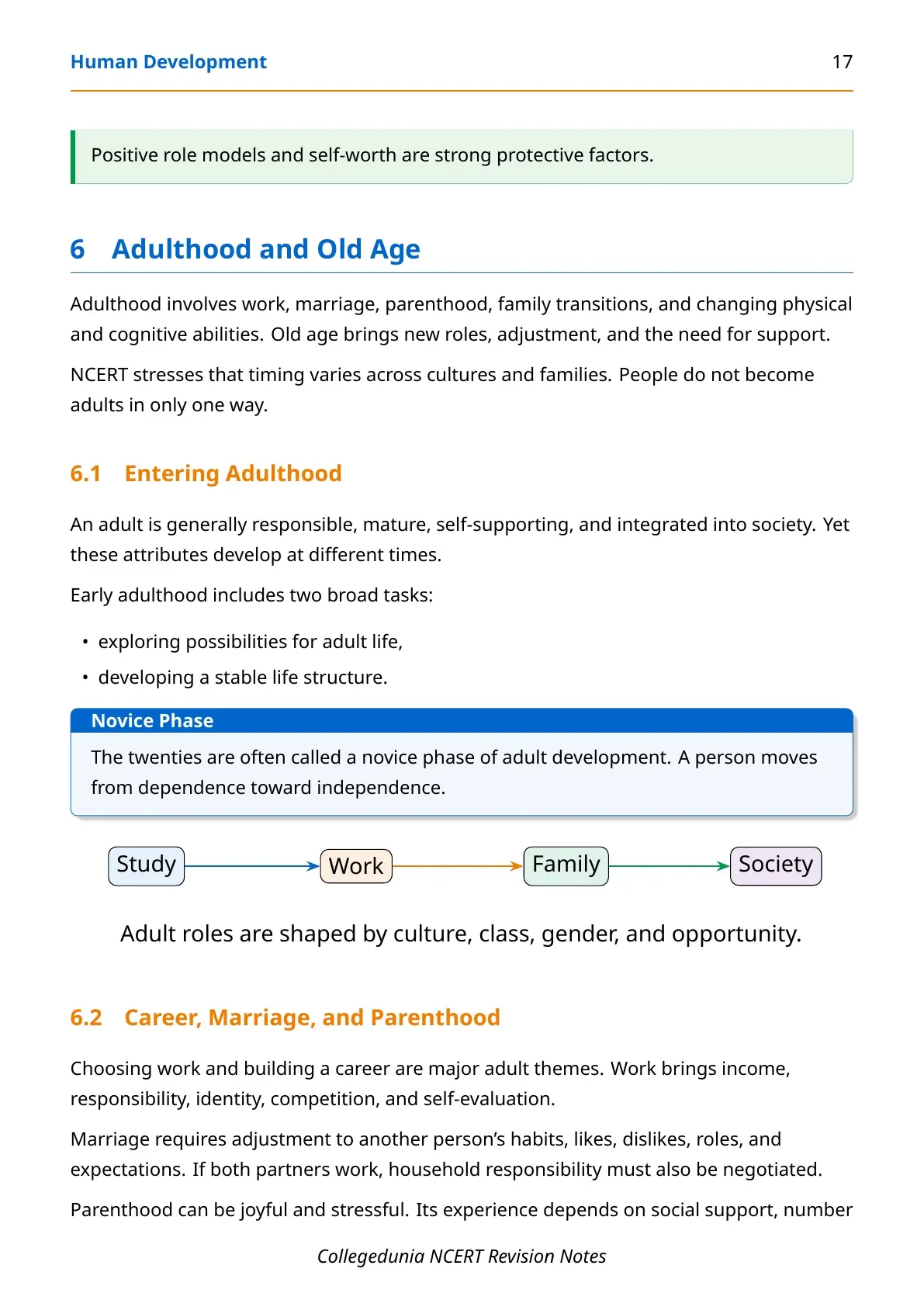
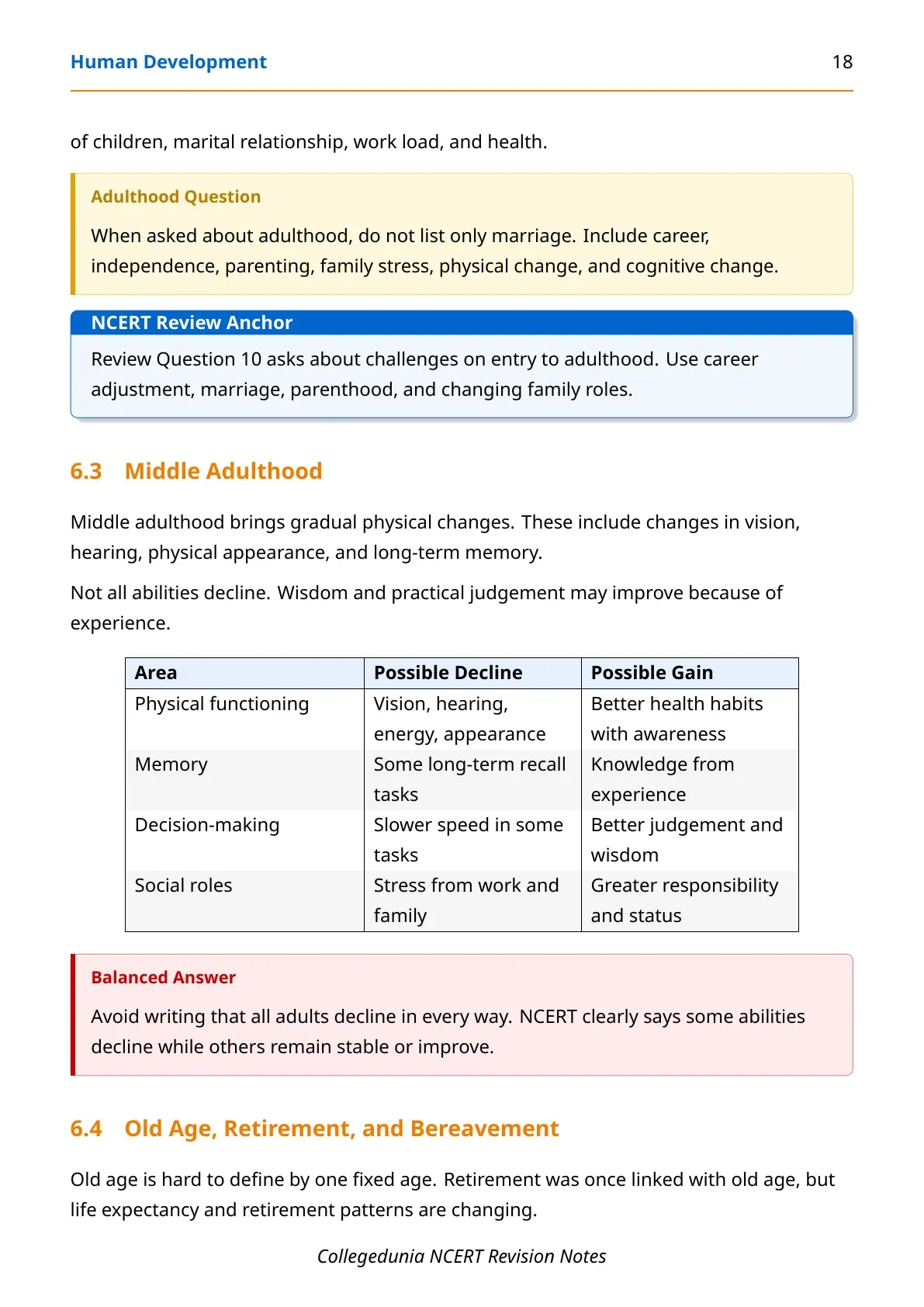
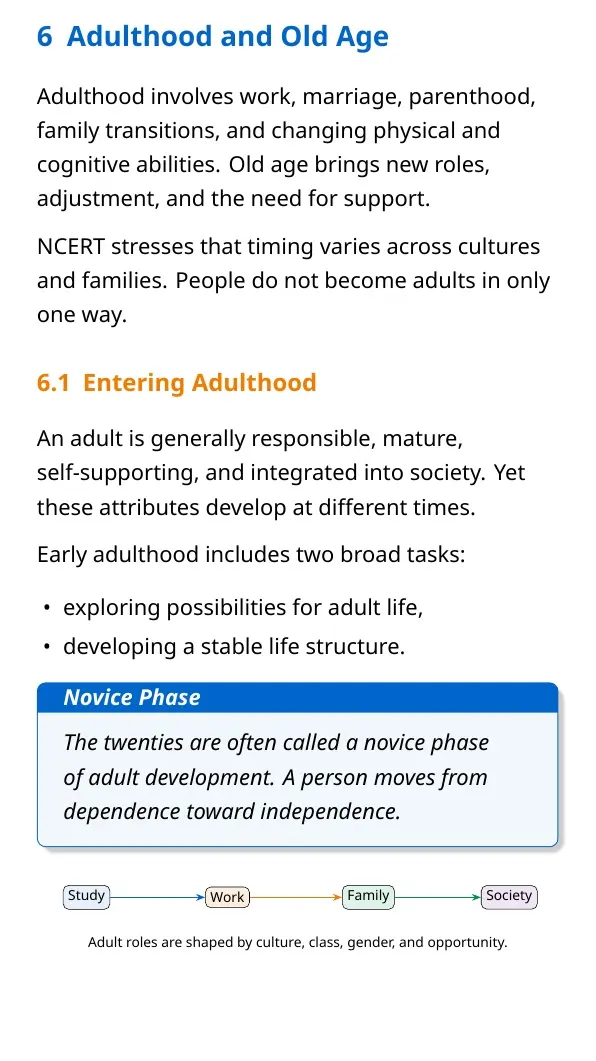
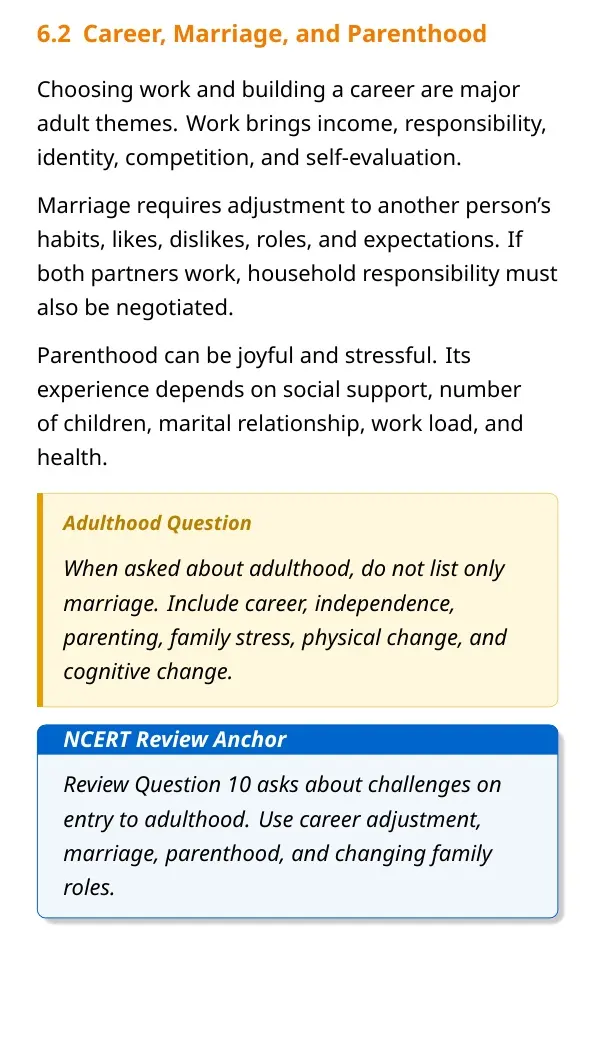
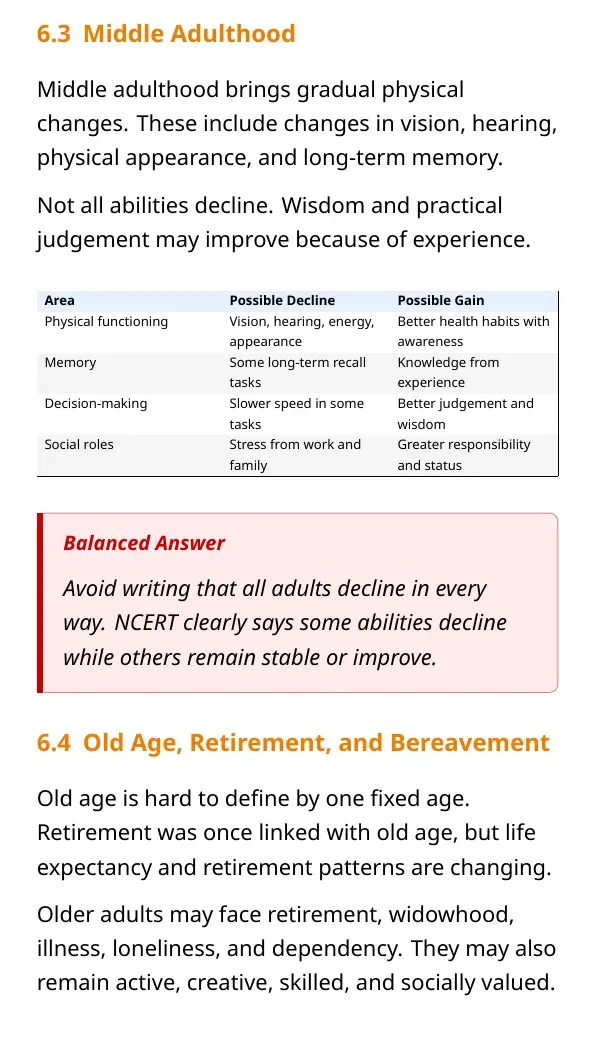
Development continues in adulthood through work, intimacy, parenting, social responsibility and adaptation to change. In old age, people may face retirement, health changes, bereavement and the need for life review. The chapter asks students to see ageing as a developmental phase, not as only decline.
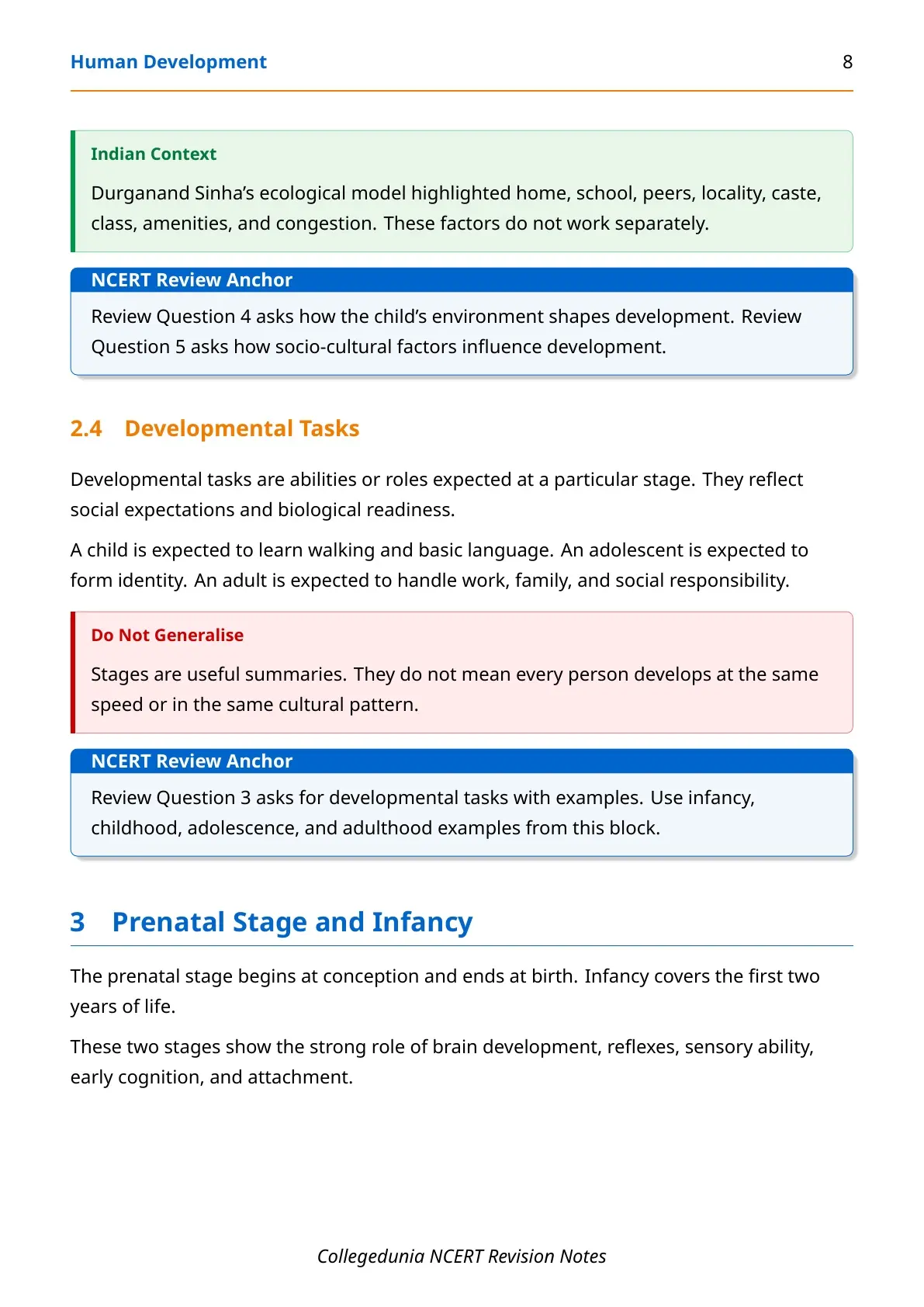
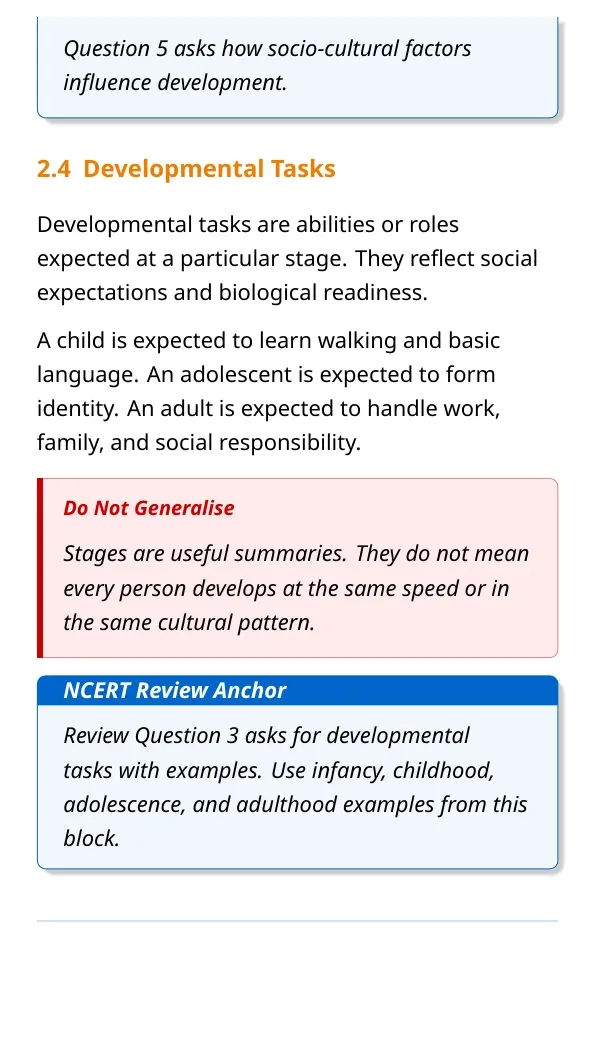
Developmental tasks are age-related expectations that society usually places before a person. In school answers, write the task and then explain it with one example. For example, childhood includes school learning and peer adjustment, adolescence includes identity formation, and adulthood includes work and responsibility.
Download the Human Development Notes PDF
Use the PDF for Chapter 3 definitions, life stages, context systems and revision tables.
Download PDFRelated Psychology Resources for Human Development
Also Check: use these links with the notes PDF when you need the same chapter in another format.
| Resource | Best use | Link |
|---|---|---|
| NCERT Solutions | Stepwise answers to textbook review questions | Human Development Class 11 NCERT Solutions |
| NCERT Book PDF | Original NCERT reading and review questions | Human Development Class 11 NCERT Book PDF |
| Handwritten Notes | Fast visual revision before tests | Human Development Class 11 Handwritten Notes |
Class 11 Psychology Notes for All Chapters
| Chapter | Notes Link |
|---|---|
| Chapter 1 | What is Psychology? Notes |
| Chapter 2 | Methods of Enquiry in Psychology Notes |
| Chapter 3 | You are here |
| Chapter 4 | Sensory, Attentional and Perceptual Processes Notes |
| Chapter 5 | Learning Notes |
| Chapter 6 | Human Memory Notes |
| Chapter 7 | Thinking Notes |
| Chapter 8 | Motivation and Emotion Notes |
Human Development Class 11 Notes FAQs
Ques. What is covered in Class 11 Psychology Chapter 3 notes?
Ans. The notes cover growth, development, maturation, evolution, heredity, environment, context systems, prenatal development, infancy, childhood, adolescence, adulthood and old age.
Ques. What is life span development?
Ans. Life span development means development begins before birth and continues throughout life. It includes physical, cognitive, social and emotional changes at every stage.
Ques. What is the role of heredity and environment in development?
Ans. Heredity gives biological potential, while environment provides the conditions that support, restrict or redirect how that potential appears in behaviour.
Ques. Why is adolescence important in Human Development?
Ans. Adolescence is important because puberty, identity formation, independence, abstract thinking and peer relations become central during this transition to adulthood.



Comments