



NCERT Notes Class 11 Psychology Chapter 4 Sensory, Attentional and Perceptual Processes help students revise sensation, attention, perception, depth cues, Gestalt organisation, constancies, illusions and socio-cultural influences for the 2026-27 syllabus. These notes turn the NCERT chapter into quick definitions, tables, diagrams and exam-ready answer frames.
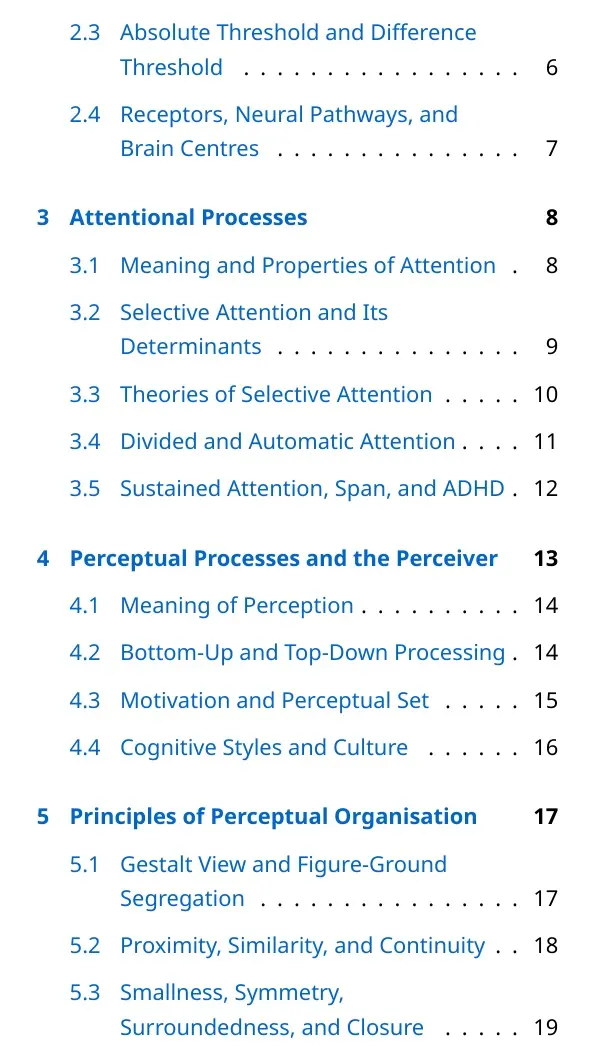
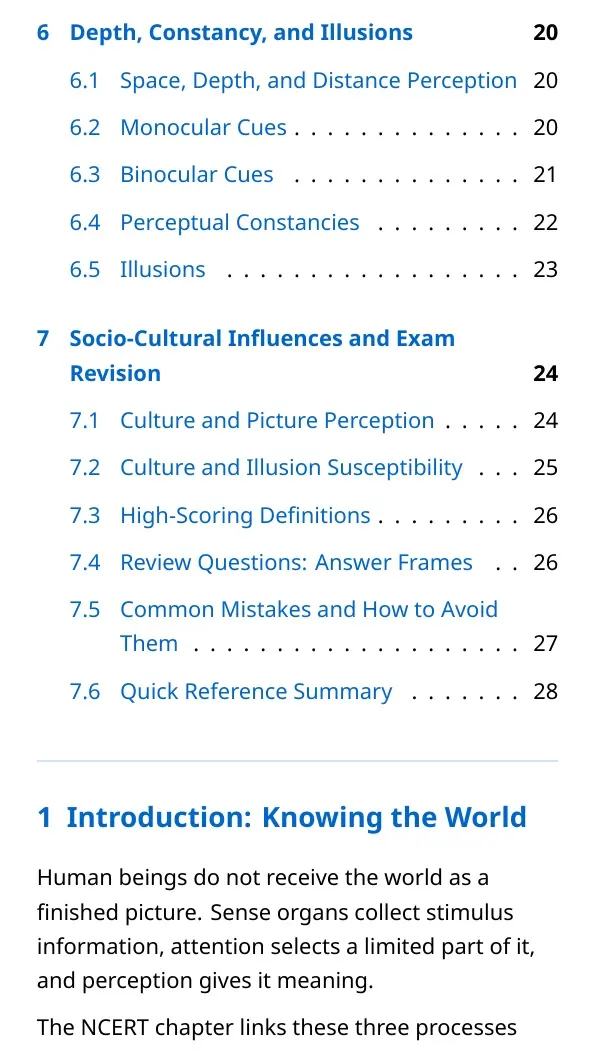
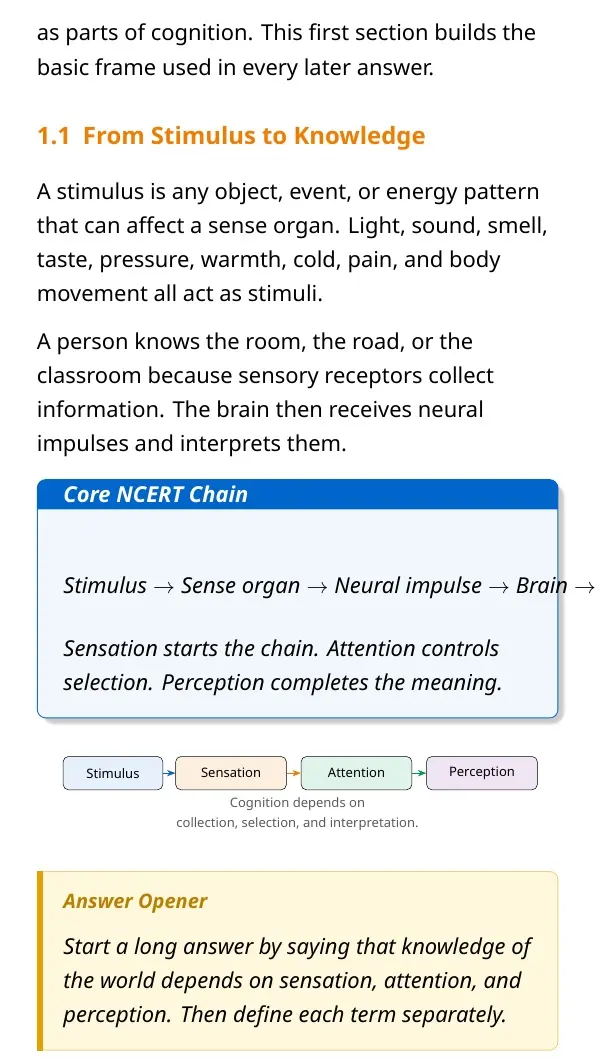
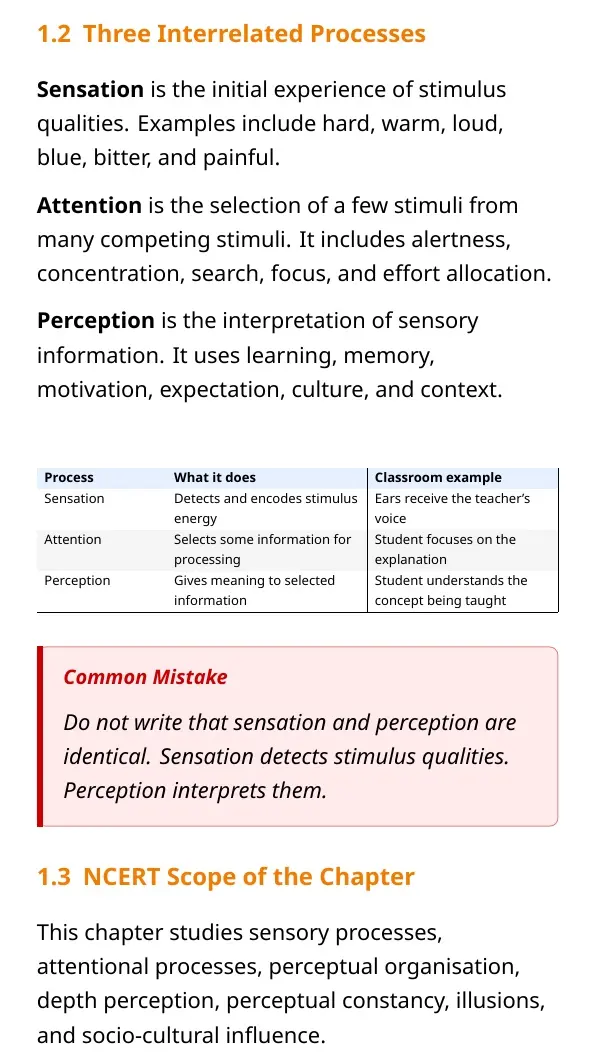
- Download the Sensory, Attentional and Perceptual Processes notes PDF for offline revision.
- Revise absolute threshold, selective attention, depth cues, Gestalt principles and illusions with NCERT examples.
- Use the tables to compare sensation and perception, monocular and binocular cues, and the major attention types.
Student Feedback: In a Collegedunia poll of 8,940 Class 11 Psychology students, 71% said the hardest part of Chapter 4 was separating attention terms from perception terms.
Source: 2026-27 Class 11 Psychology student poll across CBSE schools.
Download the Sensory, Attentional and Perceptual Processes Notes PDF
Use the PDF for Chapter 4 definitions, diagrams, cue tables and quick revision before tests.
Download PDF|
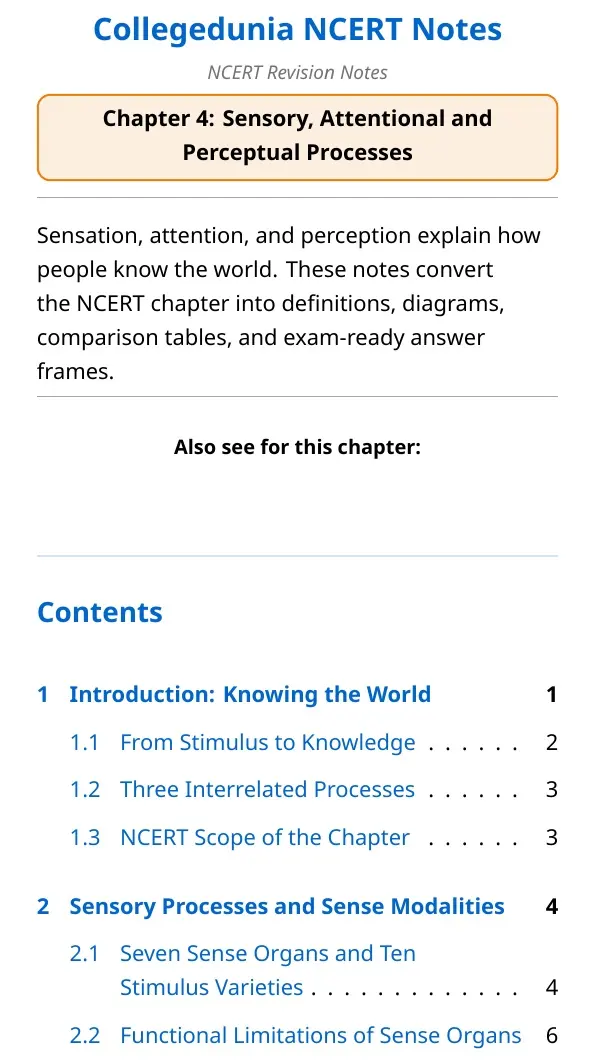
Table of Contents |
Sensory, Attentional and Perceptual Processes Class 11 Notes: Chapter Overview
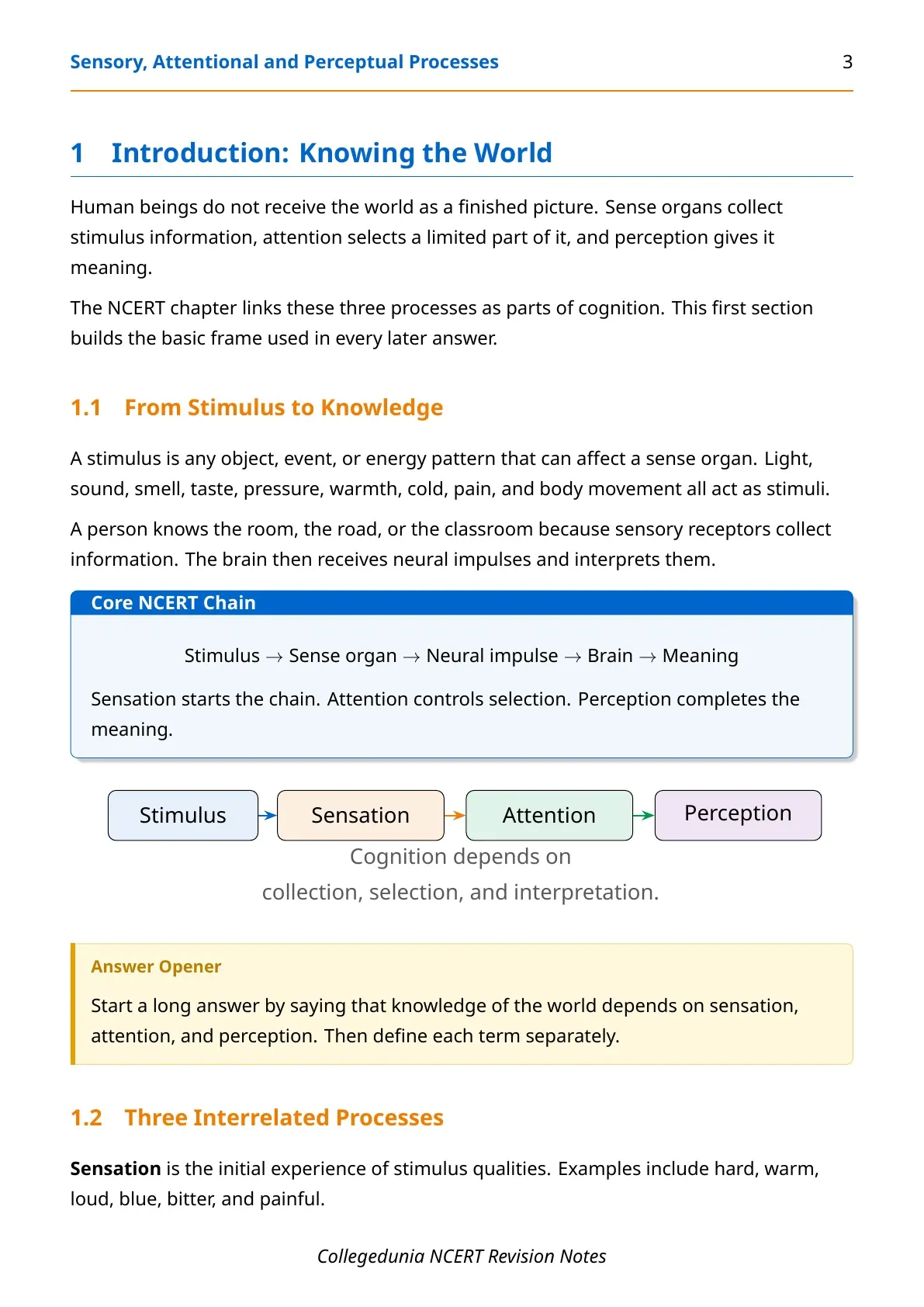
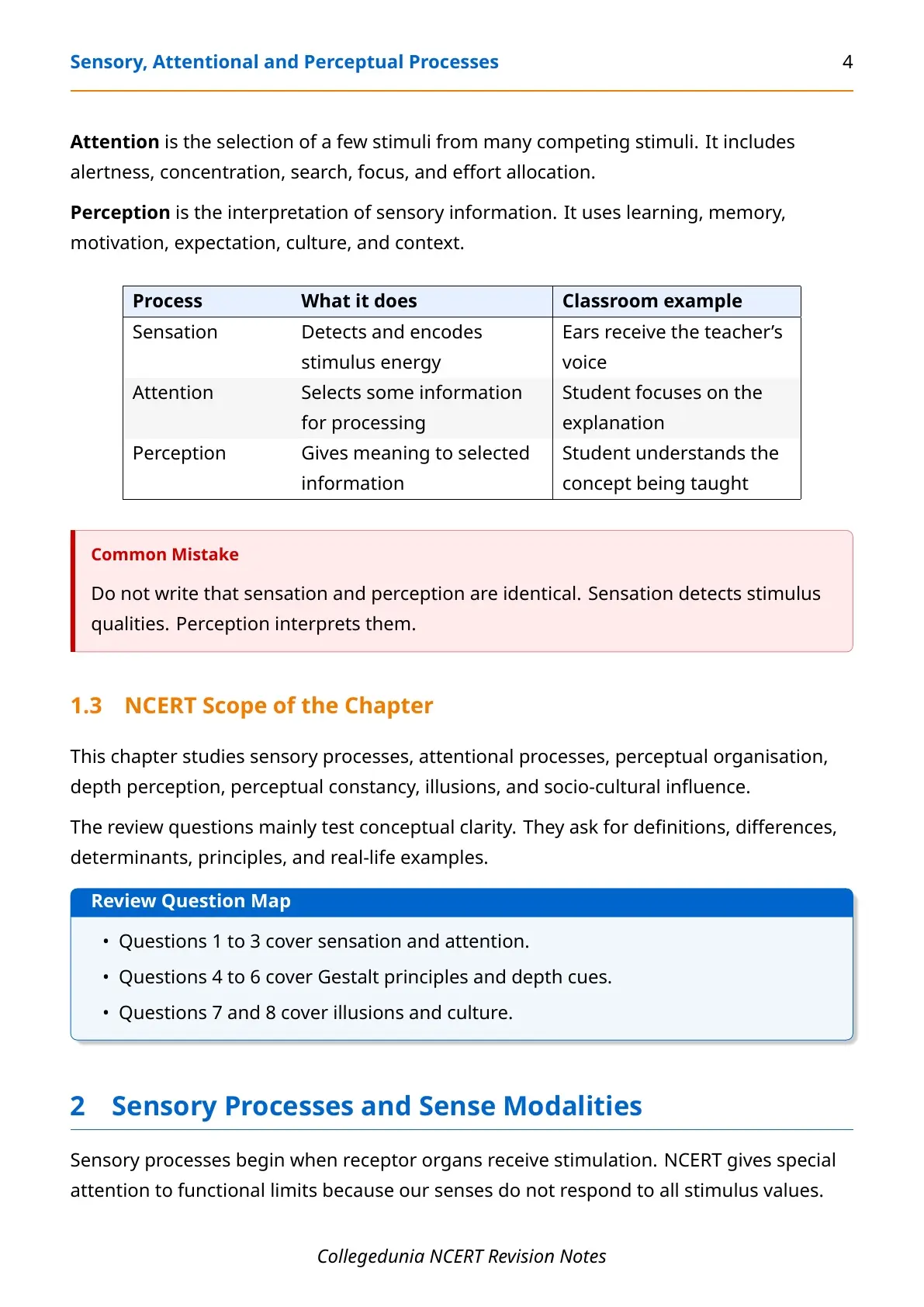
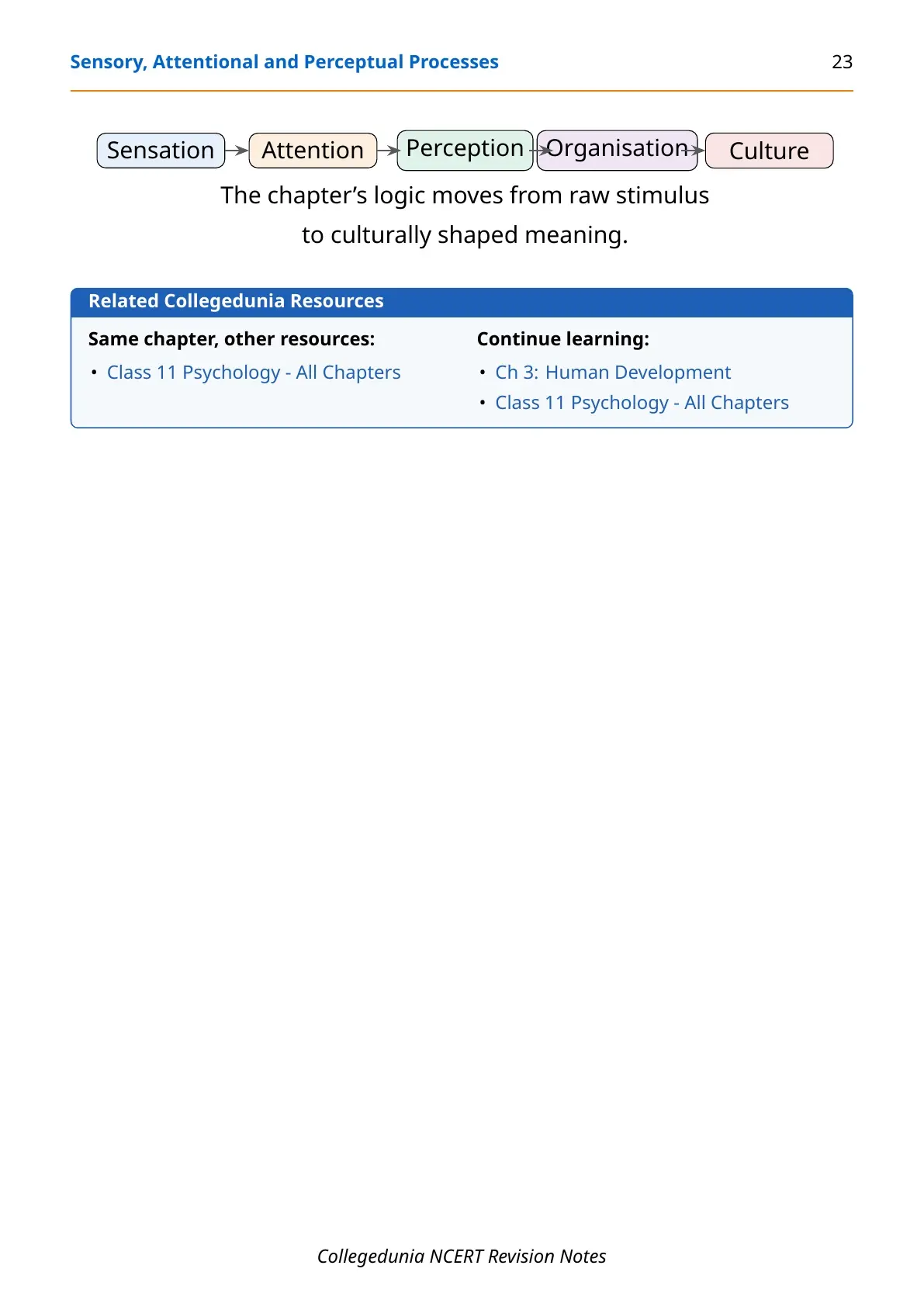
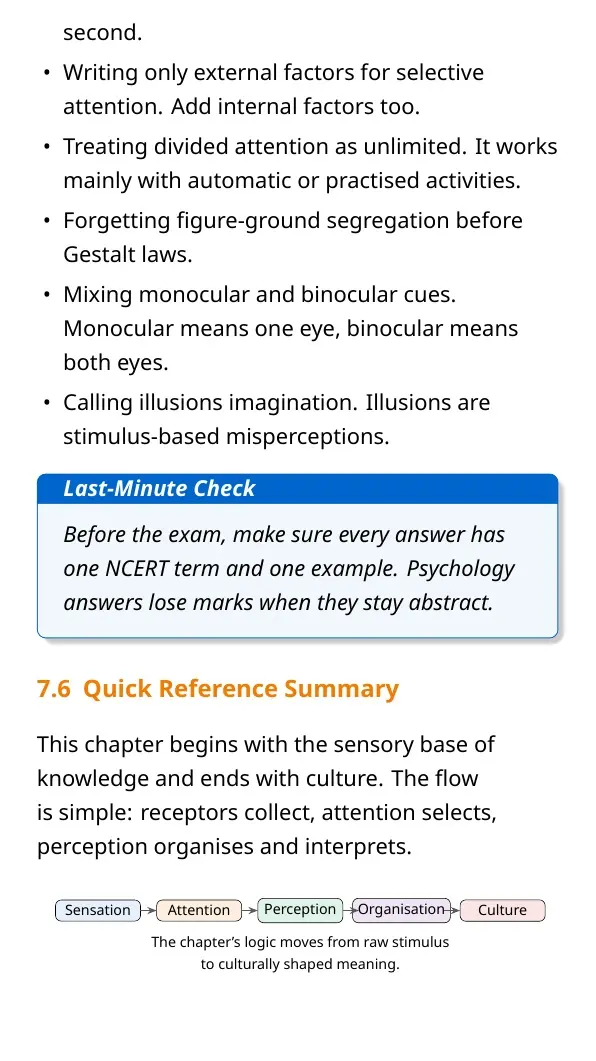
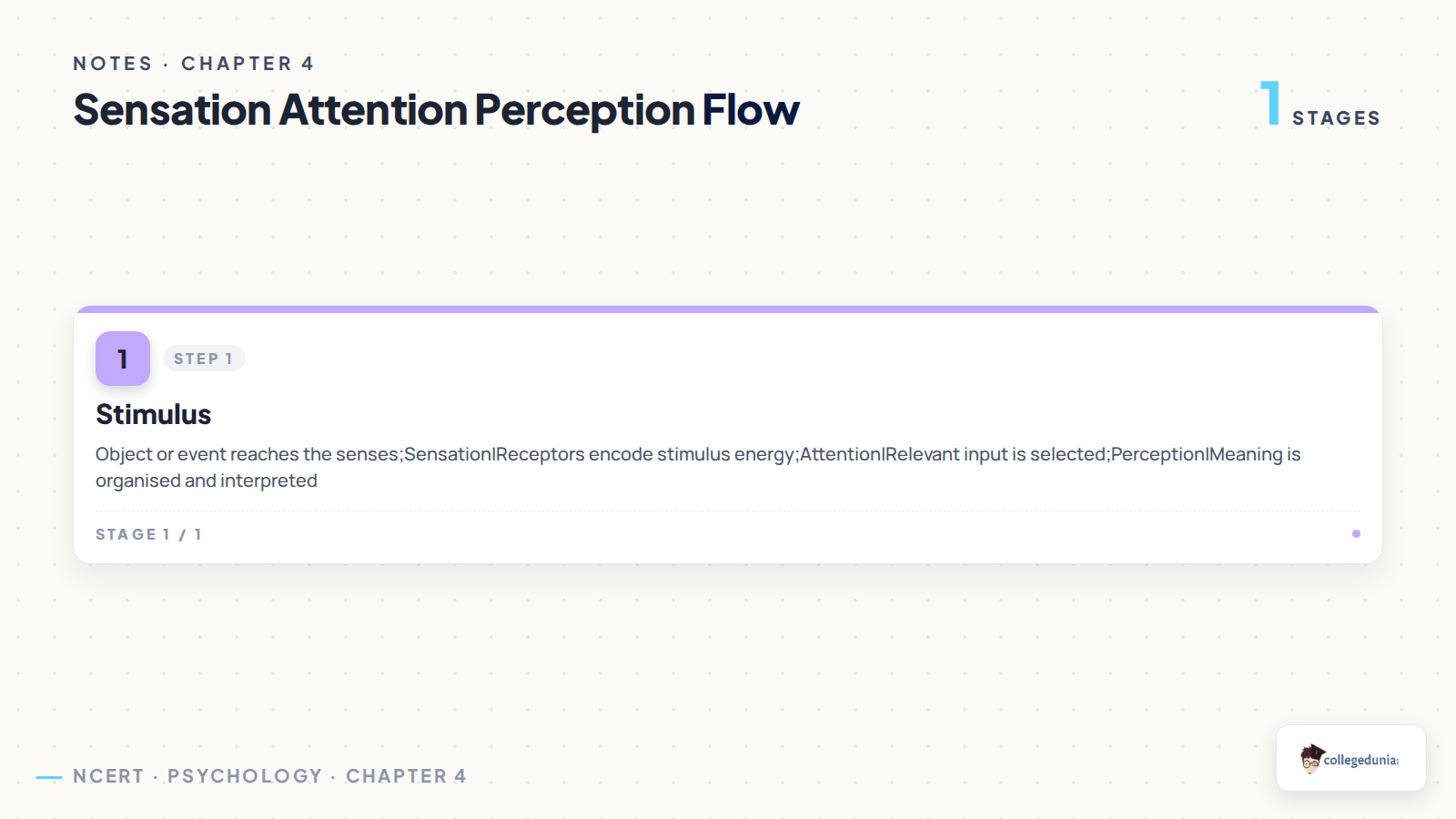
Chapter 4 explains how people know the world around them. Sensation detects stimulus qualities, attention selects a limited part of the sensory field, and perception gives meaning to selected information. The safest exam line is simple: cognition begins with sensory input but becomes meaningful only through attention and perception.
| Chapter area | What to revise | Answer cue |
|---|---|---|
| Sensory processes | Sense modalities, absolute threshold and difference threshold | Use the sugar-water example |
| Attention | Selective, divided and sustained attention | Write external and internal determinants |
| Perception | Bottom-up, top-down and perceiver factors | Use motivation, expectation, style and culture |
| Organisation and depth | Gestalt laws, depth cues, constancies and illusions | Add one diagram or real-life example |
Sensory, Attentional and Perceptual Processes Video Revision
Source: Magnet Brains on YouTube
Sensation and Sense Modalities
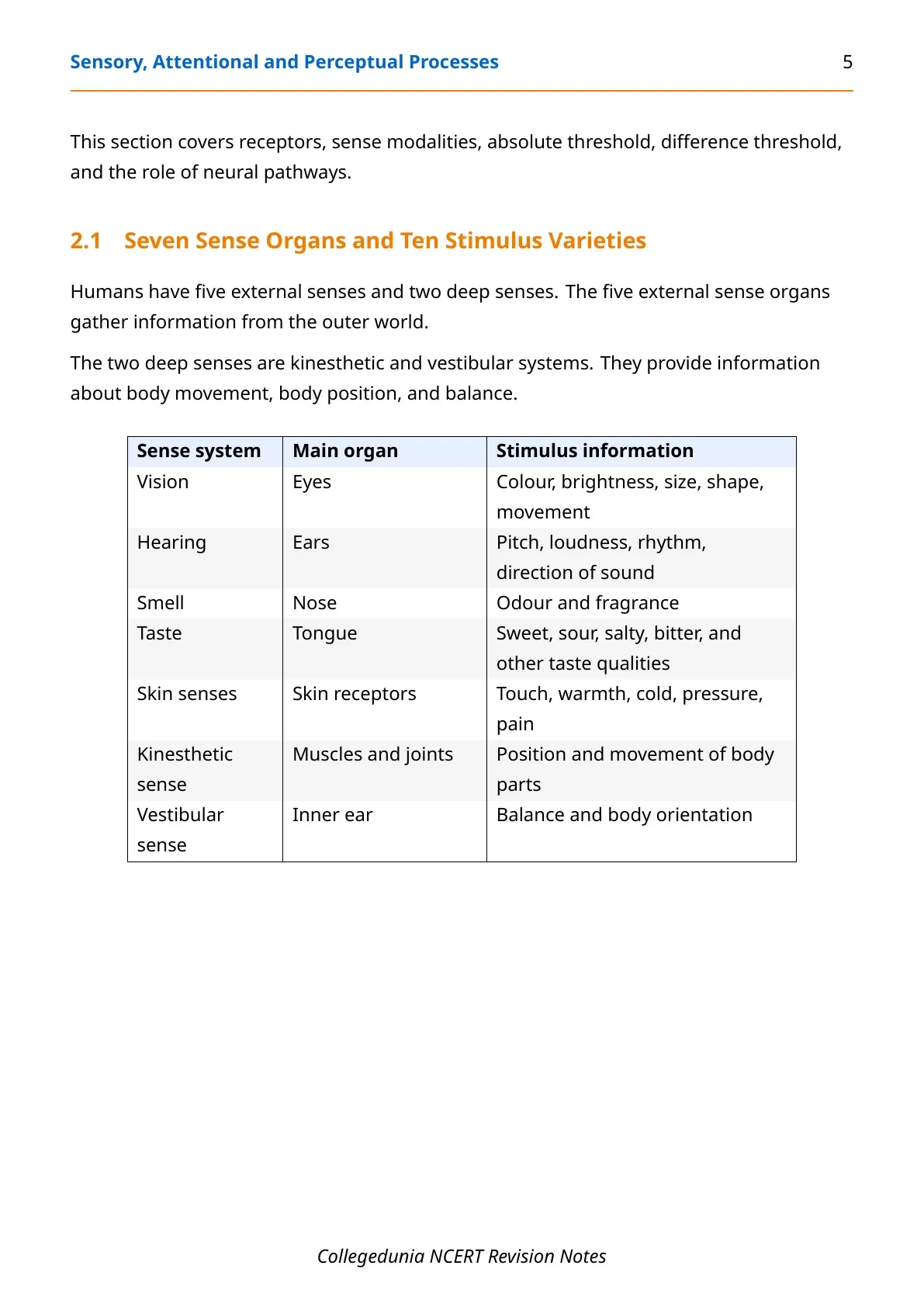
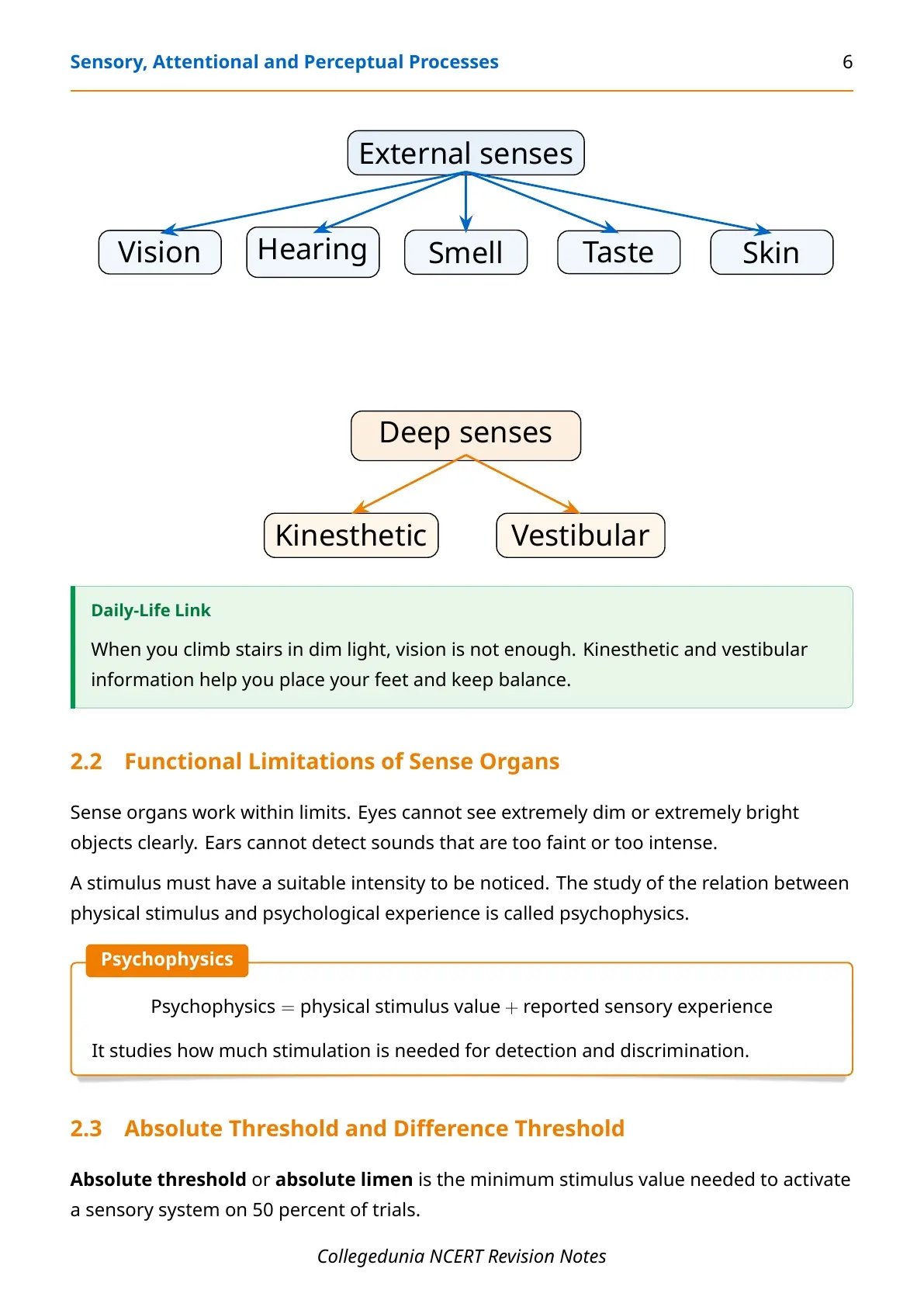
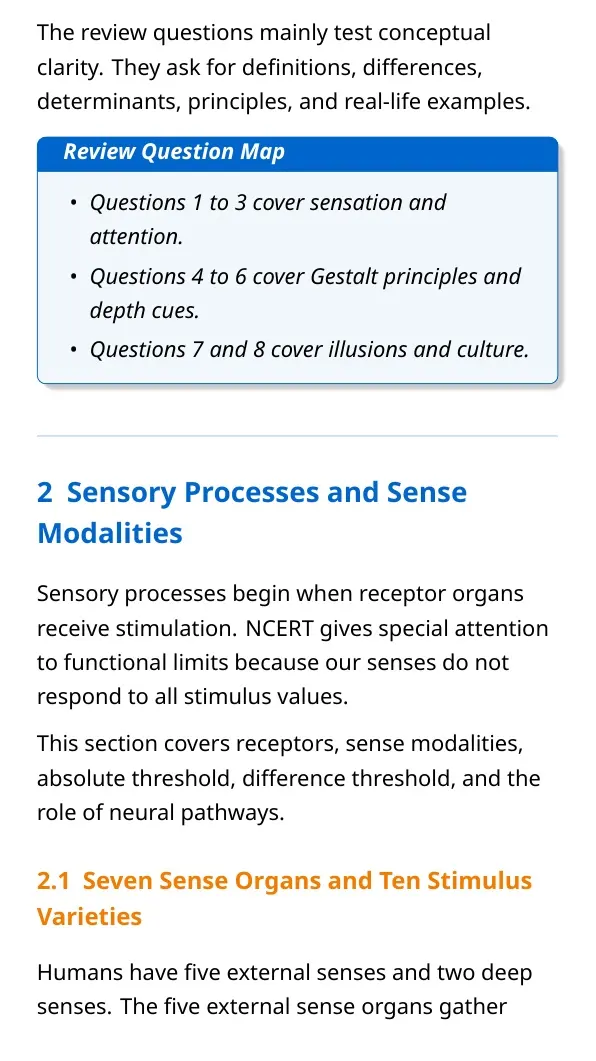
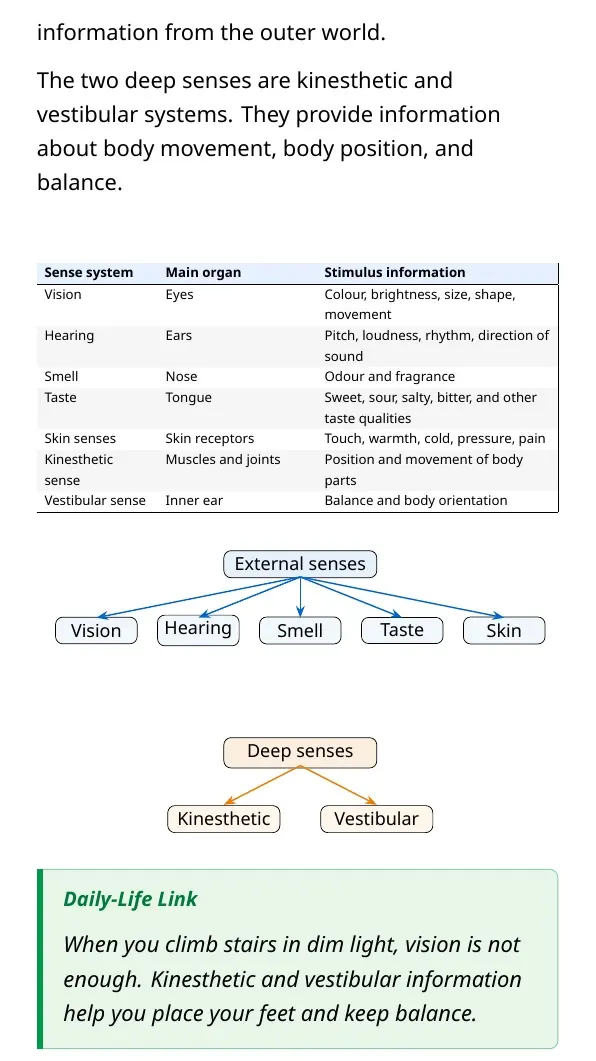
Sensation is the initial experience of a stimulus registered by a sense organ. NCERT explains that sense organs work as information-gathering systems. Five senses collect information from the external world, while kinesthetic and vestibular systems give information about body position, movement and balance.
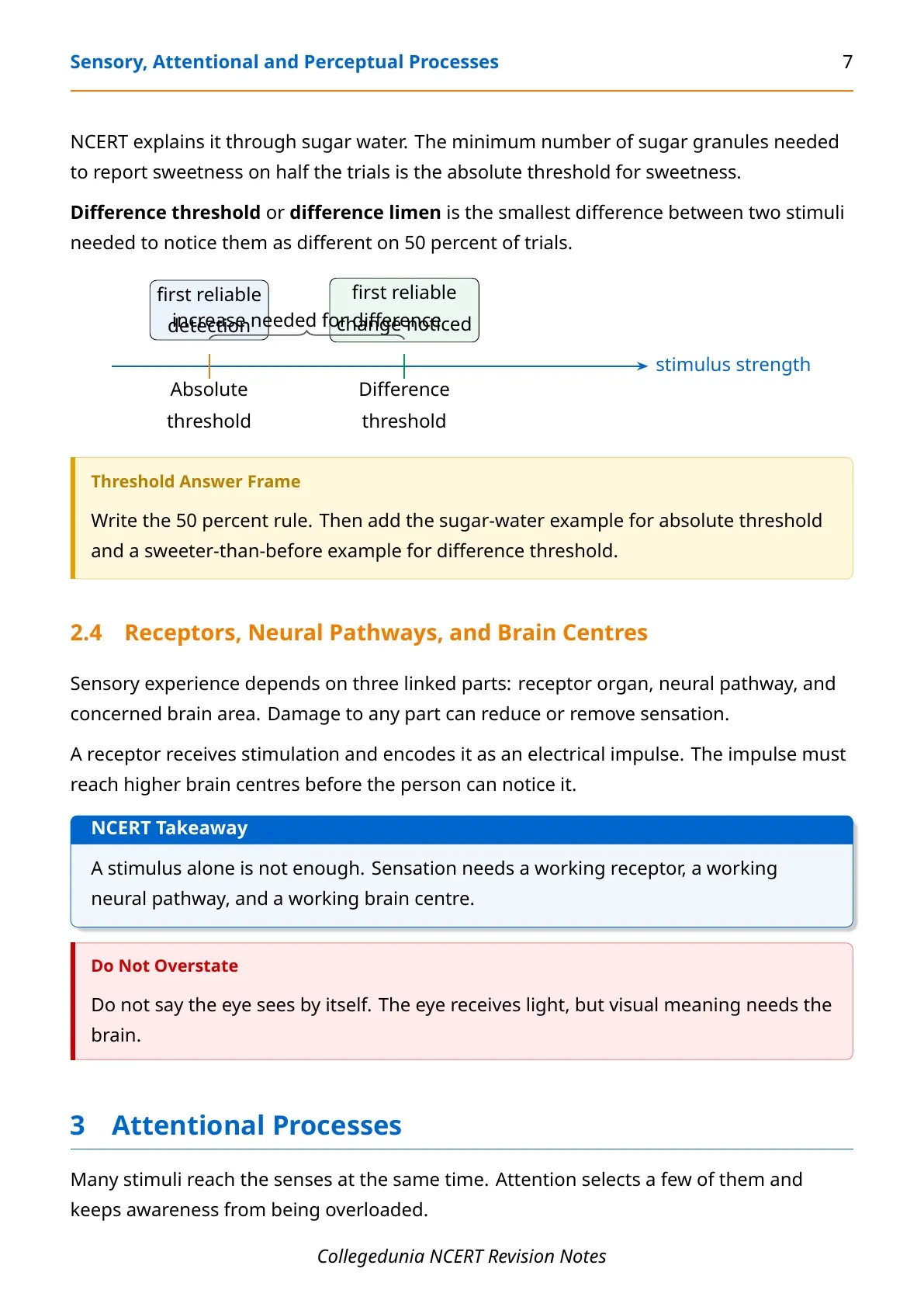
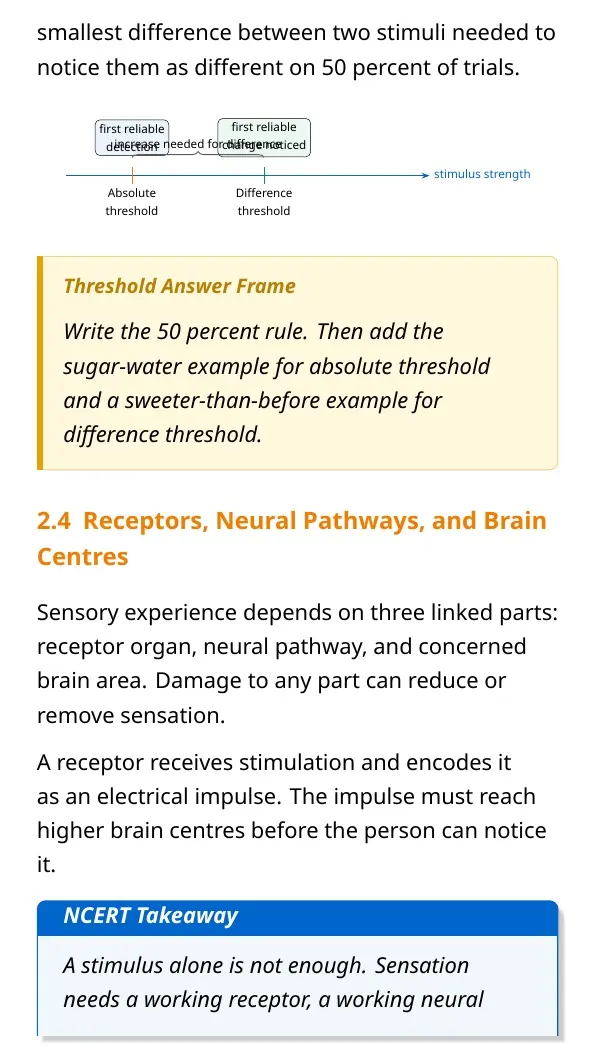
- Absolute threshold: the minimum stimulus value needed for detection on 50 percent of trials.
- Difference threshold: the smallest difference needed to notice two stimuli as different on 50 percent of trials.
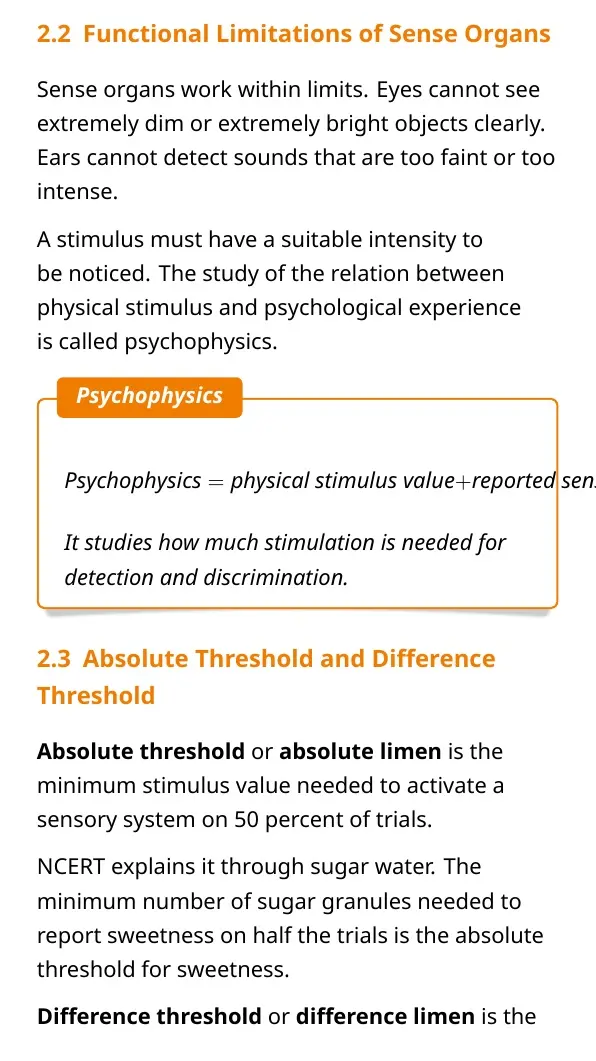
- Psychophysics: the study of the relation between stimulus values and sensory experience.
For school answers, define the term first and then give the sugar-water example. A few sugar grains may not be noticed, but a point comes when sweetness is detected. More grains are then needed before the water tastes different from the previous level.
Attention: Selective, Divided and Sustained
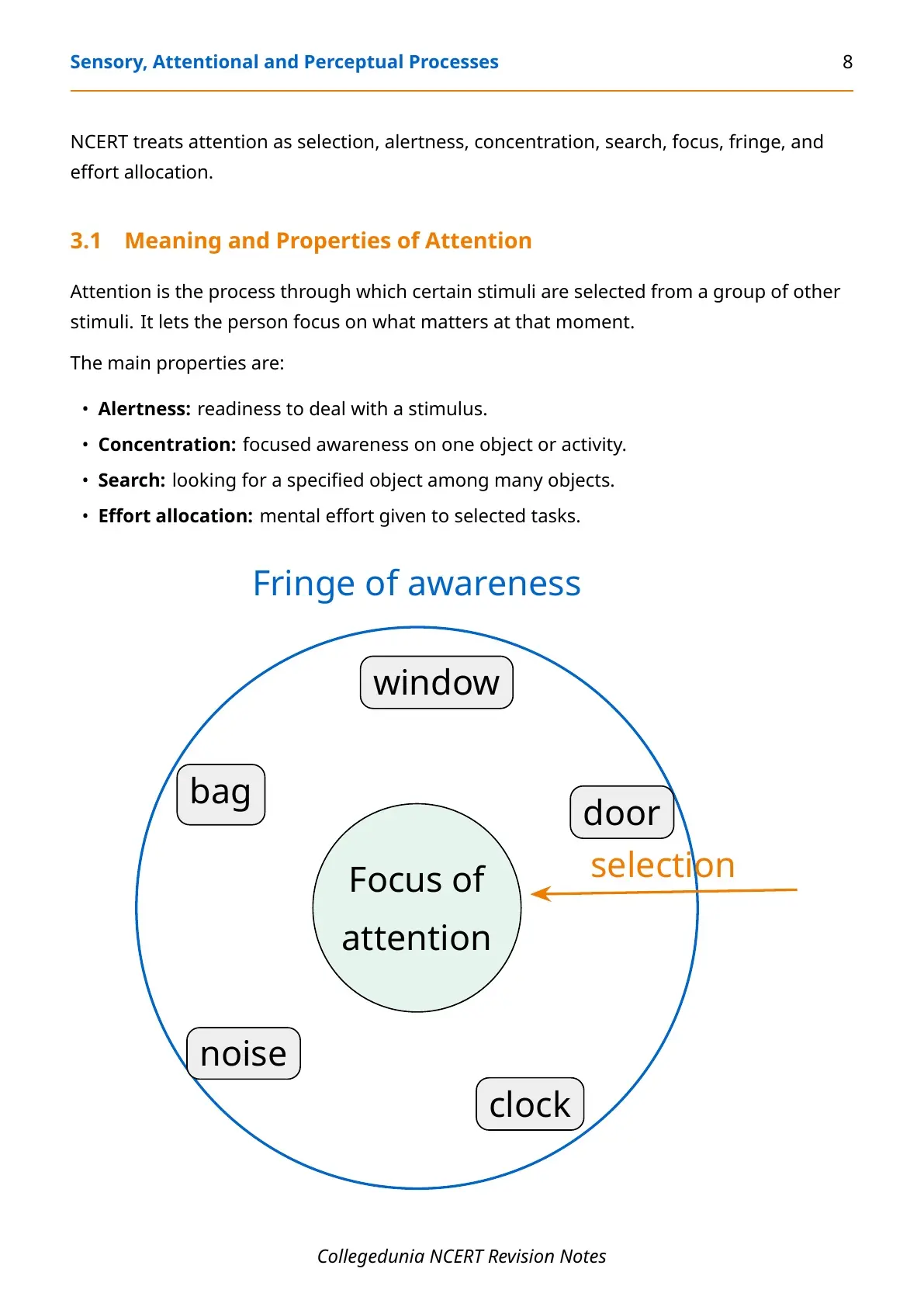
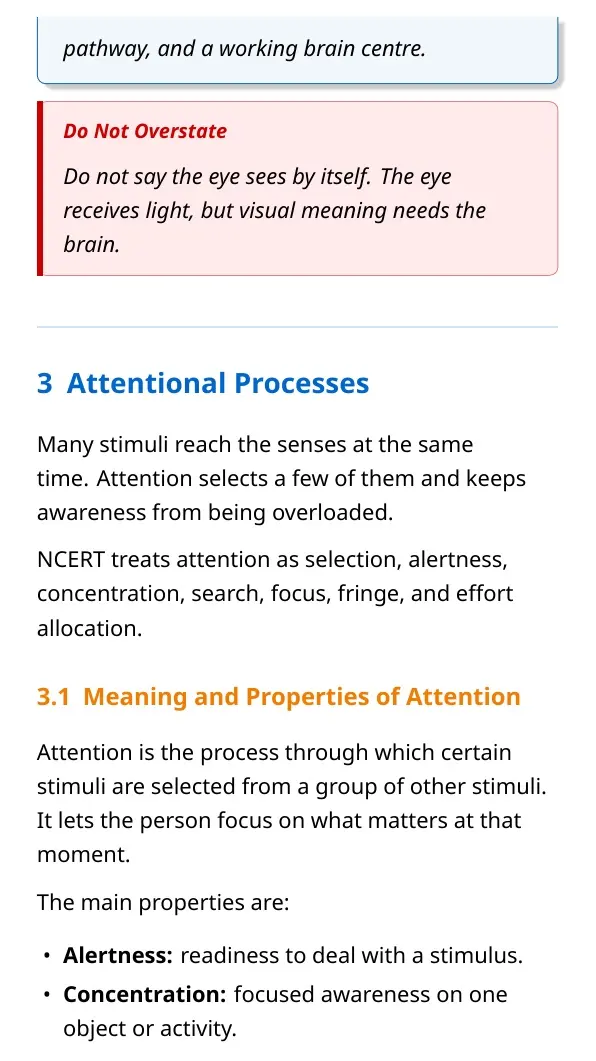
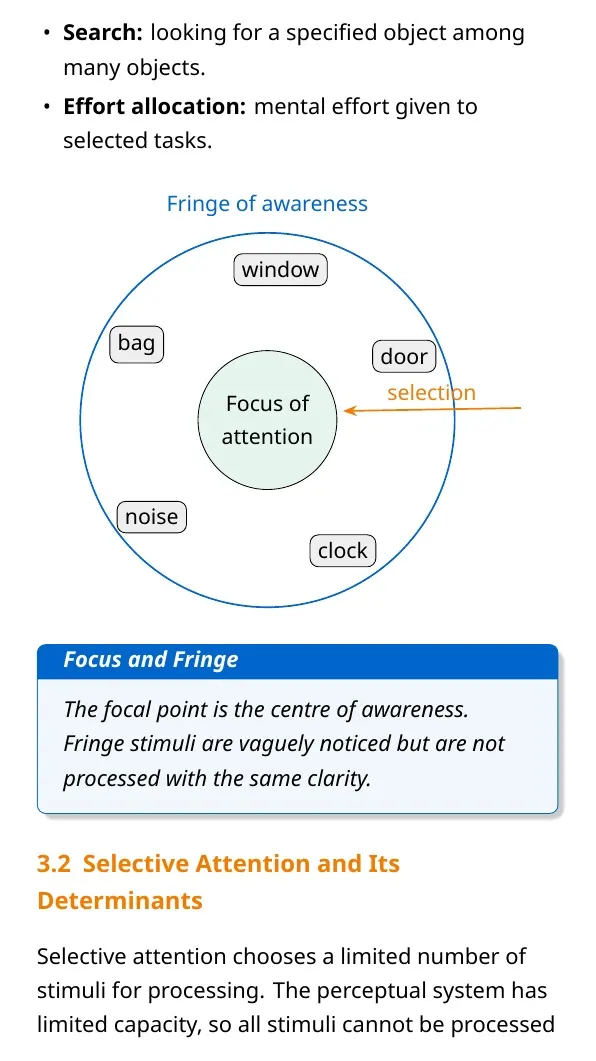
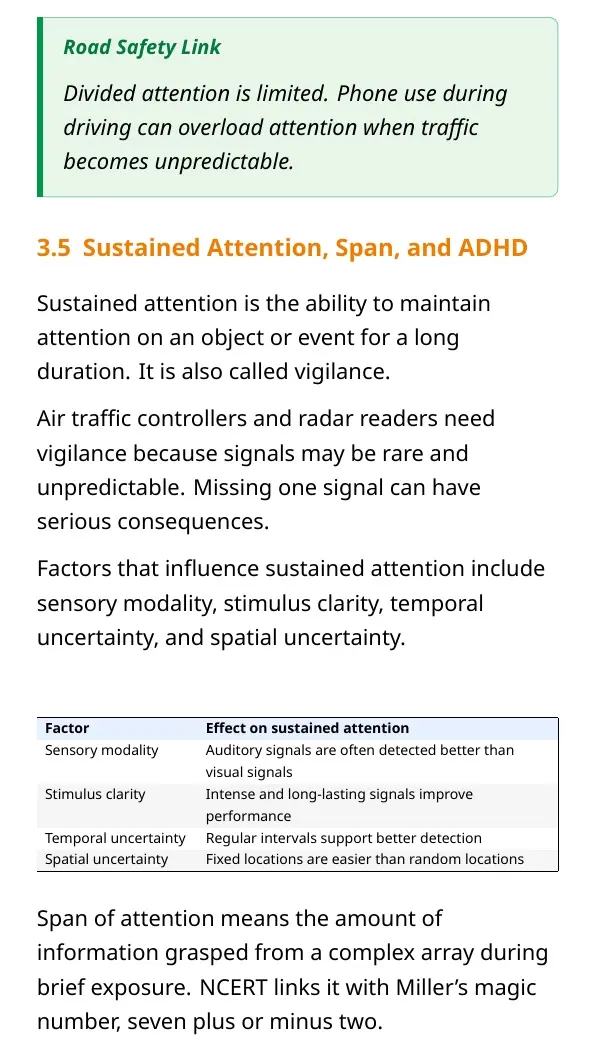
Attention is the process through which certain stimuli are selected from many competing stimuli. It includes alertness, concentration, search, focus, fringe and effort allocation. NCERT classifies attention mainly into selective and sustained attention, while divided attention is possible in highly practised tasks.
| Attention type | Meaning | Example |
|---|---|---|
| Selective attention | Selection of a few stimuli from many | Focusing on the teacher despite classroom noise |
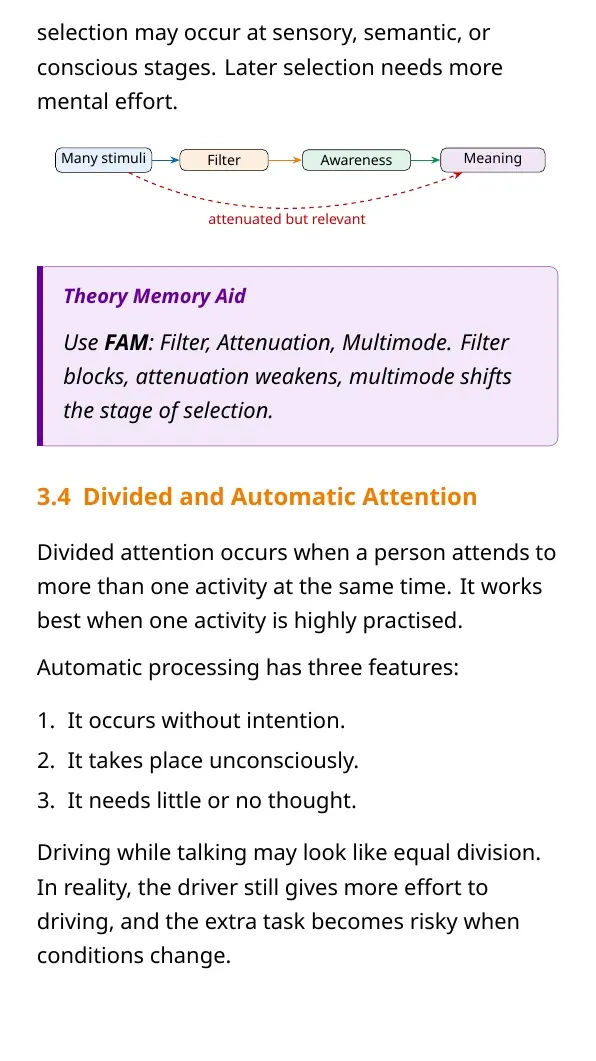
| Divided attention | Attention to more than one task, usually when one task is automatic | Walking while talking to a friend |
| Sustained attention | Maintaining attention for a long duration | Air traffic control or radar monitoring |
| Span of attention | Amount grasped during brief exposure | Miller's seven plus or minus two |
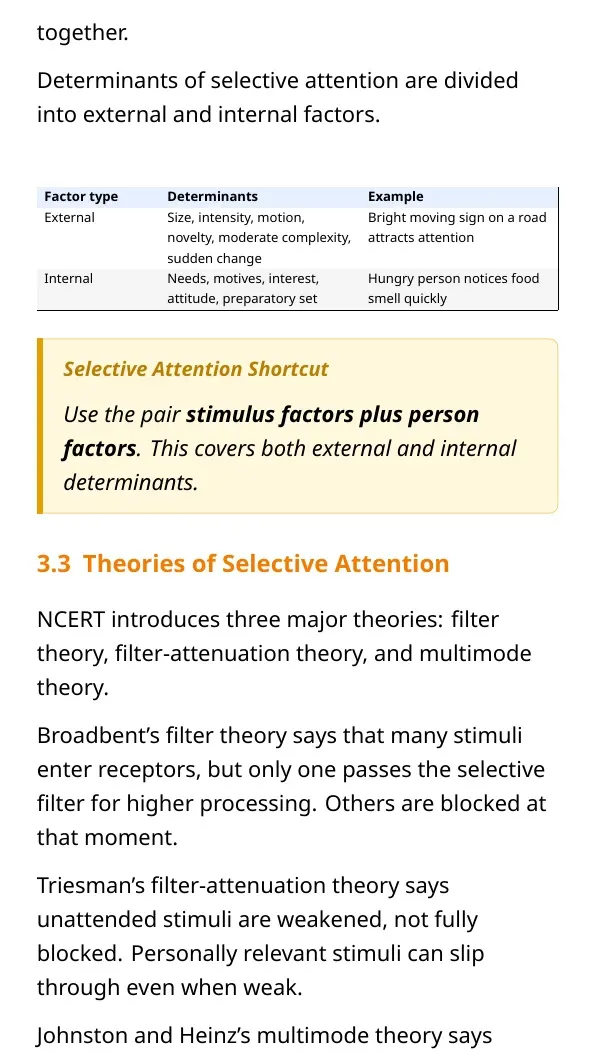
Selective attention is affected by external factors such as size, intensity, movement, novelty and sudden change. It is also affected by internal factors such as needs, motives, interests, attitudes and preparatory set.
Perception and the Perceiver
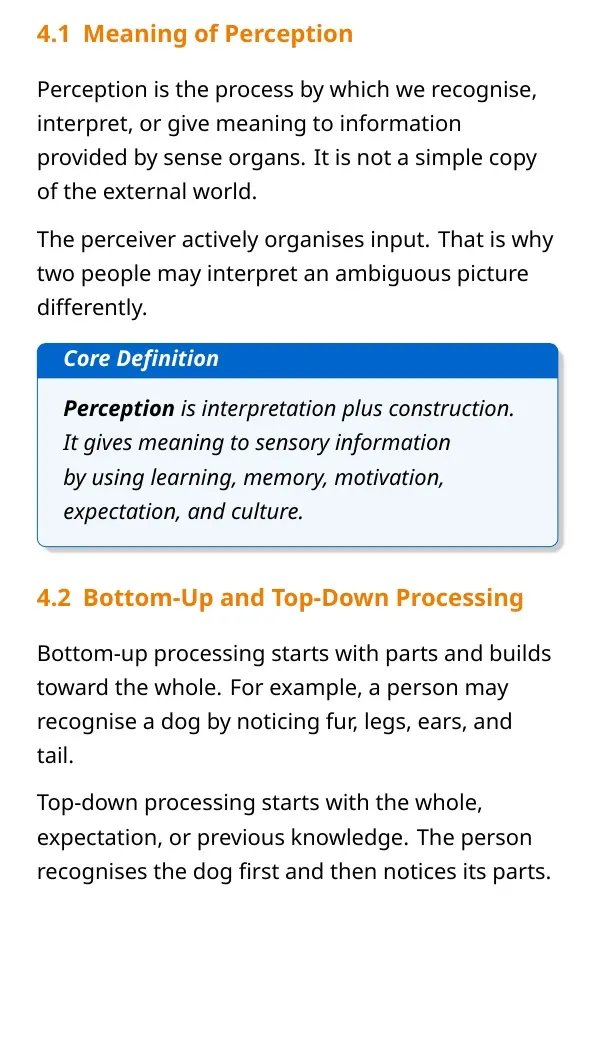
Perception is the process of recognising, interpreting and giving meaning to information provided by the sense organs. The perceiver is active, not passive. Motivation, expectations, cognitive style, memories and culture change how the same stimulus is interpreted.
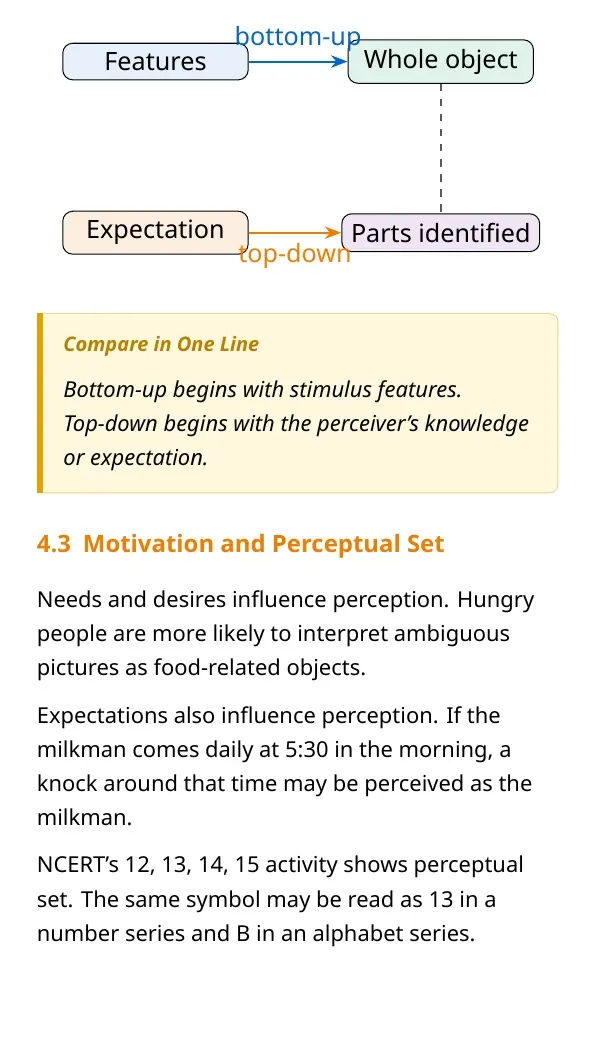
- Bottom-up processing: recognition begins with parts and moves toward the whole.
- Top-down processing: recognition begins with the whole, expectation or past knowledge.
- Field dependent style: the environment is perceived more globally.
- Field independent style: the field is broken into smaller units for analysis.
NCERT's 12, 13, 14, 15 activity is a strong example of perceptual set. The same middle figure may be read as 13 in a number series and as B in an alphabet series.
Gestalt Principles of Perceptual Organisation
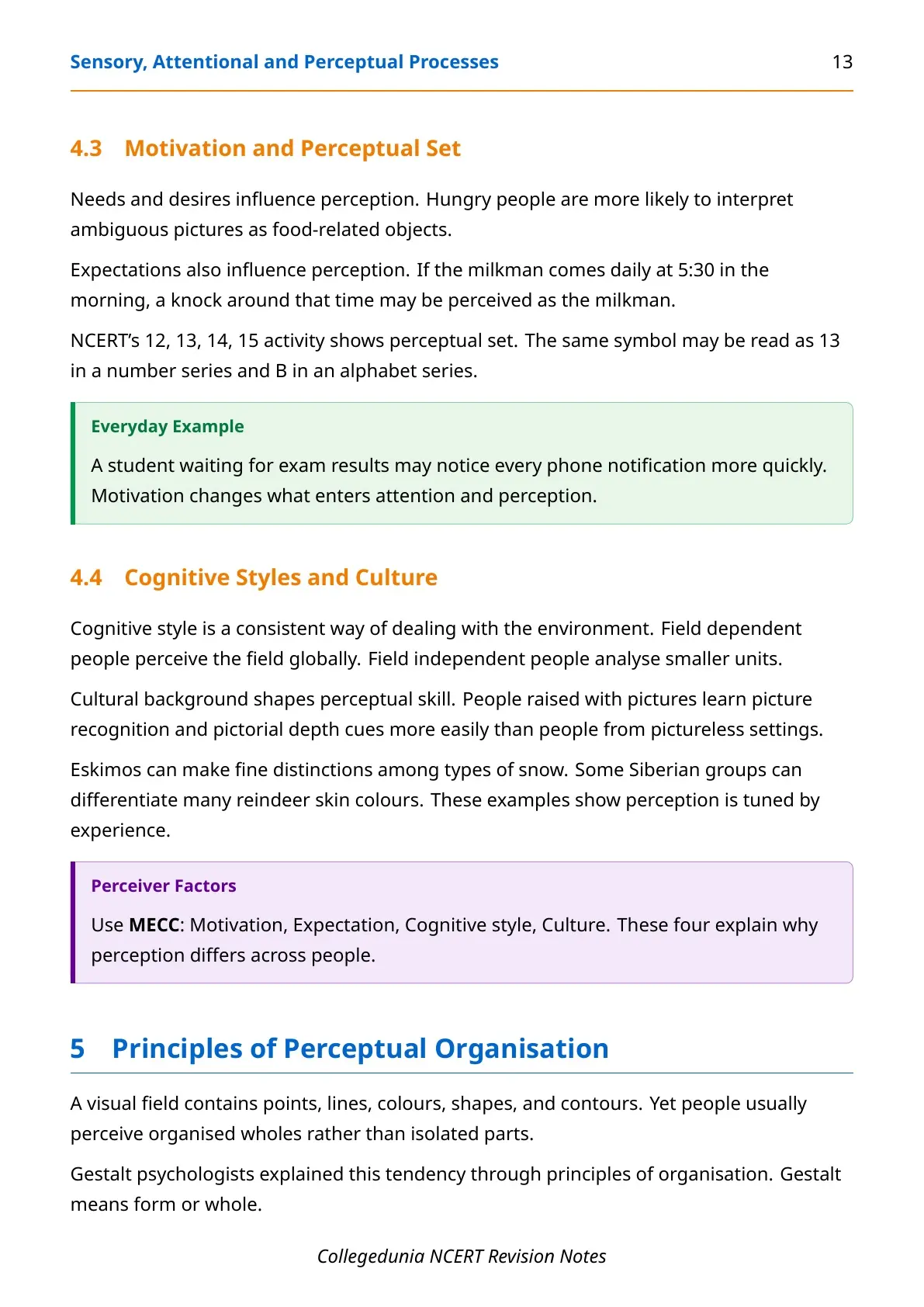
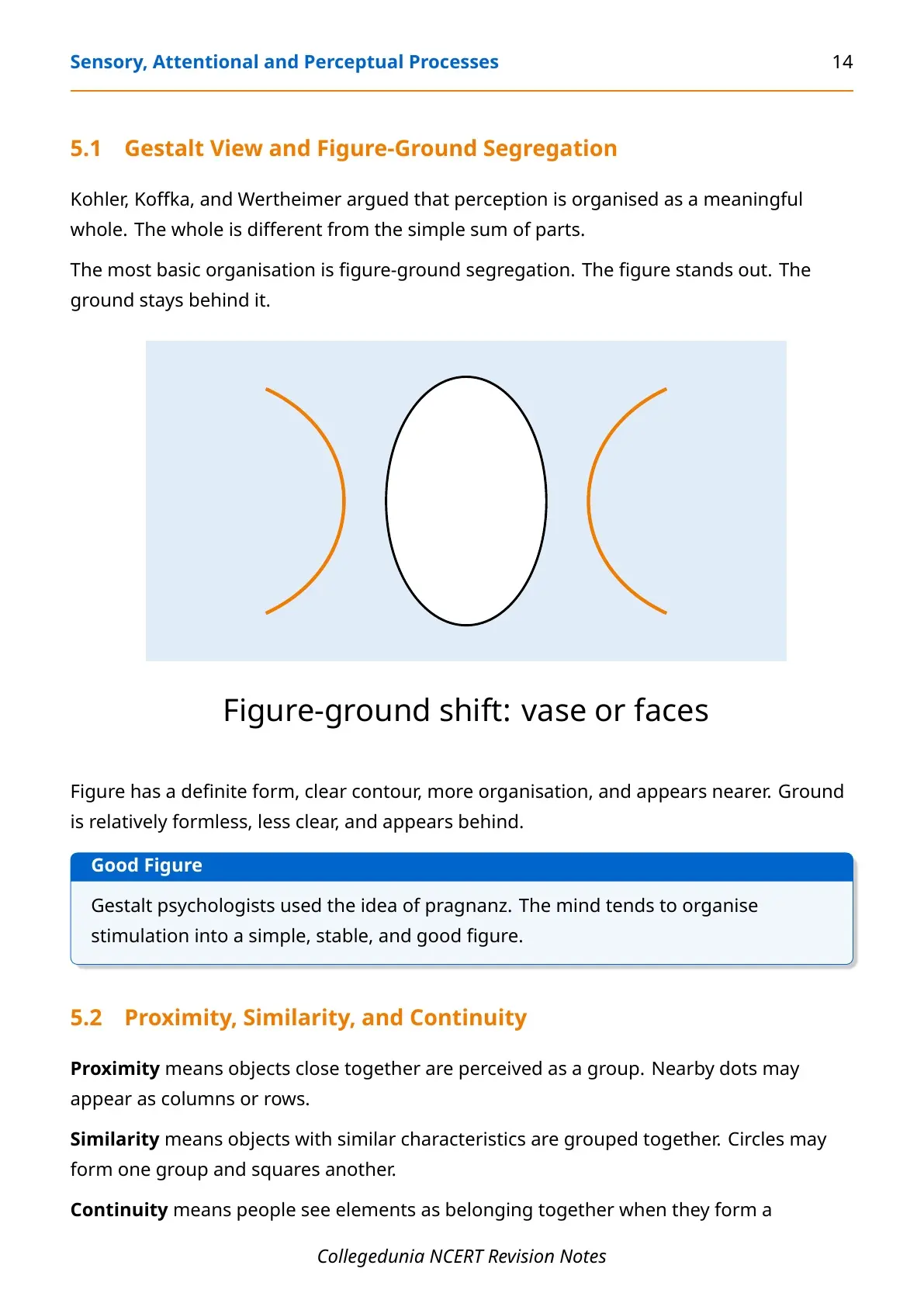
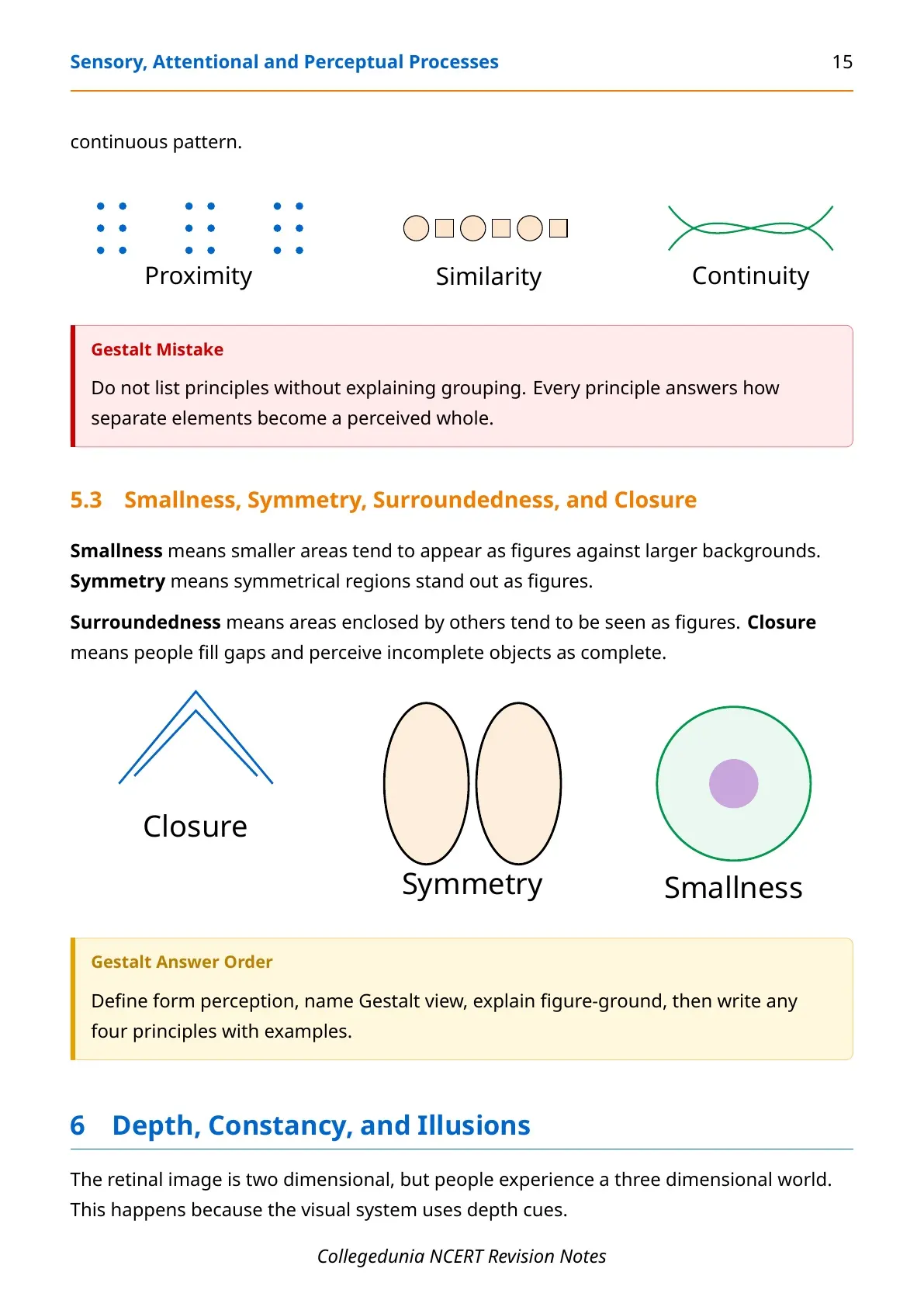
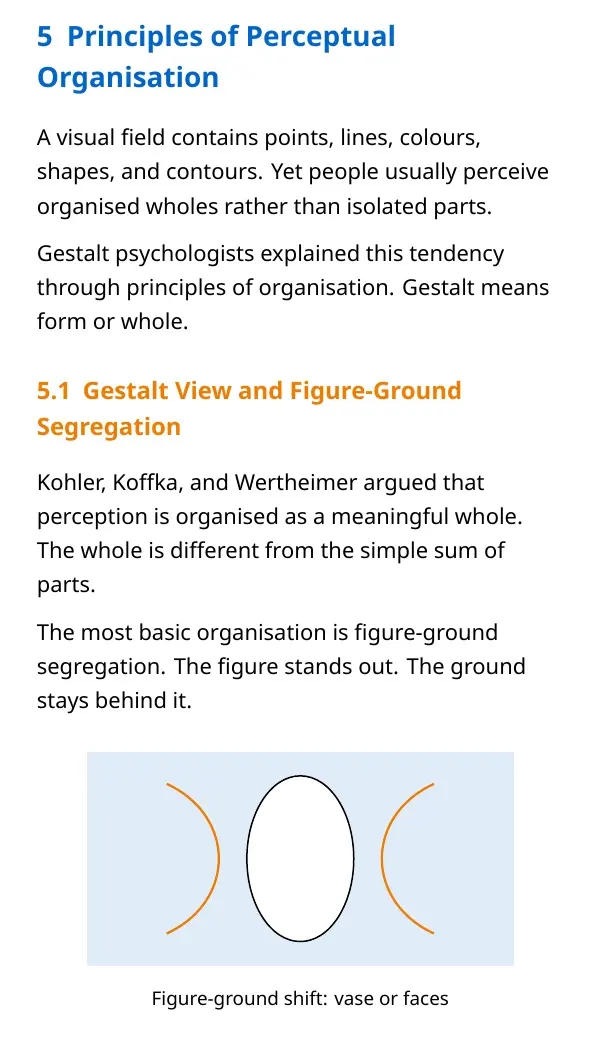
Gestalt psychologists argued that people perceive organised wholes, not disconnected parts. The most basic organisation is figure-ground segregation. Figure has a clear form and stands out, while ground stays behind and appears less definite.
| Principle | Meaning | How to remember |
|---|---|---|
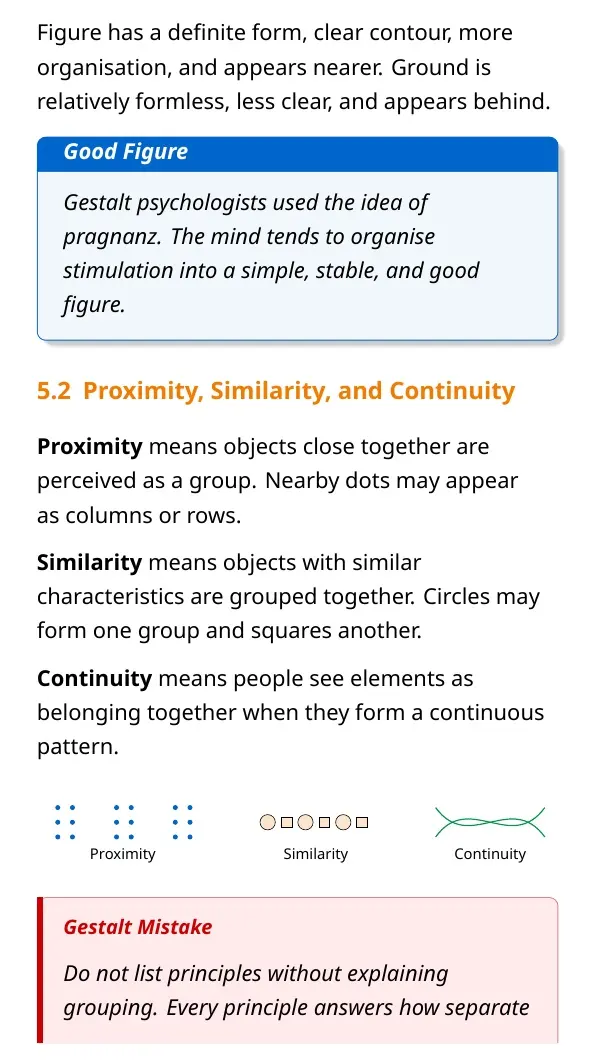
| Proximity | Close objects are grouped together | Near means together |
| Similarity | Similar objects are grouped together | Same looks form a group |
| Continuity | Elements forming a continuous pattern are grouped | The eye follows a line |
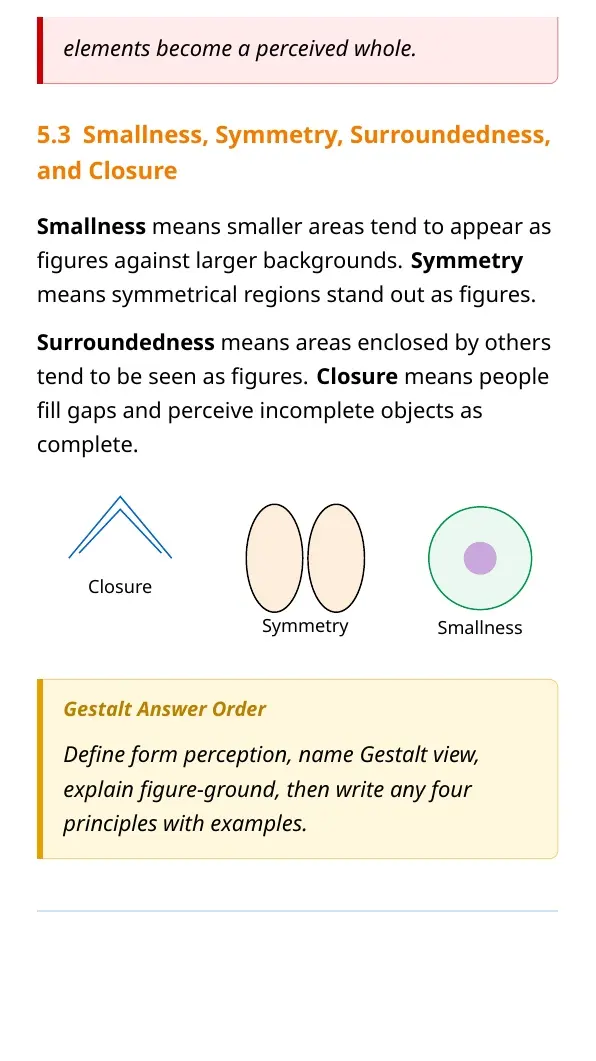
| Closure | Gaps are filled to see a complete figure | The mind completes the shape |
| Symmetry | Symmetrical regions stand out as figures | Balanced forms become visible |
Depth Cues, Constancies and Illusions
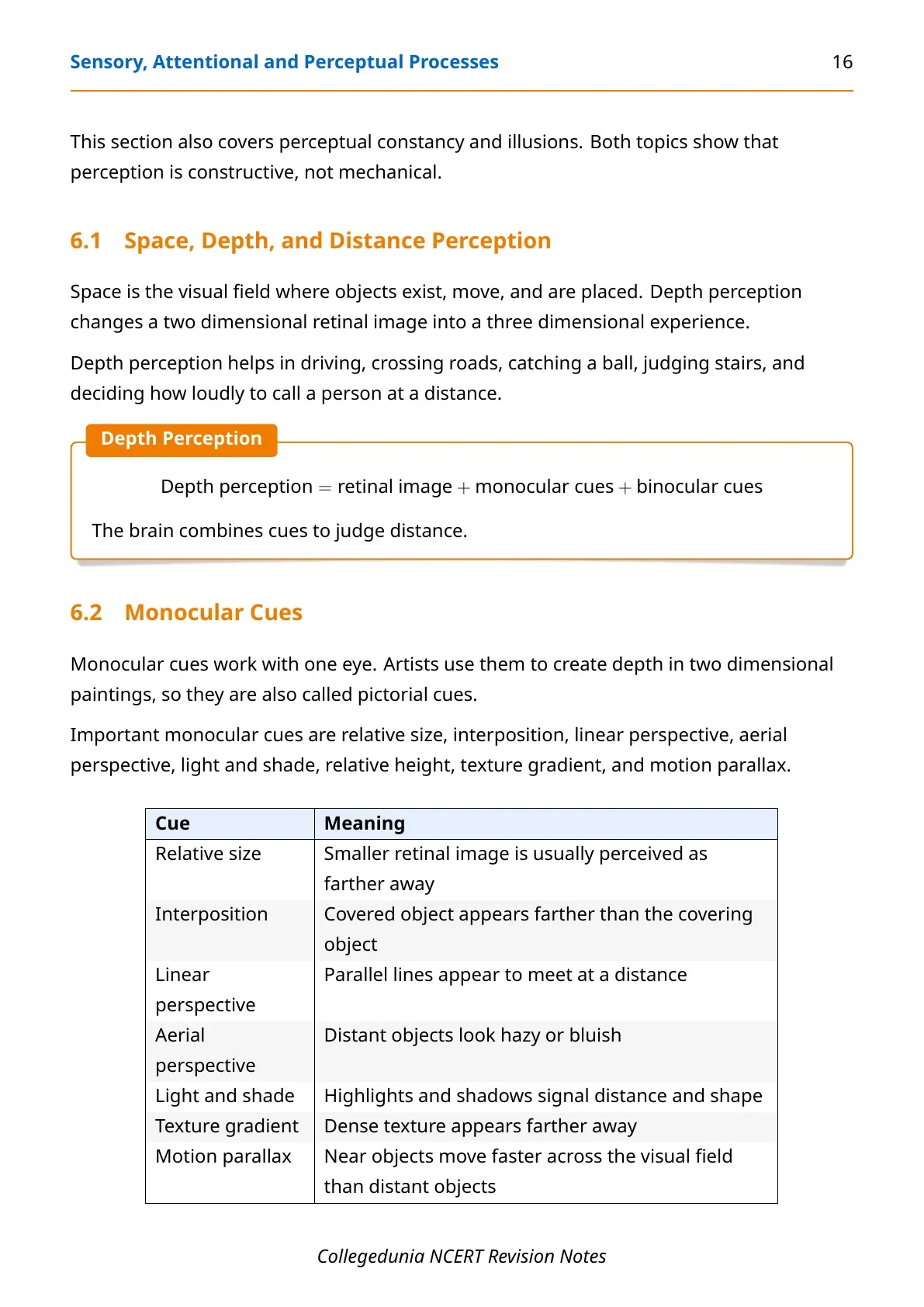
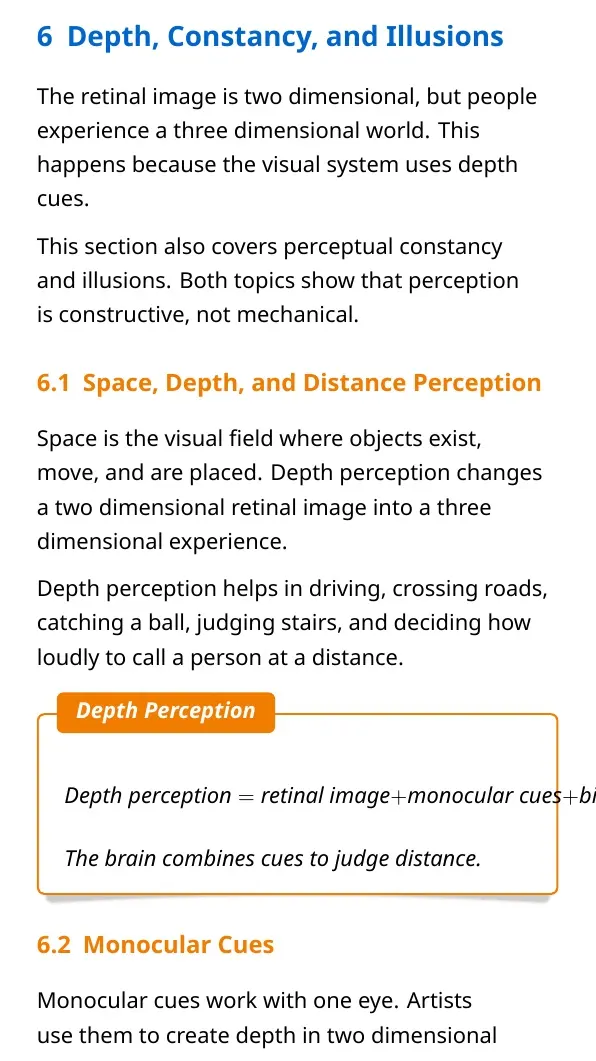
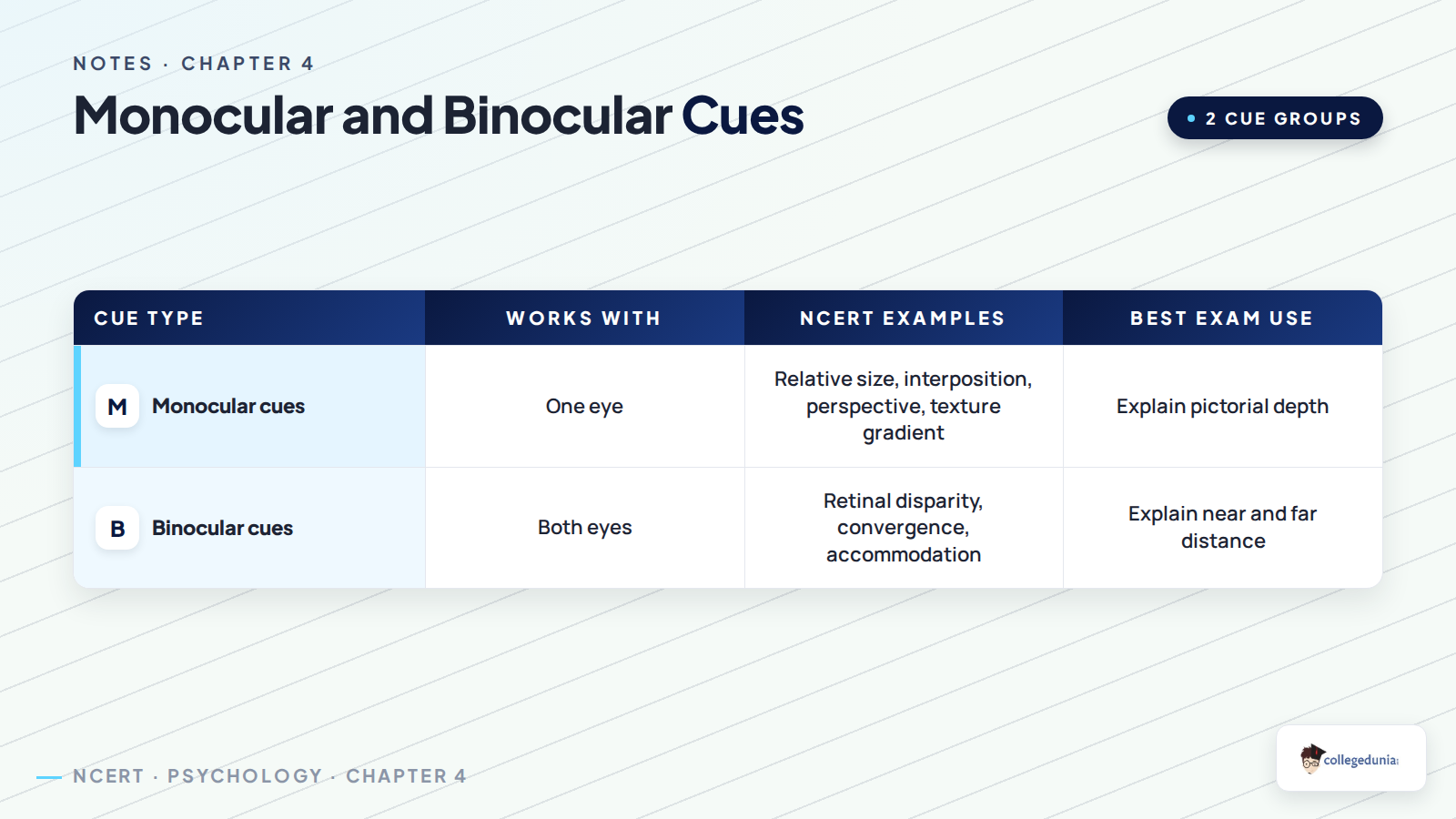
Depth perception changes a two dimensional retinal image into a three dimensional experience. People use monocular cues with one eye and binocular cues with both eyes. Perceptual constancies keep the world stable despite changes in retinal image, angle or light.
| Topic | NCERT points to revise | Example |
|---|---|---|
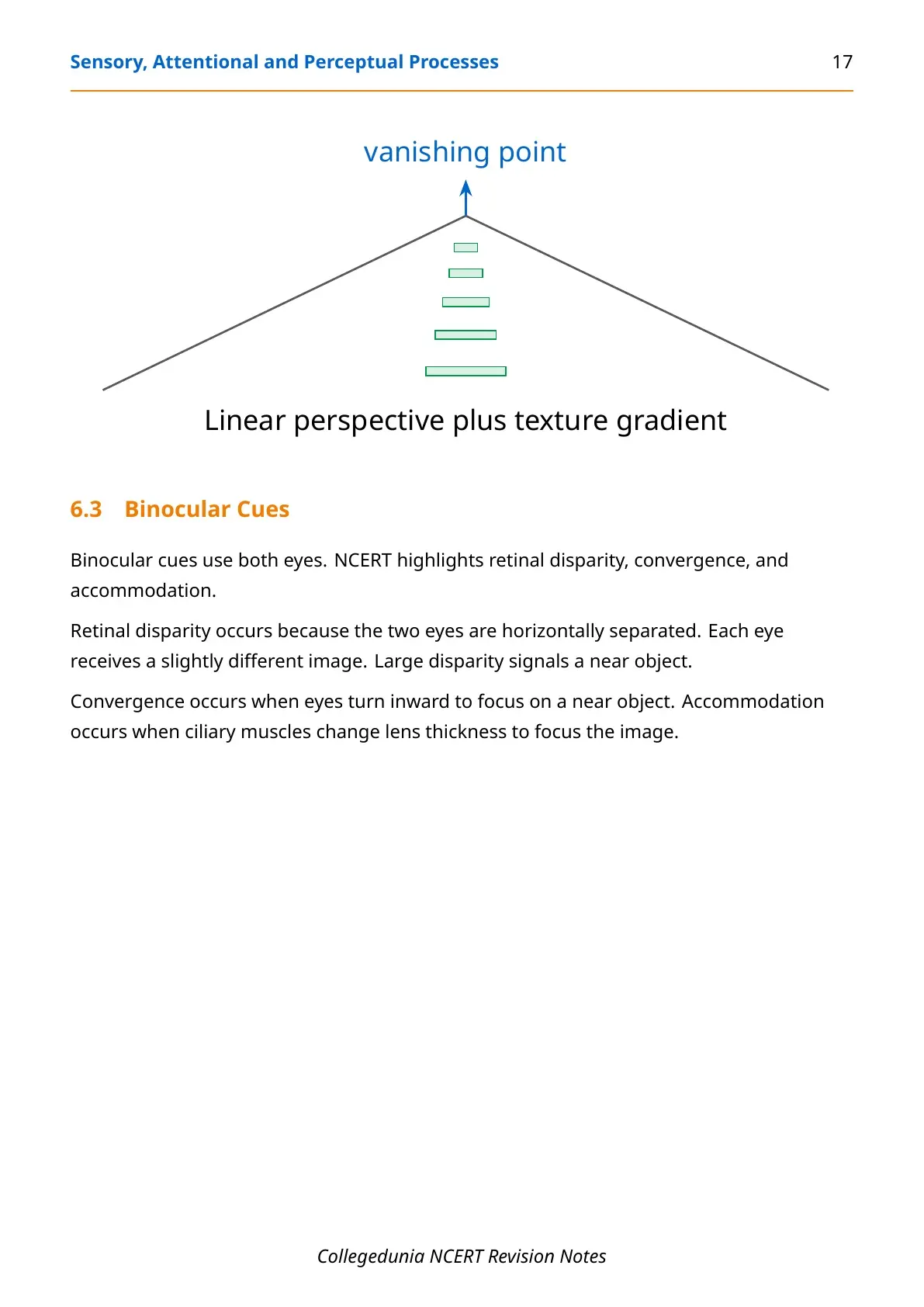
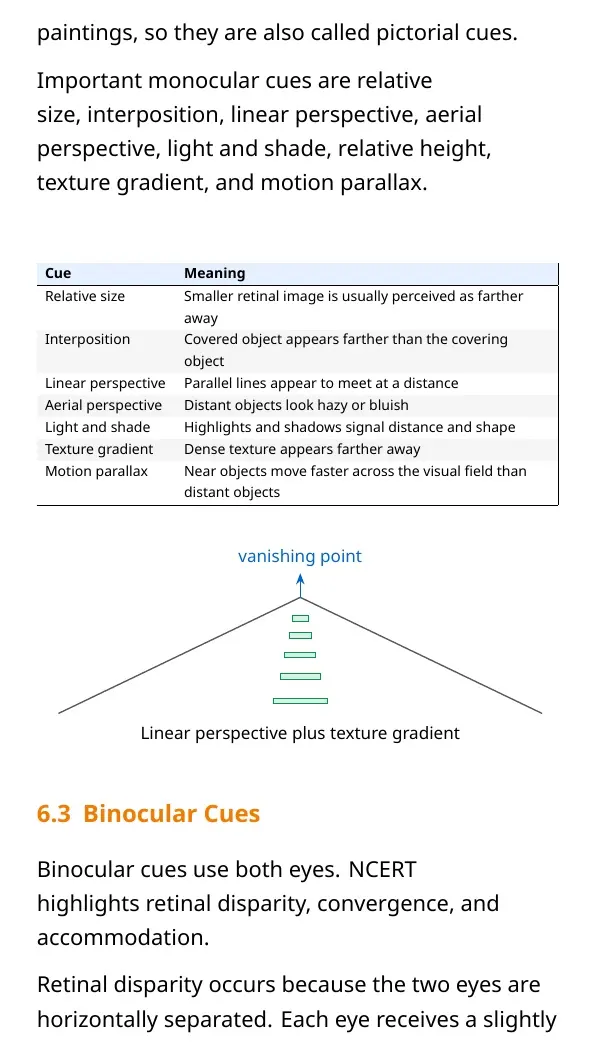
| Monocular cues | Relative size, interposition, perspective, texture gradient and motion parallax | Railway tracks seem to meet far away |
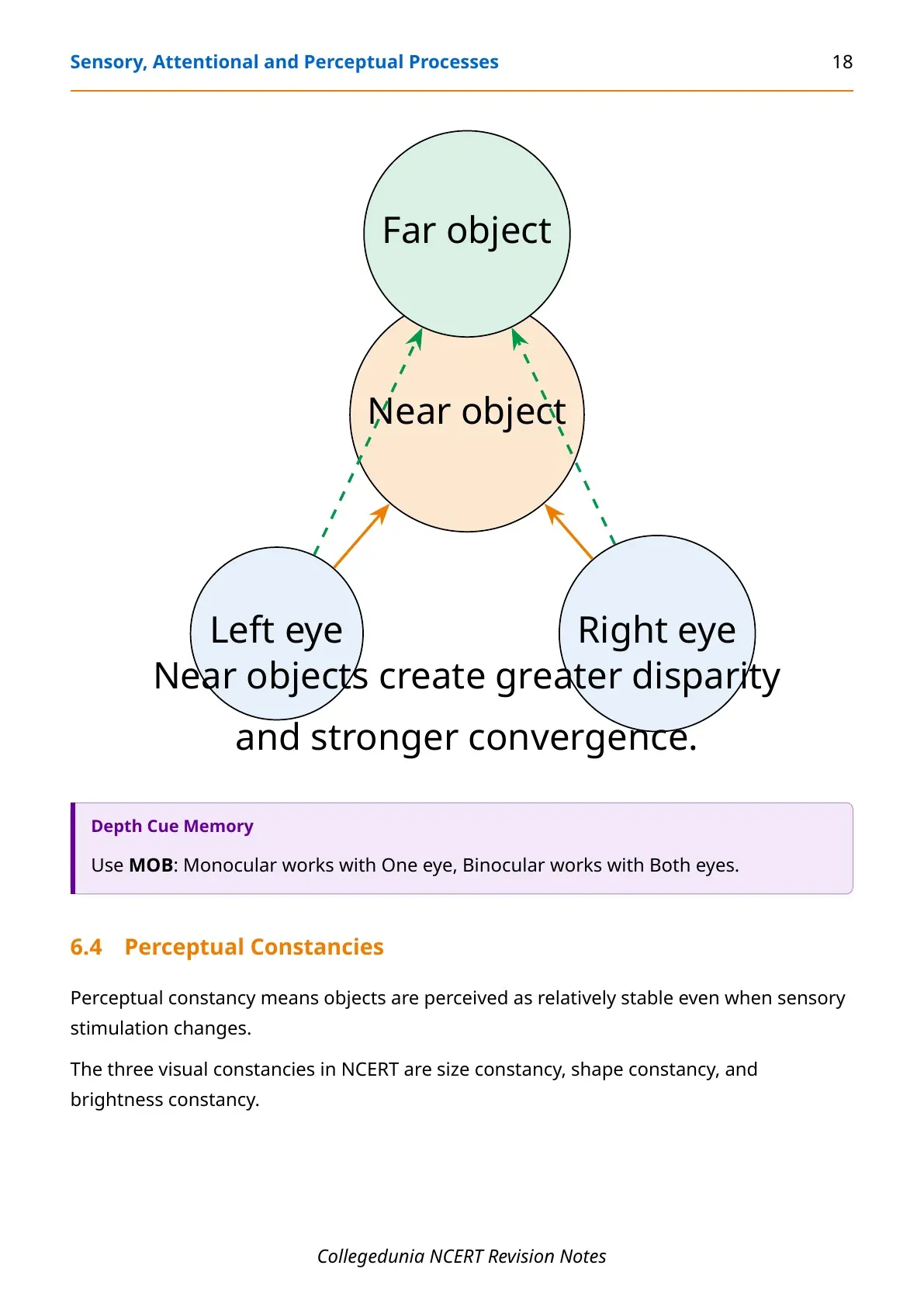
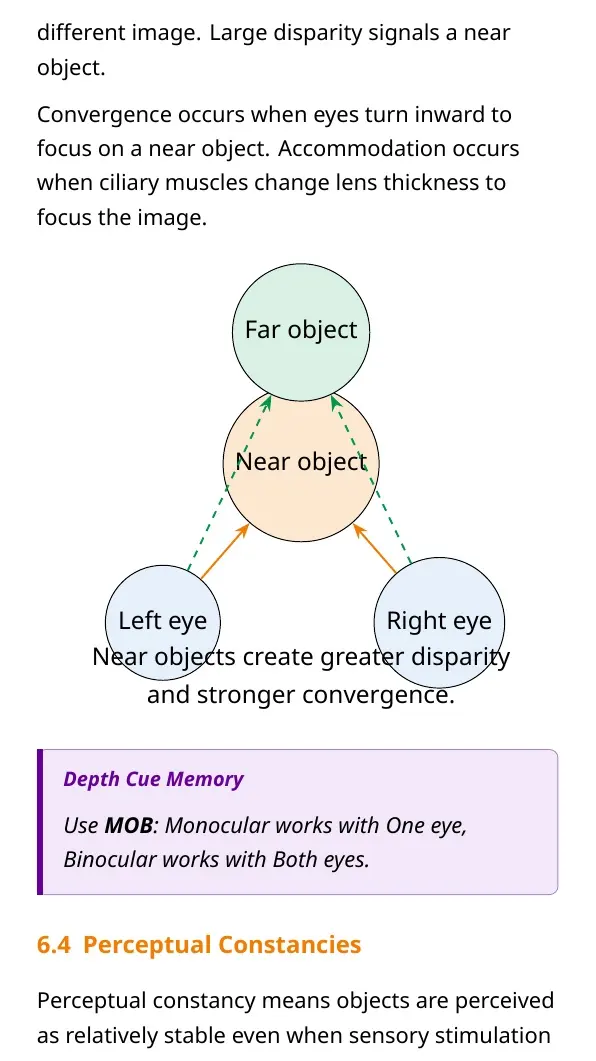
| Binocular cues | Retinal disparity, convergence and accommodation | Near objects create greater disparity |
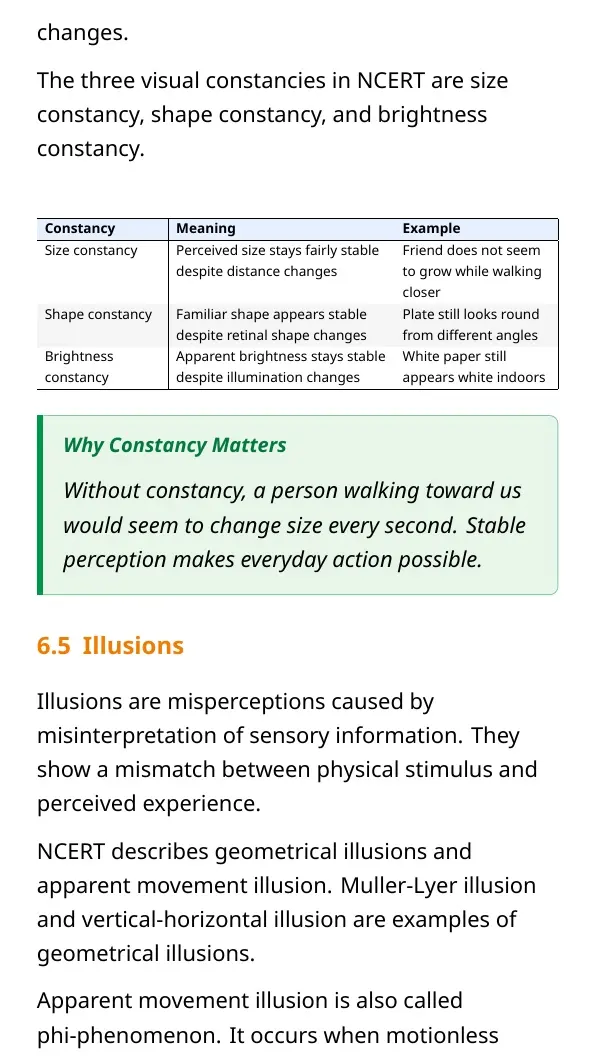
| Constancies | Size, shape and brightness constancy | White paper looks white in sunlight and room light |
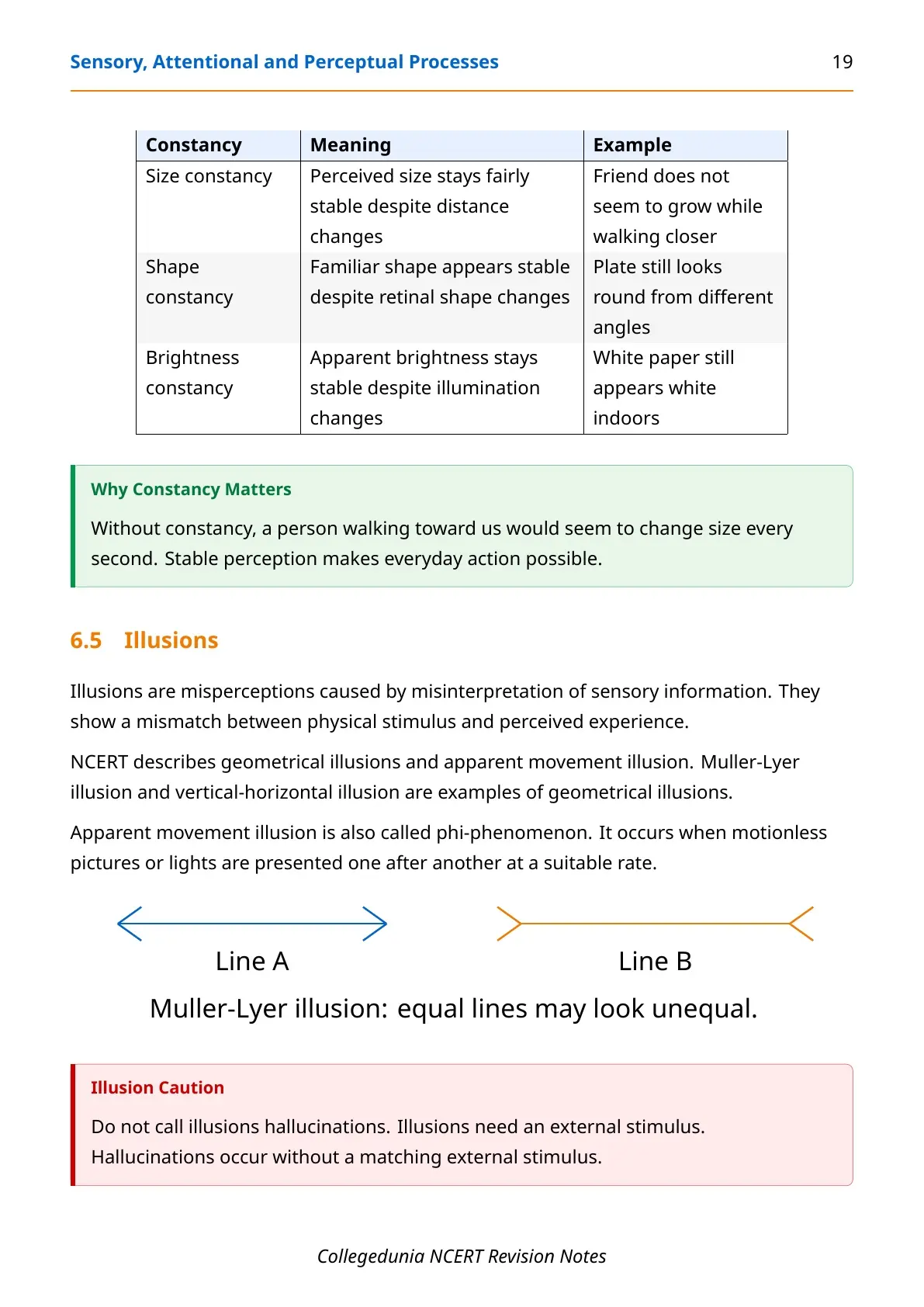
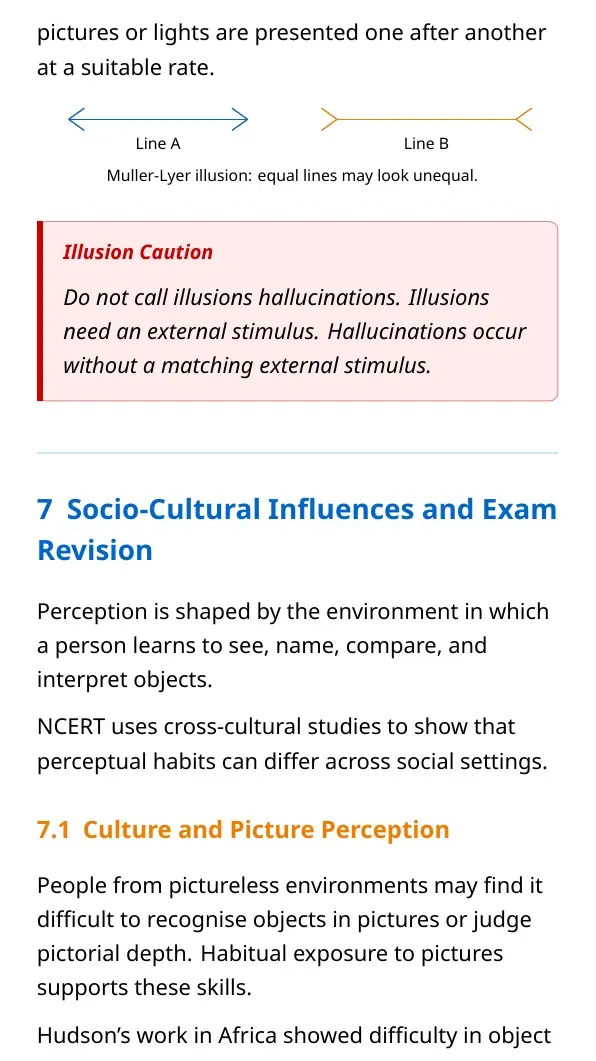
| Illusions | Muller-Lyer, vertical-horizontal and phi-phenomenon | Cinema creates apparent movement |
Socio-Cultural Influences on Perception
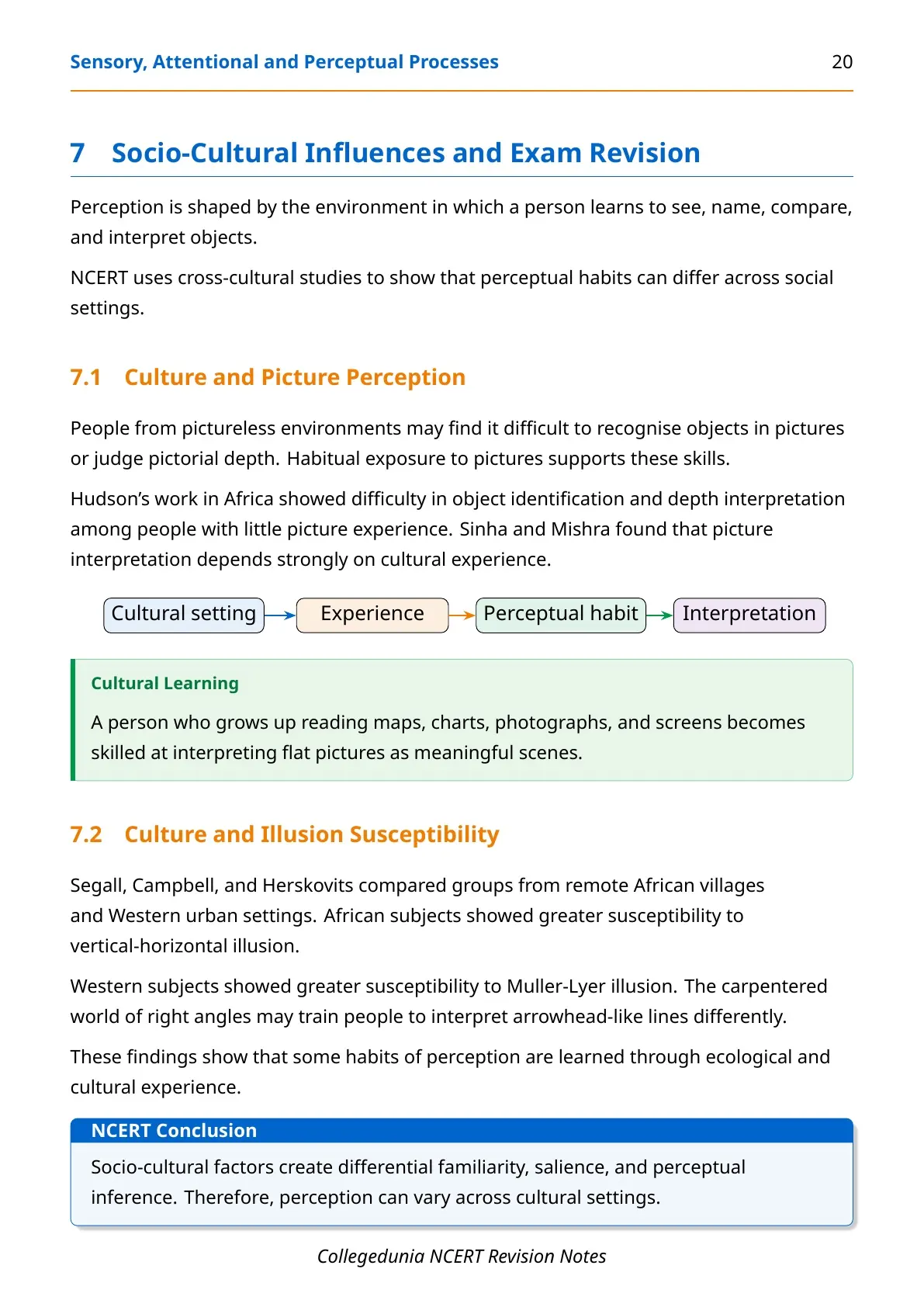
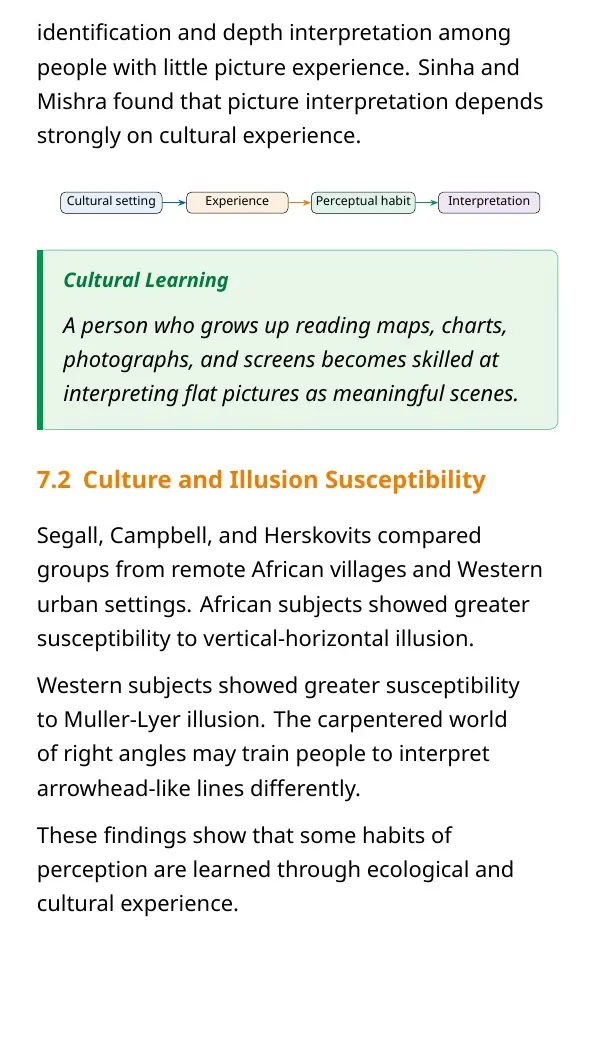
Perception is influenced by the social and cultural setting in which a person learns. People exposed to pictures, maps, screens and printed diagrams become more skilled at interpreting pictorial depth cues. People from pictureless settings may identify familiar objects but struggle with depth or action in pictures.
- Hudson's work showed that picture experience affects pictorial depth perception.
- Sinha and Mishra showed that picture interpretation varies across cultural settings.
- Segall, Campbell and Herskovits found differences in illusion susceptibility across groups.
- Western urban settings may increase Muller-Lyer susceptibility because of right-angle environments.
Related Psychology Resources for Sensory, Attentional and Perceptual Processes
Also Check: use these links with the notes PDF when you need the same chapter in another format.
| Resource | Best use | Link |
|---|---|---|
| NCERT Solutions | Stepwise answers to textbook review questions | Sensory, Attentional and Perceptual Processes NCERT Solutions |
| NCERT Book PDF | Original NCERT reading and review questions | Sensory, Attentional and Perceptual Processes NCERT Book PDF |
| Handwritten Notes | Fast visual revision before tests | Sensory, Attentional and Perceptual Processes Handwritten Notes |
Class 11 Psychology Notes for All Chapters
| Chapter | Notes Link |
|---|---|
| Chapter 1 | What is Psychology? Notes |
| Chapter 2 | Methods of Enquiry in Psychology Notes |
| Chapter 3 | Human Development Notes |
| Chapter 4 | You are here |
| Chapter 5 | Learning Notes |
| Chapter 6 | Human Memory Notes |
| Chapter 7 | Thinking Notes |
| Chapter 8 | Motivation and Emotion Notes |
Important NCERT Terms in Chapter 4
| Term | Meaning |
|---|---|
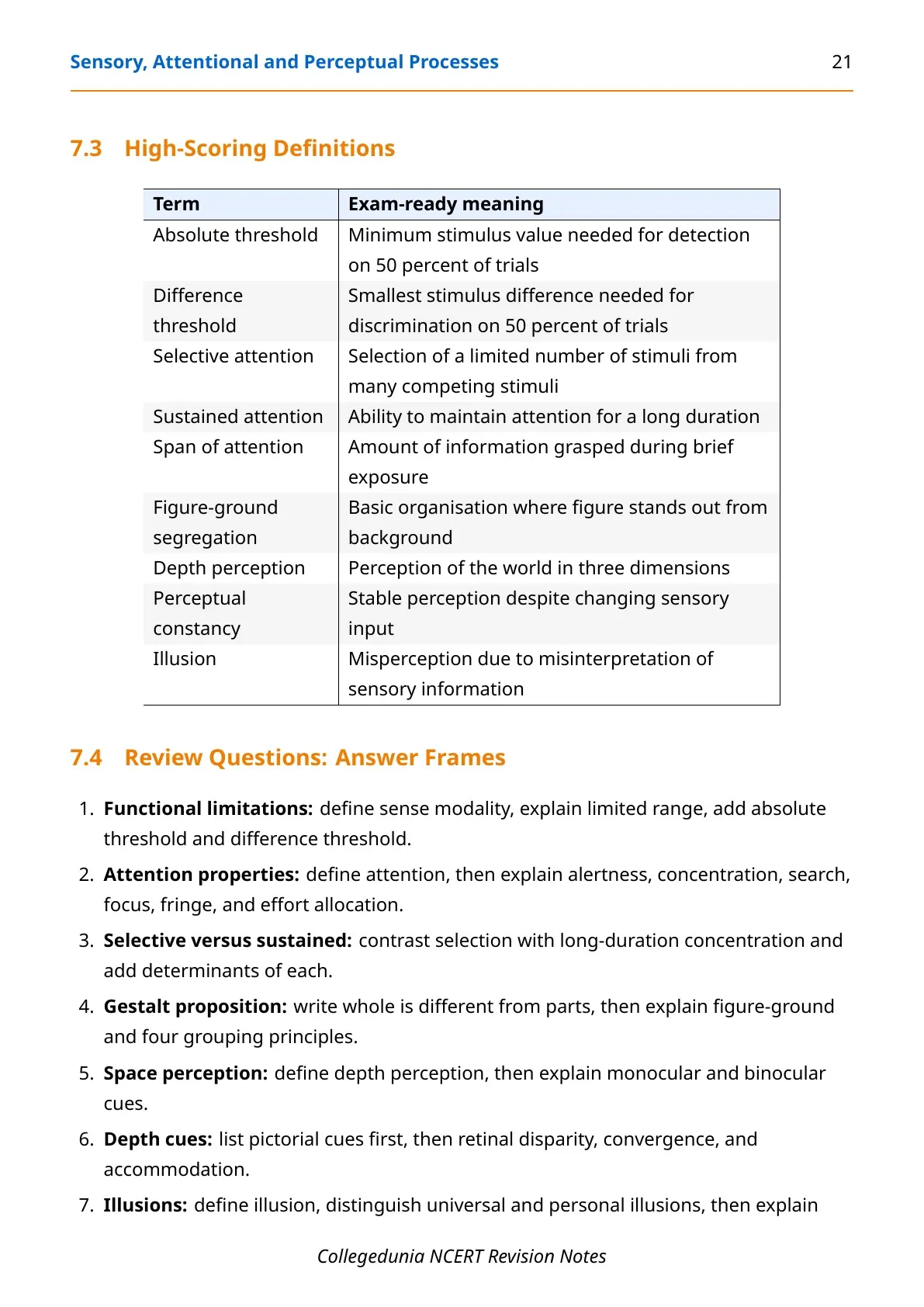
| Absolute threshold | Minimum stimulus value needed for detection on 50 percent of trials |
| Difference threshold | Smallest stimulus difference needed for discrimination on 50 percent of trials |
| Selective attention | Selection of limited stimuli from many competing stimuli |
| Figure-ground segregation | Organisation where figure stands out from background |
| Depth perception | Perception of the world in three dimensions |
| Illusion | Misperception caused by misinterpretation of sensory information |
Frequently Asked Questions
Ques. What are Sensory, Attentional and Perceptual Processes in Class 11 Psychology?
Ans. They are the three linked processes through which students understand the world. Sensation detects stimulus qualities, attention selects limited information and perception gives meaning to that information.
Ques. What is the difference between absolute threshold and difference threshold?
Ans. Absolute threshold is the minimum stimulus value needed for detection on 50 percent of trials. Difference threshold is the smallest change needed to notice two stimuli as different on 50 percent of trials.
Ques. Which depth cues are important in Chapter 4 Psychology?
Ans. Monocular cues include relative size, interposition, linear perspective, aerial perspective, light and shade, texture gradient and motion parallax. Binocular cues include retinal disparity, convergence and accommodation.
Ques. Why do illusions occur?
Ans. Illusions occur when sensory information is misinterpreted. The stimulus exists, but the perception does not match the physical stimulus exactly.



Comments