



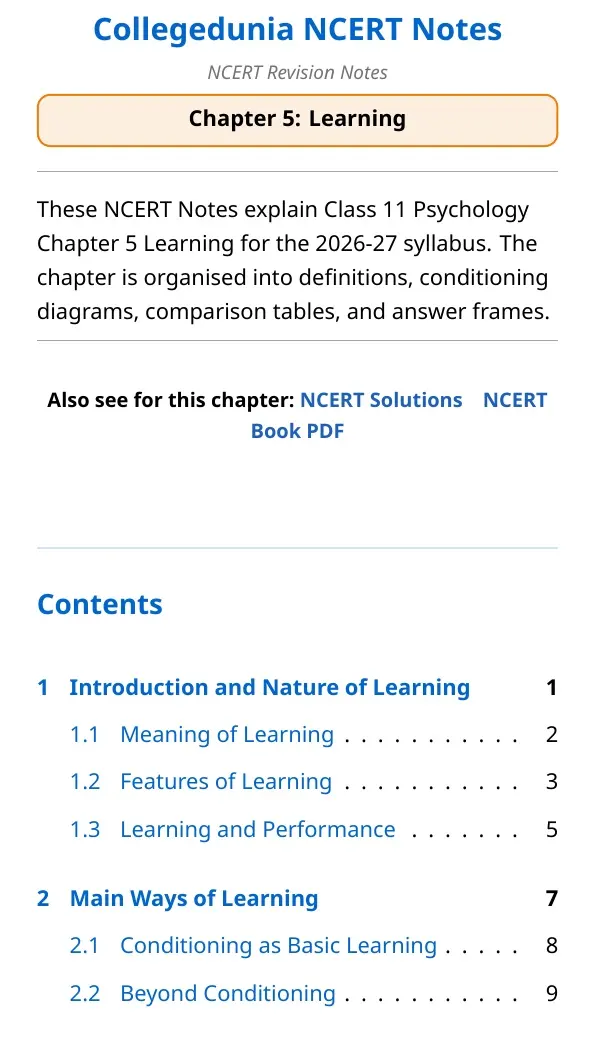
NCERT Notes Class 11 Psychology Chapter 5 Learning help students revise the nature of learning, classical conditioning, operant conditioning, observational learning, cognitive learning, verbal learning, skill learning, factors facilitating learning and learning disabilities for the 2026-27 syllabus.
Download the Learning Notes PDF
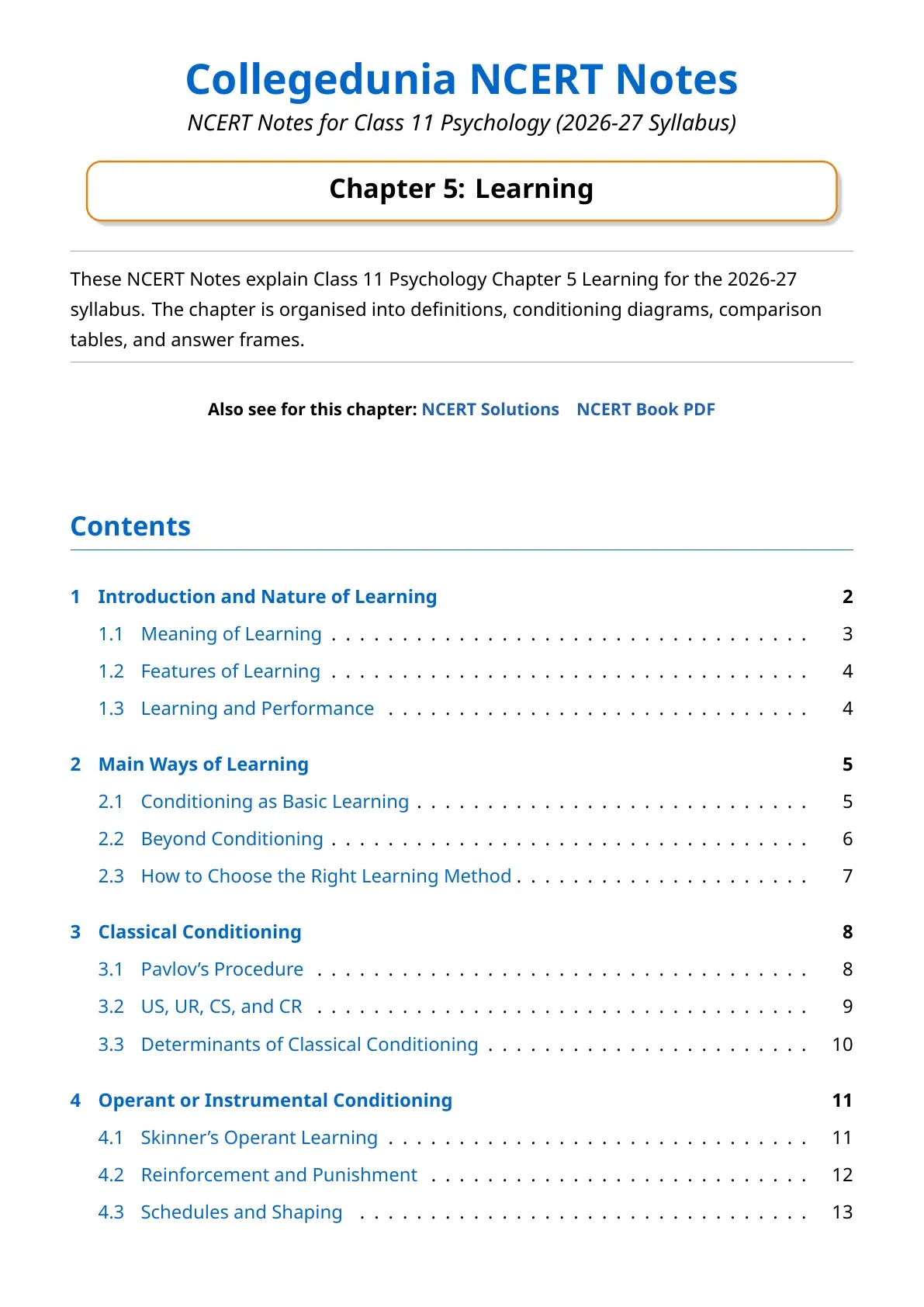
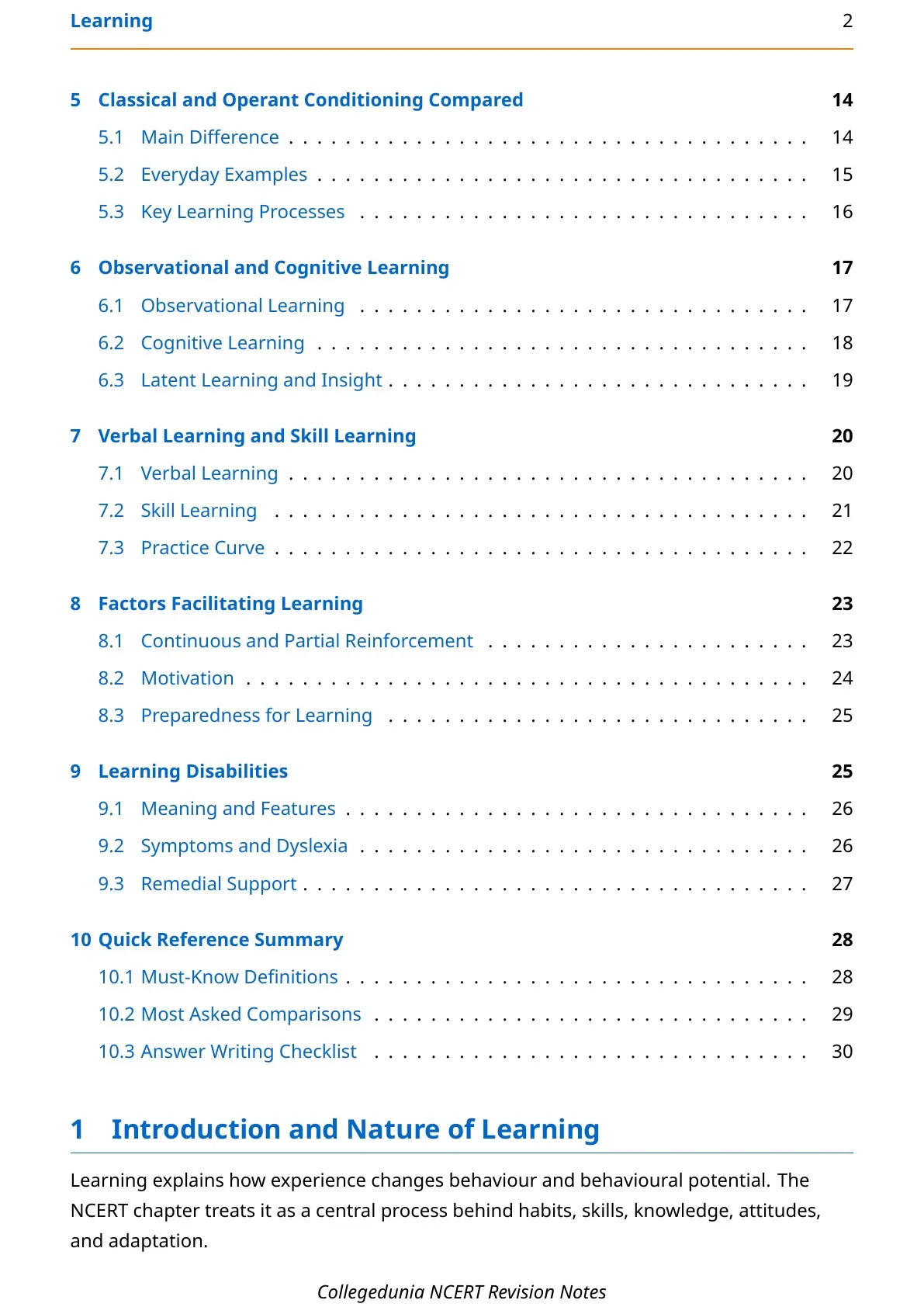
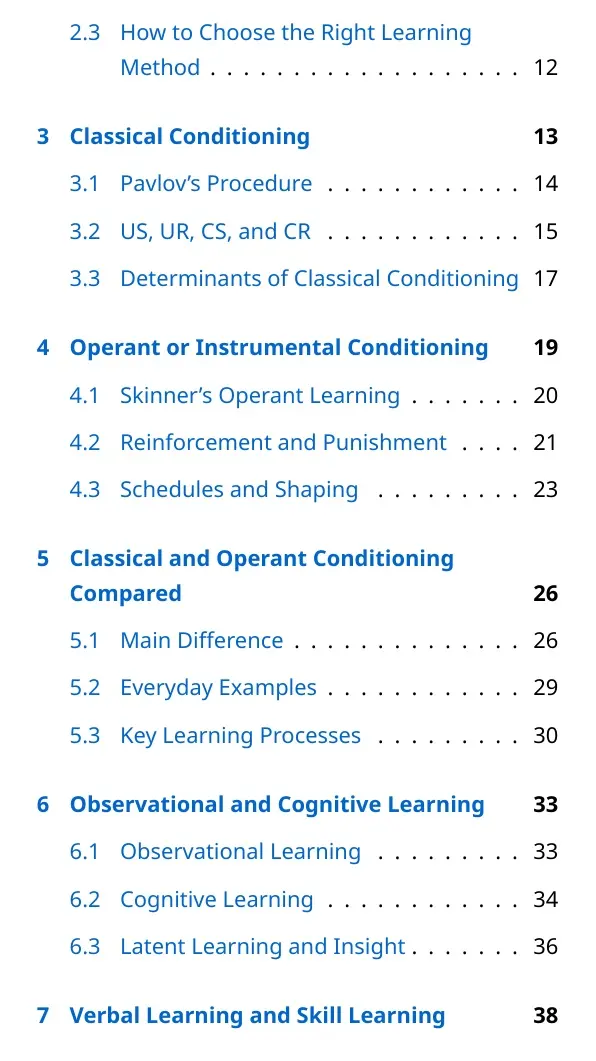
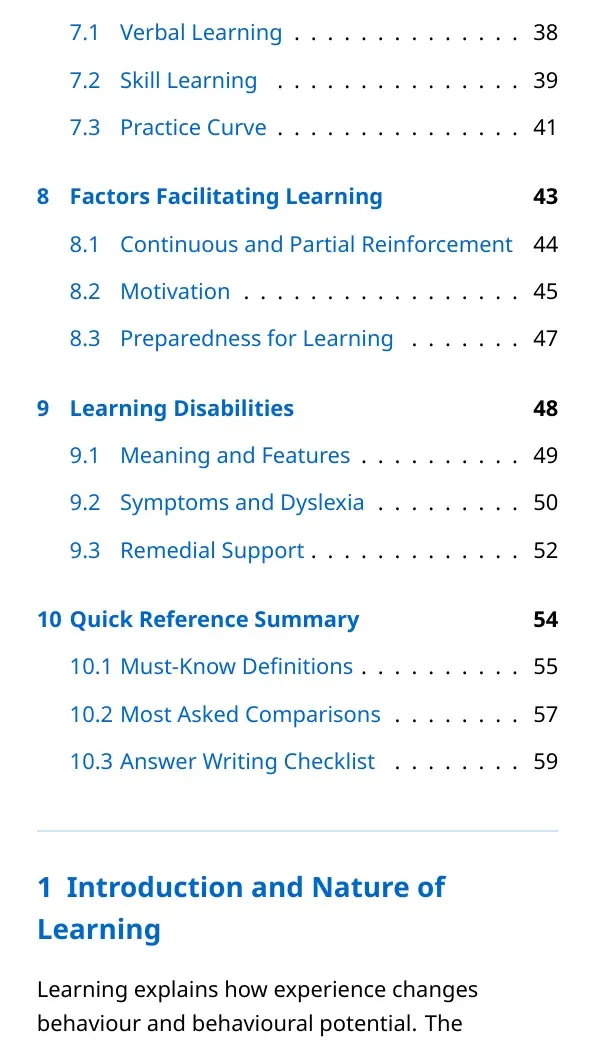
Use the PDF for Chapter 5 definitions, conditioning diagrams, comparison tables and quick revision before tests.
Download PDF- Download the Learning notes PDF for offline Class 11 Psychology revision.
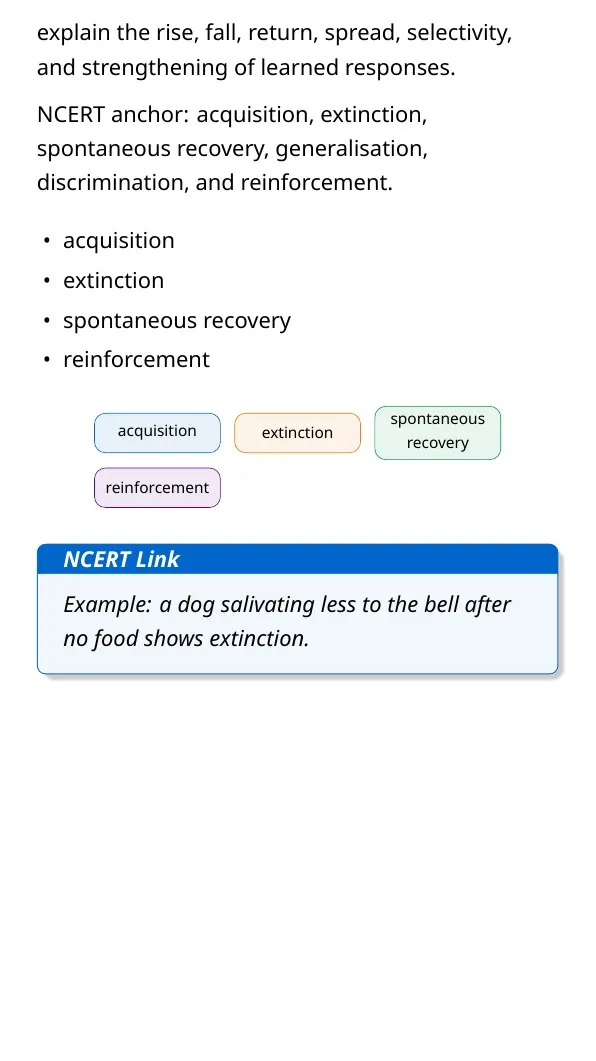
- Revise Pavlov, Skinner, reinforcement, extinction, generalisation, discrimination, cognitive maps and skill-learning phases.
- Use the comparison tables for quick answers on classical and operant conditioning.
Student Feedback: In a Collegedunia poll of 9,120 Class 11 Psychology students, 74% said the hardest part of Chapter 5 was separating classical conditioning from operant conditioning.
Source: 2026-27 Class 11 Psychology student poll across CBSE schools.
Learning Class 11 Psychology Notes: Chapter Overview
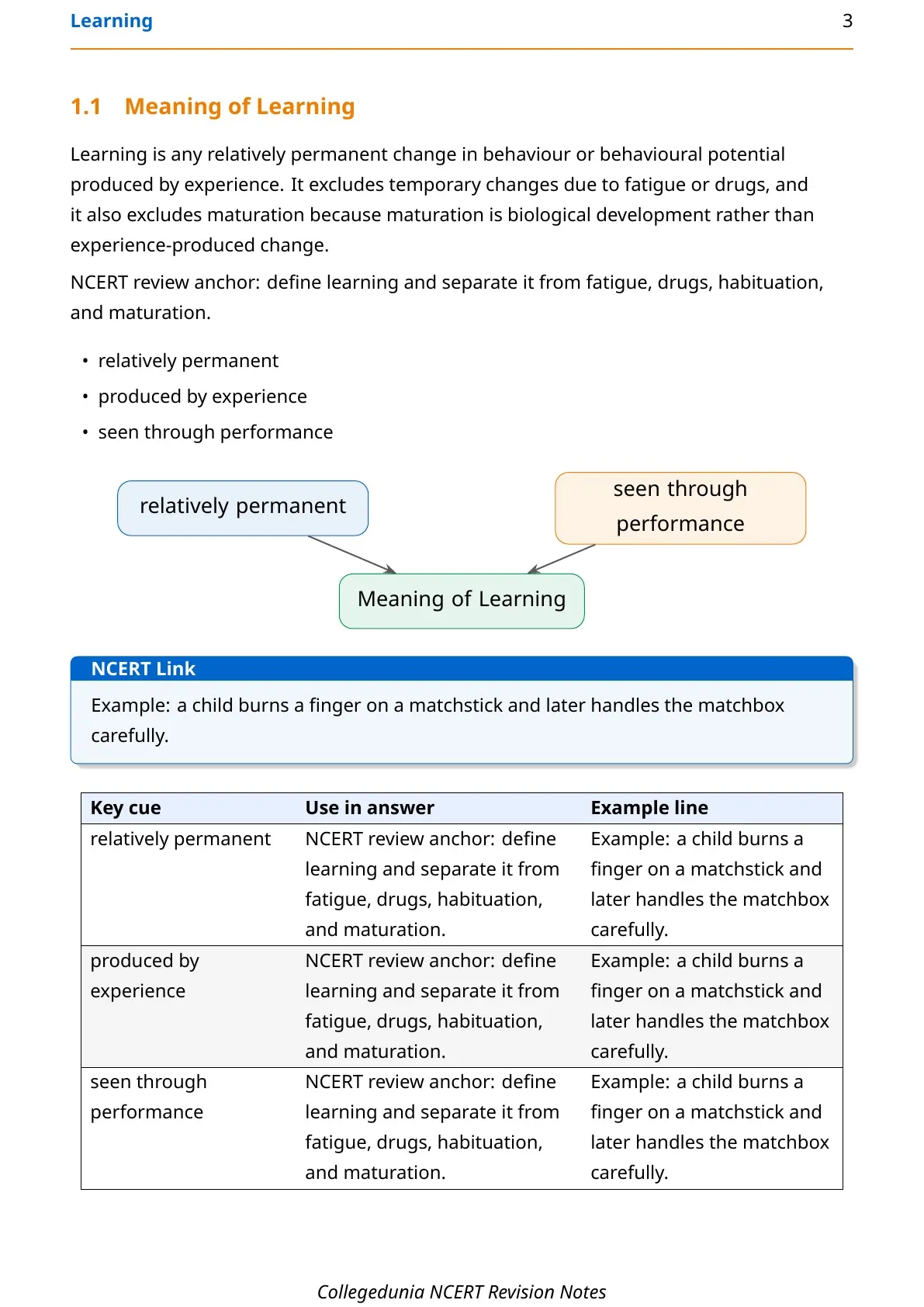
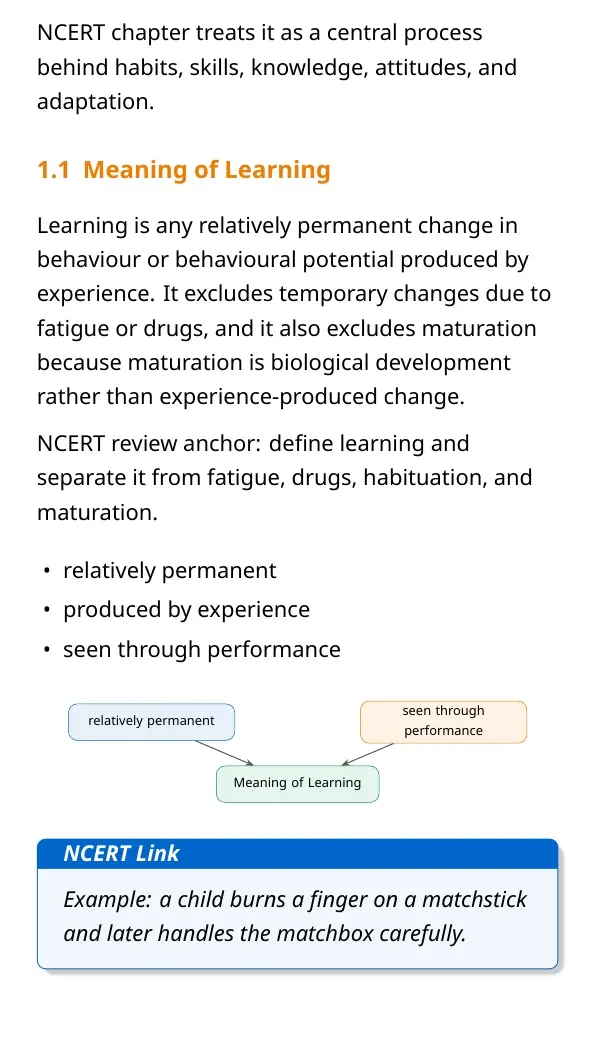
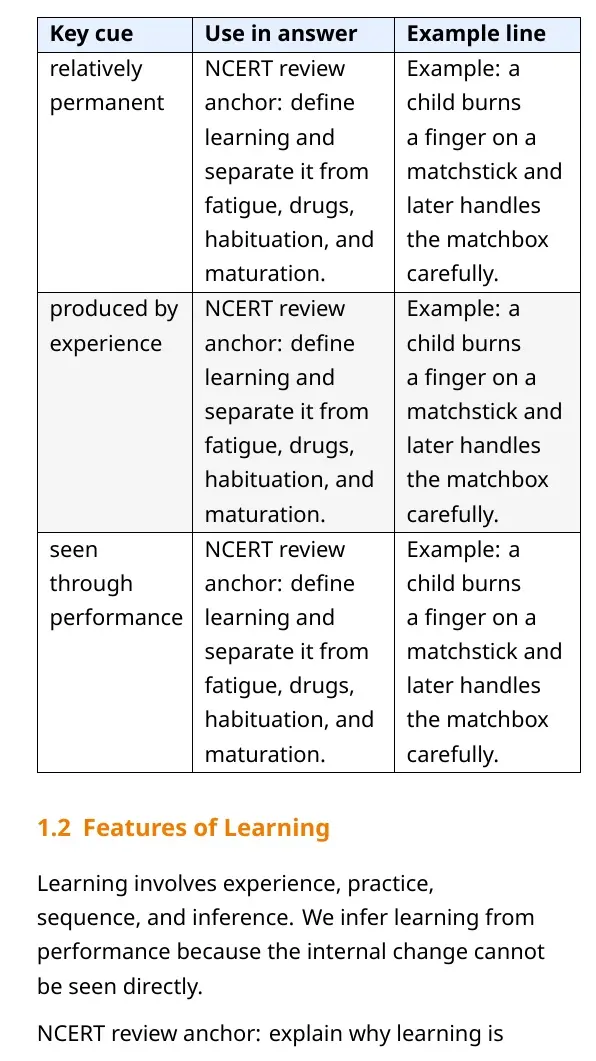
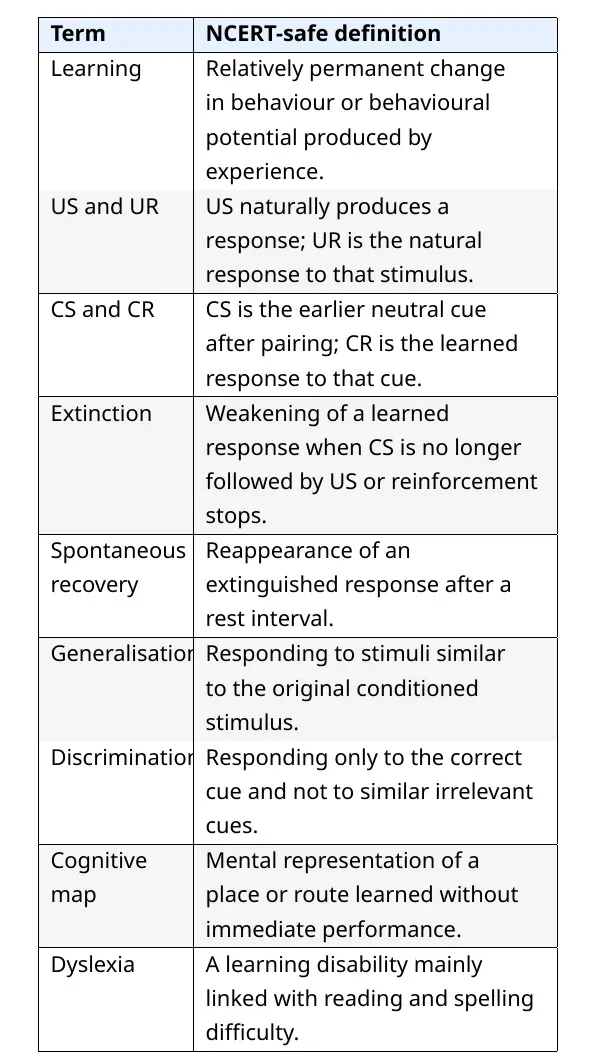
Learning is defined in NCERT as a relatively permanent change in behaviour or behavioural potential produced by experience. The chapter explains why learning is inferred from performance and why fatigue, drugs, habituation and maturation are not the same as learning.
| Chapter area | What to revise | Answer cue |
|---|---|---|
| Nature of learning | Definition, experience, performance and habit formation | Use the poem-recitation example |
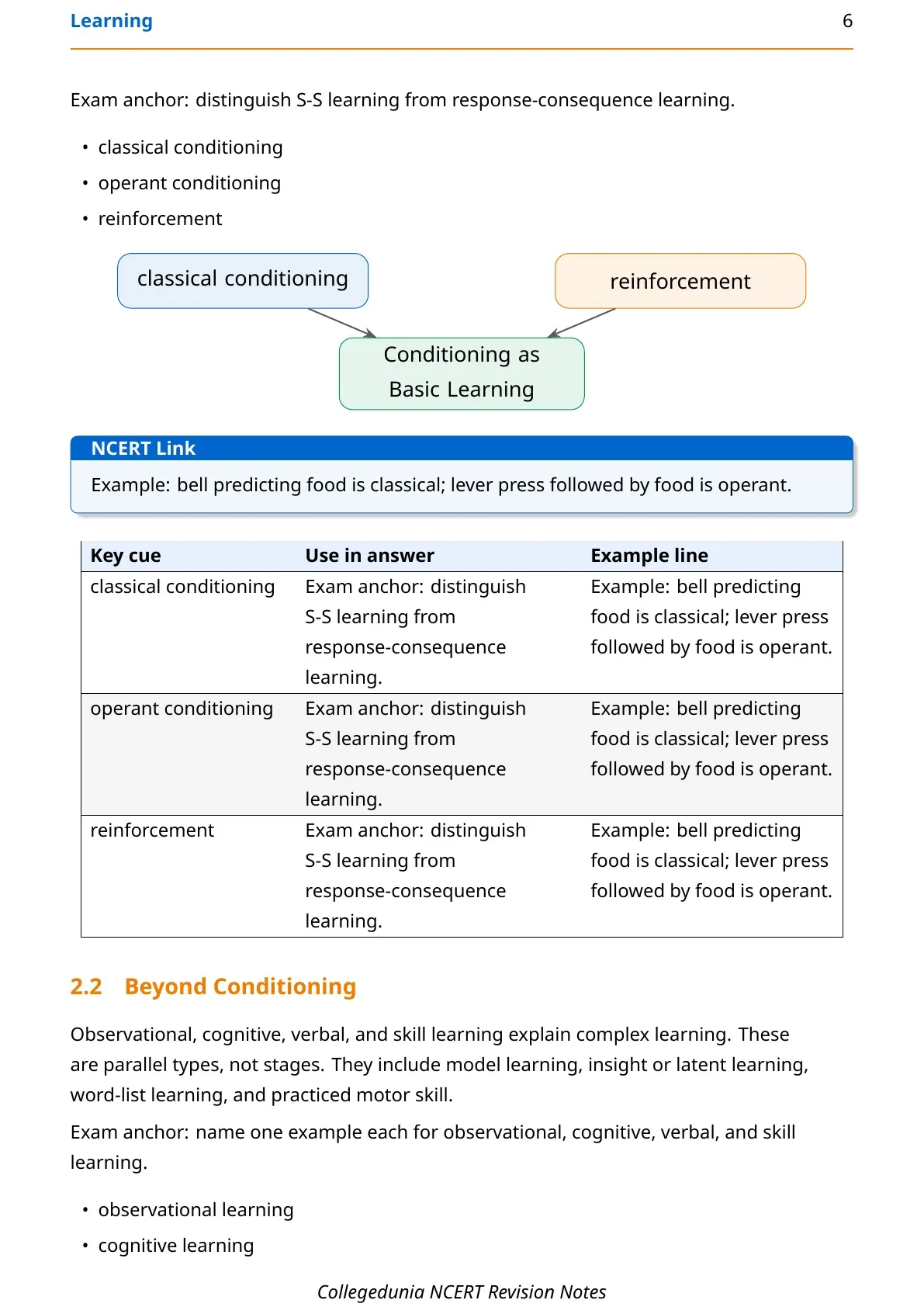
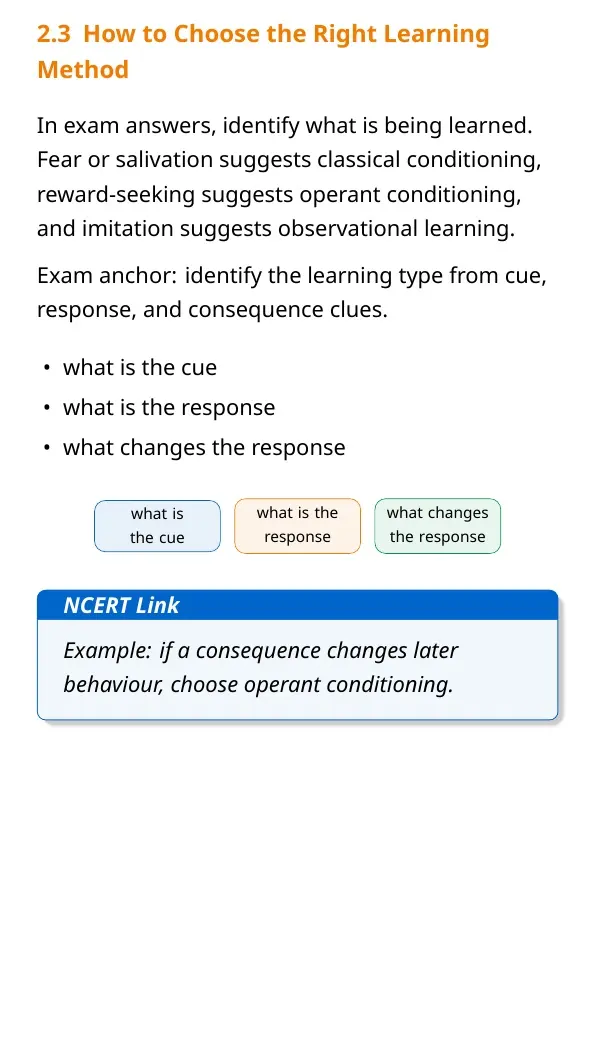
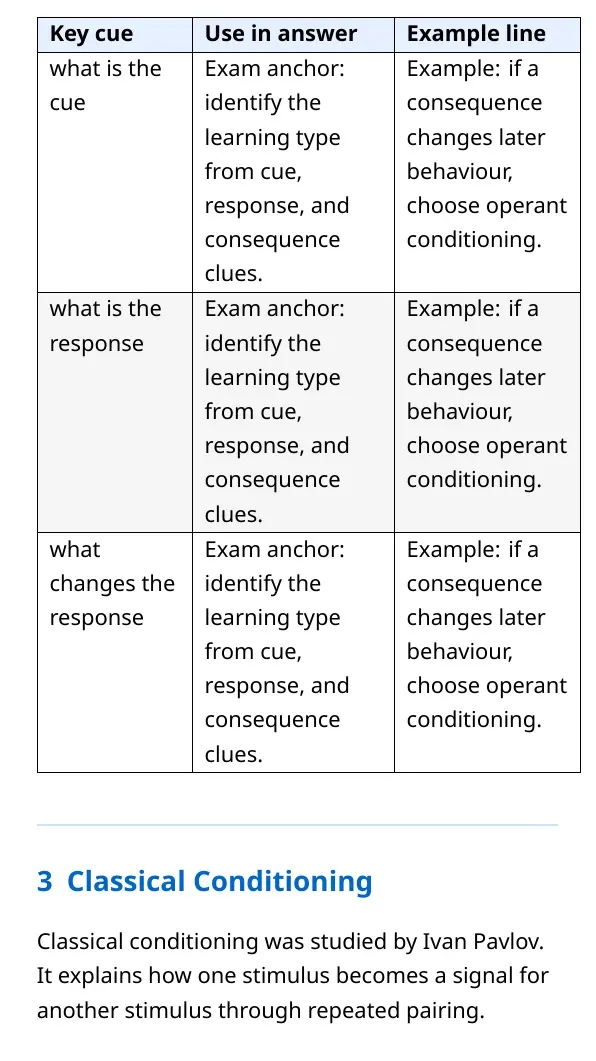
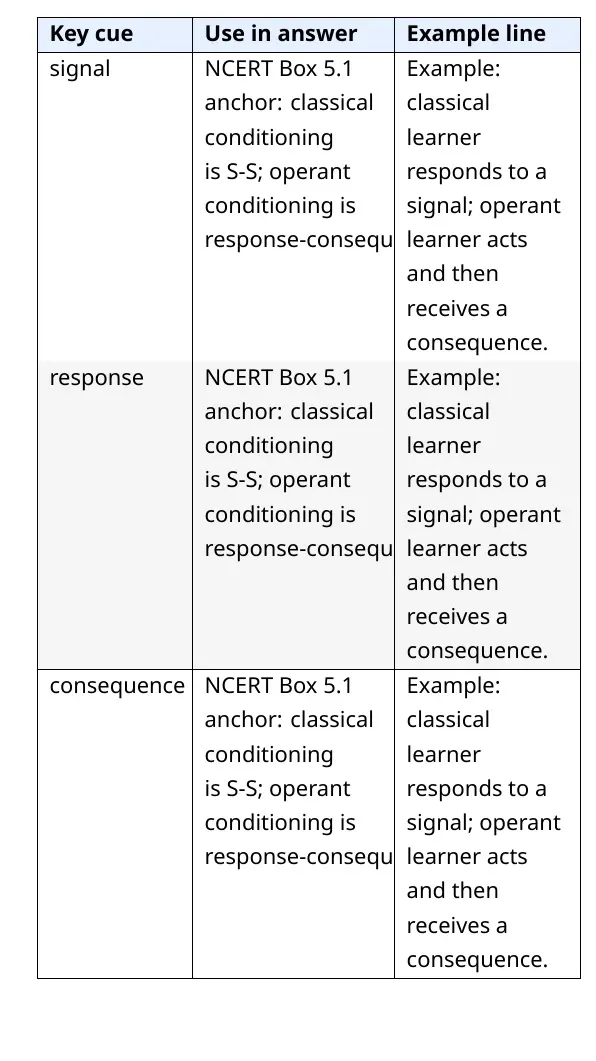
| Conditioning | Classical and operant conditioning | Separate signal learning from consequence learning |
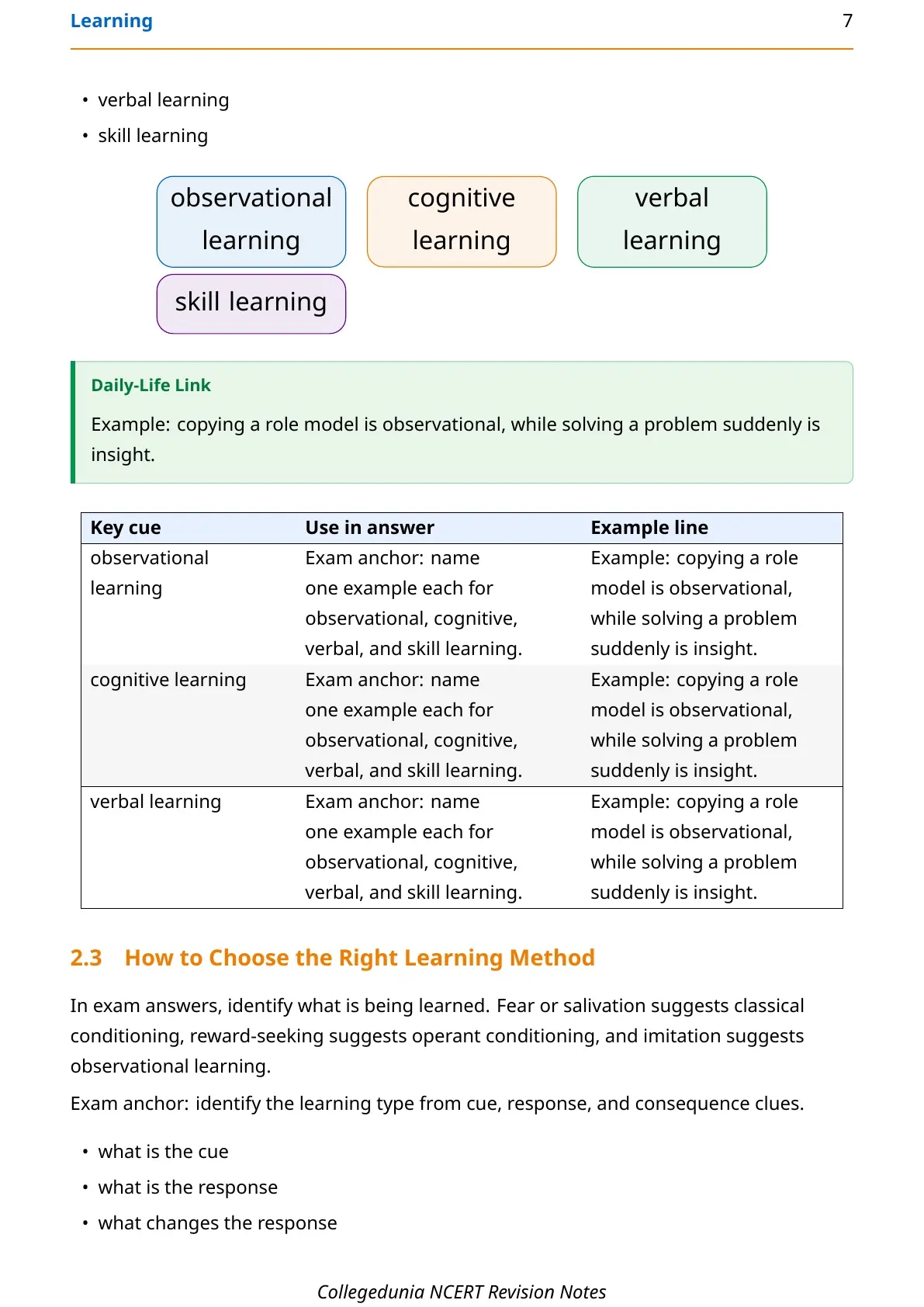
| Other forms | Observational, cognitive, verbal and skill learning | Use model, cognitive map, word list and driving examples |
| Support needs | Learning disabilities and remedial teaching | Do not blame effort or intelligence |
Learning Chapter Video Revision
Source: Magnet Brains on YouTube
Nature and Features of Learning
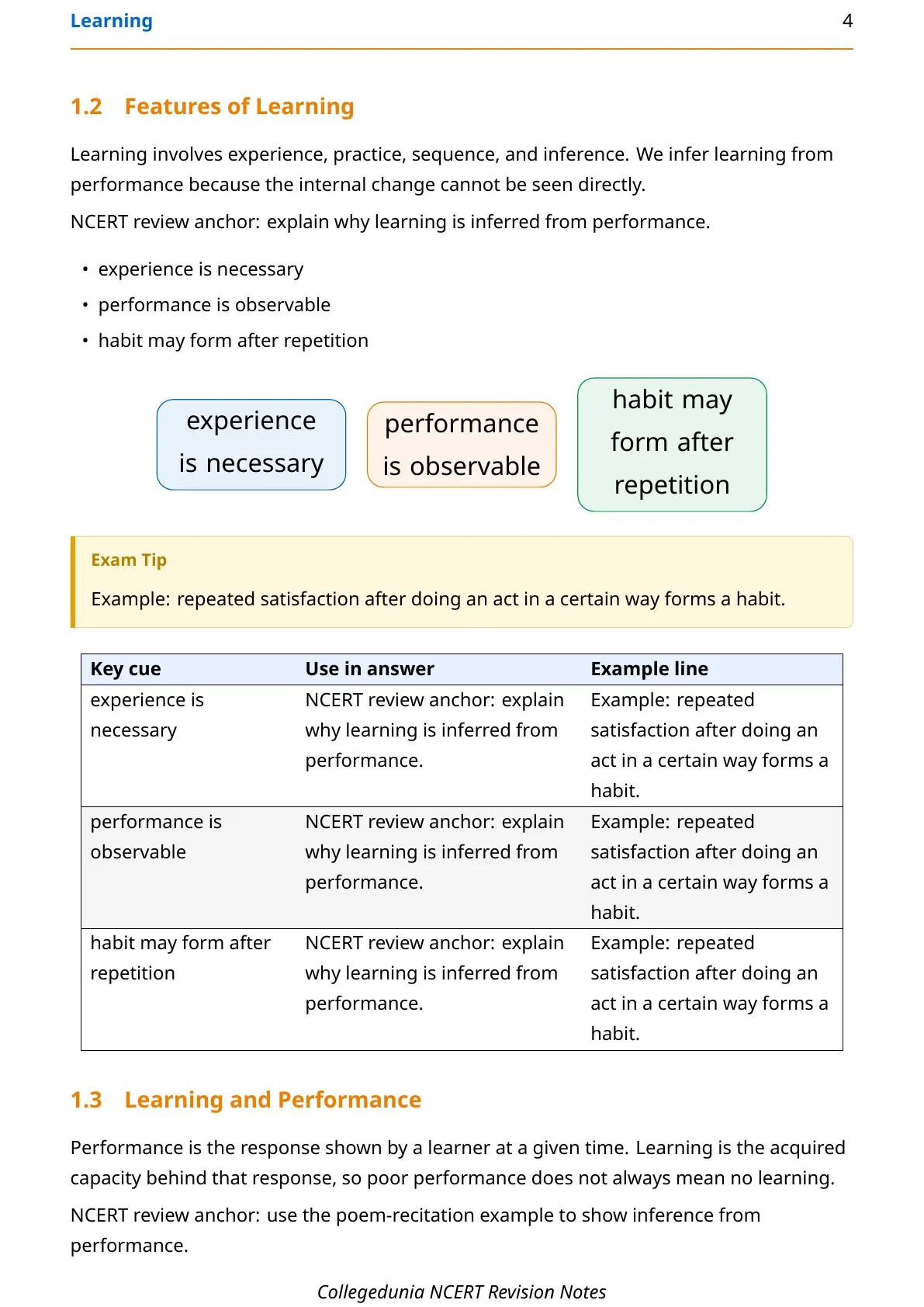
Learning always involves experience. It may come from repeated practice or from a single strong event, such as a child becoming careful after getting fingers burnt by a matchstick. Behavioural change due to fatigue or drugs is temporary, so it is not counted as learning.
- Learning: relatively permanent change produced by experience.
- Performance: observed response from which learning is inferred.
- Habit: repeated satisfaction after an act strengthens the behaviour.
Classical Conditioning in Learning
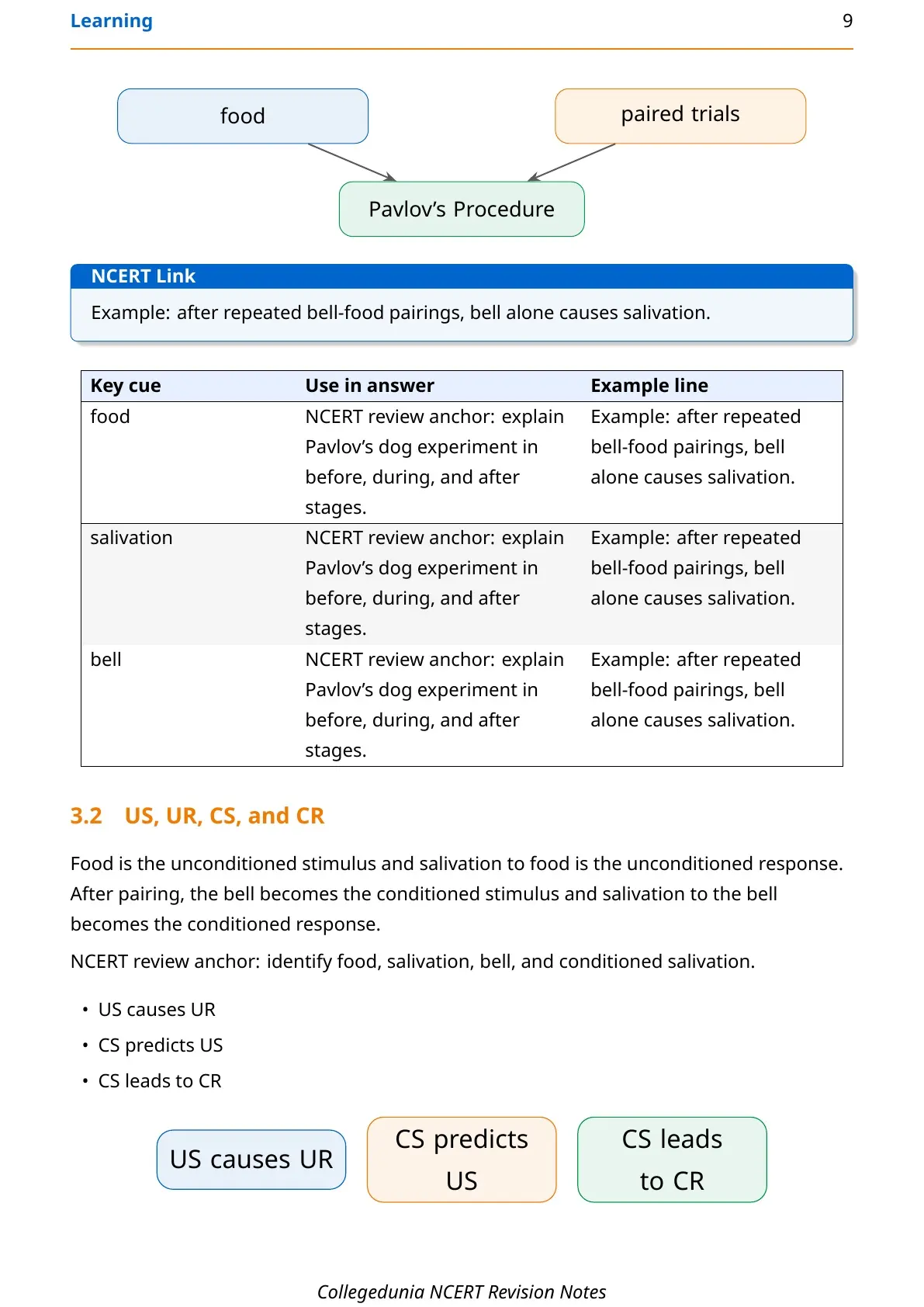
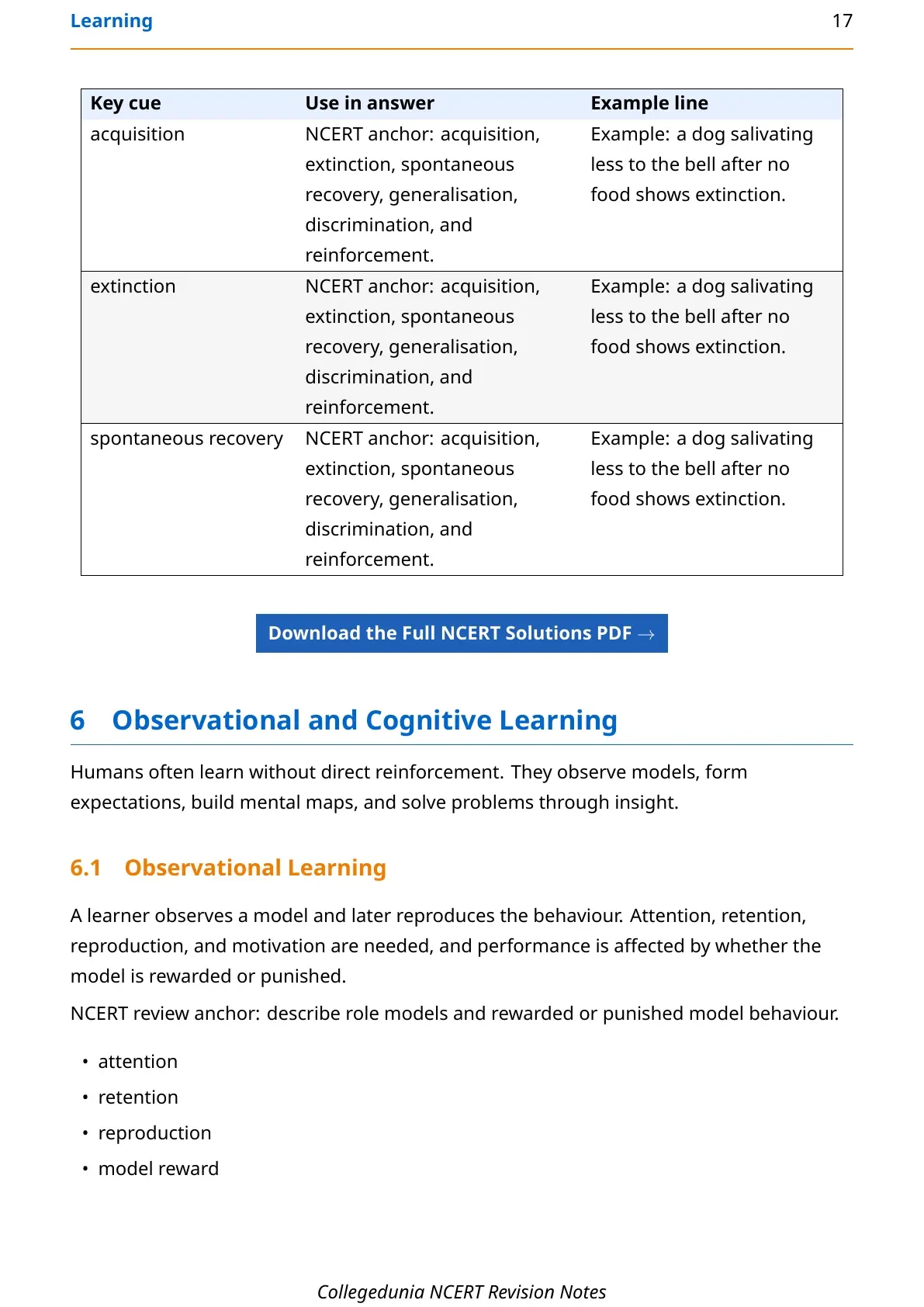
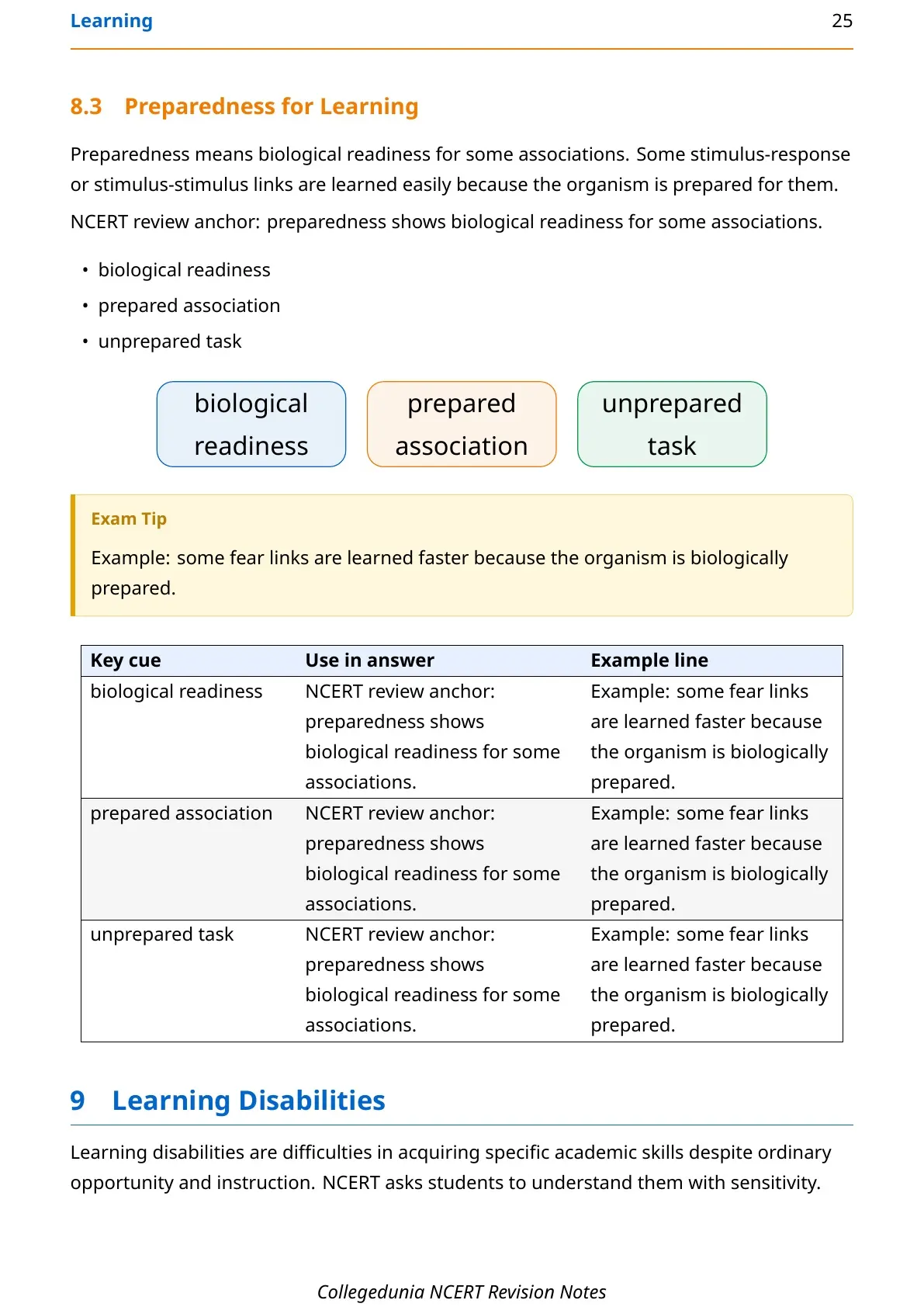
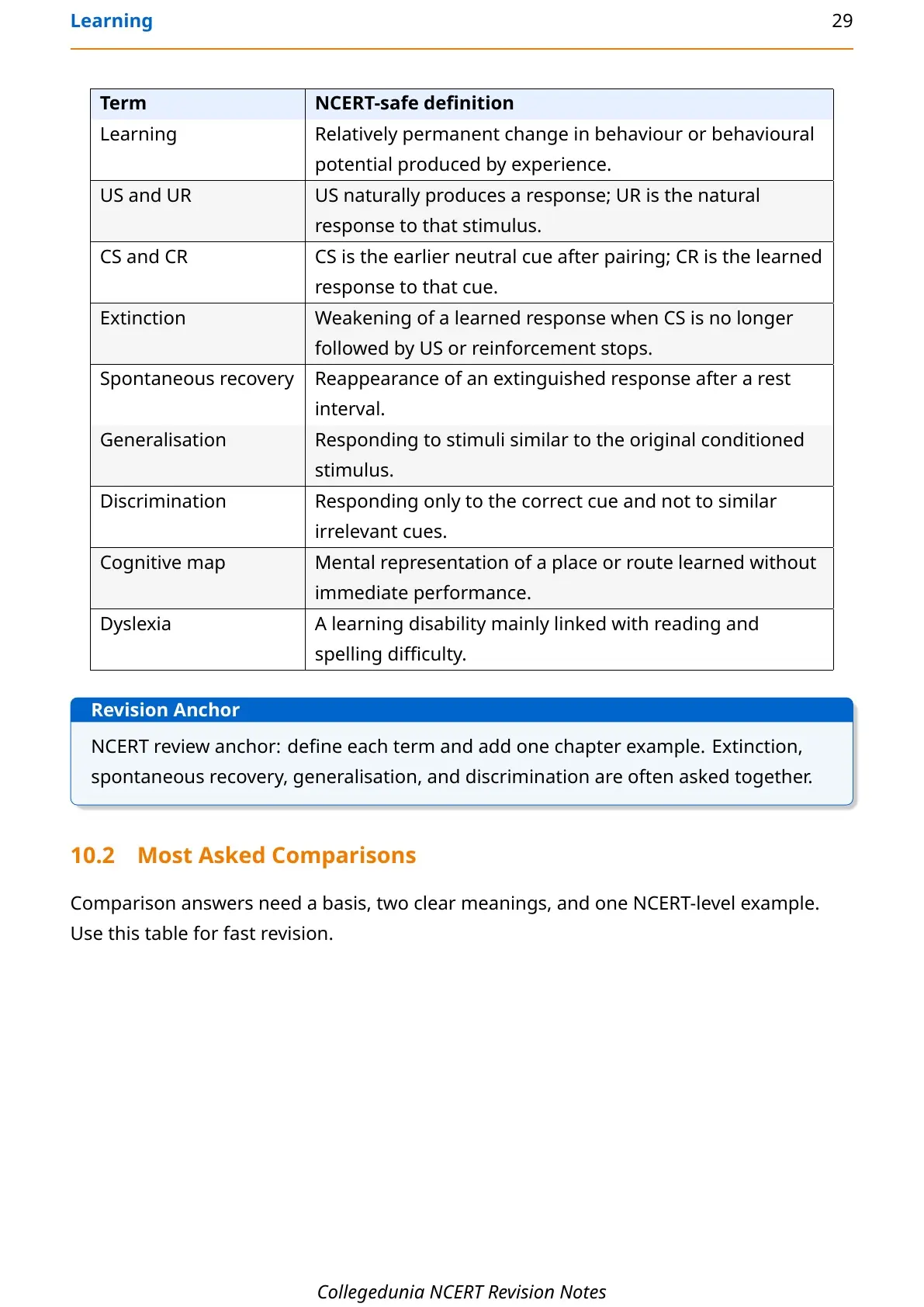
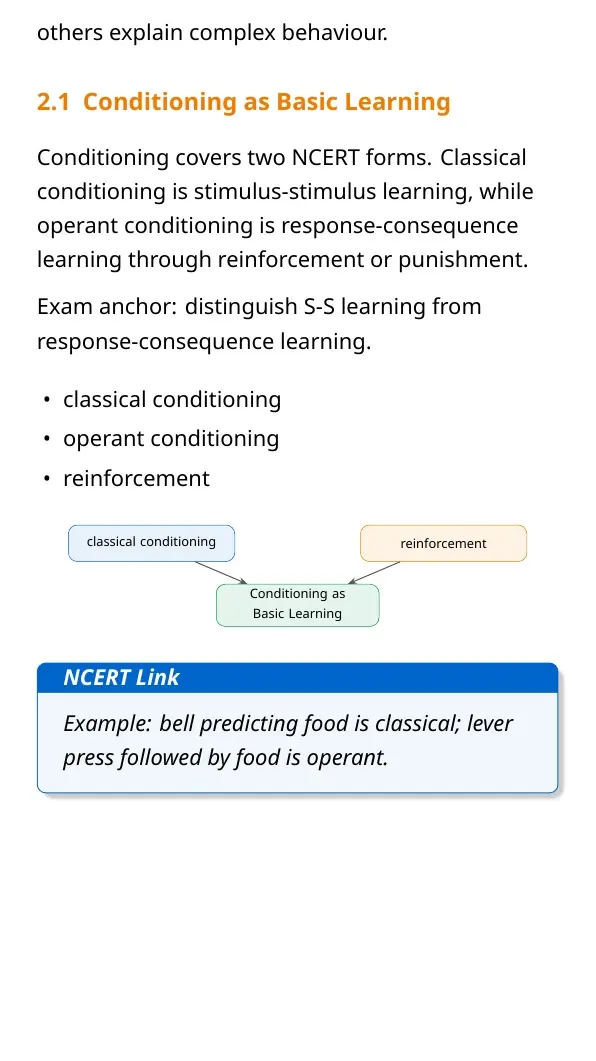
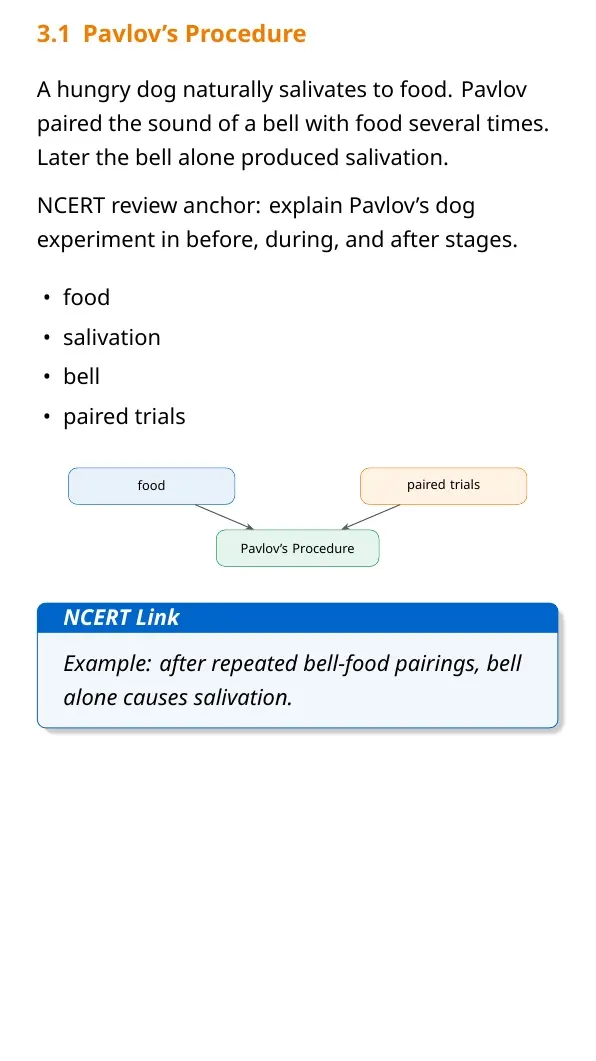
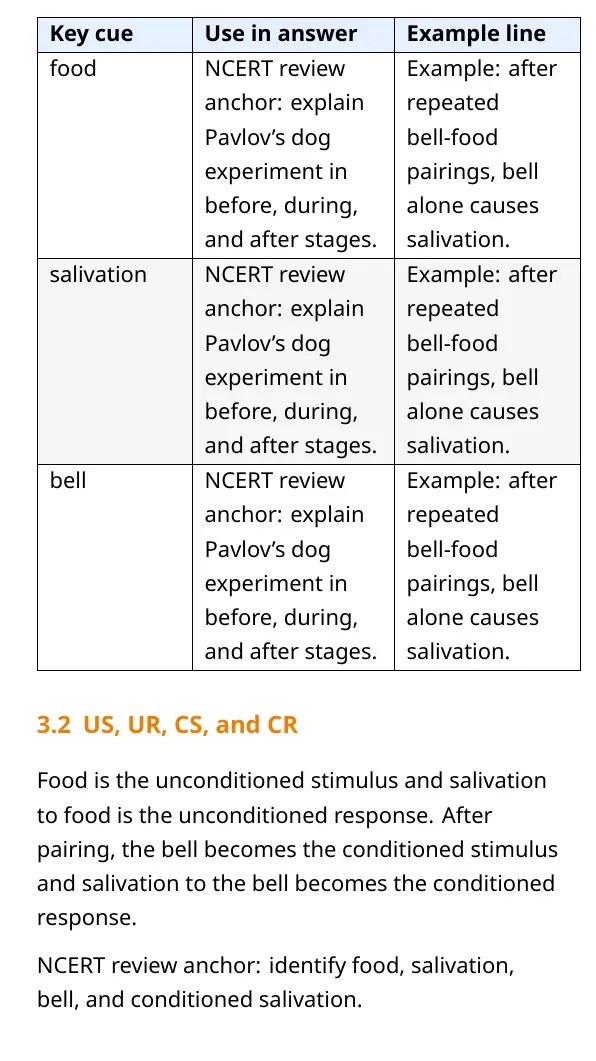
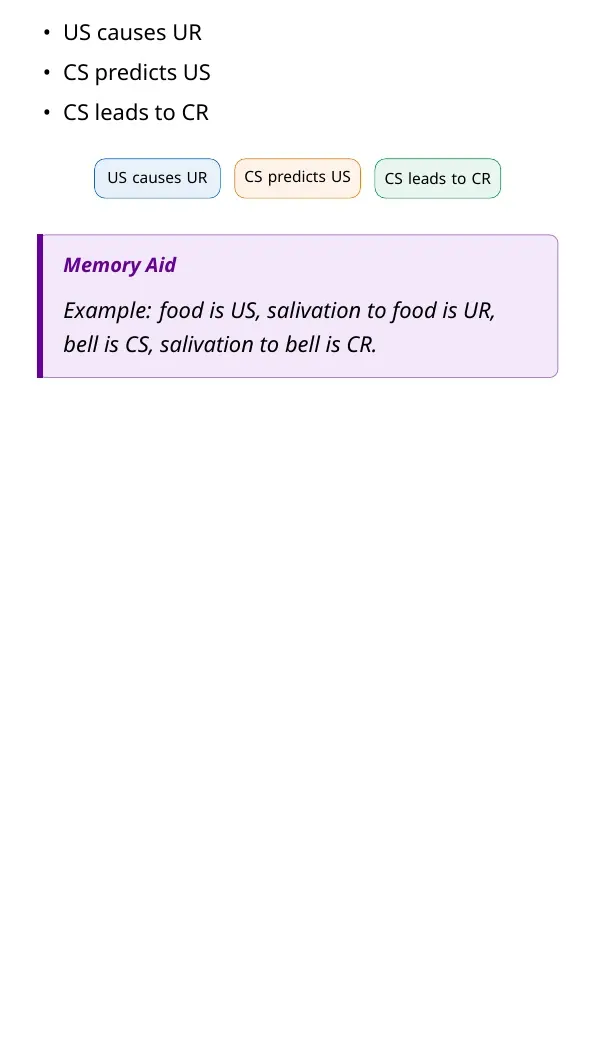
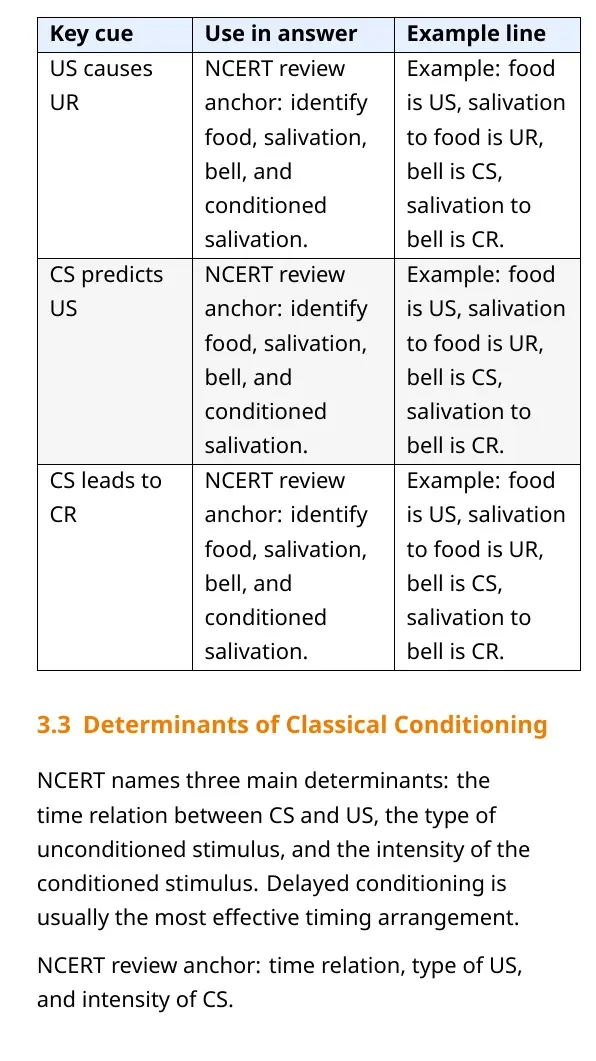
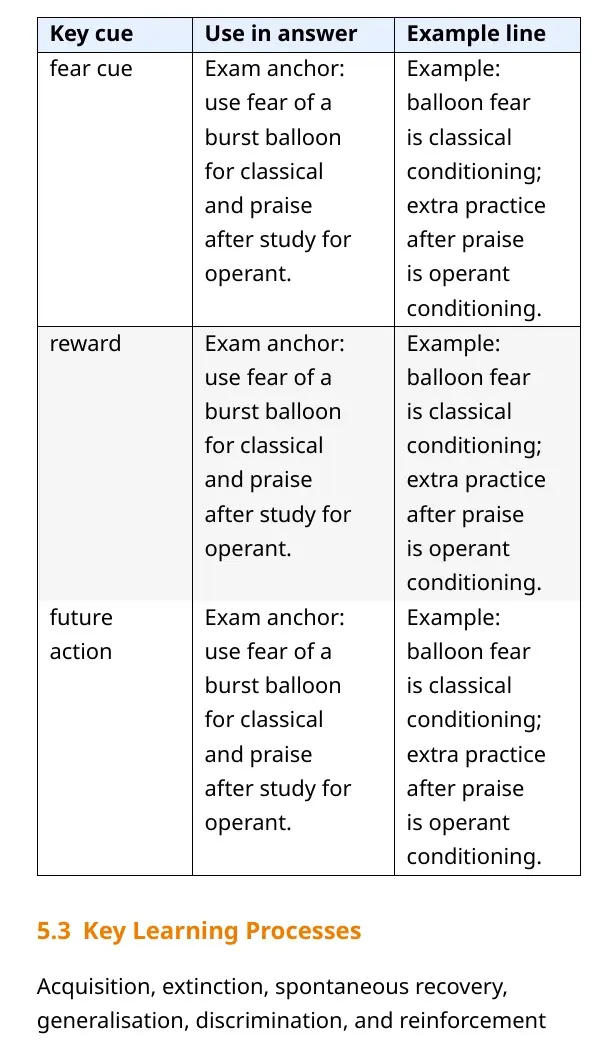
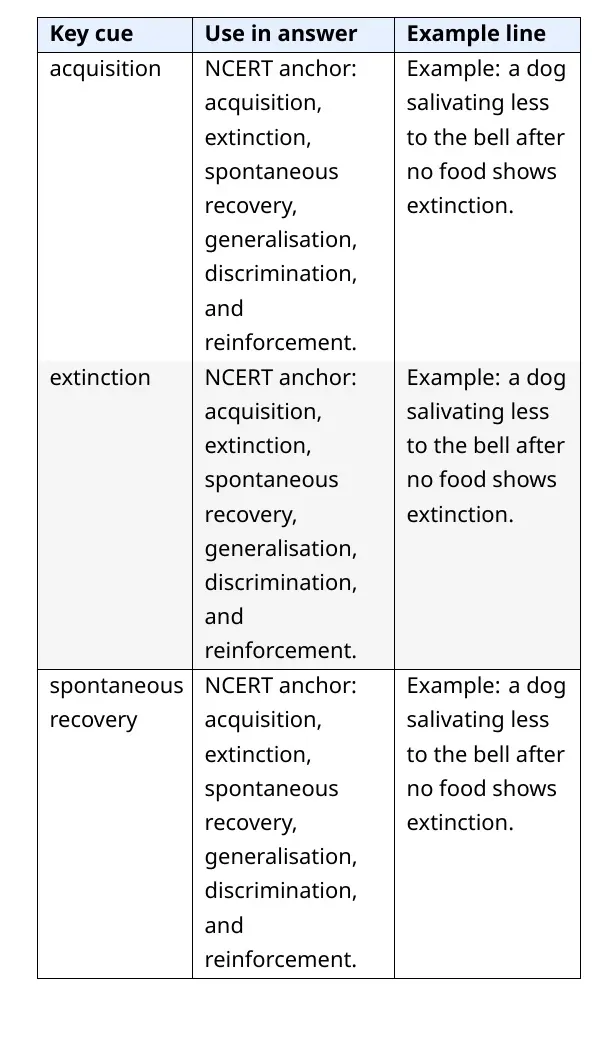
Classical conditioning was studied by Ivan Pavlov. A neutral cue becomes a conditioned stimulus after repeated pairing with an unconditioned stimulus. In Pavlov's example, food is the unconditioned stimulus, salivation to food is the unconditioned response, bell is the conditioned stimulus and salivation to bell is the conditioned response.
| Term | Meaning | Pavlov example |
|---|---|---|
| US | Naturally produces a response | Food |
| UR | Natural response to US | Salivation to food |
| CS | Earlier neutral cue after pairing | Bell |
| CR | Learned response to CS | Salivation to bell |
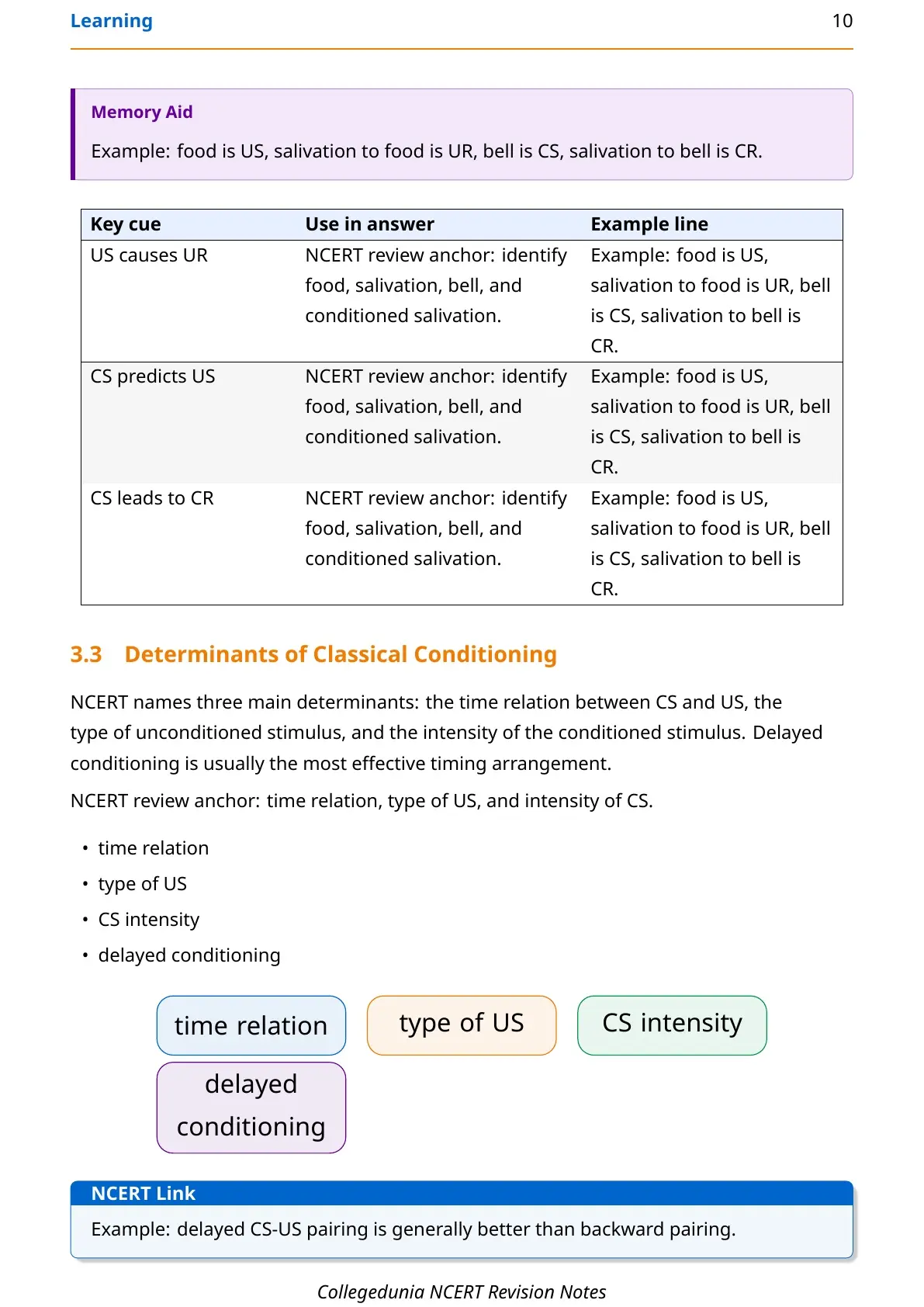
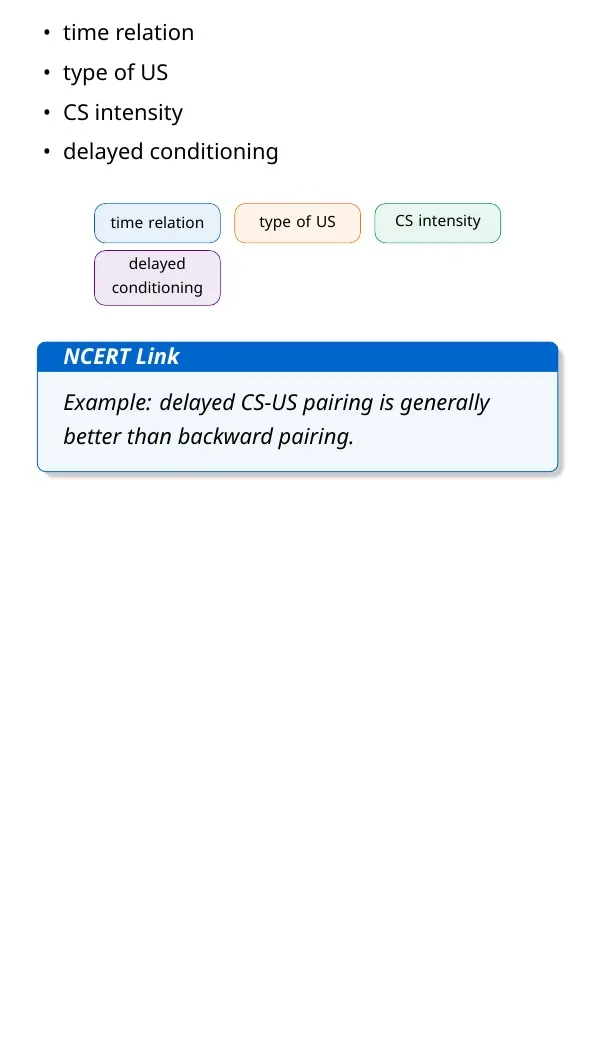
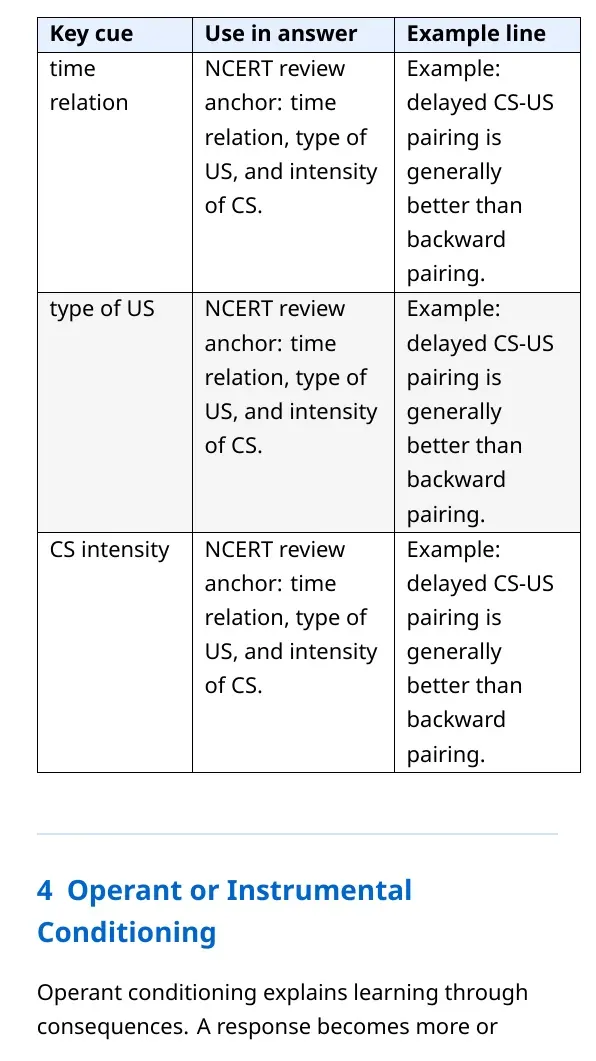
The main determinants are the time relation between CS and US, the type of unconditioned stimulus and the intensity of the conditioned stimulus. Delayed conditioning is usually stronger than backward conditioning.
Operant Conditioning and Reinforcement
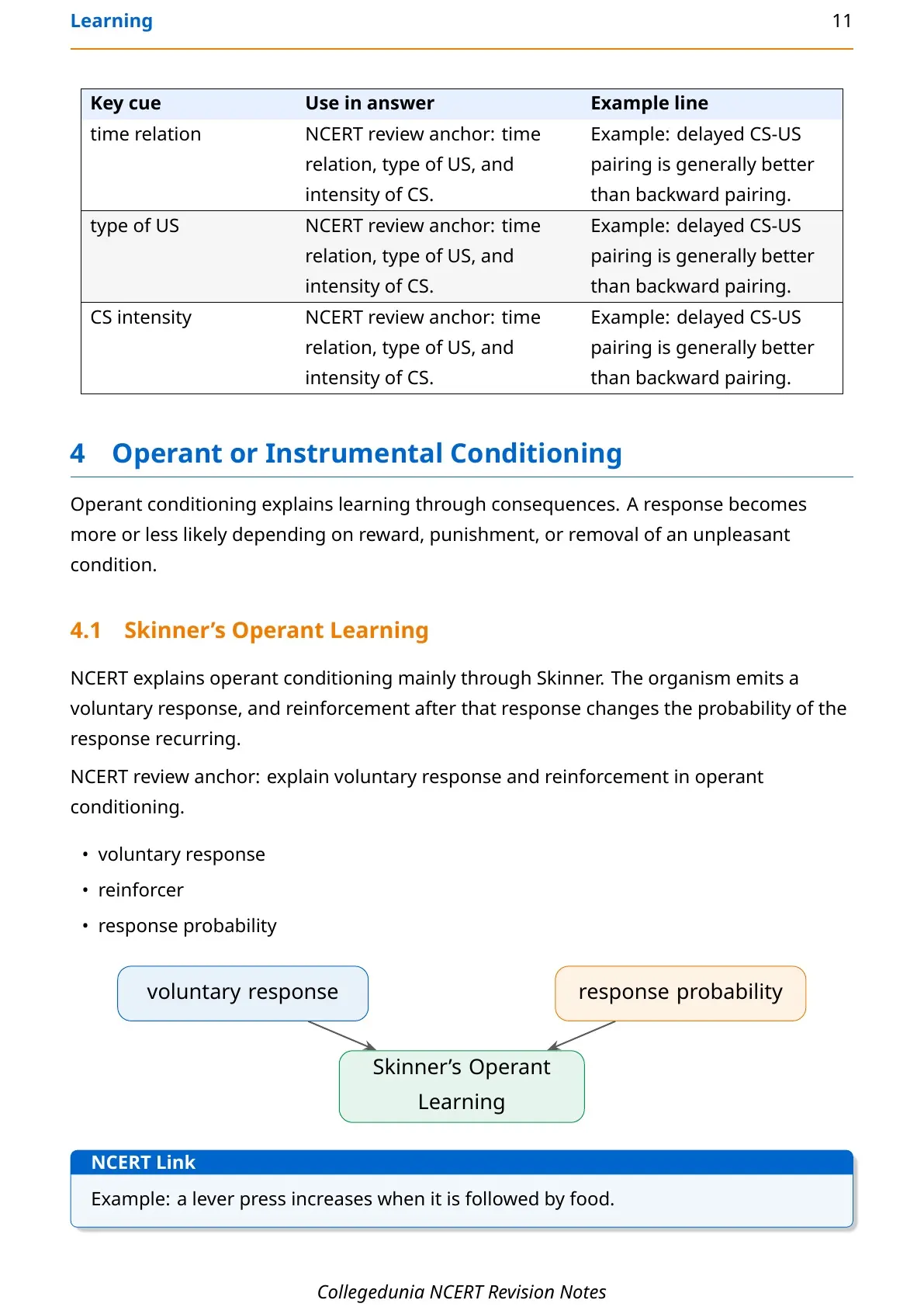
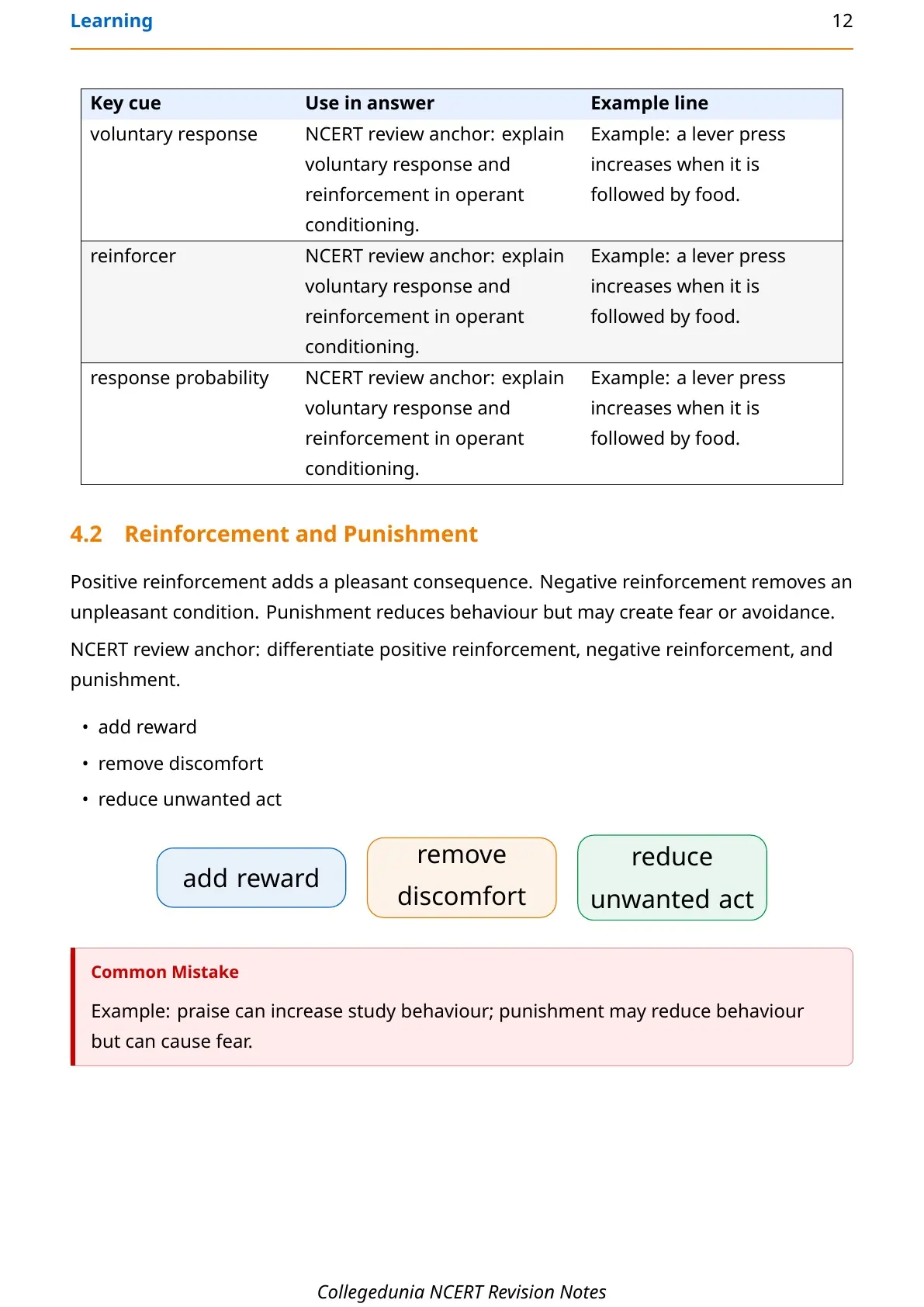
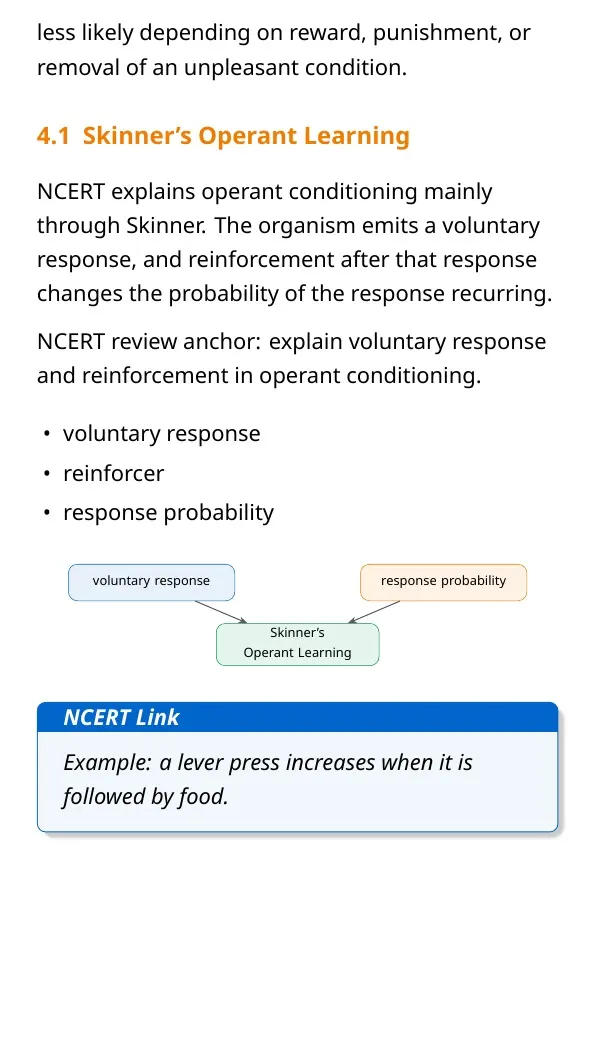
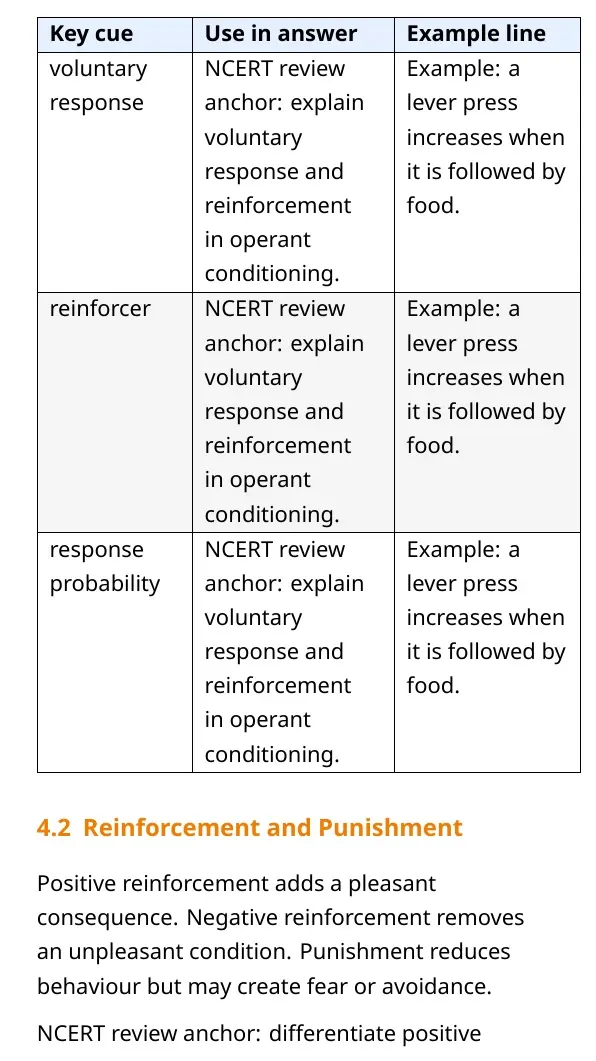
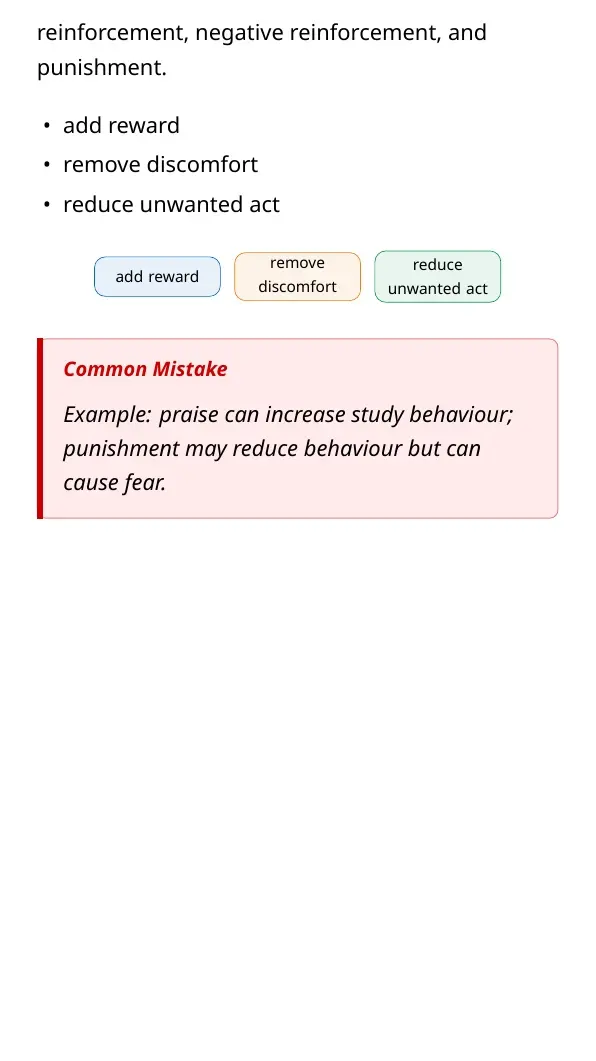
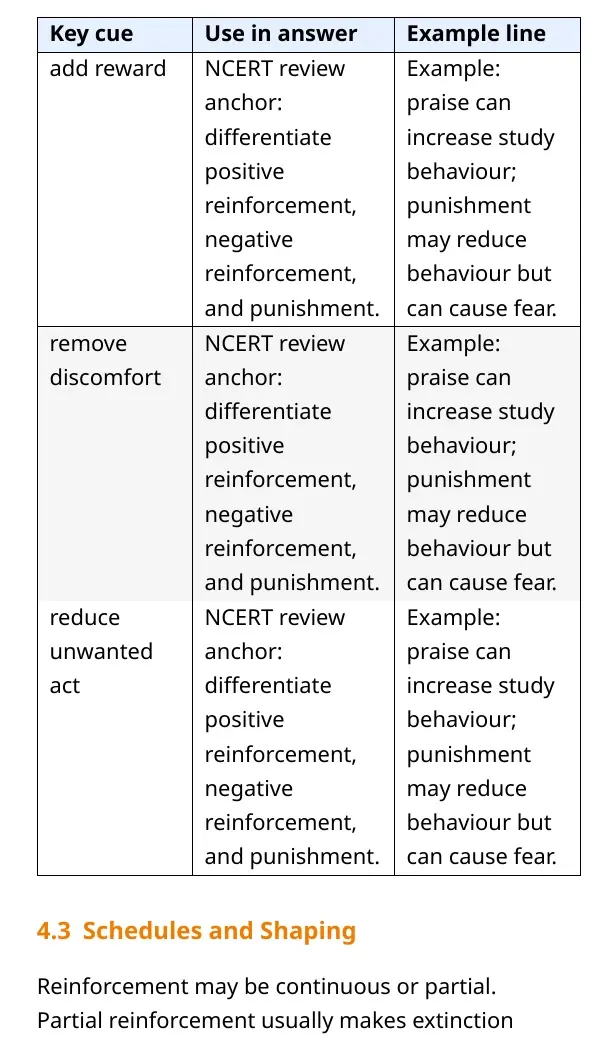
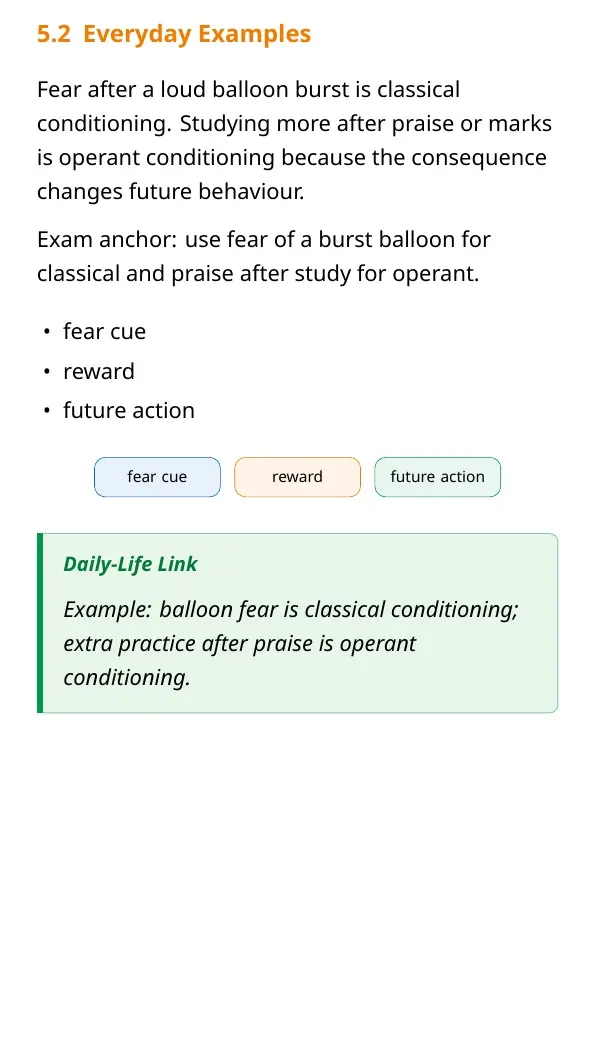
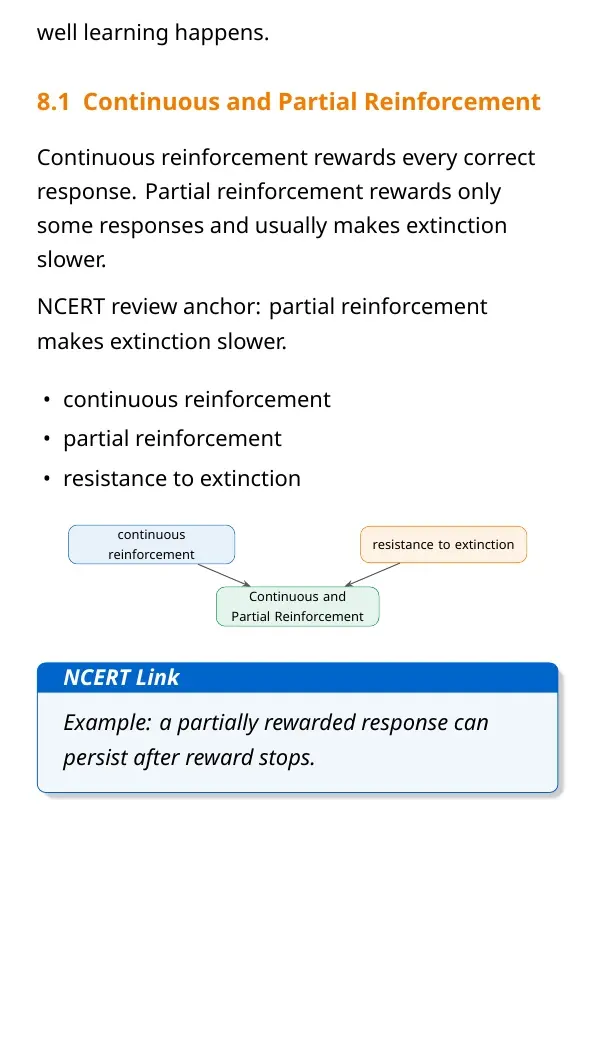
Operant conditioning explains voluntary responses that are controlled by their consequences. Skinner showed that a response becomes more likely when it is followed by reinforcement. Punishment may reduce behaviour, but it may also create fear or avoidance.
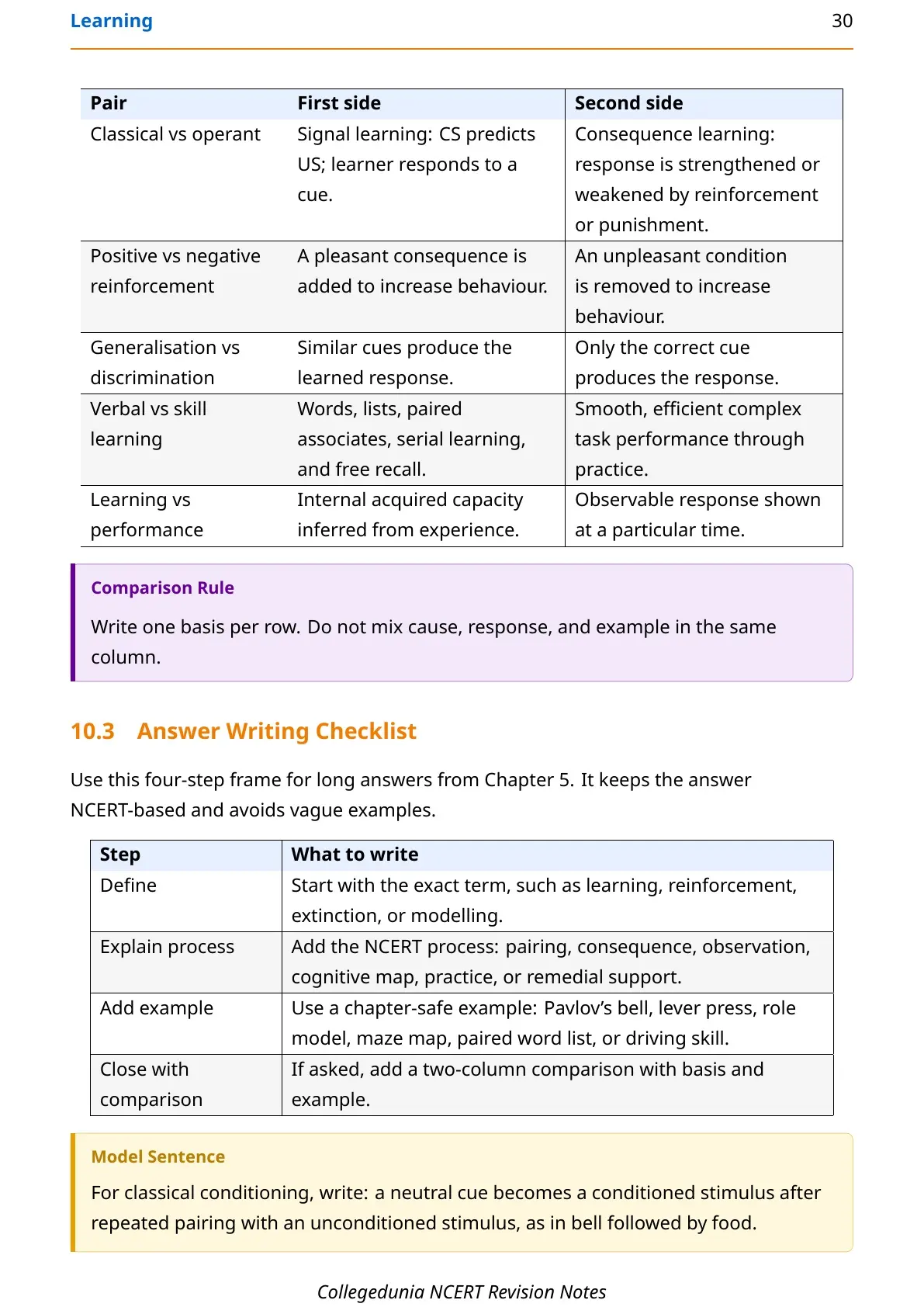
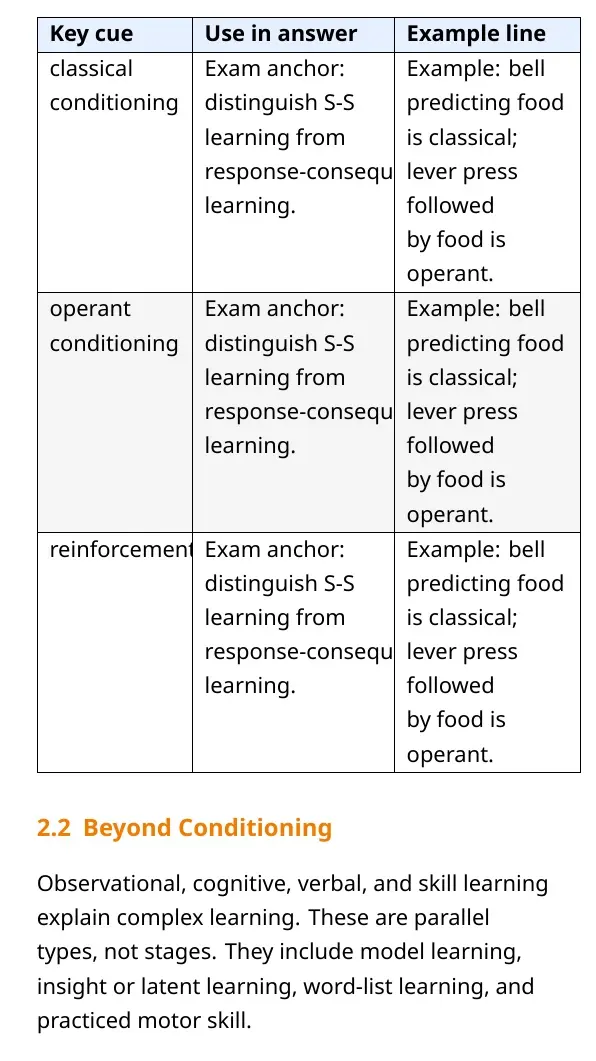
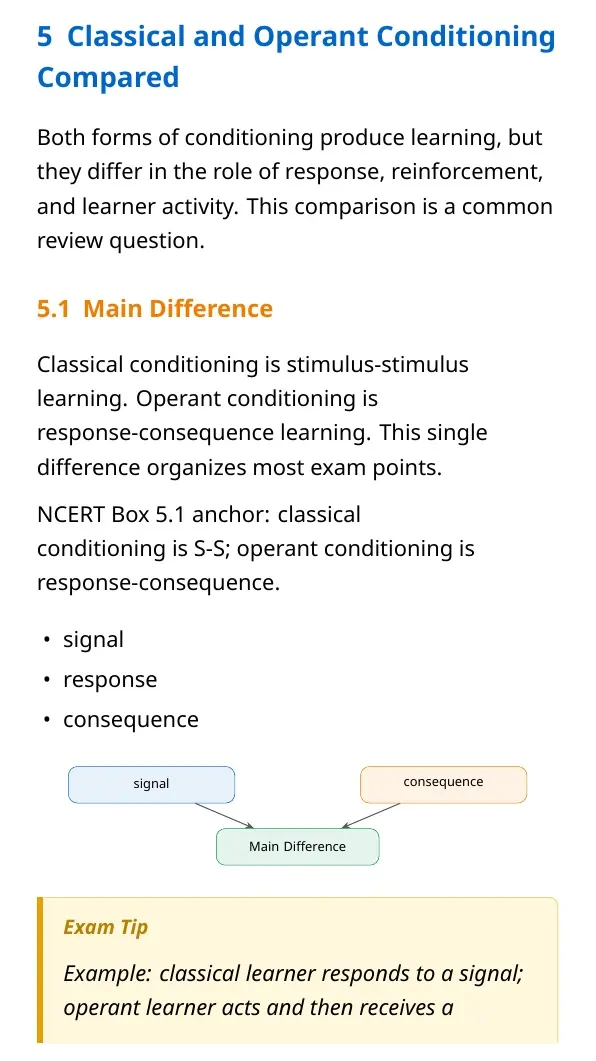
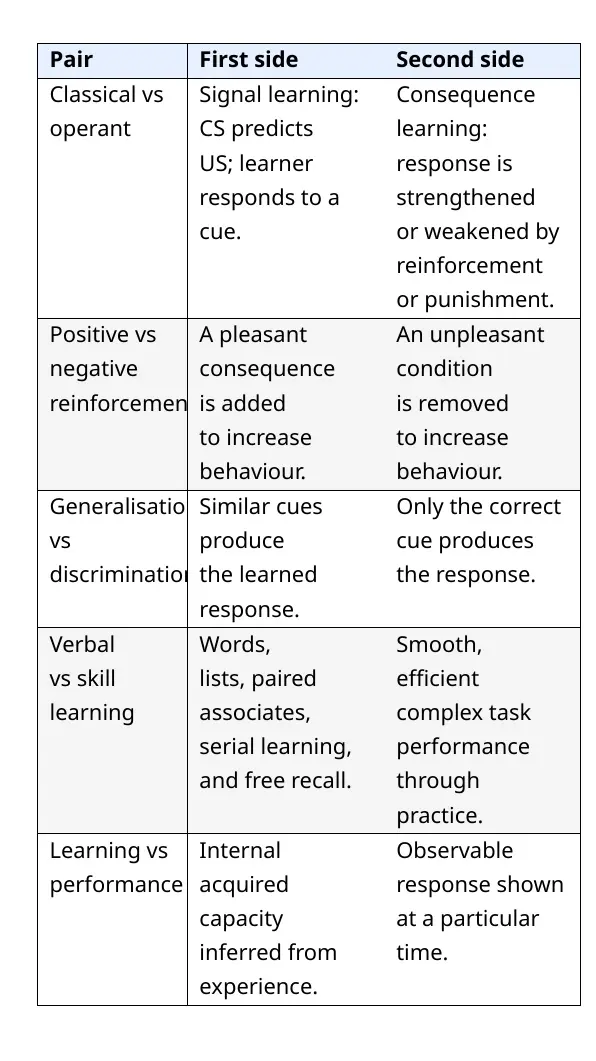
| Basis | Classical conditioning | Operant conditioning |
|---|---|---|
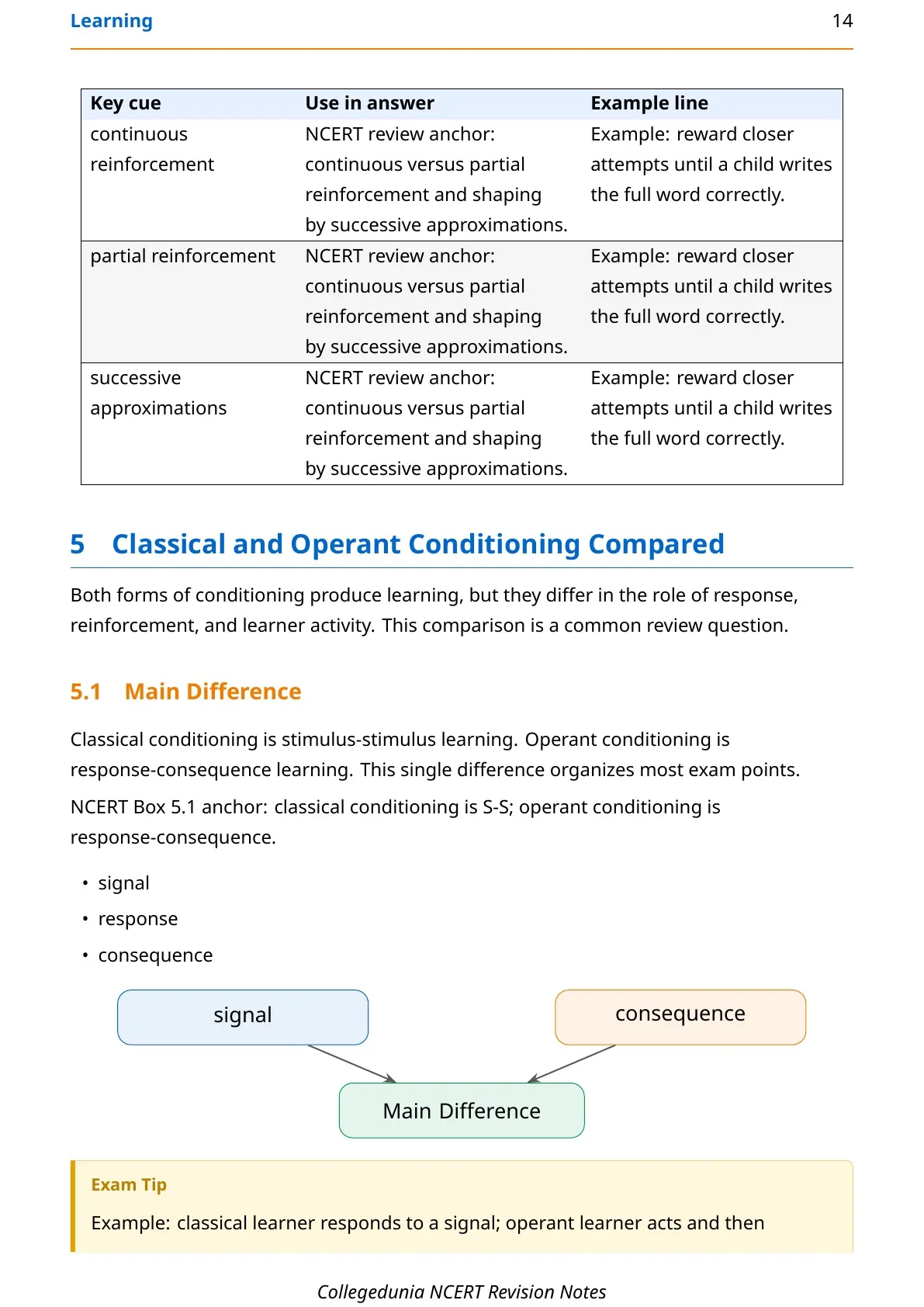
| Learning type | Stimulus to stimulus learning | Response to consequence learning |
| Learner role | Responds to a signal | Acts and receives a consequence |
| Example | Bell followed by food | Lever press followed by food |
| Key process | Pairing of CS and US | Reinforcement after response |
Observational and Cognitive Learning
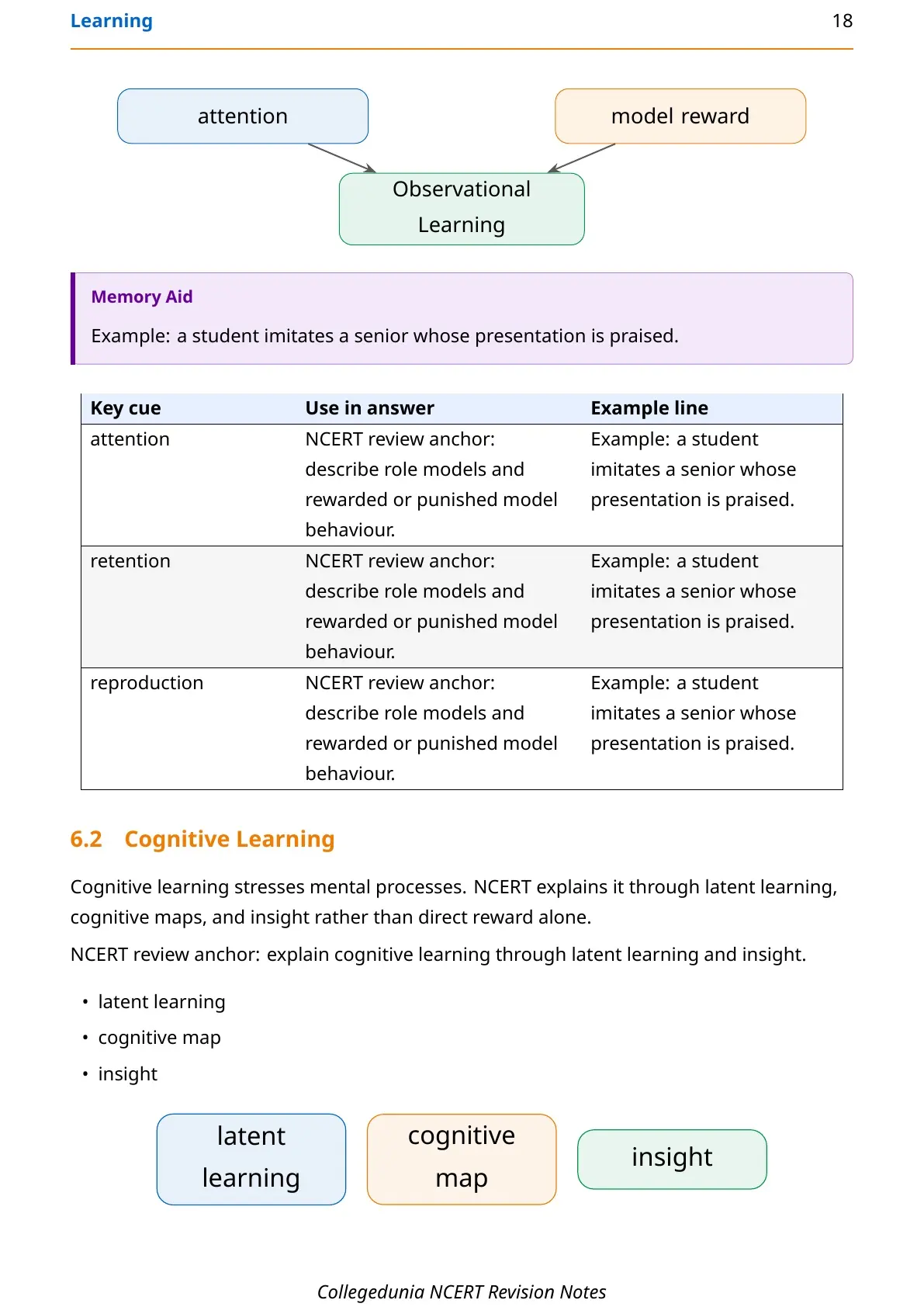
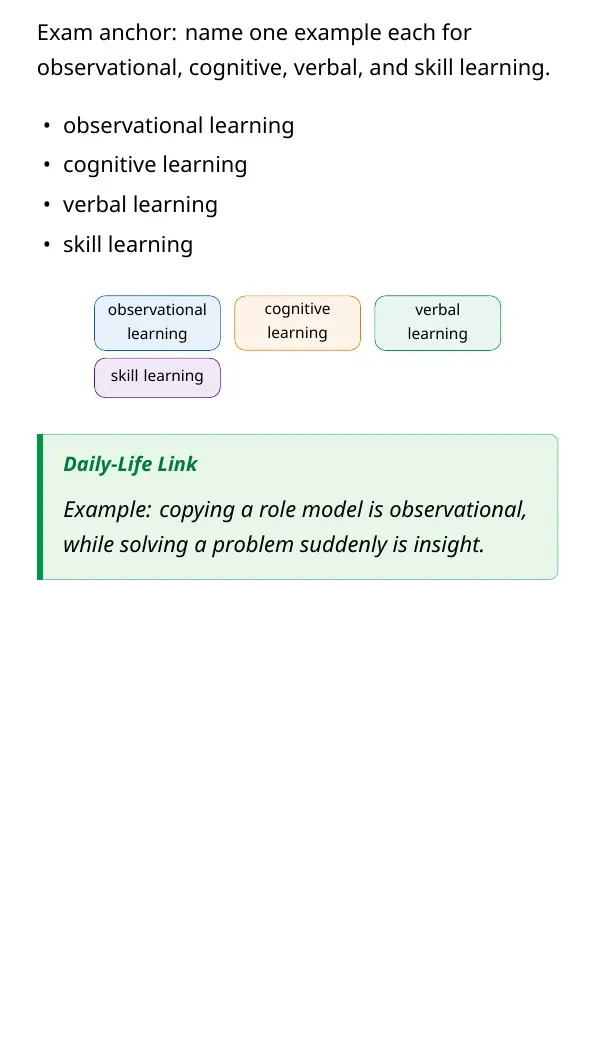
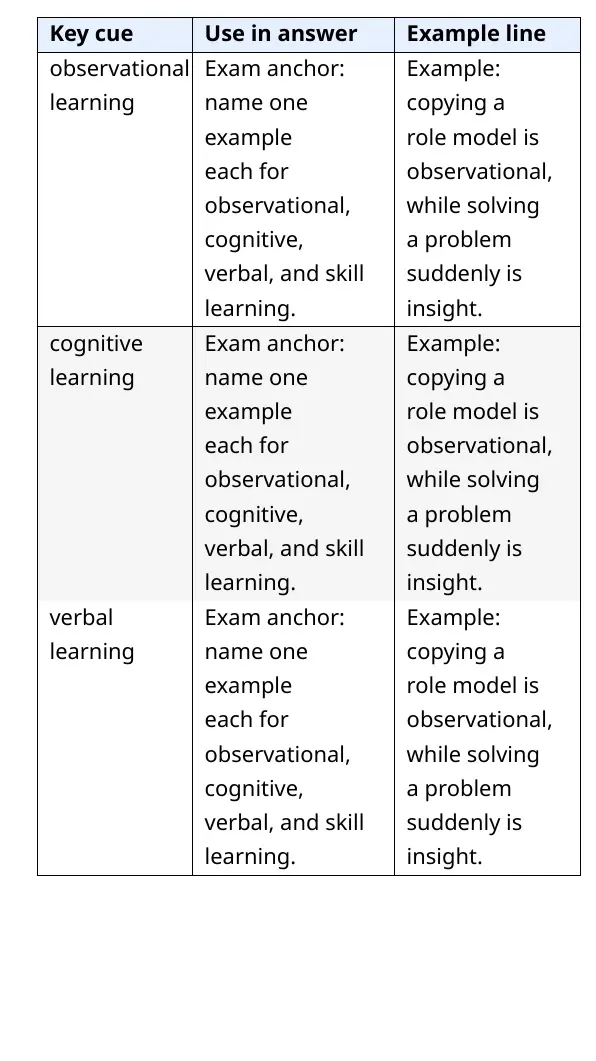
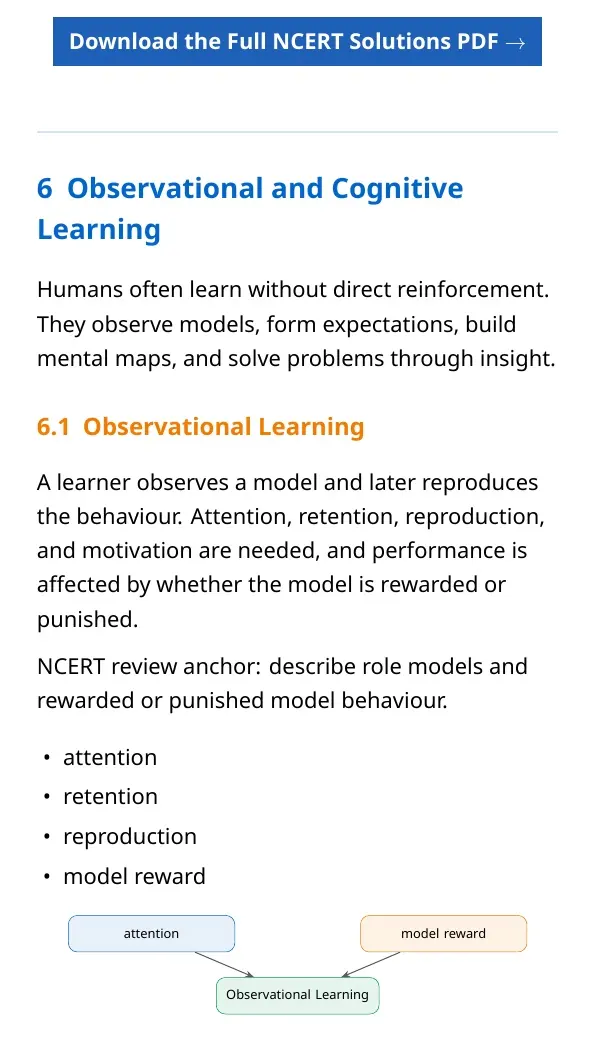
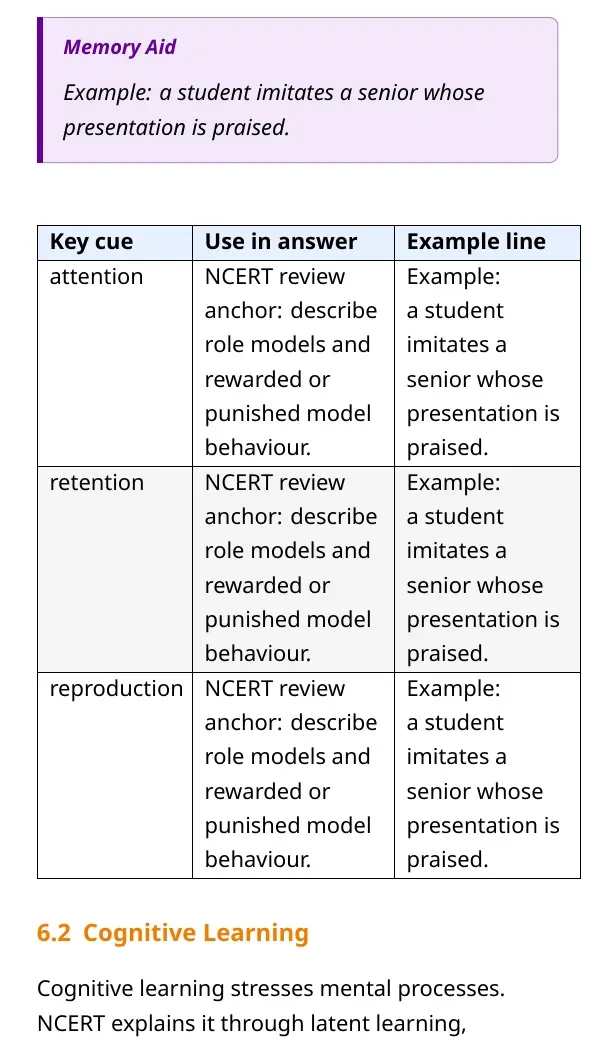
Observational learning happens when a learner observes a model and later reproduces the behaviour. Attention, retention, reproduction and motivation are needed. Performance is influenced by whether the model's behaviour is rewarded or punished.
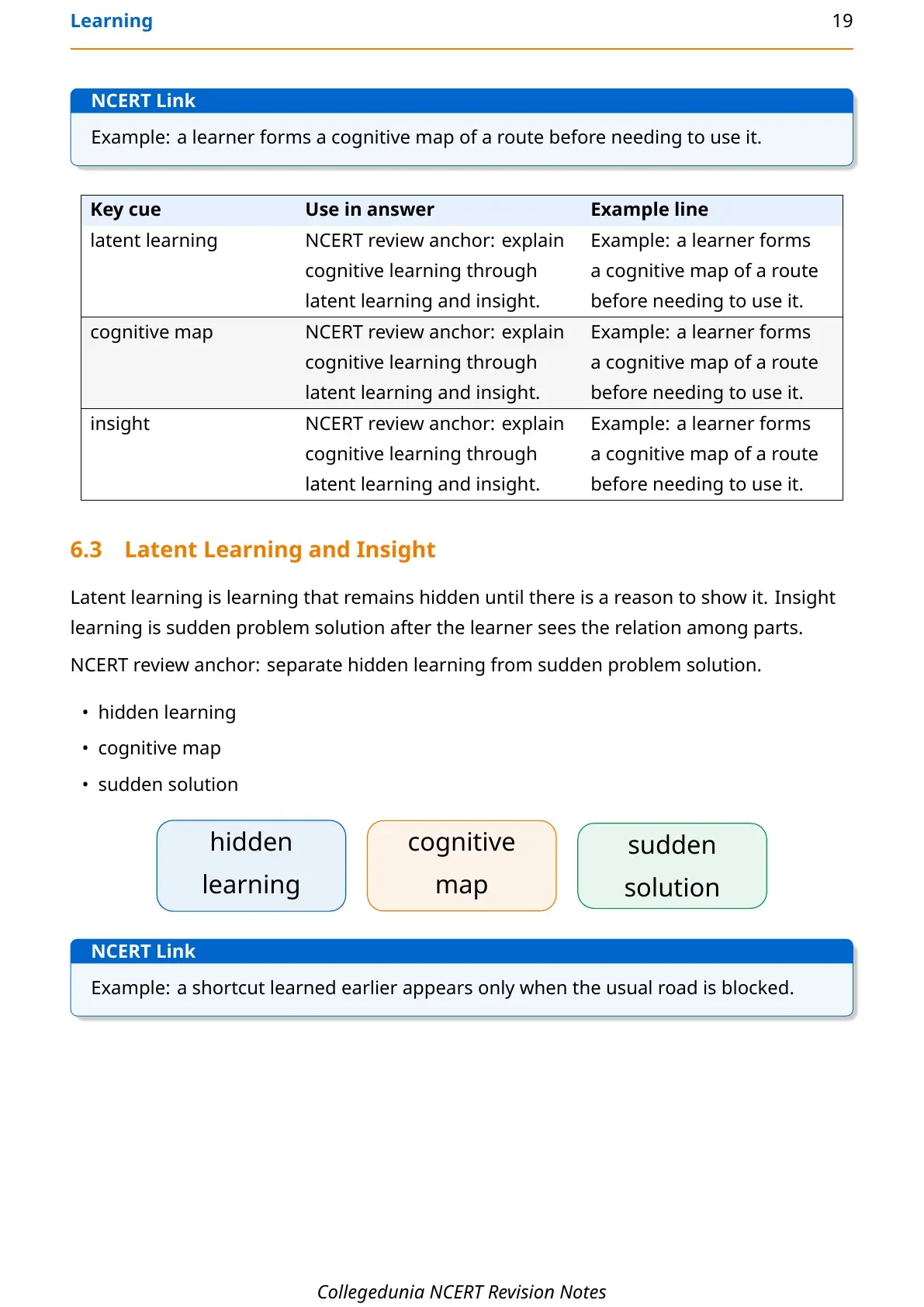
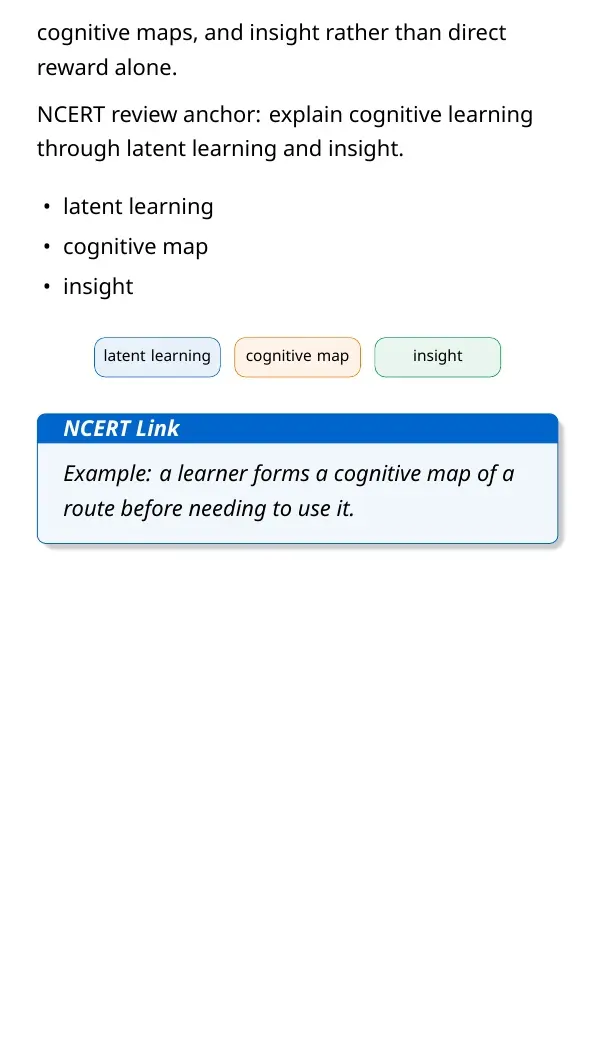
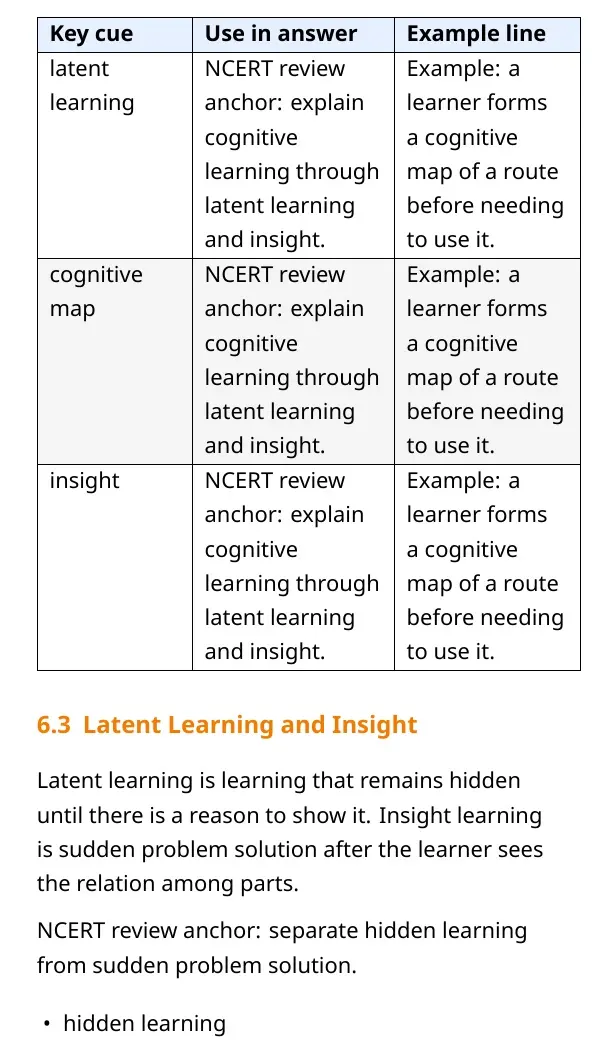
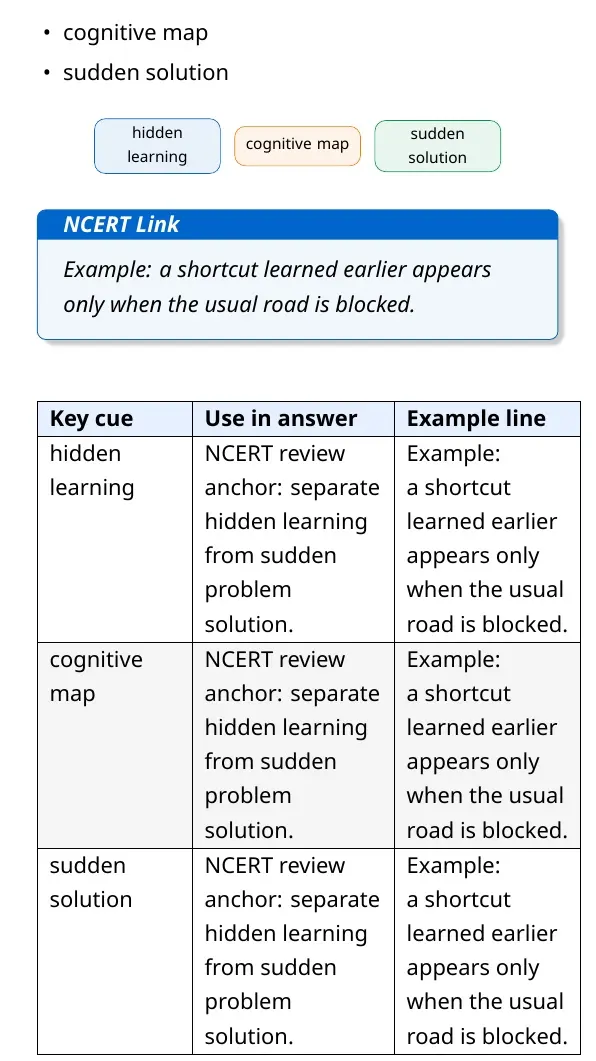
Cognitive learning stresses mental processes. Latent learning remains hidden until there is a reason to show it, cognitive map refers to mental representation of a route or place and insight is sudden solution after the learner understands the relation among parts.
Verbal Learning, Skill Learning and Learning Disabilities
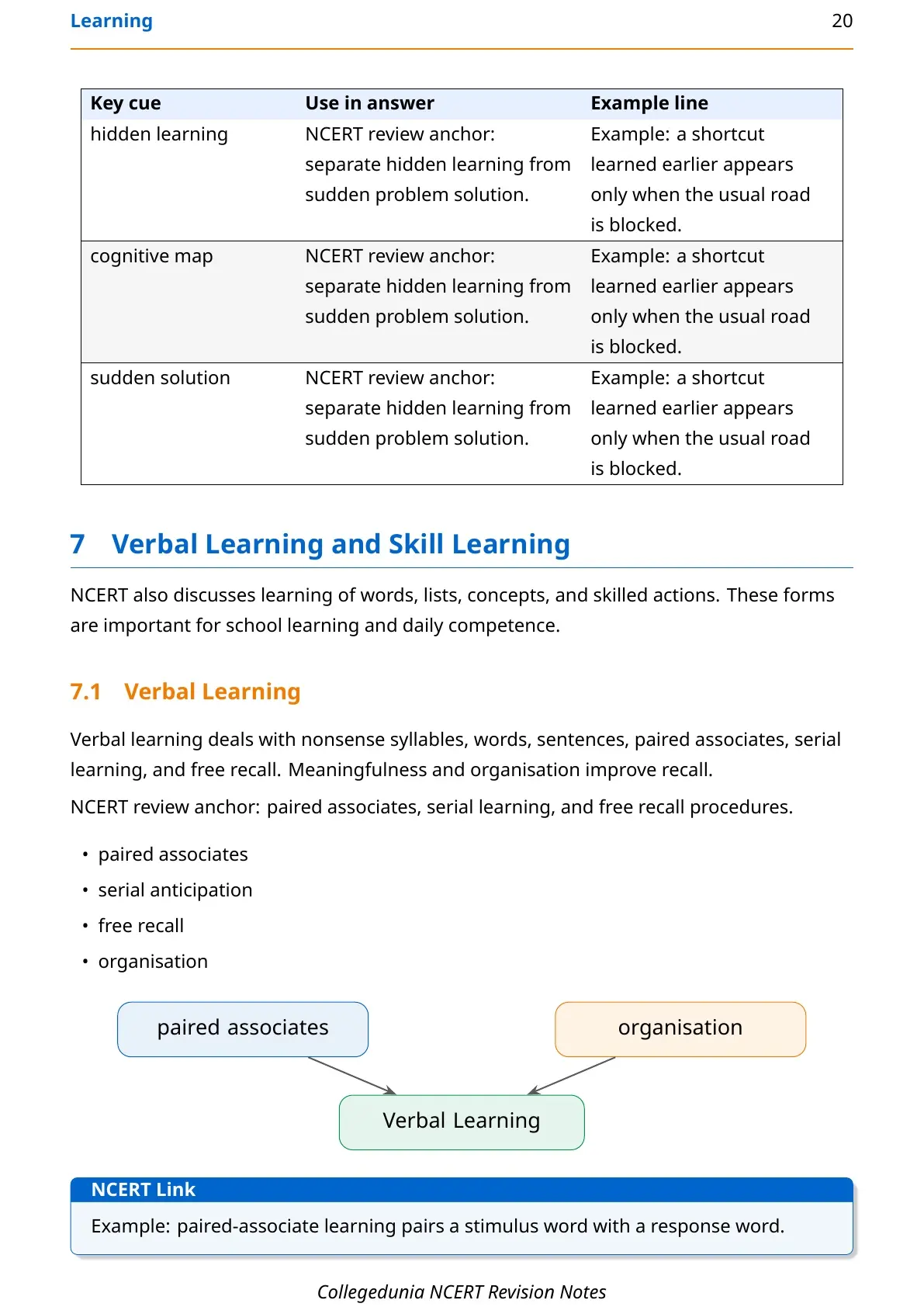
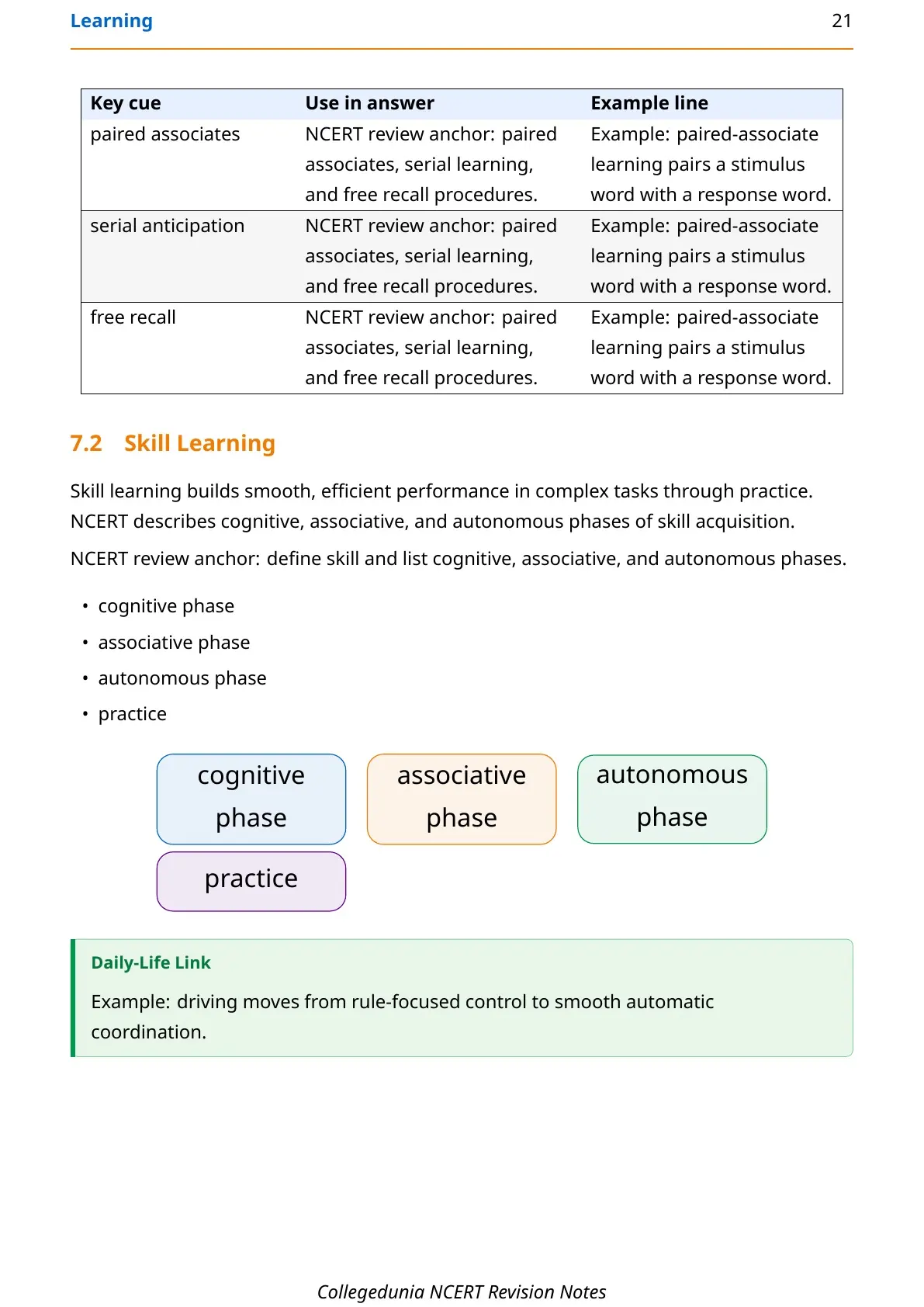
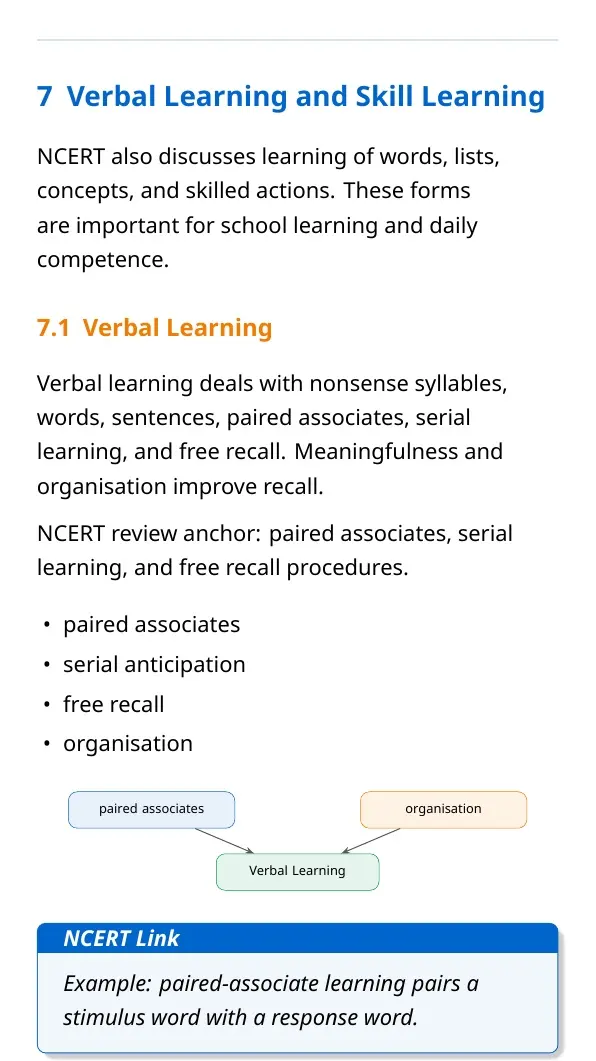
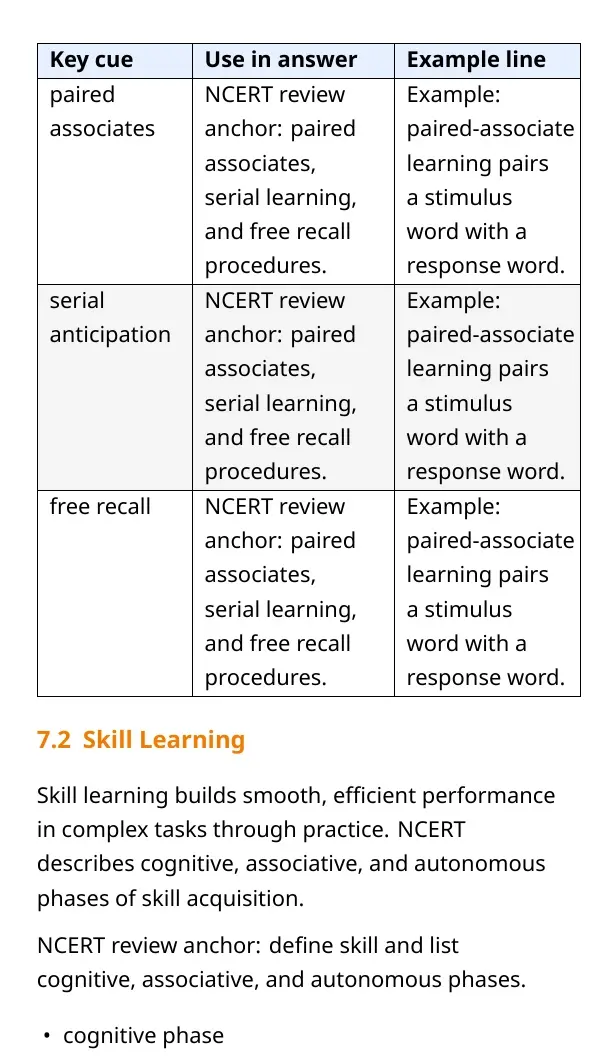
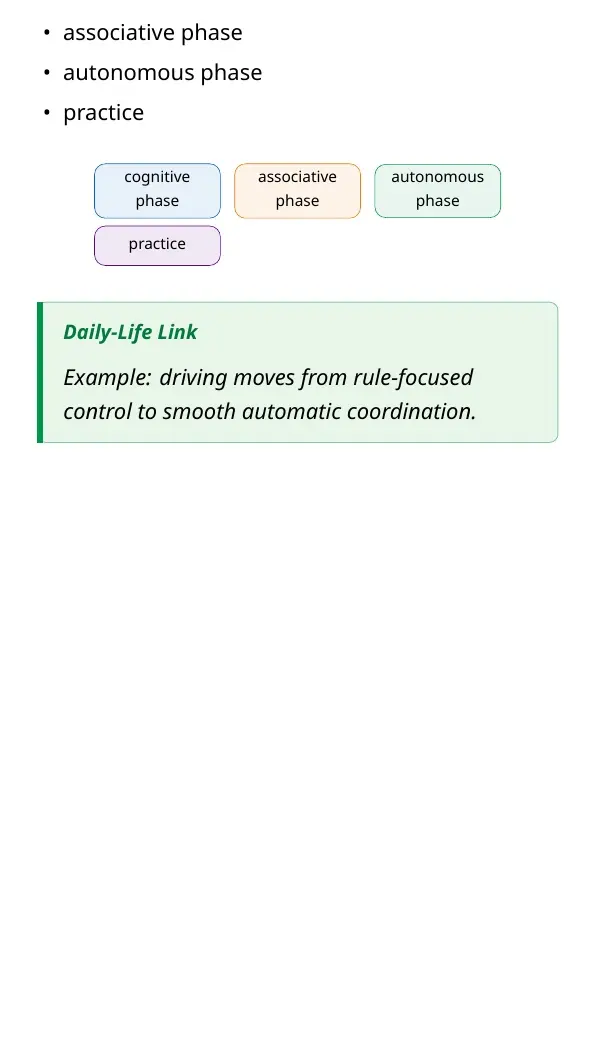
Verbal learning includes paired associates, serial learning and free recall. Skill learning builds smooth and efficient complex task performance through practice. NCERT describes cognitive, associative and autonomous phases in skill acquisition.
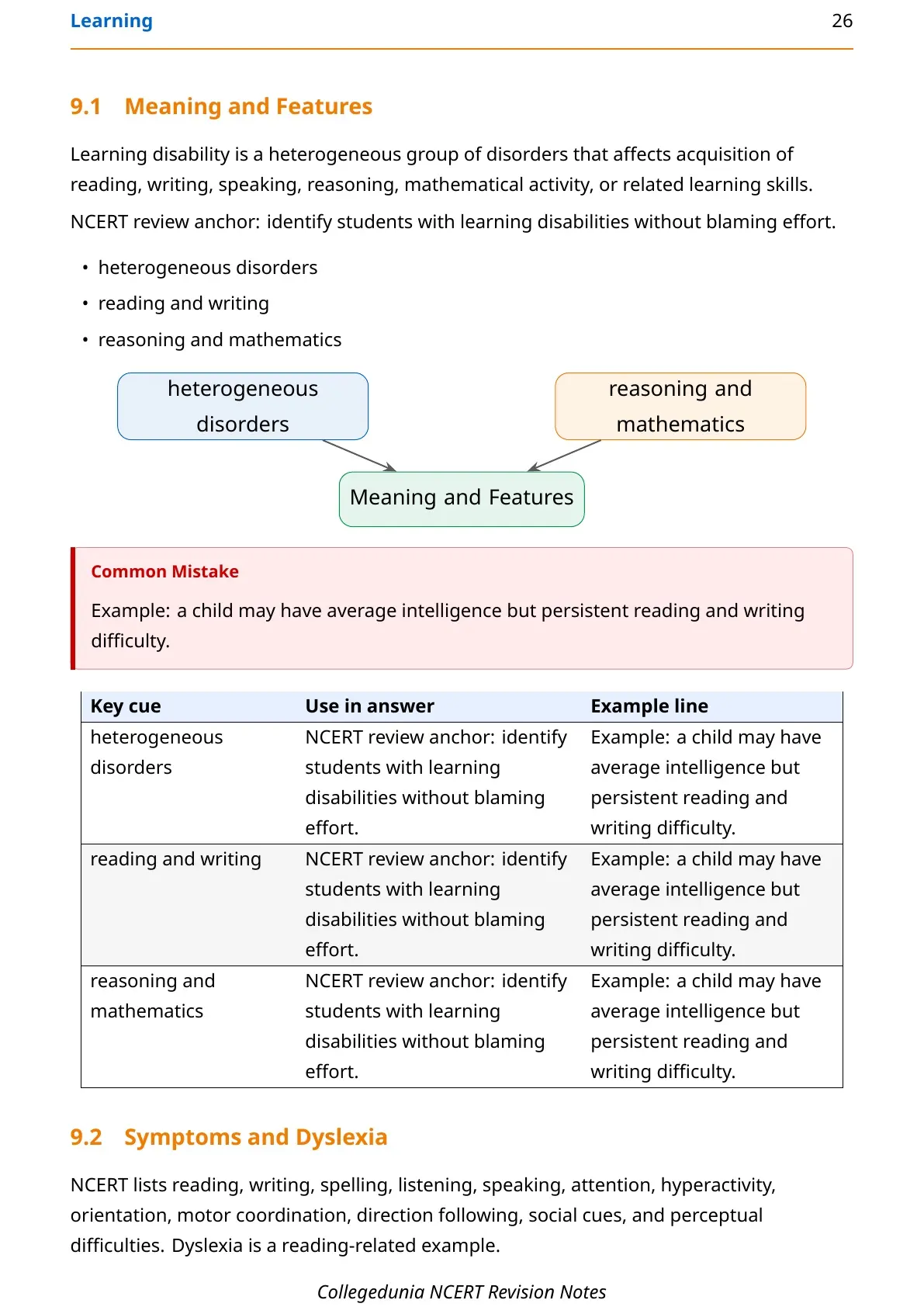
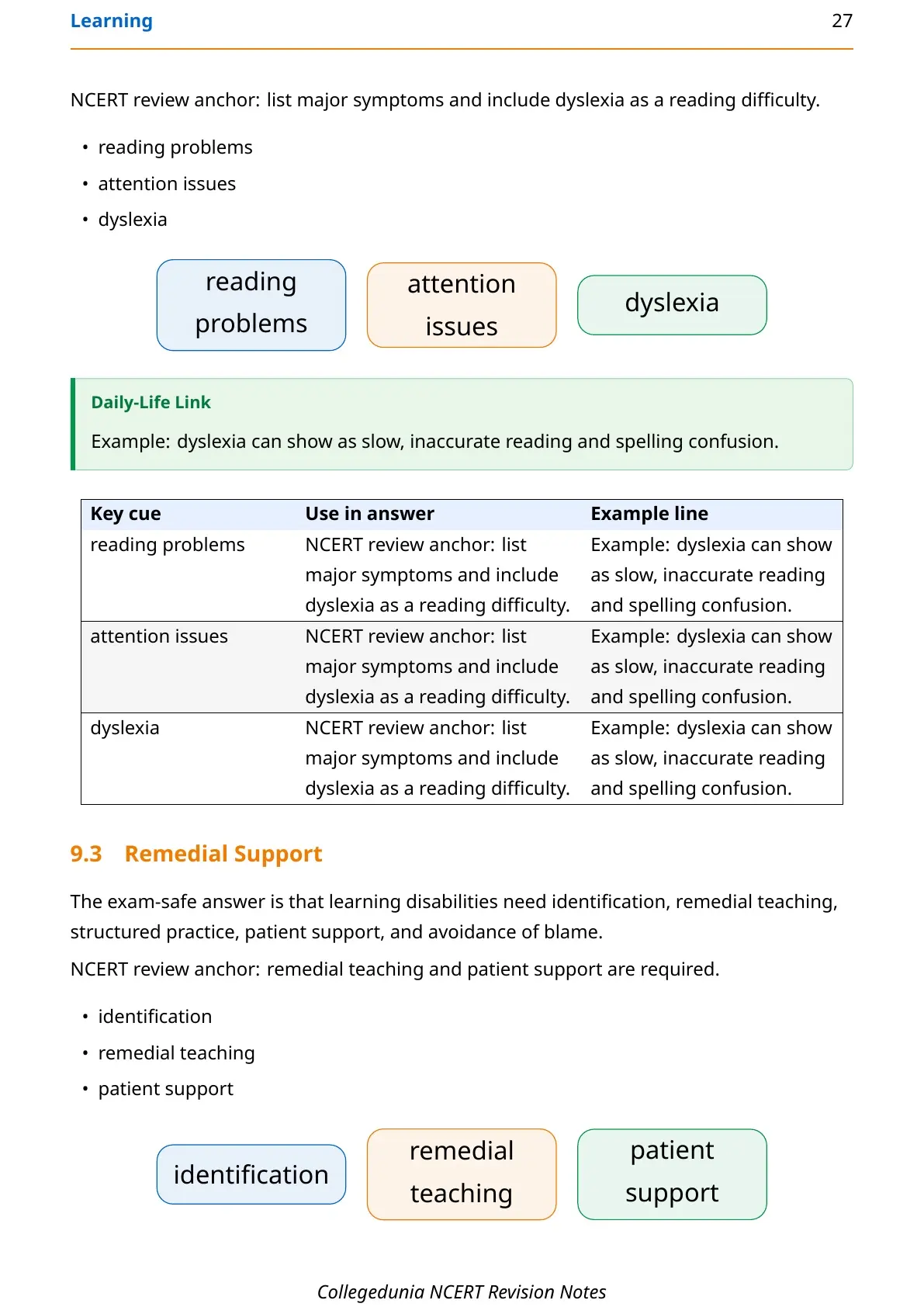
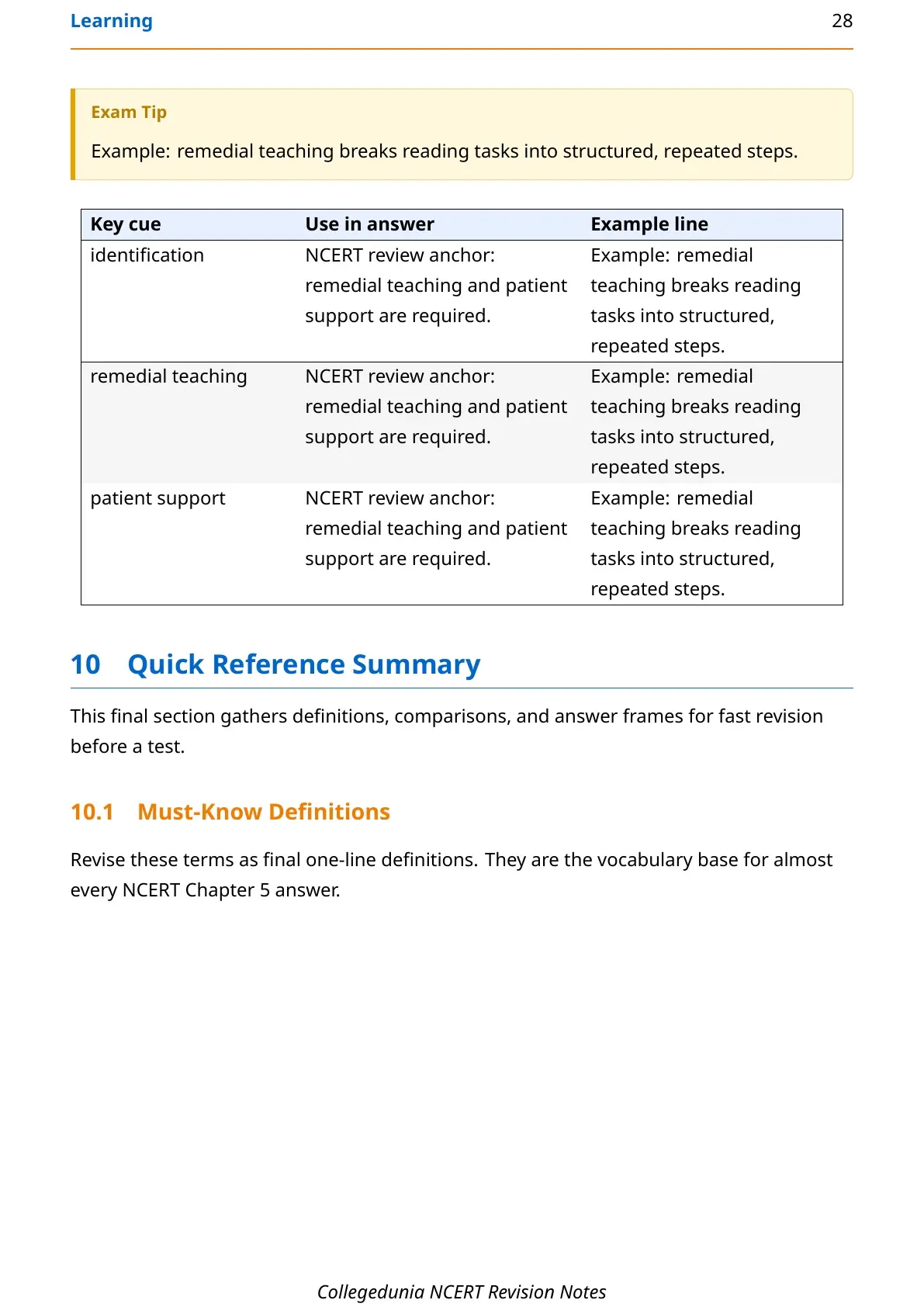
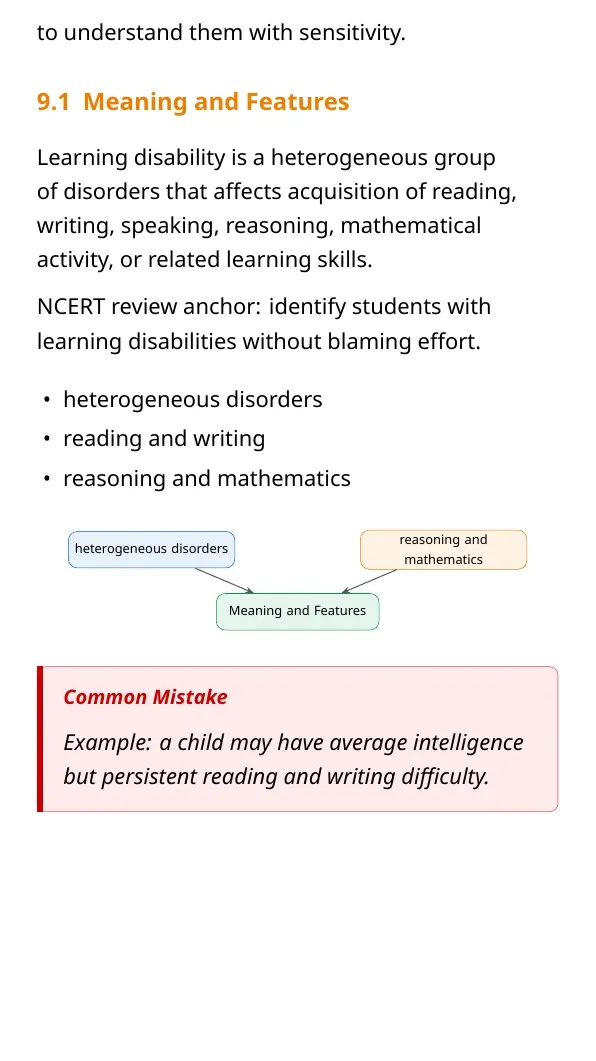
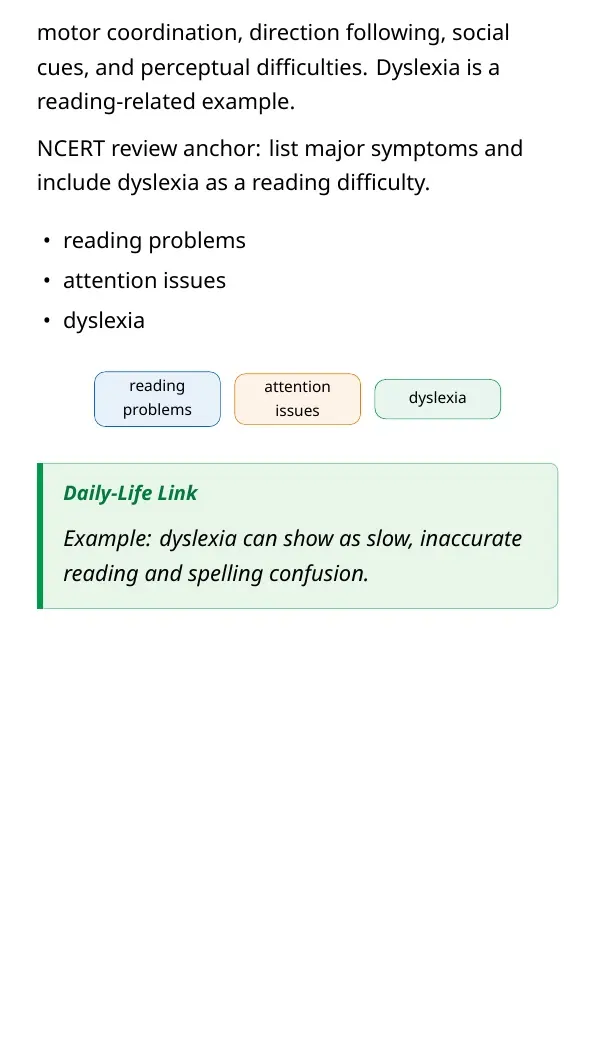
Learning disability is a heterogeneous group of disorders affecting acquisition of reading, writing, speaking, reasoning, mathematical activity or related learning skills. Dyslexia is a reading-related example. Remedial teaching and patient support are needed.
Related Psychology Resources for Learning
Also Check: use these resources with the notes PDF when revising Chapter 5.
| Resource | Best use | Link |
|---|---|---|
| NCERT Solutions | Stepwise answers to textbook questions | Learning NCERT Solutions |
| NCERT Book PDF | Original NCERT reading and review questions | Learning NCERT Book PDF |
| Previous Notes | Revise Chapter 4 before this chapter | Sensory, Attentional and Perceptual Processes Notes |
Class 11 Psychology Notes for All Chapters
| Chapter | Notes Link |
|---|---|
| Chapter 1 | What is Psychology? Notes |
| Chapter 2 | Methods of Enquiry in Psychology Notes |
| Chapter 3 | Human Development Notes |
| Chapter 4 | Sensory, Attentional and Perceptual Processes Notes |
| Chapter 5 | You are here |
| Chapter 6 | Human Memory Notes |
| Chapter 7 | Thinking Notes |
| Chapter 8 | Motivation and Emotion Notes |
Frequently Asked Questions
Ques. What is learning in Class 11 Psychology Chapter 5?
Ans. Learning is a relatively permanent change in behaviour or behavioural potential produced by experience. Temporary changes caused by fatigue or drugs are not learning.
Ques. What is the difference between classical and operant conditioning?
Ans. Classical conditioning is stimulus to stimulus learning where a cue predicts another stimulus. Operant conditioning is response to consequence learning where reinforcement or punishment changes future behaviour.
Ques. What are the types of learning in Chapter 5?
Ans. NCERT discusses classical conditioning, operant conditioning, observational learning, cognitive learning, verbal learning and skill learning.
Ques. What is a learning disability?
Ans. A learning disability is a heterogeneous group of disorders affecting acquisition of reading, writing, speaking, reasoning, mathematical activity or related learning skills.



Comments