



The Blood Class 12 notes explain Kamala Das's NCERT Kaleidoscope poem for the 2026-27 reprint. Use this page to revise the ruined ancestral house, great-grandmother, old blood pride, class criticism, broken promise, adult guilt and Language Study points before downloading the full PDF.
- Download the Class 12 English Supplementary Chapter 13 notes PDF for quick revision.
- Revise the poem through house imagery, tradition, modernity, class conflict and conscience.
- Student focus: the chapter tests close reading of exact images and balanced social interpretation.
Chapter13Kaleidoscope:BloodNotes.pdf?page=1&dpi=150)
Chapter13Kaleidoscope:BloodNotes.pdf?page=2&dpi=150)
Chapter13Kaleidoscope:BloodNotes.pdf?page=3&dpi=150)
Chapter13Kaleidoscope:BloodNotes.pdf?page=4&dpi=150)
Chapter13Kaleidoscope:BloodNotes.pdf?page=5&dpi=150)
Chapter13Kaleidoscope:BloodNotes.pdf?page=6&dpi=150)
Chapter13Kaleidoscope:BloodNotes.pdf?page=7&dpi=150)
Chapter13Kaleidoscope:BloodNotes.pdf?page=8&dpi=150)
Chapter13Kaleidoscope:BloodNotes.pdf?page=9&dpi=150)
Chapter13Kaleidoscope:BloodNotes.pdf?page=10&dpi=150)
Chapter13Kaleidoscope:BloodNotes.pdf?page=11&dpi=150)
Chapter13Kaleidoscope:BloodNotes.pdf?page=12&dpi=150)
Chapter13Kaleidoscope:BloodNotes.pdf?page=13&dpi=150)
Chapter13Kaleidoscope:BloodNotes.pdf?page=14&dpi=150)
Chapter13Kaleidoscope:BloodNotes.pdf?page=15&dpi=150)
Chapter13Kaleidoscope:BloodNotes.pdf?page=16&dpi=150)
Chapter13Kaleidoscope:BloodNotes.pdf?page=17&dpi=150)
Chapter13Kaleidoscope:BloodNotes.pdf?page=18&dpi=150)
Chapter13Kaleidoscope:BloodNotes.pdf?page=19&dpi=150)
Chapter13Kaleidoscope:BloodNotes.pdf?page=20&dpi=150)
Chapter13Kaleidoscope:BloodNotes.pdf?page=21&dpi=150)
Chapter13Kaleidoscope:BloodNotes.pdf?page=22&dpi=150)
Chapter13Kaleidoscope:BloodNotes.pdf?page=23&dpi=150)
Chapter13Kaleidoscope:BloodNotes_flat_MobileCard.pdf?page=1&dpi=150)
Chapter13Kaleidoscope:BloodNotes_flat_MobileCard.pdf?page=2&dpi=150)
Chapter13Kaleidoscope:BloodNotes_flat_MobileCard.pdf?page=3&dpi=150)
Chapter13Kaleidoscope:BloodNotes_flat_MobileCard.pdf?page=4&dpi=150)
Chapter13Kaleidoscope:BloodNotes_flat_MobileCard.pdf?page=5&dpi=150)
Chapter13Kaleidoscope:BloodNotes_flat_MobileCard.pdf?page=6&dpi=150)
Chapter13Kaleidoscope:BloodNotes_flat_MobileCard.pdf?page=7&dpi=150)
Chapter13Kaleidoscope:BloodNotes_flat_MobileCard.pdf?page=8&dpi=150)
Chapter13Kaleidoscope:BloodNotes_flat_MobileCard.pdf?page=9&dpi=150)
Chapter13Kaleidoscope:BloodNotes_flat_MobileCard.pdf?page=10&dpi=150)
Chapter13Kaleidoscope:BloodNotes_flat_MobileCard.pdf?page=11&dpi=150)
Chapter13Kaleidoscope:BloodNotes_flat_MobileCard.pdf?page=12&dpi=150)
Chapter13Kaleidoscope:BloodNotes_flat_MobileCard.pdf?page=13&dpi=150)
Chapter13Kaleidoscope:BloodNotes_flat_MobileCard.pdf?page=14&dpi=150)
Chapter13Kaleidoscope:BloodNotes_flat_MobileCard.pdf?page=15&dpi=150)
Chapter13Kaleidoscope:BloodNotes_flat_MobileCard.pdf?page=16&dpi=150)
Chapter13Kaleidoscope:BloodNotes_flat_MobileCard.pdf?page=17&dpi=150)
Chapter13Kaleidoscope:BloodNotes_flat_MobileCard.pdf?page=18&dpi=150)
Chapter13Kaleidoscope:BloodNotes_flat_MobileCard.pdf?page=19&dpi=150)
Chapter13Kaleidoscope:BloodNotes_flat_MobileCard.pdf?page=20&dpi=150)
Chapter13Kaleidoscope:BloodNotes_flat_MobileCard.pdf?page=21&dpi=150)
Chapter13Kaleidoscope:BloodNotes_flat_MobileCard.pdf?page=22&dpi=150)
Chapter13Kaleidoscope:BloodNotes_flat_MobileCard.pdf?page=23&dpi=150)
Chapter13Kaleidoscope:BloodNotes_flat_MobileCard.pdf?page=24&dpi=150)
Chapter13Kaleidoscope:BloodNotes_flat_MobileCard.pdf?page=25&dpi=150)
Chapter13Kaleidoscope:BloodNotes_flat_MobileCard.pdf?page=26&dpi=150)
Chapter13Kaleidoscope:BloodNotes_flat_MobileCard.pdf?page=27&dpi=150)
Chapter13Kaleidoscope:BloodNotes_flat_MobileCard.pdf?page=28&dpi=150)
Chapter13Kaleidoscope:BloodNotes_flat_MobileCard.pdf?page=29&dpi=150)
These Class 12 English Supplementary Blood notes are checked against the 2026-27 NCERT chapter and built for fast poem revision.
Student Feedback on Blood
In a Collegedunia poll of 12,860 Class 12 English students using NCERT literature resources, many students understood the family memory but needed help arranging the social ideas in answers.
- 82% wanted a clearer split between house imagery and class criticism.
- 77% needed support with tradition versus modernity examples.
- 69% found the final apology and old blood conflict hard to frame briefly.
Source: 2026-27 Class 12 English student poll. Sample of 12,860 students using NCERT-aligned study resources.
Blood Summary for Class 12
Blood by Kamala Das begins with a childhood memory of a ruined ancestral house. The great-grandmother loves the house and remembers older family grandeur. The adult speaker later accepts guilt for leaving the house, but she also questions the pride attached to old blood.
- Main idea: the poem joins family memory with class criticism.
- Central mood: affection, guilt and revolt appear together.
- Answer cue: quote the house detail first, then connect it to history or conscience.
Blood Video Explanation
Source: Magnet Brains on YouTube
Memory Flow in Blood
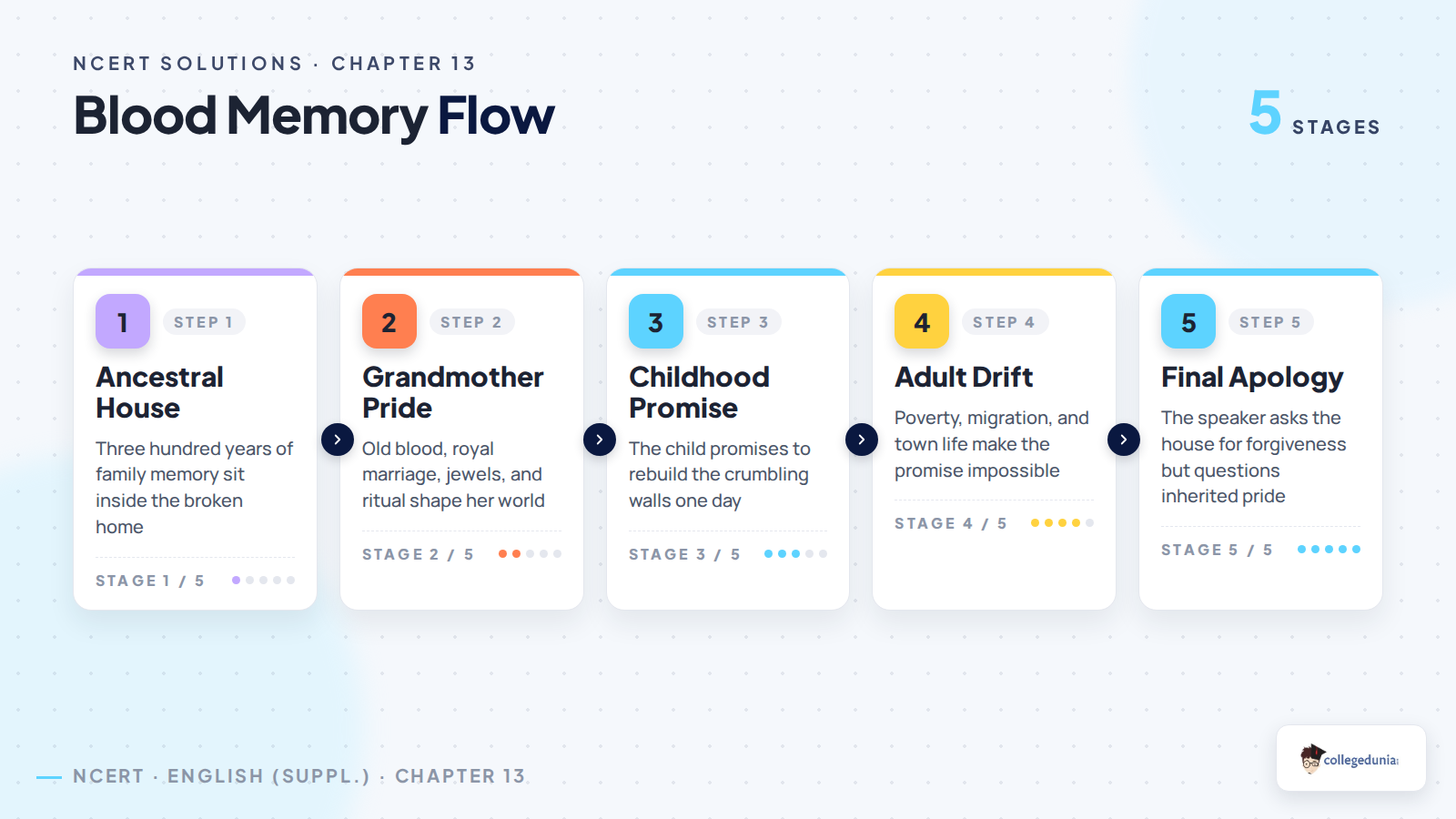
The poem moves from childhood play to the great-grandmother's grief, then to old family stories, death, migration and apology. A strong answer follows this movement instead of writing only that the poem is nostalgic.
| Stage | Poem detail | Revision cue |
|---|---|---|
| Childhood | Brother and sister play on the sands | Memory begins simply. |
| House decay | Cracked walls, fallen tiles, rats and weeds | The house feels real and wounded. |
| Old blood | Royal stories and claims of fine blood | Family pride becomes social criticism. |
| Adult guilt | The speaker asks forgiveness | The poem ends in conscience. |
House Imagery and Authenticity in Blood
The depiction of the crumbling village house feels authentic because Kamala Das uses exact visible and audible details. She does not merely say that the house is old. She shows cracked walls, dampness, fallen tiles, whining windows, rats, weeds and lichen on the snake-gods.
| Image | Literal meaning | Effect in answer |
|---|---|---|
| Cracked walls | The house is physically damaged | Shows long neglect. |
| Whining windows | The house makes sound at night | Personifies the building. |
| Snake-shrine with weeds | A ritual space is uncared for | Links decay with culture. |
| White ants | Insects destroy the house slowly | Suggests burial and death. |
Exam cue: start house answers with concrete details, then move to urbanisation, memory or guilt.
Tradition, Modernity and Old Blood
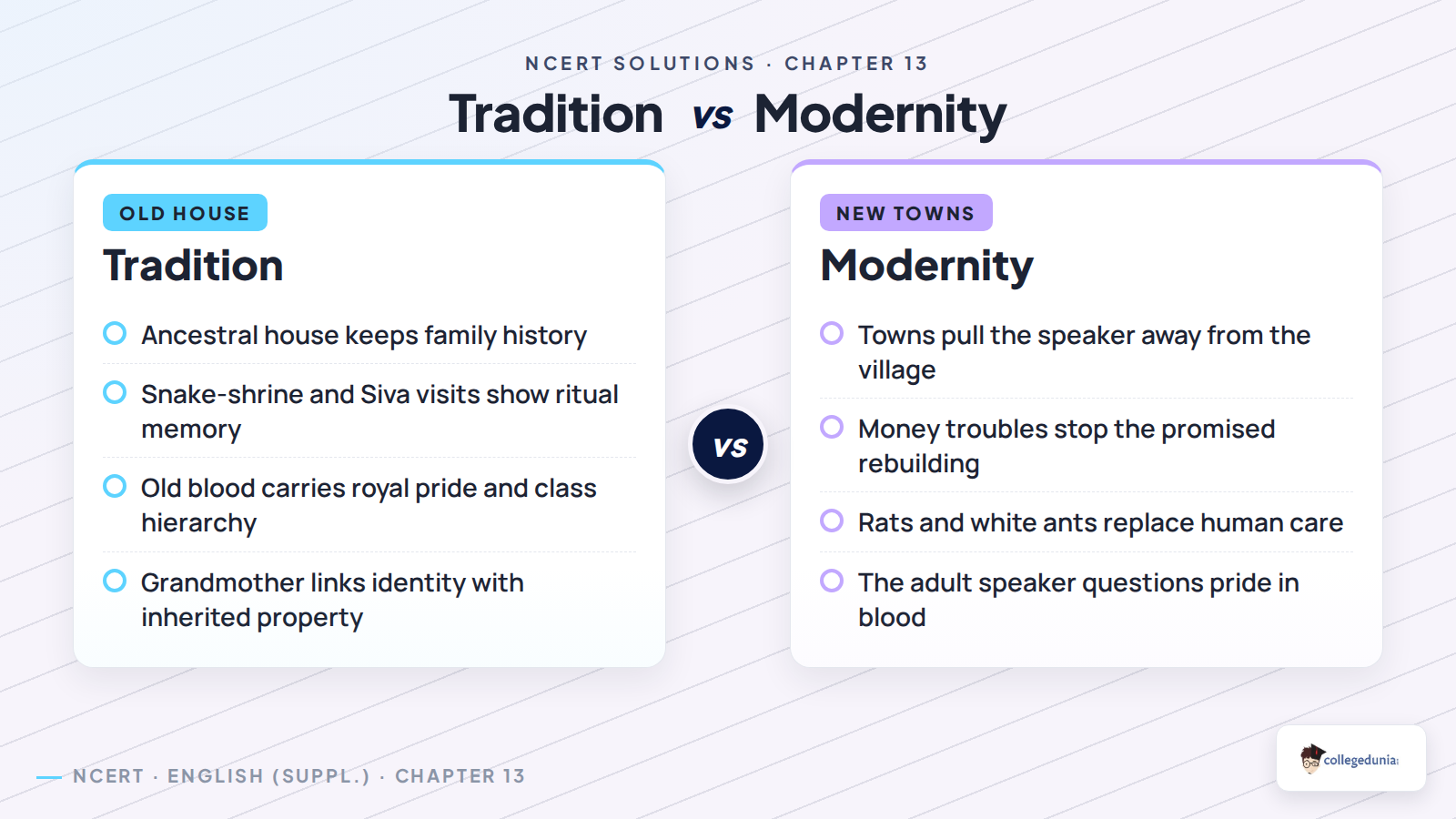
The poem does not simply praise tradition or reject modernity. Tradition gives the speaker memory, ritual and family identity. It also carries class pride. Modernity gives movement and survival, but it leaves the ancestral house uncared for.
| Tradition | Modernity | Answer value |
|---|---|---|
| Three-hundred-year-old house | Life in other towns | Shows movement away from inheritance. |
| Snake-shrine and Siva visits | Broken promise to rebuild | Shows ritual loss and adult limits. |
| Old blood and royal stories | Refusal to blame blood | Shows respect and revolt together. |
NCERT Questions Answer Plan for Blood
Write every answer with a phrase, meaning and effect. This keeps the response precise and stops broad comments about family memory from taking over.
| Question focus | What to include | Final effect |
|---|---|---|
| Authentic house | Cracked walls, fallen tiles, rats, weeds and lichen | The house feels observed from life. |
| Indian society | Old property, shrines, prince, jewels and class hierarchy | The family story becomes social history. |
| Tradition and modernity | House, shrine, old blood, towns and economic defeat | The poem balances attachment and criticism. |
| Class distinction | Old blood versus poor and new-rich blood | Das exposes inherited prejudice. |
| Conscience | Broken promise, apology and refusal to blame blood | The speaker feels guilt but thinks critically. |
| Language Study | Compare Donne and Kamala Das through prosody, vocabulary, language and themes | Donne gives compact argument; Das gives free-verse memory rooted in house, blood and guilt. |
Related Resources for Blood Class 12 English
| Resource | Use it for | Link |
|---|---|---|
| NCERT Solutions | Full textbook answers for Chapter 13 | Open NCERT Solutions |
| NCERT Book PDF | Read the official poem text | Open NCERT Book PDF |
| Handwritten Notes | Revise from concise handwritten notes | Open Handwritten Notes |
All Class 12 English Supplementary Notes Chapters
| Chapter | Notes link |
|---|---|
| Chapter 9: Kaleidoscope: Kubla Khan | Open Notes |
| Chapter 10: Kaleidoscope: Trees | Open Notes |
| Chapter 11: Kaleidoscope: The Wild Swans at Coole | Open Notes |
| Chapter 12: Kaleidoscope: Time and Time Again | Open Notes |
| Chapter 13: Kaleidoscope: Blood | Open Notes |
| Chapter 14: Kaleidoscope: Freedom | Open Notes |
Blood Class 12 English Notes FAQs
Ques. What is Blood by Kamala Das about?
Ans. Blood is about a ruined ancestral house, the great-grandmother's pride, the speaker's broken childhood promise and her adult conflict over old blood.
Ques. Why does the house feel authentic in Blood?
Ans. The house feels authentic because Das gives exact details such as cracked walls, fallen tiles, whining windows, rats, weeds and lichen on the shrine.
Ques. How does Blood show tradition and modernity?
Ans. Tradition appears through the ancestral house, shrine, old blood and royal memories. Modernity appears through migration, economic defeat and self-questioning.
Ques. What is the conflict in the speaker's conscience?
Ans. The speaker feels guilty for leaving the house, but she also refuses to accept the class pride attached to old blood without question.



Comments