



The Film-Making Class 12 English notes explain Ingmar Bergman's view of cinema and Umberto Eco's comments on film adaptations for the 2026-27 NCERT Kaleidoscope chapter. Use this page to revise childhood memories, conjuring, rhythm, montage, film versus literature, public reaction and the full Notes PDF.
- Download the Class 12 English Supplementary Chapter 16 Notes PDF for quick revision.
- Revise Bergman's film-making process, Eco's adaptation argument and answer-writing cues in one place.
- Student focus: the chapter tests exact examples and metaphors, not general film history.
Chapter16Kaleidoscope:Film-MakingNotes.pdf?page=1&dpi=150)
Chapter16Kaleidoscope:Film-MakingNotes.pdf?page=2&dpi=150)
Chapter16Kaleidoscope:Film-MakingNotes.pdf?page=3&dpi=150)
Chapter16Kaleidoscope:Film-MakingNotes.pdf?page=4&dpi=150)
Chapter16Kaleidoscope:Film-MakingNotes.pdf?page=5&dpi=150)
Chapter16Kaleidoscope:Film-MakingNotes.pdf?page=6&dpi=150)
Chapter16Kaleidoscope:Film-MakingNotes.pdf?page=7&dpi=150)
Chapter16Kaleidoscope:Film-MakingNotes.pdf?page=8&dpi=150)
Chapter16Kaleidoscope:Film-MakingNotes.pdf?page=9&dpi=150)
Chapter16Kaleidoscope:Film-MakingNotes.pdf?page=10&dpi=150)
Chapter16Kaleidoscope:Film-MakingNotes.pdf?page=11&dpi=150)
Chapter16Kaleidoscope:Film-MakingNotes.pdf?page=12&dpi=150)
Chapter16Kaleidoscope:Film-MakingNotes.pdf?page=13&dpi=150)
Chapter16Kaleidoscope:Film-MakingNotes.pdf?page=14&dpi=150)
Chapter16Kaleidoscope:Film-MakingNotes.pdf?page=15&dpi=150)
Chapter16Kaleidoscope:Film-MakingNotes.pdf?page=16&dpi=150)
Chapter16Kaleidoscope:Film-MakingNotes.pdf?page=17&dpi=150)
Chapter16Kaleidoscope:Film-MakingNotes.pdf?page=18&dpi=150)
Chapter16Kaleidoscope:Film-MakingNotes.pdf?page=19&dpi=150)
Chapter16Kaleidoscope:Film-MakingNotes.pdf?page=20&dpi=150)
Chapter16Kaleidoscope:Film-MakingNotes.pdf?page=21&dpi=150)
Chapter16Kaleidoscope:Film-MakingNotes_flat_MobileCard.pdf?page=1&dpi=150)
Chapter16Kaleidoscope:Film-MakingNotes_flat_MobileCard.pdf?page=2&dpi=150)
Chapter16Kaleidoscope:Film-MakingNotes_flat_MobileCard.pdf?page=3&dpi=150)
Chapter16Kaleidoscope:Film-MakingNotes_flat_MobileCard.pdf?page=4&dpi=150)
Chapter16Kaleidoscope:Film-MakingNotes_flat_MobileCard.pdf?page=5&dpi=150)
Chapter16Kaleidoscope:Film-MakingNotes_flat_MobileCard.pdf?page=6&dpi=150)
Chapter16Kaleidoscope:Film-MakingNotes_flat_MobileCard.pdf?page=7&dpi=150)
Chapter16Kaleidoscope:Film-MakingNotes_flat_MobileCard.pdf?page=8&dpi=150)
Chapter16Kaleidoscope:Film-MakingNotes_flat_MobileCard.pdf?page=9&dpi=150)
Chapter16Kaleidoscope:Film-MakingNotes_flat_MobileCard.pdf?page=10&dpi=150)
Chapter16Kaleidoscope:Film-MakingNotes_flat_MobileCard.pdf?page=11&dpi=150)
Chapter16Kaleidoscope:Film-MakingNotes_flat_MobileCard.pdf?page=12&dpi=150)
Chapter16Kaleidoscope:Film-MakingNotes_flat_MobileCard.pdf?page=13&dpi=150)
Chapter16Kaleidoscope:Film-MakingNotes_flat_MobileCard.pdf?page=14&dpi=150)
Chapter16Kaleidoscope:Film-MakingNotes_flat_MobileCard.pdf?page=15&dpi=150)
Chapter16Kaleidoscope:Film-MakingNotes_flat_MobileCard.pdf?page=16&dpi=150)
Chapter16Kaleidoscope:Film-MakingNotes_flat_MobileCard.pdf?page=17&dpi=150)
Chapter16Kaleidoscope:Film-MakingNotes_flat_MobileCard.pdf?page=18&dpi=150)
Chapter16Kaleidoscope:Film-MakingNotes_flat_MobileCard.pdf?page=19&dpi=150)
Chapter16Kaleidoscope:Film-MakingNotes_flat_MobileCard.pdf?page=20&dpi=150)
Chapter16Kaleidoscope:Film-MakingNotes_flat_MobileCard.pdf?page=21&dpi=150)
Chapter16Kaleidoscope:Film-MakingNotes_flat_MobileCard.pdf?page=22&dpi=150)
Chapter16Kaleidoscope:Film-MakingNotes_flat_MobileCard.pdf?page=23&dpi=150)
Chapter16Kaleidoscope:Film-MakingNotes_flat_MobileCard.pdf?page=24&dpi=150)
Chapter16Kaleidoscope:Film-MakingNotes_flat_MobileCard.pdf?page=25&dpi=150)
These Class 12 English Supplementary Film-Making notes are checked against the 2026-27 NCERT chapter and built for fast conceptual revision.
Student Feedback on Film-Making
In a Collegedunia poll of 12,860 Class 12 English students using NCERT literature resources, many students found this chapter easier after separating Bergman's film craft from Eco's comments on adaptation.
- 81% wanted a clear map of how an impression becomes a film.
- 74% needed help with the film, literature and music comparison.
- 69% revised Eco's club sandwich idea better through a table.
Source: 2026-27 Class 12 English student poll. Sample of 12,860 students using NCERT-aligned study resources.
Film-Making Class 12 English Summary
Film-Making begins with Bergman's memory of shooting The Virgin Spring in Dalarna. The cold morning, old equipment, shared labour and sudden cranes show that cinema joins practical effort with wonder.
- Bergman's focus: childhood images, optical illusion, rhythm, montage and the collective work of film-making.
- Eco's focus: a novel has many layers, so a film version must select and simplify.
- Answer cue: write with text examples such as cranes, magic lantern, coloured thread, musical score and club sandwich.
Film-Making Class 12 Video Explanation
Source: Magnet Brains on YouTube
How Bergman Explains Film-Making
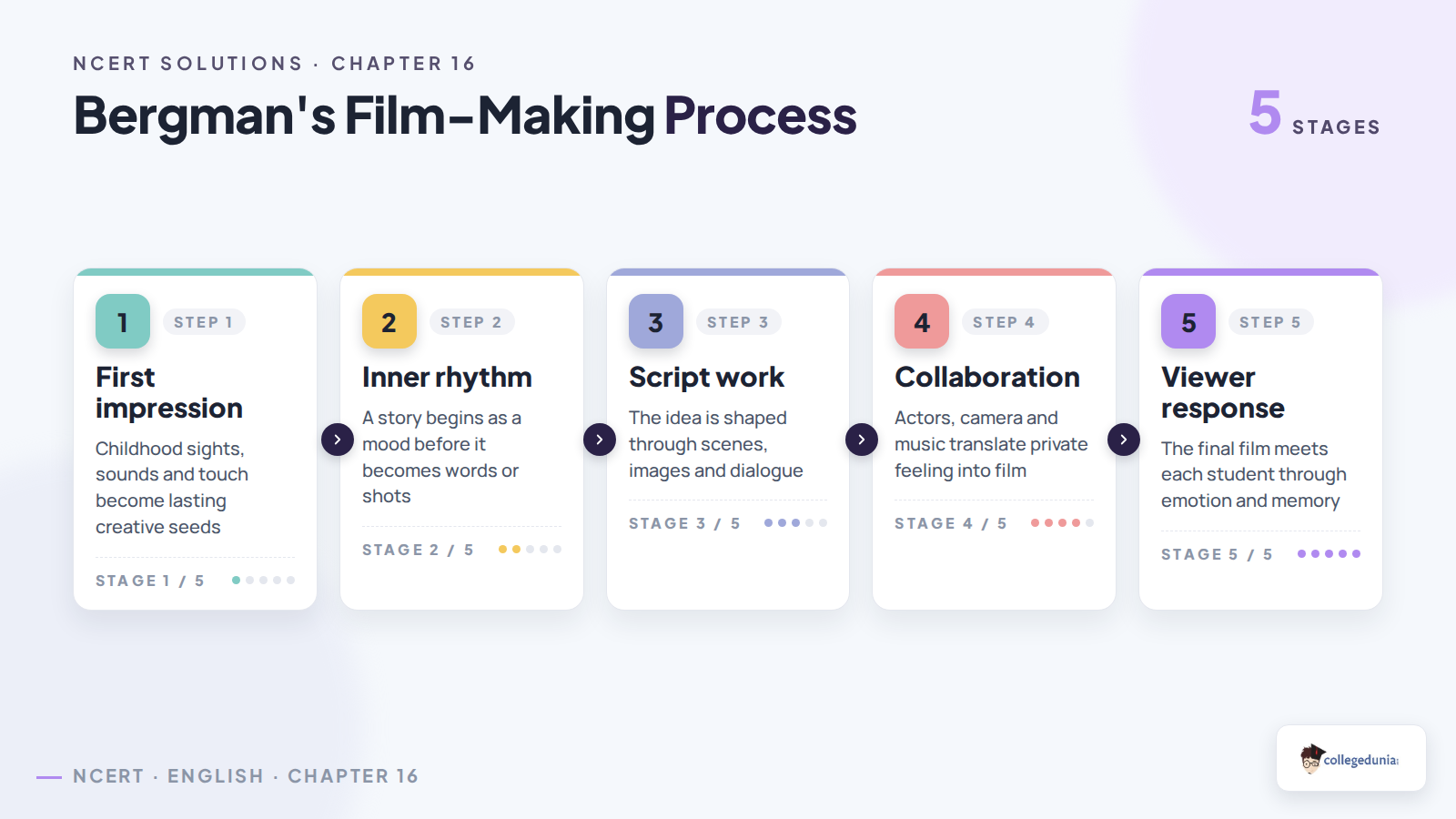
Bergman says a film often begins with a vague impression, such as a remark, a shaft of light or a few bars of music. If the impression is strong, he follows it like a coloured thread until a film begins to emerge.
| Stage | NCERT cue | Revision meaning |
|---|---|---|
| Impression | chance remark, music or light | A film starts as mood, not a full plot. |
| Thread | coloured thread in the unconscious | The idea is pulled carefully into form. |
| Screenplay | moods become words and sentences | The director must translate images into readable script. |
| Montage | relation of one picture to another | The film becomes alive through rhythm. |
Film, Literature and Music in Bergman's Essay
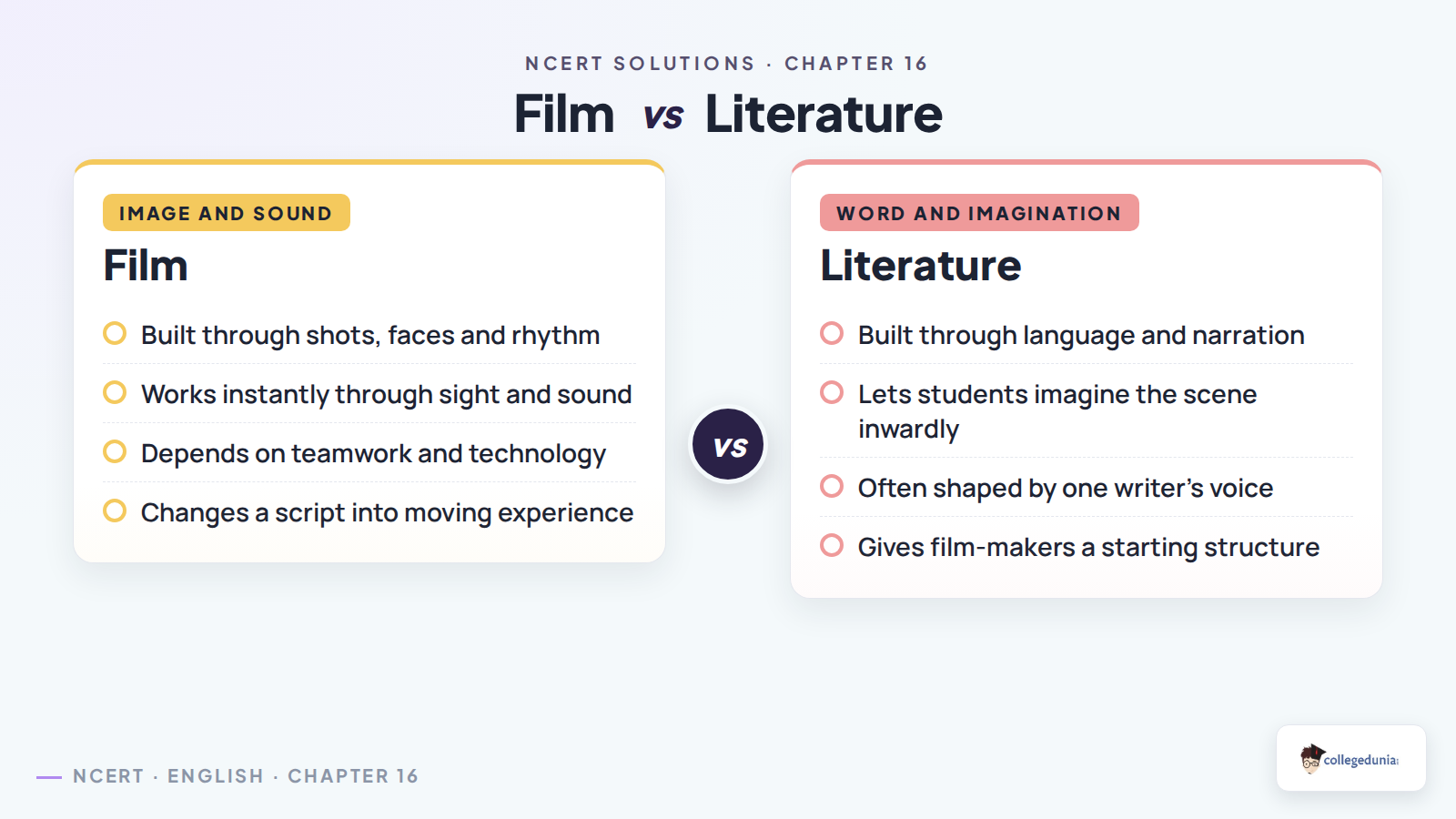
Bergman says film is different from literature because the viewer receives pictures directly through emotion and illusion. Literature works slowly through the intellect, while film and music move through rhythm and feeling.
| Art form | How it works | Use in answers |
|---|---|---|
| Literature | read consciously through words | Use for contrast with film. |
| Film | sequence of pictures works on feelings | Use for Bergman's main art-form argument. |
| Music | affects emotion directly | Use to explain why film is rhythm. |
| Screenplay | necessary but incomplete | Use for questions on dialogue and performance. |
Eco, Film Adaptation and Reader Imagination
Eco's interview explains why a film of a book cannot carry every layer of the original novel. His club sandwich image means that the novel has many layers, while a film must choose a smaller route through the material.
- Club sandwich: a novel has several layers of meaning.
- Film selection: a film cannot select all the layers at once.
- Reader imagination: a film can fix faces and scenes before the reader meets the book.
- Exam cue: Eco is not anti-film; he is protecting the independent reading experience.
Important Answer Cues for NCERT Questions
Use compact phrases from the chapter and then explain them. Avoid broad lines like films are creative. The answer should show what each phrase proves.
| Question focus | Phrase to use | What it proves |
|---|---|---|
| Childhood memories | sunlight, Venice picture, magic lantern | Bergman's senses were trained early. |
| Conjuring | deception of the human eye | Cinema depends on accepted illusion. |
| Rhythm | film breathes and pulsates | Montage gives film living movement. |
| Public response | attracted or repelled | A film must create reaction. |
| Adaptation | club sandwich | A film cannot carry every layer of a novel. |
Related Resources for Film-Making Class 12 English
| Resource | Use it for | Link |
|---|---|---|
| NCERT Solutions | Full textbook answers for Chapter 16 | Open NCERT Solutions |
All Class 12 English Supplementary Notes Chapters
| Chapter | Notes link |
|---|---|
| Chapter 12: Kaleidoscope: Time and Time Again | Open Notes |
| Chapter 13: Kaleidoscope: Blood | Open Notes |
| Chapter 14: Kaleidoscope: Freedom | Open Notes |
| Chapter 15: Kaleidoscope: The Mark on the Wall | Open Notes |
| Chapter 17: Kaleidoscope: Why the Novel Matters | Open Notes |
Film-Making Class 12 English Notes FAQs
Ques. What is Film-Making in Class 12 English Kaleidoscope about?
Ans. Film-Making is about Bergman's view of cinema as image, rhythm, illusion and collective craft. The chapter also includes Eco's view on filming books.
Ques. Why does Bergman compare film-making with conjuring?
Ans. Bergman compares film-making with conjuring because cinema uses the weakness of the human eye. Viewers accept the illusion and feels emotion through it.
Ques. Which art form is film closest to according to Bergman?
Ans. Bergman says film is closest to music because both affect emotions directly through rhythm, movement and feeling rather than only through the intellect.
Ques. How should students revise Film-Making notes?
Ans. Students should revise Bergman's childhood memories, conjuring idea, rhythm and montage, film versus literature, the Chartres analogy and Eco's club sandwich argument.



Comments