



These NCERT Notes for Class 12 Fine Arts on The Rajasthani Schools of Painting bring together every sub-school, patron, artist name and plate caption that the CBSE theory paper actually asks for. Eight court styles, six named texts and seven full page plate essays are sorted here in the order you will need them, exactly as printed in the 2026-27 NCERT text of An Introduction to Indian Art Part 2.
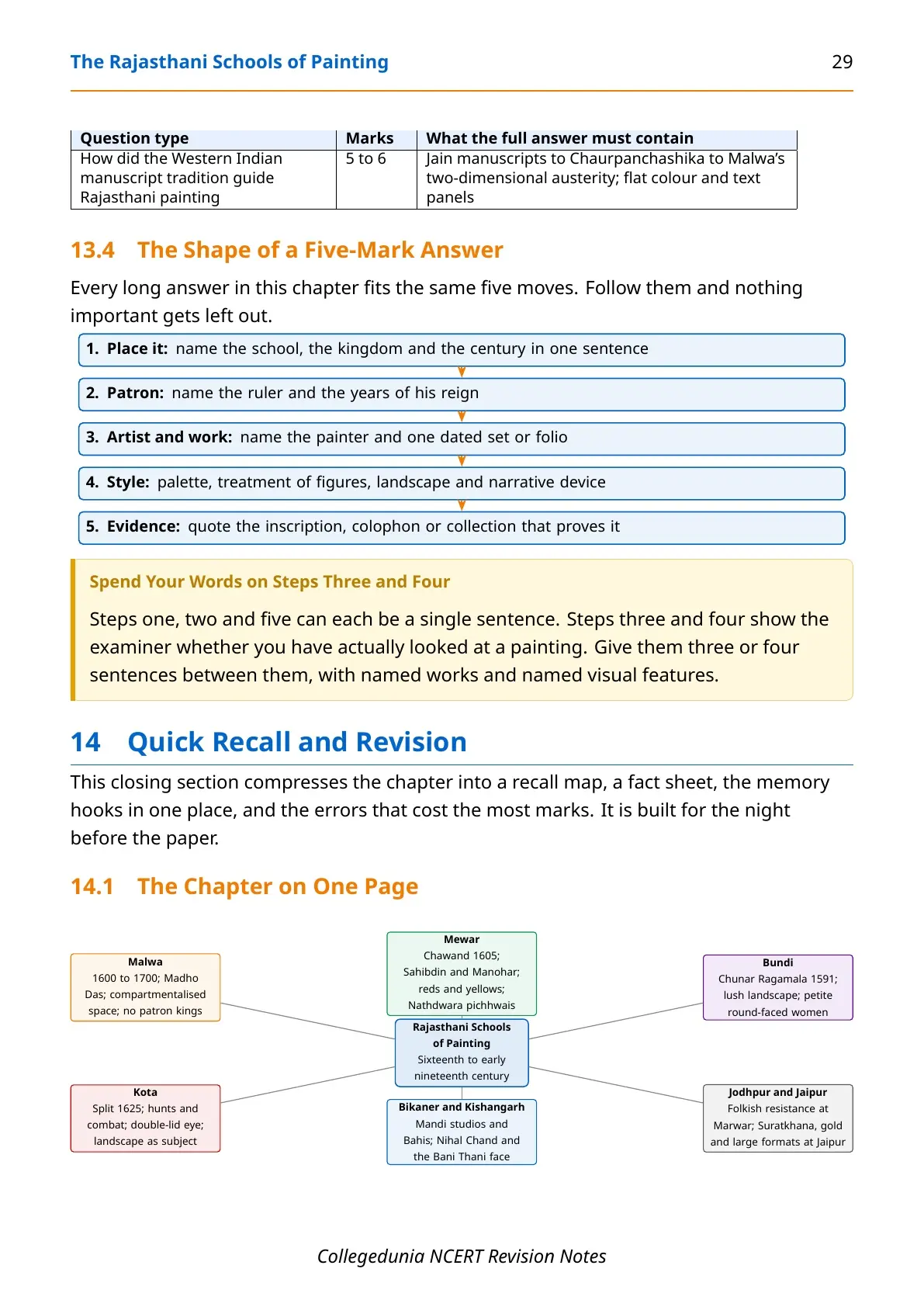
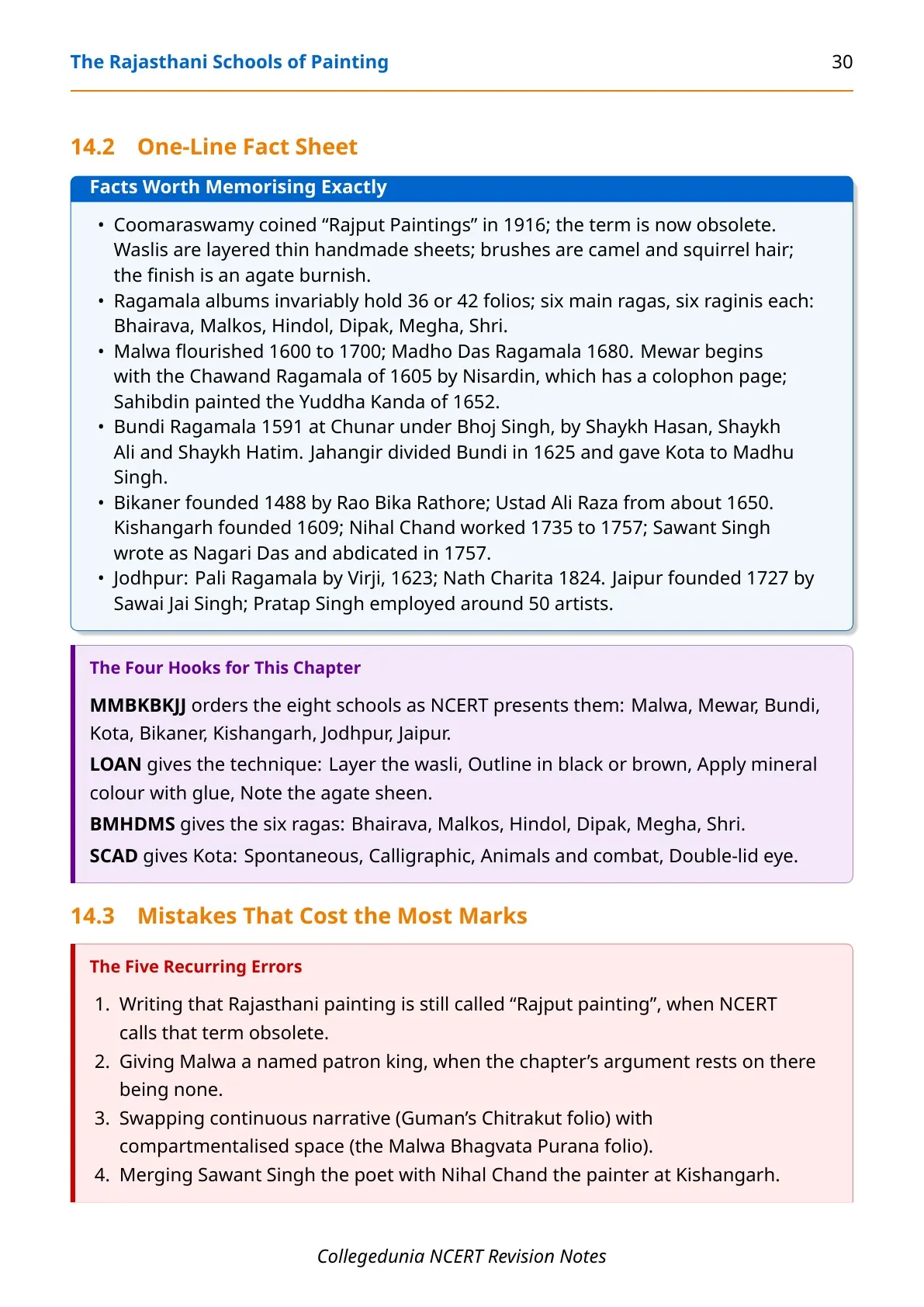
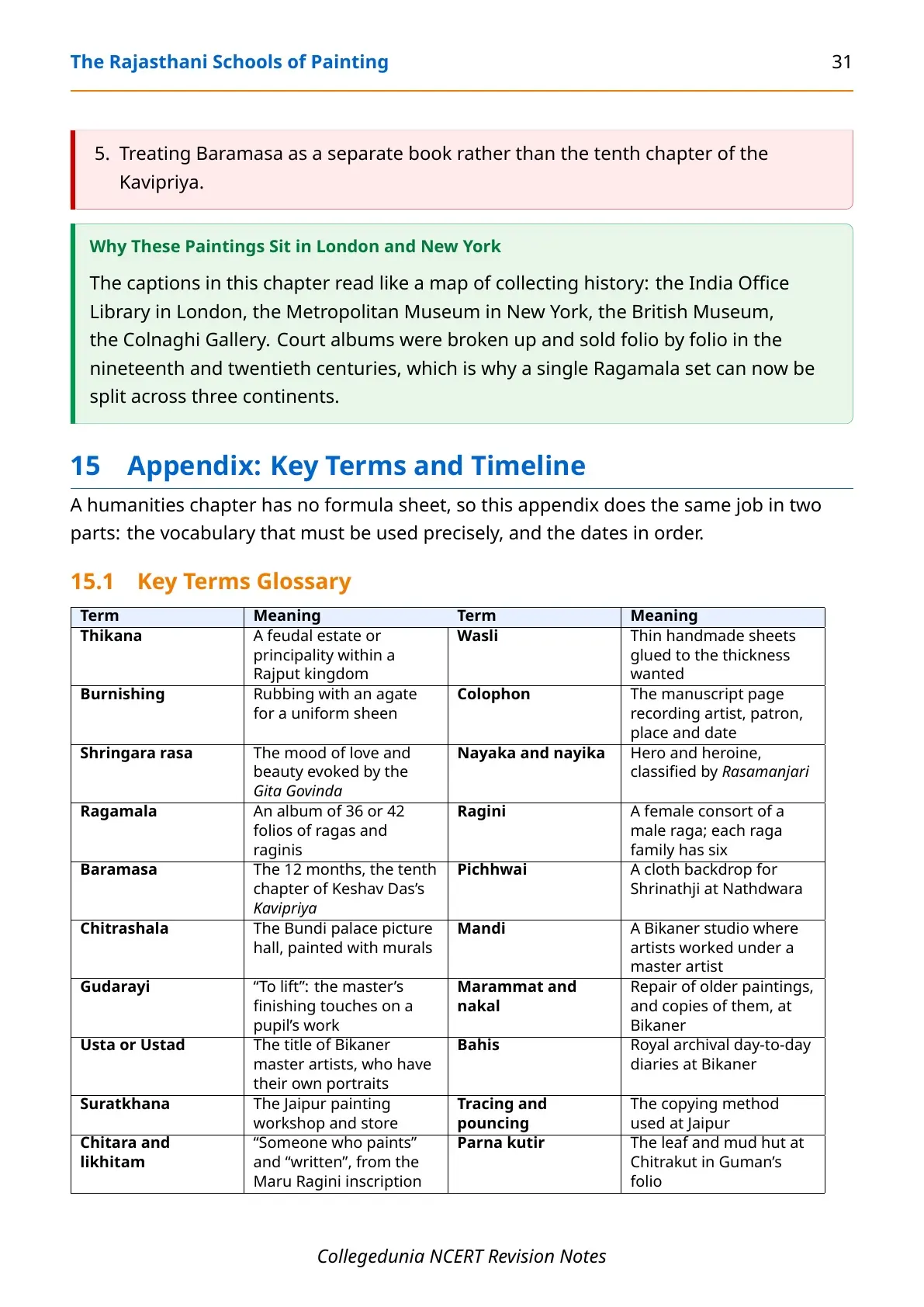
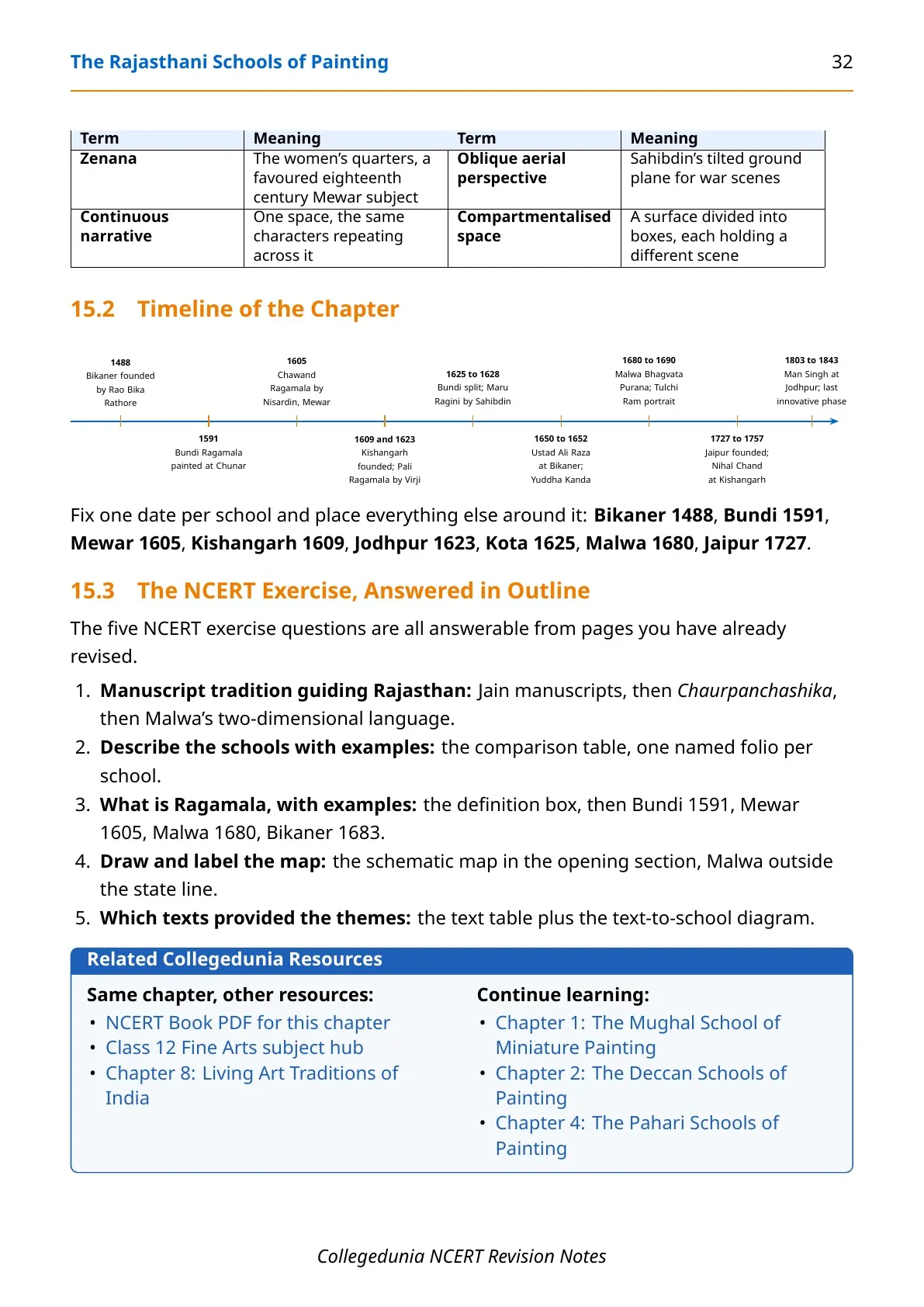
- Covers the painting of Rajasthan and parts of Madhya Pradesh from the sixteenth to the early nineteenth centuries.
- Sub-schools you must separate: Mewar, Bundi, Kota, Jaipur, Bikaner, Kishangarh, Jodhpur (Marwar) and Malwa.
- Ends with 5 NCERT exercise questions and 7 full page plates set for appreciation answers.
Every fact in these Rajasthani Schools of Painting notes is taken from the official NCERT chapter, checked line by line against the Reprint 2026-27 text, and arranged by Collegedunia Fine Arts teachers in the order the CBSE theory paper asks for it.
Read the printed chapter alongside these notes
The official NCERT chapter from An Introduction to Indian Art Part 2, Reprint 2026-27, with every plate and caption.
What the Rajasthani Schools of Painting Notes Cover for Class 12 Fine Arts
The NCERT chapter prints the title in the plural, and the plural is the whole point. This is not one style. It is a family of court styles that grew in the princely kingdoms and thikanas of what is roughly Rajasthan today, along with parts of Madhya Pradesh.
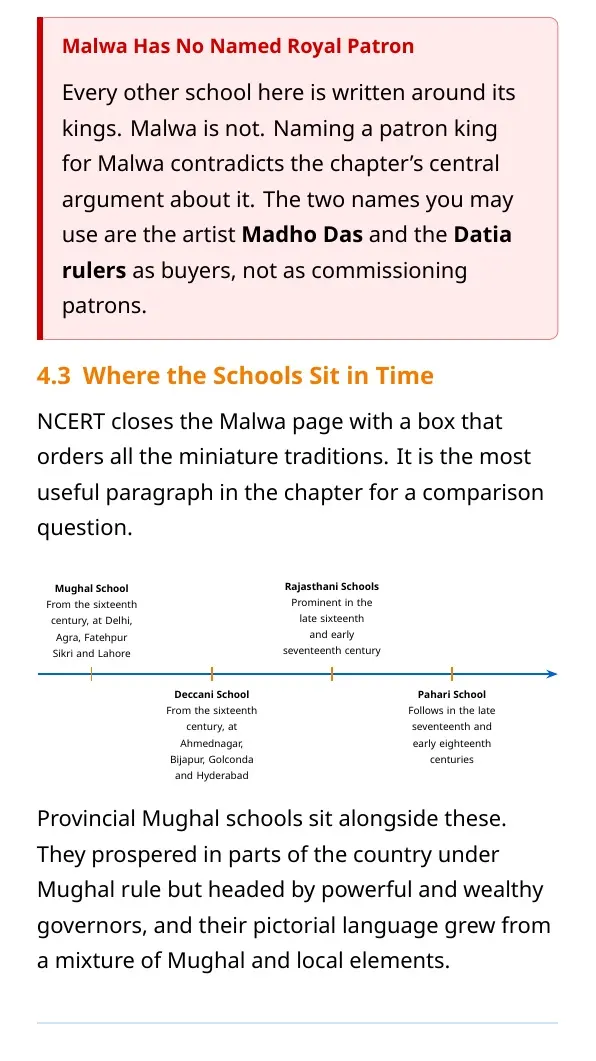
The chapter names Mewar, Bundi, Kota, Jaipur, Bikaner, Kishangarh, Jodhpur (Marwar), Malwa, Sirohi and other such principalities. The span runs largely between the sixteenth and the early nineteenth centuries. The Rajasthani Schools came into prominence in the late sixteenth and early seventeenth century, with the Pahari School following in the late seventeenth and early eighteenth centuries.
| Block in the chapter | What you must remember | Question type it feeds |
|---|---|---|
| Opening on the term itself | Coomaraswamy coined Rajput Painting in 1916; the term is now obsolete | 1 mark, 2 marks |
| Materials and method | Waslis, mineral pigments, camel and squirrel hair brushes, the agate burnish, the workshop team | 3 marks |
| Themes overview | Gita Govinda, Rasamanjari, Rasikapriya, Kavipriya, Bihari Satsai, Ragamala, Baramasa | 5 marks, exercise question 5 |
| Eight sub-schools | Dates, patrons, named artists and the pictorial trait that separates each one | 5 marks, exercise question 2 |
| Seven plate essays | Artist, date, collection and the story each plate tells | 5 marks, appreciation |
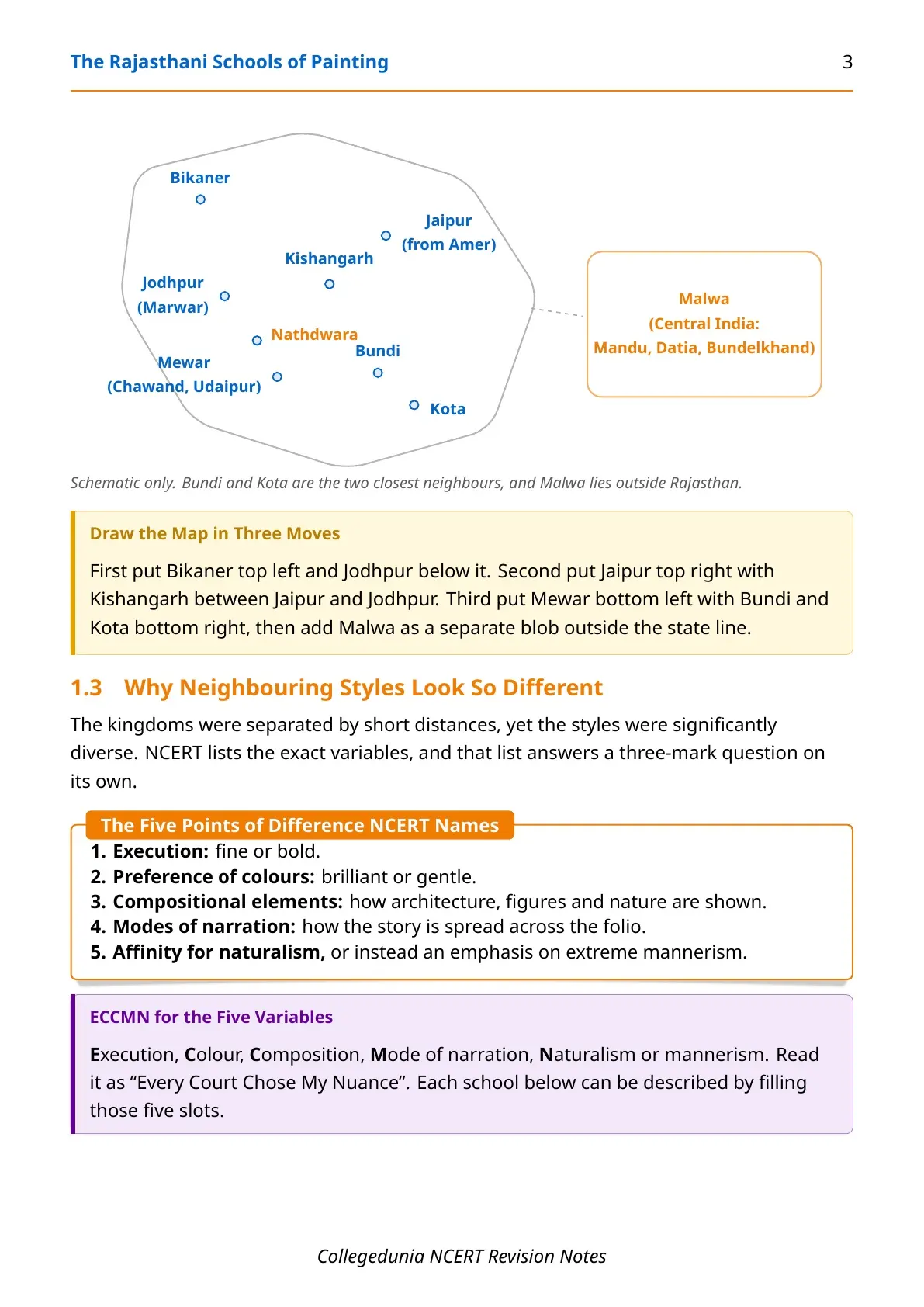
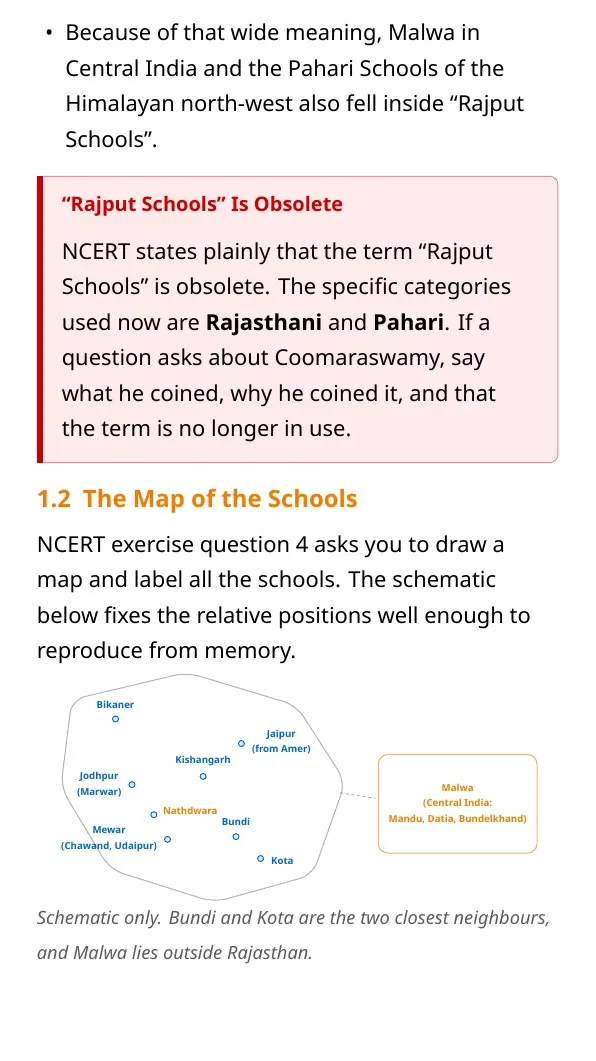
| Map work | Placing every school on a map of Rajasthan and Central India | Exercise question 4 |
The chapter also fixes where these schools sit beside the others you have already studied. The Mughal School dominates from the sixteenth century through the courts of Delhi, Agra, Fatehpur Sikri and Lahore. The Deccani School flourishes at Ahmednagar, Bijapur, Golconda and Hyderabad from the same century. Provincial Mughal Schools grow under wealthy governors appointed by Mughal emperors, where the pictorial language forms through a mix of Mughal and local elements.
Why Rajput Painting Became Rajasthani Painting: the Coomaraswamy Terminology Question
This is the easiest 2 mark question in the chapter and the one most students fumble. Scholar Anand Coomaraswamy coined the term Rajput Paintings in 1916, because most rulers and patrons of these kingdoms were Rajputs.
- He coined it to categorise and differentiate this group from the much better known Mughal School of Painting.
- Because his label was so wide, Malwa, made up of the princedoms of Central India, also fell inside Rajput Schools.
- So did the Pahari Schools of the mountainous Himalayan region of north-western India.
- For Coomaraswamy the name stood for the indigenous tradition of painting that existed in the mainland before the Mughal conquest.
- Studies in Indian painting have moved on. The term Rajput Schools is obsolete today, and specific categories such as Rajasthani and Pahari are used instead.
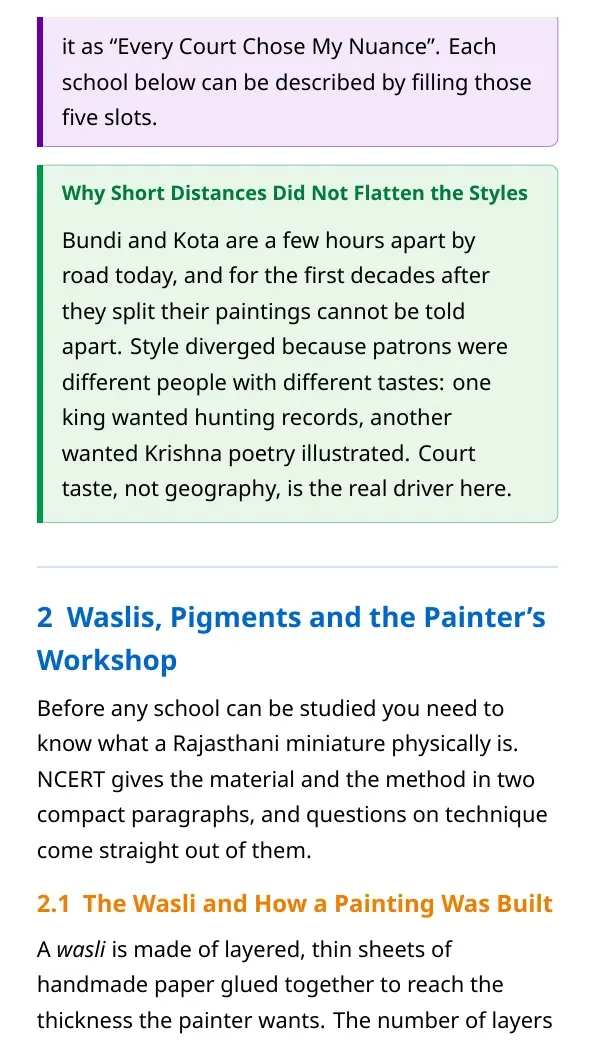
The second half of the opening tells you why one label could never hold. Though the kingdoms were separated by short distances, their pictorial styles were very diverse. The chapter lists the exact axes of that difference, and those axes are what a comparison answer is built from.
| Axis of difference | The two ends the chapter names |
|---|---|
| Execution | Fine or bold |
| Preference of colours | Brilliant or gentle |
| Compositional elements | How architecture, figures and nature are shown |
| Modes of narration | One episode per folio, or many episodes layered into one |
| Attitude to nature | An affinity for naturalism, or an emphasis on extreme mannerism |
Rajasthani Painting Unit 1 Explained in One Sitting
Source: Study Box on YouTube
How a Rajasthani Miniature Was Made: Waslis, Mineral Colour and the Workshop Team
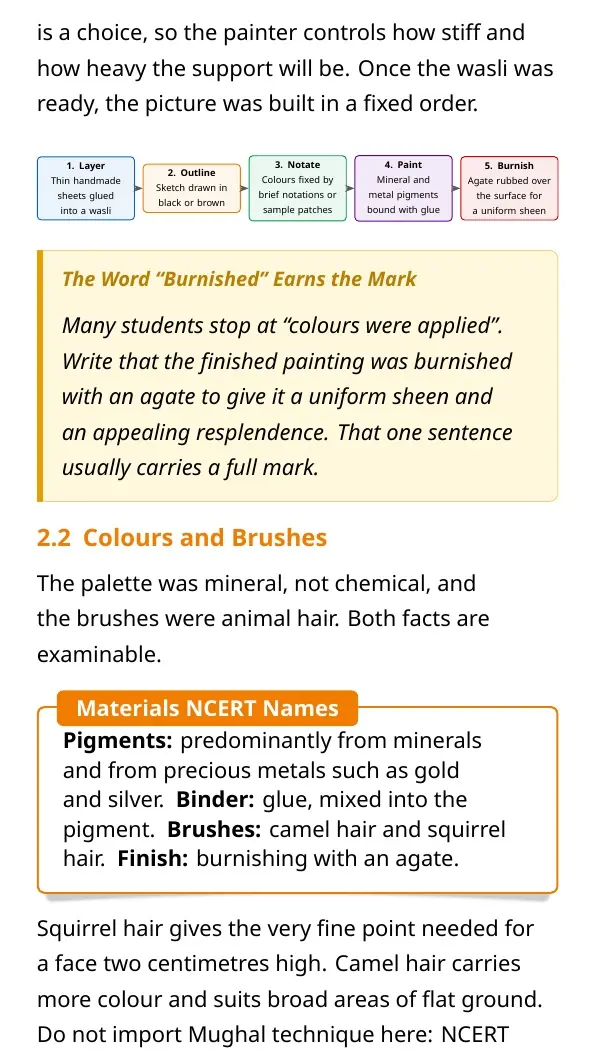
The technique paragraph is short in the book and heavily set in the paper. Learn it as a sequence, because the examiner wants the steps in order and wants the Hindi and Persian terms spelled correctly.
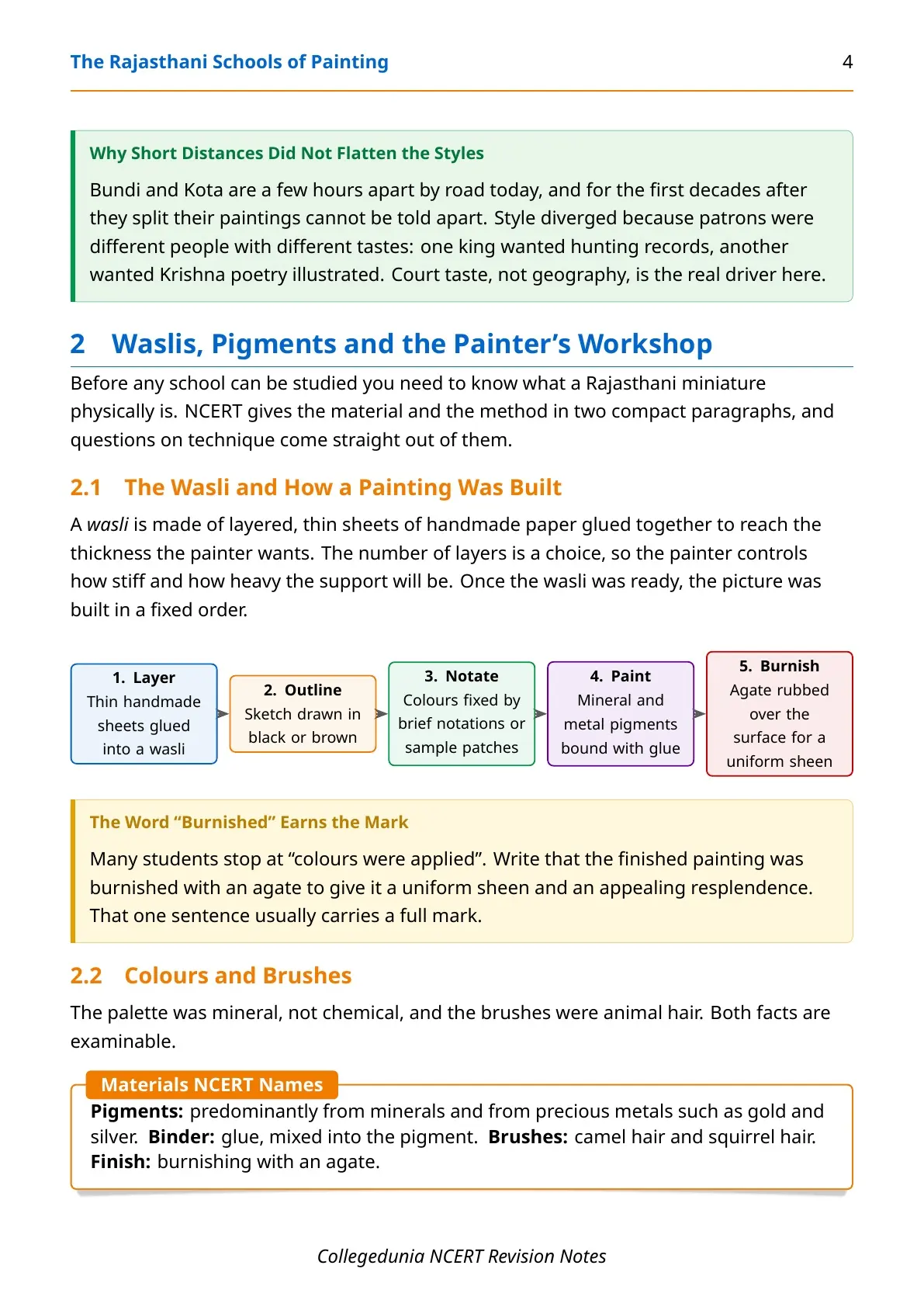
- The support. Paintings were made on waslis, which are layered thin sheets of handmade paper glued together to get the thickness the artist wanted.
- The outline. The drawing was sketched on the wasli in black or brown.
- The colour plan. Colours were fixed in place by brief notations or by small sample patches before the painting was filled in.
- The pigments. Colour came mostly from minerals and precious metals such as gold and silver, mixed with glue as the binding medium.
- The brushes. Camel and squirrel hair were used to make them.
- The finish. The completed painting was burnished with an agate to give it a uniform sheen and an appealing resplendence.
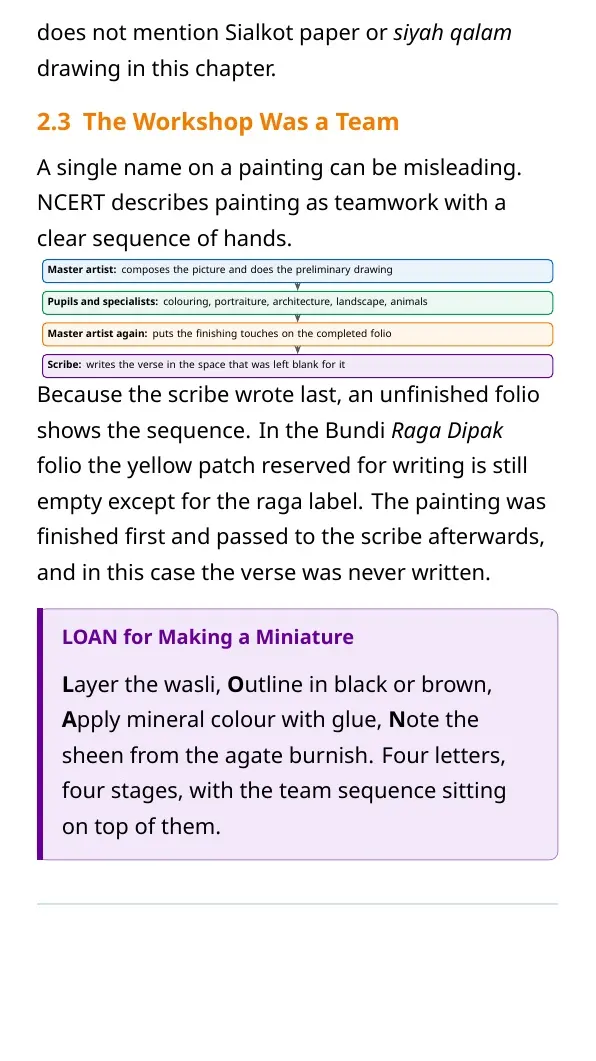
Painting was teamwork, not a solo act. The master artist composed the picture and made the preliminary drawings. Pupils or specialists in colouring, portraiture, architecture, landscape and animals then took over and did their part. The master artist came back at the end and put the finishing touches. The scribe wrote the verse in the space left for it.
That last step is worth one extra line in an answer. It explains why some finished paintings carry an empty yellow panel where a verse should be, and the Bundi Raga Dipak folio is the chapter's proof of it.
Themes of Rajasthani Painting: the Six Texts That Supplied Almost Every Subject
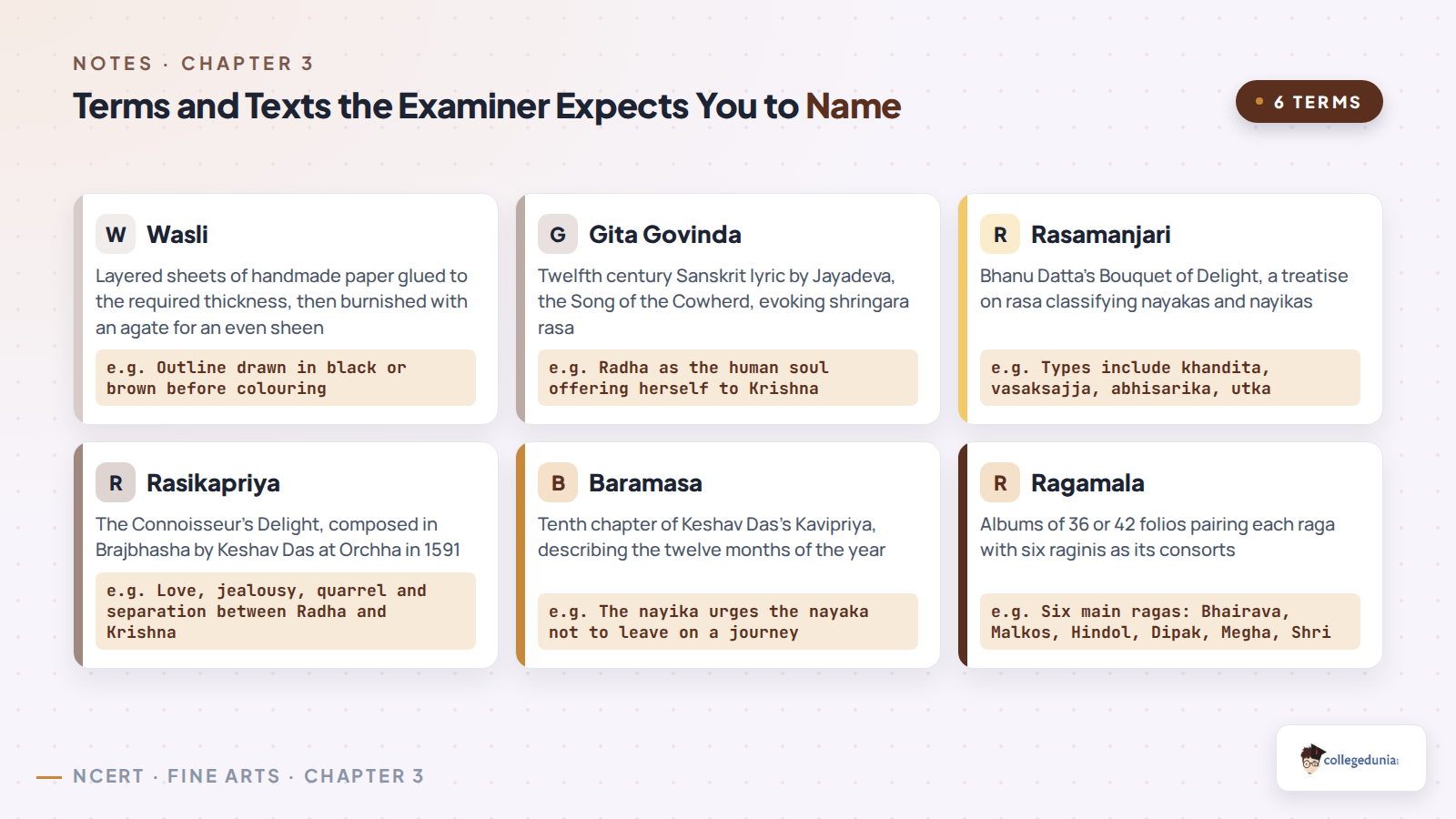
Exercise question 5 asks which texts provided the content or theme for miniature painting, and asks you to describe them with examples. This section is that answer. Learn author, language, century and one identifying idea for each.
| Text | Author, date and language | What it contains |
|---|---|---|
| Gita Govinda, the Song of the Cowherd | Jayadeva, twelfth century, Sanskrit | A lyrical poem evoking shringara rasa, showing the mystical love of Radha and Krishna through worldly imagery. Jayadeva is believed to have been the court poet of Lakshmana Sen of Bengal. |
| Rasamanjari, the Bouquet of Delight | Bhanu Datta, a Maithil Brahmin living in Bihar, fourteenth century, Sanskrit | A treatise on rasa that classifies heroes (nayakas) and heroines (nayikas). Krishna is not mentioned in the text, yet painters brought him in as the archetypal lover. |
| Rasikapriya, the Connoisseur's Delight | Keshav Das, court poet of Raja Madhukar Shah of Orchha, 1591, Brajbhasha | Complex poetic interpretations written to give aesthetic pleasure to elite courtiers. It explores love, togetherness, jilt, jealousy, quarrel and its aftermath, separation and anger, all through Radha and Krishna. |
| Kavipriya | Keshav Das, written in honour of Rai Parbin, a celebrated courtesan of Orchha | A tale of love. Its tenth chapter, titled Baramasa, describes the 12 months of the year, with daily life in each season and the festivals that fall in it. |
| Bihari Satsai | Bihari Lal, around 1662, at the court of Jaipur | 700 verses (satsai) of aphorism and moralising wit. He worked for Mirza Raja Jai Singh, whose name appears in several verses. Largely painted at Mewar and less often in the Pahari School. |
| Ragamala | A painting tradition rather than a single authored text | Pictorial interpretations of ragas and raginis, arranged in albums of 36 or 42 folios. |
Behind all six sits one historical cause. By the sixteenth century Vaishnavism in the cults of Rama and Krishna had become popular across western, northern and central India as part of the Bhakti movement that had swept the subcontinent.
- Krishna had a special appeal. He was worshipped as God and also loved as an ideal lover.
- The idea of love was cherished as a religious theme, where a delightful synthesis of sensuousness and mysticism was felt.
- Krishna was seen as the creator, from whom all creation was a sportive emanation. Radha stands for the human soul offering herself to God.
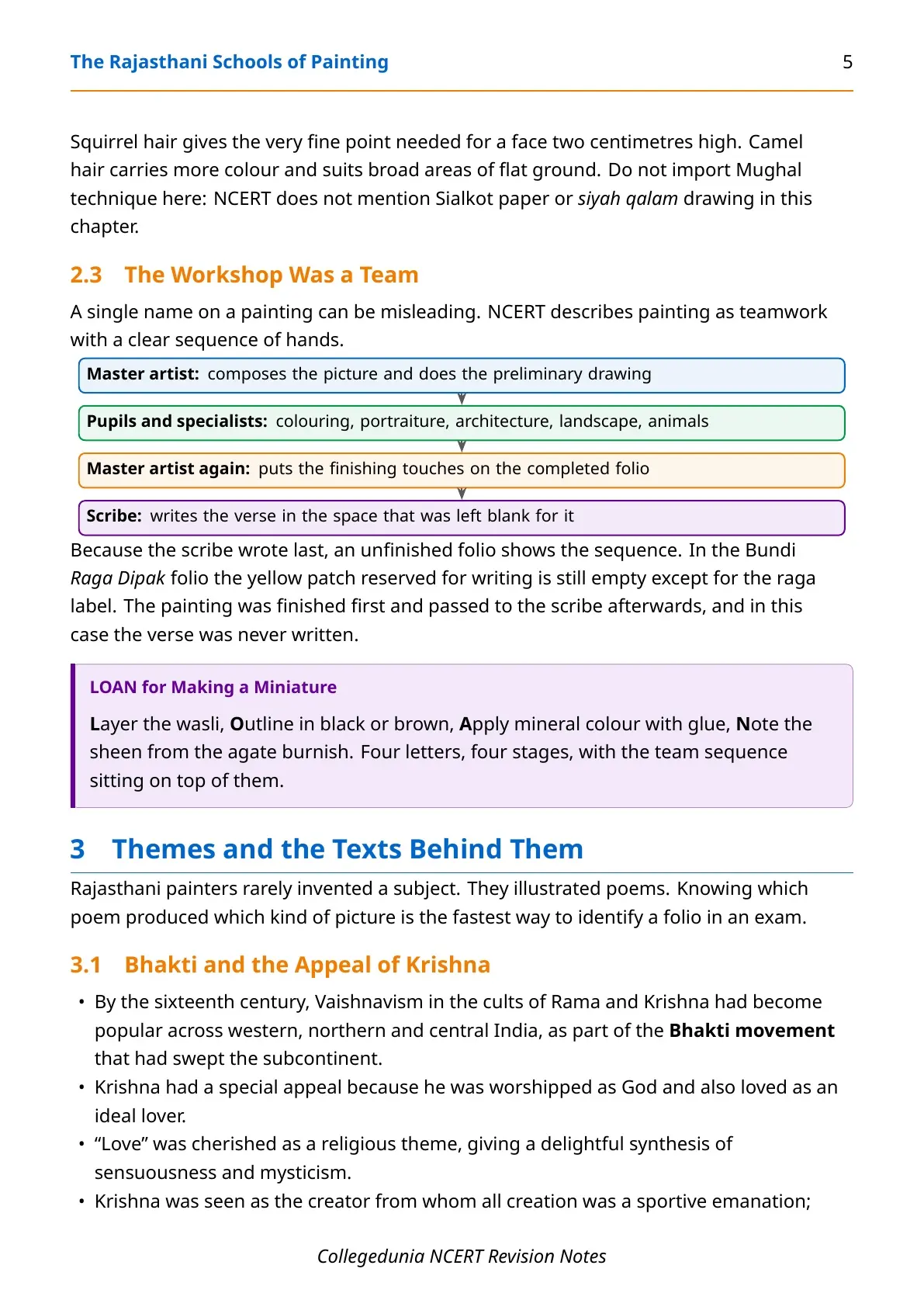
- The soul's devotion to the deity is pictured by Radha's self-abandonment to Krishna, which the Gita Govinda paintings sum up.
Beyond the six texts, the chapter lists two more theme groups. Bardic legends and romantic tales such as Dhola-Maru, Sohni-Mahiwal, Mrigavat, Chaurpanchashika and Laurchanda were favourites. So were the Ramayana, Bhagvata Purana, Mahabharata and Devi Mahatmya, which were popular with every school of painting. A large number of paintings also record darbar scenes and historic moments, hunting expeditions, wars and victories, picnics, garden parties, dance and music performances, rituals, festivals, wedding processions, portraits of kings and courtiers, city views, birds and animals.
Ragamala Painting Explained: 36 or 42 Folios, Six Ragas and Their Raginis
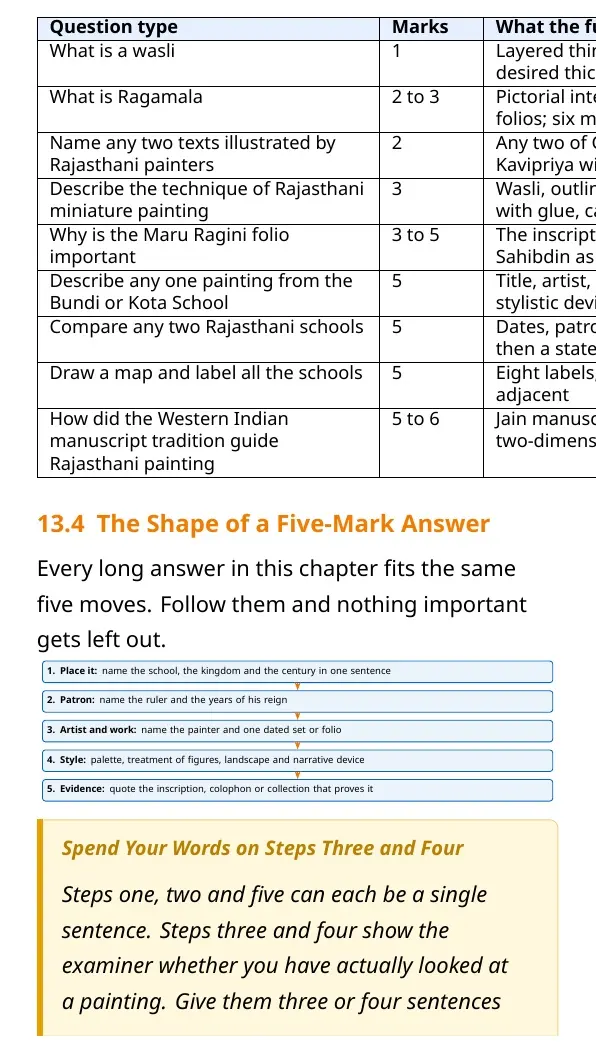
Exercise question 3 asks what a Ragamala is and asks for examples from various schools of Rajasthan. The definition is four lines and the examples are already scattered through the chapter, so collect them once and revise them together.
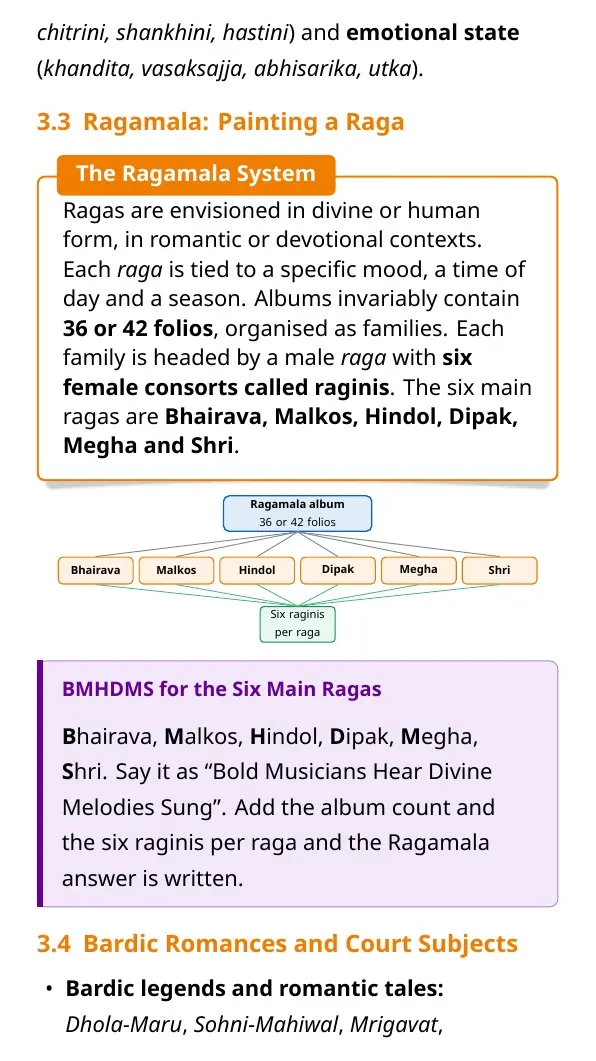
- Ragamala paintings are pictorial interpretations of ragas and raginis. Musicians and poets imagined ragas in divine or human form, in romantic or devotional settings.
- Each raga is tied to a specific mood, time of the day and season.
- The albums invariably contain 36 or 42 folios, organised in the format of families.
- Each family is headed by a male raga with six female consorts called raginis.
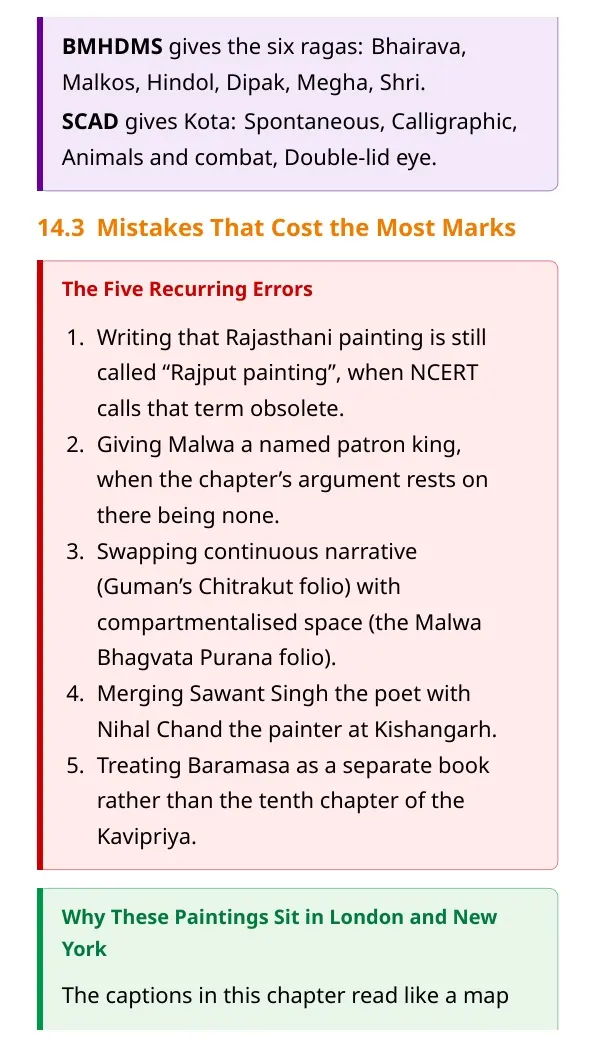
- The six main ragas are Bhairava, Malkos, Hindol, Dipak, Megha and Shri.
| Ragamala example | School, artist and date | Why it matters |
|---|---|---|
| Chawand Ragamala | Mewar, Nisardin, 1605 | The set the emergence of the Mewar School is dated from; it carries a colophon page |
| Chunar Ragamala | Bundi, painted at Chunar, set dated 1591 | Earliest and formative phase of Bundi painting; three named artists in a Persian inscription |
| Ragamala of 1628 | Mewar, Sahibdin | The set the Maru Ragini folio belongs to, with its full documentary inscription |
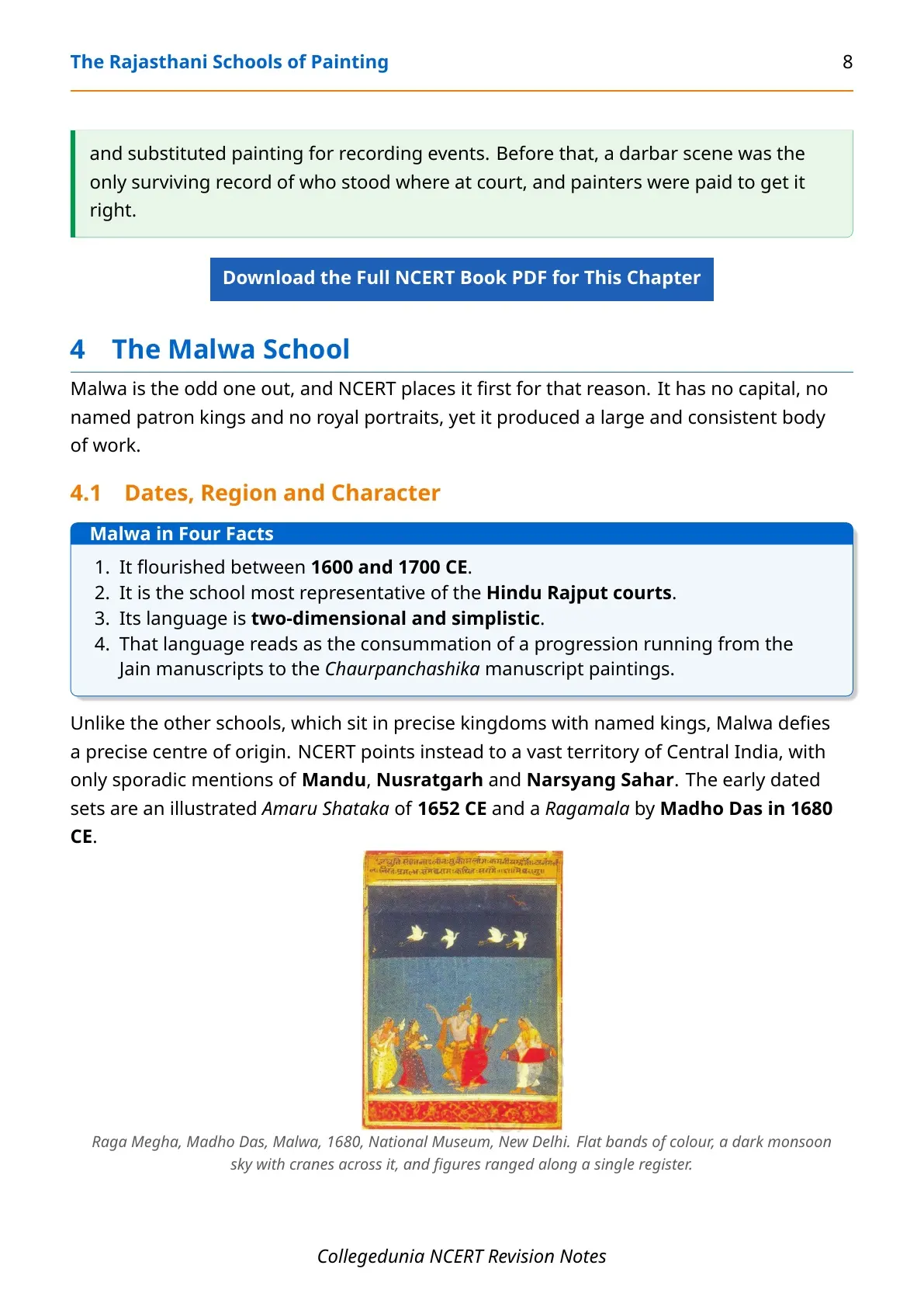
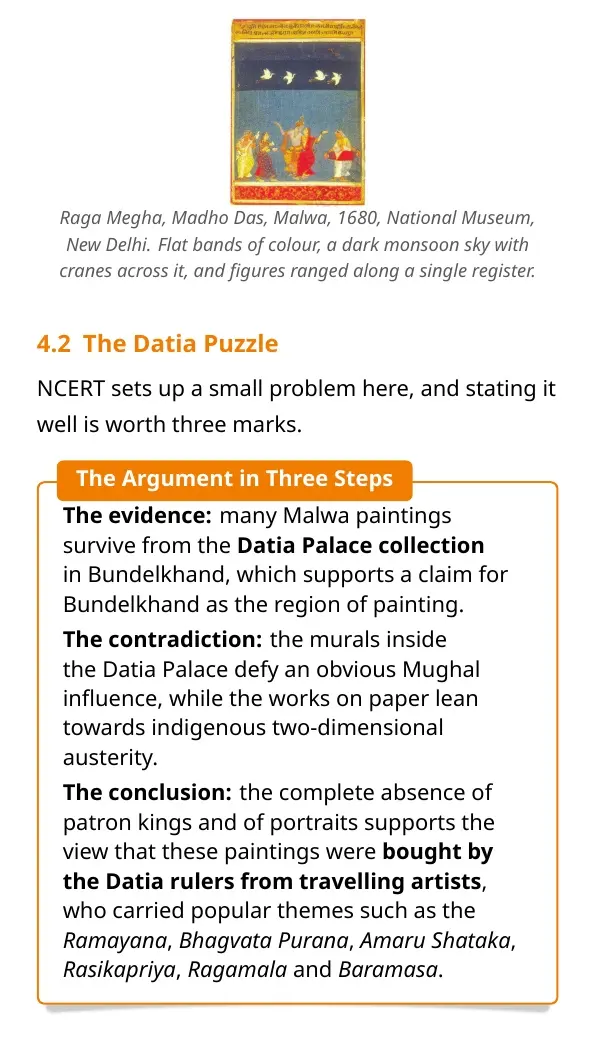
| Raga Megha | Malwa, Madho Das, 1680 | One of the few early dated Malwa sets, in the National Museum, New Delhi |
| Pali Ragamala | Jodhpur, Virji, 1623 | One of the earliest sets painted in Pali in the Marwar region |
Mewar School of Painting: Chawand, Sahibdin, Manohar and the Nathdwara Pichhwais
Mewar is guessed to be a significant early centre of painting in Rajasthan. In theory you should be able to trace one unbroken line here, from the bold indigenous styles before the seventeenth century to the finer style that follows Karan Singh's contact with the Mughals. Long wars with the Mughals wiped out most of the early examples, so that line cannot be drawn.
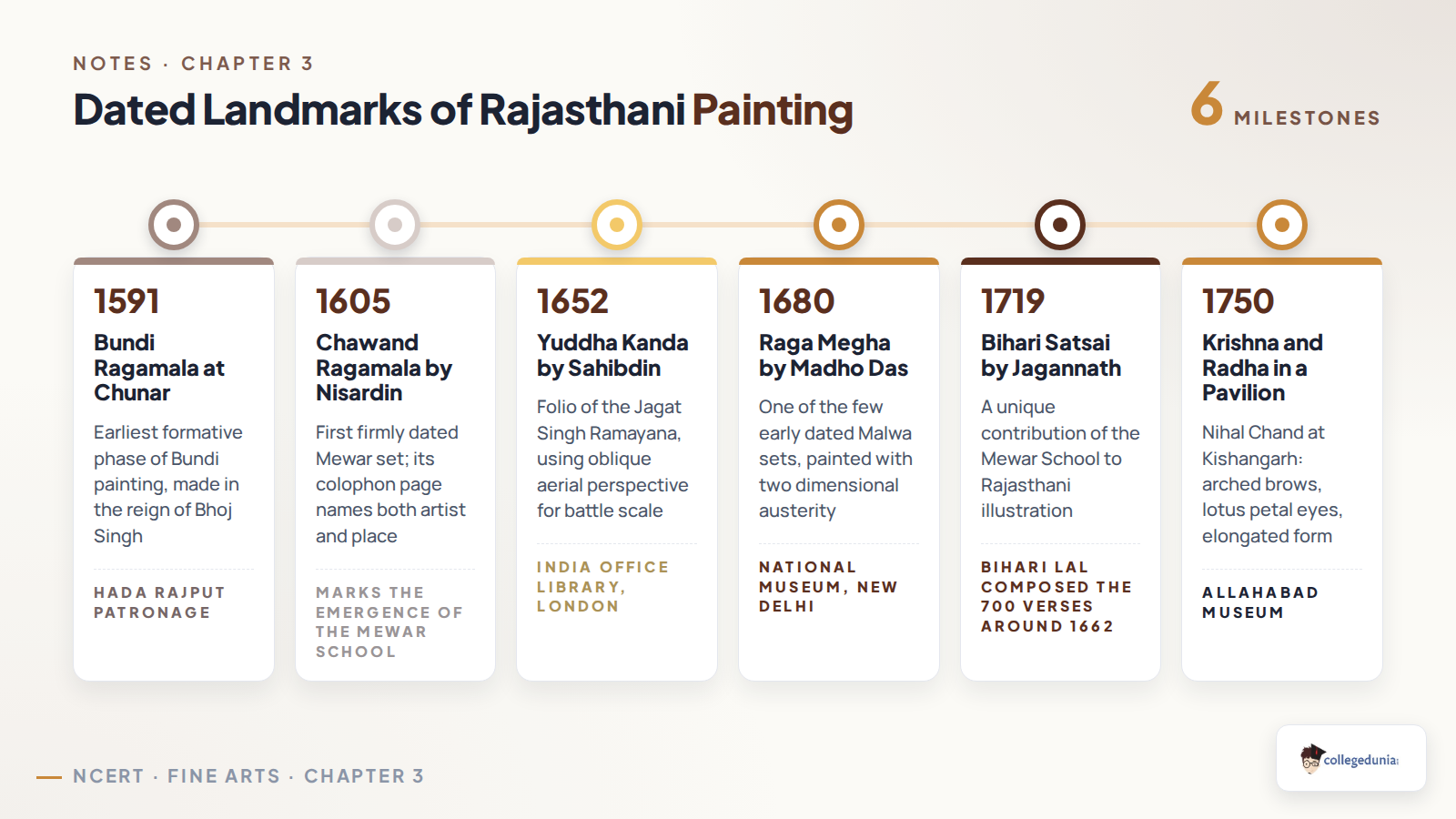
Because of that gap, the emergence of the Mewar School is instead dated from an early set of Ragamala paintings painted at Chawand in 1605 by an artist named Nisardin. The set has a colophon page that reveals all of this. It shares its visual sense with pre-seventeenth century painting: a direct approach, simpler compositions, occasional decorative detail and vibrant colours.
| Mewar artist | Work and date | Point that earns marks |
|---|---|---|
| Nisardin | Ragamala at Chawand, 1605 | The dated starting point of the school, proved by its colophon page |
| Sahibdin | Ragamala (1628), Rasikapriya, Bhagvata Purana (1648), Yuddha Kanda of Ramayana (1652) | The virtuoso of the reign of Jagat Singh I (1628 to 1652) |
| Manohar | Bal Kanda of Ramayana (1649) | The second virtuoso of the same reign, named alongside Sahibdin |
| Jagannath | Bihari Satsai, 1719 | Called an exceptionally gifted artist; a unique contribution of the Mewar School |
Other texts such as Harivamsha and Sursagar were also illustrated in the last quarter of the seventeenth century. The reign of Jagat Singh I is recognised as the period when pictorial aesthetics were reformulated, and Sahibdin and Manohar are the two artists who added that new vitality.
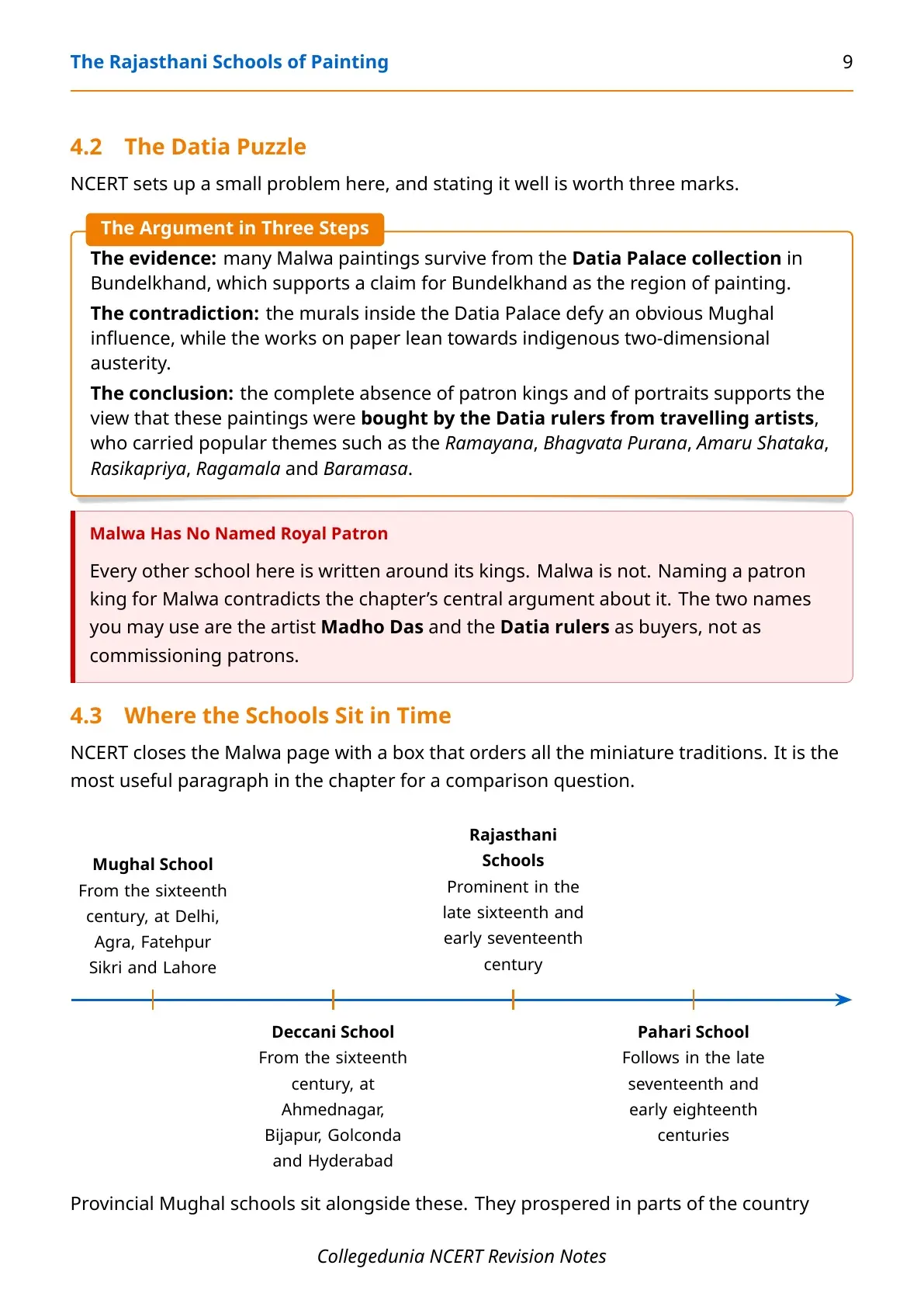
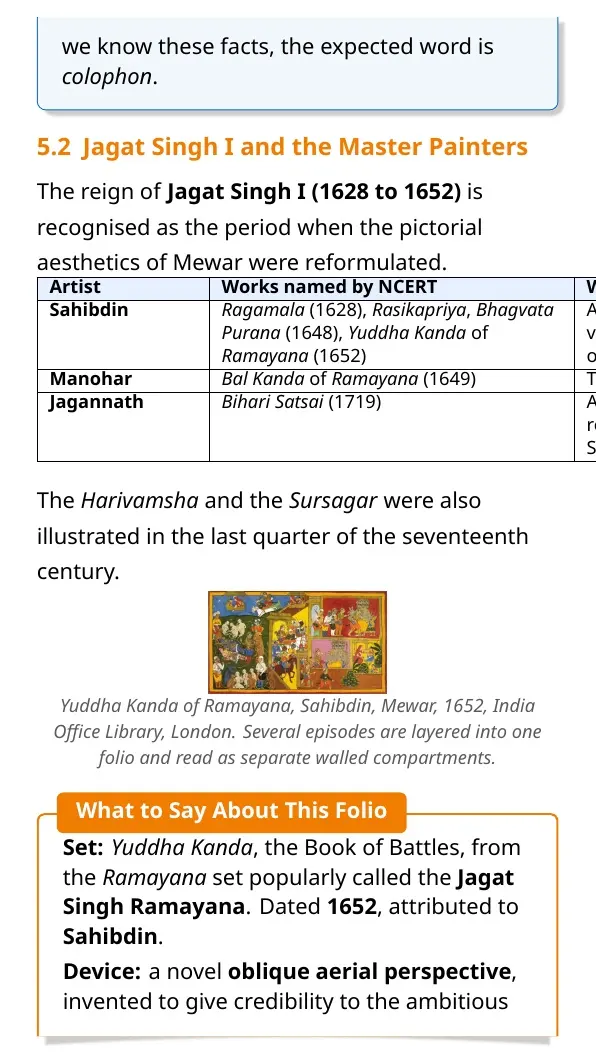
The chapter singles out Yuddha Kanda, the Book of Battles, a chapter in the Ramayana set popularly called the Jagat Singh Ramayana, dated 1652 and now in the India Office Library, London. Attributed to Sahibdin, it is the plate to prepare in full.
- Sahibdin crafted a novel pictorial device, an oblique aerial perspective, to give credibility to the huge scale that war pictures need.
- He either layers several episodes into a single painting, as here, or spreads a single episode over more than one folio.
- The painting shows Indrajit's devious tactics and his use of magic weapons in war.
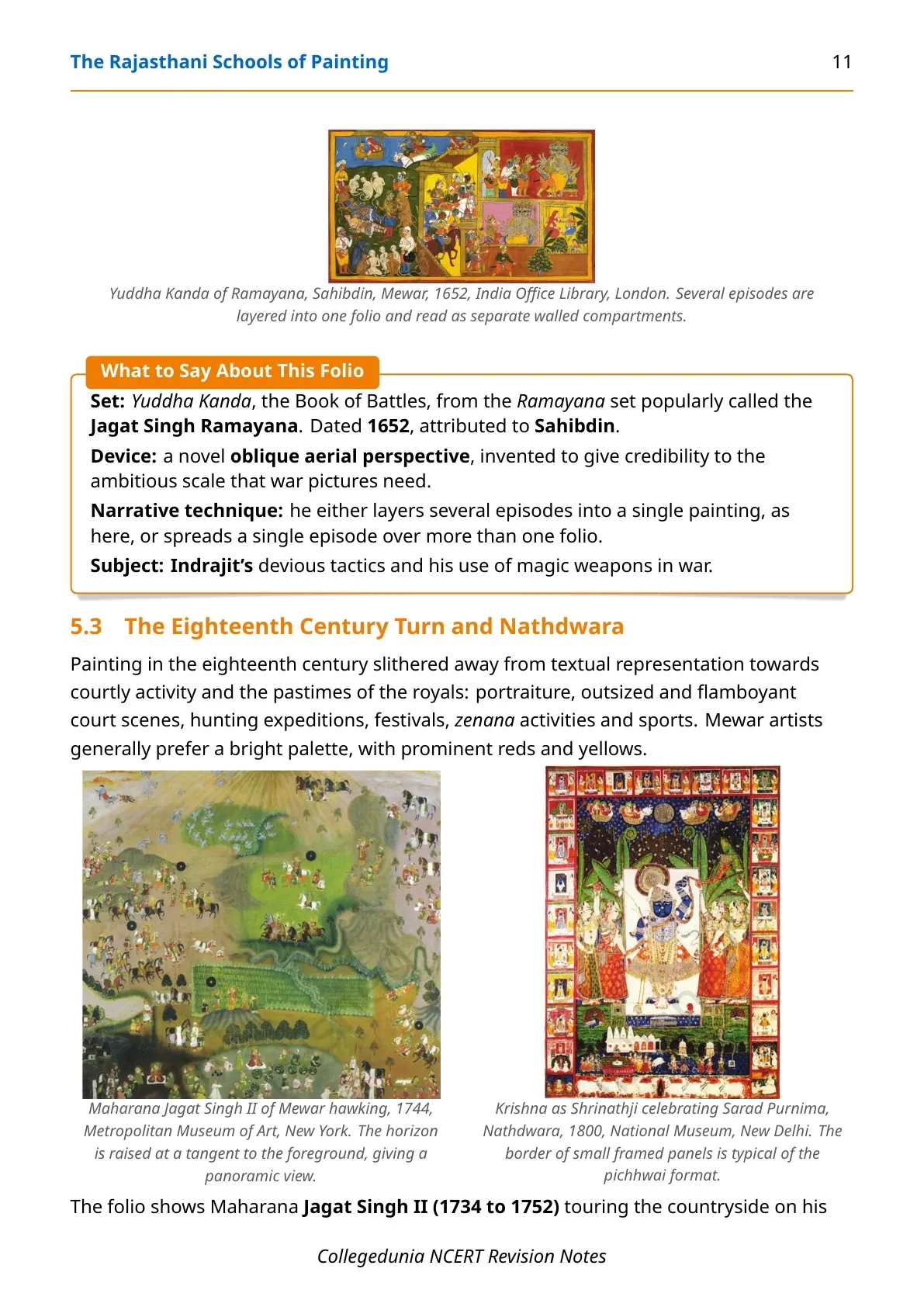
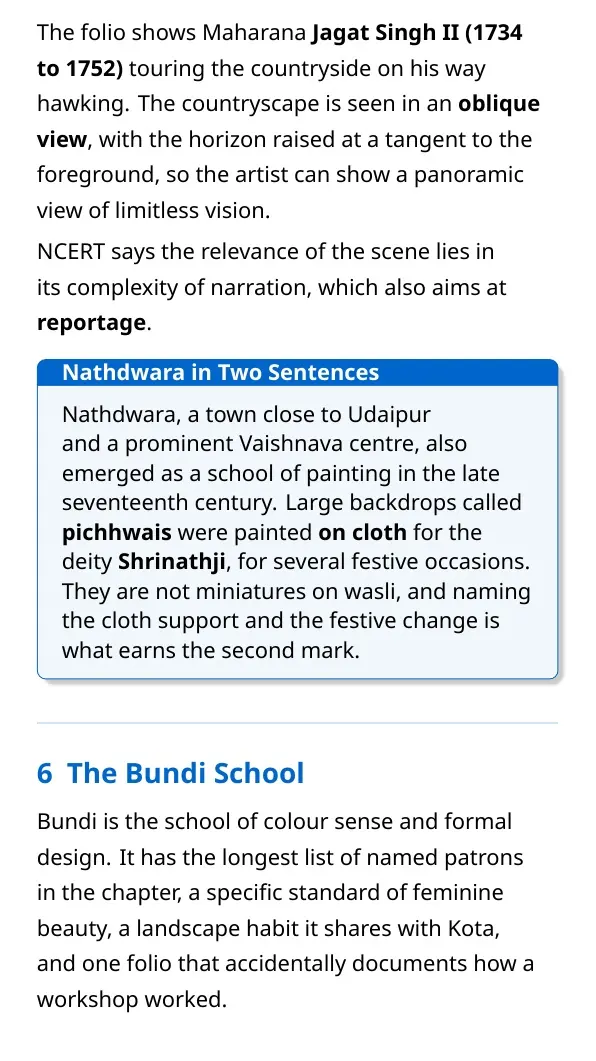
Two later developments close the Mewar section. Nathdwara, a town close to Udaipur and a prominent Vaishnava centre, emerged as a school of painting in the late seventeenth century. Large backdrops called pichhwais were painted on cloth for the deity Shrinathji for festive occasions, and the chapter reproduces Krishna as Shrinathji celebrating the festival of Sarad Purnima, Nathdwara, 1800, in the National Museum, New Delhi.
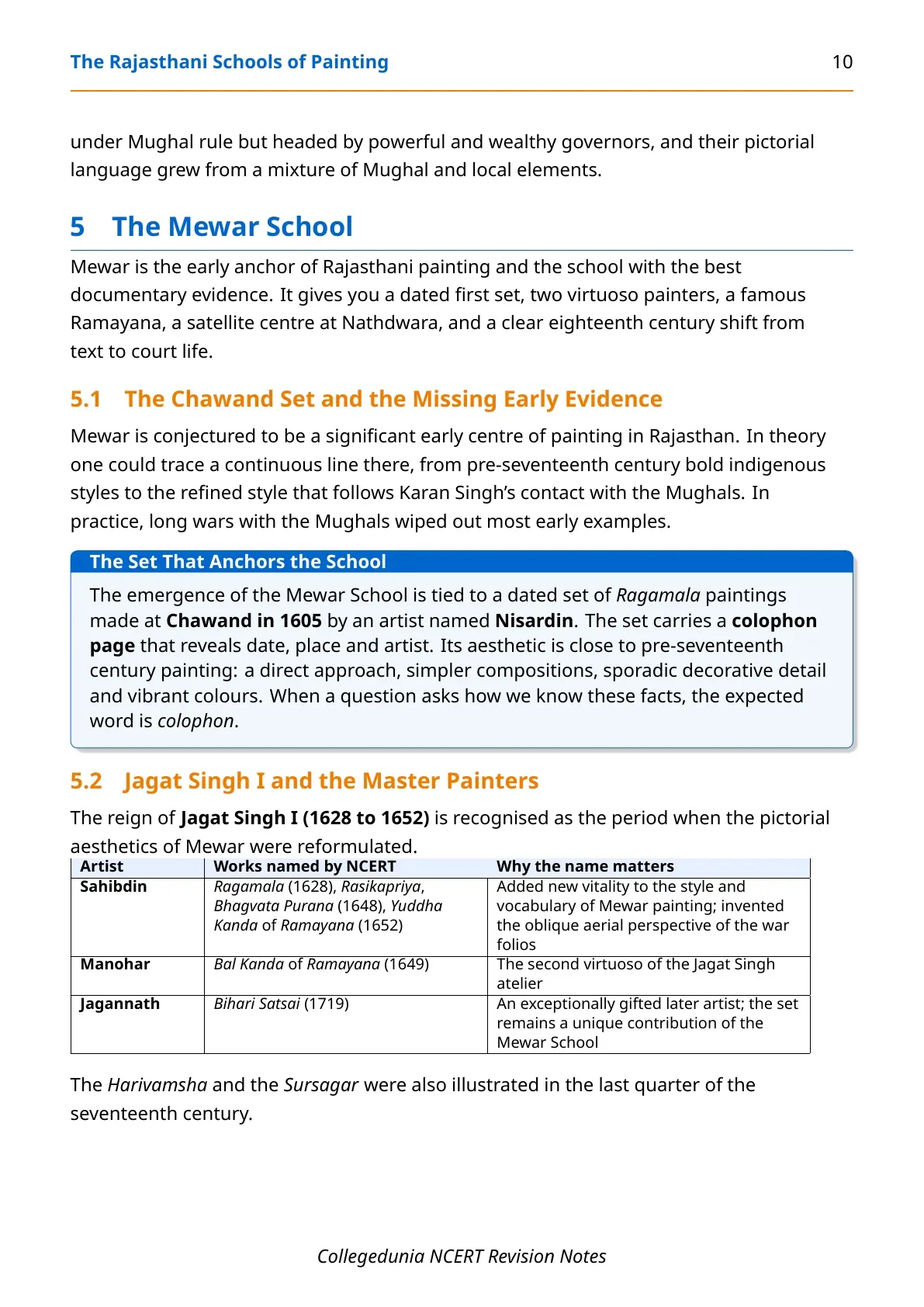
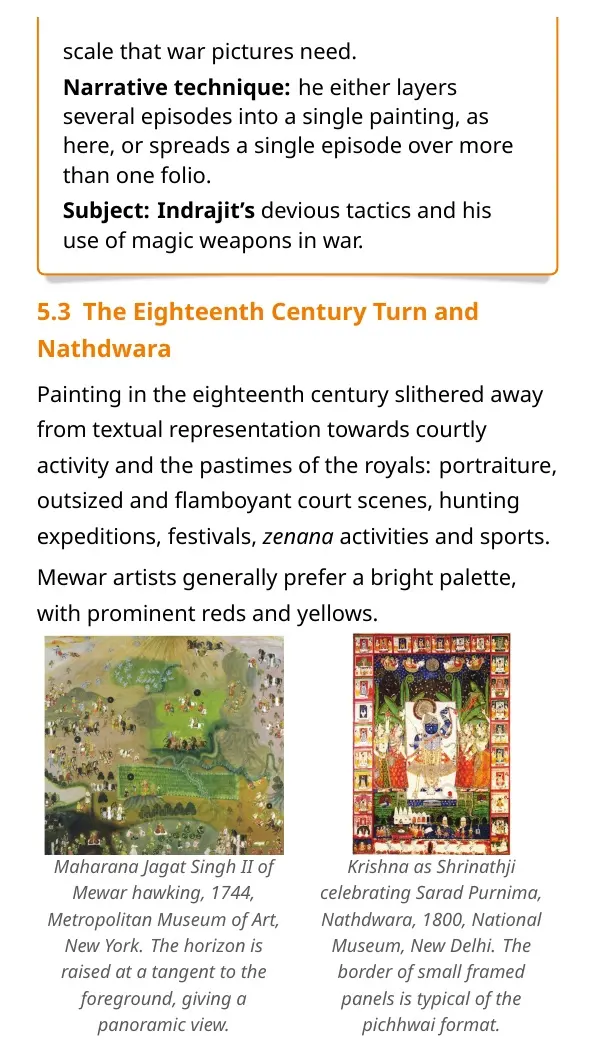
Mewar painting in the eighteenth century became increasingly secular and courtly. A fascination for portraiture appeared, along with outsized and flamboyant court scenes, hunting expeditions, festivals, zenana activities and sports. The folio of Maharana Jagat Singh II (1734 to 1752) touring the countryside on his way hawking, dated 1744 and in the Metropolitan Museum of Art, New York, shows the shift. The countryside is seen in an oblique view with the horizon raised at a tangent to the foreground, which lets the artist build a panoramic view of limitless vision. Its relevance lies in a complexity of narration that also aims at reportage. Mewar artists generally prefer a bright palette with prominent reds and yellows.
Bundi School of Painting: the Chunar Ragamala of 1591 and the Hada Patrons
A prolific and distinct school flourished at Bundi in the seventeenth century, remarkable for its unblemished colour sense and excellent formal design. Its patron list is long, so learn the rulers as a chain rather than as loose names.
| Bundi ruler | Dates | What the chapter says about him |
|---|---|---|
| Bhoj Singh, the Hada Rajput ruler | 1585 to 1607 | The Bundi Ragamala of 1591 was painted at Chunar in his reign |
| Rao Chattar Sal | 1631 to 1659 | Made governor of Delhi by Shahjahan; played a conspicuous role in the subjugation of the Deccan |
| Rao Bhao Singh | 1659 to 1682 | An enthusiastic, self-indulging patron, known from numerous portraits he commissioned of himself |
| Aniruddha Singh | 1682 to 1702 | Innovative developments; subject of the Tulchi Ram equestrian portrait |
| Budh Singh | Successor of Aniruddha Singh | His whiskered face appears in many portraits; lost his kingdom four times yet encouraged painting |
| Umed Singh | 1749 to 1771 | The most accomplished phase, brief but refined in minuteness of detail |
| Bishen Singh | 1771 to 1821 | Ruled 48 years, a connoisseur of art, keen on hunting, which fills the paintings of his period |
| Ram Singh | 1821 to 1889 | The chitrashala of the Bundi palace was decorated with murals of royal processions, hunting scenes and Krishna episodes |
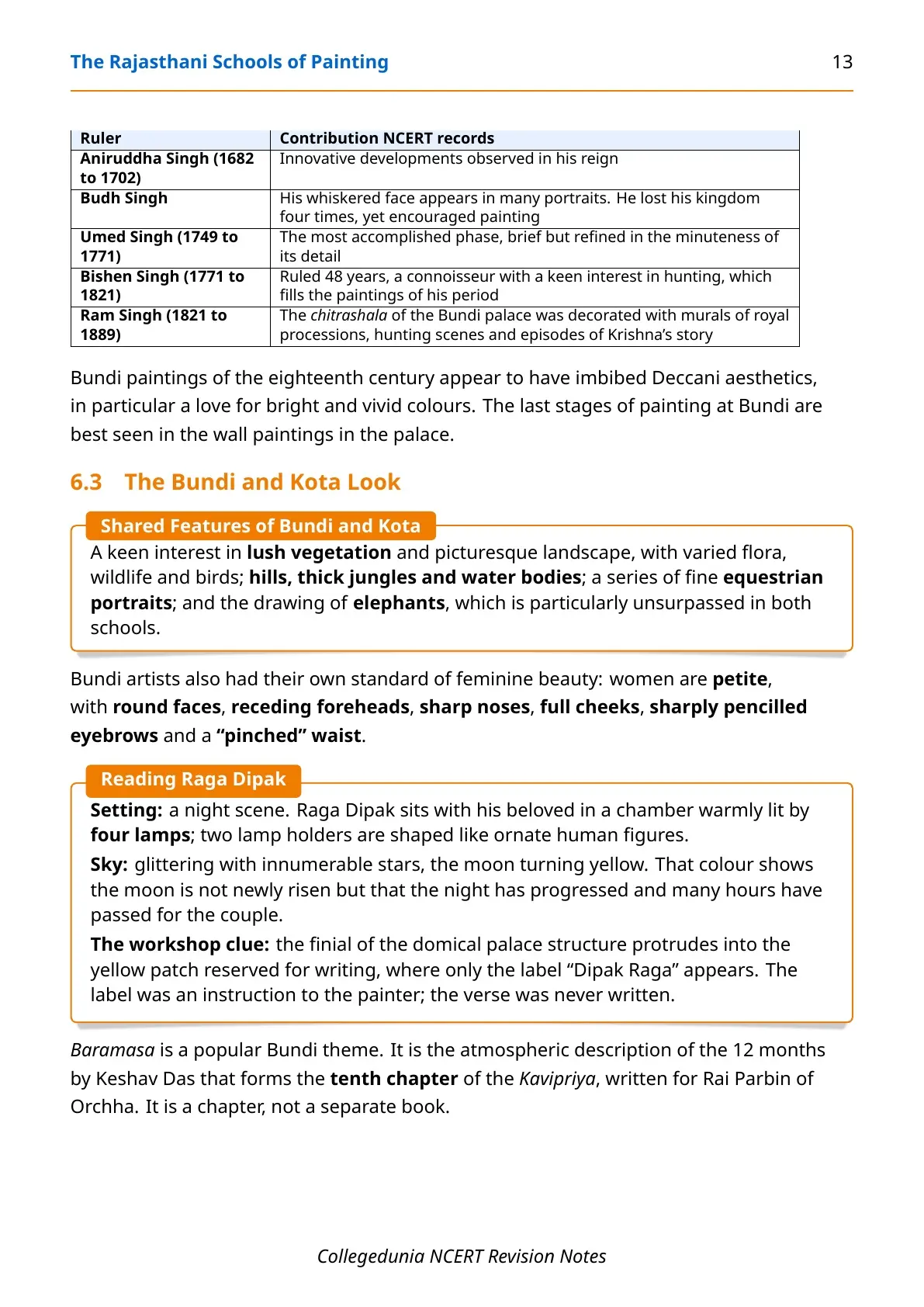
The Bundi Ragamala dated 1591 belongs to the earliest and formative phase. Its Persian inscription is the most quotable fact in the whole chapter, because it names artists and a place of origin at a date that early.
- The named artists are Shaykh Hasan, Shaykh Ali and Shaykh Hatim.
- They introduce themselves as pupils of the master artists Mir Sayyid Ali and Khwaja Abdus Samad of the Mughal court.
- They give Chunar, near Benaras, as the place of origin, where Rao Bhoj Singh and his father Rao Surjan Singh maintained a palace.
- Surviving folios of the Chunar set include the Raginis Khambavati, Bilaval, Malashri, Bhairavi and Patmanjari.
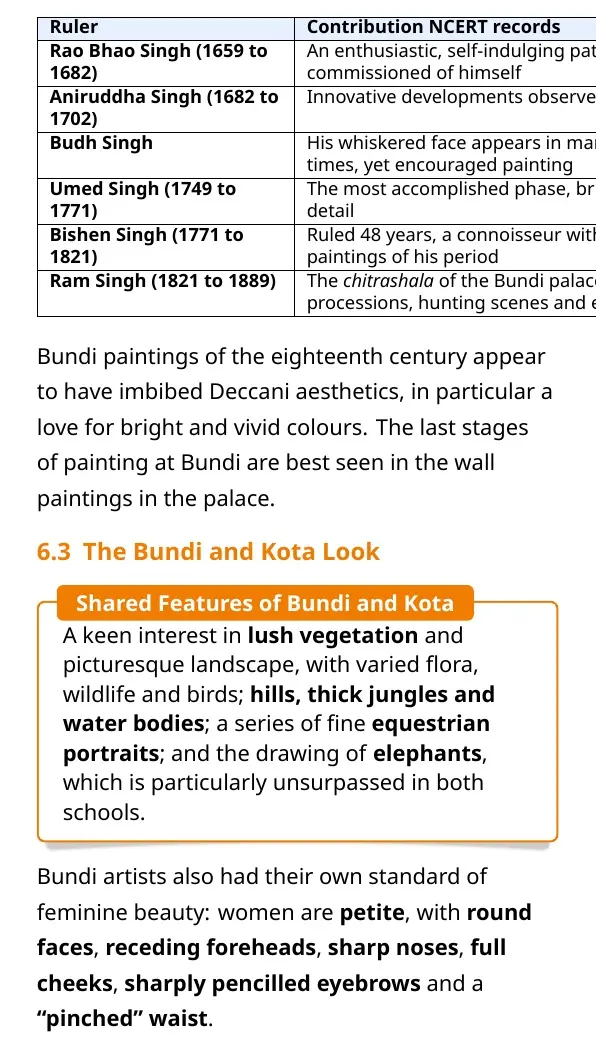
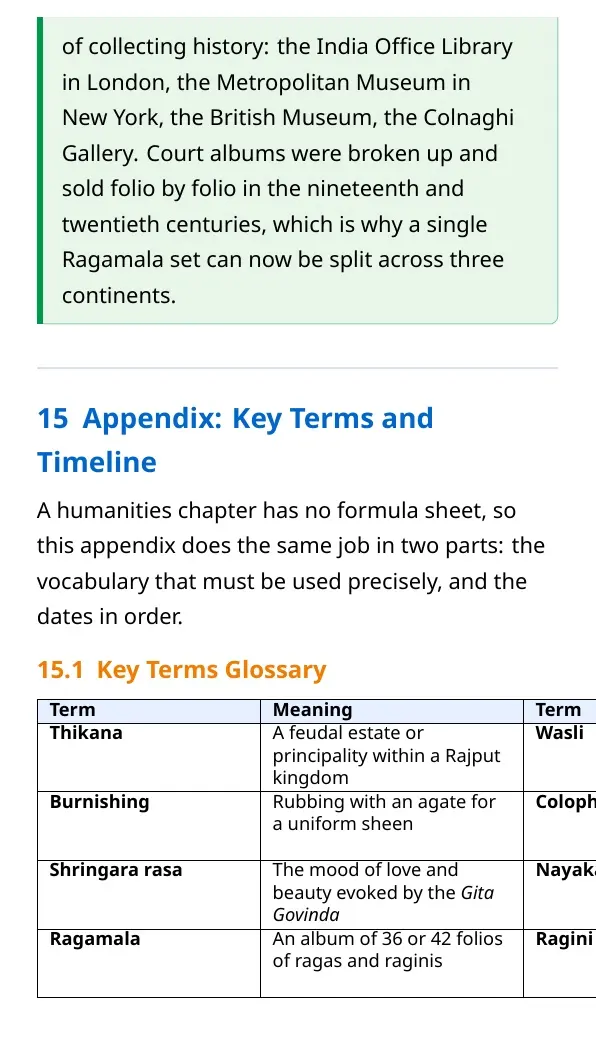
Note one caption trap before the exam. The running text dates the Chunar set to 1591, while the printed caption under the Raga Dipak plate reads 1519. Quote the set as 1591, and quote the collection as the Bharat Kala Bhavan, Varanasi.
Raga Dipak itself is a full appreciation answer. The raga is shown in a night setting, seated with his beloved in a chamber warmly lit by flames from four lamps. Two lamp holders are shaped like ornate human figures. The sky glitters with countless stars and the moon has turned yellow, which tells you the night has progressed and the couple have spent many hours together.
The technical observation is the part examiners reward. The finial on the domical structure of the palace pushes into the yellow patch that was reserved for writing, and nothing is written there except the label of Dipak Raga. That proves the painting was usually finished before it went to the scribe for the verse. Here the verse was never written, and the label was only an instruction to the artist about what he should paint.
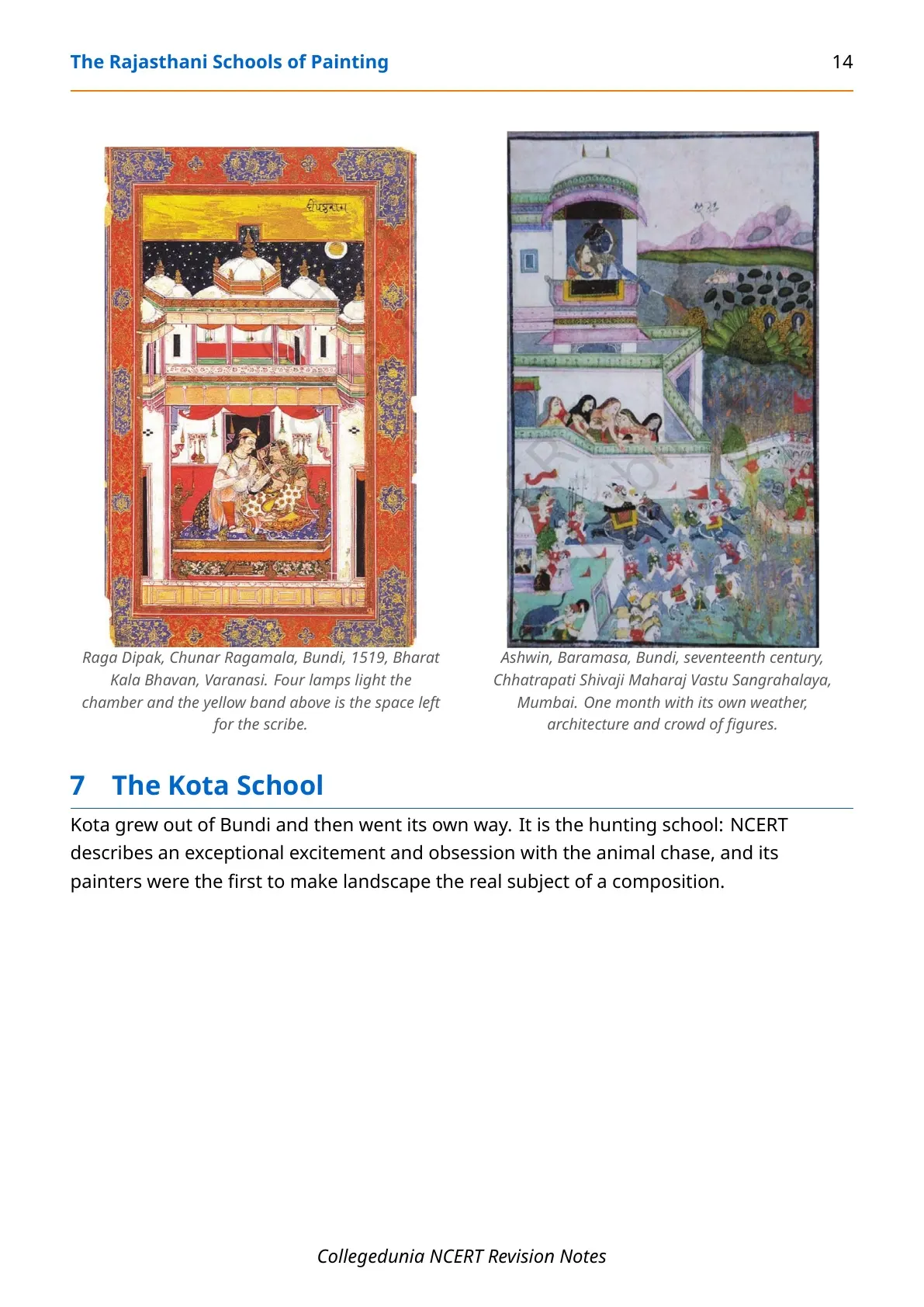
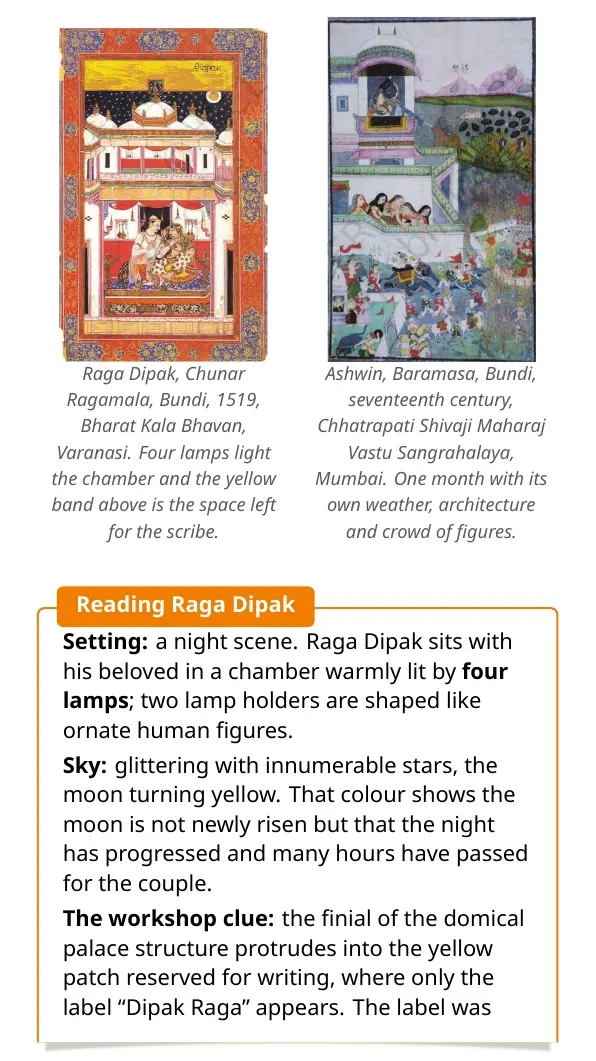
Two more Bundi facts complete the section. Baramasa is a popular Bundi theme, and the chapter reproduces Ashwin, Baramasa, Bundi, seventeenth century, from the Chhatrapati Shivaji Maharaj Vastu Sangrahalaya, Mumbai. Bundi artists also held their own standard of feminine beauty: women are petite, with round faces, receding foreheads, sharp noses, full cheeks, sharply penciled eyebrows and a pinched waist.
Kota School of Painting: the 1625 Split from Bundi and the Obsession with the Chase
The accomplished tradition at Bundi gave rise to Kota, which the chapter calls one of the most outstanding Rajasthani Schools. It excels in the depiction of hunting scenes and shows an exceptional excitement and obsession for the animal chase.
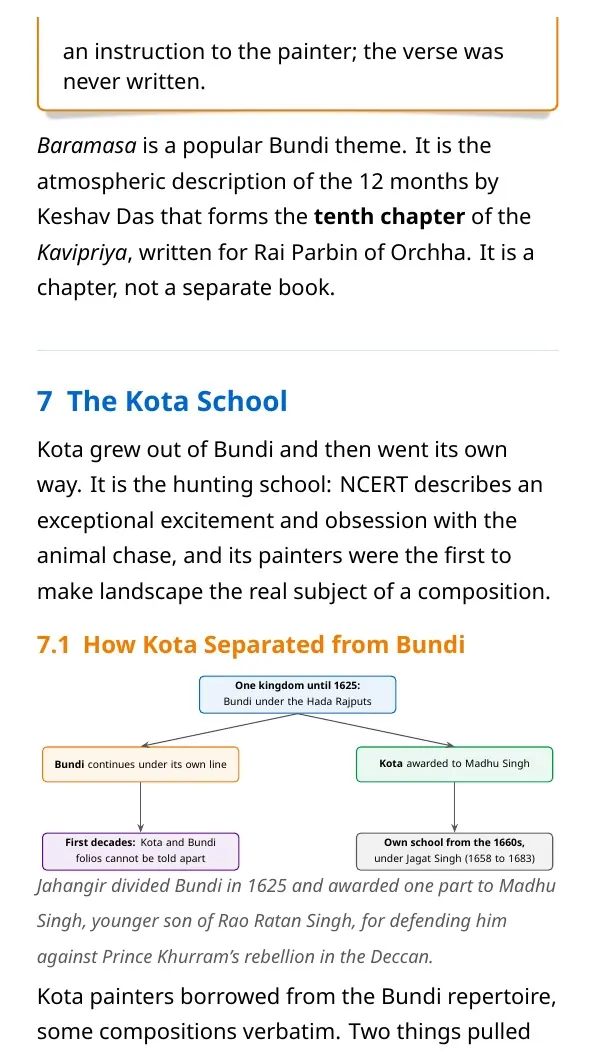
The political split is a favourite objective question. Bundi and Kota were parts of the same kingdom until 1625, when Jahangir divided the Bundi empire. One part was awarded to Madhu Singh, the younger son of Rao Ratan Singh, who was the son of Bhoj Singh of Bundi. The reward was for his bravery in defending Jahangir against the rebellion of Prince Khurram, later Shah Jahan, in the Deccan.
- After separation, Kota had its own school, starting around the 1660s in the reign of Jagat Singh (1658 to 1683).
- In the early period Bundi and Kota paintings cannot be told apart for several decades, because Kota painters borrowed from the Bundi repertoire and took some compositions verbatim.
- An attitude of non-conformity then appears in figural and architectural exaggerations, and Kota flair for drawing takes over.
- By the reign of Ram Singh I (1686 to 1708) artists had enlarged their inventory to a large variety of subjects.
- Kota artists seem to have been the first to render landscape as the real subject of a composition.
Umed Singh (1770 to 1819) is the ruler behind the hunting pictures. He came to the throne at the age of 10, and his powerful regent Zalim Singh arranged for the young king to be amused with hunting while the regent governed the state. Umed Singh spent most of his time on hunting expeditions, and paintings served as flattering records of his exploits. Kota painting of this period reflects an obsession with the chase, which became a social ritual in which even women of the court took part.
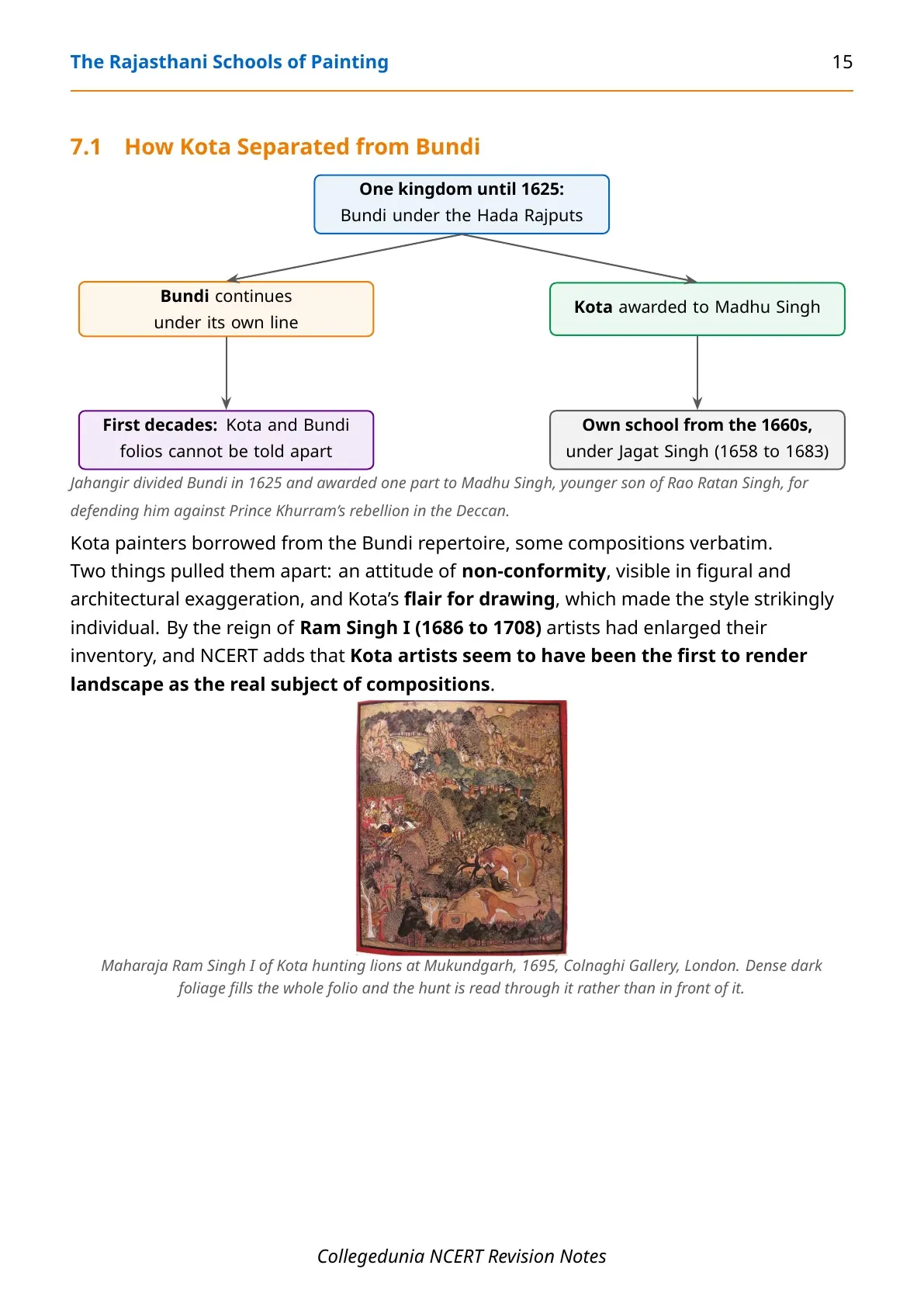
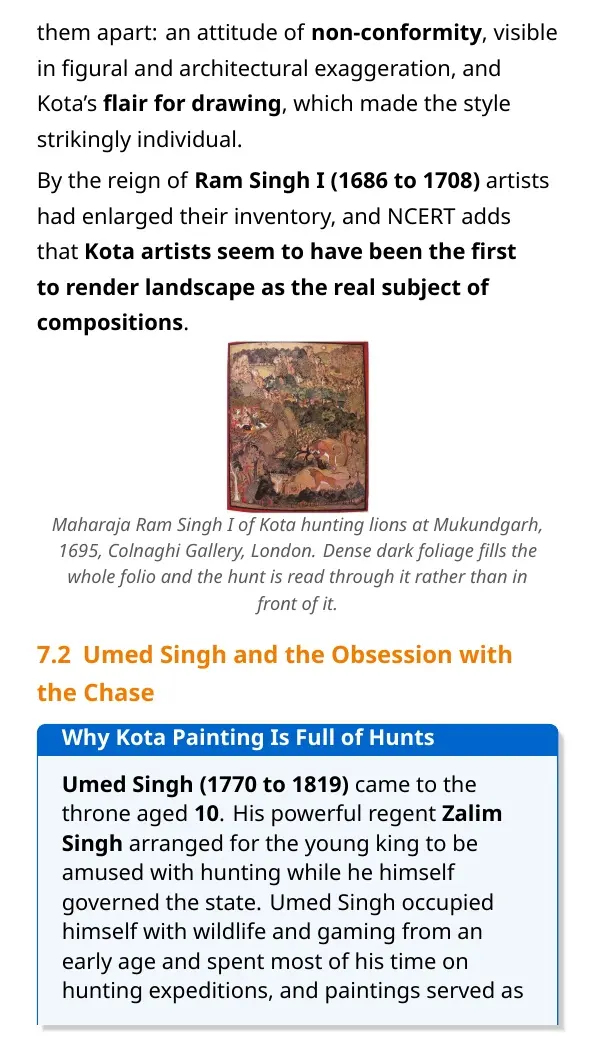
For style, four words carry the answer. Kota paintings are spontaneous and calligraphic in execution, they emphasise marked shading, especially the double-lid eye, and their artists excelled in rendering animals and combat. The chapter's plate is Maharaja Ram Singh I of Kota hunting lions at Mukundgarh, 1695, in the Colnaghi Gallery, London. Bundi and Kota also share a distinct feature: a keen interest in lush vegetation, picturesque landscape with varied flora, wildlife and birds, hills and thick jungles and water bodies, a series of fine equestrian portraits, and a drawing of elephants that is unsurpassed in both.
Bikaner School of Painting: Ustad Ali Raza, Ruknuddin and the Mandi Studios
Bikaner is the documentation chapter. If a question asks which Rajasthani school we know the most about and why, this is the answer.
Rao Bika Rathore established Bikaner, one of the most prominent kingdoms of Rajasthan, in 1488. During his regime, Anup Singh (1669 to 1698) set up a library in Bikaner that became a repository of manuscripts and paintings. Because of a long association with the Mughals, Bikaner developed a distinctive language of painting influenced by Mughal elegance and a subdued colour palette.
| Bikaner artist | Who he was | What to write |
|---|---|---|
| Ustad Ali Raza | A master painter from Delhi, employed by Karan Singh | His earliest work represents the beginnings of the Bikaner School, dated around 1650 |
| Ruknuddin | Master artist in the reign of Anup Singh, whose ancestors came from the Mughal court | His style mixes the indigenous idiom with Deccani and Mughal conventions; he painted the Ramayana, Rasikapriya and Durga Saptsati; his works are in soft colour tones |
| Ibrahim | Painter in Ruknuddin's atelier and head of a studio | His works have a misty dreamlike quality; figures are dainty with heavily modeled faces; his name occurs on different sets of Baramasa, Ragamala and Rasikapriya |
| Nathu, Sahibdin and Isa | Other well-known painters of the same atelier | Nathu also managed one of the professional studios |
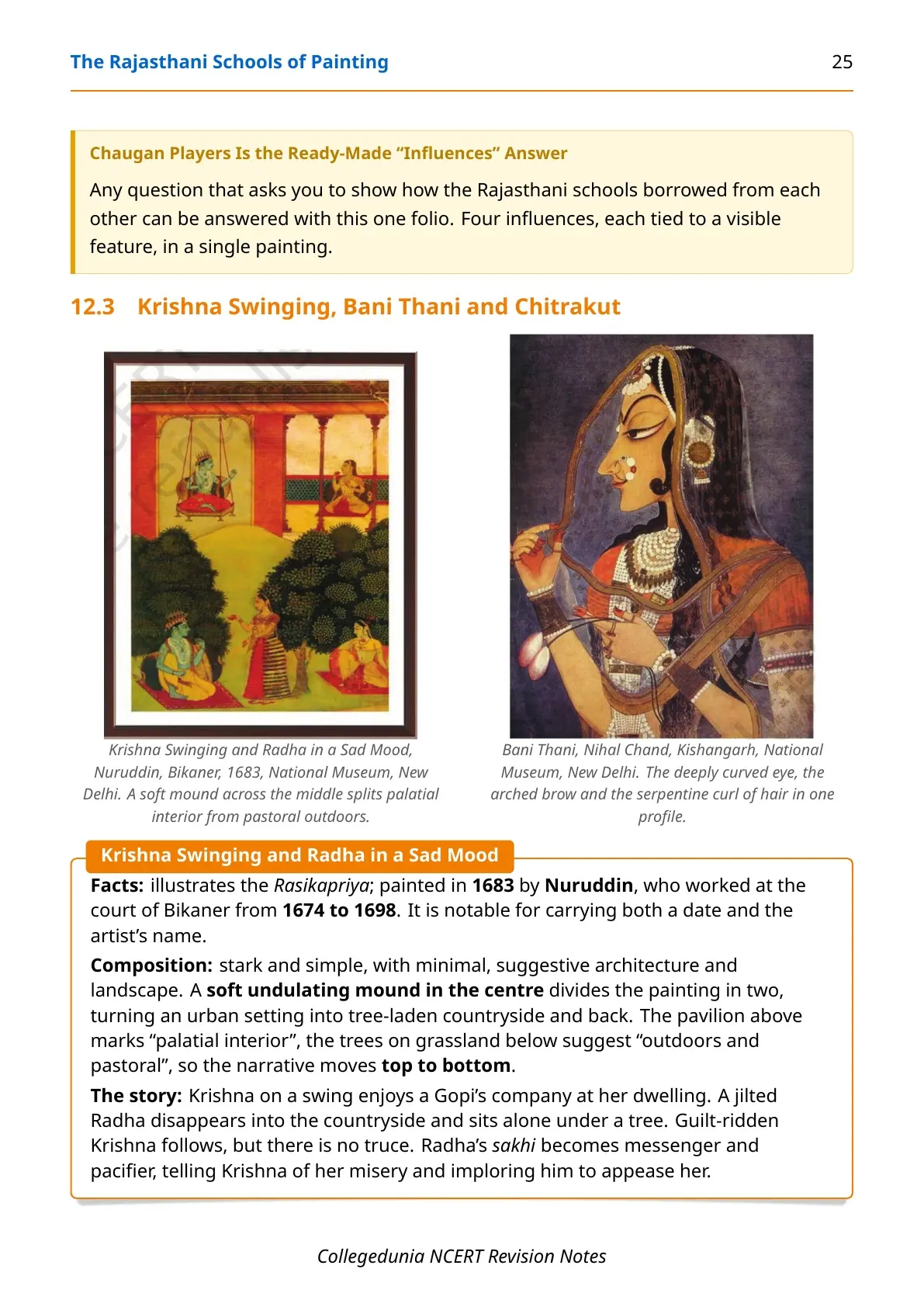
| Nuruddin | Worked in the court of Bikaner from 1674 to 1698 | Painted Krishna Swinging and Radha in Sad Mood in 1683 |
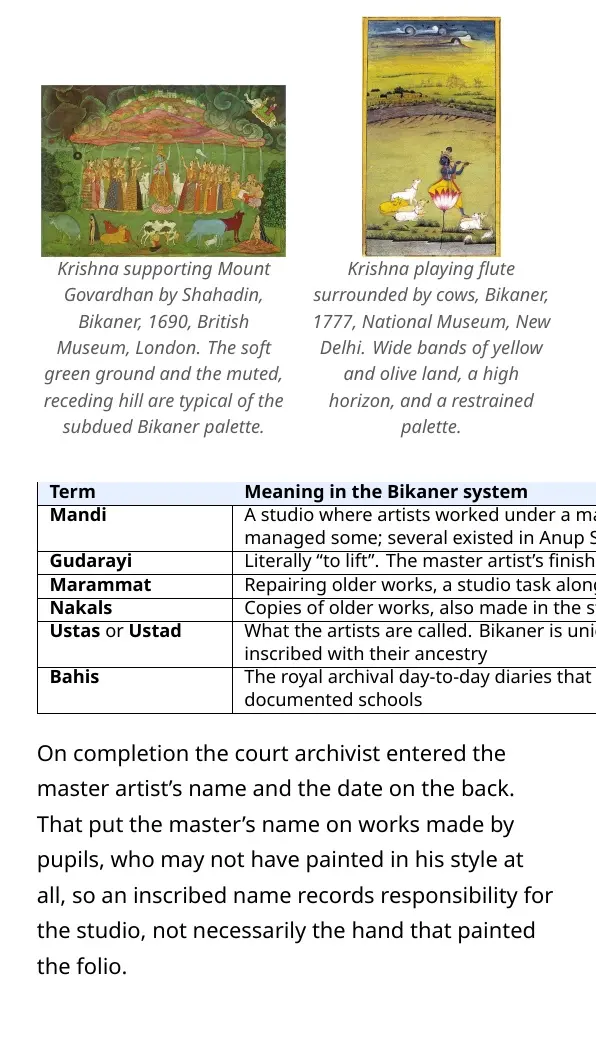
| Shahadin | Named in a plate caption | Krishna supporting Mount Govardhan, Bikaner, 1690, British Museum, London |
The workshop vocabulary of Bikaner is examinable on its own. Studios called Mandi were set up, where a group of artists worked under a master artist, and several Mandis existed in Anup Singh's reign.
- On completion, the court archivist wrote the name of the master artist and the date behind the painting.
- This is why a master's name sits on works by pupils who may not have painted in his style.
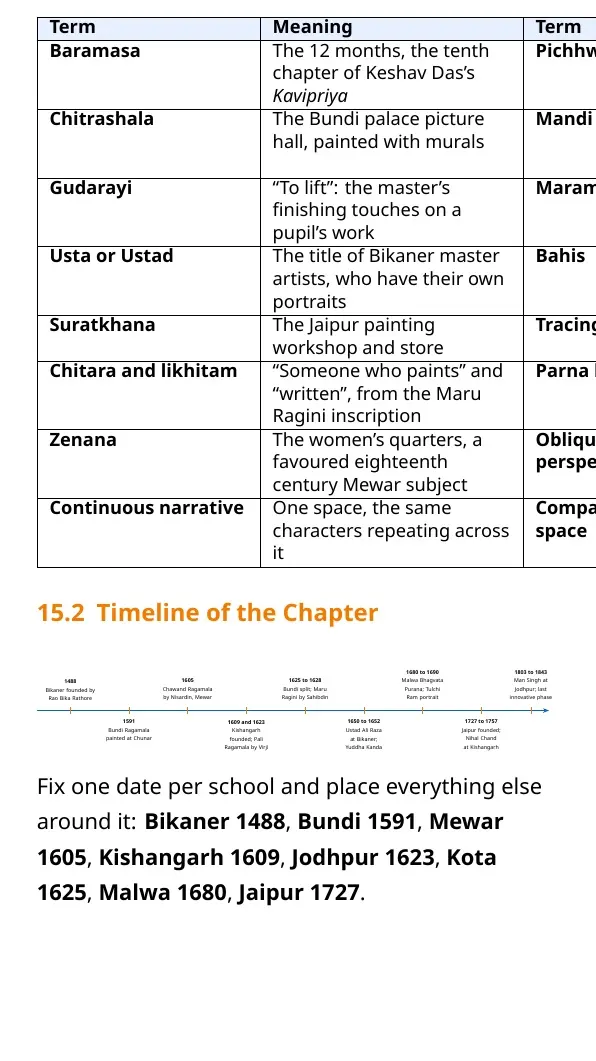
- The master did occasionally add finishing touches, and the term for that was gudarayi, which literally means to lift.
- Studios also handled marammat, meaning repair, and made nakals, meaning copies, of older works.
- The custom of having portraits of artists is unique to the Bikaner School, and most are inscribed with details of ancestry. These artists are called Ustas or Ustad.
Accounts from the Bahis, the royal archival day-to-day diaries, together with the many inscriptions on the paintings, make Bikaner one of the best documented schools of painting. Inscriptions in Marwari, and occasionally in Persian, give artists' names and dates, and sometimes even the place of production and the occasion the work was commissioned for.
Kishangarh School of Painting: Nihal Chand, Sawant Singh and the Bani Thani Face
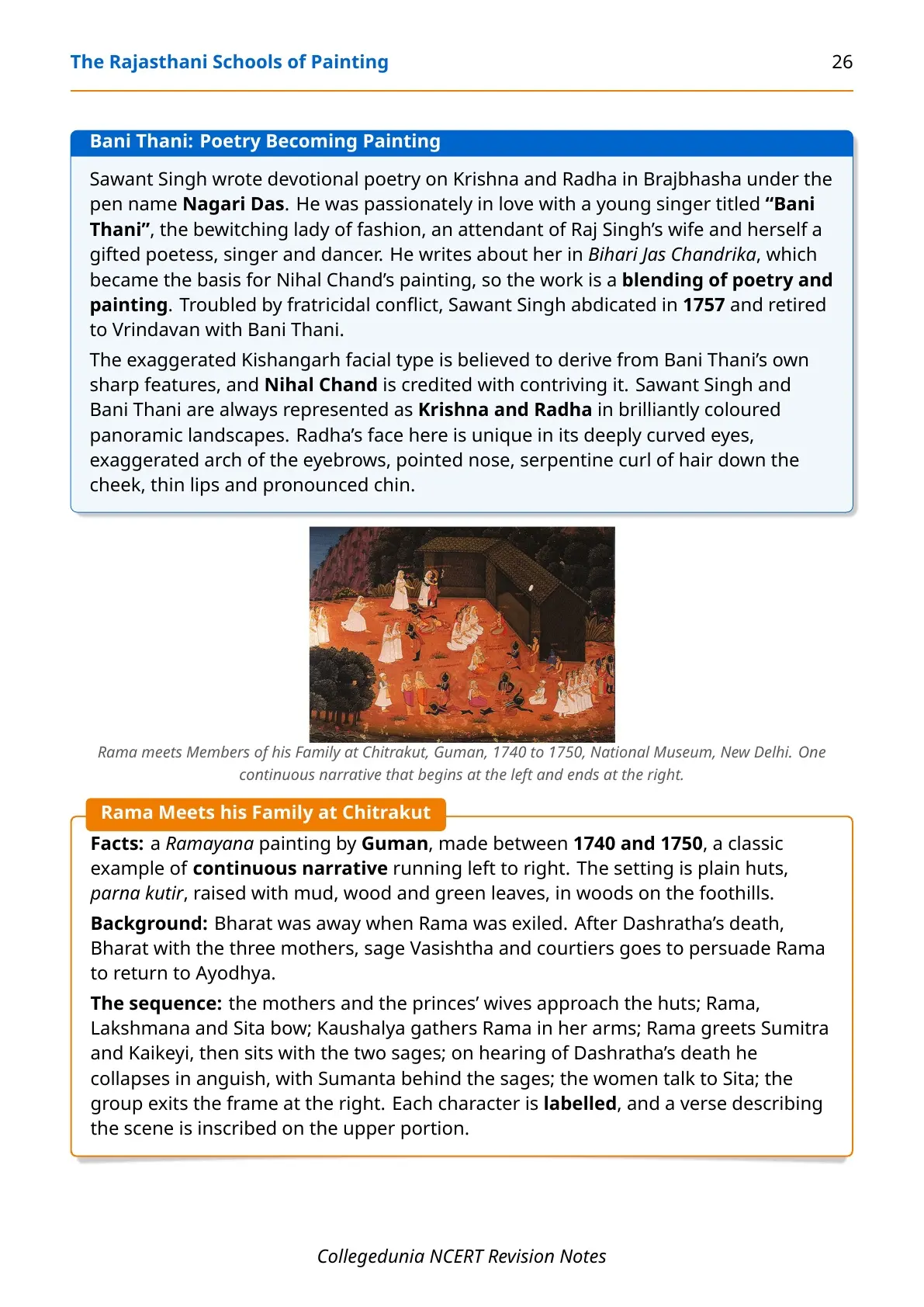
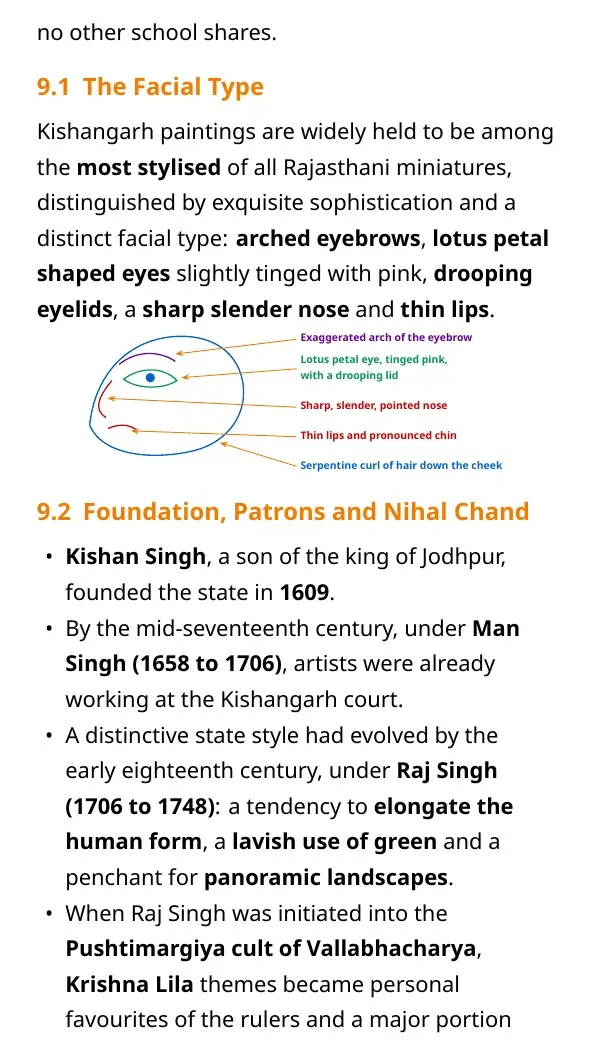
Kishangarh is widely held to be among the most stylised of all Rajasthani miniatures. It is known for exquisite sophistication and for a facial type you must be able to describe feature by feature.
- Arched eyebrows.
- Lotus petal shaped eyes, slightly tinged with pink, with drooping eyelids.
- A sharp slender nose.
- Thin lips.
Kishan Singh, one of the sons of the king of Jodhpur, founded the state of Kishangarh in 1609. Artists were already working in the court by the mid-seventeenth century under the patronage of Man Singh (1658 to 1706). The distinctive state style had evolved by the early eighteenth century, during the reign of Raj Singh (1706 to 1748), with three marks: a general tendency to elongate the human form, a lavish use of green, and a penchant for panoramic landscapes. Raj Singh was initiated into the Pushtimargiya cult of Vallabhacharya, and Krishna Lila themes then became personal favourites of the rulers and filled a major part of their court art.
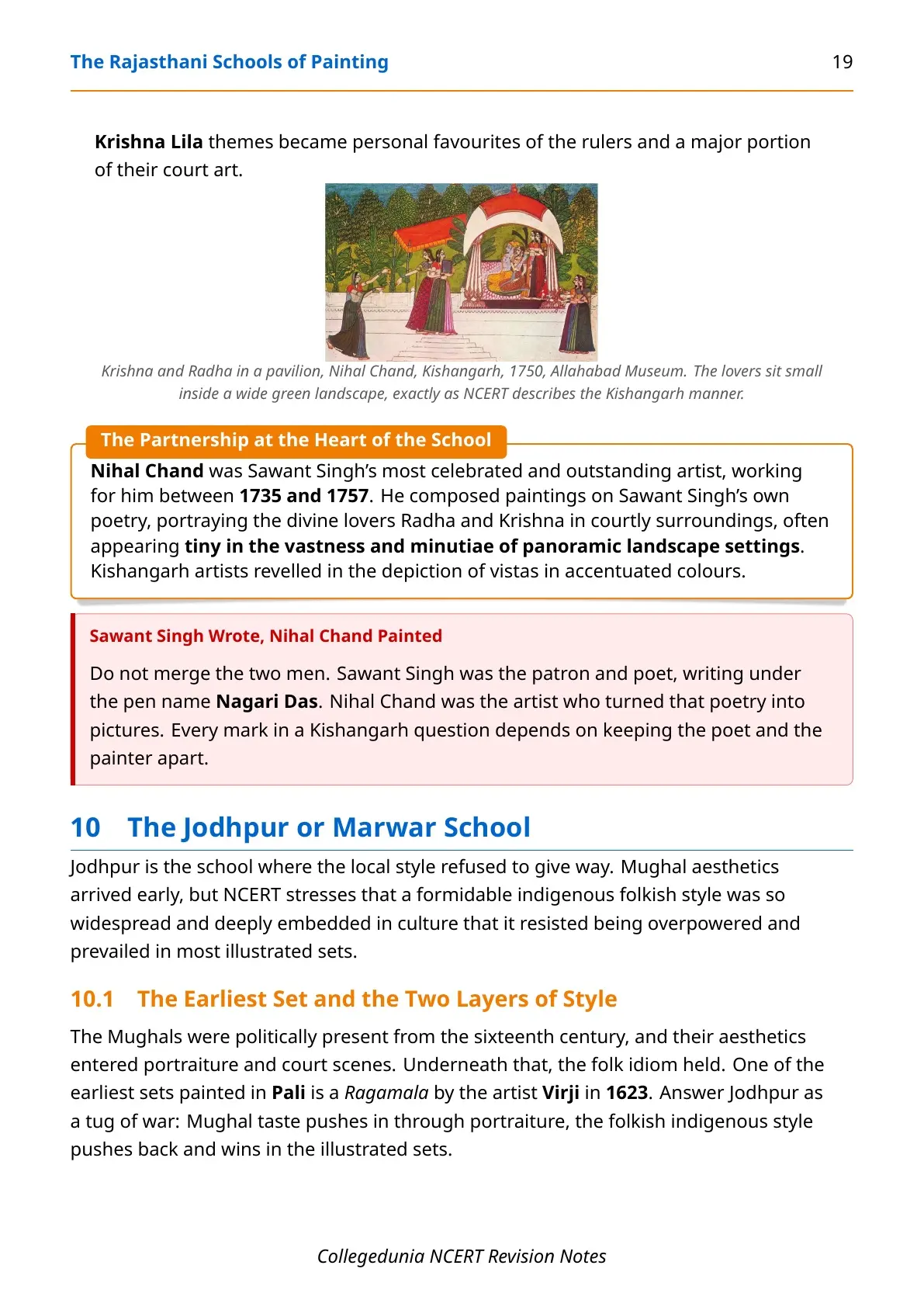
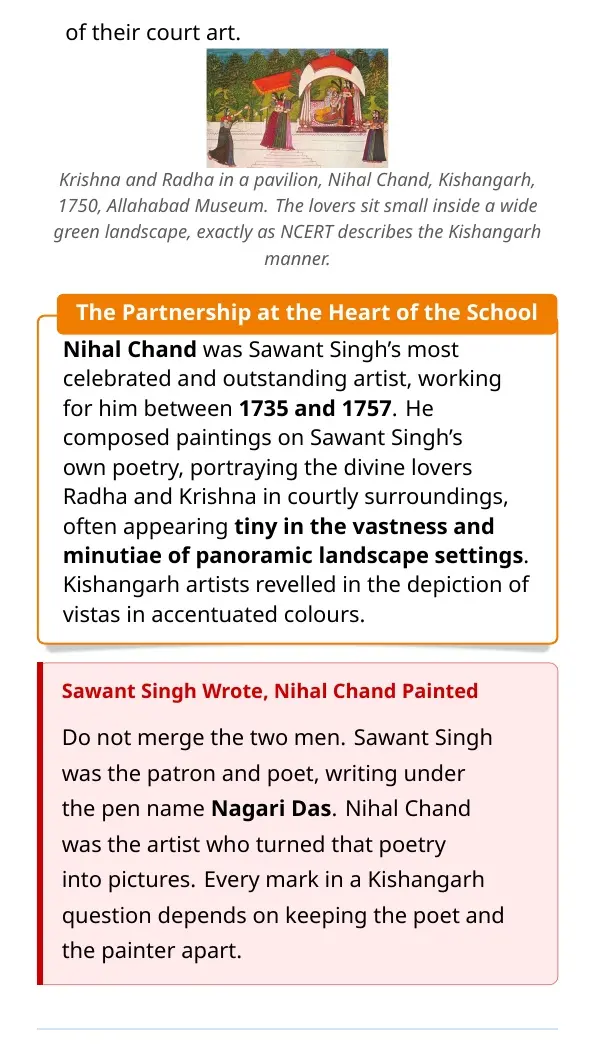
Nihal Chand was the most celebrated and outstanding artist of Sawant Singh. He worked for Sawant Singh between 1735 and 1757, composing paintings on Sawant Singh's own poetry. His subject is the divine lovers Radha and Krishna in courtly surroundings, often appearing tiny inside the vastness and minutiae of panoramic landscape settings. Kishangarh artists reveled in vistas painted in accentuated colours. The chapter's plate is Krishna and Radha in a pavilion, Nihal Chand, Kishangarh, 1750, in the Allahabad Museum.
The Bani Thani story is the most asked part of this school, so write it as a linked sequence.
- Sawant Singh wrote devotional poetry on Krishna and Radha in Brajbhasha under the pen name Nagari Das.
- He is said to have been passionately in love with a young singer given the title Bani Thani, the bewitching lady of fashion, for her unmatched beauty and elegance.
- She was an attendant of Raj Singh's wife, and a gifted poetess, singer and dancer.
- She was his muse. He writes about her in the poem Bihari Jas Chandrika, which became the basis for Nihal Chand's painting of Bani Thani, so the work is a blending of poetry and painting.
- Troubled by fratricidal conflict, Sawant Singh abdicated the throne in 1757 and retired to Vrindavan with Bani Thani.
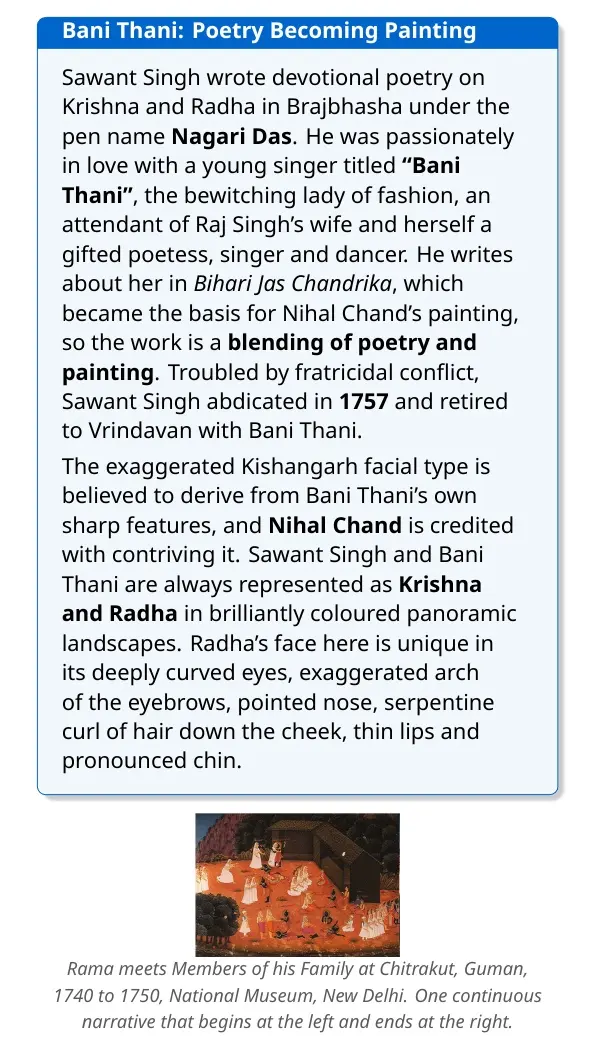
The exaggerated Kishangarh facial type is believed to be derived from the sharp features of Bani Thani herself. Nihal Chand is credited with contriving that physiognomy, and Sawant Singh and Bani Thani are always shown as Krishna and Radha in brilliantly coloured panoramic landscapes. Radha's face in Bani Thani as Radha is unique for its deeply curved eyes, the exaggerated arch of the eyebrows, a pointed nose, a serpentine curl of hair spiralling down the cheek, thin lips and a pronounced chin. The painting is in the National Museum, New Delhi.
Jodhpur or Marwar School of Painting: the Folkish Style That Refused to Be Overpowered
Jodhpur is the school where the local idiom holds its ground. Mughals had been politically present since the sixteenth century, and their visual sense entered the style of portraiture and the depiction of court scenes. The indigenous folkish style was so widespread and so deeply embedded in the culture that it resisted being overpowered and survived in most illustrated sets.
| Jodhpur patron or artist | Dates | What to remember |
|---|---|---|
| Virji | 1623 | Painted a Ragamala set at Pali, one of the earliest sets of the region |
| Maharaja Jaswant Singh | 1638 to 1678 | Ushered in a productive period. A trend for documentary painting through portraiture and court life started around 1640. He followed the Vallabha cult of Shrinathji and patronised Krishna themes, with the Bhagvata Purana most prominent |
| Ajit Singh | 1679 to 1724 | Became king after 25 years of war with Aurangzeb, fought by Veer Durgadas Rathore, who recaptured Marwar. Durgadas was celebrated in poems and court paintings, and his equestrian portraits became popular |
| Man Singh | 1803 to 1843 | The last innovative phase. Sets painted in his time are the Ramayana (1804), Dhola-Maru, Panchatantra (1804) and Shiva Purana. A follower of the Nath Sampradaya, he is shown with Nath gurus, and a Nath Charita set was painted in 1824 |
The Ramayana set of 1804 gives you a strong one line judgement for any long answer. The artist used his knowledge of Jodhpur to depict Rama's Ayodhya, so we get an idea of the bazaars, lanes and gateways of Jodhpur of that time. The chapter says this is true of every school: local architecture, costume and cultural details get woven into the stories of Krishna and Rama.
One warning belongs in this section. The documentary trend started under Jaswant Singh, and it stayed prominent until the arrival of photography in the nineteenth century replaced painting for recording events. Even so, inscriptions behind Marwar paintings tell us little until the nineteenth century. Dates are seldom inscribed, and the names of artists and the place of painting appear even more rarely. That is the exact opposite of Bikaner, and the contrast makes a neat two mark answer.
Jaipur School of Painting: Amer, the Suratkhana and Sawai Pratap Singh's Fifty Artists
The Jaipur School began in the former capital Amer, which was the nearest of all the large Rajput states to the Mughal capitals of Agra and Delhi. Its rulers kept cordial relations with the Mughal emperors, who strongly influenced the aesthetics at Amer.
- Raja Bharmal (1548 to 1575) married his daughter to Akbar.
- His son Bhagwant Das (1575 to 1592) was a close friend of Akbar.
- Bhagwant Das's son Man Singh was Akbar's most trusted general.
Sawai Jai Singh (1699 to 1743) is the ruler who turns Jaipur into a well-defined independent school. He founded the new capital city of Jaipur in 1727 and shifted from Amer. Court records show that some Mughal painters were brought from Delhi into his atelier. He invited eminent craftsmen and other artists to settle in Jaipur and reorganised the Suratkhana, the place where paintings were made and stored.
- He was drawn to the Vaishnavite sect and commissioned many paintings on the theme of Radha and Krishna.
- Artists of his reign painted sets based on Rasikapriya, Gita Govinda, Baramasa and Ragamala, in which the hero's figure strikingly resembles the king himself.
- Portrait painting was popular, and Sahibram was the accomplished portrait painter of his atelier. Muhammad Shah was another artist.
| Jaipur ruler | Dates | What he commissioned |
|---|---|---|
| Sawai Jai Singh | 1699 to 1743 | Founded Jaipur in 1727, reorganised the Suratkhana, commissioned Radha and Krishna themes and portraits |
| Sawai Ishwari Singh | 1743 to 1750 | Religious and literary texts, plus his leisure pursuits: elephant rides, boar and tiger hunts, elephant fights |
| Sawai Madho Singh | 1750 to 1767 | Incidents of his court life recorded in painting |
| Sawai Pratap Singh | 1779 to 1803 | The second thriving period. He employed around 50 artists and renewed Gita Govinda, Ragamala and Bhagvata Purana themes |
Pratap Singh matters for one reason above all. It was only in the eighteenth century, under his aspiration, that the predominant Mughal influence receded and a Jaipur style with reformulated aesthetics emerged, a blend of Mughal and indigenous features. He was a scholar, a poet, a prolific writer and an ardent follower of Krishna, and his court produced royal portraits and scenes of courtly pomp alongside the literary and religious sets.
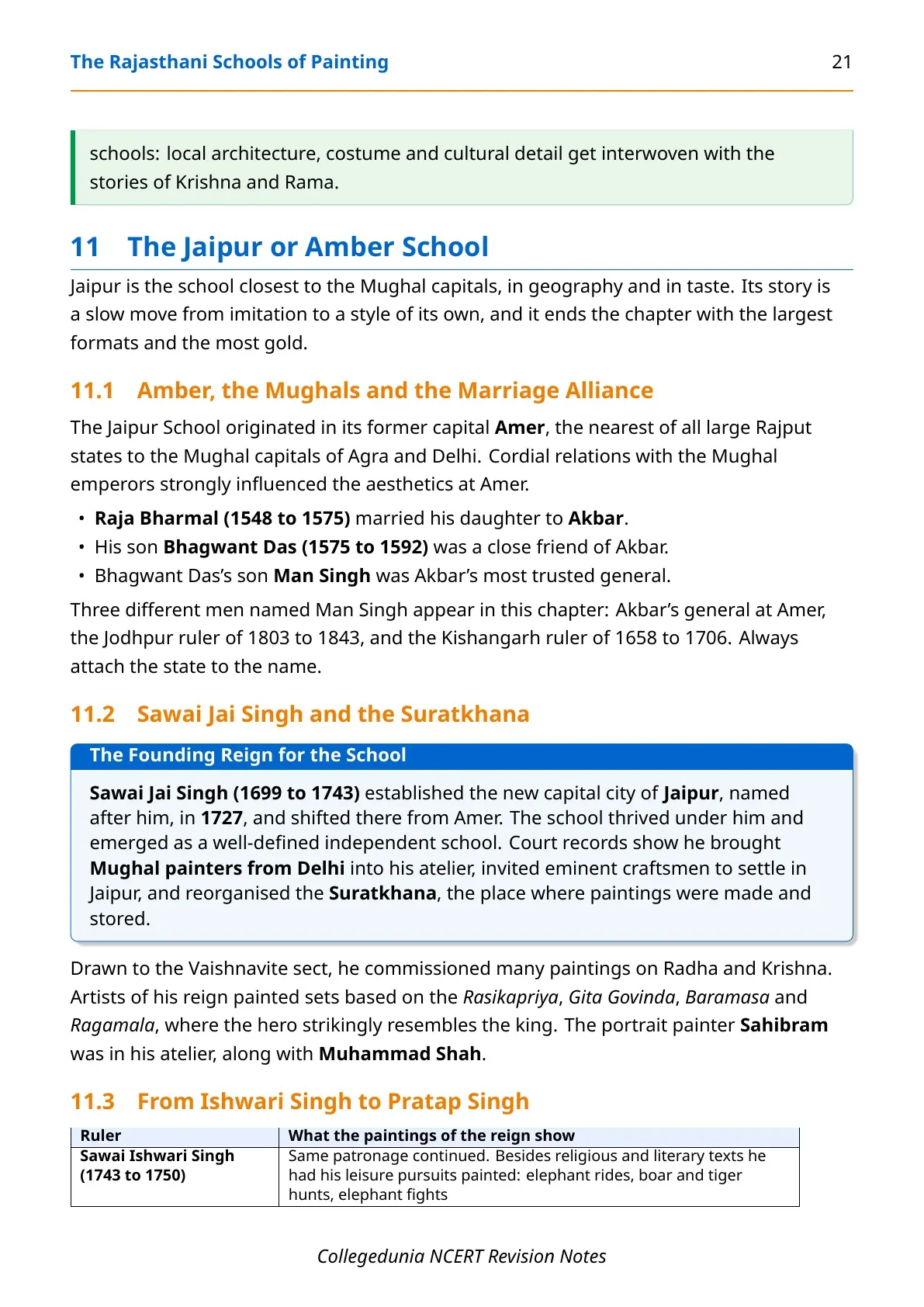
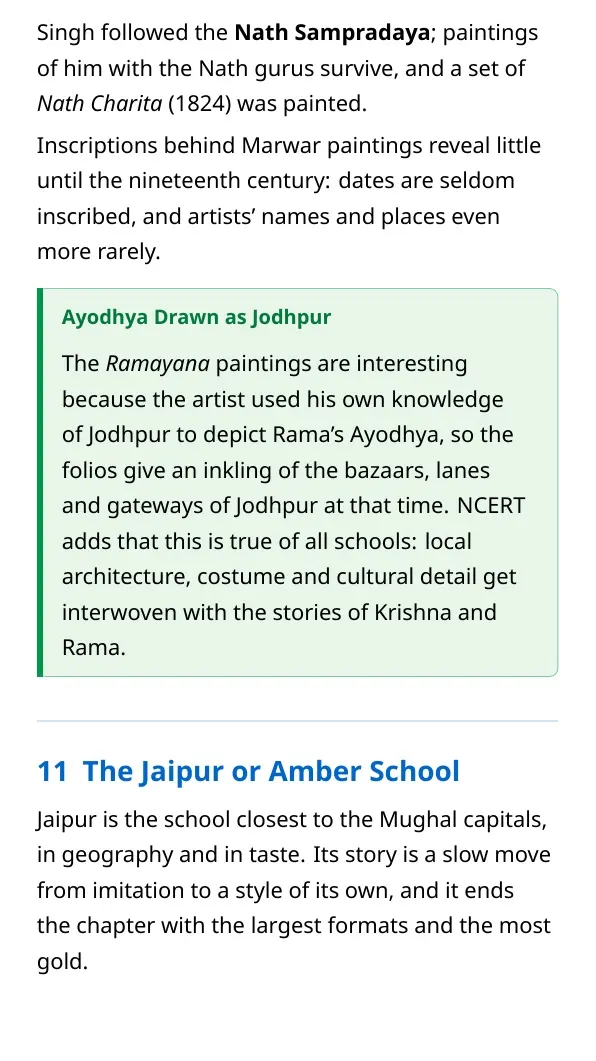
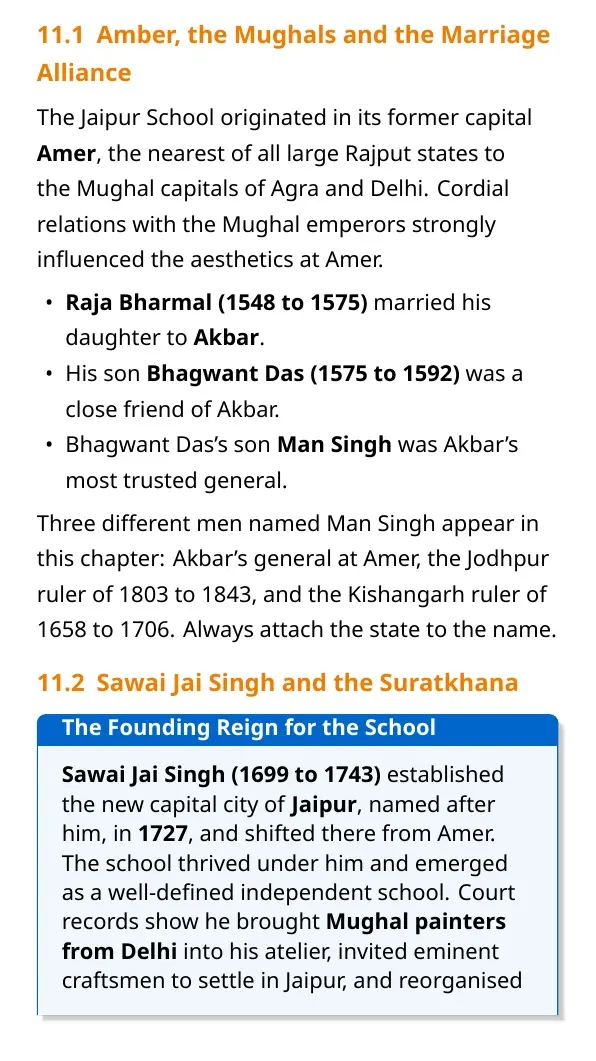
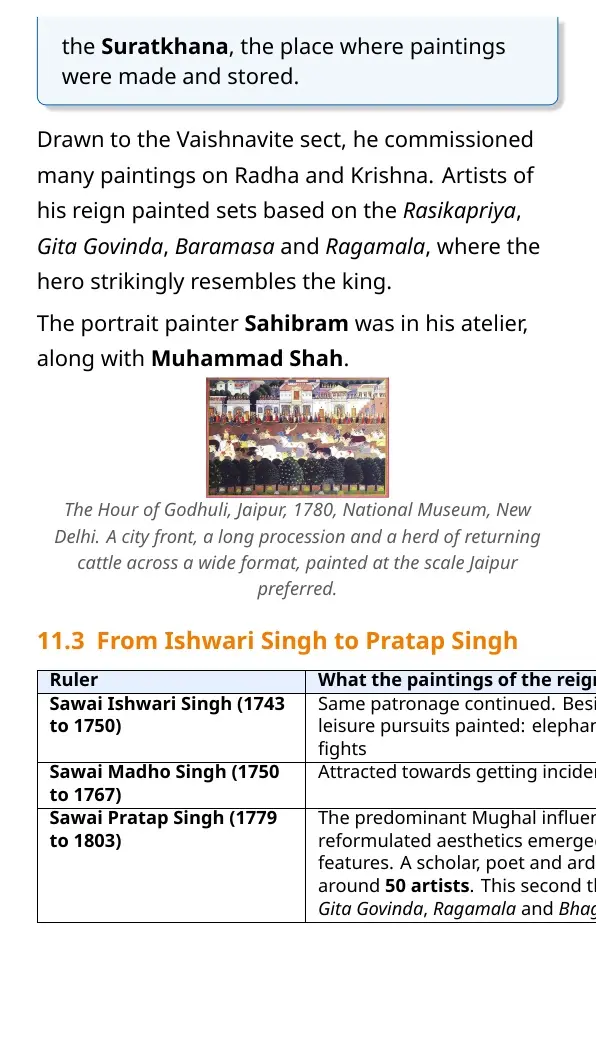
Three closing facts finish the school. As elsewhere, many copies were produced by tracing and pouncing. By the early nineteenth century there was a lavish use of gold. And Jaipur preferred large size formats and produced life-size portraits, which is the quickest way to separate a Jaipur work from a small Kishangarh folio. The chapter's plate is The Hour of Godhuli, Jaipur, 1780, in the National Museum, New Delhi.
Malwa School of Painting: the Central Indian School With No Fixed Centre
Malwa is the odd one out, and the paper likes odd ones out. The school flourished between 1600 and 1700 CE and is described as the most representative of the Hindu Rajput courts.
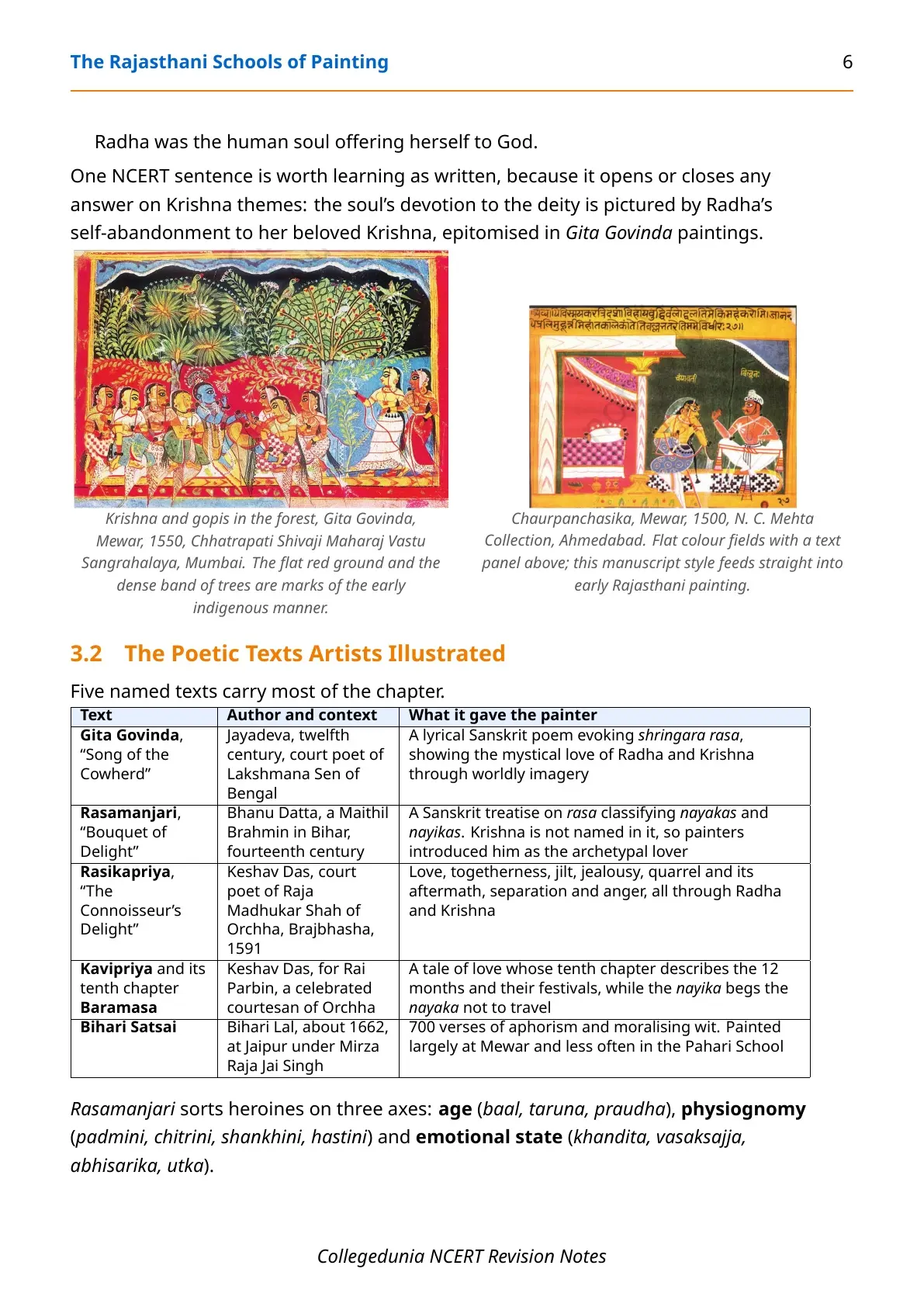
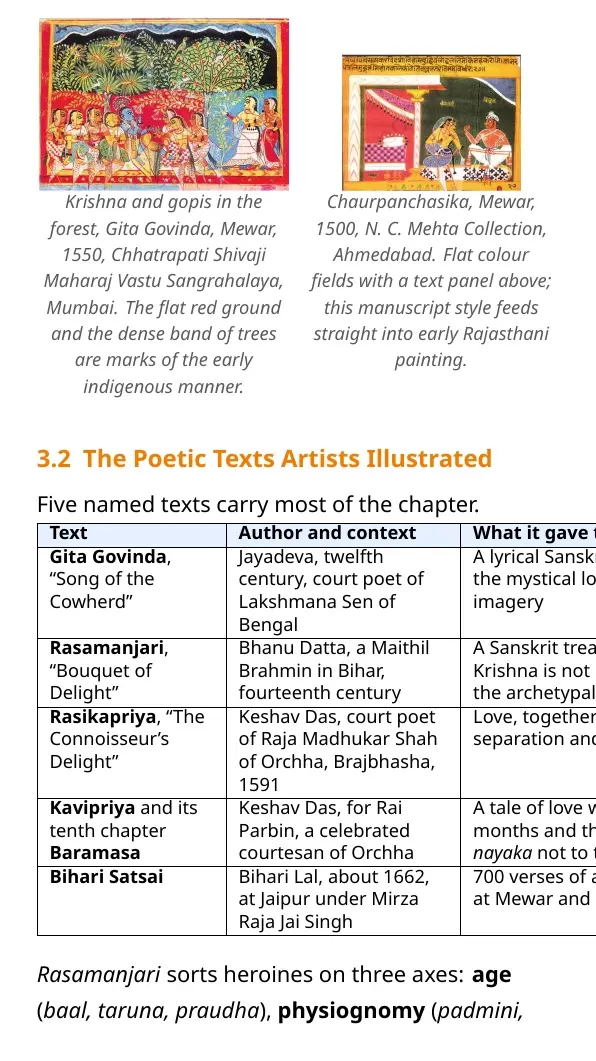
Its two-dimensional simplistic language reads as a consummation of stylistic progression from the Jain manuscripts to the Chaurpanchashika manuscript paintings. That single sentence also answers exercise question 1 about how the Western Indian manuscript tradition guided later miniature painting in Rajasthan, and the chapter reproduces a Chaurpanchasika folio of Mewar, 1500, from the N. C. Mehta Collection, Ahmedabad, Gujarat.
- Unlike the other Rajasthani schools, which sit in precise kingdoms and courts, Malwa defies a precise centre for its origin.
- It suggests instead a vast territory of Central India, with sporadic mention of a few places: Mandu, Nusratgarh and Narsyang Sahar.
- Among the few early dated sets are an illustrated Amaru Shataka dated 1652 CE and a Ragamala by Madho Das in 1680 CE.
- A large number of Malwa paintings from the Datia Palace collection support a claim for Bundelkhand as the region of painting.
The Datia evidence cuts both ways, and the chapter says so plainly. The mural paintings in the Datia Palace of Bundelkhand defy an obvious Mughal influence, which is contrary to the works on paper that lean towards indigenous two-dimensional austerity. A complete absence of any mention of patron kings, and the absence of portraits, supports the view that these paintings were bought by the Datia rulers from travelling artists. Those artists carried paintings on popular themes such as the Ramayana, Bhagvata Purana, Amaru Shataka, Rasikapriya, Ragamala and Baramasa.
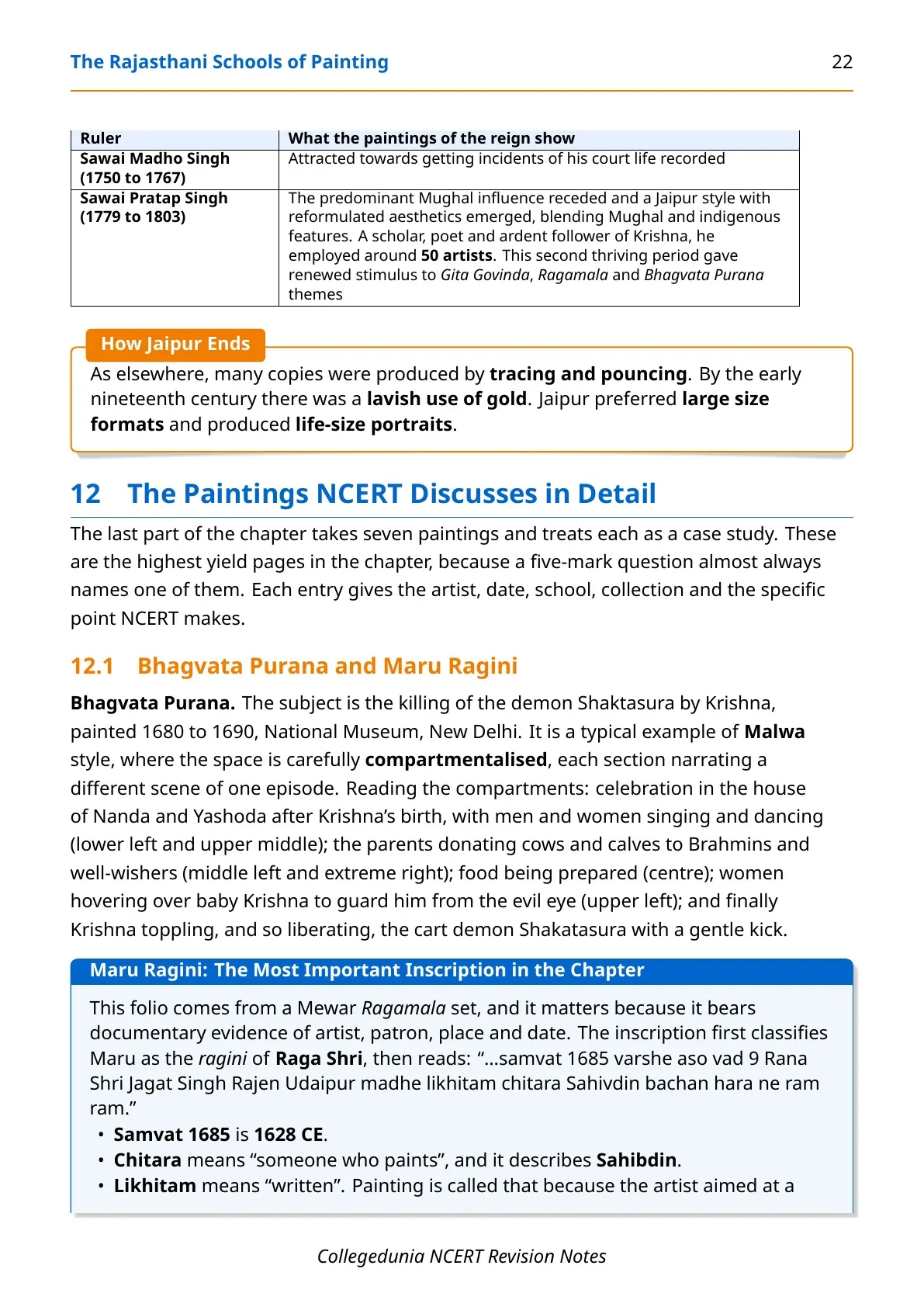
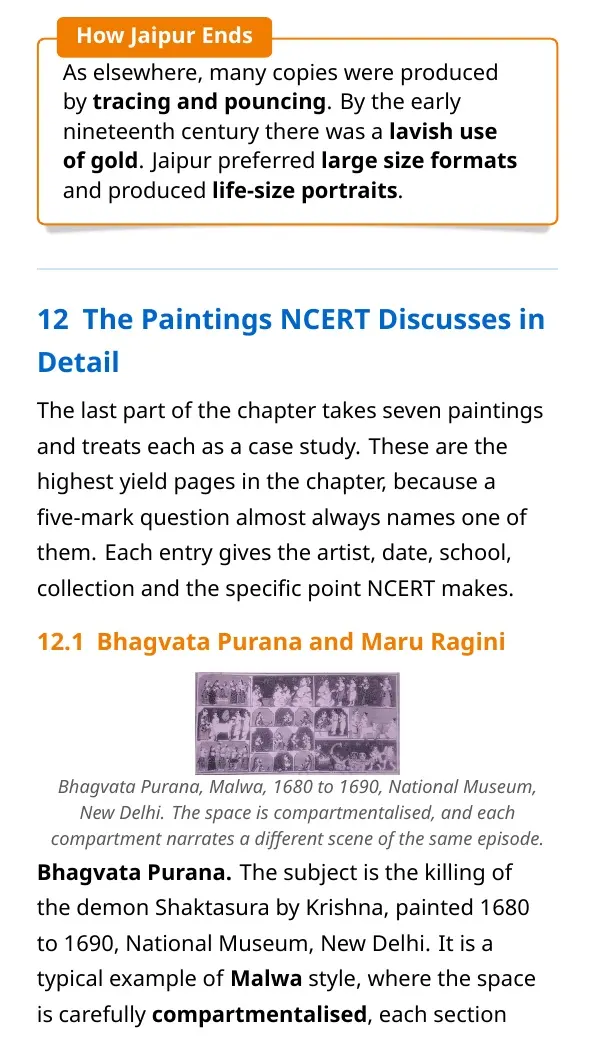
The chapter's Malwa plates are Raga Megha by Madho Das, Malwa, 1680, in the National Museum, New Delhi, and a Bhagvata Purana folio of 1680 to 1690 in the same museum. The Bhagvata Purana folio is called a typical example of Malwa style because the space is carefully compartmentalised, with each section narrating a different scene of one episode.
The Eight Rajasthani Sub-Schools Compared in One Table for Exercise Question 2
Exercise question 2 asks you to describe the different schools of Rajasthani painting and give examples to support their characteristics. Revise from this table, then write it out as eight short paragraphs in the exam.
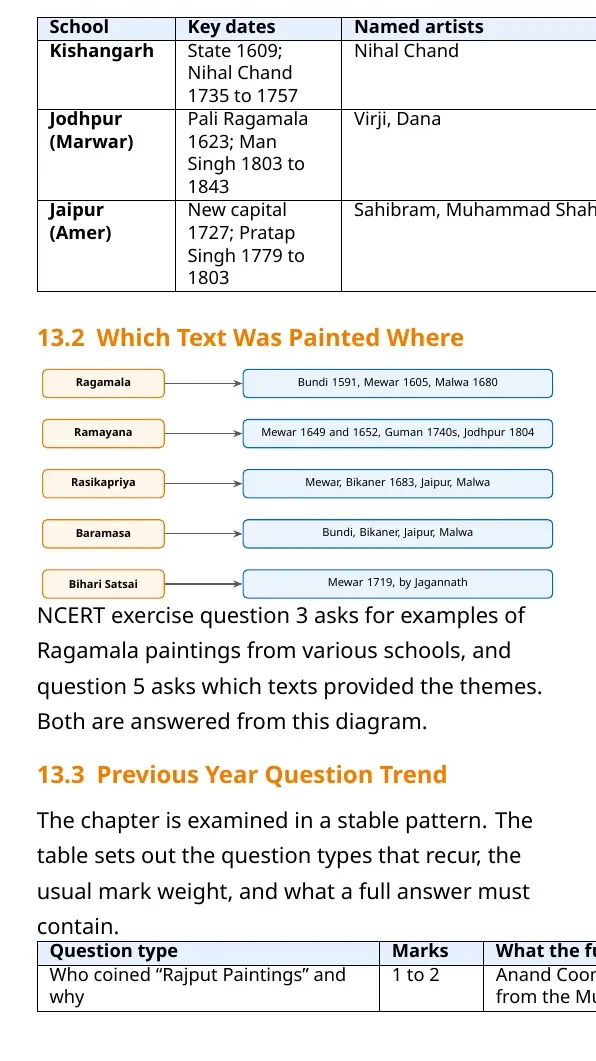
| School | Key dates and patrons | Distinguishing pictorial trait | Example to quote |
|---|---|---|---|
| Mewar | Chawand 1605; Jagat Singh I, 1628 to 1652; Jagat Singh II, 1734 to 1752 | Bright palette with prominent reds and yellows; oblique aerial perspective; several episodes layered into one folio | Yuddha Kanda of Ramayana, Sahibdin, 1652, India Office Library, London |
| Bundi | Bhoj Singh, 1585 to 1607; Chattar Sal; Bhao Singh; Umed Singh, 1749 to 1771 | Unblemished colour sense, excellent formal design, lush vegetation, petite women with a pinched waist | Raga Dipak, Chunar Ragamala, Bharat Kala Bhavan, Varanasi |
| Kota | Split from Bundi in 1625; Jagat Singh, 1658 to 1683; Umed Singh, 1770 to 1819 | Spontaneous and calligraphic execution, marked shading, the double-lid eye, animals and combat, landscape as the real subject | Maharaja Ram Singh I hunting lions at Mukundgarh, 1695, Colnaghi Gallery, London |
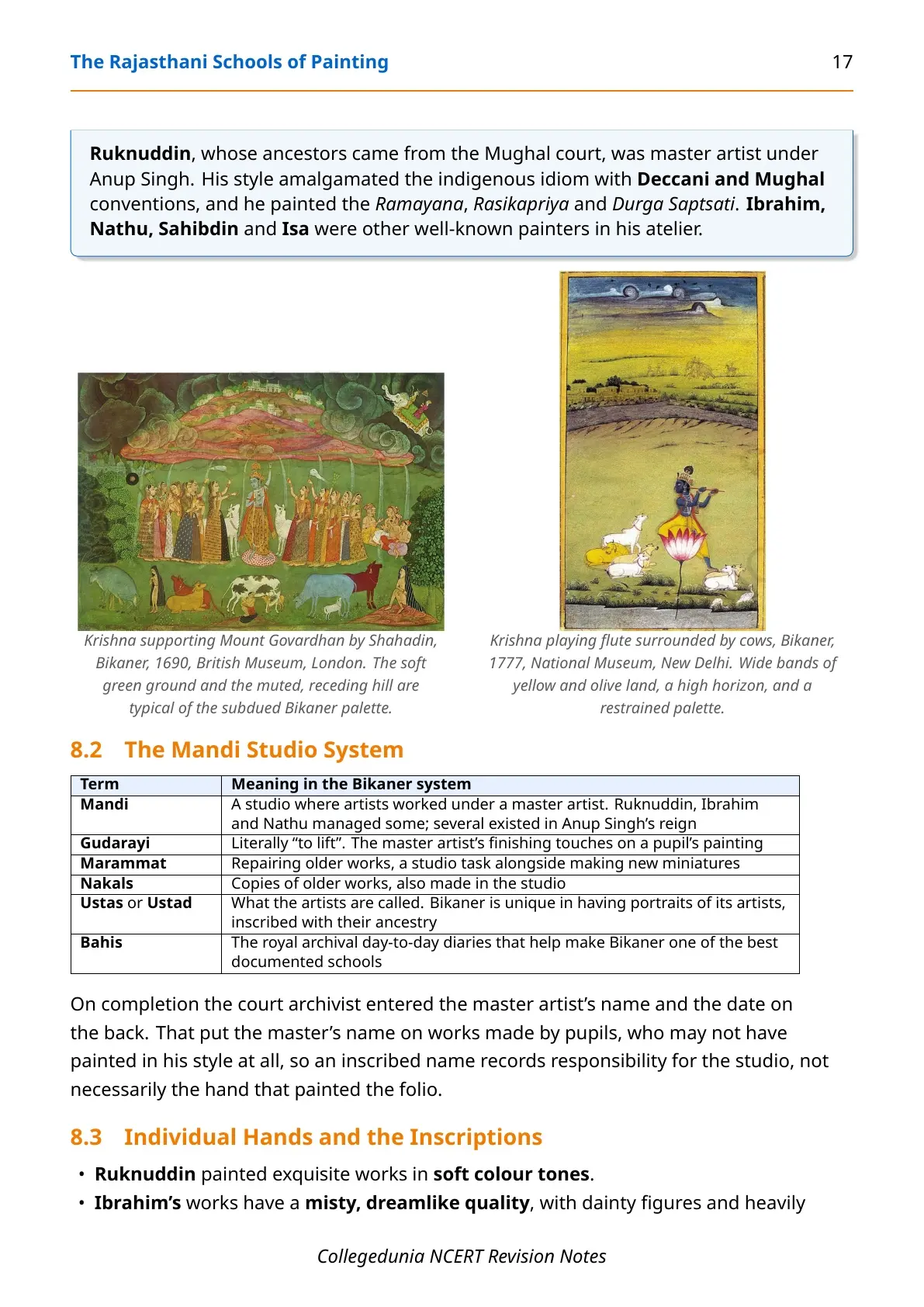
| Bikaner | Founded 1488; Karan Singh; Anup Singh, 1669 to 1698 | Mughal elegance with a subdued palette; the best documented school; Mandi studios and artist portraits | Krishna supporting Mount Govardhan, Shahadin, 1690, British Museum, London |
| Kishangarh | Founded 1609; Raj Singh, 1706 to 1748; Sawant Singh with Nihal Chand, 1735 to 1757 | The most stylised faces, elongated human form, lavish green, tiny figures in panoramic landscapes | Bani Thani, Nihal Chand, National Museum, New Delhi |
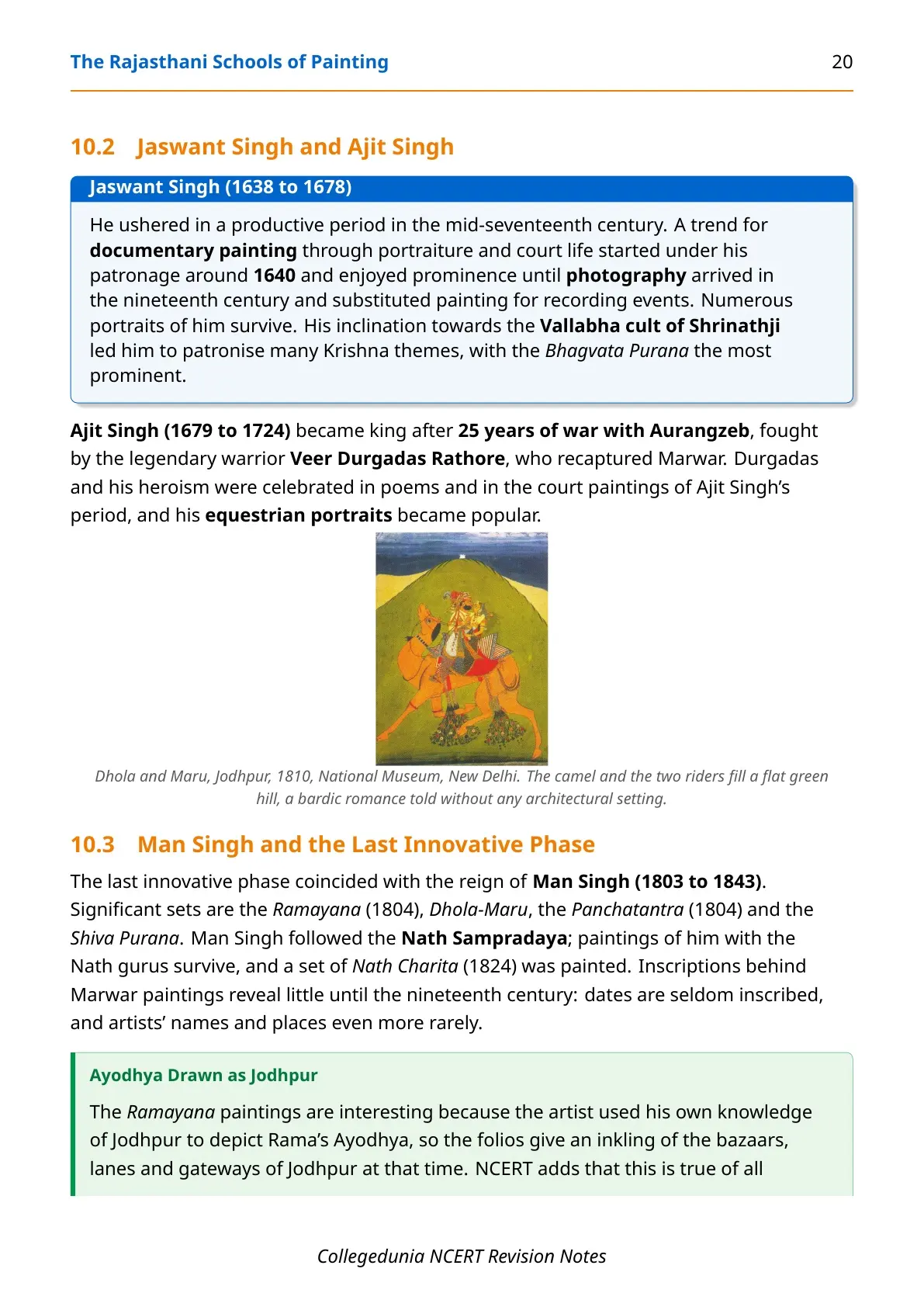
| Jodhpur (Marwar) | Virji at Pali, 1623; Jaswant Singh, 1638 to 1678; Man Singh, 1803 to 1843 | A persistent indigenous folkish style, documentary portraiture, local Jodhpur settings used for Ayodhya | Dhola and Maru, Jodhpur, 1810, National Museum, New Delhi |
| Jaipur | Amer origin; Sawai Jai Singh, 1699 to 1743; Sawai Pratap Singh, 1779 to 1803 | Strong early Mughal influence, then a blended style; large formats, life-size portraits, lavish gold | The Hour of Godhuli, Jaipur, 1780, National Museum, New Delhi |
| Malwa | 1600 to 1700 CE; no named patron kings | Two-dimensional austerity, compartmentalised space, no portraits, no patron names | Raga Megha, Madho Das, 1680, National Museum, New Delhi |
Rajasthani, Mughal and Deccani Painting Compared for the 5 Mark Answer
A comparison question can pull in the two schools you studied before this one. Keep the answer to points that the NCERT text itself supports, and close with one judgement line.
| Point of comparison | Rajasthani | Mughal | Deccani |
|---|---|---|---|
| Where it grew | Princely kingdoms and thikanas of Rajasthan and parts of Madhya Pradesh | The courts of Delhi, Agra, Fatehpur Sikri and Lahore | Ahmednagar, Bijapur, Golconda and Hyderabad |
| When it rose | Late sixteenth and early seventeenth century | Dominant from the sixteenth century | From the sixteenth century |
| Patron | Many small Rajput courts, each with its own taste | One imperial family and its atelier | The Deccan Sultans |
| Subjects | Bhakti texts, Ragamala, Baramasa, bardic romances, darbar and hunt | Court records, portraits, epics, flora and fauna | Ragamala, yoginis, sultans and Sufi themes |
| Handling of space | Often flat and two-dimensional, compartmentalised or oblique aerial | Ordered space with figures placed by rank | Dense composition, symmetrical architecture in flat registers |
| Colour | Ranges from brilliant Mewar reds and yellows to the subdued Bikaner palette | Controlled naturalistic colour | Intense colour with free use of gold |
| Record of artists | Excellent at Bikaner through Bahis and inscriptions, poor at Marwar until the nineteenth century | Named artists throughout the imperial atelier | Few named artists |
- Safe judgement line one: Mughal contact changed each Rajasthani school by a different amount. Bikaner and Jaipur absorbed the most, Jodhpur and Malwa the least.
- Safe judgement line two: the Rajasthani schools were separated by short distances yet remained significantly diverse, which is why one label such as Rajput Painting no longer works.
- Safe judgement line three: Provincial Mughal Schools formed by mixing Mughal and local elements, so influence travelled in both directions.
Named Rajasthani Paintings You Must Be Able to Appreciate in the Board Answer
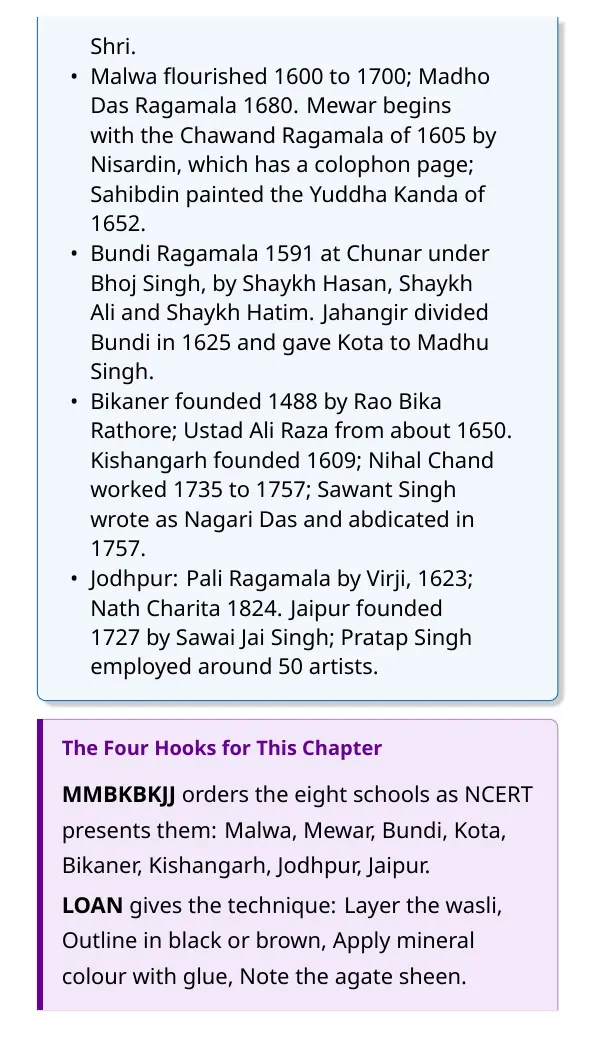
Appreciation carries the heaviest marks in Fine Arts theory. The safe answer names the school, the artist, the date and the collection, then gives the subject and two visual qualities. Build one card per plate and revise from the card.
| Painting | School, artist and date | Collection | What to write about it |
|---|---|---|---|
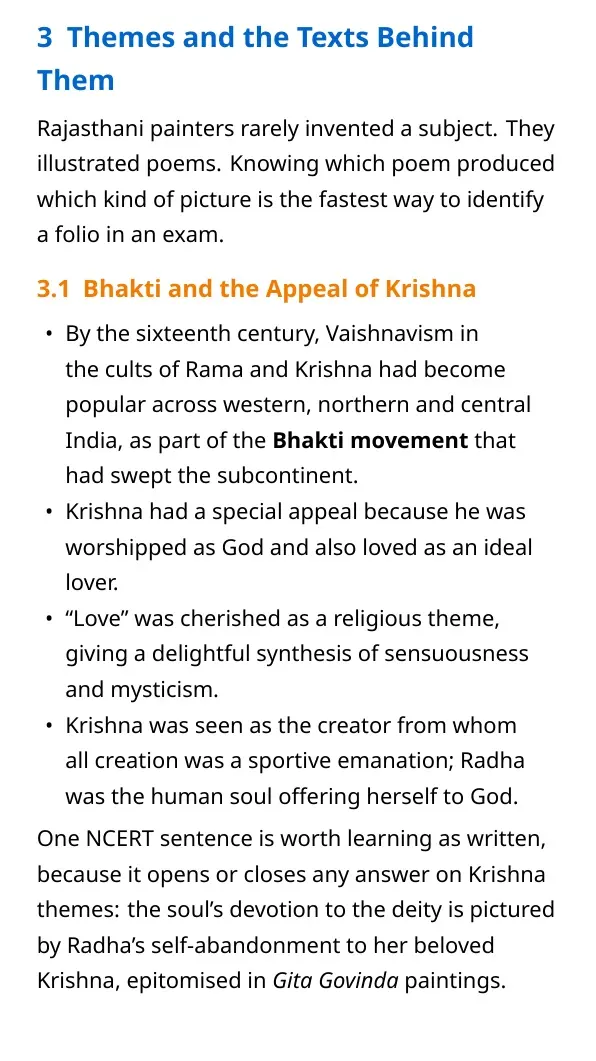
| Krishna and gopis in the forest, Gita Govinda | Mewar, 1550 | Chhatrapati Shivaji Maharaj Vastu Sangrahalaya, Mumbai | The chapter's opening image for the Bhakti theme of Radha and Krishna |
| Chaurpanchasika | Mewar, 1500 | N. C. Mehta Collection, Ahmedabad, Gujarat | The manuscript style that Malwa painting grows out of |
| Yuddha Kanda of Ramayana | Mewar, Sahibdin, 1652 | India Office Library, London | Oblique aerial perspective; several episodes layered into one folio; Indrajit's magic weapons |
| Maharana Jagat Singh II hawking | Mewar, 1744 | Metropolitan Museum of Art, New York | Oblique view with the horizon raised at a tangent; a panoramic view of limitless vision; narration aiming at reportage |
| Krishna as Shrinathji celebrating Sarad Purnima | Nathdwara, 1800 | National Museum, New Delhi | The pichhwai tradition of cloth backdrops painted for Shrinathji |
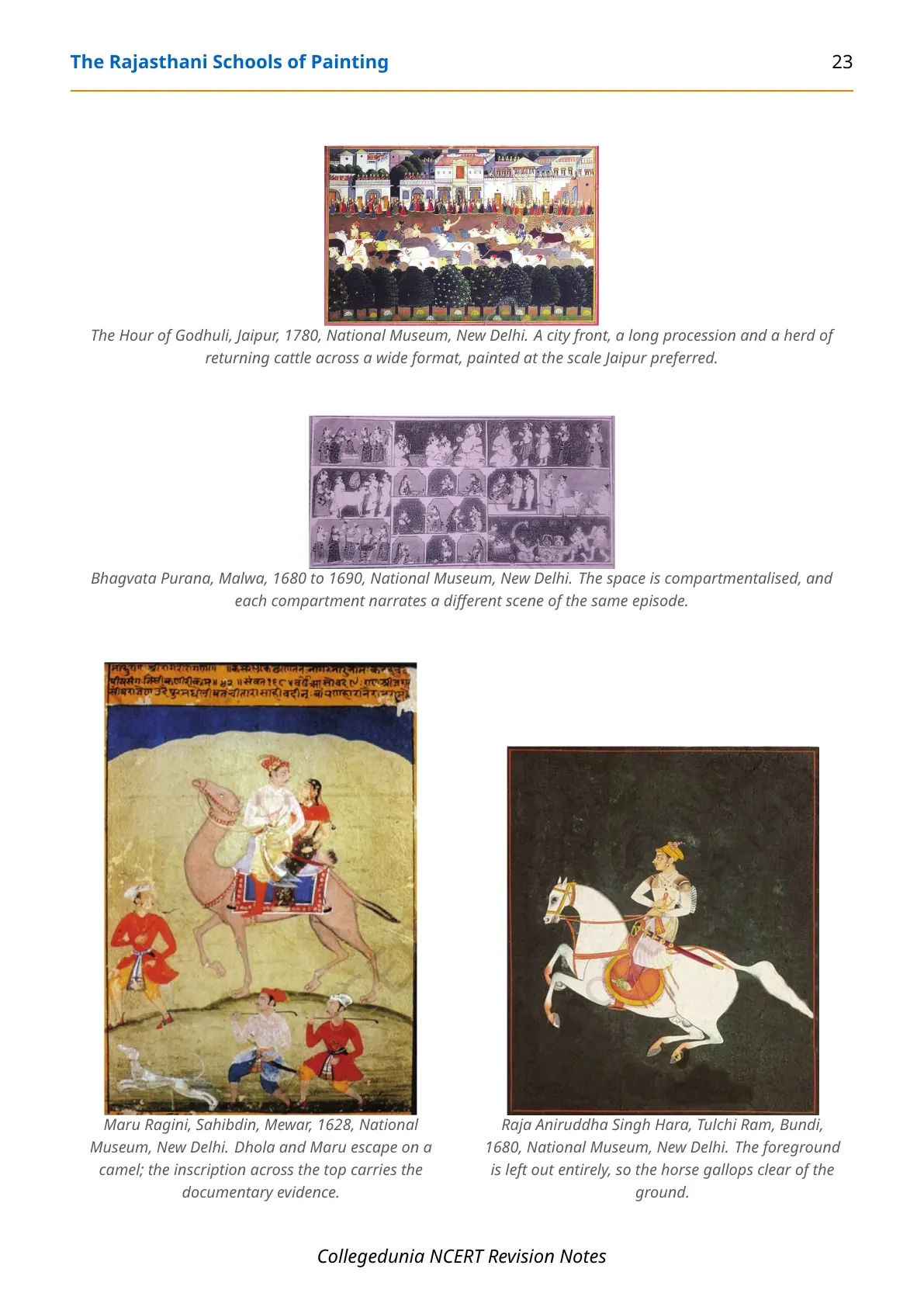
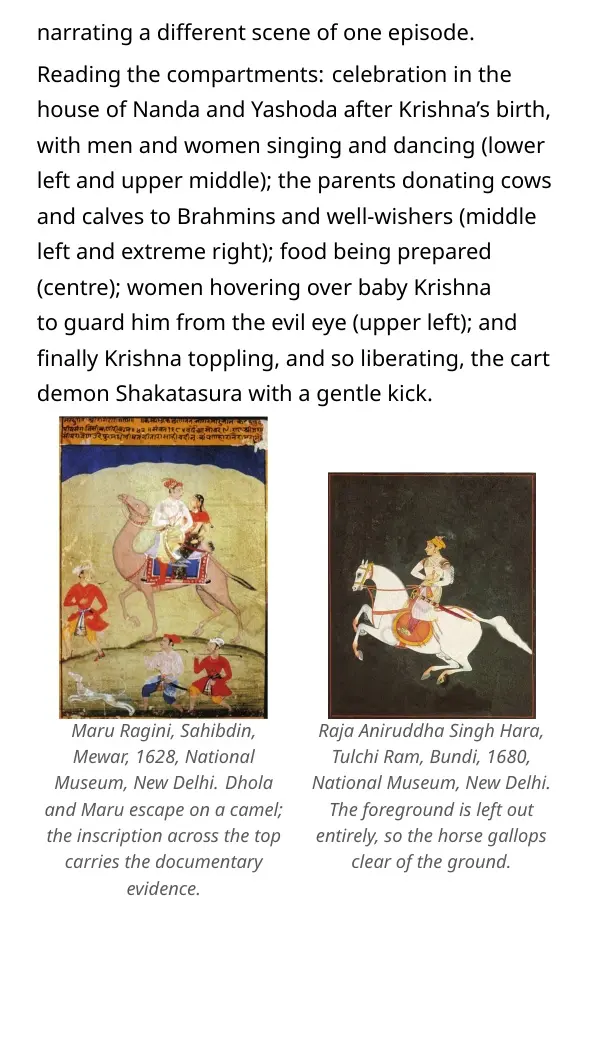
| Maru Ragini | Mewar, Sahibdin, Samvat 1685 which is 1628 CE | National Museum, New Delhi | The inscription naming artist, patron, place and date; Maru as consort of Raga Shri; Dhola and Maru escaping on a camel |
| Raga Dipak, Chunar Ragamala | Bundi, set dated 1591 | Bharat Kala Bhavan, Varanasi | Night setting, four lamps, human shaped lamp holders, a yellowing moon, and the empty verse panel |
| Ashwin, Baramasa | Bundi, seventeenth century | Chhatrapati Shivaji Maharaj Vastu Sangrahalaya, Mumbai | The Baramasa theme of the 12 months from the tenth chapter of Kavipriya |
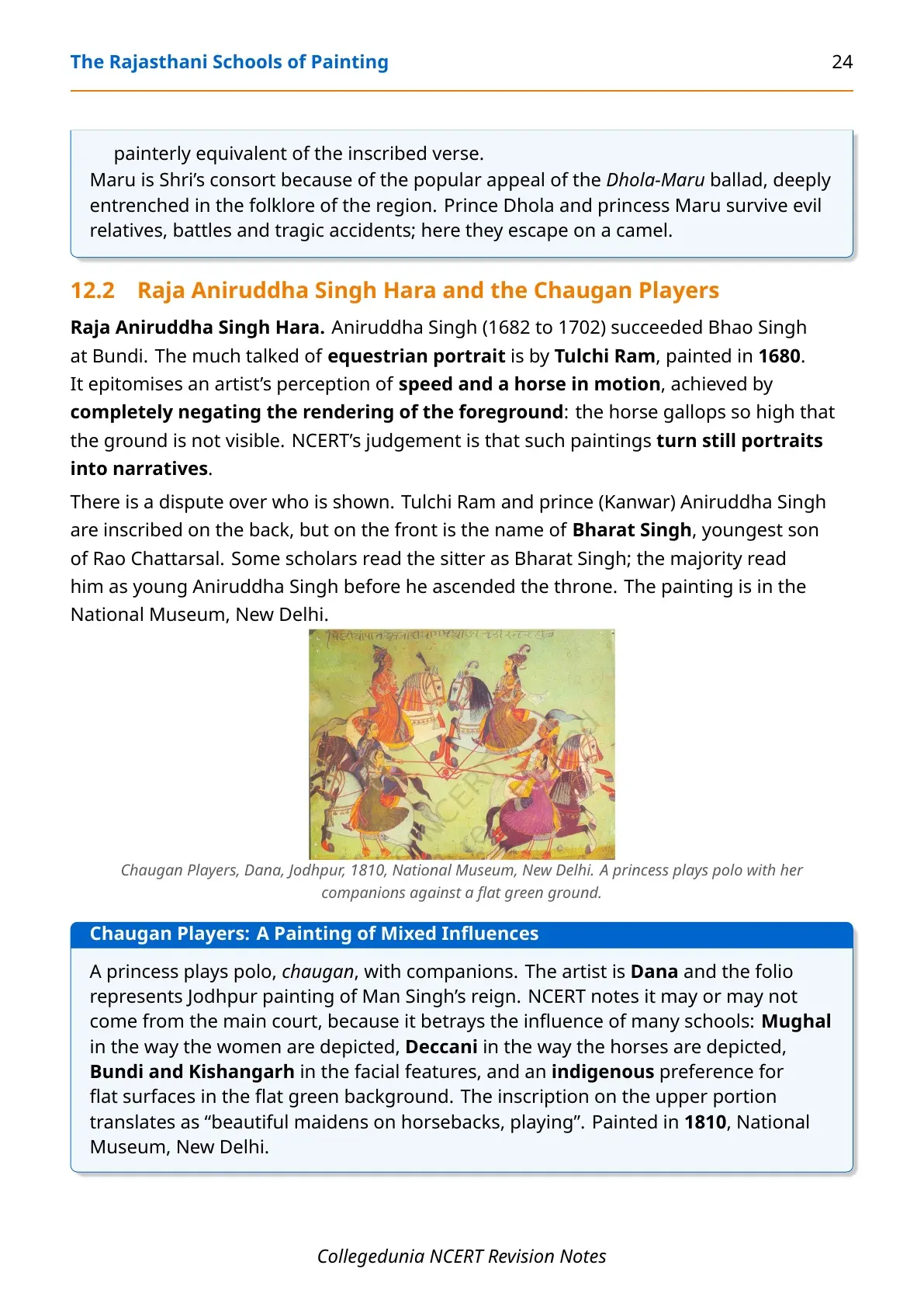
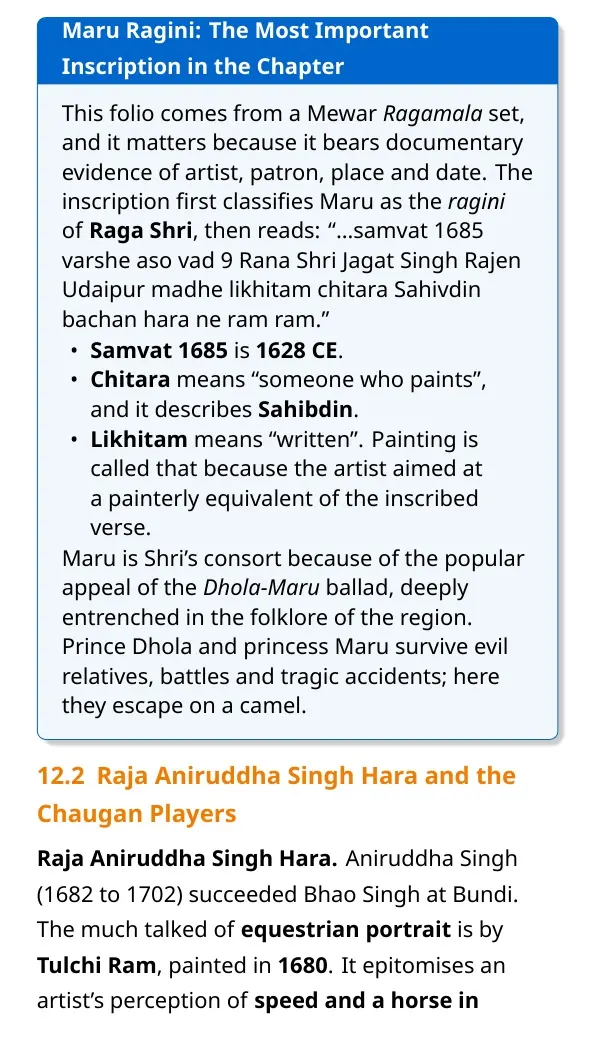
| Raja Aniruddha Singh Hara | Bundi, Tulchi Ram, 1680 | National Museum, New Delhi | An equestrian portrait built on speed; the foreground is completely negated so the ground is invisible |
| Maharaja Ram Singh I hunting lions at Mukundgarh | Kota, 1695 | Colnaghi Gallery, London | The Kota obsession with the chase; animals and combat rendered with calligraphic energy |
| Krishna supporting Mount Govardhan | Bikaner, Shahadin, 1690 | British Museum, London | Bikaner's soft tones and Mughal elegance on a Krishna Lila subject |
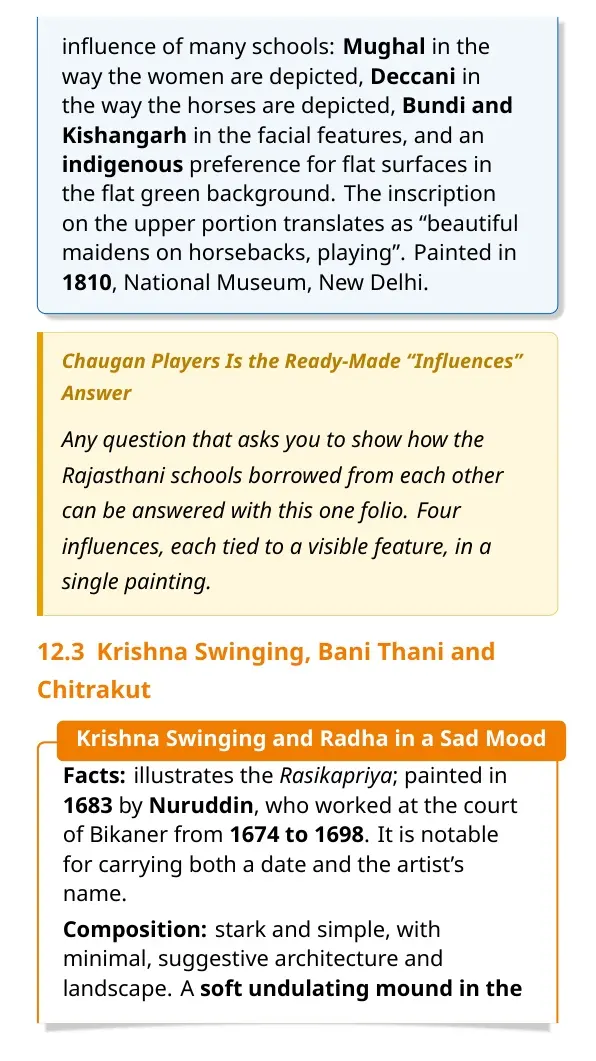
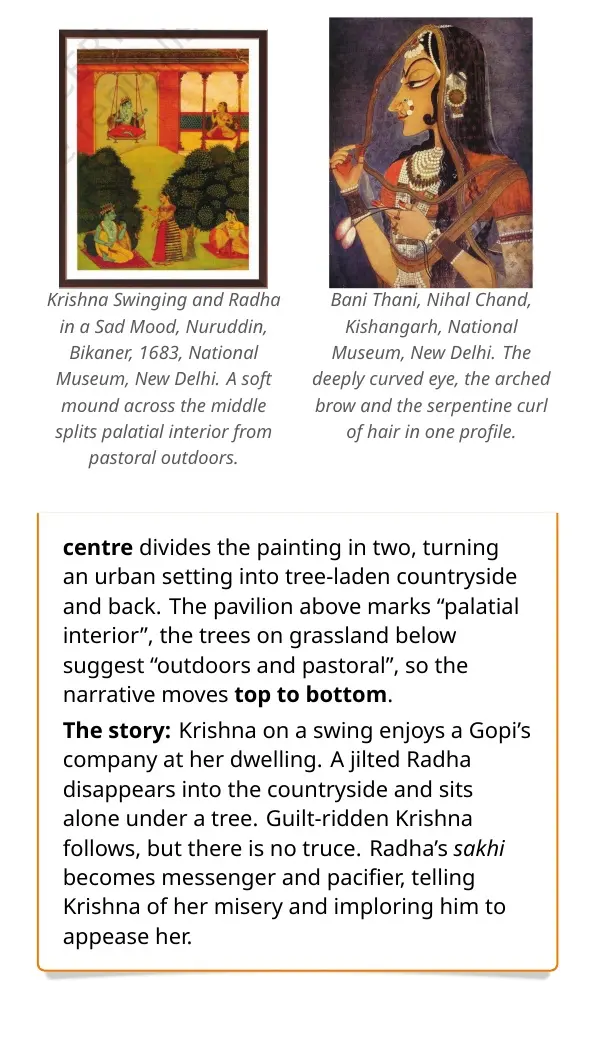
| Krishna Swinging and Radha in Sad Mood | Bikaner, Nuruddin, 1683 | National Museum, New Delhi | A Rasikapriya subject; the soft undulating mound divides indoors from outdoors; the narrative reads top to bottom |
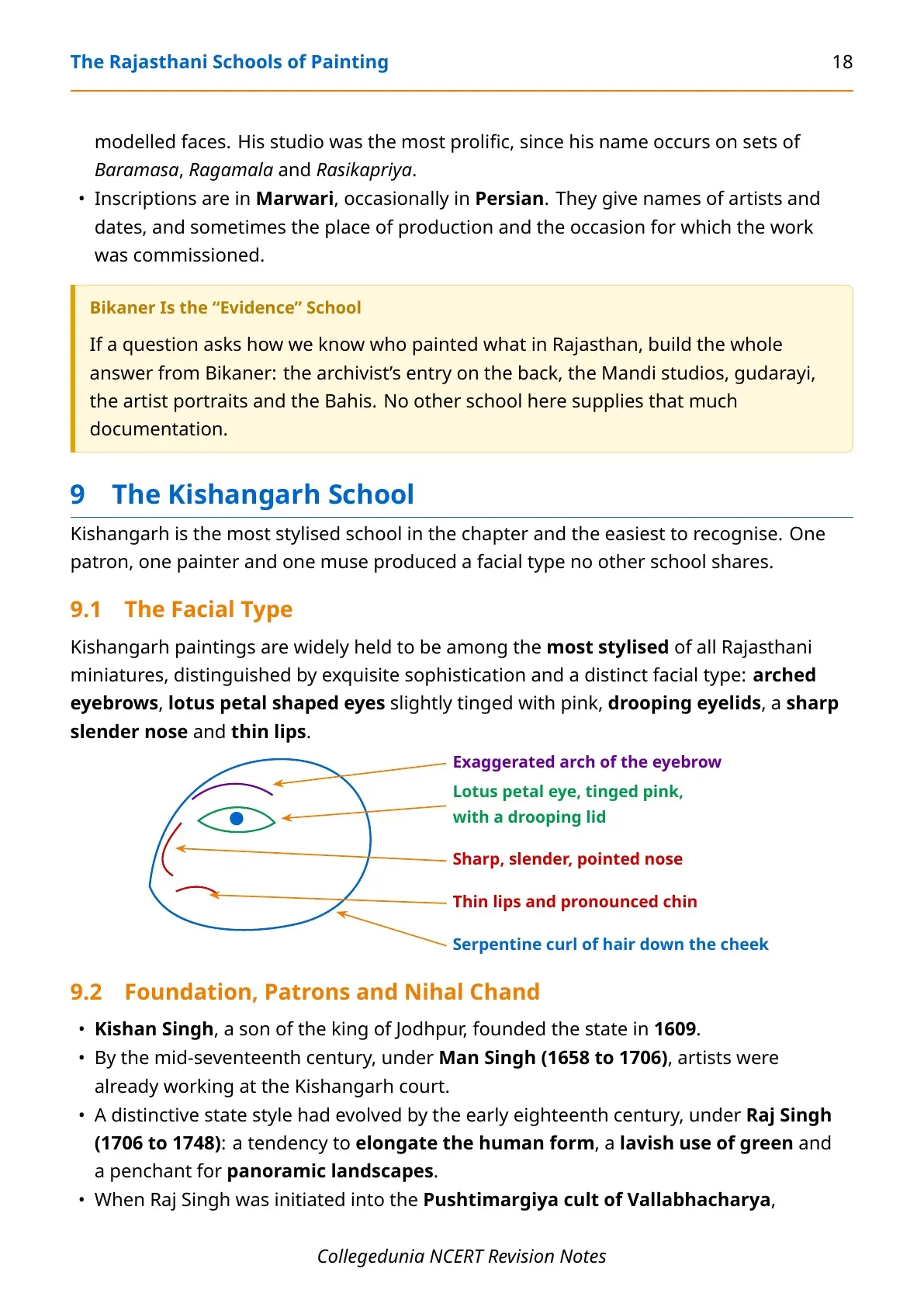
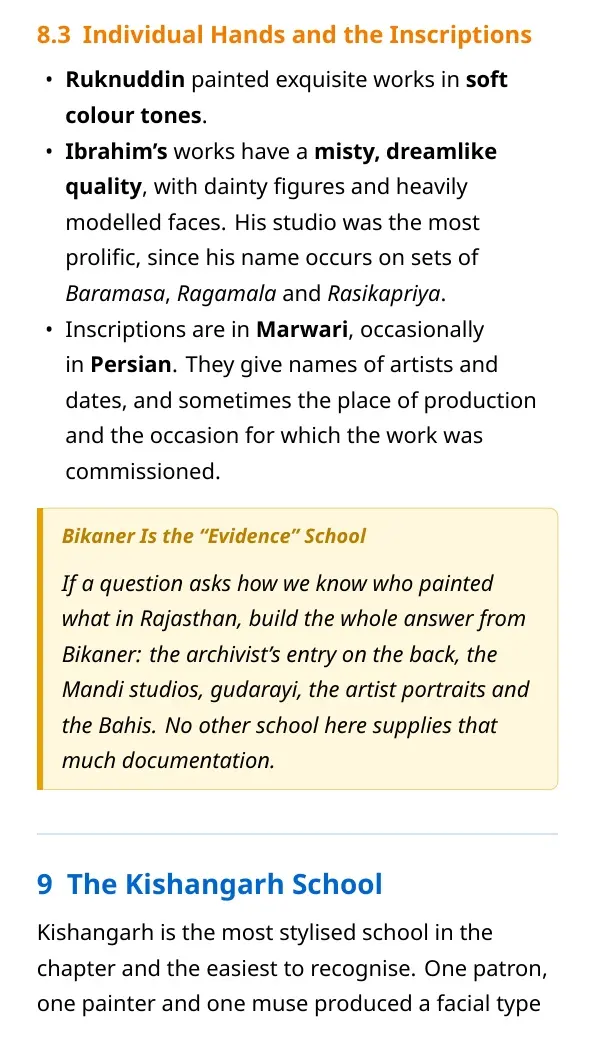
| Krishna playing Flute surrounded by Cows | Bikaner, 1777 | National Museum, New Delhi | The later Bikaner treatment of the same Krishna repertoire |
| Krishna and Radha in a pavilion | Kishangarh, Nihal Chand, 1750 | Allahabad Museum | Elongated figures, lavish green, tiny lovers inside a vast landscape |
| Bani Thani | Kishangarh, Nihal Chand | National Museum, New Delhi | Deeply curved eyes, exaggerated arched eyebrows, pointed nose, a serpentine curl of hair, thin lips, pronounced chin |
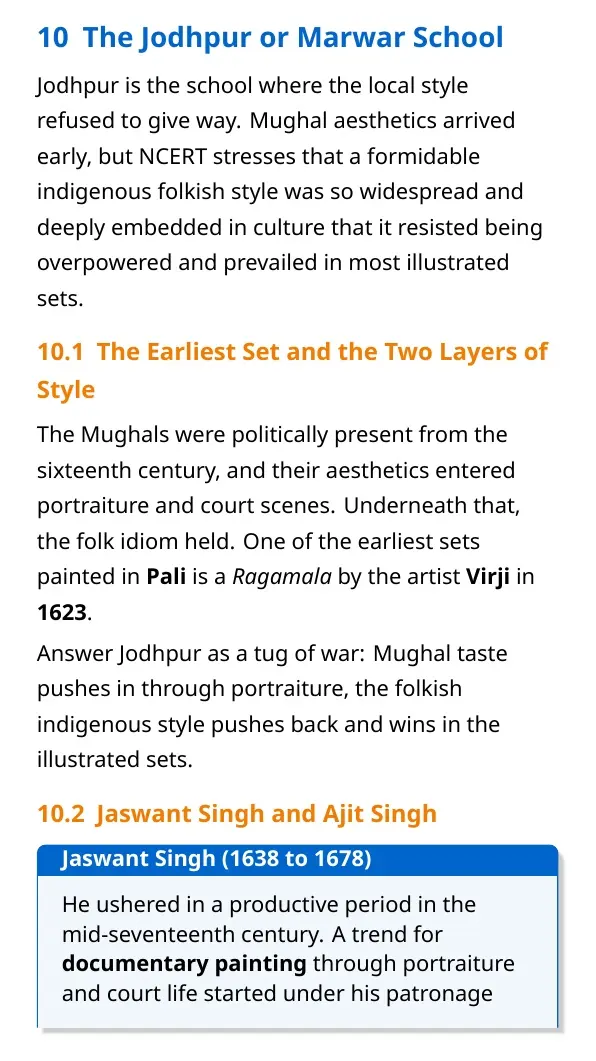
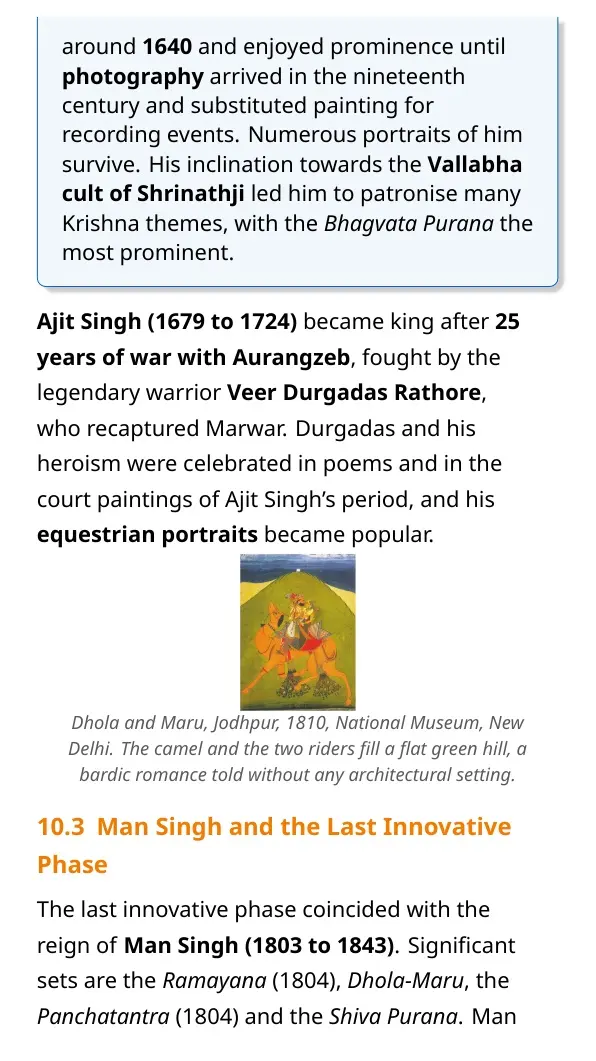
| Dhola and Maru | Jodhpur, 1810 | National Museum, New Delhi | The bardic romance of Dhola and Maru in the Marwar idiom |
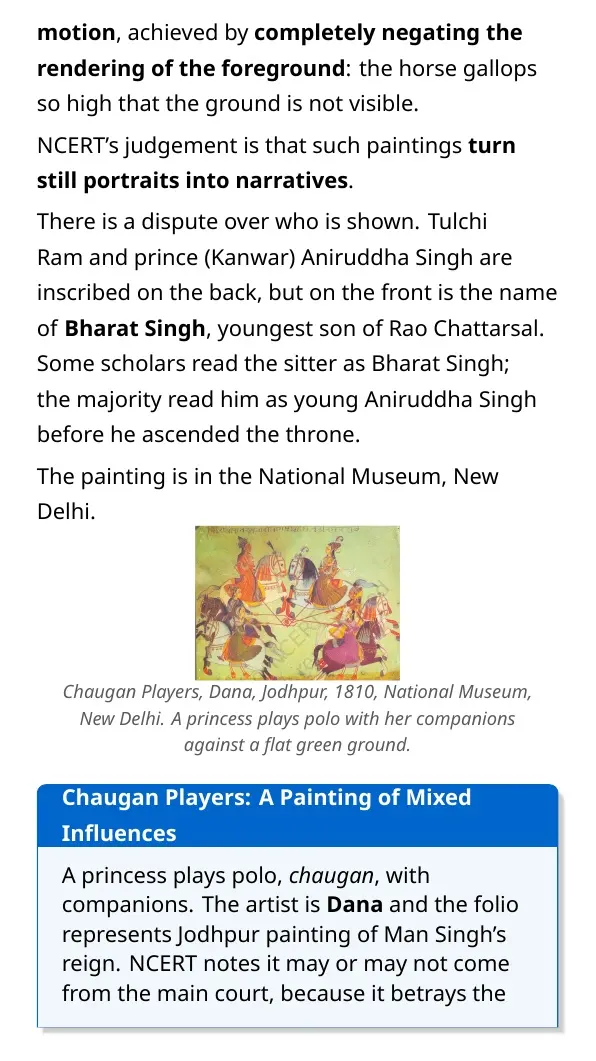
| Chaugan Players | Jodhpur, Dana, 1810, in Man Singh's reign | National Museum, New Delhi | A princess playing chaugan; Mughal, Deccani, Bundi and Kishangarh traits in one folio; a flat green background |
| The Hour of Godhuli | Jaipur, 1780 | National Museum, New Delhi | The Jaipur taste for large formats and courtly Krishna themes |
| Raga Megha | Malwa, Madho Das, 1680 | National Museum, New Delhi | One of the few dated Malwa works, in the flat two-dimensional idiom |
| Bhagvata Purana, killing of Shaktasura | Malwa style, 1680 to 1690 | National Museum, New Delhi | Compartmentalised space; celebration at Nanda and Yashoda's house; Krishna liberating the cart demon with a gentle kick |
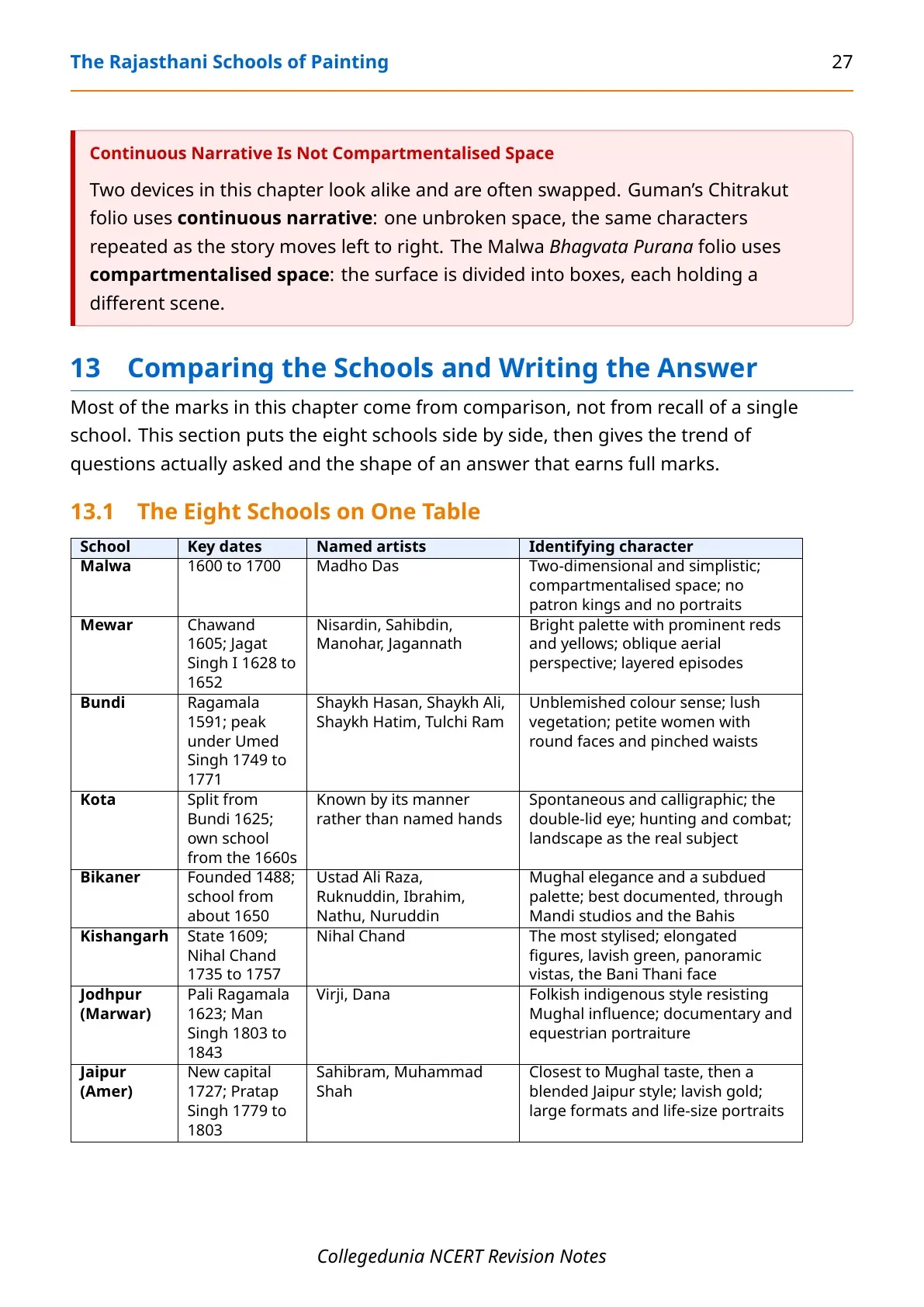
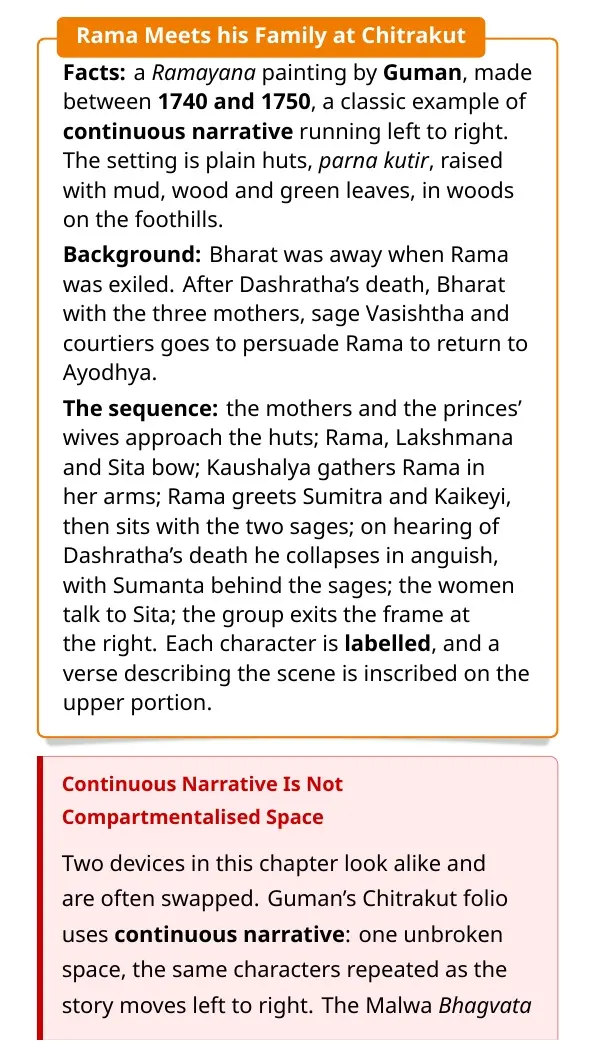
| Rama meets Members of his Family at Chitrakut | Guman, 1740 to 1750 | National Museum, New Delhi | A classic continuous narrative read from left to right; parna kutir huts of mud, wood and green leaves; every character labelled |
Four plate essays deserve extra sentences because the chapter devotes a full page to each.
- Maru Ragini: the inscription reads, in part, samvat 1685 varshe aso vad 9 Rana Shri Jagat Singh Rajen Udaipur madhe likhitam chitara Sahivdin bachan hara ne ram ram. Sahibdin is called chitara, meaning someone who paints, and the act of painting is called likhitam, meaning written, because the artist aimed to produce a painterly equivalent of the verse.
- Raja Aniruddha Singh Hara: the names of Tulchi Ram and prince, or Kanwar, Aniruddha Singh are inscribed behind the painting, while the name of Bharat Singh, youngest son of Rao Chattarsal, is inscribed on the front. Some scholars read it as Bharat Singh, but a majority believe it shows young Aniruddha Singh before he took the throne.
- Chaugan Players: the inscription on the upper portion translates as beautiful maidens on horsebacks, playing. The painting may or may not be from the main court, because it carries traits of several schools at once.
- Krishna Swinging and Radha in Sad Mood: Krishna on a swing enjoys the company of a Gopi at her dwelling, a jilted Radha disappears into the countryside and sits alone under a tree, a guilt-ridden Krishna follows without a truce, and Radha's sakhi becomes the messenger and pacifier.
Common Mistakes Students Make in the Rajasthani Schools of Painting Chapter
Watch out: almost every mark lost here comes from attaching an artist or a plate to the wrong court.
- Writing that Rajput Painting is the correct modern term. It was coined in 1916 and is now obsolete; use Rajasthani and Pahari.
- Giving Malwa a capital city. The chapter says Malwa defies a precise centre, and names only Mandu, Nusratgarh and Narsyang Sahar in passing.
- Confusing the two Sahibdins. One is the Mewar master of the Jagat Singh Ramayana; another painter of the same name appears in Ruknuddin's Bikaner atelier.
- Putting Bani Thani in Jodhpur. She belongs to Kishangarh, to Sawant Singh's court, and the painting is by Nihal Chand.
- Dating the Bundi and Kota split wrongly. Jahangir divided the kingdom in 1625, and the Kota school starts around the 1660s.
- Calling the support canvas. Rajasthani miniatures were painted on waslis of layered handmade paper. Only the Nathdwara pichhwais were painted on cloth.
- Saying every school is well documented. Bikaner is, through the Bahis and inscriptions, but Marwar inscriptions reveal little until the nineteenth century.
One habit quietly costs marks in appreciation answers. Students write adjectives without proof. Name the school, the artist, the date and the collection first, then describe. An examiner can reward a precise detail such as the double-lid eye or the serpentine curl of hair, but cannot reward the word beautiful.
Student Feedback on the Rajasthani Schools of Painting Chapter
What 14,260 students told us about studying this chapter
- 76% said telling Bundi apart from Kota was the hardest single task in the chapter.
- 2 out of 3 students could not name the artist of the Chawand Ragamala on the first attempt.
- Students who built one index card per plate scored 5 to 7 marks higher on appreciation questions.
- Most skipped block: the six source texts, left out by nearly 38% of students in their first revision round.
Source: Collegedunia Class 12 Fine Arts student poll conducted before the 2026-27 board exams. Sample of 14,260 students from CBSE schools across 18 states.
The pattern repeats from the Mughal and Deccan chapters. Students lose marks on labels, not on ideas. Spend your second revision on the school to plate index and on the six texts, rather than on rereading the prose.
How to Revise the Rajasthani Schools of Painting in a Three Block Study Plan
Eight sub-schools look heavy, but the chapter rewards short repeated passes. Three blocks of about 45 minutes will cover it, and the third block is the one that earns the marks.
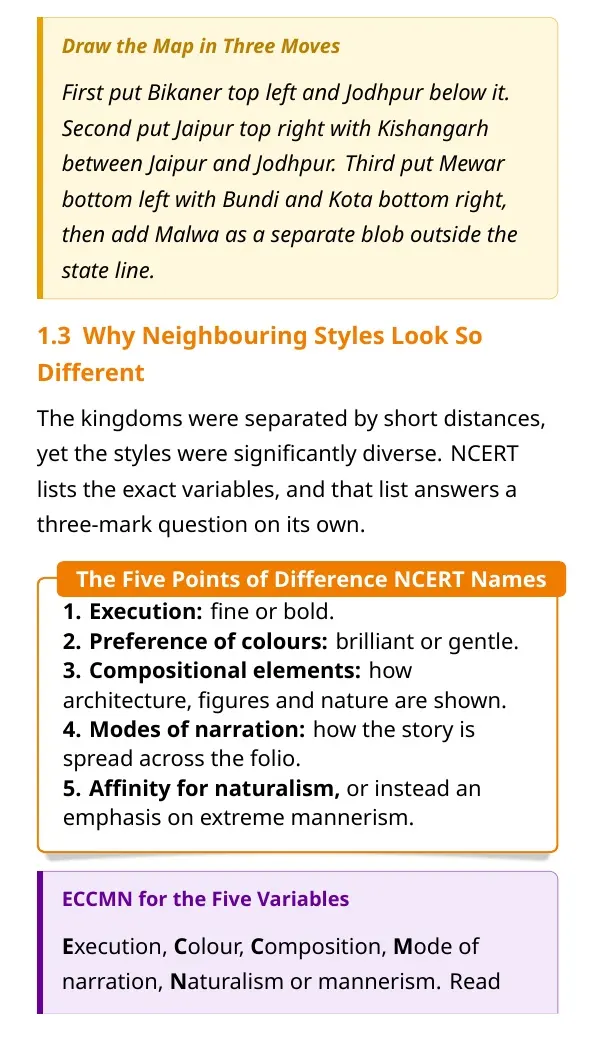
- Block 1, the map and the patrons. Draw Rajasthan and Central India, mark Mewar, Bundi, Kota, Jaipur, Bikaner, Kishangarh, Jodhpur and Malwa, then write two patrons under each. This is exercise question 4 done as revision.
- Block 2, the texts and the plate index. Write the six source texts with author, language and one idea each. Then make one card per painting with school, artist, date, collection and two visual points.
- Block 3, the comparison. Write the eight school comparison from memory, then check it against the table above. Add the Mughal and Deccani columns only if you have time left.
Finish by writing a full answer on Bani Thani in about 100 words. It is the plate most often set, it forces you to use the vocabulary of facial type and landscape that the rest of the chapter needs, and it pulls in the Sawant Singh story for free.
Rajasthani Schools of Painting Exam Focus for CBSE Fine Arts Theory and CUET
Class 12 Fine Arts Theory, subject code 049, is a 30 mark written paper based on An Introduction to Indian Art Part 2, with the rest of the subject carried by practical work. The Rajasthani chapter is a steady source of appreciation, comparison and map questions in that paper.
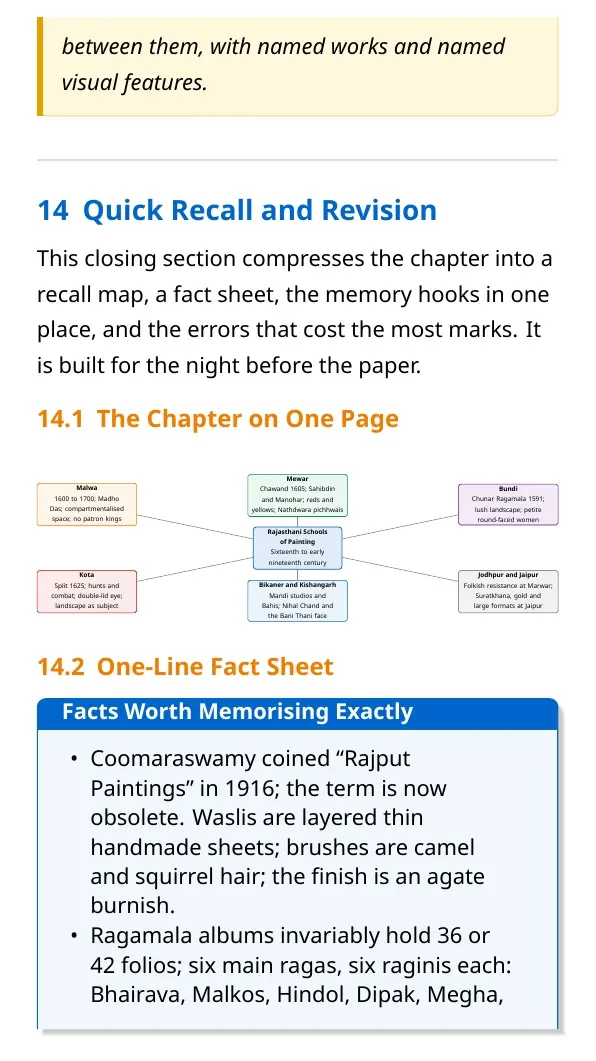
| Question shape | What it asks from this chapter | How to answer |
|---|---|---|
| 1 mark recall | A collection name, a ruler's dates, a term such as wasli, pichhwai, gudarayi, Suratkhana or chitrashala | One line, exact noun, no padding |
| 2 to 3 marks | The Coomaraswamy terminology, the Bundi and Kota split, the Bikaner Mandi system, the six main ragas | List format, three to five points |
| 5 marks, appreciation | Bani Thani, Maru Ragini, Chaugan Players, Raja Aniruddha Singh Hara or the Bhagvata Purana folio | School, artist, date, collection, then subject, composition and colour |
| 5 marks, description | Describe the different schools with examples supporting their characteristics | One short paragraph per school, each with one named work |
| Map based | Draw a map and label all schools of Rajasthani miniature painting | Mark all eight centres, and keep Malwa in Central India rather than in Rajasthan |
| CUET style objective | Match artist to school, text to author, painting to collection | Revise from the index cards, not from prose |
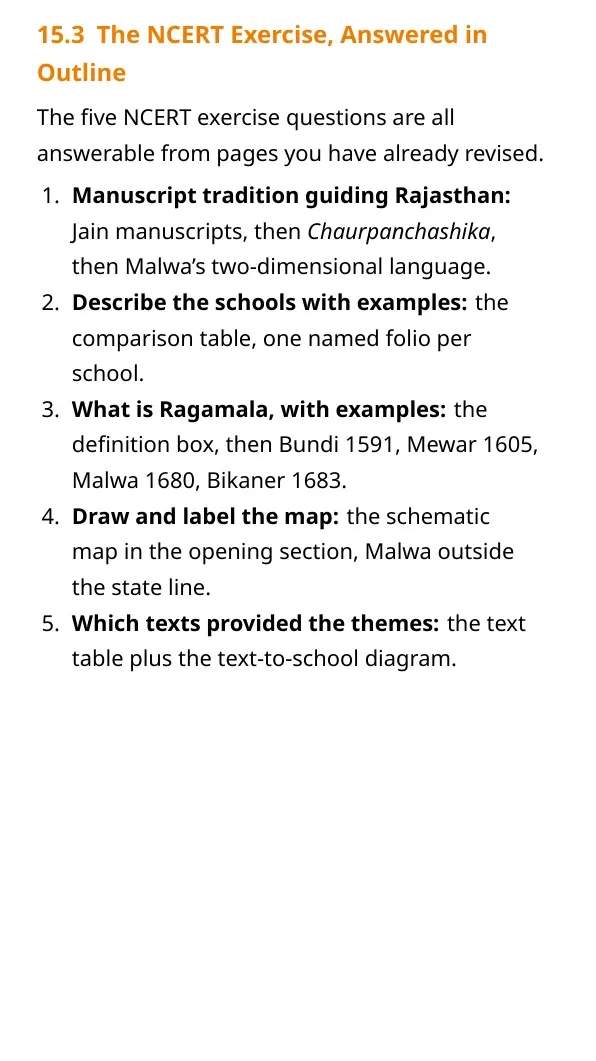
The five NCERT exercise questions map straight onto these shapes. They ask how the Western Indian manuscript painting tradition guided the development of miniature painting in Rajasthan, for a description of the different schools with supporting examples, for the meaning of Ragamala with examples from various schools, for a labelled map of all the schools, and for the texts that supplied the content or theme of the paintings. The manuscript question is answered by the line about Malwa: the two-dimensional simplistic language is a consummation of the progression from the Jain manuscripts to the Chaurpanchashika paintings.
How These Notes Pair with the Rajasthani Schools of Painting Chapter PDF
These notes are the explanation layer. The chapter PDF gives you the plates and the exact NCERT wording, which you need for captions and for appreciation vocabulary. Read the printed chapter first, then use these notes to organise it, then go back to the plates.
| Resource | What it gives you | When to use it |
|---|---|---|
| The Rajasthani Schools of Painting Class 12 NCERT Book PDF | The official chapter with all plates, captions, the seven plate essays and the five exercise questions | First read, and every time you need the exact NCERT phrasing |
| The Deccan Schools of Painting Class 12 Notes | The Deccani column you need for a three way comparison answer | Before you attempt any comparison question |
| The Pahari Schools of Painting Class 12 Notes | The other half of the old Rajput Schools label, and the school that follows in the late seventeenth century | Straight after finishing the Rajasthani chapter |
All 8 Chapters of Class 12 Fine Arts with Revision Notes
Indian painting after the Mughals splits into regional schools, then into the nationalist and modern periods. Reading the chapters in order shows how one style hands over to the next.
| Chapter | Revision Notes |
|---|---|
| Chapter 1 | The Mughal School of Miniature Painting Class 12 Notes |
| Chapter 2 | The Deccan Schools of Painting Class 12 Notes |
| Chapter 3 | The Rajasthani Schools of Painting Class 12 Notes |
| Chapter 4 | The Pahari Schools of Painting Class 12 Notes |
| Chapter 5 | The Bengal School and Cultural Nationalism Class 12 Notes |
| Chapter 6 | Modern Indian Art Class 12 Notes |
| Chapter 7 | The Company School Class 12 Notes |
| Chapter 8 | Living Art Traditions of India Class 12 Notes |
The Rajasthani Schools of Painting Class 12 Fine Arts Notes FAQs
Questions Class 12 Students Ask Most About the Rajasthani Schools Chapter
Ques. What are the Rajasthani Schools of Painting?
Ans. The term covers the schools of painting that existed in the princely kingdoms and thikanas of what is roughly Rajasthan today, along with parts of Madhya Pradesh. The chapter names Mewar, Bundi, Kota, Jaipur, Bikaner, Kishangarh, Jodhpur or Marwar, Malwa, Sirohi and other such principalities. The span runs largely between the sixteenth and the early nineteenth centuries.
Ques. Who coined the term Rajput Painting and why is it no longer used?
Ans. Scholar Anand Coomaraswamy coined it in 1916, because most rulers and patrons of these kingdoms were Rajputs, and he wanted to separate this group from the Mughal School. His label also took in Malwa and the Pahari Schools. Studies in Indian painting have moved on since then, so the term Rajput Schools is obsolete and specific categories such as Rajasthani and Pahari are used instead.
Ques. What are waslis and how was a Rajasthani miniature painted?
Ans. Waslis are layered thin sheets of handmade paper glued together to get the thickness the artist wanted. The outline was sketched on the wasli in black or brown, and colours were fixed by brief notations or sample patches. Pigments came mostly from minerals and precious metals such as gold and silver, mixed with glue as the binding medium. Brushes were made from camel and squirrel hair, and the finished painting was burnished with an agate for a uniform sheen.
Ques. What is Ragamala painting?
Ans. Ragamala paintings are pictorial interpretations of ragas and raginis. Each raga is linked to a specific mood, time of the day and season. The albums invariably contain 36 or 42 folios arranged in families, each family headed by a male raga with six female consorts called raginis. The six main ragas are Bhairava, Malkos, Hindol, Dipak, Megha and Shri.
Ques. Which texts provided the themes for Rajasthani miniature painting?
Ans. The Gita Govinda by Jayadeva, the Rasamanjari by Bhanu Datta, the Rasikapriya and Kavipriya by Keshav Das, and the Bihari Satsai by Bihari Lal. Ragamala sets, Baramasa sets and bardic romances such as Dhola-Maru, Sohni-Mahiwal, Mrigavat, Chaurpanchashika and Laurchanda were also favourites, along with the Ramayana, Bhagvata Purana, Mahabharata and Devi Mahatmya.
Ques. Who were Sahibdin and Manohar?
Ans. They were the two virtuoso artists of the Mewar School during the reign of Jagat Singh I, 1628 to 1652, who added new vitality to the style. Sahibdin painted the Ragamala of 1628, the Rasikapriya, the Bhagvata Purana of 1648 and the Yuddha Kanda of the Ramayana in 1652. Manohar's most significant work is the Bal Kanda of the Ramayana of 1649.
Ques. Why did the Bundi and Kota schools separate?
Ans. Bundi and Kota were parts of the same kingdom until 1625, when Jahangir divided the Bundi empire. He awarded one part to Madhu Singh, the younger son of Rao Ratan Singh, for his bravery in defending the emperor against the rebellion of Prince Khurram, later Shah Jahan, in the Deccan. Kota then developed its own school from around the 1660s, in the reign of Jagat Singh.
Ques. What makes the Kota School different from the Bundi School?
Ans. Kota excels in hunting scenes and shows an obsession with the animal chase. Its paintings are spontaneous and calligraphic in execution, with marked shading and the distinctive double-lid eye, and its artists excelled in rendering animals and combat. Kota artists also seem to have been the first to render landscape as the real subject of a composition. In the early decades, however, Bundi and Kota works cannot be told apart, because Kota painters borrowed from the Bundi repertoire.
Ques. Why is Bikaner called one of the best documented schools of painting?
Ans. The court archivist wrote the master artist's name and the date behind each finished painting, and the royal day-to-day diaries called Bahis survive. Inscriptions in Marwari, and occasionally Persian, give artists' names and dates, and sometimes the place of production and the occasion. Bikaner also has a custom found nowhere else in these schools, the practice of making portraits of the artists themselves, who are called Ustas or Ustad.
Ques. Who was Bani Thani?
Ans. Bani Thani, the bewitching lady of fashion, was a young singer at Kishangarh and an attendant of Raj Singh's wife, as well as a gifted poetess, singer and dancer. Sawant Singh, who wrote poetry under the pen name Nagari Das, was passionately in love with her and made her his muse. His poem Bihari Jas Chandrika became the basis for Nihal Chand's painting of Bani Thani. Sawant Singh abdicated the throne in 1757 and retired to Vrindavan with her.
Ques. What is the distinctive Kishangarh facial type?
Ans. Kishangarh faces have arched eyebrows, lotus petal shaped eyes slightly tinged with pink, drooping eyelids, a sharp slender nose and thin lips. In Bani Thani as Radha the face adds deeply curved eyes, an exaggerated arch of the eyebrows, a pointed nose, a serpentine curl of hair spiralling down the cheek and a pronounced chin. The type is believed to be derived from Bani Thani's own features, and Nihal Chand is credited with creating it.
Ques. Why is the Malwa School hard to place on a map?
Ans. Unlike the other Rajasthani schools, which sit in precise kingdoms and courts, Malwa defies a precise centre for its origin and points instead to a vast territory of Central India, with only Mandu, Nusratgarh and Narsyang Sahar mentioned in passing. It flourished between 1600 and 1700 CE. The complete absence of patron kings and of portraits suggests the Datia rulers bought these paintings from travelling artists.
Ques. What does the inscription on Maru Ragini tell us?
Ans. It gives the artist, patron, place and date of the painting. Samvat 1685 is 1628 CE, the patron is Rana Shri Jagat Singh of Udaipur, and the artist Sahibdin is called chitara, meaning someone who paints. The act of painting is called likhitam, meaning written, because the artist's goal was to produce a painterly equivalent of the verse inscribed on the painting.
Ques. How is the Rajasthani style different from the Mughal style?
Ans. Rajasthani painting was paid for by many small Rajput courts, each with its own taste, while Mughal painting served one imperial family in the courts of Delhi, Agra, Fatehpur Sikri and Lahore. Rajasthani subjects come mainly from Bhakti texts, Ragamala, Baramasa and bardic romances, and the handling of space is often flat, compartmentalised or built on an oblique aerial view. Mughal contact did reach these courts, but it changed Bikaner and Jaipur far more than Jodhpur or Malwa.
Ques. Is the Rajasthani Schools of Painting chapter part of the 2026-27 Class 12 Fine Arts syllabus?
Ans. Yes. It is a chapter of An Introduction to Indian Art Part 2, the NCERT textbook prescribed for Class 12 Fine Arts Theory, subject code 049, in the 2026-27 session. It regularly supplies appreciation, description and map questions in the CBSE theory paper, and matching questions in CUET style objective tests.



Comments