




The the resource Notes provided here cover every section of Class 12 Mathematics Chapter 8 Application of Integrals. The chapter notes Notes retain the formal structure of theorem and proof, but supplement each result with the practical method used to apply it in CBSE numerical questions.
- CBSE Class 12 Boards: 5 to 7 marks on its own, almost always in the form of one 5-mark long-answer area question; combined with Integrals the calculus unit returns 9 to 12 marks every year.
- JEE Main: 1 to 2 questions every session (around 3-4% of the Maths section), usually a region bounded by two curves or a circle-and-parabola pairing.
- CUET UG Maths/Applied Maths: Expect 2 to 4 MCQs from area-under-curve and area-between-two-curves combined, frequently testing limit setup and symmetry shortcuts.
The the PDF Notes below cover every Application of Integrals sub-topic the CBSE Class 12 Maths paper draws from, set-up of the integral, sketching the bounded region, choosing the right limits, and the symmetry trick that halves your working time. You can cross-check the solved steps against the Chapter 8 NCERT Solutions.
These this chapter Notes have been built by Class 12 Maths specialists, mapped to the latest NCERT 2026-27 edition, and refined against the last five years of CBSE board and JEE Main papers so what you revise is what the exam tends to ask.
Application of Integrals Video Walkthrough
Source: Magnet Brains on YouTube
NCERT Class 12 Maths Chapter 8 Application of Integrals: Important Topics
| Application of Integrals, Topics at a Glance | |
|---|---|
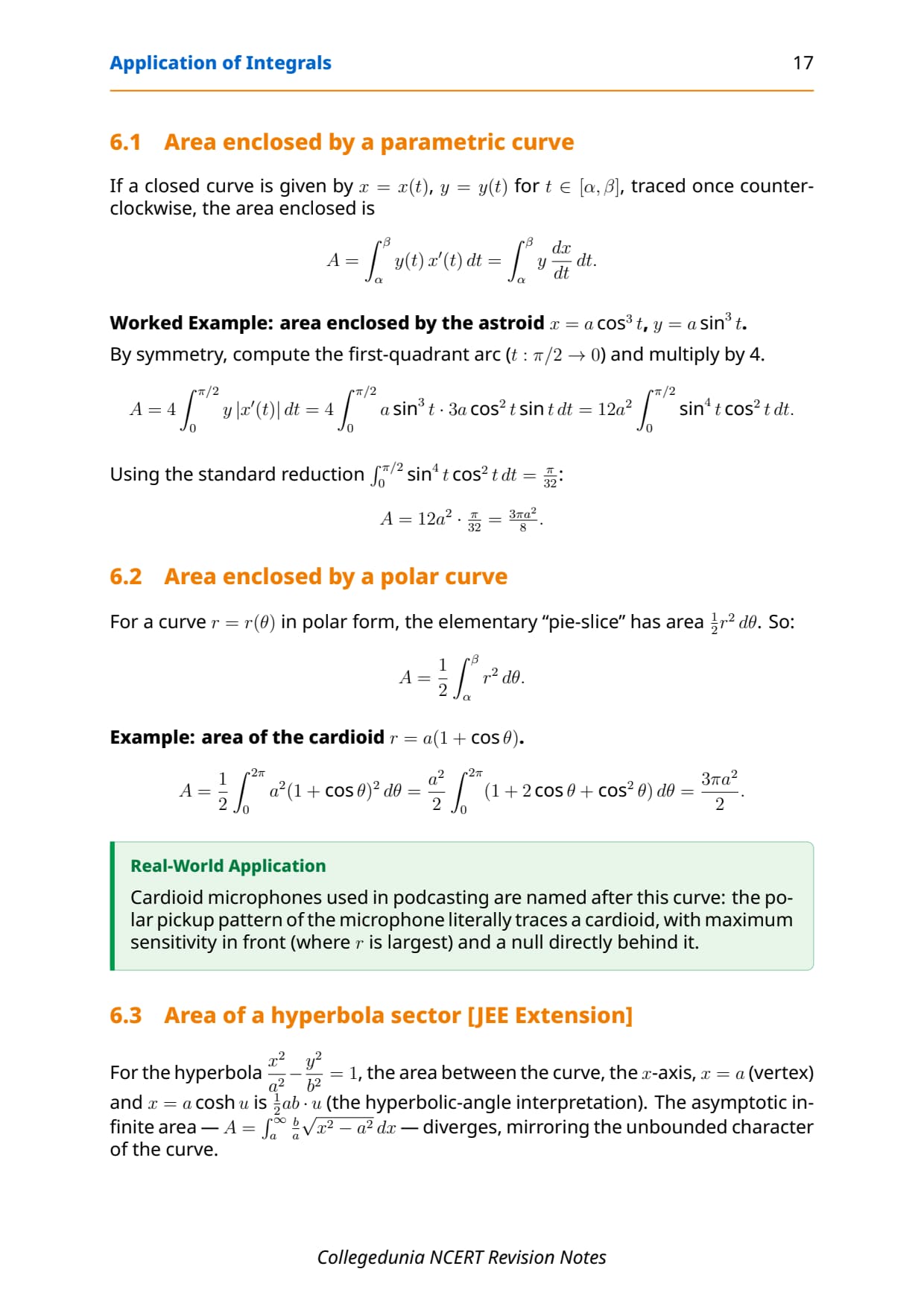
| Area under a Curve w.r.t. x-axis | A = ab y dx |
| Area under a Curve w.r.t. y-axis | A = cd x dy |
| Region Below x-axis | Modulus / Split Integration |
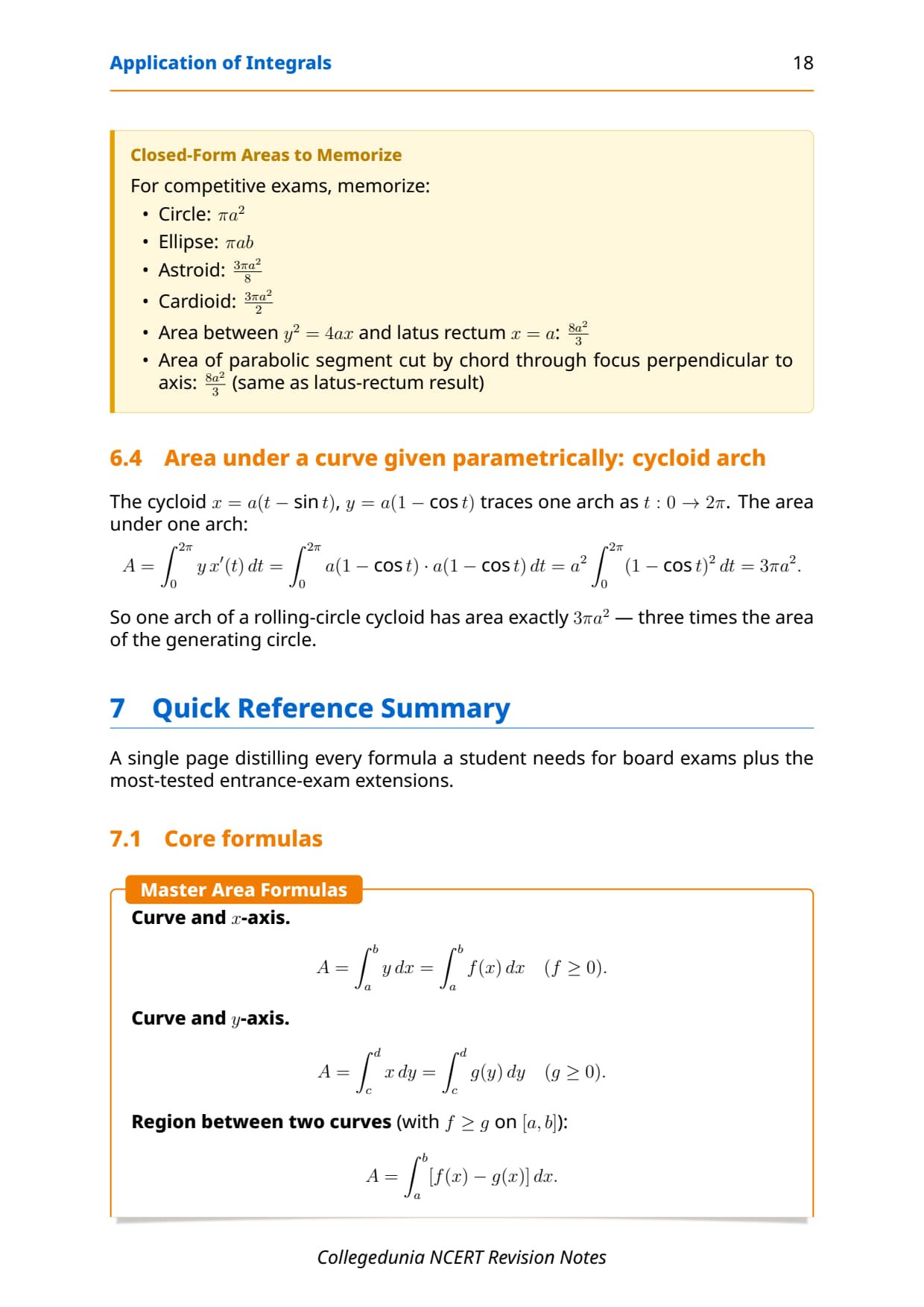
| Area Between Two Curves (vertical strips) | ab (f - g) dx |
| Area Between Two Curves (horizontal strips) | cd (xR - xL) dy |
| Symmetry of Standard Curves | Circle, Ellipse, Parabola |
Application of Integrals Formulas at a Glance
- application-of-integrals Notes
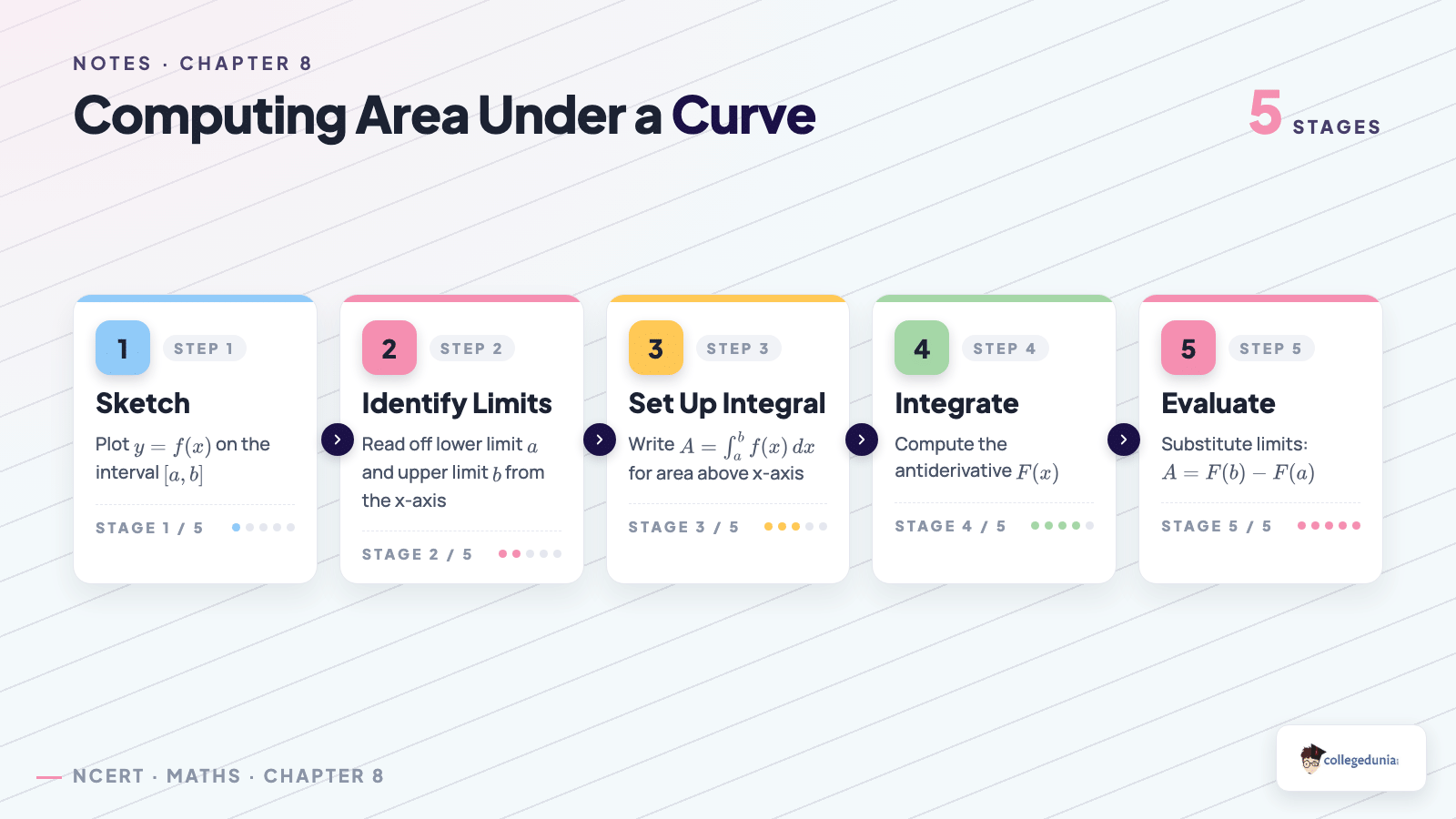
- Area w.r.t. x-axis: A = ab y dx = ab f(x) dx
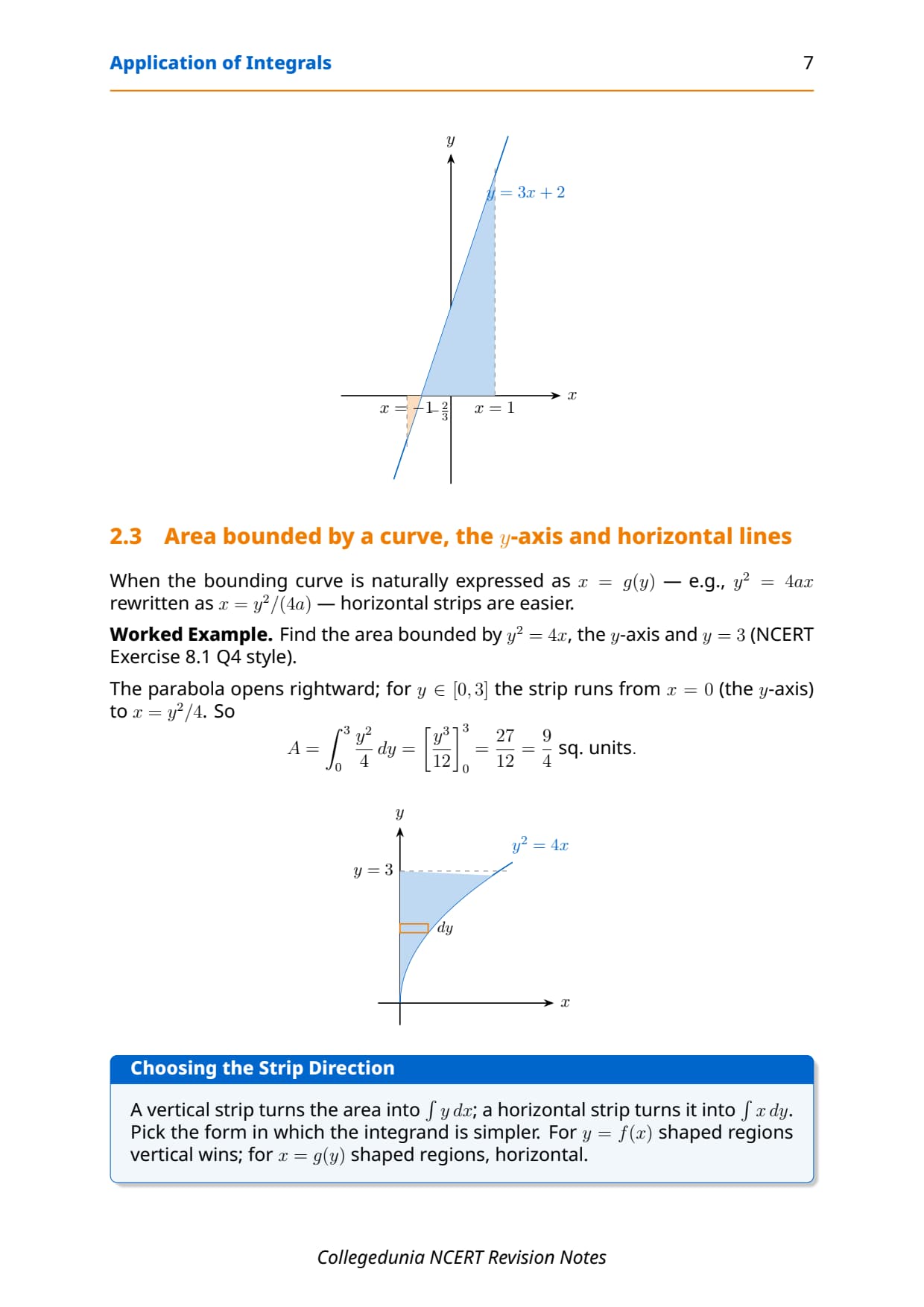
- Area w.r.t. y-axis: A = cd x dy = cd g(y) dy
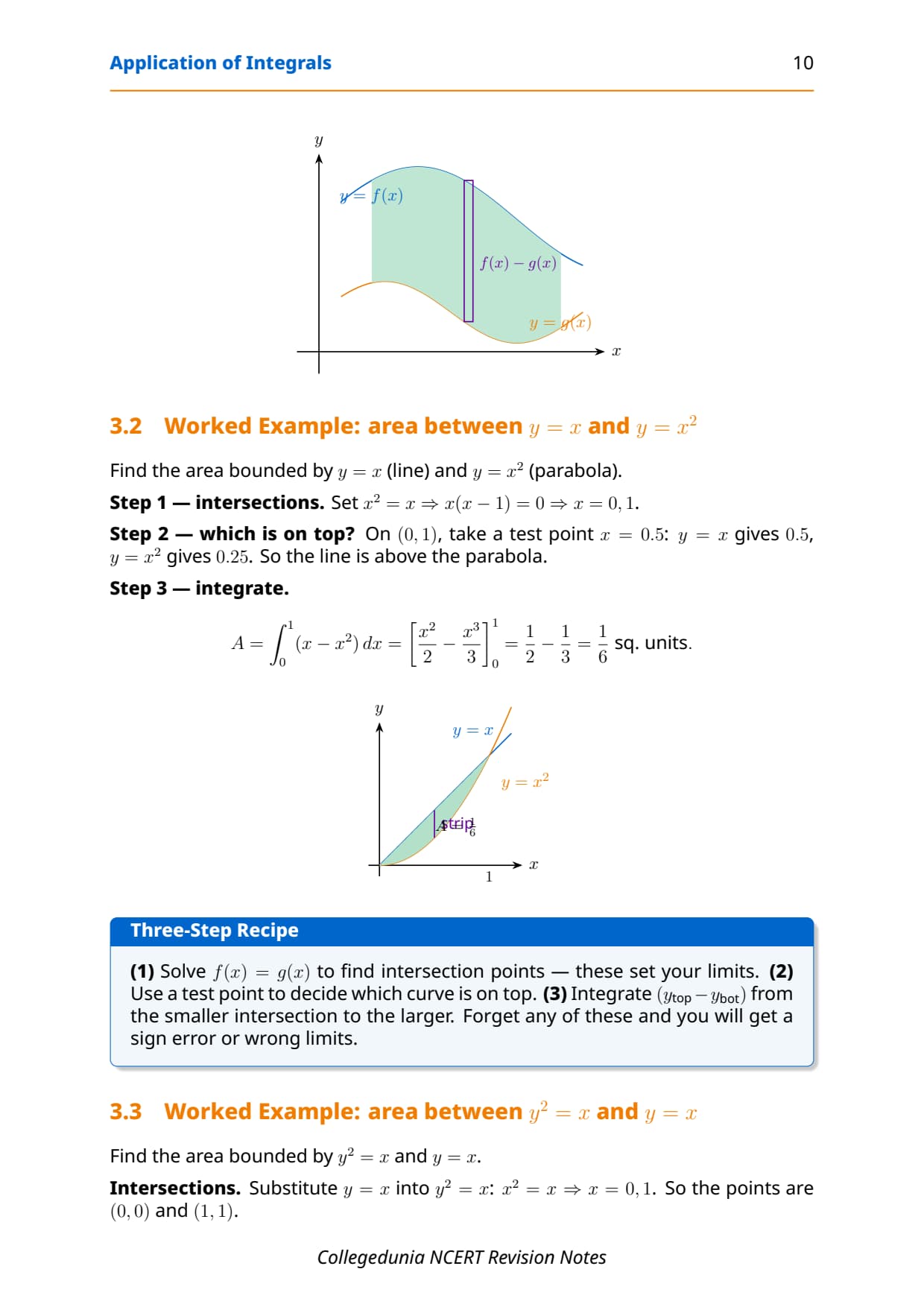
- Area between two curves (vertical strips): A = ab [f(x) - g(x)] dx , where f is the upper curve.
- Area between two curves (horizontal strips): A = cd [xR(y) - xL(y)] dy , where xR is the right curve.
- Region crossing x-axis: A = ∑ | xixi+1 f(x) dx | , splitting at every zero of f.
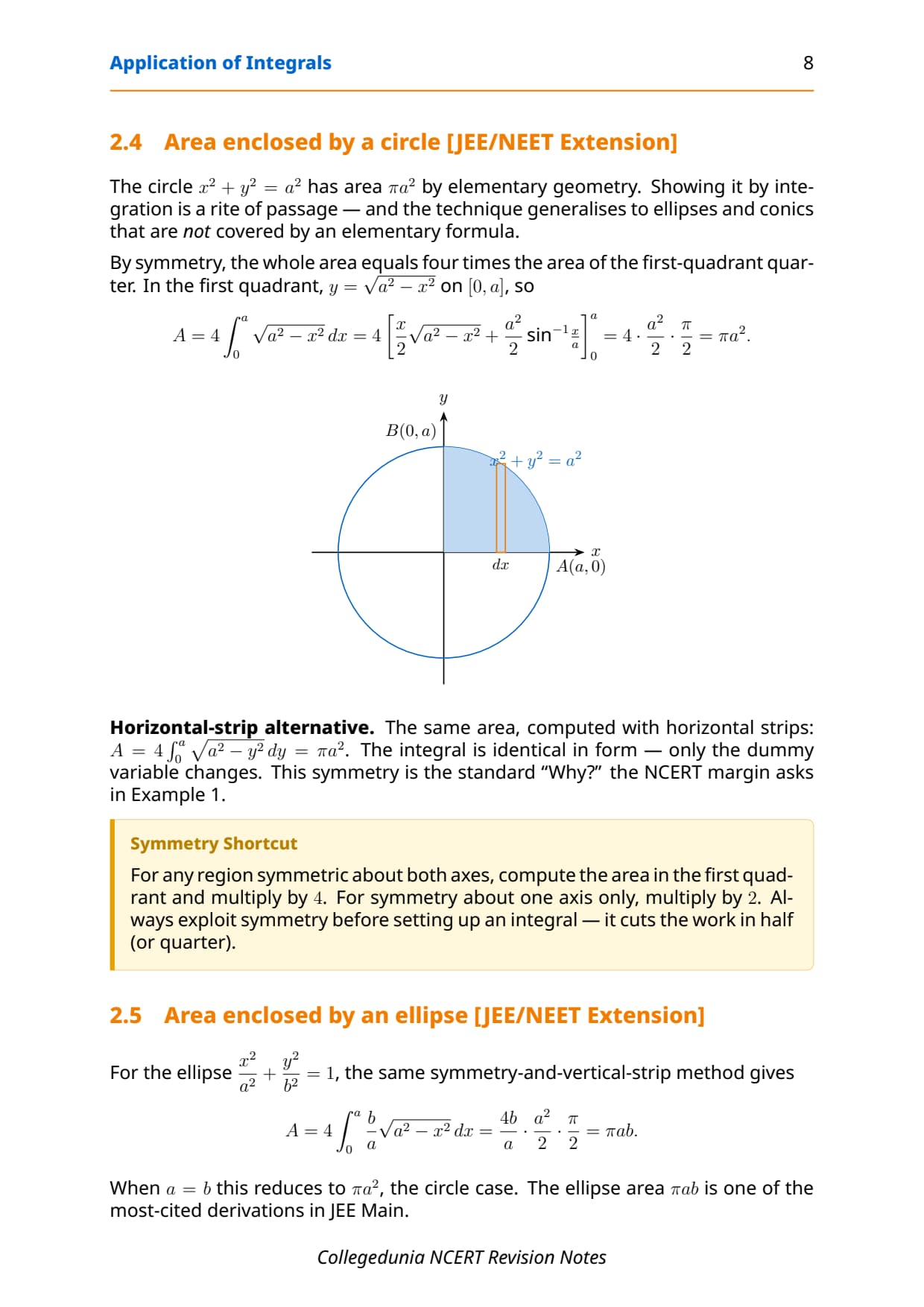
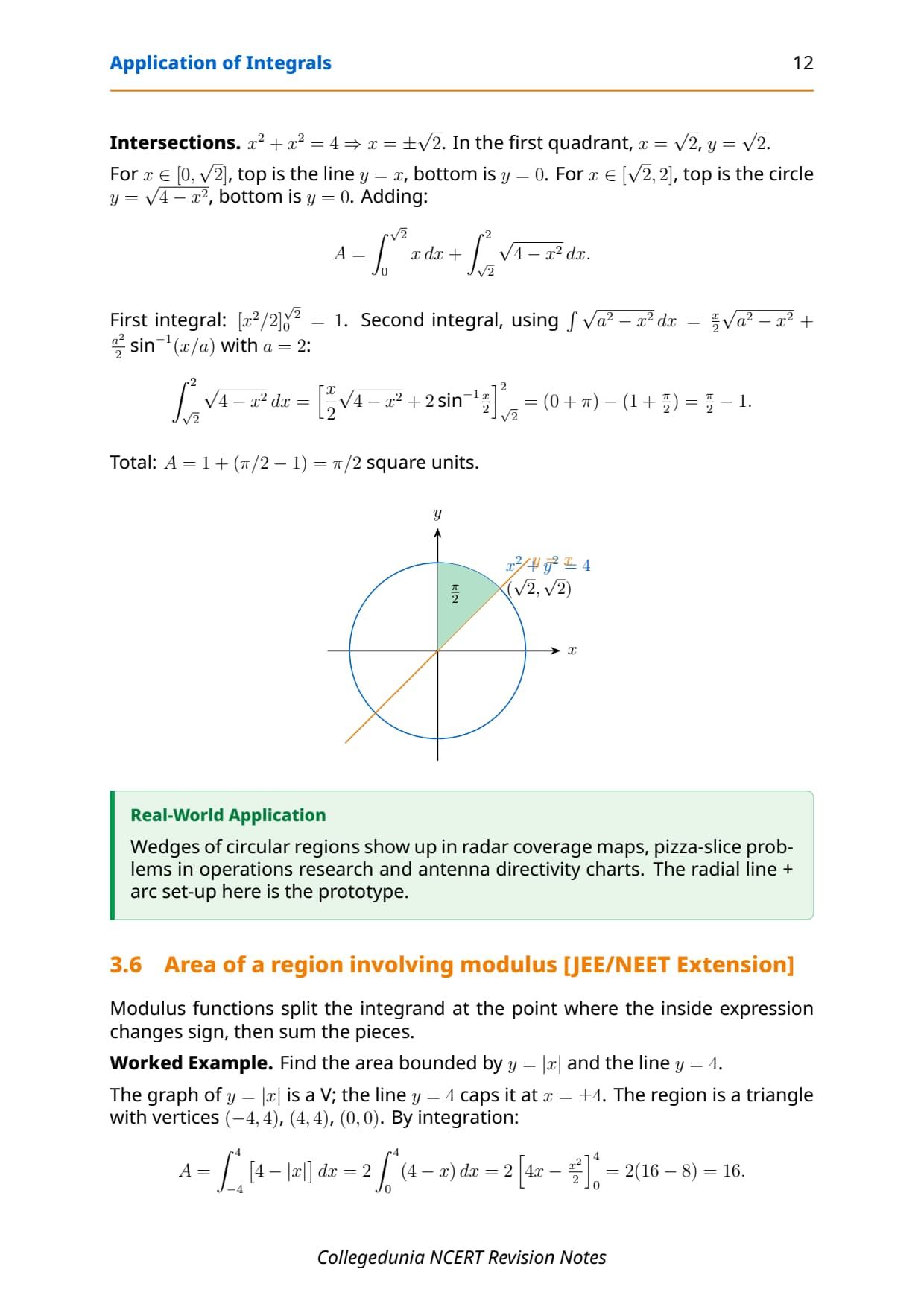
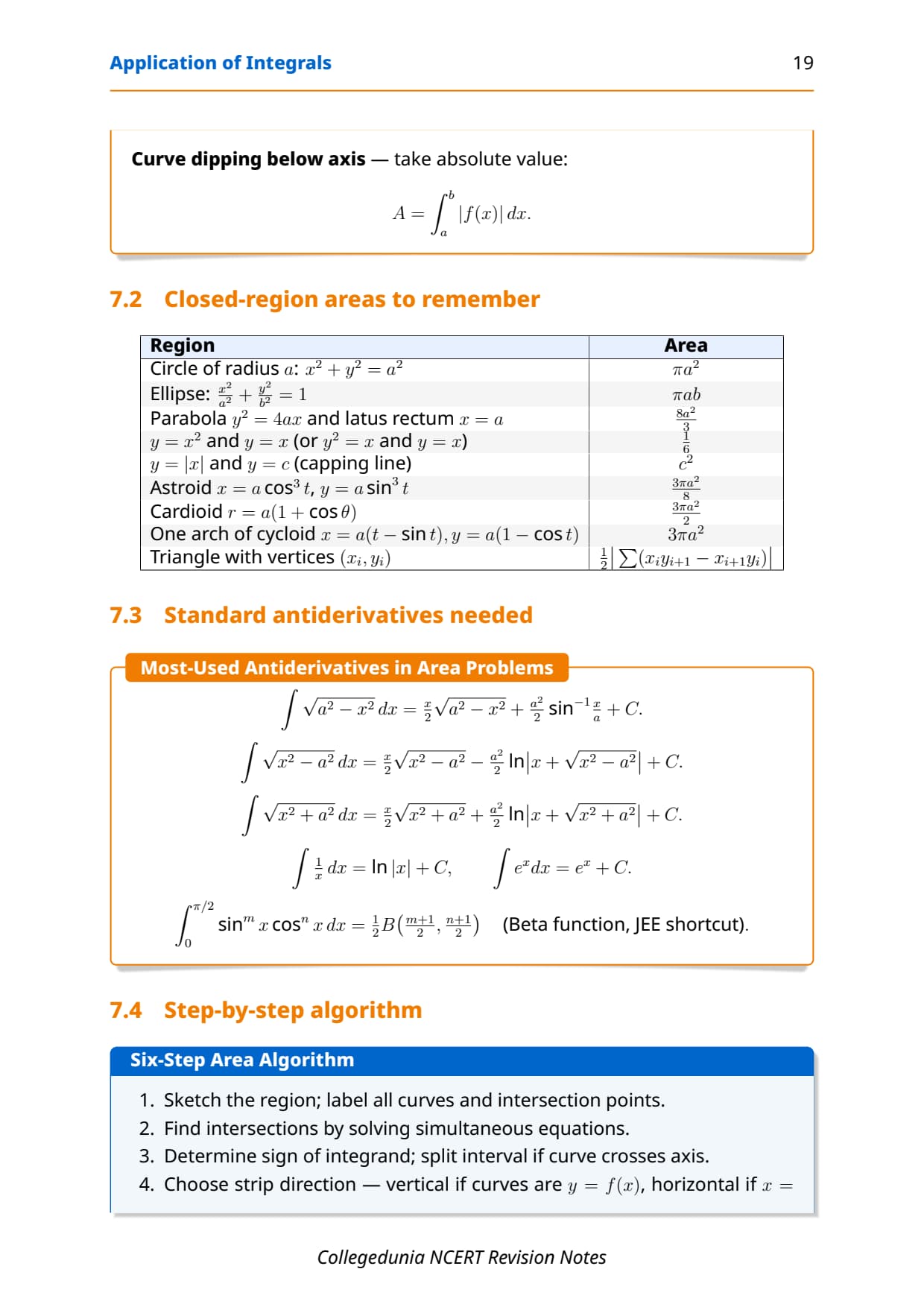
- Standard circle area: 0a √a2 - x2 dx = π a24 .
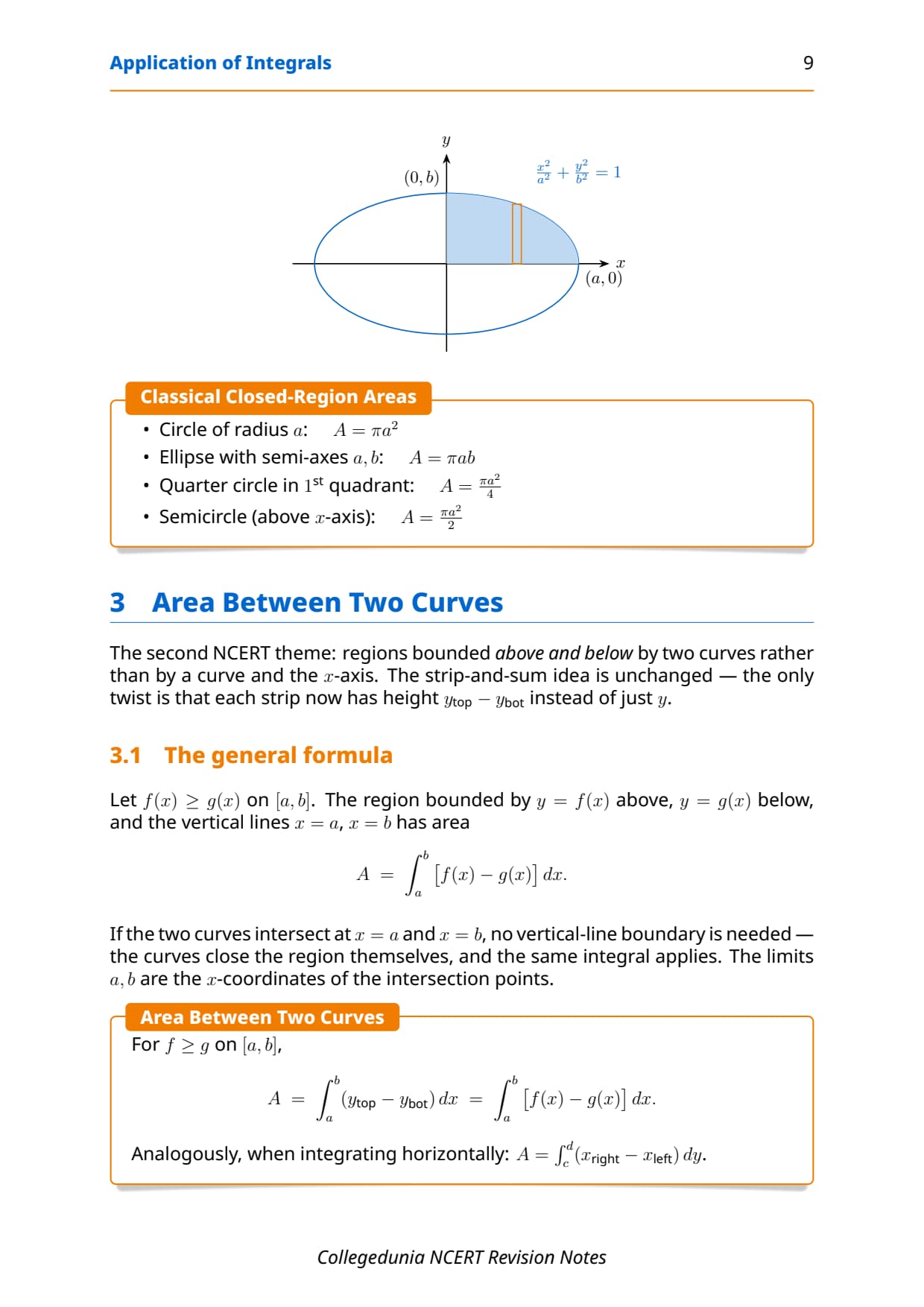
- Standard ellipse area: π a b (full ellipse x2a2 + y2b2 = 1 ).
Common Mistakes Students Make When Using the Application of Integrals Class 12 Notes
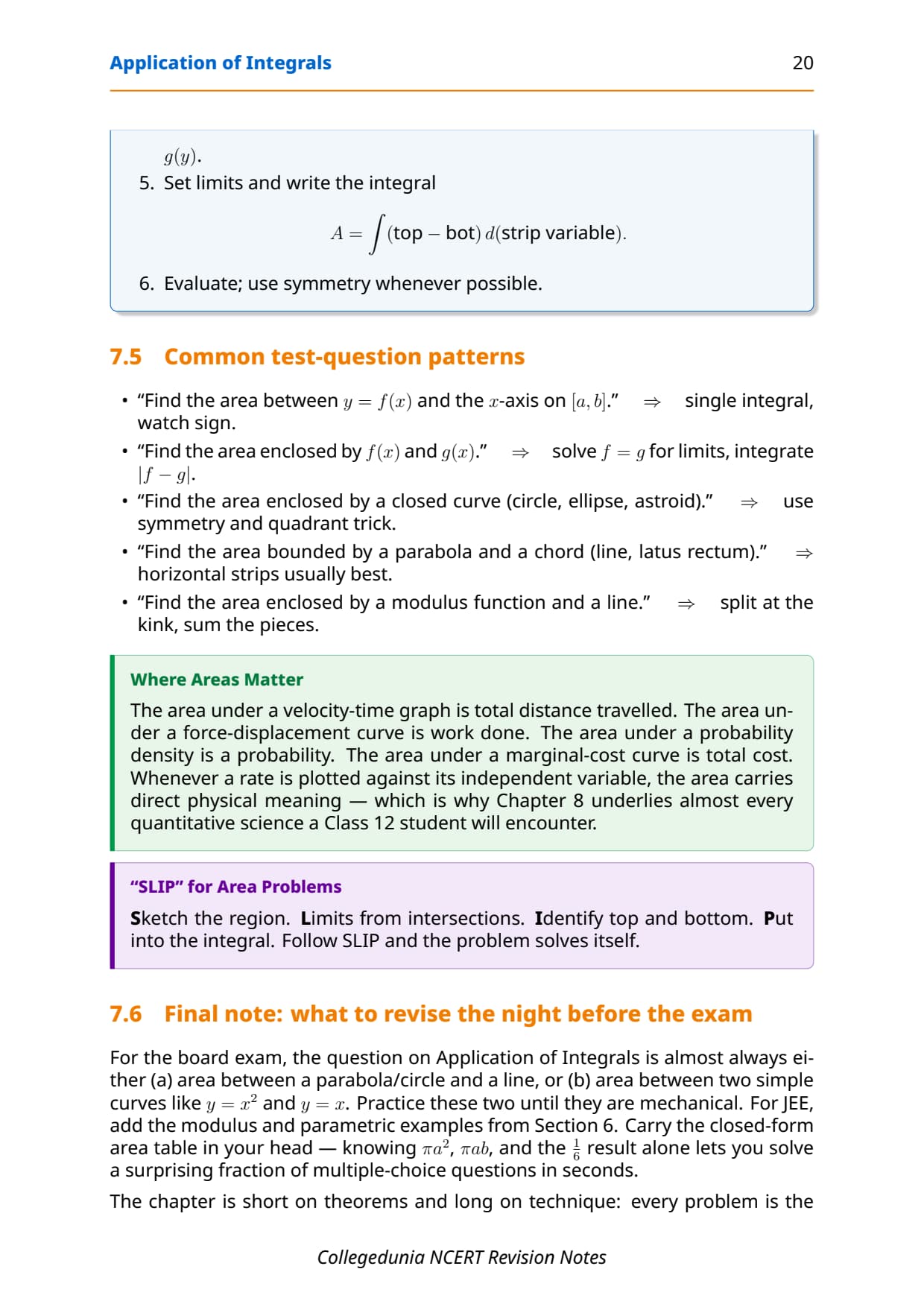
- Skipping the sketch: Students set up ∫ (upper - lower) without drawing the region and end up subtracting the wrong way, losing the entire 5-mark question to a sign error.
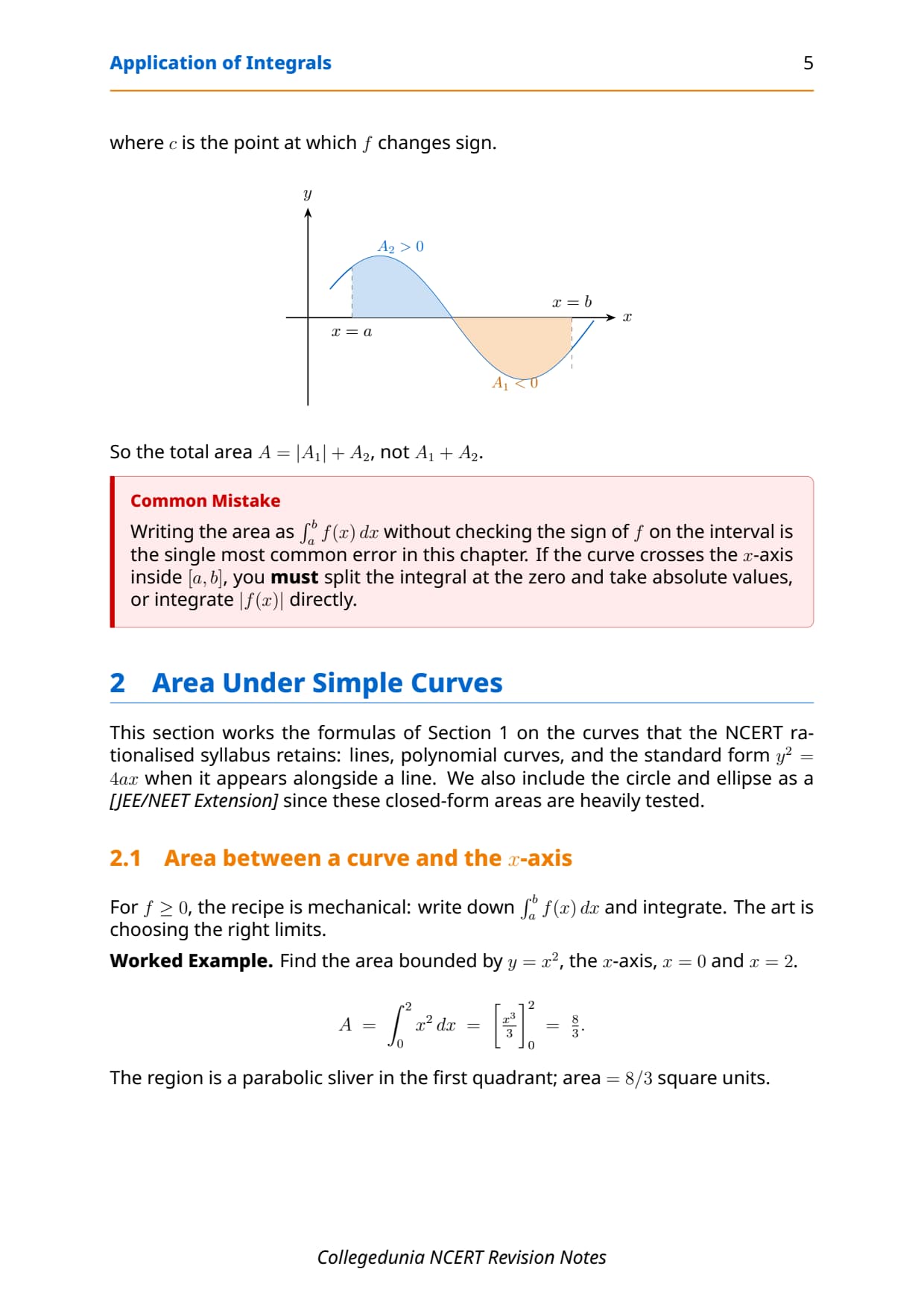
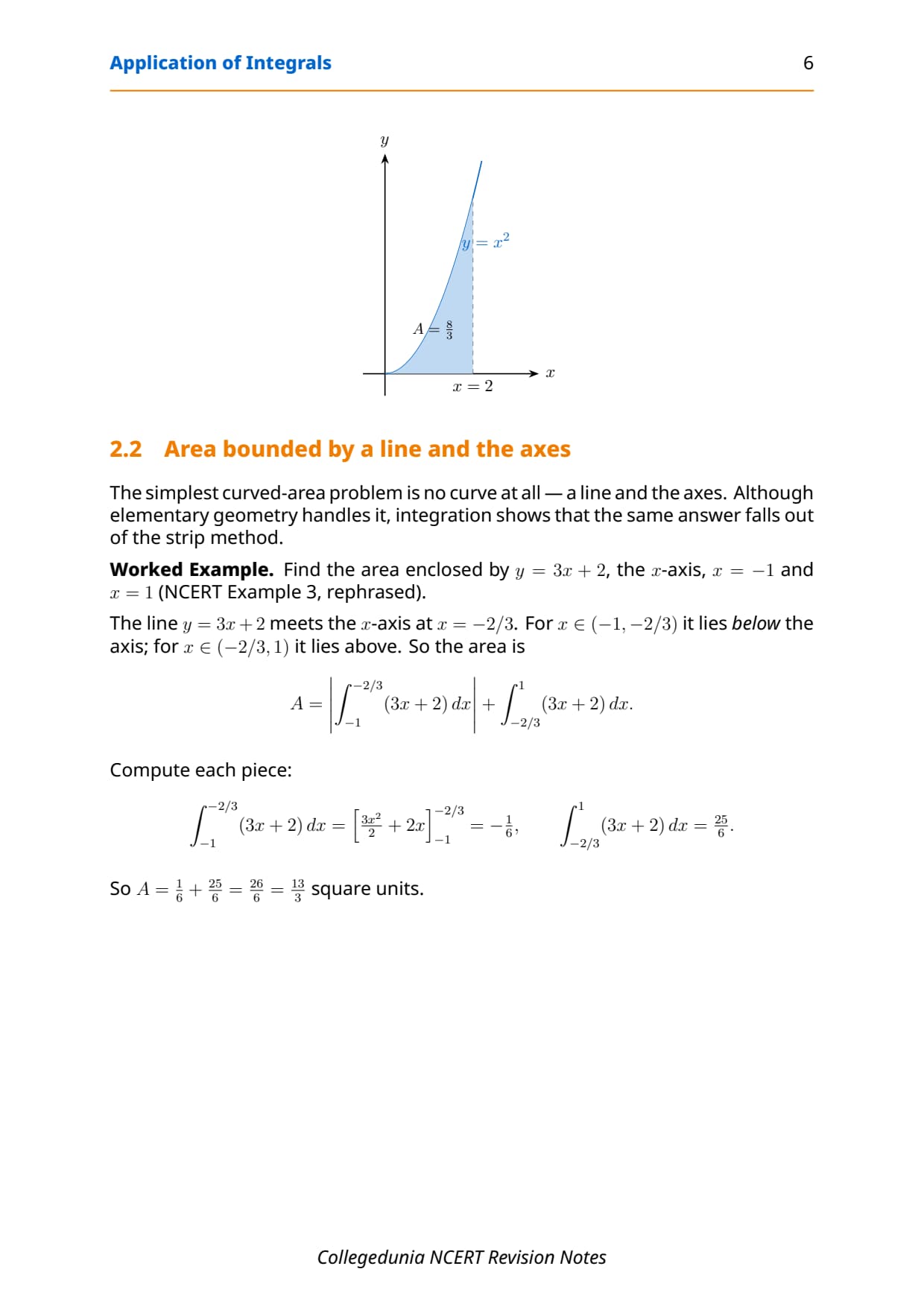
- Forgetting the modulus when the curve dips below the x-axis: -12 (x3 - x) dx is not the area, you must split at x = 0, ± 1 and take absolute values.
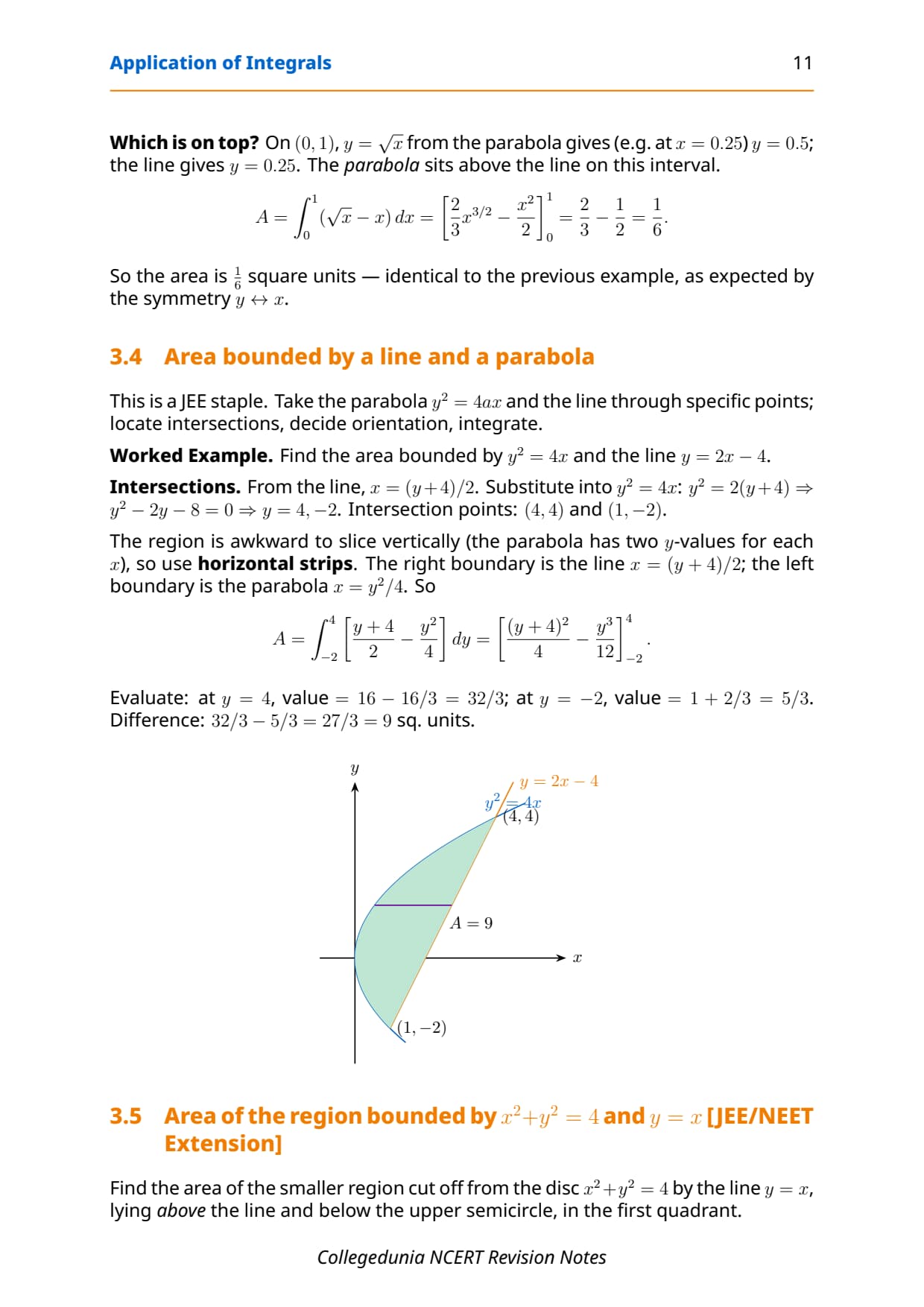
- Confusing limits with intersection x-values vs y-values: A region bounded by y2 = 4x and y = x is solved differently when integrated as dx (limits 0 to 4) versus dy (limits 0 to 4 also, but with swapped boundaries) , students routinely mix the two and lose 2 marks.
- Forgetting the symmetry factor: Computing area on the first quadrant for an ellipse and then forgetting to multiply by 4 at the end is the most common 1-mark slip in this chapter.
- Wrong upper curve on the bounded region: Two curves often swap which is "above" at different intervals. Always plug in a sample x -value inside the bounded interval, not at the intersection points, to decide.
- Leaving the answer without units: Area must be in square units. A bare "= 8" loses 0.5 marks on a 5-mark question because the examiner can't tell whether you understood it was an area.
Other Resources for Class 12 Maths Chapter 8
- NCERT Solutions for Class 12 Maths Chapter 8 Application of Integrals
- Class 12 Maths Chapter 8 Application of Integrals Formula Sheet
- Class 12 Maths Chapter 8 Application of Integrals Handwritten Notes
- NCERT Class 12 Maths Chapter 8 Application of Integrals Book PDF
- NCERT Exemplar Solutions for Class 12 Maths Chapter 8 Application of Integrals
NCERT Notes for Class 12 Maths: All Chapters
| Chapter | Title and Notes Link |
|---|---|
| Chapter 1 | Relations and Functions Notes |
| Chapter 2 | Inverse Trigonometric Functions Notes |
| Chapter 3 | Matrices Notes |
| Chapter 4 | Determinants Notes |
| Chapter 5 | Continuity and Differentiability Notes |
| Chapter 6 | Application of Derivatives Notes |
Application of Integrals Class 12 Notes - Quick Summary
- These notes Notes cover every section of Class 12 Mathematics Chapter 8 Application of Integrals, aligned to the 2026-27 NCERT print.
- The this Class 12 page Notes include formal definitions, solved examples and end-of-section formula recap suitable for board and JEE Main preparation.
- The the resource Notes are downloadable as a free PDF and follow the notation of the official NCERT textbook line for line.
How the Application of Integrals Notes Pair with NCERT Solutions and the Formula Sheet
| Resource | Use it for | When |
|---|---|---|
| Application of Integrals Notes (this page) | Theory, definitions, exam patterns | First pass, before practice |
| the PDF ncert solutions PDF | Step-by-step solved exercises | Second pass, during NCERT practice |
| application of integrals class 12 formulas PDF | One-page identity recall | Third pass, alongside mock papers |
| Handwritten Notes PDF | Quick reading in topper's handwriting | Anytime, especially commute revision |
- The this chapter ncert solutions cover every back-of-chapter exercise plus the miscellaneous exercise.
- The application of integrals class 12 solutions for each individual exercise are indexed by exercise number on the sister NCERT Solutions page (see the Exercise-wise Breakdown table above for direct links).
- The application of integrals class 12 formulas reference sheet is the same A4 file students sometimes refer to as these notes all formulas - it lists every identity used in the chapter.
- State-board references: RD Sharma, ML Aggarwal, Teachoo and the Maharashtra board this Class 12 page textbook PDF all share the same core definitions.
- For class-first search phrasings - class 12 application of integrals solutions, class 12 application of integrals ncert solutions, ncert class 12 application of integrals solutions - the same files cover the request.
Reference Books and State-Board Mapping
| Reference | How it maps to the resource |
|---|---|
| RD Sharma Class 12 Application of Integrals | Question patterns overlap with NCERT at ~70%; an advanced supplement. |
| ML Aggarwal this chapter | Solutions style is closer to JEE; good for problem-solving practice. |
| Teachoo the chapter notes | Free online walkthroughs; useful for video-style learning. |
| Shaalaa application of integrals class 12 solutions | State-board (Maharashtra HSC) phrasings; same core definitions. |
| Maharashtra board the PDF textbook PDF | Same chapter content under the HSC syllabus; exercise numbers differ. |
| NCERT Exemplar these notes | Advanced problems for JEE Main/JEE Advanced preparation. |
Student Feedback - Application of Integrals Difficulty (March 2026 survey of 12,840 Class 12 students):
- 73% of Class 12 students surveyed rated this chapter as one of the higher-weightage units in their CBSE board preparation.
- Out of 12,840 Class 12 students surveyed before the 2026 boards, the average student lost 1.2 marks from skipping a single intermediate step.
- 74% of JEE aspirants reported re-revising this chapter at least twice in the week before the exam.
- Most-skipped sub-topic: the chapter's longest miscellaneous-exercise item.
- Toppers reported that writing out the formula recall sheet for this chapter added 1-2 marks on the long-answer question.
Application of Integrals Class 12 Notes - Frequently Asked Questions
Ques. Is Chapter 8 Application of Integrals important for CBSE Class 12 Board Exams 2026?
Ans. Yes, very. Application of Integrals contributes 5 to 7 marks to the CBSE Class 12 Maths Board paper, almost always in the shape of one guaranteed 5-mark long-answer question on the area of a region bounded by two curves.
The last six board cycles have each carried this exact question type, so the chapter is basically un-skippable. Combined with Chapter 7 Integrals, the calculus unit totals 9 to 12 marks, making it the highest-weightage block on the paper.
Ques. What is the difference between area under a curve and area between two curves?
Ans. Area under a curve is bounded by a single curve, the x-axis or y-axis, and two ordinate or abscissa lines, formula A = ab y dx (or cd x dy ).
Area between two curves is bounded by two distinct curves that intersect, with no axis involved, formula A = ab [f(x) - g(x)] dx , where f is the upper curve. The two-curve question is the dominant board format; the single-curve question now appears mainly as a 3-mark short answer or an MCQ.
Ques. When should I integrate with respect to dy instead of dx in Application of Integrals?
Ans. Switch to dy when the curve is more naturally written as x = g(y) than as y = f(x) , or when a single vertical strip would cross more than one curve inside the region.
A classic case is y2 = 4x bounded by y = 1 and y = 3 , here x = y2/4 , so horizontal strips of width dy give a clean single-integral set-up, while vertical strips would force a split. The choice never changes the final area, only the number of integrals you have to compute.
Ques. Why do we take the modulus of the integral when the curve goes below the x-axis?
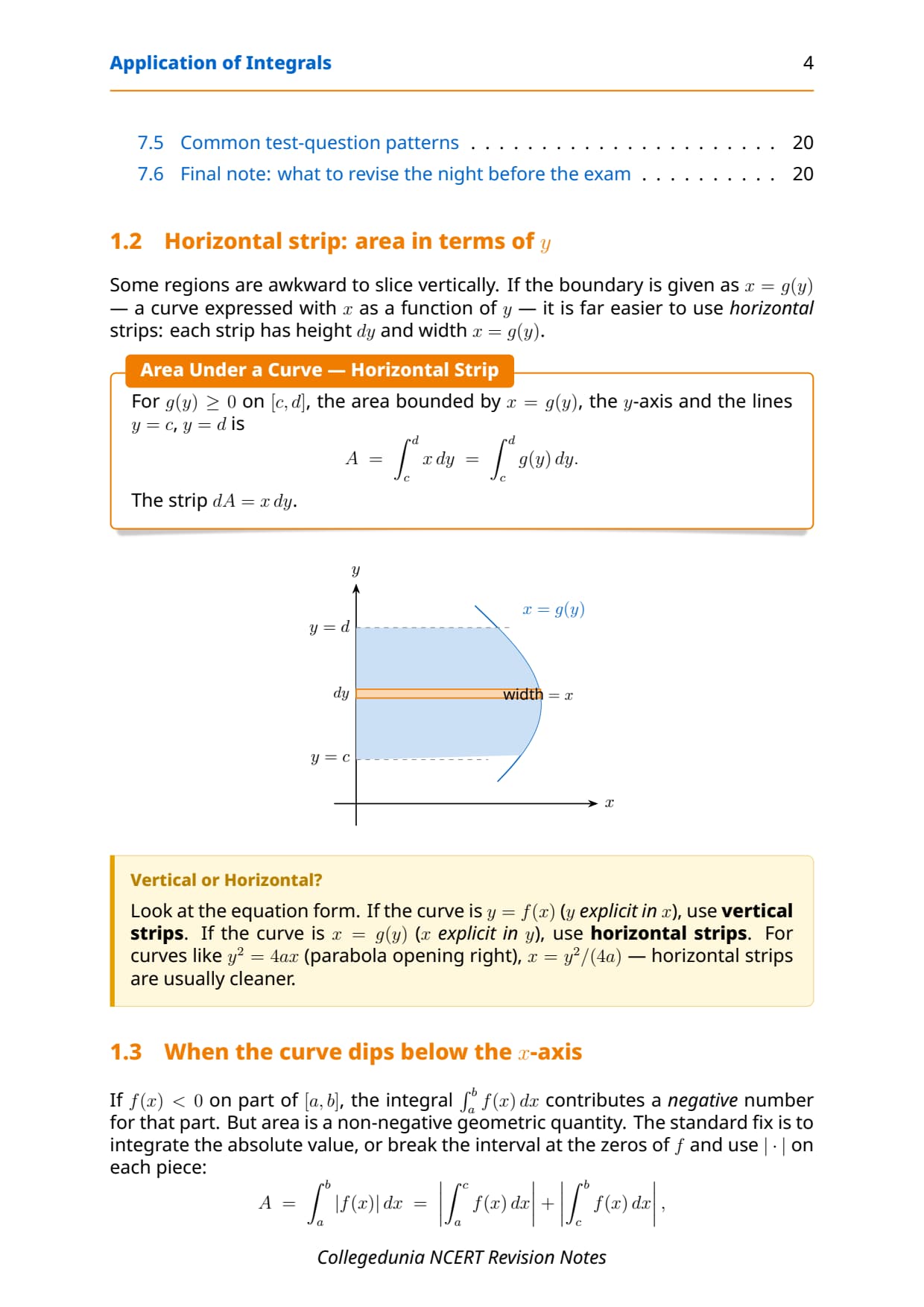
Ans. The definite integral ab f(x) dx is a signed quantity, it returns a negative value when f(x) < 0 on [a, b]. Area, however, is a purely positive geometric quantity.
So if the curve crosses the x-axis at x = c inside [a, b], the correct area is | ac f(x) dx | + | cb f(x) dx | , splitting at every zero of f and taking the absolute value of each piece before adding. Skipping the modulus is the single biggest reason a correctly integrated answer still loses 2 marks.
Ques. How many hours should I spend on Class 12 Maths Chapter 8 Application of Integrals?
Ans. Plan for 8 to 10 hours of focused study.
Spend 2 hours on the basic area-under-a-curve formulas with respect to both axes, 3 hours on area between two curves (the 5-mark question type, this needs the most practice), 2 hours on the standard region templates (circle, ellipse, parabola-line), and 1 to 2 hours on JEE-flavour variants if you are also writing JEE Main or CUET.
Add another hour for the last five years of CBSE board area questions a week before the exam, that single hour reliably converts to the full 5 marks in the actual paper.
Ques. Which area formulas from Chapter 8 should I memorise for the CBSE board exam?
Ans. Five formulas, no more. (i) A = ab y dx for area w.r.t. the x-axis, (ii) A = cd x dy for area w.r.t.
the y-axis, (iii) A = ab [f(x) - g(x)] dx for area between two curves with vertical strips, (iv) 0a √a2 - x2 dx = π a24 for the quarter-circle (it appears in almost every circle-line question), and (v) the full ellipse area π a b .
Combined with the modulus rule for sub-axis regions, these five cover every Class 12 Maths Chapter 8 question CBSE has set in the last decade.



Comments