




The NCERT Class 6 English Poorvi Chapter 5 Notes PDF helps students revise Culture and Tradition for the 2026-27 textbook. The unit covers Hamara Bharat, Kalakritiyon ka Bharat, The Kites, Ila Sachani, and the National War Memorial.
- Download the notes PDF for quick school revision.
- Revise craft traditions, poem devices, biography points and vocabulary in one place.
- Use the tables, image maps and FAQs before writing textbook answers.
Chapter5CultureandTraditionNotes.pdf?page=1&dpi=150)
Chapter5CultureandTraditionNotes.pdf?page=2&dpi=150)
Chapter5CultureandTraditionNotes.pdf?page=3&dpi=150)
Chapter5CultureandTraditionNotes.pdf?page=4&dpi=150)
Chapter5CultureandTraditionNotes.pdf?page=5&dpi=150)
Chapter5CultureandTraditionNotes.pdf?page=6&dpi=150)
Chapter5CultureandTraditionNotes.pdf?page=7&dpi=150)
Chapter5CultureandTraditionNotes.pdf?page=8&dpi=150)
Chapter5CultureandTraditionNotes.pdf?page=9&dpi=150)
Chapter5CultureandTraditionNotes.pdf?page=10&dpi=150)
Chapter5CultureandTraditionNotes.pdf?page=11&dpi=150)
Chapter5CultureandTraditionNotes.pdf?page=12&dpi=150)
Chapter5CultureandTraditionNotes.pdf?page=13&dpi=150)
Chapter5CultureandTraditionNotes.pdf?page=14&dpi=150)
Chapter5CultureandTraditionNotes.pdf?page=15&dpi=150)
Chapter5CultureandTraditionNotes.pdf?page=16&dpi=150)
Chapter5CultureandTraditionNotes.pdf?page=17&dpi=150)
Chapter5CultureandTraditionNotes.pdf?page=18&dpi=150)
Chapter5CultureandTraditionNotes.pdf?page=19&dpi=150)
Chapter5CultureandTraditionNotes.pdf?page=20&dpi=150)
Chapter5CultureandTraditionNotes.pdf?page=21&dpi=150)
Chapter5CultureandTraditionNotes.pdf?page=22&dpi=150)
Chapter5CultureandTraditionNotes.pdf?page=23&dpi=150)
Chapter5CultureandTraditionNotes.pdf?page=24&dpi=150)
Chapter5CultureandTraditionNotes.pdf?page=25&dpi=150)
Chapter5CultureandTraditionNotes.pdf?page=26&dpi=150)
Chapter5CultureandTraditionNotes.pdf?page=27&dpi=150)
Chapter5CultureandTraditionNotes.pdf?page=28&dpi=150)
Chapter5CultureandTraditionNotes.pdf?page=29&dpi=150)
Chapter5CultureandTraditionNotes.pdf?page=30&dpi=150)
Chapter5CultureandTraditionNotes.pdf?page=31&dpi=150)
Chapter5CultureandTraditionNotes.pdf?page=32&dpi=150)
Chapter5CultureandTraditionNotes_flat_MobileCard.pdf?page=1&dpi=150)
Chapter5CultureandTraditionNotes_flat_MobileCard.pdf?page=2&dpi=150)
Chapter5CultureandTraditionNotes_flat_MobileCard.pdf?page=3&dpi=150)
Chapter5CultureandTraditionNotes_flat_MobileCard.pdf?page=4&dpi=150)
Chapter5CultureandTraditionNotes_flat_MobileCard.pdf?page=5&dpi=150)
Chapter5CultureandTraditionNotes_flat_MobileCard.pdf?page=6&dpi=150)
Chapter5CultureandTraditionNotes_flat_MobileCard.pdf?page=7&dpi=150)
Chapter5CultureandTraditionNotes_flat_MobileCard.pdf?page=8&dpi=150)
Chapter5CultureandTraditionNotes_flat_MobileCard.pdf?page=9&dpi=150)
Chapter5CultureandTraditionNotes_flat_MobileCard.pdf?page=10&dpi=150)
Chapter5CultureandTraditionNotes_flat_MobileCard.pdf?page=11&dpi=150)
Chapter5CultureandTraditionNotes_flat_MobileCard.pdf?page=12&dpi=150)
Chapter5CultureandTraditionNotes_flat_MobileCard.pdf?page=13&dpi=150)
Chapter5CultureandTraditionNotes_flat_MobileCard.pdf?page=14&dpi=150)
Chapter5CultureandTraditionNotes_flat_MobileCard.pdf?page=15&dpi=150)
Chapter5CultureandTraditionNotes_flat_MobileCard.pdf?page=16&dpi=150)
Chapter5CultureandTraditionNotes_flat_MobileCard.pdf?page=17&dpi=150)
Chapter5CultureandTraditionNotes_flat_MobileCard.pdf?page=18&dpi=150)
Chapter5CultureandTraditionNotes_flat_MobileCard.pdf?page=19&dpi=150)
Chapter5CultureandTraditionNotes_flat_MobileCard.pdf?page=20&dpi=150)
Chapter5CultureandTraditionNotes_flat_MobileCard.pdf?page=21&dpi=150)
Chapter5CultureandTraditionNotes_flat_MobileCard.pdf?page=22&dpi=150)
Chapter5CultureandTraditionNotes_flat_MobileCard.pdf?page=23&dpi=150)
Chapter5CultureandTraditionNotes_flat_MobileCard.pdf?page=24&dpi=150)
Chapter5CultureandTraditionNotes_flat_MobileCard.pdf?page=25&dpi=150)
Chapter5CultureandTraditionNotes_flat_MobileCard.pdf?page=26&dpi=150)
Chapter5CultureandTraditionNotes_flat_MobileCard.pdf?page=27&dpi=150)
Chapter5CultureandTraditionNotes_flat_MobileCard.pdf?page=28&dpi=150)
Chapter5CultureandTraditionNotes_flat_MobileCard.pdf?page=29&dpi=150)
Chapter5CultureandTraditionNotes_flat_MobileCard.pdf?page=30&dpi=150)
Chapter5CultureandTraditionNotes_flat_MobileCard.pdf?page=31&dpi=150)
Chapter5CultureandTraditionNotes_flat_MobileCard.pdf?page=32&dpi=150)
Chapter5CultureandTraditionNotes_flat_MobileCard.pdf?page=33&dpi=150)
These Culture and Tradition notes follow the 2026-27 NCERT Poorvi chapter and focus on the prose, poem, biography, grammar and listening tasks students practise in class.
Student Feedback: In a Collegedunia poll of 11,980 Class 6 English students conducted before the 2026 school exams, 84% said this unit became easier after they grouped it by craft, poem, biography and remembrance.
Culture and Tradition Notes Overview
Culture and Tradition is Unit 5 of the Class 6 English Poorvi book. It teaches students that Bharat's culture includes languages, crafts, food, festivals, poetry, courage and remembrance. The safest revision method is to connect each text with one value: unity, creativity, imagination, determination or respect.
| Part of the unit | Main idea | Revision cue |
|---|---|---|
| Hamara Bharat | Unity in diversity and prosperity | Wise people, rich nature and hard work |
| Kalakritiyon ka Bharat | Regional craft traditions | Aipan, Dhokra, coconut shell craft and Kondapalli toys |
| The Kites | Imagination and sky imagery | Simile, alliteration and rhyme |
| Ila Sachani | Courage and independence through art | Family support plus determination |
Culture and Tradition Class 6 Video Recap
Source: Magnet Brains on YouTube
Kalakritiyon ka Bharat Craft Notes
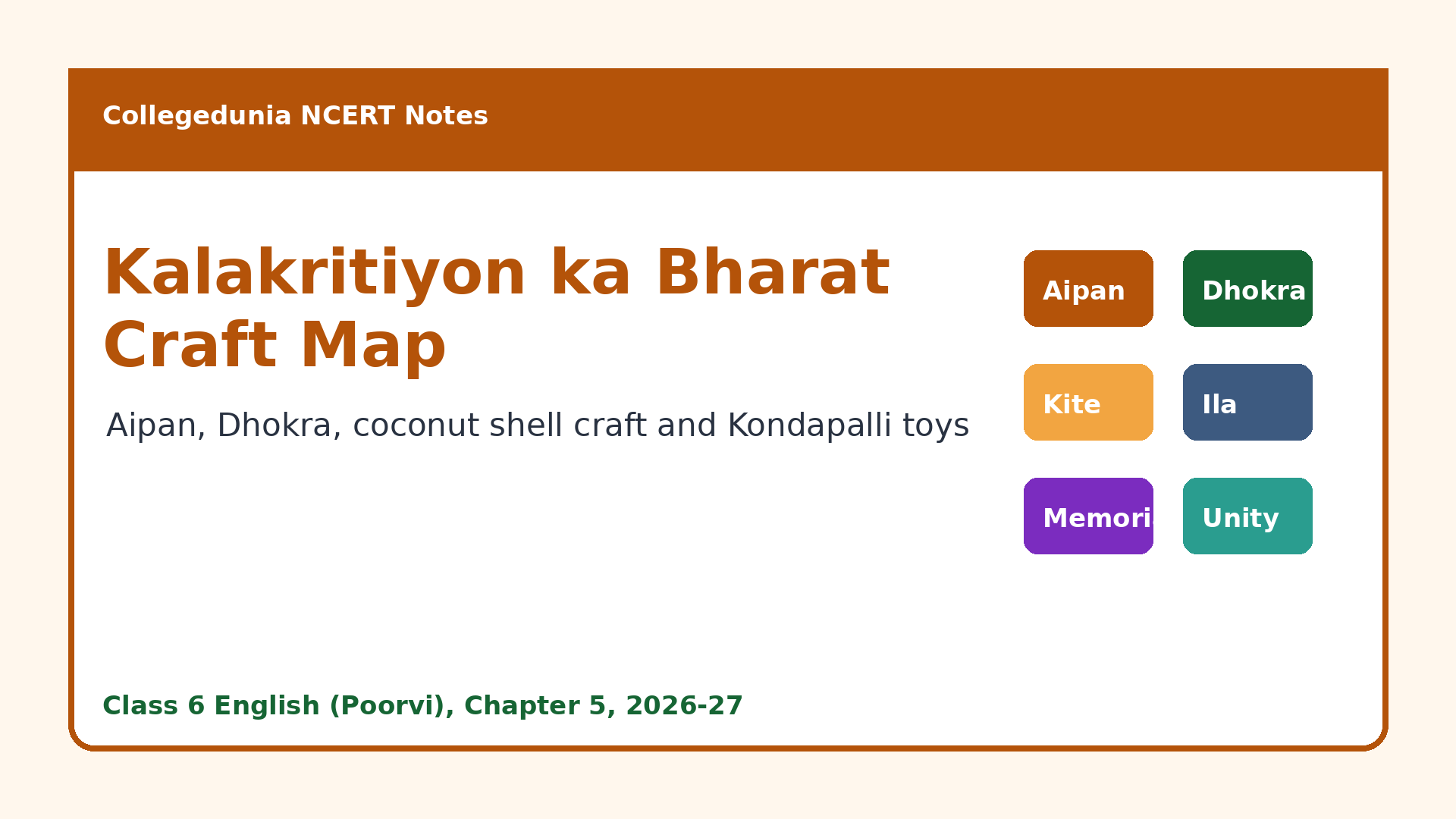
Kalakritiyon ka Bharat presents children from different states sharing their local art forms. The lesson is easy when each craft is revised by state, material and process.
- Aipan: Uttarakhand folk art made with rice flour paste on a geru base.
- Dhokra: Odisha metal craft using clay, wax, fire and brass scrap.
- Coconut shell craft: Kerala craft that turns shells into bowls, jewellery and useful objects.
- Kondapalli toys: Andhra Pradesh wooden toys made with soft wood, makku and colours.
For process answers, use sequence words such as first, after that, next, then and finally.
The Kites Poem Notes for Class 6
The Kites by Daphne Lister describes colourful kites flying in a windy sky. The speaker wishes to become small and light enough to climb on a kite, drift on paper wings and look down over parks and rooftops.
| Poem point | Meaning | Answer cue |
|---|---|---|
| Like coloured birds | Kites are compared with birds | Simile using like |
| Light as air | The child wants to be very light | Simile using as |
| Wild wind sings | The wind seems musical | Sound image |
| High, high in the air | The kite flies very high | Repetition for emphasis |
Ila Sachani Summary and Message
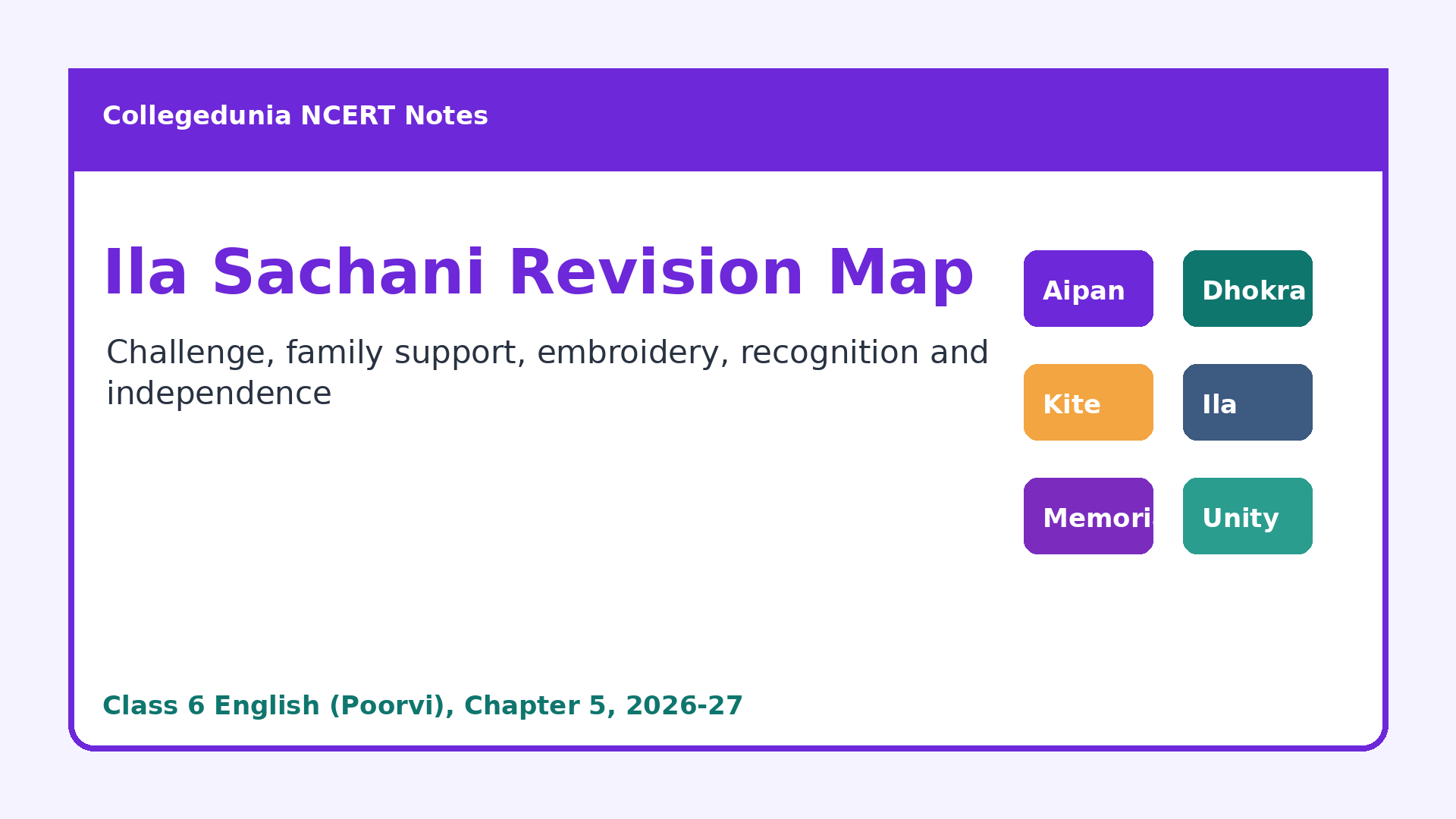
Ila Sachani's story shows how courage and support can turn a challenge into victory. Ila was born with her hands hanging loose by her sides, but her mother and grandmother taught her Kathiawar embroidery using her feet.
- Ila first made fine designs for family and friends.
- Villagers began admiring her special skill.
- A state exhibition gave her public recognition.
- She later received awards and the President's Medal.
- The main message is that focus, hard work, positivity and support can create independence.
Culture and Tradition Grammar Map
The grammar and vocabulary work in Culture and Tradition is tied to the reading sections. Students practise sequence words, simple present tense, poem devices, synonyms, antonyms and quantity words.
- Sequence words: first, after that, next, then, finally.
- Simple present: use s or es with he, she and it.
- Simile: comparison using like or as.
- Alliteration: nearby words beginning with the same consonant sound.
- Quantity words: many and few for countable nouns, much and little for uncountable nouns.
More Class 6 English Poorvi Chapter 5 Resources
Use these resources with the notes PDF when you want the official text, solved questions or a quicker visual revision path.
| Resource | Best use | Link |
|---|---|---|
| NCERT Book PDF | Read the official 2026-27 source chapter | Coming soon |
| NCERT Solutions | Practise textbook questions after revision | Coming soon |
| Handwritten Notes | Revise the unit in a topper's handwritten style | Coming soon |
All NCERT Notes for Class 6 English Poorvi Chapters
| Chapter | Title | Notes |
|---|---|---|
| Chapter 1 | Fables and Folk Tales | Open notes |
| Chapter 2 | Friendship | Open notes |
| Chapter 3 | Nurturing Nature | Coming soon |
| Chapter 4 | Sports and Wellness | Open notes |
| Chapter 5 | Culture and Tradition | Current notes |
Class 6 English Poorvi Chapter 5 Notes FAQs
Ques. What is the main theme of Culture and Tradition in Class 6 English Poorvi?
Ans. The unit shows that culture includes unity, local crafts, poetry, courage, food, festivals and respect for national memory.
Ques. Which crafts are discussed in Kalakritiyon ka Bharat?
Ans. The lesson discusses Aipan from Uttarakhand, Dhokra from Odisha, coconut shell craft from Kerala and Kondapalli toys from Andhra Pradesh.
Ques. What literary devices are used in The Kites?
Ans. The poem uses simile in like coloured birds and as light as air. It also uses alliteration and repetition to create sound and emphasis.
Ques. What message does Ila Sachani's story give?
Ans. Ila Sachani's story teaches that challenges can become victories through focus, hard work, positivity, family support and regular practice.



Comments