



The NCERT Notes for Class 6 Science Chapter 12 Beyond Earth help students revise stars, constellations, the Pole Star, planets, Moon, satellites, asteroids, comets and galaxies according to the 2026-27 Curiosity textbook.
- Best use: read the NCERT story once, then revise these notes topic by topic.
- PDF focus: sky watching, Solar System order, Moon facts and important terms.
- Chapter value: helps students answer matching, diagram and short-answer questions clearly.
Chapter12BeyondEarthNotes.pdf?page=1&dpi=150)
Chapter12BeyondEarthNotes.pdf?page=2&dpi=150)
Chapter12BeyondEarthNotes.pdf?page=3&dpi=150)
Chapter12BeyondEarthNotes.pdf?page=4&dpi=150)
Chapter12BeyondEarthNotes.pdf?page=5&dpi=150)
Chapter12BeyondEarthNotes.pdf?page=6&dpi=150)
Chapter12BeyondEarthNotes.pdf?page=7&dpi=150)
Chapter12BeyondEarthNotes.pdf?page=8&dpi=150)
Chapter12BeyondEarthNotes.pdf?page=9&dpi=150)
Chapter12BeyondEarthNotes.pdf?page=10&dpi=150)
Chapter12BeyondEarthNotes.pdf?page=11&dpi=150)
Chapter12BeyondEarthNotes.pdf?page=12&dpi=150)
Chapter12BeyondEarthNotes.pdf?page=13&dpi=150)
Chapter12BeyondEarthNotes.pdf?page=14&dpi=150)
Chapter12BeyondEarthNotes.pdf?page=15&dpi=150)
Chapter12BeyondEarthNotes.pdf?page=16&dpi=150)
Chapter12BeyondEarthNotes.pdf?page=17&dpi=150)
Chapter12BeyondEarthNotes.pdf?page=18&dpi=150)
Chapter12BeyondEarthNotes.pdf?page=19&dpi=150)
Chapter12BeyondEarthNotes.pdf?page=20&dpi=150)
Chapter12BeyondEarthNotes.pdf?page=21&dpi=150)
Chapter12BeyondEarthNotes.pdf?page=22&dpi=150)
Chapter12BeyondEarthNotes.pdf?page=23&dpi=150)
Chapter12BeyondEarthNotes_flat_MobileCard.pdf?page=1&dpi=150)
Chapter12BeyondEarthNotes_flat_MobileCard.pdf?page=2&dpi=150)
Chapter12BeyondEarthNotes_flat_MobileCard.pdf?page=3&dpi=150)
Chapter12BeyondEarthNotes_flat_MobileCard.pdf?page=4&dpi=150)
Chapter12BeyondEarthNotes_flat_MobileCard.pdf?page=5&dpi=150)
Chapter12BeyondEarthNotes_flat_MobileCard.pdf?page=6&dpi=150)
Chapter12BeyondEarthNotes_flat_MobileCard.pdf?page=7&dpi=150)
Chapter12BeyondEarthNotes_flat_MobileCard.pdf?page=8&dpi=150)
Chapter12BeyondEarthNotes_flat_MobileCard.pdf?page=9&dpi=150)
Chapter12BeyondEarthNotes_flat_MobileCard.pdf?page=10&dpi=150)
Chapter12BeyondEarthNotes_flat_MobileCard.pdf?page=11&dpi=150)
Chapter12BeyondEarthNotes_flat_MobileCard.pdf?page=12&dpi=150)
Chapter12BeyondEarthNotes_flat_MobileCard.pdf?page=13&dpi=150)
Chapter12BeyondEarthNotes_flat_MobileCard.pdf?page=14&dpi=150)
Chapter12BeyondEarthNotes_flat_MobileCard.pdf?page=15&dpi=150)
Chapter12BeyondEarthNotes_flat_MobileCard.pdf?page=16&dpi=150)
Chapter12BeyondEarthNotes_flat_MobileCard.pdf?page=17&dpi=150)
Chapter12BeyondEarthNotes_flat_MobileCard.pdf?page=18&dpi=150)
Chapter12BeyondEarthNotes_flat_MobileCard.pdf?page=19&dpi=150)
Chapter12BeyondEarthNotes_flat_MobileCard.pdf?page=20&dpi=150)
Chapter12BeyondEarthNotes_flat_MobileCard.pdf?page=21&dpi=150)
Chapter12BeyondEarthNotes_flat_MobileCard.pdf?page=22&dpi=150)
Chapter12BeyondEarthNotes_flat_MobileCard.pdf?page=23&dpi=150)
Chapter12BeyondEarthNotes_flat_MobileCard.pdf?page=24&dpi=150)
Chapter12BeyondEarthNotes_flat_MobileCard.pdf?page=25&dpi=150)
Chapter12BeyondEarthNotes_flat_MobileCard.pdf?page=26&dpi=150)
Chapter12BeyondEarthNotes_flat_MobileCard.pdf?page=27&dpi=150)
Chapter12BeyondEarthNotes_flat_MobileCard.pdf?page=28&dpi=150)
Chapter12BeyondEarthNotes_flat_MobileCard.pdf?page=29&dpi=150)
Chapter12BeyondEarthNotes_flat_MobileCard.pdf?page=30&dpi=150)
These notes follow the 2026-27 NCERT Curiosity chapter and keep the main sky facts in simple revision order.
|
Table of Contents |
Beyond Earth Class 6 Notes: What the Chapter Covers
Beyond Earth starts in Nubra, Ladakh, where dark skies make thousands of stars visible. The chapter then moves from star patterns to the Solar System and finally to the Milky Way.
| Part | What students revise | NCERT focus |
|---|---|---|
| Night sky | Stars, constellations, Orion, Sirius, Big Dipper and Pole Star. | Recognising patterns and directions. |
| Solar System | Sun, planets, moons, asteroids and comets. | Objects moving around the Sun. |
| Beyond Solar System | Milky Way Galaxy and Universe. | Our place in outer space. |
Beyond Earth One Shot Revision Video
Source: Magnet Brains on YouTube
Stars and Constellations in Beyond Earth
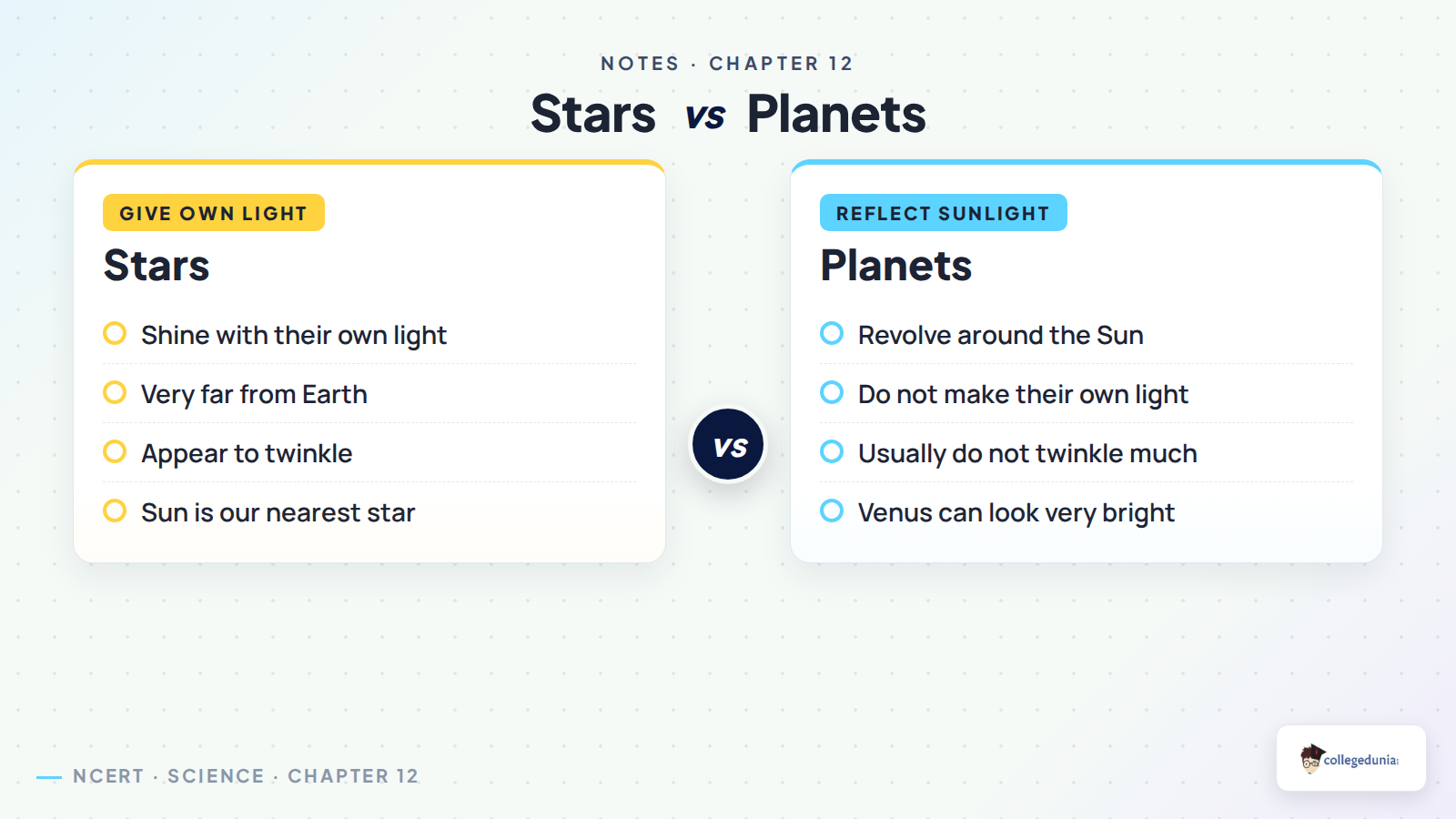
Stars shine with their own light. Some stars look bright, while others look dim. Groups of stars may appear to form patterns, but the connecting lines are imagined by people.
- Constellation: a defined region of sky that often includes a star pattern.
- Orion: often shown as a hunter, with three bright stars in the belt.
- Sirius: the brightest star in the night sky.
- 88 constellations are officially listed by the International Astronomical Union.
Pole Star and Direction Finding in Beyond Earth
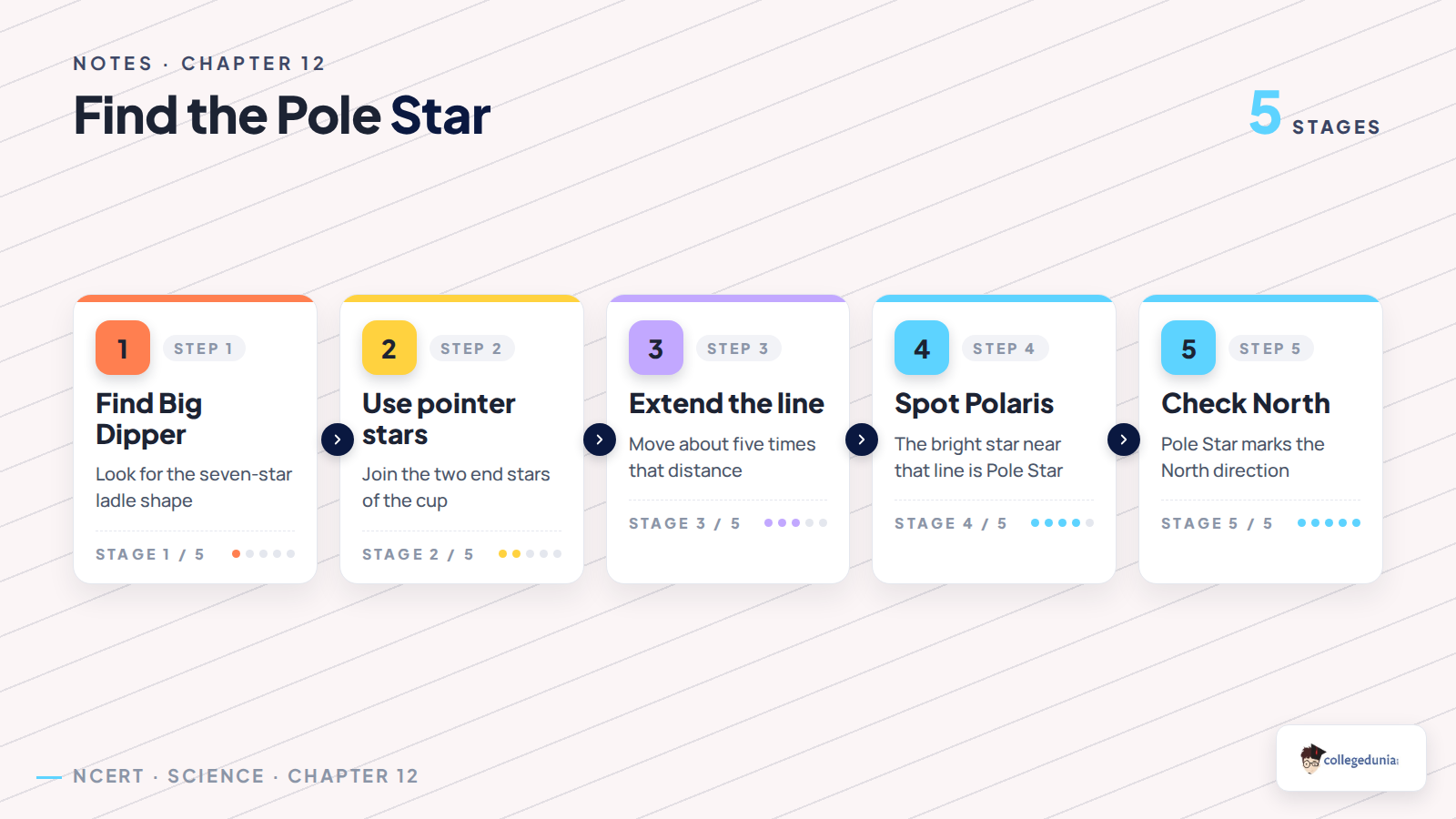
The Pole Star or Polaris appears nearly fixed in the northern sky. This makes it useful for finding the North direction in the Northern hemisphere.
- Find the Big Dipper in the northern sky.
- Look at the two stars at the end of its cup.
- Imagine a straight line through them.
- Move about five times that distance to reach the Pole Star.
In India, the Big Dipper is called Saptarishi, and the Pole Star is called Dhruva Tara.
Planets and Solar System Order in Beyond Earth
The Sun is a star and the main source of heat and light for Earth. A planet is a large, nearly spherical object that revolves around the Sun.
| Planet group | Planets | Key point |
|---|---|---|
| Inner planets | Mercury, Venus, Earth, Mars | Smaller and rocky. |
| Outer planets | Jupiter, Saturn, Uranus, Neptune | Larger and mostly gas or ice. |
| Dwarf planet | Pluto | Beyond Neptune and smaller than Earth's Moon. |
Learn the order: Mercury, Venus, Earth, Mars, Jupiter, Saturn, Uranus, Neptune. Venus is a planet, even though it is called the Morning Star or Evening Star.
Moon Phases and Satellites in Beyond Earth
A satellite is an object that moves around a planet. The Moon is Earth's natural satellite. It takes about 27 days to complete one revolution around Earth.
- The Moon is about one quarter of Earth's diameter.
- The Moon is about 3,84,000 km away from Earth.
- Its surface has craters formed by rocks from space.
- Moon phases mean the changing visible shape of the Moon on different nights.
The NCERT chapter focuses on the Moon as a satellite, its distance, surface and revolution. Use Moon phases as an observation point while watching the sky.
Asteroids, Comets, Milky Way and Universe
The Solar System includes the Sun, eight planets, their moons and smaller objects. Asteroids are rocky, irregular objects. Many move between Mars and Jupiter in the asteroid belt.
- Comets: icy-rocky objects that form tails when they come near the Sun.
- Halley's Comet: appears about every 76 years.
- Milky Way: our home galaxy, also called Akash Ganga.
- Universe: all galaxies, stars, planets and space beyond them.
Observing the Sky Safely for Beyond Earth
Sky watching is best from a dark open area. City lights, dust and smoke make fewer stars visible. Light pollution means too much artificial light at night.
- Go only with adults to a safe open place.
- Choose a clear, cloudless night.
- Wait about half an hour for your eyes to adjust.
- Use a sky map app, printed chart or compass.
Do not look at the Sun through binoculars or a telescope. For night events, visit a planetarium, science museum or astronomy club with adults.
Important Terms in Beyond Earth Notes
| Term | Meaning |
|---|---|
| Revolution | Movement of an object around another object. |
| Solar System | The Sun, planets, moons, asteroids and comets together. |
| Constellation | A defined sky region with a recognisable star pattern. |
| Galaxy | A huge group of millions to billions of stars. |
| Exoplanet | A planet that revolves around another star outside our Solar System. |
Common Mistakes Students Make in Beyond Earth
Many students lose marks by mixing everyday names with science terms. Check these points before writing answers.
- Do not call Venus a star. It is a planet.
- Do not write Pluto as one of the eight planets.
- Do not say constellation lines are real lines in the sky.
- Do not confuse rotation with revolution.
- Do not write that all planets are rocky.
How to Use the Beyond Earth Notes PDF
Use the PDF after reading the textbook once. Start with the table of terms, then revise the planet order and sky-watching steps.
- Write the eight planets from memory.
- Draw the Big Dipper and mark the Pole Star.
- Make a two-column table for stars and planets.
- Revise Moon, asteroid, comet and Milky Way facts.
Student Feedback on Beyond Earth Notes
Student Feedback: In a Collegedunia Class 6 Science check conducted before the 2026 school cycle, 12,860 students said Beyond Earth became easier after revising the sky objects in groups.
- 74% of students remembered planet order faster with one line of practice.
- 69% of students mixed up stars, planets and satellites before using a comparison table.
- 71% of students found Pole Star questions easier after drawing the Big Dipper.
Related Class 6 Science Resources for Beyond Earth
| Resource | Use it for | Link |
|---|---|---|
| NCERT Solutions | Check textbook exercise answers. | Beyond Earth Class 6 Solutions |
| NCERT Book PDF | Read the official chapter text. | Beyond Earth NCERT Book PDF |
| Handwritten Notes | Use quick handwritten revision. | Beyond Earth Handwritten Notes |
More Class 6 Science Notes
| Chapter | Notes Link |
|---|---|
| Chapter 9 Methods of Separation in Everyday Life | Open Chapter 9 Notes |
| Chapter 10 Living Creatures: Exploring their Characteristics | Open Chapter 10 Notes |
| Chapter 11 Nature's Treasures | Open Chapter 11 Notes |
Beyond Earth Class 6 Science Notes FAQs
Ques. What is covered in Class 6 Science Chapter 12 Beyond Earth notes?
Ans. The notes cover stars, constellations, Pole Star, planets, Solar System, Moon, satellites, asteroids, comets, Milky Way and Universe.
Ques. What is the correct order of planets in Beyond Earth?
Ans. The correct order is Mercury, Venus, Earth, Mars, Jupiter, Saturn, Uranus and Neptune.
Ques. Why is the Pole Star useful?
Ans. The Pole Star appears nearly fixed in the North direction, so it helps students locate north in the Northern hemisphere.
Ques. Is Venus a star in Class 6 Science Beyond Earth?
Ans. No. Venus is a planet. It is called the Morning Star or Evening Star because it shines brightly near dawn or dusk.
Ques. Are these notes based on the 2026-27 NCERT Curiosity textbook?
Ans. Yes. These notes follow Class 6 Science Curiosity Chapter 12 Beyond Earth for the 2026-27 NCERT syllabus.



Comments