



Inside the Large Numbers Around Us Class 7 notes, you will find place-value charts, rounding rules, and quick multiplication methods. The explanations follow the 2026-27 NCERT Mathematics (Part 1) chapter. They also connect lakhs and crores with millions and billions through clear examples.
- Chapter coverage: Six textbook sections, from one lakh to large-number thought experiments.
- Key skills: Read, compare, round, estimate, regroup, multiply, and divide large numbers.
- Revision focus: Indian and International place value, nearest neighbours, and product patterns.
Chapter1LargeNumbersAroundUsNotes.pdf?page=1&dpi=150)
Chapter1LargeNumbersAroundUsNotes.pdf?page=2&dpi=150)
Chapter1LargeNumbersAroundUsNotes.pdf?page=3&dpi=150)
Chapter1LargeNumbersAroundUsNotes.pdf?page=4&dpi=150)
Chapter1LargeNumbersAroundUsNotes.pdf?page=5&dpi=150)
Chapter1LargeNumbersAroundUsNotes.pdf?page=6&dpi=150)
Chapter1LargeNumbersAroundUsNotes.pdf?page=7&dpi=150)
Chapter1LargeNumbersAroundUsNotes.pdf?page=8&dpi=150)
Chapter1LargeNumbersAroundUsNotes.pdf?page=9&dpi=150)
Chapter1LargeNumbersAroundUsNotes.pdf?page=10&dpi=150)
Chapter1LargeNumbersAroundUsNotes.pdf?page=11&dpi=150)
Chapter1LargeNumbersAroundUsNotes.pdf?page=12&dpi=150)
Chapter1LargeNumbersAroundUsNotes.pdf?page=13&dpi=150)
Chapter1LargeNumbersAroundUsNotes.pdf?page=14&dpi=150)
Chapter1LargeNumbersAroundUsNotes.pdf?page=15&dpi=150)
Chapter1LargeNumbersAroundUsNotes.pdf?page=16&dpi=150)
Chapter1LargeNumbersAroundUsNotes.pdf?page=17&dpi=150)
Chapter1LargeNumbersAroundUsNotes.pdf?page=18&dpi=150)
Chapter1LargeNumbersAroundUsNotes.pdf?page=19&dpi=150)
Chapter1LargeNumbersAroundUsNotes.pdf?page=20&dpi=150)
Chapter1LargeNumbersAroundUsNotes_flat_MobileCard.pdf?page=1&dpi=150)
Chapter1LargeNumbersAroundUsNotes_flat_MobileCard.pdf?page=2&dpi=150)
Chapter1LargeNumbersAroundUsNotes_flat_MobileCard.pdf?page=3&dpi=150)
Chapter1LargeNumbersAroundUsNotes_flat_MobileCard.pdf?page=4&dpi=150)
Chapter1LargeNumbersAroundUsNotes_flat_MobileCard.pdf?page=5&dpi=150)
Chapter1LargeNumbersAroundUsNotes_flat_MobileCard.pdf?page=6&dpi=150)
Chapter1LargeNumbersAroundUsNotes_flat_MobileCard.pdf?page=7&dpi=150)
Chapter1LargeNumbersAroundUsNotes_flat_MobileCard.pdf?page=8&dpi=150)
Chapter1LargeNumbersAroundUsNotes_flat_MobileCard.pdf?page=9&dpi=150)
Chapter1LargeNumbersAroundUsNotes_flat_MobileCard.pdf?page=10&dpi=150)
Chapter1LargeNumbersAroundUsNotes_flat_MobileCard.pdf?page=11&dpi=150)
Chapter1LargeNumbersAroundUsNotes_flat_MobileCard.pdf?page=12&dpi=150)
Chapter1LargeNumbersAroundUsNotes_flat_MobileCard.pdf?page=13&dpi=150)
Chapter1LargeNumbersAroundUsNotes_flat_MobileCard.pdf?page=14&dpi=150)
Chapter1LargeNumbersAroundUsNotes_flat_MobileCard.pdf?page=15&dpi=150)
Chapter1LargeNumbersAroundUsNotes_flat_MobileCard.pdf?page=16&dpi=150)
Chapter1LargeNumbersAroundUsNotes_flat_MobileCard.pdf?page=17&dpi=150)
Chapter1LargeNumbersAroundUsNotes_flat_MobileCard.pdf?page=18&dpi=150)
Chapter1LargeNumbersAroundUsNotes_flat_MobileCard.pdf?page=19&dpi=150)
Chapter1LargeNumbersAroundUsNotes_flat_MobileCard.pdf?page=20&dpi=150)
Chapter1LargeNumbersAroundUsNotes_flat_MobileCard.pdf?page=21&dpi=150)
Chapter1LargeNumbersAroundUsNotes_flat_MobileCard.pdf?page=22&dpi=150)
Chapter1LargeNumbersAroundUsNotes_flat_MobileCard.pdf?page=23&dpi=150)
Chapter1LargeNumbersAroundUsNotes_flat_MobileCard.pdf?page=24&dpi=150)
Chapter1LargeNumbersAroundUsNotes_flat_MobileCard.pdf?page=25&dpi=150)
Chapter1LargeNumbersAroundUsNotes_flat_MobileCard.pdf?page=26&dpi=150)
Chapter1LargeNumbersAroundUsNotes_flat_MobileCard.pdf?page=27&dpi=150)
Chapter1LargeNumbersAroundUsNotes_flat_MobileCard.pdf?page=28&dpi=150)
Chapter1LargeNumbersAroundUsNotes_flat_MobileCard.pdf?page=29&dpi=150)
These Collegedunia notes follow the 2026-27 NCERT chapter and keep every rule close to a textbook example.
Large Numbers Around Us Topic Map for Class 7 Maths
The chapter starts with one lakh and then moves to crores, arabs, millions, and billions. Use this map to plan a quick revision.
| Topic | What to remember | Priority |
|---|---|---|
| Reading large numbers | Indian commas follow 3-2-2; International commas follow 3-3-3 | High |
| Place value | A digit's value depends on its position | High |
| Rounding and estimation | Choose a suitable place and decide whether to round up or down | High |
| Products and quotients | Regroup factors to make calculations shorter | Medium |
| Digit patterns | Use lower and upper limits to predict a product's length | Medium |
Large Numbers Around Us Video Lesson
Source: Magnet Brains on YouTube
Indian and International Place Value Systems Compared
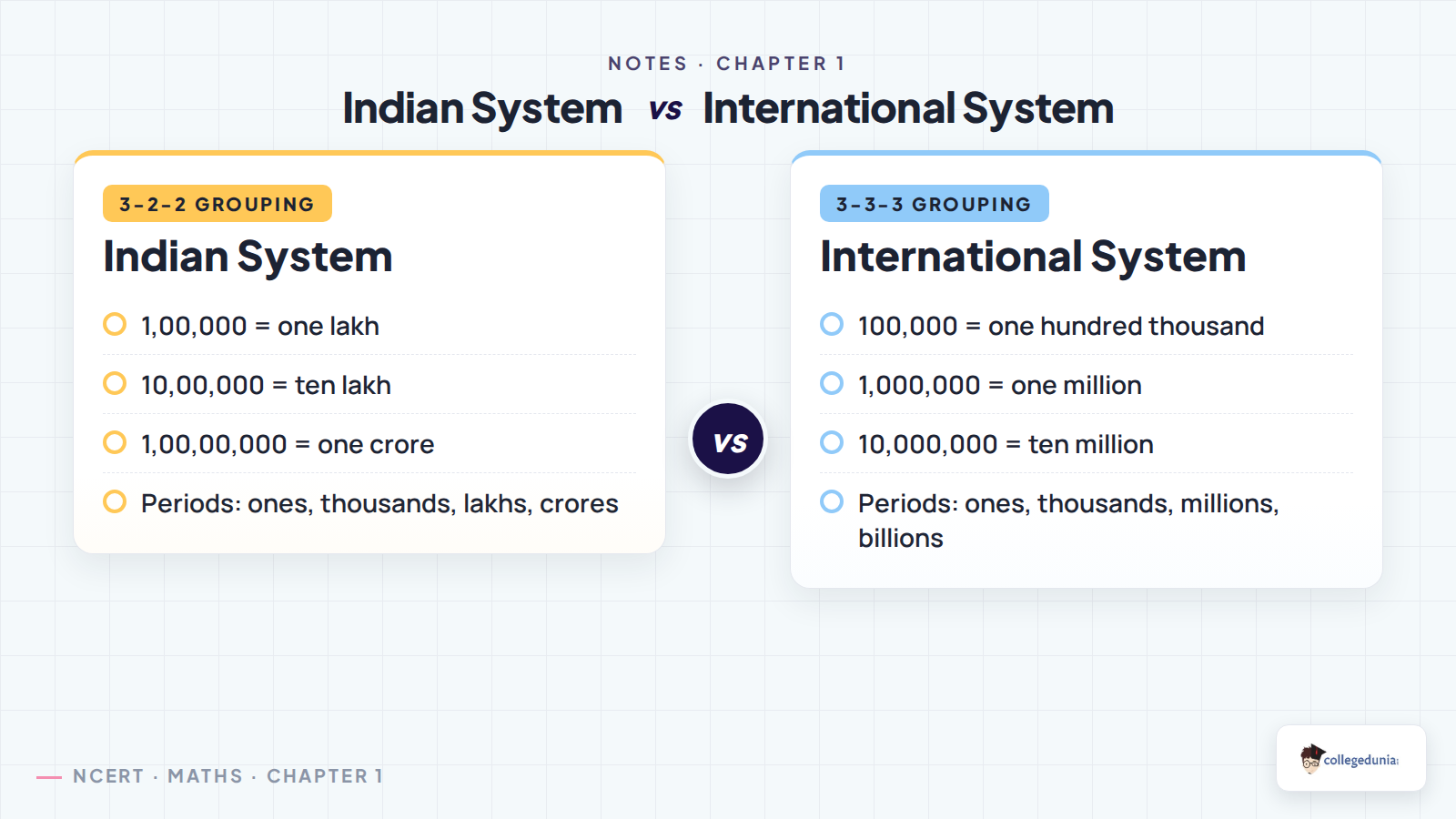
The same numeral gets different comma groups and number names in the two systems. The value itself does not change.
| Value | Indian system | International system |
|---|---|---|
| 100,000 | 1,00,000 - one lakh | 100,000 - one hundred thousand |
| 1,000,000 | 10,00,000 - ten lakh | 1,000,000 - one million |
| 10,000,000 | 1,00,00,000 - one crore | 10,000,000 - ten million |
| 1,000,000,000 | 1,00,00,00,000 - one arab | 1,000,000,000 - one billion |
One million equals ten lakh, while one billion equals one hundred crore.
Place Value and Minimum Button Clicks Explained
Creative Chitti shows that a number can be split in many ways. Systematic Sippy asks for the fewest button clicks.
- Expanded form: 5,072 = (5 × 1,000) + (7 × 10) + (2 × 1).
- Minimum clicks: Add the digits in standard expanded form: 5 + 0 + 7 + 2 = 14.
- Regrouping: 5,072 can also be written as (50 × 100) + (7 × 10) + 2.
Rounding, Nearest Neighbours and Estimation Rules
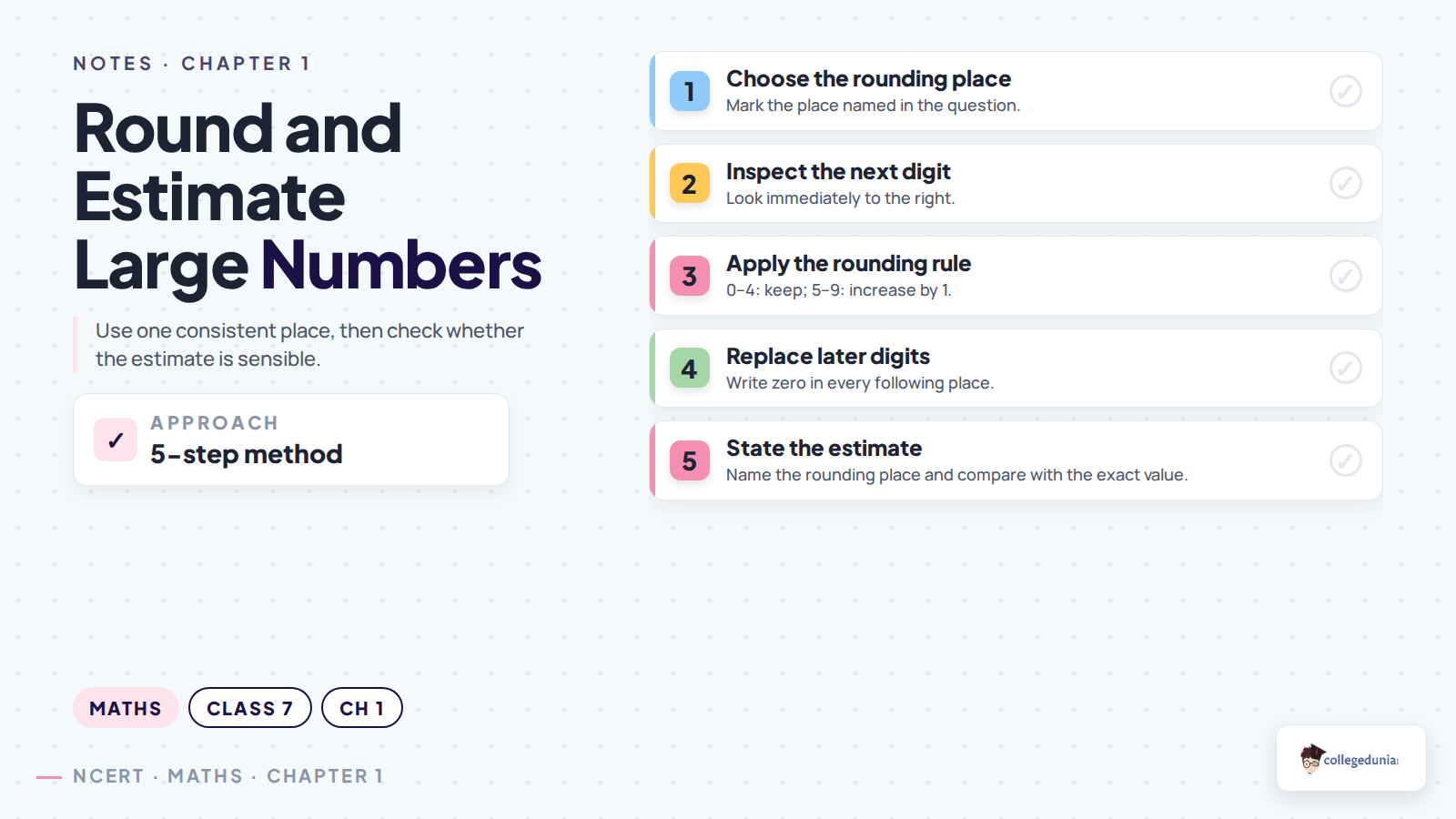
Rounding gives a useful nearby value. Exact numbers are still needed for phone numbers, money paid, and final calculations.
- Choose the place to which you want to round.
- Check the digit immediately to its right.
- Keep the chosen digit for 0 to 4; increase it for 5 to 9.
- Replace all following digits with zeroes.
For example, 6,72,85,183 rounds to 6,73,00,000 at the nearest lakh. Estimate first, then calculate exactly to check if the answer is sensible.
Large Number Product Patterns and Quick Calculations
The chapter uses factor regrouping to shorten multiplication. It also links factor length with the possible length of a product.
- Multiply by 5: divide by 2, then multiply by 10.
- Multiply by 25: divide by 4, then multiply by 100.
- Multiply by 125: divide by 8, then multiply by 1,000.
- Two 2-digit factors: their product has 3 or 4 digits.
- Two 3-digit factors: their product has 5 or 6 digits.
Reason: 10 × 10 = 100, while 99 × 99 is less than 100 × 100 = 10,000.
Common Mistakes in the Large Numbers Around Us Chapter
Most errors come from comma placement or choosing an unsuitable rounded value. Check these points before submitting an answer.
- Do not mix the Indian 3-2-2 grouping with the International 3-3-3 grouping.
- Do not change the number's value when moving commas.
- State the rounding place, such as nearest thousand or nearest lakh.
- Use exact values when the question asks for an exact difference.
Large Number Calculation Self-Check
Before finalising an answer, read the numeral once in the chosen place-value system, check every comma group, and compare the exact result with a quick estimate.
A sensible estimate catches many misplaced-zero and wrong-operation errors.
Large Numbers Around Us Class 7 Related Resources
Use the textbook for activities, the solutions for answers, and the formula sheet for a short recap.
| Resource | Link |
|---|---|
| NCERT Solutions | Large Numbers Around Us Class 7 NCERT Solutions |
| Notes | Large Numbers Around Us Class 7 Notes |
| Formula Sheet | Large Numbers Around Us Class 7 Formula Sheet |
| NCERT Book PDF | Large Numbers Around Us Class 7 NCERT Book PDF |
| Handwritten Notes | Large Numbers Around Us Class 7 Handwritten Notes |
NCERT Notes for Class 7 Mathematics (Part 1): All Chapters
This table links every Part 1 chapter for quick movement during revision.
| Chapter | Resource |
|---|---|
| Chapter 1 | Large Numbers Around Us Notes |
| Chapter 2 | Arithmetic Expressions Notes |
| Chapter 3 | A Peek Beyond the Point Notes |
| Chapter 4 | Expressions Using Letter-Numbers Notes |
| Chapter 5 | Parallel and Intersecting Lines Notes |
| Chapter 6 | Number Play Notes |
| Chapter 7 | A Tale of Three Intersecting Lines Notes |
| Chapter 8 | Working with Fractions Notes |
Large Numbers Around Us Class 7 Maths Notes FAQs
Ques. What is one lakh?
Ans. One lakh is 1,00,000. It is one followed by five zeroes.
Ques. What is one crore?
Ans. One crore is 1,00,00,000. It equals one hundred lakh or ten million.
Ques. How are commas placed in the Indian place value system?
Ans. Keep three digits at the right. Then group the remaining digits in pairs from right to left.
Ques. How are commas placed in the International place value system?
Ans. Group the digits in sets of three from right to left.
Ques. When should a number be rounded up?
Ans. Round up when the next digit is 5 to 9, or when a safe upper estimate is needed.
Ques. Are these notes based on the 2026-27 NCERT syllabus?
Ans. Yes. The notes follow the 2026-27 reprint of Ganita Prakash, Mathematics (Part 1), for Grade 7.



Comments