



Inside the A Peek Beyond the Point Class 7 notes, you will find tenths, hundredths, decimal place value, and clear calculation methods. The explanations follow the 2026-27 NCERT Mathematics (Part 1) chapter. They connect fractions with decimal notation through measurement and place-value examples.
- Chapter coverage: Smaller units, tenths, hundredths, decimal notation, measurement conversions, comparison, addition, and subtraction.
- Key idea: Each place is ten times the place immediately to its right.
- Revision focus: Read decimals correctly and regroup tenths or hundredths during calculations.
Chapter3APeekBeyondthePointNotes.pdf?page=1&dpi=150)
Chapter3APeekBeyondthePointNotes.pdf?page=2&dpi=150)
Chapter3APeekBeyondthePointNotes.pdf?page=3&dpi=150)
Chapter3APeekBeyondthePointNotes.pdf?page=4&dpi=150)
Chapter3APeekBeyondthePointNotes.pdf?page=5&dpi=150)
Chapter3APeekBeyondthePointNotes.pdf?page=6&dpi=150)
Chapter3APeekBeyondthePointNotes.pdf?page=7&dpi=150)
Chapter3APeekBeyondthePointNotes.pdf?page=8&dpi=150)
Chapter3APeekBeyondthePointNotes.pdf?page=9&dpi=150)
Chapter3APeekBeyondthePointNotes.pdf?page=10&dpi=150)
Chapter3APeekBeyondthePointNotes.pdf?page=11&dpi=150)
Chapter3APeekBeyondthePointNotes.pdf?page=12&dpi=150)
Chapter3APeekBeyondthePointNotes.pdf?page=13&dpi=150)
Chapter3APeekBeyondthePointNotes.pdf?page=14&dpi=150)
Chapter3APeekBeyondthePointNotes.pdf?page=15&dpi=150)
Chapter3APeekBeyondthePointNotes.pdf?page=16&dpi=150)
Chapter3APeekBeyondthePointNotes.pdf?page=17&dpi=150)
Chapter3APeekBeyondthePointNotes.pdf?page=18&dpi=150)
Chapter3APeekBeyondthePointNotes.pdf?page=19&dpi=150)
Chapter3APeekBeyondthePointNotes.pdf?page=20&dpi=150)
Chapter3APeekBeyondthePointNotes.pdf?page=21&dpi=150)
Chapter3APeekBeyondthePointNotes.pdf?page=22&dpi=150)
Chapter3APeekBeyondthePointNotes.pdf?page=23&dpi=150)
Chapter3APeekBeyondthePointNotes_flat_MobileCard.pdf?page=1&dpi=150)
Chapter3APeekBeyondthePointNotes_flat_MobileCard.pdf?page=2&dpi=150)
Chapter3APeekBeyondthePointNotes_flat_MobileCard.pdf?page=3&dpi=150)
Chapter3APeekBeyondthePointNotes_flat_MobileCard.pdf?page=4&dpi=150)
Chapter3APeekBeyondthePointNotes_flat_MobileCard.pdf?page=5&dpi=150)
Chapter3APeekBeyondthePointNotes_flat_MobileCard.pdf?page=6&dpi=150)
Chapter3APeekBeyondthePointNotes_flat_MobileCard.pdf?page=7&dpi=150)
Chapter3APeekBeyondthePointNotes_flat_MobileCard.pdf?page=8&dpi=150)
Chapter3APeekBeyondthePointNotes_flat_MobileCard.pdf?page=9&dpi=150)
Chapter3APeekBeyondthePointNotes_flat_MobileCard.pdf?page=10&dpi=150)
Chapter3APeekBeyondthePointNotes_flat_MobileCard.pdf?page=11&dpi=150)
Chapter3APeekBeyondthePointNotes_flat_MobileCard.pdf?page=12&dpi=150)
Chapter3APeekBeyondthePointNotes_flat_MobileCard.pdf?page=13&dpi=150)
Chapter3APeekBeyondthePointNotes_flat_MobileCard.pdf?page=14&dpi=150)
Chapter3APeekBeyondthePointNotes_flat_MobileCard.pdf?page=15&dpi=150)
Chapter3APeekBeyondthePointNotes_flat_MobileCard.pdf?page=16&dpi=150)
Chapter3APeekBeyondthePointNotes_flat_MobileCard.pdf?page=17&dpi=150)
Chapter3APeekBeyondthePointNotes_flat_MobileCard.pdf?page=18&dpi=150)
Chapter3APeekBeyondthePointNotes_flat_MobileCard.pdf?page=19&dpi=150)
Chapter3APeekBeyondthePointNotes_flat_MobileCard.pdf?page=20&dpi=150)
Chapter3APeekBeyondthePointNotes_flat_MobileCard.pdf?page=21&dpi=150)
Chapter3APeekBeyondthePointNotes_flat_MobileCard.pdf?page=22&dpi=150)
Chapter3APeekBeyondthePointNotes_flat_MobileCard.pdf?page=23&dpi=150)
Chapter3APeekBeyondthePointNotes_flat_MobileCard.pdf?page=24&dpi=150)
Chapter3APeekBeyondthePointNotes_flat_MobileCard.pdf?page=25&dpi=150)
Chapter3APeekBeyondthePointNotes_flat_MobileCard.pdf?page=26&dpi=150)
Chapter3APeekBeyondthePointNotes_flat_MobileCard.pdf?page=27&dpi=150)
Chapter3APeekBeyondthePointNotes_flat_MobileCard.pdf?page=28&dpi=150)
Chapter3APeekBeyondthePointNotes_flat_MobileCard.pdf?page=29&dpi=150)
Chapter3APeekBeyondthePointNotes_flat_MobileCard.pdf?page=30&dpi=150)
Chapter3APeekBeyondthePointNotes_flat_MobileCard.pdf?page=31&dpi=150)
Chapter3APeekBeyondthePointNotes_flat_MobileCard.pdf?page=32&dpi=150)
A Peek Beyond the Point Topic Map for Class 7 Maths
The chapter starts with accurate measurement and builds the decimal system one place at a time. Use this map for a quick first reading.
| Topic | Main idea | Revision priority |
|---|---|---|
| Smaller units | A unit can be split for a more exact measurement | High |
| Tenths | Ten one-tenths make one whole unit | High |
| Hundredths | Ten one-hundredths make one-tenth | High |
| Decimal place value | The decimal point separates whole-number and fractional places | High |
| Measurement conversions | Centimetres, grams, and paise can be written as decimal metres, kilograms, and rupees | High |
| Operations | Regroup equal places while adding or subtracting | High |
A Peek Beyond the Point Explained for Class 7
Source: Magnet Brains on YouTube
Tenths and Hundredths in A Peek Beyond the Point
Ten equal parts of one unit are called tenths. One part is one-tenth, written as 1/10. A length of 2 and 7/10 units means two whole units and seven tenths.
- 10 tenths = 1 unit.
- 34 tenths = 3 units and 4 tenths.
- 10 hundredths = 1 tenth.
- 100 hundredths = 1 unit.
When each tenth is split into ten equal parts, each small part is one-hundredth. Use smaller units when the answer must be more exact.
Decimal Place Value and the Role of the Decimal Point
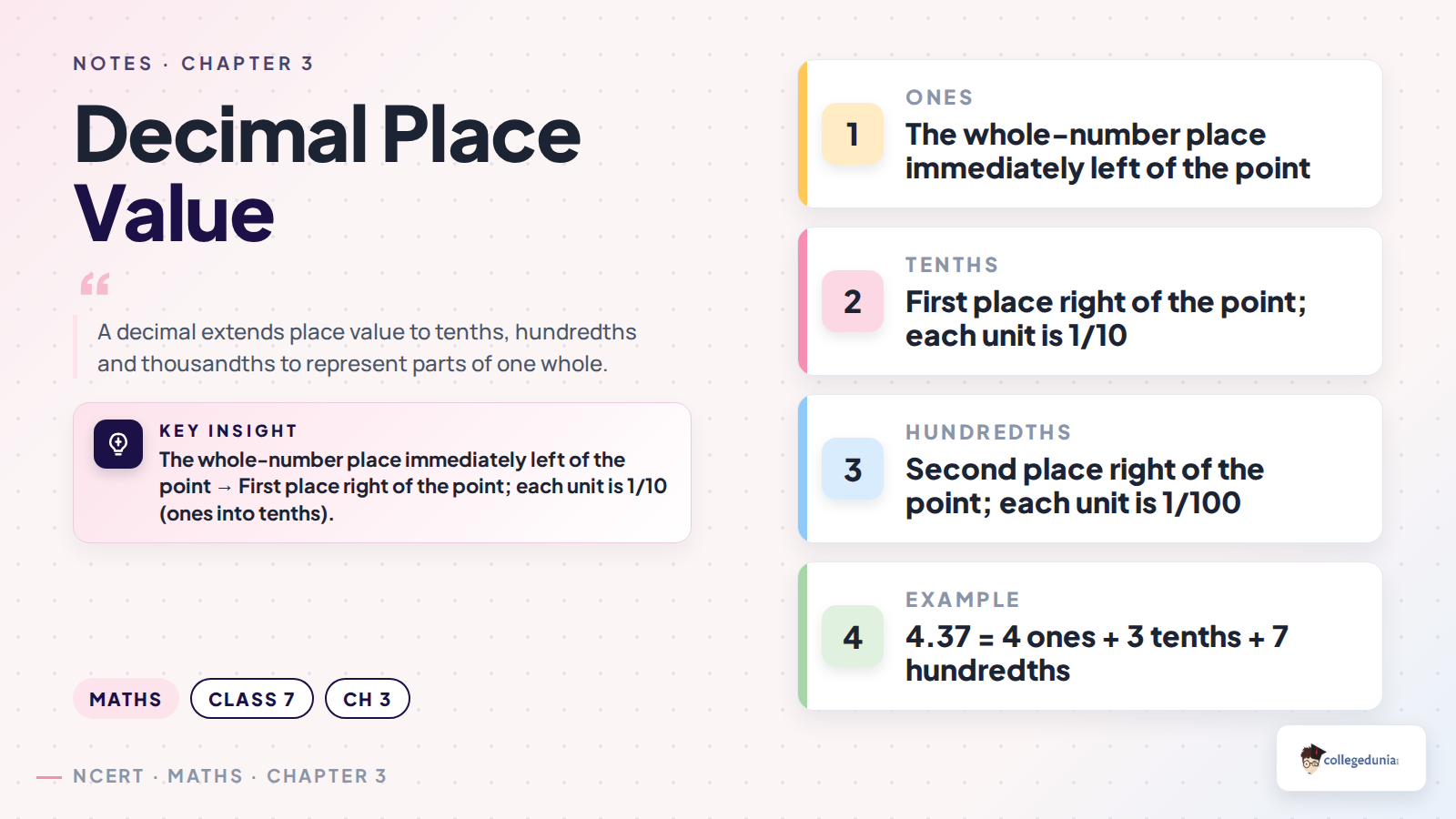
The decimal system extends ordinary place value to quantities smaller than one. Every step to the right makes the place value ten times smaller.
| Number | Place-value meaning | How to read it |
|---|---|---|
| 705 | 7 hundreds and 5 ones | Seven hundred and five |
| 70.5 | 7 tens and 5 tenths | Seventy point five |
| 7.05 | 7 ones and 5 hundredths | Seven point zero five |
| 0.274 | 2 tenths, 7 hundredths, and 4 thousandths | Zero point two seven four |
Read every digit after the decimal point separately. This keeps 7.05 different from 7.5.
Comparing Decimals with a Place-Value Table
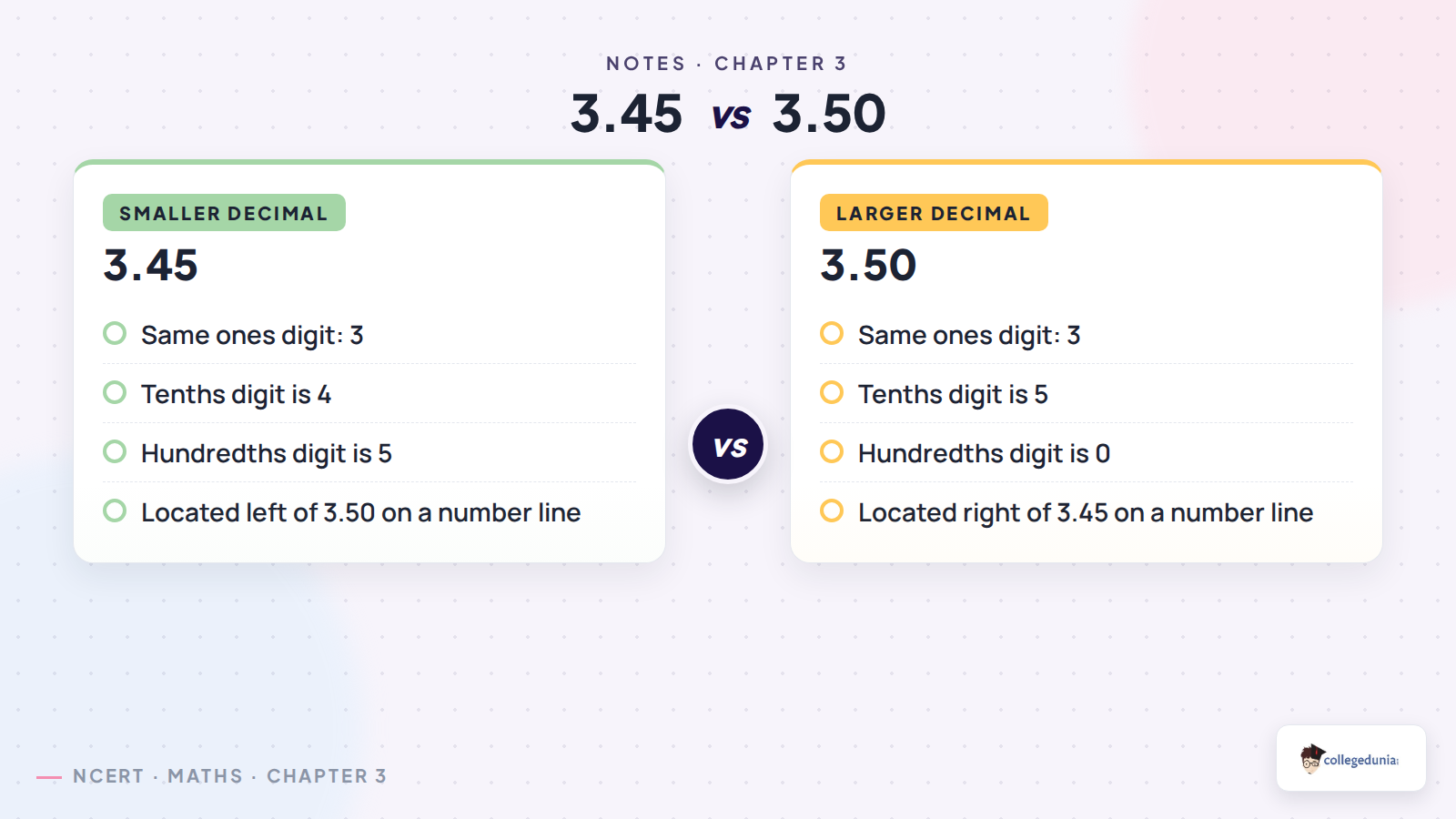
Compare whole-number parts first. If they match, compare tenths, then hundredths, and continue from left to right.
- Write the decimal points in one vertical line.
- Add zeroes at the right when helpful.
- Compare digits in the same place.
- Mark the first place where the digits differ.
For example, 3.60 and 3.6 name the same value. But 3.06 is smaller because it has zero tenths.
Measurement Conversions with Decimals
NCERT connects decimal notation with length, weight, and money. Smaller units become decimal parts of the larger unit.
| Conversion | Decimal form | Place-value reason |
|---|---|---|
| 37 cm to metres | 37 cm = 0.37 m | 100 cm make 1 m, so centimetres are hundredths of a metre |
| 750 g to kilograms | 750 g = 0.750 kg | 1000 g make 1 kg, so grams are thousandths of a kilogram |
| 7 rupees 5 paise | Rs 7.05 | 100 paise make 1 rupee, so paise use two decimal places |
Always check the unit before moving the decimal point. The number gets smaller when you express a smaller unit in a larger unit.
Adding and Subtracting Tenths and Hundredths
Only equal place values should be combined. Keep units under units, tenths under tenths, and hundredths under hundredths.
- Regroup 10 hundredths as 1 tenth.
- Regroup 10 tenths as 1 whole unit.
- For subtraction, split one whole into 10 tenths when needed.
- Split one tenth into 10 hundredths when needed.
Common Mistakes in A Peek Beyond the Point
Most errors come from mixing place values or reading decimals like whole numbers. Check these points before finalising an answer.
- Do not treat 7.05 as 7.5.
- Do not compare decimal digits without matching their places.
- Do not write 0.274 as “two hundred and seventy-four” after the point.
- Do not forget to regroup before subtracting a larger digit from a smaller digit.
A Peek Beyond the Point Class 7 Related Resources
Use the textbook for activities, solutions for checked answers, and the formula sheet for quick recall.
| Resource | Link |
|---|---|
| NCERT Solutions | A Peek Beyond the Point Class 7 NCERT Solutions |
| Formula Sheet | A Peek Beyond the Point Class 7 Formula Sheet |
| NCERT Book PDF | A Peek Beyond the Point Class 7 NCERT Book PDF |
| Handwritten Notes | A Peek Beyond the Point Class 7 Handwritten Notes |
NCERT Notes for Class 7 Mathematics (Part 1): All Chapters
Use this table to move between Part 1 chapter notes during revision.
| Chapter | Notes |
|---|---|
| Chapter 1 | Large Numbers Around Us Notes |
| Chapter 2 | Arithmetic Expressions Notes |
| Chapter 3 | A Peek Beyond the Point Notes |
| Chapter 4 | Expressions Using Letter-Numbers Notes |
| Chapter 5 | Parallel and Intersecting Lines Notes |
| Chapter 6 | Number Play Notes |
| Chapter 7 | A Tale of Three Intersecting Lines Notes |
| Chapter 8 | Working with Fractions Notes |
A Peek Beyond the Point Class 7 Maths Notes FAQs
Ques. Why do we need units smaller than one?
Ans. Smaller units help measure lengths and quantities more accurately when whole units are not enough.
Ques. How many tenths make one whole?
Ans. Ten tenths make one whole because 10 multiplied by 1/10 equals 1.
Ques. How many hundredths make one tenth?
Ans. Ten hundredths make one tenth. One hundred hundredths make one whole.
Ques. What does the decimal point show?
Ans. It separates whole-number places on the left from fractional places on the right.
Ques. How is 7.05 read?
Ans. It is read as seven point zero five. It means seven ones and five hundredths.
Ques. Are these notes based on the 2026-27 NCERT book?
Ans. Yes. These notes follow the 2026-27 reprint of Ganita Prakash, Mathematics (Part 1), for Grade 7.



Comments