



Inside the Parallel and Intersecting Lines Class 7 notes, you will revise intersecting lines, linear pairs, vertically opposite angles, perpendicular lines, parallel lines, transversals, corresponding angles, alternate angles, and same-side interior angles. The page follows the 2026-27 NCERT Mathematics (Part 1) book.
- Chapter focus: Exact angle reasoning with intersecting and parallel lines.
- Key rule: Linear pairs total 180 degrees and vertically opposite angles are equal.
- Revision goal: Use transversals to prove and calculate angle values.
Chapter5ParallelandIntersectingLinesNotes.pdf?page=1&dpi=150)
Chapter5ParallelandIntersectingLinesNotes.pdf?page=2&dpi=150)
Chapter5ParallelandIntersectingLinesNotes.pdf?page=3&dpi=150)
Chapter5ParallelandIntersectingLinesNotes.pdf?page=4&dpi=150)
Chapter5ParallelandIntersectingLinesNotes.pdf?page=5&dpi=150)
Chapter5ParallelandIntersectingLinesNotes.pdf?page=6&dpi=150)
Chapter5ParallelandIntersectingLinesNotes.pdf?page=7&dpi=150)
Chapter5ParallelandIntersectingLinesNotes.pdf?page=8&dpi=150)
Chapter5ParallelandIntersectingLinesNotes.pdf?page=9&dpi=150)
Chapter5ParallelandIntersectingLinesNotes.pdf?page=10&dpi=150)
Chapter5ParallelandIntersectingLinesNotes.pdf?page=11&dpi=150)
Chapter5ParallelandIntersectingLinesNotes.pdf?page=12&dpi=150)
Chapter5ParallelandIntersectingLinesNotes.pdf?page=13&dpi=150)
Chapter5ParallelandIntersectingLinesNotes.pdf?page=14&dpi=150)
Chapter5ParallelandIntersectingLinesNotes.pdf?page=15&dpi=150)
Chapter5ParallelandIntersectingLinesNotes.pdf?page=16&dpi=150)
Chapter5ParallelandIntersectingLinesNotes.pdf?page=17&dpi=150)
Chapter5ParallelandIntersectingLinesNotes.pdf?page=18&dpi=150)
Chapter5ParallelandIntersectingLinesNotes.pdf?page=19&dpi=150)
Chapter5ParallelandIntersectingLinesNotes.pdf?page=20&dpi=150)
Chapter5ParallelandIntersectingLinesNotes.pdf?page=21&dpi=150)
Chapter5ParallelandIntersectingLinesNotes.pdf?page=22&dpi=150)
Chapter5ParallelandIntersectingLinesNotes_flat_MobileCard.pdf?page=1&dpi=150)
Chapter5ParallelandIntersectingLinesNotes_flat_MobileCard.pdf?page=2&dpi=150)
Chapter5ParallelandIntersectingLinesNotes_flat_MobileCard.pdf?page=3&dpi=150)
Chapter5ParallelandIntersectingLinesNotes_flat_MobileCard.pdf?page=4&dpi=150)
Chapter5ParallelandIntersectingLinesNotes_flat_MobileCard.pdf?page=5&dpi=150)
Chapter5ParallelandIntersectingLinesNotes_flat_MobileCard.pdf?page=6&dpi=150)
Chapter5ParallelandIntersectingLinesNotes_flat_MobileCard.pdf?page=7&dpi=150)
Chapter5ParallelandIntersectingLinesNotes_flat_MobileCard.pdf?page=8&dpi=150)
Chapter5ParallelandIntersectingLinesNotes_flat_MobileCard.pdf?page=9&dpi=150)
Chapter5ParallelandIntersectingLinesNotes_flat_MobileCard.pdf?page=10&dpi=150)
Chapter5ParallelandIntersectingLinesNotes_flat_MobileCard.pdf?page=11&dpi=150)
Chapter5ParallelandIntersectingLinesNotes_flat_MobileCard.pdf?page=12&dpi=150)
Chapter5ParallelandIntersectingLinesNotes_flat_MobileCard.pdf?page=13&dpi=150)
Chapter5ParallelandIntersectingLinesNotes_flat_MobileCard.pdf?page=14&dpi=150)
Chapter5ParallelandIntersectingLinesNotes_flat_MobileCard.pdf?page=15&dpi=150)
Chapter5ParallelandIntersectingLinesNotes_flat_MobileCard.pdf?page=16&dpi=150)
Chapter5ParallelandIntersectingLinesNotes_flat_MobileCard.pdf?page=17&dpi=150)
Chapter5ParallelandIntersectingLinesNotes_flat_MobileCard.pdf?page=18&dpi=150)
Chapter5ParallelandIntersectingLinesNotes_flat_MobileCard.pdf?page=19&dpi=150)
Chapter5ParallelandIntersectingLinesNotes_flat_MobileCard.pdf?page=20&dpi=150)
Chapter5ParallelandIntersectingLinesNotes_flat_MobileCard.pdf?page=21&dpi=150)
Chapter5ParallelandIntersectingLinesNotes_flat_MobileCard.pdf?page=22&dpi=150)
Chapter5ParallelandIntersectingLinesNotes_flat_MobileCard.pdf?page=23&dpi=150)
Chapter5ParallelandIntersectingLinesNotes_flat_MobileCard.pdf?page=24&dpi=150)
Chapter5ParallelandIntersectingLinesNotes_flat_MobileCard.pdf?page=25&dpi=150)
Chapter5ParallelandIntersectingLinesNotes_flat_MobileCard.pdf?page=26&dpi=150)
Chapter5ParallelandIntersectingLinesNotes_flat_MobileCard.pdf?page=27&dpi=150)
Chapter5ParallelandIntersectingLinesNotes_flat_MobileCard.pdf?page=28&dpi=150)
Chapter5ParallelandIntersectingLinesNotes_flat_MobileCard.pdf?page=29&dpi=150)
Chapter5ParallelandIntersectingLinesNotes_flat_MobileCard.pdf?page=30&dpi=150)
Chapter5ParallelandIntersectingLinesNotes_flat_MobileCard.pdf?page=31&dpi=150)
Chapter5ParallelandIntersectingLinesNotes_flat_MobileCard.pdf?page=32&dpi=150)
Chapter5ParallelandIntersectingLinesNotes_flat_MobileCard.pdf?page=33&dpi=150)
These Collegedunia notes follow the 2026-27 NCERT Ganita Prakash chapter and use textbook-style angle diagrams for quick revision.
Parallel and Intersecting Lines Topic Map for Class 7 Maths
The chapter begins with two lines meeting at a point and then moves to parallel lines checked by transversals. Each topic adds one visual rule.
| Topic | Main idea | Revision priority |
|---|---|---|
| Intersecting lines | Two lines meet at one point and make four angles | High |
| Linear pairs | Adjacent angles on a straight line add to 180 degrees | High |
| Vertically opposite angles | Opposite angles at a crossing are equal | High |
| Parallel lines | Same-plane lines that never meet | High |
| Transversals | One line crosses two lines and creates angle pairs | High |
Parallel and Intersecting Lines Quick Revision
Source: Magnet Brains on YouTube
Linear Pairs and Vertically Opposite Angles
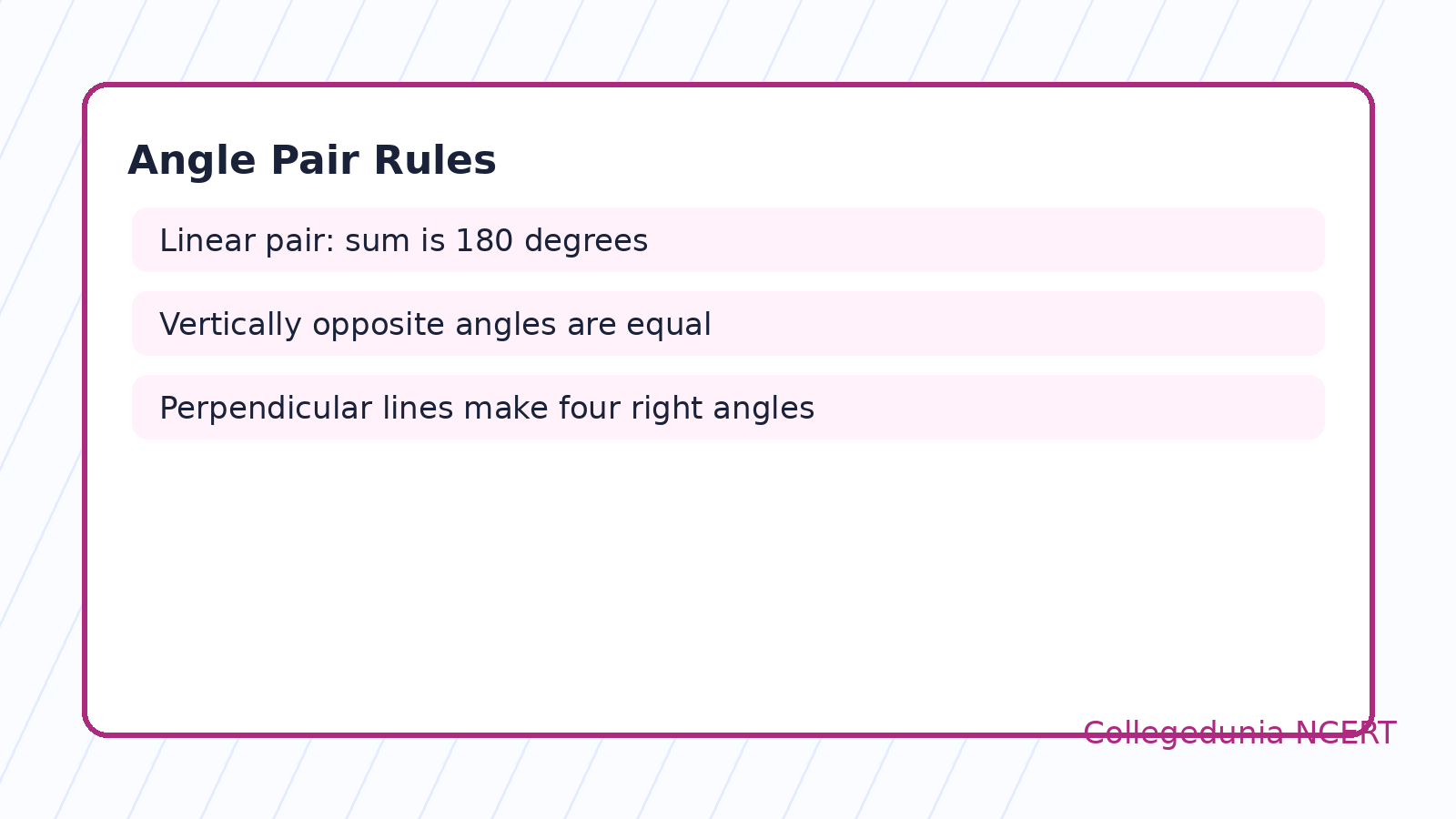
When two lines intersect, four angles are formed. Adjacent angles along a straight line form a linear pair. Opposite angles are vertically opposite angles.
- Linear pair: a + b = 180 degrees.
- Vertically opposite pair: a = c and b = d.
- Perpendicular crossing: all four angles are 90 degrees.
Use a linear pair first when one angle touches the given angle. Use vertically opposite angles when the angle is across the crossing point.
Parallel Lines and Transversals
A transversal is a line that intersects two other lines. It creates two sets of four angles. The same relative positions form corresponding angles.
- Mark the two lines and the transversal.
- Find corresponding angle positions first.
- Use equality if the two lines are parallel.
- Use inequality to show two lines are not parallel.
Corresponding and Alternate Angles
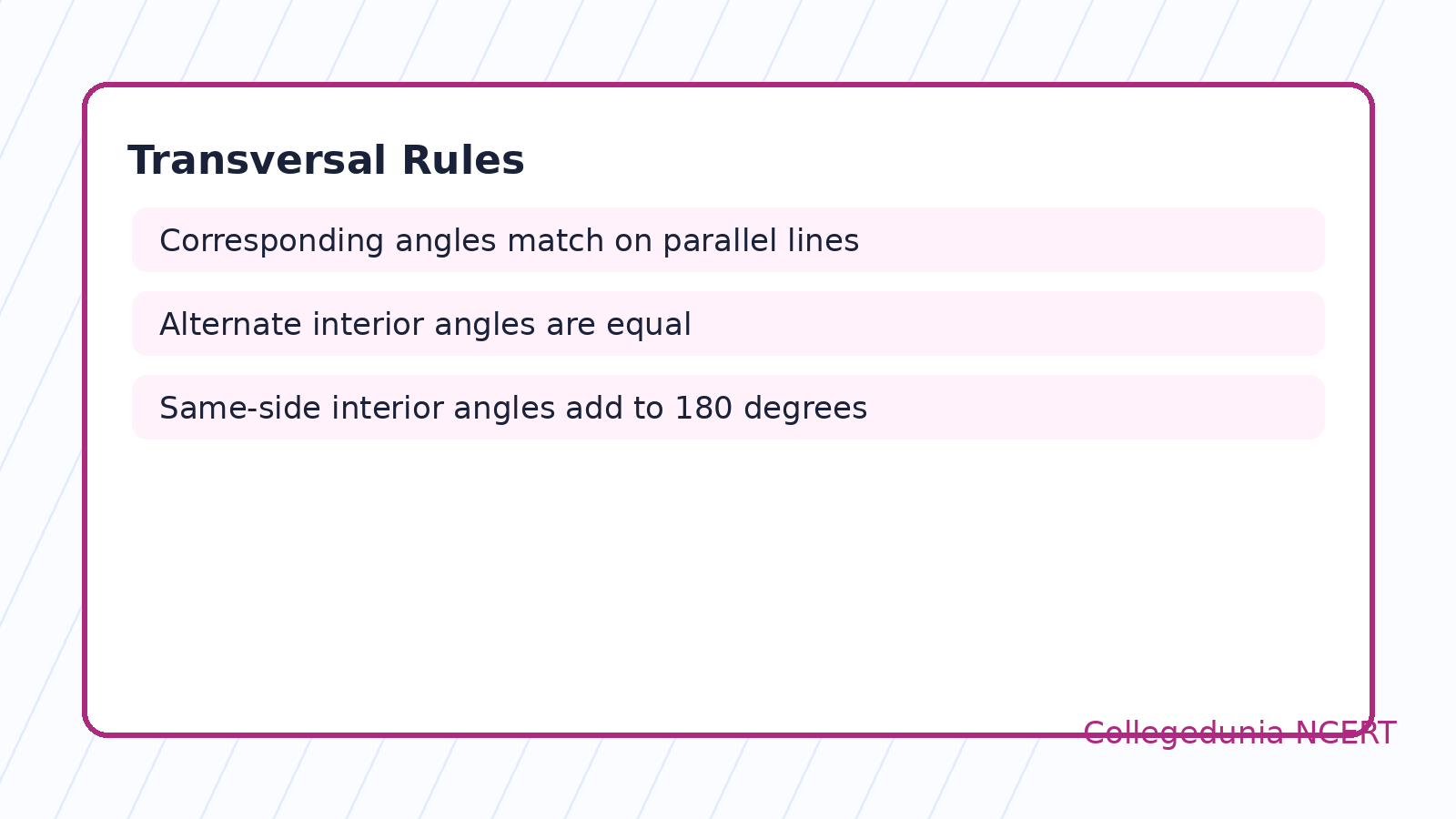
Corresponding angles occupy the same position at the two crossings. Alternate interior angles lie inside the two lines and on opposite sides of the transversal.
| Angle pair | Rule for parallel lines | Use |
|---|---|---|
| Corresponding angles | Equal | Test or use parallel lines |
| Alternate interior angles | Equal | Find matching interior angles |
| Same-side interior angles | Sum is 180 degrees | Find supplementary angles |
Worked Angle Examples
If one angle in a parallel-line transversal diagram is 135 degrees, its matching corresponding angle is also 135 degrees. Its linear-pair neighbour is 45 degrees.
- Given angle: 135 degrees.
- Linear-pair angle: 180 - 135 = 45 degrees.
- Vertically opposite angle: 135 degrees.
- Corresponding angle on the parallel line: 135 degrees.
Parallel check: if two corresponding angles are not equal, the two lines are not parallel.
Common Mistakes in Parallel and Intersecting Lines
- Do not assume lines are parallel only because they look parallel.
- Do not add vertically opposite angles. They are equal, not supplementary.
- Do not use alternate-angle equality unless the lines are parallel.
- Do not ignore the same-plane condition in the definition of parallel lines.
A neat diagram is useful, but the proof comes from angle relations.
Related Resources
Use the textbook for activities and the handwritten notes for a short final revision.
| Resource | Link |
|---|---|
| NCERT Book PDF | Parallel and Intersecting Lines Class 7 NCERT Book PDF |
| Handwritten Notes | Parallel and Intersecting Lines Class 7 Handwritten Notes |
NCERT Notes for Class 7 Mathematics (Part 1): All Chapters
Use this table to move between Mathematics (Part 1) notes during revision.
| Chapter | Notes |
|---|---|
| Chapter 1 | Large Numbers Around Us Notes |
| Chapter 2 | Arithmetic Expressions Notes |
| Chapter 3 | A Peek Beyond the Point Notes |
| Chapter 4 | Expressions using Letter-Numbers Notes |
| Chapter 5 | Parallel and Intersecting Lines Notes |
| Chapter 6 | Number Play Notes |
| Chapter 7 | A Tale of Three Intersecting Lines Notes |
| Chapter 8 | Working with Fractions Notes |
Parallel and Intersecting Lines Class 7 Maths Notes FAQs
Ques. What is a linear pair?
Ans. A linear pair is a pair of adjacent angles whose outside arms form a straight line. The angles add to 180 degrees.
Ques. What are vertically opposite angles?
Ans. They are the opposite angles formed when two lines intersect. They are always equal.
Ques. What is a transversal?
Ans. A transversal is a line that intersects two other lines and forms eight angles.
Ques. When are corresponding angles equal?
Ans. Corresponding angles are equal when a transversal intersects a pair of parallel lines.



Comments