



Inside the A Tale of Three Intersecting Lines Class 7 notes, you will find triangle constructions, the triangle inequality, angle sums, exterior angles, altitudes, and triangle types. Each idea follows the 2026-27 NCERT Mathematics (Part 1) book and includes a short rule or method for revision.
- Chapter focus: Construct triangles and decide when a triangle can exist.
- Key result: The three interior angles of every triangle add to 180 degrees.
- Revision goal: Connect side lengths, angles, altitudes, and triangle types.
Chapter7ATaleofThreeIntersectingLinesNotes.pdf?page=1&dpi=150)
Chapter7ATaleofThreeIntersectingLinesNotes.pdf?page=2&dpi=150)
Chapter7ATaleofThreeIntersectingLinesNotes.pdf?page=3&dpi=150)
Chapter7ATaleofThreeIntersectingLinesNotes.pdf?page=4&dpi=150)
Chapter7ATaleofThreeIntersectingLinesNotes.pdf?page=5&dpi=150)
Chapter7ATaleofThreeIntersectingLinesNotes.pdf?page=6&dpi=150)
Chapter7ATaleofThreeIntersectingLinesNotes.pdf?page=7&dpi=150)
Chapter7ATaleofThreeIntersectingLinesNotes.pdf?page=8&dpi=150)
Chapter7ATaleofThreeIntersectingLinesNotes.pdf?page=9&dpi=150)
Chapter7ATaleofThreeIntersectingLinesNotes.pdf?page=10&dpi=150)
Chapter7ATaleofThreeIntersectingLinesNotes.pdf?page=11&dpi=150)
Chapter7ATaleofThreeIntersectingLinesNotes.pdf?page=12&dpi=150)
Chapter7ATaleofThreeIntersectingLinesNotes.pdf?page=13&dpi=150)
Chapter7ATaleofThreeIntersectingLinesNotes.pdf?page=14&dpi=150)
Chapter7ATaleofThreeIntersectingLinesNotes.pdf?page=15&dpi=150)
Chapter7ATaleofThreeIntersectingLinesNotes.pdf?page=16&dpi=150)
Chapter7ATaleofThreeIntersectingLinesNotes.pdf?page=17&dpi=150)
Chapter7ATaleofThreeIntersectingLinesNotes.pdf?page=18&dpi=150)
Chapter7ATaleofThreeIntersectingLinesNotes.pdf?page=19&dpi=150)
Chapter7ATaleofThreeIntersectingLinesNotes.pdf?page=20&dpi=150)
Chapter7ATaleofThreeIntersectingLinesNotes.pdf?page=21&dpi=150)
Chapter7ATaleofThreeIntersectingLinesNotes.pdf?page=22&dpi=150)
Chapter7ATaleofThreeIntersectingLinesNotes.pdf?page=23&dpi=150)
Chapter7ATaleofThreeIntersectingLinesNotes.pdf?page=24&dpi=150)
Chapter7ATaleofThreeIntersectingLinesNotes.pdf?page=25&dpi=150)
Chapter7ATaleofThreeIntersectingLinesNotes.pdf?page=26&dpi=150)
Chapter7ATaleofThreeIntersectingLinesNotes_flat_MobileCard.pdf?page=1&dpi=150)
Chapter7ATaleofThreeIntersectingLinesNotes_flat_MobileCard.pdf?page=2&dpi=150)
Chapter7ATaleofThreeIntersectingLinesNotes_flat_MobileCard.pdf?page=3&dpi=150)
Chapter7ATaleofThreeIntersectingLinesNotes_flat_MobileCard.pdf?page=4&dpi=150)
Chapter7ATaleofThreeIntersectingLinesNotes_flat_MobileCard.pdf?page=5&dpi=150)
Chapter7ATaleofThreeIntersectingLinesNotes_flat_MobileCard.pdf?page=6&dpi=150)
Chapter7ATaleofThreeIntersectingLinesNotes_flat_MobileCard.pdf?page=7&dpi=150)
Chapter7ATaleofThreeIntersectingLinesNotes_flat_MobileCard.pdf?page=8&dpi=150)
Chapter7ATaleofThreeIntersectingLinesNotes_flat_MobileCard.pdf?page=9&dpi=150)
Chapter7ATaleofThreeIntersectingLinesNotes_flat_MobileCard.pdf?page=10&dpi=150)
Chapter7ATaleofThreeIntersectingLinesNotes_flat_MobileCard.pdf?page=11&dpi=150)
Chapter7ATaleofThreeIntersectingLinesNotes_flat_MobileCard.pdf?page=12&dpi=150)
Chapter7ATaleofThreeIntersectingLinesNotes_flat_MobileCard.pdf?page=13&dpi=150)
Chapter7ATaleofThreeIntersectingLinesNotes_flat_MobileCard.pdf?page=14&dpi=150)
Chapter7ATaleofThreeIntersectingLinesNotes_flat_MobileCard.pdf?page=15&dpi=150)
Chapter7ATaleofThreeIntersectingLinesNotes_flat_MobileCard.pdf?page=16&dpi=150)
Chapter7ATaleofThreeIntersectingLinesNotes_flat_MobileCard.pdf?page=17&dpi=150)
Chapter7ATaleofThreeIntersectingLinesNotes_flat_MobileCard.pdf?page=18&dpi=150)
Chapter7ATaleofThreeIntersectingLinesNotes_flat_MobileCard.pdf?page=19&dpi=150)
Chapter7ATaleofThreeIntersectingLinesNotes_flat_MobileCard.pdf?page=20&dpi=150)
Chapter7ATaleofThreeIntersectingLinesNotes_flat_MobileCard.pdf?page=21&dpi=150)
Chapter7ATaleofThreeIntersectingLinesNotes_flat_MobileCard.pdf?page=22&dpi=150)
Chapter7ATaleofThreeIntersectingLinesNotes_flat_MobileCard.pdf?page=23&dpi=150)
Chapter7ATaleofThreeIntersectingLinesNotes_flat_MobileCard.pdf?page=24&dpi=150)
Chapter7ATaleofThreeIntersectingLinesNotes_flat_MobileCard.pdf?page=25&dpi=150)
Chapter7ATaleofThreeIntersectingLinesNotes_flat_MobileCard.pdf?page=26&dpi=150)
Chapter7ATaleofThreeIntersectingLinesNotes_flat_MobileCard.pdf?page=27&dpi=150)
Chapter7ATaleofThreeIntersectingLinesNotes_flat_MobileCard.pdf?page=28&dpi=150)
Chapter7ATaleofThreeIntersectingLinesNotes_flat_MobileCard.pdf?page=29&dpi=150)
Chapter7ATaleofThreeIntersectingLinesNotes_flat_MobileCard.pdf?page=30&dpi=150)
Chapter7ATaleofThreeIntersectingLinesNotes_flat_MobileCard.pdf?page=31&dpi=150)
Chapter7ATaleofThreeIntersectingLinesNotes_flat_MobileCard.pdf?page=32&dpi=150)
Chapter7ATaleofThreeIntersectingLinesNotes_flat_MobileCard.pdf?page=33&dpi=150)
Chapter7ATaleofThreeIntersectingLinesNotes_flat_MobileCard.pdf?page=34&dpi=150)
Chapter7ATaleofThreeIntersectingLinesNotes_flat_MobileCard.pdf?page=35&dpi=150)
These Collegedunia notes follow the 2026-27 NCERT Ganita Prakash chapter and keep each construction rule easy to check.
A Tale of Three Intersecting Lines Topic Map for Class 7 Mathematics
The chapter begins with compass constructions and then explains why some measurements cannot form a triangle. It also links parallel lines to the angle sum property.
| Topic | Main idea | Revision priority |
|---|---|---|
| Triangle construction | Use arcs to locate the third vertex | High |
| Triangle inequality | Each side is shorter than the sum of the other two | High |
| Angle sum | Three interior angles add to 180 degrees | High |
| Altitudes | Draw a perpendicular from a vertex to the opposite side | Medium |
| Triangle types | Classify by sides and by angles | Medium |
Triangle Construction and Angle Rules Revision
Source: Magnet Brains on YouTube
Triangle Construction from Three Given Side Lengths
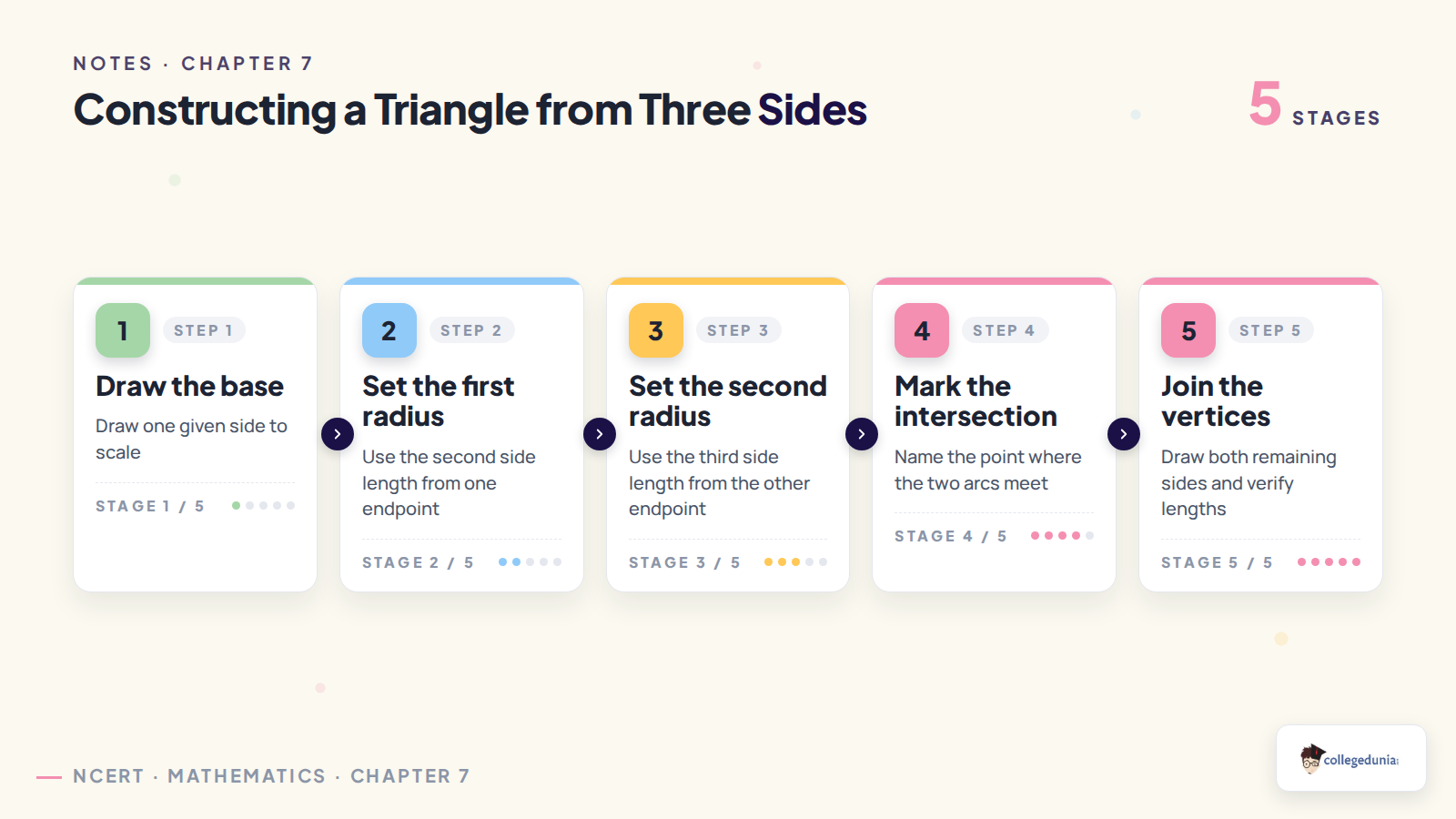
Take one side as the base. Two compass arcs then locate a point at the correct distance from both base vertices.
- Draw the base with one given side length.
- Draw an arc from one endpoint using the second length.
- Draw another arc from the other endpoint using the third length.
- Join the arc intersection to both endpoints.
An equilateral triangle uses the same compass radius from both endpoints. Its three sides have equal lengths.
Triangle Inequality Rule and the Fastest Existence Check
The direct path between two points is shorter than a route through a third point. This idea gives the triangle inequality.
- Arrange the three lengths from smallest to largest.
- Add the two smaller lengths.
- A triangle exists only when this sum is greater than the longest length.
- If the sum equals the longest length, the arcs only touch.
For lengths 4 cm, 5 cm, and 8 cm, check 4 + 5 > 8. The inequality holds, so the triangle exists. For 3 cm, 4 cm, and 8 cm, 3 + 4 < 8, so no triangle exists.
Checking the longest side is enough because each smaller side is already less than the sum containing the longest side.
Triangle Construction with Given Sides and Angles
The book gives two more construction cases. Both use a base, measured angles, and the intersection of lines.
| Given measurements | Construction method | Existence check |
|---|---|---|
| Two sides and included angle | Draw one side, make the angle, mark the second side | A positive side length and an angle below 180 degrees form a triangle |
| Two angles and included side | Draw the side and make one angle at each endpoint | The two angles must add to less than 180 degrees |
If two given angles add to 180 degrees or more, the two arms do not meet above the base. No triangle is formed.
Angle Sum and Exterior Angle Rules for Triangles
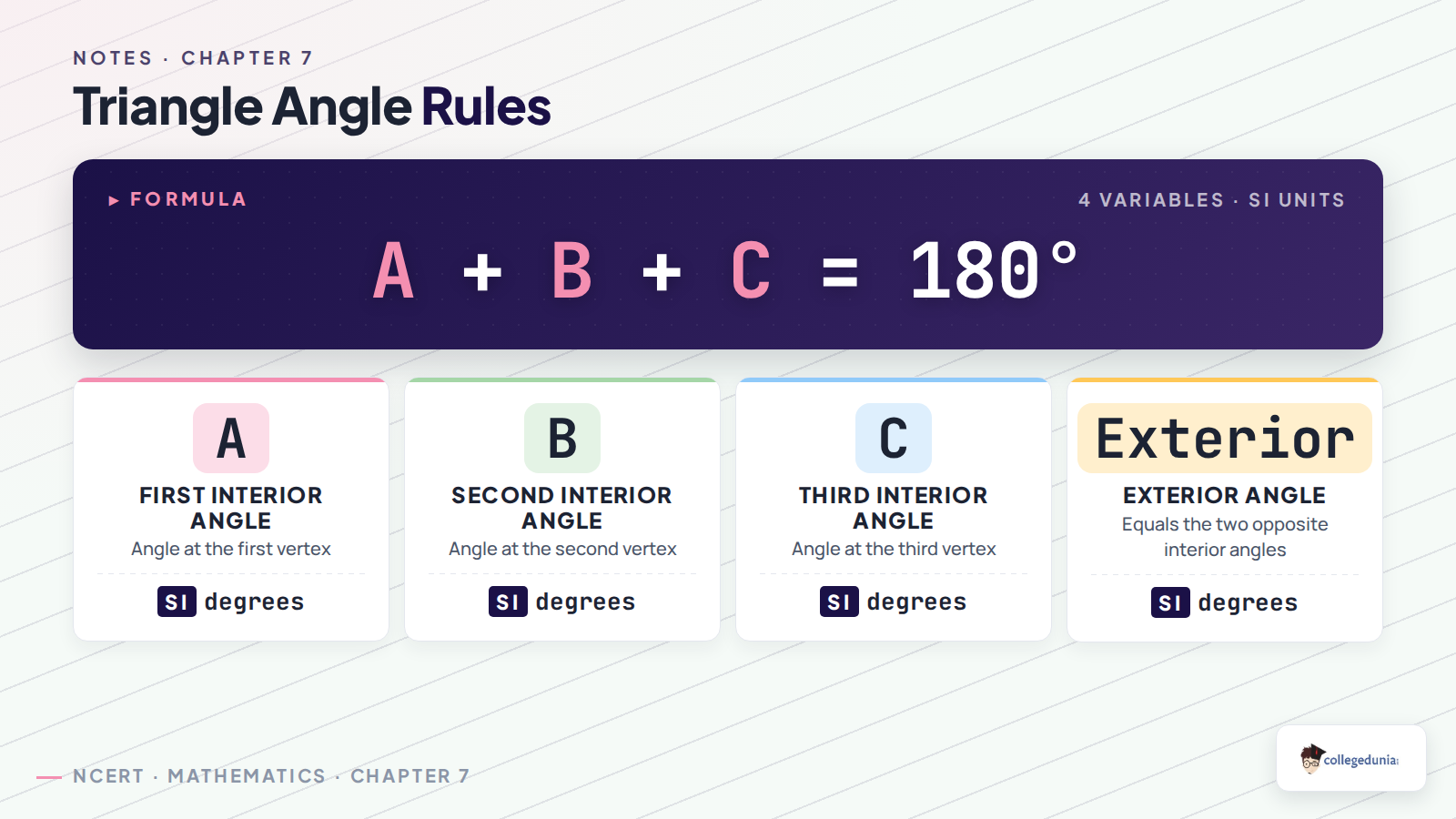
A line through one vertex, drawn parallel to the opposite side, copies the two base angles as alternate angles. These copied angles and the top angle form a straight angle.
- Angle sum property: angle A + angle B + angle C = 180 degrees.
- Missing angle: subtract the two known angles from 180 degrees.
- Exterior angle: add the two interior angles away from it.
For example, if two interior angles are 50 degrees and 70 degrees, the third angle is 60 degrees. The exterior angle beside that third angle is 120 degrees.
An exterior angle equals the sum of the two opposite interior angles.
Altitudes and Types of Triangles in A Tale of Three Intersecting Lines
An altitude is a perpendicular line segment from a vertex to the opposite side or its extended line. A set square helps draw the right angle accurately.
| Classification | Type | Meaning |
|---|---|---|
| By sides | Equilateral | All three sides are equal |
| By sides | Isosceles | Two sides are equal |
| By sides | Scalene | All three sides have different lengths |
| By angles | Acute-angled | All three angles are acute |
| By angles | Right-angled | One angle is 90 degrees |
| By angles | Obtuse-angled | One angle is greater than 90 degrees |
In a right triangle, two sides can also be altitudes. In an obtuse triangle, an altitude may meet an extended side.
Common Mistakes in Triangle Constructions and Angle Questions
Most errors come from using the wrong radius, measuring the wrong angle, or treating equality as a valid triangle inequality.
- Do not change the compass opening while drawing one fixed-radius arc.
- Do not accept two smaller sides whose sum equals the longest side.
- Do not confuse an altitude with any line from a vertex.
- Do not call a triangle acute when only one angle is acute.
Check every construction by measuring its sides and angles once. This catches a misplaced compass point quickly.
A Tale of Three Intersecting Lines Class 7 Related Resources
Use the NCERT book for construction activities and the handwritten notes for a short final recap.
| Resource | Link |
|---|---|
| NCERT Book PDF | A Tale of Three Intersecting Lines Class 7 NCERT Book PDF |
| Handwritten Notes | A Tale of Three Intersecting Lines Class 7 Handwritten Notes |
| Notes | A Tale of Three Intersecting Lines Class 7 Notes |
NCERT Notes for Class 7 Mathematics (Part 1): All Chapters
Use this table to move between Mathematics (Part 1) notes during revision.
| Chapter | Notes |
|---|---|
| Chapter 1 | Large Numbers Around Us Notes |
| Chapter 3 | A Peek Beyond the Point Notes |
| Chapter 4 | Expressions using Letter-Numbers Notes |
| Chapter 5 | Parallel and Intersecting Lines Notes |
| Chapter 6 | Number Play Notes |
| Chapter 7 | A Tale of Three Intersecting Lines Notes |
| Chapter 8 | Working with Fractions Notes |
A Tale of Three Intersecting Lines Class 7 Mathematics Notes FAQs
Ques. What is the triangle inequality?
Ans. Each side of a triangle must be shorter than the sum of the other two sides.
Ques. What is the fastest way to check whether three lengths form a triangle?
Ans. Add the two smaller lengths. Their sum must be greater than the longest length.
Ques. What is the angle sum property of a triangle?
Ans. The three interior angles of every triangle add to 180 degrees.
Ques. What is an exterior angle of a triangle?
Ans. It is the angle between one side and the extension of an adjacent side.
Ques. What is an altitude of a triangle?
Ans. It is a perpendicular segment from a vertex to the opposite side or its extended line.
Ques. When can two angles and their included side form a triangle?
Ans. The two given angles must add to less than 180 degrees.
Ques. Are these notes based on the 2026-27 NCERT book?
Ans. Yes. They follow Chapter 7 of the 2026-27 Ganita Prakash Mathematics (Part 1) book for Grade 7.



Comments