



The NCERT Notes for Class 7 Mathematics Part 2 Chapter 1 Geometric Twins cover congruent figures, triangle congruence rules and equal-angle results for the 2026-27 textbook. Use these notes to revise how shapes match exactly and how SSS, SAS, ASA, AAS and RHS are used in questions.
- Resource: Class 7 Maths Part 2 Chapter 1 Notes PDF.
- Chapter focus: congruent figures, corresponding parts, triangle tests and isosceles angles.
- Revision use: quick rule tables, labelled diagrams and common-trap checks.
Chapter1GeometricTwinsNotes.pdf?page=1&dpi=150)
Chapter1GeometricTwinsNotes.pdf?page=2&dpi=150)
Chapter1GeometricTwinsNotes.pdf?page=3&dpi=150)
Chapter1GeometricTwinsNotes.pdf?page=4&dpi=150)
Chapter1GeometricTwinsNotes.pdf?page=5&dpi=150)
Chapter1GeometricTwinsNotes.pdf?page=6&dpi=150)
Chapter1GeometricTwinsNotes.pdf?page=7&dpi=150)
Chapter1GeometricTwinsNotes.pdf?page=8&dpi=150)
Chapter1GeometricTwinsNotes.pdf?page=9&dpi=150)
Chapter1GeometricTwinsNotes.pdf?page=10&dpi=150)
Chapter1GeometricTwinsNotes.pdf?page=11&dpi=150)
Chapter1GeometricTwinsNotes.pdf?page=12&dpi=150)
Chapter1GeometricTwinsNotes.pdf?page=13&dpi=150)
Chapter1GeometricTwinsNotes.pdf?page=14&dpi=150)
Chapter1GeometricTwinsNotes.pdf?page=15&dpi=150)
Chapter1GeometricTwinsNotes.pdf?page=16&dpi=150)
Chapter1GeometricTwinsNotes.pdf?page=17&dpi=150)
Chapter1GeometricTwinsNotes.pdf?page=18&dpi=150)
Chapter1GeometricTwinsNotes.pdf?page=19&dpi=150)
Chapter1GeometricTwinsNotes.pdf?page=20&dpi=150)
Chapter1GeometricTwinsNotes.pdf?page=21&dpi=150)
Chapter1GeometricTwinsNotes_flat_MobileCard.pdf?page=1&dpi=150)
Chapter1GeometricTwinsNotes_flat_MobileCard.pdf?page=2&dpi=150)
Chapter1GeometricTwinsNotes_flat_MobileCard.pdf?page=3&dpi=150)
Chapter1GeometricTwinsNotes_flat_MobileCard.pdf?page=4&dpi=150)
Chapter1GeometricTwinsNotes_flat_MobileCard.pdf?page=5&dpi=150)
Chapter1GeometricTwinsNotes_flat_MobileCard.pdf?page=6&dpi=150)
Chapter1GeometricTwinsNotes_flat_MobileCard.pdf?page=7&dpi=150)
Chapter1GeometricTwinsNotes_flat_MobileCard.pdf?page=8&dpi=150)
Chapter1GeometricTwinsNotes_flat_MobileCard.pdf?page=9&dpi=150)
Chapter1GeometricTwinsNotes_flat_MobileCard.pdf?page=10&dpi=150)
Chapter1GeometricTwinsNotes_flat_MobileCard.pdf?page=11&dpi=150)
Chapter1GeometricTwinsNotes_flat_MobileCard.pdf?page=12&dpi=150)
Chapter1GeometricTwinsNotes_flat_MobileCard.pdf?page=13&dpi=150)
Chapter1GeometricTwinsNotes_flat_MobileCard.pdf?page=14&dpi=150)
Chapter1GeometricTwinsNotes_flat_MobileCard.pdf?page=15&dpi=150)
Chapter1GeometricTwinsNotes_flat_MobileCard.pdf?page=16&dpi=150)
Chapter1GeometricTwinsNotes_flat_MobileCard.pdf?page=17&dpi=150)
Chapter1GeometricTwinsNotes_flat_MobileCard.pdf?page=18&dpi=150)
Chapter1GeometricTwinsNotes_flat_MobileCard.pdf?page=19&dpi=150)
Chapter1GeometricTwinsNotes_flat_MobileCard.pdf?page=20&dpi=150)
Chapter1GeometricTwinsNotes_flat_MobileCard.pdf?page=21&dpi=150)
Chapter1GeometricTwinsNotes_flat_MobileCard.pdf?page=22&dpi=150)
Chapter1GeometricTwinsNotes_flat_MobileCard.pdf?page=23&dpi=150)
Chapter1GeometricTwinsNotes_flat_MobileCard.pdf?page=24&dpi=150)
Chapter1GeometricTwinsNotes_flat_MobileCard.pdf?page=25&dpi=150)
Chapter1GeometricTwinsNotes_flat_MobileCard.pdf?page=26&dpi=150)
Chapter1GeometricTwinsNotes_flat_MobileCard.pdf?page=27&dpi=150)
Chapter1GeometricTwinsNotes_flat_MobileCard.pdf?page=28&dpi=150)
Chapter1GeometricTwinsNotes_flat_MobileCard.pdf?page=29&dpi=150)
Chapter1GeometricTwinsNotes_flat_MobileCard.pdf?page=30&dpi=150)
Chapter1GeometricTwinsNotes_flat_MobileCard.pdf?page=31&dpi=150)
Chapter1GeometricTwinsNotes_flat_MobileCard.pdf?page=32&dpi=150)
Student Feedback: In a classroom revision poll, students said the chapter felt easier after they separated ASA, AAS and SSA in one table.
Geometric Twins Class 7 Notes Overview
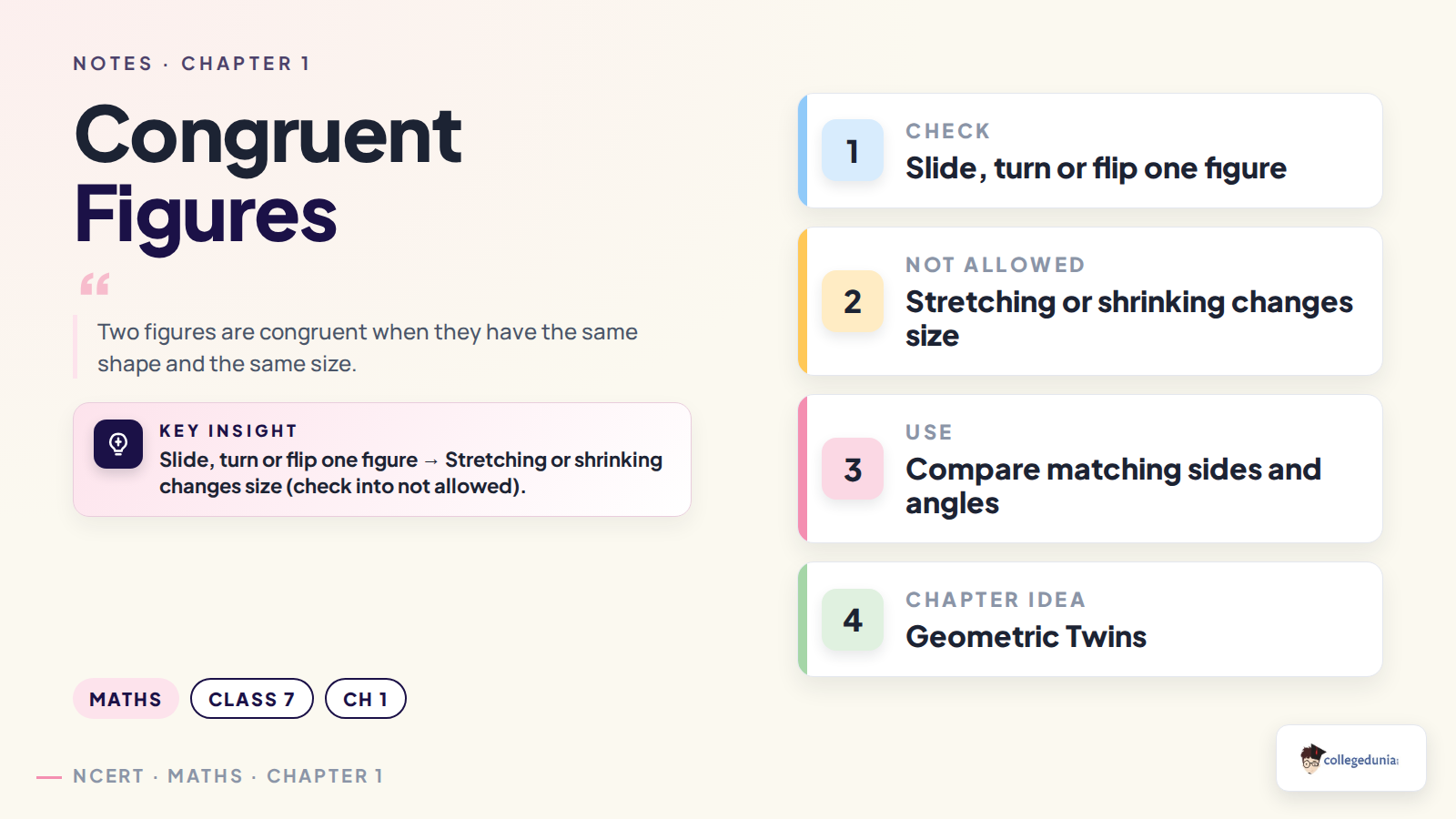
Geometric Twins starts with a simple idea: two figures are congruent only when one can fit exactly on the other. A figure may slide, turn or flip before matching. Stretching or shrinking breaks congruence because the size changes.
The chapter then moves from figures to triangles. It shows which measurements fix a triangle and which measurements only make it look similar. These notes keep that order, so students can revise the reason behind each test instead of memorising letters alone.
Congruent Figures and Superimposing
Two figures are congruent when they have the same shape and the same size. The easiest check is the tracing-paper test. If one figure fits exactly over another after a slide, turn or flip, the figures are congruent.
A circle is fixed by its radius, and a rectangle is fixed by length and breadth. A bent signboard shape needs more data. Two arm lengths are not enough because the angle between them can change.
| Figure | Measurements to compare | Congruent when |
|---|---|---|
| Circle | Radius or diameter | Both radii are equal |
| Rectangle | Length and breadth | Both measurements match |
| Bent arm shape | Two arms and included angle | All three measurements match |
Geometric Twins Video Lesson
Source: Khan Academy India - English on YouTube
Triangle Congruence Rules in Geometric Twins
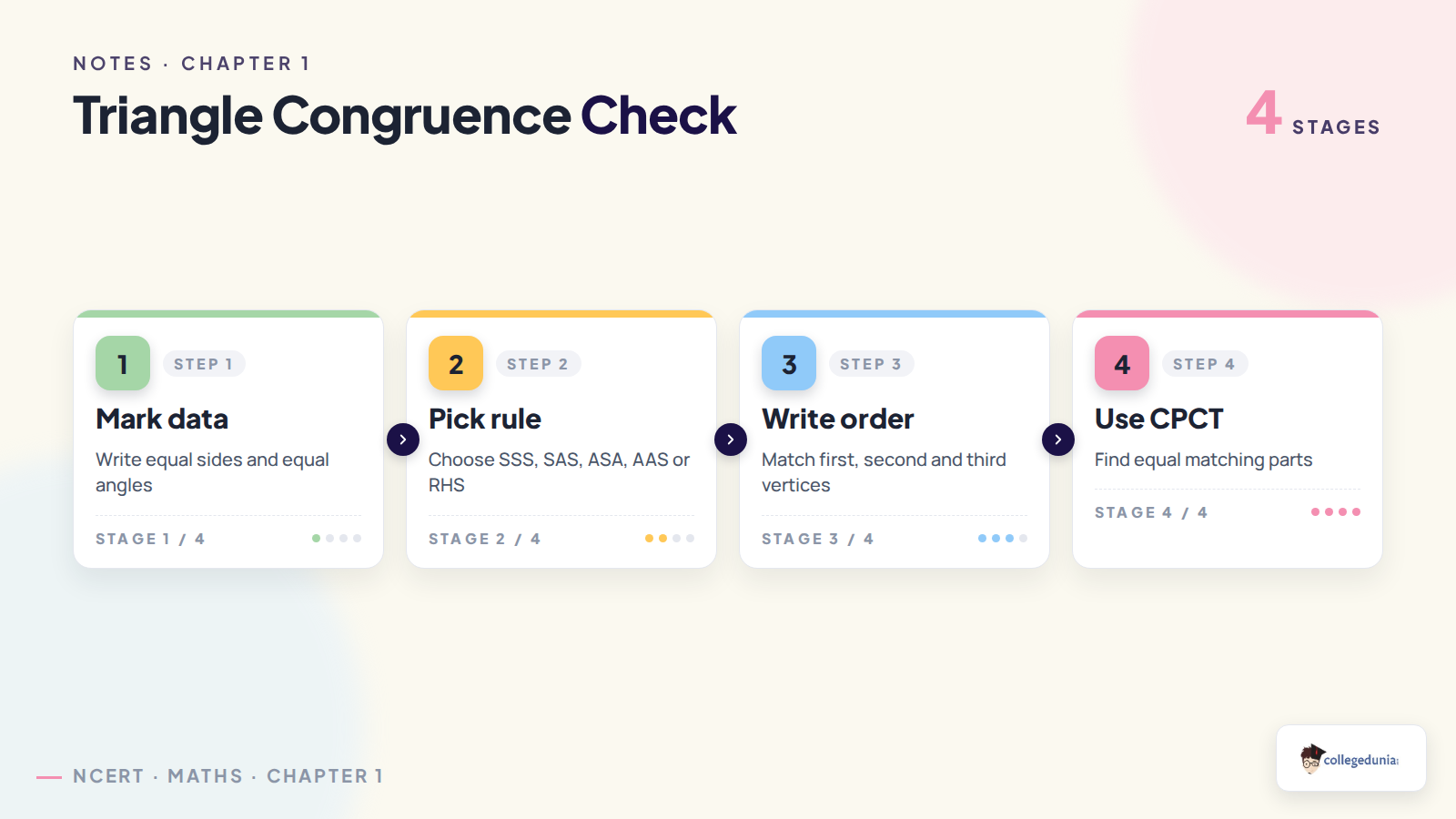
The chapter gives five safe triangle congruence tests. SSS, SAS, ASA, AAS and RHS all prove congruence when the matching parts are written in the correct order.
| Rule | What must match | Important check |
|---|---|---|
| SSS | Three sides | All side pairs are equal |
| SAS | Two sides and included angle | The angle lies between the sides |
| ASA | Two angles and included side | The side lies between the angles |
| AAS | Two angles and a non-included side | Find the third angle if needed |
| RHS | Right angle, hypotenuse and one side | Both triangles must be right triangles |
Why AAA and SSA Need Care
AAA gives the same shape, but it does not fix the size. A larger triangle can have the same three angle measures as a smaller one. That is why AAA is not a congruence test.
SSA also needs care. If two sides and a non-included angle are given, two different triangles may be possible. For Class 7 questions, treat SSA as not enough unless the right-triangle RHS case applies.
Isosceles and Equilateral Triangle Results
Geometric Twins uses congruence to prove a useful fact about isosceles triangles. If two sides of a triangle are equal, the angles opposite those sides are equal.
For example, if AB = AC and ∠ A = 80∘, then the base angles share the remaining 100∘. So ∠ B = ∠ C = 50∘.
In an equilateral triangle, all three sides are equal. So all three angles are equal too. Since a triangle has angle sum 180∘, each angle is 60∘.
How to Use These Geometric Twins Notes
Start by reading the rule table once. Then solve a question and write the congruence statement carefully. The order of letters decides which parts match.
- Mark equal sides and angles in the diagram.
- Choose SSS, SAS, ASA, AAS or RHS.
- Write triangle names in matching order.
- Use corresponding parts after congruence is proved.
Do not use matching parts before proving congruence. First prove the triangles congruent, then write the equal side or angle asked in the question.
Class 7 Maths Part 2 Chapter 1 Resource Links
Use these resources when you want the same chapter in another format.
| Resource | Best use | Link |
|---|---|---|
| NCERT Notes | Quick concept revision | Geometric Twins Notes |
| NCERT Solutions | Step-by-step answers for textbook questions | Geometric Twins Solutions |
| Questions Page | Expandable answer cards for practice | Use the solutions page |
All NCERT Notes for Class 7 Mathematics Part 2 Chapters
| Chapter | Title | Notes link |
|---|---|---|
| Chapter 1 | Geometric Twins | NCERT Notes Chapter 1 |
| Chapter 3 | Finding Common Ground | NCERT Notes Chapter 3 |
| Chapter 4 | Another Peek Beyond the Point | NCERT Notes Chapter 4 |
| Chapter 6 | Constructions and Tilings | NCERT Notes Chapter 6 |
Geometric Twins Class 7 Maths NCERT Notes FAQs
Ques. What does Class 7 Maths Chapter 1 Geometric Twins explain?
Ans. It explains congruent figures, triangle congruence rules, corresponding parts and equal-angle results for isosceles and equilateral triangles.
Ques. Which triangle congruence rules are used in Geometric Twins?
Ans. The chapter uses SSS, SAS, ASA, AAS and RHS. It also explains why AAA and SSA are not safe congruence tests.
Ques. Why is AAS different from ASA?
Ans. ASA uses the side between two known angles. AAS uses two angles and a non-included side, then the third angle is found first.
Ques. Do these notes follow the 2026-27 NCERT textbook?
Ans. Yes. The notes follow the 2026-27 Ganita Prakash Class 7 Mathematics Part 2 chapter on Geometric Twins.



Comments