



The NCERT Notes for Class 7 Mathematics Part 2 Chapter 6 Constructions and Tilings explain perpendicular bisectors, angle bisection, angle copying, regular hexagons, tangrams and domino tiling for the 2026-27 textbook. These notes help students revise exact ruler-compass steps before solving the Figure it Out tasks.
- Resource: Class 7 Maths Part 2 Chapter 6 Notes PDF.
- Chapter focus: construction steps, congruence reasons, arch designs and tiling tests.
- Revision use: quick methods, diagrams, parity checks and common errors.
Chapter6ConstructionsandTilingsNotes.pdf?page=1&dpi=150)
Chapter6ConstructionsandTilingsNotes.pdf?page=2&dpi=150)
Chapter6ConstructionsandTilingsNotes.pdf?page=3&dpi=150)
Chapter6ConstructionsandTilingsNotes.pdf?page=4&dpi=150)
Chapter6ConstructionsandTilingsNotes.pdf?page=5&dpi=150)
Chapter6ConstructionsandTilingsNotes.pdf?page=6&dpi=150)
Chapter6ConstructionsandTilingsNotes.pdf?page=7&dpi=150)
Chapter6ConstructionsandTilingsNotes.pdf?page=8&dpi=150)
Chapter6ConstructionsandTilingsNotes.pdf?page=9&dpi=150)
Chapter6ConstructionsandTilingsNotes.pdf?page=10&dpi=150)
Chapter6ConstructionsandTilingsNotes.pdf?page=11&dpi=150)
Chapter6ConstructionsandTilingsNotes.pdf?page=12&dpi=150)
Chapter6ConstructionsandTilingsNotes.pdf?page=13&dpi=150)
Chapter6ConstructionsandTilingsNotes.pdf?page=14&dpi=150)
Chapter6ConstructionsandTilingsNotes.pdf?page=15&dpi=150)
Chapter6ConstructionsandTilingsNotes.pdf?page=16&dpi=150)
Chapter6ConstructionsandTilingsNotes.pdf?page=17&dpi=150)
Chapter6ConstructionsandTilingsNotes.pdf?page=18&dpi=150)
Chapter6ConstructionsandTilingsNotes.pdf?page=19&dpi=150)
Chapter6ConstructionsandTilingsNotes.pdf?page=20&dpi=150)
Chapter6ConstructionsandTilingsNotes.pdf?page=21&dpi=150)
Chapter6ConstructionsandTilingsNotes.pdf?page=22&dpi=150)
Chapter6ConstructionsandTilingsNotes.pdf?page=23&dpi=150)
Chapter6ConstructionsandTilingsNotes_flat_MobileCard.pdf?page=1&dpi=150)
Chapter6ConstructionsandTilingsNotes_flat_MobileCard.pdf?page=2&dpi=150)
Chapter6ConstructionsandTilingsNotes_flat_MobileCard.pdf?page=3&dpi=150)
Chapter6ConstructionsandTilingsNotes_flat_MobileCard.pdf?page=4&dpi=150)
Chapter6ConstructionsandTilingsNotes_flat_MobileCard.pdf?page=5&dpi=150)
Chapter6ConstructionsandTilingsNotes_flat_MobileCard.pdf?page=6&dpi=150)
Chapter6ConstructionsandTilingsNotes_flat_MobileCard.pdf?page=7&dpi=150)
Chapter6ConstructionsandTilingsNotes_flat_MobileCard.pdf?page=8&dpi=150)
Chapter6ConstructionsandTilingsNotes_flat_MobileCard.pdf?page=9&dpi=150)
Chapter6ConstructionsandTilingsNotes_flat_MobileCard.pdf?page=10&dpi=150)
Chapter6ConstructionsandTilingsNotes_flat_MobileCard.pdf?page=11&dpi=150)
Chapter6ConstructionsandTilingsNotes_flat_MobileCard.pdf?page=12&dpi=150)
Chapter6ConstructionsandTilingsNotes_flat_MobileCard.pdf?page=13&dpi=150)
Chapter6ConstructionsandTilingsNotes_flat_MobileCard.pdf?page=14&dpi=150)
Chapter6ConstructionsandTilingsNotes_flat_MobileCard.pdf?page=15&dpi=150)
Chapter6ConstructionsandTilingsNotes_flat_MobileCard.pdf?page=16&dpi=150)
Chapter6ConstructionsandTilingsNotes_flat_MobileCard.pdf?page=17&dpi=150)
Chapter6ConstructionsandTilingsNotes_flat_MobileCard.pdf?page=18&dpi=150)
Chapter6ConstructionsandTilingsNotes_flat_MobileCard.pdf?page=19&dpi=150)
Chapter6ConstructionsandTilingsNotes_flat_MobileCard.pdf?page=20&dpi=150)
Chapter6ConstructionsandTilingsNotes_flat_MobileCard.pdf?page=21&dpi=150)
Chapter6ConstructionsandTilingsNotes_flat_MobileCard.pdf?page=22&dpi=150)
Chapter6ConstructionsandTilingsNotes_flat_MobileCard.pdf?page=23&dpi=150)
Chapter6ConstructionsandTilingsNotes_flat_MobileCard.pdf?page=24&dpi=150)
Chapter6ConstructionsandTilingsNotes_flat_MobileCard.pdf?page=25&dpi=150)
Chapter6ConstructionsandTilingsNotes_flat_MobileCard.pdf?page=26&dpi=150)
Chapter6ConstructionsandTilingsNotes_flat_MobileCard.pdf?page=27&dpi=150)
Chapter6ConstructionsandTilingsNotes_flat_MobileCard.pdf?page=28&dpi=150)
Chapter6ConstructionsandTilingsNotes_flat_MobileCard.pdf?page=29&dpi=150)
Chapter6ConstructionsandTilingsNotes_flat_MobileCard.pdf?page=30&dpi=150)
Chapter6ConstructionsandTilingsNotes_flat_MobileCard.pdf?page=31&dpi=150)
Chapter6ConstructionsandTilingsNotes_flat_MobileCard.pdf?page=32&dpi=150)
Chapter6ConstructionsandTilingsNotes_flat_MobileCard.pdf?page=33&dpi=150)
Chapter6ConstructionsandTilingsNotes_flat_MobileCard.pdf?page=34&dpi=150)
Student Feedback: Students usually improve in this chapter when they label every arc centre before joining the final line.
Constructions and Tilings Class 7 Notes Overview
Constructions and Tilings connects exact geometry with visual design. The first half builds perpendicular bisectors, right angles, angle bisectors, copied angles, parallel lines, arches, regular hexagons and six-pointed stars. The second half studies tangrams and tiling regions without gaps or overlaps.
The chapter also explains why each construction works. Equal compass arcs lead to equal lengths, and equal lengths often lead to congruent triangles. For tiling, the main checks are area, parity and black-white square counts.
Ruler and Compass Constructions in Class 7 Maths Chapter 6
Most construction steps use the same pattern. Draw a light support line, set a compass radius, mark equal arcs, join reliable intersection points and then check the final figure.
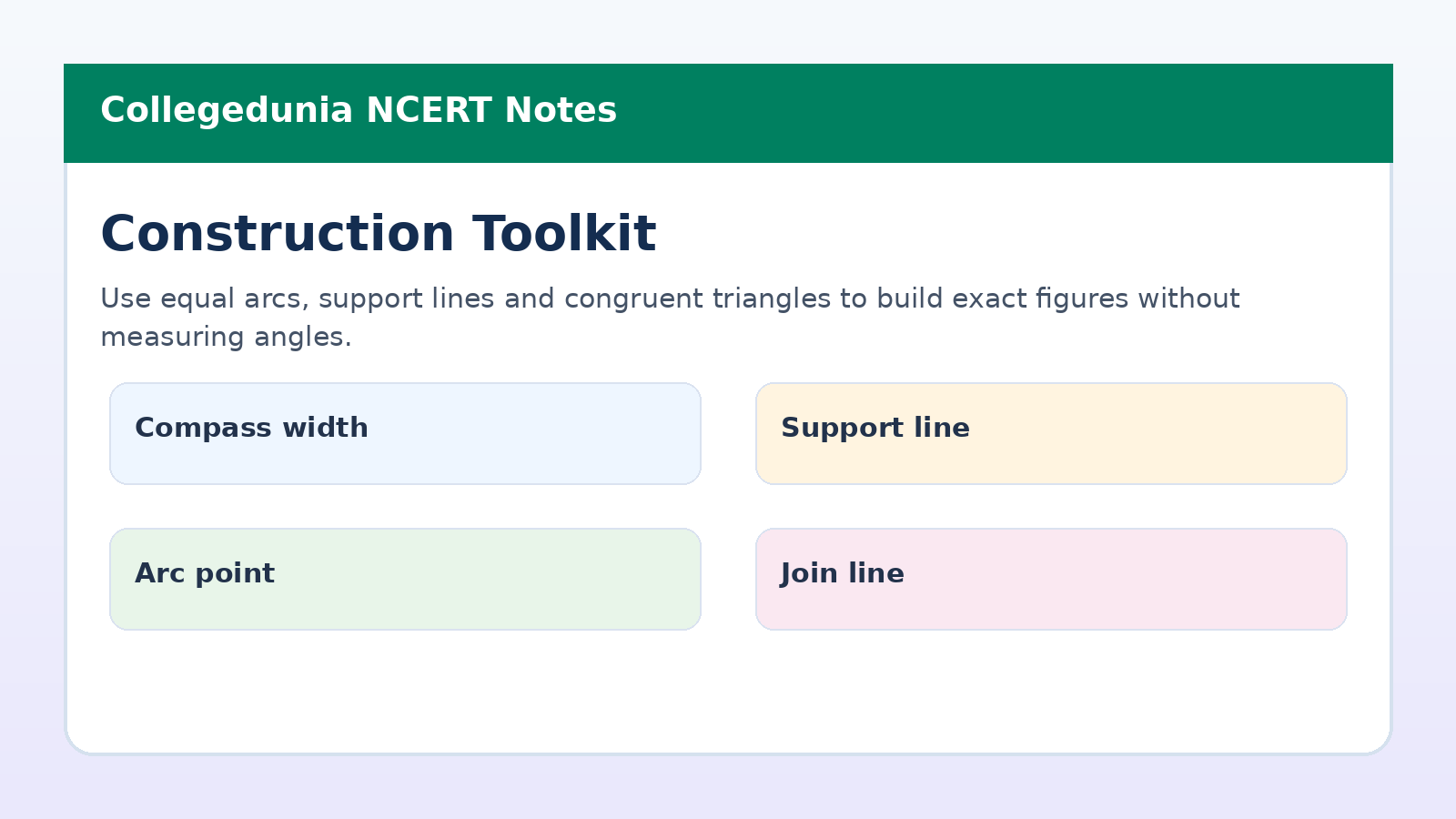
| Construction | Main step | Reason |
|---|---|---|
| Perpendicular bisector | Draw equal arcs from both endpoints | points are equally distant from X and Y |
| 90 degree angle | make O the midpoint of a segment | the perpendicular bisector passes through O |
| Angle bisector | mark equal points on both arms and join arc intersection | SSS congruence gives equal angles |
| Copy angle | transfer chord length on an equal arc | matching triangles copy the angle |
Constructions and Tilings Video Lesson
Source: YouTube classroom video
Hexagons, Stars and Arch Designs in Constructions and Tilings
A regular hexagon can be made from six congruent equilateral triangles around a centre. Each equilateral triangle gives a 60 degree angle, and six such angles complete 360 degrees around the point.
- Use an equilateral triangle to construct a 60 degree angle.
- Use 60 degrees and 120 degrees to build regular hexagons.
- Use equal supports and equal angles for symmetric arches.
- Trace the final arch only after checking support lines.
Tiling and Checkerboard Test in Class 7 Maths Chapter 6
Tiling means covering a region with shapes without gaps or overlaps. A 2 x 1 domino covers two unit squares, so a region with an odd number of unit squares cannot be tiled by dominoes.
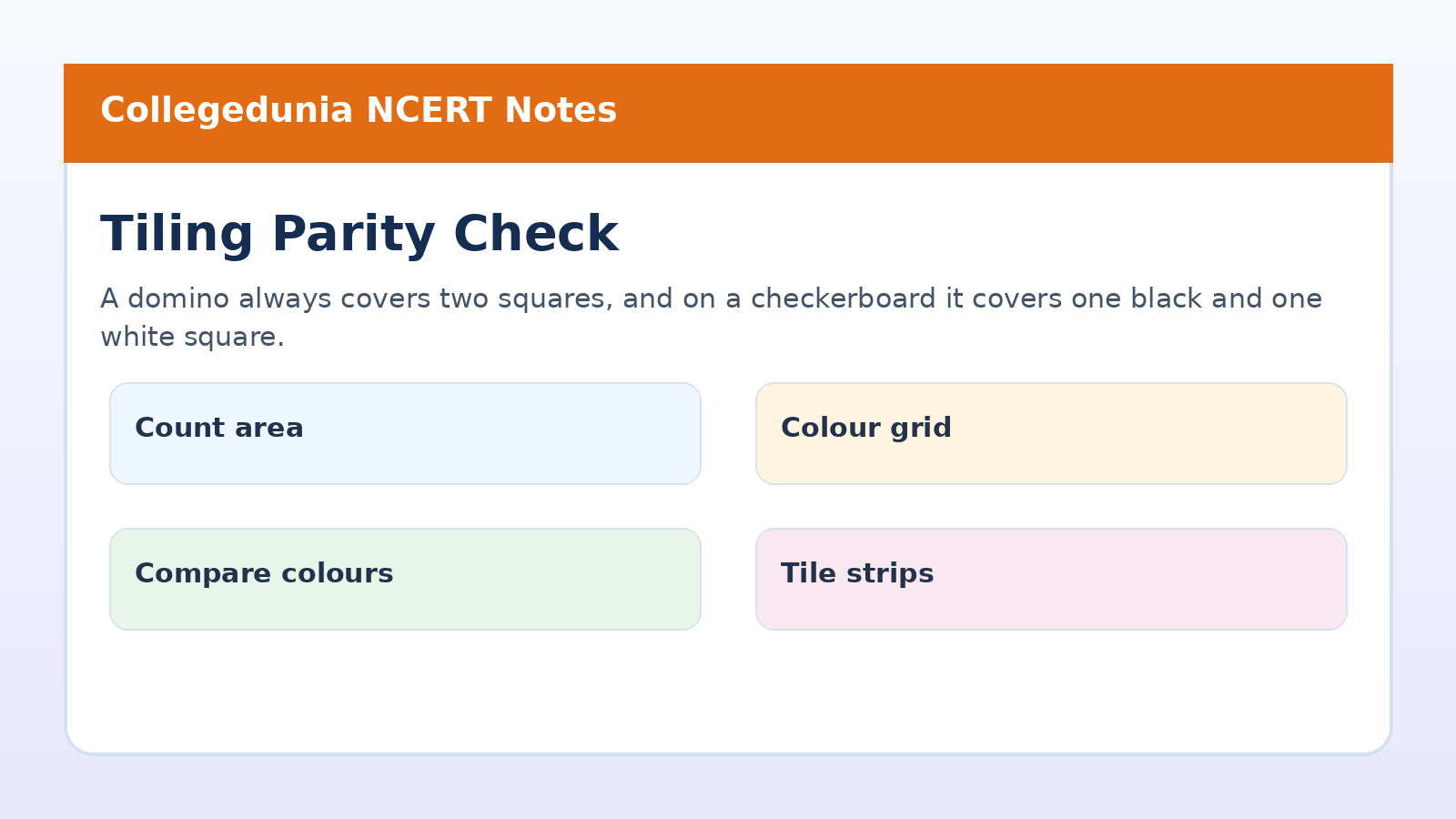
| Tiling check | What to ask | Useful result |
|---|---|---|
| Area parity | Is the number of unit squares even? | odd area cannot use 2 x 1 dominoes |
| Even dimension | Does one side have an even count? | tile in strips along that direction |
| Checkerboard count | Are black and white counts equal? | unequal counts prove no domino tiling |
| Plane tiling | Do angles around a point fill 360 degrees? | squares, triangles and hexagons can tile |
How to Use These Constructions and Tilings Notes
First revise the construction flow, then practise one perpendicular bisector, one angle bisector and one angle copy. After that, solve tiling questions by counting area and using checkerboard colouring.
- Keep support lines light and final boundaries dark.
- Do not change compass width during one equal-arc step.
- Write the congruence reason after each construction proof.
- For domino tiling, check black-white counts after checking area.
Class 7 Maths Part 2 Chapter 6 Resource Links
Use these related resources for official reading, solved exercises and quick visual revision.
| Resource | Best use | Link |
|---|---|---|
| NCERT Notes | Quick concept revision | Current notes |
| NCERT Solutions | Step-by-step textbook answers | Open solutions |
| Handwritten Notes | Fast visual revision | Open handwritten notes |
| NCERT Book PDF | Official chapter reading | Open book PDF |
All NCERT Notes for Class 7 Mathematics Part 2 Chapters
| Chapter | Title | Notes link |
|---|---|---|
| Chapter 1 | Geometric Twins | Open Notes |
| Chapter 2 | Operations with Integers | Open Notes |
| Chapter 3 | Finding Common Ground | Open Notes |
| Chapter 4 | Another Peek Beyond the Point | Open Notes |
| Chapter 5 | Connecting the Dots | Open Notes |
Constructions and Tilings Class 7 Maths NCERT Notes FAQs
Ques. What does Class 7 Maths Chapter 6 Constructions and Tilings cover?
Ans. It covers perpendicular bisectors, 90 degree construction, angle bisection, angle copying, parallel lines, hexagons, tangrams and tiling tests.
Ques. How is a perpendicular bisector constructed?
Ans. Draw equal arcs from both endpoints above and below the segment. Join the two arc intersection points to get the perpendicular bisector.
Ques. What is the checkerboard test for tiling?
Ans. Colour the grid black and white. A 2 x 1 domino covers one black and one white square, so unequal counts prove the region is not tileable.
Ques. Do these notes follow the 2026-27 NCERT textbook?
Ans. Yes. These notes follow Ganita Prakash Class 7 Mathematics Part 2 Chapter 6 for the 2026-27 session.



Comments