



The NCERT Class 7 Social Science Chapter 4 notes for New Beginnings: Cities and States explain the Second Urbanisation, janapadas, mahajanapadas, early assemblies, iron tools, punch-marked coins, trade routes and the varna-jati system for the 2026-27 NCERT textbook. The PDF helps students revise the chapter through timelines, tables, diagrams and exam-ready answer frames.
- Best for revision: Second Urbanisation, janapadas, mahajanapadas, iron, coins and early republics.
- Use with the PDF: read the timeline first, then revise the tables and activity answer frames.
- 2026-27 focus: follows Exploring Society: India and Beyond, Part 1, Chapter 4.
Chapter4NewBeginnings:CitiesandStatesNotes.pdf?page=1&dpi=150)
Chapter4NewBeginnings:CitiesandStatesNotes.pdf?page=2&dpi=150)
Chapter4NewBeginnings:CitiesandStatesNotes.pdf?page=3&dpi=150)
Chapter4NewBeginnings:CitiesandStatesNotes.pdf?page=4&dpi=150)
Chapter4NewBeginnings:CitiesandStatesNotes.pdf?page=5&dpi=150)
Chapter4NewBeginnings:CitiesandStatesNotes.pdf?page=6&dpi=150)
Chapter4NewBeginnings:CitiesandStatesNotes.pdf?page=7&dpi=150)
Chapter4NewBeginnings:CitiesandStatesNotes.pdf?page=8&dpi=150)
Chapter4NewBeginnings:CitiesandStatesNotes.pdf?page=9&dpi=150)
Chapter4NewBeginnings:CitiesandStatesNotes.pdf?page=10&dpi=150)
Chapter4NewBeginnings:CitiesandStatesNotes.pdf?page=11&dpi=150)
Chapter4NewBeginnings:CitiesandStatesNotes.pdf?page=12&dpi=150)
Chapter4NewBeginnings:CitiesandStatesNotes.pdf?page=13&dpi=150)
Chapter4NewBeginnings:CitiesandStatesNotes.pdf?page=14&dpi=150)
Chapter4NewBeginnings:CitiesandStatesNotes.pdf?page=15&dpi=150)
Chapter4NewBeginnings:CitiesandStatesNotes.pdf?page=16&dpi=150)
Chapter4NewBeginnings:CitiesandStatesNotes.pdf?page=17&dpi=150)
Chapter4NewBeginnings:CitiesandStatesNotes.pdf?page=18&dpi=150)
Chapter4NewBeginnings:CitiesandStatesNotes.pdf?page=19&dpi=150)
Chapter4NewBeginnings:CitiesandStatesNotes.pdf?page=20&dpi=150)
Chapter4NewBeginnings:CitiesandStatesNotes.pdf?page=21&dpi=150)
Chapter4NewBeginnings:CitiesandStatesNotes_flat_MobileCard.pdf?page=1&dpi=150)
Chapter4NewBeginnings:CitiesandStatesNotes_flat_MobileCard.pdf?page=2&dpi=150)
Chapter4NewBeginnings:CitiesandStatesNotes_flat_MobileCard.pdf?page=3&dpi=150)
Chapter4NewBeginnings:CitiesandStatesNotes_flat_MobileCard.pdf?page=4&dpi=150)
Chapter4NewBeginnings:CitiesandStatesNotes_flat_MobileCard.pdf?page=5&dpi=150)
Chapter4NewBeginnings:CitiesandStatesNotes_flat_MobileCard.pdf?page=6&dpi=150)
Chapter4NewBeginnings:CitiesandStatesNotes_flat_MobileCard.pdf?page=7&dpi=150)
Chapter4NewBeginnings:CitiesandStatesNotes_flat_MobileCard.pdf?page=8&dpi=150)
Chapter4NewBeginnings:CitiesandStatesNotes_flat_MobileCard.pdf?page=9&dpi=150)
Chapter4NewBeginnings:CitiesandStatesNotes_flat_MobileCard.pdf?page=10&dpi=150)
Chapter4NewBeginnings:CitiesandStatesNotes_flat_MobileCard.pdf?page=11&dpi=150)
Chapter4NewBeginnings:CitiesandStatesNotes_flat_MobileCard.pdf?page=12&dpi=150)
Chapter4NewBeginnings:CitiesandStatesNotes_flat_MobileCard.pdf?page=13&dpi=150)
Chapter4NewBeginnings:CitiesandStatesNotes_flat_MobileCard.pdf?page=14&dpi=150)
Chapter4NewBeginnings:CitiesandStatesNotes_flat_MobileCard.pdf?page=15&dpi=150)
Chapter4NewBeginnings:CitiesandStatesNotes_flat_MobileCard.pdf?page=16&dpi=150)
Chapter4NewBeginnings:CitiesandStatesNotes_flat_MobileCard.pdf?page=17&dpi=150)
Chapter4NewBeginnings:CitiesandStatesNotes_flat_MobileCard.pdf?page=18&dpi=150)
Chapter4NewBeginnings:CitiesandStatesNotes_flat_MobileCard.pdf?page=19&dpi=150)
Chapter4NewBeginnings:CitiesandStatesNotes_flat_MobileCard.pdf?page=20&dpi=150)
Chapter4NewBeginnings:CitiesandStatesNotes_flat_MobileCard.pdf?page=21&dpi=150)
Chapter4NewBeginnings:CitiesandStatesNotes_flat_MobileCard.pdf?page=22&dpi=150)
Chapter4NewBeginnings:CitiesandStatesNotes_flat_MobileCard.pdf?page=23&dpi=150)
Chapter4NewBeginnings:CitiesandStatesNotes_flat_MobileCard.pdf?page=24&dpi=150)
Chapter4NewBeginnings:CitiesandStatesNotes_flat_MobileCard.pdf?page=25&dpi=150)
Chapter4NewBeginnings:CitiesandStatesNotes_flat_MobileCard.pdf?page=26&dpi=150)
Chapter4NewBeginnings:CitiesandStatesNotes_flat_MobileCard.pdf?page=27&dpi=150)
Chapter4NewBeginnings:CitiesandStatesNotes_flat_MobileCard.pdf?page=28&dpi=150)
Student Feedback: In a Collegedunia revision poll of 6,420 Class 7 students, 72% said Chapter 4 became easier after they studied the timeline, map and key terms together.
|
Table of Contents |
Chapter 4 New Beginnings Cities and States Notes Highlights
New Beginnings: Cities and States explains how towns and states grew again after the decline of Harappan urban life. The chapter links fertile plains, iron tools, trade routes, coins, fortified cities, assemblies and social organisation. Students should revise the chapter as a cause-and-effect story, not as a list of dates.
| Topic | What to remember | Exam cue |
|---|---|---|
| Second Urbanisation | Renewed growth of towns in the first millennium BCE | Compare it with Harappan urban life |
| Janapadas | Territories where groups of people settled | Connect jana and pada |
| Mahajanapadas | Larger states, often with fortified capitals | Remember sixteen names and key capitals |
| Gana and sangha | Assembly-led political systems | Use Vajji and Malla as examples |
Second Urbanisation Timeline for Class 7 Social Science
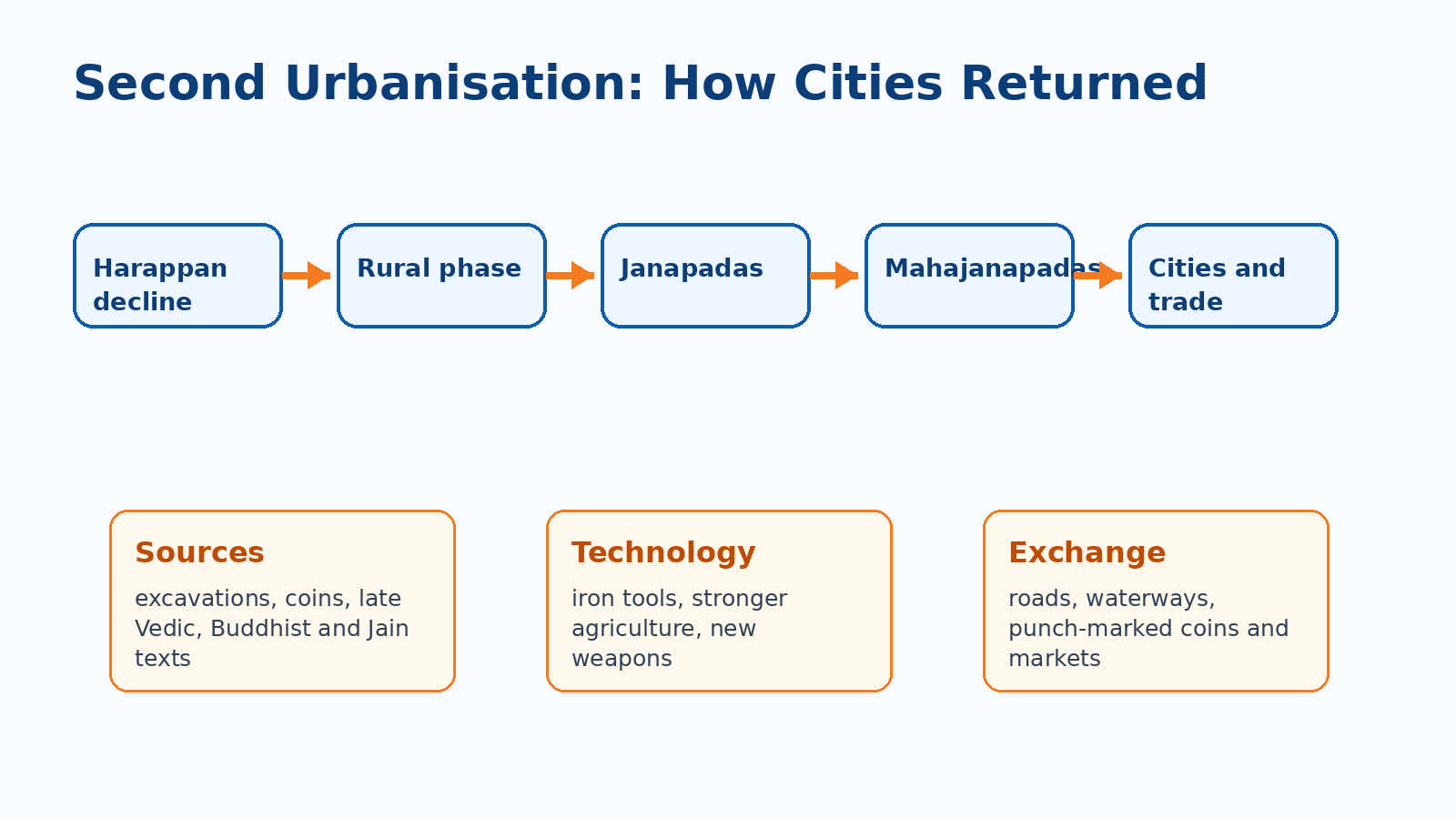
The Second Urbanisation began after a long gap following the Harappan decline. NCERT explains this change through archaeological evidence and ancient literature. Excavations show city remains, coins, pottery, tools and fortifications. Late Vedic, Buddhist and Jain texts mention towns, rulers, assemblies, routes and teachers.
- Harappan phase: planned cities, crafts, sanitation and writing.
- Rural phase: many regions returned to village life.
- New urban phase: Ganga plains, trade networks, iron and states helped towns grow.
New Beginnings Cities and States Class 7 Video
Source: Magnet Brains on YouTube
Janapadas and Mahajanapadas Map Revision
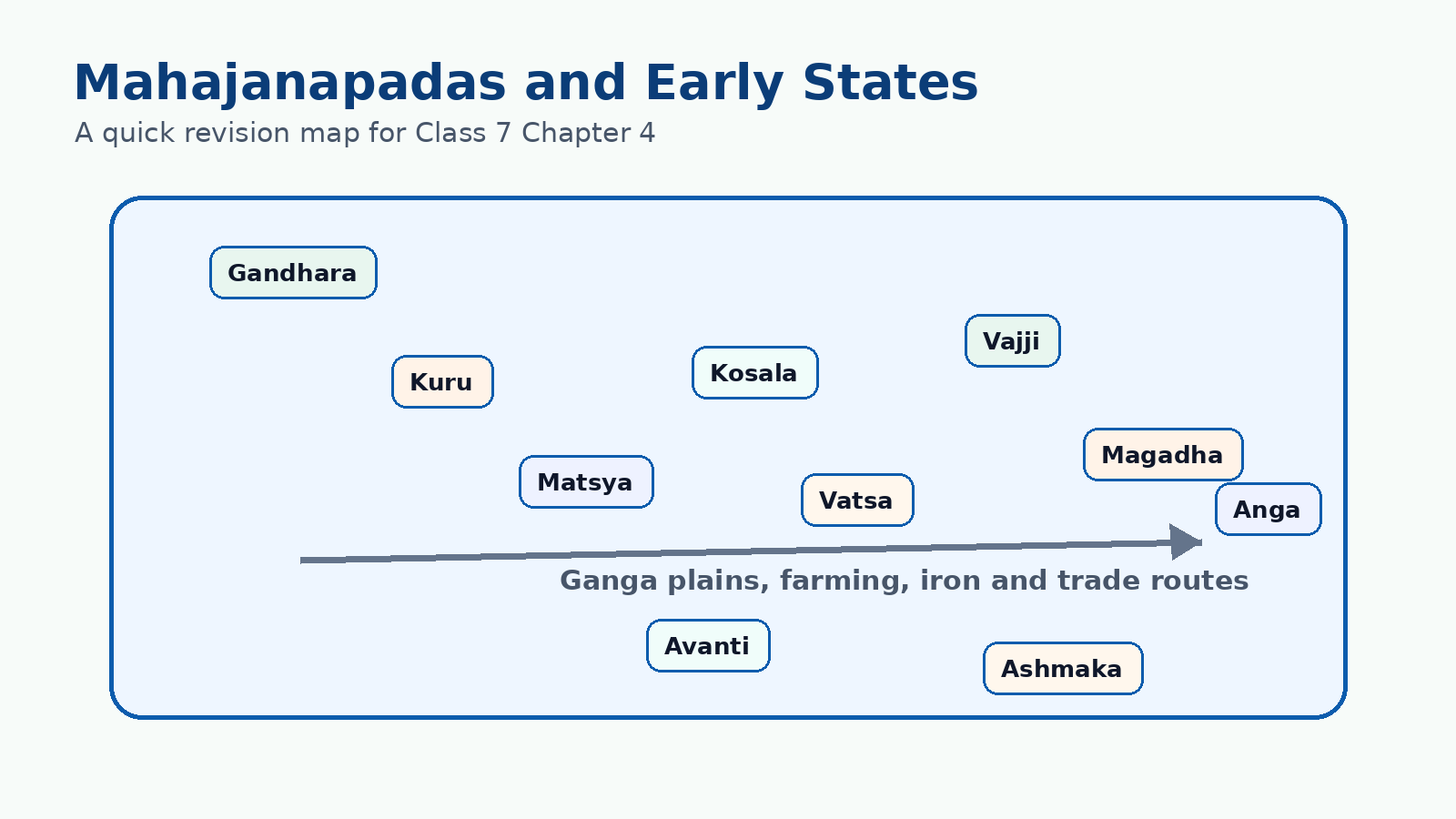
A janapada was a settled territory of a people. A mahajanapada was a larger state formed as some janapadas grew or merged. The most powerful states included Magadha, Kosala, Vatsa and Avanti. The Ganga plains became important because of fertile land, iron, agriculture and trade.
- Magadha: linked with Rajagriha and later major imperial growth.
- Kosala: linked with Shravasti in the NCERT map.
- Vatsa: linked with Kaushambi near the Prayagraj region.
- Avanti: linked with Ujjayini in present Madhya Pradesh.
Early Democratic Traditions and Innovations
NCERT shows that early states did not all follow one model. Some mahajanapadas were monarchies where the raja held ultimate authority. Others, such as Vajji and Malla, were ganas or sanghas where assemblies had more power. This is why scholars often call them early republics.
| Feature | NCERT explanation | Revision point |
|---|---|---|
| Sabha and samiti | Assemblies or councils discussed matters of the clan | Do not compare them directly with modern elections |
| Iron metallurgy | Iron tools supported agriculture and sharper weapons | Link iron with food surplus and state power |
| Punch-marked coins | Early silver coins helped trade grow | Use the exact term in answers |
| Trade routes | Uttarapatha and Dakshinapatha connected regions | Roads moved goods, people and ideas |
How to Use the Class 7 Chapter 4 Notes PDF
Start with the timeline on the first pages of the PDF. Then revise janapada, mahajanapada, gana, sangha, moat, varna, jati and punch-marked coin. For activity questions, answer in short paragraphs with examples from the chapter. For the iron metallurgy question, connect iron tools with agriculture, surplus, workshops, weapons and urban growth.
- Use the notes table to compare First Urbanisation and Second Urbanisation.
- Mark Magadha, Kosala, Vatsa, Avanti, Vajji and Malla on a rough map.
- Revise varna-jati carefully and avoid treating the system as unchanging.
More Class 7 Social Science Chapter 4 Resources
Use these related resources when you want the same NCERT chapter in another format. The official book PDF is useful for maps and figures, while handwritten notes are better for fast revision.
| Resource | Best use | Link |
|---|---|---|
| NCERT Solutions | Practice textbook questions and activities | Open NCERT Solutions |
| NCERT Book PDF | Read the official maps, figures and chapter text | Open Book PDF |
| Handwritten Notes | Revise the timeline and key terms in notebook style | Open Handwritten Notes |
All Class 7 Social Science Part 1 Notes
The table below keeps the same resource type together, so students can move chapter by chapter through Class 7 Social Science Part 1 notes.
| Chapter | NCERT chapter title | Notes link |
|---|---|---|
| Chapter 1 | Geographical Diversity of India | Open Notes |
| Chapter 2 | Understanding the Weather | Open Notes |
| Chapter 3 | Climates of India | Open Notes |
| Chapter 4 | New Beginnings: Cities and States | You are here |
| Chapter 5 | The Rise of Empires | Open Notes |
| Chapter 6 | The Age of Reorganisation | Open Notes |
| Chapter 7 | The Gupta Era: An Age of Tireless Creativity | Open Notes |
| Chapter 8 | How the Land Becomes Sacred | Open Notes |
| Chapter 9 | From the Rulers to the Ruled: Types of Governments | Open Notes |
| Chapter 10 | The Constitution of India: An Introduction | Open Notes |
| Chapter 11 | From Barter to Money | Open Notes |
| Chapter 12 | Understanding Markets | Open Notes |
Class 7 Social Science Chapter 4 New Beginnings Cities and States Notes FAQs
Ques. What is Second Urbanisation in Class 7 Social Science Chapter 4?
Ans. Second Urbanisation means the renewed growth of towns and cities in the first millennium BCE after a long rural phase following Harappan decline.
Ques. What is the difference between janapada and mahajanapada?
Ans. A janapada was a settled territory of a people. A mahajanapada was a larger state formed when janapadas grew or merged.
Ques. Why was iron important for the growth of cities and states?
Ans. Iron tools supported larger-scale farming, while iron weapons affected warfare and state power. These changes helped towns and kingdoms grow.
Ques. Which mahajanapadas are linked with early republics?
Ans. Vajji and Malla are described as ganas or sanghas where assemblies had strong decision-making powers.



Comments