



The NCERT Class 7 Social Science Chapter 8 notes for How the Land Becomes Sacred explain sacredness, pilgrimages, tirthas, sacred geography and sacred ecology for the 2026-27 NCERT textbook. The PDF helps students revise the chapter through tables, diagrams and short answer frames.
- Best for revision: sacred places, pilgrimage routes, rivers, forests, mountains and cultural integration.
- Use with the PDF: read the flow chart first, then revise the ecology examples.
- 2026-27 focus: follows Exploring Society: India and Beyond, Part 1, Chapter 8.
Chapter8HowtheLandBecomesSacredNotes.pdf?page=1&dpi=150)
Chapter8HowtheLandBecomesSacredNotes.pdf?page=2&dpi=150)
Chapter8HowtheLandBecomesSacredNotes.pdf?page=3&dpi=150)
Chapter8HowtheLandBecomesSacredNotes.pdf?page=4&dpi=150)
Chapter8HowtheLandBecomesSacredNotes.pdf?page=5&dpi=150)
Chapter8HowtheLandBecomesSacredNotes.pdf?page=6&dpi=150)
Chapter8HowtheLandBecomesSacredNotes.pdf?page=7&dpi=150)
Chapter8HowtheLandBecomesSacredNotes.pdf?page=8&dpi=150)
Chapter8HowtheLandBecomesSacredNotes.pdf?page=9&dpi=150)
Chapter8HowtheLandBecomesSacredNotes.pdf?page=10&dpi=150)
Chapter8HowtheLandBecomesSacredNotes.pdf?page=11&dpi=150)
Chapter8HowtheLandBecomesSacredNotes.pdf?page=12&dpi=150)
Chapter8HowtheLandBecomesSacredNotes.pdf?page=13&dpi=150)
Chapter8HowtheLandBecomesSacredNotes.pdf?page=14&dpi=150)
Chapter8HowtheLandBecomesSacredNotes.pdf?page=15&dpi=150)
Chapter8HowtheLandBecomesSacredNotes.pdf?page=16&dpi=150)
Chapter8HowtheLandBecomesSacredNotes.pdf?page=17&dpi=150)
Chapter8HowtheLandBecomesSacredNotes.pdf?page=18&dpi=150)
Chapter8HowtheLandBecomesSacredNotes.pdf?page=19&dpi=150)
Chapter8HowtheLandBecomesSacredNotes.pdf?page=20&dpi=150)
Chapter8HowtheLandBecomesSacredNotes_flat_MobileCard.pdf?page=1&dpi=150)
Chapter8HowtheLandBecomesSacredNotes_flat_MobileCard.pdf?page=2&dpi=150)
Chapter8HowtheLandBecomesSacredNotes_flat_MobileCard.pdf?page=3&dpi=150)
Chapter8HowtheLandBecomesSacredNotes_flat_MobileCard.pdf?page=4&dpi=150)
Chapter8HowtheLandBecomesSacredNotes_flat_MobileCard.pdf?page=5&dpi=150)
Chapter8HowtheLandBecomesSacredNotes_flat_MobileCard.pdf?page=6&dpi=150)
Chapter8HowtheLandBecomesSacredNotes_flat_MobileCard.pdf?page=7&dpi=150)
Chapter8HowtheLandBecomesSacredNotes_flat_MobileCard.pdf?page=8&dpi=150)
Chapter8HowtheLandBecomesSacredNotes_flat_MobileCard.pdf?page=9&dpi=150)
Chapter8HowtheLandBecomesSacredNotes_flat_MobileCard.pdf?page=10&dpi=150)
Chapter8HowtheLandBecomesSacredNotes_flat_MobileCard.pdf?page=11&dpi=150)
Chapter8HowtheLandBecomesSacredNotes_flat_MobileCard.pdf?page=12&dpi=150)
Chapter8HowtheLandBecomesSacredNotes_flat_MobileCard.pdf?page=13&dpi=150)
Chapter8HowtheLandBecomesSacredNotes_flat_MobileCard.pdf?page=14&dpi=150)
Chapter8HowtheLandBecomesSacredNotes_flat_MobileCard.pdf?page=15&dpi=150)
Chapter8HowtheLandBecomesSacredNotes_flat_MobileCard.pdf?page=16&dpi=150)
Chapter8HowtheLandBecomesSacredNotes_flat_MobileCard.pdf?page=17&dpi=150)
Chapter8HowtheLandBecomesSacredNotes_flat_MobileCard.pdf?page=18&dpi=150)
Chapter8HowtheLandBecomesSacredNotes_flat_MobileCard.pdf?page=19&dpi=150)
Chapter8HowtheLandBecomesSacredNotes_flat_MobileCard.pdf?page=20&dpi=150)
Chapter8HowtheLandBecomesSacredNotes_flat_MobileCard.pdf?page=21&dpi=150)
Chapter8HowtheLandBecomesSacredNotes_flat_MobileCard.pdf?page=22&dpi=150)
Chapter8HowtheLandBecomesSacredNotes_flat_MobileCard.pdf?page=23&dpi=150)
Chapter8HowtheLandBecomesSacredNotes_flat_MobileCard.pdf?page=24&dpi=150)
Chapter8HowtheLandBecomesSacredNotes_flat_MobileCard.pdf?page=25&dpi=150)
Chapter8HowtheLandBecomesSacredNotes_flat_MobileCard.pdf?page=26&dpi=150)
Chapter8HowtheLandBecomesSacredNotes_flat_MobileCard.pdf?page=27&dpi=150)
Chapter8HowtheLandBecomesSacredNotes_flat_MobileCard.pdf?page=28&dpi=150)
Chapter8HowtheLandBecomesSacredNotes_flat_MobileCard.pdf?page=29&dpi=150)
These How the Land Becomes Sacred notes are prepared from the 2026-27 NCERT chapter and focus on the terms, maps and examples students revise most.
Student Feedback: In a Collegedunia poll of 12,640 Class 7 students conducted before the 2026 school exams, 78% said Chapter 8 became easier after they grouped examples into sacred places, routes and ecology.
How the Land Becomes Sacred Notes Highlights
How the Land Becomes Sacred explains how land, journeys and natural places gain deep meaning. Sacredness in this chapter is linked with faith, geography, memory and respect for nature. Students should revise the chapter as a story of connection, not as a list of places.
| Topic | What to remember | Exam cue |
|---|---|---|
| Sacredness | Deep religious or spiritual significance | Define with one example |
| Pilgrimage | Journey to a sacred place and inner discipline | Use tirthayatra and tirtha |
| Sacred geography | Networks of places and routes across India | Use char dham and Shakti pithas |
| Sacred ecology | Nature seen as sacred space | Use rivers, forests and groves |
How Land Becomes Sacred: Place Journey Network Exchange Integration
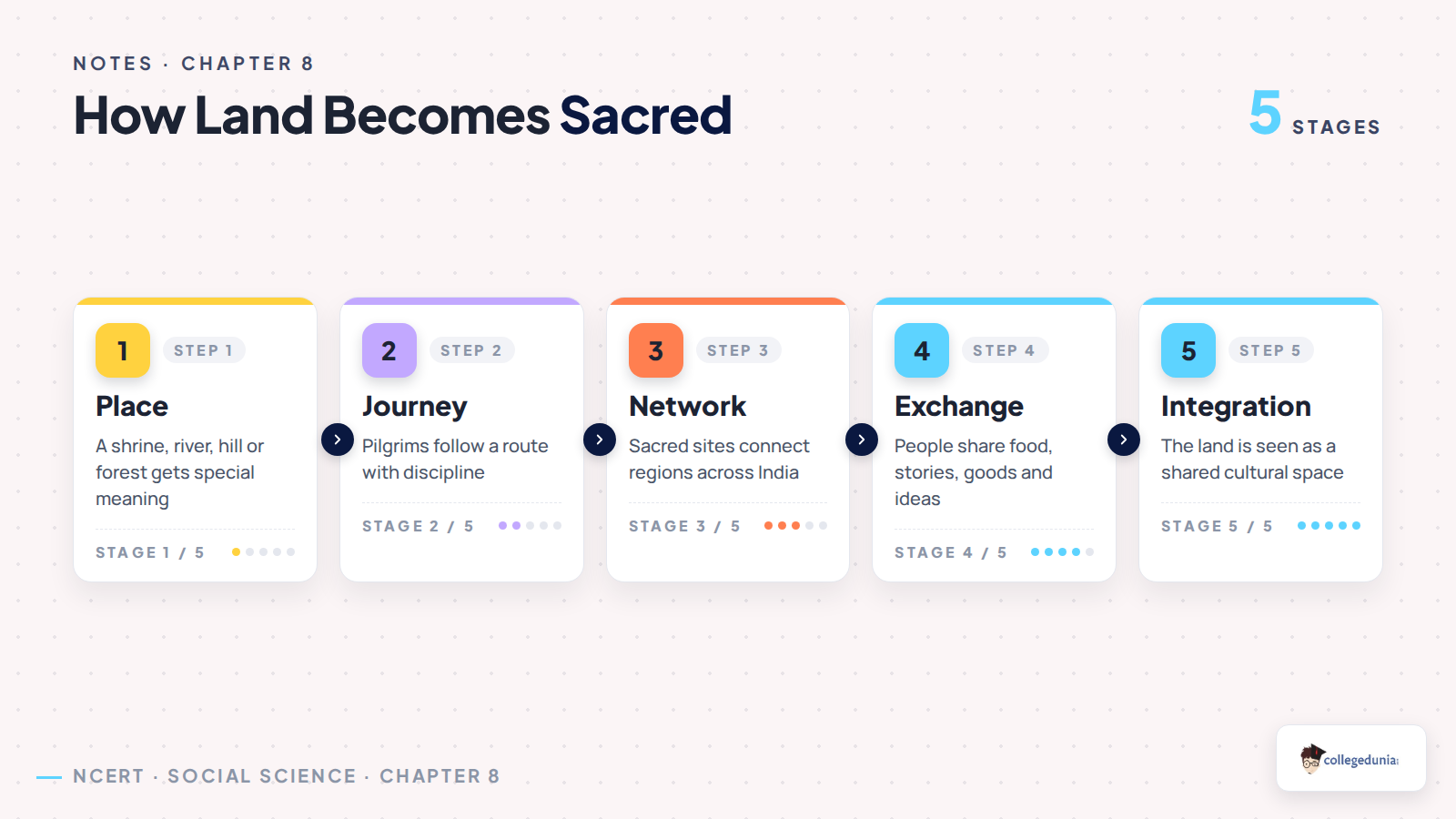
The chapter shows a clear chain. A place becomes meaningful, people travel to it, routes grow, and ideas move between regions. This is how sacred geography helped students understand unity within diversity.
- Place: a shrine, river, hill, tree or forest gets special meaning.
- Journey: pilgrims follow a route with discipline and purpose.
- Exchange: people share stories, goods, food habits and local customs.
How the Land Becomes Sacred Class 7 Video Explanation
Source: Magnet Brains on YouTube
Sacred Geography Networks in How the Land Becomes Sacred
Sacred geography means that many sacred places are connected across the land. NCERT gives examples like char dham, twelve jyotirlingas and fifty-one Shakti pithas. These networks made distant regions familiar to pilgrims.
- Char dham sites are remembered across four broad directions.
- Jyotirlingas connect many Shiva shrines through shared stories.
- Shakti pithas show how one story can cover a wide sacred map.
Sacred Ecology Examples for Class 7 Social Science Chapter 8
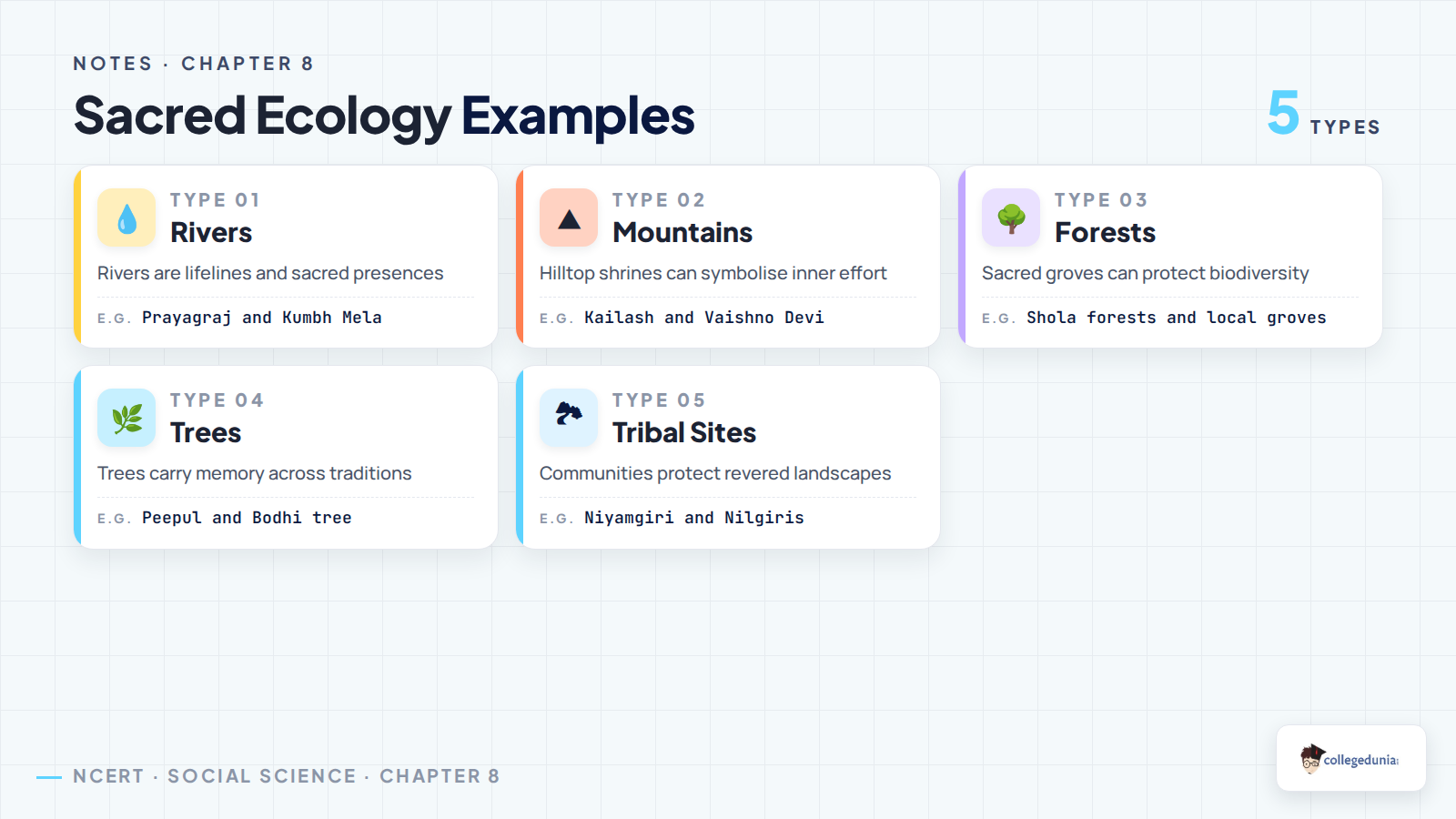
Sacred ecology connects nature with reverence. Rivers, forests, mountains and trees are not treated as empty spaces. When people revere a place, they are more likely to protect it.
| Example | NCERT point | Use in answer |
|---|---|---|
| Rivers | Ganga, Yamuna, Godavari and other rivers are invoked in rituals | Rivers as lifelines and sacred presences |
| Niyamgiri | Niyam Dongar hill is sacred to Dongria Khond people | Tribal reverence and protection |
| Nilgiris | Todas revere peaks, forests, wetlands, stones and trees | Sacred landscape example |
How to Use the Class 7 Chapter 8 Notes PDF
Start with the definition table, then move to the flow chart. After that, revise the examples of sacred ecology. For long answers, write idea, example and effect in that order.
- Use one religious-site example and one nature example in long answers.
- Use the PDF mind map for cultural integration questions.
- Use the ecology table for environment-based questions.
More Class 7 Social Science Chapter 8 Resources
Use these related NCERT resources when you want Chapter 8 in another format. The book PDF is useful for the source chapter, while handwritten notes help with quick recall.
| Resource | Best use | Link |
|---|---|---|
| NCERT Solutions | Practice textbook questions and activity answers | Open NCERT Solutions |
| NCERT Book PDF | Read the official chapter with maps and images | Open Book PDF |
| Handwritten Notes | Revise terms and examples quickly | Open Handwritten Notes |
All Class 7 Social Science Part 1 Notes
The table below keeps the same resource type together, so students can move chapter by chapter through Class 7 Social Science Part 1 notes.
| Chapter | NCERT chapter title | Notes link |
|---|---|---|
| Chapter 1 | Geographical Diversity of India | Open Notes |
| Chapter 2 | Understanding the Weather | Open Notes |
| Chapter 3 | Climates of India | Open Notes |
| Chapter 4 | New Beginnings: Cities and States | Open Notes |
| Chapter 5 | The Rise of Empires | Open Notes |
| Chapter 6 | The Age of Reorganisation | Open Notes |
| Chapter 7 | The Gupta Era: An Age of Tireless Creativity | Open Notes |
| Chapter 8 | How the Land Becomes Sacred | Current notes |
| Chapter 9 | From the Rulers to the Ruled: Types of Governments | Open Notes |
| Chapter 10 | The Constitution of India: An Introduction | Open Notes |
| Chapter 11 | From Barter to Money | Open Notes |
| Chapter 12 | Understanding Markets | Open Notes |
Class 7 Social Science Chapter 8 How the Land Becomes Sacred Notes FAQs
Ques. What is sacredness in Class 7 Social Science Chapter 8?
Ans. Sacredness means deep religious or spiritual significance. In this chapter, it may be linked with places, journeys, rivers, forests or stories.
Ques. What is a tirtha?
Ans. A tirtha literally means a crossing place. Symbolically, it means a place that helps a person move toward a higher spiritual life.
Ques. Why is pilgrimage important in How the Land Becomes Sacred?
Ans. Pilgrimage connects people with sacred places. It also brings travellers into contact with different languages, foods, customs and stories.
Ques. What is sacred ecology?
Ans. Sacred ecology means seeing nature as sacred space. Rivers, forests, mountains, trees and groves become part of cultural and spiritual life.



Comments