



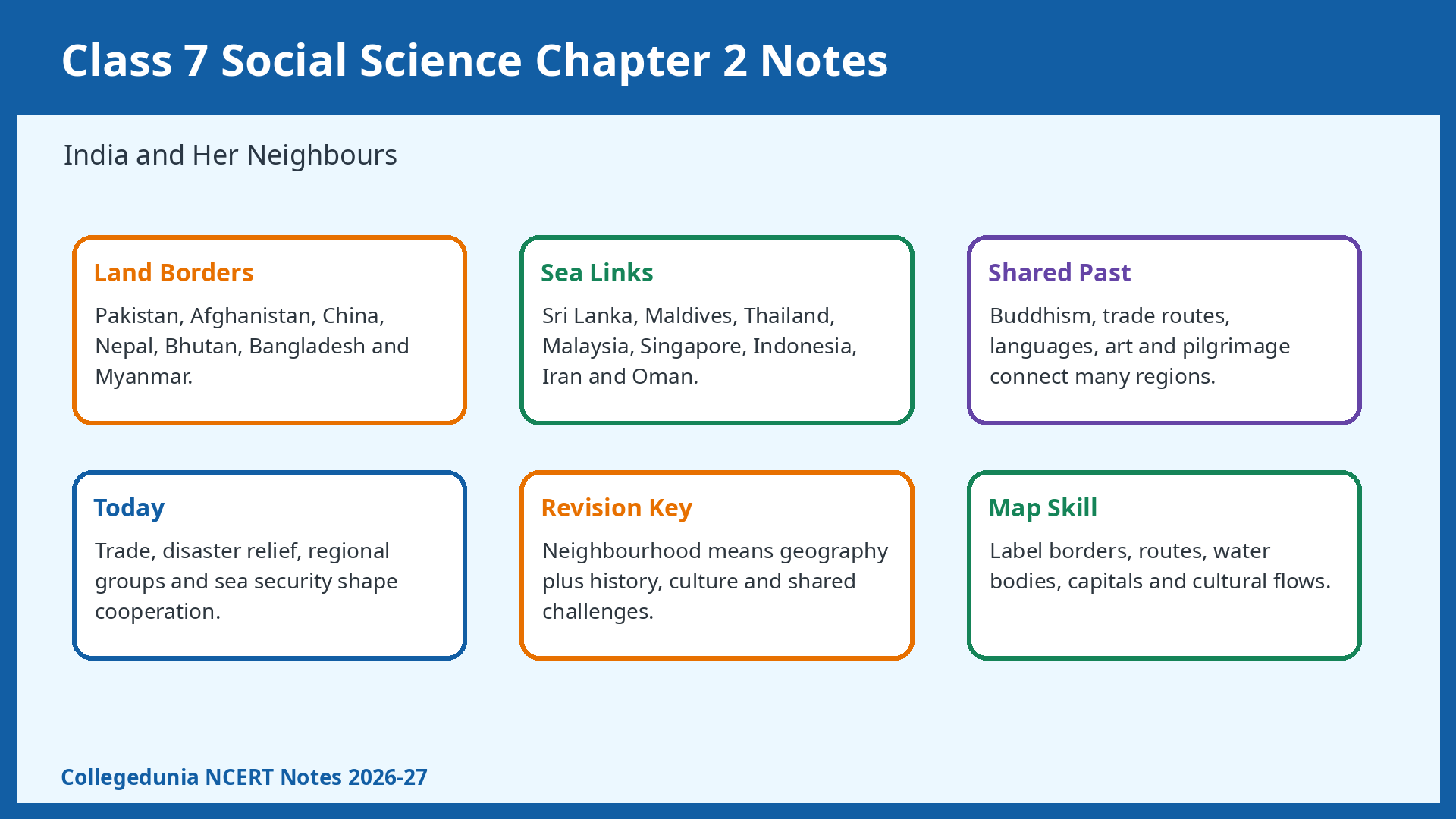
The NCERT Class 7 Social Science Chapter 2 notes for India and Her Neighbours explain land neighbours, maritime neighbours, Buddhism, trade routes, regional cooperation and shared challenges. These notes follow the 2026-27 NCERT textbook and help students revise the chapter through maps, comparison tables and answer frames.
- Best for revision: land borders, maritime neighbours, cultural links, ports, routes and cooperation examples.
- Use with the PDF: read the country-wise table first, then revise the land versus maritime comparison.
- 2026-27 focus: follows Exploring Society: India and Beyond, Part 2, Chapter 2.
Chapter2IndiaandHerNeighboursNotes.pdf?page=1&dpi=150)
Chapter2IndiaandHerNeighboursNotes.pdf?page=2&dpi=150)
Chapter2IndiaandHerNeighboursNotes.pdf?page=3&dpi=150)
Chapter2IndiaandHerNeighboursNotes.pdf?page=4&dpi=150)
Chapter2IndiaandHerNeighboursNotes.pdf?page=5&dpi=150)
Chapter2IndiaandHerNeighboursNotes.pdf?page=6&dpi=150)
Chapter2IndiaandHerNeighboursNotes.pdf?page=7&dpi=150)
Chapter2IndiaandHerNeighboursNotes.pdf?page=8&dpi=150)
Chapter2IndiaandHerNeighboursNotes.pdf?page=9&dpi=150)
Chapter2IndiaandHerNeighboursNotes.pdf?page=10&dpi=150)
Chapter2IndiaandHerNeighboursNotes.pdf?page=11&dpi=150)
Chapter2IndiaandHerNeighboursNotes.pdf?page=12&dpi=150)
Chapter2IndiaandHerNeighboursNotes.pdf?page=13&dpi=150)
Chapter2IndiaandHerNeighboursNotes.pdf?page=14&dpi=150)
Chapter2IndiaandHerNeighboursNotes.pdf?page=15&dpi=150)
Chapter2IndiaandHerNeighboursNotes.pdf?page=16&dpi=150)
Chapter2IndiaandHerNeighboursNotes.pdf?page=17&dpi=150)
Chapter2IndiaandHerNeighboursNotes.pdf?page=18&dpi=150)
Chapter2IndiaandHerNeighboursNotes.pdf?page=19&dpi=150)
Chapter2IndiaandHerNeighboursNotes.pdf?page=20&dpi=150)
Chapter2IndiaandHerNeighboursNotes.pdf?page=21&dpi=150)
Chapter2IndiaandHerNeighboursNotes.pdf?page=22&dpi=150)
Chapter2IndiaandHerNeighboursNotes_flat_MobileCard.pdf?page=1&dpi=150)
Chapter2IndiaandHerNeighboursNotes_flat_MobileCard.pdf?page=2&dpi=150)
Chapter2IndiaandHerNeighboursNotes_flat_MobileCard.pdf?page=3&dpi=150)
Chapter2IndiaandHerNeighboursNotes_flat_MobileCard.pdf?page=4&dpi=150)
Chapter2IndiaandHerNeighboursNotes_flat_MobileCard.pdf?page=5&dpi=150)
Chapter2IndiaandHerNeighboursNotes_flat_MobileCard.pdf?page=6&dpi=150)
Chapter2IndiaandHerNeighboursNotes_flat_MobileCard.pdf?page=7&dpi=150)
Chapter2IndiaandHerNeighboursNotes_flat_MobileCard.pdf?page=8&dpi=150)
Chapter2IndiaandHerNeighboursNotes_flat_MobileCard.pdf?page=9&dpi=150)
Chapter2IndiaandHerNeighboursNotes_flat_MobileCard.pdf?page=10&dpi=150)
Chapter2IndiaandHerNeighboursNotes_flat_MobileCard.pdf?page=11&dpi=150)
Chapter2IndiaandHerNeighboursNotes_flat_MobileCard.pdf?page=12&dpi=150)
Chapter2IndiaandHerNeighboursNotes_flat_MobileCard.pdf?page=13&dpi=150)
Chapter2IndiaandHerNeighboursNotes_flat_MobileCard.pdf?page=14&dpi=150)
Chapter2IndiaandHerNeighboursNotes_flat_MobileCard.pdf?page=15&dpi=150)
Chapter2IndiaandHerNeighboursNotes_flat_MobileCard.pdf?page=16&dpi=150)
Chapter2IndiaandHerNeighboursNotes_flat_MobileCard.pdf?page=17&dpi=150)
Chapter2IndiaandHerNeighboursNotes_flat_MobileCard.pdf?page=18&dpi=150)
Chapter2IndiaandHerNeighboursNotes_flat_MobileCard.pdf?page=19&dpi=150)
Chapter2IndiaandHerNeighboursNotes_flat_MobileCard.pdf?page=20&dpi=150)
Chapter2IndiaandHerNeighboursNotes_flat_MobileCard.pdf?page=21&dpi=150)
Chapter2IndiaandHerNeighboursNotes_flat_MobileCard.pdf?page=22&dpi=150)
Chapter2IndiaandHerNeighboursNotes_flat_MobileCard.pdf?page=23&dpi=150)
Chapter2IndiaandHerNeighboursNotes_flat_MobileCard.pdf?page=24&dpi=150)
Chapter2IndiaandHerNeighboursNotes_flat_MobileCard.pdf?page=25&dpi=150)
Chapter2IndiaandHerNeighboursNotes_flat_MobileCard.pdf?page=26&dpi=150)
Chapter2IndiaandHerNeighboursNotes_flat_MobileCard.pdf?page=27&dpi=150)
Chapter2IndiaandHerNeighboursNotes_flat_MobileCard.pdf?page=28&dpi=150)
Chapter2IndiaandHerNeighboursNotes_flat_MobileCard.pdf?page=29&dpi=150)
Chapter2IndiaandHerNeighboursNotes_flat_MobileCard.pdf?page=30&dpi=150)
Chapter2IndiaandHerNeighboursNotes_flat_MobileCard.pdf?page=31&dpi=150)
Chapter2IndiaandHerNeighboursNotes_flat_MobileCard.pdf?page=32&dpi=150)
Chapter2IndiaandHerNeighboursNotes_flat_MobileCard.pdf?page=33&dpi=150)
Chapter2IndiaandHerNeighboursNotes_flat_MobileCard.pdf?page=34&dpi=150)
Student Feedback: In a Collegedunia revision poll of 5,980 Class 7 students, 76% said Chapter 2 became easier after they grouped neighbours as land links, sea links, cultural links and cooperation examples.
Chapter 2 India and Her Neighbours Notes Highlights
India and Her Neighbours explains that a neighbour is not only a country sharing a land border. India is also connected through the Indian Ocean, ancient trade routes, Buddhist links, shared rivers, ports, migration, disaster relief and regional cooperation. The main revision idea is simple: geography begins the relationship, but history and people keep it alive.
| Topic | What to remember | Exam cue |
|---|---|---|
| Land neighbours | Countries linked through borders and border regions | Nepal, Bhutan, Bangladesh, Myanmar |
| Maritime neighbours | Countries linked through nearby seas and ocean routes | Sri Lanka, Maldives, Oman |
| Culture | Buddhism, epics, language and temples crossed borders | Use China, Bhutan, Sri Lanka, Thailand |
| Cooperation | Trade, ports, disaster relief and security create modern links | Use Chabahar, Maldives aid, Trilateral Highway |
India's Neighbourhood Web
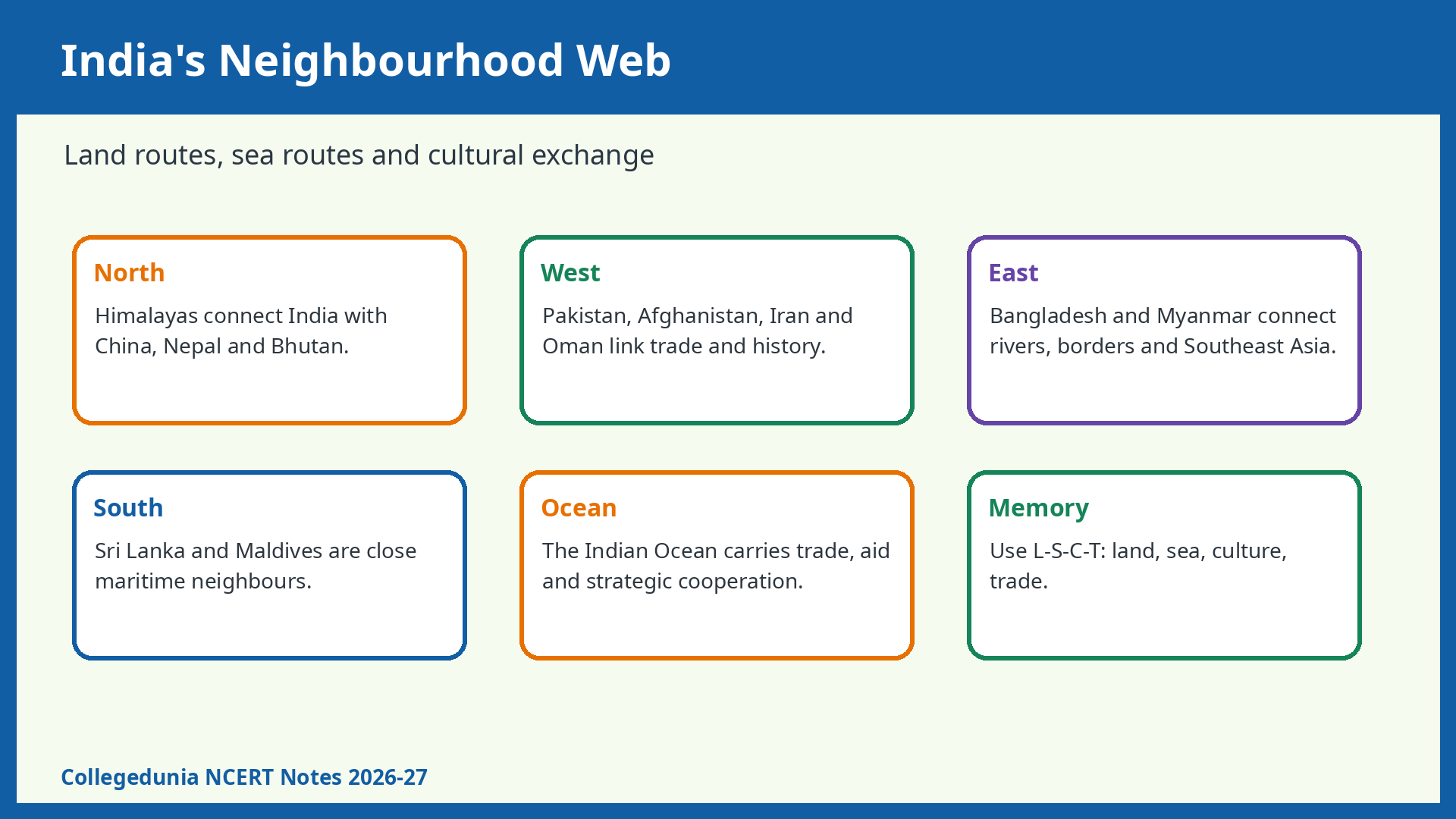
India's neighbourhood works like a web. Land borders connect India with countries such as Nepal, Bhutan, Bangladesh and Myanmar. Sea routes connect India with Sri Lanka, the Maldives, Oman, Iran and Southeast Asian countries. Culture and trade make these links older and deeper.
- Land link: shared borders, rivers, migration, markets and security.
- Sea link: ports, trade, fishing, tourism, disaster relief and climate risk.
- Cultural link: Buddhism, Hindu epics, language, art, food and pilgrimage.
India and Her Neighbours Revision Video
Source: Magnet Brains on YouTube
Land and Maritime Neighbours
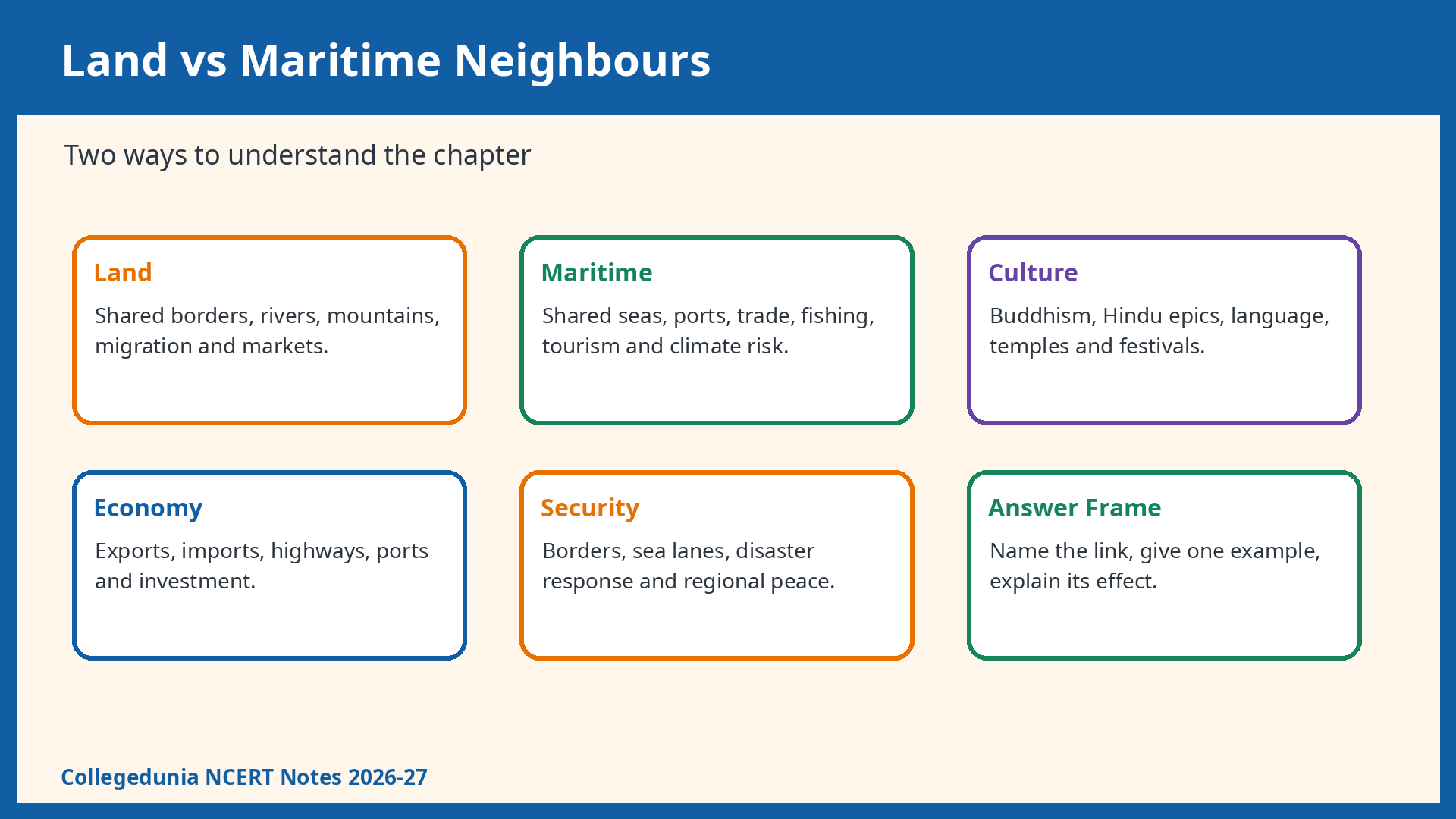
One of the easiest ways to revise the chapter is to compare land neighbours with maritime neighbours. Land neighbours share borders, while maritime neighbours are connected through nearby seas and ocean routes. Both types shape India's foreign relations.
| Point | Land neighbours | Maritime neighbours |
|---|---|---|
| Connection | Shared land boundary | Shared sea or ocean route |
| Main examples | Nepal, Bhutan, Bangladesh, Myanmar, Pakistan, China | Sri Lanka, Maldives, Oman, Iran, Thailand, Indonesia |
| Common issues | Border movement, trade, rivers, security | Ports, sea lanes, fishing, climate risk |
| Revision clue | Border and land route | Ocean and port route |
Country-wise Revision Table
The chapter has many countries, so revise one example per country. This method helps in short answers and map-based activities.
| Country | Main link with India | Example to remember |
|---|---|---|
| China | Buddhism, trade and border tensions | Faxian, Xuanzang, trade imbalance |
| Pakistan | Partition, conflict and shared heritage | Kartarpur Corridor |
| Bangladesh | Language, rivers and Sundarbans | Ganga-Brahmaputra systems |
| Nepal | Open border, pilgrimage and trade | Pashupatinath and free movement |
| Bhutan | Buddhism and hydropower | Gross National Happiness |
| Myanmar | Northeast gateway and Buddhism | Land Border Crossing Agreement |
| Sri Lanka | Palk Strait and Buddhism | Mahendra and Sanghamitra |
| Maldives | Indian Ocean and crisis support | 2004 tsunami and Male water crisis |
How to Use the Class 7 Chapter 2 Notes PDF
Start with the neighbourhood web, then revise the comparison table and country-wise examples. For long answers, use a four-part frame: geography, history, culture and modern cooperation. For this chapter, always connect a country with at least one example.
- Use the PDF tables for direct three-mark comparison questions.
- Use the country-wise table for map work and quick oral revision.
- Use the answer frames for questions on maritime neighbours, Buddhism and regional cooperation.
More Class 7 Social Science Chapter 2 Resources
Use these related resources when you want the same chapter in another format. The official book PDF is useful for reading the source chapter, while solutions help with activities and textbook questions.
| Resource | Best use | Link |
|---|---|---|
| NCERT Notes | Topic-by-topic revision with maps and tables | Current page |
| NCERT Solutions | Practice textbook questions and activity answers | Open NCERT Solutions |
| NCERT Book PDF | Read the official chapter with textbook figures | Open Book PDF |
| Handwritten Notes | Revise in a quick one-sitting format | Open Handwritten Notes |
All Chapters in Class 7 Social Science Part 2 Notes
The table below keeps the same resource type together, so students can move chapter by chapter through Class 7 Social Science Part 2 notes.
| Chapter | NCERT chapter title | Notes link |
|---|---|---|
| Chapter 1 | The Story of Indian Farming | Open Notes |
| Chapter 2 | India and Her Neighbours | Current notes |
| Chapter 3 | Empires and Kingdoms: 6th to 10th Centuries | Open Notes |
| Chapter 4 | Turning Tides: 11th and 12th Centuries | Open Notes |
| Chapter 5 | India, a Home to Many | Open Notes |
| Chapter 6 | The State, the Government, and You | Open Notes |
| Chapter 7 | Infrastructure: Engine of India's Development | Open Notes |
| Chapter 8 | Banks and the Magic of Finance | Open Notes |
Class 7 Social Science Chapter 2 India and Her Neighbours Notes FAQs
Ques. What is India and Her Neighbours about?
Ans. The chapter explains India's land and maritime neighbours, shared culture, trade routes, regional cooperation and common challenges.
Ques. Who is a maritime neighbour?
Ans. A maritime neighbour is a country connected through a shared sea or ocean route. Sri Lanka and the Maldives are examples for India.
Ques. Why is Buddhism important in this chapter?
Ans. Buddhism links India with countries such as China, Bhutan, Myanmar, Sri Lanka, Thailand and Indonesia through monks, texts and pilgrimage.
Ques. How should students revise Class 7 Social Science Chapter 2?
Ans. Students should group examples under land links, sea links, cultural links and cooperation, then practise map-based questions.



Comments