



The NCERT Class 7 Social Science Chapter 3 notes for Empires and Kingdoms: 6th to 10th Centuries explain Harsha, Kannauj, regional dynasties, temple grants, vassals, jatis, bhakti saints and the Cholas. These notes follow the 2026-27 NCERT textbook and help students revise the chapter through timelines, comparison tables and answer cues.
- Best for revision: Harsha, Gurjara-Pratiharas, Palas, Rashtrakutas, Cholas, vassals and temple networks.
- Use with the PDF: read the timeline first, then revise the dynasty and administration tables.
- 2026-27 focus: follows Exploring Society: India and Beyond, Part 2, Chapter 3.
Chapter3EmpiresandKingdoms:6thto10thCenturiesNotes.pdf?page=1&dpi=150)
Chapter3EmpiresandKingdoms:6thto10thCenturiesNotes.pdf?page=2&dpi=150)
Chapter3EmpiresandKingdoms:6thto10thCenturiesNotes.pdf?page=3&dpi=150)
Chapter3EmpiresandKingdoms:6thto10thCenturiesNotes.pdf?page=4&dpi=150)
Chapter3EmpiresandKingdoms:6thto10thCenturiesNotes.pdf?page=5&dpi=150)
Chapter3EmpiresandKingdoms:6thto10thCenturiesNotes.pdf?page=6&dpi=150)
Chapter3EmpiresandKingdoms:6thto10thCenturiesNotes.pdf?page=7&dpi=150)
Chapter3EmpiresandKingdoms:6thto10thCenturiesNotes.pdf?page=8&dpi=150)
Chapter3EmpiresandKingdoms:6thto10thCenturiesNotes.pdf?page=9&dpi=150)
Chapter3EmpiresandKingdoms:6thto10thCenturiesNotes.pdf?page=10&dpi=150)
Chapter3EmpiresandKingdoms:6thto10thCenturiesNotes.pdf?page=11&dpi=150)
Chapter3EmpiresandKingdoms:6thto10thCenturiesNotes.pdf?page=12&dpi=150)
Chapter3EmpiresandKingdoms:6thto10thCenturiesNotes.pdf?page=13&dpi=150)
Chapter3EmpiresandKingdoms:6thto10thCenturiesNotes.pdf?page=14&dpi=150)
Chapter3EmpiresandKingdoms:6thto10thCenturiesNotes.pdf?page=15&dpi=150)
Chapter3EmpiresandKingdoms:6thto10thCenturiesNotes.pdf?page=16&dpi=150)
Chapter3EmpiresandKingdoms:6thto10thCenturiesNotes.pdf?page=17&dpi=150)
Chapter3EmpiresandKingdoms:6thto10thCenturiesNotes.pdf?page=18&dpi=150)
Chapter3EmpiresandKingdoms:6thto10thCenturiesNotes.pdf?page=19&dpi=150)
Chapter3EmpiresandKingdoms:6thto10thCenturiesNotes.pdf?page=20&dpi=150)
Chapter3EmpiresandKingdoms:6thto10thCenturiesNotes.pdf?page=21&dpi=150)
Chapter3EmpiresandKingdoms:6thto10thCenturiesNotes.pdf?page=22&dpi=150)
Chapter3EmpiresandKingdoms:6thto10thCenturiesNotes_flat_MobileCard.pdf?page=1&dpi=150)
Chapter3EmpiresandKingdoms:6thto10thCenturiesNotes_flat_MobileCard.pdf?page=2&dpi=150)
Chapter3EmpiresandKingdoms:6thto10thCenturiesNotes_flat_MobileCard.pdf?page=3&dpi=150)
Chapter3EmpiresandKingdoms:6thto10thCenturiesNotes_flat_MobileCard.pdf?page=4&dpi=150)
Chapter3EmpiresandKingdoms:6thto10thCenturiesNotes_flat_MobileCard.pdf?page=5&dpi=150)
Chapter3EmpiresandKingdoms:6thto10thCenturiesNotes_flat_MobileCard.pdf?page=6&dpi=150)
Chapter3EmpiresandKingdoms:6thto10thCenturiesNotes_flat_MobileCard.pdf?page=7&dpi=150)
Chapter3EmpiresandKingdoms:6thto10thCenturiesNotes_flat_MobileCard.pdf?page=8&dpi=150)
Chapter3EmpiresandKingdoms:6thto10thCenturiesNotes_flat_MobileCard.pdf?page=9&dpi=150)
Chapter3EmpiresandKingdoms:6thto10thCenturiesNotes_flat_MobileCard.pdf?page=10&dpi=150)
Chapter3EmpiresandKingdoms:6thto10thCenturiesNotes_flat_MobileCard.pdf?page=11&dpi=150)
Chapter3EmpiresandKingdoms:6thto10thCenturiesNotes_flat_MobileCard.pdf?page=12&dpi=150)
Chapter3EmpiresandKingdoms:6thto10thCenturiesNotes_flat_MobileCard.pdf?page=13&dpi=150)
Chapter3EmpiresandKingdoms:6thto10thCenturiesNotes_flat_MobileCard.pdf?page=14&dpi=150)
Chapter3EmpiresandKingdoms:6thto10thCenturiesNotes_flat_MobileCard.pdf?page=15&dpi=150)
Chapter3EmpiresandKingdoms:6thto10thCenturiesNotes_flat_MobileCard.pdf?page=16&dpi=150)
Chapter3EmpiresandKingdoms:6thto10thCenturiesNotes_flat_MobileCard.pdf?page=17&dpi=150)
Chapter3EmpiresandKingdoms:6thto10thCenturiesNotes_flat_MobileCard.pdf?page=18&dpi=150)
Chapter3EmpiresandKingdoms:6thto10thCenturiesNotes_flat_MobileCard.pdf?page=19&dpi=150)
Chapter3EmpiresandKingdoms:6thto10thCenturiesNotes_flat_MobileCard.pdf?page=20&dpi=150)
Chapter3EmpiresandKingdoms:6thto10thCenturiesNotes_flat_MobileCard.pdf?page=21&dpi=150)
Chapter3EmpiresandKingdoms:6thto10thCenturiesNotes_flat_MobileCard.pdf?page=22&dpi=150)
Chapter3EmpiresandKingdoms:6thto10thCenturiesNotes_flat_MobileCard.pdf?page=23&dpi=150)
Chapter3EmpiresandKingdoms:6thto10thCenturiesNotes_flat_MobileCard.pdf?page=24&dpi=150)
Chapter3EmpiresandKingdoms:6thto10thCenturiesNotes_flat_MobileCard.pdf?page=25&dpi=150)
Chapter3EmpiresandKingdoms:6thto10thCenturiesNotes_flat_MobileCard.pdf?page=26&dpi=150)
Chapter3EmpiresandKingdoms:6thto10thCenturiesNotes_flat_MobileCard.pdf?page=27&dpi=150)
Chapter3EmpiresandKingdoms:6thto10thCenturiesNotes_flat_MobileCard.pdf?page=28&dpi=150)
Chapter3EmpiresandKingdoms:6thto10thCenturiesNotes_flat_MobileCard.pdf?page=29&dpi=150)
Chapter3EmpiresandKingdoms:6thto10thCenturiesNotes_flat_MobileCard.pdf?page=30&dpi=150)
Chapter3EmpiresandKingdoms:6thto10thCenturiesNotes_flat_MobileCard.pdf?page=31&dpi=150)
Student Feedback: In a Collegedunia revision poll of 12,640 Class 7 students, 78% said Chapter 3 became easier after they grouped rulers by region, capital, administration and cultural contribution.
Empires and Kingdoms Class 7 Notes Highlights
Empires and Kingdoms: 6th to 10th Centuries shows why India had many powerful regional kingdoms after the Gupta age. The chapter moves from Harsha in north India to the struggle for Kannauj, then to the Palas, Rashtrakutas, Cholas and temple-centred society. The key idea is that power came from land, armies, alliances, temples and local chiefs.
| Topic | What to remember | Exam cue |
|---|---|---|
| Harsha | Ruled from Kannauj and held the famous Prayaga assembly | Use for early seventh century north India |
| Kannauj | Important city contested by major dynasties | Connect with the tripartite struggle |
| Land grants | Kings gave land to officers, temples and religious groups | Use for administration and society |
| Bhakti | Alvars and Nayanars spread devotional poetry | Use for cultural change |
Empires and Kingdoms Class 7 Revision Video
Source: Magnet Brains on YouTube
Empires and Kingdoms Timeline for Quick Revision
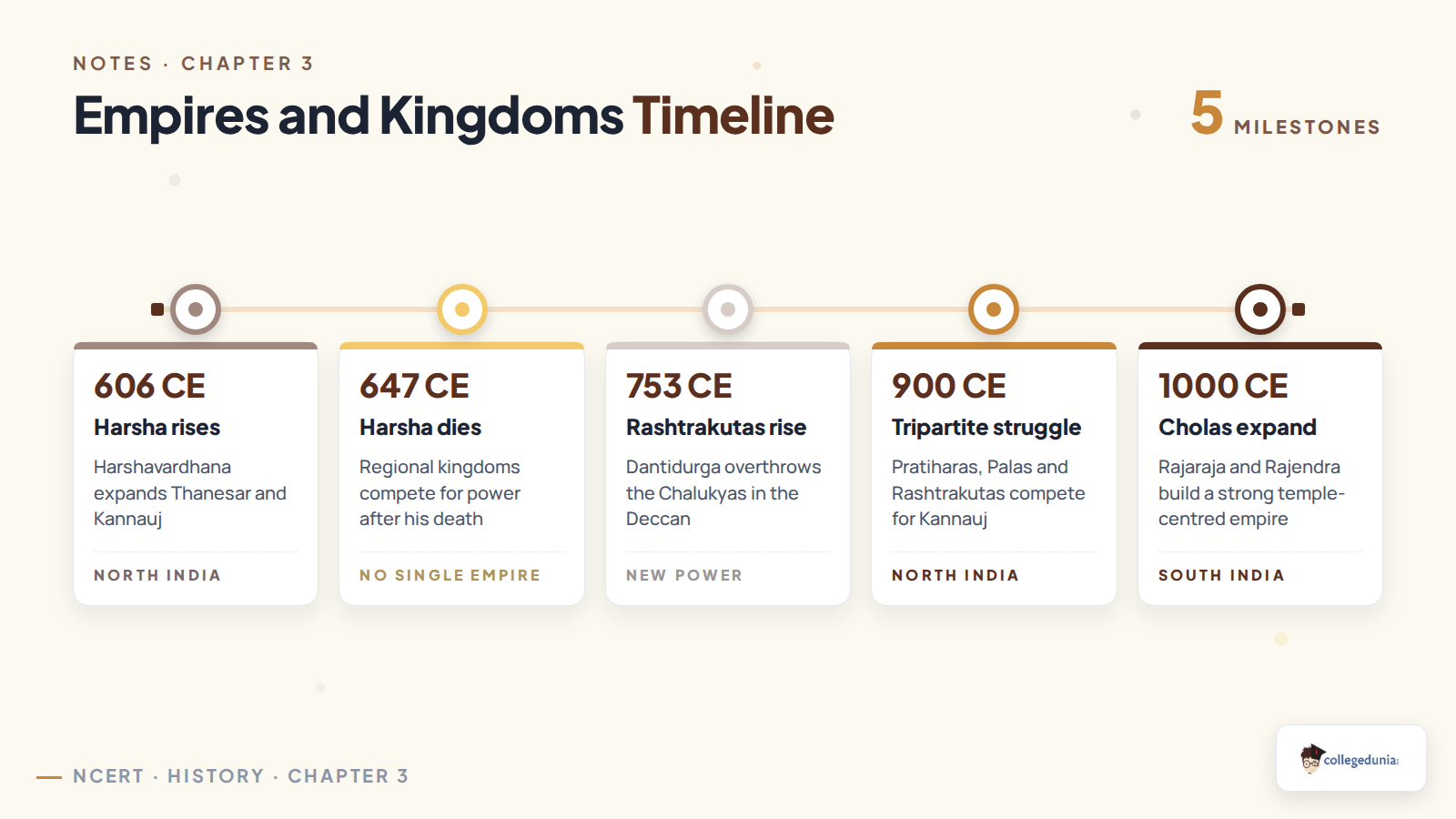
The timeline helps students place rulers and dynasties in order. Harsha's rule comes first, followed by a period when many regional powers became stronger. By the ninth and tenth centuries, the Cholas in the south and the dynasties contesting Kannauj shaped much of the chapter.
- 606 CE: Harsha begins his rule and later makes Kannauj a major centre.
- 753 CE: Dantidurga helps the Rashtrakutas rise in the Deccan.
- 900 CE: Pratiharas, Palas and Rashtrakutas compete for Kannauj.
- 1000 CE: Chola power grows through temples, armies and overseas contact.
Three Early Medieval Power Centres Students Must Know
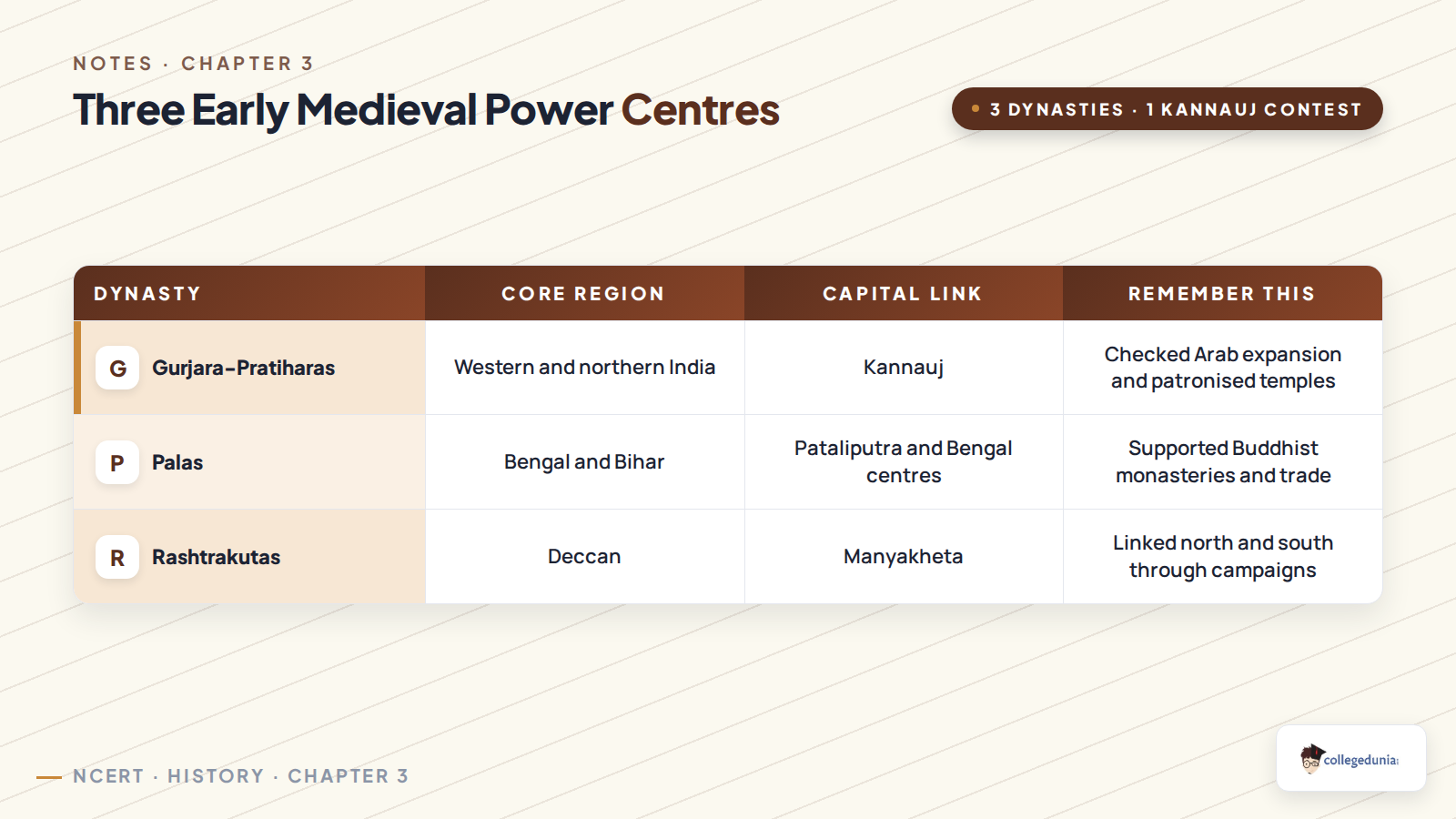
Many questions in this chapter ask students to compare dynasties. The safest method is to revise one region, one capital link and one cultural contribution for each power centre.
| Dynasty | Core region | Strong memory point |
|---|---|---|
| Gurjara-Pratiharas | Western and northern India | Defended north India and competed for Kannauj |
| Palas | Bengal and Bihar | Supported Buddhist monasteries such as Nalanda and Vikramashila |
| Rashtrakutas | Deccan | Linked north and south India through campaigns and temple patronage |
| Cholas | Tamil region and beyond | Used temples, irrigation, trade and naval expeditions to expand influence |
Administration and Society in Empires and Kingdoms
Early medieval rulers did not govern alone. They depended on officials, chiefs, vassals, merchants, temple authorities and landholding groups. For answer writing, always link administration with land control. Land grants created loyal supporters and also gave local elites more power.
- Vassals: local rulers accepted a stronger king and gave military support.
- Land grants: kings rewarded officials, temples, Brahmanas and religious institutions.
- Jatis: occupational groups grew more visible in local society.
- Temples: worked as religious, economic and cultural centres.
Bhakti, Temples and Culture in the Chapter
The chapter also shows that kingdoms were not only about battles. Bhakti poets, temples, inscriptions and regional languages shaped public life. The Alvars worshipped Vishnu, while the Nayanars worshipped Shiva. Their hymns helped devotional ideas reach ordinary people.
| Cultural element | Where it appears | What it shows |
|---|---|---|
| Alvars | South India | Devotion to Vishnu through Tamil hymns |
| Nayanars | South India | Devotion to Shiva through Tamil hymns |
| Kalhana | Kashmir | History writing through Rajatarangini |
| Temple grants | Many kingdoms | Temples received land and became local institutions |
How to Use the Class 7 Chapter 3 Notes PDF
Start with the timeline, then revise the dynasty table and administration bullets. For long answers, use a four-part frame: ruler, region, administration and culture. The PDF is best used as a 30-minute revision sheet before class tests and chapter activities.
- Use the timeline for sequence-based questions and map activities.
- Use the dynasty table for short comparison answers.
- Use the culture table for questions on Alvars, Nayanars, Kalhana and temples.
More Class 7 Social Science Chapter 3 Resources
Use these related resources when you want the same chapter in another format. The official book PDF is useful for reading the source chapter, while solutions help with textbook activities and short answers.
| Resource | Best use | Link |
|---|---|---|
| NCERT Notes | Topic-by-topic revision with timeline and tables | Current page |
| NCERT Solutions | Practice textbook questions and activity answers | Coming soon |
| NCERT Book PDF | Read the official chapter with textbook figures | Coming soon |
| Handwritten Notes | Revise in a quick one-sitting format | Coming soon |
All Chapters in Class 7 Social Science Part 2 Notes
The table below keeps the same resource type together, so students can move chapter by chapter through Class 7 Social Science Part 2 notes.
| Chapter | NCERT chapter title | Notes link |
|---|---|---|
| Chapter 1 | The Story of Indian Farming | Open Notes |
| Chapter 2 | India and Her Neighbours | Open Notes |
| Chapter 3 | Empires and Kingdoms: 6th to 10th Centuries | Current notes |
| Chapter 4 | Turning Tides: 11th and 12th Centuries | Coming soon |
| Chapter 5 | India, a Home to Many | Coming soon |
| Chapter 6 | The State, the Government, and You | Coming soon |
| Chapter 7 | Infrastructure: Engine of India's Development | Coming soon |
| Chapter 8 | Banks and the Magic of Finance | Coming soon |
Class 7 Social Science Chapter 3 Empires and Kingdoms Notes FAQs
Ques. What is Empires and Kingdoms: 6th to 10th Centuries about?
Ans. The chapter explains regional kingdoms after the Gupta age, including Harsha, Kannauj, the Palas, Rashtrakutas, Cholas, land grants, vassals, temples and bhakti movements.
Ques. Why was Kannauj important in Class 7 Social Science Chapter 3?
Ans. Kannauj was a major political centre in north India. The Gurjara-Pratiharas, Palas and Rashtrakutas competed for control over it.
Ques. What were land grants in early medieval kingdoms?
Ans. Land grants were gifts of land made by rulers to officials, temples, Brahmanas or religious institutions. They helped kings reward supporters and manage local areas.
Ques. How should students revise NCERT Class 7 Social Science Chapter 3 notes?
Ans. Students should revise the timeline, compare major dynasties, remember one example for each cultural topic and practise short answers on vassals, jatis and temple grants.



Comments