



The NCERT Class 7 Social Science Chapter 4 notes for Turning Tides: 11th and 12th Centuries explain Turkic invasions, Chola power, regional kingdoms, temples, science, culture and the Tarain battles. These notes follow the 2026-27 NCERT textbook and help students revise the chapter through timelines, comparison tables and answer cues.
- Best for revision: Mahmud of Ghazni, Rajaraja Chola, Rajendra Chola, Bhoja, Kakatiyas, Prithviraja III and Muhammad Ghuri.
- Use with the PDF: read the timeline first, then revise comparison tables and answer frames.
- 2026-27 focus: follows Exploring Society: India and Beyond, Part 2, Chapter 4.
Chapter4TurningTides:11thand12thCenturiesNotes.pdf?page=1&dpi=150)
Chapter4TurningTides:11thand12thCenturiesNotes.pdf?page=2&dpi=150)
Chapter4TurningTides:11thand12thCenturiesNotes.pdf?page=3&dpi=150)
Chapter4TurningTides:11thand12thCenturiesNotes.pdf?page=4&dpi=150)
Chapter4TurningTides:11thand12thCenturiesNotes.pdf?page=5&dpi=150)
Chapter4TurningTides:11thand12thCenturiesNotes.pdf?page=6&dpi=150)
Chapter4TurningTides:11thand12thCenturiesNotes.pdf?page=7&dpi=150)
Chapter4TurningTides:11thand12thCenturiesNotes.pdf?page=8&dpi=150)
Chapter4TurningTides:11thand12thCenturiesNotes.pdf?page=9&dpi=150)
Chapter4TurningTides:11thand12thCenturiesNotes.pdf?page=10&dpi=150)
Chapter4TurningTides:11thand12thCenturiesNotes.pdf?page=11&dpi=150)
Chapter4TurningTides:11thand12thCenturiesNotes.pdf?page=12&dpi=150)
Chapter4TurningTides:11thand12thCenturiesNotes.pdf?page=13&dpi=150)
Chapter4TurningTides:11thand12thCenturiesNotes.pdf?page=14&dpi=150)
Chapter4TurningTides:11thand12thCenturiesNotes.pdf?page=15&dpi=150)
Chapter4TurningTides:11thand12thCenturiesNotes.pdf?page=16&dpi=150)
Chapter4TurningTides:11thand12thCenturiesNotes.pdf?page=17&dpi=150)
Chapter4TurningTides:11thand12thCenturiesNotes.pdf?page=18&dpi=150)
Chapter4TurningTides:11thand12thCenturiesNotes.pdf?page=19&dpi=150)
Chapter4TurningTides:11thand12thCenturiesNotes.pdf?page=20&dpi=150)
Chapter4TurningTides:11thand12thCenturiesNotes.pdf?page=21&dpi=150)
Chapter4TurningTides:11thand12thCenturiesNotes_flat_MobileCard.pdf?page=1&dpi=150)
Chapter4TurningTides:11thand12thCenturiesNotes_flat_MobileCard.pdf?page=2&dpi=150)
Chapter4TurningTides:11thand12thCenturiesNotes_flat_MobileCard.pdf?page=3&dpi=150)
Chapter4TurningTides:11thand12thCenturiesNotes_flat_MobileCard.pdf?page=4&dpi=150)
Chapter4TurningTides:11thand12thCenturiesNotes_flat_MobileCard.pdf?page=5&dpi=150)
Chapter4TurningTides:11thand12thCenturiesNotes_flat_MobileCard.pdf?page=6&dpi=150)
Chapter4TurningTides:11thand12thCenturiesNotes_flat_MobileCard.pdf?page=7&dpi=150)
Chapter4TurningTides:11thand12thCenturiesNotes_flat_MobileCard.pdf?page=8&dpi=150)
Chapter4TurningTides:11thand12thCenturiesNotes_flat_MobileCard.pdf?page=9&dpi=150)
Chapter4TurningTides:11thand12thCenturiesNotes_flat_MobileCard.pdf?page=10&dpi=150)
Chapter4TurningTides:11thand12thCenturiesNotes_flat_MobileCard.pdf?page=11&dpi=150)
Chapter4TurningTides:11thand12thCenturiesNotes_flat_MobileCard.pdf?page=12&dpi=150)
Chapter4TurningTides:11thand12thCenturiesNotes_flat_MobileCard.pdf?page=13&dpi=150)
Chapter4TurningTides:11thand12thCenturiesNotes_flat_MobileCard.pdf?page=14&dpi=150)
Chapter4TurningTides:11thand12thCenturiesNotes_flat_MobileCard.pdf?page=15&dpi=150)
Chapter4TurningTides:11thand12thCenturiesNotes_flat_MobileCard.pdf?page=16&dpi=150)
Chapter4TurningTides:11thand12thCenturiesNotes_flat_MobileCard.pdf?page=17&dpi=150)
Chapter4TurningTides:11thand12thCenturiesNotes_flat_MobileCard.pdf?page=18&dpi=150)
Chapter4TurningTides:11thand12thCenturiesNotes_flat_MobileCard.pdf?page=19&dpi=150)
Chapter4TurningTides:11thand12thCenturiesNotes_flat_MobileCard.pdf?page=20&dpi=150)
Chapter4TurningTides:11thand12thCenturiesNotes_flat_MobileCard.pdf?page=21&dpi=150)
Chapter4TurningTides:11thand12thCenturiesNotes_flat_MobileCard.pdf?page=22&dpi=150)
Chapter4TurningTides:11thand12thCenturiesNotes_flat_MobileCard.pdf?page=23&dpi=150)
Chapter4TurningTides:11thand12thCenturiesNotes_flat_MobileCard.pdf?page=24&dpi=150)
Chapter4TurningTides:11thand12thCenturiesNotes_flat_MobileCard.pdf?page=25&dpi=150)
Chapter4TurningTides:11thand12thCenturiesNotes_flat_MobileCard.pdf?page=26&dpi=150)
Chapter4TurningTides:11thand12thCenturiesNotes_flat_MobileCard.pdf?page=27&dpi=150)
Chapter4TurningTides:11thand12thCenturiesNotes_flat_MobileCard.pdf?page=28&dpi=150)
Chapter4TurningTides:11thand12thCenturiesNotes_flat_MobileCard.pdf?page=29&dpi=150)
Chapter4TurningTides:11thand12thCenturiesNotes_flat_MobileCard.pdf?page=30&dpi=150)
Chapter4TurningTides:11thand12thCenturiesNotes_flat_MobileCard.pdf?page=31&dpi=150)
Chapter4TurningTides:11thand12thCenturiesNotes_flat_MobileCard.pdf?page=32&dpi=150)
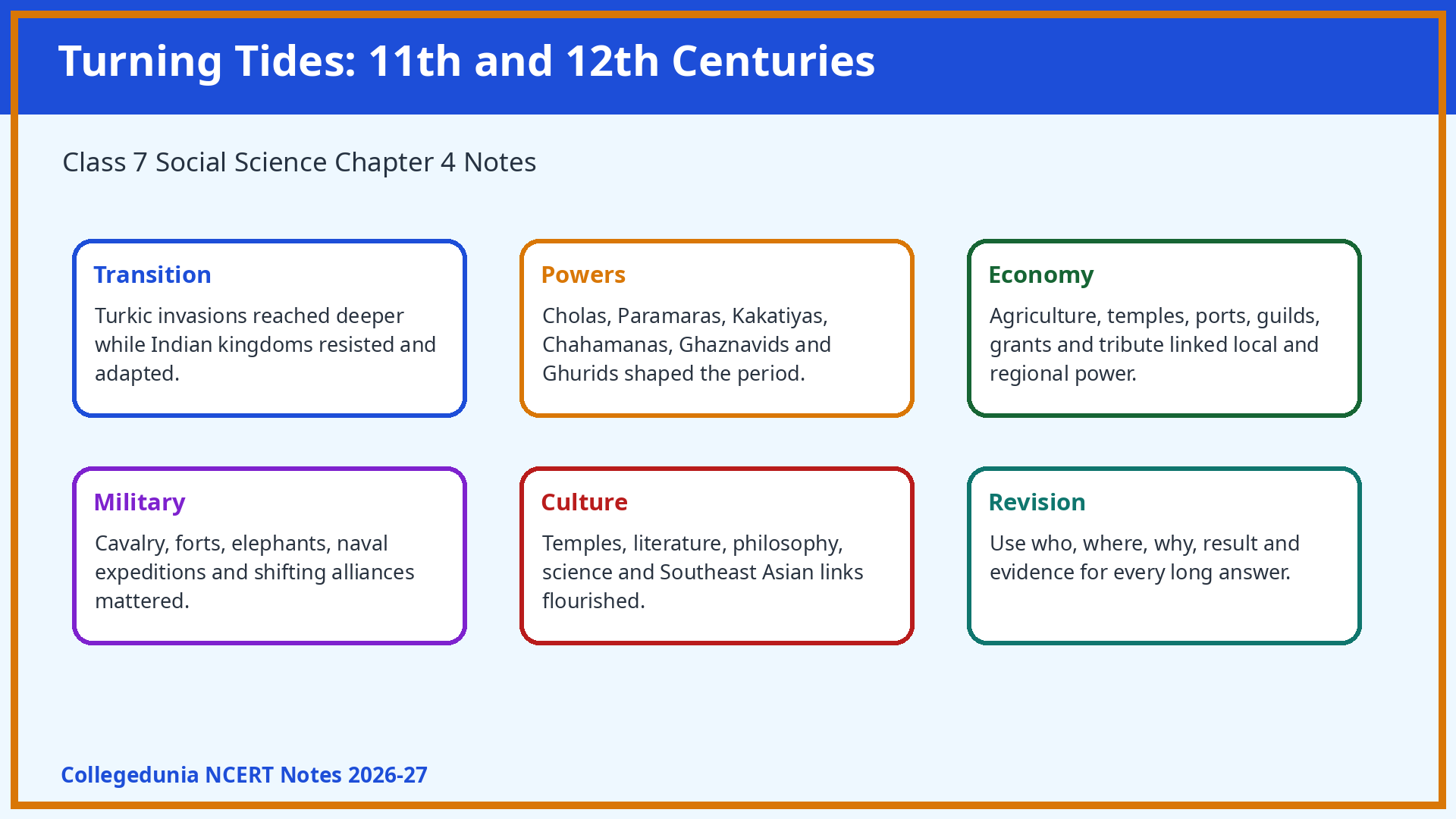
Student Feedback: In a Collegedunia revision check, students said this chapter becomes easier after separating the period into invasions, regional powers, administration and cultural achievements.
Turning Tides Class 7 Notes Overview
Class 7 Social Science Chapter 4 studies the 11th and 12th centuries as a period of transition. Turkic invasions reached deeper into north India, but Indian regional powers also governed, built, traded and produced important works.
The chapter begins with conflict and ends with conflict, yet NCERT also asks students to notice temples, ports, mathematics, literature, philosophy and links with Southeast Asia.
Turning Tides 11th and 12th Centuries Video Lesson
Source: Magnet Brains on YouTube
Timeline and Transition in Class 7 Social Science Chapter 4
A transition is a period of change between two phases. In this chapter, older regional kingdoms continued, while new invasions, military methods and political shifts changed the balance of power.
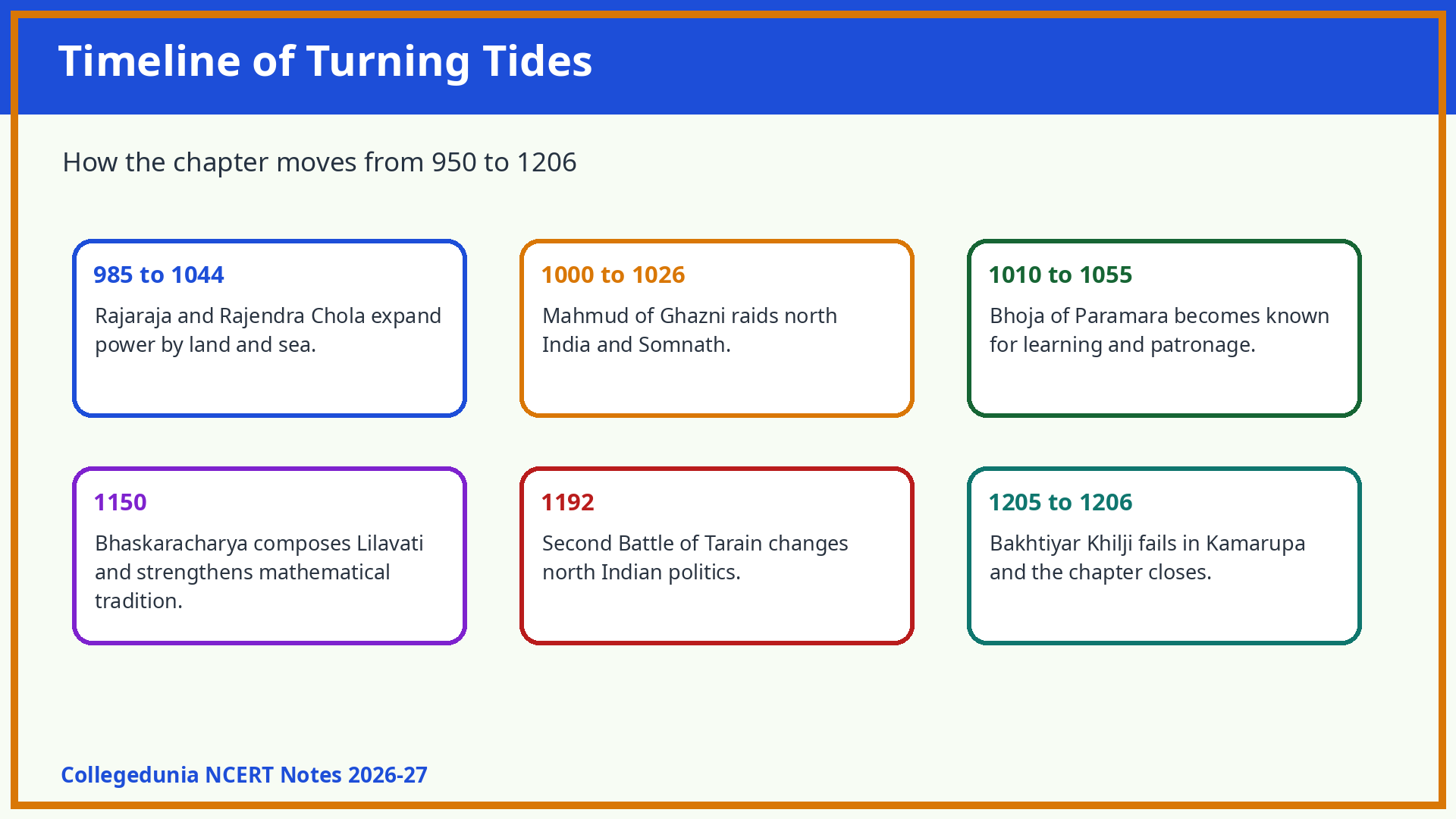
| Date or period | Event | Why it matters |
|---|---|---|
| 985-1014 | Rajaraja Chola I | Chola expansion and temple building |
| 1026 | Somnath raid | Shows Ghaznavid plunder and north-west pressure |
| 1150 | Bhaskaracharya composes Lilavati | Shows growth of mathematical learning |
| 1192 | Second Battle of Tarain | Marks an important Ghurid victory |
Cholas Ghaznavids Ghurids and Regional Powers
The Cholas show south Indian strength through administration, temples, ports and naval activity. Ghaznavid and Ghurid campaigns show the new military pressure from the north-west.
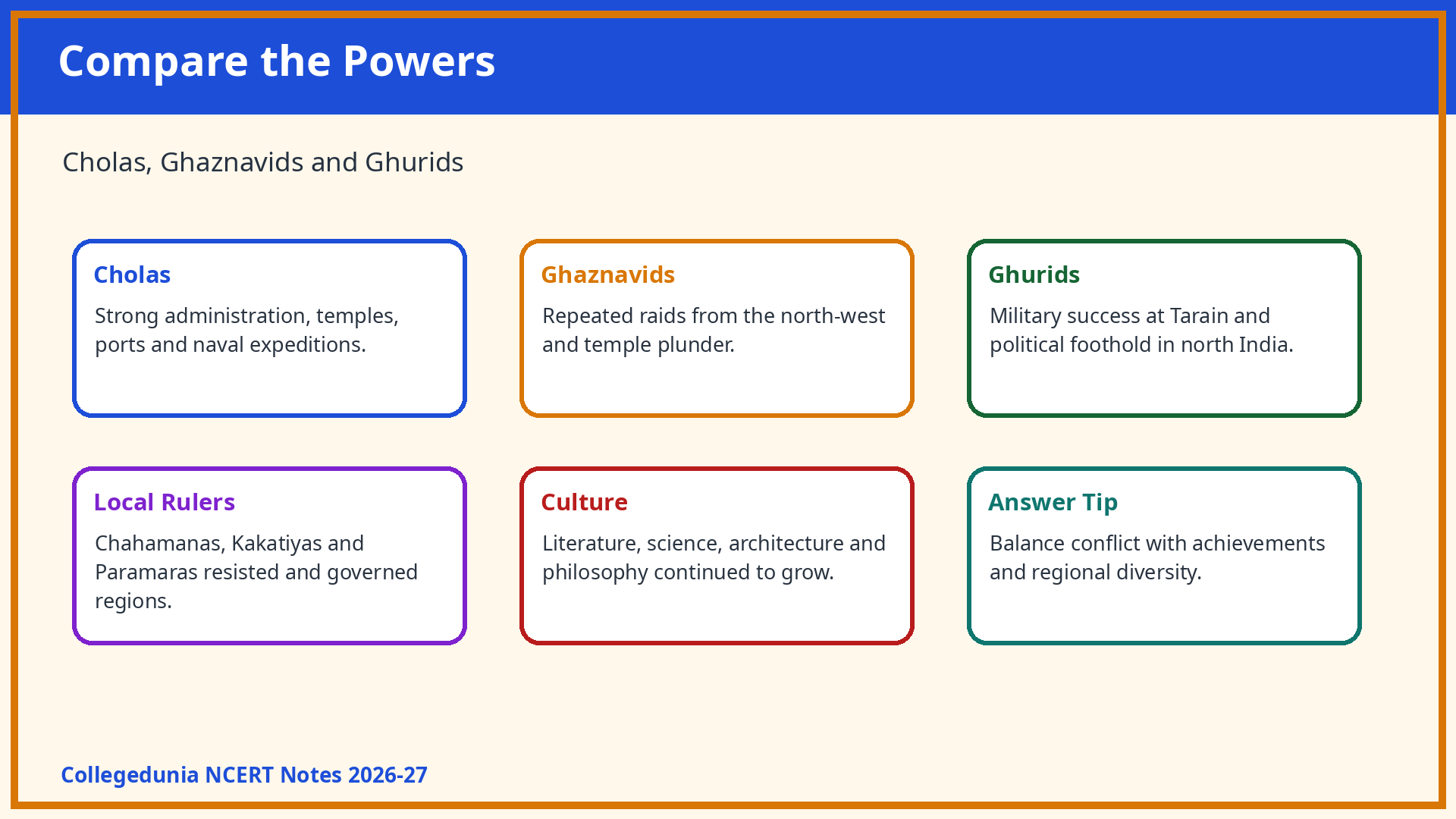
- Cholas: strong administration, temple centres, ports and Indian Ocean links.
- Mahmud of Ghazni: repeated raids, including the attack on Somnath.
- Muhammad Ghuri: victory at the second Battle of Tarain in 1192.
- Regional powers: Paramaras, Kakatiyas and Chahamanas shaped different regions.
Architecture Culture Science and Answer Writing
Temples were centres of worship, economy, art and local life. Courtly learning, literature, philosophy and science also developed during this period. Bhaskaracharya's Lilavati is an important example of mathematical achievement.
For a long answer, start with the meaning of transition, give examples from invasions and regional powers, then add one cultural or scientific achievement. This keeps the answer balanced.
Turning Tides Related Resources
| Resource | Link |
|---|---|
| NCERT Solutions | Class 7 Social Science Chapter 4 NCERT Solutions |
| NCERT Book PDF | Class 7 Social Science Chapter 4 NCERT Book PDF |
| Handwritten Notes | Class 7 Social Science Chapter 4 Handwritten Notes |
Class 7 Social Science Part 2 Notes for All Chapters
| Chapter | Notes |
|---|---|
| Chapter 1 | The Story of Indian Farming Notes |
| Chapter 2 | India and Her Neighbours Notes |
| Chapter 3 | Empires and Kingdoms Notes |
| Chapter 4 | Turning Tides Notes |
Student Doubts on Class 7 Social Science Chapter 4
Turning Tides Class 7 Notes FAQs
Ques. Why are the 11th and 12th centuries called a transition?
Ans. They are called a transition because older regional kingdoms continued while Turkic invasions, new military pressures and changing political systems reshaped north India.
Ques. Which Chola rulers are important in this chapter?
Ans. Rajaraja Chola I and Rajendra Chola I are important because they expanded Chola power, supported temples and showed maritime reach.
Ques. Why is the second Battle of Tarain important?
Ans. The second Battle of Tarain in 1192 was important because Muhammad Ghuri defeated Prithviraja III and changed the political balance in north India.
Ques. What cultural achievements appear in Chapter 4?
Ans. The chapter mentions temples, architecture, literature, philosophy, bhakti traditions and Bhaskaracharya's mathematical work Lilavati.



Comments