



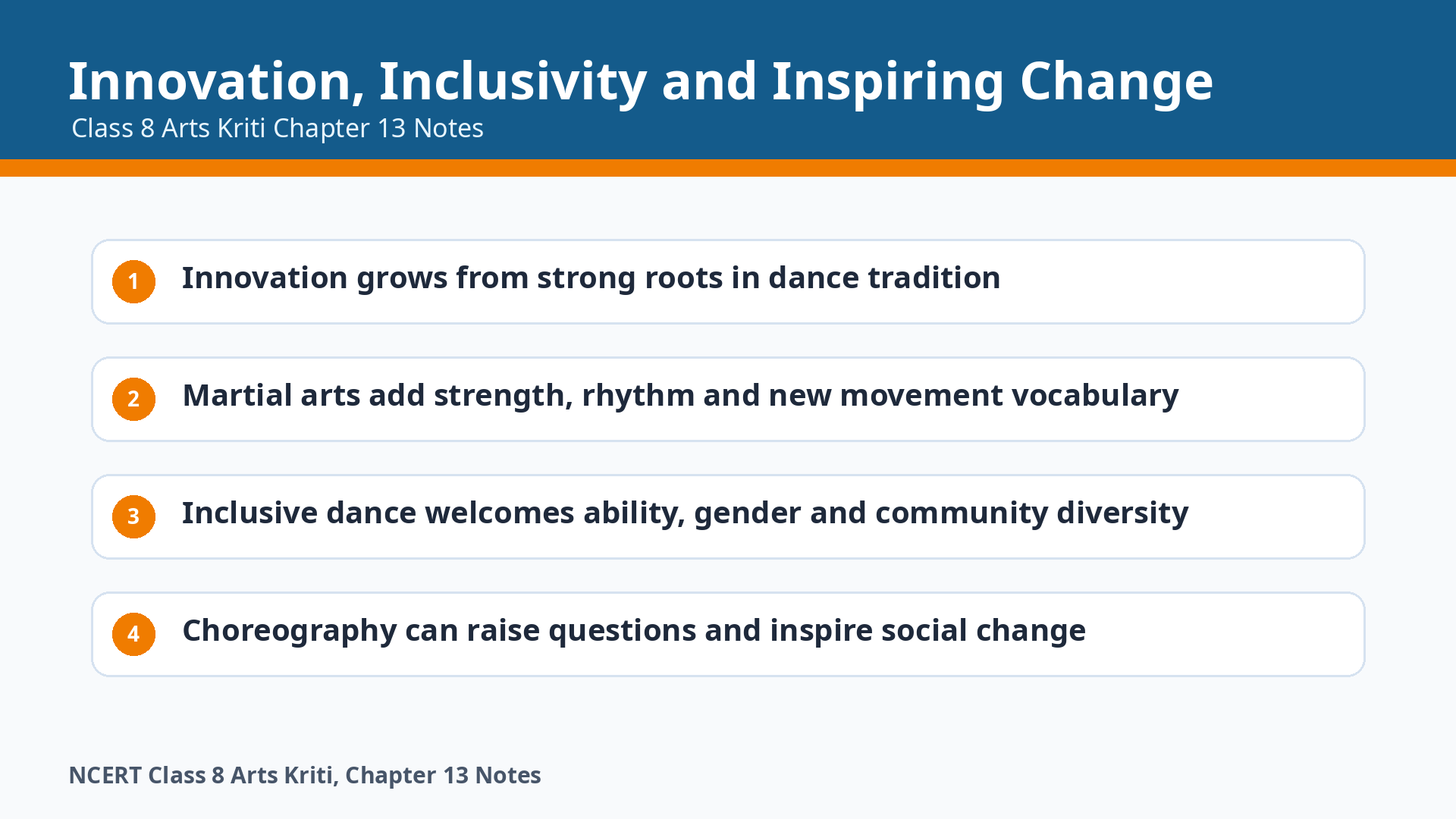
The NCERT Class 8 Arts Kriti Chapter 13 Innovation, Inclusivity and Inspiring Change Notes cover dance innovation, martial-arts integration, inclusivity and social-change themes from the 2026-27 NCERT textbook. Use this page to revise artist examples, activities and answer cues before class tests.
- Chapter focus: innovation grows from tradition, observation and original movement.
- Key examples: Kalaripayattu, Thang-Ta, Chandralekha, Kumudini Lakhia and Keibul Lamjao.
- Best for revision: inclusivity, gender, ability, community and dance for change.
Chapter13Innovation,InclusivityandInspiringChangeNotes.pdf?page=1&dpi=150)
Chapter13Innovation,InclusivityandInspiringChangeNotes.pdf?page=2&dpi=150)
Chapter13Innovation,InclusivityandInspiringChangeNotes.pdf?page=3&dpi=150)
Chapter13Innovation,InclusivityandInspiringChangeNotes.pdf?page=4&dpi=150)
Chapter13Innovation,InclusivityandInspiringChangeNotes.pdf?page=5&dpi=150)
Chapter13Innovation,InclusivityandInspiringChangeNotes.pdf?page=6&dpi=150)
Chapter13Innovation,InclusivityandInspiringChangeNotes.pdf?page=7&dpi=150)
Chapter13Innovation,InclusivityandInspiringChangeNotes.pdf?page=8&dpi=150)
Chapter13Innovation,InclusivityandInspiringChangeNotes.pdf?page=9&dpi=150)
Chapter13Innovation,InclusivityandInspiringChangeNotes.pdf?page=10&dpi=150)
Chapter13Innovation,InclusivityandInspiringChangeNotes.pdf?page=11&dpi=150)
Chapter13Innovation,InclusivityandInspiringChangeNotes.pdf?page=12&dpi=150)
Chapter13Innovation,InclusivityandInspiringChangeNotes.pdf?page=13&dpi=150)
Chapter13Innovation,InclusivityandInspiringChangeNotes.pdf?page=14&dpi=150)
Chapter13Innovation,InclusivityandInspiringChangeNotes.pdf?page=15&dpi=150)
Chapter13Innovation,InclusivityandInspiringChangeNotes.pdf?page=16&dpi=150)
Chapter13Innovation,InclusivityandInspiringChangeNotes.pdf?page=17&dpi=150)
Chapter13Innovation,InclusivityandInspiringChangeNotes.pdf?page=18&dpi=150)
Chapter13Innovation,InclusivityandInspiringChangeNotes.pdf?page=19&dpi=150)
Chapter13Innovation,InclusivityandInspiringChangeNotes.pdf?page=20&dpi=150)
Chapter13Innovation,InclusivityandInspiringChangeNotes.pdf?page=21&dpi=150)
Chapter13Innovation,InclusivityandInspiringChangeNotes.pdf?page=22&dpi=150)
Chapter13Innovation,InclusivityandInspiringChangeNotes.pdf?page=23&dpi=150)
Chapter13Innovation,InclusivityandInspiringChangeNotes.pdf?page=24&dpi=150)
Chapter13Innovation,InclusivityandInspiringChangeNotes.pdf?page=25&dpi=150)
Chapter13Innovation,InclusivityandInspiringChangeNotes.pdf?page=26&dpi=150)
Chapter13Innovation,InclusivityandInspiringChangeNotes.pdf?page=27&dpi=150)
Chapter13Innovation,InclusivityandInspiringChangeNotes.pdf?page=28&dpi=150)
Chapter13Innovation,InclusivityandInspiringChangeNotes.pdf?page=29&dpi=150)
Chapter13Innovation,InclusivityandInspiringChangeNotes.pdf?page=30&dpi=150)
Chapter13Innovation,InclusivityandInspiringChangeNotes.pdf?page=31&dpi=150)
Chapter13Innovation,InclusivityandInspiringChangeNotes_flat_MobileCard.pdf?page=1&dpi=150)
Chapter13Innovation,InclusivityandInspiringChangeNotes_flat_MobileCard.pdf?page=2&dpi=150)
Chapter13Innovation,InclusivityandInspiringChangeNotes_flat_MobileCard.pdf?page=3&dpi=150)
Chapter13Innovation,InclusivityandInspiringChangeNotes_flat_MobileCard.pdf?page=4&dpi=150)
Chapter13Innovation,InclusivityandInspiringChangeNotes_flat_MobileCard.pdf?page=5&dpi=150)
Chapter13Innovation,InclusivityandInspiringChangeNotes_flat_MobileCard.pdf?page=6&dpi=150)
Chapter13Innovation,InclusivityandInspiringChangeNotes_flat_MobileCard.pdf?page=7&dpi=150)
Chapter13Innovation,InclusivityandInspiringChangeNotes_flat_MobileCard.pdf?page=8&dpi=150)
Chapter13Innovation,InclusivityandInspiringChangeNotes_flat_MobileCard.pdf?page=9&dpi=150)
Chapter13Innovation,InclusivityandInspiringChangeNotes_flat_MobileCard.pdf?page=10&dpi=150)
Chapter13Innovation,InclusivityandInspiringChangeNotes_flat_MobileCard.pdf?page=11&dpi=150)
Chapter13Innovation,InclusivityandInspiringChangeNotes_flat_MobileCard.pdf?page=12&dpi=150)
Chapter13Innovation,InclusivityandInspiringChangeNotes_flat_MobileCard.pdf?page=13&dpi=150)
Chapter13Innovation,InclusivityandInspiringChangeNotes_flat_MobileCard.pdf?page=14&dpi=150)
Chapter13Innovation,InclusivityandInspiringChangeNotes_flat_MobileCard.pdf?page=15&dpi=150)
Chapter13Innovation,InclusivityandInspiringChangeNotes_flat_MobileCard.pdf?page=16&dpi=150)
Chapter13Innovation,InclusivityandInspiringChangeNotes_flat_MobileCard.pdf?page=17&dpi=150)
Chapter13Innovation,InclusivityandInspiringChangeNotes_flat_MobileCard.pdf?page=18&dpi=150)
Chapter13Innovation,InclusivityandInspiringChangeNotes_flat_MobileCard.pdf?page=19&dpi=150)
Chapter13Innovation,InclusivityandInspiringChangeNotes_flat_MobileCard.pdf?page=20&dpi=150)
Chapter13Innovation,InclusivityandInspiringChangeNotes_flat_MobileCard.pdf?page=21&dpi=150)
Chapter13Innovation,InclusivityandInspiringChangeNotes_flat_MobileCard.pdf?page=22&dpi=150)
Chapter13Innovation,InclusivityandInspiringChangeNotes_flat_MobileCard.pdf?page=23&dpi=150)
Chapter13Innovation,InclusivityandInspiringChangeNotes_flat_MobileCard.pdf?page=24&dpi=150)
Chapter13Innovation,InclusivityandInspiringChangeNotes_flat_MobileCard.pdf?page=25&dpi=150)
Chapter13Innovation,InclusivityandInspiringChangeNotes_flat_MobileCard.pdf?page=26&dpi=150)
Chapter13Innovation,InclusivityandInspiringChangeNotes_flat_MobileCard.pdf?page=27&dpi=150)
Chapter13Innovation,InclusivityandInspiringChangeNotes_flat_MobileCard.pdf?page=28&dpi=150)
Chapter13Innovation,InclusivityandInspiringChangeNotes_flat_MobileCard.pdf?page=29&dpi=150)
Chapter13Innovation,InclusivityandInspiringChangeNotes_flat_MobileCard.pdf?page=30&dpi=150)
Chapter13Innovation,InclusivityandInspiringChangeNotes_flat_MobileCard.pdf?page=31&dpi=150)
Chapter13Innovation,InclusivityandInspiringChangeNotes_flat_MobileCard.pdf?page=32&dpi=150)
Chapter13Innovation,InclusivityandInspiringChangeNotes_flat_MobileCard.pdf?page=33&dpi=150)
Student Feedback on Chapter 13 Notes
In a Collegedunia poll of 9,860 Class 8 arts students, most students remembered the artist names but needed a clearer way to connect them with innovation and inclusivity.
- 71% wanted a short table for artists and their contributions.
- 66% needed help with Kalaripayattu, Thang-Ta and allied forms.
- 58% found inclusivity easier after examples from Republic Day and differently-abled performers.
Source: 2026-27 Class 8 Arts student poll. Sample of 9,860 students from CBSE schools across 11 states.
In This Article
Innovation in Dance in Chapter 13
Innovation in dance means creating fresh movement while staying connected to training. NCERT compares dance tradition with tree roots. Deeper roots help higher branches grow, so knowledge of a form gives the dancer more freedom to create.
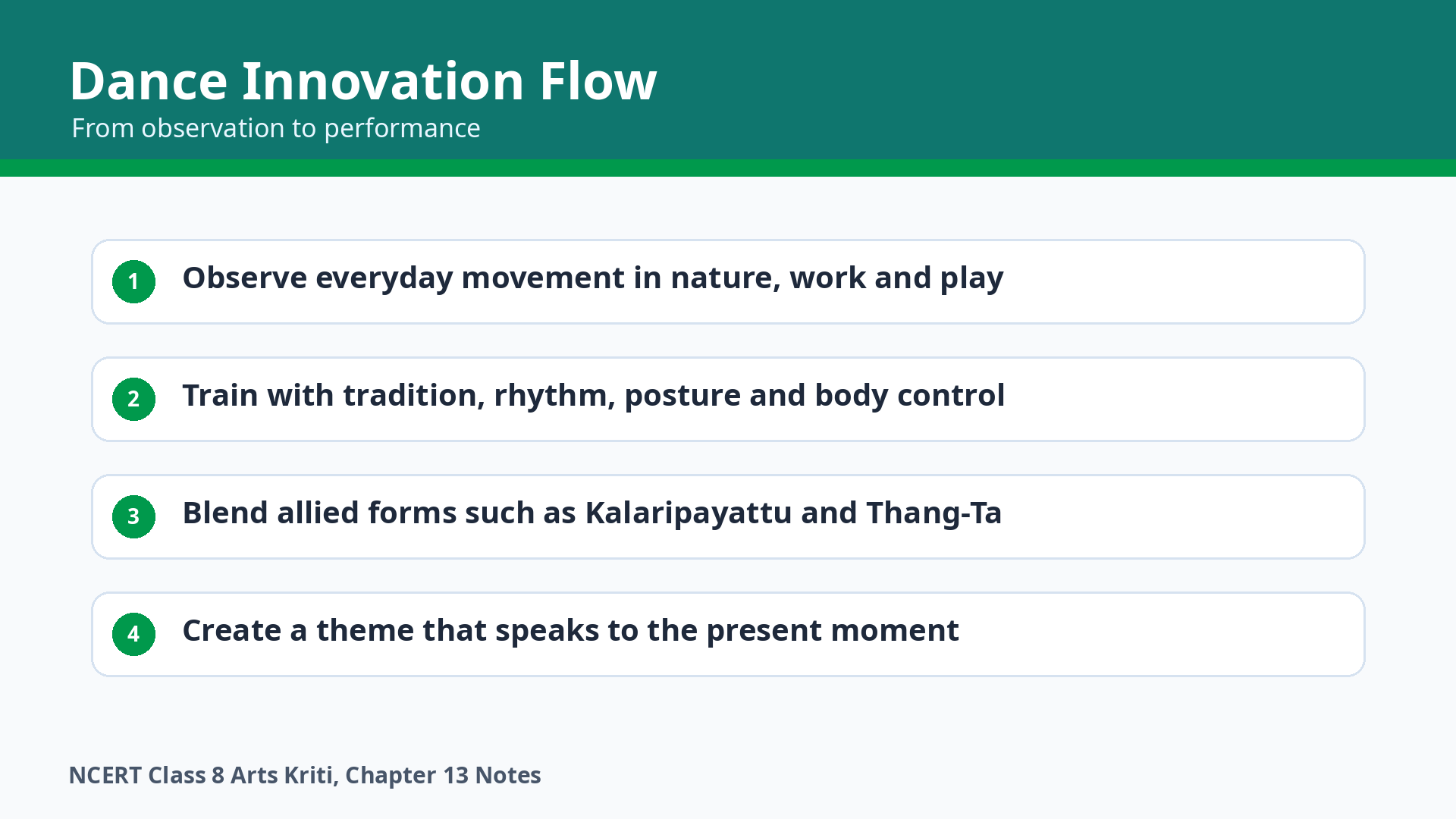
- Everyday movement can become dance material when rhythm and intention are added.
- Birds, leaves, grass, sweeping and tea-picking are given as observation examples.
- Original thought makes a dancer's work different from imitation.
Class 8 Arts Chapter 13 Dance Innovation Video
Source: Magnet Brains on YouTube
Martial Arts and Allied Forms in Dance
The chapter explains that allied forms such as martial arts can enrich dance. Kalaripayattu from Kerala brings self-defence training, marma knowledge and animal stances. Thang-Ta from Manipur brings sword, spear, breath control and ritual movement.
| Form | Region | Dance Use |
|---|---|---|
| Kalaripayattu | Kerala | Strength, stance, control and body awareness |
| Thang-Ta | Manipur | Sword-spear movement, energy and breath rhythm |
| Chhau | Eastern India | Martial energy and dramatic body movement |
Artists Who Shaped Creative Choreography
NCERT names several artists who used tradition to speak to modern life. Narendra Sharma worked with socially relevant dance dramas. Acharya Parvatikumar used traditional forms for city scenes. Chandralekha joined Bharatanatyam, yoga and Kalaripayattu. Kumudini Lakhia refreshed kathak through group choreography.
Important: In answers, match the artist with the exact contribution instead of listing names alone.
Inclusivity in Dance for Class 8 Arts
Inclusivity in dance means dance is accessible, enjoyable and respectful for people of different abilities, ages, genders and communities. The chapter highlights differently-abled performers, dance beyond gender and shared stages where many traditions meet.
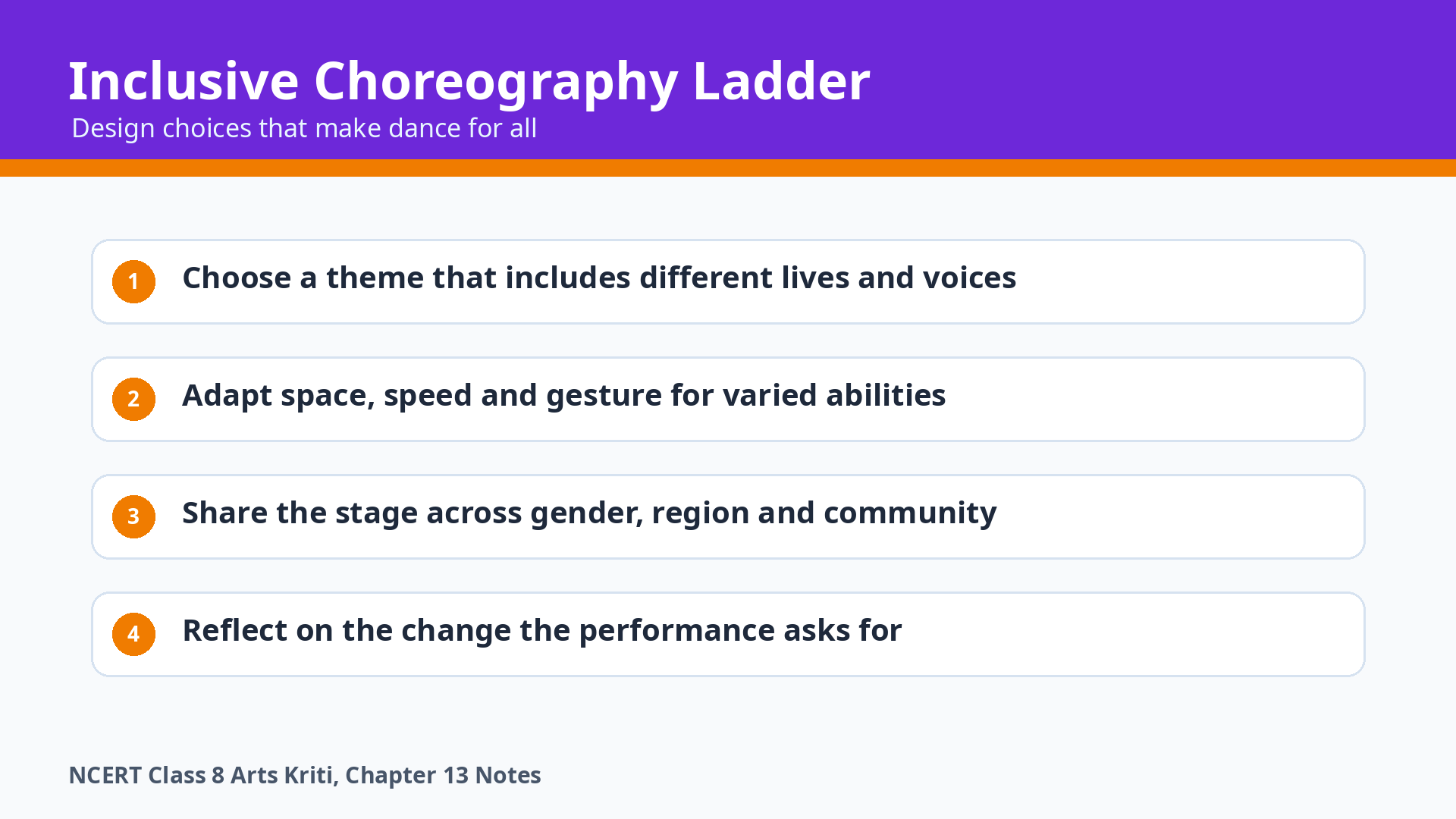
- Activity 13.3 asks students to make dance accessible to differently-abled performers.
- The Republic Day 2025 event brought over 5,000 folk and tribal artists together.
- Dance beyond gender asks students to research a transgender dance artist.
Dance as a Way to Inspire Change
Dance can start conversations about issues such as gender discrimination, climate change, cleanliness and conservation. The chapter gives Keibul Lamjao, premiered by JNMDA in 1985, as an example linked with the Sangai deer and environmental concern.
| Activity | What Students Do | Answer Cue |
|---|---|---|
| 13.2 Dance the Now | Create dance on a current social issue | Theme, song, movement and message |
| 13.3 Dance for All | Make dance accessible and enjoyable | Space, pace, support and dignity |
| 13.4 Inspiring Change | Ask what change dance can prompt | Compassion, thought and action |
| 13.5 Dance Beyond Gender | Research a transgender dance artist | Artist, contribution and diversity |
Related Resources for Innovation, Inclusivity and Inspiring Change
| Resource | Use it for | Link |
|---|---|---|
| Handwritten Notes | Quick notebook-style revision | Open Handwritten Notes |
| NCERT Solutions | Exercise answers for the same chapter | Open NCERT Solutions |
| NCERT Book PDF | Official textbook chapter | Open Book PDF |
All Class 8 Arts Kriti Notes Chapters
| Chapter | Notes Link |
|---|---|
| Chapter 11: Pan Indian Dance Forms | Open Notes |
| Chapter 12: Dance for Well-being | Open Notes |
| Chapter 13: Innovation, Inclusivity and Inspiring Change | Open Notes |
| Chapter 14: A Presentation of Dance and Choreography | Open Notes |
Innovation, Inclusivity and Inspiring Change Class 8 Arts Notes FAQs
Ques. What is innovation in dance in Class 8 Arts Chapter 13?
Ans. Innovation in dance means creating new movement ideas from tradition, observation, training and original thought.
Ques. Which martial arts are discussed in Chapter 13?
Ans. The chapter discusses Kalaripayattu from Kerala and Thang-Ta from Manipur as allied forms used in dance.
Ques. What does inclusivity in dance mean?
Ans. Inclusivity in dance means people of different ages, abilities, genders and communities can participate with dignity.
Ques. How can dance inspire change?
Ans. Dance can raise questions about social issues, build compassion and help viewers think about change.



Comments