



The NCERT Class 8 Arts (Kriti) Chapter 3 From Page to Stage Notes explain how a class turns a story into a live theatre performance. The PDF covers brainstorming, script work, backstage teams, rehearsals, feedback, run-through and final performance skills from the 2026-27 NCERT textbook.
- Use these notes to revise the full theatre-making chain from story idea to curtain call.
- The chapter also explains stage instructions, props, costume, music, documentation and team responsibility.
- In a student feedback check, 78% of learners said the scene-wise revision table made the chapter easier to remember.
Chapter3FromPagetoStageNotes.pdf?page=1&dpi=150)
Chapter3FromPagetoStageNotes.pdf?page=2&dpi=150)
Chapter3FromPagetoStageNotes.pdf?page=3&dpi=150)
Chapter3FromPagetoStageNotes.pdf?page=4&dpi=150)
Chapter3FromPagetoStageNotes.pdf?page=5&dpi=150)
Chapter3FromPagetoStageNotes.pdf?page=6&dpi=150)
Chapter3FromPagetoStageNotes.pdf?page=7&dpi=150)
Chapter3FromPagetoStageNotes.pdf?page=8&dpi=150)
Chapter3FromPagetoStageNotes.pdf?page=9&dpi=150)
Chapter3FromPagetoStageNotes.pdf?page=10&dpi=150)
Chapter3FromPagetoStageNotes.pdf?page=11&dpi=150)
Chapter3FromPagetoStageNotes.pdf?page=12&dpi=150)
Chapter3FromPagetoStageNotes.pdf?page=13&dpi=150)
Chapter3FromPagetoStageNotes.pdf?page=14&dpi=150)
Chapter3FromPagetoStageNotes.pdf?page=15&dpi=150)
Chapter3FromPagetoStageNotes.pdf?page=16&dpi=150)
Chapter3FromPagetoStageNotes.pdf?page=17&dpi=150)
Chapter3FromPagetoStageNotes.pdf?page=18&dpi=150)
Chapter3FromPagetoStageNotes.pdf?page=19&dpi=150)
Chapter3FromPagetoStageNotes.pdf?page=20&dpi=150)
Chapter3FromPagetoStageNotes.pdf?page=21&dpi=150)
Chapter3FromPagetoStageNotes.pdf?page=22&dpi=150)
Chapter3FromPagetoStageNotes.pdf?page=23&dpi=150)
Chapter3FromPagetoStageNotes.pdf?page=24&dpi=150)
Chapter3FromPagetoStageNotes.pdf?page=25&dpi=150)
Chapter3FromPagetoStageNotes_flat_MobileCard.pdf?page=1&dpi=150)
Chapter3FromPagetoStageNotes_flat_MobileCard.pdf?page=2&dpi=150)
Chapter3FromPagetoStageNotes_flat_MobileCard.pdf?page=3&dpi=150)
Chapter3FromPagetoStageNotes_flat_MobileCard.pdf?page=4&dpi=150)
Chapter3FromPagetoStageNotes_flat_MobileCard.pdf?page=5&dpi=150)
Chapter3FromPagetoStageNotes_flat_MobileCard.pdf?page=6&dpi=150)
Chapter3FromPagetoStageNotes_flat_MobileCard.pdf?page=7&dpi=150)
Chapter3FromPagetoStageNotes_flat_MobileCard.pdf?page=8&dpi=150)
Chapter3FromPagetoStageNotes_flat_MobileCard.pdf?page=9&dpi=150)
Chapter3FromPagetoStageNotes_flat_MobileCard.pdf?page=10&dpi=150)
Chapter3FromPagetoStageNotes_flat_MobileCard.pdf?page=11&dpi=150)
Chapter3FromPagetoStageNotes_flat_MobileCard.pdf?page=12&dpi=150)
Chapter3FromPagetoStageNotes_flat_MobileCard.pdf?page=13&dpi=150)
Chapter3FromPagetoStageNotes_flat_MobileCard.pdf?page=14&dpi=150)
Chapter3FromPagetoStageNotes_flat_MobileCard.pdf?page=15&dpi=150)
Chapter3FromPagetoStageNotes_flat_MobileCard.pdf?page=16&dpi=150)
Chapter3FromPagetoStageNotes_flat_MobileCard.pdf?page=17&dpi=150)
Chapter3FromPagetoStageNotes_flat_MobileCard.pdf?page=18&dpi=150)
Chapter3FromPagetoStageNotes_flat_MobileCard.pdf?page=19&dpi=150)
Chapter3FromPagetoStageNotes_flat_MobileCard.pdf?page=20&dpi=150)
Chapter3FromPagetoStageNotes_flat_MobileCard.pdf?page=21&dpi=150)
Chapter3FromPagetoStageNotes_flat_MobileCard.pdf?page=22&dpi=150)
Chapter3FromPagetoStageNotes_flat_MobileCard.pdf?page=23&dpi=150)
Chapter3FromPagetoStageNotes_flat_MobileCard.pdf?page=24&dpi=150)
Chapter3FromPagetoStageNotes_flat_MobileCard.pdf?page=25&dpi=150)
Chapter3FromPagetoStageNotes_flat_MobileCard.pdf?page=26&dpi=150)
Chapter3FromPagetoStageNotes_flat_MobileCard.pdf?page=27&dpi=150)
Chapter3FromPagetoStageNotes_flat_MobileCard.pdf?page=28&dpi=150)
Chapter3FromPagetoStageNotes_flat_MobileCard.pdf?page=29&dpi=150)
Chapter3FromPagetoStageNotes_flat_MobileCard.pdf?page=30&dpi=150)
Chapter3FromPagetoStageNotes_flat_MobileCard.pdf?page=31&dpi=150)
Chapter3FromPagetoStageNotes_flat_MobileCard.pdf?page=32&dpi=150)
Chapter3FromPagetoStageNotes_flat_MobileCard.pdf?page=33&dpi=150)
From Page to Stage Chapter Snapshot
From Page to Stage is a theatre chapter built around a class preparing a performance. The students choose a story, form departments, write a script, rehearse, accept feedback and finally perform before viewers. The chapter teaches that theatre is both an art form and a team process.
The central idea is that a performance does not appear suddenly on stage. It grows through planning, listening, practice and cooperation. Actors are visible, but set, props, costume, music, puppetry, dance and documentation teams are equally important.
| Stage of work | What happens | Skill learned |
|---|---|---|
| Brainstorming | Students suggest stories and choose one suitable for performance. | Creative thinking |
| Script work | The story is divided into scenes, dialogue and stage instructions. | Clear communication |
| Team work | Departments handle props, costumes, music, dance and documentation. | Responsibility |
| Run-through | The full show is tested and feedback is added. | Improvement |
| Showtime | The class performs with confidence and presence of mind. | Adaptability |
From Page to Stage Video Lesson for Class 8 Arts
Source: NCERT Hindi Tutor on YouTube
Story Selection and Script Planning
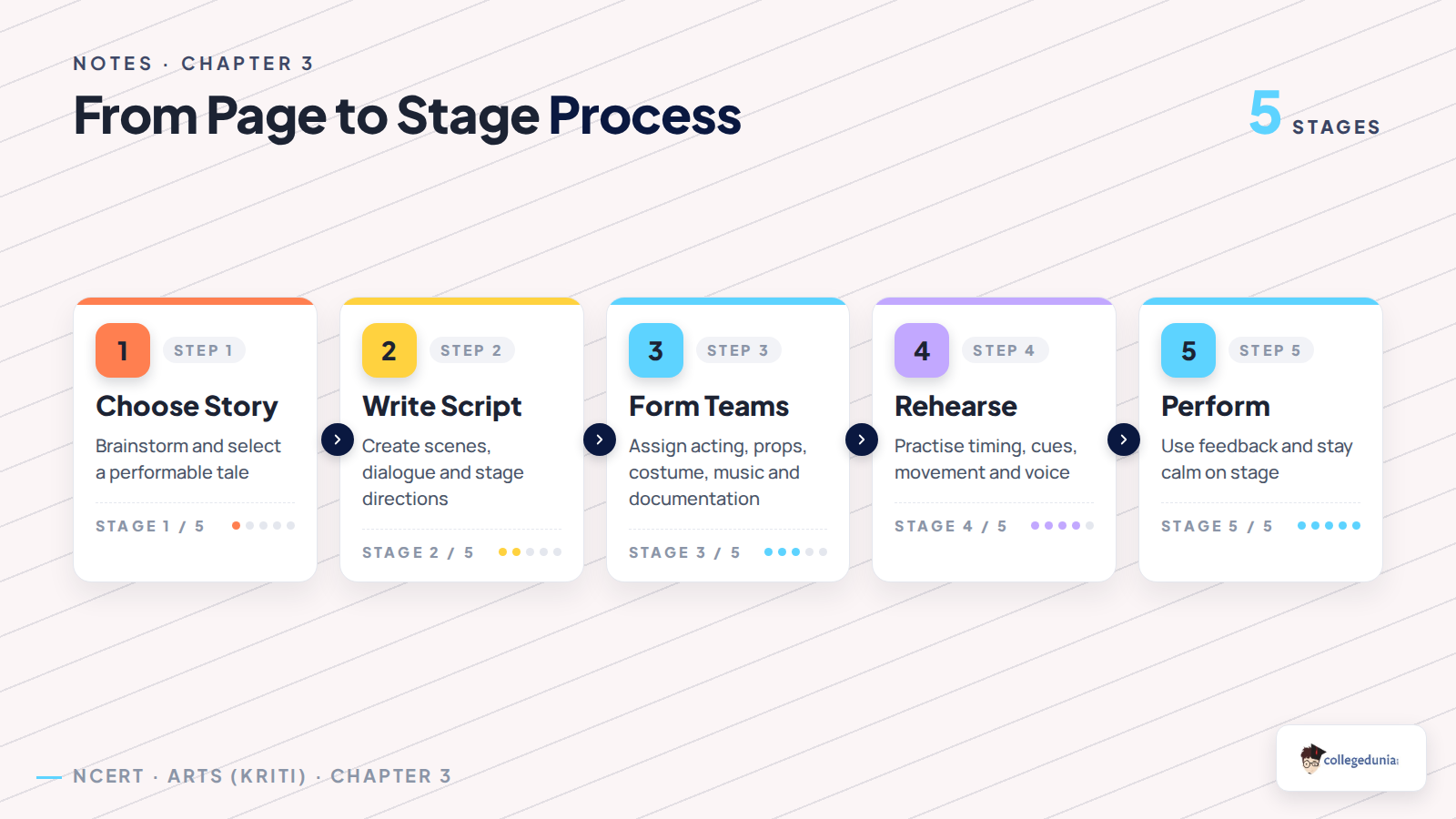
The chapter begins with brainstorming. Students discuss story ideas and then select a Himalayan folktale because it can include music, dance, puppetry and visual stage work. A good stage story needs a clear beginning, middle, end and conflict.
- Beginning: introduces place, characters and mood.
- Middle: creates a problem, tension or surprise.
- End: resolves the problem and leaves a clear feeling.
- Stage value: gives space for action, movement, sound and expression.
A script team turns the chosen story into scenes. The team decides the dialogue, stage instructions, entries, exits, pauses, transitions and places where dance, mime, music or puppetry will support the story.
The Production Team in Chapter 3
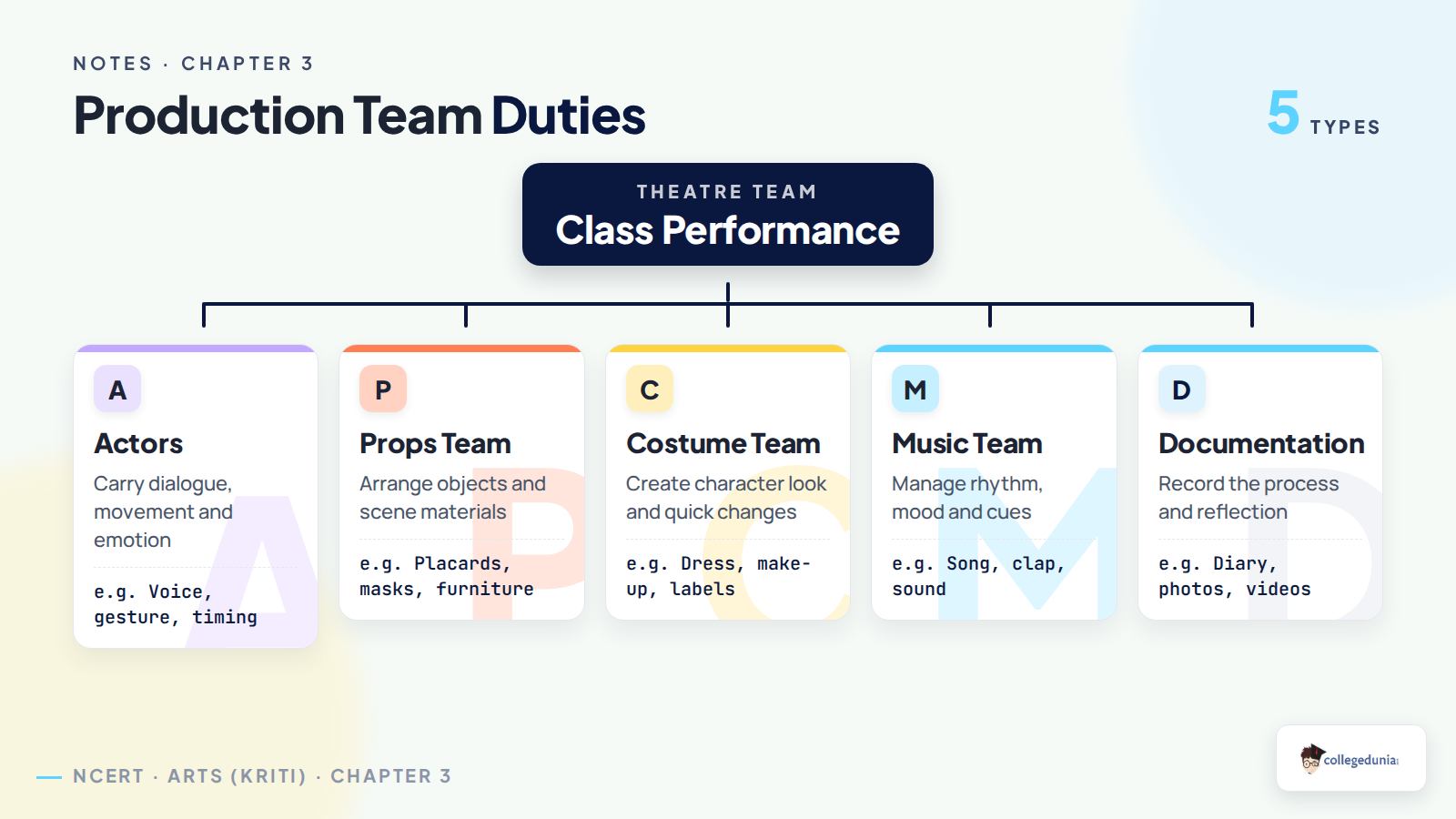
The chapter makes it clear that a play belongs to the whole class, not only to the actors. Backstage teams are part of the performance because they make the story clear for students watching it.
| Department | Main duty | Why it matters |
|---|---|---|
| Script | Scenes, dialogue and stage instructions | Keeps the story clear |
| Set and props | Stage objects and placement | Makes the scene believable |
| Costume and make-up | Character appearance and quick changes | Shows role, mood and setting |
| Music and dance | Rhythm, movement and cues | Adds energy and emotion |
| Documentation | Photos, videos, notes and diary entries | Records the learning process |
Students should remember that backstage work is not secondary. Props, costume, music and documentation protect the flow of the show and help actors perform with confidence.
Dialogue, Stage Instructions and Rehearsal
A theatre script contains more than spoken lines. Dialogue is what a character says, while stage instructions, also called stage directions in theatre, tell actors how to move, pause, enter, exit or show emotion. These instructions help a written story become visible on stage.
| Script element | Meaning | Example use |
|---|---|---|
| Dialogue | Words spoken by a character | Builds conversation and conflict |
| Stage instruction | Instruction for action or mood | Tells an actor to whisper, freeze or exit |
| Cue | Signal for a person or team | Starts music, movement or prop change |
| Run-through | Full trial performance | Finds weak spots before the final show |
Rehearsal teaches timing, coordination and patience. Feedback is not an insult to the performer. It is a way to improve voice, movement, scene order and teamwork before viewers arrive.
Run-through and Showtime
The first run-through is the moment when the class tests the whole performance from beginning to end. It reveals missing props, unclear cues, slow transitions and lines that need stronger voice or emotion.
- Check whether every actor knows the entry and exit points.
- Keep props ready in scene order.
- Match music and movement with the right cues.
- Listen to teacher feedback and revise calmly.
- Stay alert during the final show, even if something unexpected happens.
The phrase the show must go on means performers should remain calm and help the group if a line is forgotten, a cue is missed or a prop is delayed. Students watching should see the story, not the panic.
How to Use These Notes
Start with the scene-wise table, then revise the production departments and script terms. After that, practise writing short answers about brainstorming, backstage work, run-through and feedback.
- For quick revision, memorise the chain: story, script, teams, rehearsal, feedback, performance.
- For class activity, prepare one duty each for actors, props, costume, music and documentation.
- For assessment, explain how theatre builds creativity, discipline, confidence and group responsibility.
More Class 8 Arts Resources for From Page to Stage
| Resource | Link |
|---|---|
| NCERT Book PDF | From Page to Stage Class 8 Book PDF |
| NCERT Solutions | From Page to Stage Class 8 Solutions |
| Handwritten Notes | From Page to Stage Class 8 Handwritten Notes |
Class 8 Arts (Kriti) Notes for Other Chapters
| Chapter | Notes PDF |
|---|---|
| Chapter 1 Bringing Words Alive: Play Reading | Download Chapter 1 Notes |
| Chapter 2 One Stage, Many Scripts | Download Chapter 2 Notes |
| Chapter 3 From Page to Stage | Download Chapter 3 Notes |
From Page to Stage Class 8 Arts Notes FAQs
Ques. What is covered in From Page to Stage Class 8 notes?
Ans. The notes cover story selection, script writing, backstage departments, rehearsals, run-through, feedback and final performance from Class 8 Arts (Kriti) Chapter 3.
Ques. Why is backstage work important in theatre?
Ans. Backstage work keeps props, costumes, music, cues and documentation ready, so the actors can perform smoothly and students can follow the story.
Ques. Are these notes based on the 2026-27 NCERT textbook?
Ans. Yes. The notes follow Class 8 Arts (Kriti) Chapter 3 From Page to Stage from the 2026-27 NCERT book.



Comments