



The Class 8 Maths Power Play notes cover exponents, the laws of exponents, negative and zero powers, scientific notation and exponential growth, as set out in the 2026-27 NCERT Ganita Prakash Part 1 textbook.
- Chapter Length: a 25-page notes PDF with 17 diagrams, 14 worked examples and a one-page formula recap.
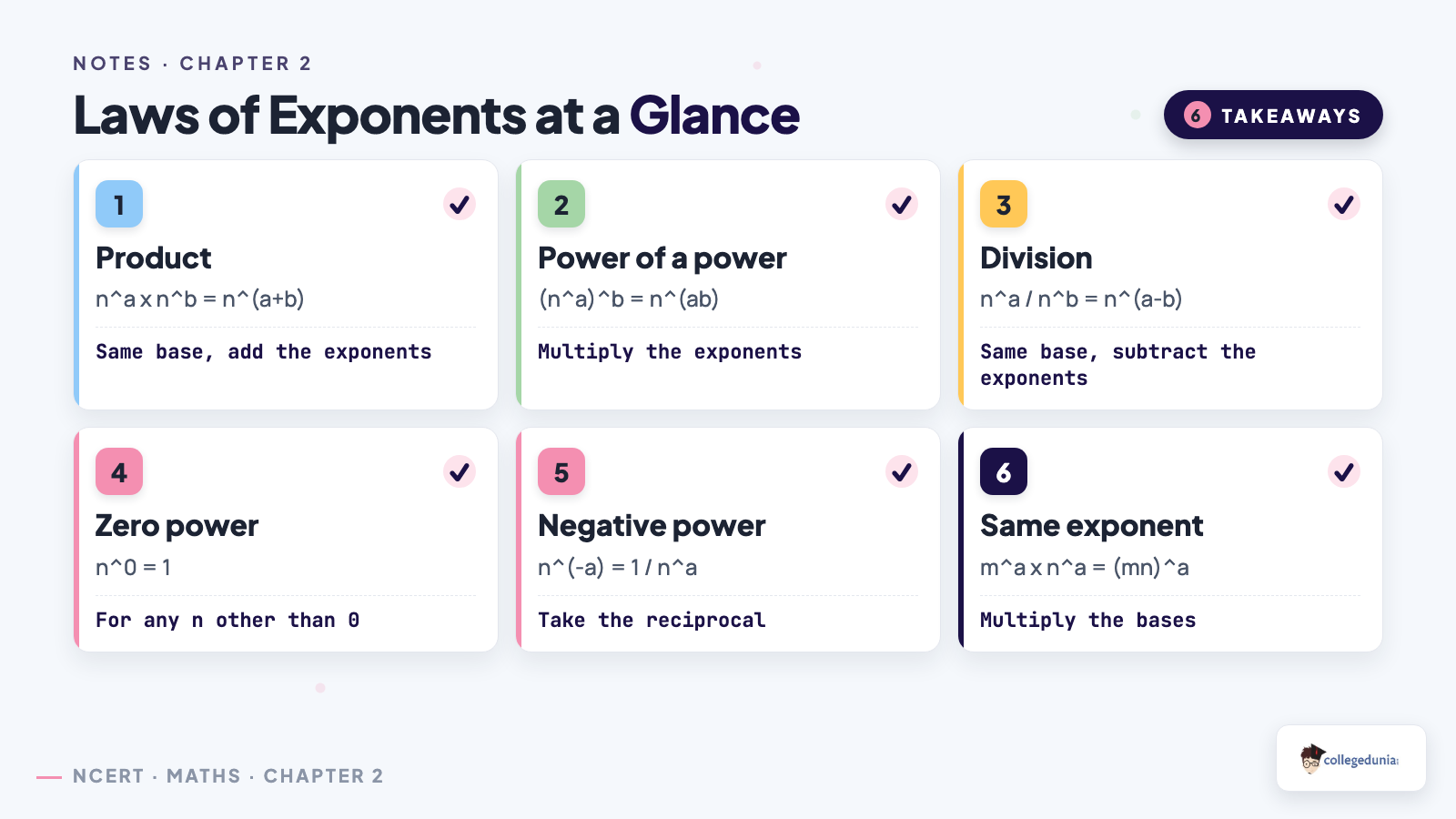
- Laws Covered: product, power of a power, division, same-exponent, zero and negative exponent.
- Pairs With: Chapter 1, A Square and A Cube, since squares and cubes are the first two powers you meet.
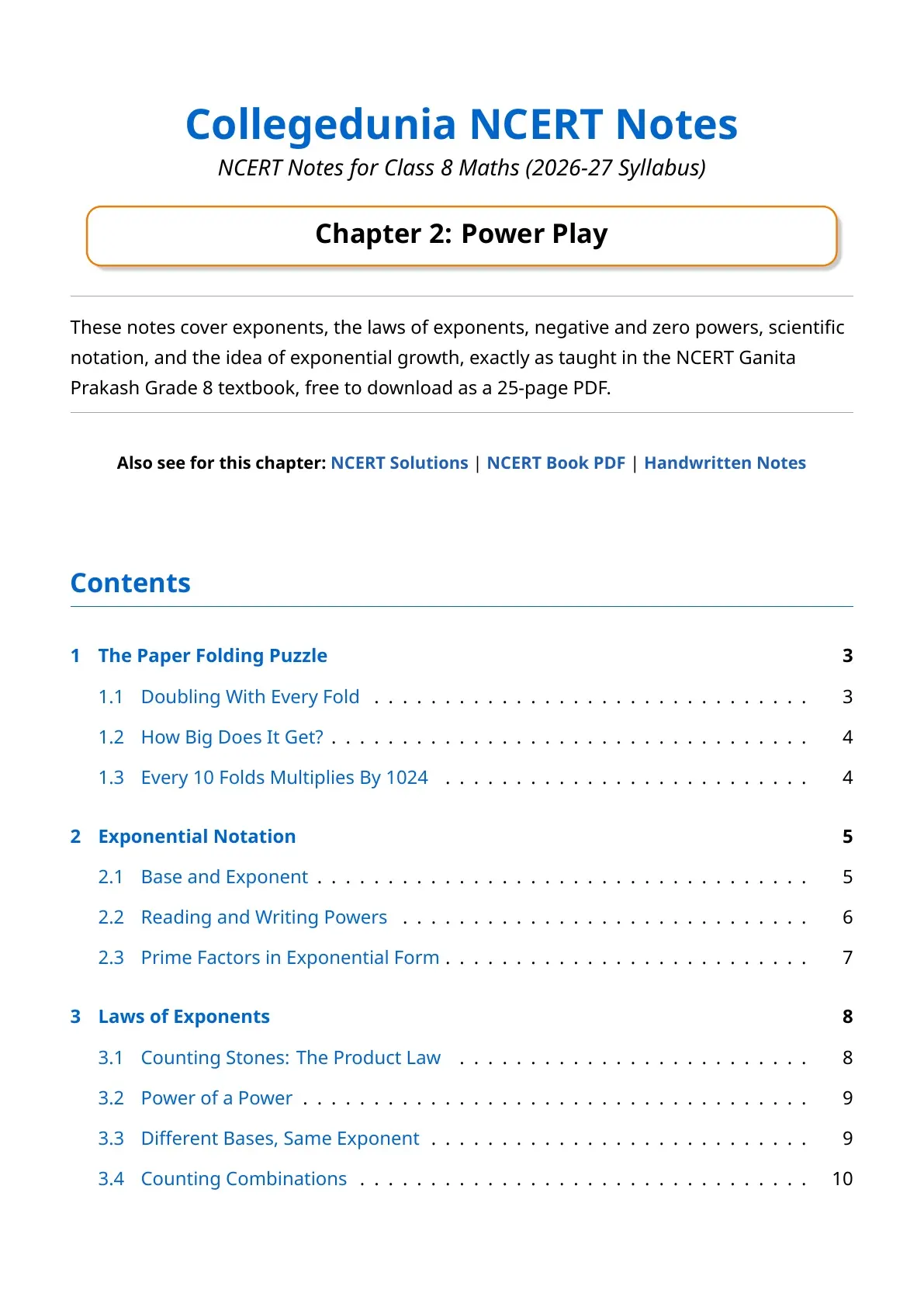
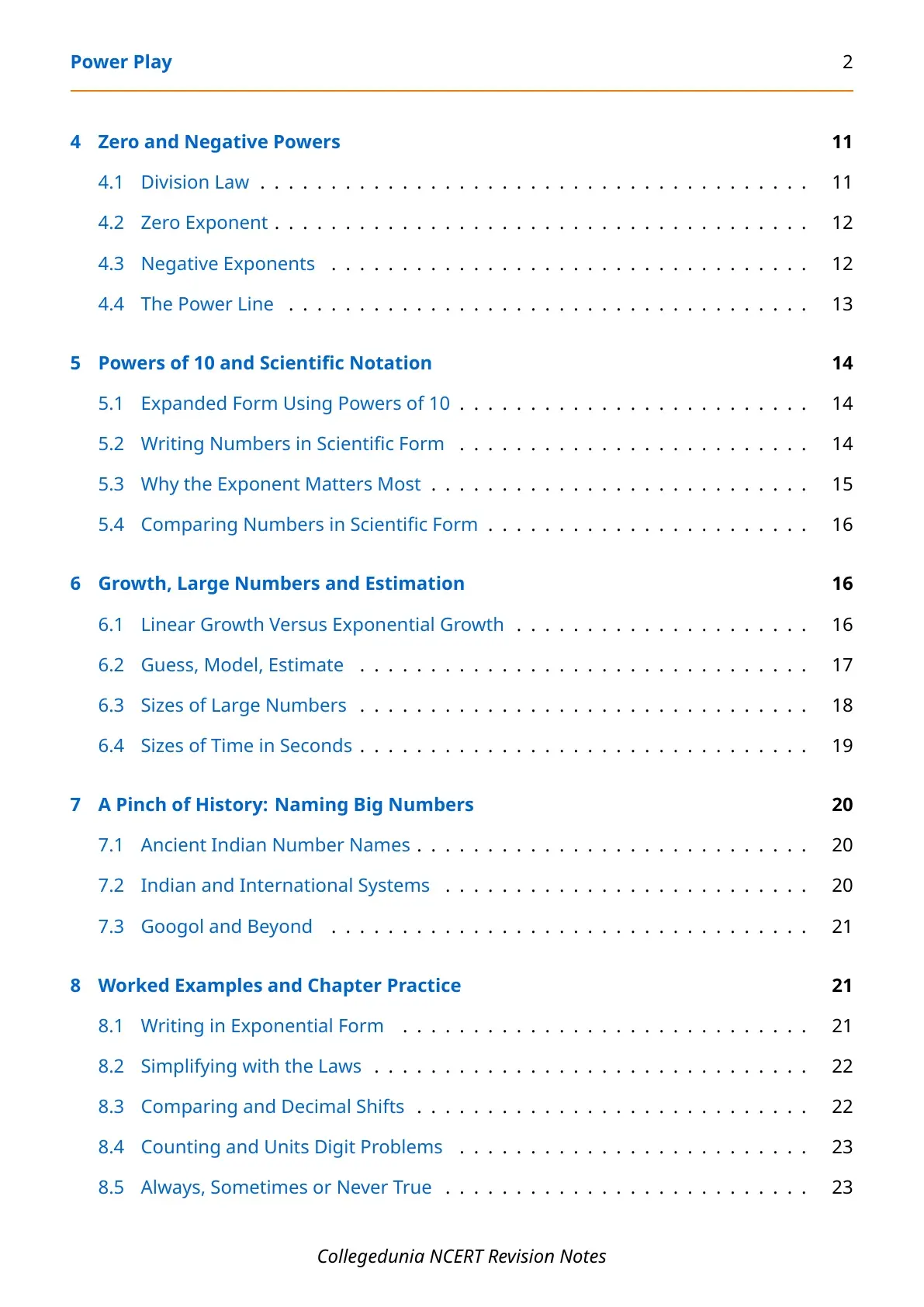
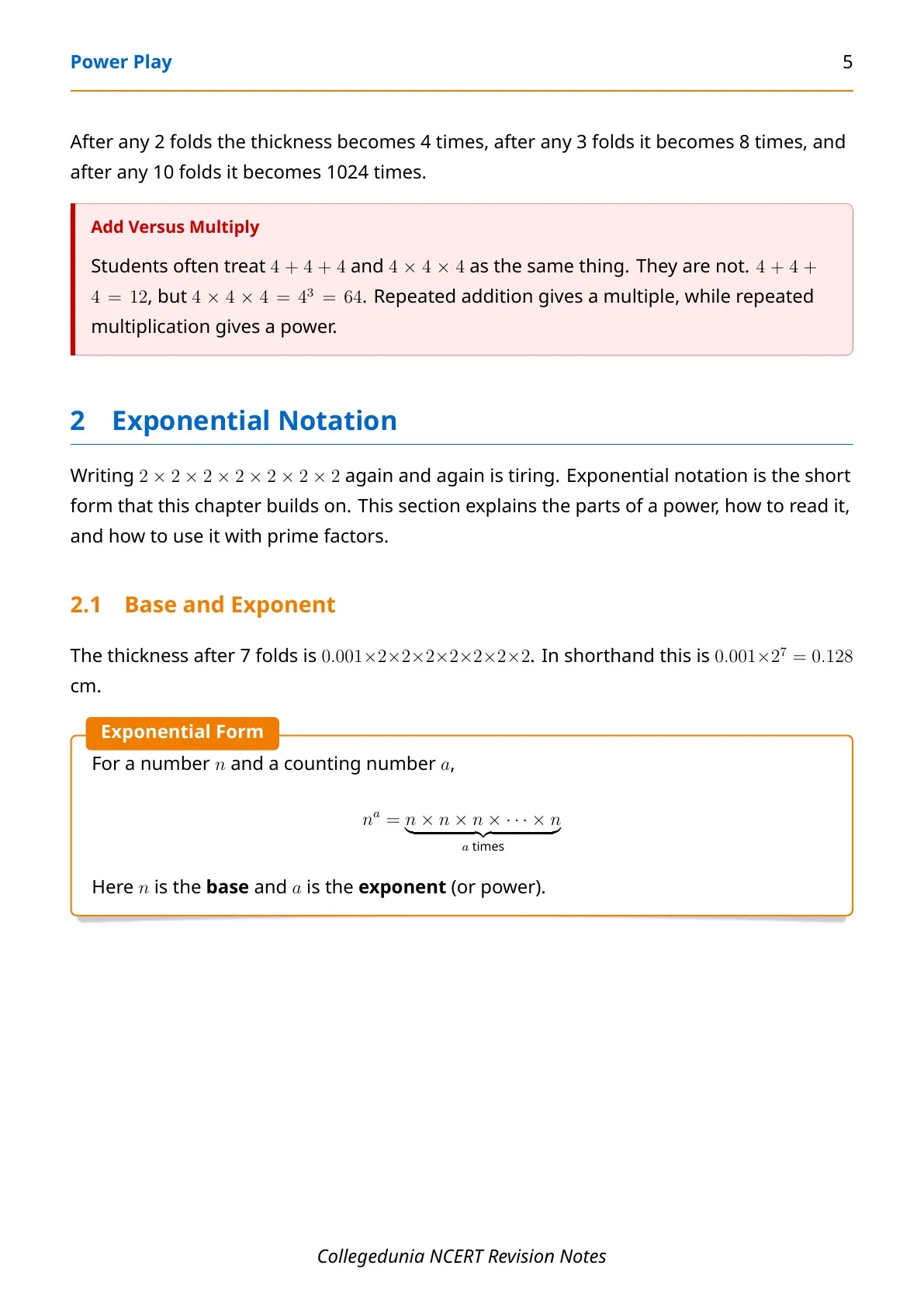
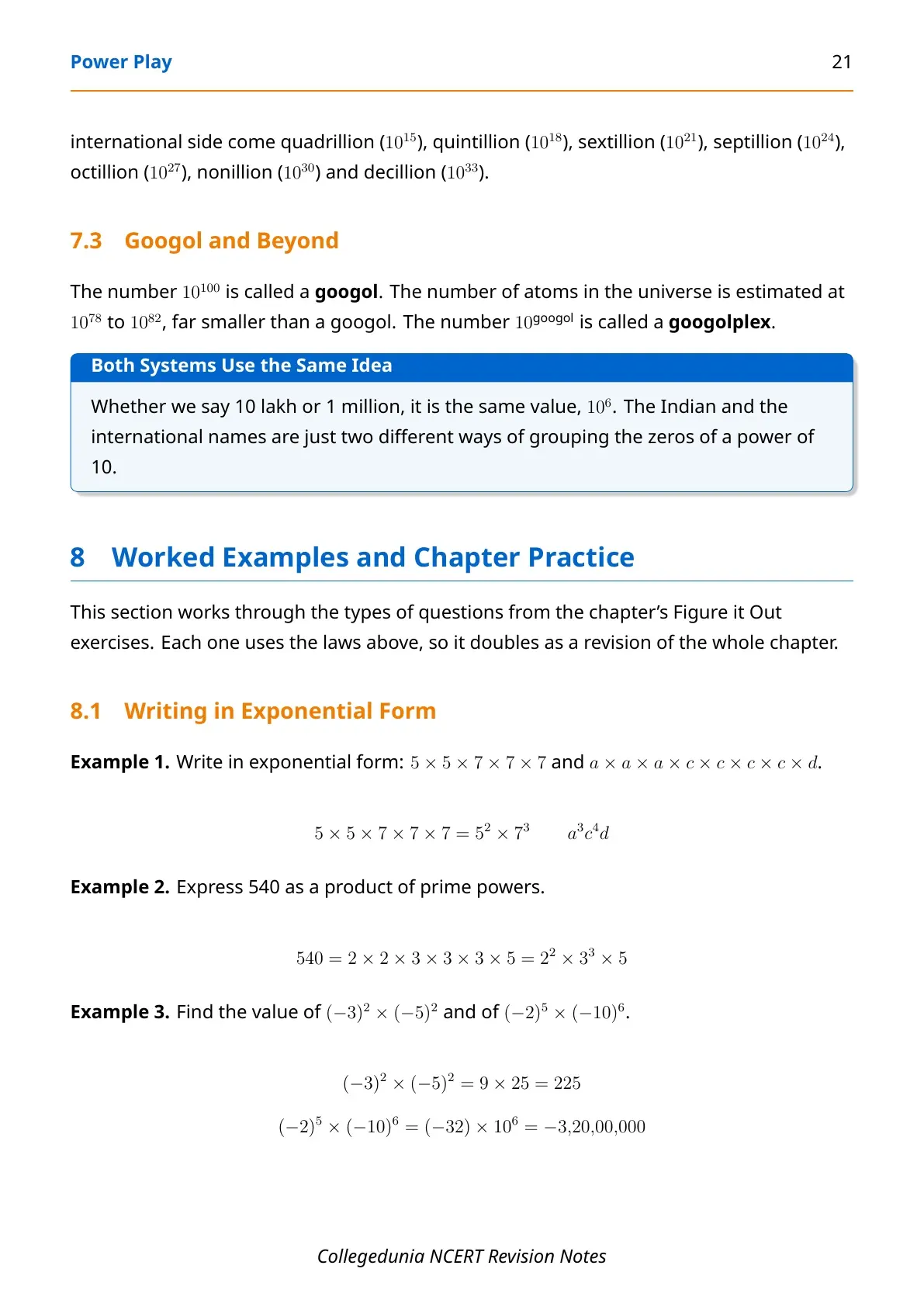
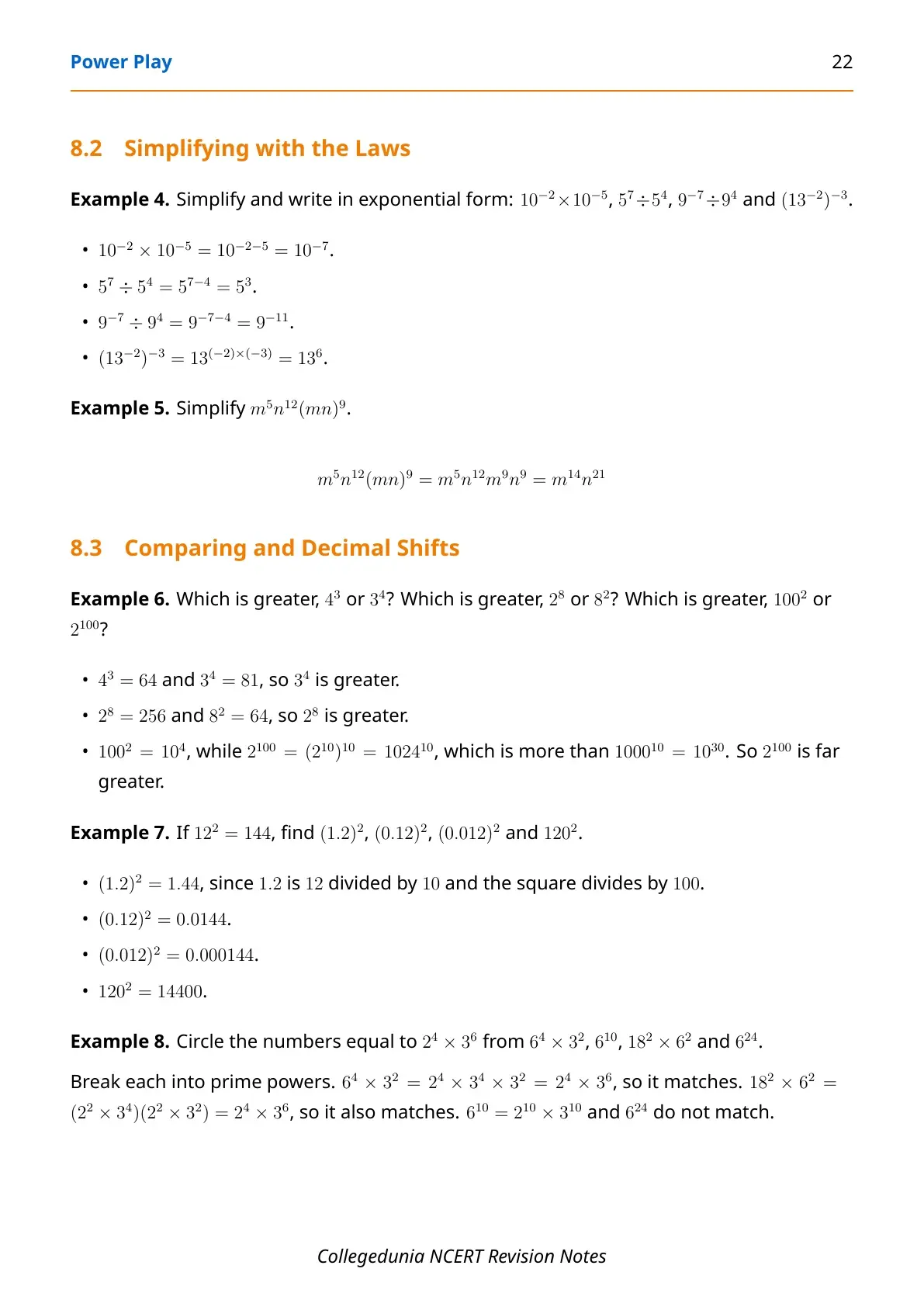
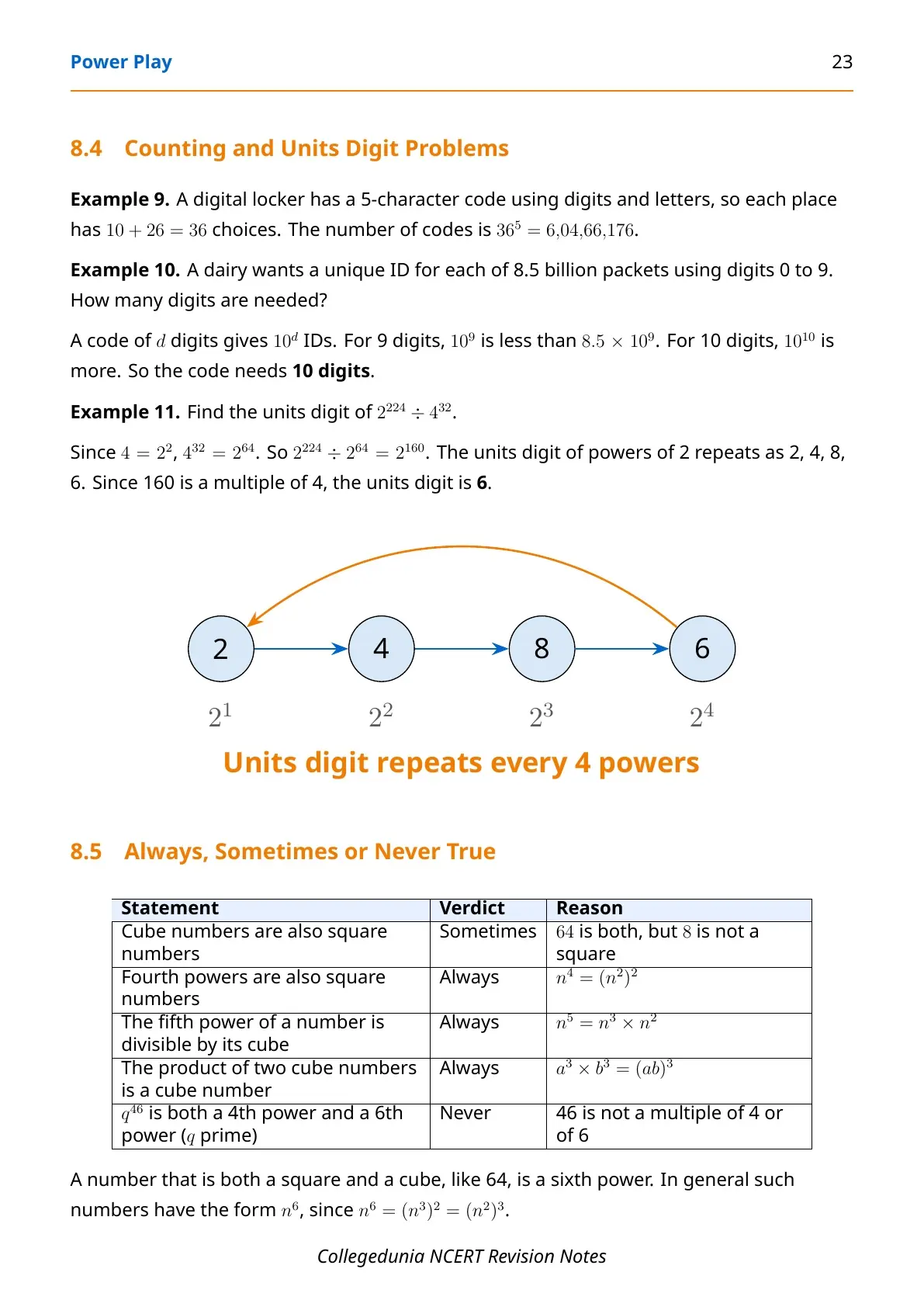
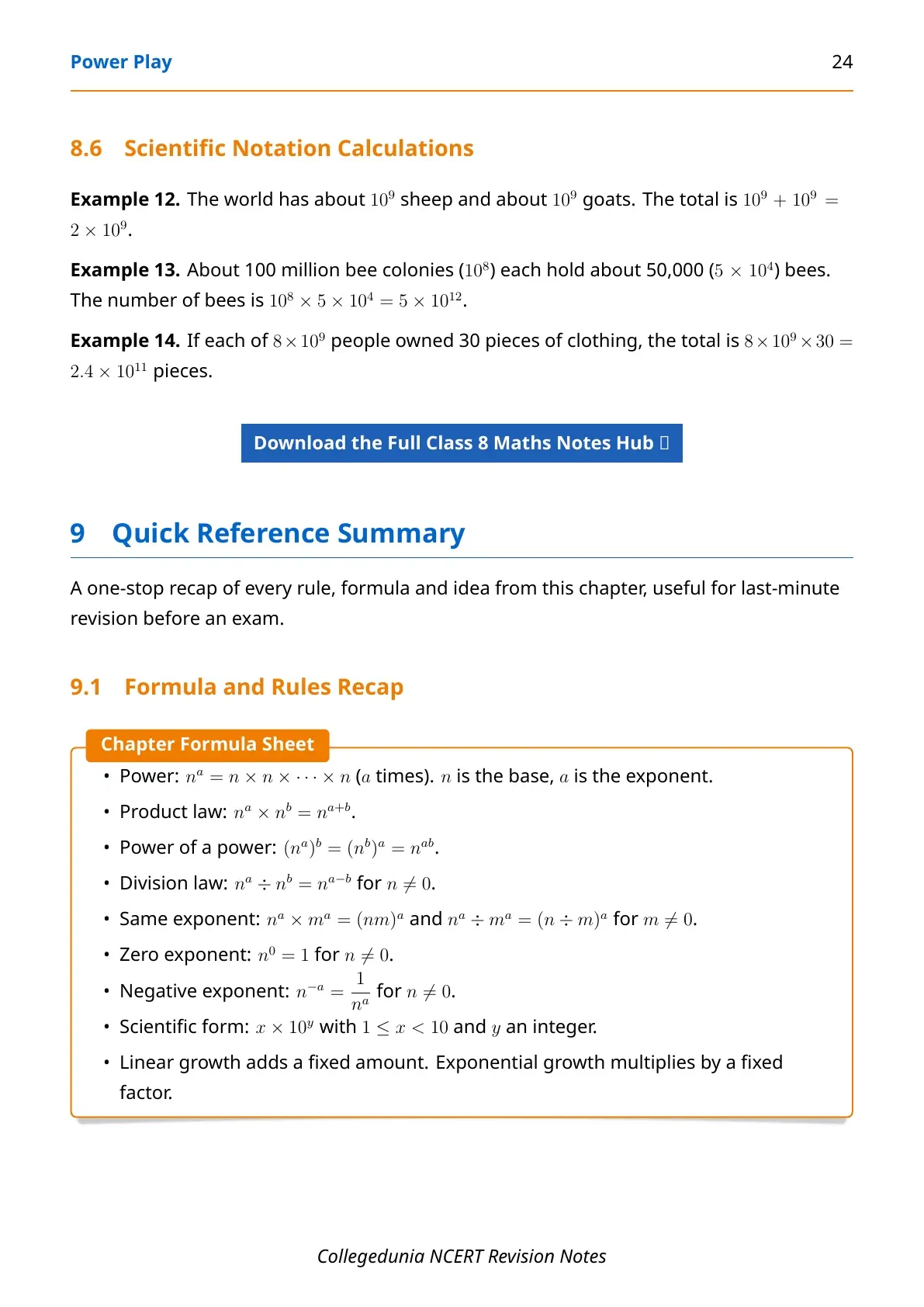
These Class 8 Maths notes for Power Play follow the 2026-27 NCERT Ganita Prakash Part 1 textbook section by section, from the paper-folding puzzle to the history of number names.
Student Feedback
Class 8 students most often write to us about three things in Power Play: what a negative exponent means, why any non-zero number to the power 0 is 1, and when to add exponents and when to multiply them. The notes answer each of these with a worked example, so start with the laws section if those are your trouble spots.
|
Table of Contents |
What Power Play Covers in the 2026-27 NCERT
The chapter starts with a puzzle about folding paper and uses it to introduce exponential growth. Everything after that, the laws, negative powers and scientific notation, is a way of handling numbers that grow or shrink by repeated multiplication.
- Paper folding, doubling and why 46 folds reach past the Moon
- Base, exponent and exponential form, including prime factors written as powers
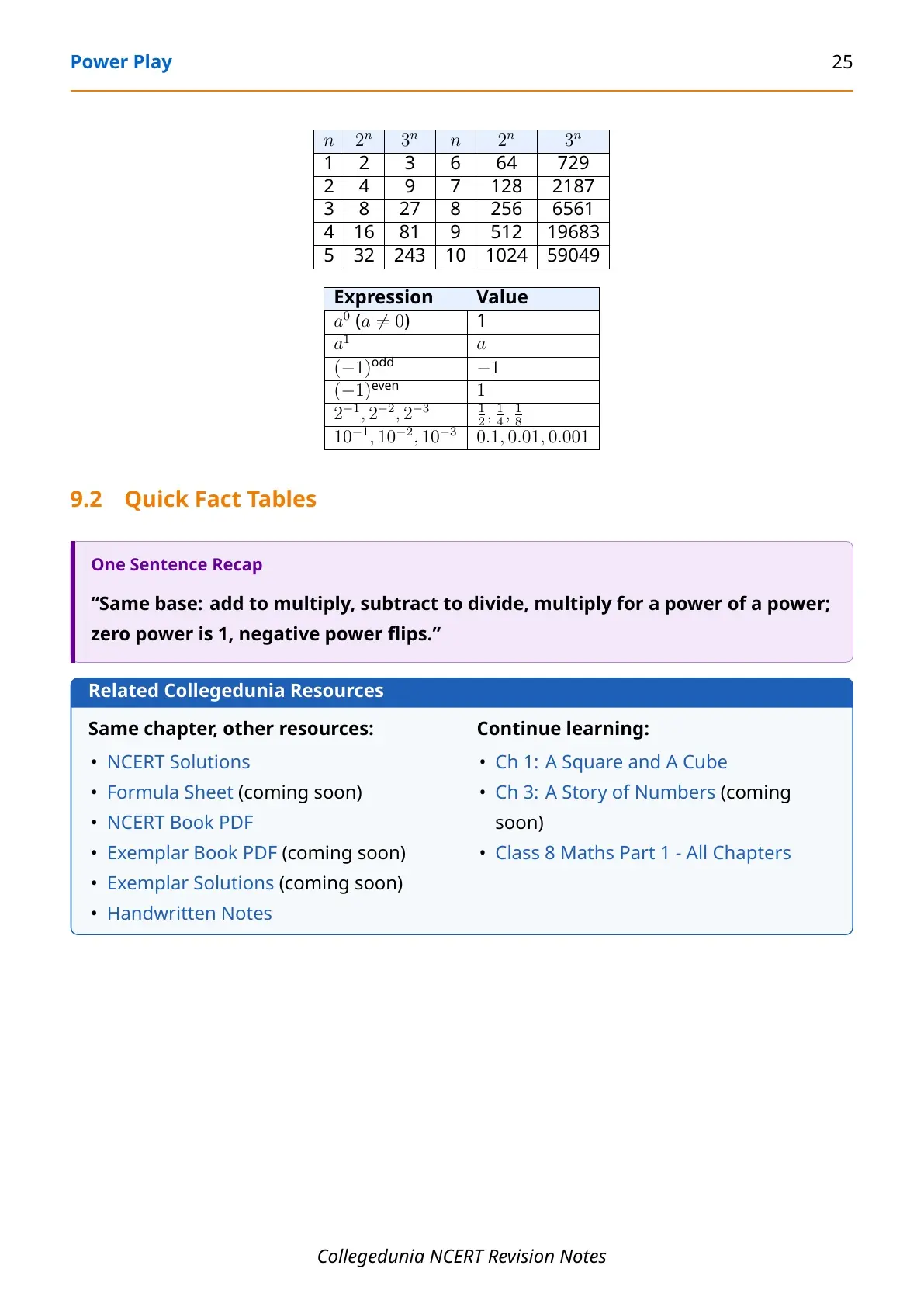
- Laws of exponents for integer powers, with n0 = 1 and n-a = 1/na
- Powers of 10, standard form and the size of very large numbers
- Linear and exponential growth, plus a guess-and-estimate method for open questions
- Number names from the Lalitavistara, the lakh-crore system and the million-billion system
Paper Folding and Exponential Growth in Power Play
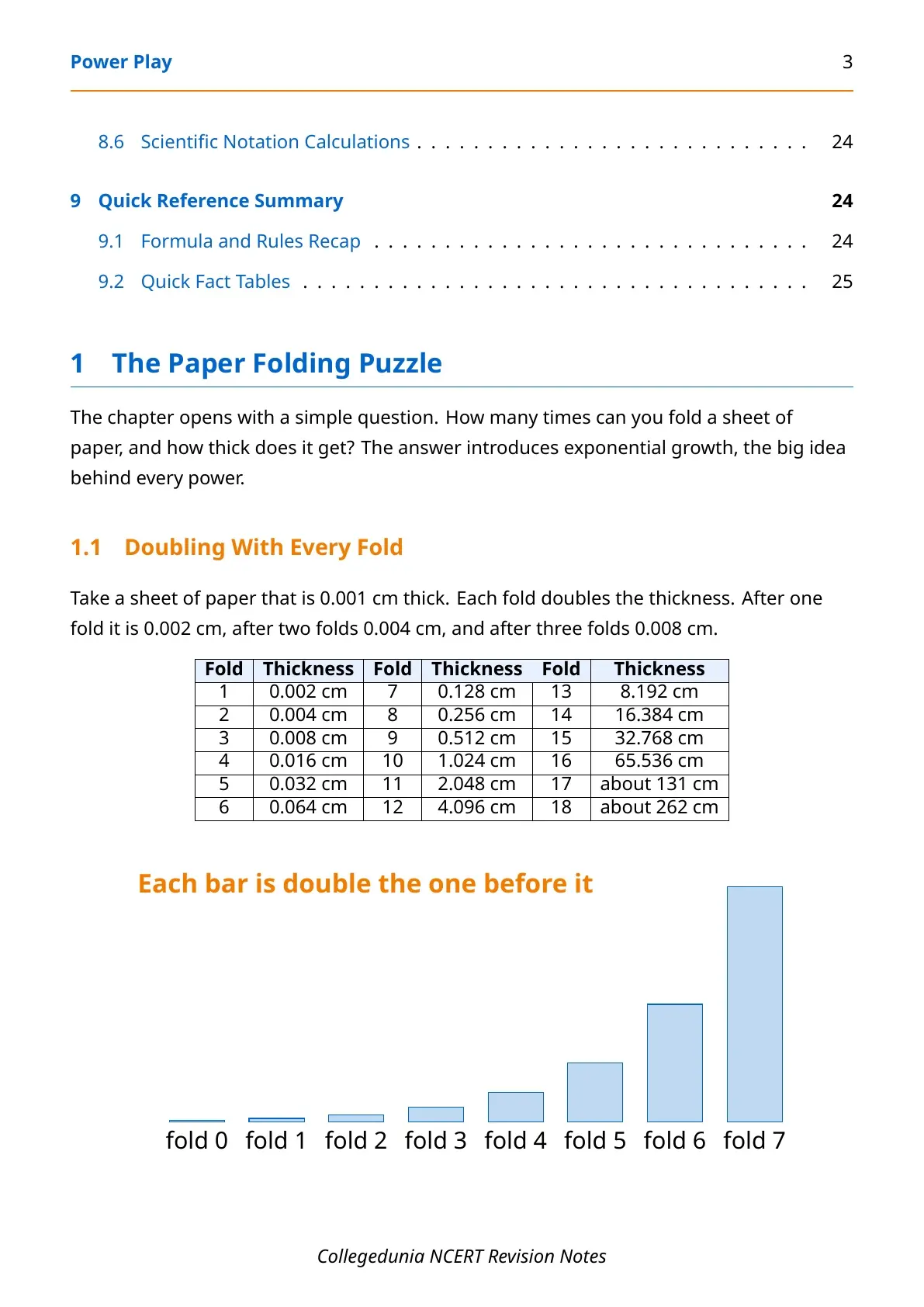
The chapter opens by asking how thick a sheet of paper gets if you keep folding it. Take a sheet 0.001 cm thick. Every fold doubles the thickness, so the thickness after n folds is 0.001 × 2n cm.
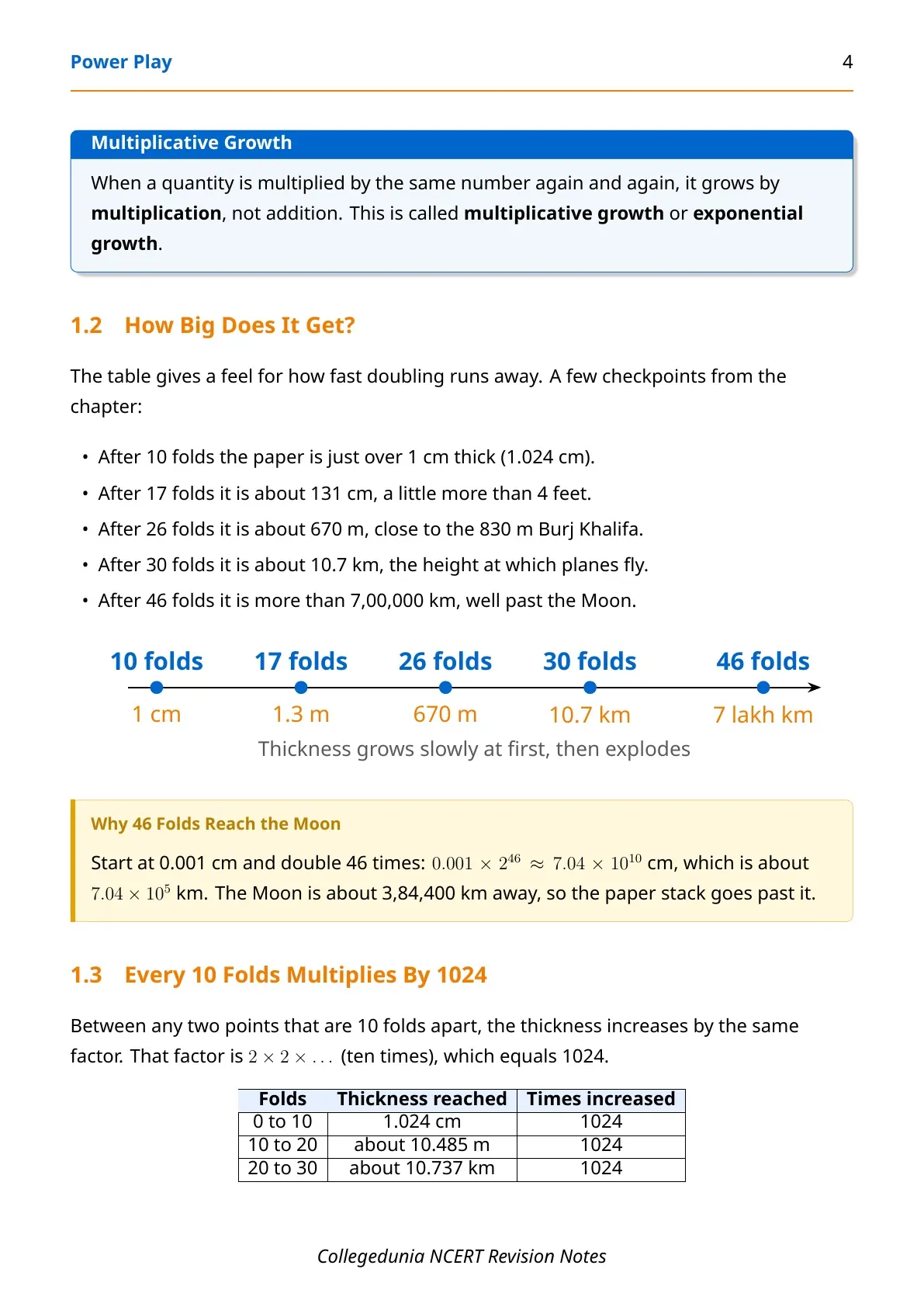
| Folds | Thickness | Comparison from the book |
|---|---|---|
| 10 | 1.024 cm | Just over 1 cm |
| 17 | About 131 cm | A little more than 4 feet |
| 26 | About 670 m | Burj Khalifa is 830 m |
| 30 | About 10.7 km | Height at which planes fly |
| 46 | More than 7,00,000 km | Past the Moon (3,84,400 km) |
Between any two points that are 10 folds apart, the thickness grows 1024 times, because 210 = 1024. This kind of growth, where a quantity is multiplied by the same number again and again, is called multiplicative or exponential growth.
Power Play Class 8 Maths Explained for Boards
Source: PW Class 8 on YouTube
Exponential Notation: Base, Exponent and Prime Factors
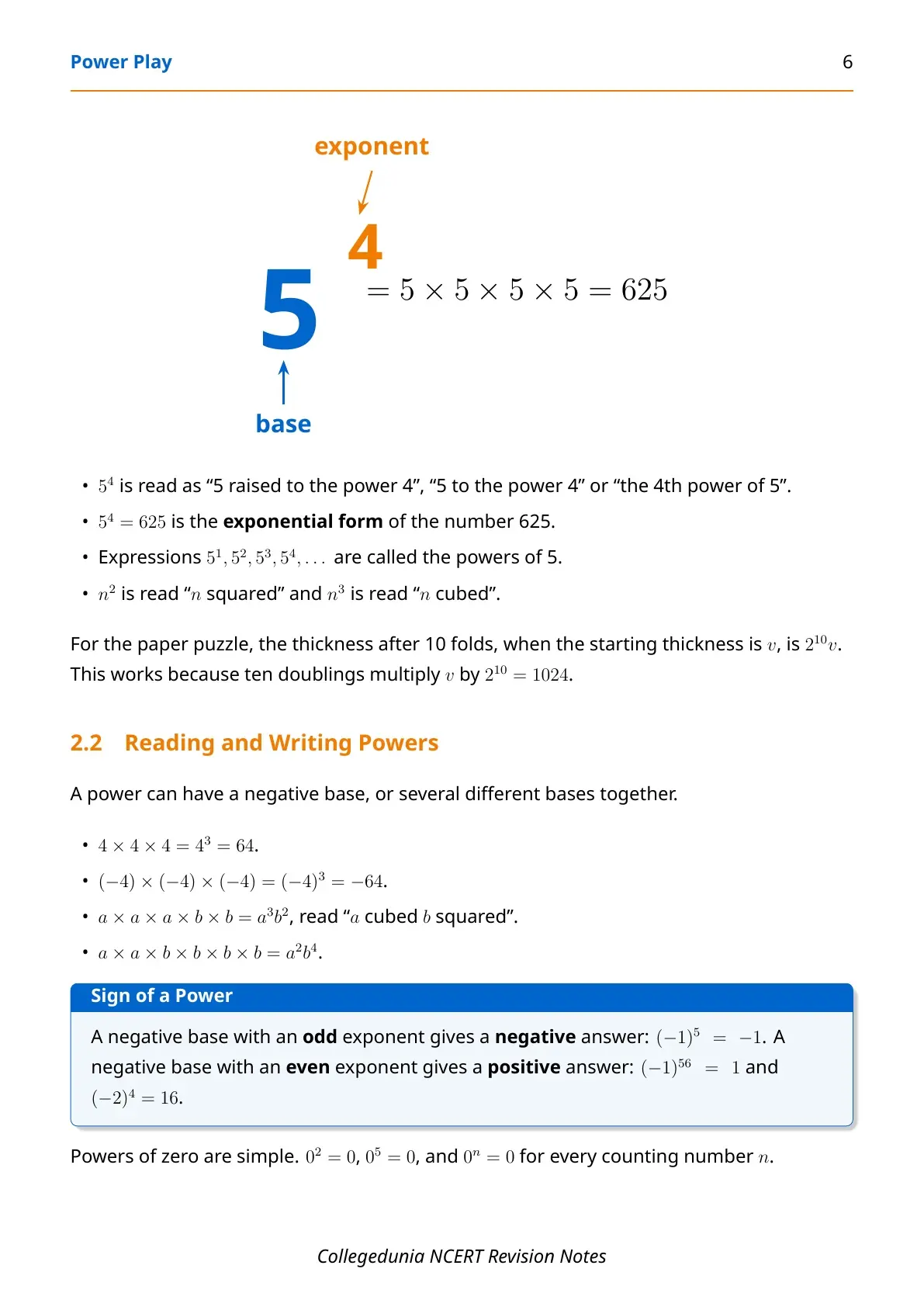
In na, the number n is the base and a is the exponent, so 54 = 5 × 5 × 5 × 5 = 625. It is read as "5 raised to the power 4". When the paper starts at thickness v, its thickness after 10 folds is 210v.
The sign of a power depends on the exponent when the base is negative. (−1)5 = −1 because 5 is odd, while (−1)56 = 1 and (−2)4 = 16 because the exponents are even. Powers of zero stay zero, so 0n = 0 for every counting number n.
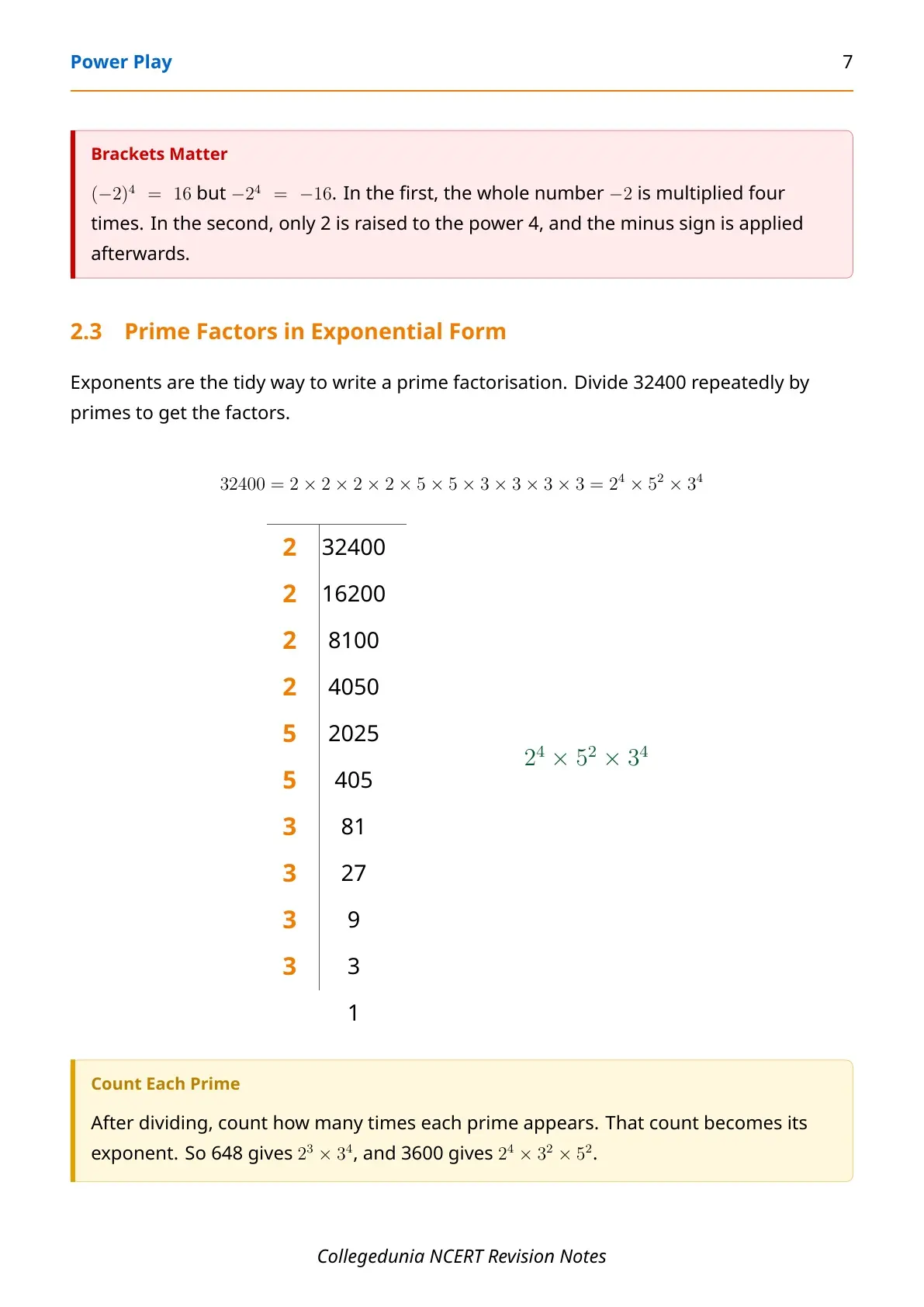
Exponents also give a compact way to write a prime factorisation. Dividing 32400 by primes gives 24 × 34 × 52. Count how many times each prime divides the number, and that count is its exponent.
Laws of Exponents for Class 8 Power Play
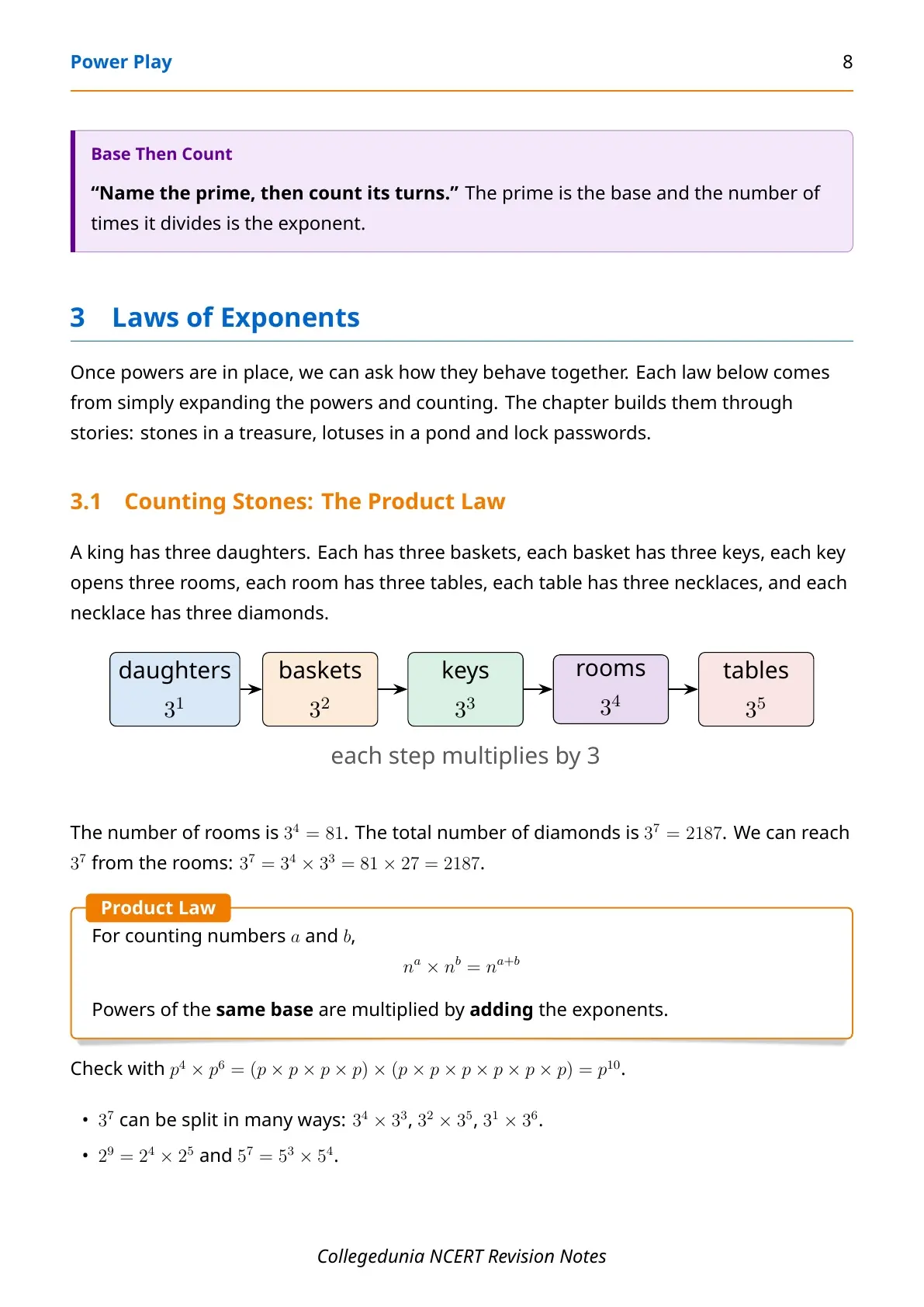
Each law in this chapter comes from expanding the powers and counting. The stones in the king's treasure, the lotus pond and the lock passwords are the three stories the book uses to build them.
| Law | Rule | Example |
|---|---|---|
| Product of same base | na × nb = na+b | 34 × 33 = 37 = 2187 |
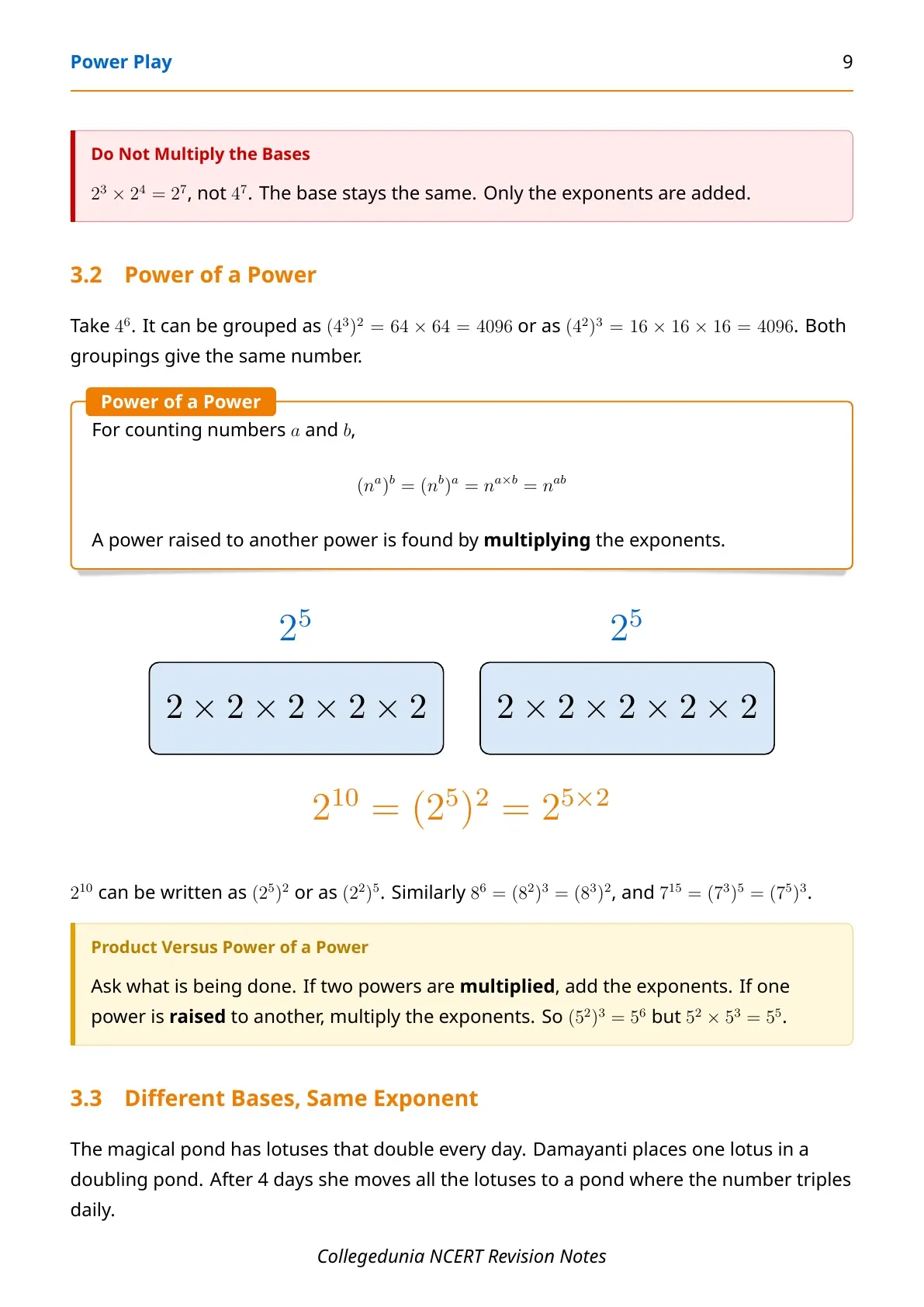
| Power of a power | (na)b = nab | (25)2 = 210 |
| Division of same base | na ÷ nb = na−b | 2100 ÷ 225 = 275 |
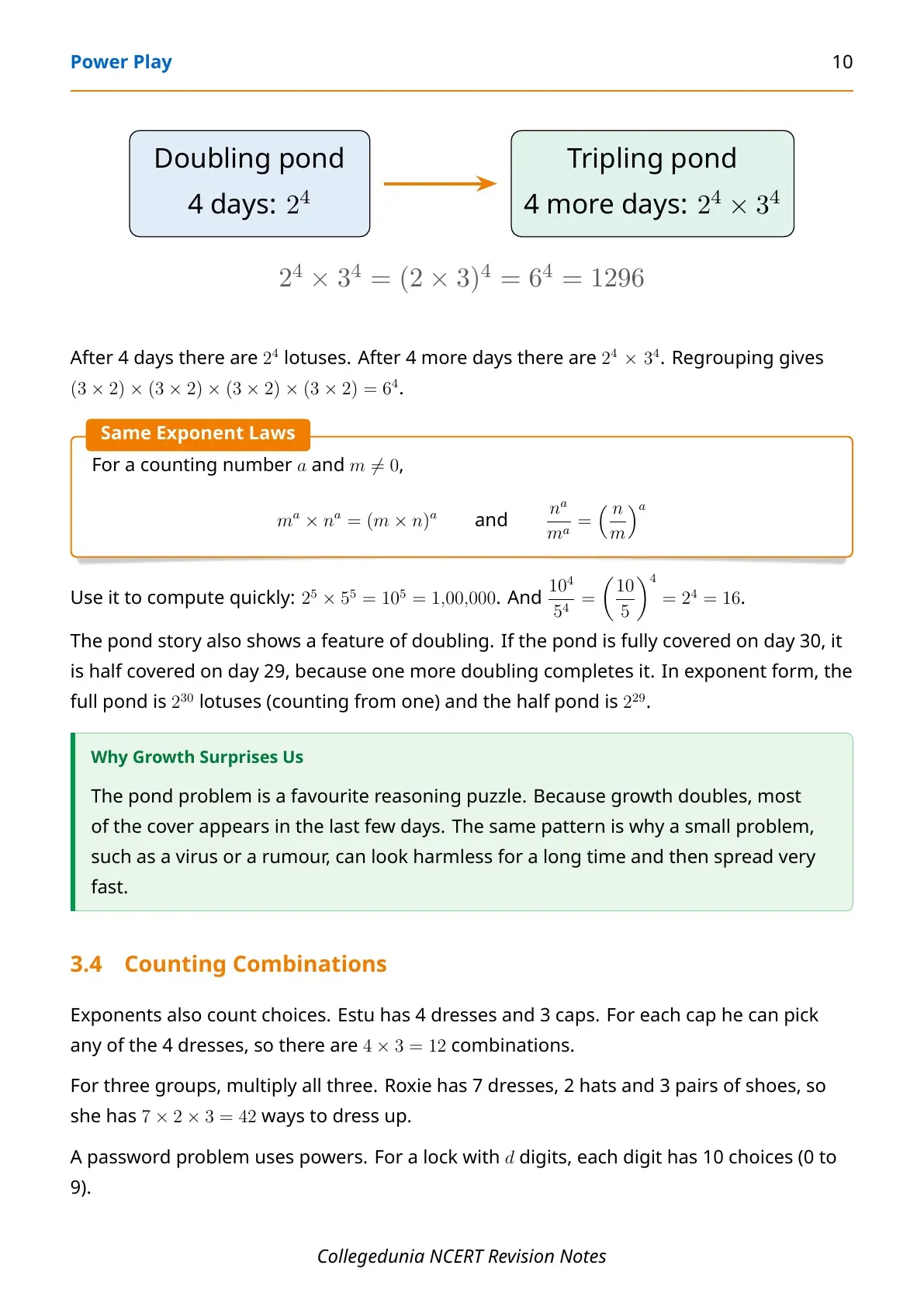
| Same exponent, product | ma × na = (mn)a | 25 × 55 = 105 |
| Same exponent, quotient | na ÷ ma = (n/m)a | 104 ÷ 54 = 24 = 16 |
The king's treasure gives the product law. There are 34 = 81 rooms and 37 diamonds in all, and 37 = 34 × 33 = 81 × 27 = 2187. The pond gives the same-exponent law: one lotus doubling for 4 days and then tripling for 4 days ends as 24 × 34 = 64 = 1296 lotuses.
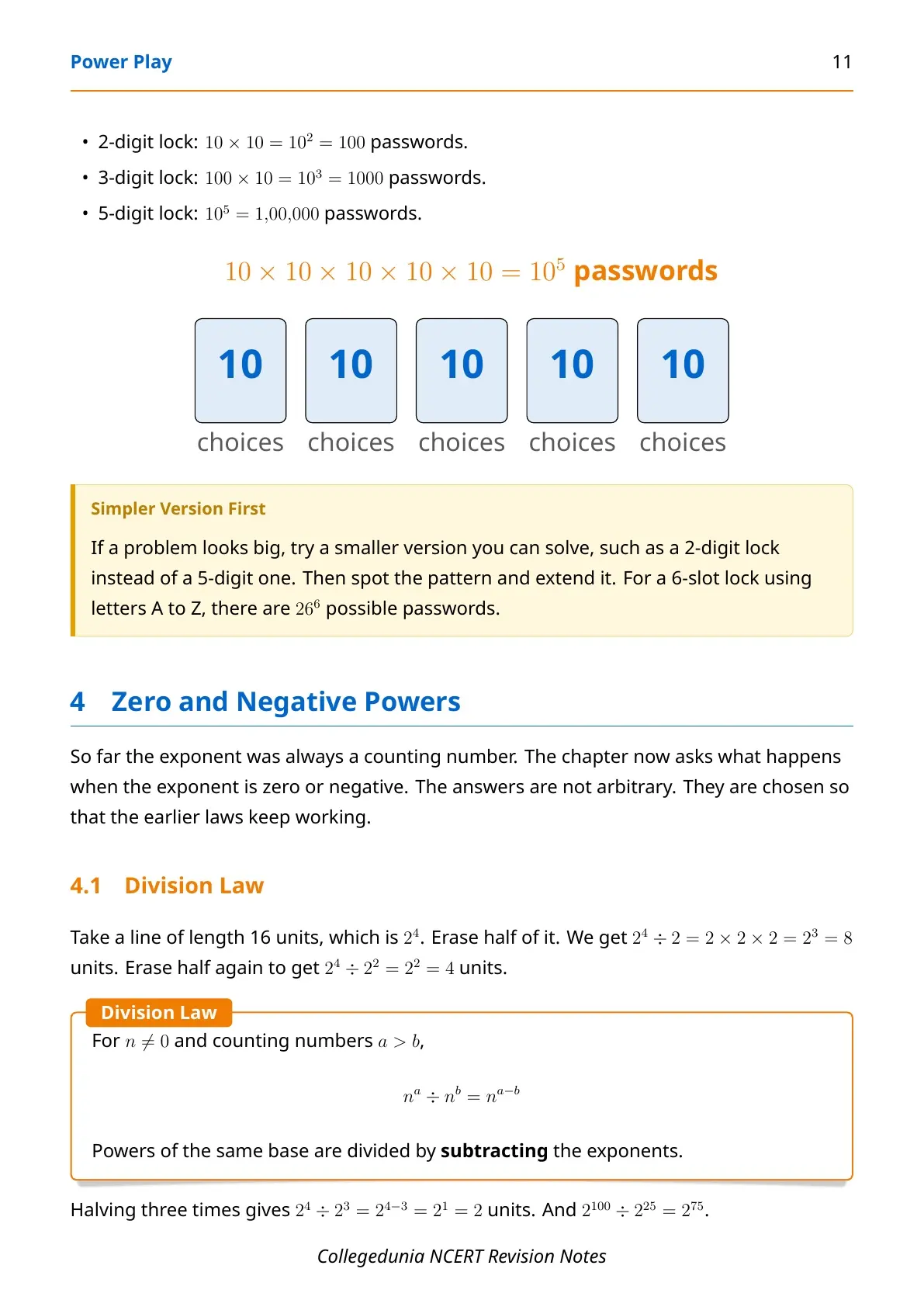
The same idea counts combinations. A 5-digit lock has 10 choices for each place, so it has 105 = 1,00,000 passwords. A lock with 6 letter slots from A to Z has 266.
Zero and Negative Powers Explained
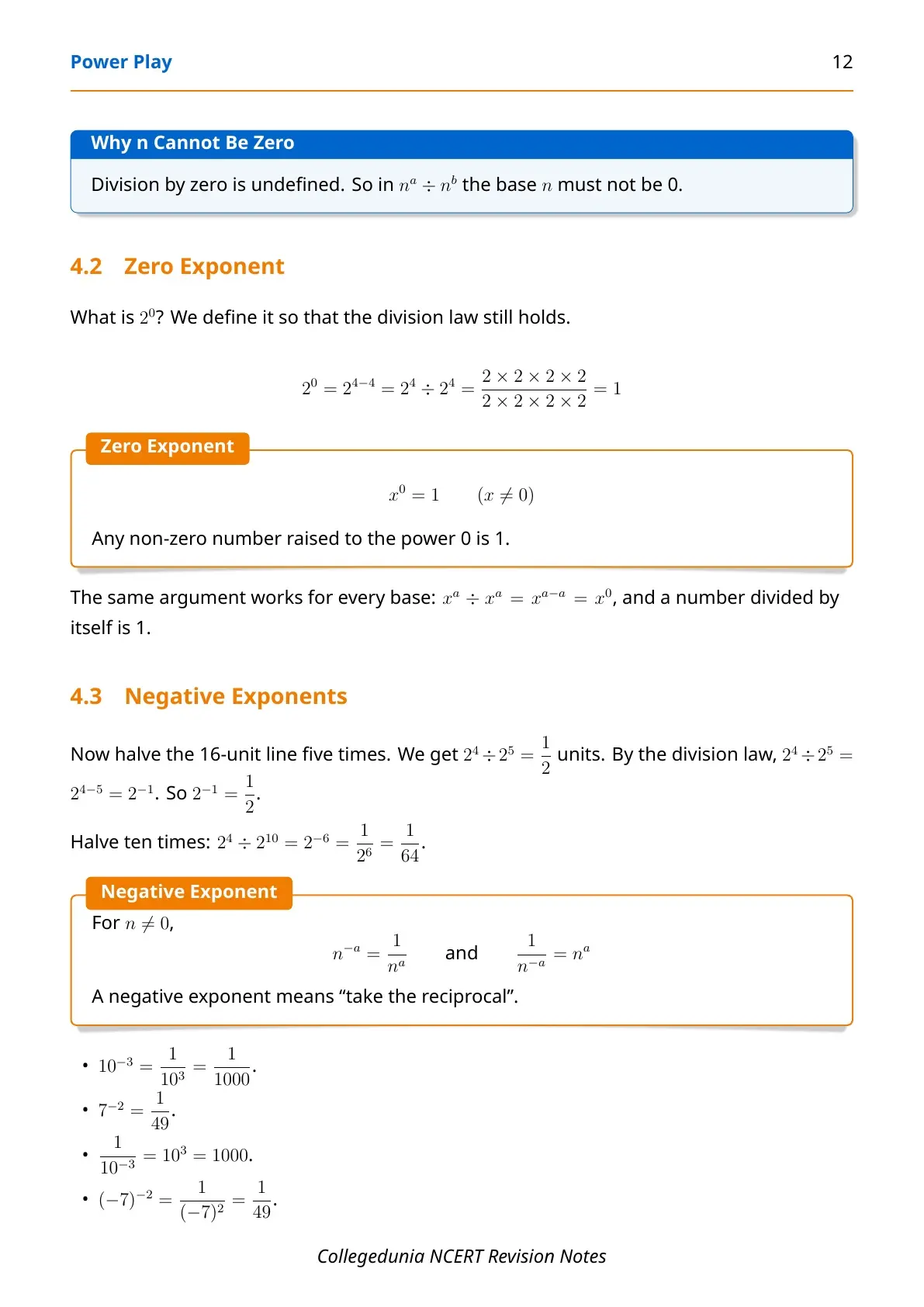
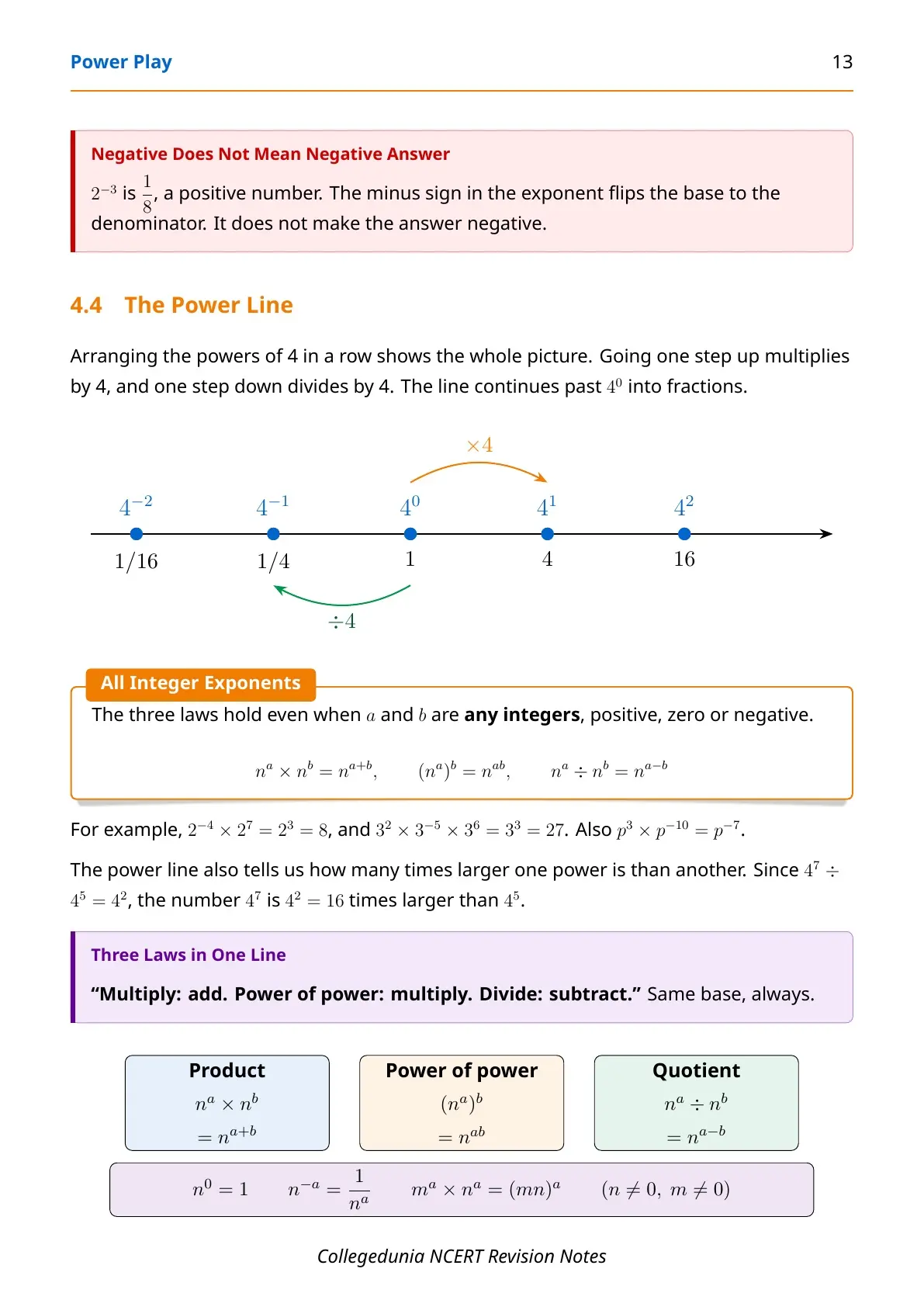
These definitions are chosen so that the division law keeps working. Halve a line of length 24 units four times and you get 24 ÷ 24 = 20 = 1 unit. So n0 = 1 for every n other than 0.
Halve it five times and you get 24 ÷ 25 = 2−1 = 1/2. Halve it ten times and you get 2−6 = 1/64. In general, n−a = 1/na, and 1/n−a = na.
- 10−3 = 1/1000
- 7−2 = 1/49, and (−7)−2 = 1/49 as well
- 2−4 × 27 = 23 = 8
- 32 × 3−5 × 36 = 33 = 27
The power line of 4 shows the whole pattern. Going one step up multiplies by 4 and one step down divides by 4, and the line carries on past 40 = 1 into 1/4 and 1/16. All three laws hold for any integer exponents, positive, zero or negative.
Powers of 10 and Scientific Notation in Power Play
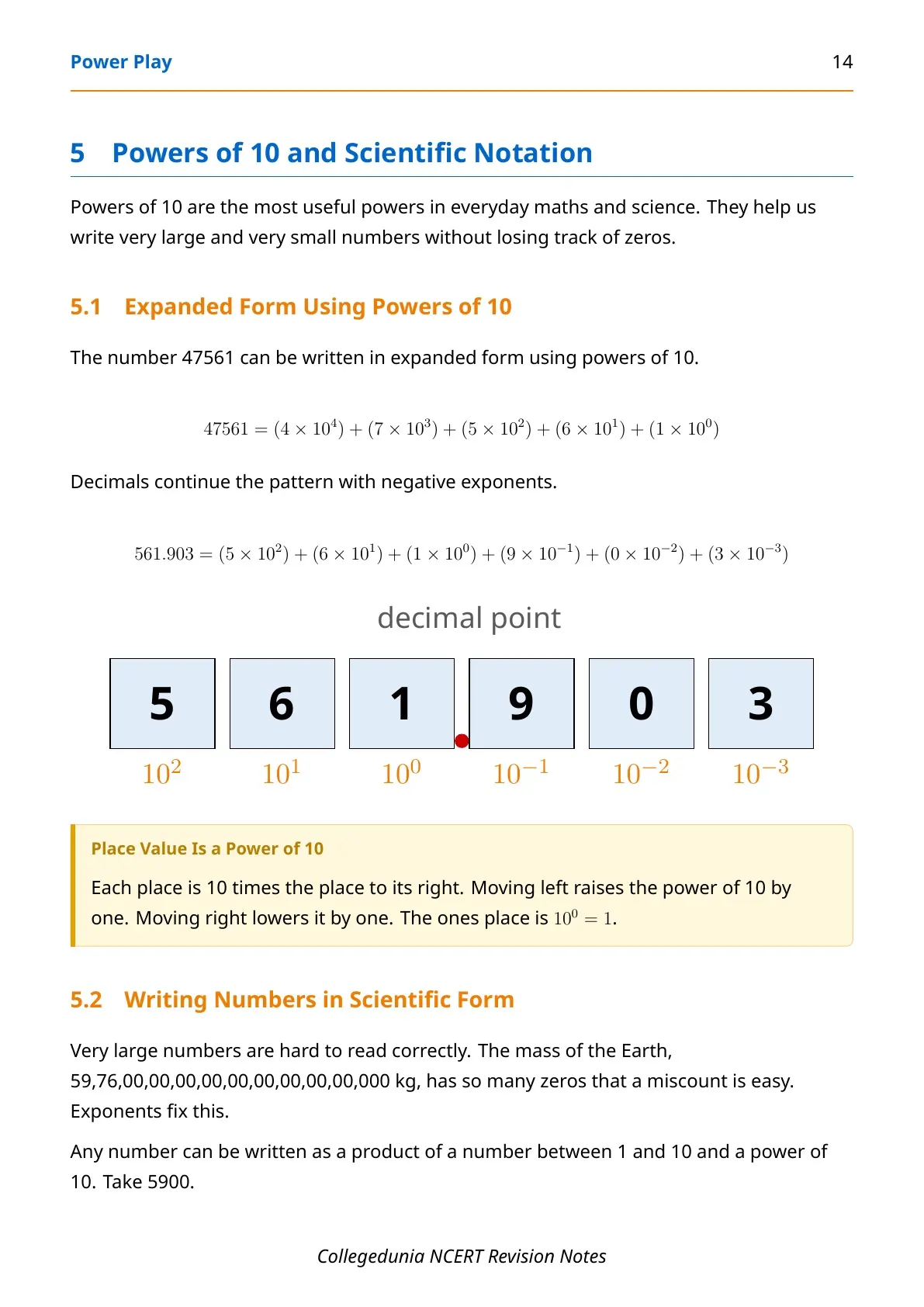
Place value is a list of powers of 10. 47561 = 4 × 10⁴ + 7 × 10³ + 5 × 10² + 6 × 101 + 1 × 100, and decimals continue the list with 10−1, 10−2 and so on.
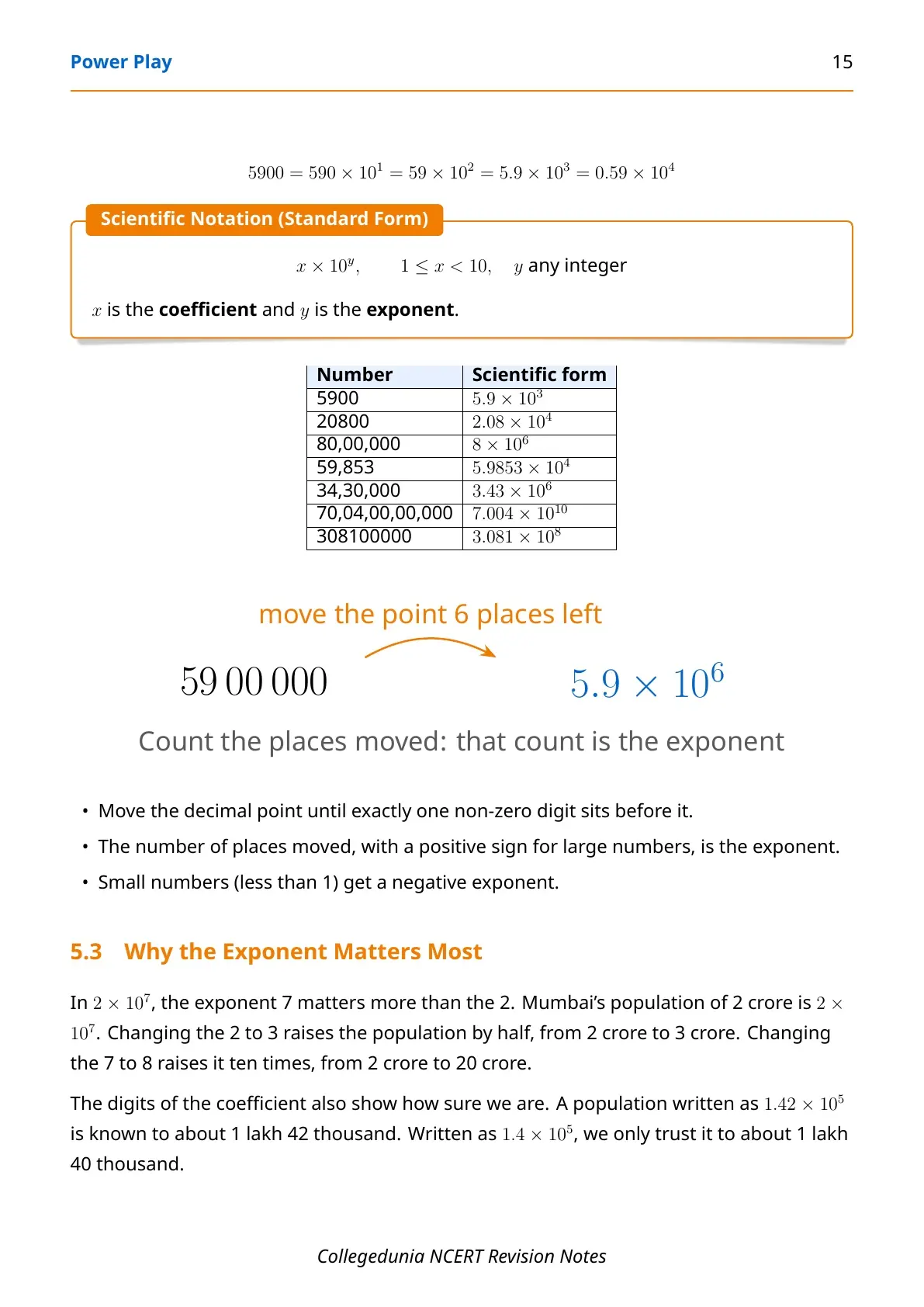
A number is in scientific (standard) form when it is written as x × 10y with 1 ≤ x < 10 and y an integer. The exponent tells you how big the number is, which is why it matters more than the coefficient. Changing 2 × 10⁷ to 3 × 10⁷ adds half again, but changing it to 2 × 10⁸ makes it ten times larger.
| Number | Standard form |
|---|---|
| 59,853 | 5.9853 × 10⁴ |
| 65,950 | 6.595 × 10⁴ |
| 34,30,000 | 3.43 × 10⁶ |
| 70,04,00,00,000 | 7.004 × 10¹⁰ |
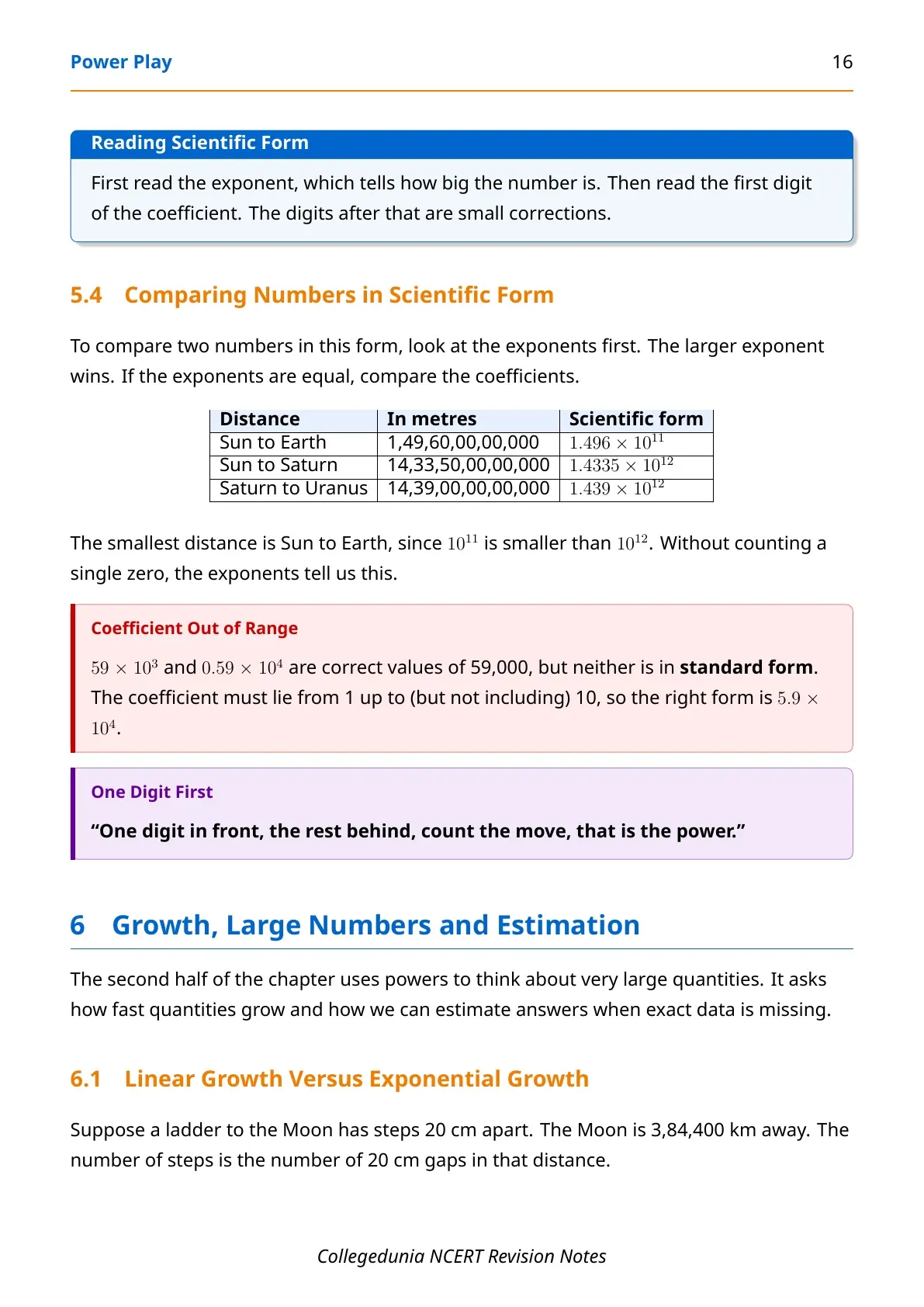
| Sun to Earth, 1,49,60,00,00,000 m | 1.496 × 10¹¹ m |
| Sun to Saturn, 14,33,50,00,00,000 m | 1.4335 × 10¹² m |
To compare two numbers in this form, compare the exponents first. Sun to Earth has exponent 11 while Sun to Saturn and Saturn to Uranus have exponent 12, so Sun to Earth is the smallest of the three distances.
Large Numbers, Estimation and Linear Versus Exponential Growth
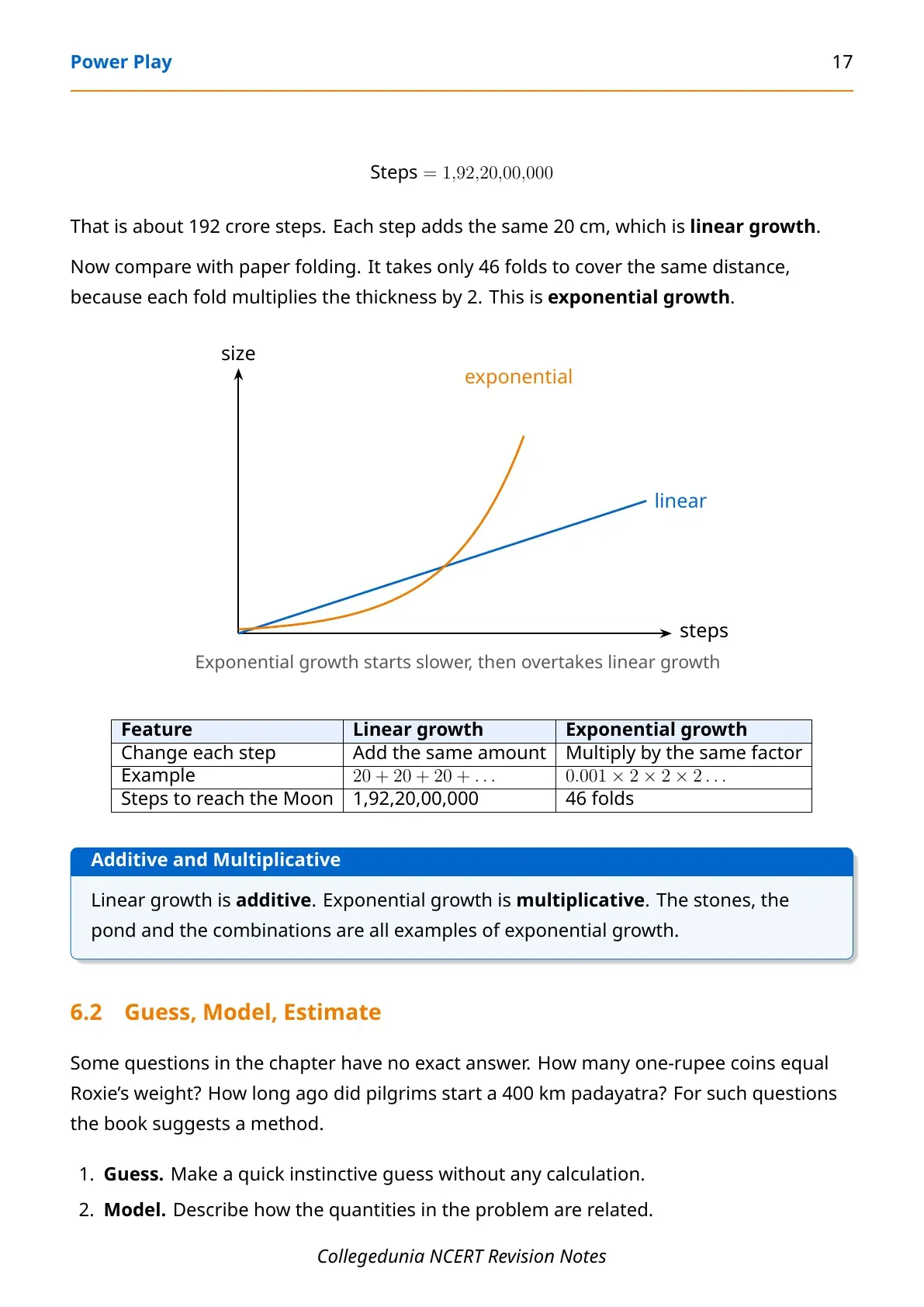
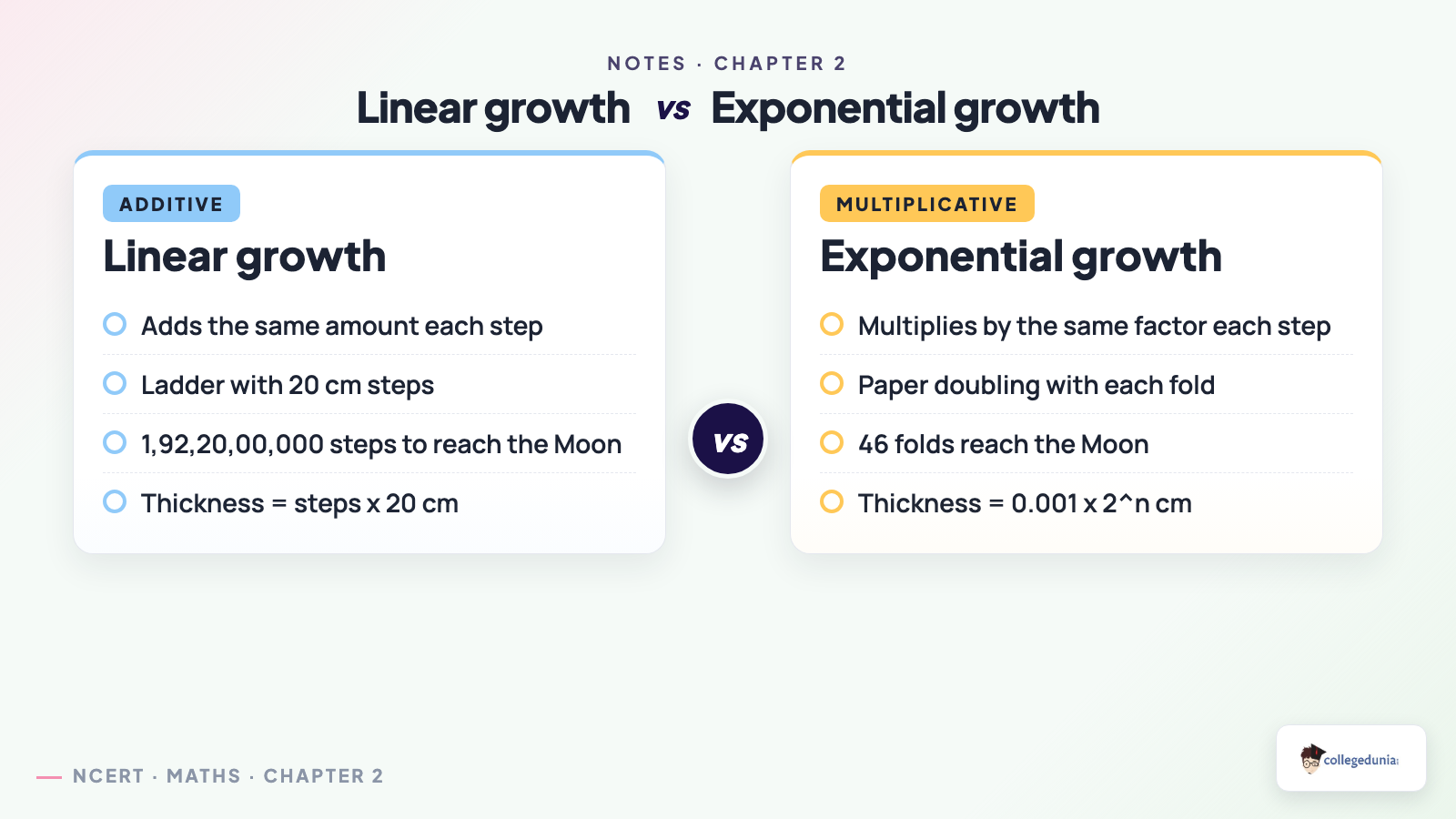
A ladder to the Moon with steps 20 cm apart needs 1,92,20,00,000 steps, because each step adds the same 20 cm. That is linear growth. The paper reaches the same distance in 46 folds, because each fold multiplies. Linear growth is additive and exponential growth is multiplicative.
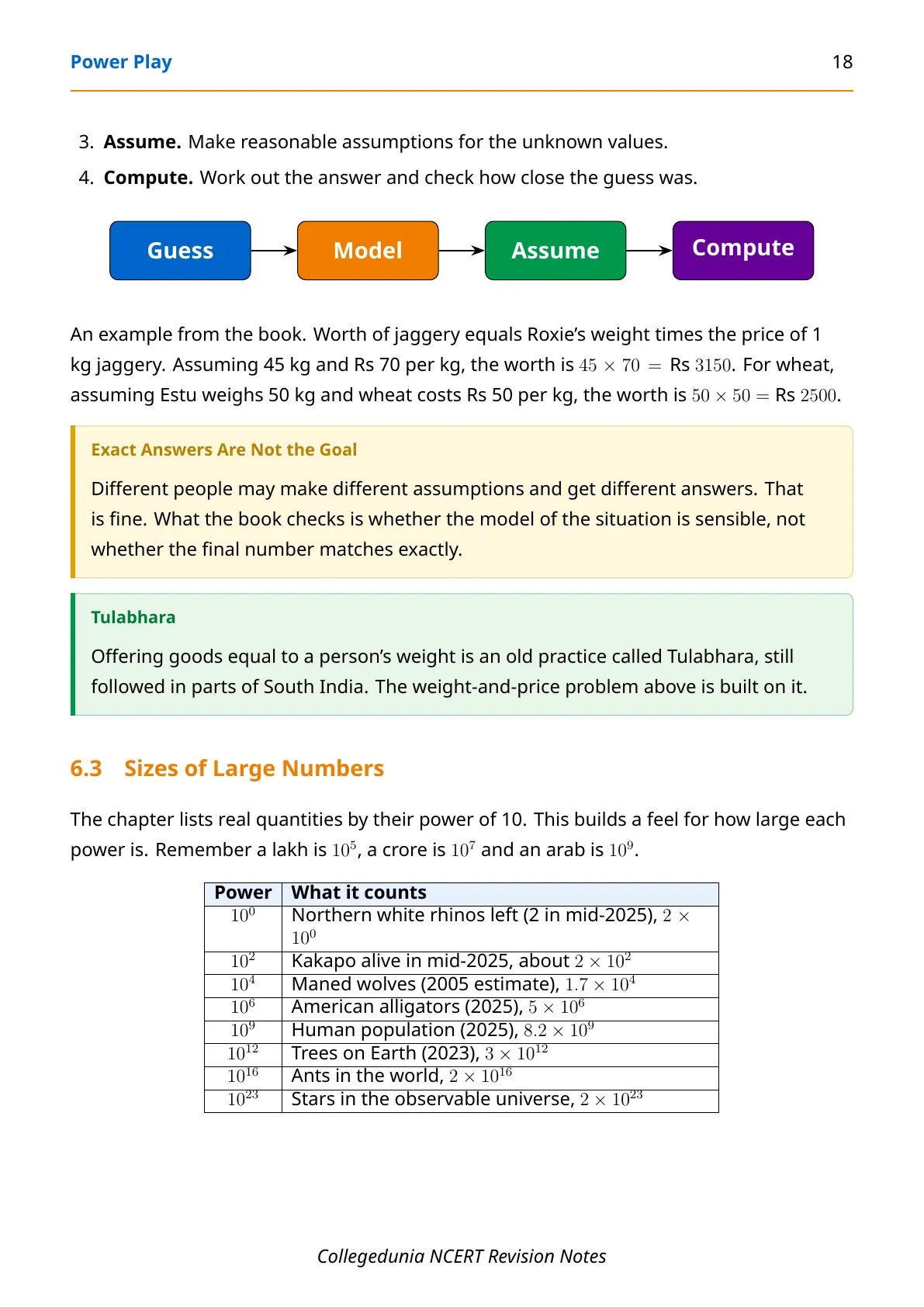
For questions with no exact data, such as how many one-rupee coins weigh as much as Roxie, the book suggests a fixed routine.
- Make a quick instinctive guess with no calculation.
- Describe how the quantities in the problem are related.
- Make reasonable assumptions for what you do not know.
- Compute, then check how close the guess was.
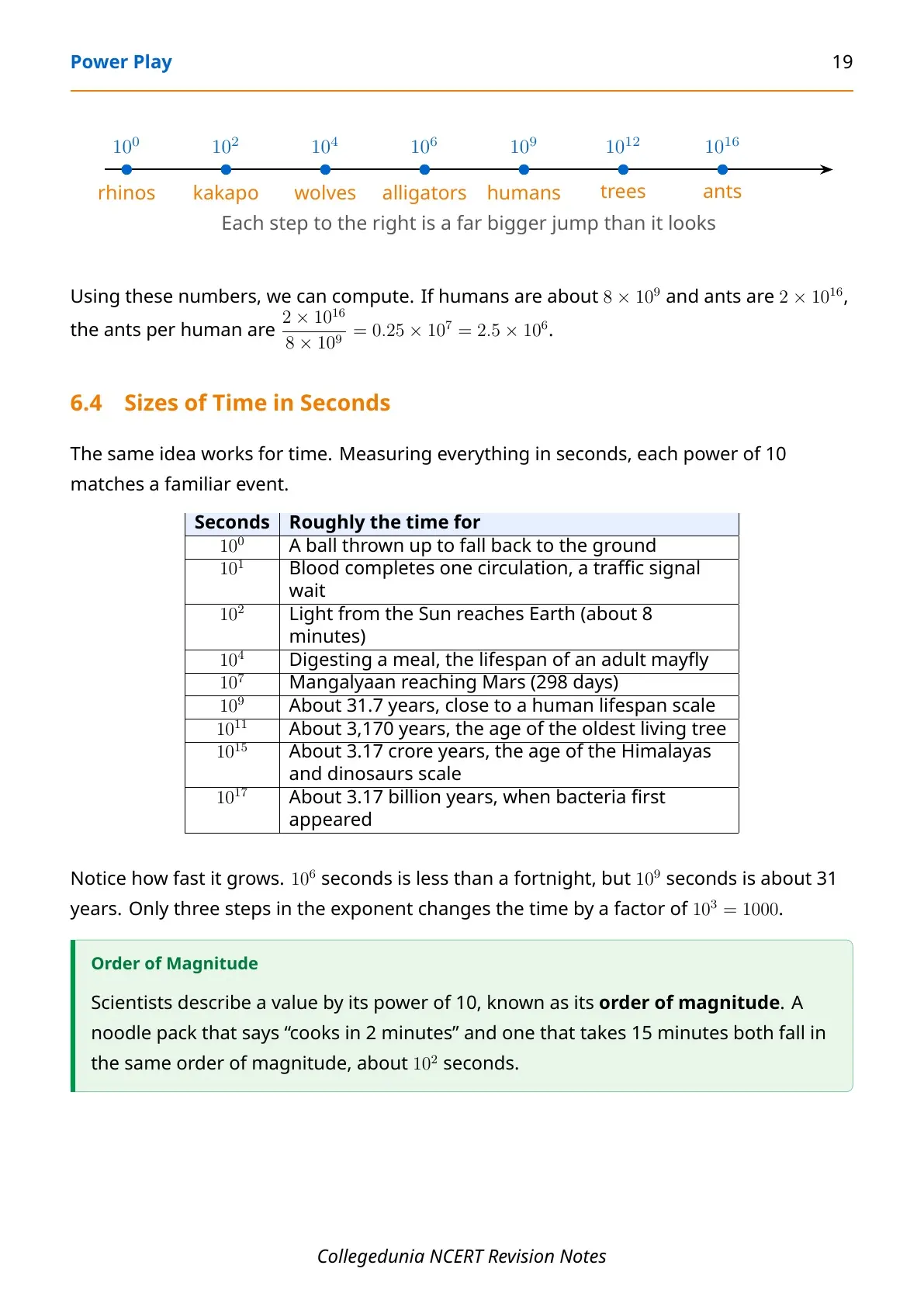
The chapter then lists real quantities by their power of 10, from 2 × 100 northern white rhinos to 2 × 10²³ stars in the observable universe. It does the same for time in seconds: 109 seconds is about 31.7 years, while 106 seconds is under a fortnight. Three steps in the exponent change the answer a thousand times.
Number Names: Lakh, Crore, Million and Billion
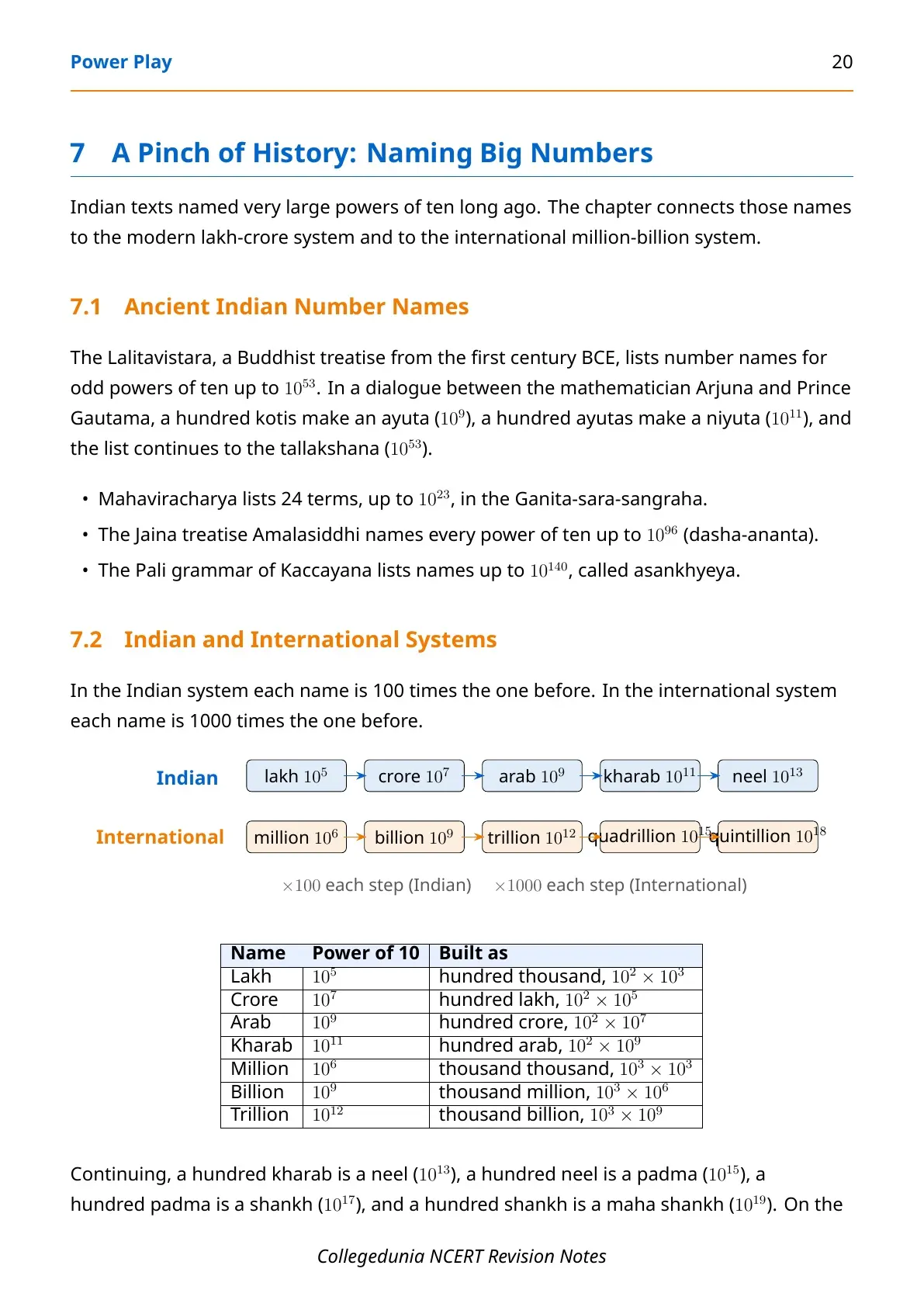
The Lalitavistara, a Buddhist text from the first century BCE, names odd powers of ten up to 1053. Mahaviracharya lists 24 names up to 1023, and the Jaina text Amalasiddhi names every power up to 1096.
| Indian system | Power of 10 | International system | Power of 10 |
|---|---|---|---|
| Lakh | 105 | Million | 106 |
| Crore | 107 | Billion | 109 |
| Arab | 109 | Trillion | 1012 |
| Kharab | 1011 | Quadrillion | 1015 |
Each Indian name is 100 times the one before it, and each international name is 1000 times the one before. The number 10100 is a googol, and 10googol is a googolplex.
Worked Examples from Power Play
These are the question types from the chapter's Figure it Out exercise, solved with the laws above.
- Prime powers: 648 = 23 × 34 and 3600 = 24 × 32 × 52.
- Comparing: 43 = 64 is less than 34 = 81, and 2100 is far larger than 1002 = 104.
- Decimal shifts: if 122 = 144, then (1.2)2 = 1.44, (0.12)2 = 0.0144 and 1202 = 14400.
- Units digit of 2224 ÷ 432: since 432 = 264, the answer is 2160. Powers of 2 end in 2, 4, 8, 6 in a cycle, and 160 is a multiple of 4, so the units digit is 6.
- Dairy IDs: 8.5 billion packets need a code of 10 digits, since 109 is too small and 1010 is enough.
The true-or-false type needs a reason. Fourth powers are always squares because n4 = (n2)2. Cube numbers are only sometimes squares, since 64 is both but 8 is not. A number that is both a square and a cube, like 64, is a sixth power.
Power Play Formulas at a Glance
This is the set of rules worth keeping on one revision card.
| Rule | Statement | Condition |
|---|---|---|
| Product | na × nb = na+b | Same base |
| Power of a power | (na)b = nab | Any base |
| Division | na ÷ nb = na−b | n ≠ 0 |
| Zero exponent | n0 = 1 | n ≠ 0 |
| Negative exponent | n−a = 1/na | n ≠ 0 |
| Standard form | x × 10y | 1 ≤ x < 10, y an integer |
How to Use the Power Play Notes Page
Read the paper-folding section first, since every law in the chapter is a version of that doubling idea. Then work through the laws section with a pencil and re-derive each rule by expanding a small case such as 23 × 22.
Keep the worked examples for last. Try each one before reading the solution, and check any answer you are unsure about with the quick fact table of powers of 2 and 3 at the end of the PDF.
More Class 8 Maths Part 1 Resources for Power Play
These resources for the same chapter and the other Part 1 notes pages are live. Solutions, handwritten notes and the book PDF for Power Play sit next to this page.
| Resource | Status |
|---|---|
| Power Play Class 8 Notes | Live (this page) |
| Power Play Class 8 Solutions | Live |
| Power Play Class 8 Handwritten Notes | Live |
| Power Play Class 8 NCERT Book PDF | Live |
| A Square and A Cube Class 8 Notes | Live |
| We Distribute, Yet Things Multiply Class 8 Notes | Live |
| Proportional Reasoning 1 Class 8 Notes | Live |
Power Play Class 8 Maths Notes FAQs
Ques. Where can I download Power Play Class 8 Maths Notes PDF?
Ans. You can download the Power Play Class 8 Maths Notes PDF from the card on this page. It is free and needs no login.
Ques. Do these notes follow the 2026-27 NCERT?
Ans. Yes. They follow Chapter 2 of the Ganita Prakash Part 1 textbook for Class 8 in the 2026-27 session.
Ques. How many pages is the Power Play notes PDF?
Ans. The PDF runs 25 pages. It covers exponent notation, all the laws of exponents, zero and negative powers, scientific notation, growth, number names and worked examples.
Ques. What are the laws of exponents in Class 8?
Ans. For the same base, na × nb = na+b, (na)b = nab and na ÷ nb = na−b. For the same exponent, ma × na = (mn)a.
Ques. Why is any non-zero number to the power 0 equal to 1?
Ans. By the division law, na ÷ na = na−a = n0. A non-zero number divided by itself is 1, so n0 = 1.
Ques. What does a negative exponent mean?
Ans. It means the reciprocal of the positive power. For example, 2−3 = 1/23 = 1/8. The answer stays positive when the base is positive.
Ques. What is scientific notation?
Ans. It writes a number as x × 10y, where x is at least 1 and less than 10 and y is an integer. For example, 308100000 = 3.081 × 10⁸.
Ques. How is exponential growth different from linear growth?
Ans. Linear growth adds the same amount each step, like a ladder with 20 cm steps. Exponential growth multiplies by the same factor each step, like paper doubling in thickness with every fold.
Ques. How many folds does it take for paper to reach the Moon?
Ans. About 46 folds, starting from a thickness of 0.001 cm. The thickness then exceeds 7,00,000 km, while the Moon is about 3,84,400 km away.



Comments