



Inside the Class 8 Mathematics Chapter 6 We Distribute, Yet Things Multiply notes, you will find distributive property rules, algebraic identities, and fast multiplication methods. The notes follow the 2026-27 Ganita Prakash textbook and use clear steps for expanding products, spotting mistakes, and checking equal expressions.
- Core rule: multiply every term inside a bracket before combining like terms.
- Key identities: revise square of a sum, square of a difference, and difference of squares.
- Practice focus: expand products, track signs, and use identities for quick calculations.
Chapter6WeDistribute,YetThingsMultiplyNotes.pdf?page=1&dpi=150)
Chapter6WeDistribute,YetThingsMultiplyNotes.pdf?page=2&dpi=150)
Chapter6WeDistribute,YetThingsMultiplyNotes.pdf?page=3&dpi=150)
Chapter6WeDistribute,YetThingsMultiplyNotes.pdf?page=4&dpi=150)
Chapter6WeDistribute,YetThingsMultiplyNotes.pdf?page=5&dpi=150)
Chapter6WeDistribute,YetThingsMultiplyNotes.pdf?page=6&dpi=150)
Chapter6WeDistribute,YetThingsMultiplyNotes.pdf?page=7&dpi=150)
Chapter6WeDistribute,YetThingsMultiplyNotes.pdf?page=8&dpi=150)
Chapter6WeDistribute,YetThingsMultiplyNotes.pdf?page=9&dpi=150)
Chapter6WeDistribute,YetThingsMultiplyNotes.pdf?page=10&dpi=150)
Chapter6WeDistribute,YetThingsMultiplyNotes.pdf?page=11&dpi=150)
Chapter6WeDistribute,YetThingsMultiplyNotes.pdf?page=12&dpi=150)
Chapter6WeDistribute,YetThingsMultiplyNotes.pdf?page=13&dpi=150)
Chapter6WeDistribute,YetThingsMultiplyNotes.pdf?page=14&dpi=150)
Chapter6WeDistribute,YetThingsMultiplyNotes.pdf?page=15&dpi=150)
Chapter6WeDistribute,YetThingsMultiplyNotes.pdf?page=16&dpi=150)
Chapter6WeDistribute,YetThingsMultiplyNotes.pdf?page=17&dpi=150)
Chapter6WeDistribute,YetThingsMultiplyNotes.pdf?page=18&dpi=150)
Chapter6WeDistribute,YetThingsMultiplyNotes.pdf?page=19&dpi=150)
Chapter6WeDistribute,YetThingsMultiplyNotes.pdf?page=20&dpi=150)
Chapter6WeDistribute,YetThingsMultiplyNotes.pdf?page=21&dpi=150)
Chapter6WeDistribute,YetThingsMultiplyNotes.pdf?page=22&dpi=150)
Chapter6WeDistribute,YetThingsMultiplyNotes.pdf?page=23&dpi=150)
Chapter6WeDistribute,YetThingsMultiplyNotes.pdf?page=24&dpi=150)
Chapter6WeDistribute,YetThingsMultiplyNotes.pdf?page=25&dpi=150)
Chapter6WeDistribute,YetThingsMultiplyNotes.pdf?page=26&dpi=150)
Chapter6WeDistribute,YetThingsMultiplyNotes_flat_MobileCard.pdf?page=1&dpi=150)
Chapter6WeDistribute,YetThingsMultiplyNotes_flat_MobileCard.pdf?page=2&dpi=150)
Chapter6WeDistribute,YetThingsMultiplyNotes_flat_MobileCard.pdf?page=3&dpi=150)
Chapter6WeDistribute,YetThingsMultiplyNotes_flat_MobileCard.pdf?page=4&dpi=150)
Chapter6WeDistribute,YetThingsMultiplyNotes_flat_MobileCard.pdf?page=5&dpi=150)
Chapter6WeDistribute,YetThingsMultiplyNotes_flat_MobileCard.pdf?page=6&dpi=150)
Chapter6WeDistribute,YetThingsMultiplyNotes_flat_MobileCard.pdf?page=7&dpi=150)
Chapter6WeDistribute,YetThingsMultiplyNotes_flat_MobileCard.pdf?page=8&dpi=150)
Chapter6WeDistribute,YetThingsMultiplyNotes_flat_MobileCard.pdf?page=9&dpi=150)
Chapter6WeDistribute,YetThingsMultiplyNotes_flat_MobileCard.pdf?page=10&dpi=150)
Chapter6WeDistribute,YetThingsMultiplyNotes_flat_MobileCard.pdf?page=11&dpi=150)
Chapter6WeDistribute,YetThingsMultiplyNotes_flat_MobileCard.pdf?page=12&dpi=150)
Chapter6WeDistribute,YetThingsMultiplyNotes_flat_MobileCard.pdf?page=13&dpi=150)
Chapter6WeDistribute,YetThingsMultiplyNotes_flat_MobileCard.pdf?page=14&dpi=150)
Chapter6WeDistribute,YetThingsMultiplyNotes_flat_MobileCard.pdf?page=15&dpi=150)
Chapter6WeDistribute,YetThingsMultiplyNotes_flat_MobileCard.pdf?page=16&dpi=150)
Chapter6WeDistribute,YetThingsMultiplyNotes_flat_MobileCard.pdf?page=17&dpi=150)
Chapter6WeDistribute,YetThingsMultiplyNotes_flat_MobileCard.pdf?page=18&dpi=150)
Chapter6WeDistribute,YetThingsMultiplyNotes_flat_MobileCard.pdf?page=19&dpi=150)
Chapter6WeDistribute,YetThingsMultiplyNotes_flat_MobileCard.pdf?page=20&dpi=150)
Chapter6WeDistribute,YetThingsMultiplyNotes_flat_MobileCard.pdf?page=21&dpi=150)
Chapter6WeDistribute,YetThingsMultiplyNotes_flat_MobileCard.pdf?page=22&dpi=150)
Chapter6WeDistribute,YetThingsMultiplyNotes_flat_MobileCard.pdf?page=23&dpi=150)
Chapter6WeDistribute,YetThingsMultiplyNotes_flat_MobileCard.pdf?page=24&dpi=150)
Chapter6WeDistribute,YetThingsMultiplyNotes_flat_MobileCard.pdf?page=25&dpi=150)
Chapter6WeDistribute,YetThingsMultiplyNotes_flat_MobileCard.pdf?page=26&dpi=150)
Chapter6WeDistribute,YetThingsMultiplyNotes_flat_MobileCard.pdf?page=27&dpi=150)
Chapter6WeDistribute,YetThingsMultiplyNotes_flat_MobileCard.pdf?page=28&dpi=150)
Chapter6WeDistribute,YetThingsMultiplyNotes_flat_MobileCard.pdf?page=29&dpi=150)
Chapter6WeDistribute,YetThingsMultiplyNotes_flat_MobileCard.pdf?page=30&dpi=150)
Chapter6WeDistribute,YetThingsMultiplyNotes_flat_MobileCard.pdf?page=31&dpi=150)
Chapter6WeDistribute,YetThingsMultiplyNotes_flat_MobileCard.pdf?page=32&dpi=150)
These notes are checked against the 2026-27 NCERT chapter and keep every algebra rule linked to a textbook example.
Student Feedback: In a Collegedunia poll of 10,420 Class 8 students, most students found expansions easier after drawing an area model first.
Source: Collegedunia 2026-27 Class 8 Mathematics student poll.
We Distribute, Yet Things Multiply Core Ideas for Class 8
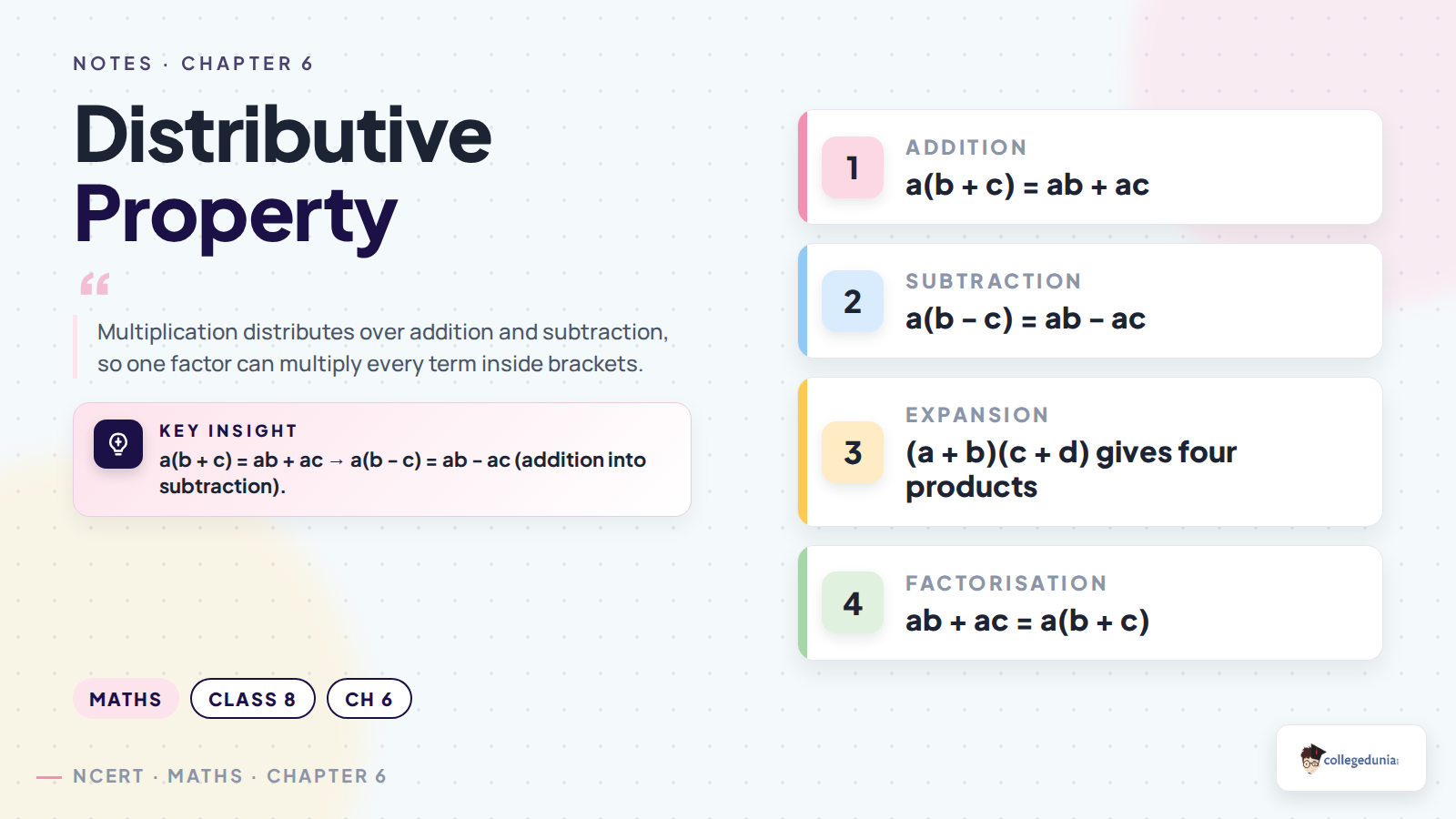
The distributive property links multiplication with addition and subtraction. It lets you split a difficult product into smaller products. Every term in one bracket must multiply every term in the other bracket.
- Over addition: a(b + c) = ab + ac.
- Over subtraction: a(b - c) = ab - ac.
- Two brackets: (a + m)(b + n) = ab + an + bm + mn.
- Like terms: terms with the same letters and powers can be combined.
A missing product or a wrong sign changes the whole expansion. Draw arrows from each term when the brackets contain several terms.
Distributive Property Chapter Overview
Source: Magnet Brains on YouTube
How Products Change When Numbers Increase or Decrease
The chapter begins with a useful question: how does a product change when its factors change? Suppose the original product is ab. The expansion shows the exact increase or decrease.
| Change in factors | New product | Change from ab |
|---|---|---|
| b increases by 1 | a(b + 1) = ab + a | Increase of a |
| Both increase by 1 | (a + 1)(b + 1) = ab + a + b + 1 | Increase of a + b + 1 |
| a increases by 1, b decreases by 1 | (a + 1)(b - 1) = ab + b - a - 1 | b - a - 1 |
| Changes are m and n | (a + m)(b + n) | an + bm + mn |
Substitute negative values for a decrease. This keeps one general identity useful for many different cases.
Three Algebraic Identities Every Class 8 Student Should Know
Special cases of distributivity produce three identities used throughout school algebra. Learn the pattern, but also understand how it comes from multiplication.
| Identity | Expansion | Quick use |
|---|---|---|
| Square of a sum | (a + b)2 = a2 + 2ab + b2 | Find 1042 as (100 + 4)2 |
| Square of a difference | (a - b)2 = a2 - 2ab + b2 | Find 992 as (100 - 1)2 |
| Sum times difference | (a + b)(a - b) = a2 - b2 | Find 98 x 102 as (100 - 2)(100 + 2) |
The middle term is twice the product of the two terms. Its sign is positive for a sum and negative for a difference.
Fast Multiplication with the Distributive Property
Distributivity also turns numbers near 10, 100, or 1000 into easier calculations. Split the special factor and multiply each part.
- Write 11 as 10 + 1, so 3874 x 11 becomes 38740 + 3874.
- Write 101 as 100 + 1, so 89 x 101 becomes 8900 + 89.
- Write 99 as 100 - 1, so 73 x 99 becomes 7300 - 73.
- Write 1001 as 1000 + 1, then add the shifted number to itself.
Choose a split that makes mental calculation easy. The final answer should match ordinary multiplication when you check it.
Common Mistakes in We Distribute, Yet Things Multiply
Most errors come from skipping a term or changing a sign. Use this checklist before accepting an answer.
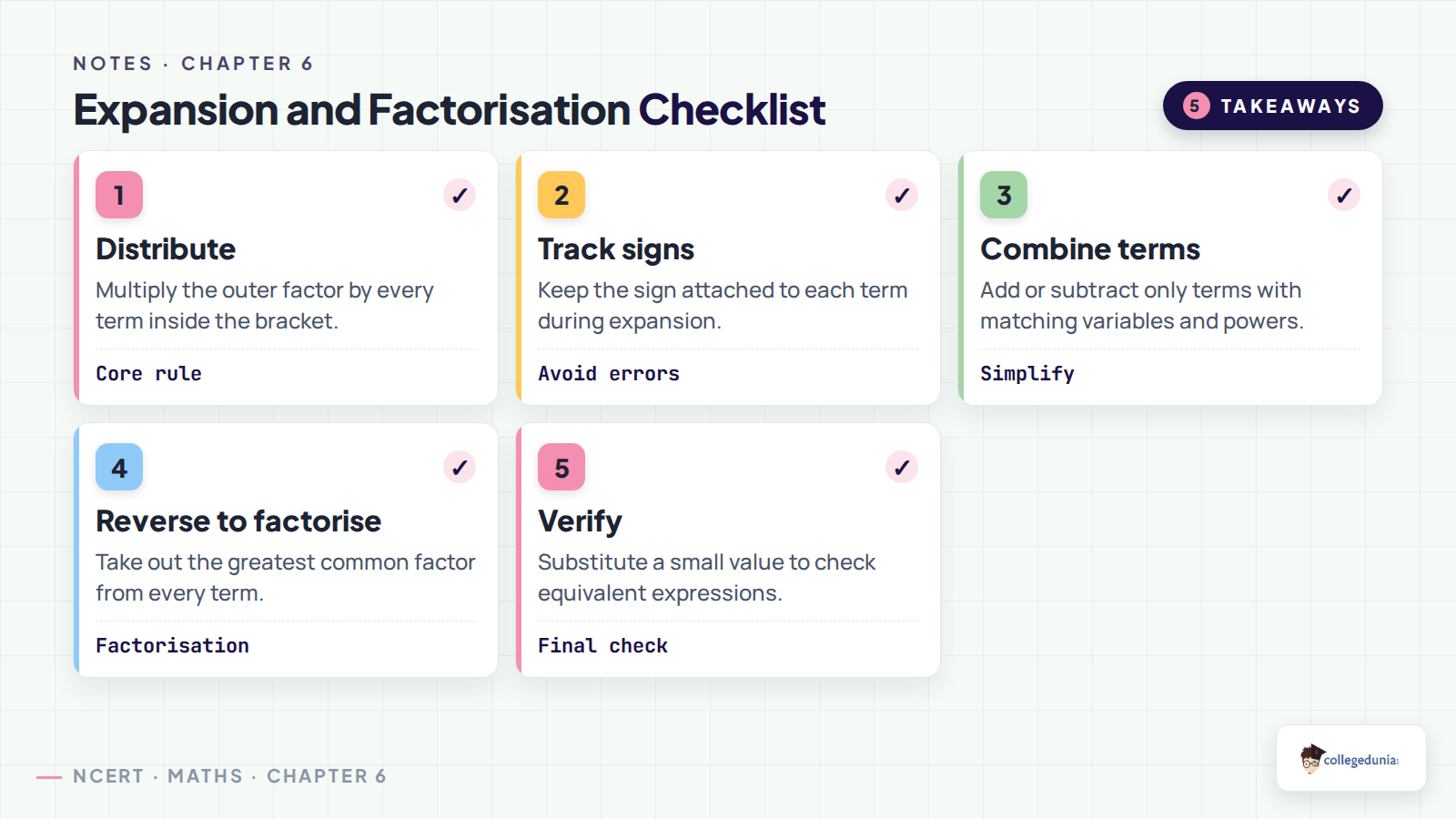
- Incomplete distribution: multiply the outside term by every term inside the bracket.
- Lost negative sign: keep brackets until every product has the correct sign.
- Wrong square: (a + b)2 is not a2 + b2.
- Unlike terms combined: a2 and a cannot be added as one term.
- Identity used blindly: rewrite the expression in the exact identity form first.
Check an identity by replacing letters with small integers. One unequal result proves that the claimed identity is wrong.
How to Revise the Distributive Property Notes
Use the notes in three short rounds. This plan links the visual meaning, the algebra steps, and the quick calculation methods.
- Draw an area model for a(b + c) and (a + b)2.
- Expand five expressions by drawing arrows between terms.
- Write the three special identities from memory.
- Solve one quick square and one product near 100.
- Check each result by direct multiplication or substitution.
We Distribute, Yet Things Multiply Related Class 8 Resources
Read the official chapter for activities, then use the other resources for practice and shorter revision.
| Resource | How it helps |
|---|---|
| We Distribute, Yet Things Multiply Class 8 NCERT Solutions | Check the Figure it Out questions after solving them. |
| We Distribute, Yet Things Multiply Class 8 NCERT Book PDF | Read the official examples, diagrams, and activities. |
| We Distribute, Yet Things Multiply Class 8 Handwritten Notes | Review identities and sign rules in a shorter format. |
NCERT Notes for Class 8 Mathematics Part 1: All Chapters
The table links every Mathematics Part 1 chapter to its matching Collegedunia notes page.
| Chapter | Notes |
|---|---|
| Chapter 1 | A Square and a Cube Class 8 Notes |
| Chapter 2 | Power Play Class 8 Notes |
| Chapter 3 | A Story of Numbers Class 8 Notes |
| Chapter 4 | Quadrilaterals Class 8 Notes |
| Chapter 5 | Number Play Class 8 Notes |
| Chapter 6 | We Distribute, Yet Things Multiply Class 8 Notes |
| Chapter 7 | Proportional Reasoning-1 Class 8 Notes |
We Distribute, Yet Things Multiply Class 8 Mathematics Notes FAQs
Ques. What is the distributive property?
Ans. The distributive property states that a(b + c) = ab + ac. The outside factor multiplies every term inside the bracket.
Ques. What are the three main identities in this chapter?
Ans. They are (a + b)2, (a - b)2, and (a + b)(a - b). Their expansions come from distributivity.
Ques. Why is (a + b) squared not equal to a squared plus b squared?
Ans. Multiplying (a + b) by itself also creates ab and ba. Together, these middle terms become 2ab.
Ques. How can identities help with fast multiplication?
Ans. Rewrite numbers around an easy base such as 10 or 100. Then use a sum, difference, or square identity.
Ques. How can students check an algebraic identity?
Ans. Expand both sides carefully. Students can also replace letters with several small integers and compare the resulting values.
Ques. Are these notes based on the 2026-27 NCERT textbook?
Ans. Yes. The notes follow Chapter 6 of the 2026-27 Ganita Prakash textbook, including identities and fast multiplication.



Comments