




These ncert class 8 maths notes chapter 2 The Baudhayana-Pythagoras Theorem start where the textbook starts, with a rope, a brick altar and a verse written around 800 BCE. Baudhayana wrote the rule a² + b² = c² in his Sulba-Sutra about three hundred years before Pythagoras. The notes cover every construction, proof and worked example in Ganita Prakash Part 2 for the 2026-27 session.
- Chapter: Chapter 2 of Ganita Prakash Part 2, the Class 8 Maths textbook for 2026-27
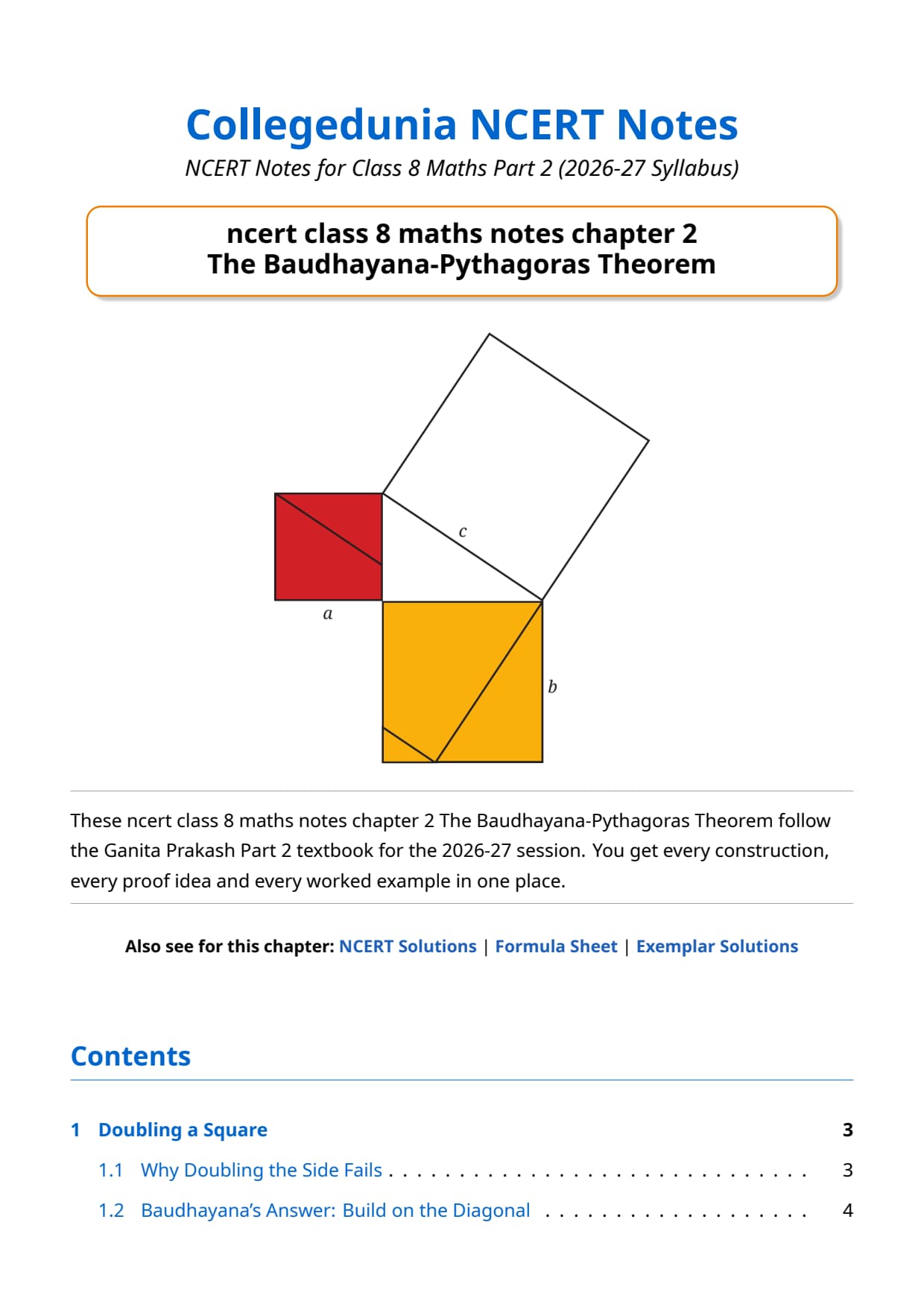
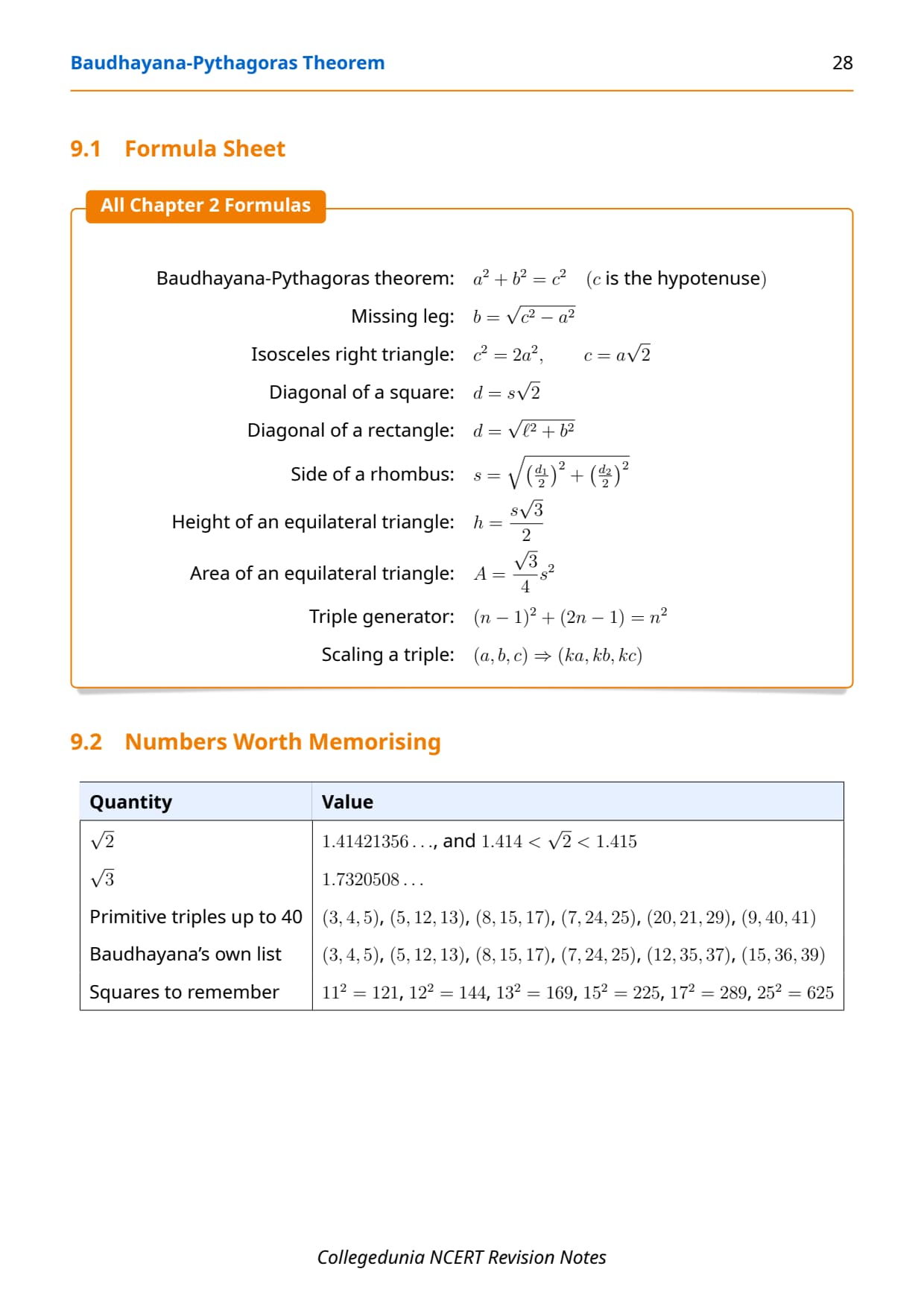
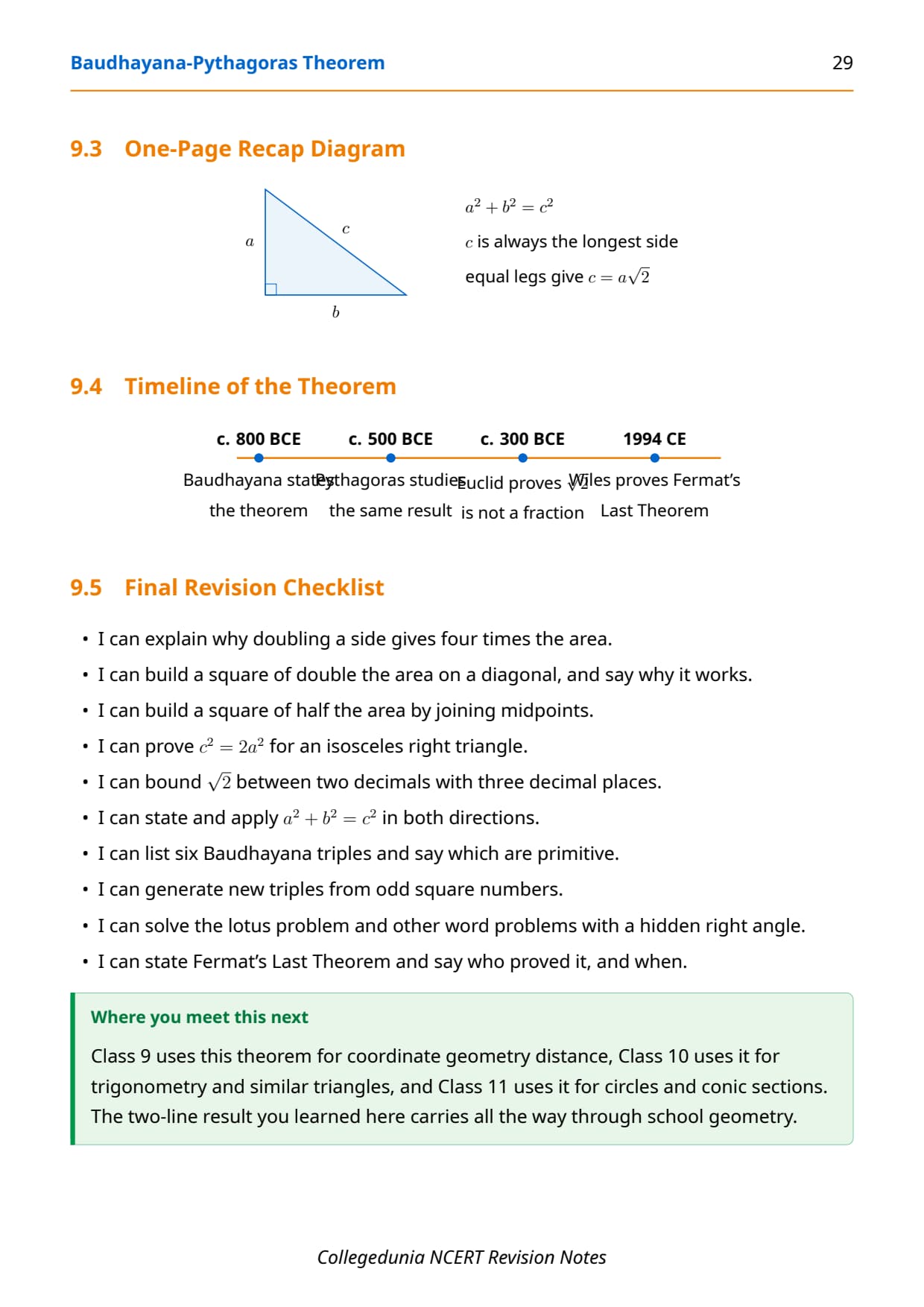
- Core rule: a² + b² = c², where c is the hypotenuse of a right-angled triangle
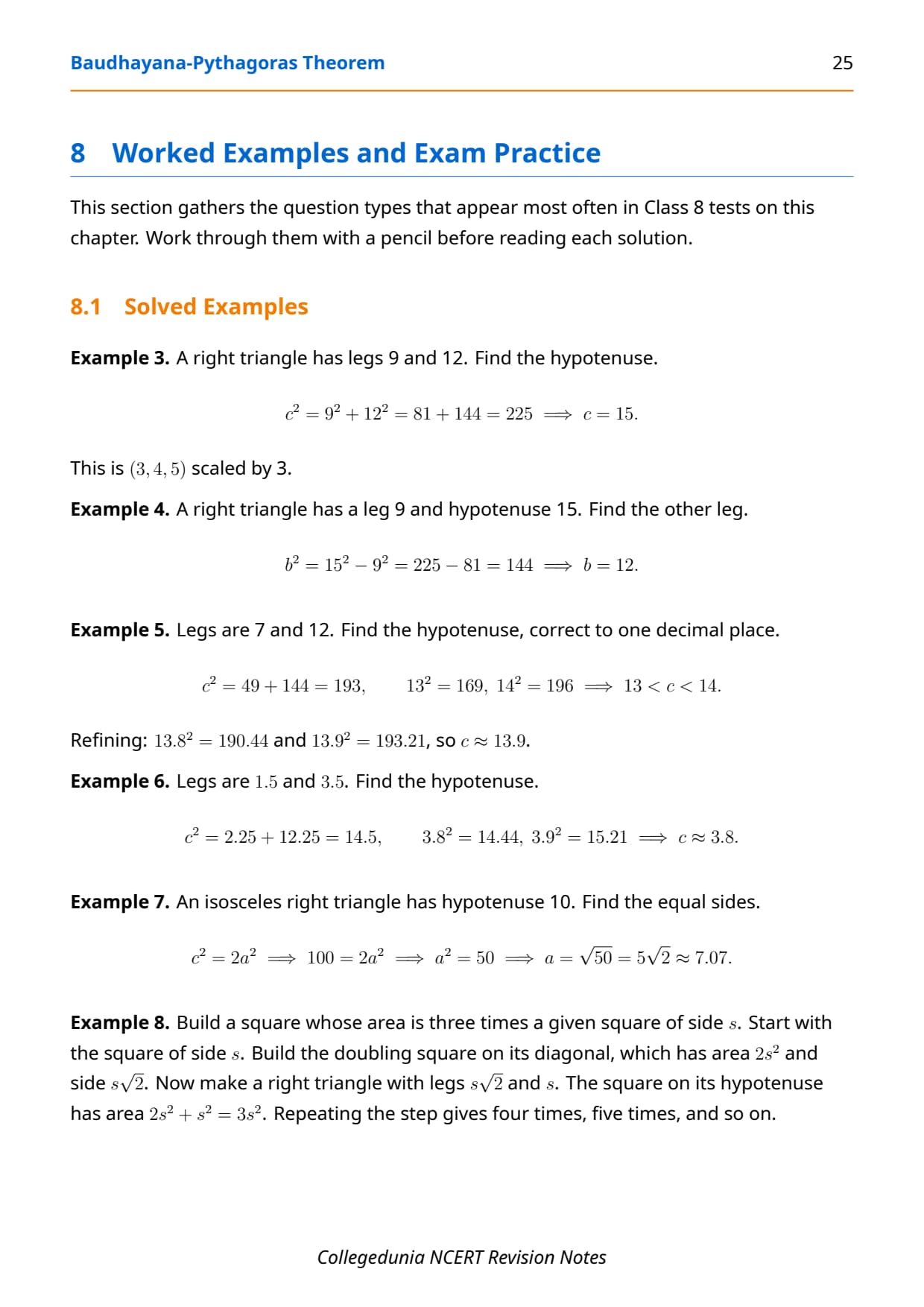
- Must-learn triples: (3, 4, 5), (5, 12, 13), (8, 15, 17), (7, 24, 25) and (20, 21, 29)
Every construction, proof and solved example in these Class 8 Maths notes is checked line by line against the printed Ganita Prakash Part 2 chapter for the 2026-27 session.
Baudhayana's Sulba-Sutra: The Rule That Came 300 Years Before Pythagoras
Baudhayana was a priest and a geometer. He wrote the Sulba-Sutra around 800 BCE to give exact rules for building fire altars out of bricks. Altars had to keep a fixed area while changing shape, so he needed real geometry, not guesswork.
Verse 1.9 and Verse 1.12 of that text carry the two ideas this whole chapter is built on. Pythagoras, the Greek mathematician, worked on the same relation near 500 BCE. The joint name credits both traditions, and the NCERT textbook uses it throughout.
- Sulba: the Sanskrit word for a measuring cord, the rope that did the work of a compass
- Verse 1.9: the diagonal of a square makes a square of twice the area
- Verse 1.12: the square on the diagonal equals the two squares on the sides added together
- Verse 1.13: a list of six whole-number right triangles, written 2500 years ago
So the chapter is not a Greek import with an Indian label pasted on. Baudhayana stated the general rule first, and he stated it as a working instruction for builders. That is the angle the NCERT chapter leads with, and it is worth remembering for a 3-mark "explain the origin" question.
The Baudhayana-Pythagoras Theorem Explained in Simple Language
Source: PW Class 8 on YouTube
Doubling a Square: Why Baudhayana Built on the Diagonal
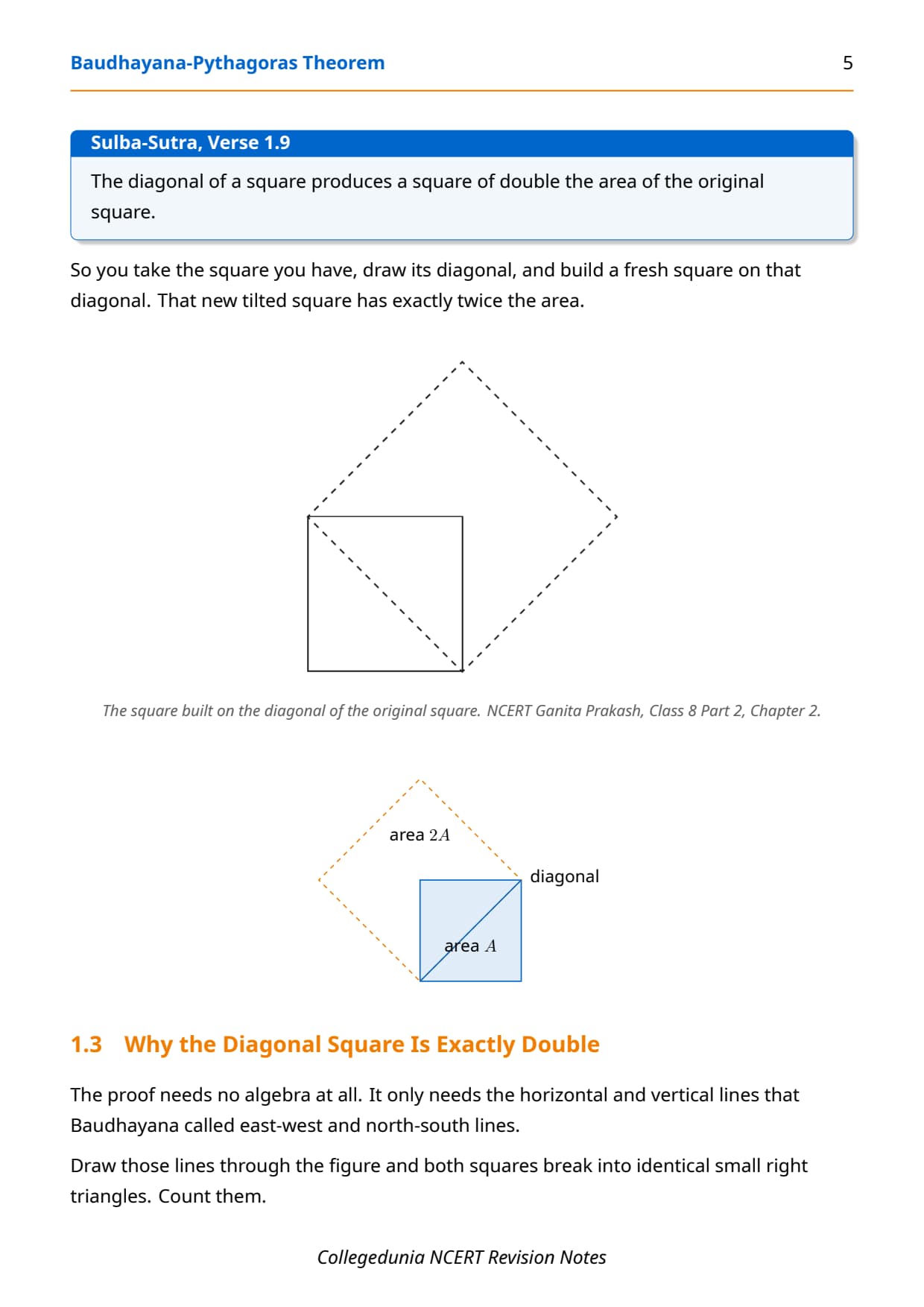
The chapter opens with one question. Given a square, build another square with exactly double the area. Most students try doubling the side first, and that guess is wrong in a useful way.
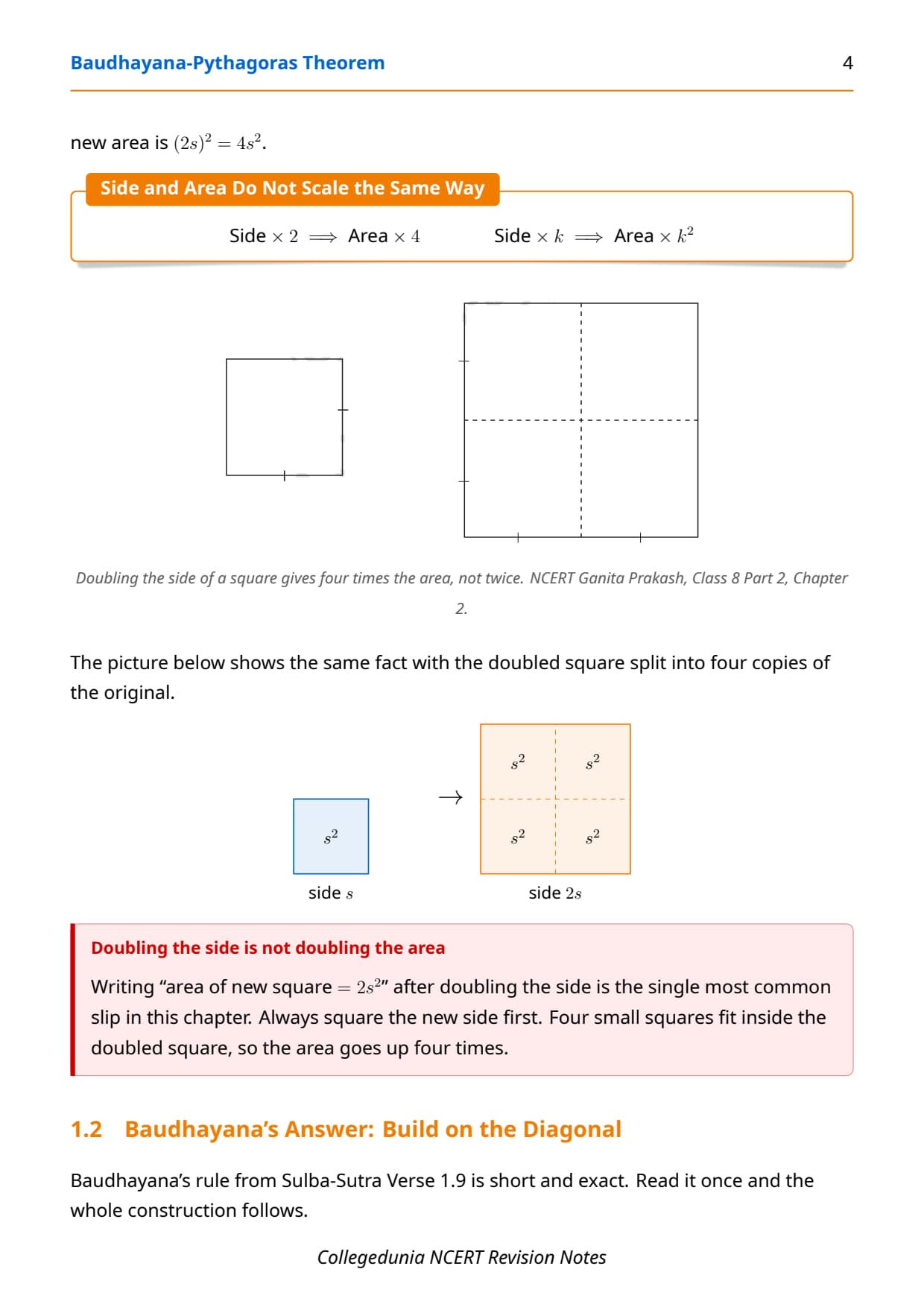
If the old side is s, the old area is s². Double the side to 2s and the new area is (2s)² = 4s², which is four times, not twice. Four copies of the small square fit inside the big one, and the picture makes the error obvious.
| What you change | New side | New area | Area multiplier |
|---|---|---|---|
| Double the side | 2s | 4s² | 4 times |
| Triple the side | 3s | 9s² | 9 times |
| Build on the diagonal | s√2 | 2s² | 2 times |
| Scale the side by k | ks | k²s² | k² times |
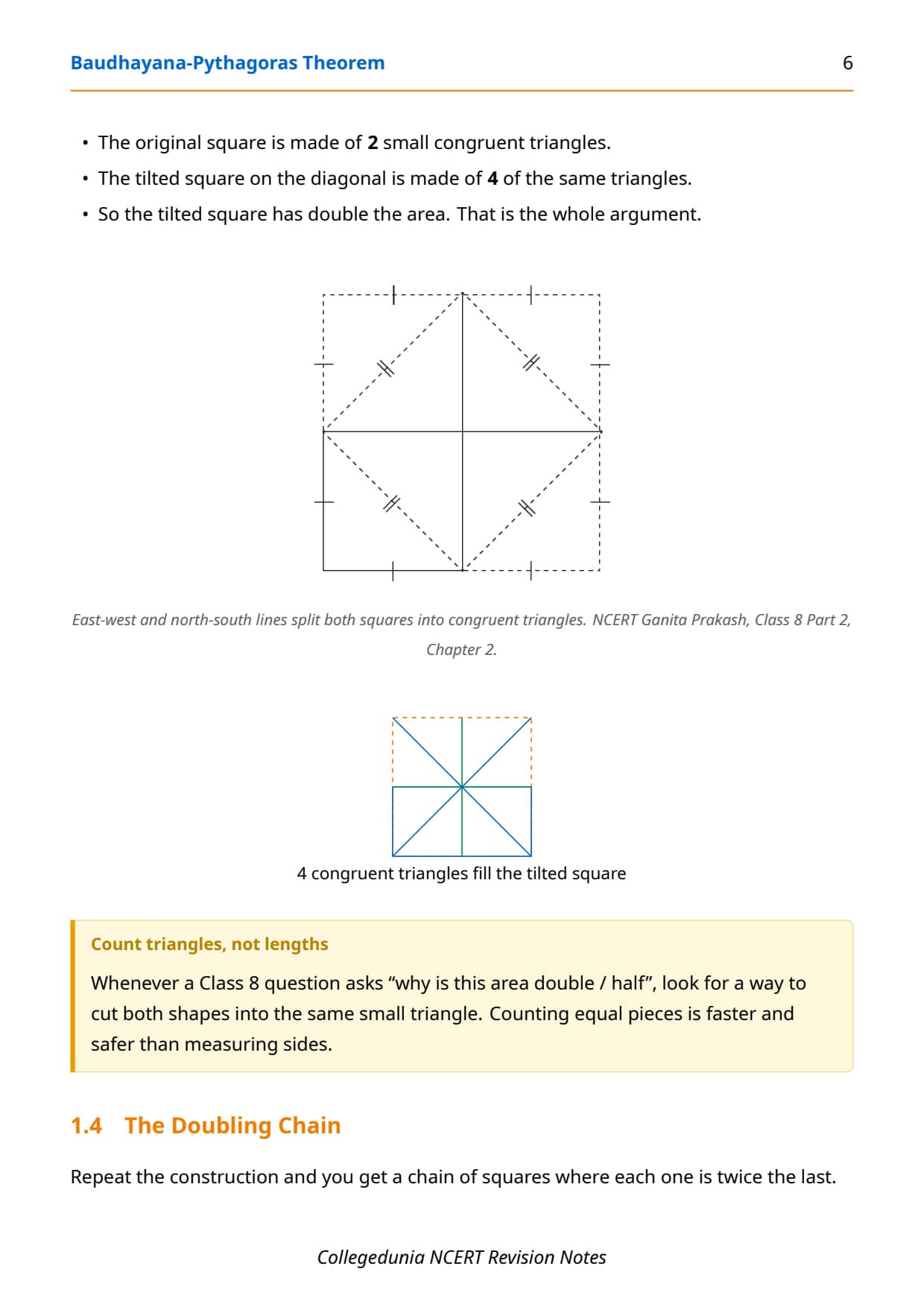
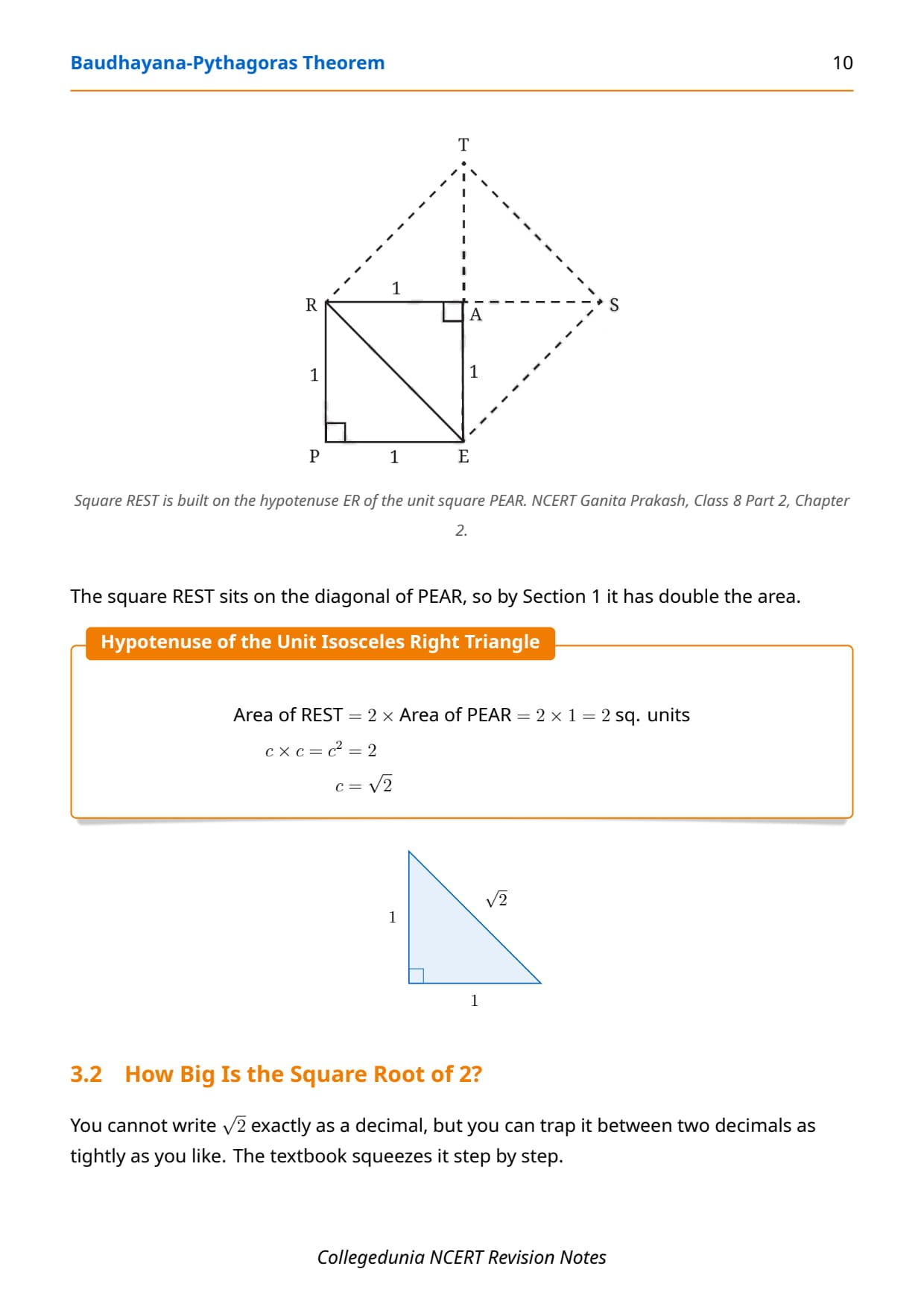
Baudhayana's answer is to build the new square on the diagonal of the old one. Why it works is easy to see with paper. Cut the original square along both diagonals and you get four small triangles. The square drawn on one diagonal holds exactly eight of those triangles, so its area is double.
Side multiplies by k, area multiplies by k squared. That one line explains the whole section. Repeat the diagonal step and the chain keeps running: s² gives 2s², then 4s², then 8s², doubling every time.
Halving a Square by Joining Midpoints and by Paper Folding
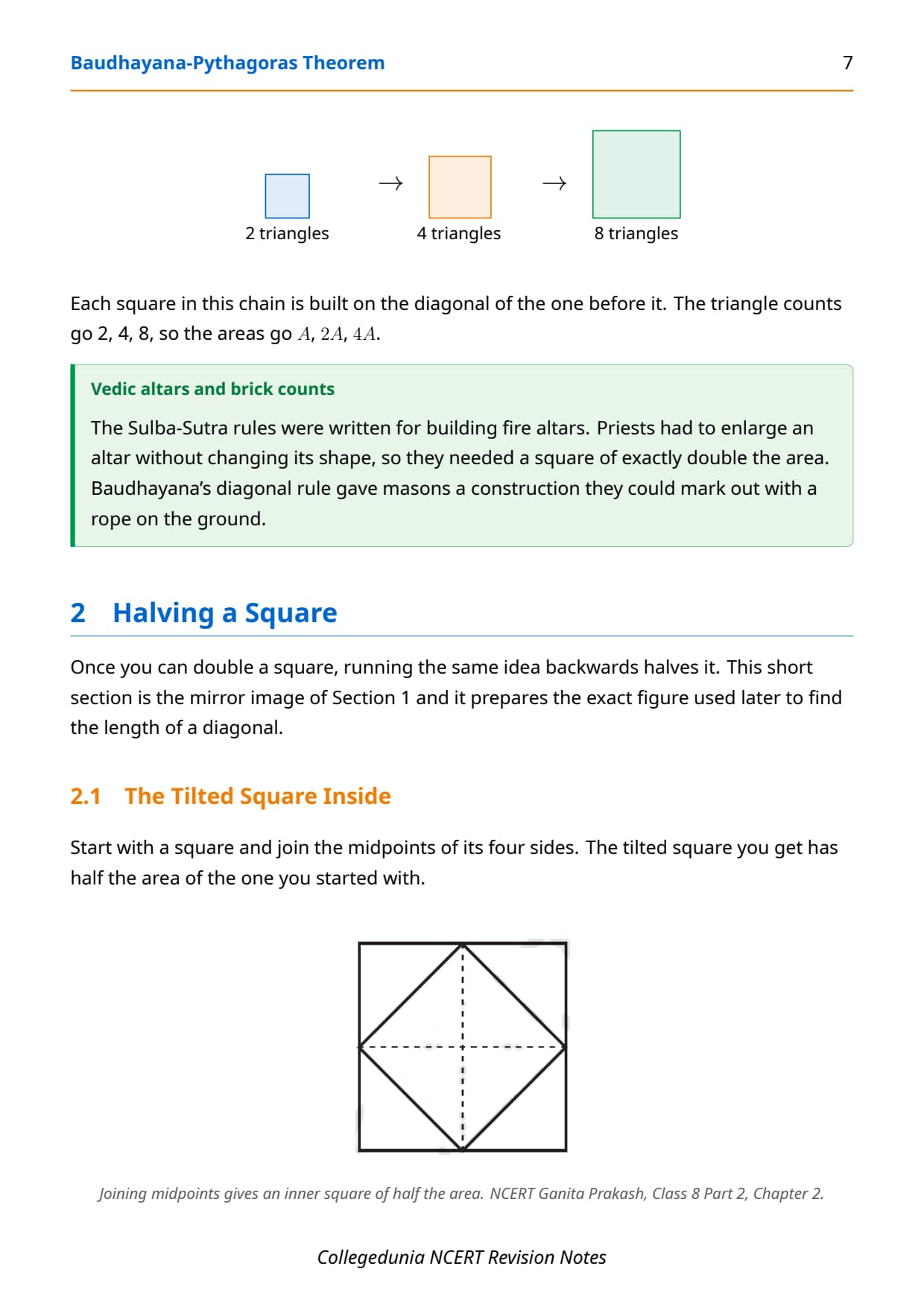
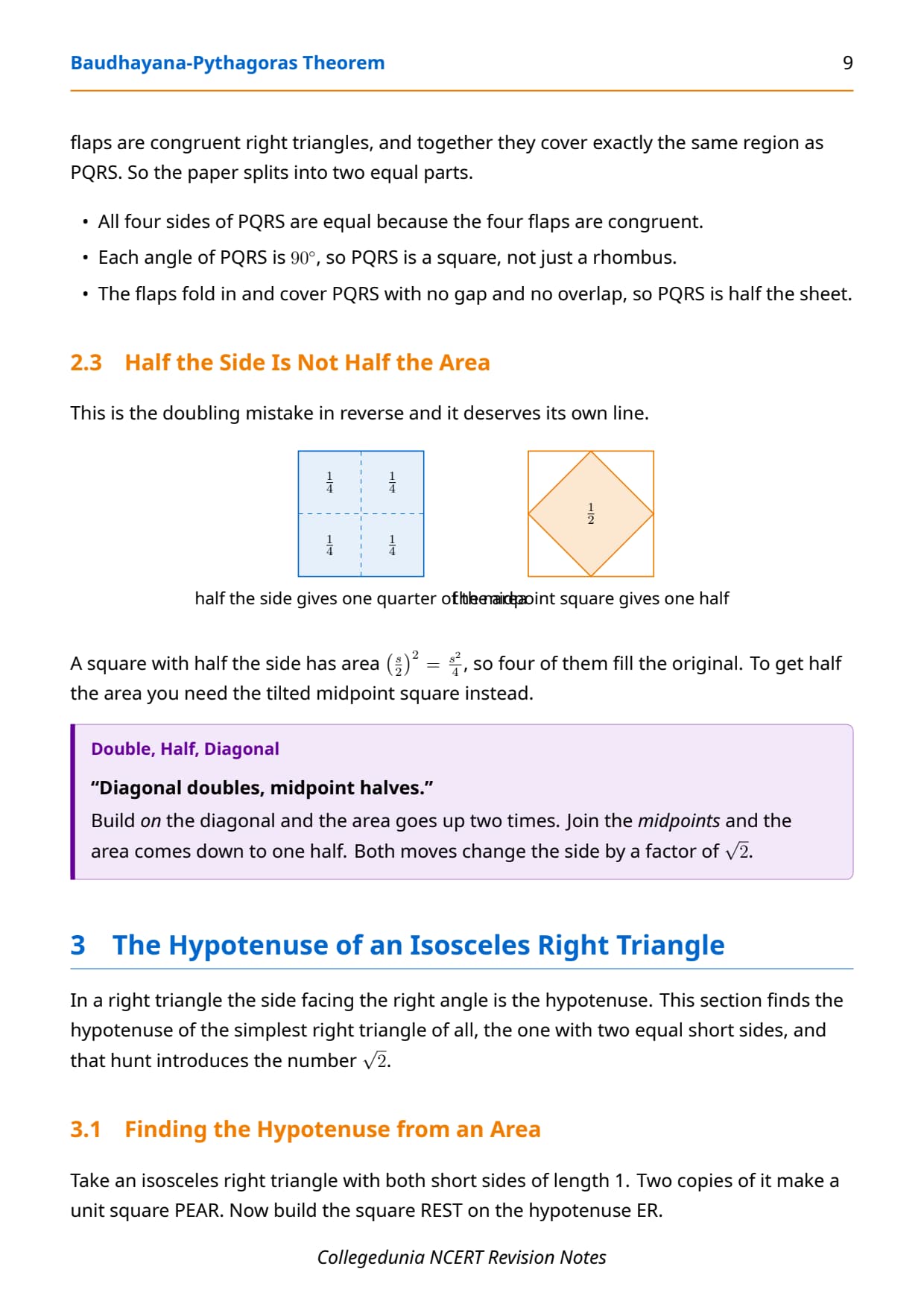
The reverse problem is just as neat. Join the midpoints of the four sides of a square and a smaller tilted square appears inside. That tilted square has exactly half the area of the one you started with.
The proof needs no algebra. The four corner triangles you cut off are congruent. Slide them inwards and they fill the tilted square perfectly, so the inside square and the four corners share the area equally.
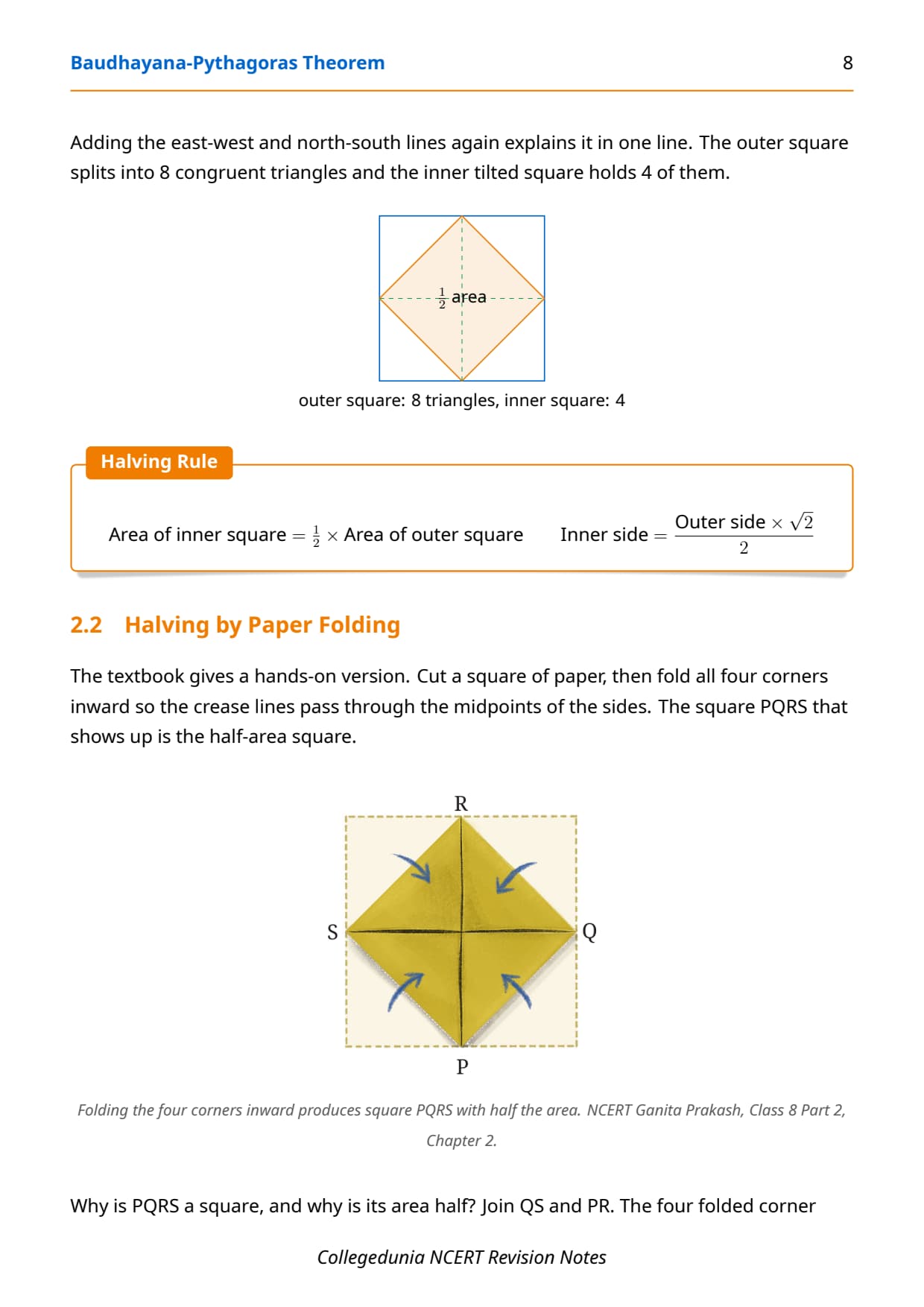
- Fold the square along one diagonal, then along the other, to mark the centre
- Fold each corner in to the centre point
- The shape left in the middle is the half-area square, with side s√2 ÷ 2
- Check: (s ÷ √2)² = s² ÷ 2, which is half the original area
Watch the trap here. Halving the side does not halve the area. A square of side s ÷ 2 has area s² ÷ 4, which is a quarter. The tilted square is the correct half, and its side is longer than half the original side.
The Isosceles Right Triangle and How Big the Square Root of 2 Really Is
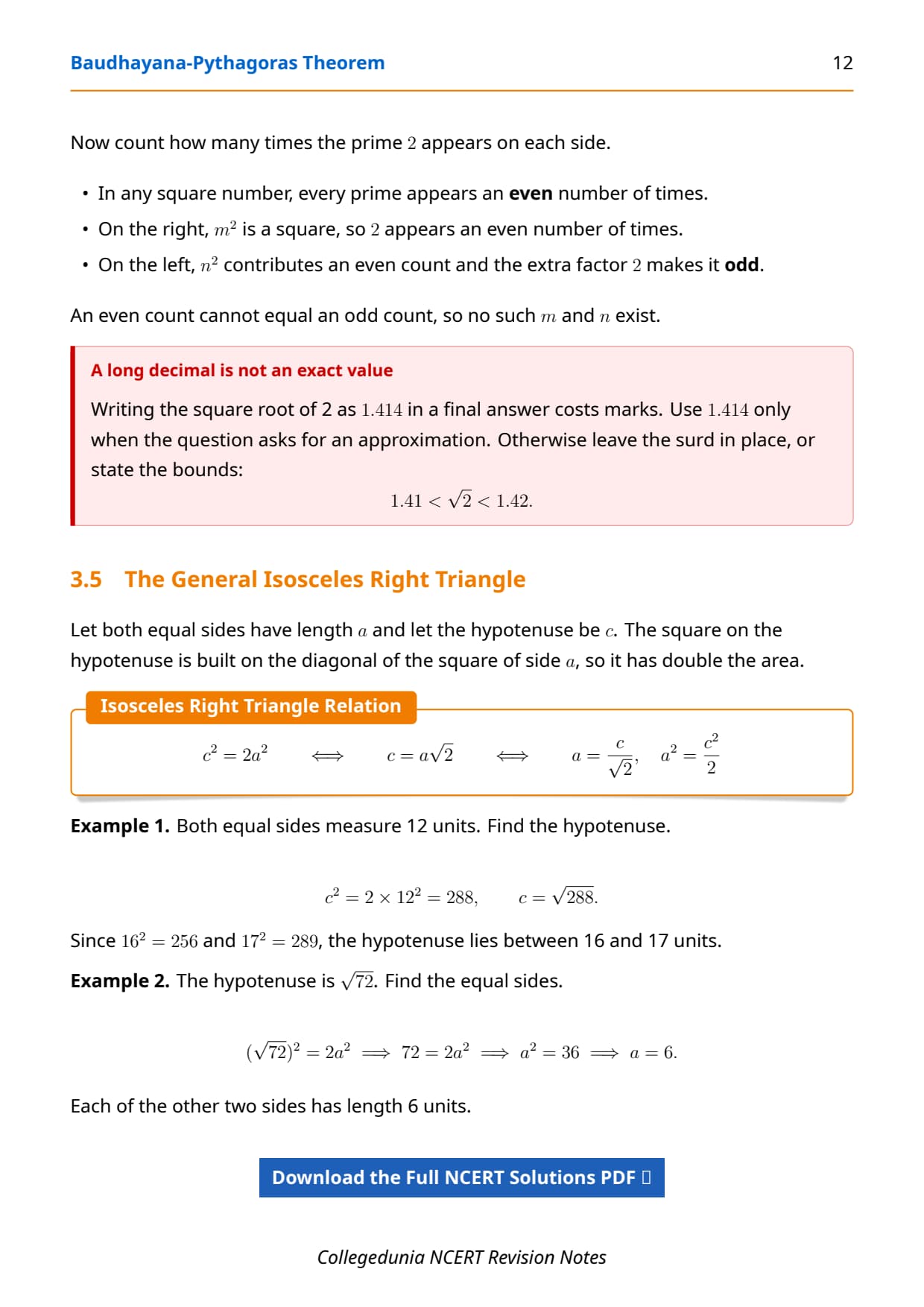
Half of the diagonal square is a right triangle with two equal legs. Put the legs equal to a, and the theorem gives c² = 2a², so c = a√2. That single formula answers most isosceles right-triangle questions in the chapter.
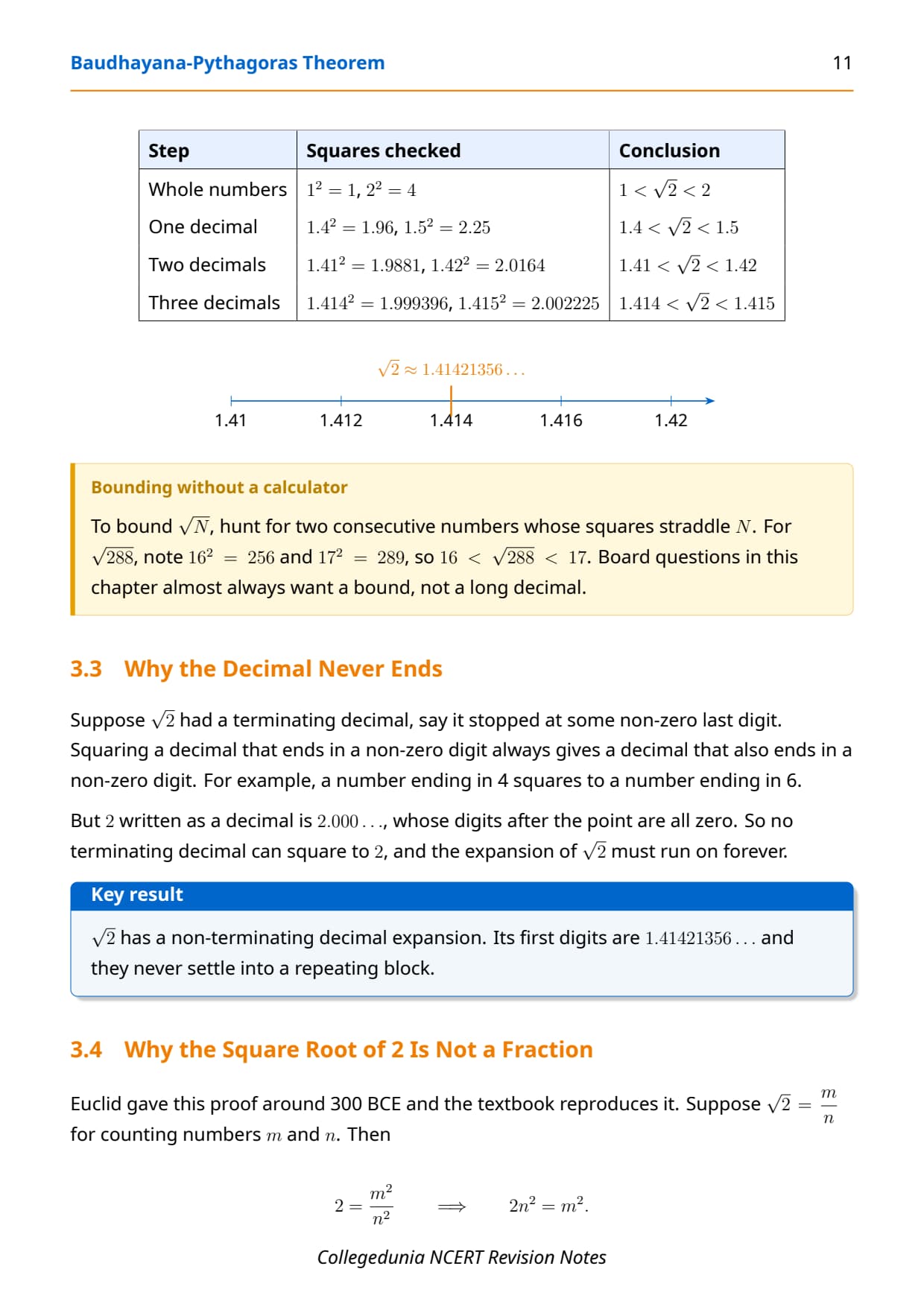
The textbook then asks how big √2 actually is. You squeeze it between decimals. Since 1.4² = 1.96 and 1.5² = 2.25, the number sits between 1.4 and 1.5. Refine again and again to tighten the gap.
| Step | Lower guess | Upper guess | What it tells you |
|---|---|---|---|
| 1 | 1.4² = 1.96 | 1.5² = 2.25 | 1.4 < √2 < 1.5 |
| 2 | 1.41² = 1.9881 | 1.42² = 2.0164 | 1.41 < √2 < 1.42 |
| 3 | 1.414² = 1.999396 | 1.415² = 2.002225 | 1.414 < √2 < 1.415 |
The decimal never stops and never repeats. Euclid proved around 300 BCE that √2 cannot be written as a fraction of two whole numbers. Assume it can, cancel to lowest terms, and you end up proving both numbers are even, which contradicts the cancelling you just did.
Never write √2 = 1.414 as an exact answer. Keep the surd, or state the bound. A 2-mark question in Class 8 usually asks for the bound, not the decimal.
The Dissection Proof That Turns Two Different Squares Into One
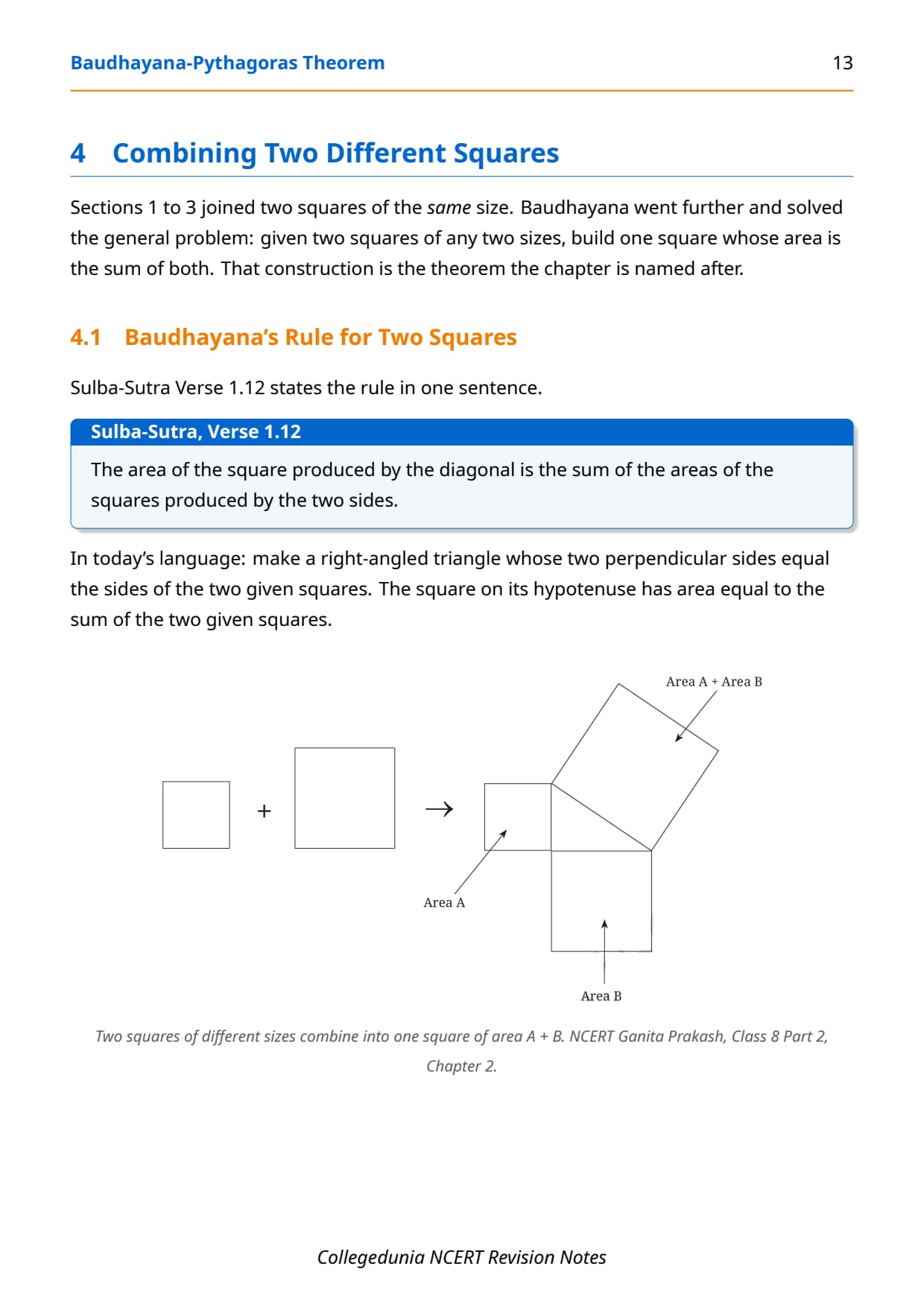
Sections 1 to 3 joined two squares of the same size. Baudhayana solved the general case in Verse 1.12: given any two squares, build a single square whose area is the sum of both. That construction is the theorem itself.
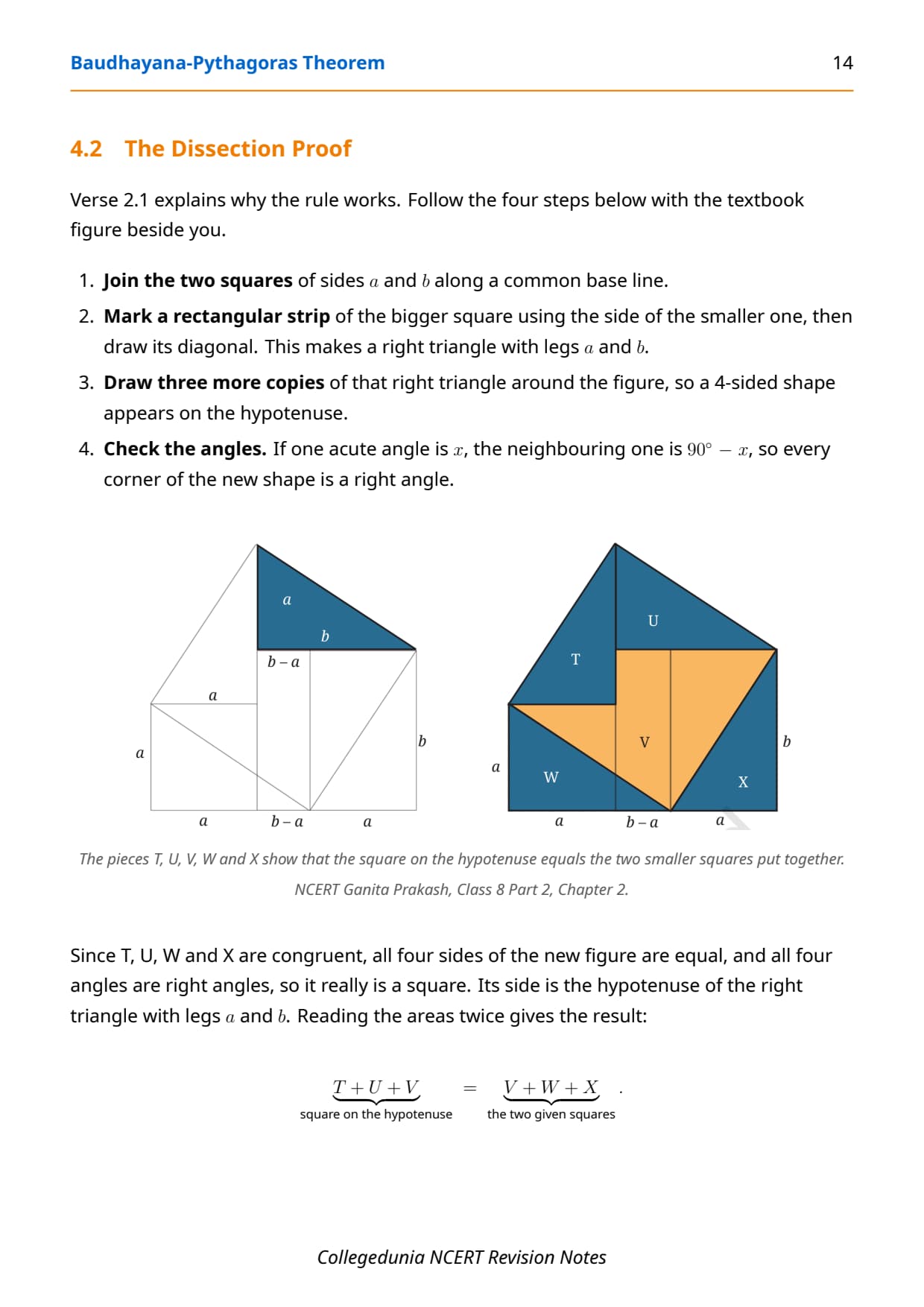
Verse 2.1 explains why it works, using a cut-and-rearrange argument that a Class 8 student can follow with scissors.
- Place the two squares, sides a and b, side by side on a common base line
- Mark a strip of the bigger square equal to the smaller side, then draw its diagonal to make a right triangle with legs a and b
- Draw three more copies of that triangle around the figure, so a new four-sided shape sits on the hypotenuse
- Check the angles: if one acute angle is x, the next is 90° − x, so every corner of the new shape is a right angle
All four triangles are congruent, so the new figure has four equal sides and four right angles. It is a square, and its side is the hypotenuse. Reading the area of the whole picture two different ways gives the result.
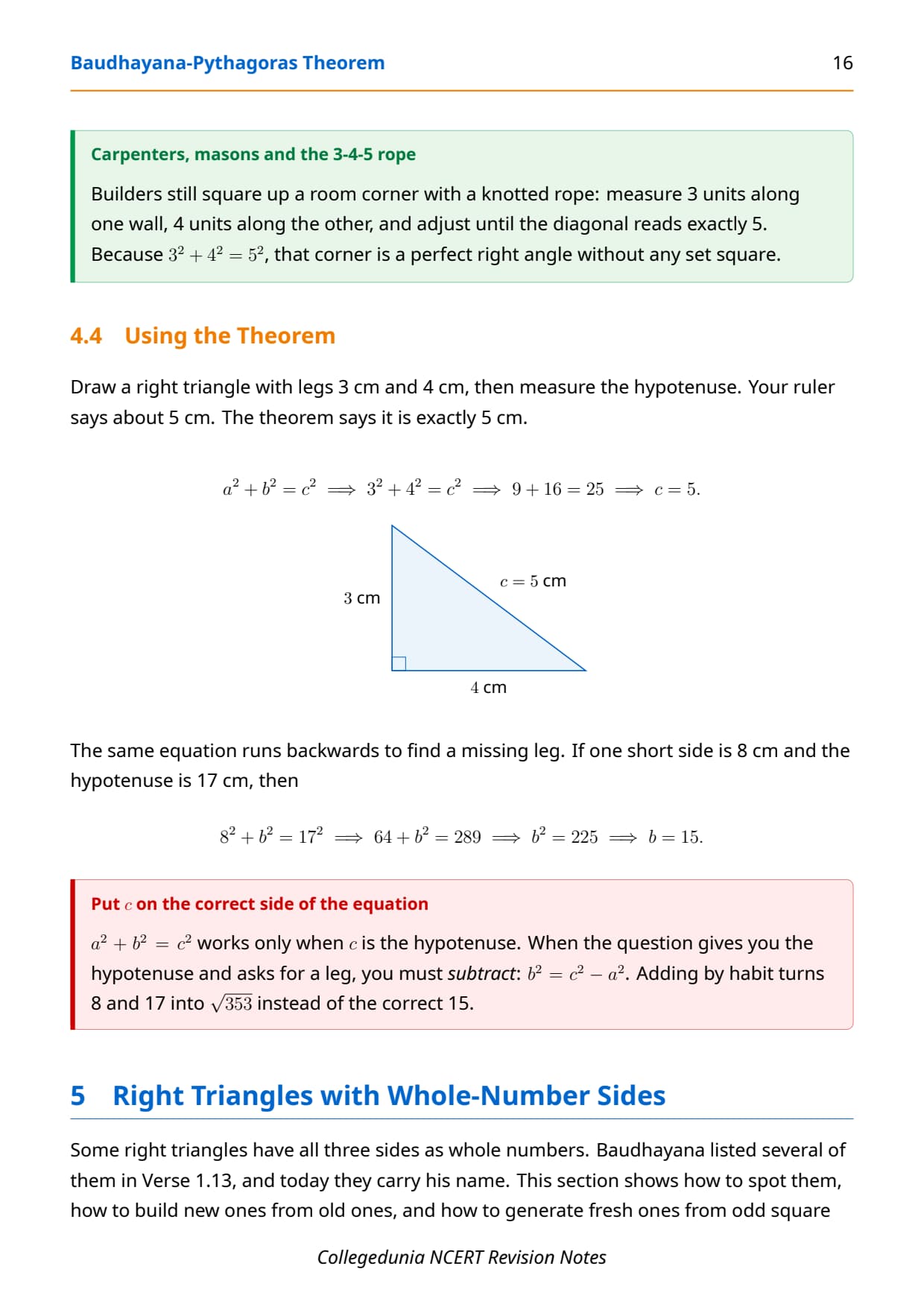
Builders still use the same idea. A mason squares a room corner with a knotted rope: 3 units along one wall, 4 along the other, then adjust until the diagonal reads exactly 5. Because 3² + 4² = 5², that corner is a true right angle with no set square needed.
Using a² + b² = c² in Both Directions Without Losing Marks
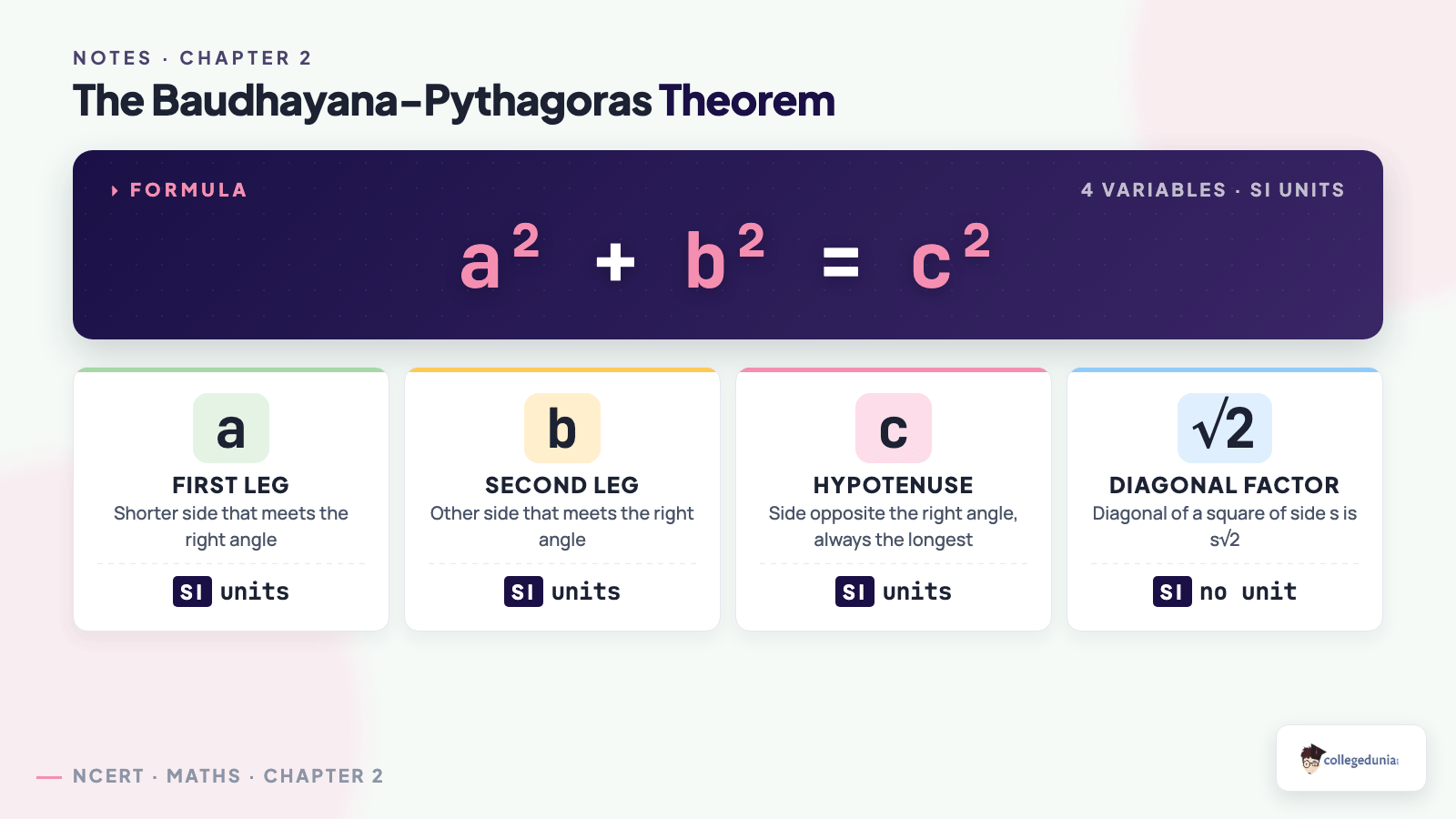
The formula runs forwards to find a hypotenuse and backwards to find a missing leg. Both directions appear in Class 8 tests, and the backward one is where marks leak away.
Forwards, with legs 3 cm and 4 cm: c² = 9 + 16 = 25, so c = 5 cm. Backwards, with a leg 8 cm and hypotenuse 17 cm: b² = 289 − 64 = 225, so b = 15 cm.
- Hypotenuse asked: add the squares of the two legs, then take the square root
- Leg asked: subtract the square of the known leg from the square of the hypotenuse
- Sanity check: c must be longer than each leg and shorter than the two legs added
- Last step: the equation gives c², so remember to take the square root
Adding by habit when the hypotenuse is already given is the single biggest error in this chapter. With 8 and 17 it turns a clean answer of 15 into √353, which is neither a whole number nor correct.
Baudhayana Triples: Whole-Number Right Triangles Worth Memorising
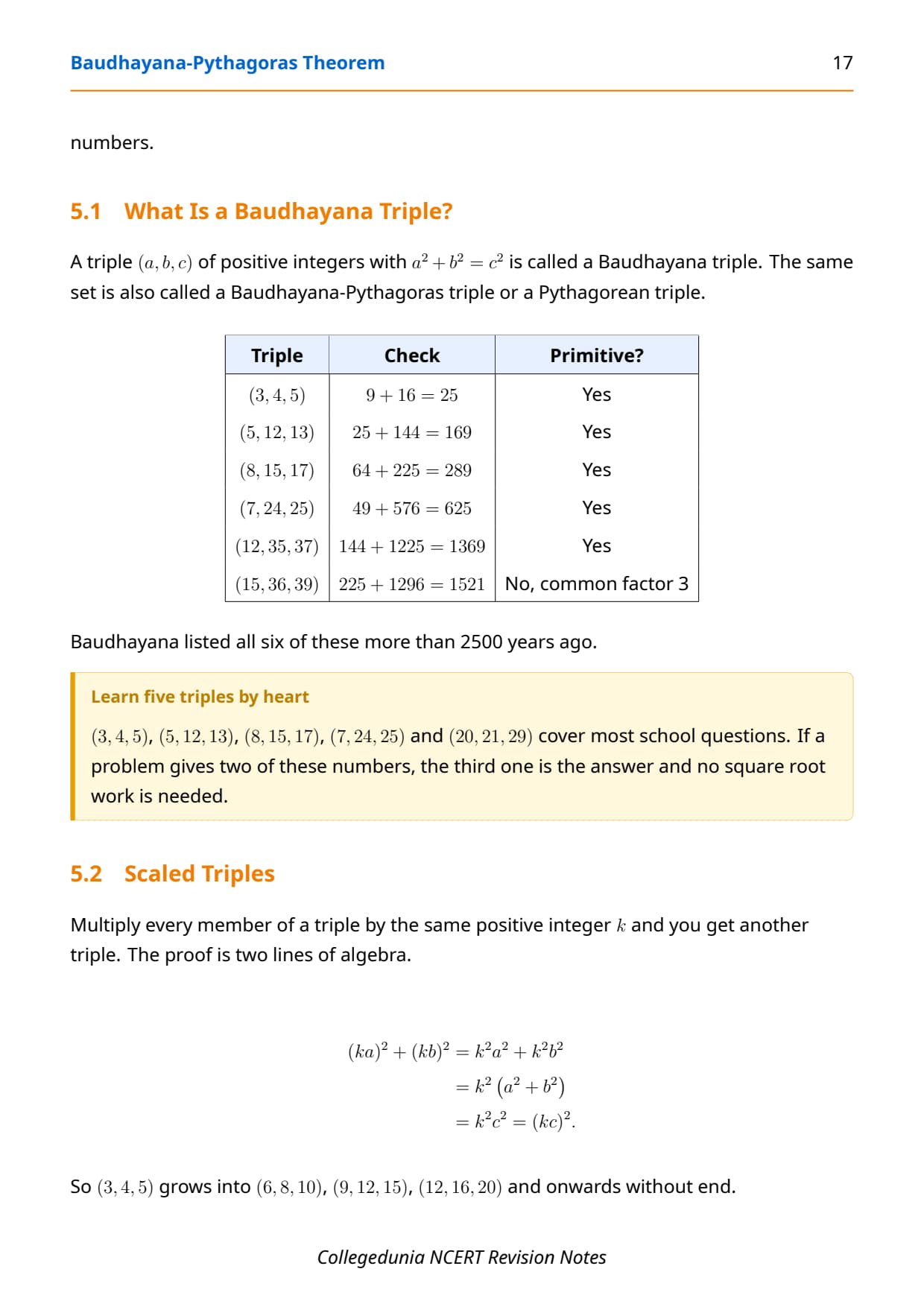
A triple (a, b, c) of positive whole numbers with a² + b² = c² is a Baudhayana triple, also called a Pythagorean triple. Baudhayana listed six of them in Verse 1.13. If a question hands you two numbers from a known triple, the third is the answer and no square root work is needed.
| Triple | Check | Primitive? |
|---|---|---|
| (3, 4, 5) | 9 + 16 = 25 | Yes |
| (5, 12, 13) | 25 + 144 = 169 | Yes |
| (8, 15, 17) | 64 + 225 = 289 | Yes |
| (7, 24, 25) | 49 + 576 = 625 | Yes |
| (12, 35, 37) | 144 + 1225 = 1369 | Yes |
| (15, 36, 39) | 225 + 1296 = 1521 | No, common factor 3 |
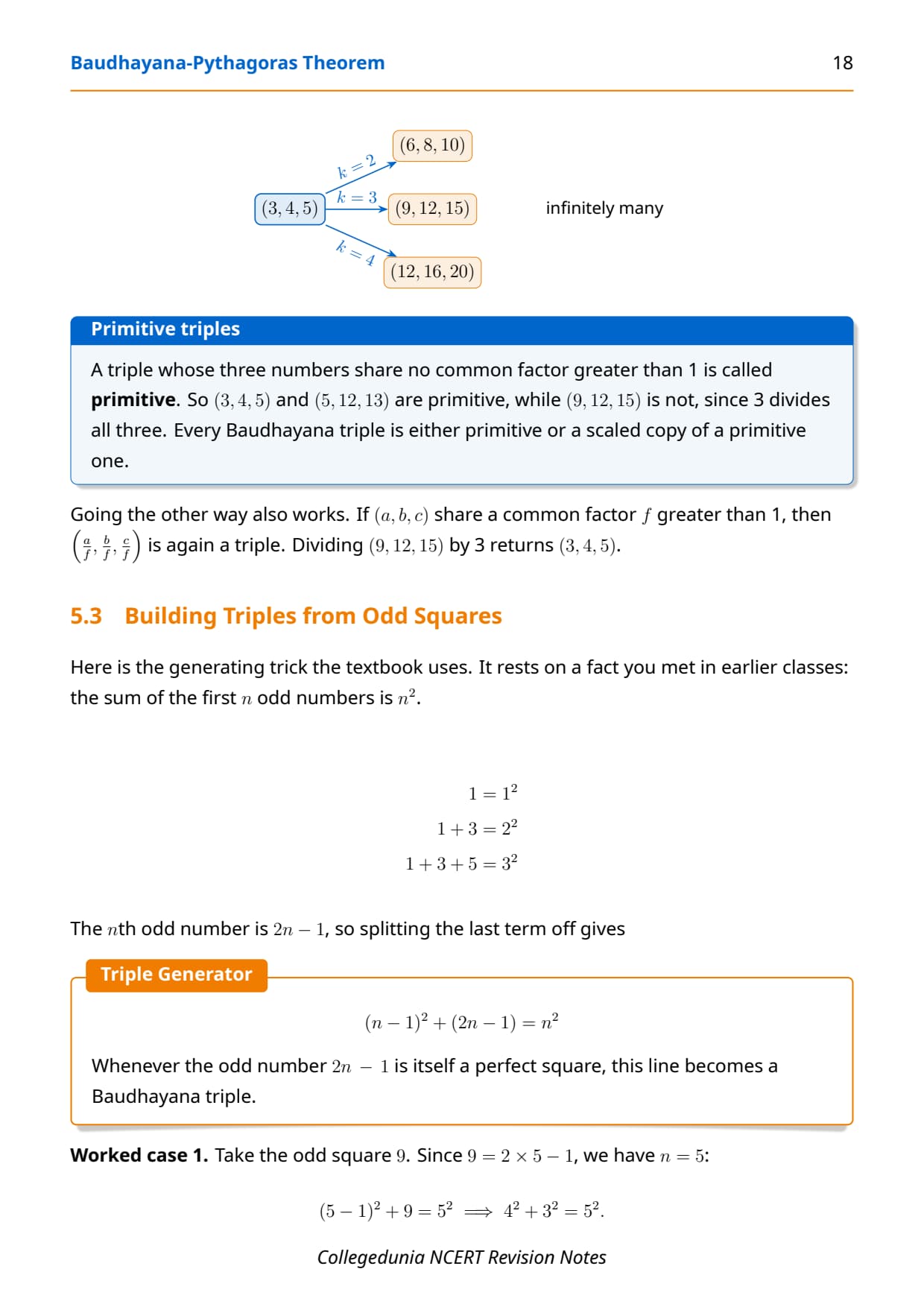
Multiply every member of a triple by the same whole number k and you get another triple, because (ka)² + (kb)² = k²(a² + b²) = (kc)². So (3, 4, 5) grows into (6, 8, 10), (9, 12, 15), (12, 16, 20) and on without end.
A triple whose three numbers share no common factor above 1 is called primitive. Every Baudhayana triple is either primitive or a scaled copy of a primitive one. Dividing (9, 12, 15) by 3 returns you to (3, 4, 5).
Building New Triples From Odd Square Numbers
The generator uses a fact from earlier classes: the sum of the first n odd numbers is n². Splitting off the last odd number, which is 2n − 1, gives (n − 1)² + (2n − 1) = n². Whenever 2n − 1 is itself a perfect square, that line is a triple.
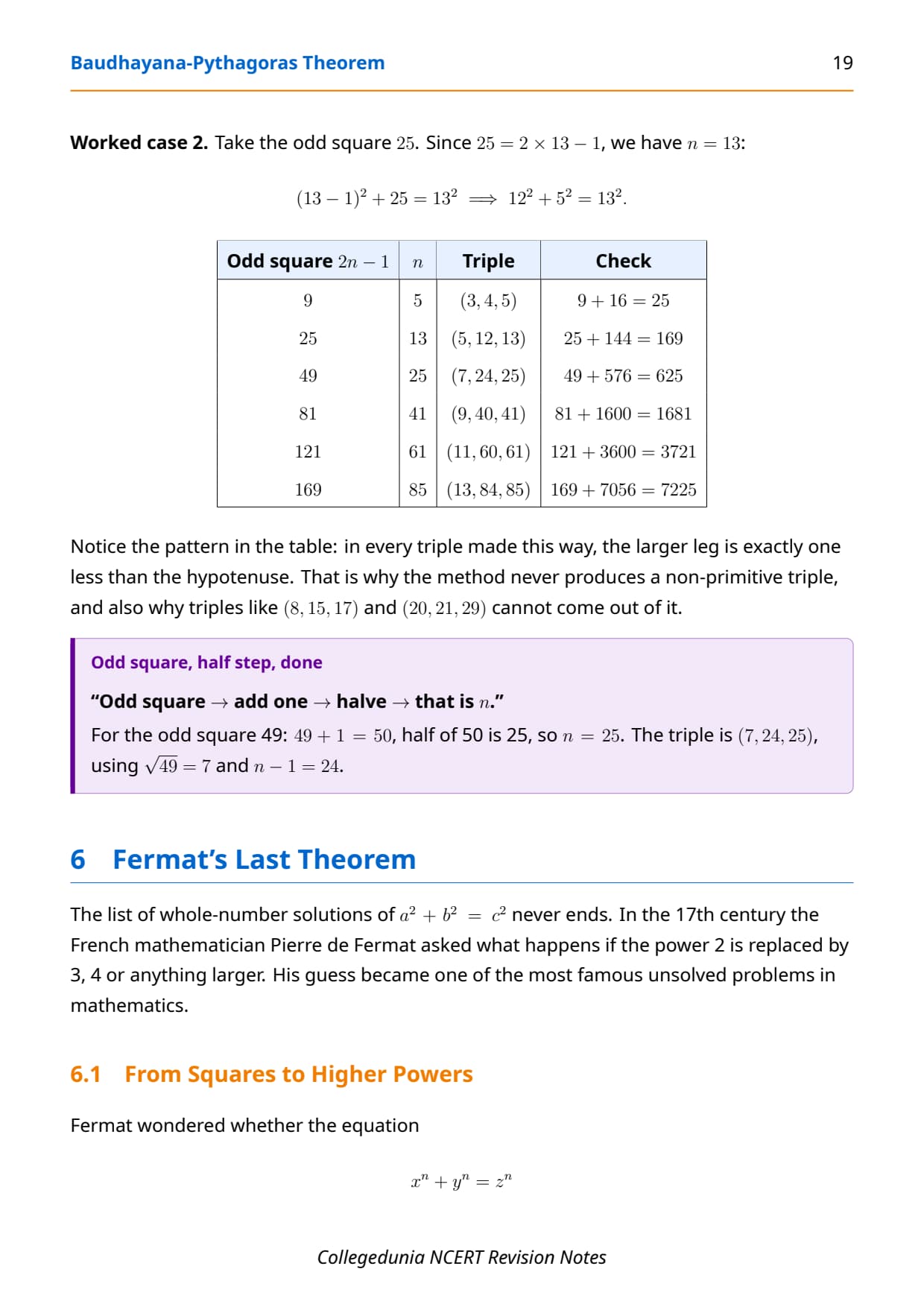
| Odd square (2n − 1) | n | Triple | Check |
|---|---|---|---|
| 9 | 5 | (3, 4, 5) | 9 + 16 = 25 |
| 25 | 13 | (5, 12, 13) | 25 + 144 = 169 |
| 49 | 25 | (7, 24, 25) | 49 + 576 = 625 |
| 81 | 41 | (9, 40, 41) | 81 + 1600 = 1681 |
| 121 | 61 | (11, 60, 61) | 121 + 3600 = 3721 |
| 169 | 85 | (13, 84, 85) | 169 + 7056 = 7225 |
Mnemonic: odd square, add one, halve it, that is n. For 49: 49 + 1 = 50, half of 50 is 25, so n = 25 and the triple is (7, 24, 25). Notice the larger leg is always one less than the hypotenuse, which is why triples like (8, 15, 17) never come out of this method.
From Squares to Cubes: Fermat's Last Theorem and Andrew Wiles
Whole-number solutions of a² + b² = c² never run out. In the 17th century the French mathematician Pierre de Fermat asked what happens when the power 2 is replaced by 3, 4 or anything larger. Is there a cube that equals the sum of two cubes?
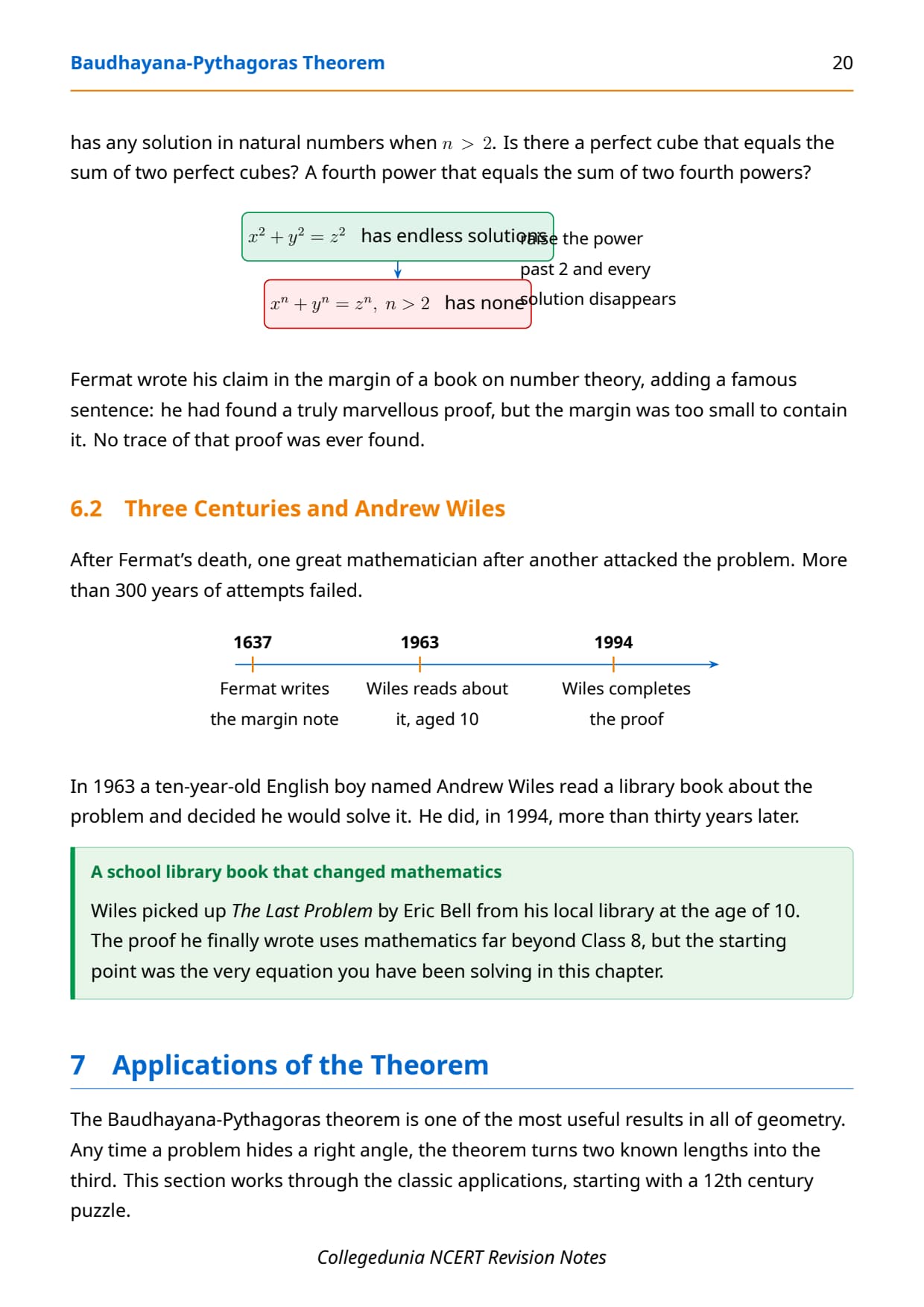
His claim was that xn + yn = zn has no solution in natural numbers once n is bigger than 2. He wrote it in the margin of a book, adding that he had a marvellous proof but the margin was too small. That proof was never found.
| Year | What happened |
|---|---|
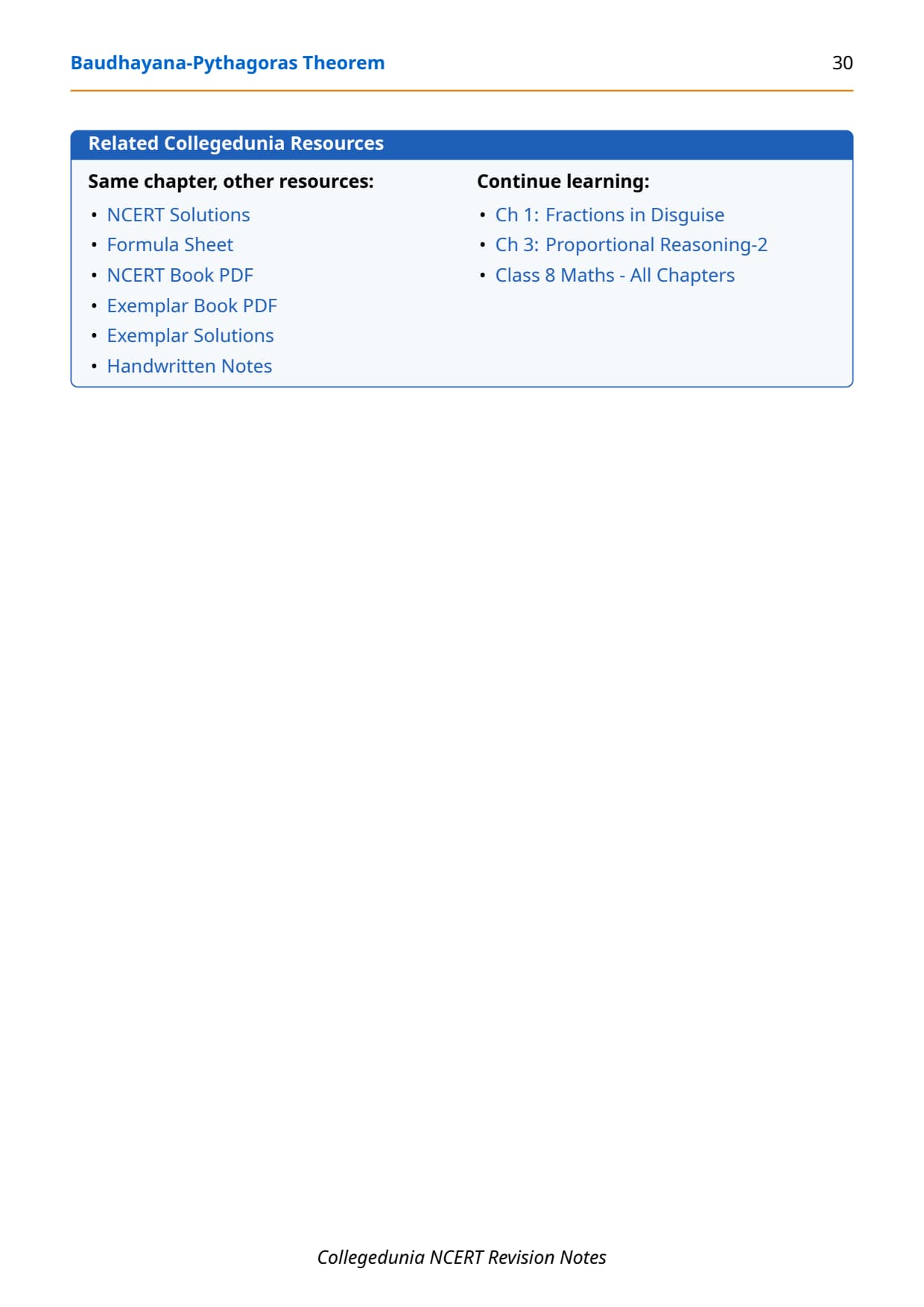
| c. 800 BCE | Baudhayana states the theorem in the Sulba-Sutra |
| c. 500 BCE | Pythagoras studies the same result in Greece |
| c. 300 BCE | Euclid proves the square root of 2 is not a fraction |
| 1637 | Fermat writes his margin note |
| 1963 | Andrew Wiles, aged 10, reads about the problem in a library book |
| 1994 | Wiles completes the proof after more than 300 years of failed attempts |
The point of this section is motivation, not method. A ten-year-old picked up a library book in 1963 and finished the job in 1994. The equation he started from is the one you are solving in Class 8.
Applications of the Theorem: Lotus Problem, Diagonals and the Rhombus
Any time a problem hides a right angle, the theorem turns two known lengths into the third. The textbook works through five classic cases, starting with a 12th century puzzle from Bhaskaracharya's Lilavati.
The Lotus Problem From Lilavati
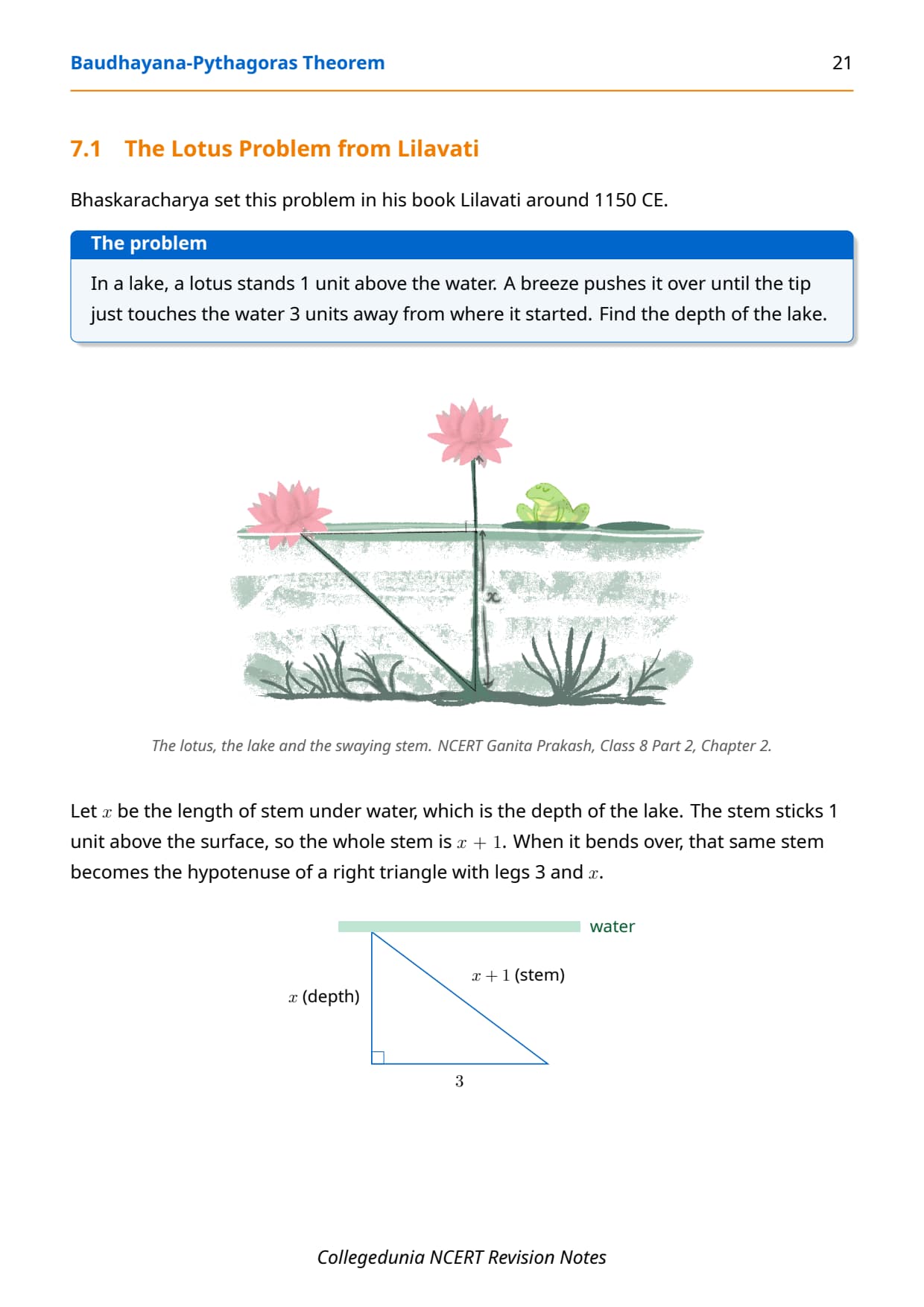
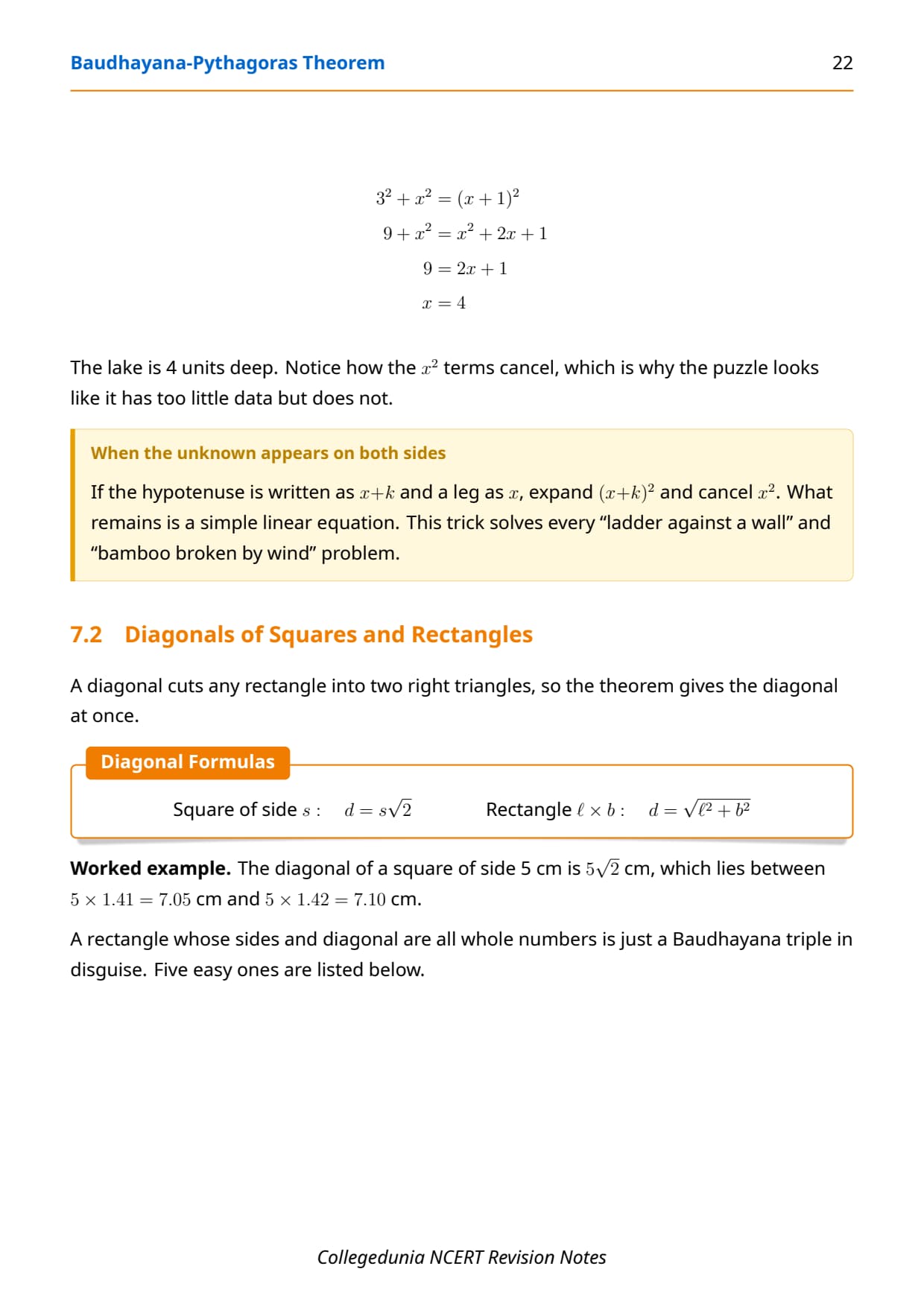
A lotus stands 1 unit above the water. A breeze pushes it over until the tip touches the water 3 units away. Find the depth of the lake. Let x be the depth, so the full stem is x + 1 and becomes the hypotenuse.
Then 3² + x² = (x + 1)², so 9 + x² = x² + 2x + 1. The x² terms cancel and 9 = 2x + 1, giving x = 4 units. The puzzle only looks short of data.
| Shape | What the right triangle is | Formula |
|---|---|---|
| Square, side s | Half the square, cut by a diagonal | d = s√2 |
| Rectangle, sides ℓ and b | Half the rectangle, cut by a diagonal | d = √(ℓ² + b²) |
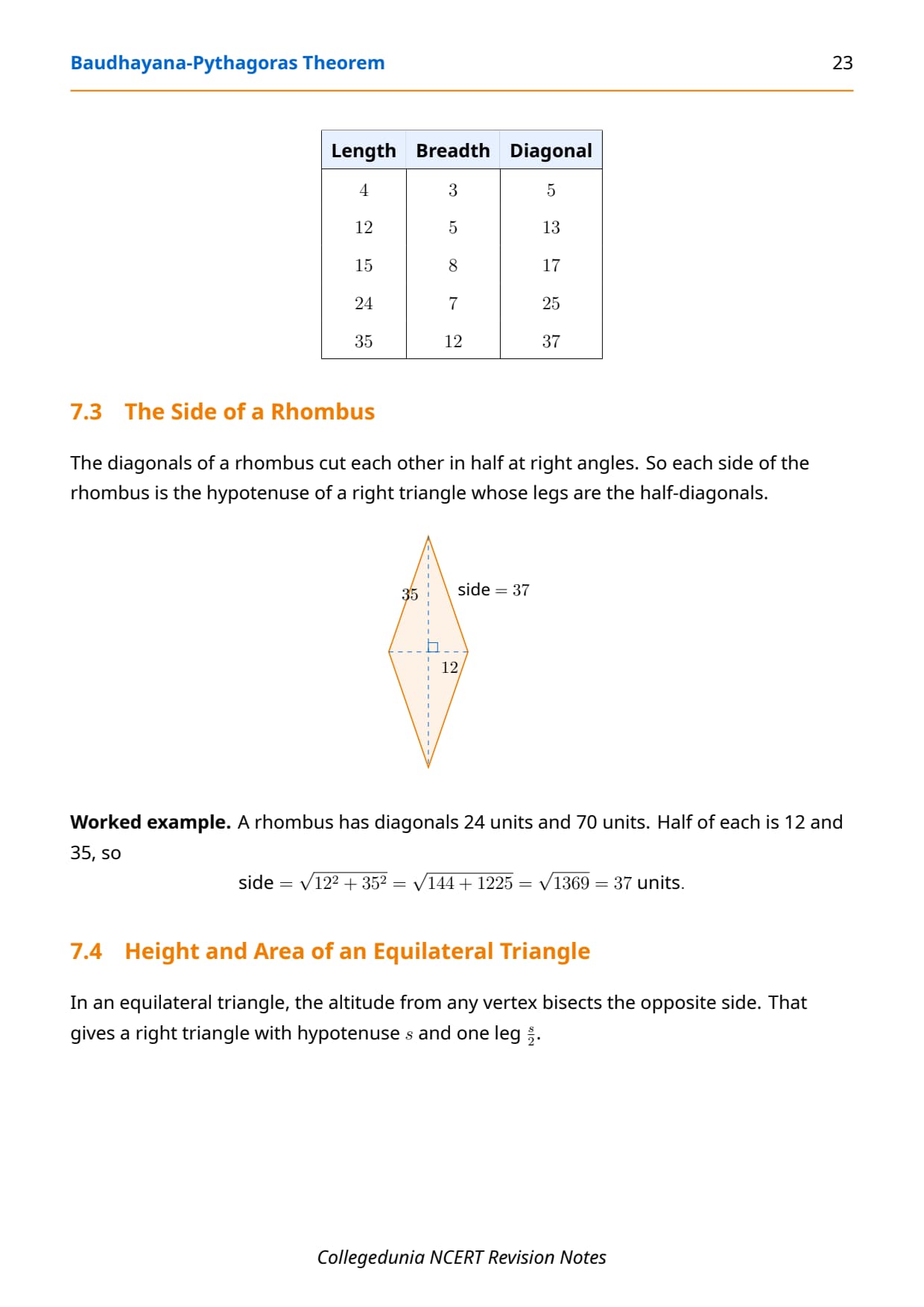
| Rhombus, diagonals d₁ and d₂ | Quarter of the rhombus, legs are the half-diagonals | s = √((d₁÷2)² + (d₂÷2)²) |
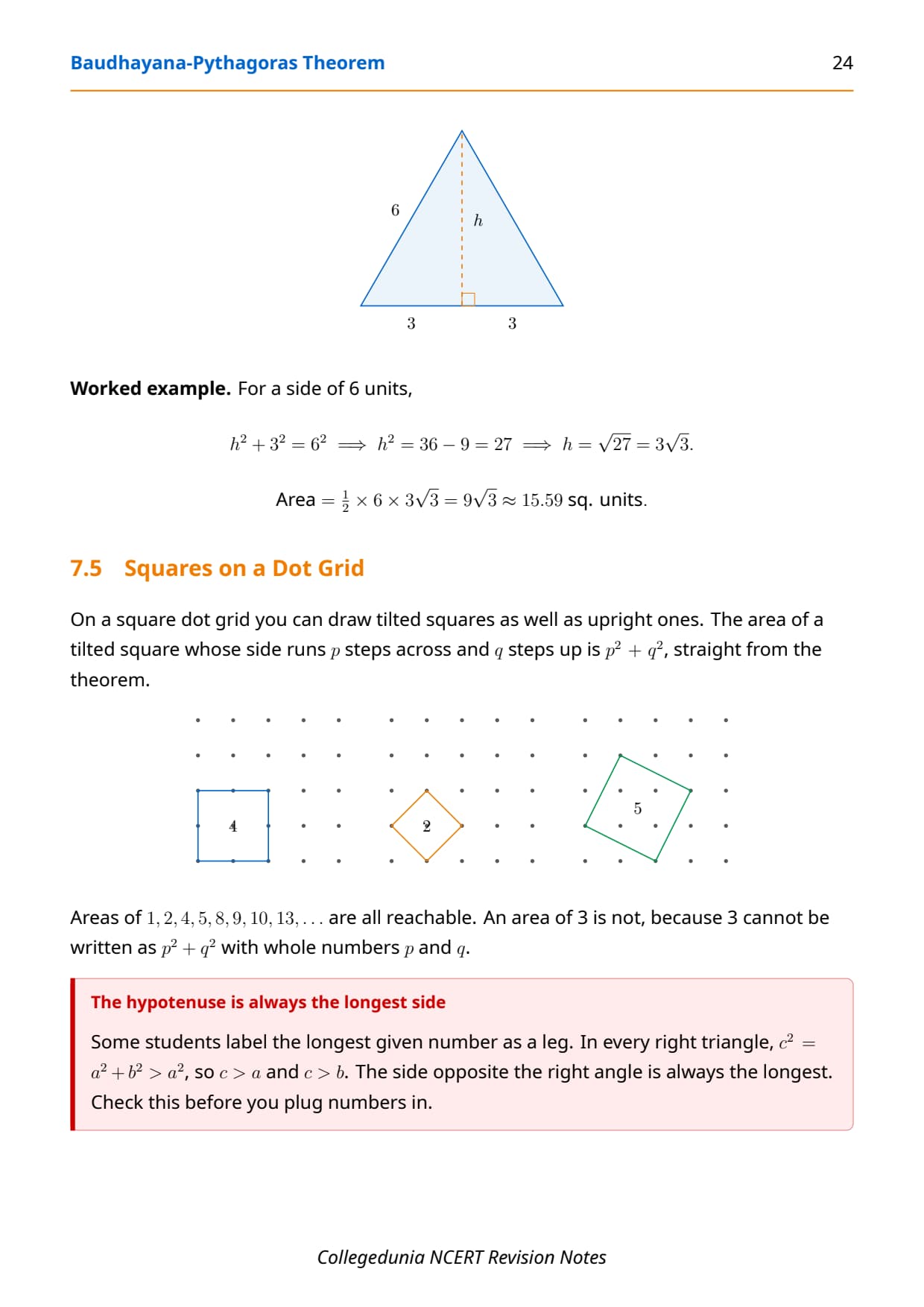
| Equilateral triangle, side s | Half the triangle, cut by an altitude | h = s√3 ÷ 2 |
| Tilted square on a dot grid | Side runs p across and q up | Area = p² + q² |
Worked example. A rhombus has diagonals 24 and 70 units. Half of each is 12 and 35, so the side is √(144 + 1225) = √1369 = 37 units, which is the triple (12, 35, 37) hiding in plain sight.
Worked example. An equilateral triangle of side 6 has h² = 36 − 9 = 27, so h = 3√3 and the area is 9√3, roughly 15.59 square units.
On a dot grid, areas of 1, 2, 4, 5, 8, 9, 10 and 13 are all reachable with tilted squares. An area of 3 is impossible, because 3 cannot be written as p² + q² with whole numbers.
Common Mistakes Students Make in the Baudhayana-Pythagoras Theorem Chapter
Most lost marks in this chapter come from six repeat errors. Each one has a fix that takes seconds.
| Mistake | Fix |
|---|---|
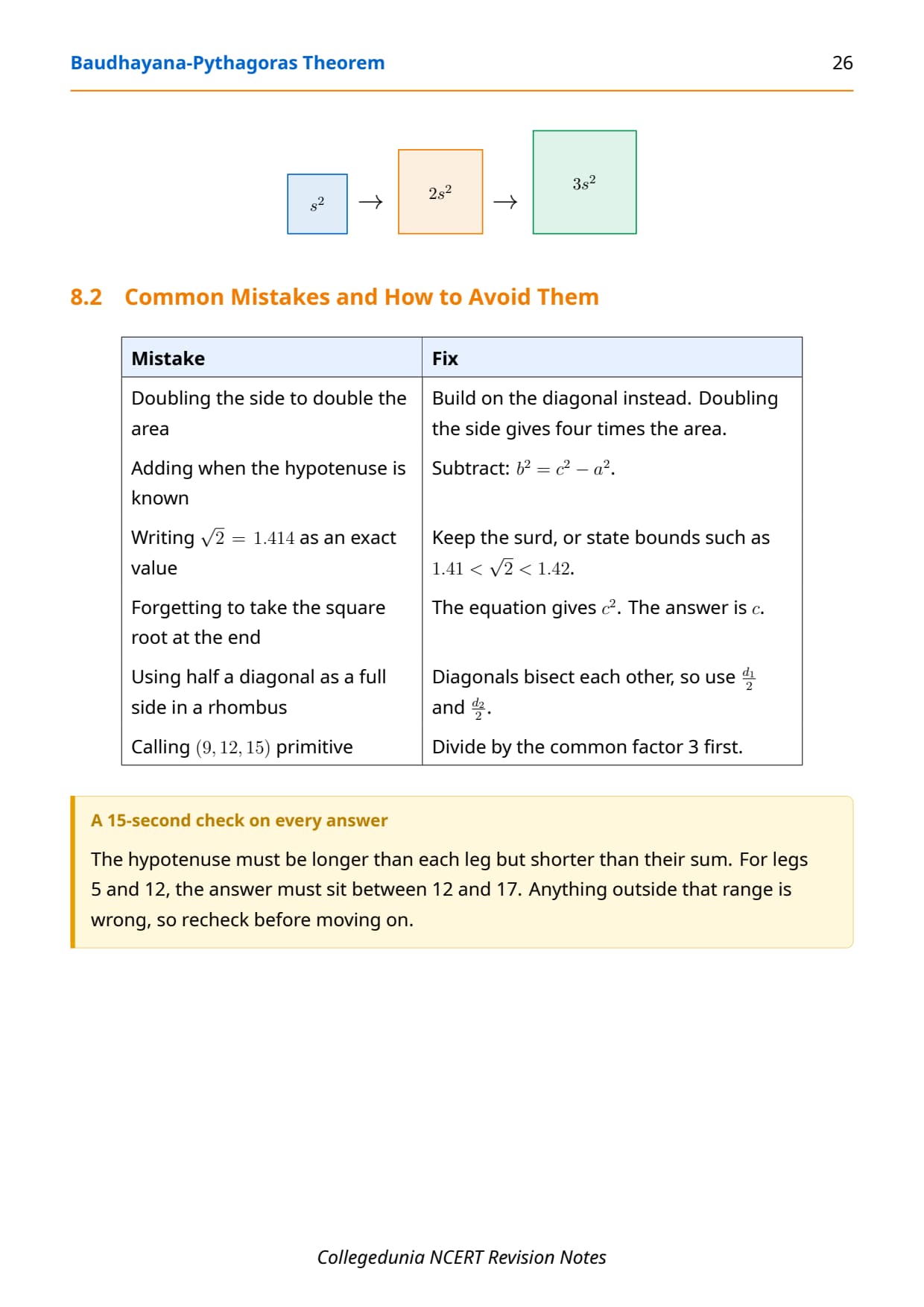
| Doubling the side to double the area | Build on the diagonal. Doubling the side gives four times the area. |
| Adding when the hypotenuse is already known | Subtract: b² = c² − a² |
| Writing √2 = 1.414 as an exact value | Keep the surd, or give the bound 1.414 < √2 < 1.415 |
| Stopping at c² and forgetting the square root | The answer is c, not c² |
| Using a full diagonal as a rhombus side | Diagonals bisect, so use d₁÷2 and d₂÷2 |
| Calling (9, 12, 15) primitive | Divide out the common factor 3 first |
The 15-second check. The hypotenuse must be longer than each leg but shorter than the two legs added. For legs 5 and 12, the answer has to sit between 12 and 17. Anything outside that range is wrong.
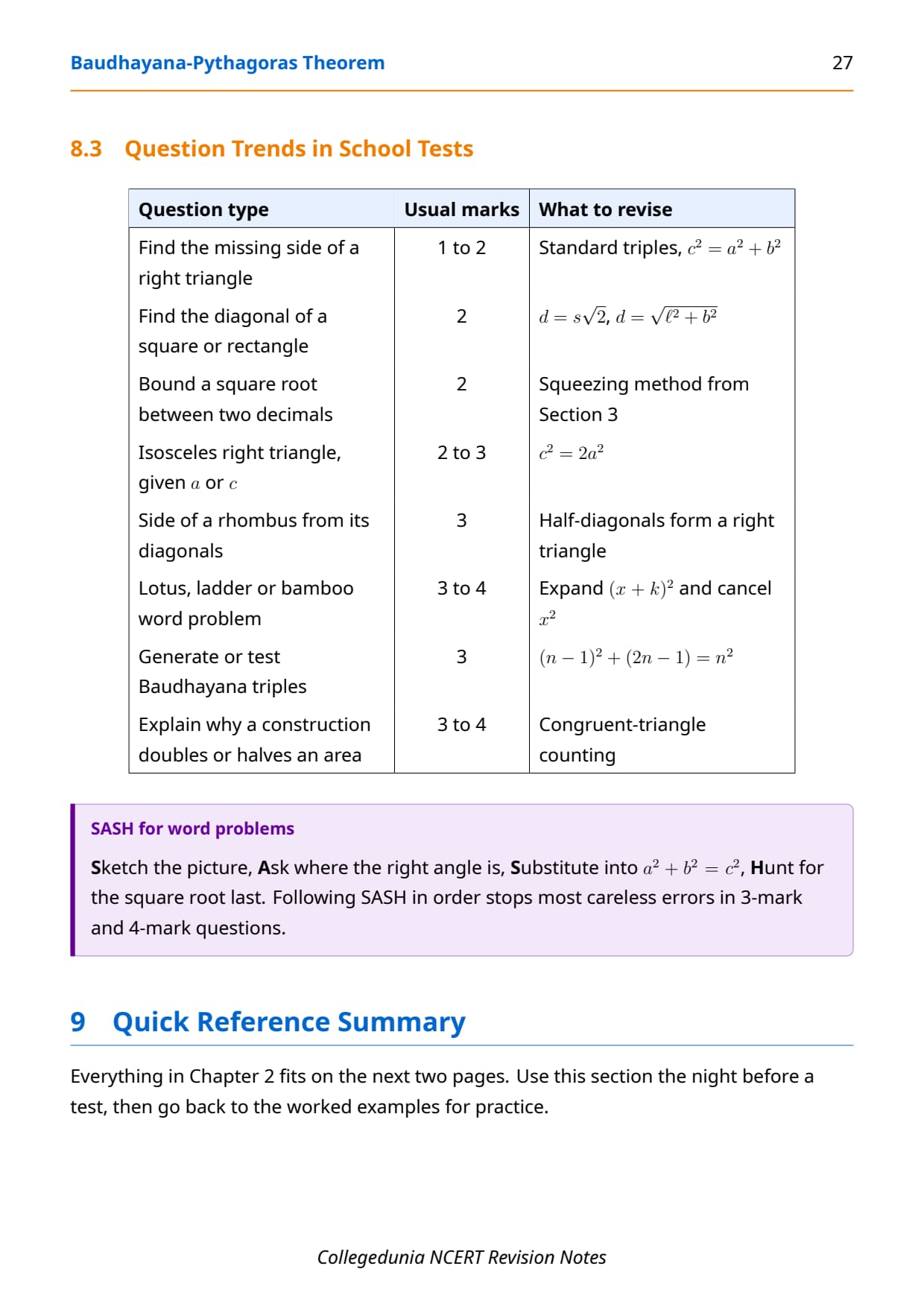
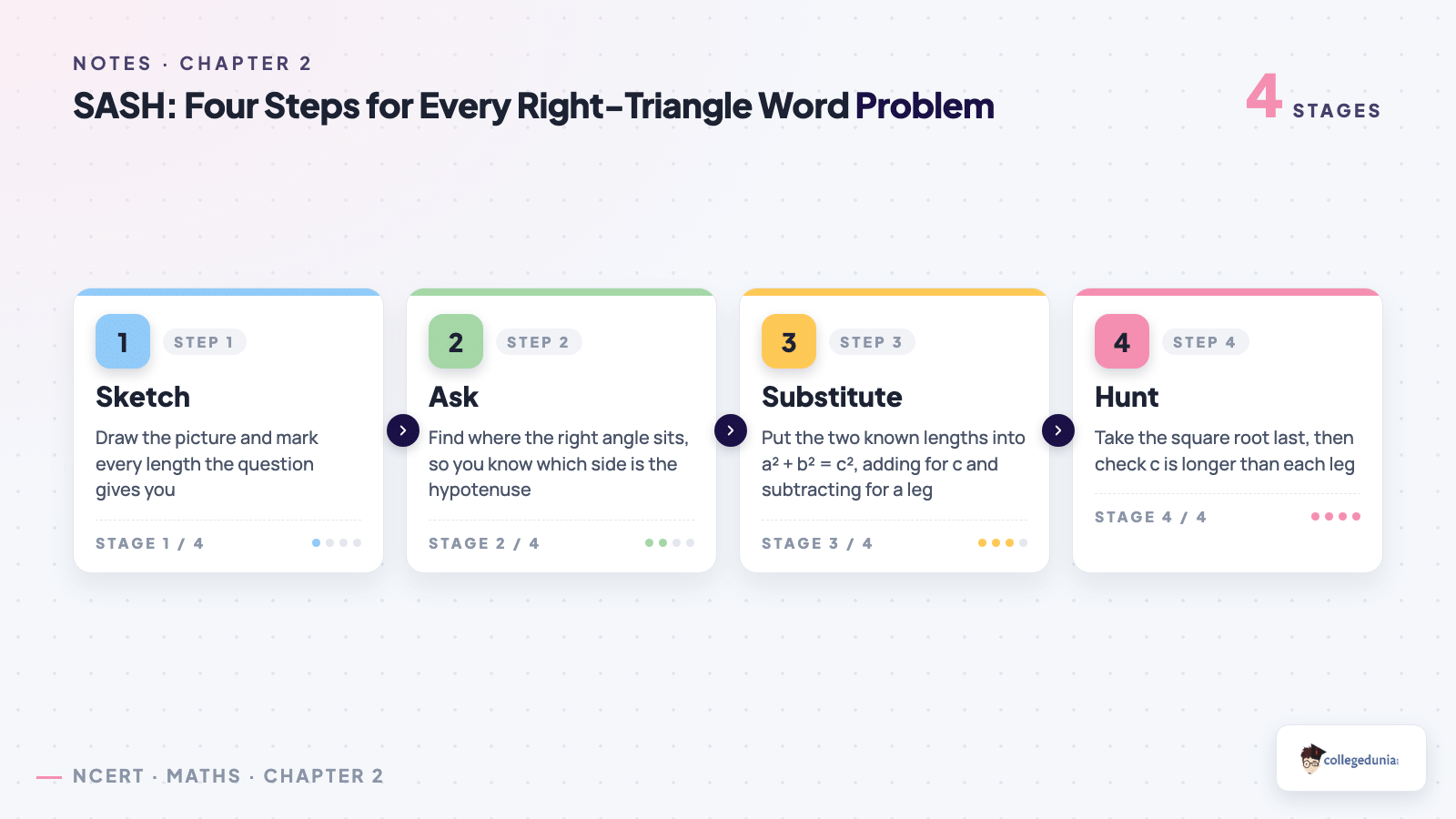
SASH for word problems. Sketch the picture, Ask where the right angle is, Substitute into a² + b² = c², Hunt for the square root last. Following those four steps in order stops most careless errors in 3-mark and 4-mark questions.
Question Trends and Marks for the Baudhayana-Pythagoras Theorem in Class 8 Tests
Class 8 papers are set by schools, so the pattern varies. Across the question banks we track, eight question types cover almost everything asked from this chapter.
| Question type | Usual marks | What to revise |
|---|---|---|
| Find the missing side of a right triangle | 1 to 2 | Standard triples, a² + b² = c² |
| Find the diagonal of a square or rectangle | 2 | d = s√2 and d = √(ℓ² + b²) |
| Bound a square root between two decimals | 2 | The squeezing method |
| Isosceles right triangle, given a leg or c | 2 to 3 | c² = 2a² |
| Side of a rhombus from its diagonals | 3 | Half-diagonals form a right triangle |
| Lotus, ladder or broken-bamboo word problem | 3 to 4 | Expand (x + k)² and cancel x² |
| Generate or test a Baudhayana triple | 3 | (n − 1)² + (2n − 1) = n² |
| Explain why a construction doubles or halves an area | 3 to 4 | Counting congruent triangles |
This chapter also feeds straight into Class 9 and Class 10 geometry, coordinate distance formulas and later into trigonometry. Students heading for olympiads or an engineering-entrance foundation course meet the same triples again, so the memorising you do now keeps paying off.
What the Baudhayana-Pythagoras Theorem Notes PDF Contains
The downloadable PDF runs to 30 pages and follows the same order as the printed chapter, so you can keep it open beside the textbook.
- Sections 1 to 3: doubling a square, halving a square, and the isosceles right triangle
- Section 4: the dissection proof and the full statement of the theorem
- Sections 5 and 6: Baudhayana triples, the odd-square generator, and Fermat's Last Theorem
- Sections 7 to 9: applications, eight solved examples, a mistake table and a one-page formula sheet
Colour-coded boxes mark the formulas, the quick tips and the common traps. The last two pages hold a revision checklist and a timeline you can read the night before a test.
How These Notes Pair With the Other Class 8 Maths Resources
Use the notes to learn the constructions, then move to the solutions for practice. The table below links every resource we publish for this chapter.
| Resource | Best used for | Link |
|---|---|---|
| NCERT Solutions | Every textbook question solved step by step | NCERT Solutions for The Baudhayana-Pythagoras Theorem |
| Formula Sheet | A one-page recap of all ten formulas | Formula Sheet for The Baudhayana-Pythagoras Theorem |
| Handwritten Notes | Fast revision in a topper's own handwriting | Handwritten Notes for The Baudhayana-Pythagoras Theorem |
| NCERT Book PDF | The official Ganita Prakash Part 2 chapter file | Download the Ganita Prakash Part 2 Chapter PDF |
Tip: read the notes once, attempt the textbook questions with the book closed, then open the solutions only for the questions you could not finish.
Class 8 Maths Notes for Ganita Prakash Part 2: All Chapters
All seven chapters of the Class 8 Maths Part 2 textbook have their own notes page for the 2026-27 session.
| Chapter | Title | Notes |
|---|---|---|
| Chapter 1 | Fractions in Disguise | Fractions in Disguise Class 8 Notes |
| Chapter 2 | The Baudhayana-Pythagoras Theorem | You are here |
| Chapter 3 | Proportional Reasoning 2 | Proportional Reasoning Class 8 Notes |
| Chapter 4 | Exploring Some Geometric Themes | Exploring Some Geometric Themes Class 8 Notes |
| Chapter 5 | Tales by Dots and Lines | Tales by Dots and Lines Class 8 Notes |
| Chapter 6 | Algebra Play | Algebra Play Class 8 Notes |
| Chapter 7 | Area | Area Class 8 Notes |
FAQs on NCERT Class 8 Maths Notes Chapter 2 The Baudhayana-Pythagoras Theorem
Quick Answers on Doubling Squares, Triples and the Lotus Problem
Ques. Who was Baudhayana and why is the theorem named after him?
Ans. Baudhayana was an Indian priest and geometer who wrote the Sulba-Sutra around 800 BCE. He stated the rule that the square on the diagonal equals the two squares on the sides added together. Pythagoras studied the same result near 500 BCE, about three hundred years later, so the NCERT textbook uses the joint name.
Ques. What is the statement of the Baudhayana-Pythagoras theorem?
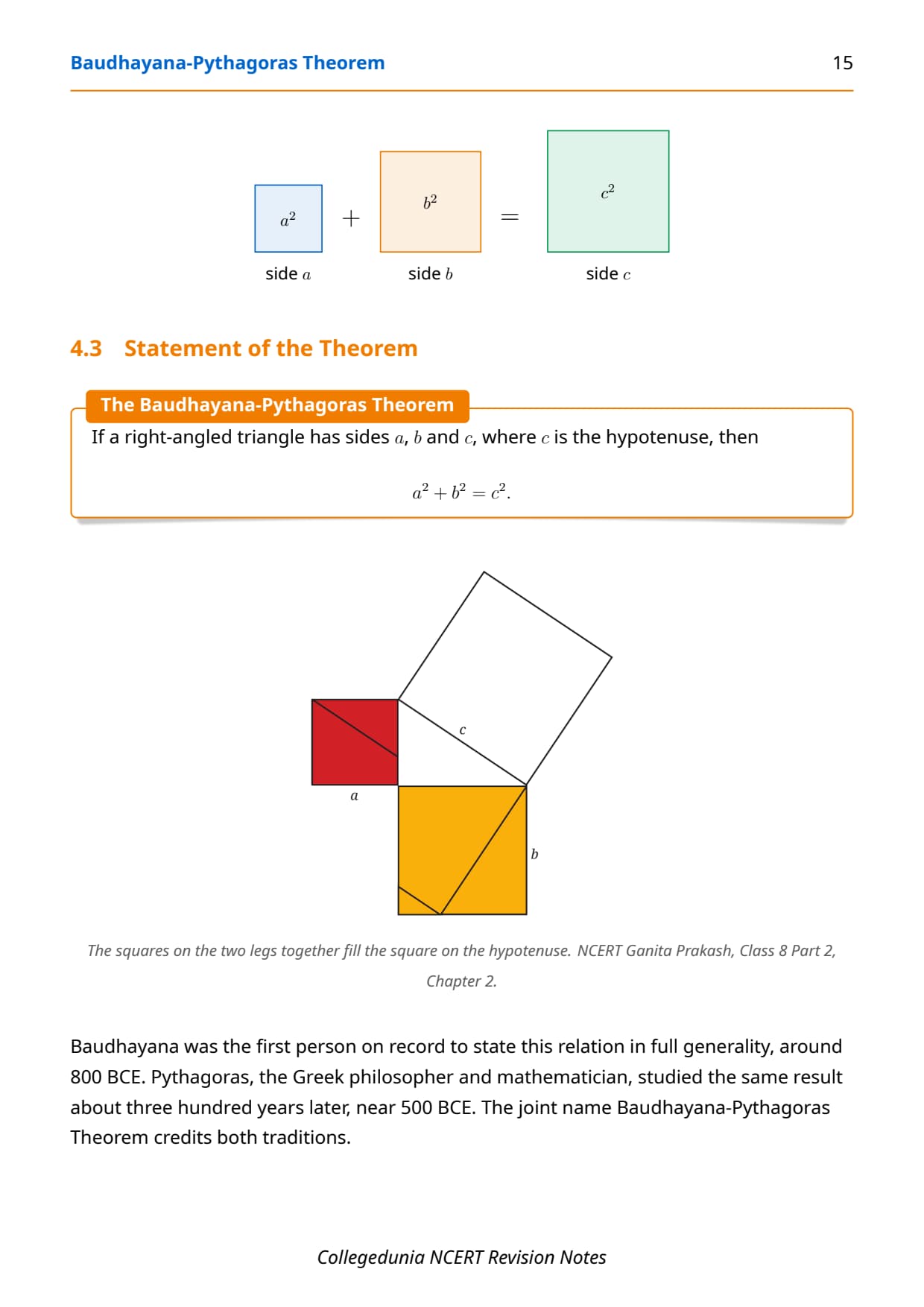
Ans. If a right-angled triangle has sides a, b and c, where c is the hypotenuse, then a² + b² = c². The square drawn on the hypotenuse has the same area as the two squares drawn on the other two sides put together.
Ques. How do you double the area of a square?
Ans. Build the new square on the diagonal of the old one. If the old side is s, the diagonal is s√2 and the new area is 2s². Doubling the side instead gives 4s², which is four times the area, not twice.
Ques. What is a Baudhayana triple?
Ans. A Baudhayana triple is a set of three positive whole numbers (a, b, c) with a² + b² = c². Common ones are (3, 4, 5), (5, 12, 13), (8, 15, 17), (7, 24, 25) and (20, 21, 29). The same sets are also called Pythagorean triples.
Ques. What does primitive mean for a triple?
Ans. A triple is primitive when its three numbers share no common factor greater than 1. So (3, 4, 5) and (5, 12, 13) are primitive, while (9, 12, 15) is not, because 3 divides all three. Every triple is either primitive or a scaled copy of a primitive one.
Ques. How do you generate new triples from odd square numbers?
Ans. Use (n − 1)² + (2n − 1) = n². Take an odd perfect square, add one, halve it, and that gives n. For 49: 49 + 1 = 50, half is 25, so n = 25 and the triple is (7, 24, 25).
Ques. How is the square root of 2 bounded between two decimals?
Ans. Square trial decimals and squeeze. Since 1.41² = 1.9881 and 1.42² = 2.0164, the value lies between 1.41 and 1.42. One more step gives 1.414 < √2 < 1.415. The decimal never ends and never repeats, so it cannot be written as a fraction.
Ques. How is the lotus problem from Lilavati solved?
Ans. Let the depth be x, so the stem is x + 1 and becomes the hypotenuse. Then 3² + x² = (x + 1)². The x² terms cancel, leaving 9 = 2x + 1, so x = 4 units. The same trick solves ladder and broken-bamboo problems.
Ques. How do you find the side of a rhombus from its diagonals?
Ans. The diagonals of a rhombus bisect each other at right angles, so each side is the hypotenuse of a right triangle whose legs are the half-diagonals. For diagonals 24 and 70, the halves are 12 and 35, so the side is √(144 + 1225) = 37 units.
Ques. What is Fermat's Last Theorem and how does it connect to this chapter?
Ans. Fermat claimed in 1637 that x raised to n plus y raised to n never equals z raised to n in natural numbers once n is bigger than 2. The case n = 2 is exactly the Baudhayana-Pythagoras theorem, which has endless solutions. Andrew Wiles proved the general claim in 1994.
Ques. Are these Class 8 Maths notes based on the 2026-27 syllabus?
Ans. Yes. The notes follow Ganita Prakash Part 2, the Class 8 Maths textbook for the 2026-27 session, section by section. Every construction, worked example and formula matches the printed chapter.



Comments