




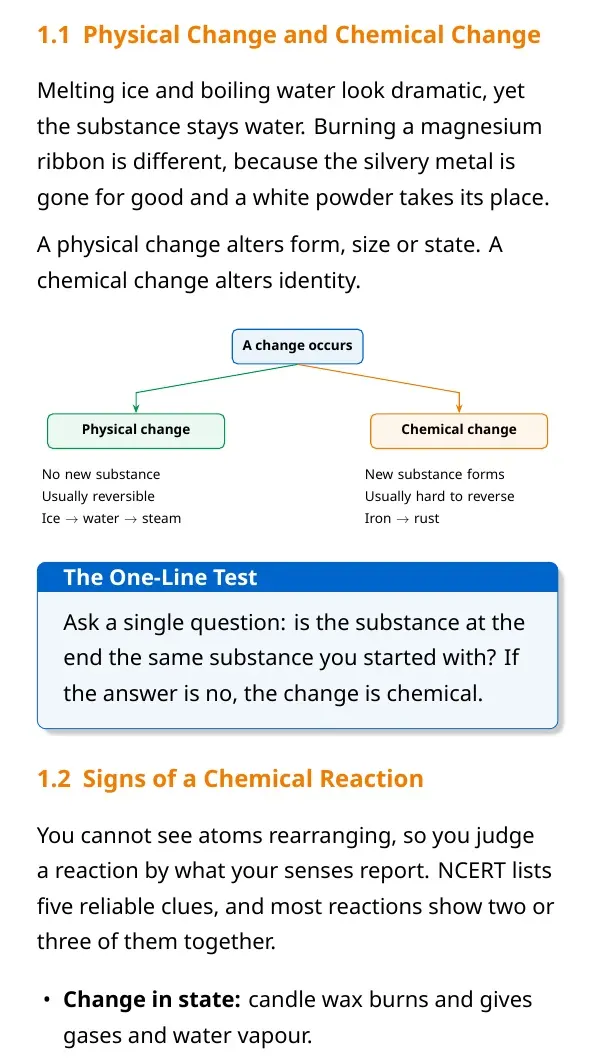
A chemical reaction changes one or more substances into new substances with different properties. Class 10 Science Chapter 1 Chemical Reactions and Equations opens the chemistry section of the NCERT book. These Chemical Reactions and Equations Class 10 Science Notes cover every reaction type and balancing rule. They also flag what the 2026-27 NCERT keeps.
- CBSE Board Weightage: 5 to 6 marks, inside the 25-mark unit Chemical Substances: Nature and Behaviour.
- Question Pattern: one 1-mark balancing question and one 3-mark reaction-type question appear in most papers.
- Class 11 and 12 Link: the redox basics here feed straight into Class 11 Chemistry and Class 12 Electrochemistry.
You can find the complete Chemical Reactions and Equations Class 10 Science Notes in the article below. Every balanced equation, reaction type, and board tip is covered.
These notes are prepared by Collegedunia subject experts and mapped to the 2026-27 NCERT. Every equation is checked against the last five years of CBSE Class 10 Science board papers.
Also Check:
- Chemical Reactions and Equations Class 10 Science NCERT Solutions
- Chemical Reactions and Equations Class 10 Science Formula Sheet
How will Collegedunia's Chemical Reactions and Equations Class 10 Science Notes Help You?
These notes are built for the two things the board paper tests. You have to write a correct balanced equation, and then name the reaction type.
- 2026-27 NCERT Alignment: Every activity, equation, and definition matches the current NCERT print.
- Balanced Equations Written Out: Each reaction is shown with its physical states, so you can copy the exam-ready form.
- Expert Checked: Subject experts have checked every equation against the official NCERT text.
- Quick Revision Blocks: Tip boxes and a repeated-question list keep your night-before revision short.
Chemical Reactions and Equations Class 10 Science Notes: Full Concept Walkthrough
The chapter runs in four blocks. Read them in this order, because each block uses the equations written in the one before it.
Chemical Equations and How to Balance Them
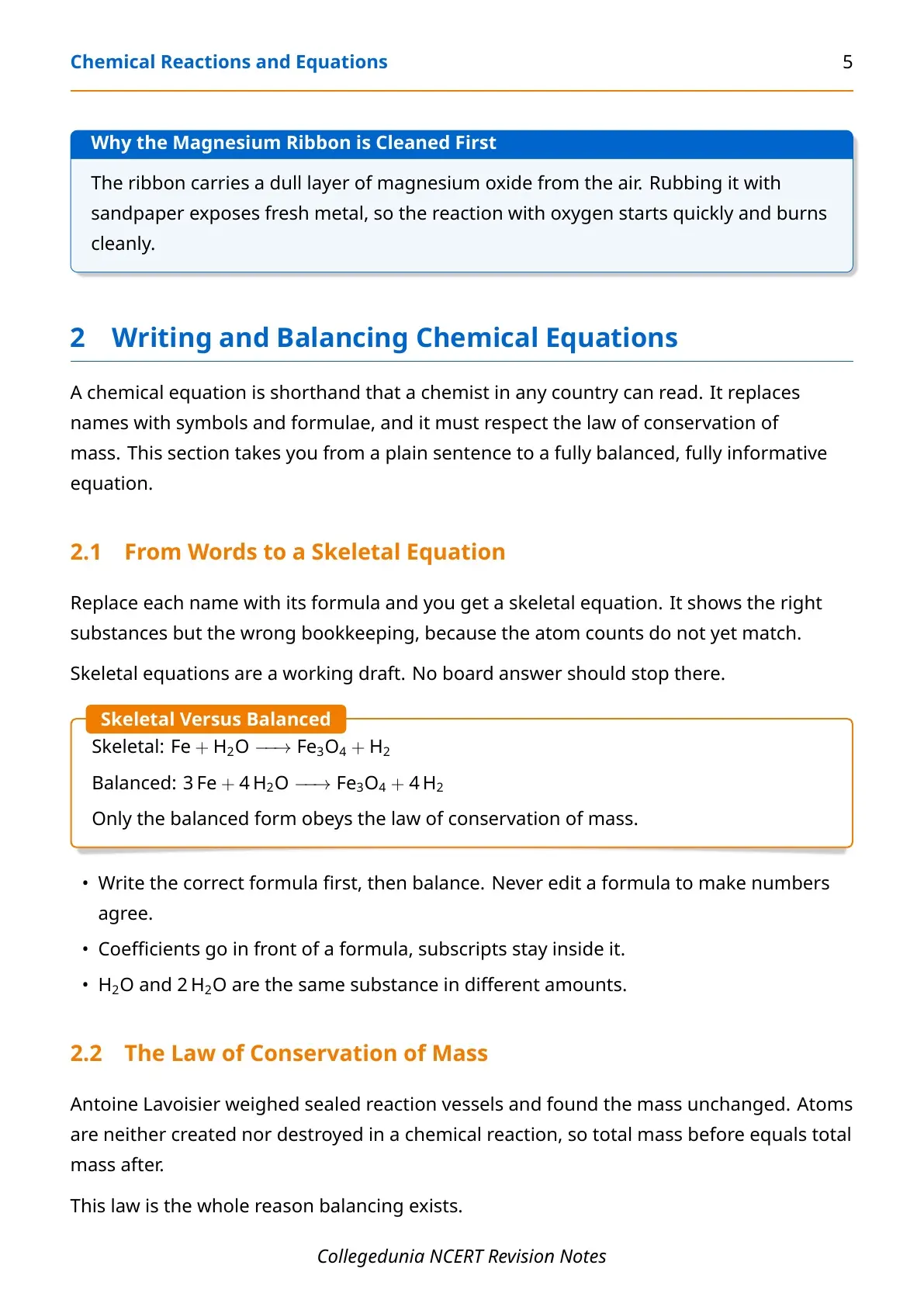
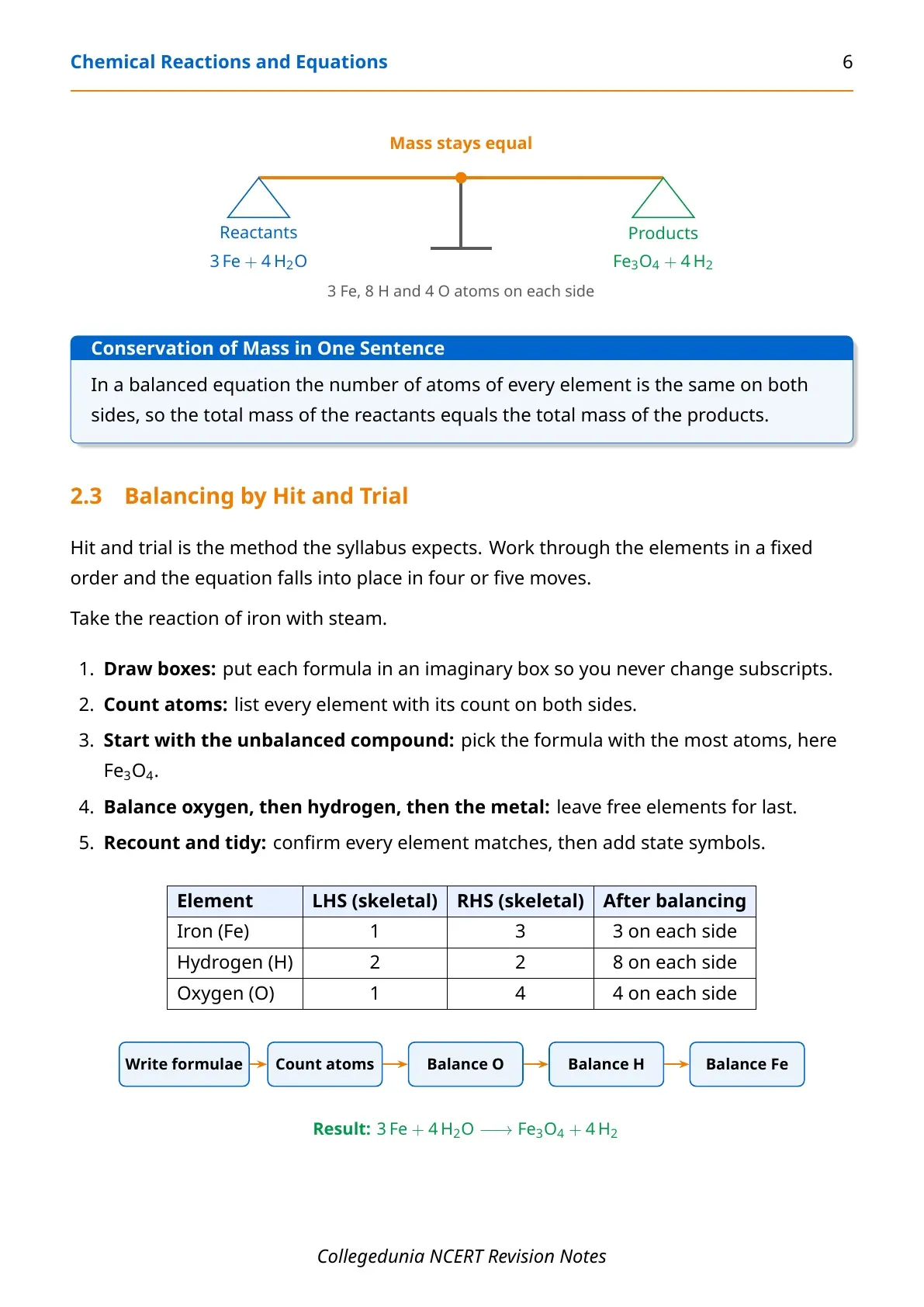
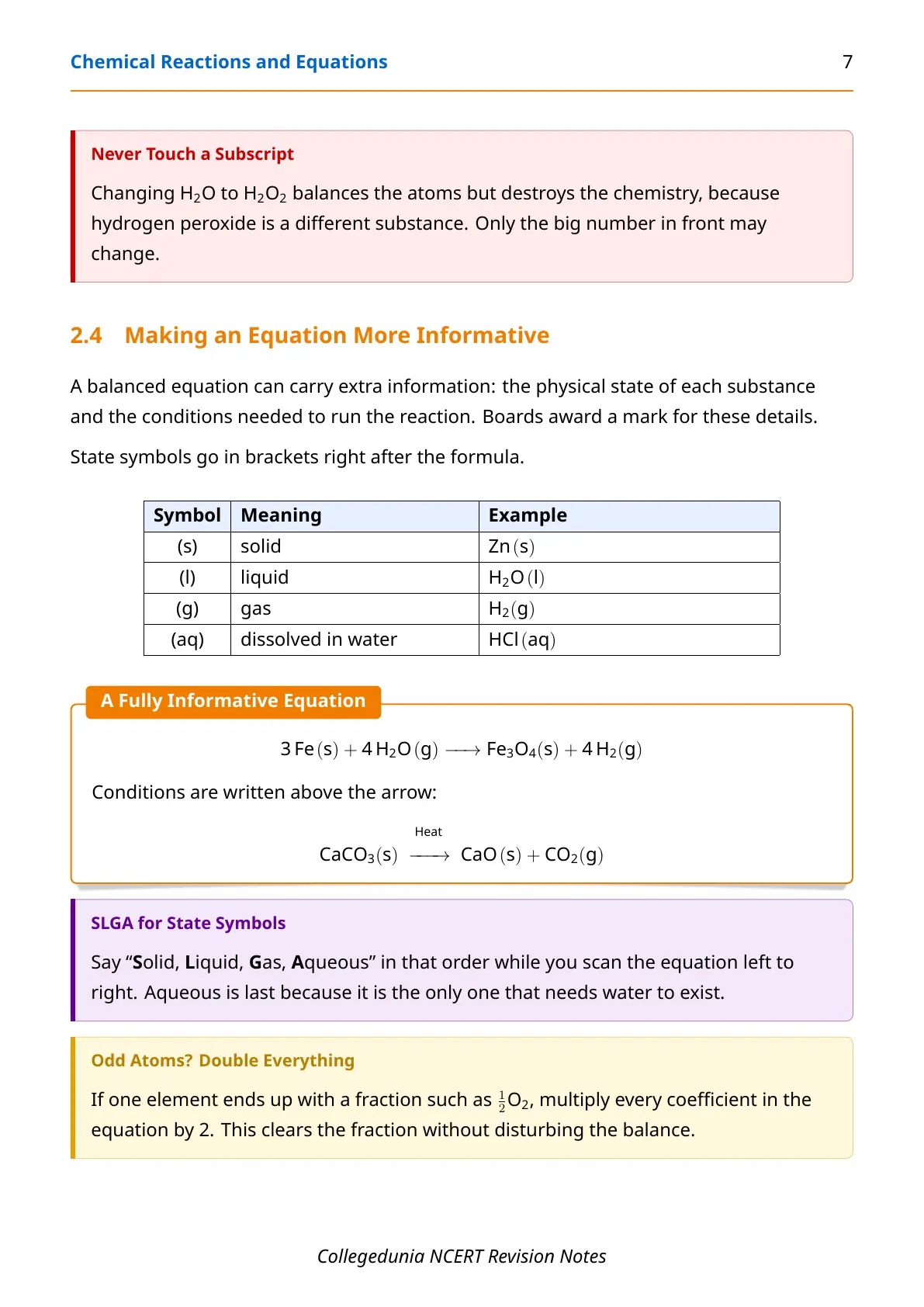
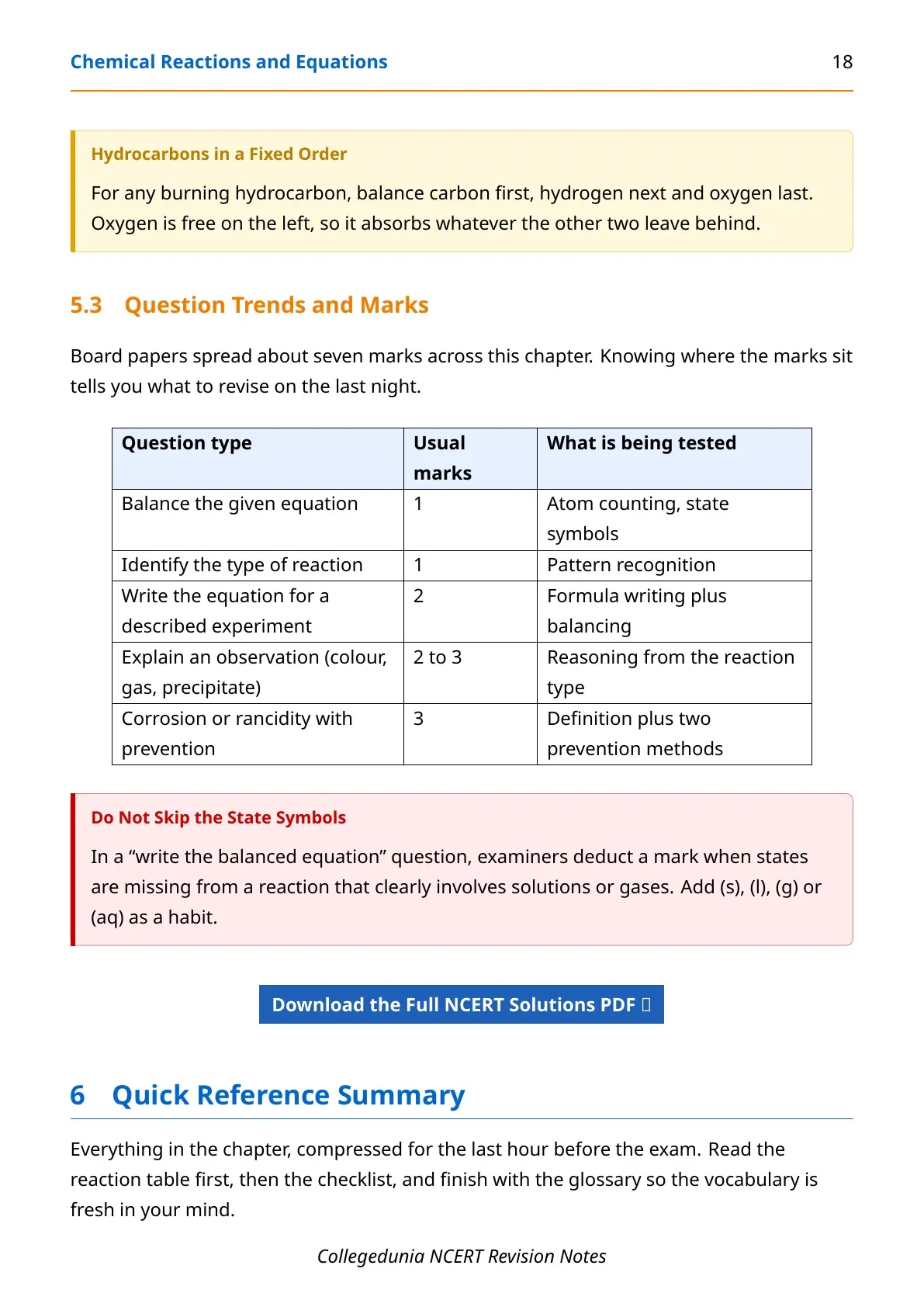
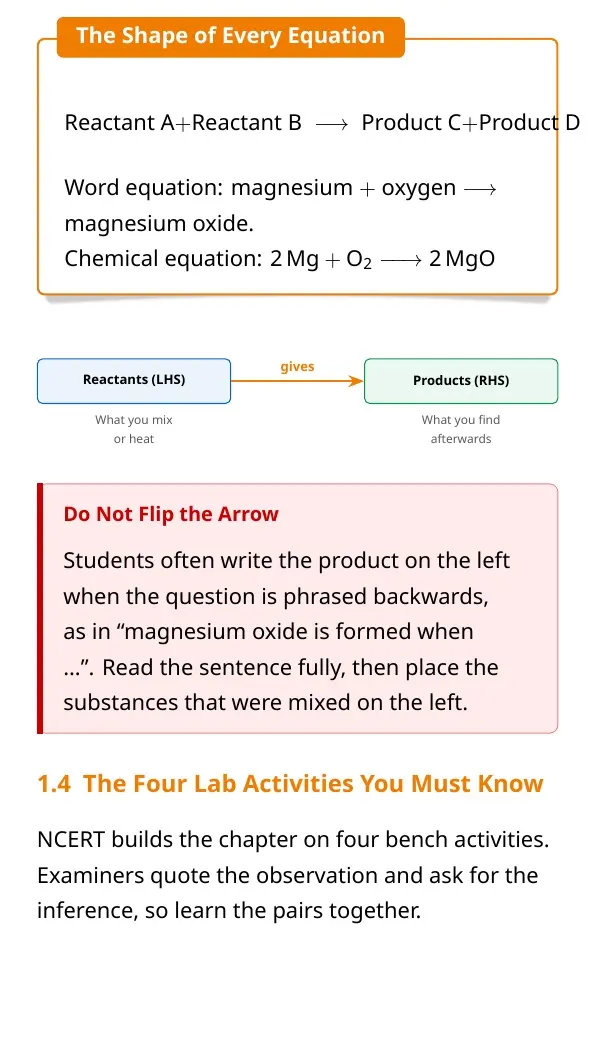
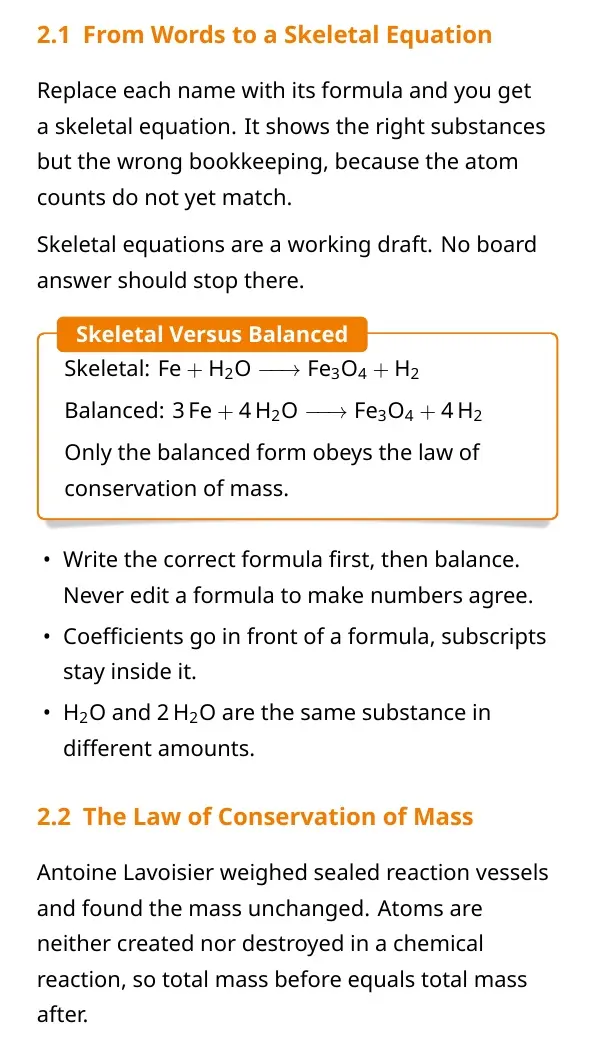
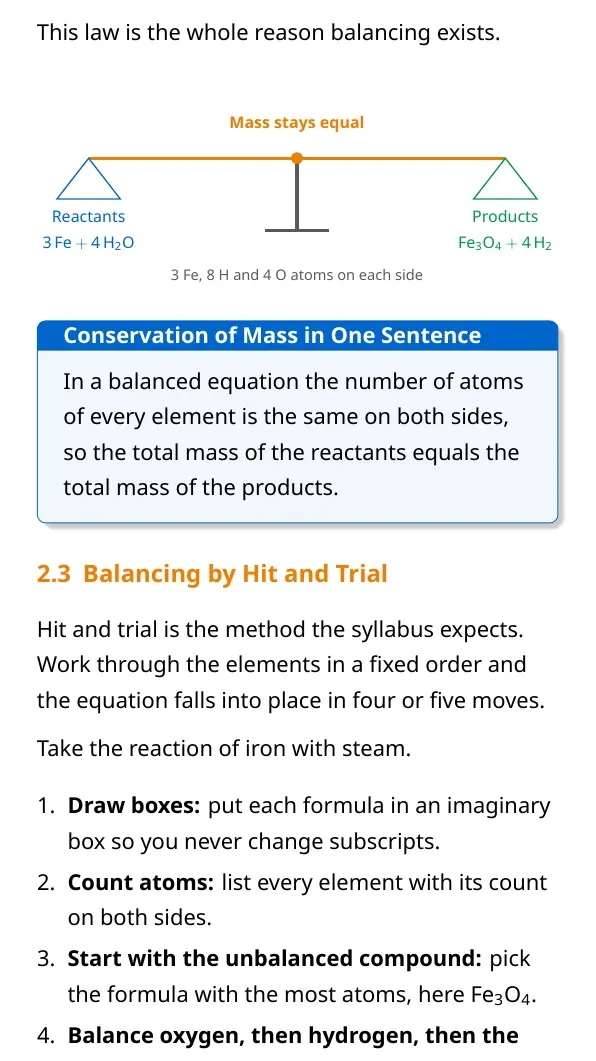
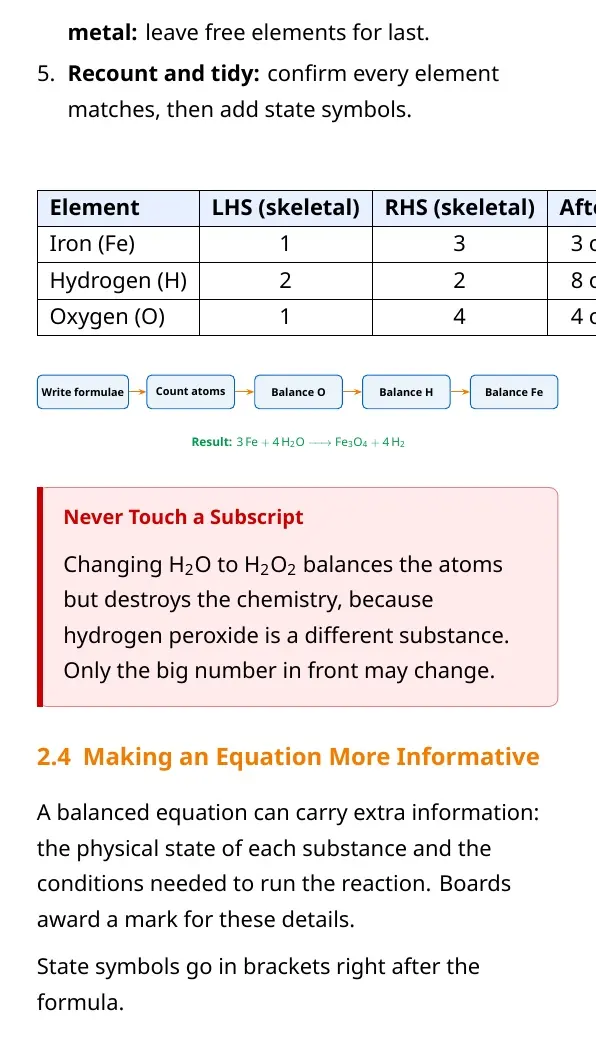
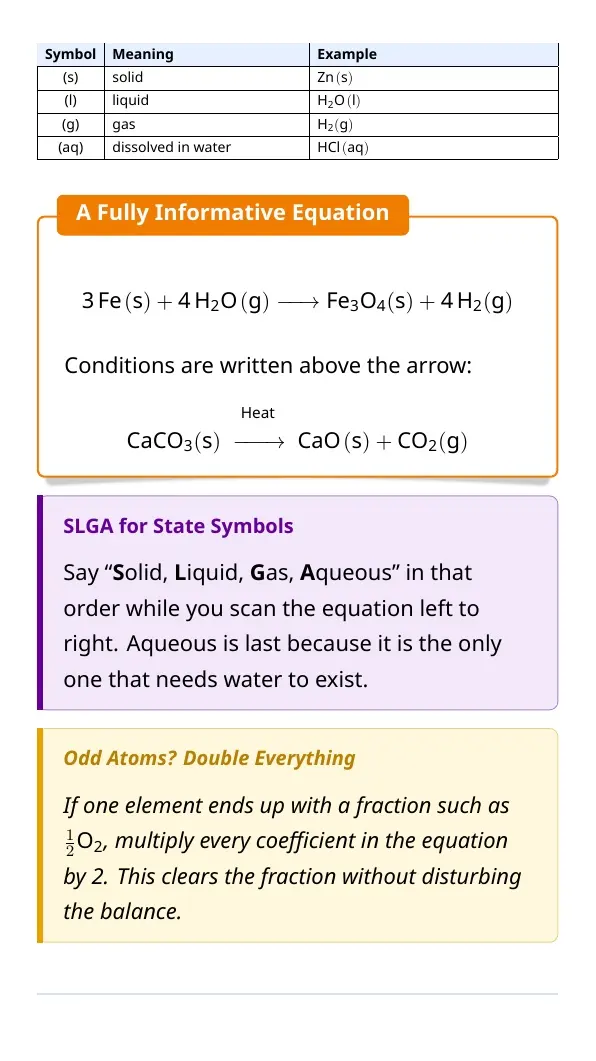
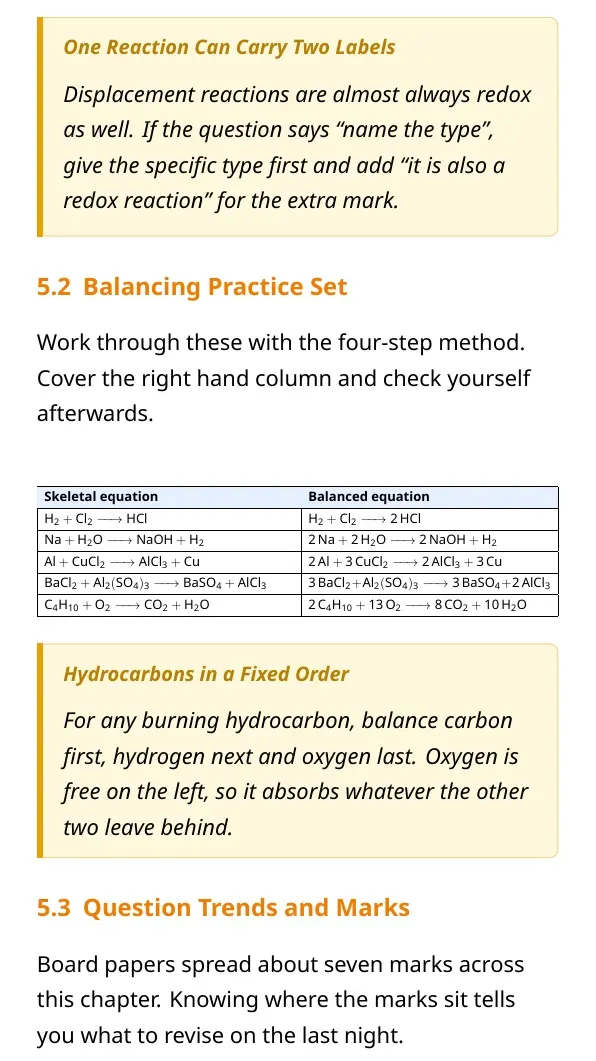
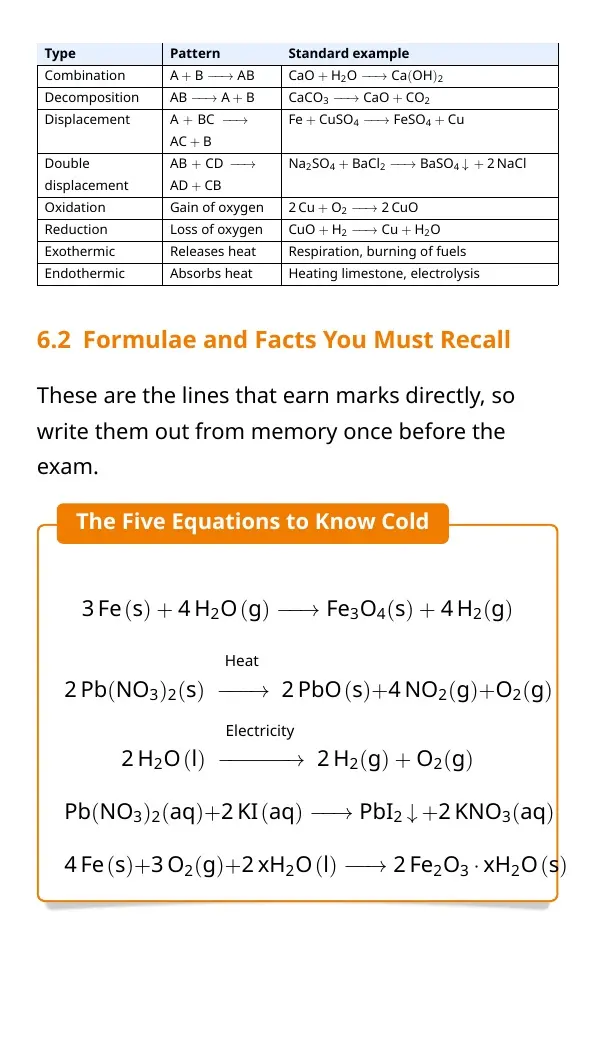
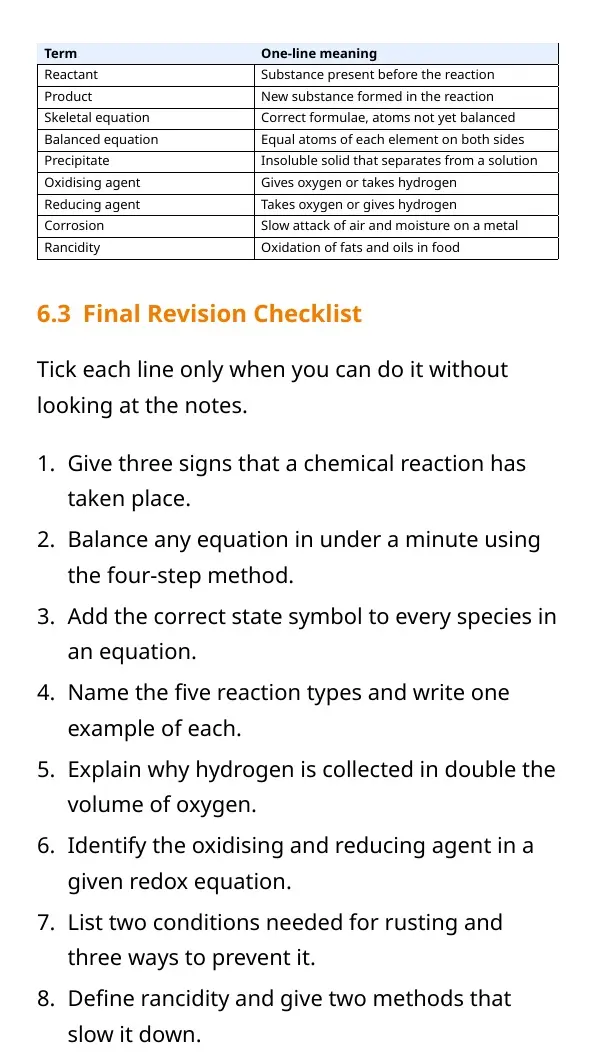
A chemical equation is a short way of writing a reaction with symbols and formulas. The substances you start with are reactants, and the new substances formed are products. A skeletal equation only names them. A balanced equation follows the law of conservation of mass. Each element then has the same number of atoms on both sides. Balance by hit and trial: count atoms element by element, then change the coefficients in front. Never change a subscript inside a formula. Add the physical states (s), (l), (g) and (aq), and write conditions such as heat above the arrow.
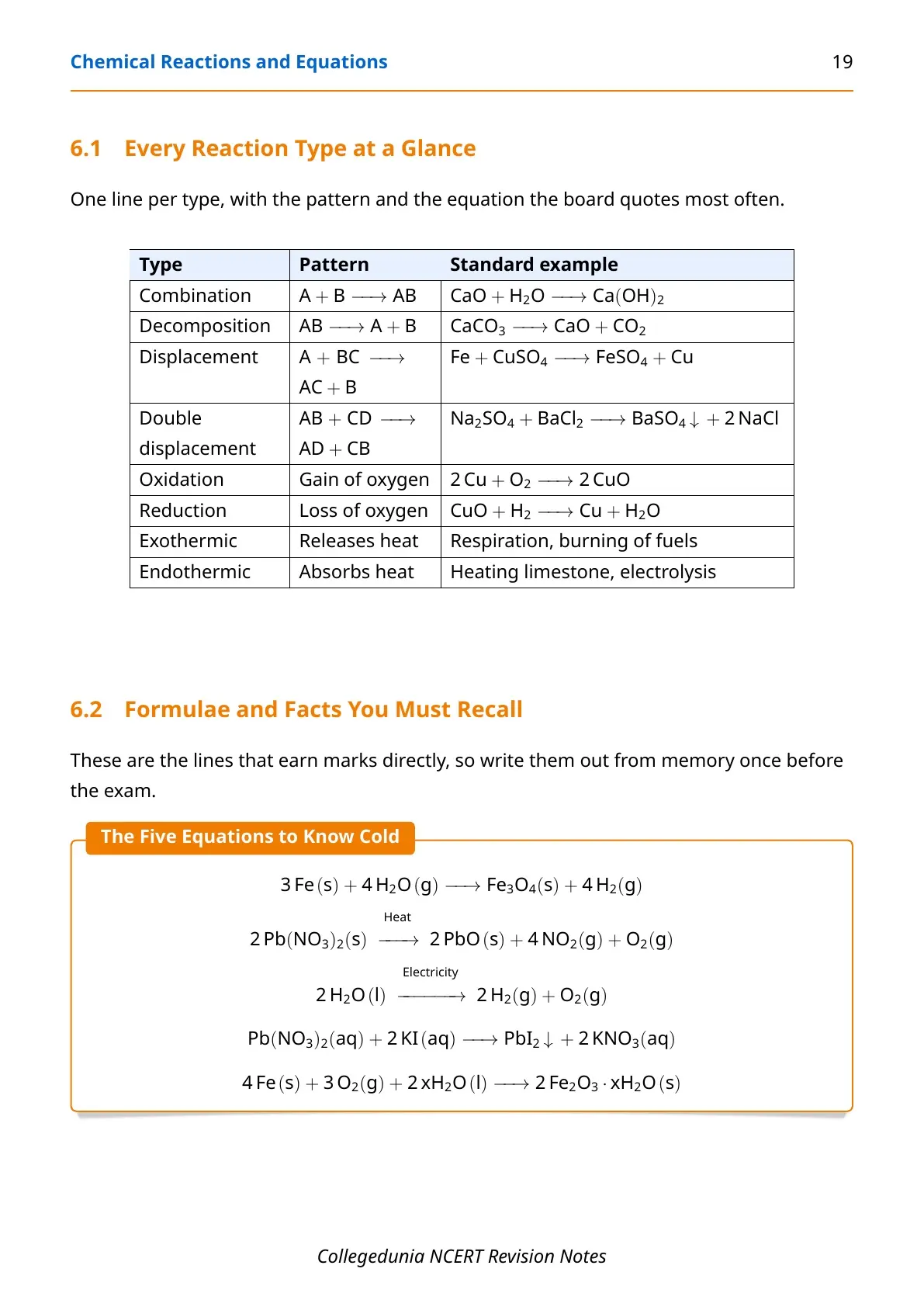
3Fe(s) + 4H2O(g) → Fe3O4(s) + 4H2(g)
Combination and Decomposition Reactions in Class 10 Science
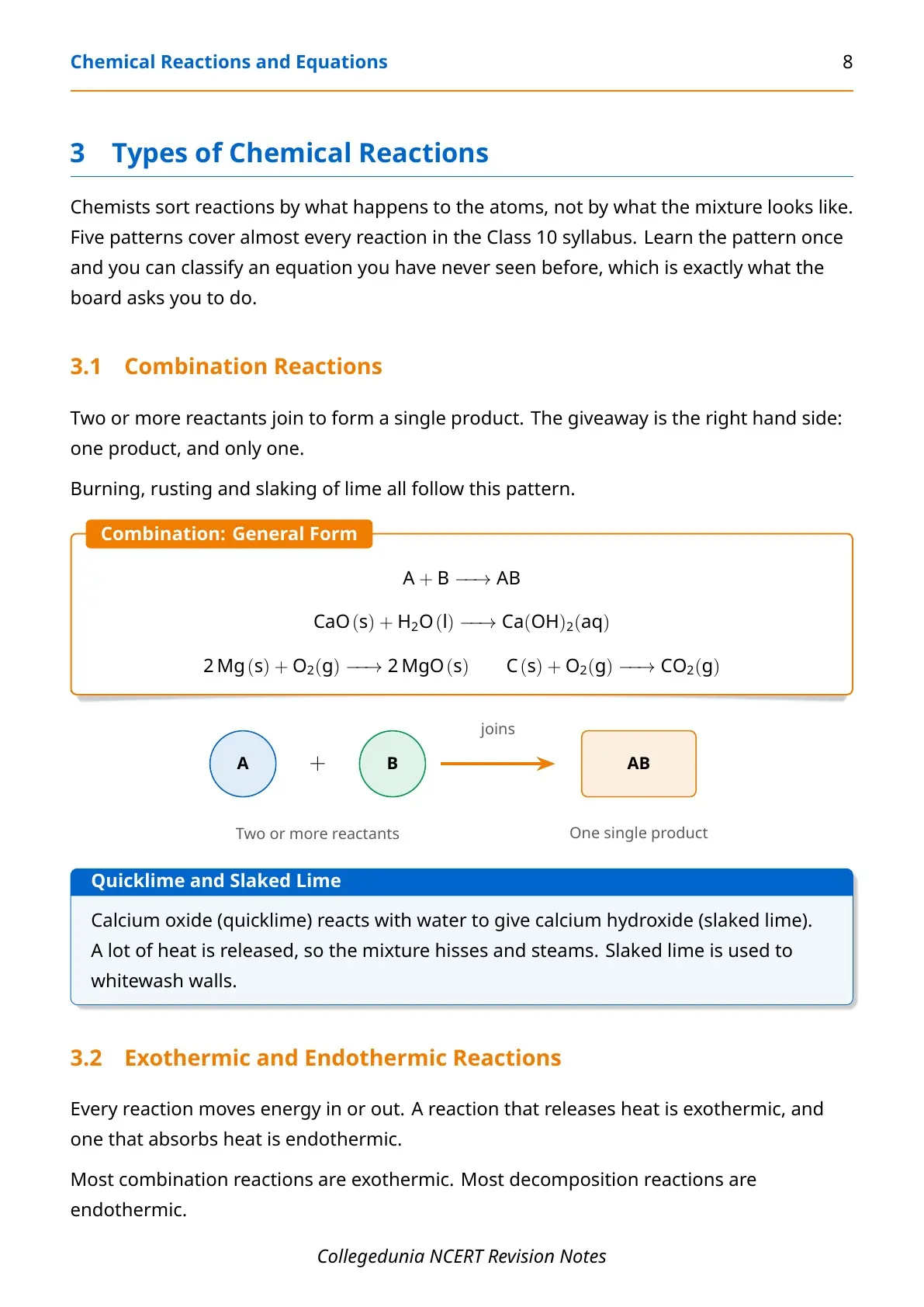
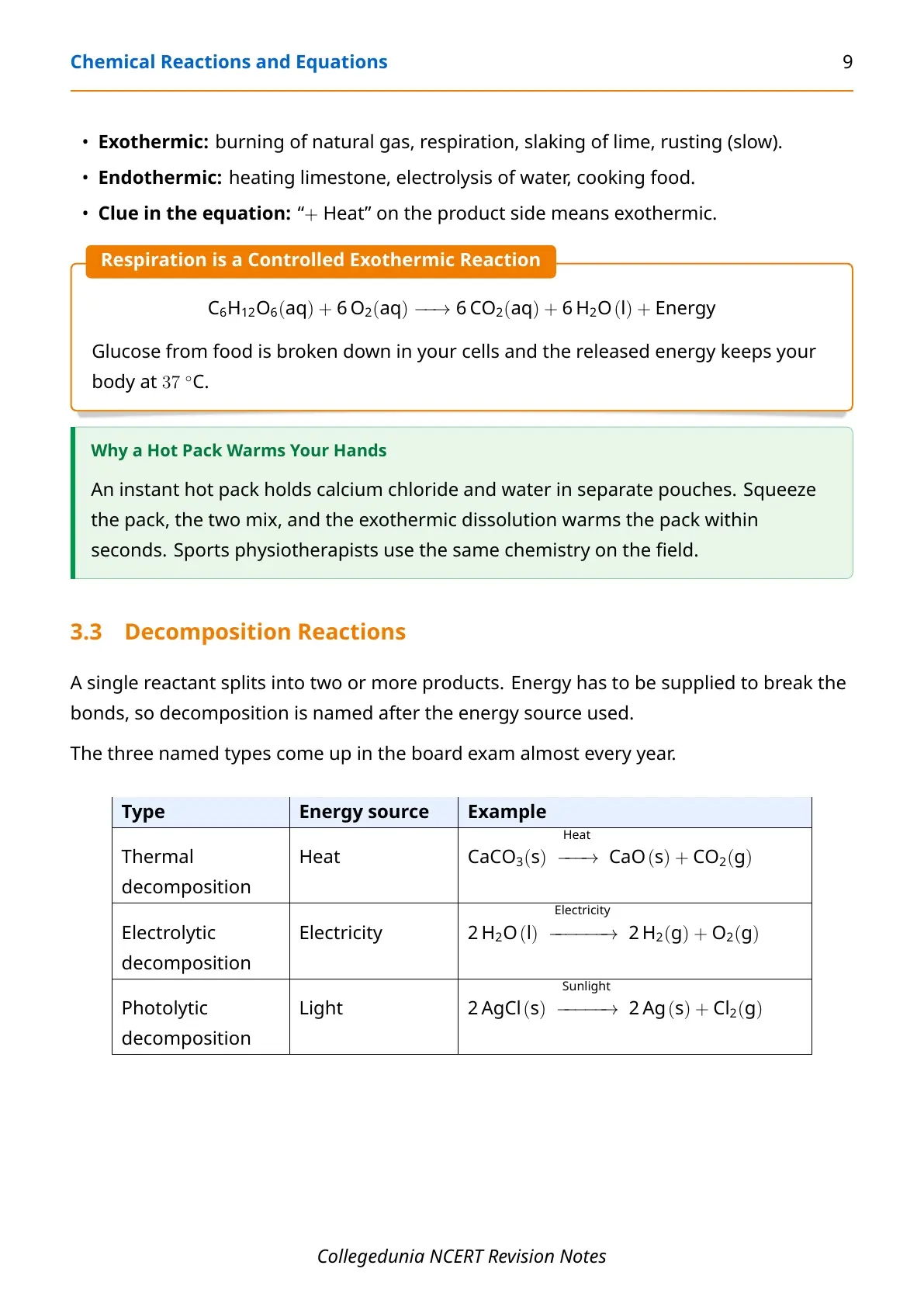
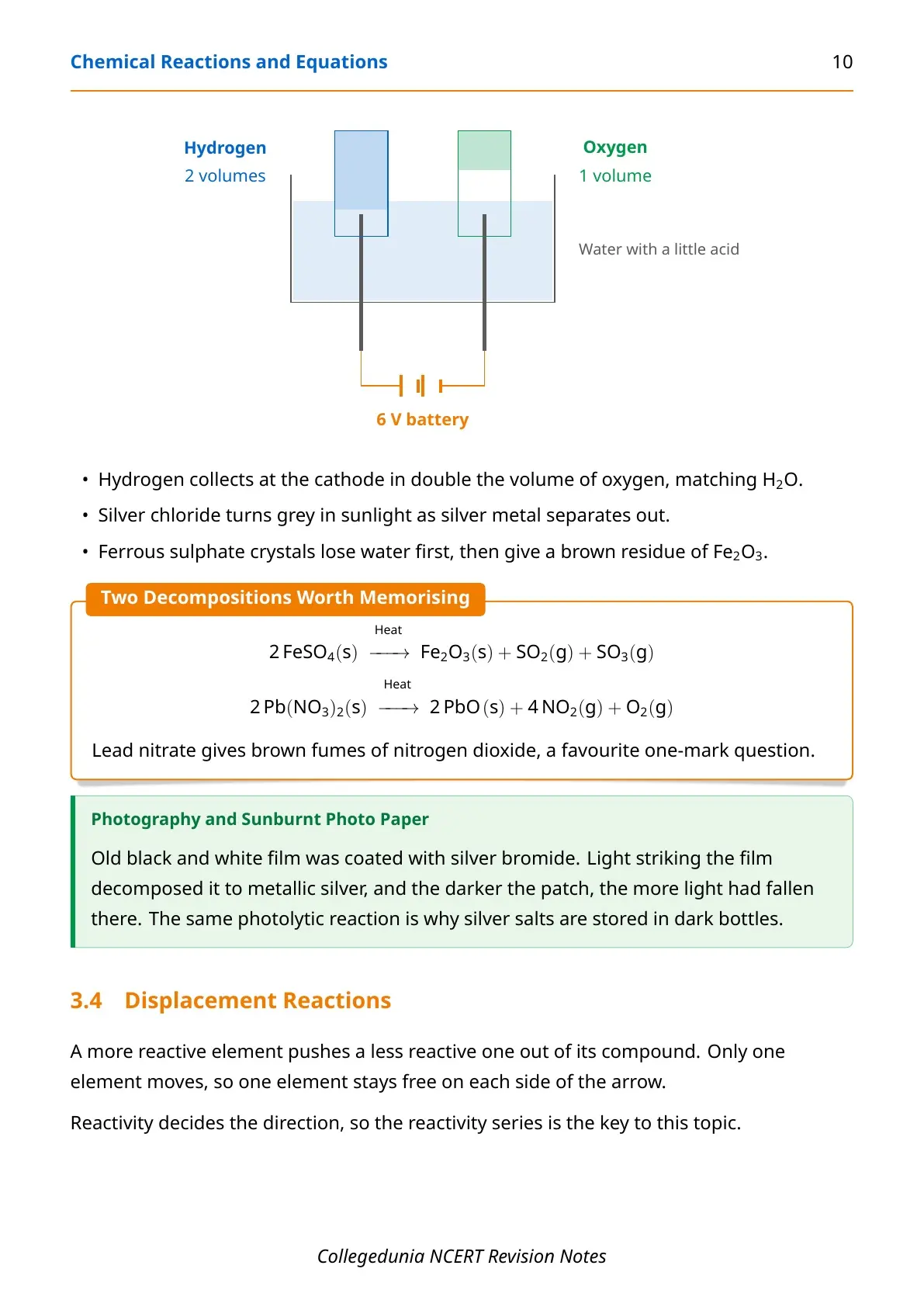
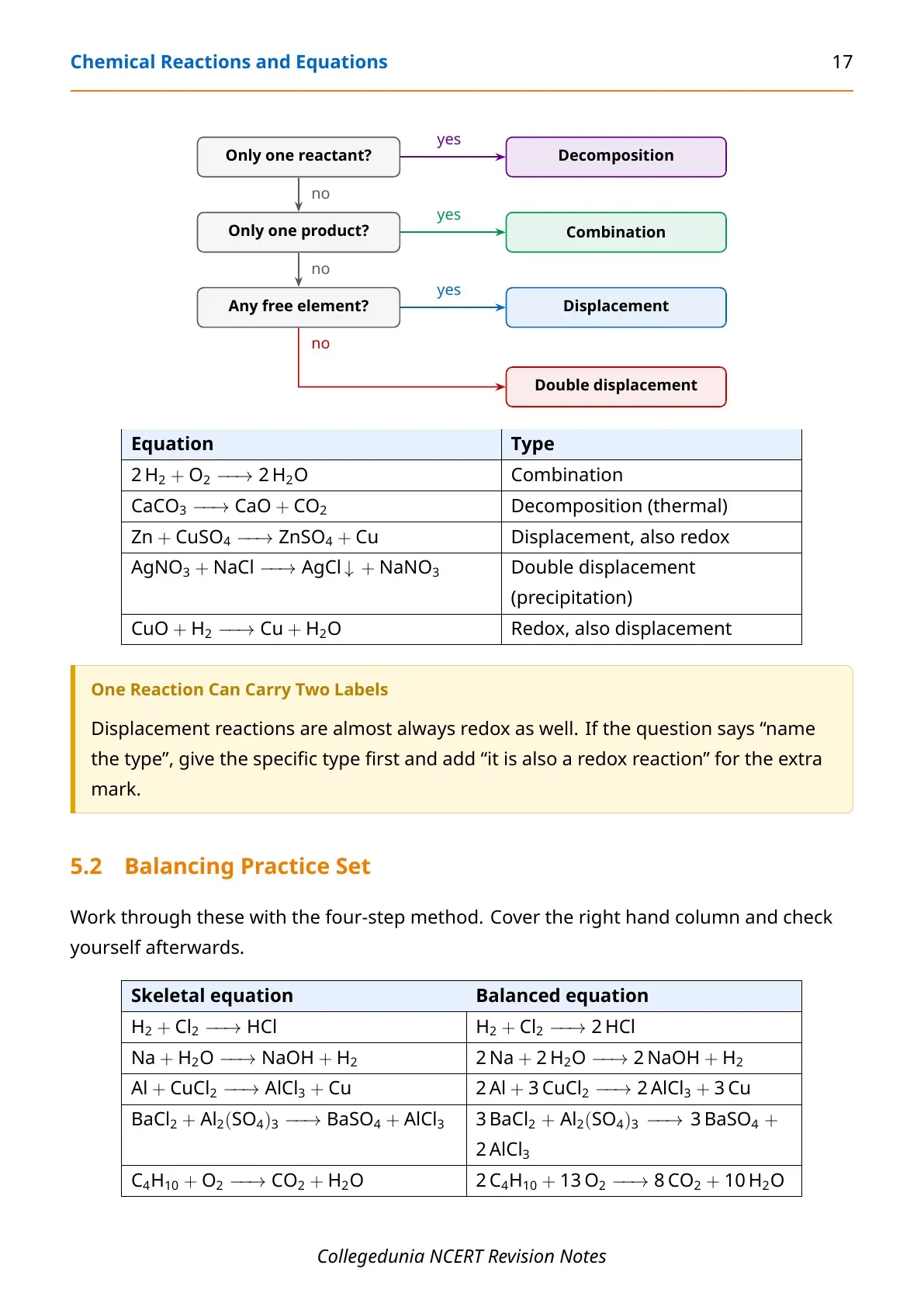
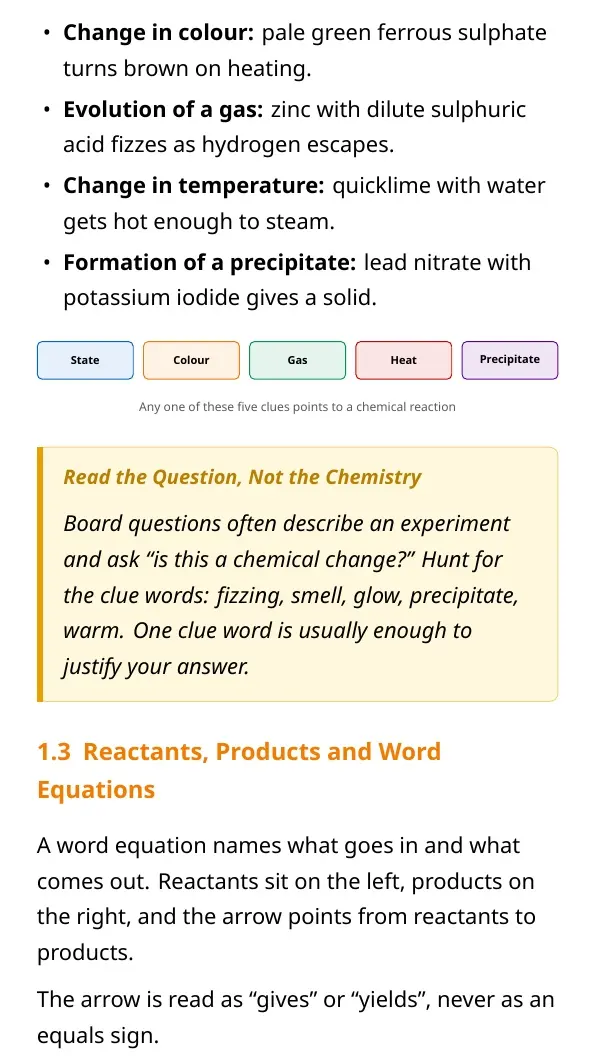
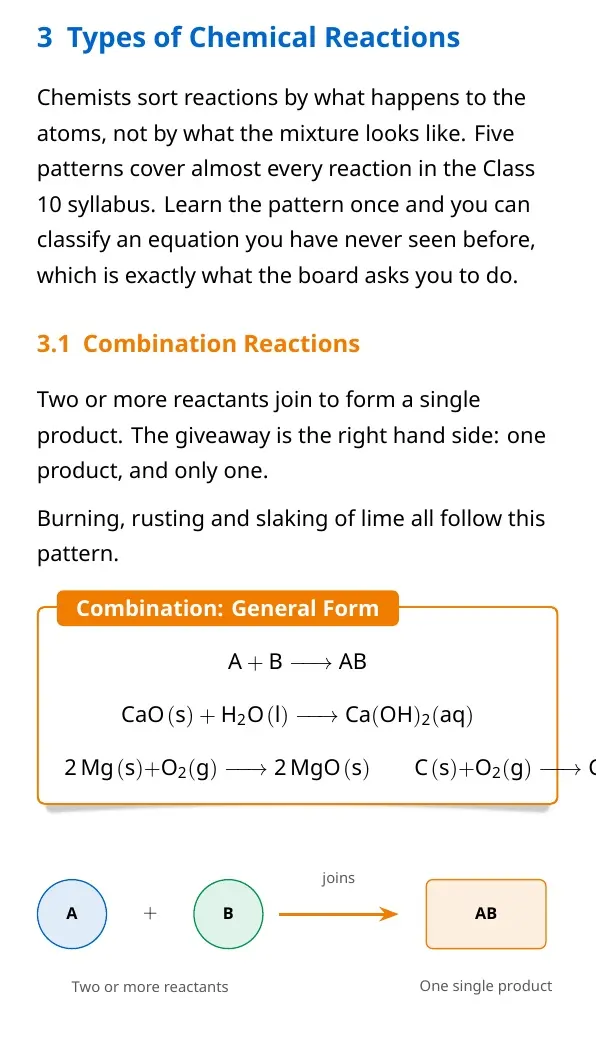
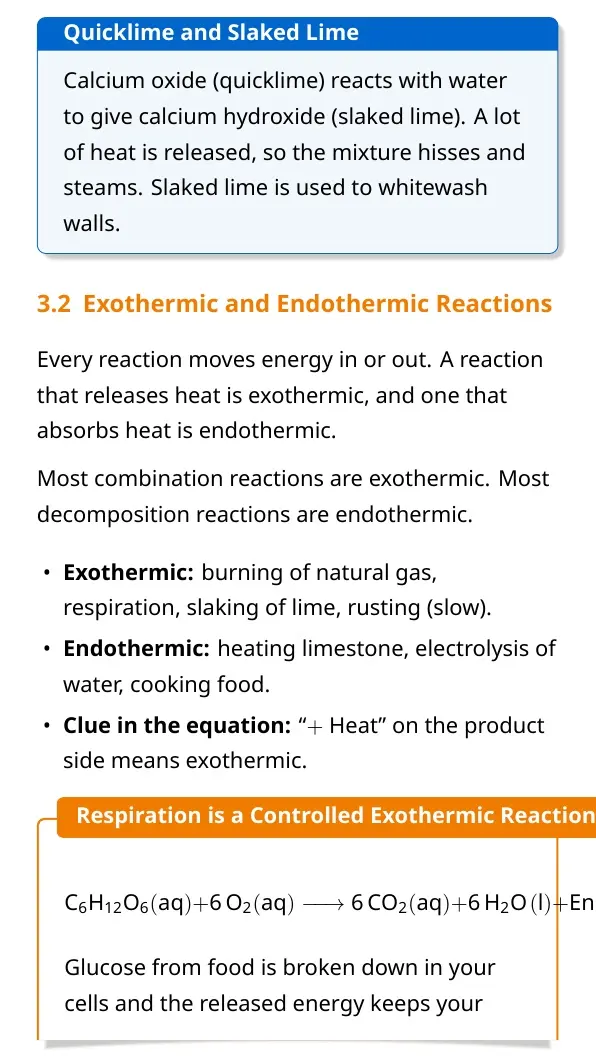
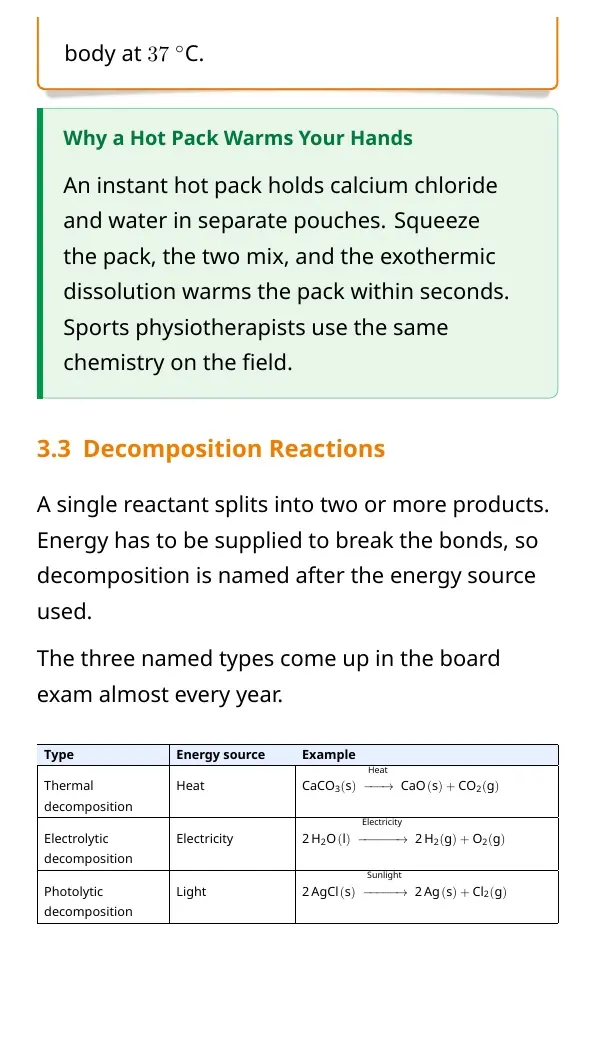
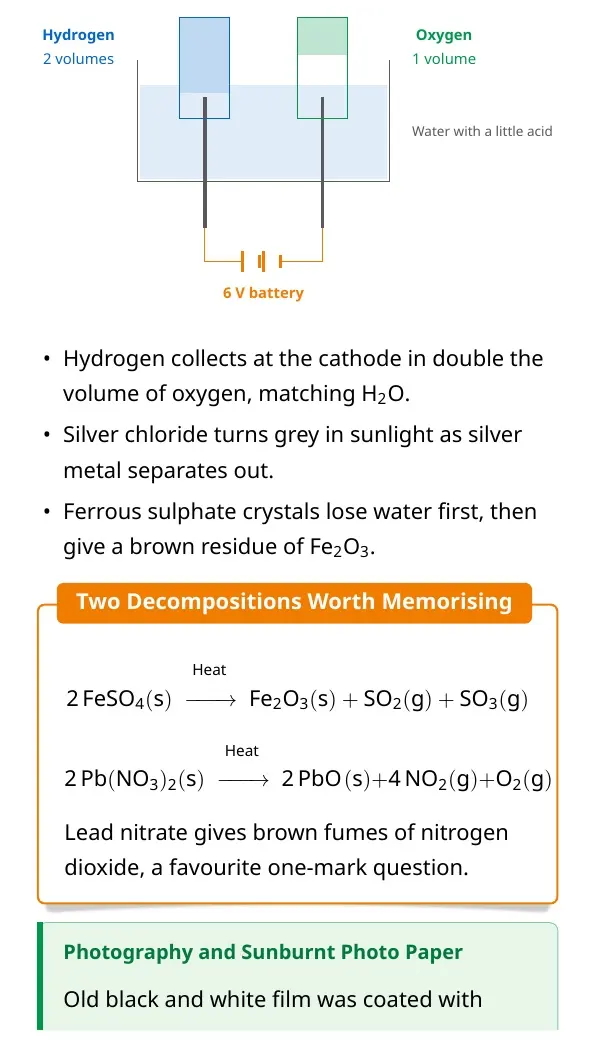
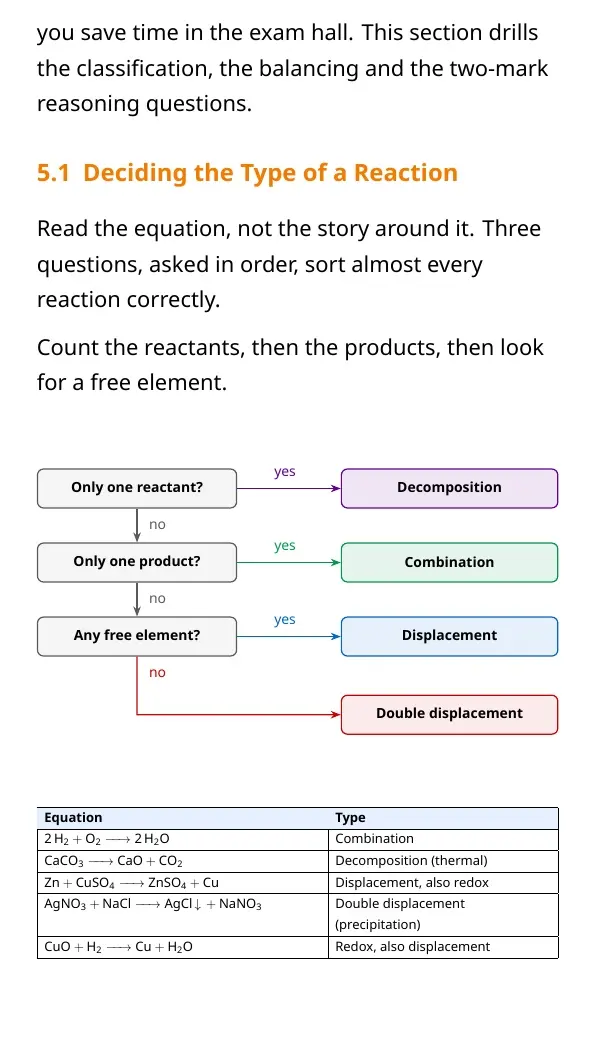
In a combination reaction, two or more substances join to give one product. Quicklime and water give slaked lime, CaO(s) + H2O(l) → Ca(OH)2(aq), and the mixture turns hot. A reaction that gives out heat is exothermic. Decomposition is the reverse: one compound breaks into two or more products. Heat causes thermal decomposition, as in CaCO3(s) → CaO(s) + CO2(g). Electricity causes electrolytic decomposition, as in the electrolysis of water. Light causes photolytic decomposition, as in 2AgCl(s) → 2Ag(s) + Cl2(g). Most decomposition reactions take in heat, so they are endothermic.
Displacement and Double Displacement Reactions
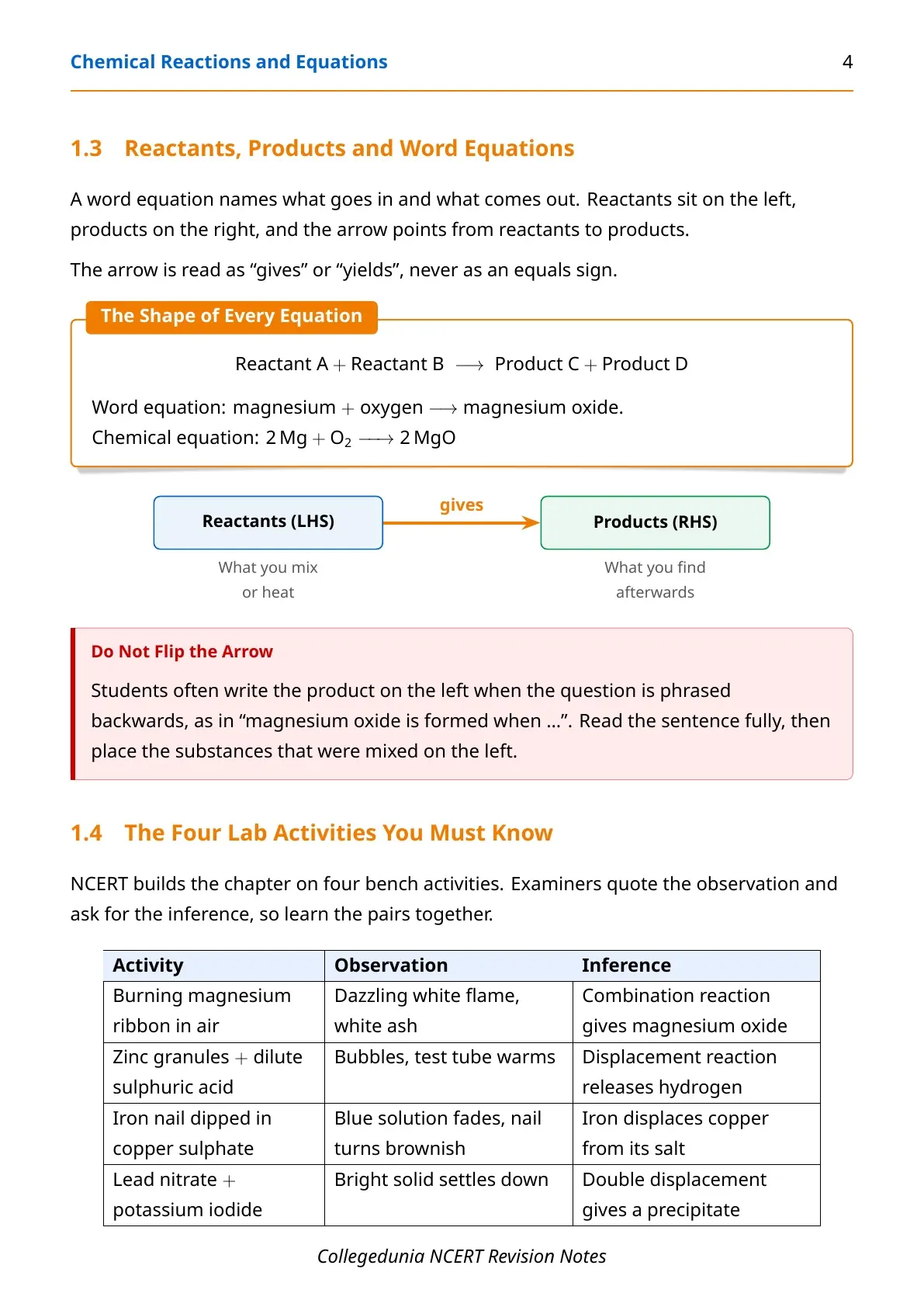
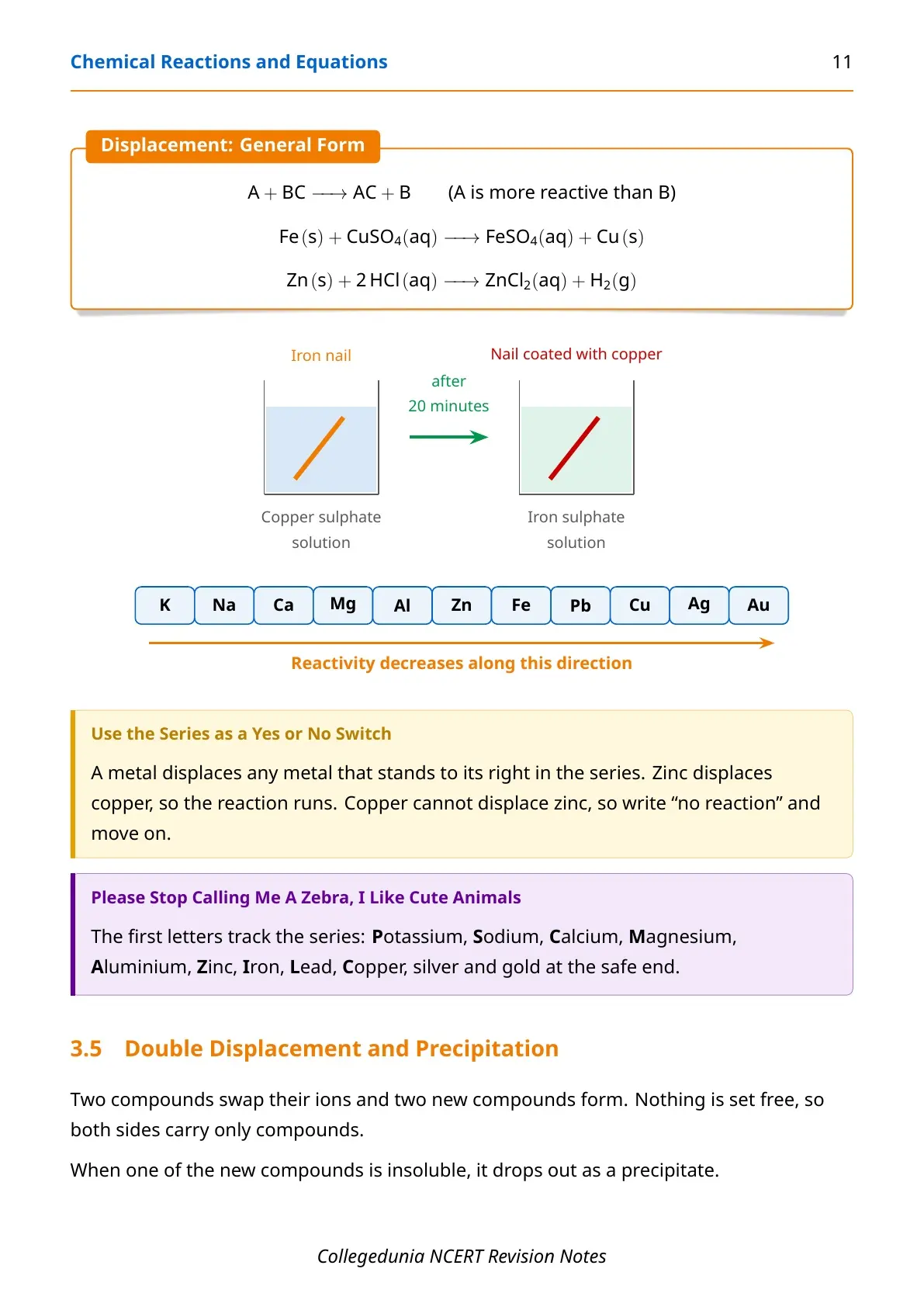
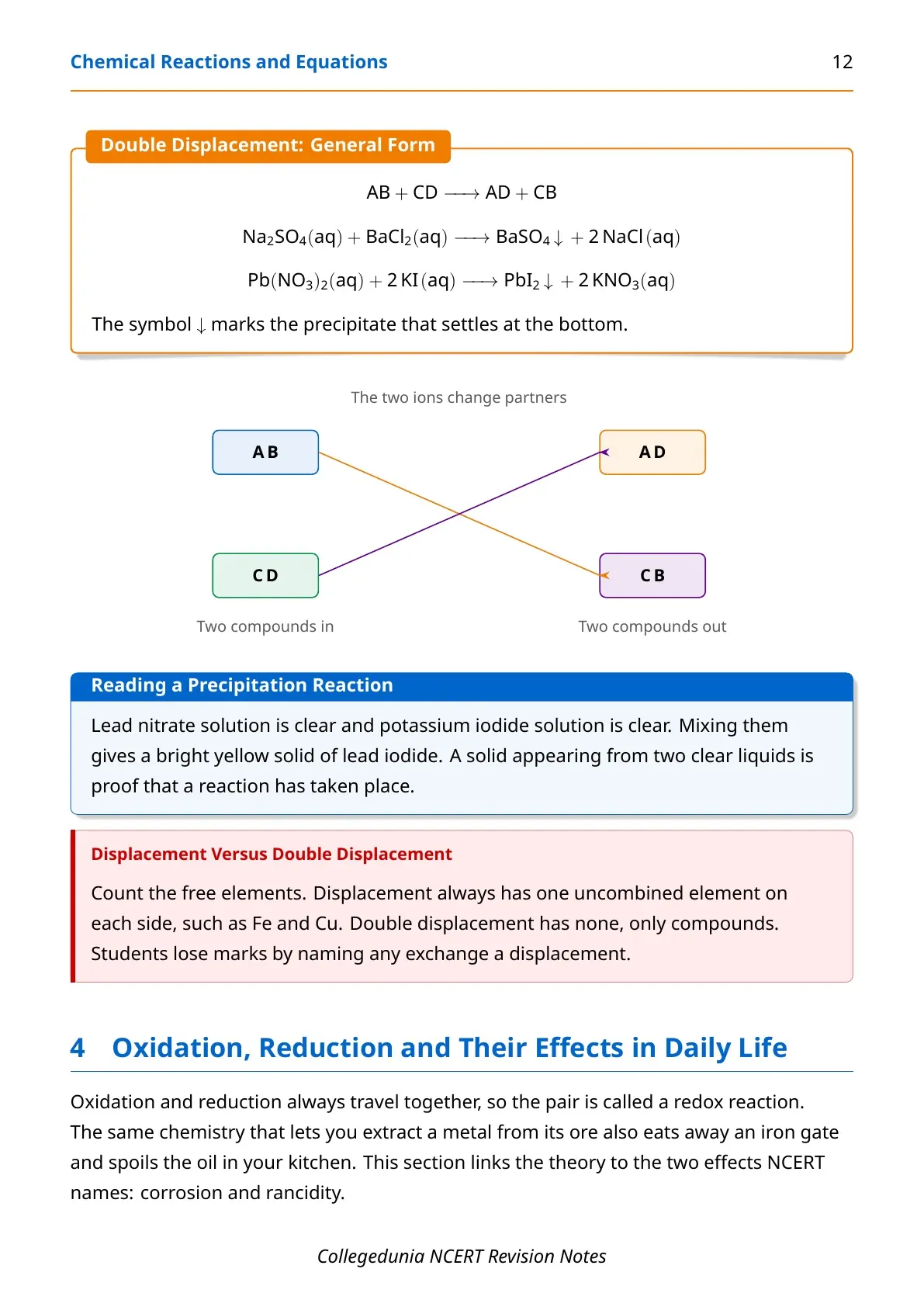
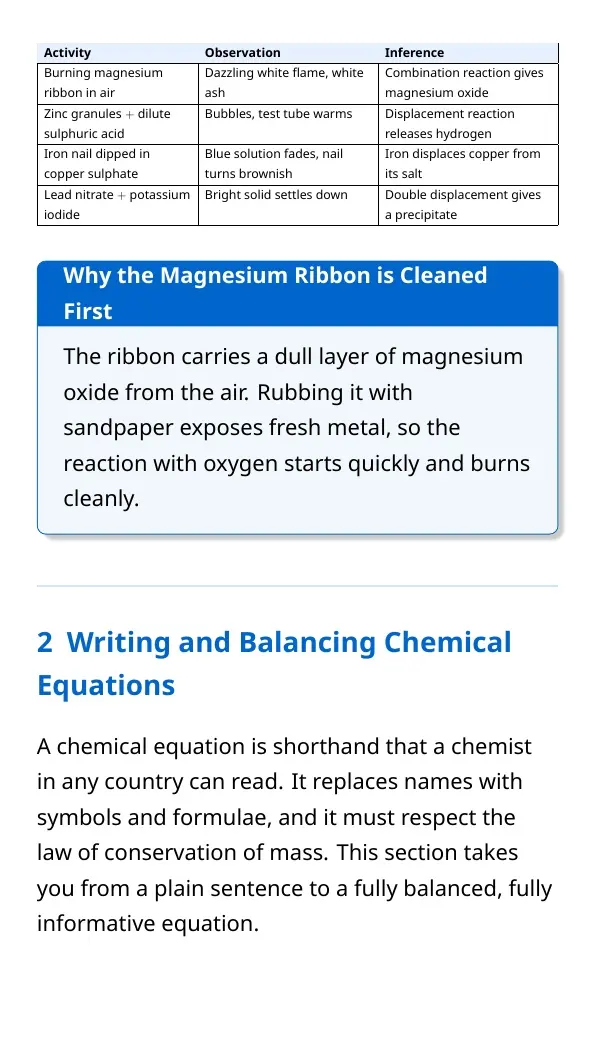
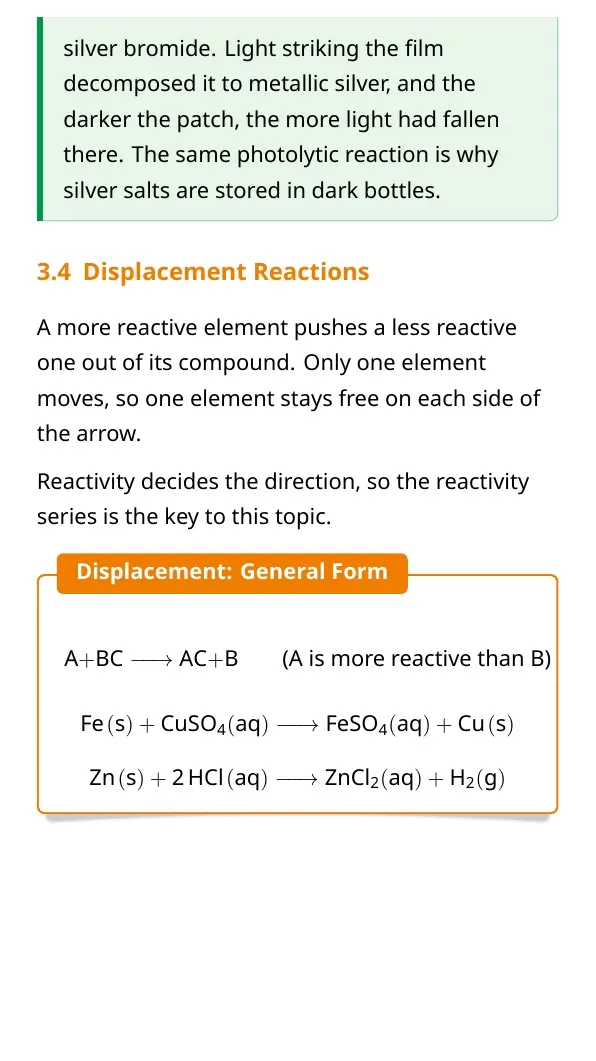
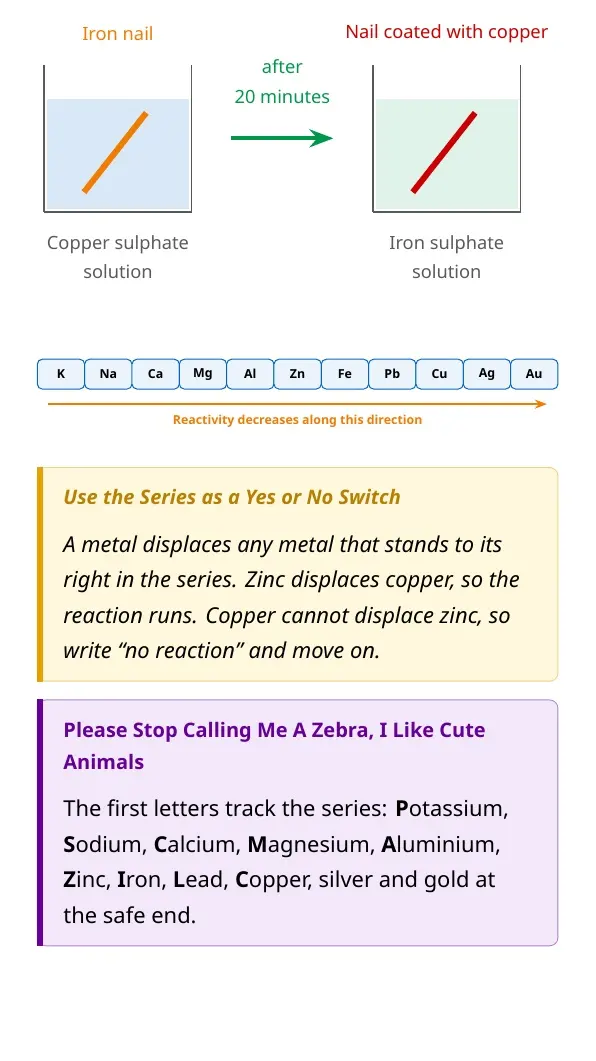
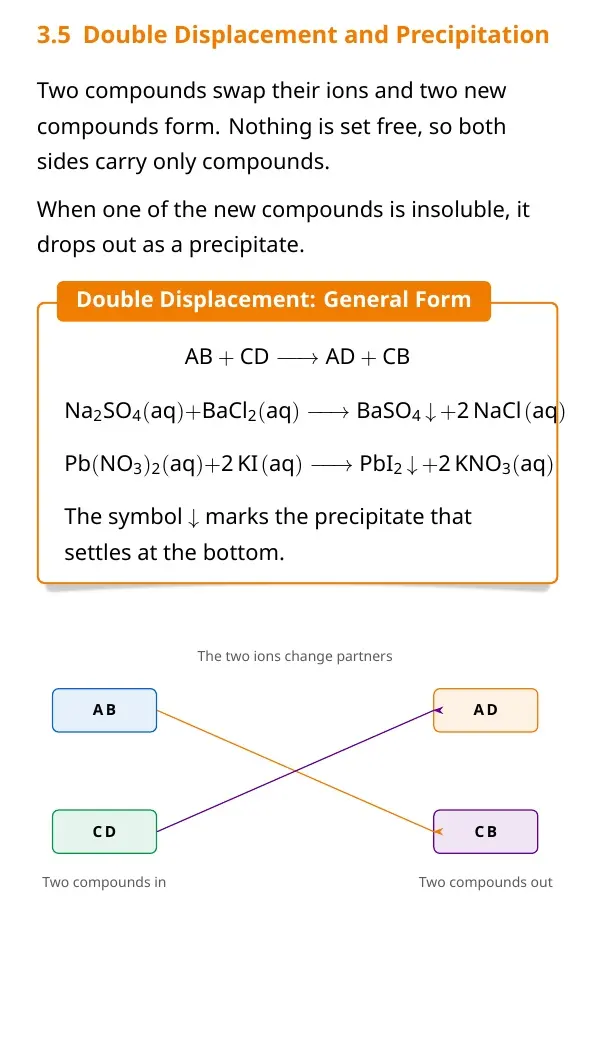
In a displacement reaction, a more reactive metal pushes a less reactive metal out of its salt solution. Iron in copper sulphate gives Fe(s) + CuSO4(aq) → FeSO4(aq) + Cu(s), and the blue solution turns pale green. In a double displacement reaction, two compounds swap their ions. Sodium sulphate and barium chloride give Na2SO4(aq) + BaCl2(aq) → BaSO4(s) + 2NaCl(aq). The white barium sulphate that settles is a precipitate, so this is also called a precipitation reaction. Neutralisation, where an acid and a base give salt and water, is another double displacement reaction.
Oxidation, Reduction, Corrosion and Rancidity
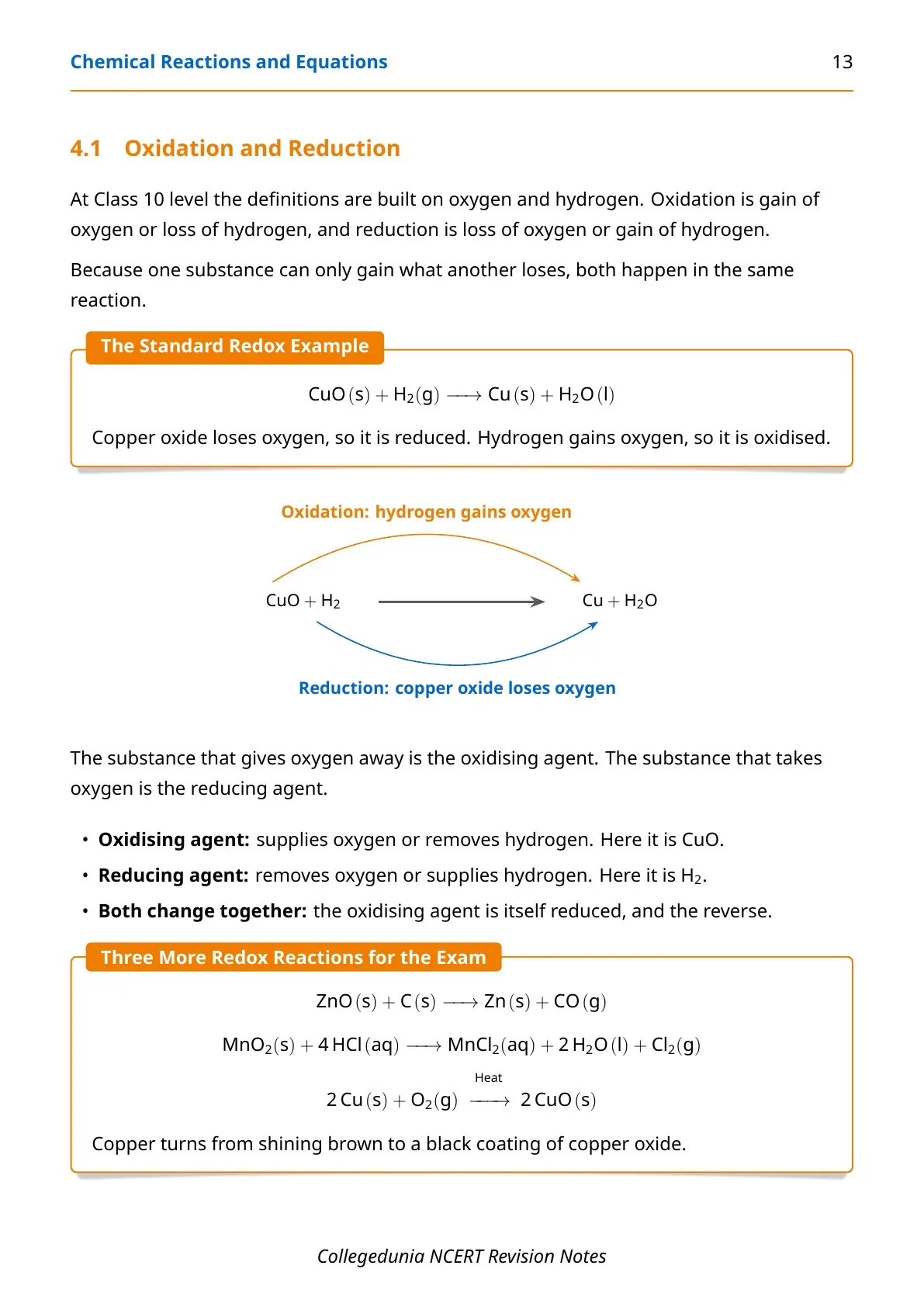
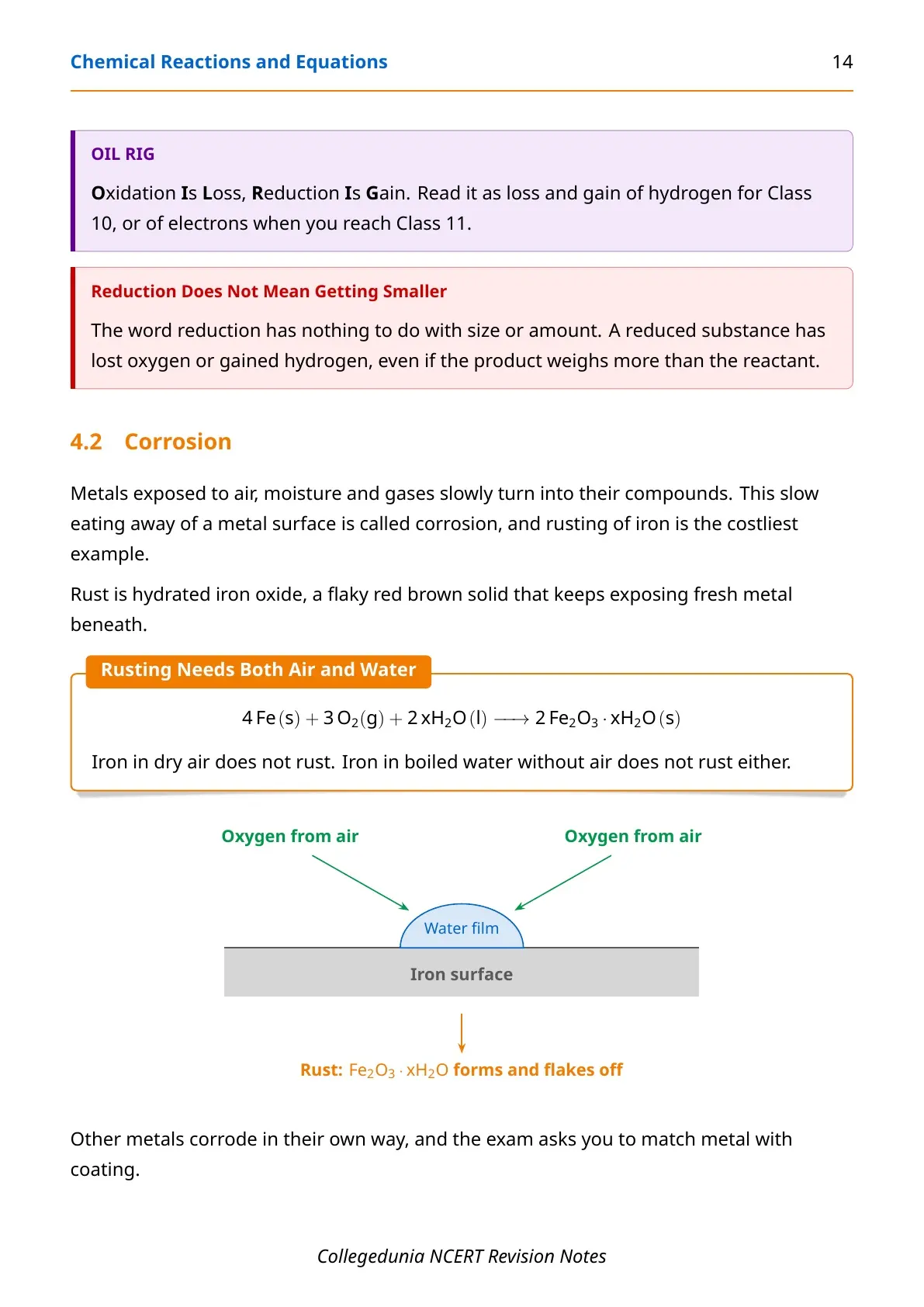
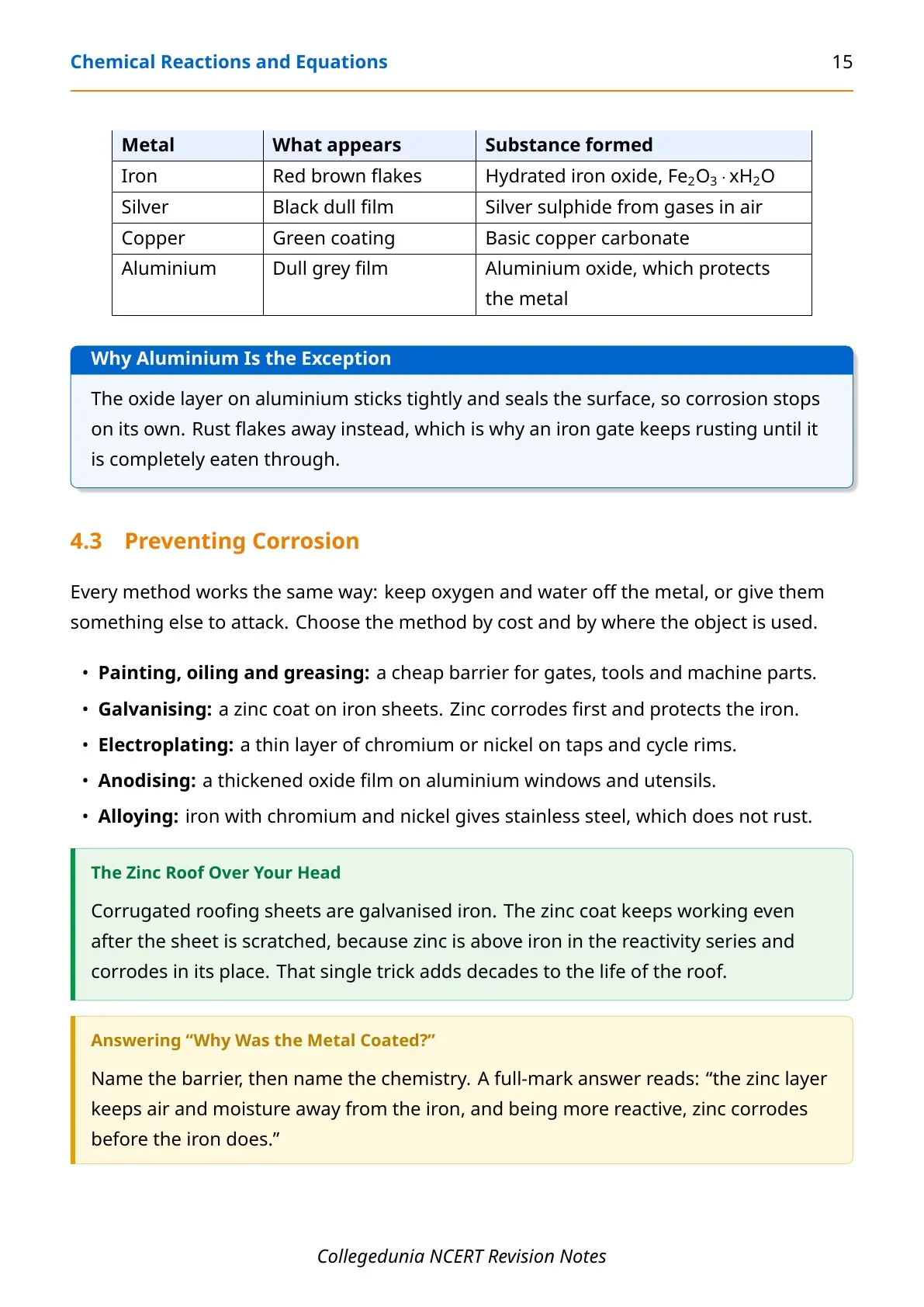
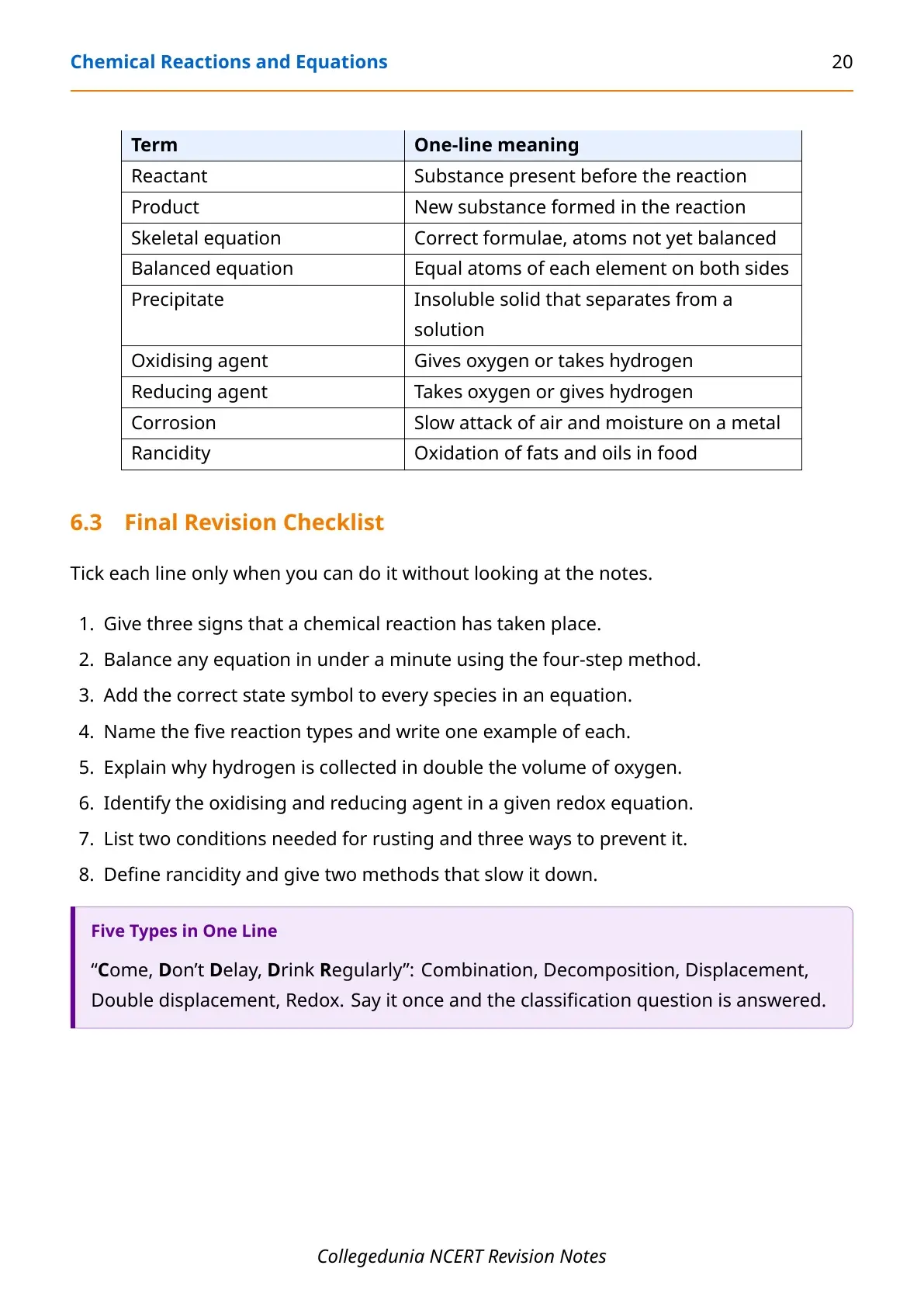
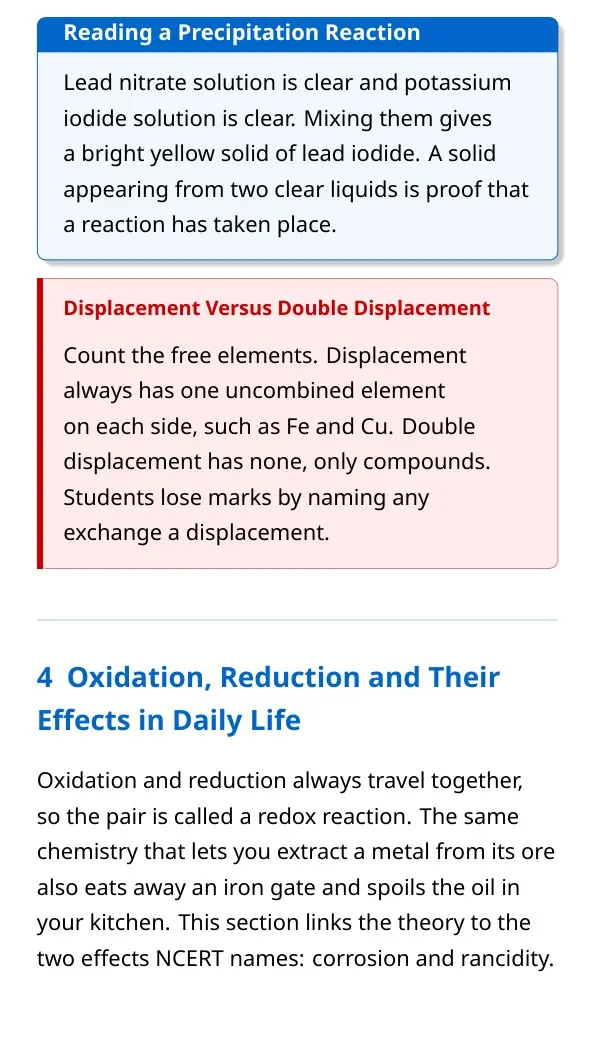
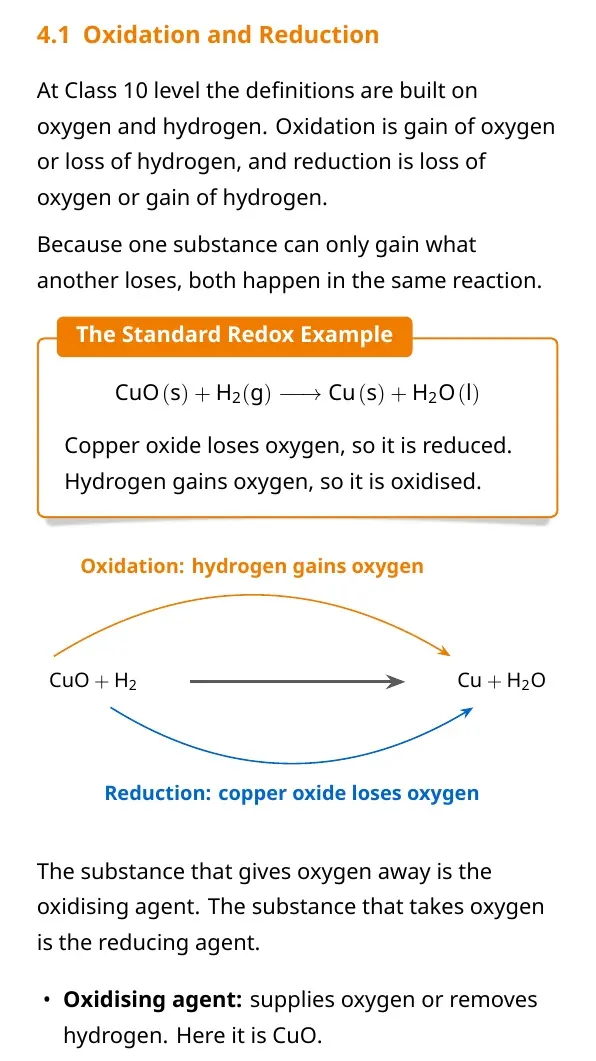
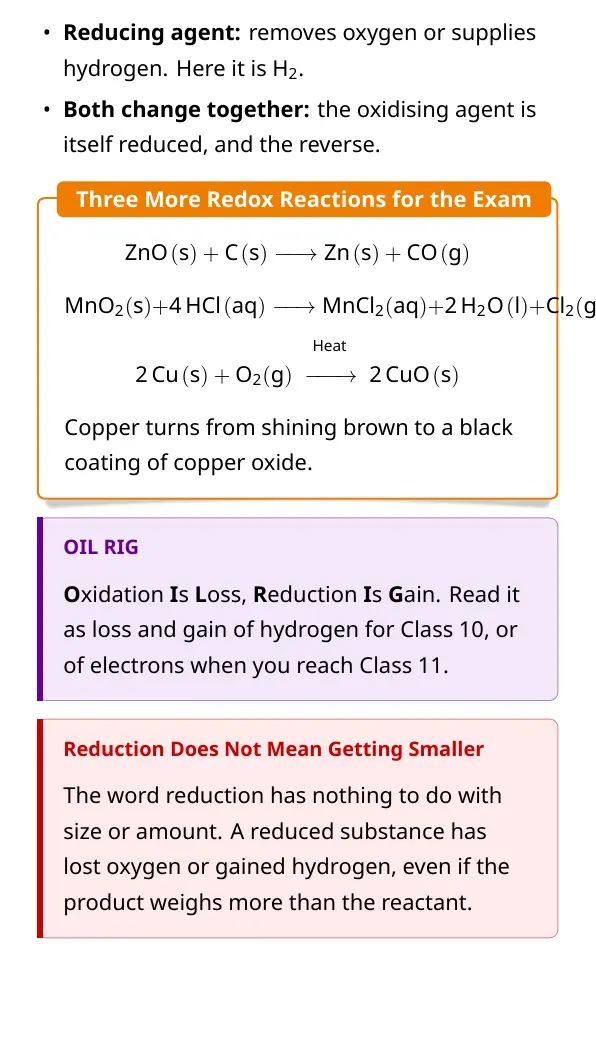
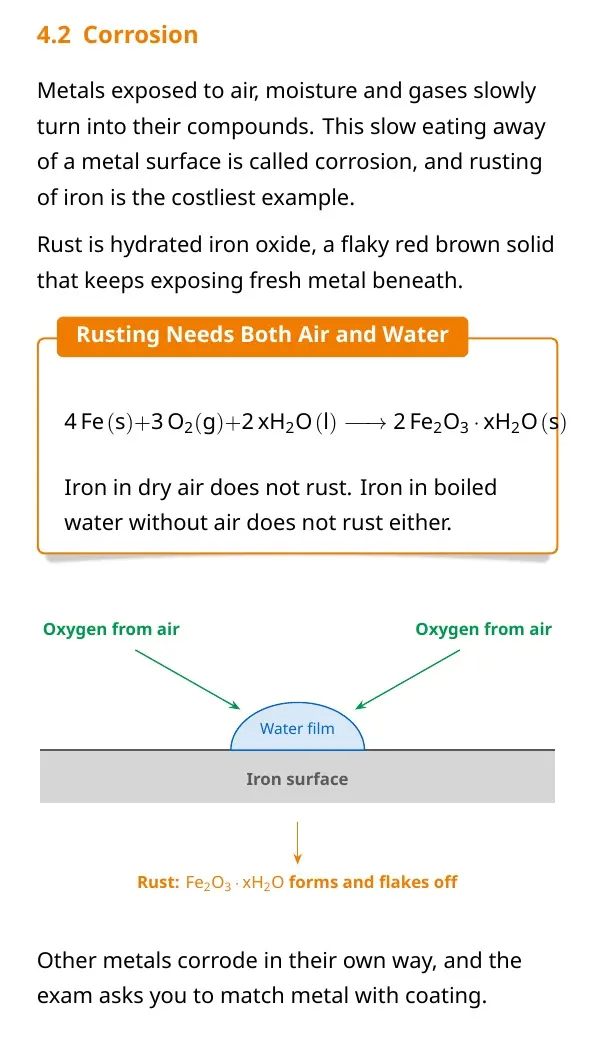
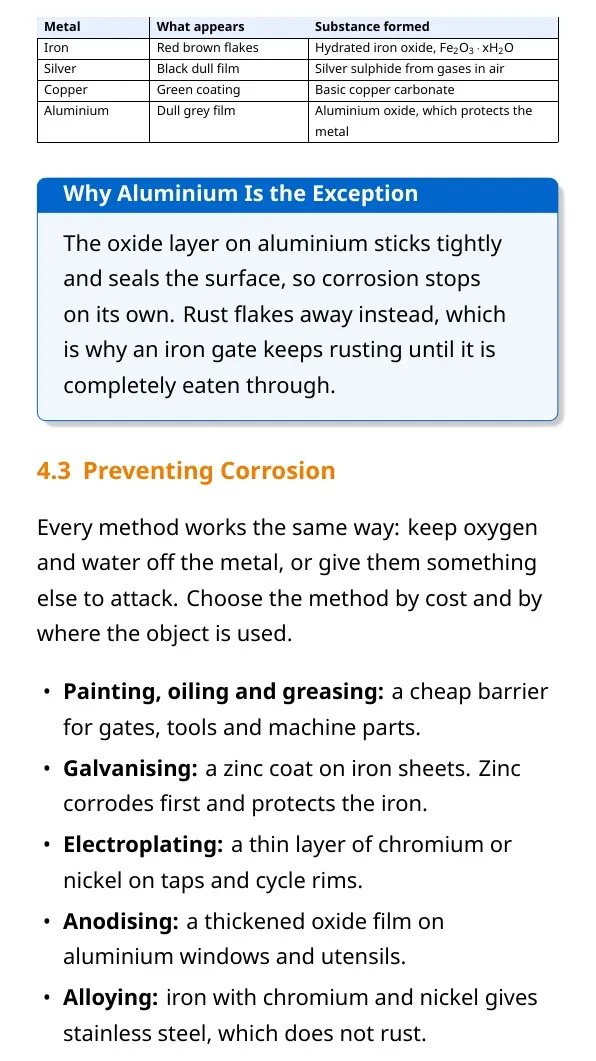
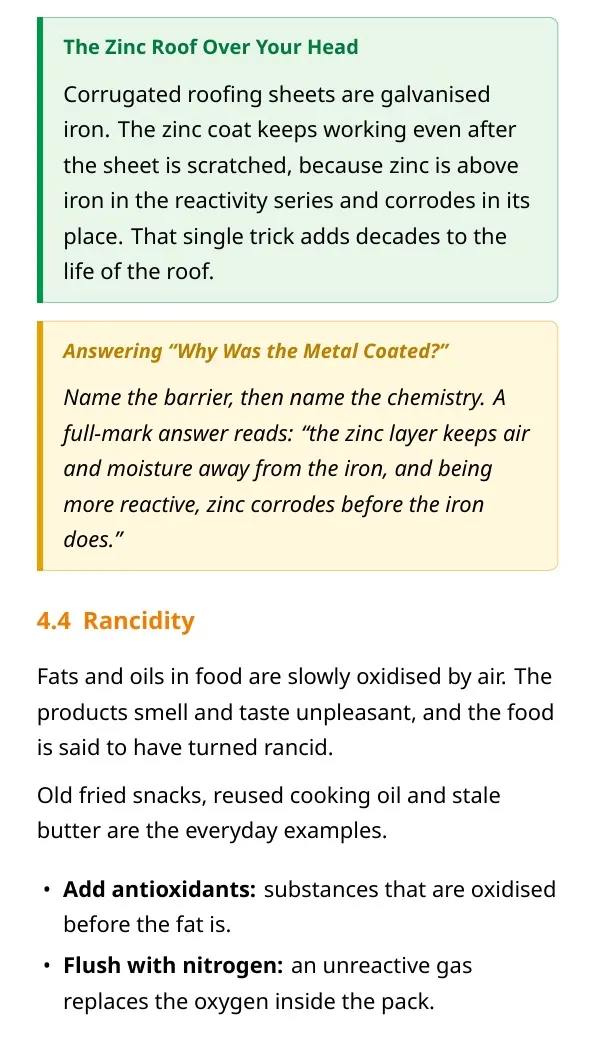
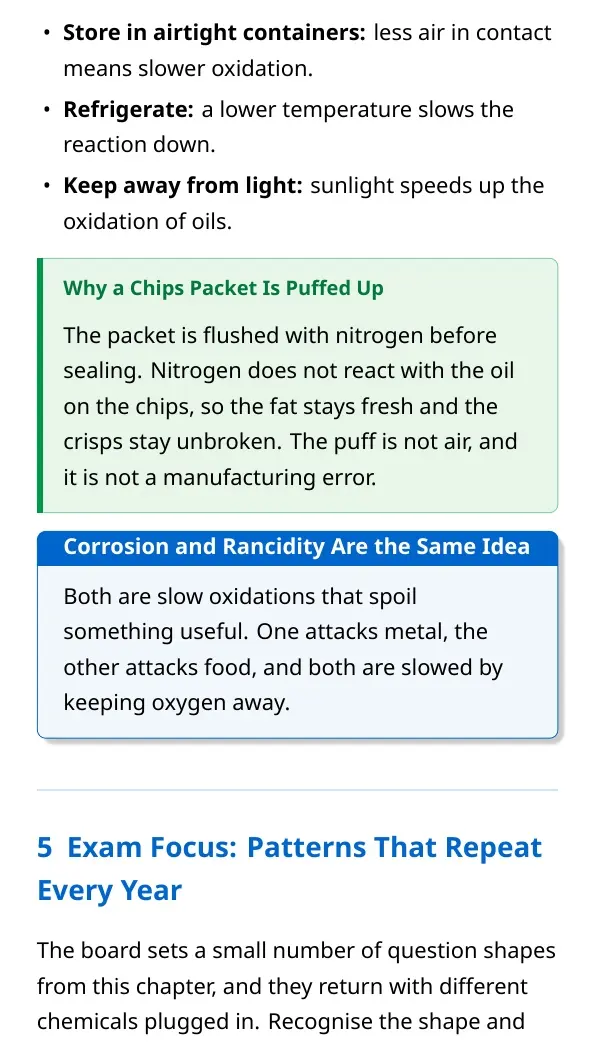
Oxidation is the gain of oxygen or the loss of hydrogen. Reduction is the loss of oxygen or the gain of hydrogen. Both happen together in a redox reaction. In CuO(s) + H2(g) → Cu(s) + H2O(l), copper oxide is reduced and hydrogen is oxidised. Corrosion is the slow attack on a metal surface by air and moisture. Iron rusts to a brown flaky layer, silver turns black, and copper turns green. Rancidity is the oxidation of fats and oils in stored food, which gives a bad smell and taste.
Chemical Reactions and Equations Topic-wise Weightage for CBSE Class 10 Science
Balancing and reaction types carry the most marks in this chapter. Study the two High rows first, then the Medium rows.
| Sub-topic | Weightage | CBSE Frequency |
|---|---|---|
| Balancing a chemical equation | High | Almost every year |
| Types of reactions and their examples | High | Almost every year |
| Oxidation, reduction and redox | Medium | 3 out of last 5 years |
| Corrosion and rancidity | Medium | 3 out of last 5 years |
| Exothermic and endothermic changes | Medium | 2 out of last 5 years |
| Symbols for physical states | Low | 1 out of last 5 years |
Chemical Reactions and Equations: Most Repeated Questions in CBSE Board Exams
The four questions below return in some form in most Class 10 Science papers. Write the equation first, then the one-line reason.
Q1. Why is respiration called an exothermic reaction?
Glucose reacts with oxygen in our cells and gives carbon dioxide, water and energy. Since the reaction releases energy, it is exothermic.
Q2. Why is a white silver chloride sample kept in a dark bottle?
Sunlight breaks silver chloride into silver and chlorine, and the white solid turns grey. A dark bottle stops this photolytic decomposition.
Q3. What is observed when an iron nail is dipped in copper sulphate solution?
The blue colour fades to pale green and a brown coating forms on the nail. Iron is more reactive, so it displaces copper.
Q4. What is rancidity, and how is it slowed down?
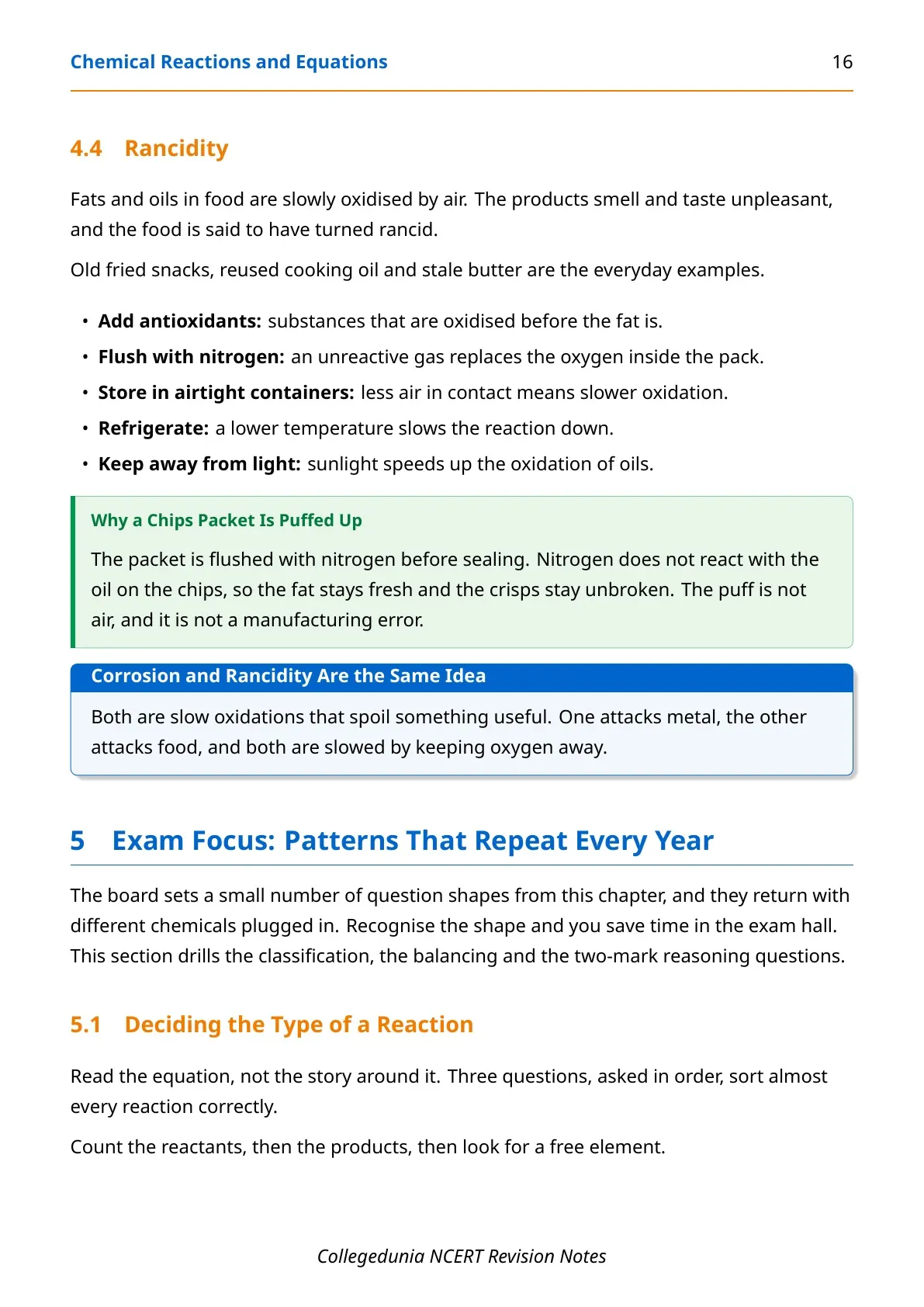
Rancidity is the oxidation of fats and oils in food. Antioxidants, airtight packing and flushing the pack with nitrogen slow it down.
Chemical Reactions and Equations Important Equations for Class 10 Boards
Learn these five equations with their states of matter. Board questions often give you the reaction in words and ask for the balanced form.
- Burning of magnesium: 2Mg(s) + O2(g) → 2MgO(s), the standard combination example.
- Heating limestone: CaCO3(s) → CaO(s) + CO2(g), thermal decomposition used in lime kilns.
- Electrolysis of water: 2H2O(l) → 2H2(g) + O2(g), with twice as much hydrogen as oxygen.
- Iron in copper sulphate: Fe(s) + CuSO4(aq) → FeSO4(aq) + Cu(s), the displacement example.
- Lead nitrate and potassium iodide: Pb(NO3)2(aq) + 2KI(aq) → PbI2(s) + 2KNO3(aq), the yellow precipitate.
Chemical Reactions and Equations Topics Students Often Get Confused About
Three pairs cause most of the lost marks in this chapter. Fix them before the exam, because questions are often set on the difference itself.
- Combination vs exothermic - combination describes what joins; exothermic describes the heat given out. A reaction can be both.
- Displacement vs double displacement - one element replaces another in the first; two compounds exchange ions in the second.
- Corrosion vs rancidity - corrosion attacks a metal surface; rancidity spoils the fats and oils in food. Both are oxidation.
How Frequently Has Chemical Reactions and Equations Been Asked in CBSE Class 10 Science?
Three topics carry the repeat questions. The year-by-year question map, with marks per question, sits on the NCERT Solutions page for this chapter.
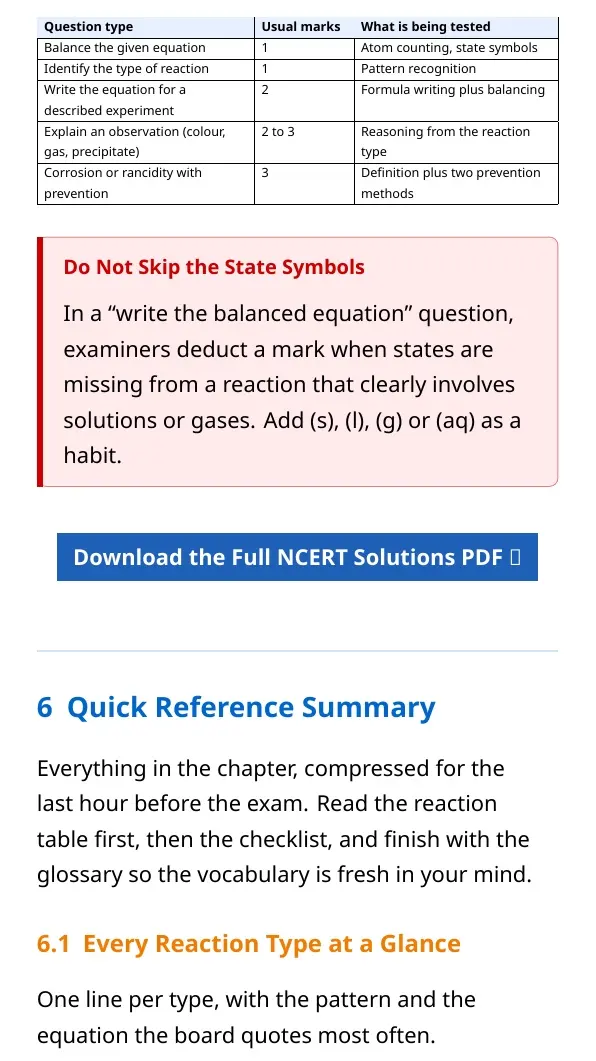
- Balance the given equation: a 1-mark or 2-mark question in nearly every paper, usually with states of matter asked for.
- Identify the reaction type and give a reason: a 3-mark question built on displacement or decomposition.
- Rancidity or corrosion in daily life: a 2-mark question, often set as a short case-based item.
Full year-wise PYQ map: Chemical Reactions and Equations Class 10 Science NCERT Solutions
Where You See Chemical Reactions and Equations in Daily Life
Case-based questions in the board paper use these settings, so link each one to its reaction type as you revise.
- Rusting of gates and railings: iron reacts with air and moisture, which is why painting and galvanising are used.
- Chips packets filled with nitrogen: nitrogen keeps oxygen away from the oil, so rancidity is delayed.
- Lime kilns and cement plants: limestone is heated to give quicklime, a thermal decomposition run at a large scale.
- Black and white photography: light breaks down silver chloride, the same photolytic decomposition as in the lab activity.
Related Links:
- Acids, Bases and Salts Class 10 Science Notes
- Chemical Reactions and Equations Class 10 Science Handwritten Notes
2026-27 NCERT Update: Chemical Reactions and Equations Changes Summary
The current 2026-27 syllabus keeps this chapter whole. You still study chemical equations, the four reaction types, redox, corrosion and rancidity, and the activity list is unchanged.
Detailed kept-trimmed-removed table: Class 10 Science Chapter 1 NCERT Book PDF
More Chemical Reactions and Equations Science Class 10 Resources
- Chemical Reactions and Equations Class 10 Science NCERT Solutions
- Chemical Reactions and Equations Class 10 Science Notes
- Chemical Reactions and Equations Class 10 Science Formula Sheet
- Chemical Reactions and Equations Class 10 Science NCERT Book PDF
- Chemical Reactions and Equations Class 10 Science NCERT Exemplar Book PDF
- Chemical Reactions and Equations Class 10 Science NCERT Exemplar Solutions
- Chemical Reactions and Equations Class 10 Science Handwritten Notes
NCERT Notes for Class 10 Science: All Chapters
Use this table to jump to the notes for any other chapter of the Class 10 Science book.
| Chapter | Resource |
|---|---|
| Chapter 1 | Chemical Reactions and Equations Notes |
| Chapter 2 | Acids, Bases and Salts Notes |
| Chapter 3 | Metals and Non-metals Notes |
| Chapter 4 | Carbon and its Compounds Notes |
| Chapter 5 | Life Processes Notes |
| Chapter 6 | Control and Coordination Notes |
| Chapter 7 | How do Organisms Reproduce Notes |
| Chapter 8 | Heredity Notes |
| Chapter 9 | Light Reflection and Refraction Notes |
| Chapter 10 | The Human Eye and the Colourful World Notes |
| Chapter 11 | Electricity Notes |
| Chapter 12 | Magnetic Effects of Electric Current Notes |
| Chapter 13 | Our Environment Notes |
Chemical Reactions and Equations Class 10 Science Notes FAQs
Ques. Where can I download the Chemical Reactions and Equations Class 10 Science Notes PDF?
Ans. You can download the PDF directly from this page on Collegedunia. Both the Normal and HD versions are free.
Ques. Are these notes aligned with the 2026-27 NCERT?
Ans. Yes. They follow the current 2026-27 syllabus for Class 10 Science. Chapter 1 is retained in full, so every reaction type and activity in the notes is still examinable.
Ques. How many pages is the Class 10th Science Chemical Reactions and Equations Notes PDF?
Ans. The notes PDF runs about [page count] pages. It covers chemical equations, balancing, the four reaction types, redox, corrosion and rancidity.
Ques. What are the main types of chemical reactions in Class 10 Chapter 1?
Ans. Combination, decomposition, displacement and double displacement. Oxidation and reduction reactions are studied alongside them as redox changes.
Ques. How many marks does Chemical Reactions and Equations carry in the Class 10 board exam?
Ans. About 5 to 6 marks. The chapter is part of the 25-mark unit Chemical Substances: Nature and Behaviour.
Ques. What is the quickest way to balance a chemical equation?
Ans. Count the atoms of each element on both sides, then start with the element found in the fewest formulas. Change only the coefficients, never the subscripts, and finish with hydrogen and oxygen.



Comments