


The NCERT Book PDF for Class 10 Geography Chapter 3 Water Resources page brings together the full official chapter text that the CBSE board paper actually tests.
Students can read the water resources class 10 pdf online or download it free for the 2026-27 session. The chapter covers water scarcity, multi-purpose river projects, dams, rainwater harvesting, and traditional water conservation methods like tankas and bamboo drip irrigation.
- Source: Official NCERT Contemporary India II textbook, Chapter 3, 2026-27 reprint.
- Exam value: carries about 6 to 7 marks in the CBSE Class 10 Social Science paper.
- Key topics: water scarcity, multi-purpose river projects, dams, rainwater harvesting.
This Water Resources Class 10 PDF is the exact official NCERT chapter text, checked against the 2026-27 Contemporary India II reprint.
What the Water Resources Class 10 PDF Contains
The PDF holds the full Chapter 3 of the NCERT Contemporary India II book, printed as the 2026-27 edition. It covers the main concepts and ends with the back-exercise questions. A Collegedunia poll of 11,540 Class 10 students found that 72% kept the PDF open while solving past papers.
- Water scarcity: why regions face water shortage even when rainfall is high, and the role of over-exploitation and pollution.
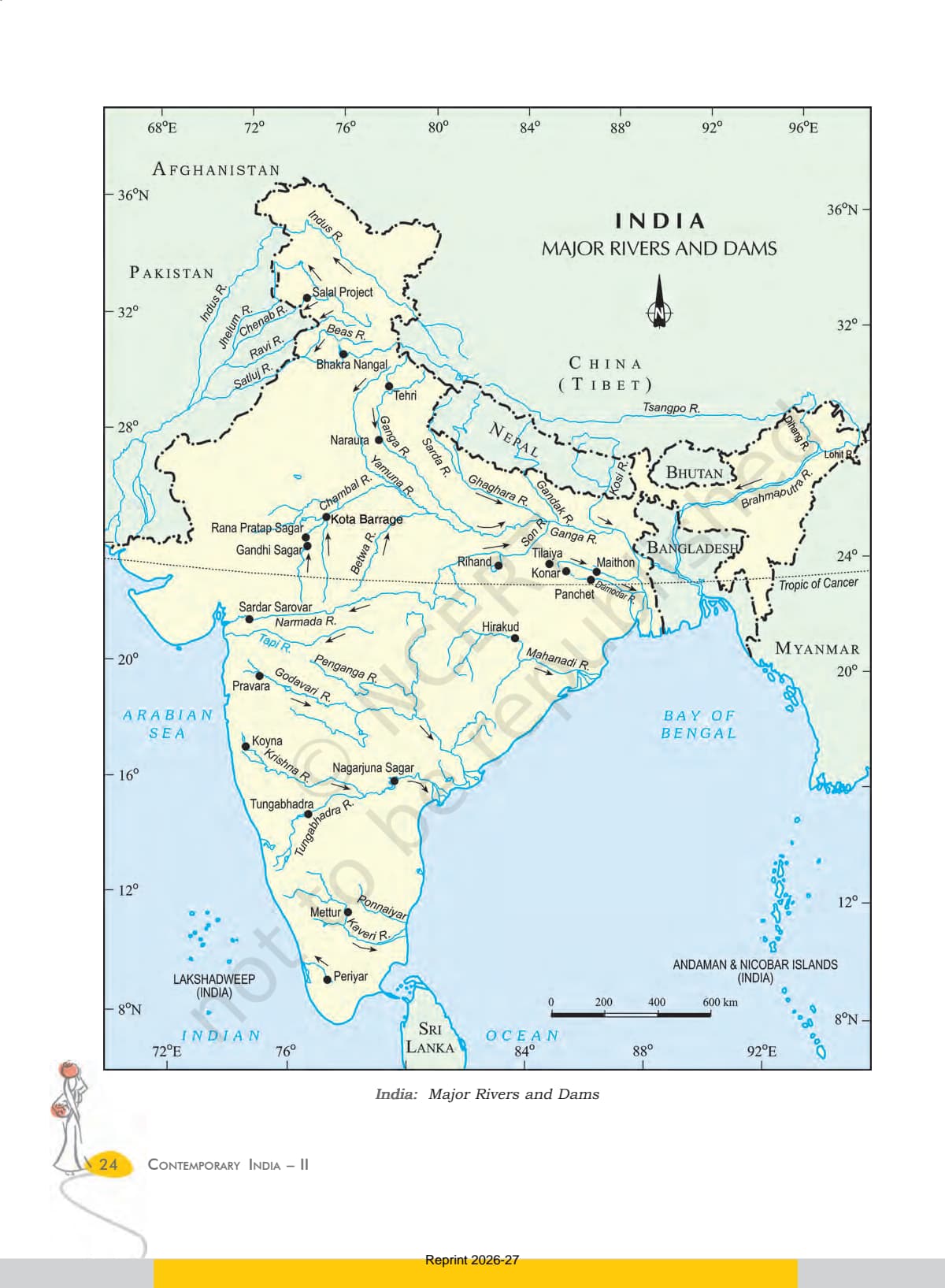
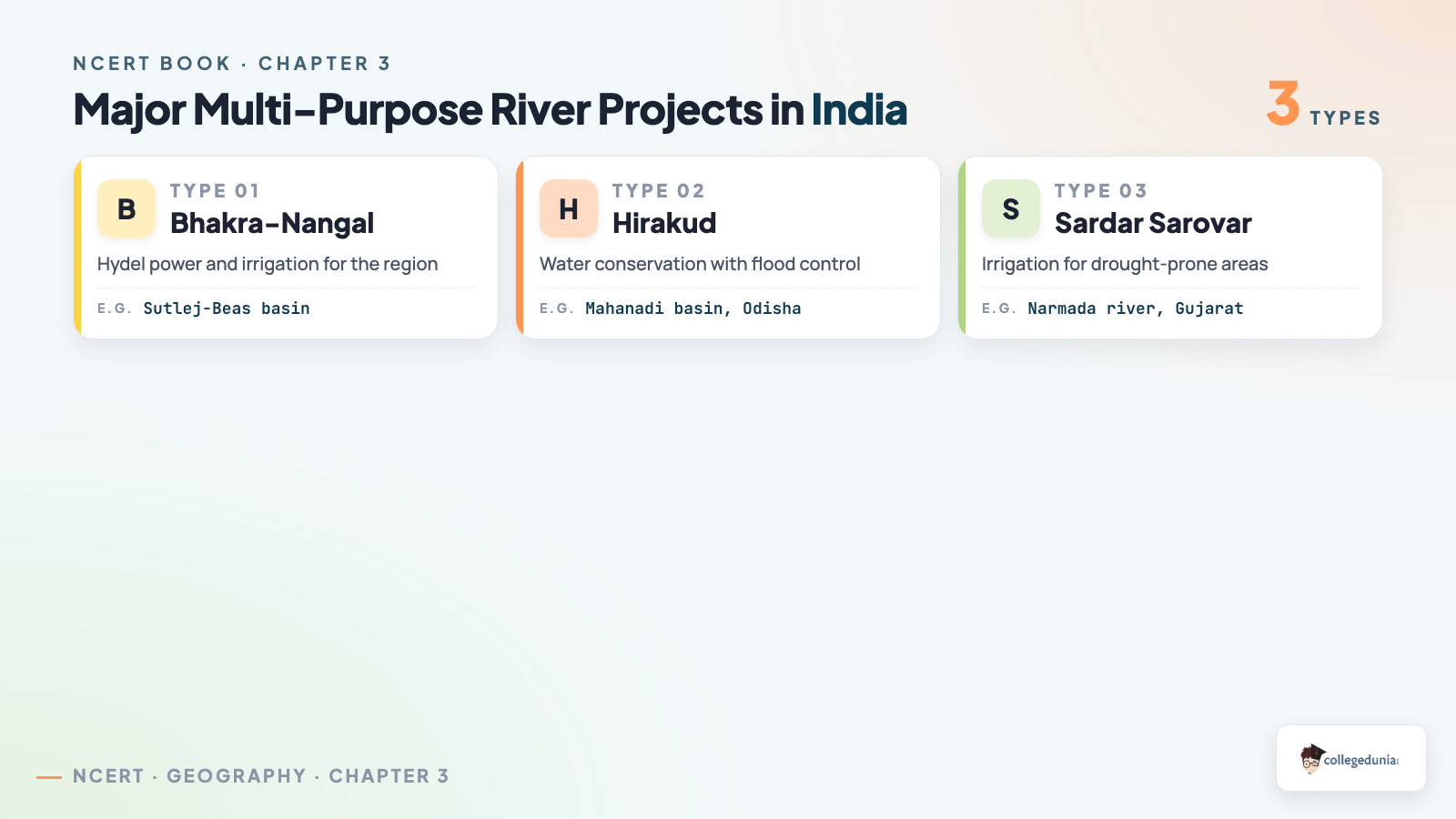
- Multi-purpose river projects: dams like Bhakra-Nangal, Hirakud, and Sardar Sarovar, with their uses and drawbacks.
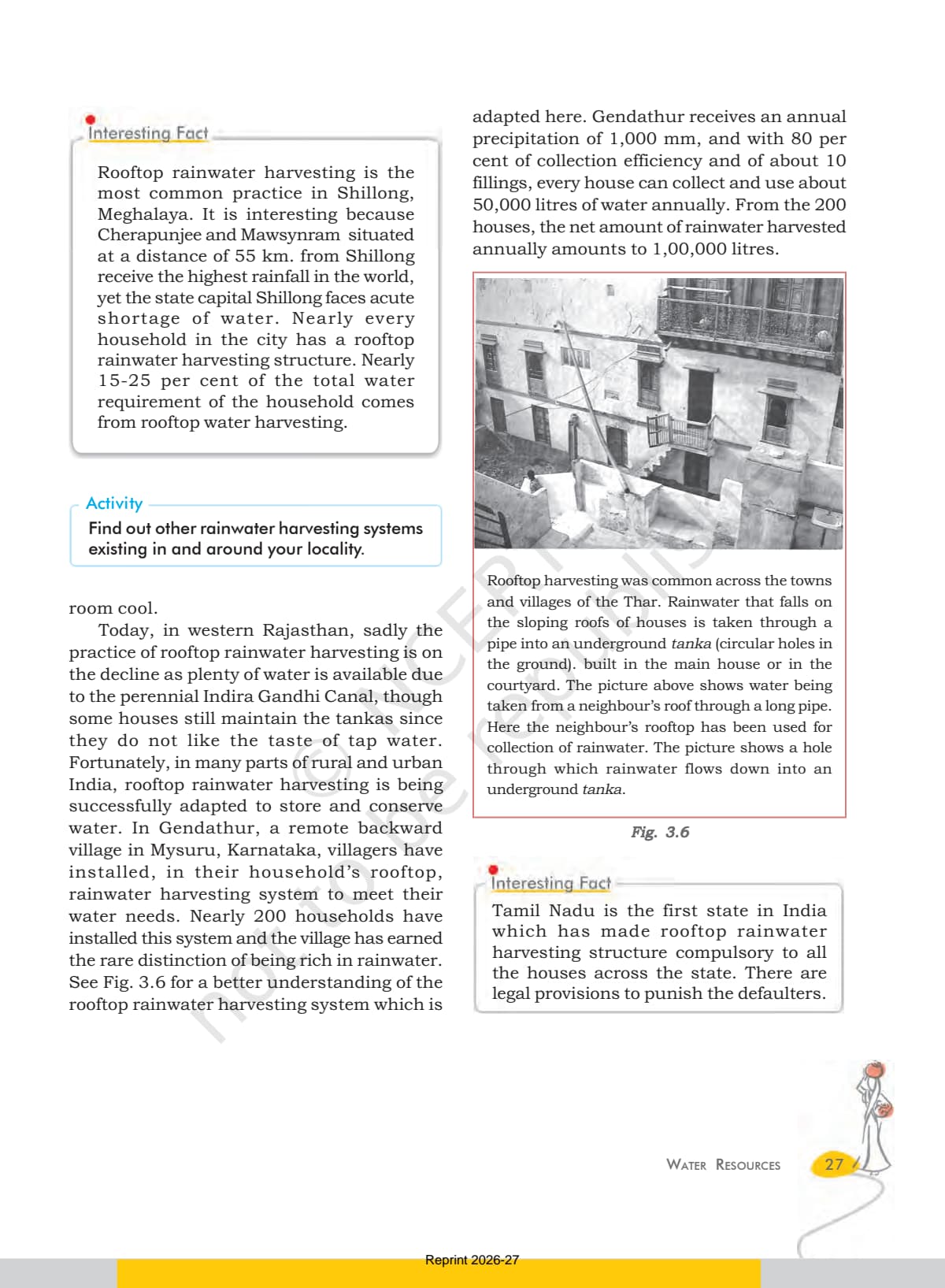
- Rainwater harvesting: guls, kuls, khadins, johads, tankas, and rooftop harvesting in Rajasthan and Meghalaya.
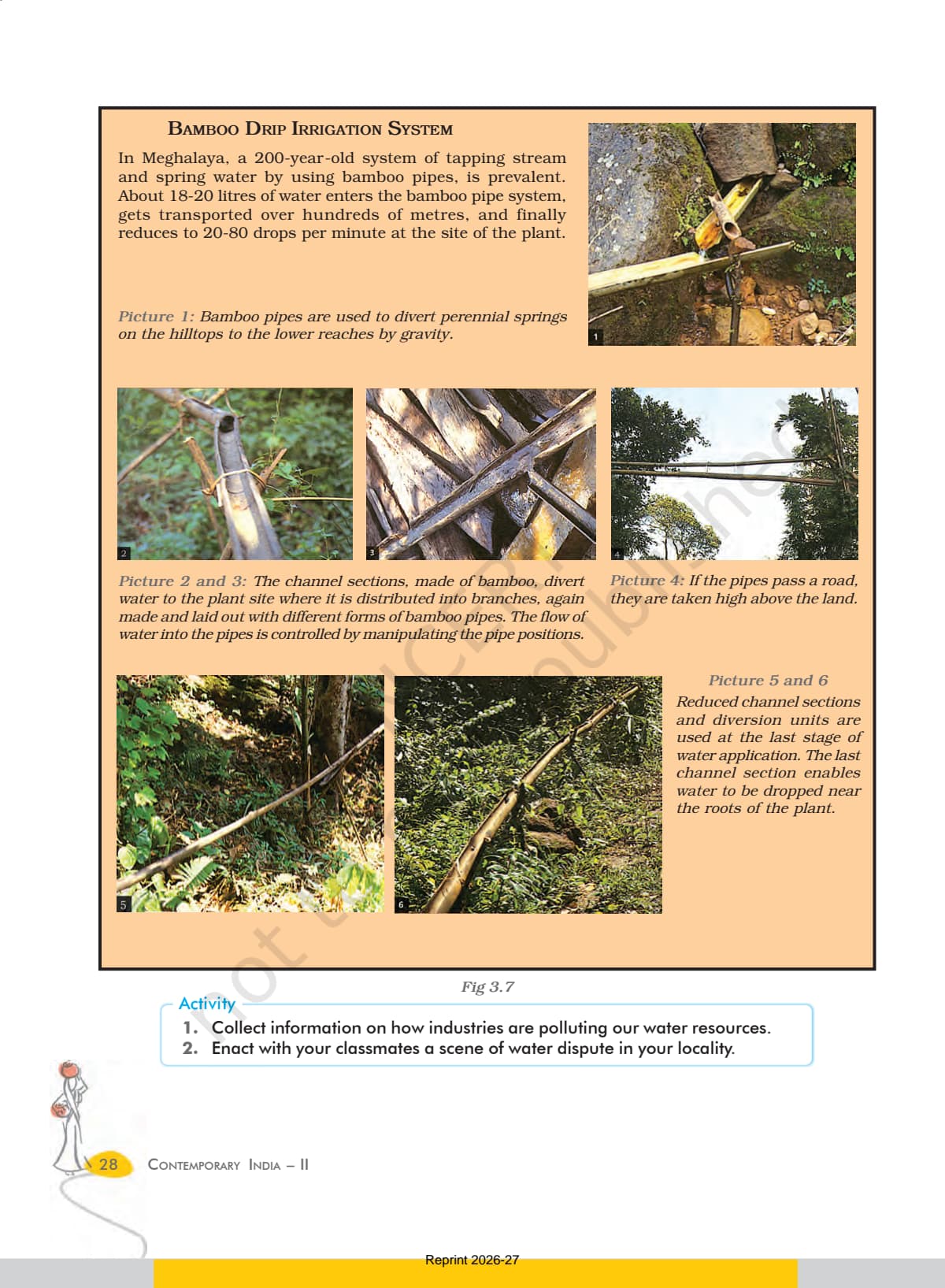
- Bamboo drip irrigation: the 200-year-old water system of Meghalaya that uses bamboo pipes.
- Government schemes: Jal Jeevan Mission, Atal Bhujal Yojana, and Pradhan Mantri Krishi Sinchayee Yojana.
Water Resources Class 10 Full Chapter Video
Source: Magnet Brains on YouTube
Water Resources Class 10 Notes Inside the Chapter
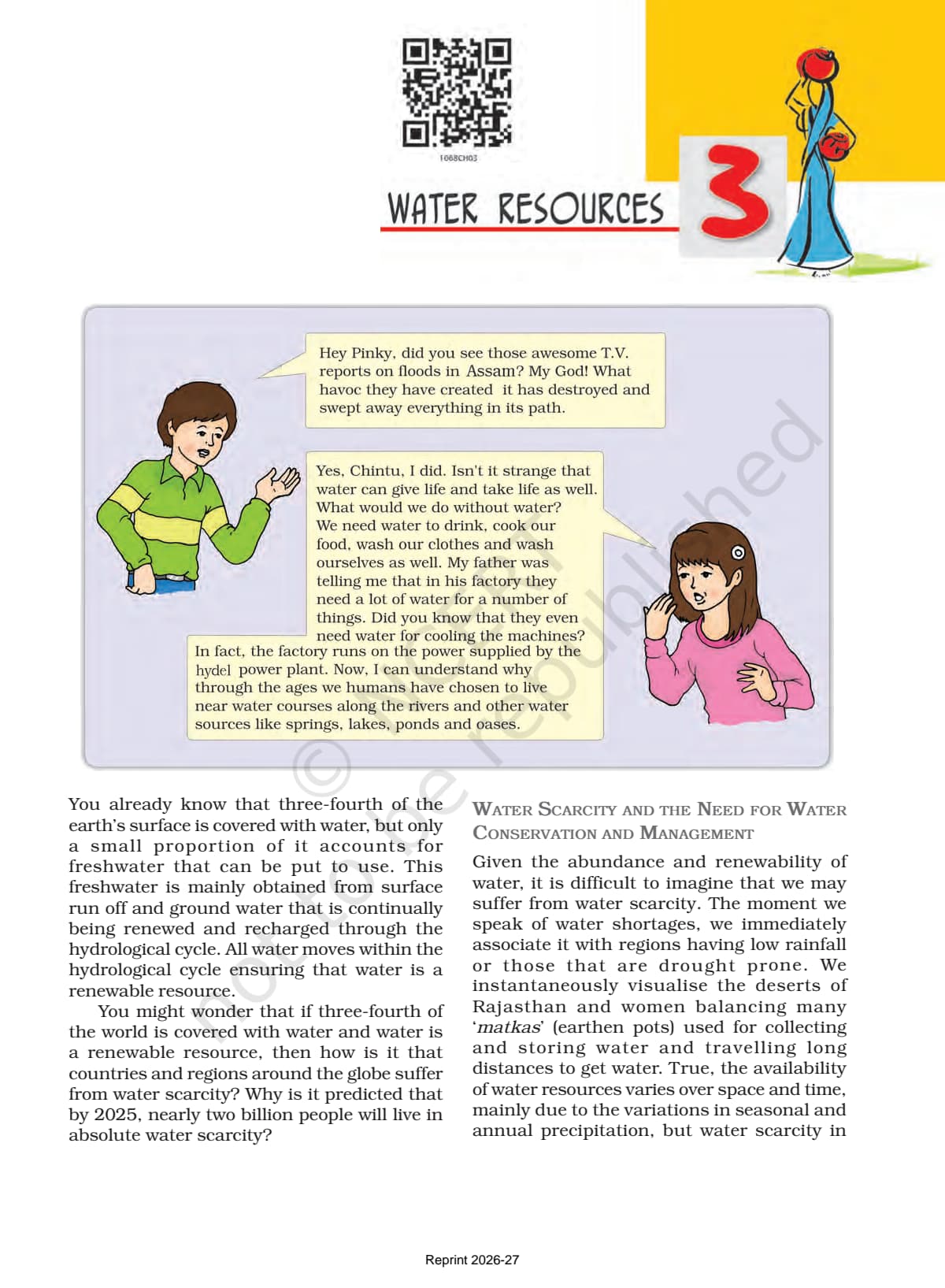
The chapter opens with the water cycle. Three-fourths of the earth's surface is covered with water, but only a small share is freshwater that we can use. It comes from surface run-off and groundwater, and the hydrological cycle keeps renewing it, so water is a renewable resource. Yet many regions still face water scarcity.
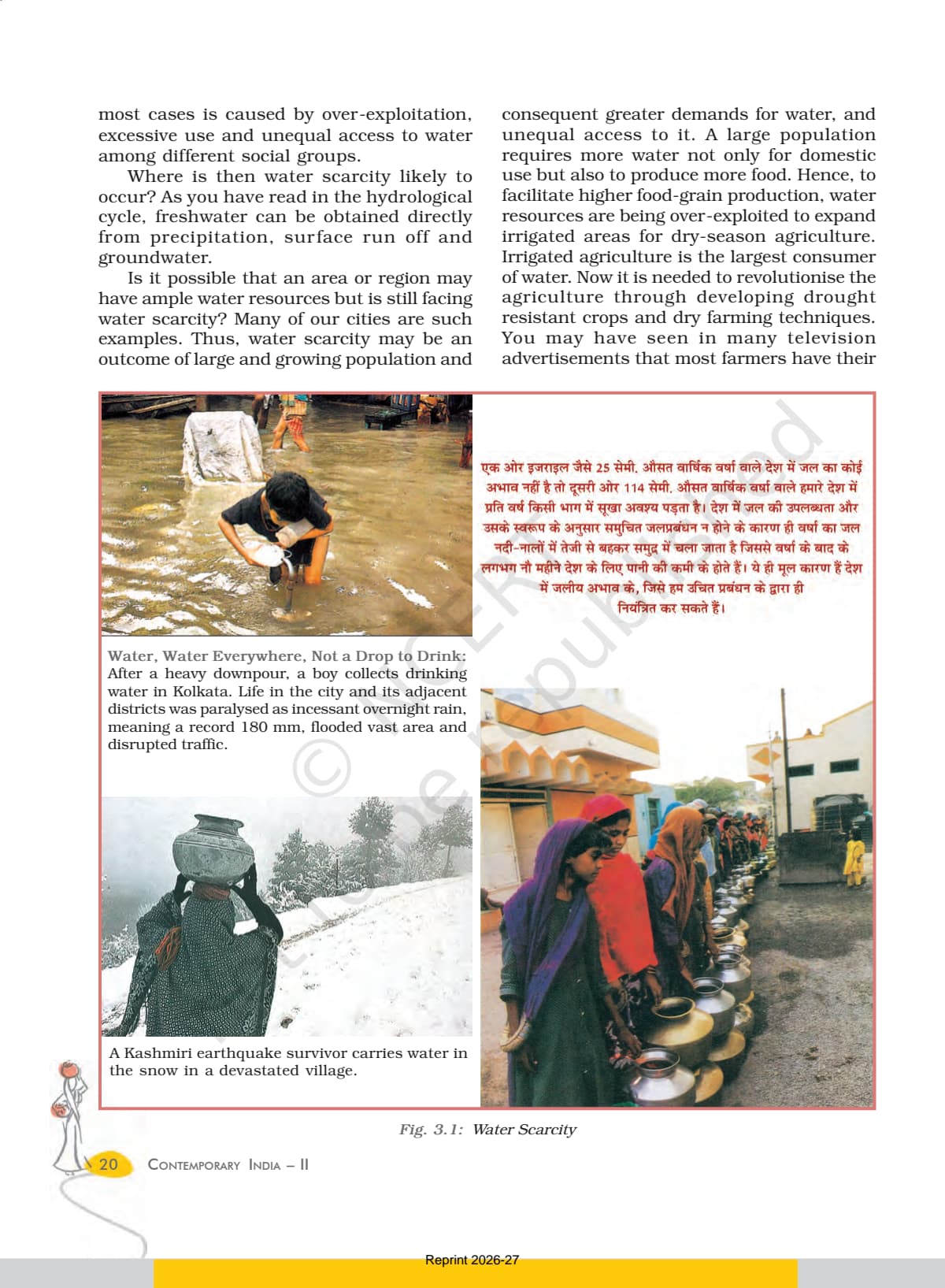
Water scarcity is not always about low rainfall. By 2025, nearly two billion people are predicted to live in absolute water scarcity. It is often caused by over-exploitation, excessive use, and unequal access.
- Main causes: a large and growing population, more demand for food, and over-exploitation of groundwater for irrigation.
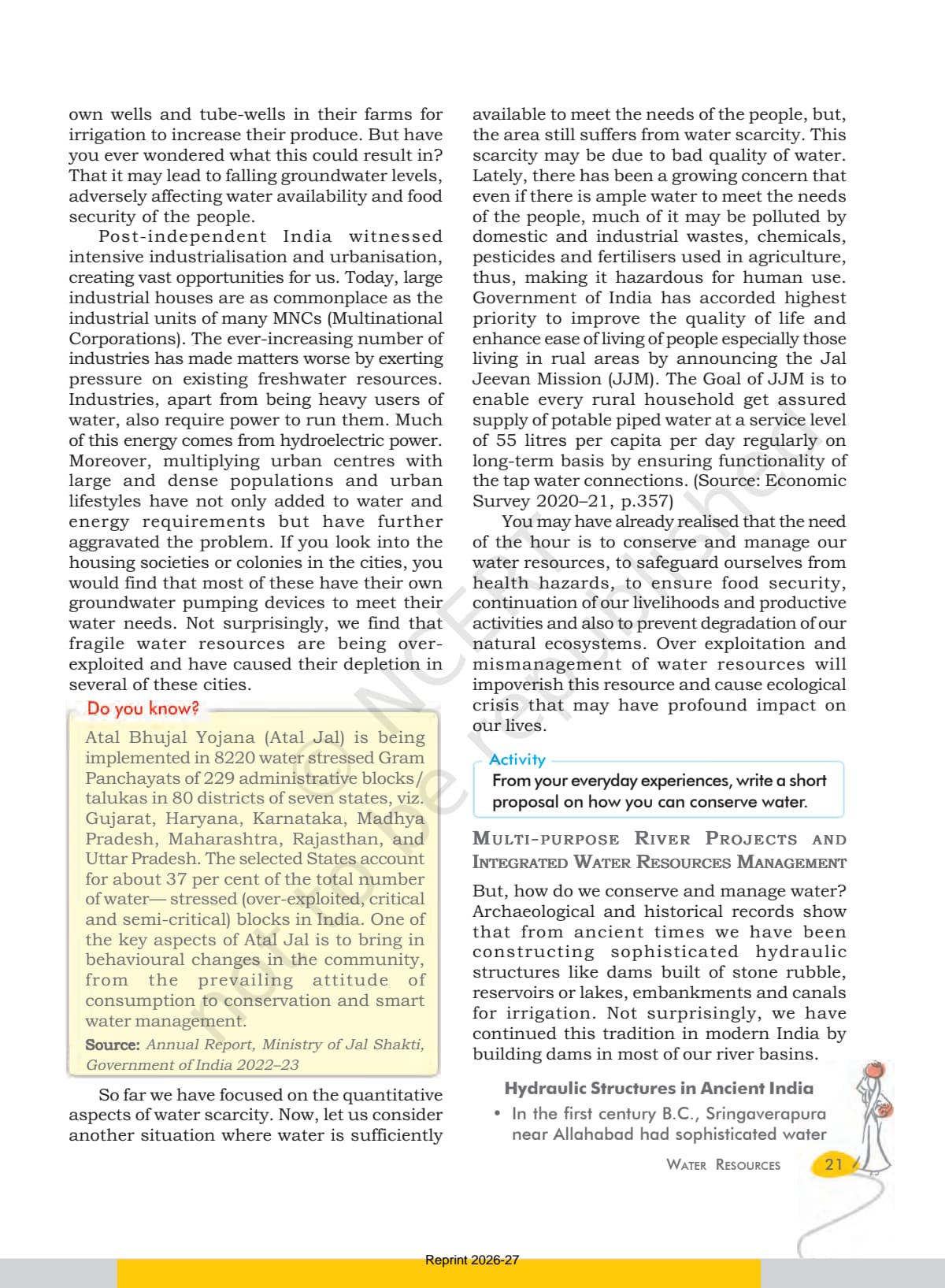
- Industry and cities: industries and dense urban colonies pump groundwater and add pressure on fragile water resources.
- Poor quality: water polluted by domestic and industrial waste, pesticides, and fertilisers is unsafe for human use.
Multi-Purpose River Projects and Dams in the Class 10 Geography PDF
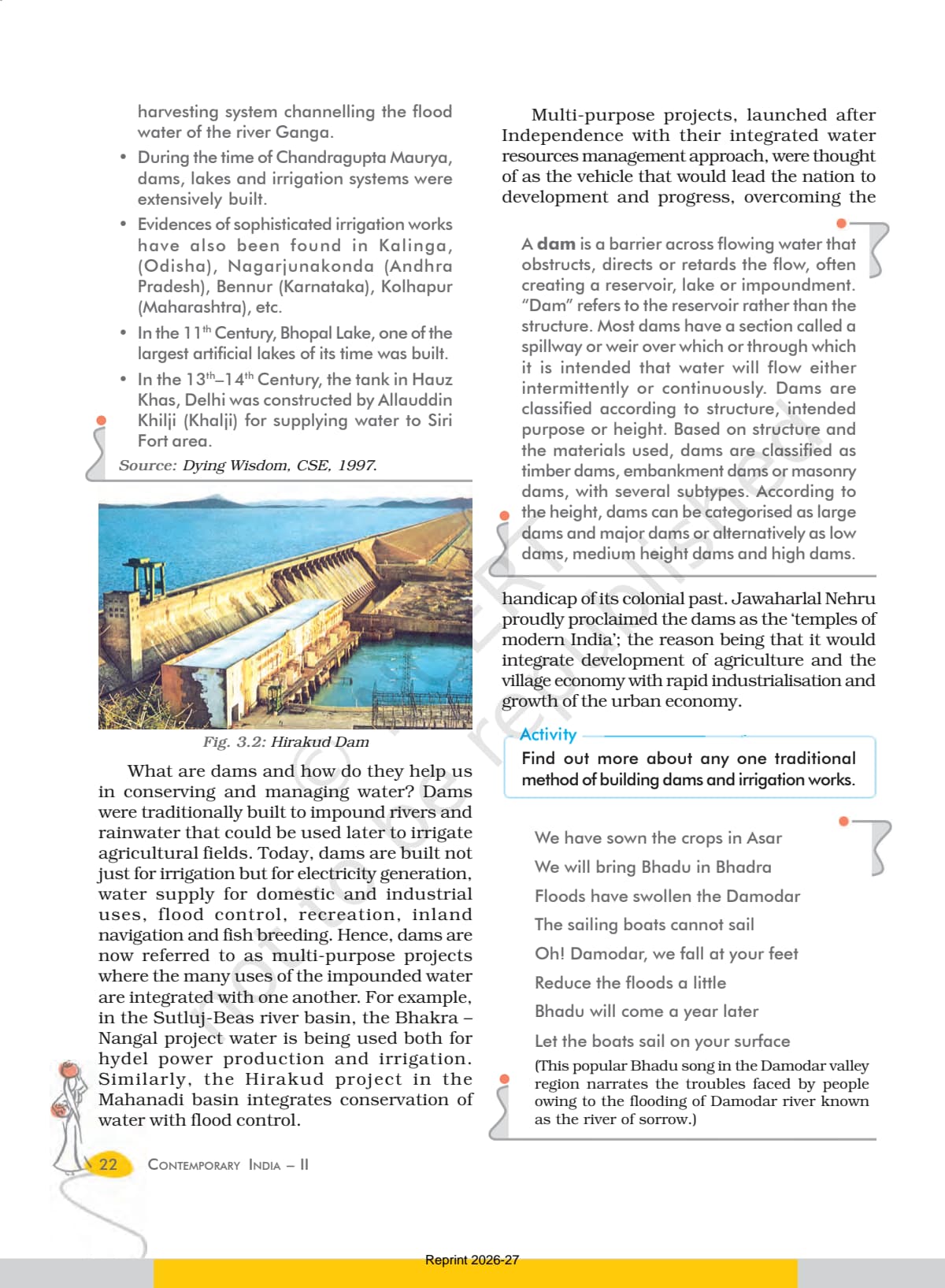
Dams were once built only to store river water for irrigation. Today they serve many uses at once, so they are called multi-purpose projects. One dam can give power, water supply, and flood control together.
Jawaharlal Nehru called the dams the "temples of modern India" because they joined farming, industry, and the urban economy. But in recent years, large dams have faced strong opposition for harming rivers and displacing people.
- Bhakra-Nangal project: on the Sutlej-Beas basin, used for both hydel power and irrigation.
- Hirakud project: on the Mahanadi basin, combines water conservation with flood control.
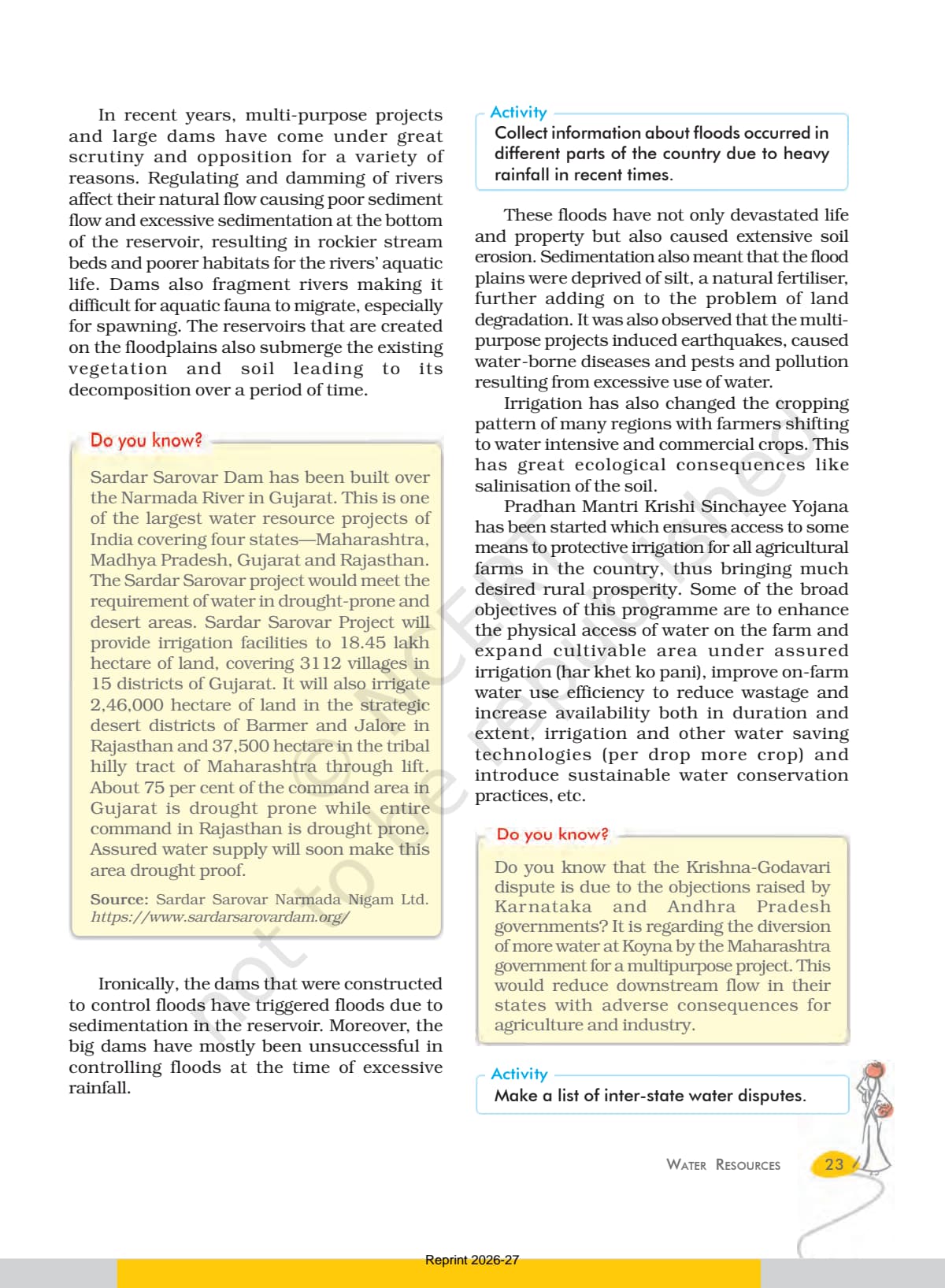
- Sardar Sarovar Dam: built on the Narmada in Gujarat, covering four states and irrigating drought-prone areas.
- Drawbacks: dams change river flow, cause sedimentation, submerge land, and can even trigger floods and earthquakes.
Water Resources Class 10 PDF Section-Wise Contents
The 2026-27 NCERT prints Water Resources across clear sections. Use the table below as a checklist.
| Section | Topic | What you will learn |
|---|---|---|
| 3.1 | Water Scarcity and the Need for Conservation | Why water is renewable yet scarce, and how over-use, pollution, and unequal access cause shortage |
| 3.2 | Multi-Purpose River Projects and Integrated Water Resources Management | What dams are, how they help, and the arguments for and against large dams |
| 3.3 | Rainwater Harvesting | Traditional and modern water-harvesting methods across Rajasthan, Meghalaya, and Karnataka |
Rainwater Harvesting Methods Covered in the Class 10 Geography Chapter 3 PDF
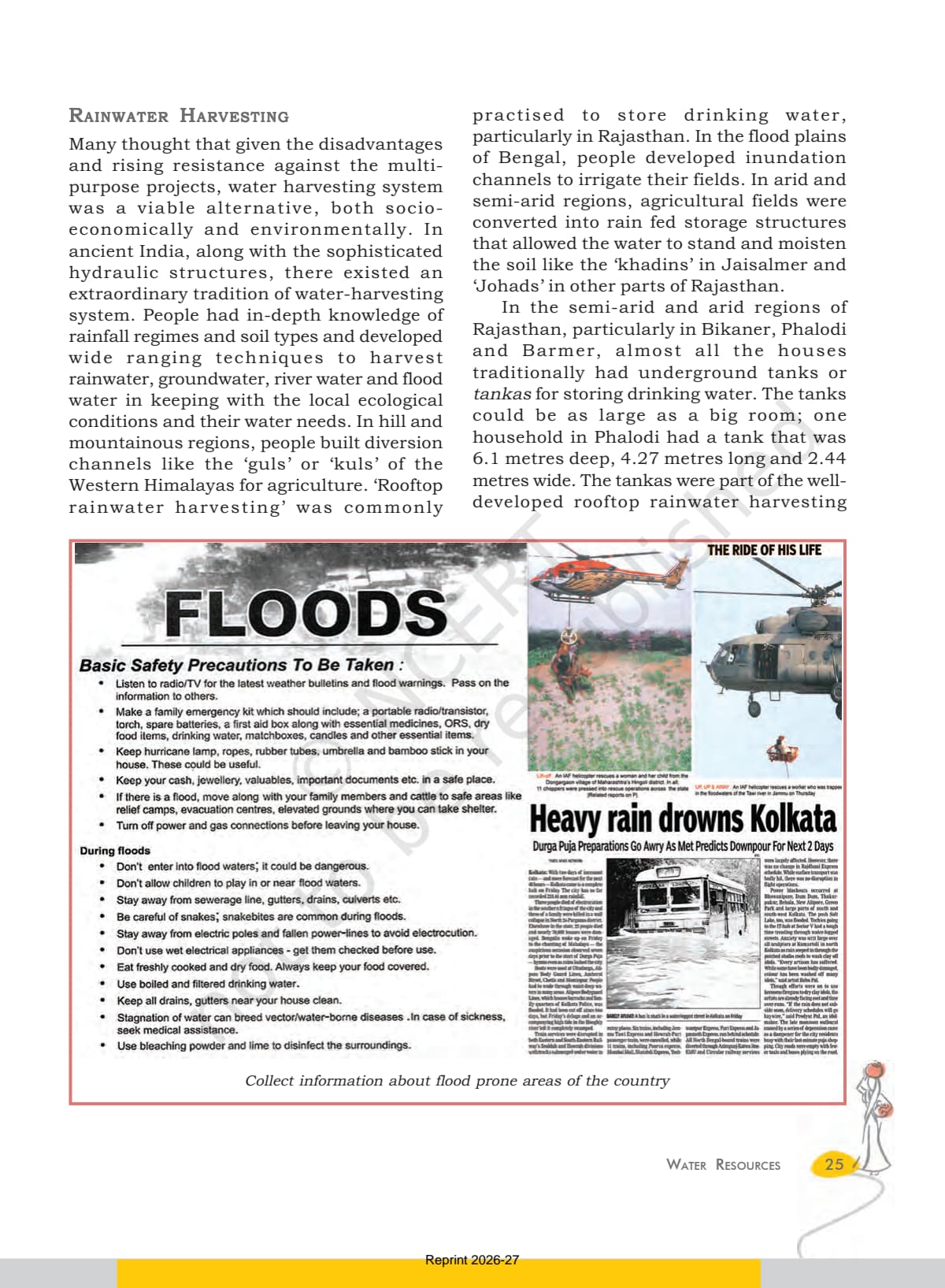
Many people saw rainwater harvesting as a better choice than big dams. India has an old tradition of harvesting rainwater, groundwater, and flood water in ways that suit the local land. This is a favourite match-the-column question in the board paper.
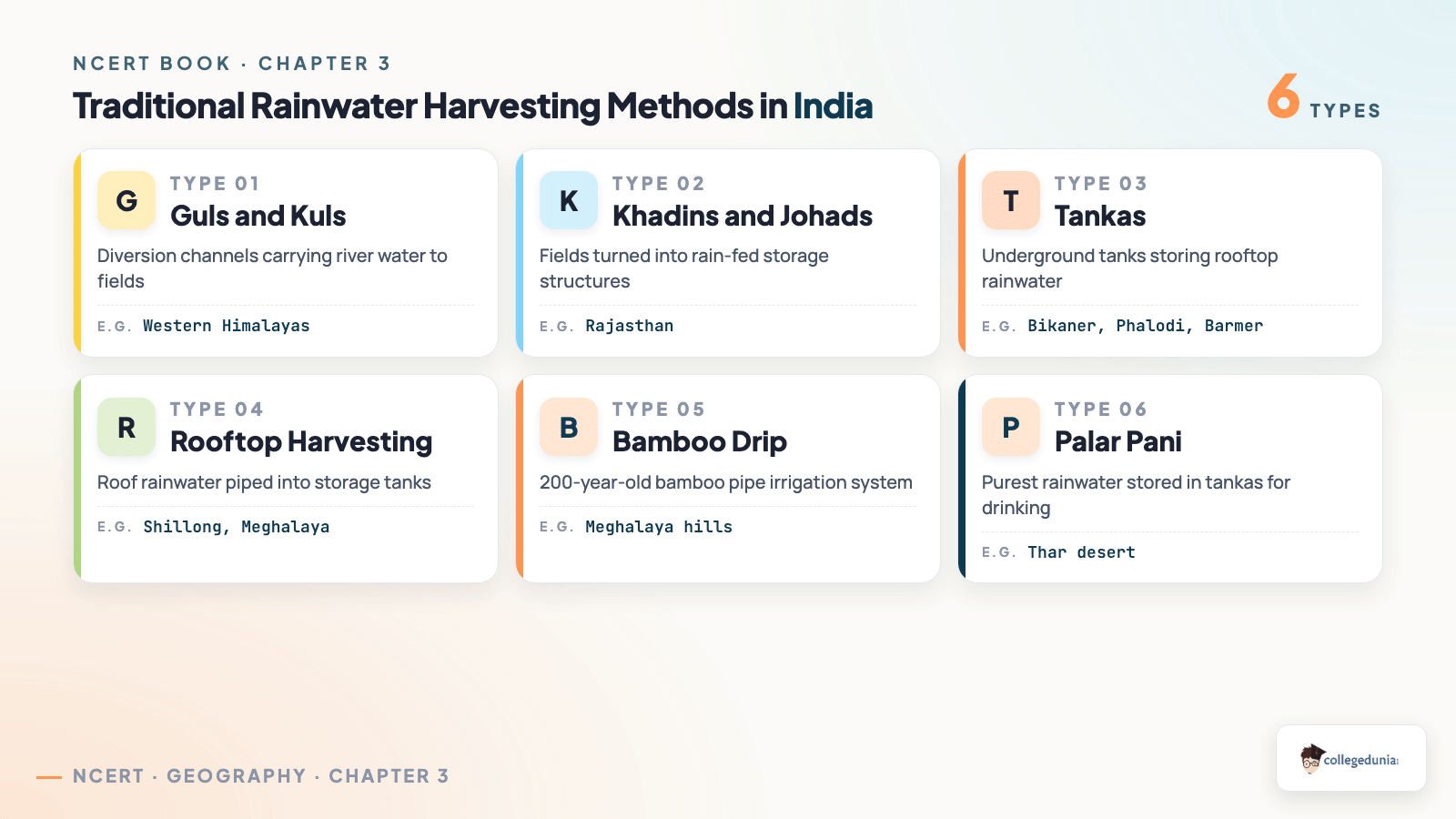
| Method | Region | How it works |
|---|---|---|
| Guls and kuls | Western Himalayas | Diversion channels that carry river water to fields for farming. |
| Khadins and johads | Rajasthan | Fields turned into rain-fed storage so water stands and moistens the soil. |
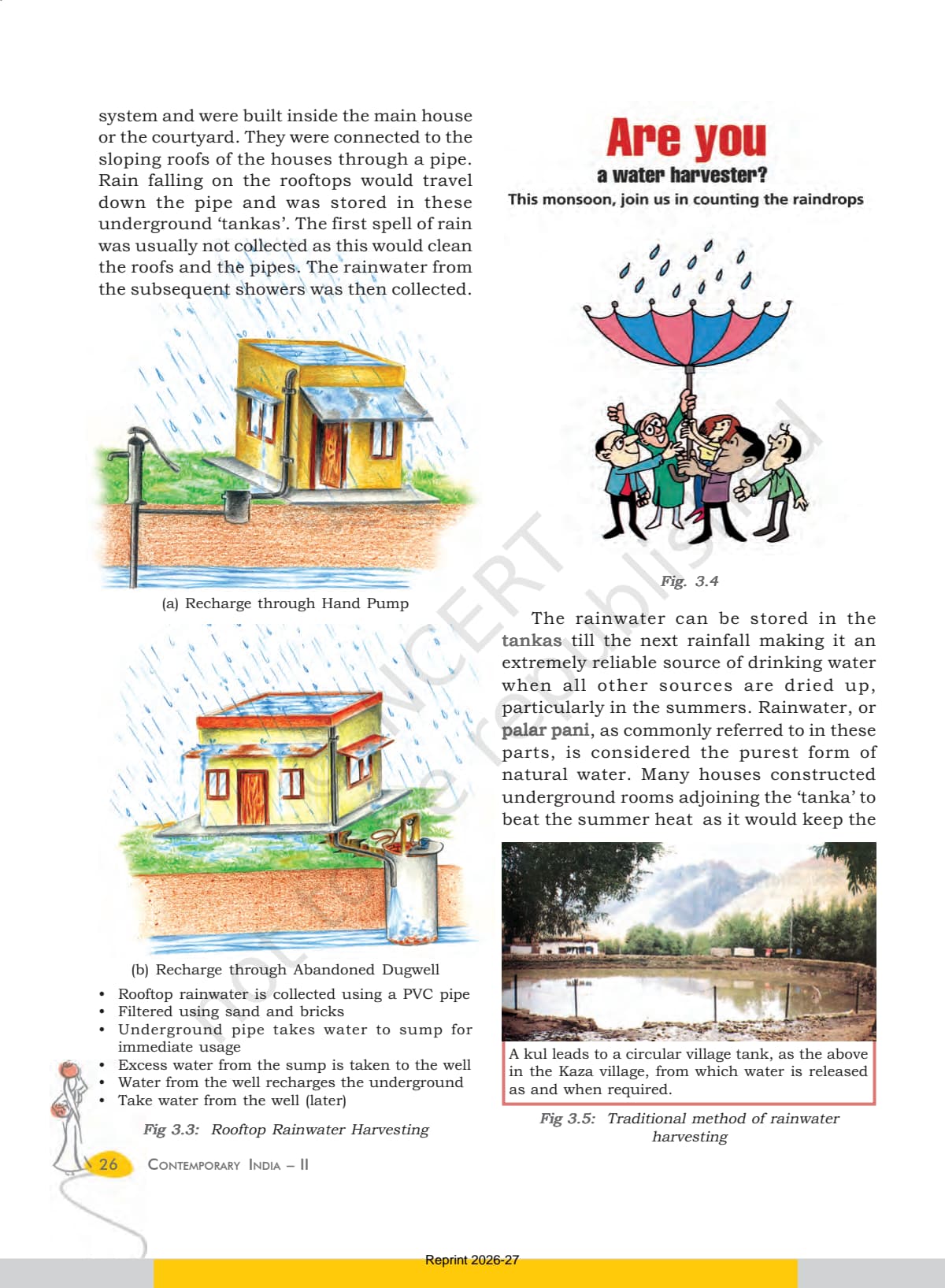
| Tankas | Bikaner, Phalodi, Barmer | Underground tanks that store rooftop rainwater, or palar pani, for drinking. |
| Rooftop harvesting | Shillong, Meghalaya | Roof rainwater piped into tanks; meets 15 to 25 per cent of household needs. |
In Gendathur, a village in Mysuru, Karnataka, nearly 200 households built rooftop systems. Tamil Nadu is the first state to make rooftop rainwater harvesting compulsory for all houses. In Meghalaya, a 200-year-old bamboo drip irrigation system still taps stream and spring water using bamboo pipes.
Government Schemes for Water in the Water Resources Class 10 PDF
The chapter lists the major water schemes of the government. These are short, fact-based points that often appear as 1-mark or 3-mark questions in the board exam.
- Jal Jeevan Mission (JJM): aims to give every rural household 55 litres of piped water per person each day.
- Atal Bhujal Yojana: works in water-stressed gram panchayats to shift people from water use to water conservation.
- Pradhan Mantri Krishi Sinchayee Yojana: brings protective irrigation to farms with the goal "har khet ko pani" and "per drop more crop".
Important: the goal of all three schemes is the same. They want to conserve water, secure food, and protect natural ecosystems from over-use and mismanagement.
How the Water Resources PDF Helps You Score in Boards
This chapter rewards students who can recall the right examples and the right places. The official PDF gives you the exact wording the examiner expects, so your 3-mark and 5-mark answers stay accurate.
- 2026-27 NCERT alignment: every line matches the current Contemporary India II reprint, so you never study an outdated point.
- Exam-ready facts: the Bhakra-Nangal, Hirakud, and Sardar Sarovar dams and the harvesting methods are framed the way boards ask them.
- Free and offline: download the water resources class 10 pdf once and read it without internet.
- Map and match practice: use the section table and the rainwater-harvesting table for quick last-day revision.
Tip from students: in a Collegedunia survey, 69% of toppers revised this chapter from the official NCERT PDF the night before the exam.
Water Resources Class 10 PDF: Editions, Language and Download
The PDF on this page is the most-downloaded format of this chapter for Class 10 Geography students who want the exact book text.
Languages and Format of the Class 10 Geography Chapter 3 PDF
The chapter is available in English here, and NCERT also prints a Hindi-medium version of Contemporary India II. The file is the standard-resolution official scan, so the maps of major rivers and dams and the rooftop harvesting diagrams stay clear when you zoom in.
Is the Class 10 Geography Chapter 3 Book Alone Enough for Boards?
The book text is enough for the facts, but pair it with the notes and solutions for full marks. This PDF gives you every line the printed release carries, and the linked resources add explanations and solved back exercises.
How This Chapter Connects to Other Class 10 Geography Resources
Read this Book PDF first, then move to the chapter notes and the solutions for the back-exercise questions. The links below open the same chapter in other formats.
Student Feedback
In a Collegedunia poll of 11,540 Class 10 students, 76% said the official NCERT PDF was their first choice for revising Water Resources before the board exam. Most paired it with the chapter notes for a quick recap.
Source: Collegedunia Class 10 student poll, 2026-27 session.
Other Resources for This Chapter
Pair this with the other Class 10 Geography resources for this chapter, all linked below.
| Resource | Open |
|---|---|
| NCERT Solutions | Class 10 Geography Chapter 3 Solutions |
| Notes | Class 10 Geography Chapter 3 Notes |
| Formula Sheet | Class 10 Geography Chapter 3 Formula Sheet |
| Handwritten Notes | Class 10 Geography Chapter 3 Handwritten Notes |
| NCERT Book PDF | Class 10 Geography Chapter 3 NCERT Book PDF |
NCERT Book PDF for Class 10 Geography: All Chapters
Download the official NCERT Book PDF for every chapter of Class 10 Geography Contemporary India II from the table below.
| Chapter | Resource |
|---|---|
| Chapter 1 | Resources and Development NCERT Book PDF |
| Chapter 2 | Forest and Wildlife Resources NCERT Book PDF |
| Chapter 4 | Agriculture NCERT Book PDF |
| Chapter 5 | Minerals and Energy Resources NCERT Book PDF |
| Chapter 6 | Manufacturing Industries NCERT Book PDF |
| Chapter 7 | Lifelines of National Economy NCERT Book PDF |
Water Resources Class 10 PDF FAQs
Ques. Where can I download the Water Resources Class 10 PDF?
Ans. You can download the water resources class 10 pdf directly from this page. It is the official NCERT Chapter 3 text from Contemporary India II, and it is free.
Ques. Is this Class 10 Geography Chapter 3 PDF aligned with the 2026-27 NCERT?
Ans. Yes. This PDF is the current 2026-27 reprint of the NCERT Contemporary India II textbook, so every line matches the syllabus you study for the board exam.
Ques. What is water scarcity in Class 10 Geography Chapter 3?
Ans. Water scarcity is the shortage of usable water. It is caused by over-exploitation, excessive use, unequal access, and pollution, and not only by low rainfall.
Ques. What are multi-purpose river projects in this chapter?
Ans. Multi-purpose river projects are dams used for many purposes at once, like irrigation, power, water supply, and flood control. Examples are Bhakra-Nangal, Hirakud, and Sardar Sarovar.
Ques. What is rainwater harvesting in Class 10 Geography Chapter 3?
Ans. Rainwater harvesting is the collecting and storing of rainwater for later use. Traditional methods include guls, kuls, khadins, johads, tankas, and rooftop harvesting in places like Rajasthan and Meghalaya.



Comments