


This is the 2026-27 print of the NCERT Class 10 Geography book PDF Chapter 5 Minerals and Energy Resources, the minerals chapter of Contemporary India II. The full 16-page chapter is free to download below, with a page-by-page map so you can jump straight to ferrous minerals, energy resources, or conservation. Read it cover to cover or use the section map for quick board revision.
The minerals and energy resources class 10 PDF on this page is free and updated for the 2026-27 CBSE syllabus.
- CBSE Weightage: 5 to 6 marks per board paper, from Unit 1 Resources.
- Question Mix: 1 MCQ, one 3-mark mineral or energy question, and one 5-mark map or distribution answer in most papers.
- Most Tested: modes of occurrence of minerals, iron ore belts, and conventional vs non-conventional energy.
This NCERT book PDF page is curated by subject experts, taken from the 2026-27 NCERT print, and checked against the last five years of CBSE Class 10 Social Science papers.
How the NCERT Class 10 Geography Book PDF Chapter 5 Helps You Prepare
Minerals and Energy Resources is the fifth chapter in Contemporary India II and a reliable scorer in the Social Science paper. It carries a steady 5 to 6 marks and ties together the modes of occurrence of minerals, the iron ore belts, and the two families of energy resources.
- 2026-27 NCERT Match: Section, figure, and exercise counts match the current NCERT print.
- Page-Band Map: Every topic is tagged with the page range inside the official PDF.
- Distribution Focus: The iron ore belts and energy sources are pulled into single comparison tables for fast recall.
- Exam-Tagged Reading: Each section is flagged with the question type CBSE asks from it.
Minerals and Energy Resources Class 10 Explained for Boards
Source: Magnet Brains on YouTube
What the Minerals and Energy Resources Class 10 PDF Contains
The chapter moves from what a mineral is and how it occurs, to ferrous, non-ferrous, and non-metallic minerals, then conservation, and ends with energy resources. The table below maps each part to its page band in the official NCERT PDF.
| Topic | Page Range | What it Covers |
|---|---|---|
| What is a Mineral | 42-43 | Minerals in rocks, ores, and how geographers and geologists study them. |
| Mode of Occurrence | 43-44 | Veins and lodes, beds and layers, placer deposits, ocean minerals, and rat-hole mining. |
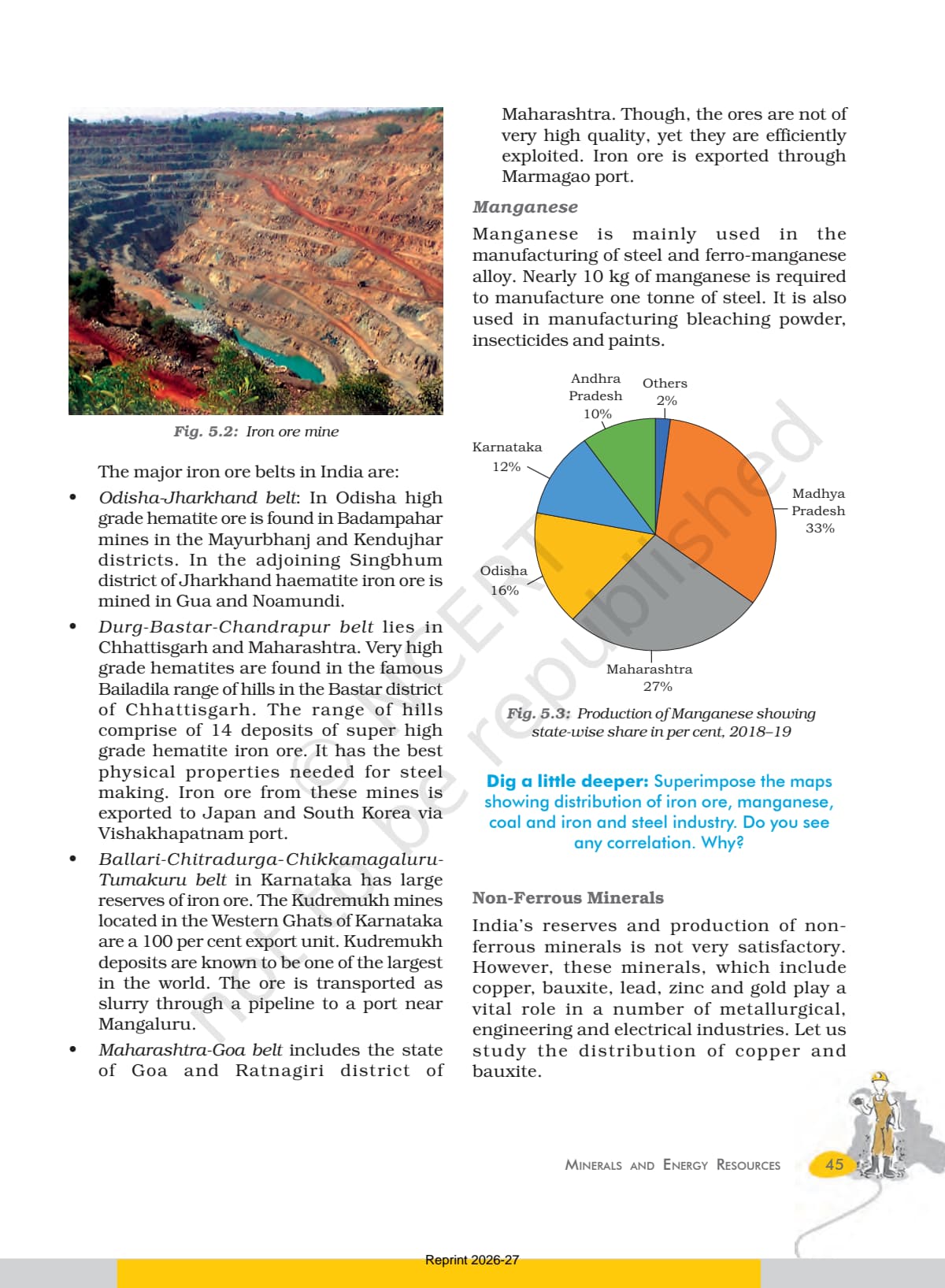
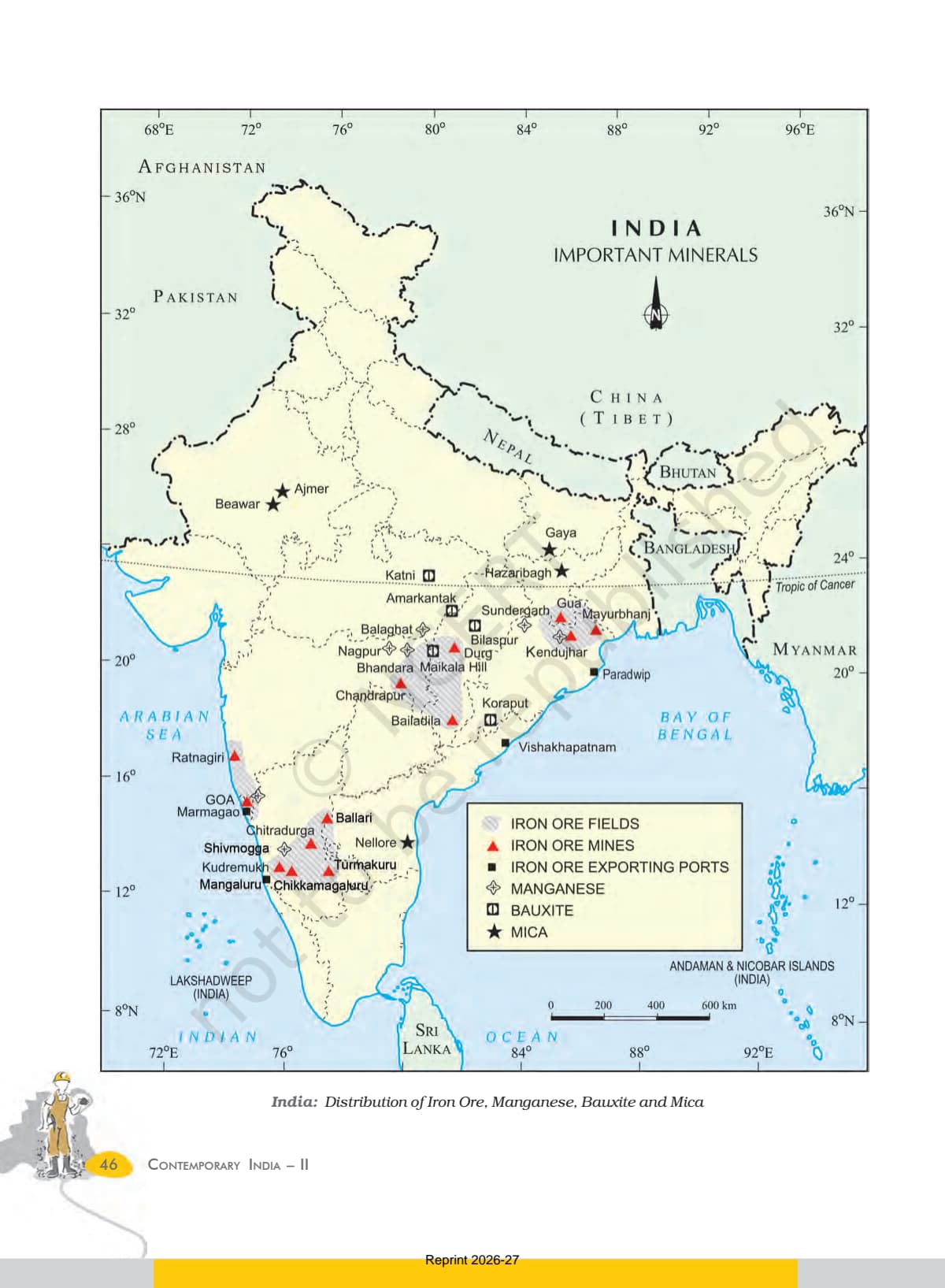
| Ferrous Minerals | 44-45 | Iron ore, the four iron ore belts, and manganese (Fig 5.2, 5.3). |
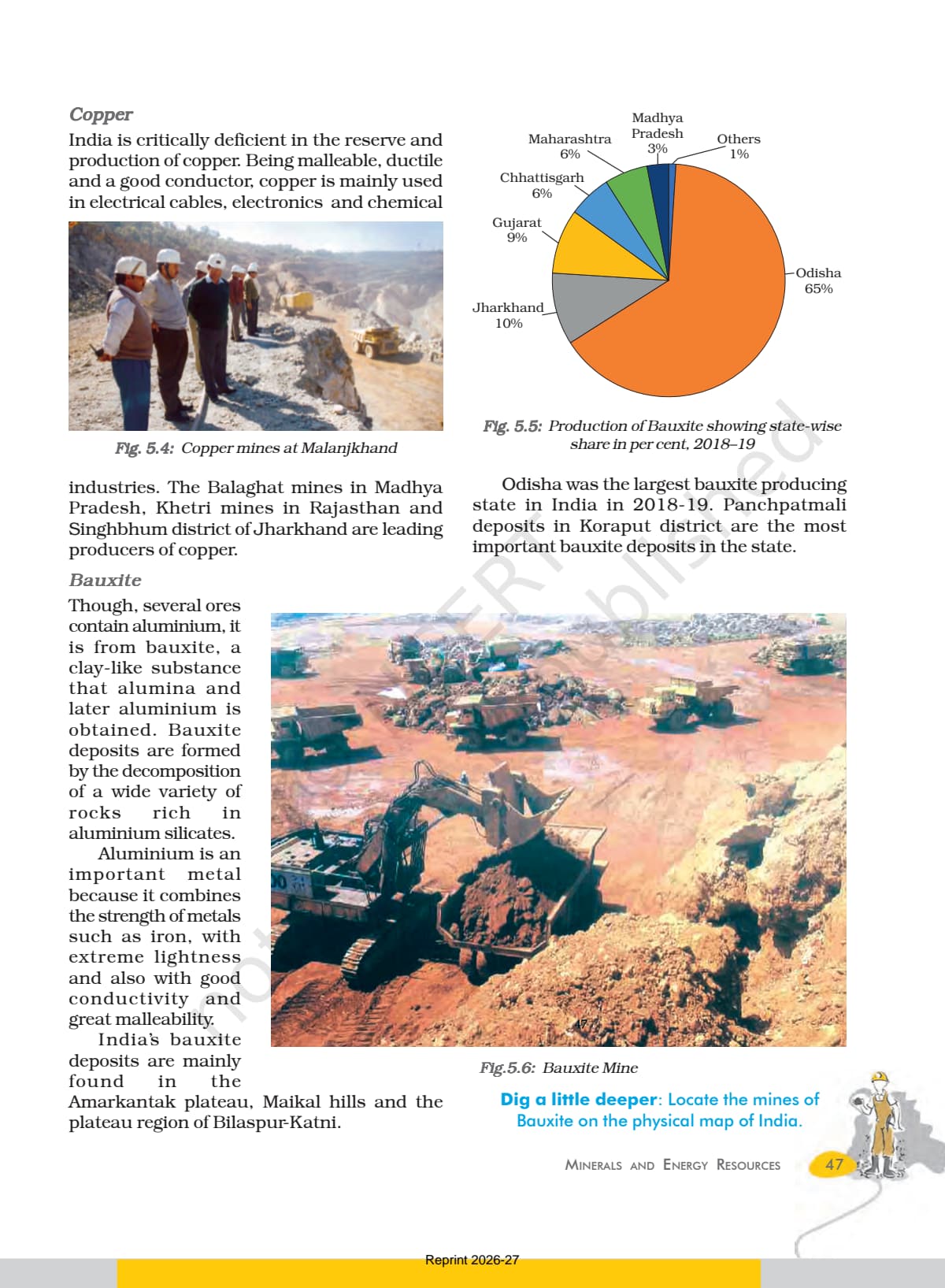
| Non-Ferrous Minerals | 46-47 | Copper and bauxite with their producing states (Fig 5.4 to 5.6). |
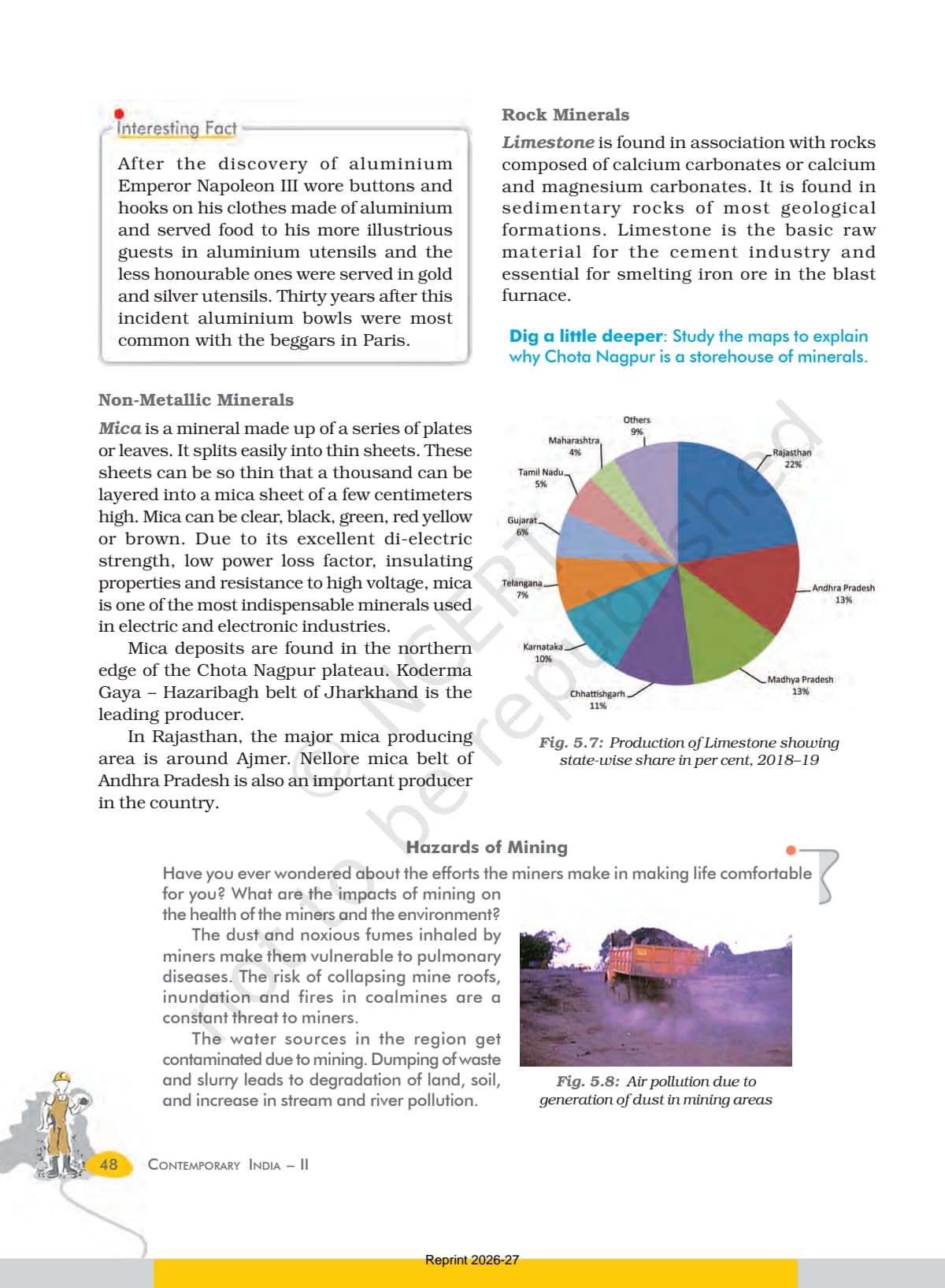
| Non-Metallic Minerals | 48 | Mica and limestone, their properties and producing belts (Fig 5.7). |
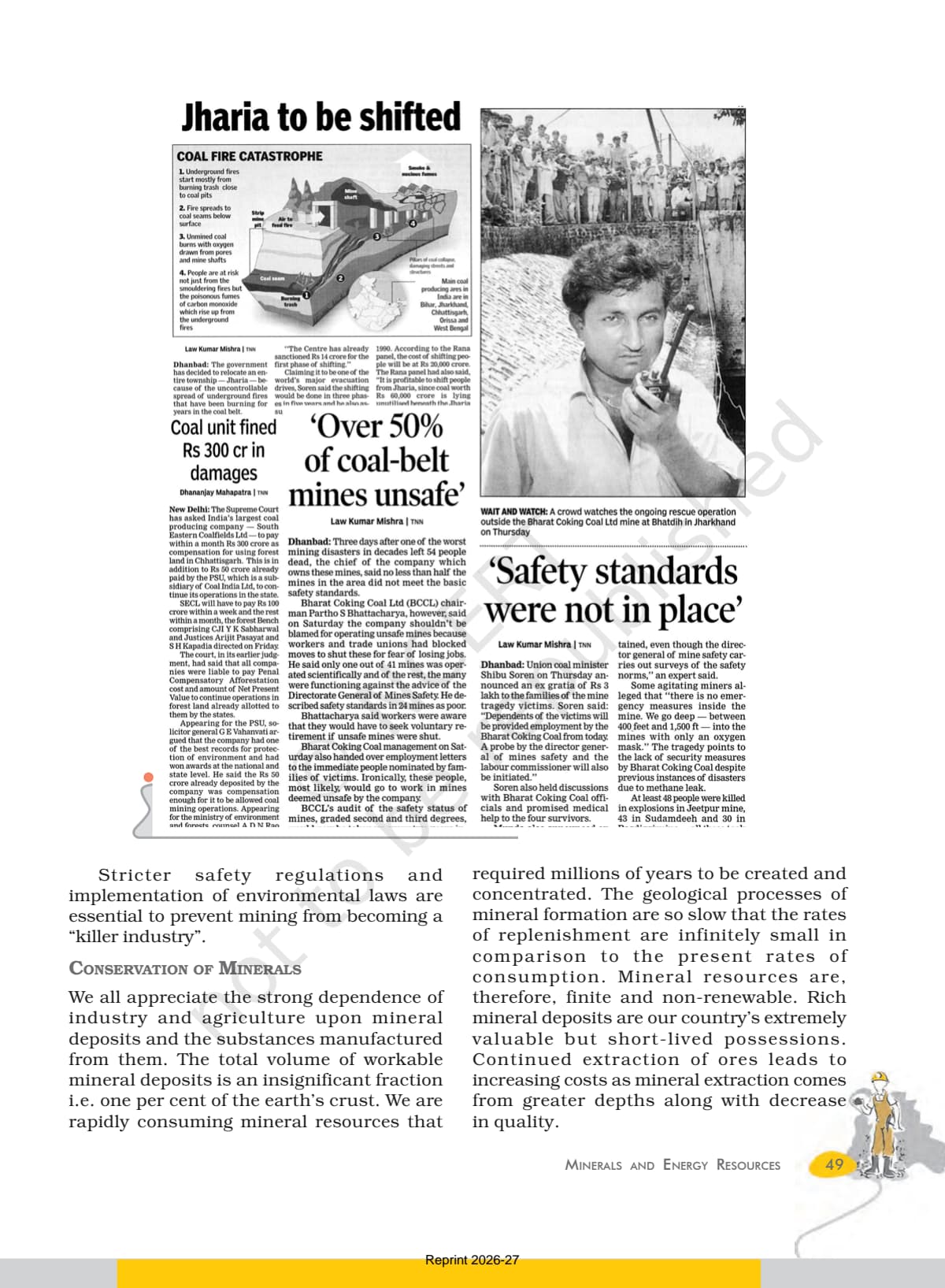
| Hazards and Conservation | 48-50 | Hazards of mining and the conservation of mineral resources (Fig 5.8). |
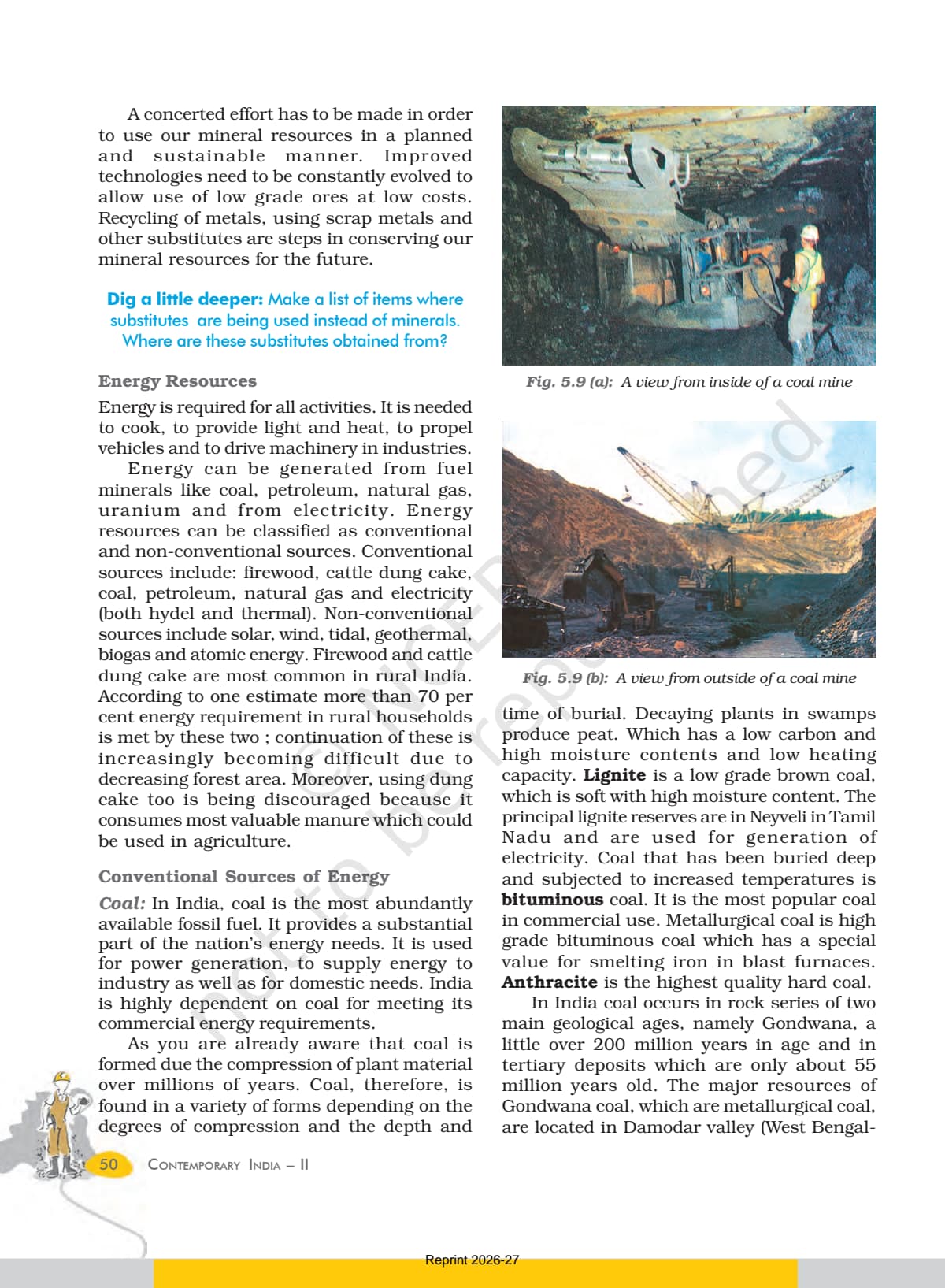
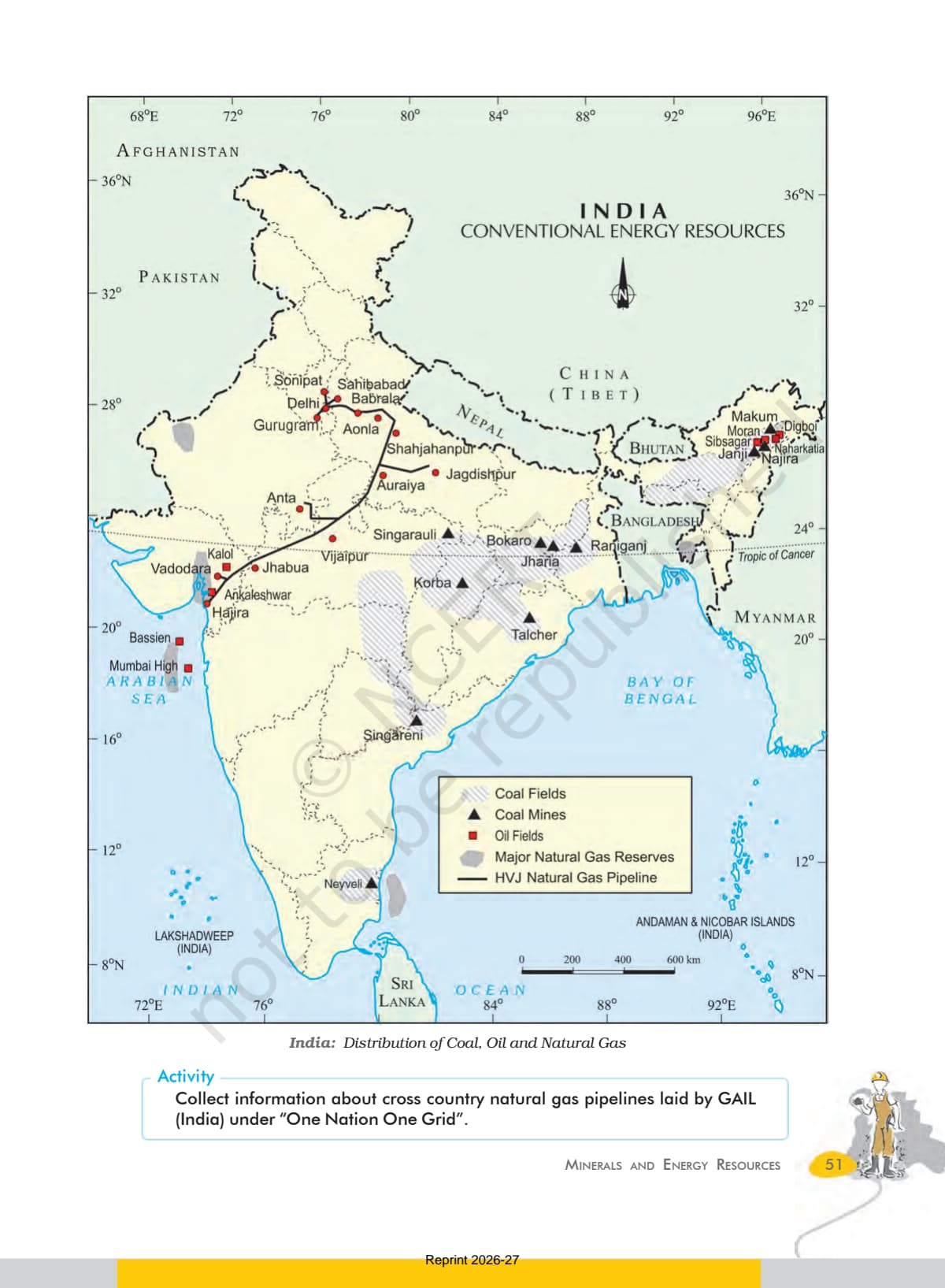
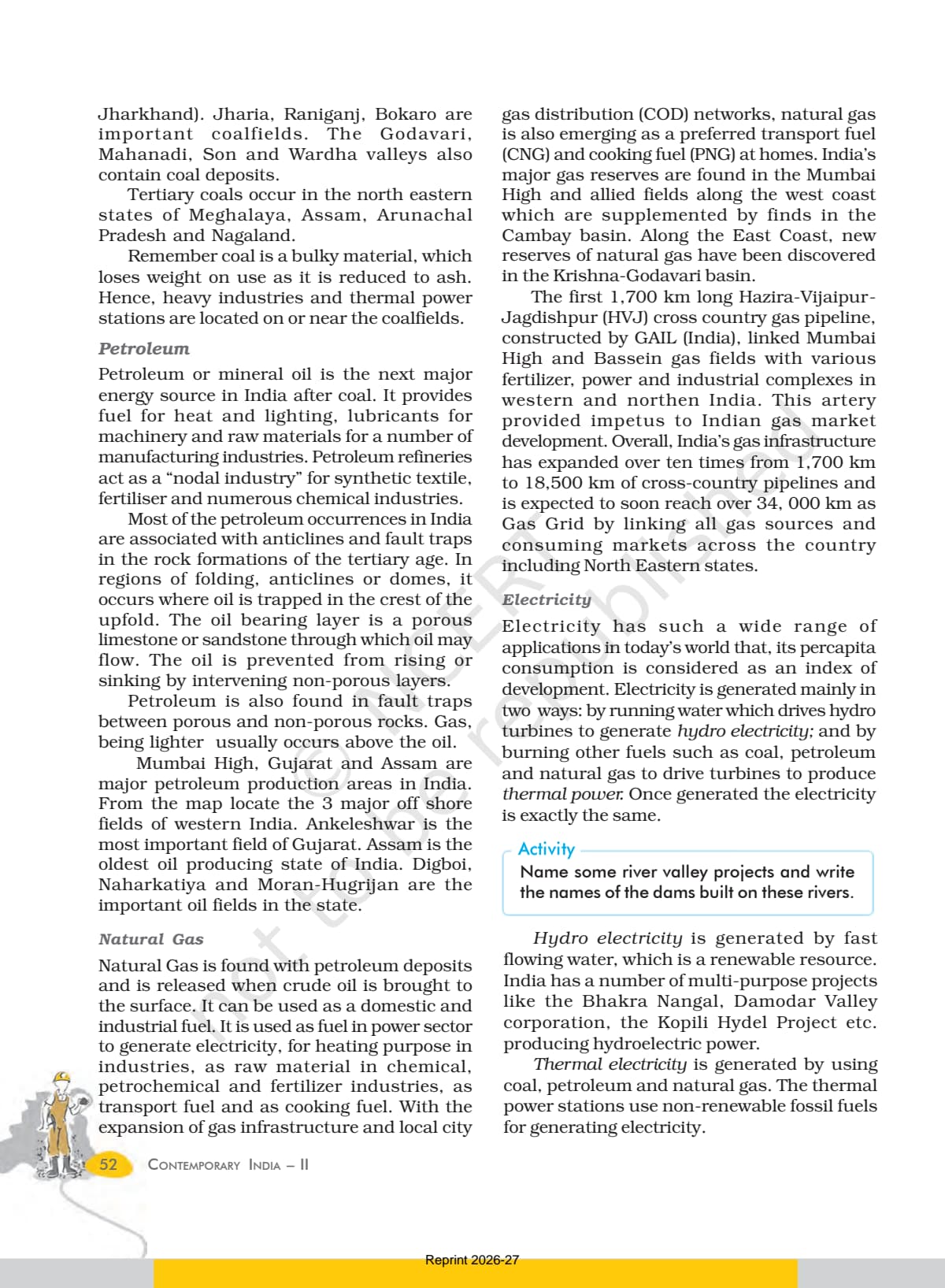
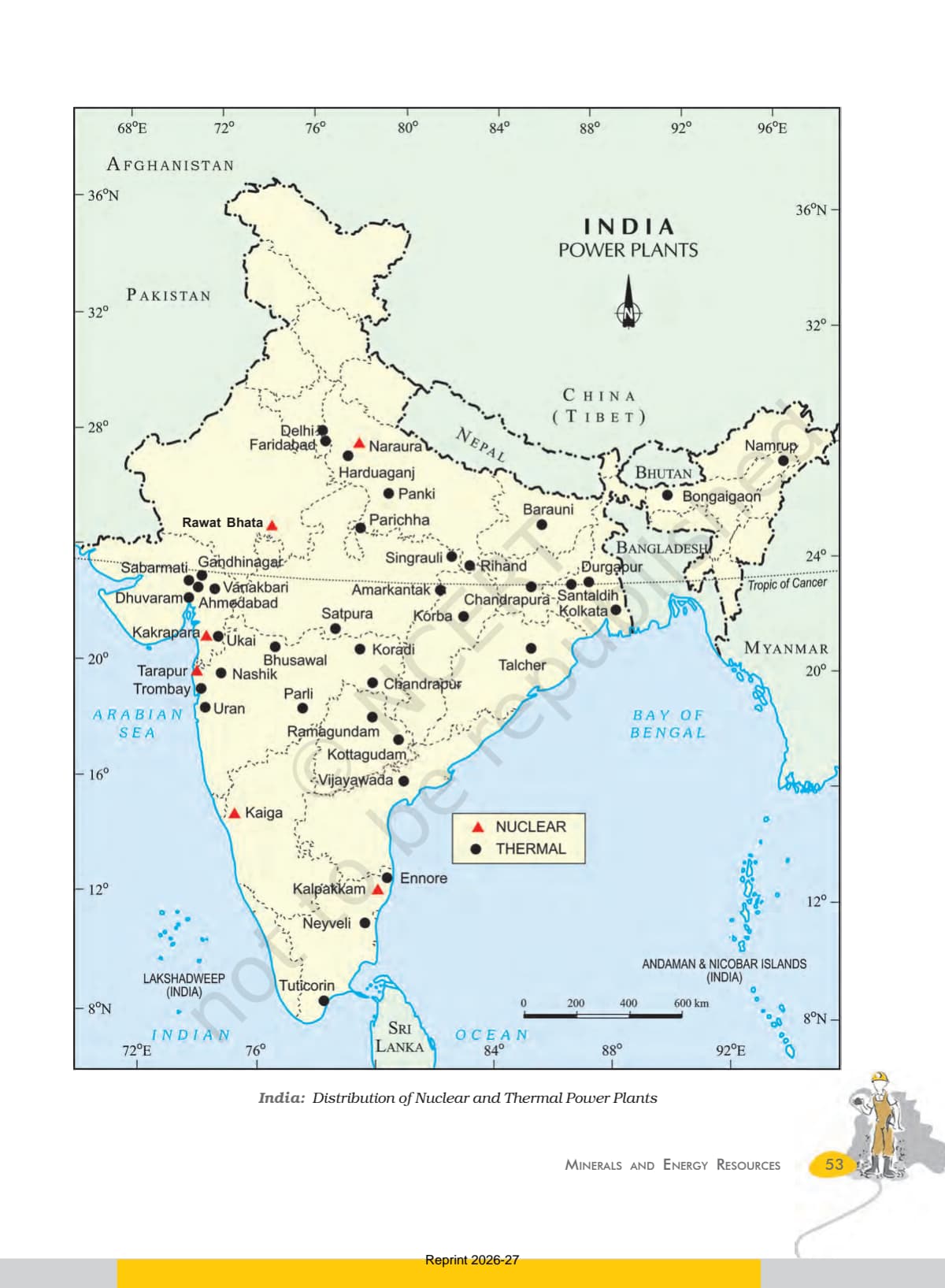
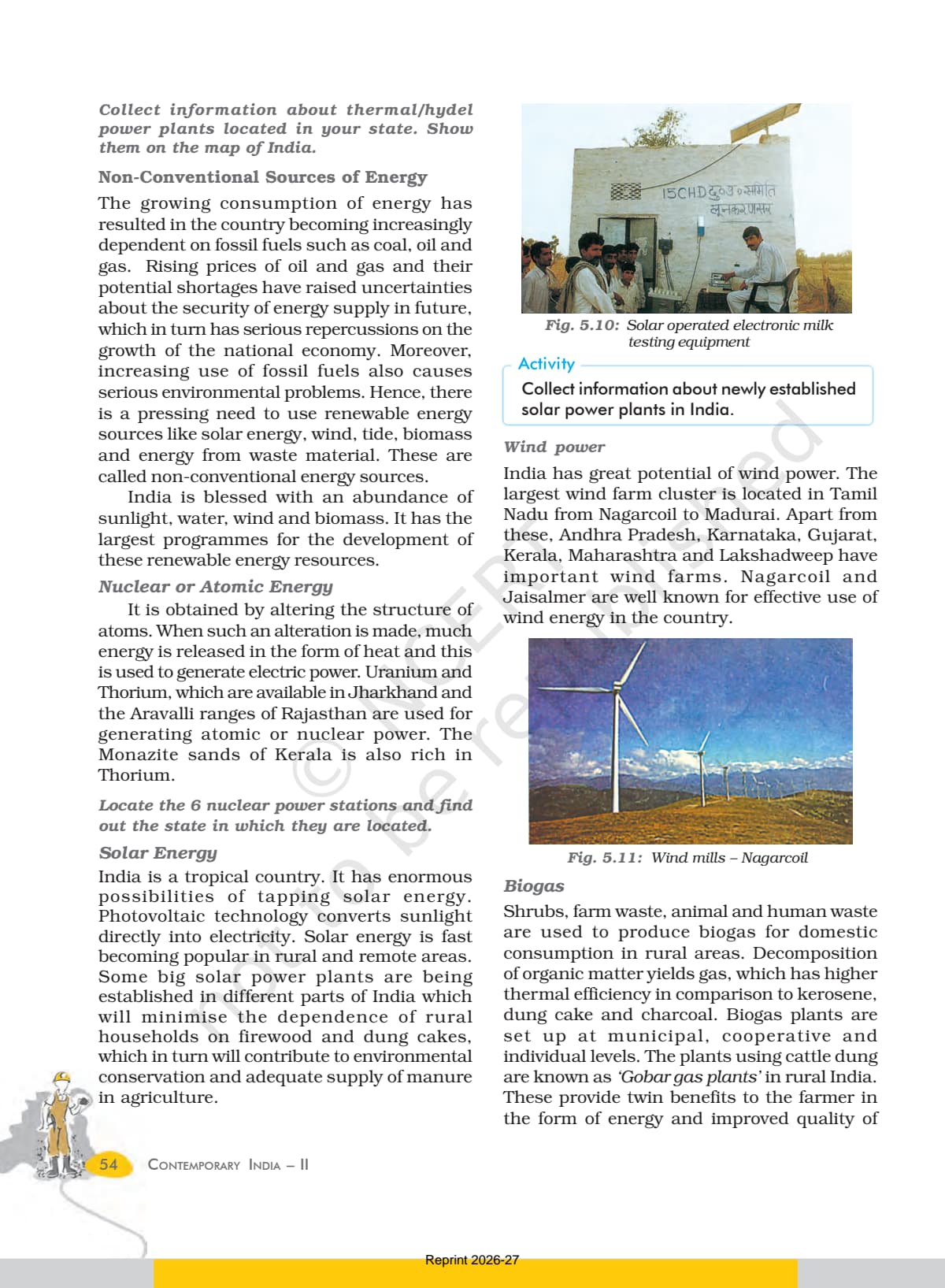
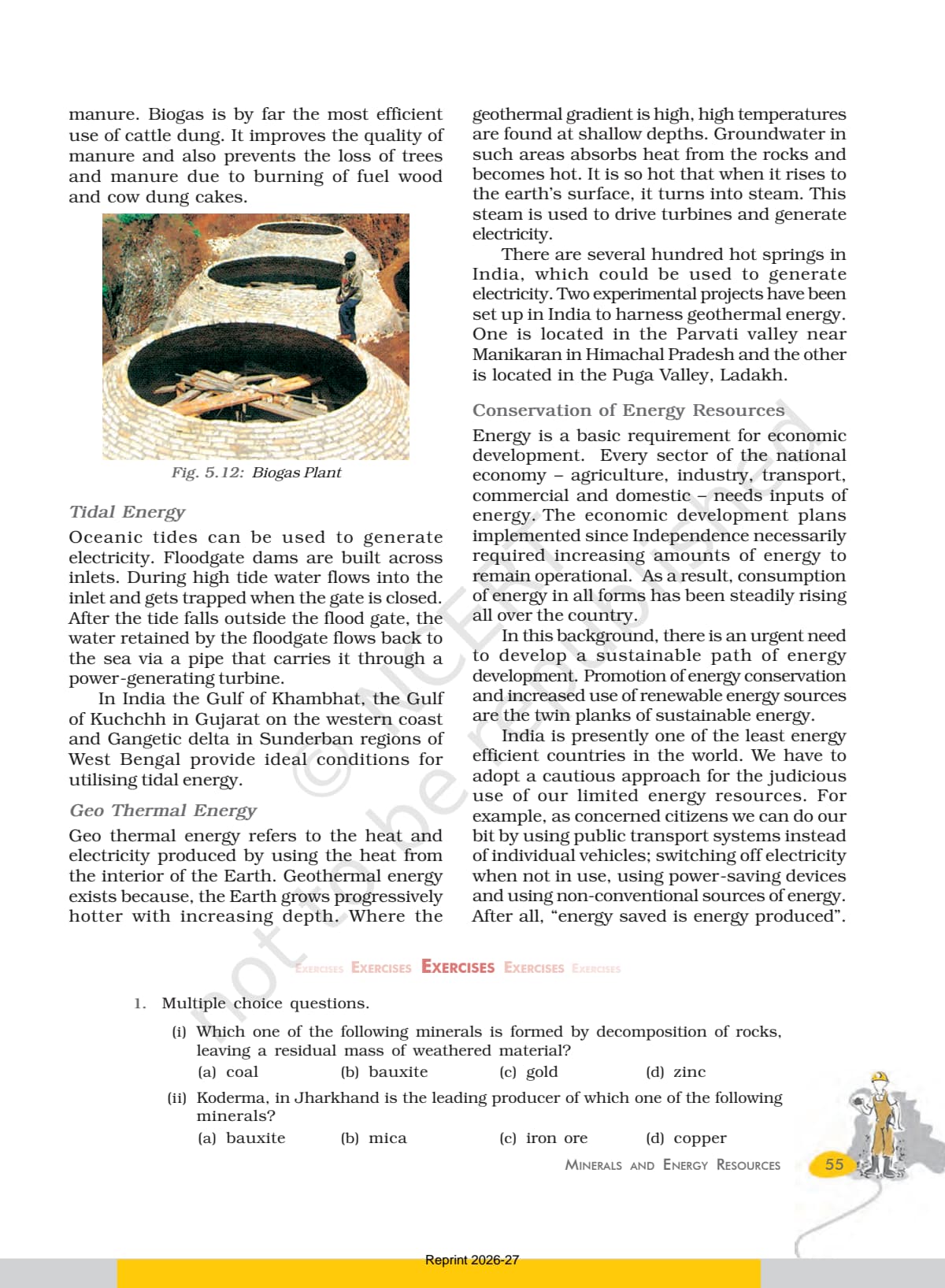
| Energy Resources | 50-55 | Coal, petroleum, natural gas, and non-conventional sources (Fig 5.9 to 5.11). |
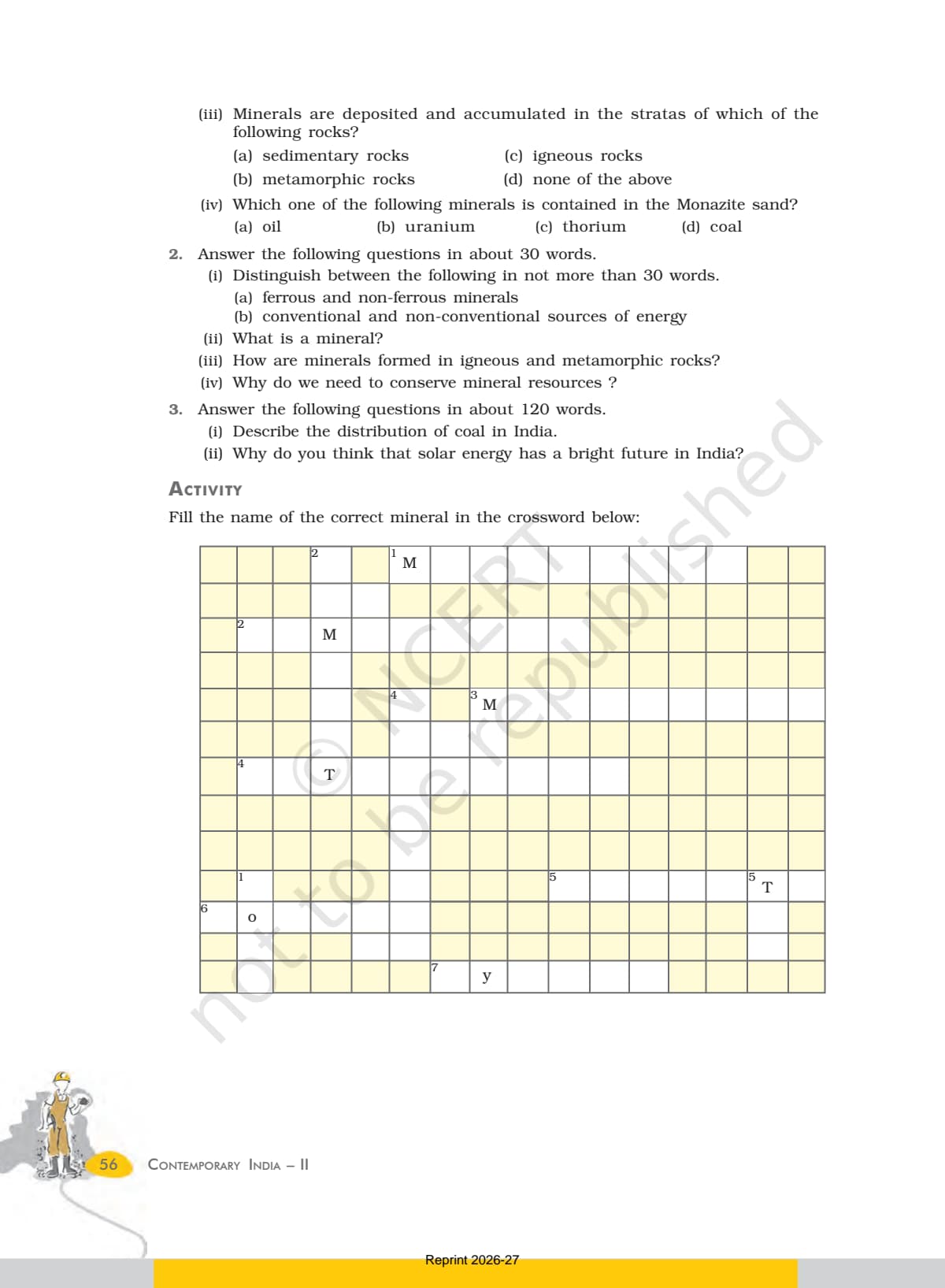
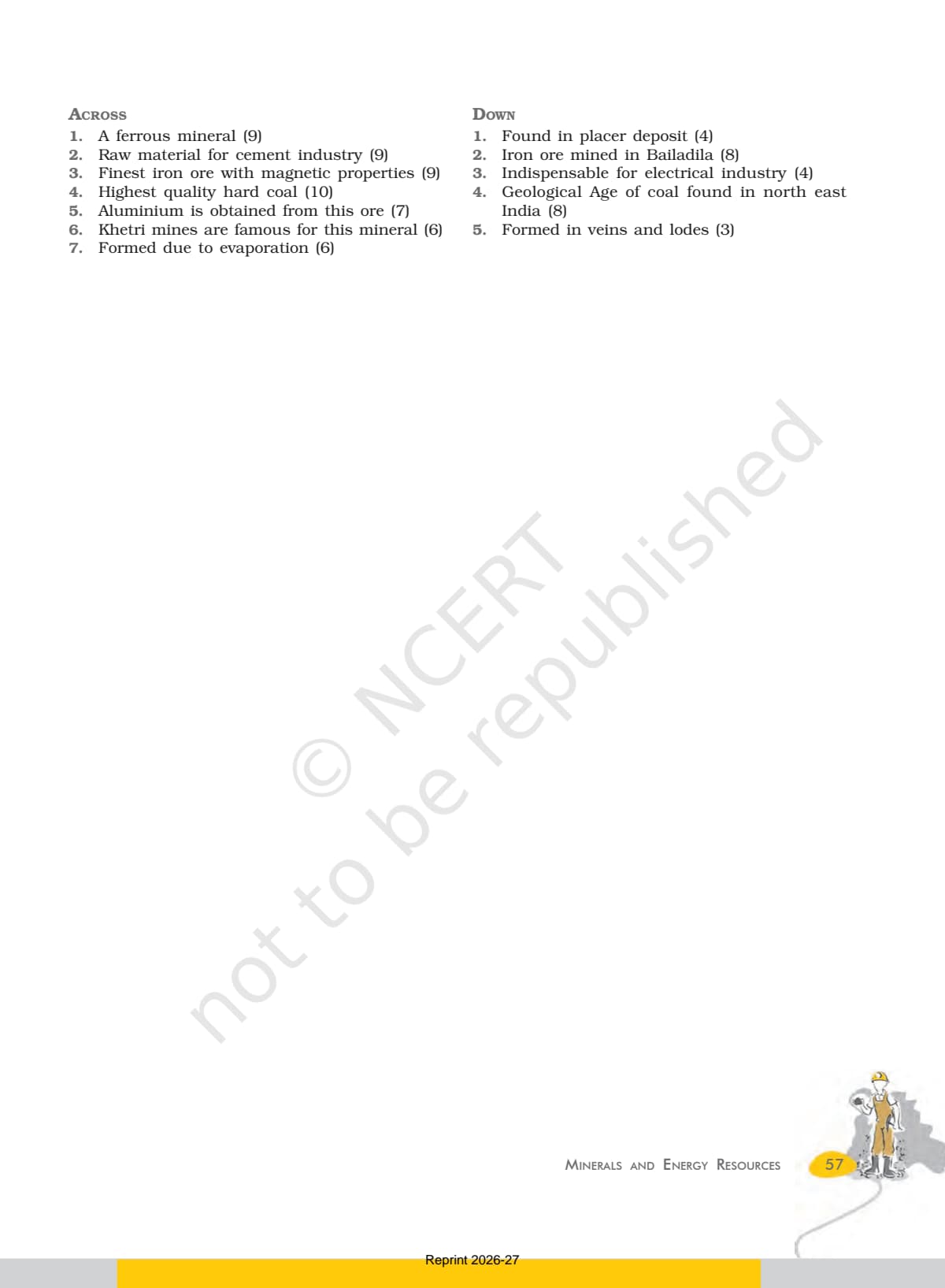
| Exercises and Activity | 55-57 | 4 MCQs, 30-word and 120-word questions, and a mineral crossword. |
Ferrous minerals and energy resources carry the heaviest exam weight in this chapter. Treat the iron ore belts and the energy sources (pages 44 to 55) as primary and the conservation section as a supporting read.
What is a Mineral and How it Occurs in NCERT Class 10 Geography Chapter 5
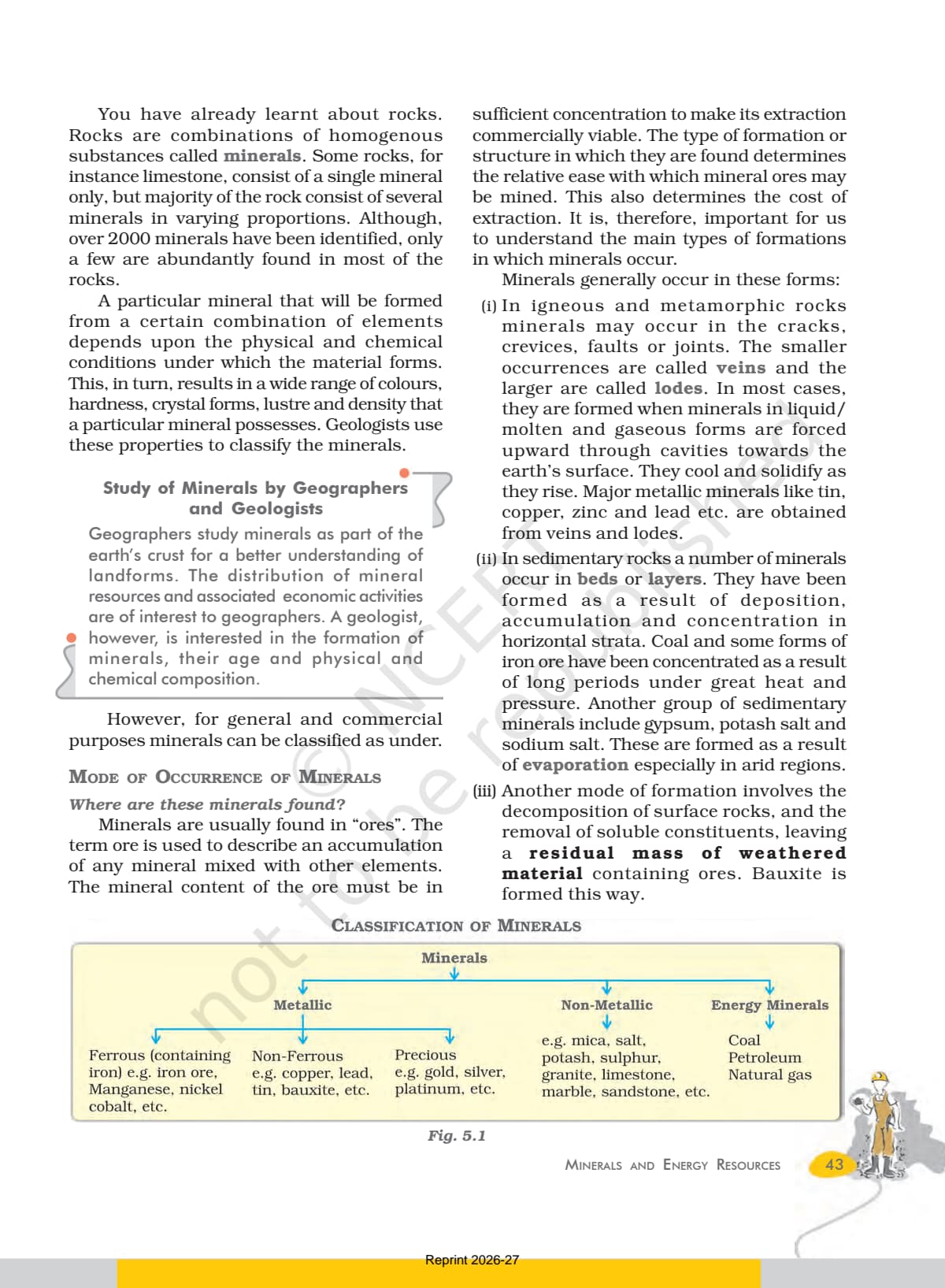
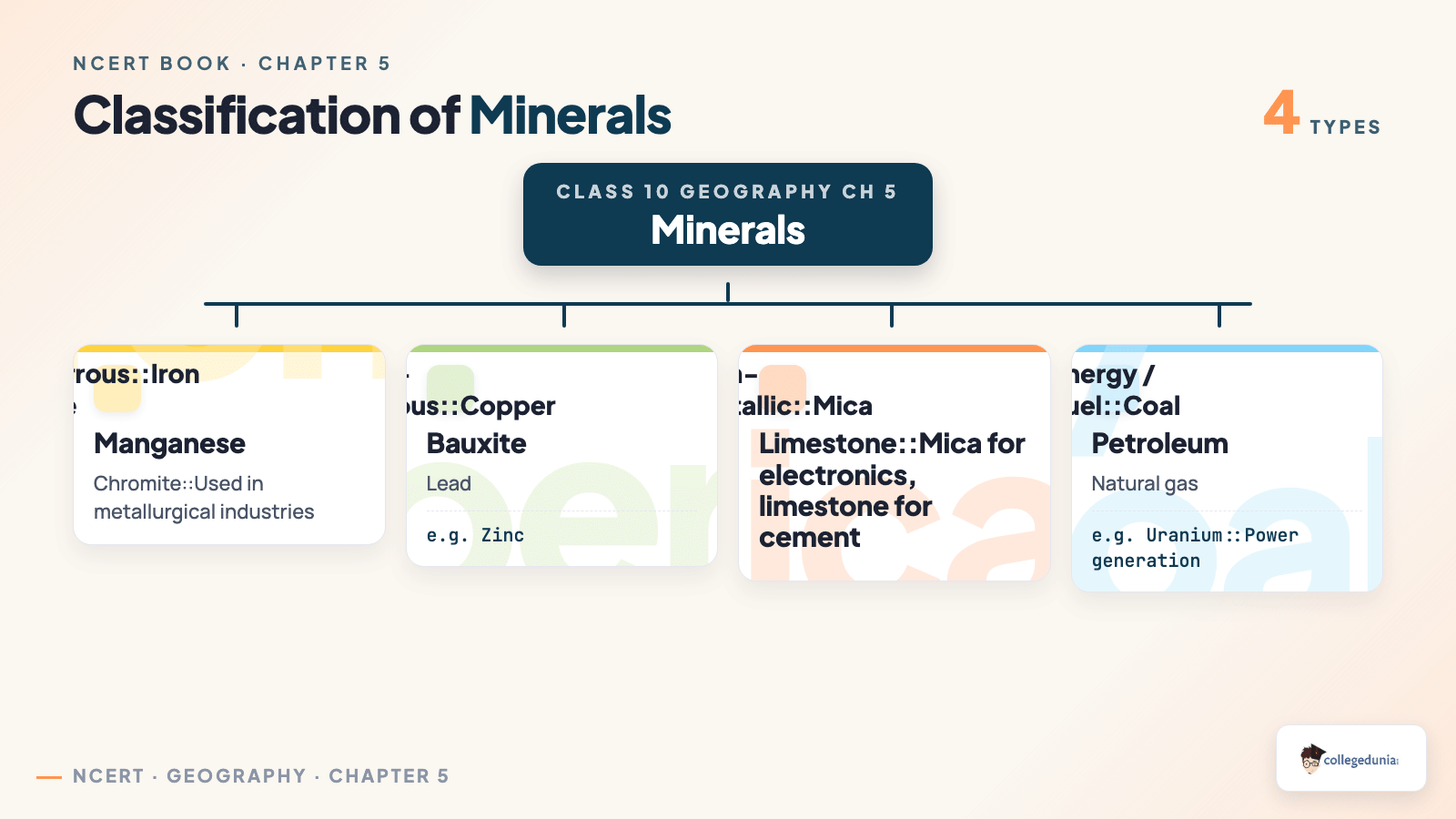
NCERT defines a mineral as a homogenous, naturally occurring substance with a definable internal structure. Rocks are combinations of minerals, and over 2000 have been identified though only a few are abundant. The modes of occurrence below are a common source of 1-mark and 3-mark questions.
- Veins and lodes: in igneous and metamorphic rocks, minerals occur in cracks and joints; smaller occurrences are veins and larger ones are lodes (tin, copper, zinc, lead).
- Beds and layers: in sedimentary rocks, minerals occur in horizontal beds formed by deposition, such as coal, gypsum, and potash.
- Decomposition: bauxite is formed by the decomposition of surface rocks, leaving a residual mass of weathered material.
- Placer deposits: alluvial deposits in valley sands that are not corroded by water, such as gold, silver, tin, and platinum.
- Ocean waters: common salt, magnesium, and bromine are derived from ocean waters, and ocean beds hold manganese nodules.
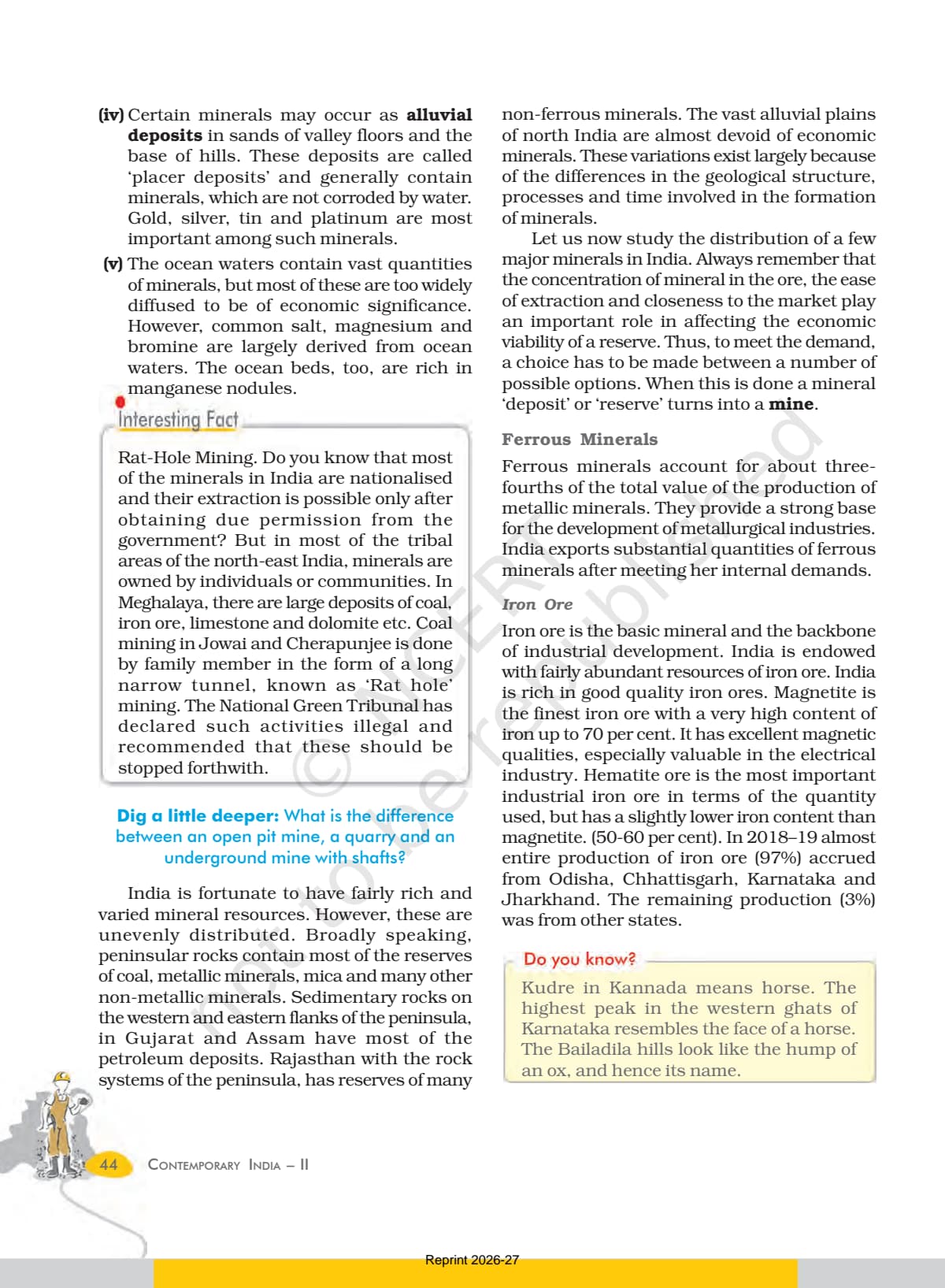
The chapter also explains rat-hole mining in Meghalaya, a long narrow tunnel form of coal mining declared illegal by the National Green Tribunal, which is a favourite case-based question.
Ferrous Minerals in Minerals and Energy Resources Class 10 PDF
Ferrous minerals account for about three-fourths of the total value of the production of metallic minerals and provide the base for metallurgical industries. A direct question usually asks you to name an iron ore belt and its state, so learn the four belts with one mine each.
| Iron Ore Belt | States | Key Mines / Facts |
|---|---|---|
| Odisha-Jharkhand belt | Odisha, Jharkhand | High-grade hematite at Badampahar (Mayurbhanj, Kendujhar); Gua and Noamundi in Singhbhum. |
| Durg-Bastar-Chandrapur belt | Chhattisgarh, Maharashtra | Very high-grade hematite in the Bailadila range; exported to Japan and South Korea via Vishakhapatnam. |
| Ballari-Chitradurga-Chikkamagaluru-Tumakuru belt | Karnataka | Kudremukh mines, a 100 per cent export unit; ore moved as slurry by pipeline to Mangaluru. |
| Maharashtra-Goa belt | Goa, Maharashtra (Ratnagiri) | Ores not very high grade but efficiently exploited; exported through Marmagao port. |
Manganese is used in making steel and ferro-manganese alloy, with nearly 10 kg needed per tonne of steel. A frequent 3-mark question asks why heavy industries locate near iron ore belts - because iron ore is bulky and costly to transport.
Non-Ferrous and Non-Metallic Minerals in Class 10 Geography Chapter 5
The chapter then covers copper and bauxite among non-ferrous minerals and mica and limestone among non-metallic minerals. These are reliable 3-mark questions on uses and producing states, so learn one stand-out fact for each.
- Copper: India is critically deficient; malleable, ductile, and a good conductor, used in electrical cables. Balaghat (Madhya Pradesh), Khetri (Rajasthan), and Singhbhum (Jharkhand) lead.
- Bauxite: the clay-like ore from which aluminium is obtained; Odisha was the largest producer in 2018-19, with Panchpatmali deposits in Koraput.
- Mica: splits into thin sheets with excellent di-electric strength; the Koderma-Gaya-Hazaribagh belt of Jharkhand leads, with Ajmer (Rajasthan) and the Nellore belt (Andhra Pradesh).
- Limestone: the basic raw material for the cement industry and essential for smelting iron ore in the blast furnace.
Aluminium is an important metal because it combines the strength of iron with extreme lightness, good conductivity, and great malleability, which is why bauxite is exam-relevant.
Conservation of Minerals and Hazards of Mining in NCERT Chapter 5
NCERT stresses that mineral resources are finite and non-renewable, since the total volume of workable deposits is only about one per cent of the earth's crust. The hazards and conservation points below are the source of the conservation question.
- Hazards of mining: dust and noxious fumes cause pulmonary diseases; collapsing roofs, inundation, and fires threaten miners; water sources get contaminated.
- Finite resources: minerals take millions of years to form, so rates of replenishment are tiny compared with consumption.
- Conservation steps: improved technologies to use low-grade ores, recycling of metals, using scrap metals, and substitutes.
- Stricter rules: safety regulations and environmental laws are needed to stop mining from becoming a "killer industry".
The chapter frames conservation as planned, sustainable use rather than a ban on mining, the angle the 5-mark question expects. Pair the cause (minerals are finite and non-renewable) with three measures (recycling, scrap metals, substitutes) to score full marks.
Energy Resources in Class 10 Geography Chapter 5
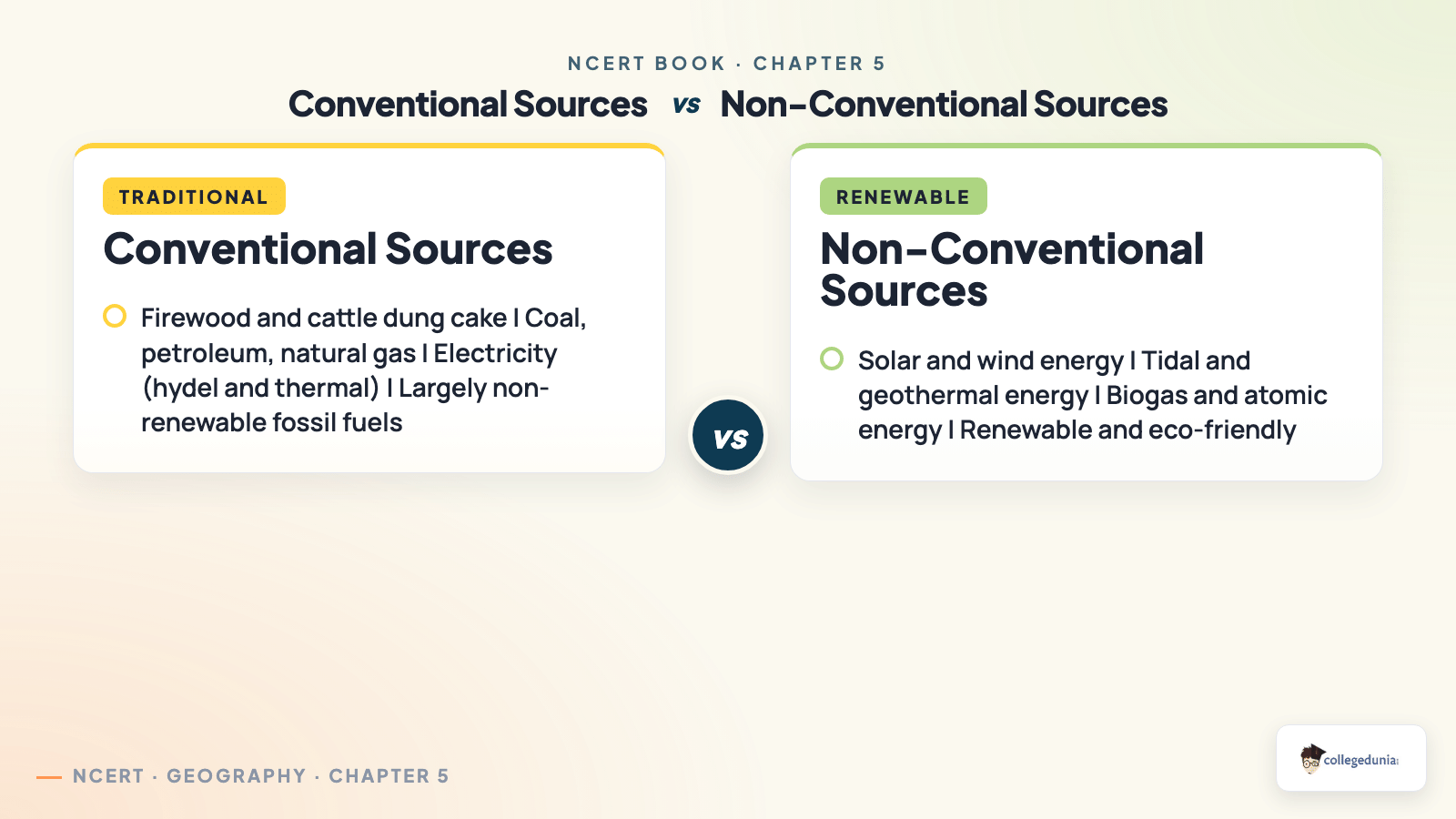
The second half splits energy into conventional sources (firewood, cattle dung cake, coal, petroleum, natural gas, electricity) and non-conventional sources (solar, wind, tidal, geothermal, biogas, atomic energy). This table is the most exam-relevant block here.
| Energy Source | Type | Key Regions / Facts |
|---|---|---|
| Coal | Conventional | Most abundant fossil fuel; Jharia, Raniganj, Bokaro coalfields; Gondwana and tertiary coals. |
| Petroleum | Conventional | Found in anticlines and fault traps; Mumbai High, Gujarat (Ankleshwar), and Assam (Digboi) areas. |
| Natural Gas | Conventional | Found with petroleum; used as CNG transport fuel and PNG cooking fuel. |
| Nuclear / Atomic | Non-conventional | Uranium and thorium from Jharkhand and Aravalli; Monazite sands of Kerala rich in thorium. |
| Solar and Wind | Non-conventional | Largest wind farm cluster from Nagarcoil to Madurai; photovoltaic solar in rural areas. |
| Geothermal and Biogas | Non-conventional | Parvati valley (Manikaran) and Puga valley (Ladakh) projects; biogas from cattle dung. |
Coal is a bulky material that loses weight on use, so heavy industries and thermal power stations locate near the coalfields. A frequent 120-word question asks you to describe the distribution of coal in India - cover the Gondwana fields and the tertiary north-eastern coals.
How to Read the Minerals and Energy Resources Chapter for Boards
The chapter is 16 pages, so one focused session covers it. Use a three-pass routine, about three to four hours total.
- Pass 1: Read once and mark every defined term (veins, lodes, placer deposits, ferrous, bauxite, non-conventional).
- Pass 2: Build two tables from memory, one for the iron ore belts and one for energy sources by type.
- Pass 3: Solve the four MCQs and all 30-word questions on page 55, then both 120-word answers. Finally memorise the coal distribution and the conventional versus non-conventional split.
NCERT Class 10 Geography Chapter 5 Important Questions and Exercises
The page 55 exercises mirror the CBSE question pattern, so solving them once is enough practice.
- MCQs: mineral formed by decomposition (bauxite); rocks holding deposited minerals; mineral in Monazite sand (thorium).
- 30-word answers: ferrous vs non-ferrous minerals; conventional vs non-conventional energy; what is a mineral; why conserve minerals.
- 120-word answers: distribution of coal in India; why solar energy has a bright future in India.
Also Check: These Collegedunia resources cover the same chapter in other formats.
| Resource | Best Used For |
|---|---|
| Minerals and Energy Resources Class 10 NCERT Solutions | Step-by-step answers to every exercise question. |
| Minerals and Energy Resources Class 10 Notes | Quick revision of every section with diagrams. |
| Minerals and Energy Resources Class 10 Handwritten Notes | One-shot scanned revision before the exam. |
NCERT Class 10 Geography Book PDF: All Chapters
Other Class 10 Geography (Contemporary India II) NCERT book PDFs you can download free:
| Chapter | Resource |
|---|---|
| Chapter 1 | Resources and Development NCERT PDF |
| Chapter 2 | Forest and Wildlife Resources NCERT PDF |
| Chapter 3 | Water Resources NCERT PDF |
| Chapter 4 | Agriculture NCERT PDF |
| Chapter 6 | Manufacturing Industries NCERT PDF |
| Chapter 7 | Lifelines of National Economy NCERT PDF |
Minerals and Energy Resources NCERT PDF: available above as a free download, taken from the 2026-27 NCERT print.
NCERT Class 10 Geography Book PDF Chapter 5 Minerals and Energy Resources - Frequently Asked Questions
Ques. Where can I download the minerals and energy resources class 10 PDF for Chapter 5 for free?
Ans. You can download the Minerals and Energy Resources NCERT PDF directly from this page. The full 16-page chapter from the 2026-27 NCERT print is free to download.
Ques. Is this Minerals and Energy Resources Class 10 PDF aligned with the 2026-27 CBSE syllabus?
Ans. Yes. The page reflects the current 2026-27 Class 10 Geography (Contemporary India II) syllabus. It keeps all sections, the mineral classification, the iron ore belts, and the energy resources.
Ques. What is a mineral in Class 10 Geography Chapter 5?
Ans. A mineral is a homogenous, naturally occurring substance with a definable internal structure. Rocks are combinations of minerals, and over 2000 minerals have been identified, though only a few are found abundantly in most rocks.
Ques. What are the four major iron ore belts in India?
Ans. The four iron ore belts are the Odisha-Jharkhand belt, the Durg-Bastar-Chandrapur belt, the Ballari-Chitradurga-Chikkamagaluru-Tumakuru belt in Karnataka, and the Maharashtra-Goa belt. Each is linked to specific mines and export ports.
Ques. What is the difference between conventional and non-conventional energy sources?
Ans. Conventional sources include firewood, cattle dung cake, coal, petroleum, natural gas, and electricity. Non-conventional sources are renewable and include solar, wind, tidal, geothermal, biogas, and atomic energy.
Ques. How many marks does the Minerals and Energy Resources chapter carry in the Class 10 board exam?
Ans. The chapter usually carries 5 to 6 marks in the CBSE Class 10 Social Science paper. Most papers ask one MCQ, one 3-mark mineral or energy answer, and one 5-mark distribution or map-based answer from it.
Ques. Why do we need to conserve mineral resources?
Ans. Mineral resources are finite and non-renewable because they take millions of years to form, while consumption is rapid. We conserve them through improved technology for low-grade ores, recycling of metals, using scrap metals, and adopting substitutes.



Comments