



The NCERT Book for Class 10 Maths Chapter 1 Real Numbers is the official CBSE textbook chapter, free to read and download for the 2026-27 session. It builds the number theory the board tests: the Fundamental Theorem of Arithmetic, finding HCF and LCM by prime factorisation, and proving numbers like √2 are irrational.
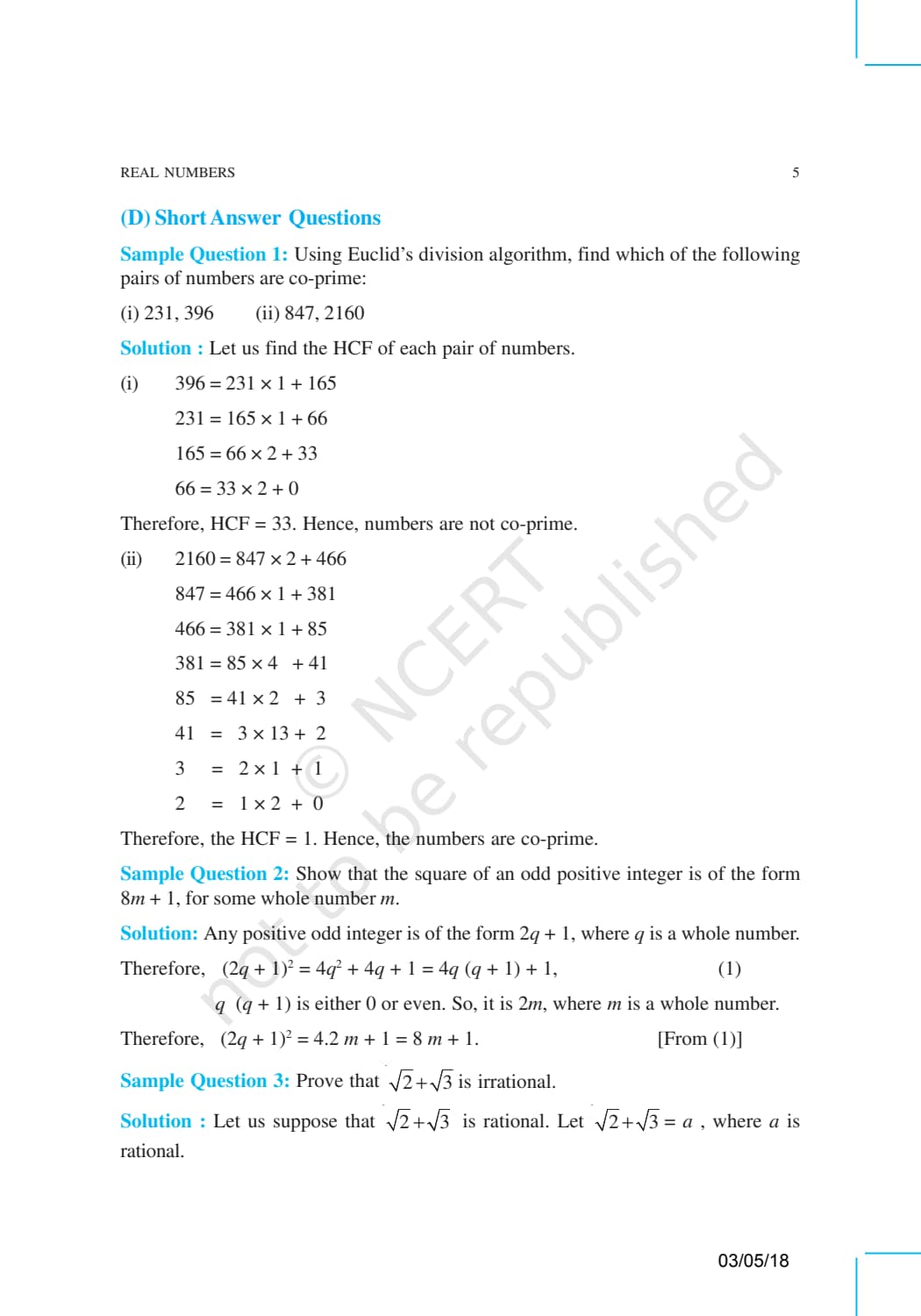
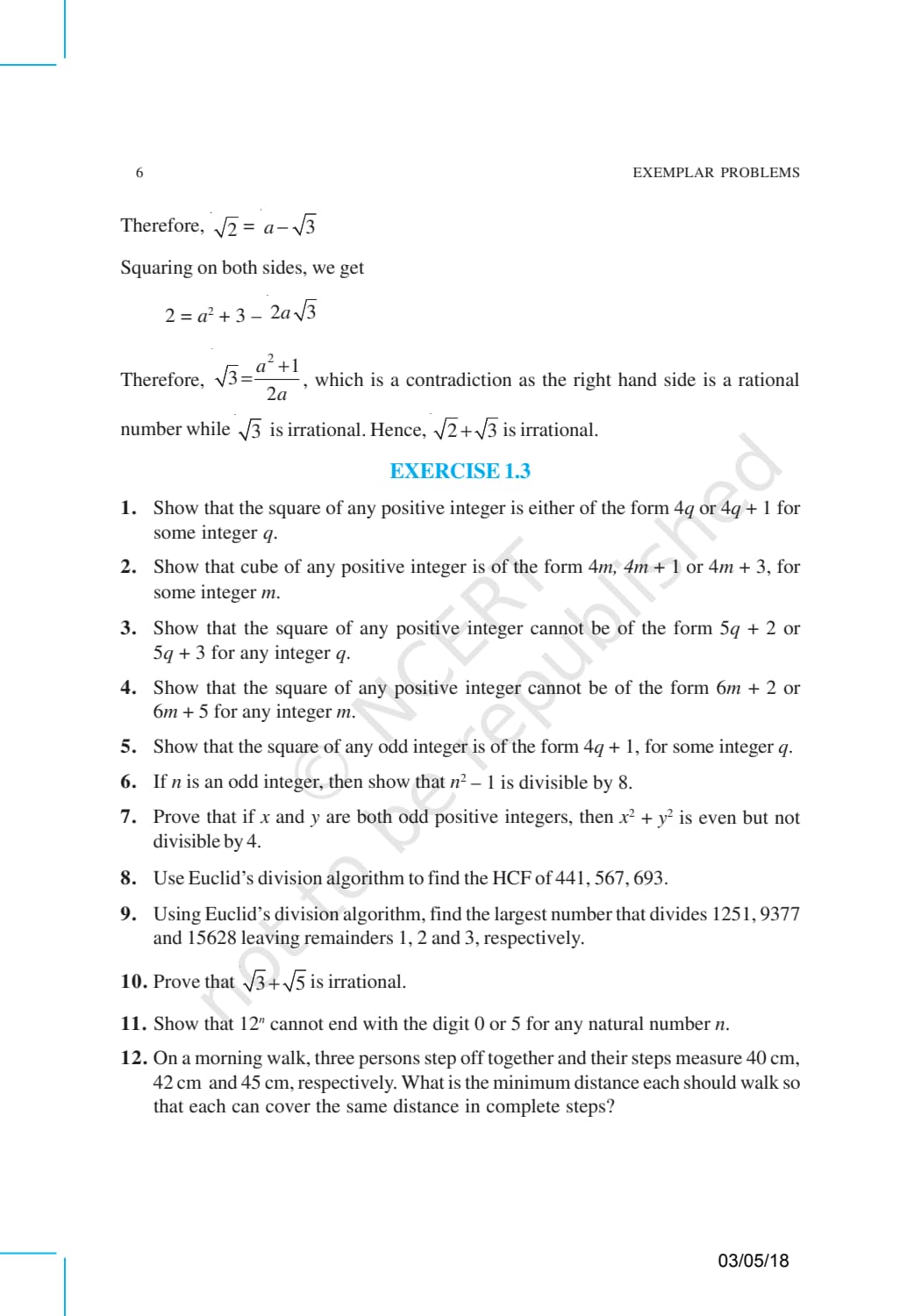
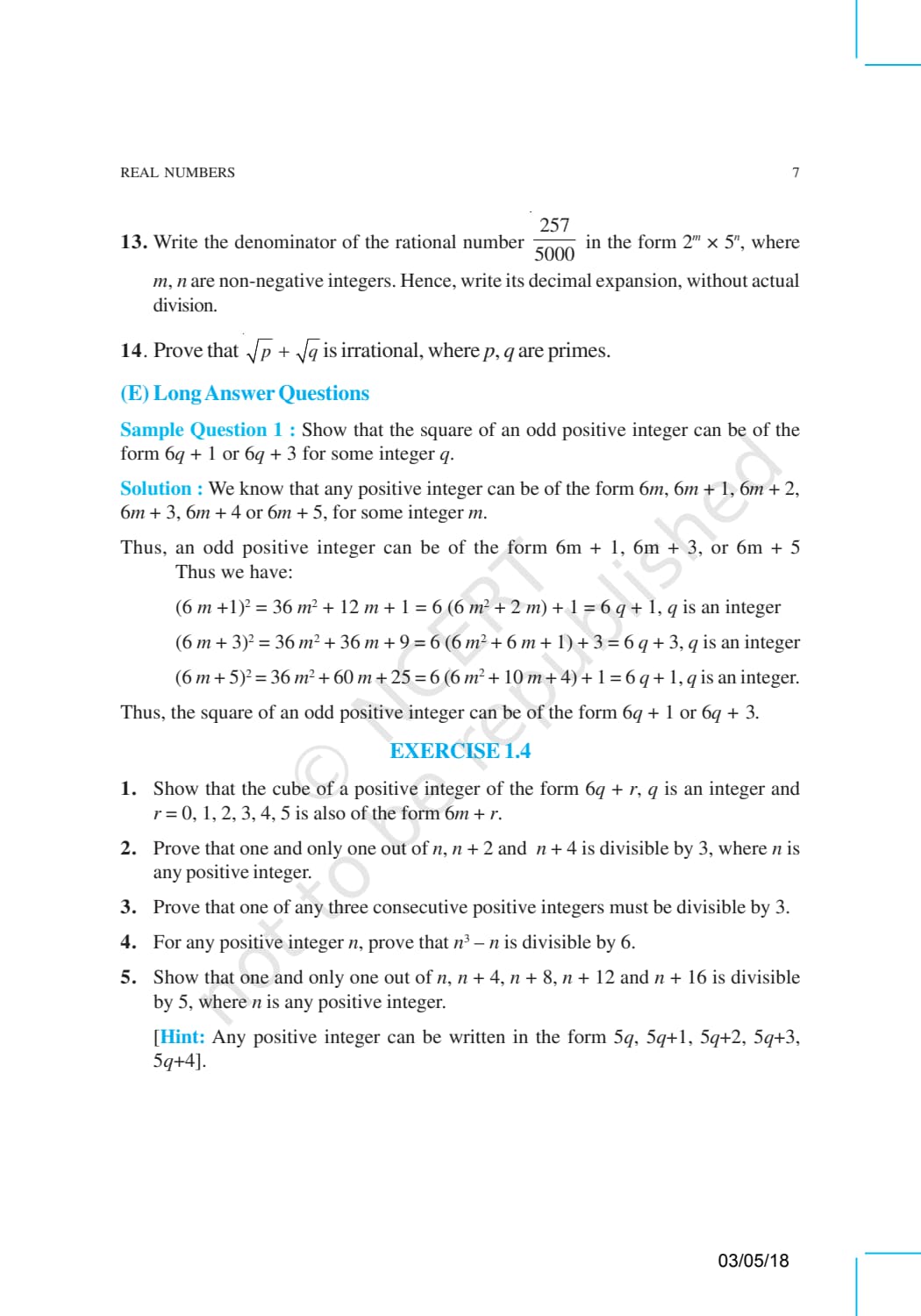


- Official NCERT textbook PDF of Chapter 1, with every theorem, solved example, and exercise exactly as printed.
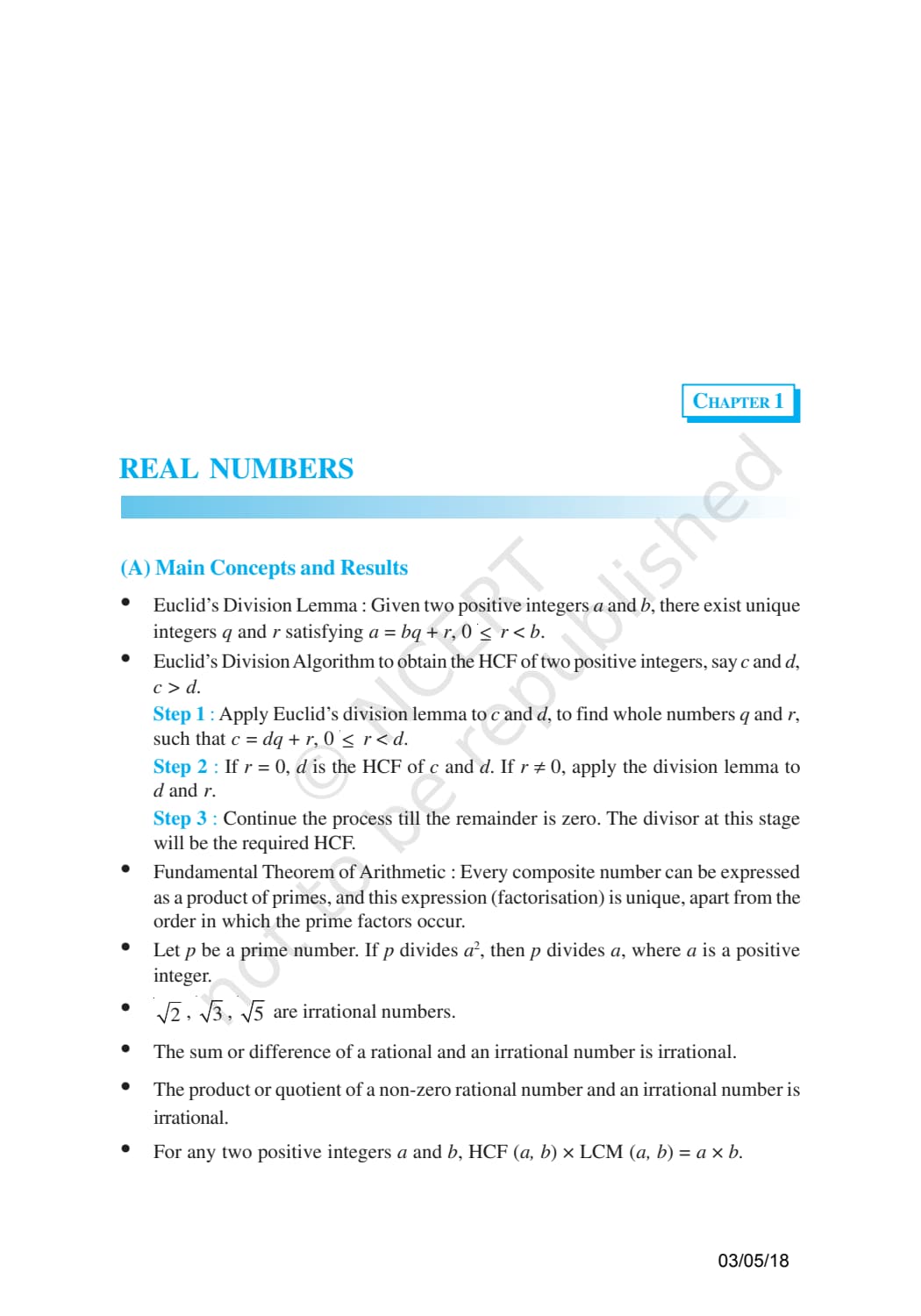
- Covers the Fundamental Theorem of Arithmetic, HCF and LCM by prime factorisation, and proofs that √2, √3 and √5 are irrational.
- Aligned with the 2026-27 CBSE syllabus, useful for board revision and as the base text for solutions and notes.
This page hosts the official NCERT Class 10 Maths textbook chapter, mapped to the 2026-27 CBSE syllabus and checked page by page against the printed Real Numbers chapter.
Watch Real Numbers Class 10 Maths Explained
Source: Ritik Mishra - 9th & 10th on YouTube
What the NCERT Book Chapter Covers
The PDF above is the complete official chapter, exactly as printed in the 2026-27 textbook. It carries forward real numbers from Class 9 and adds two big ideas: how every composite number splits into primes, and how that fact proves certain numbers can never be written as a fraction.
- Fundamental Theorem of Arithmetic: every composite number is a product of primes, and that factorisation is unique.
- HCF and LCM: how to find both using the prime factorisation method, and the relation HCF × LCM = product of two numbers.
- Irrational numbers: proofs that √2, √3 and √5 are irrational, using proof by contradiction.
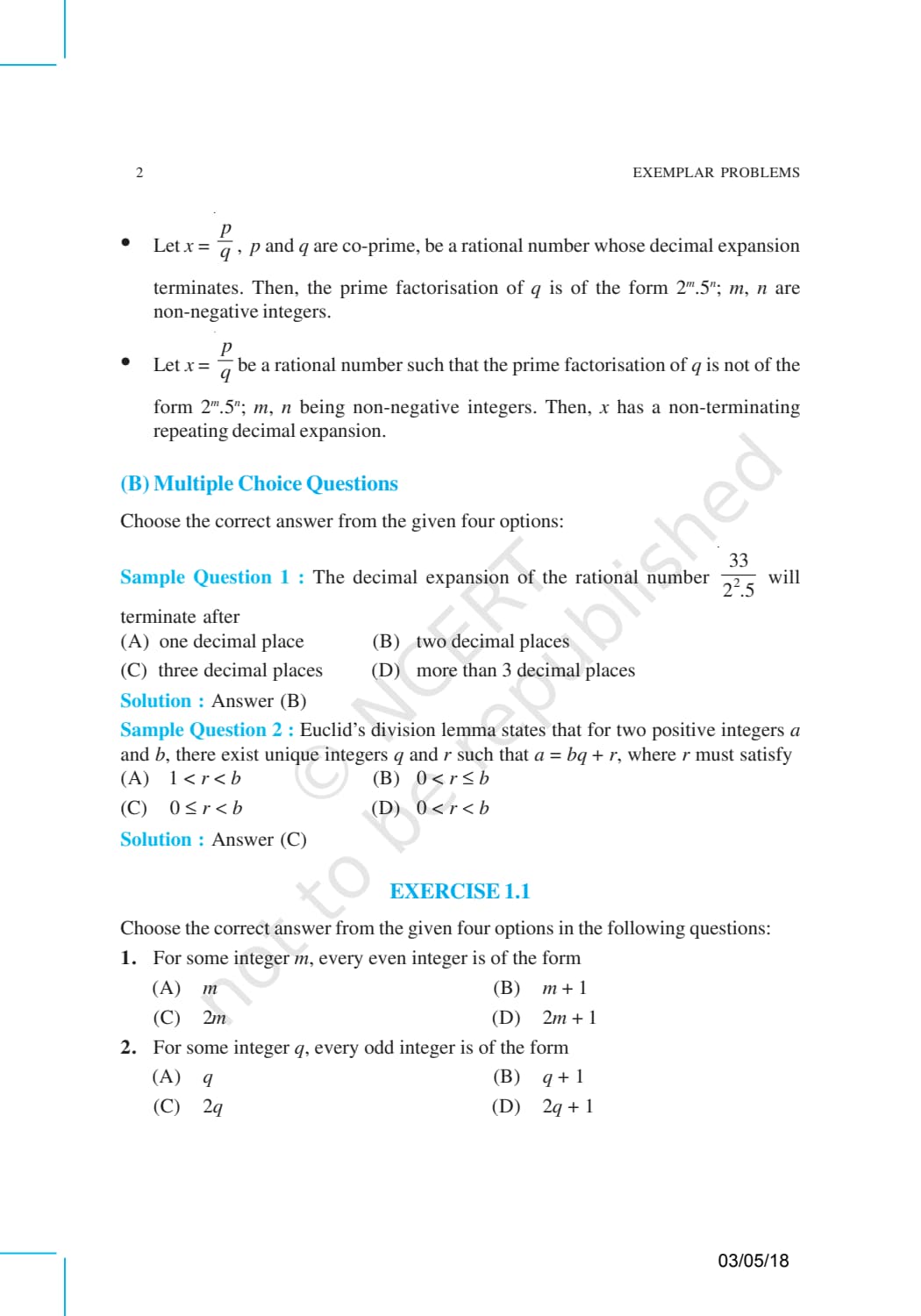
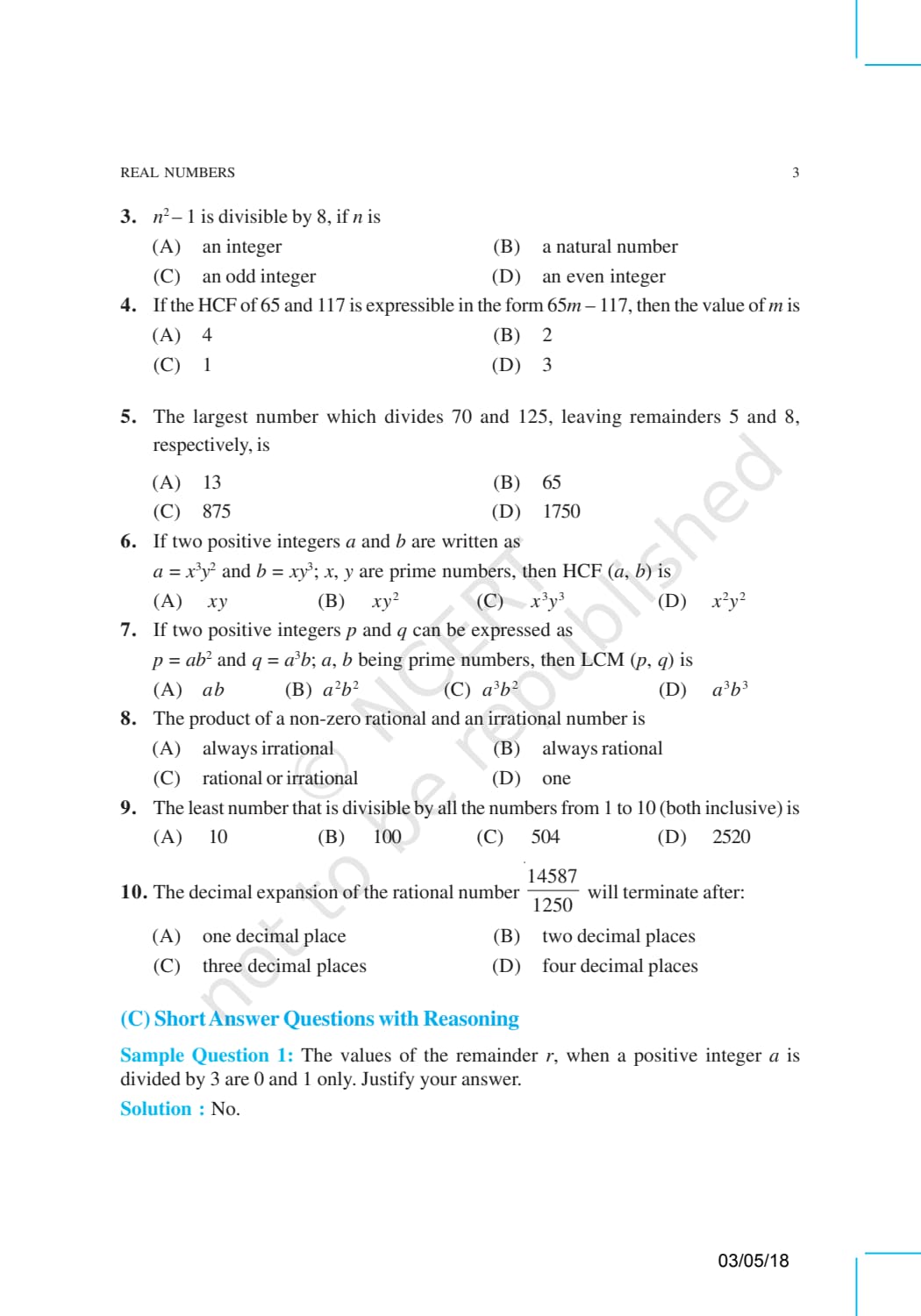
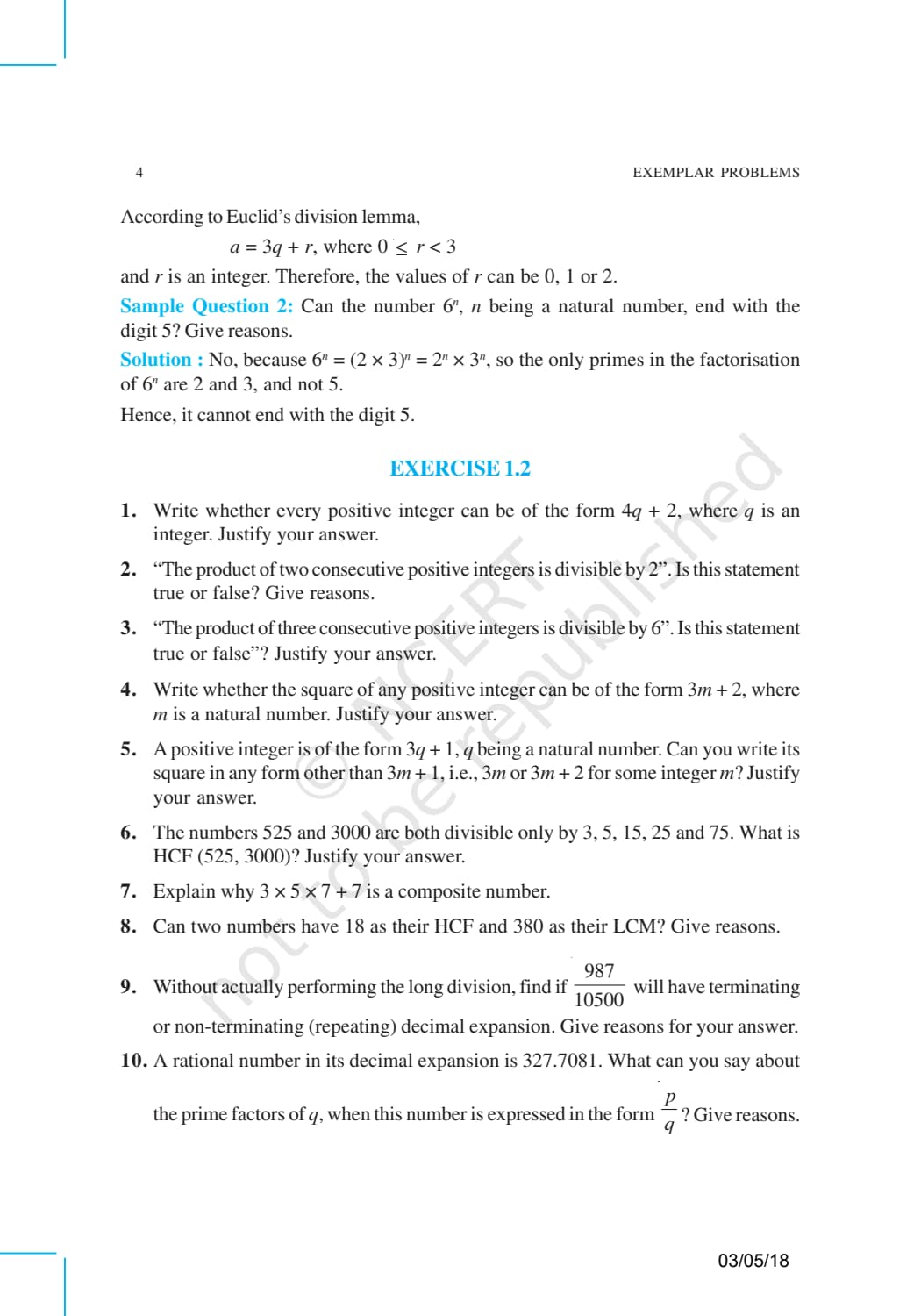
- Solved examples and two exercises: Exercise 1.1 on prime factorisation, HCF and LCM, and Exercise 1.2 on irrational numbers.
Fundamental Theorem of Arithmetic
The first section introduces the Fundamental Theorem of Arithmetic. In plain words, every composite number can be written as a product of prime numbers. There is only one way to do this, apart from the order of the factors. So a number like 32760 has exactly one prime factorisation, no matter how you start.
One classic use is checking the last digit of a number. The book proves 4n can never end in zero: its only prime factor is 2, but a number ending in zero also needs a factor of 5.
| Term | Meaning | Example |
|---|---|---|
| Prime number | A number with exactly two factors, 1 and itself | 2, 3, 5, 7, 11, 13 |
| Composite number | A number with more than two factors | 4, 6, 8, 9, 12 |
| Prime factorisation | Writing a number as a product of primes | 156 = 22 × 3 × 13 |
| Co-prime numbers | Numbers whose only common factor is 1 | 8 and 9 |
HCF & LCM by Prime Factorisation
The Fundamental Theorem of Arithmetic gives a clean way to find the HCF (Highest Common Factor) and LCM (Lowest Common Multiple). Write each number as a product of powers of primes, then use one simple rule for each.
The book works through 96 and 404 as a model. After prime factorising both, the HCF is the product of the lowest powers of the common primes, and the LCM follows from the HCF and product relation.
- HCF: take only the common prime factors, each raised to its smallest power.
- LCM: take all the prime factors that appear, each raised to its greatest power.
- Check: for any two numbers, HCF × LCM = product of the two numbers, a fast way to confirm your answer.
Proving Numbers Irrational
The last section, Revisiting Irrational Numbers, is where many students lose marks. A number is irrational if it cannot be written as a fraction p/q, where p and q are integers and q is not zero. The chapter proves √2, √3 and √5 are irrational using proof by contradiction.
Every proof leans on Theorem 1.2: if a prime p divides a2, then p divides a. The proof of √2 runs like this:
- Assume the opposite: suppose √2 = a/b, where a and b are co-prime integers, b not zero.
- Square it: this gives 2b2 = a2, so 2 divides a2, and by Theorem 1.2 also a.
- Substitute: writing a = 2c gives b2 = 2c2, so 2 divides b too.
- Contradiction: now 2 divides both a and b, but they were co-prime. The assumption is at fault, so √2 must be irrational.
Solved Examples & Exercises
The chapter is short but dense: several solved examples, then two exercises. The solved examples show the exact way to set out a proof or an HCF and LCM calculation, so copy that style.
| Section | What it tests | Sample question |
|---|---|---|
| Exercise 1.1 | Prime factorisation, HCF and LCM | Find the LCM and HCF of 26 and 91, and verify LCM × HCF = product. |
| Exercise 1.2 | Proving numbers are irrational | Prove that √5 is irrational. |
| Solved examples | Model proofs and calculations | Show that 3√2 is irrational. |
A favourite reasoning question asks why a number such as 7 × 11 × 13 + 13 is composite. Take out the common factor 13, which shows the number has a factor other than 1 and itself.
How to Use the PDF for Revision
The official textbook is the safest source, as every theorem, proof and exercise is exam-correct. Use this PDF in two reading passes, paired with the solutions and notes linked below.
- First pass: read Sections 1.2 and 1.3 in order. Cover each solved example, try it yourself, then check your steps against the book.
- Second pass: work Exercise 1.1 and 1.2 by hand without the answers. Prime factorise carefully and write every line of each proof in full.
- Board angle: Real Numbers is a scoring chapter in Unit 1. HCF, LCM and Fundamental Theorem questions appear most years, plus one proof on irrational numbers.
Student Feedback
71% of Class 10 students said the irrational number proofs were the hardest part in class tests. 3 out of 5 students told us that reading the chapter theorem by theorem helped them write the √2 proof correctly under exam pressure.
Source: 2026-27 Class 10 Maths student poll, 8,700 students from CBSE schools in 12 states, before the 2026 boards.
Other Resources for This Chapter
Pair the official chapter with the other Class 10 Maths Chapter 1 Real Numbers resources, all linked below.
| Resource | What it covers | Open |
|---|---|---|
| NCERT Book PDF | Official Class 10 Maths Chapter 1 textbook, with every theorem, example and exercise. | Class 10 Maths Chapter 1 NCERT Book PDF |
| NCERT Solutions | Step-by-step answers to all exercise questions of the chapter. | Class 10 Maths Chapter 1 NCERT Solutions |
| Notes | Concept-first revision notes on the theorem, HCF, LCM and irrational proofs. | Class 10 Maths Chapter 1 Notes |
| Formula Sheet | Quick reference of key results, formulae and definitions for fast revision. | Class 10 Maths Chapter 1 Formula Sheet |
| Handwritten Notes | Scanned-style handwritten pages for last-minute board revision. | Class 10 Maths Chapter 1 Handwritten Notes |
NCERT Book for Class 10 Maths: All Chapters
Related Links: Open the NCERT Book PDF for the other Class 10 Maths chapters from the table below.
| Chapter | NCERT Book PDF link |
|---|---|
| Chapter 1 | Real Numbers NCERT Book PDF |
| Chapter 2 | Polynomials NCERT Book PDF |
| Chapter 3 | Pair of Linear Equations in Two Variables NCERT Book PDF |
| Chapter 4 | Quadratic Equations NCERT Book PDF |
| Chapter 5 | Arithmetic Progressions NCERT Book PDF |
| Chapter 6 | Triangles NCERT Book PDF |
| Chapter 7 | Coordinate Geometry NCERT Book PDF |
| Chapter 8 | Introduction to Trigonometry NCERT Book PDF |
| Chapter 9 | Some Applications of Trigonometry NCERT Book PDF |
| Chapter 10 | Circles NCERT Book PDF |
| Chapter 11 | Areas Related to Circles NCERT Book PDF |
| Chapter 12 | Surface Areas and Volumes NCERT Book PDF |
| Chapter 13 | Statistics NCERT Book PDF |
| Chapter 14 | Probability NCERT Book PDF |
NCERT Book Class 10 Maths Chapter 1 Real Numbers FAQs
Ques. What does Chapter 1 Real Numbers cover in the Class 10 Maths NCERT Book?
Ans. Chapter 1 covers the number theory you need for the board exam. It states the Fundamental Theorem of Arithmetic, which says every composite number is a unique product of primes, and uses it to find HCF and LCM by prime factorisation. It then revisits irrational numbers and proves the square roots of 2, 3 and 5 are irrational using proof by contradiction. The chapter has solved examples plus two exercises, 1.1 and 1.2, aligned with the 2026-27 CBSE syllabus.
Ques. What is the Fundamental Theorem of Arithmetic in Class 10 Maths?
Ans. The Fundamental Theorem of Arithmetic states that every composite number can be expressed as a product of prime numbers, and this factorisation is unique apart from the order in which the prime factors are written. For example, 156 is always 2 squared times 3 times 13, no matter how you begin breaking it down. This theorem is the base for finding HCF and LCM by prime factorisation and for proving that certain numbers, such as the square root of 2, are irrational. It is one of the most important results in the chapter for the Class 10 Maths board exam.
Ques. How do you find HCF and LCM by the prime factorisation method?
Ans. First write each number as a product of powers of its prime factors. The HCF is the product of the common prime factors, each taken to its smallest power, while the LCM is the product of all the prime factors that appear, each taken to its greatest power. For two numbers you can also use the relation HCF times LCM equals the product of the two numbers, which is a quick way to find one when you know the other and to verify your answer. This shortcut works only for two numbers, not for three.
Ques. How does the NCERT Book prove that the square root of 2 is irrational?
Ans. The book uses proof by contradiction. It assumes the square root of 2 is rational, so it can be written as a fraction a over b where a and b are co-prime integers. Squaring gives 2b squared equals a squared, which shows 2 divides a squared, and so 2 divides a. Writing a as 2c and substituting back shows 2 also divides b. That means 2 divides both a and b, which contradicts the fact that a and b were co-prime. Since the assumption fails, the square root of 2 must be irrational.
Ques. Is the Class 10 Maths Chapter 1 NCERT Book PDF free to download for 2026-27?
Ans. Yes. The official NCERT Book PDF for Class 10 Maths Chapter 1 Real Numbers is free to read and download on this page for the 2026-27 session. It is the complete chapter as printed in the CBSE textbook, including the theorems, solved examples and the end-of-chapter exercises 1.1 and 1.2. You can pair the book with the linked NCERT Solutions and revision notes for the same chapter so that you read the textbook and revise from one place.
Ques. How many exercises are there in Class 10 Maths Chapter 1 Real Numbers?
Ans. The Real Numbers chapter has two exercises. Exercise 1.1 is on expressing numbers as products of their prime factors and on finding the HCF and LCM using prime factorisation, including word problems such as the circular path question. Exercise 1.2 is on proving that given numbers are irrational, for example the square root of 5 and expressions such as 3 plus 2 times the square root of 5. Both exercises are fully worked in the linked NCERT Solutions for the chapter, and the solved examples in the book show the method to follow.
Ques. Are these NCERT Book contents aligned with the 2026-27 CBSE syllabus?
Ans. Yes. This page hosts the official NCERT Class 10 Maths textbook chapter for the current 2026-27 CBSE syllabus. The Real Numbers chapter focuses on the Fundamental Theorem of Arithmetic, HCF and LCM, and irrational numbers, so the theorems, examples and exercises you read here are exam-correct. Because it is the official book, it is the safest base text for board preparation, and the linked solutions, notes and formula sheet for the same chapter all follow this textbook order.



Comments