


The NCERT Book for Class 10 Maths Chapter 10 Circles is the official CBSE textbook chapter, free to read and download for the 2026-27 session. It adds two key tangent results needed for the board exam.
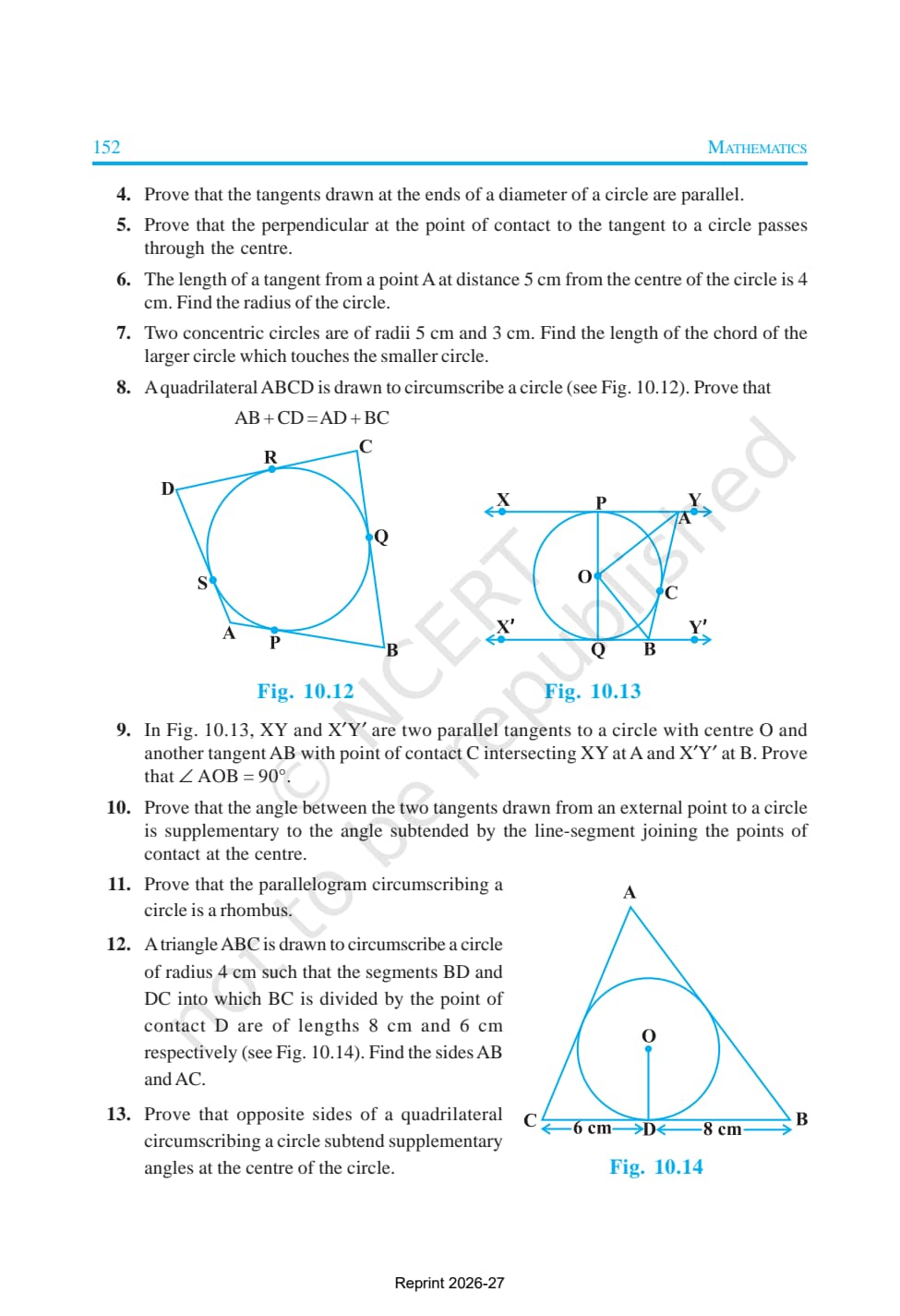
- Official NCERT textbook PDF, with every definition, theorem, proof and exercise exactly as printed.
- Covers the tangent to a circle, the number of tangents from a point, and two theorems with proofs.
- Part of the Geometry unit, which carries about 15 marks in the board exam.
This page hosts the official NCERT Class 10 Maths textbook chapter, checked page by page against the 2026-27 CBSE syllabus and the printed Circles chapter.
Watch Circles Class 10 Maths Explained
Source: Magnet Brains on YouTube
What the Circles NCERT Book Covers
The PDF above is the complete official chapter for 2026-27. Circles is short but proof-heavy.
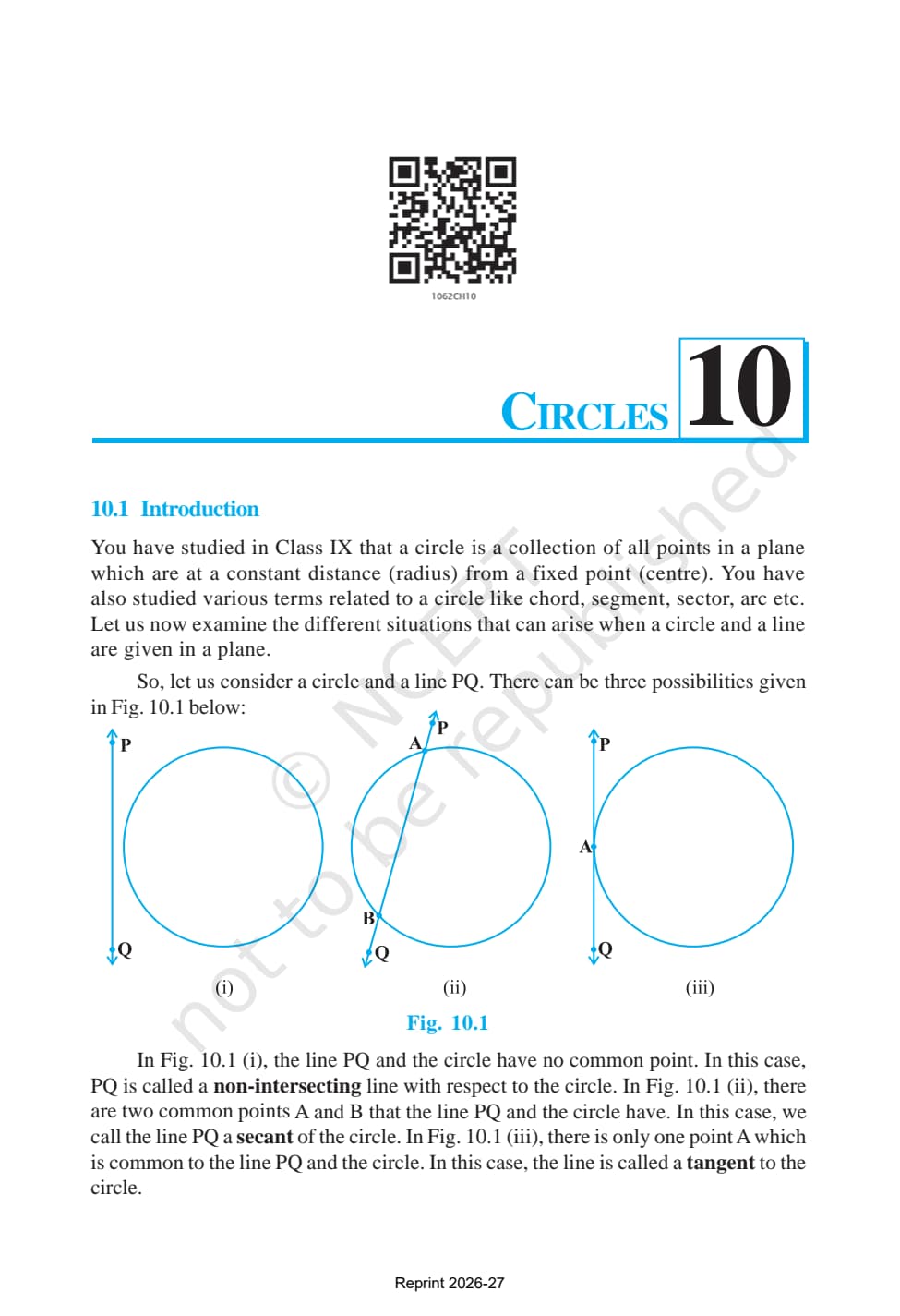
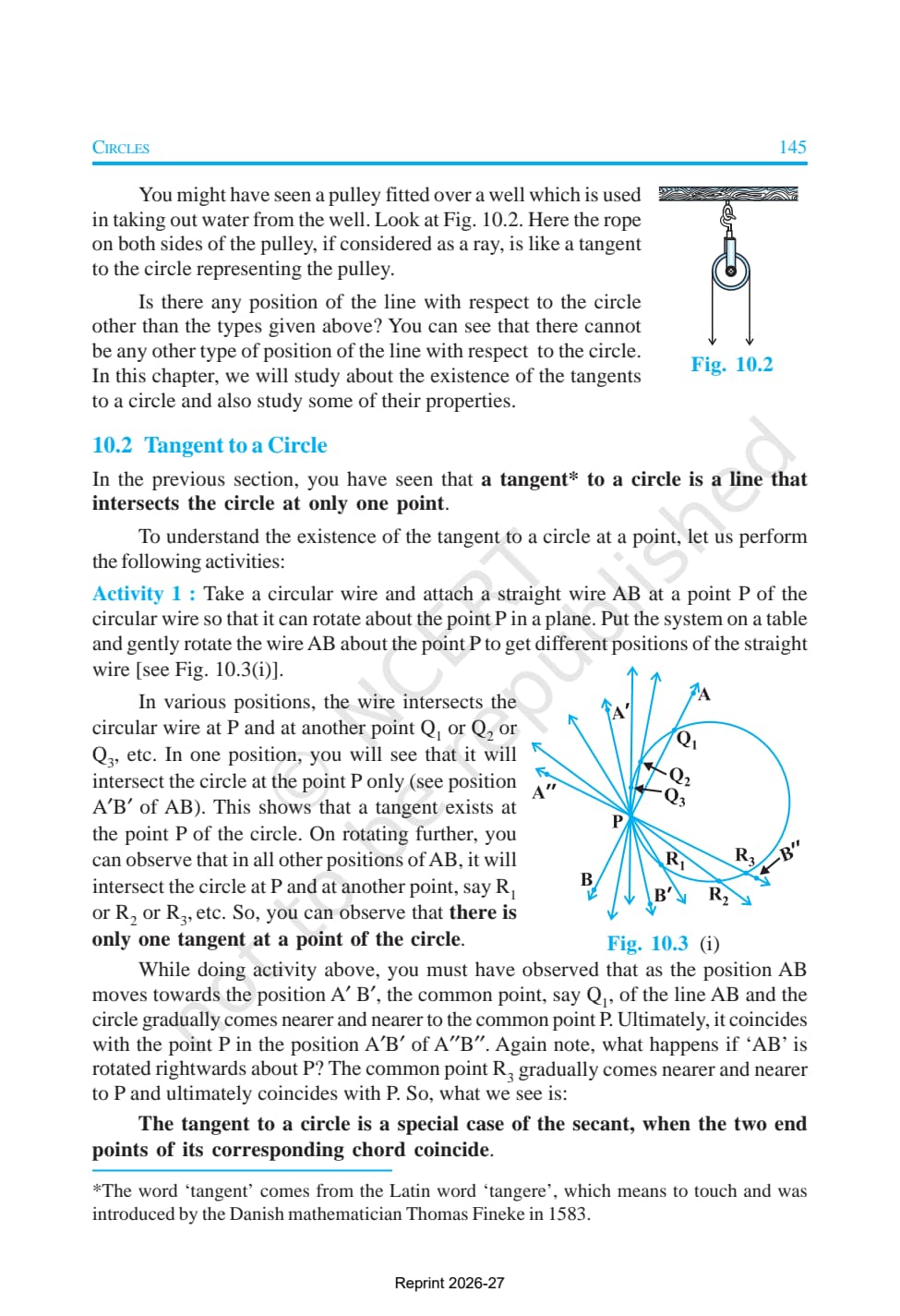
- Tangent to a circle: a line that touches the circle at exactly one point, unlike a secant which cuts it at two.
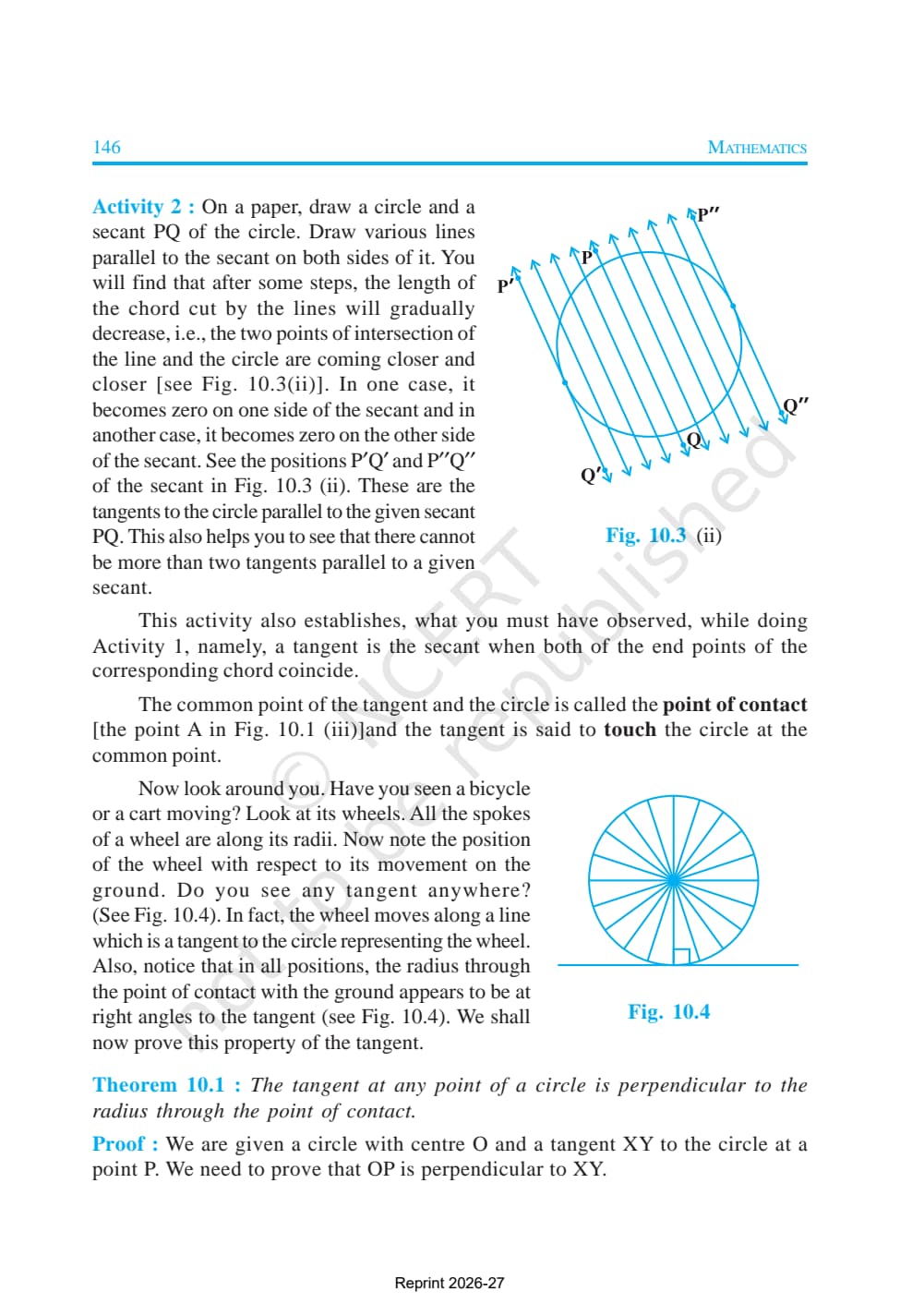
- Point of contact: the single point where the tangent touches the circle.
- Theorem 10.1: the tangent is perpendicular to the radius at the point of contact.
- Theorem 10.2: two tangents from an external point are equal in length.
The whole chapter rests on these two theorems. Learn the proofs, not just the statements.
Tangent to a Circle: Definition and Properties
The book compares three positions of a line near a circle: it can miss it, cut it at two points (a secant), or touch it at one point (a tangent).
A tangent is the limiting case of a secant. As a secant's two points A and B move closer, they meet at one point P, and the line becomes a tangent at P.
| Line type | Intersections with circle | Key property |
|---|---|---|
| Non-intersecting line | 0 points | Lies entirely outside the circle; distance from centre > radius |
| Secant | 2 points | Passes through the interior; chord is the segment between the two points |
| Tangent | 1 point (point of contact) | Touches without crossing; perpendicular to radius at point of contact |
The tangent at a point on the circle is unique, since the perpendicular to the radius there is a single line.
Theorem 10.1: Tangent Perpendicular to Radius
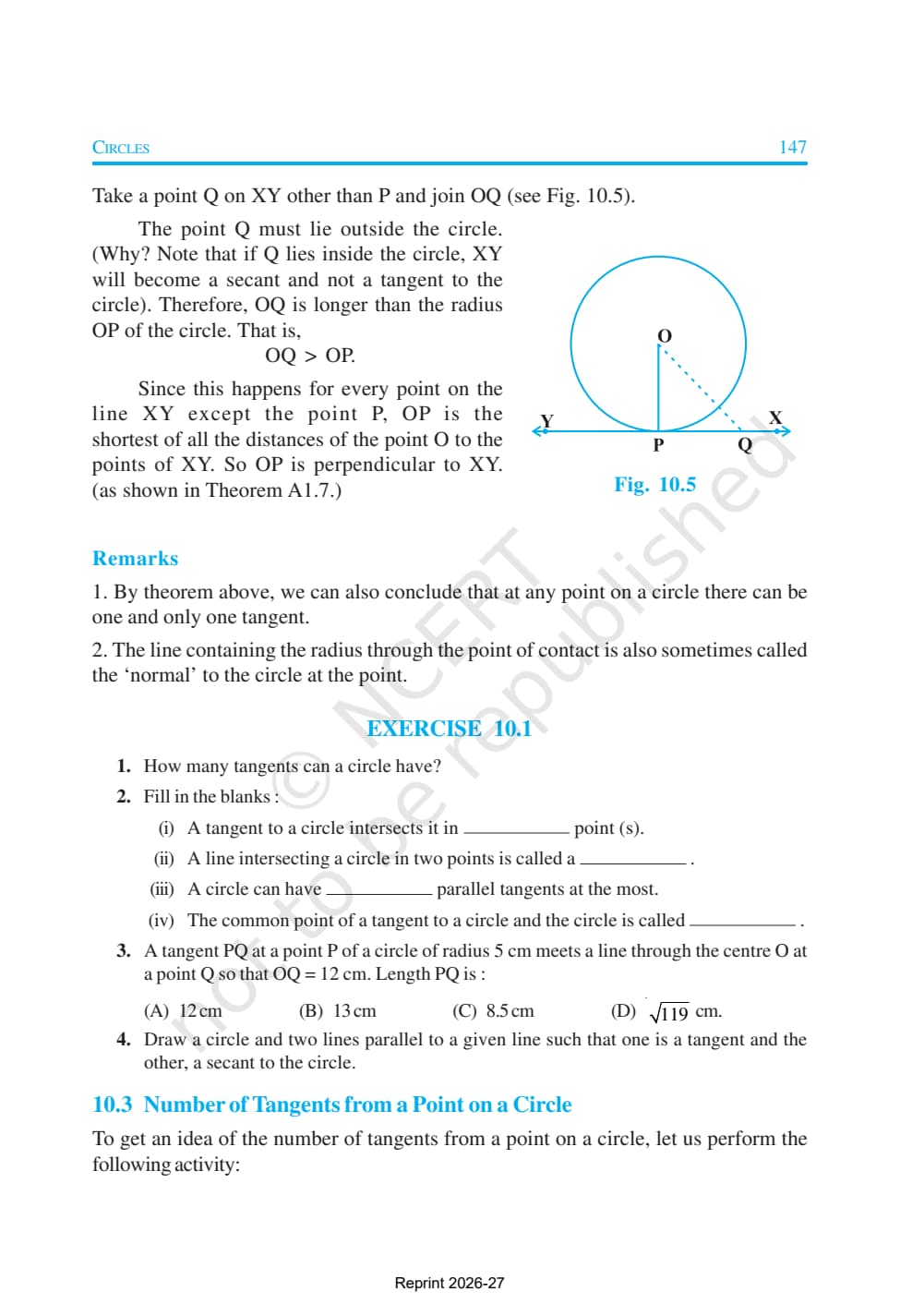
This is the chapter's foundational theorem: "The tangent at any point of a circle is perpendicular to the radius through the point of contact." The book proves it by contradiction.
The proof strategy:
- Assume the tangent at P is NOT perpendicular to the radius OP (O is the centre).
- Then some other point Q on the tangent has OQ shorter than OP.
- But every point on the tangent except P lies outside the circle, so OQ must exceed OP.
- This contradiction shows the assumption is false: the tangent is perpendicular to OP at P.
Corollary: at any point on a circle there is exactly one tangent, since the perpendicular to OP at P is unique. Students should be able to state this in board exams.
If OP is the radius and PT is the tangent at P, then angle OPT = 90°.
So OP² + PT² = OT² by Pythagoras in triangle OPT.
This is the most-used formula in the exercises. Most problems give two lengths and ask for the third.
Theorem 10.2: Equal Tangents from an External Point
Theorem 10.2 is the most tested result in board exams: "The lengths of the two tangents drawn from an external point to a circle are equal."
The proof uses congruent triangles from Chapter 6:
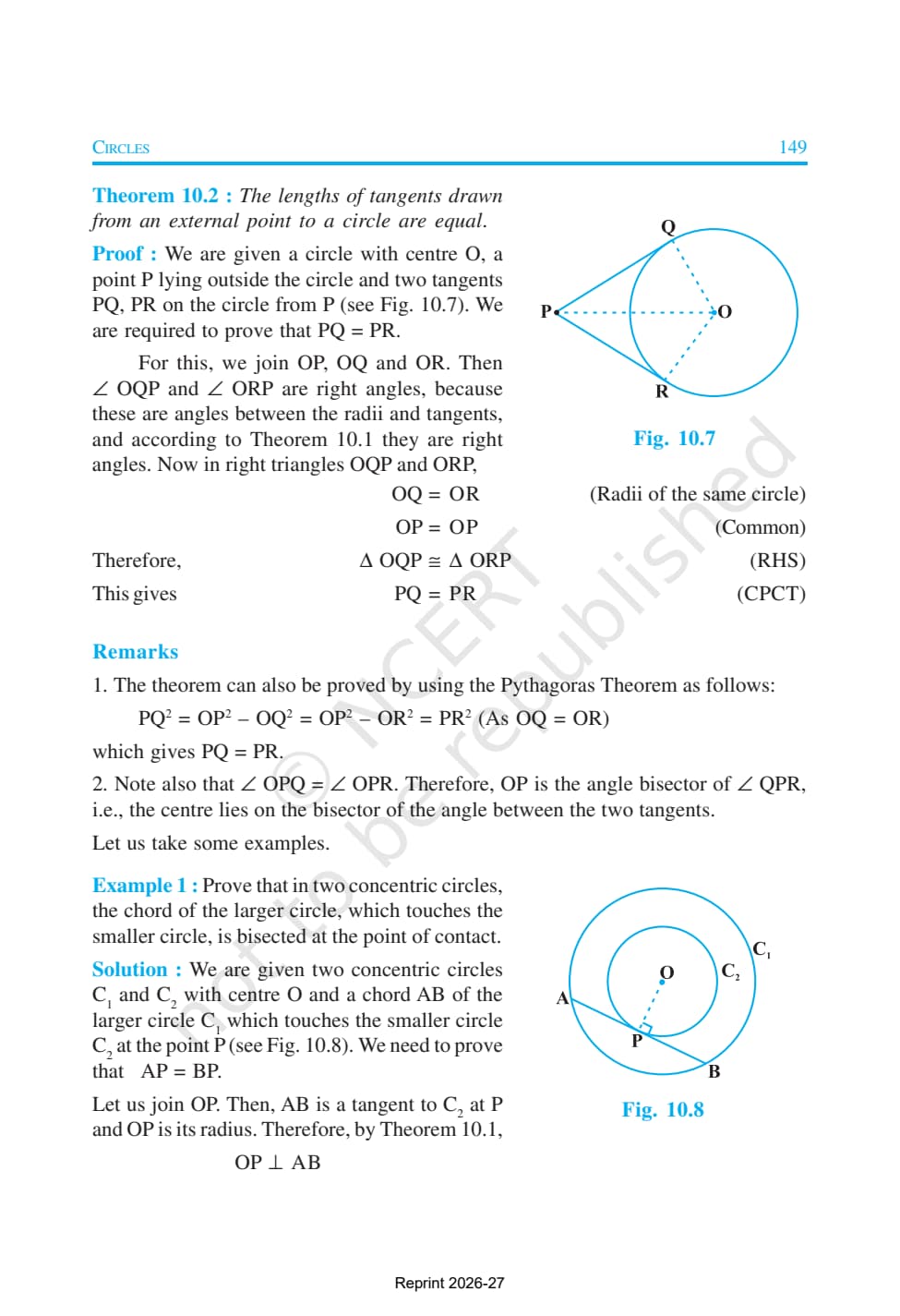
- Let the two tangents from external point P touch the circle at A and B.
- Join OA, OB, OP. By Theorem 10.1, angle OAP = angle OBP = 90°.
- In triangles OAP and OBP: OA = OB (radii), OP common, both right angles.
- By RHS congruence, triangle OAP ≅ triangle OBP, so PA = PB (CPCT).
Theorem 10.2 has two corollaries seen in board questions. OP bisects angle APB, and OP is the perpendicular bisector of chord AB.
| Situation | Number of tangents possible | Reason |
|---|---|---|
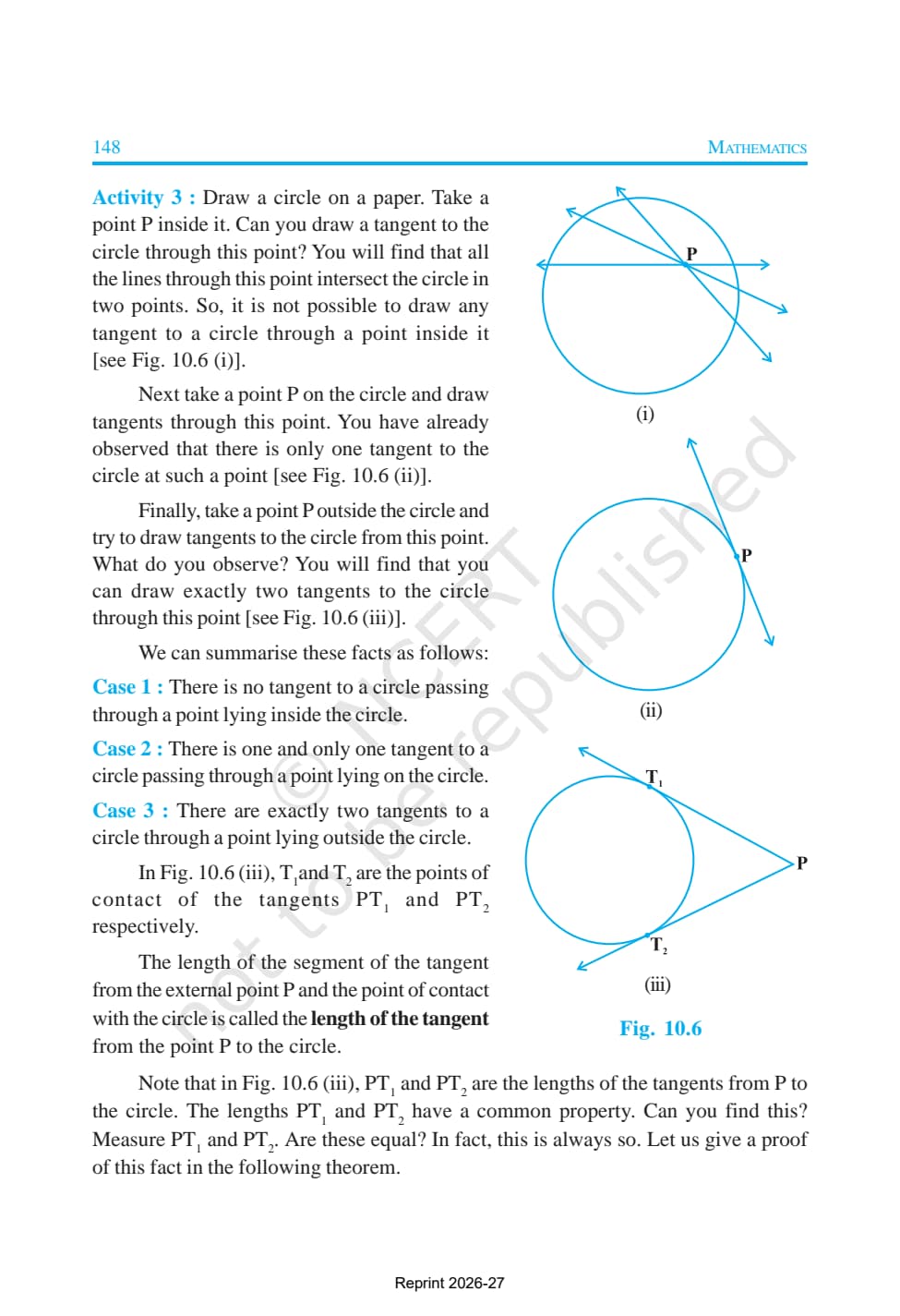
| Point inside the circle | 0 | Any line through an interior point always intersects the circle at two points; no tangent is possible |
| Point on the circle | 1 | Exactly one tangent at the point of contact, perpendicular to the radius (Theorem 10.1) |
| Point outside the circle | 2 | Two equal-length tangents from the external point (Theorem 10.2) |
Solved Examples in Circles Class 10 Maths
The chapter has 3 solved examples that apply both theorems with earlier geometry. They cover the core problem types:
- Example 1: Theorem 10.1 with Pythagoras to find an unknown length.
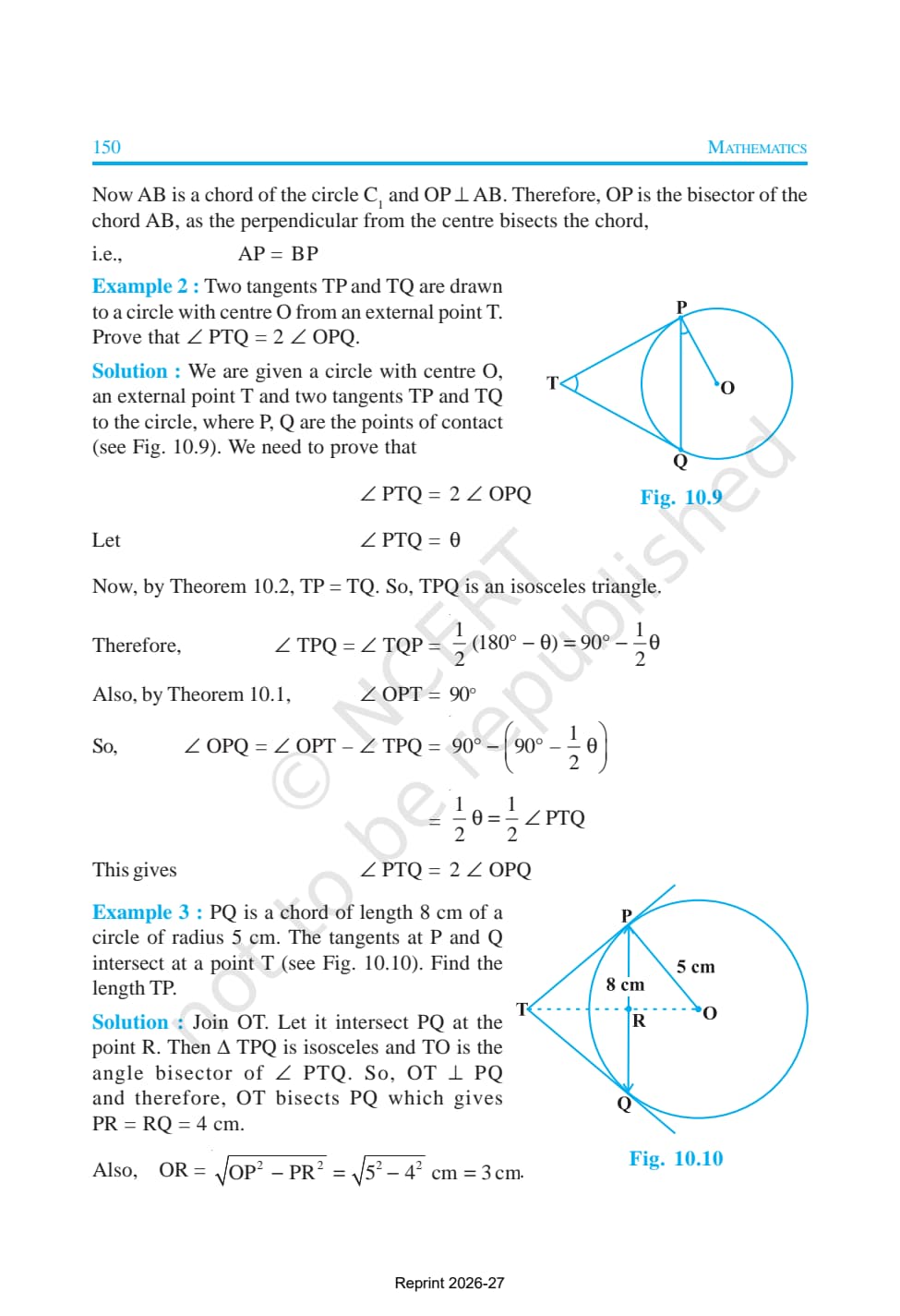
- Example 2: two tangents from an external point; Theorem 10.2 to find a length or angle.
- Example 3: Theorem 10.2 with angle properties to prove a quadrilateral result.
Work through every example first. Watch the congruence proof format: both triangles, the criterion, then CPCT.
Exercises in the Circles Chapter
Circles has two exercises: Exercise 10.1 (4 questions) and Exercise 10.2 (13 questions). Together they cover every board question type.
| Exercise | Questions | What it tests | Marks |
|---|---|---|---|
| Exercise 10.1 | 4 | Number of tangents from inside, on, or outside the circle; Theorem 10.1 with Pythagoras to find lengths. | 1 to 2 |
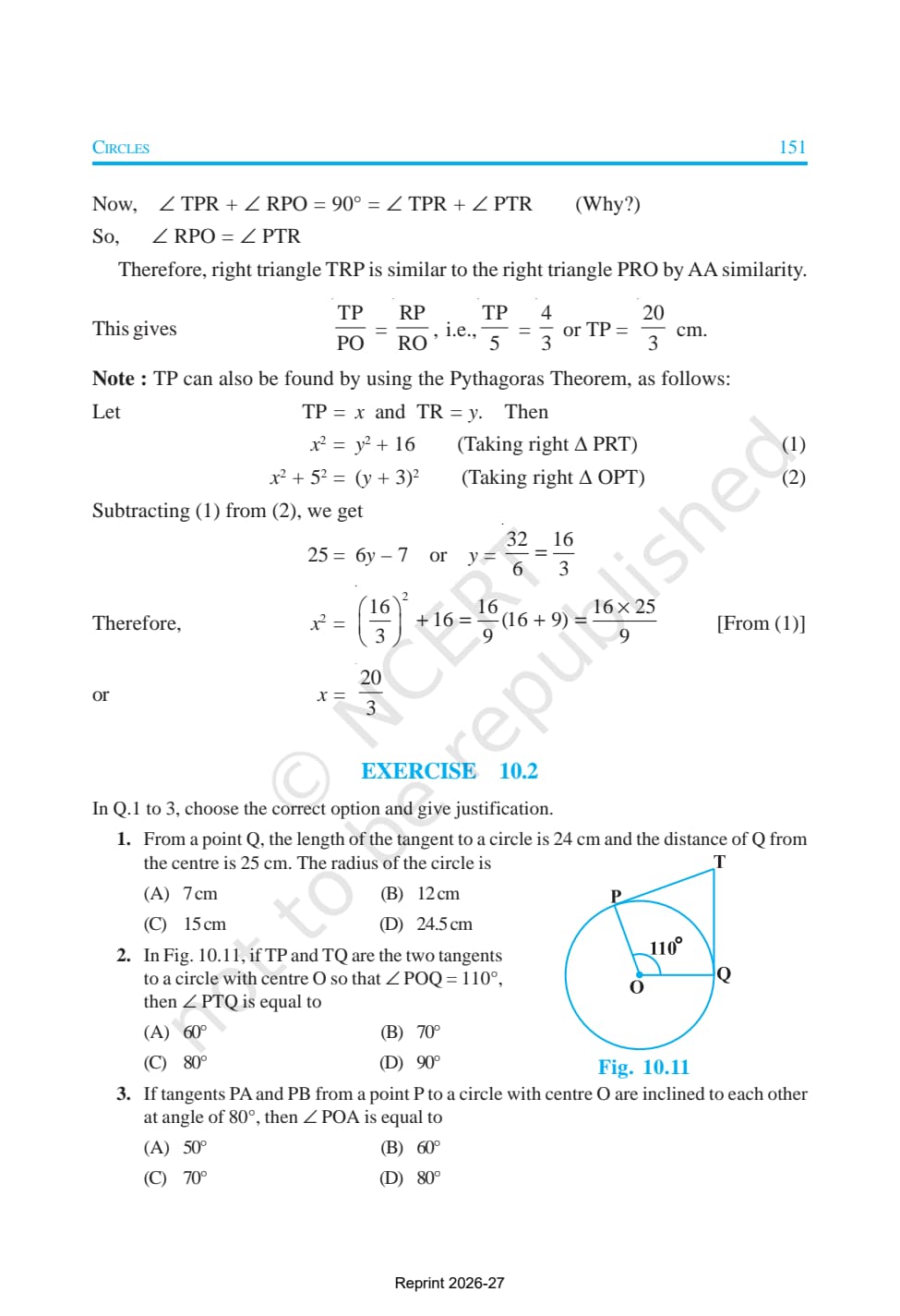
| Exercise 10.2 | 13 | Theorem 10.2 in many set-ups; multi-step proofs using both theorems; quadrilaterals from tangents; tangent and chord angles. | 2 to 4 |
Exercise 10.1 is the gentle entry: count tangents, then use the perpendicular result with Pythagoras to find a length.
Exercise 10.2 carries most marks. Many questions ask you to prove a result with congruent triangles and CPCT. Questions 11 and 12 are the most asked in board exams.
How to Use the Circles PDF for Board Revision
This is a proof-based chapter. A simple three-step plan works well:
- Definitions: read the opening section, draw a tangent, and mark the right angle at the point of contact.
- Both proofs: read each theorem, close the book, and write the proof from memory until it flows.
- Exercises: do all 17 questions in order, then check against the NCERT Solutions linked below.
Student Feedback
68% of Class 10 students said the hardest part was knowing which property to apply at each proof step. 4 out of 5 students said drawing a clear, labelled diagram first made their answers cleaner.
Source: 2026-27 Class 10 Maths student poll, 7,200 students from CBSE schools in 12 states, taken before the 2026 board exams.
Other Resources for Circles
Revise with the matching Solutions, notes, formula sheet and handwritten notes below.
| Resource | What it covers | Open |
|---|---|---|
| NCERT Book PDF | Official Class 10 Maths Chapter 10 textbook, with definitions, two theorems with proofs, solved examples, and both exercises. | Circles NCERT Book PDF |
| NCERT Solutions | Step-by-step answers to all 17 questions across Exercise 10.1 and Exercise 10.2, with full proof working and CPCT stated at every step. | Class 10 Maths Chapter 10 NCERT Solutions |
| Notes | Concept-first revision notes covering tangent definitions, both theorems, their corollaries, and key results for board exam preparation. | Class 10 Maths Chapter 10 Notes |
| Formula Sheet | Quick reference for tangent-radius perpendicularity, equal tangent lengths, and Pythagoras-based calculations used in Chapter 10. | Class 10 Maths Chapter 10 Formula Sheet |
| Handwritten Notes | Scanned-style handwritten pages for last-minute board revision of circle theorems and proof structures. | Class 10 Maths Chapter 10 Handwritten Notes |
| Exemplar Solutions | Answers to NCERT Exemplar problems for Chapter 10, with harder tangent and circle configurations not covered in the main exercises. | Class 10 Maths Chapter 10 Exemplar Solutions |
NCERT Book for Class 10 Maths: All Chapters
Related Links: Open the NCERT Book PDF for any other Class 10 Maths chapter below.
| Chapter | NCERT Book PDF link |
|---|---|
| Chapter 1 | Real Numbers NCERT Book PDF |
| Chapter 2 | Polynomials NCERT Book PDF |
| Chapter 3 | Pair of Linear Equations in Two Variables NCERT Book PDF |
| Chapter 4 | Quadratic Equations NCERT Book PDF |
| Chapter 5 | Arithmetic Progressions NCERT Book PDF |
| Chapter 6 | Triangles NCERT Book PDF |
| Chapter 7 | Coordinate Geometry NCERT Book PDF |
| Chapter 8 | Introduction to Trigonometry NCERT Book PDF |
| Chapter 9 | Some Applications of Trigonometry NCERT Book PDF |
| Chapter 10 | Circles NCERT Book PDF |
| Chapter 11 | Areas Related to Circles NCERT Book PDF |
| Chapter 12 | Surface Areas and Volumes NCERT Book PDF |
| Chapter 13 | Statistics NCERT Book PDF |
| Chapter 14 | Probability NCERT Book PDF |
NCERT Book Class 10 Maths Chapter 10 Circles FAQs
Ques. What does Chapter 10 Circles cover in the Class 10 Maths NCERT Book?
Ans. Chapter 10 Circles in the Class 10 Maths NCERT Book covers the relationship between a circle and a tangent line. The chapter defines a tangent as a line that touches the circle at exactly one point (the point of contact) and contrasts it with a secant (which intersects at two points). It proves two key theorems: Theorem 10.1, which states that the tangent at any point of a circle is perpendicular to the radius drawn to that point, and Theorem 10.2, which states that the lengths of the two tangents drawn from an external point to a circle are equal. The chapter has 3 solved examples, Exercise 10.1 with 4 questions, and Exercise 10.2 with 13 questions, all aligned to the 2026-27 CBSE Class 10 Maths syllabus.
Ques. What is Theorem 10.1 in Class 10 Maths Chapter 10 Circles?
Ans. Theorem 10.1 in Class 10 Maths Chapter 10 states: "The tangent at any point of a circle is perpendicular to the radius through the point of contact." This means that if O is the centre of the circle, P is the point where a tangent touches the circle, and OP is the radius, then the angle between OP and the tangent line at P is exactly 90 degrees. The NCERT Book proves this theorem using a contradiction (indirect proof): if the tangent were not perpendicular to the radius, another point on the tangent would be closer to O than P, which contradicts the fact that all points on the tangent other than P are outside the circle. This theorem is the basis for all Pythagoras calculations in Chapter 10: if T is an external point and TP is the tangent, then OT squared equals OP squared plus PT squared.
Ques. What is Theorem 10.2 in Class 10 Maths Chapter 10 Circles?
Ans. Theorem 10.2 in Class 10 Maths Chapter 10 states: "The lengths of the two tangents drawn from an external point to a circle are equal." If P is a point outside the circle with centre O, and PA and PB are the two tangents from P touching the circle at A and B respectively, then PA equals PB. The NCERT Book proves this using RHS (Right angle-Hypotenuse-Side) congruence: in triangles OAP and OBP, the right angles are at A and B (by Theorem 10.1), the hypotenuse OP is common, and OA equals OB (both are radii). So the triangles are congruent, and therefore PA equals PB by CPCT. An important consequence is that OP bisects angle APB and is the perpendicular bisector of chord AB.
Ques. How many exercises are in Class 10 Maths Chapter 10 Circles?
Ans. Chapter 10 Circles in the Class 10 Maths NCERT Book has two exercises. Exercise 10.1 has 4 questions that test understanding of when tangents are possible from different positions relative to a circle, and direct application of the radius-perpendicular-to-tangent theorem using Pythagoras. Exercise 10.2 has 13 questions covering a wider range: equal tangent lengths from an external point, angle calculations in two-tangent configurations, proof-type questions about quadrilaterals formed by tangents, and multi-step problems combining both Chapter 10 theorems with angle properties from earlier chapters. There are also 3 solved examples in the chapter body that model the key problem types before the exercises begin. Always verify with the latest 2026-27 CBSE syllabus for which questions carry board exam marks in your session.
Ques. How many tangents can be drawn from a point to a circle?
Ans. The number of tangents that can be drawn from a point to a circle depends on where the point is. If the point is inside the circle, no tangent is possible, because any line through an interior point always intersects the circle at two points and is therefore a secant. If the point is exactly on the circle, exactly one tangent can be drawn at that point, perpendicular to the radius at the point of contact (Theorem 10.1). If the point is outside the circle, exactly two tangents can be drawn, and by Theorem 10.2 these two tangents have equal lengths. This three-case summary is directly tested in Exercise 10.1 of the NCERT Book and is a frequent 1-mark question in CBSE board exams.
Ques. Is the Class 10 Maths Chapter 10 Circles NCERT Book PDF free to download for 2026-27?
Ans. Yes. The official NCERT Book PDF for Class 10 Maths Chapter 10 Circles is free to read and download on this page for the 2026-27 session. It is the complete chapter as printed in the CBSE textbook, including the definitions, both theorems with their full proofs, 3 solved examples, all 4 questions of Exercise 10.1, and all 13 questions of Exercise 10.2. You can pair the book with the NCERT Solutions, revision notes, and formula sheet linked in the table above so that you read the textbook and revise from one place for the 2026-27 CBSE Class 10 Maths board exam.



Comments