


The NCERT Book for Class 10 Maths Chapter 2 Polynomials is the official CBSE textbook chapter, free to read and download for 2026-27. It builds the algebra you are tested on: the degree of a polynomial, the geometric meaning of zeroes, and the relationship between zeroes and coefficients.
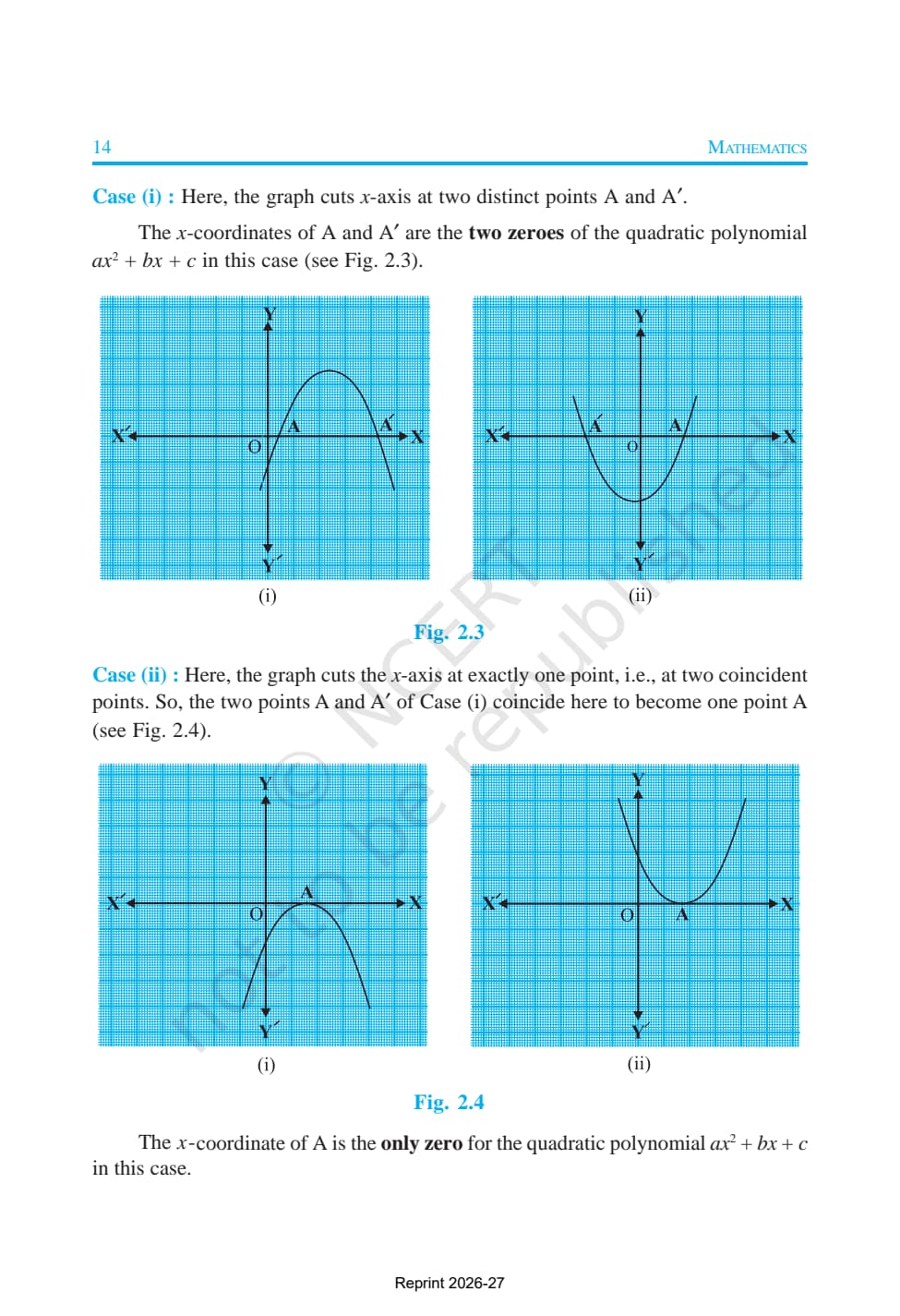
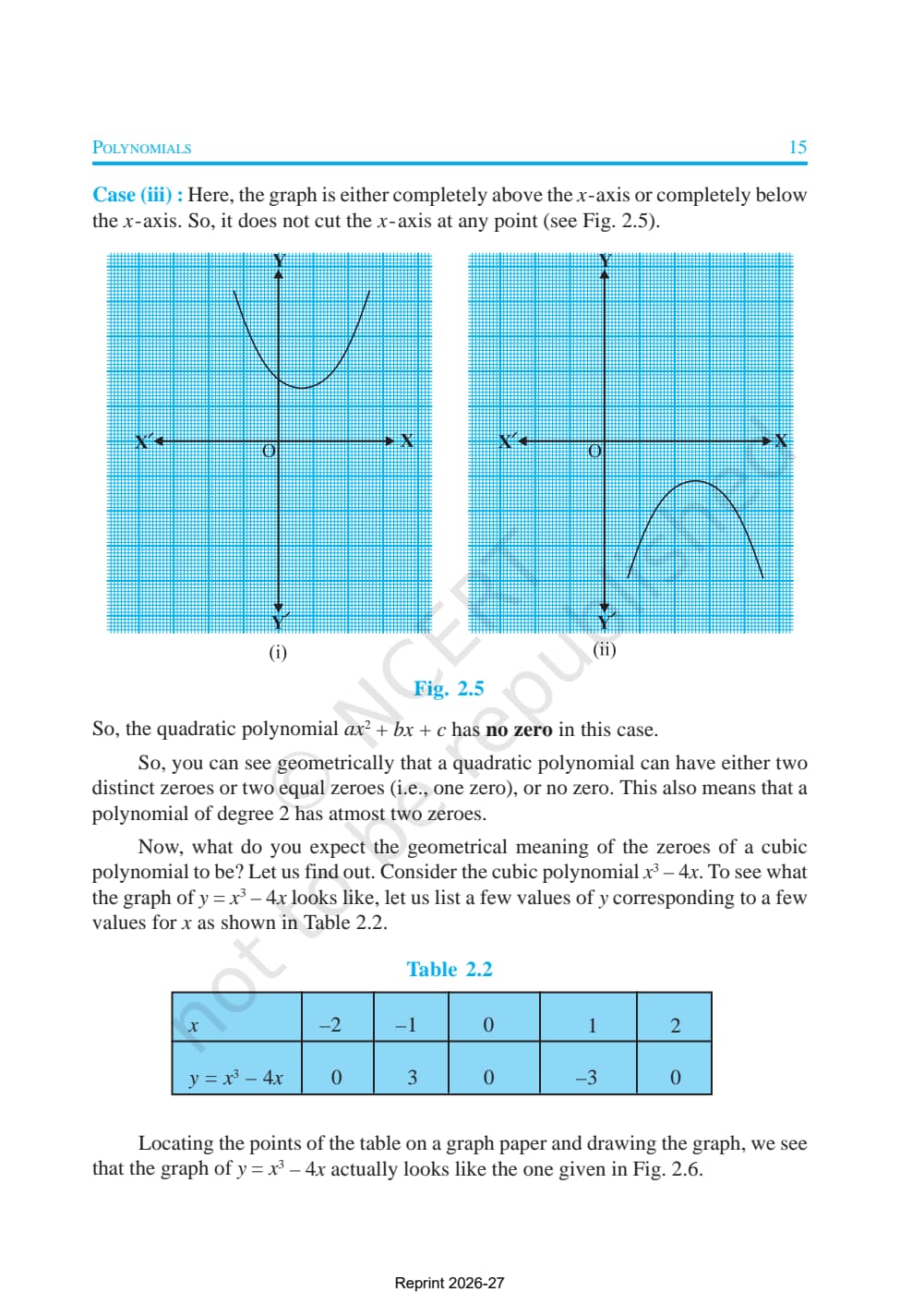
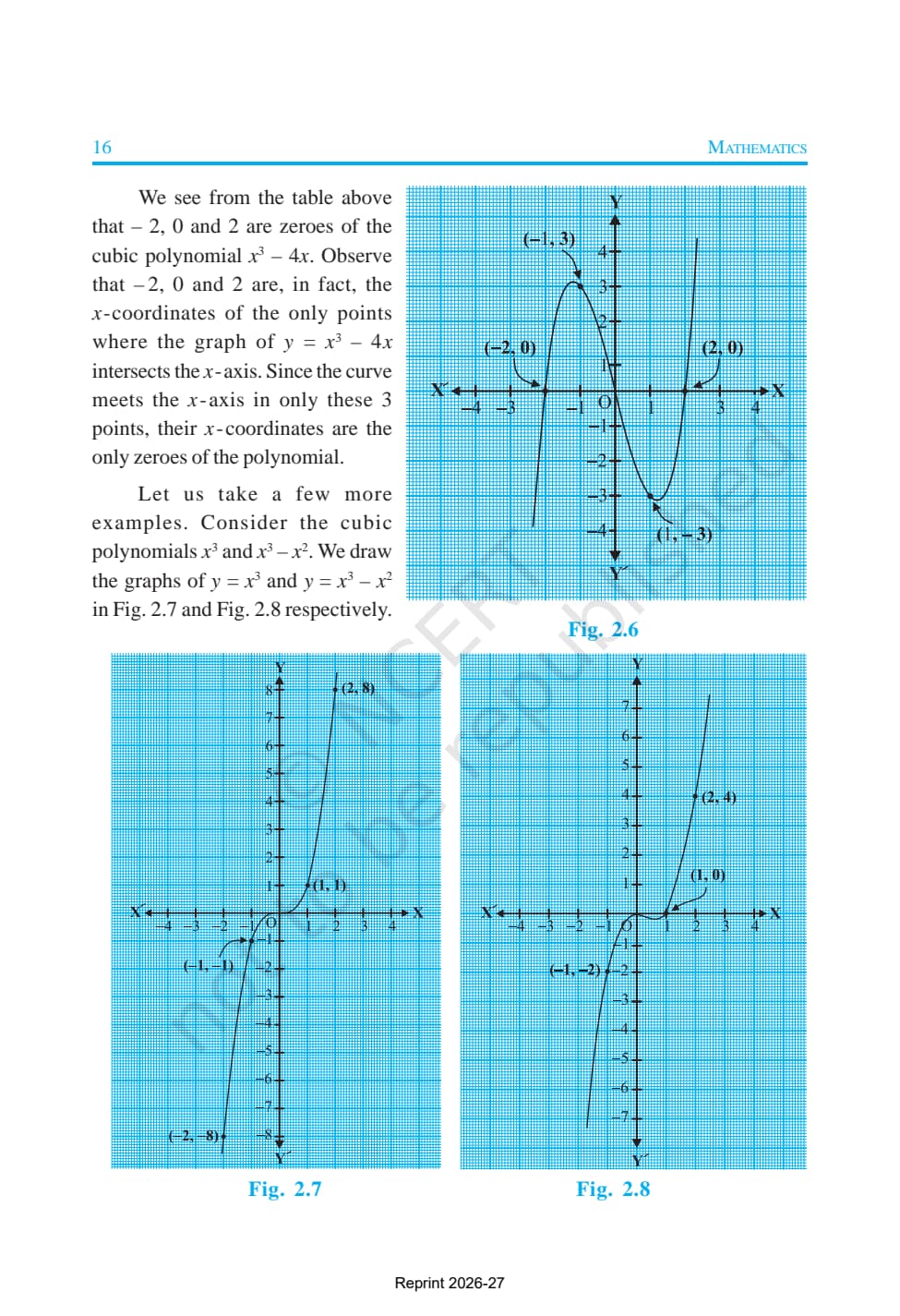
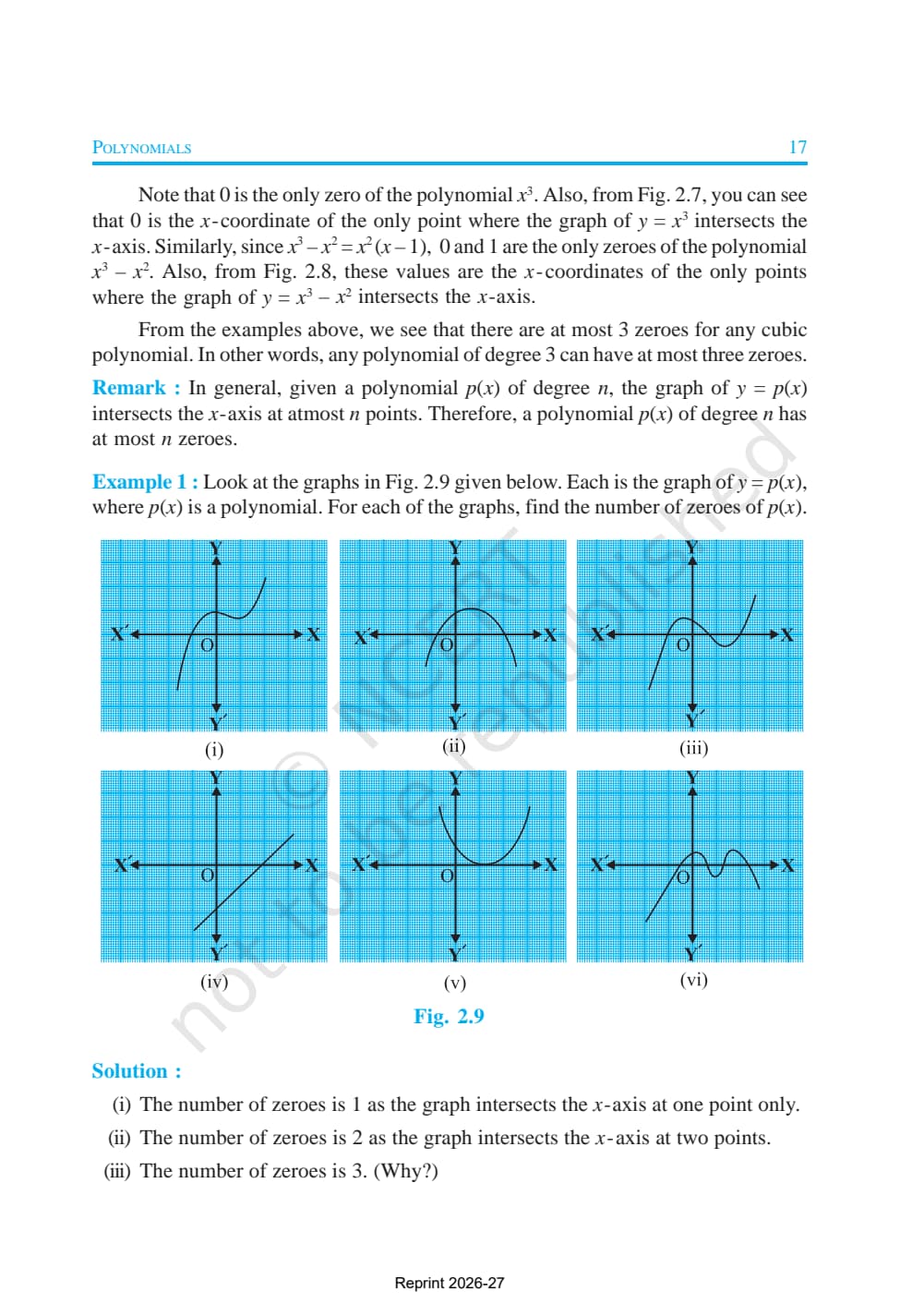
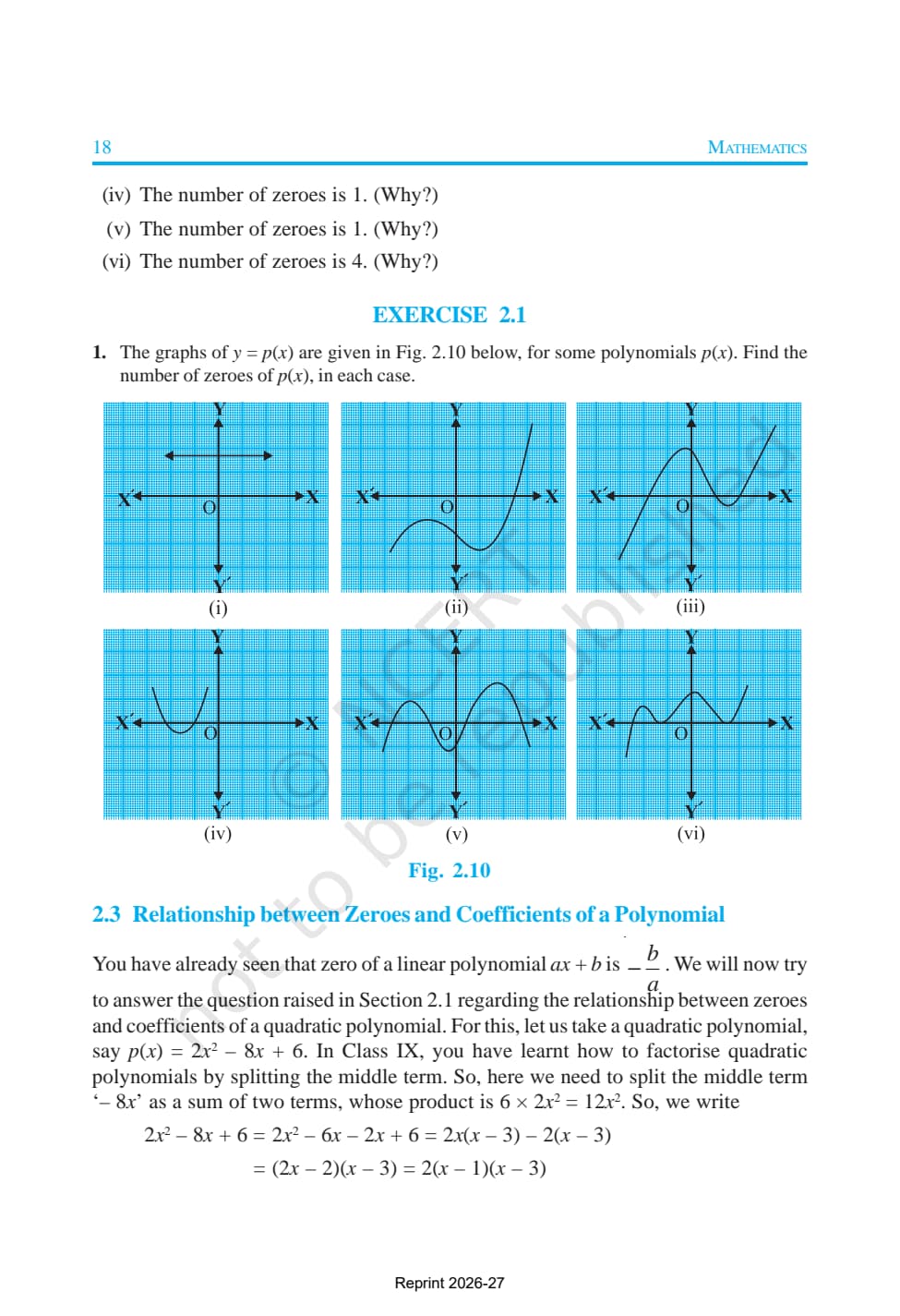
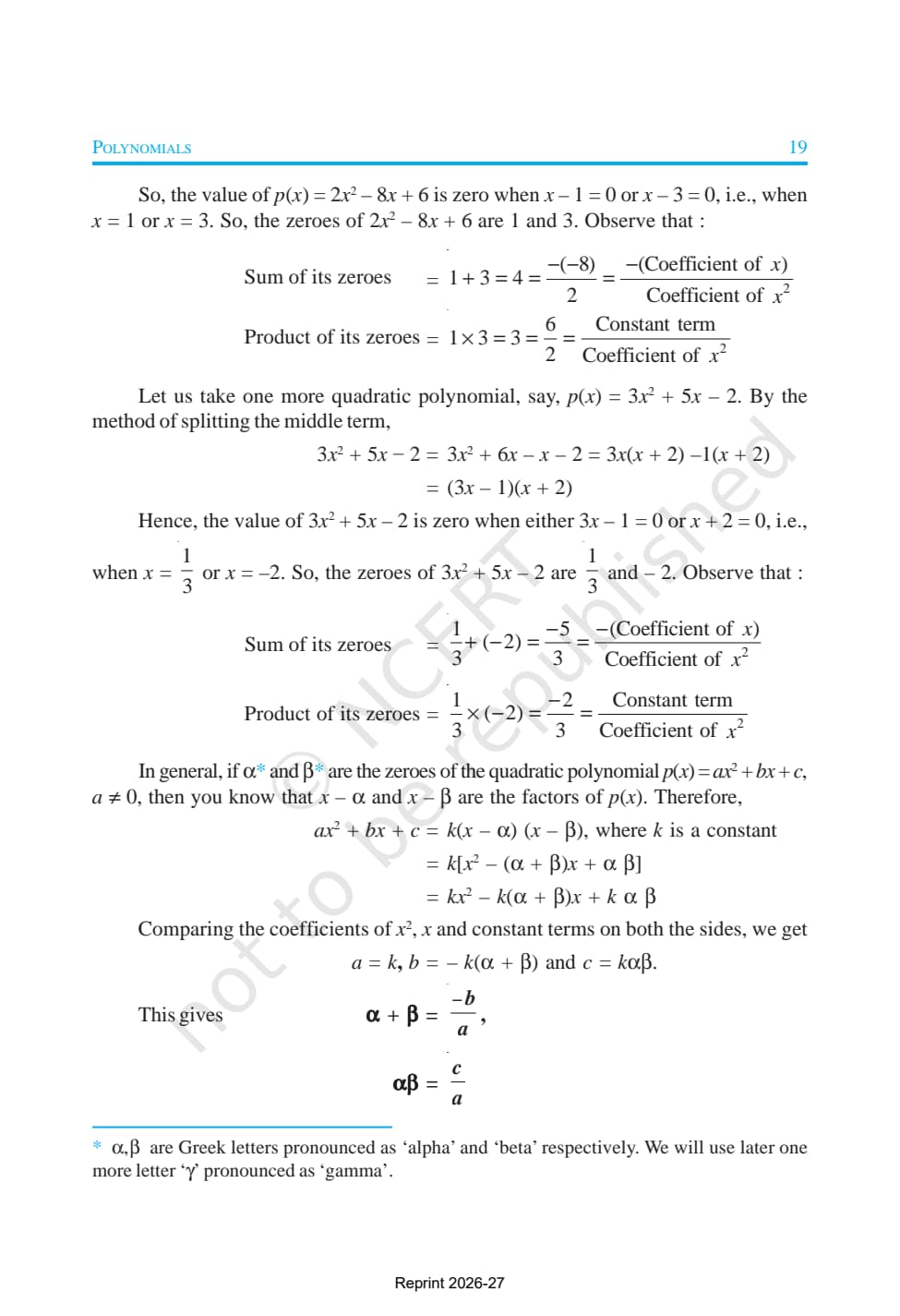
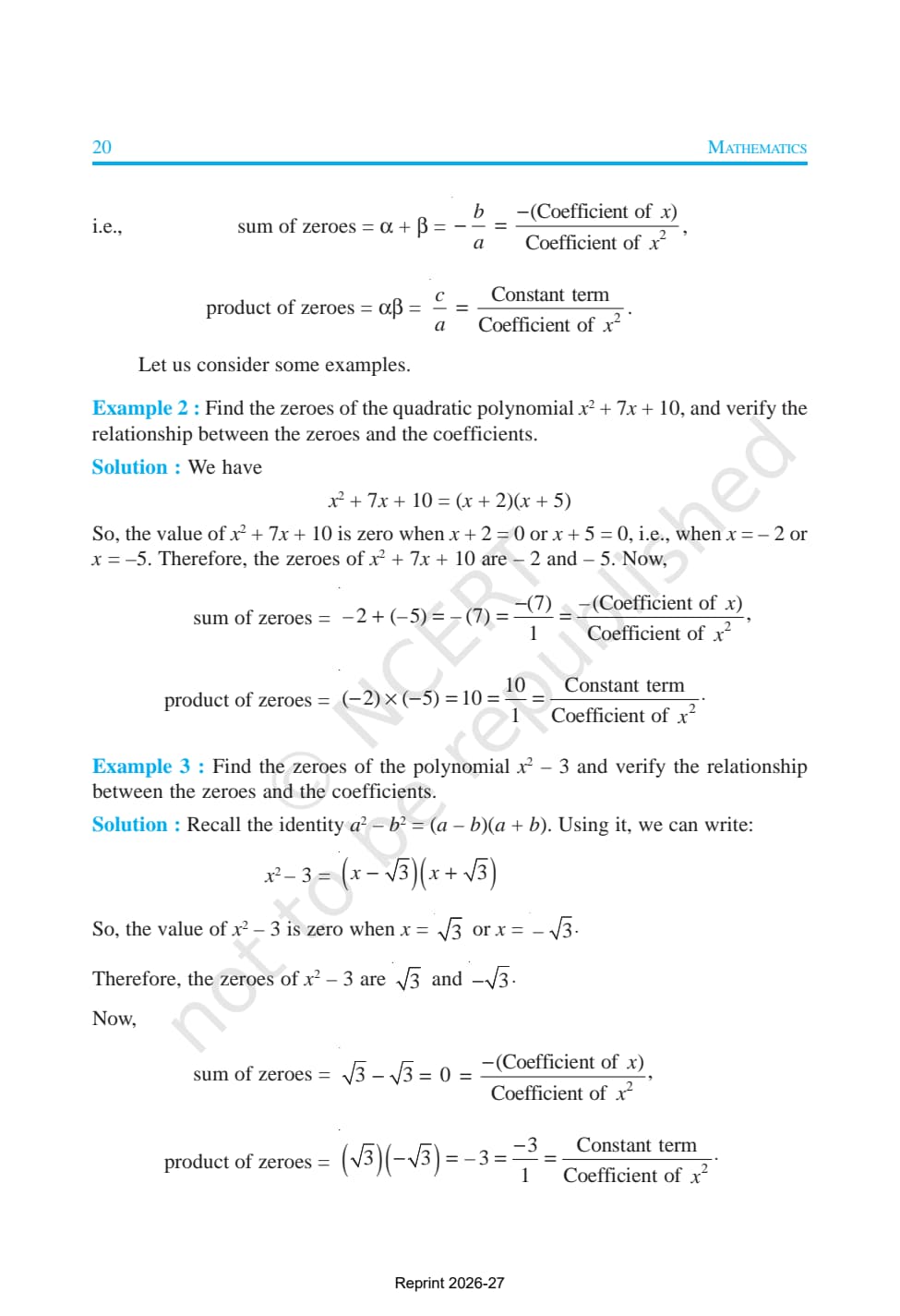
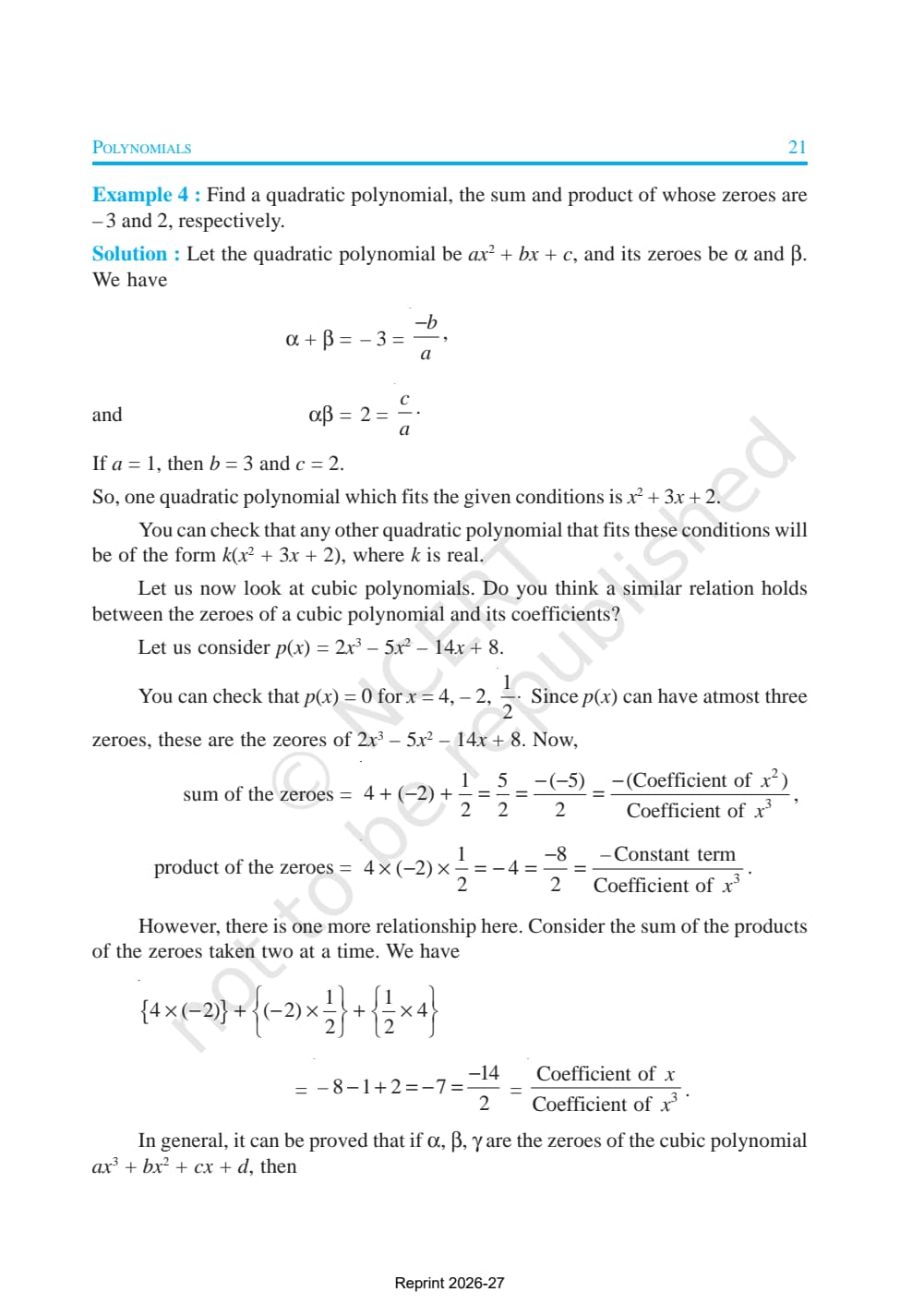
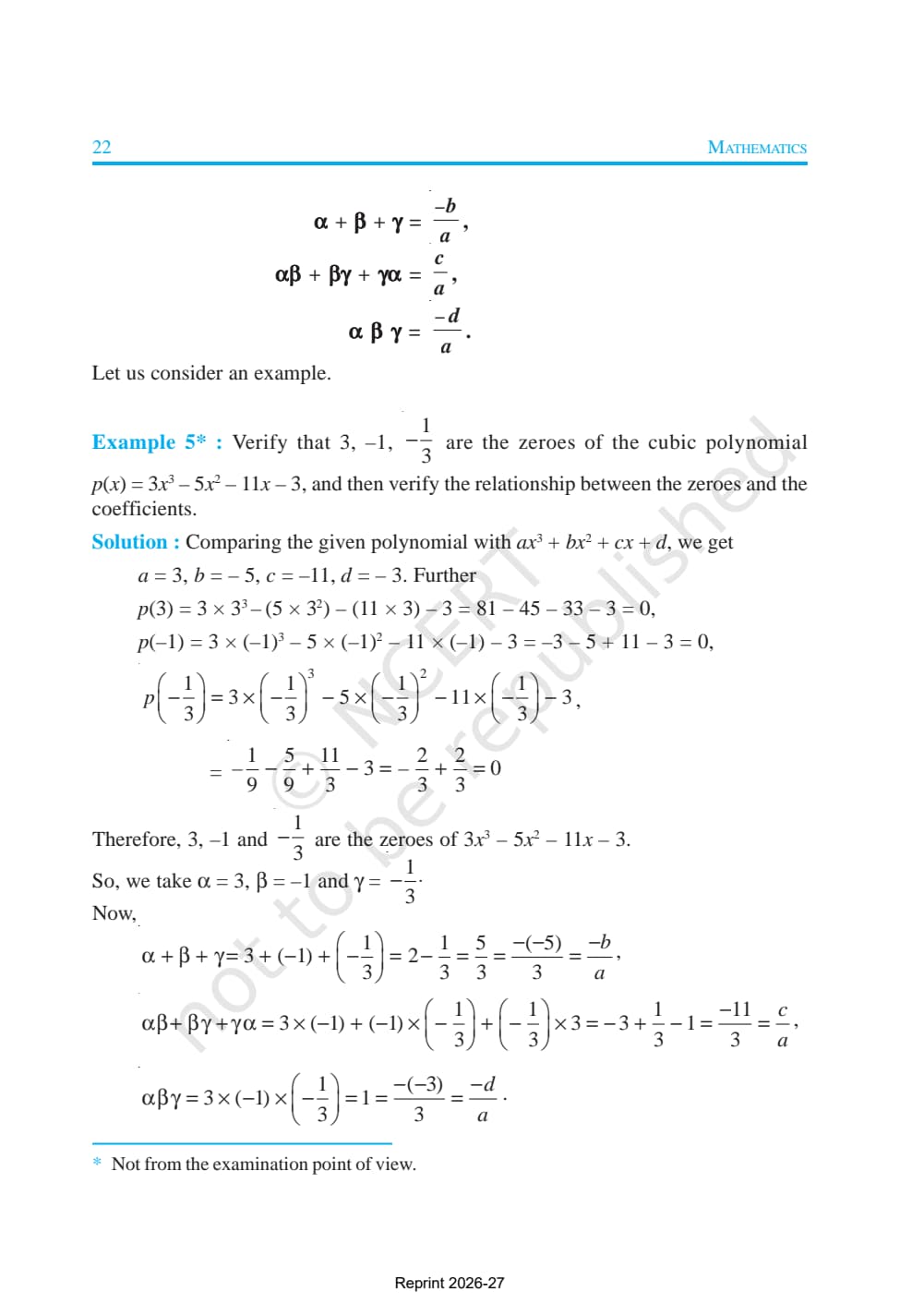
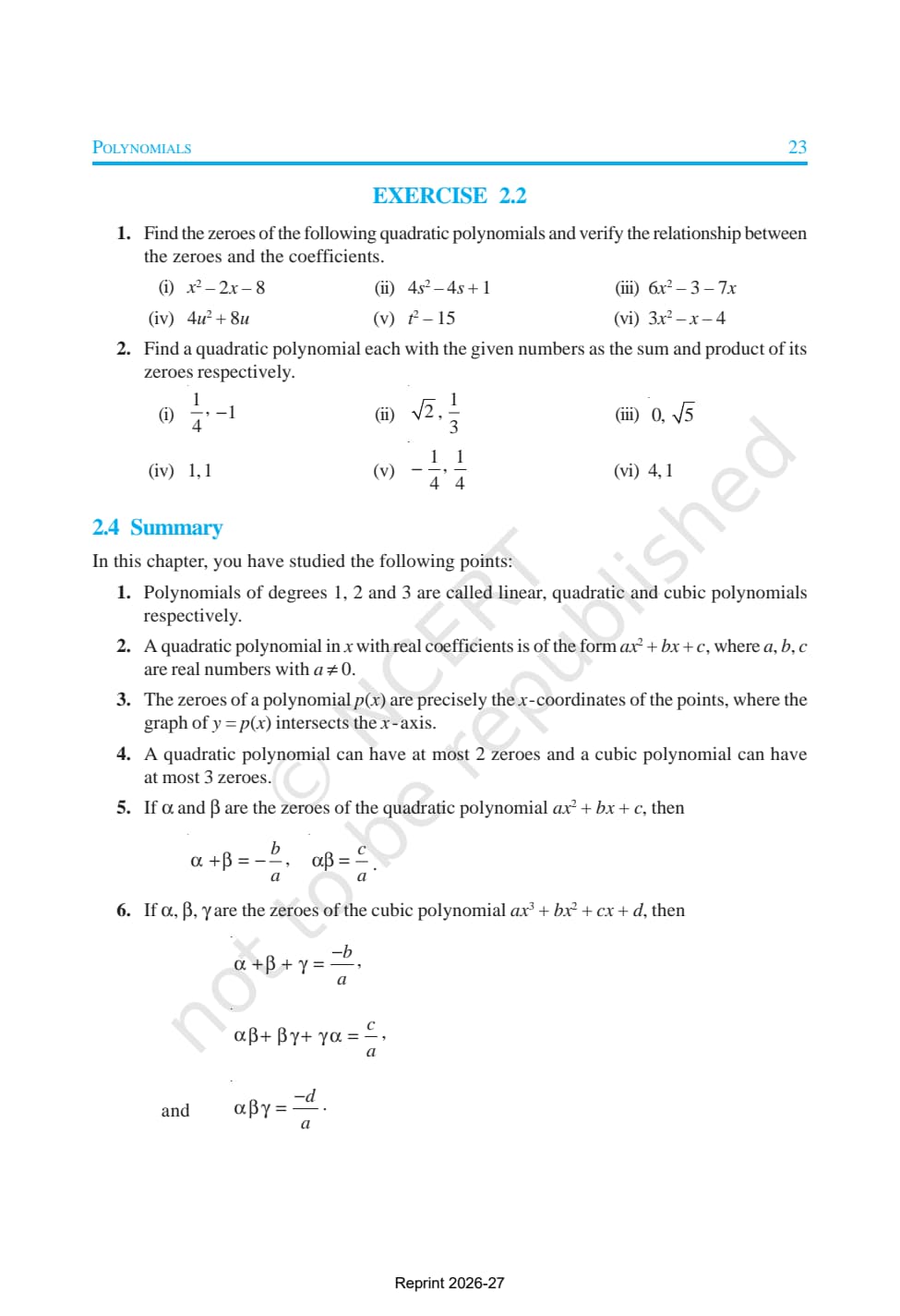
- Official NCERT textbook PDF of Chapter 2, with every definition, solved example, and exercise exactly as printed.
- Covers linear, quadratic and cubic polynomials, the geometric meaning of the zeroes, and the relationship between zeroes and coefficients.
- Aligned with the 2026-27 CBSE Class 10 Maths syllabus, useful for board revision and as the base text for solutions and notes.
This page hosts the official NCERT Class 10 Maths textbook chapter, mapped to the 2026-27 CBSE syllabus and checked page by page against the printed Polynomials chapter.
Watch Polynomials Class 10 Maths Explained
Source: Magnet Brains on YouTube
What the NCERT Book Chapter Covers
The PDF above is the complete official chapter. It carries forward Class 9 polynomials and adds two ideas: how zeroes show on the graph, and how they link to coefficients. Read it in order before solutions and notes.
- Degree and types: linear, quadratic or cubic, set by the highest power.
- Geometric meaning: zeroes are where the graph cuts the x-axis.
- Zeroes and coefficients: sum and product for a quadratic, three relations for a cubic.
- Solved examples and two exercises: Exercise 2.1 (zeroes from graphs) and 2.2 (zeroes and coefficients).
Degree of a Polynomial and Its Types
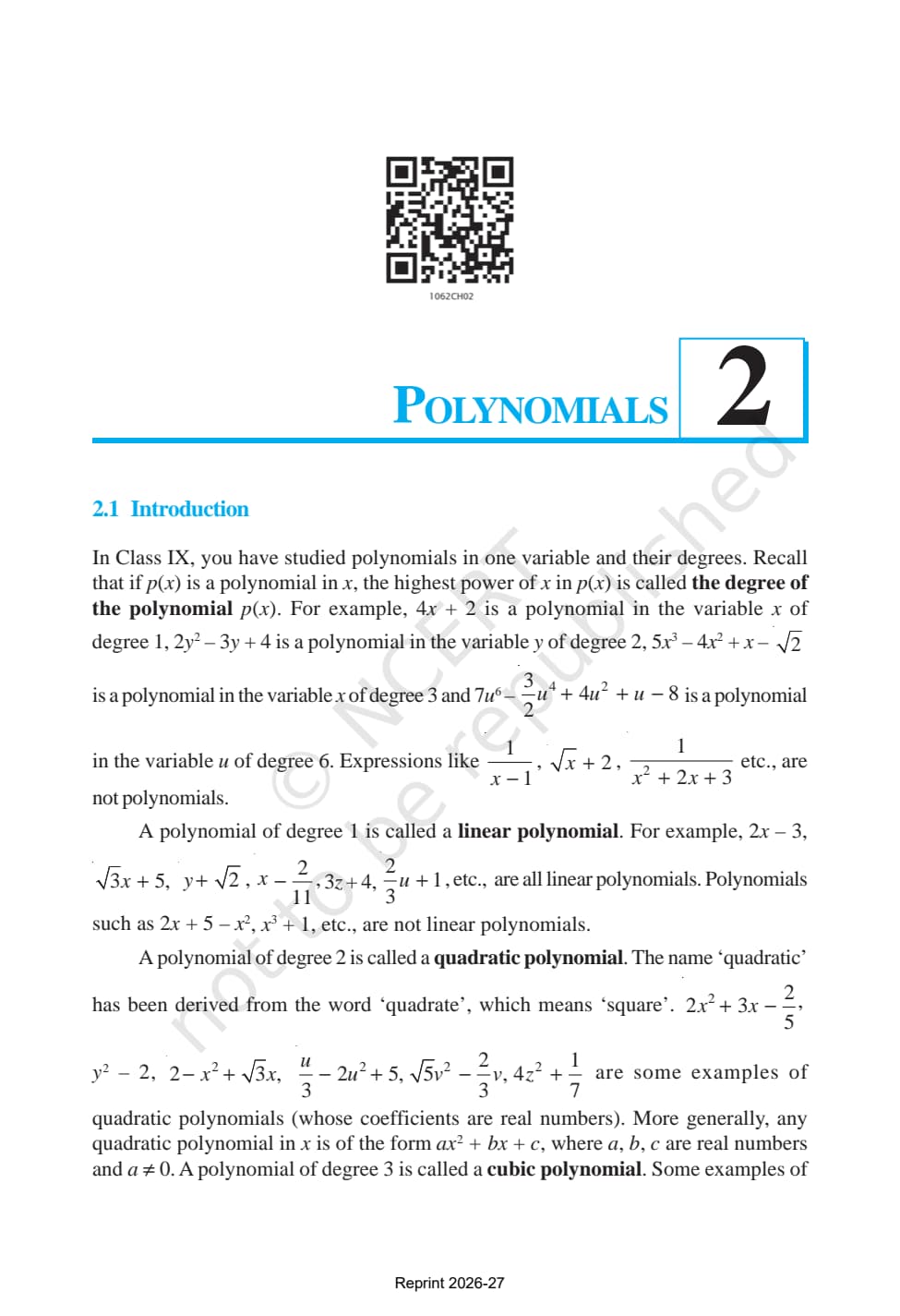
The Introduction revises what a polynomial is. If p(x) is a polynomial in x, the highest power of x in p(x) is called its degree. The degree decides the name and shape, so every later section builds on it.
The book groups polynomials by degree, as the table shows. The name "quadratic" comes from "quadrate", meaning square.
| Type | Degree | General form | Example |
|---|---|---|---|
| Linear | 1 | ax + b, a ≠ 0 | 2x − 3 |
| Quadratic | 2 | ax2 + bx + c, a ≠ 0 | 2x2 + 3x − 5 |
| Cubic | 3 | ax3 + bx2 + cx + d, a ≠ 0 | x3 − 4x |
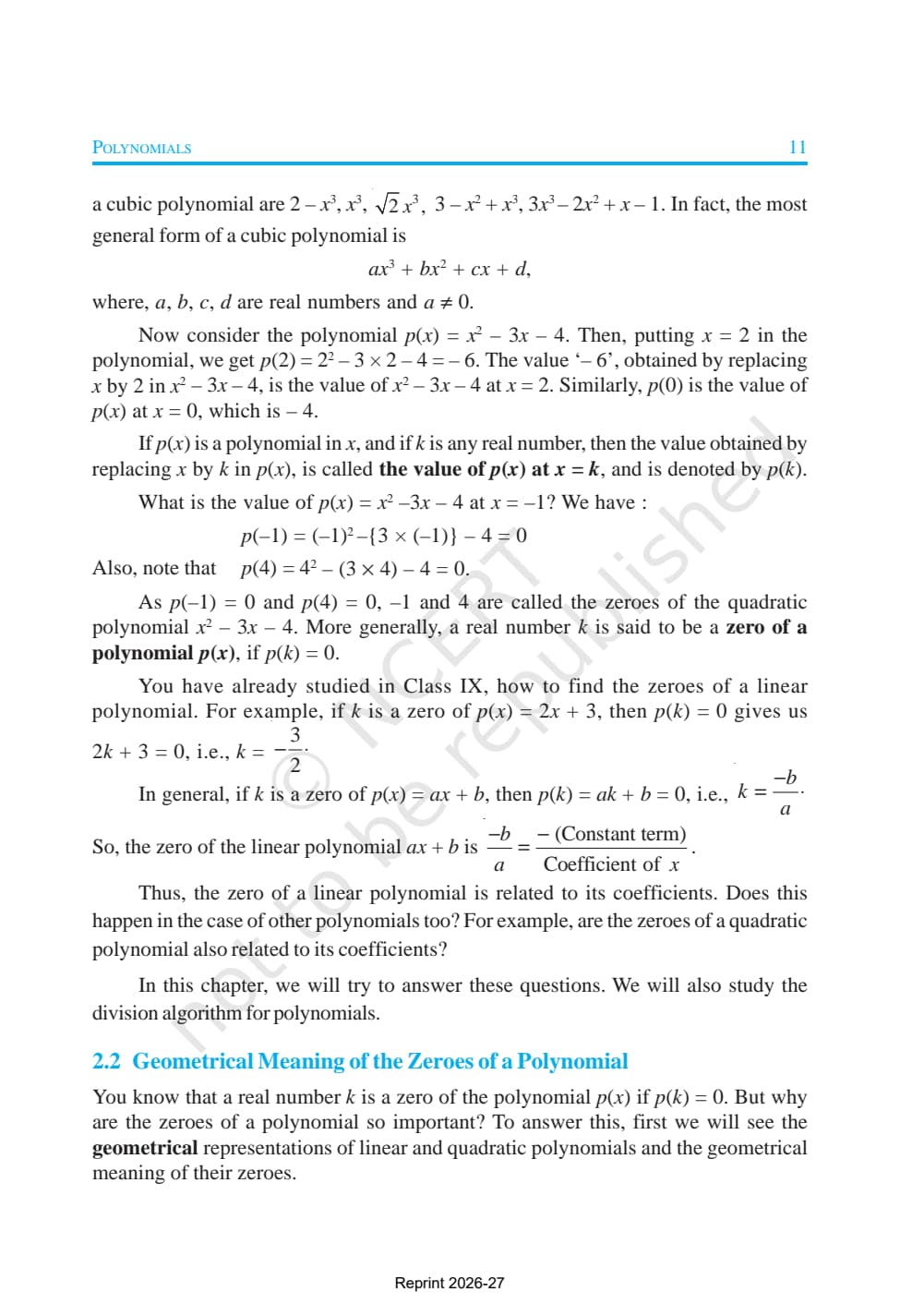
It also defines the value and the zero of a polynomial. The value at x = k, written p(k), is found by replacing x with k. A number k is a zero if p(k) = 0. For ax + b, the only zero is x = −b/a.
Geometric Meaning of the Zeroes
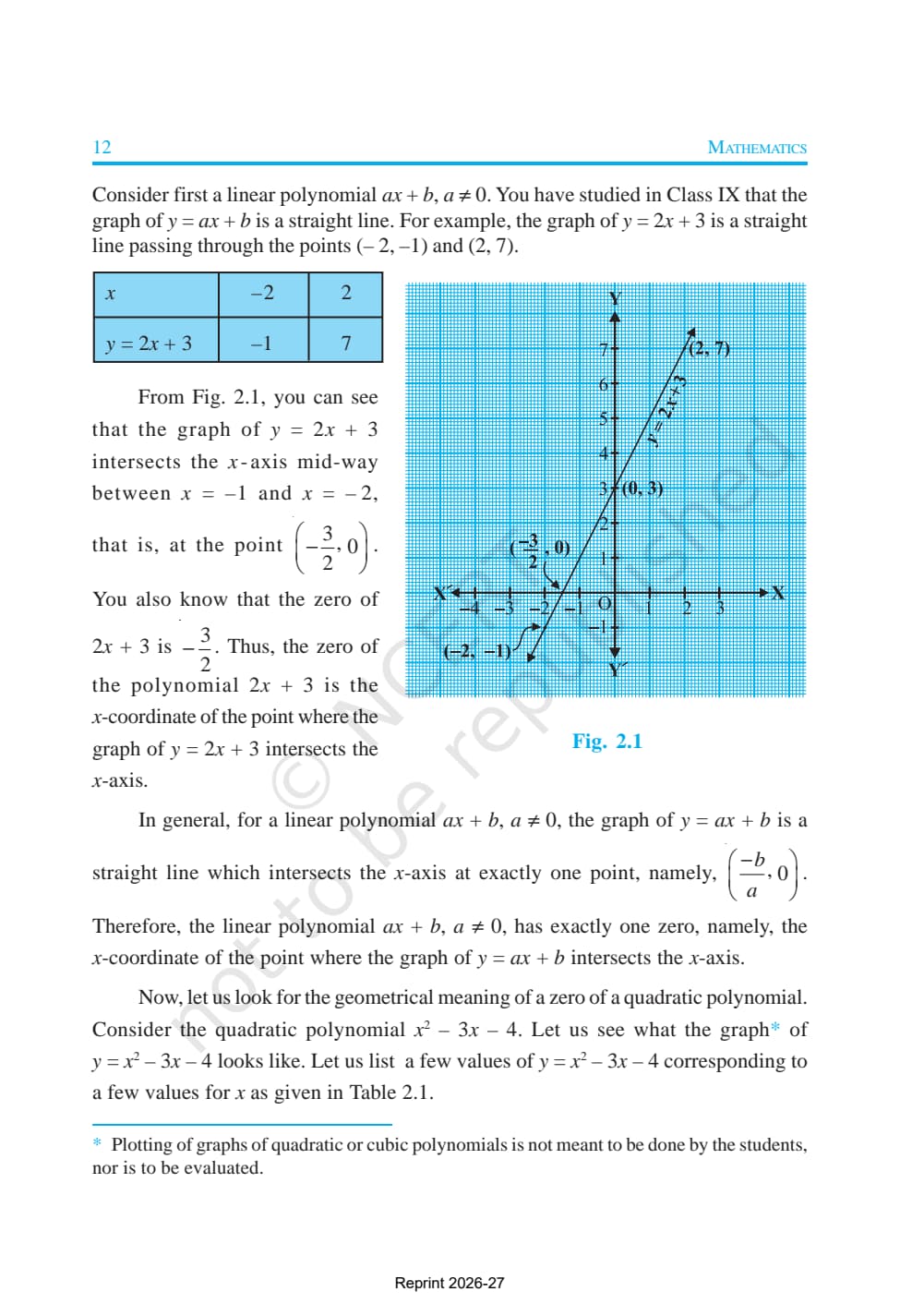
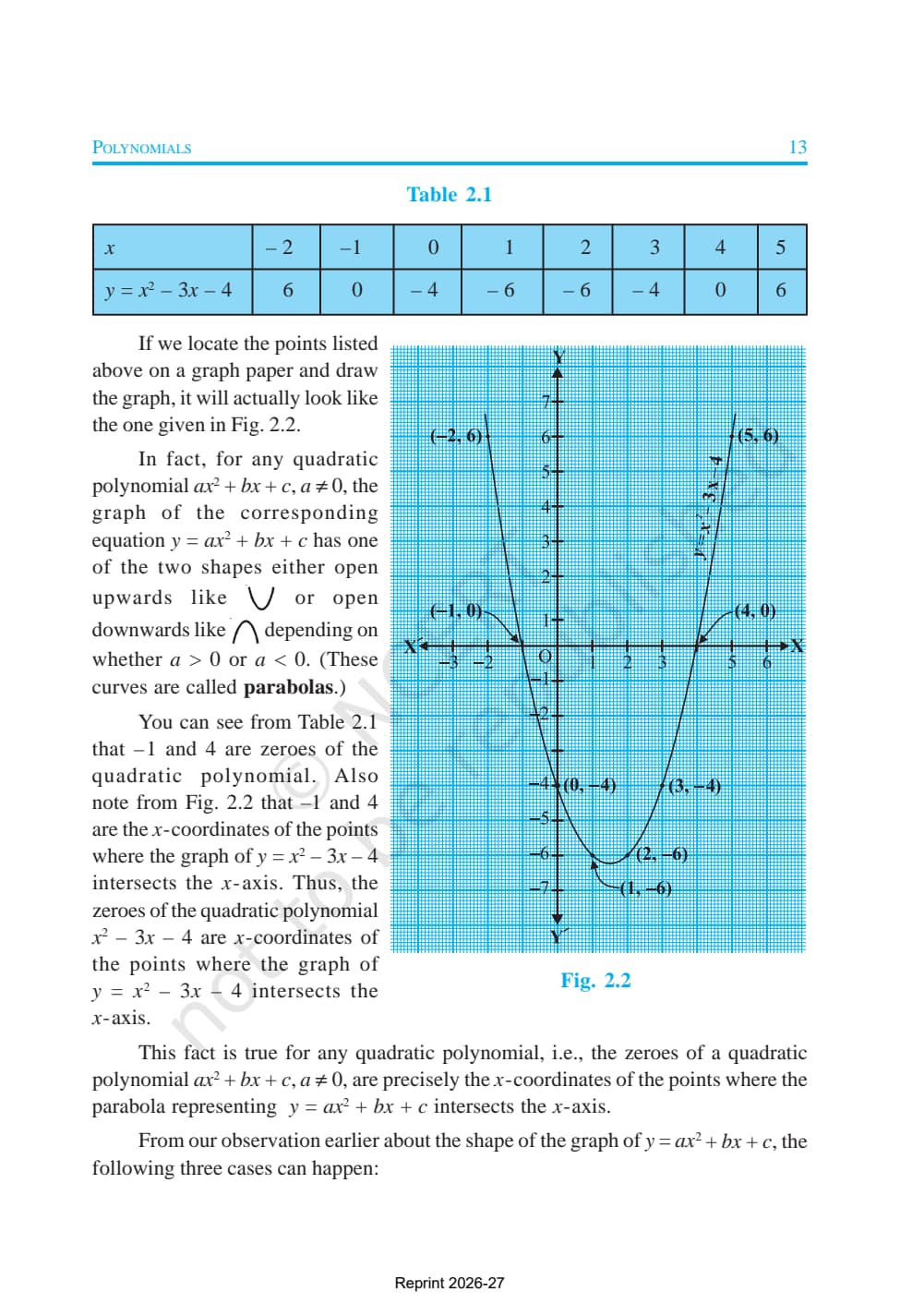
Section 2.2 is the heart of the chapter. Using graphs, it shows that the zeroes of a polynomial are the x-coordinates of the points where its graph cuts the x-axis.
A linear graph y = ax + b is a straight line that crosses the x-axis once, so one zero. A quadratic graph is a curve called a parabola, opening up when a is positive and down when a is negative.
- Two distinct zeroes: the parabola cuts the x-axis at two points, like y = x2 − 3x − 4 (zeroes −1 and 4).
- One zero: the parabola just touches the x-axis at one point.
- No real zero: the parabola never cuts the x-axis.
The key rule is the maximum number of zeroes. A quadratic has at most 2 zeroes and a cubic has at most 3. In general, a polynomial of degree n has at most n zeroes, because its graph meets the x-axis at most n times.
Relationship Between Zeroes and Coefficients
Section 2.3 is the most exam-heavy part. You do not need a graph to know the sum and product of the zeroes. Both are fixed by the coefficients.
For a quadratic ax2 + bx + c with zeroes α and β, the book proves two results: the sum is −b/a and the product is c/a. It checks this on examples like 2x2 − 8x + 6.
- Sum of zeroes: α + β = −(coefficient of x) ÷ (coefficient of x2).
- Product of zeroes: αβ = (constant term) ÷ (coefficient of x2).
- Building a polynomial: from a known sum and product, use k[x2 − (sum)x + (product)], as Question 2 of Exercise 2.2 asks.
For a cubic ax3 + bx2 + cx + d with zeroes α, β and γ, the book gives three relations. These are extra reading, not for the exam.
Solved Examples and Exercises
The chapter is compact: five solved examples, then two exercises. The examples show how to verify a zero, factorise to find zeroes, and check the coefficient relationship.
| Section | What it tests | Sample question |
|---|---|---|
| Exercise 2.1 | Number of zeroes from a graph | The graphs of y = p(x) are given; find the number of zeroes in each case. |
| Exercise 2.2 | Zeroes and coefficients of a quadratic | Find the zeroes of x2 − 2x − 8 and verify the relationship. |
| Solved examples | Verifying zeroes and forming polynomials | Find a quadratic whose sum and product of zeroes are −3 and 2. |
A common question gives a sum and product and asks for a quadratic: slot them into x2 − (sum)x + (product). Another asks for the zeroes of x2 − 3 using a2 − b2 = (a − b)(a + b).
How to Use the Book PDF for Revision
The official textbook is the safest source. Use it in two passes, paired with the solutions and notes below.
- First pass: read Sections 2.1 to 2.3 in order. Cover each solved example, try it, then check. Focus on Section 2.2 graphs.
- Second pass: solve Exercise 2.1 and 2.2 by hand. Verify with α + β = −b/a and αβ = c/a.
- Board angle: Polynomials sits in the Algebra unit. Forming a quadratic from a sum and product, and verifying the zeroes-coefficients relationship, come up almost yearly.
Student Feedback
68% of Class 10 students said the relationship between zeroes and coefficients was the hardest part in class tests. 3 out of 5 students said reading the NCERT chapter with the graphs in front of them made the geometric meaning of zeroes click.
Source: 2026-27 Class 10 Maths student poll. Sample of 8,200 students from CBSE schools across 12 states.
Other Resources for Polynomials
Read the chapter above, then revise with the resources below.
| Resource | What it covers | Open |
|---|---|---|
| NCERT Book PDF | Official Class 10 Maths Chapter 2 textbook, with every definition, example and exercise. | Class 10 Maths Chapter 2 NCERT Book PDF |
| NCERT Solutions | Step-by-step answers to all exercise questions of the chapter. | Class 10 Maths Chapter 2 NCERT Solutions |
| Notes | Concept-first revision notes on degree, zeroes and the coefficient relations. | Class 10 Maths Chapter 2 Notes |
| Formula Sheet | Quick reference of key results, formulae and definitions for fast revision. | Class 10 Maths Chapter 2 Formula Sheet |
| Handwritten Notes | Scanned-style handwritten pages for last-minute board revision. | Class 10 Maths Chapter 2 Handwritten Notes |
NCERT Book for Class 10 Maths: All Chapters
Related Links: Use the table below to open the NCERT Book PDF for the other chapters of Class 10 Maths.
| Chapter | NCERT Book PDF link |
|---|---|
| Chapter 1 | Real Numbers NCERT Book PDF |
| Chapter 2 | Polynomials NCERT Book PDF |
| Chapter 3 | Pair of Linear Equations in Two Variables NCERT Book PDF |
| Chapter 4 | Quadratic Equations NCERT Book PDF |
| Chapter 5 | Arithmetic Progressions NCERT Book PDF |
| Chapter 6 | Triangles NCERT Book PDF |
| Chapter 7 | Coordinate Geometry NCERT Book PDF |
| Chapter 8 | Introduction to Trigonometry NCERT Book PDF |
| Chapter 9 | Some Applications of Trigonometry NCERT Book PDF |
| Chapter 10 | Circles NCERT Book PDF |
| Chapter 11 | Areas Related to Circles NCERT Book PDF |
| Chapter 12 | Surface Areas and Volumes NCERT Book PDF |
| Chapter 13 | Statistics NCERT Book PDF |
| Chapter 14 | Probability NCERT Book PDF |
NCERT Book Class 10 Maths Chapter 2 Polynomials FAQs
Ques. What does Chapter 2 Polynomials cover in the Class 10 Maths NCERT Book?
Ans. Chapter 2 of the Class 10 Maths NCERT Book covers the algebra of polynomials you need for the board exam. It revises the degree of a polynomial and the names linear, quadratic and cubic, then explains the geometric meaning of the zeroes, showing that the zeroes are the x-coordinates of the points where the graph cuts the x-axis. It also gives the relationship between the zeroes and the coefficients of a polynomial. The chapter has solved examples plus two exercises, Exercise 2.1 and Exercise 2.2, and is aligned with the 2026-27 CBSE syllabus.
Ques. What is the relationship between zeroes and coefficients of a quadratic polynomial?
Ans. For a quadratic polynomial of the form ax squared plus bx plus c, with zeroes alpha and beta, the sum of the zeroes equals minus b divided by a, and the product of the zeroes equals c divided by a. In words, the sum of the zeroes is the negative of the coefficient of x divided by the coefficient of x squared, and the product is the constant term divided by the coefficient of x squared. This lets you check the zeroes you find by factorising, and it lets you build a quadratic when only the sum and product of its zeroes are given.
Ques. What is the geometric meaning of the zeroes of a polynomial?
Ans. The zeroes of a polynomial are the x-coordinates of the points where the graph of y equals p of x cuts the x-axis. The graph of a linear polynomial is a straight line that crosses the x-axis at exactly one point, so it has one zero. The graph of a quadratic polynomial is a parabola that may cut the x-axis at two points, touch it at one point, or miss it completely, giving two, one or no real zeroes. This is why a quadratic has at most two zeroes and a cubic has at most three.
Ques. How many zeroes can a quadratic and a cubic polynomial have?
Ans. A quadratic polynomial can have at most two zeroes, and a cubic polynomial can have at most three zeroes. In general, a polynomial of degree n has at most n zeroes, because its graph can meet the x-axis at most n times. A quadratic may have two distinct zeroes when its parabola cuts the x-axis twice, one zero when the parabola just touches the x-axis, or no real zero when the parabola lies entirely above or below the x-axis. This rule is one of the most tested ideas from the chapter.
Ques. Is the Class 10 Maths Chapter 2 NCERT Book PDF free to download for 2026-27?
Ans. Yes. The official NCERT Book PDF for Class 10 Maths Chapter 2 Polynomials is free to read and download on this page for the 2026-27 session. It is the complete chapter as printed in the CBSE textbook, including the definitions, the graphs in Section 2.2, the solved examples, and the end-of-chapter exercises 2.1 and 2.2. You can pair the book with the linked NCERT Solutions and revision notes for the same chapter so that you read the textbook and revise from one place.
Ques. How many exercises are there in Class 10 Maths Chapter 2 Polynomials?
Ans. The Polynomials chapter has two exercises. Exercise 2.1 gives you graphs of y equals p of x and asks you to find the number of zeroes in each case by counting how many times the graph cuts the x-axis. Exercise 2.2 asks you to find the zeroes of given quadratic polynomials and verify the relationship between the zeroes and the coefficients, and to form a quadratic when the sum and product of its zeroes are given. Both exercises are fully worked in the linked NCERT Solutions for the chapter.
Ques. Are these NCERT Book contents aligned with the 2026-27 CBSE syllabus?
Ans. Yes. This page hosts the official NCERT Class 10 Maths textbook chapter for the current 2026-27 CBSE syllabus. The Polynomials chapter focuses on the degree and types of polynomials, the geometric meaning of the zeroes, and the relationship between zeroes and coefficients, so the definitions, examples and exercises you read here are exam-correct. Because it is the official book, it is the safest base text for board preparation, and the linked solutions, notes and formula sheet for the same chapter all follow this textbook order.



Comments