


The NCERT Book for Class 10 Maths Chapter 3 Pair of Linear Equations in Two Variables is the official CBSE textbook chapter, free to read and download for 2026-27. It is a high-scoring part of the Algebra unit. You set up two linear equations from a word problem, then solve them by the graphical, substitution and elimination methods.
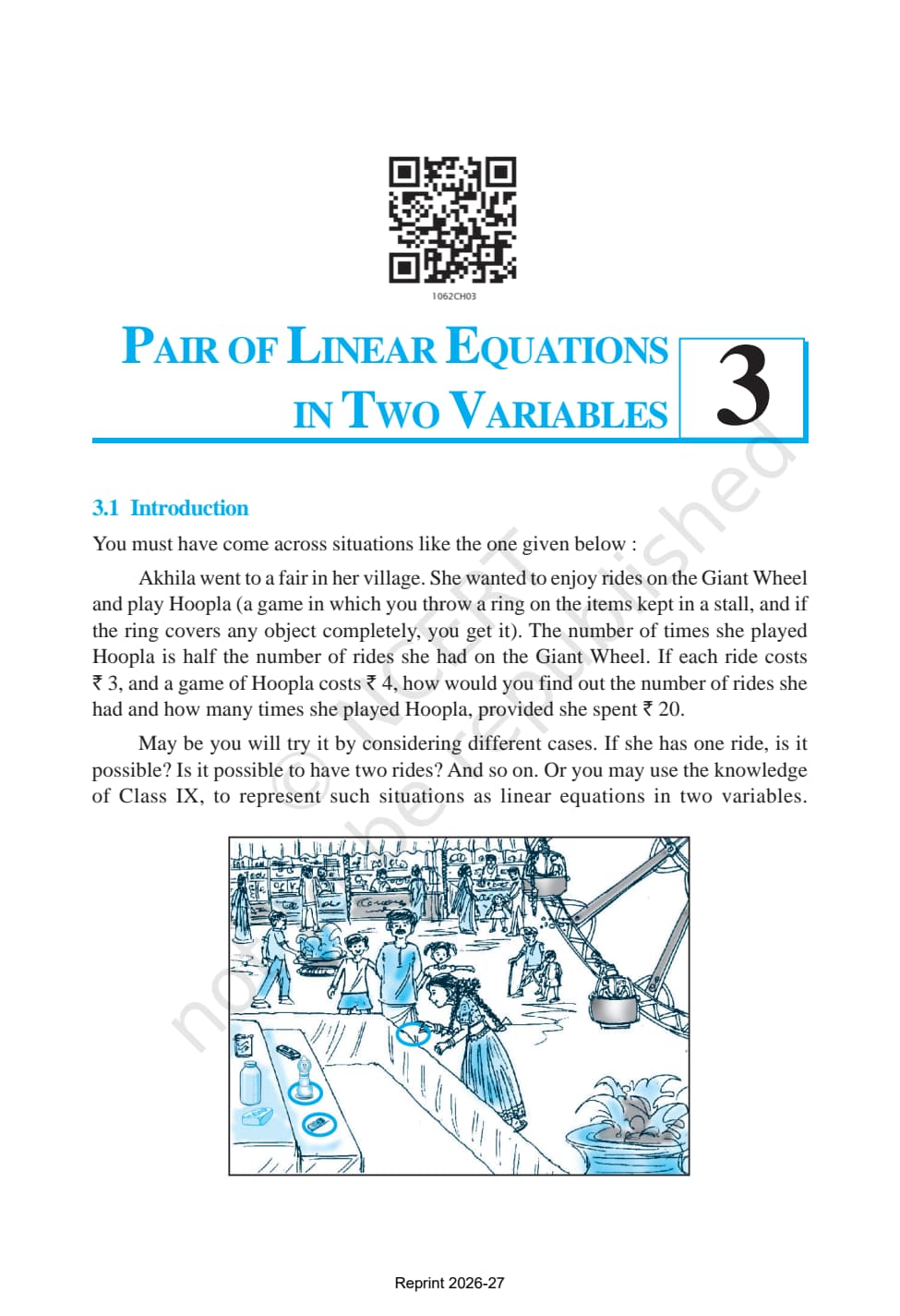
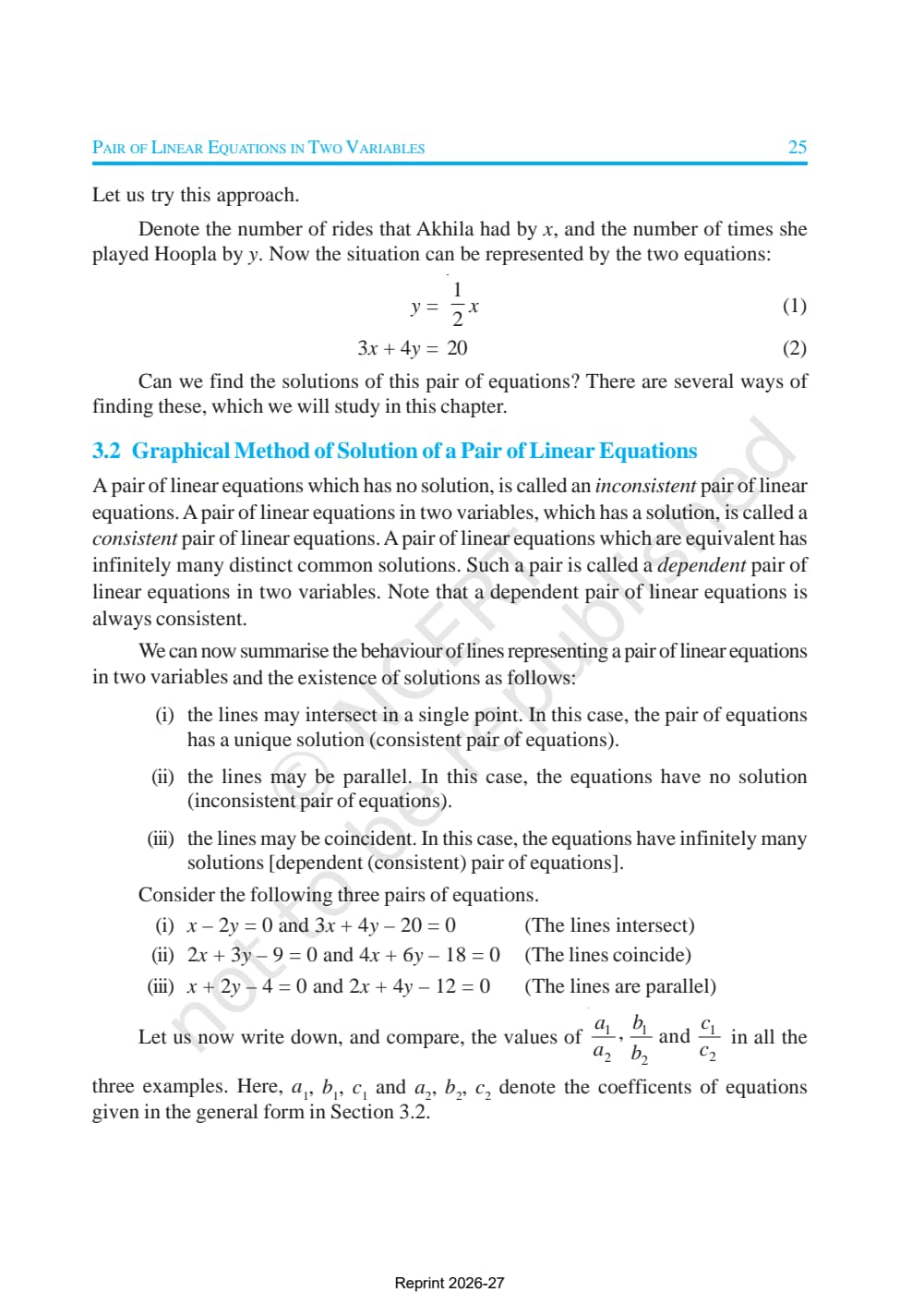
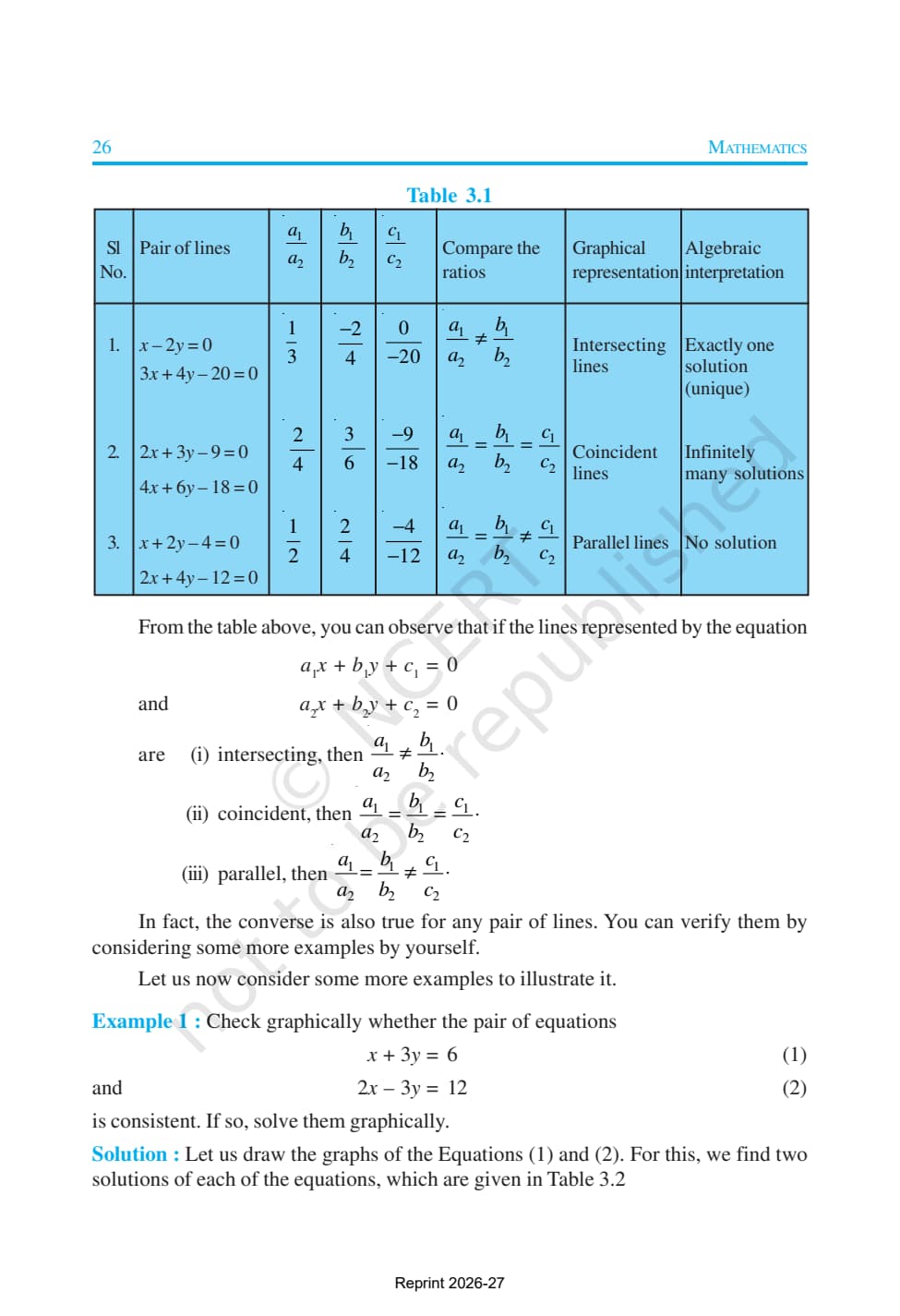
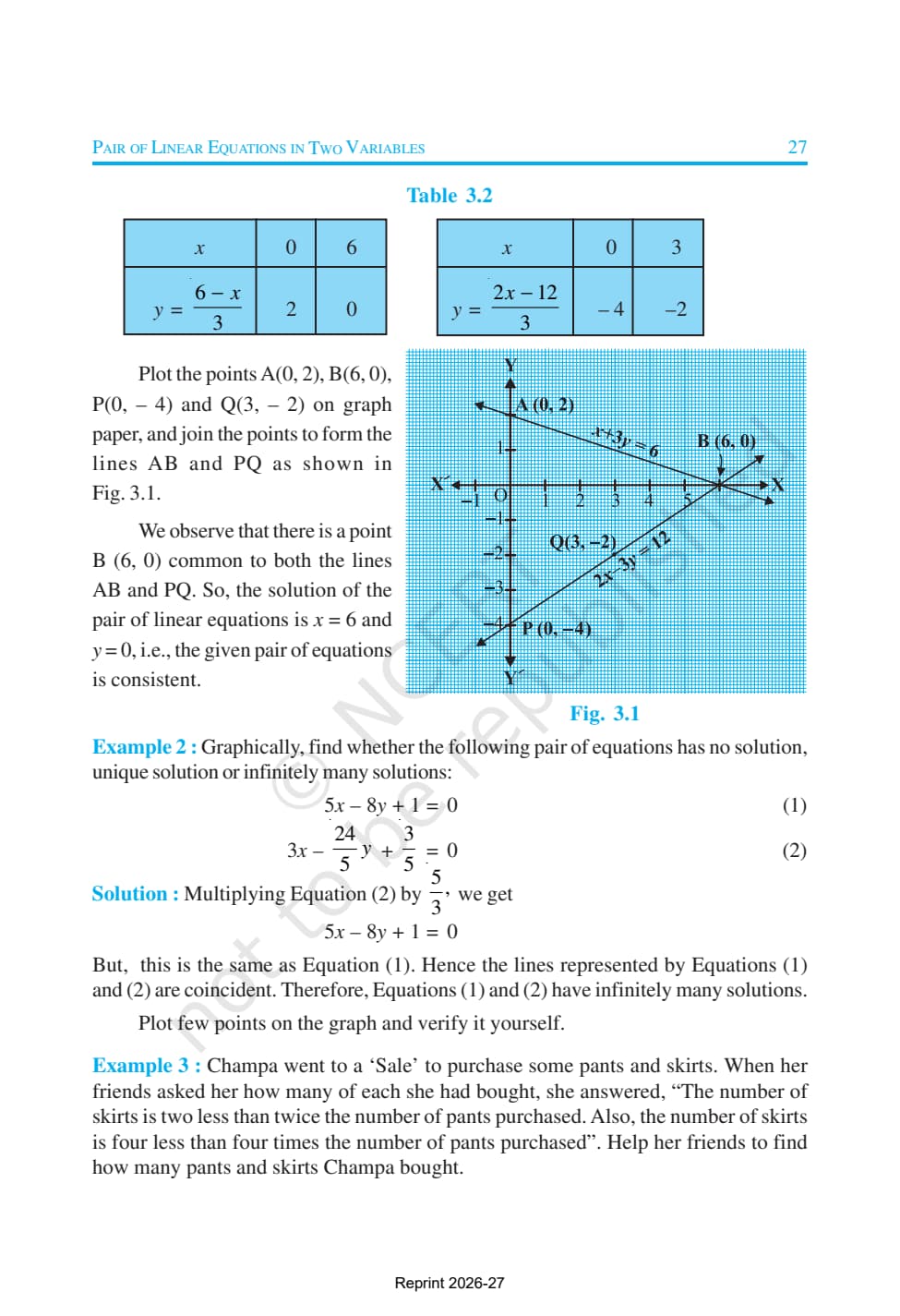
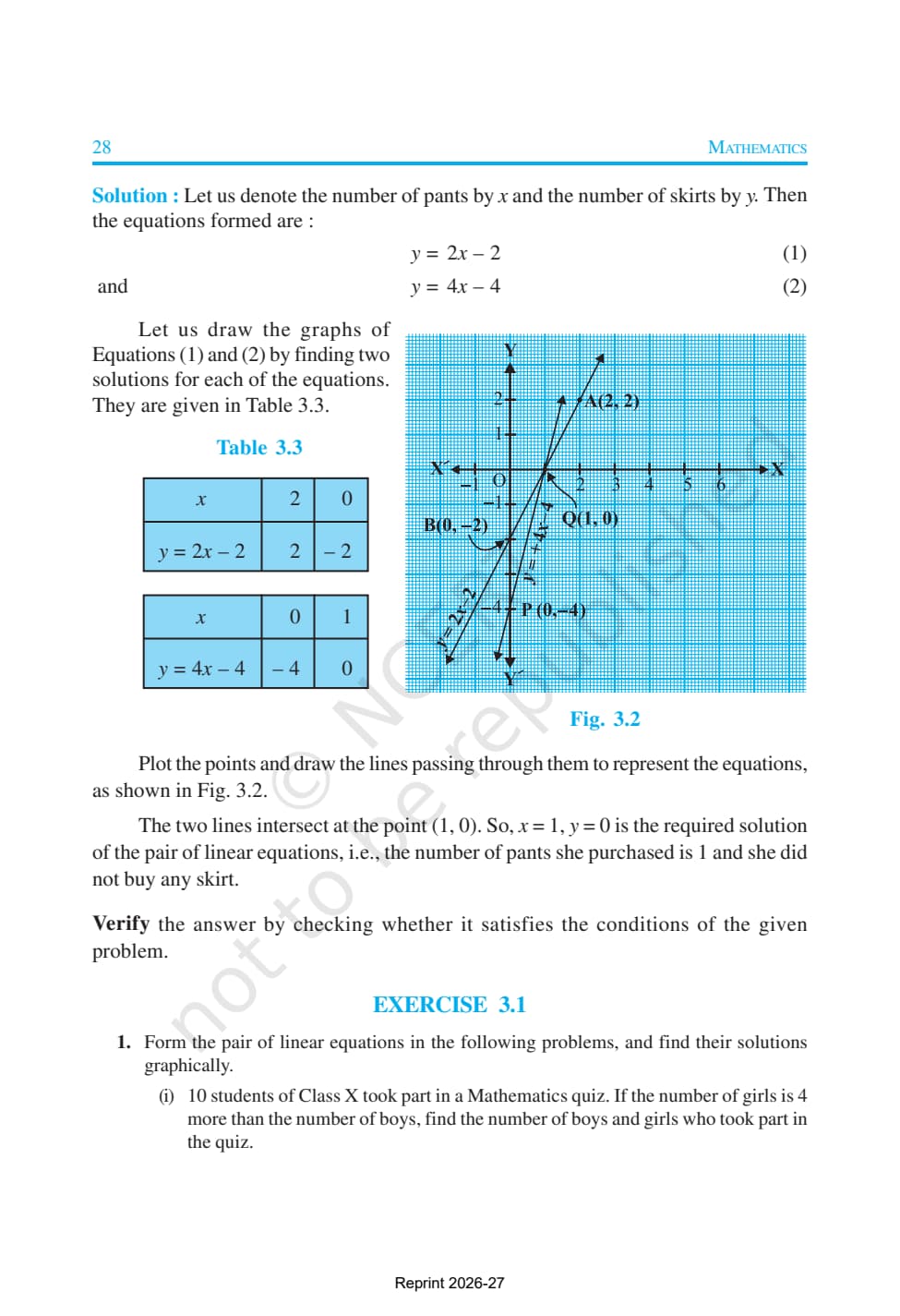
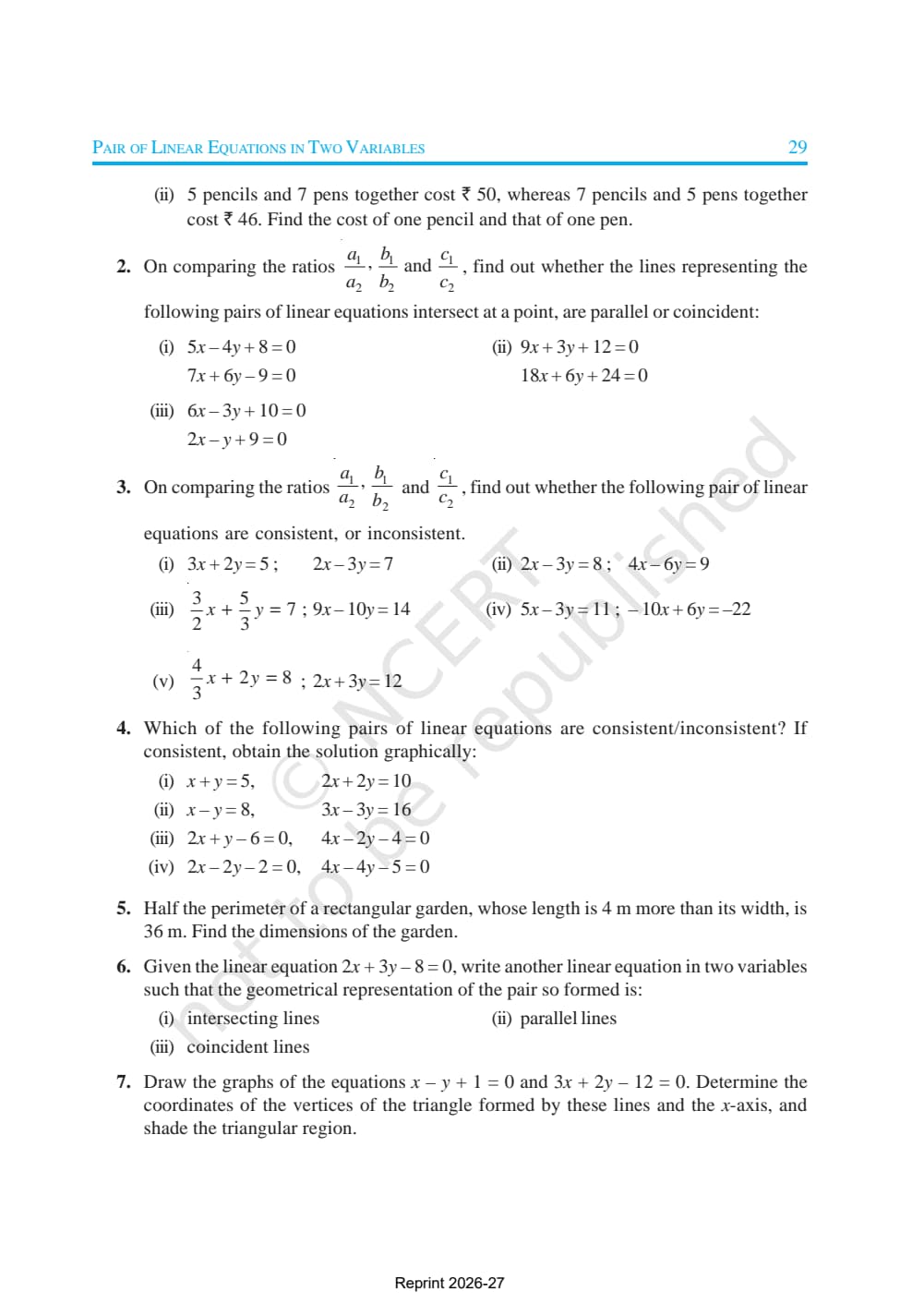
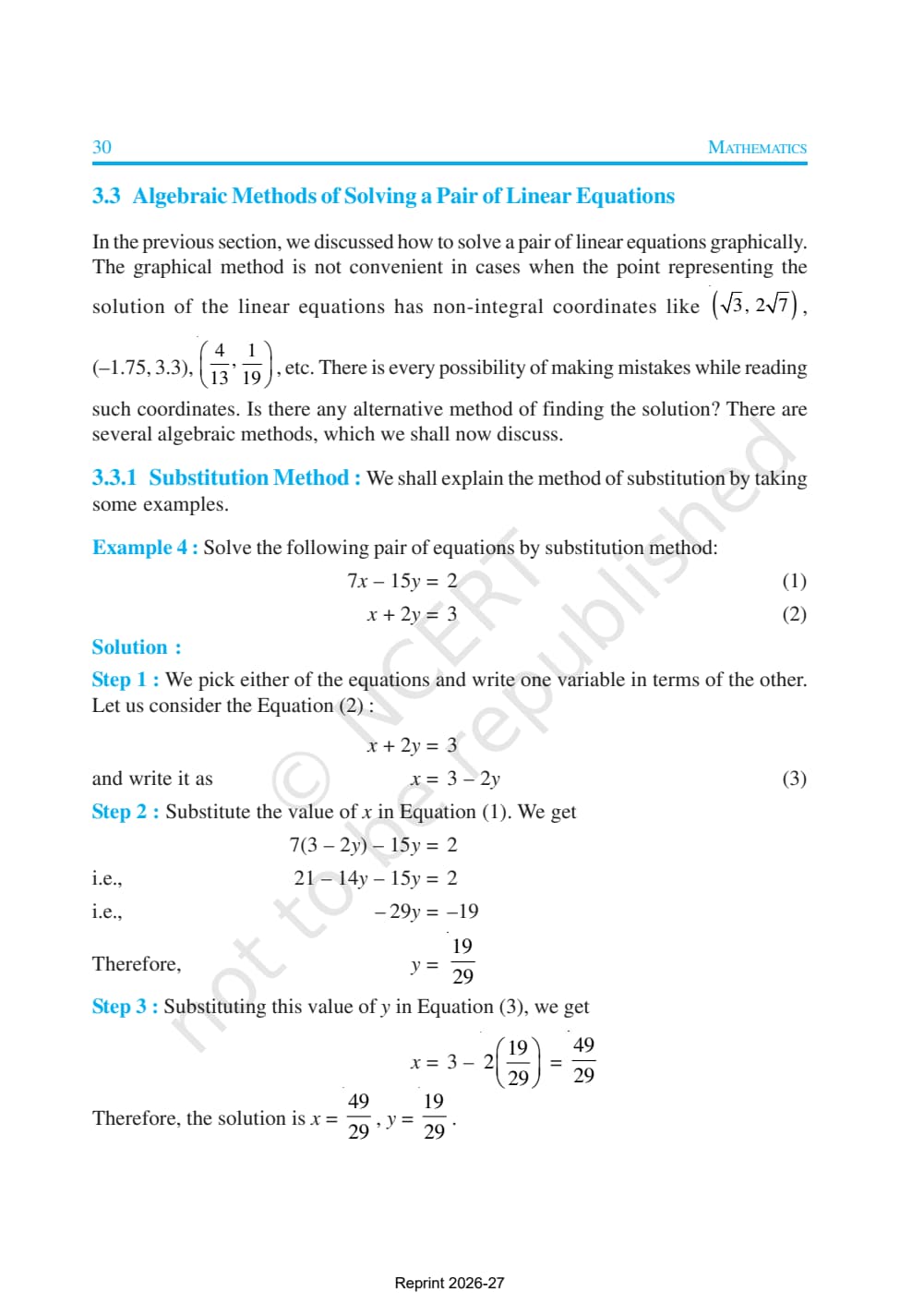
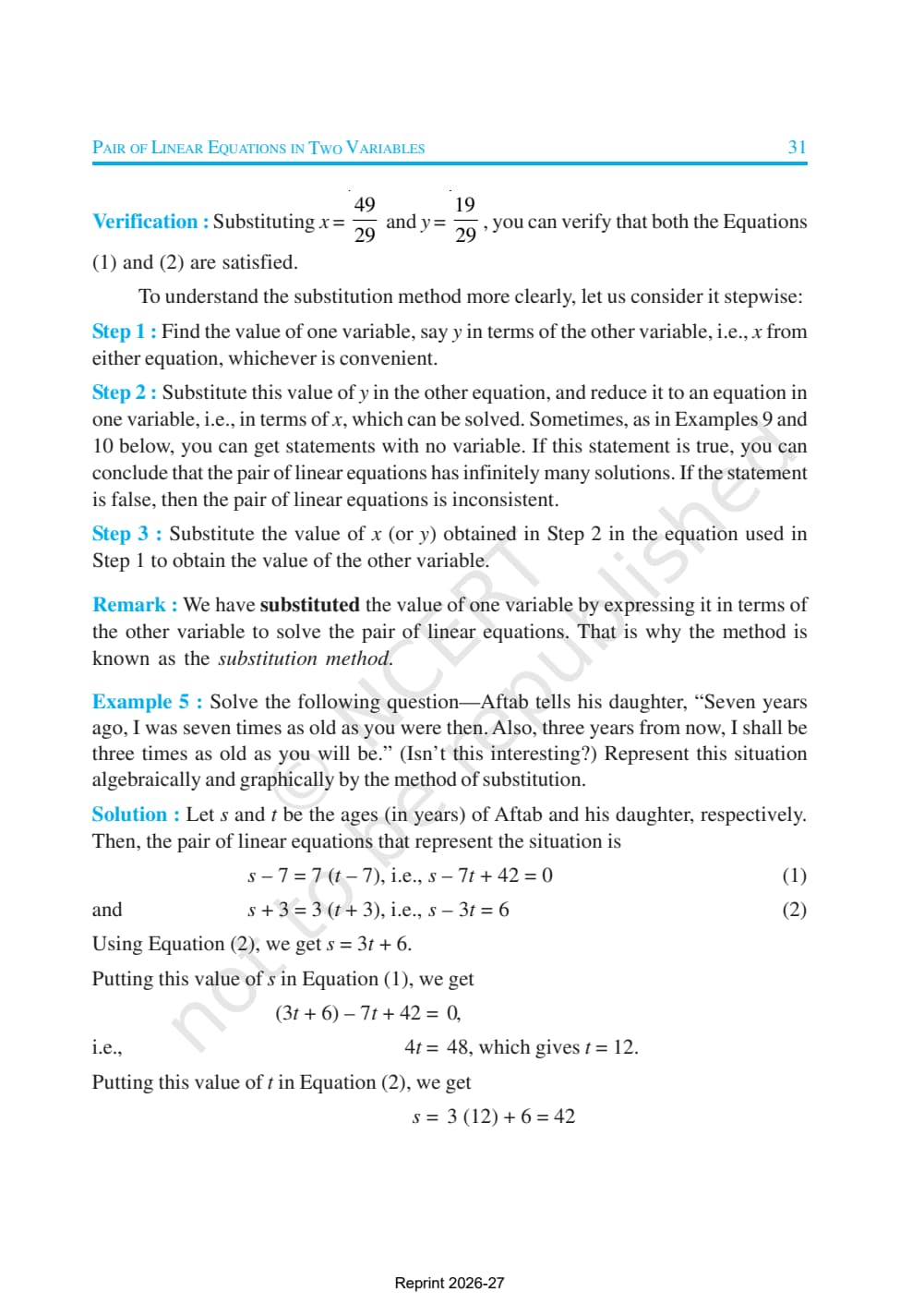
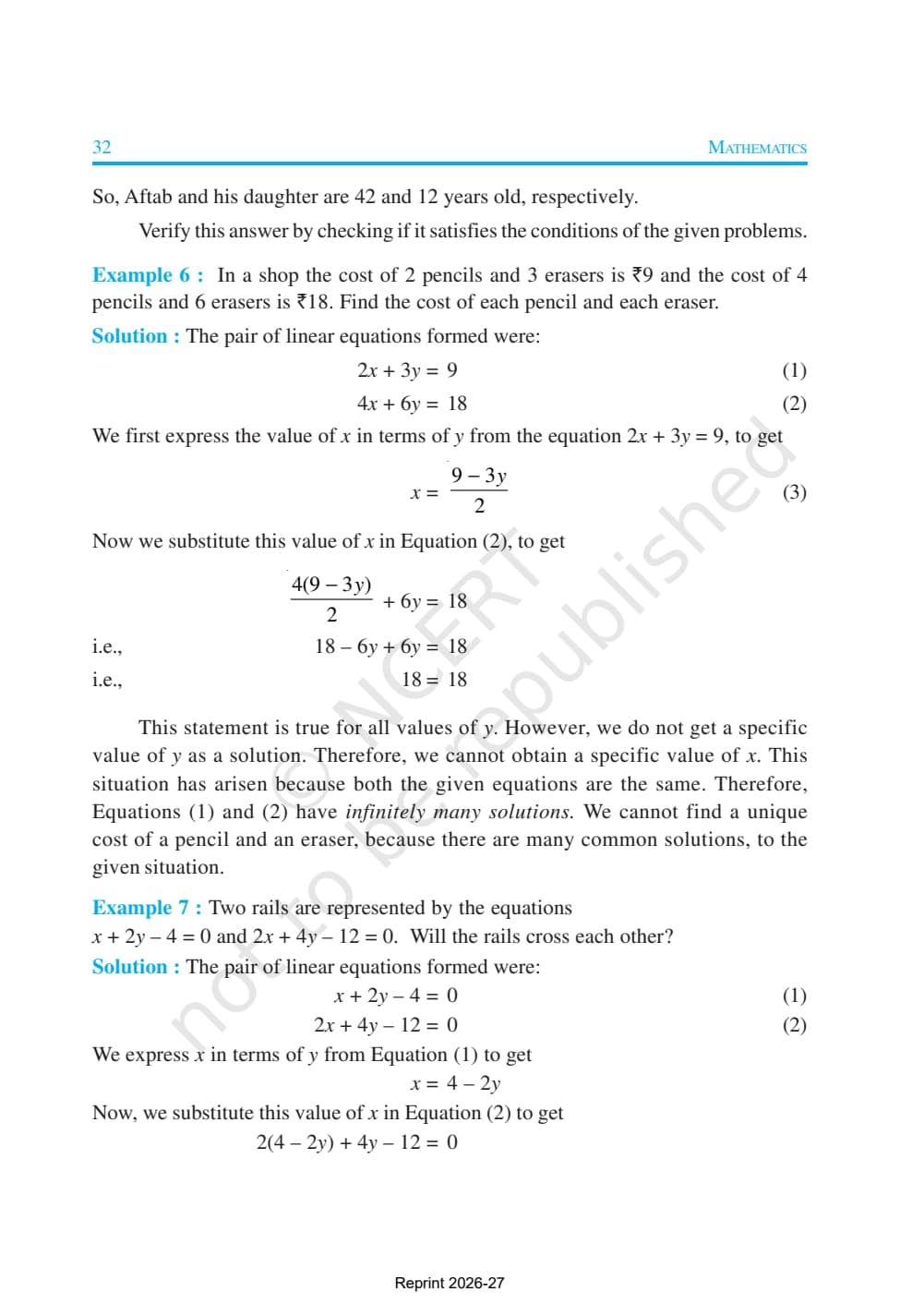
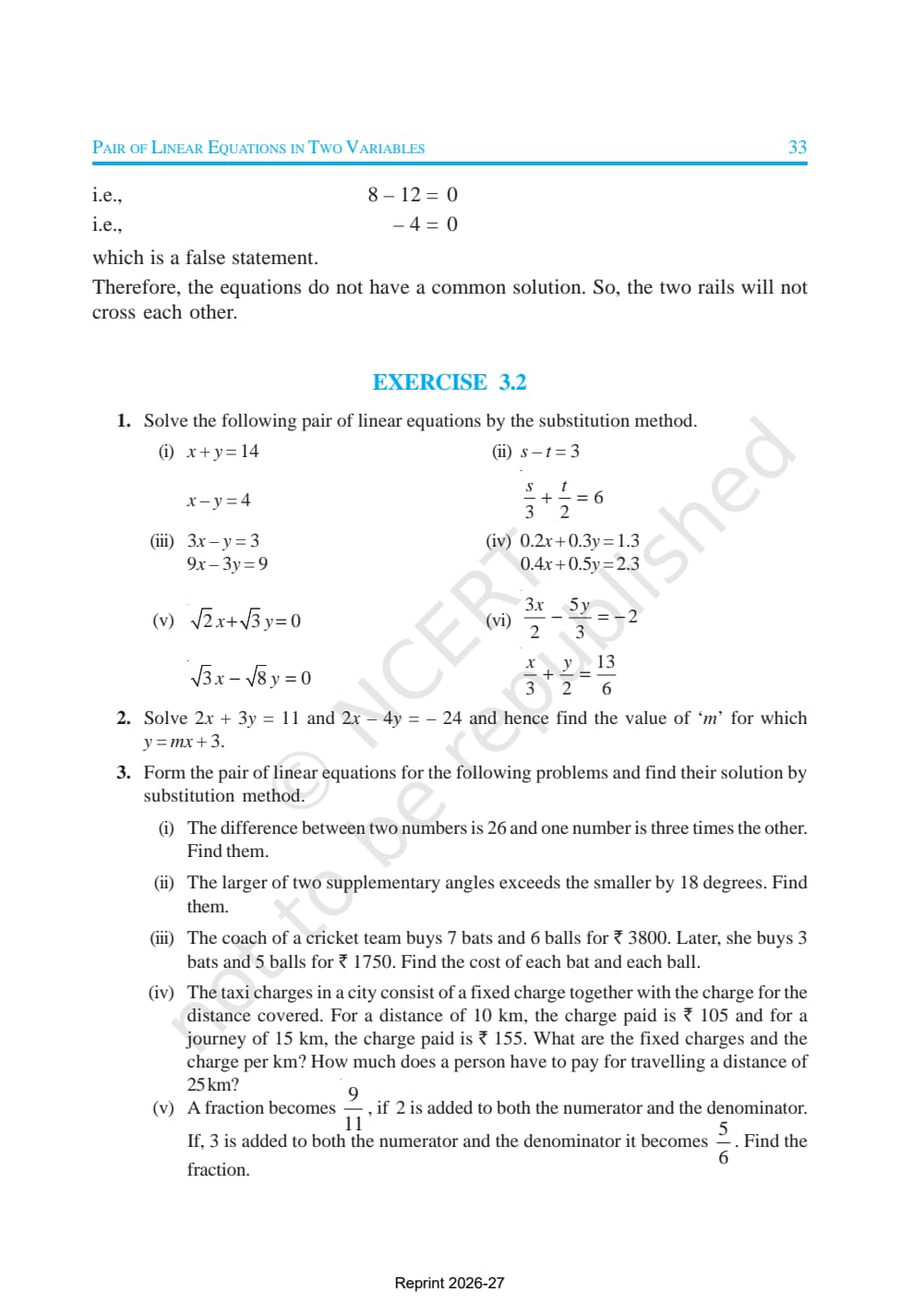
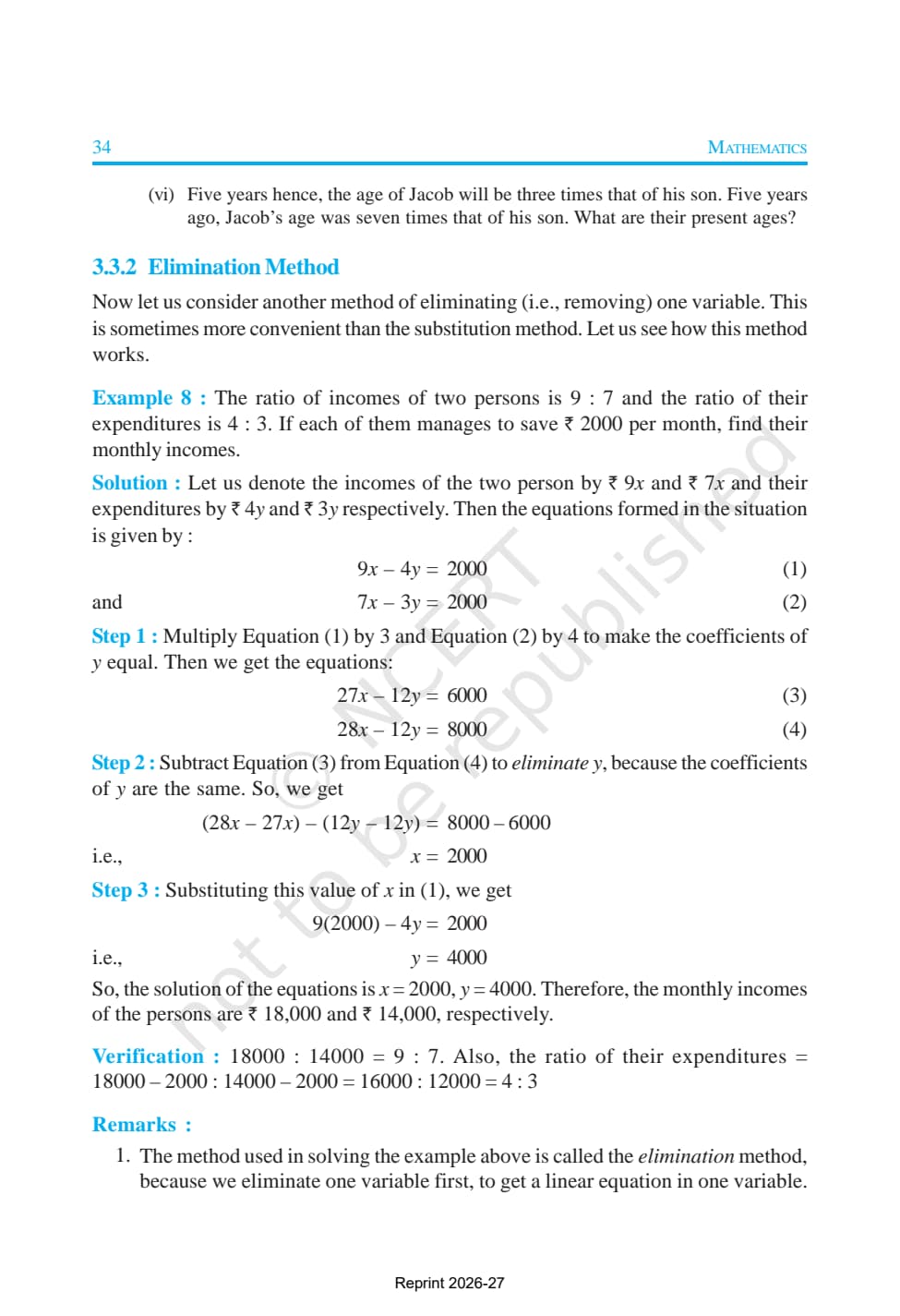
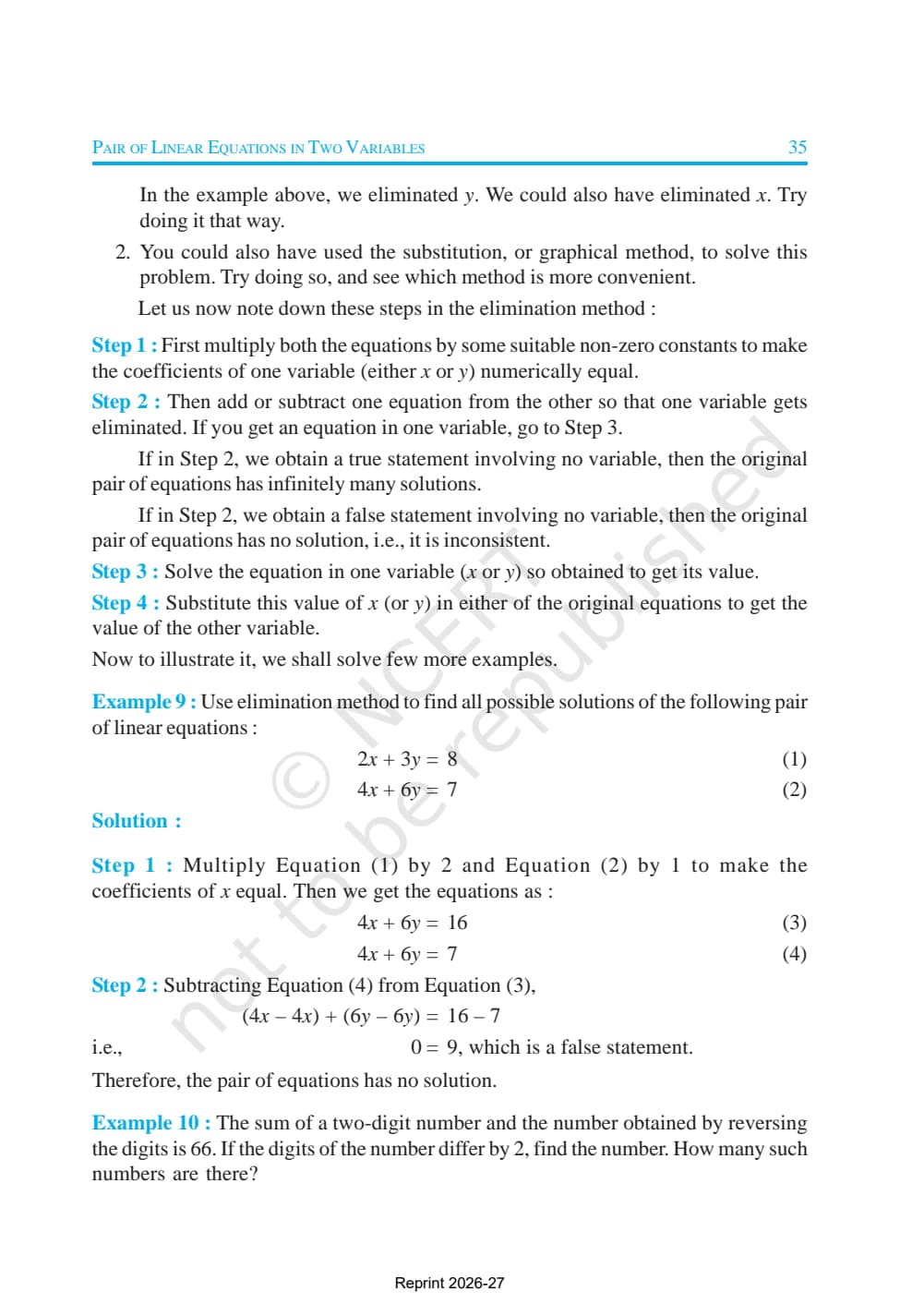
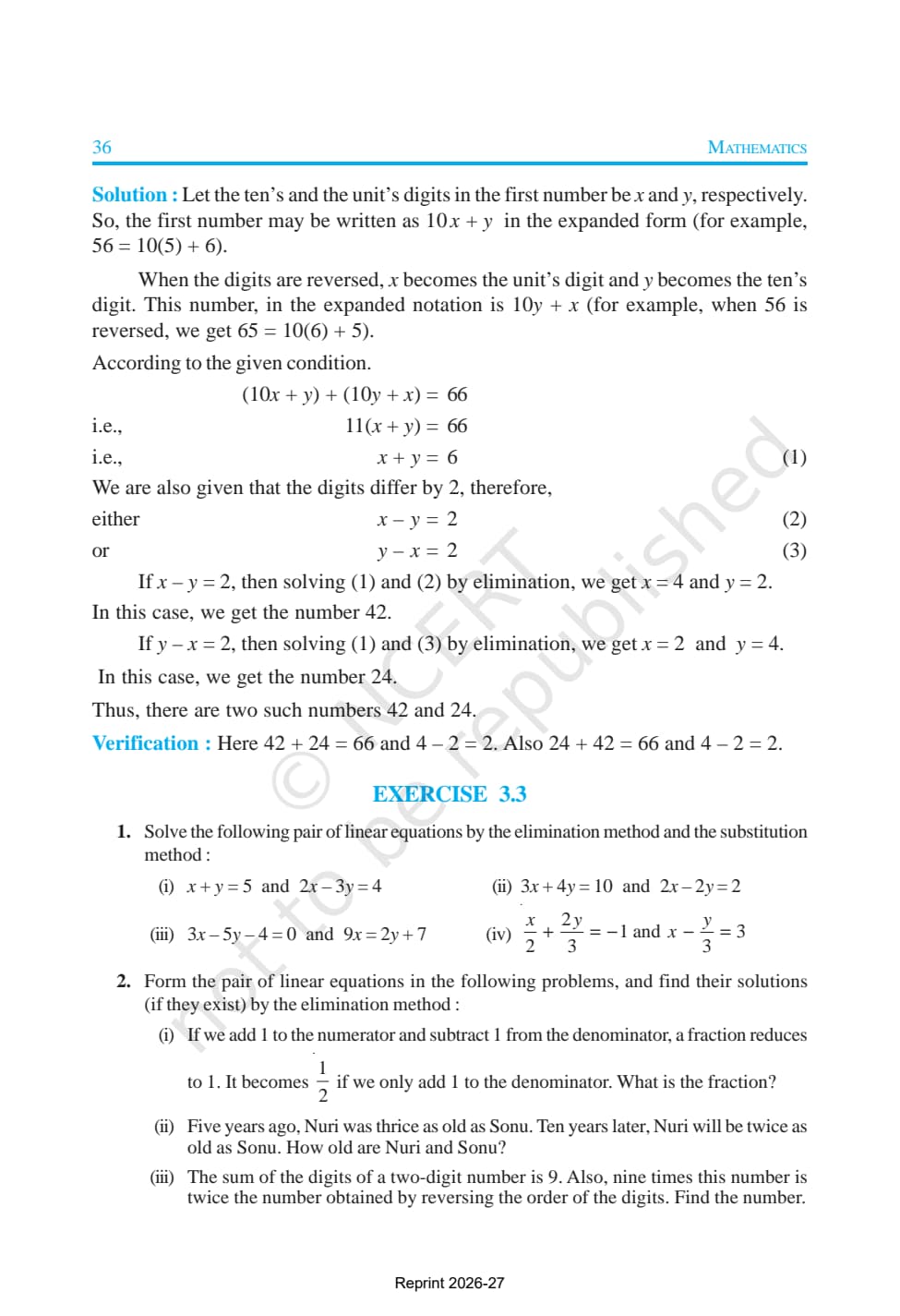
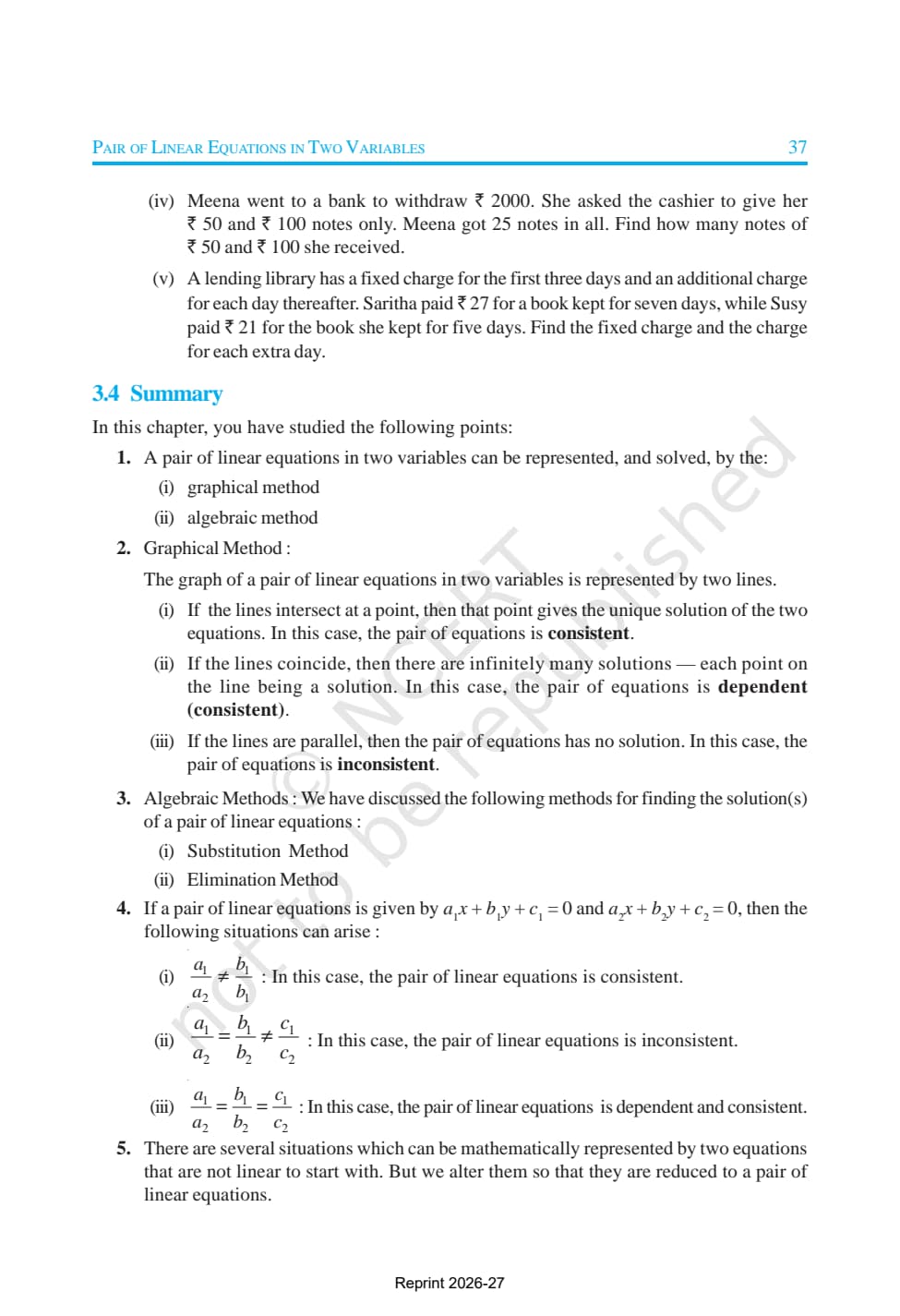
- Official NCERT textbook PDF of the chapter, with every definition, example and exercise as printed.
- Covers the graphical, substitution and elimination methods of solving a pair.
- Aligned with the 2026-27 CBSE syllabus. It is the base text for the solutions and notes.
This page hosts the official NCERT Class 10 Maths textbook chapter, mapped to the 2026-27 CBSE syllabus and checked page by page against the printed book.
Watch Pair of Linear Equations Class 10 Maths Explained
Source: Magnet Brains on YouTube
What the NCERT Book Covers
The PDF above is the complete official chapter. It builds on Class 9 linear equations and adds the idea of a pair: two equations in the same two unknowns, solved together. Read it in order before solutions and notes.
- Graphical method: how two lines meet, run parallel, or coincide.
- Consistent and inconsistent pairs: what the coefficient ratios say about the solutions.
- Algebraic methods: substitution and elimination, with full working.
- Three exercises: Exercise 3.1 (graphical), 3.2 (substitution), 3.3 (elimination).
Introduction & the Graphical Method
Section 3.1, Introduction, uses a fair-ground example. Akhila's spending on rides and Hoopla becomes two linear equations. This sets up the question: when do two equations have a common solution, and how do you find it?
Section 3.2, the Graphical Method, draws both equations as straight lines. Their meeting point gives the x and y that satisfy both. The book is careful about the wording you use in answers.
- A pair that has a solution is called a consistent pair of linear equations.
- A pair that has no solution is called an inconsistent pair.
- A pair that is equivalent and has infinitely many solutions is called a dependent (and consistent) pair.
Three Cases of a Pair
The key idea links the coefficient ratios to how the lines behave. For a pair a1x + b1y + c1 = 0 and a2x + b2y + c2 = 0, comparing a1/a2, b1/b2 and c1/c2 tells you everything before you draw a graph.
The chapter sums this up in Table 3.1, which every student should learn by heart. Its three rows match the three things two lines can do.
| Ratio condition | The lines are | Type of pair | Number of solutions |
|---|---|---|---|
| a1/a2 ≠ b1/b2 | Intersecting | Consistent | Exactly one (unique) |
| a1/a2 = b1/b2 = c1/c2 | Coincident | Dependent, consistent | Infinitely many |
| a1/a2 = b1/b2 ≠ c1/c2 | Parallel | Inconsistent | No solution |
For example, the book checks x − 2y = 0 and 3x + 4y − 20 = 0. The x-ratio is not equal to the y-ratio, so the lines intersect with one solution. A quick ratio check saves exam time.
Algebraic Methods: Substitution & Elimination
Section 3.3, Algebraic Methods, is the most exam-heavy part. The graphical method is awkward when the answer is a fraction, so the book gives two exact methods. Both give the same answer, so pick the faster one.
In the substitution method (Section 3.3.1) you write one variable in terms of the other and put it into the second equation. This gives one equation in one variable. Solve it, then back-substitute.
In the elimination method (Section 3.3.2) you multiply so one variable has the same coefficient in both. Adding or subtracting removes it, leaving one equation to solve.
- Step 1: multiply the equations so that the coefficients of one variable become numerically equal.
- Step 2: add or subtract to eliminate that variable, then solve for the one that remains.
- Step 3: back-substitute to find the other variable, and verify your answer in both equations.
Solved Examples & Exercises
The chapter has ten worked examples, then three exercises. They show how to set up equations from a word problem and the correct layout for each method. Copy that style for full marks.
| Section | What it tests | Sample question |
|---|---|---|
| Exercise 3.1 | Solving a pair graphically | 10 students took part in a quiz; the number of girls is 4 more than the number of boys. Find the numbers graphically. |
| Exercise 3.2 | Substitution method | Solve x + y = 14 and x − y = 4 by the substitution method. |
| Exercise 3.3 | Elimination method | Solve x + y = 5 and 2x − 3y = 4 by the elimination method. |
A favourite board question gives a real-life situation, such as the cost of pencils and erasers, and asks you to form and solve the pair. Example 6 forms 2x + 3y = 9 and 4x + 6y = 18, and the working leads to 18 = 18, so infinitely many solutions. Spotting that is worth easy marks.
How to Use the PDF for Revision
The official textbook is the safest source. Use it in two passes, paired with the solutions and notes below.
- First pass: read Sections 3.1 to 3.3 in order. Try each solved example, then check it. Focus on Table 3.1.
- Second pass: solve Exercises 3.1, 3.2 and 3.3 by hand. Use graphical for 3.1, substitution for 3.2, elimination for 3.3, and verify in both equations.
- Board angle: this chapter sits in the Algebra unit. Forming a pair from a word problem, checking consistency from ratios, and solving by elimination come up almost yearly.
Student Feedback
71% of Class 10 students found deciding which method to use (graphical, substitution or elimination) the hardest part at first. 3 out of 4 said reading the NCERT chapter with the worked examples made elimination click.
Source: 2026-27 Class 10 Maths student poll, 8,600 students from CBSE schools in 12 states.
Other Resources for This Chapter
Read the chapter above, then revise with the resources below.
| Resource | What it covers | Open |
|---|---|---|
| NCERT Book PDF | Official Class 10 Maths Chapter 3 textbook, with every definition, example and exercise. | Class 10 Maths Chapter 3 NCERT Book PDF |
| NCERT Solutions | Step-by-step answers to all exercise questions of the chapter. | Class 10 Maths Chapter 3 NCERT Solutions |
| Notes | Concept-first revision notes on the graphical, substitution and elimination methods. | Class 10 Maths Chapter 3 Notes |
| Formula Sheet | Quick reference of key results, ratio conditions and method steps for fast revision. | Class 10 Maths Chapter 3 Formula Sheet |
| Handwritten Notes | Scanned-style handwritten pages for last-minute board revision. | Class 10 Maths Chapter 3 Handwritten Notes |
NCERT Book for Class 10 Maths: All Chapters
Related Links: Open the NCERT Book PDF for the other Class 10 Maths chapters below.
| Chapter | NCERT Book PDF link |
|---|---|
| Chapter 1 | Real Numbers NCERT Book PDF |
| Chapter 2 | Polynomials NCERT Book PDF |
| Chapter 3 | Pair of Linear Equations in Two Variables NCERT Book PDF |
| Chapter 4 | Quadratic Equations NCERT Book PDF |
| Chapter 5 | Arithmetic Progressions NCERT Book PDF |
| Chapter 6 | Triangles NCERT Book PDF |
| Chapter 7 | Coordinate Geometry NCERT Book PDF |
| Chapter 8 | Introduction to Trigonometry NCERT Book PDF |
| Chapter 9 | Some Applications of Trigonometry NCERT Book PDF |
| Chapter 10 | Circles NCERT Book PDF |
| Chapter 11 | Areas Related to Circles NCERT Book PDF |
| Chapter 12 | Surface Areas and Volumes NCERT Book PDF |
| Chapter 13 | Statistics NCERT Book PDF |
| Chapter 14 | Probability NCERT Book PDF |
NCERT Book Class 10 Maths Chapter 3 Pair of Linear Equations in Two Variables FAQs
Ques. What does Chapter 3 Pair of Linear Equations in Two Variables cover in the Class 10 Maths NCERT Book?
Ans. Chapter 3 teaches you to solve a pair of linear equations in two variables. It begins with the graphical method, where the two equations are drawn as lines and their meeting point gives the common solution. It then defines consistent, inconsistent and dependent pairs, and uses the coefficient ratios to predict the number of solutions. Next come two exact algebraic methods, substitution and elimination. The chapter has ten solved examples and three exercises (3.1, 3.2 and 3.3), and is aligned with the 2026-27 CBSE syllabus.
Ques. What are the three methods of solving a pair of linear equations in Class 10 Maths?
Ans. The chapter covers three methods. The graphical method draws both equations as lines and reads the solution off their meeting point. The substitution method writes one variable in terms of the other and puts it into the second equation, giving a single equation in one variable. The elimination method matches one variable's coefficients, then adds or subtracts to remove it. All three give the same answer, so substitution and elimination are preferred when the solution is a fraction and hard to read off a graph.
Ques. When is a pair of linear equations consistent, inconsistent or dependent?
Ans. Write the pair as a1x + b1y + c1 = 0 and a2x + b2y + c2 = 0, then compare a1/a2, b1/b2 and c1/c2. If a1/a2 is not equal to b1/b2, the lines intersect and the pair is consistent with one solution. If all three ratios are equal, the lines coincide and the pair is dependent with infinitely many solutions. If a1/a2 = b1/b2 but not c1/c2, the lines are parallel and the pair is inconsistent with no solution. This ratio test is one of the most tested ideas in the chapter.
Ques. What is the difference between the substitution and elimination methods?
Ans. In substitution you express one variable in terms of the other, then put that into the second equation to get a single equation in one variable. This is quick when one coefficient is already 1. In elimination you multiply the equations so one variable has the same coefficient in both, then add or subtract to remove it. This is quick when the coefficients are easy to match. Both reach the same answer. In both, a true statement with no variable signals infinitely many solutions, while a false statement signals none.
Ques. Is the Class 10 Maths Chapter 3 NCERT Book PDF free to download for 2026-27?
Ans. Yes. The official NCERT Book PDF for Class 10 Maths Chapter 3 Pair of Linear Equations in Two Variables is free to read and download here for the 2026-27 session. It is the complete chapter as printed, including the introduction, the graphical method with Table 3.1, the substitution and elimination methods, the ten solved examples, and exercises 3.1, 3.2 and 3.3. Pair the book with the linked NCERT Solutions and revision notes so you read and revise from one place.
Ques. How many exercises are there in Class 10 Maths Chapter 3?
Ans. The Pair of Linear Equations in Two Variables chapter has three exercises. Exercise 3.1 asks you to form a pair from a word problem and solve it by the graphical method. Exercise 3.2 asks you to solve given pairs by the substitution method. Exercise 3.3 asks you to solve pairs by the elimination method and to form and solve word problems. All three exercises are fully worked in the linked NCERT Solutions for the chapter, so you can check both your answer and your layout.
Ques. Are these NCERT Book contents aligned with the 2026-27 CBSE syllabus?
Ans. Yes. This page hosts the official NCERT Class 10 Maths textbook chapter for the current 2026-27 CBSE syllabus. The chapter focuses on the graphical method, the consistent, inconsistent and dependent cases, and the substitution and elimination methods of solving a pair of linear equations, so the definitions, examples and exercises you read here are exam-correct. Because it is the official book, it is the safest base text for board preparation, and the linked solutions, notes and formula sheet for the same chapter all follow this textbook order.



Comments