



The NCERT Book for Class 10 Maths Chapter 4 Quadratic Equations is the official CBSE textbook chapter, free to read and download. It is a high-scoring part of the Algebra unit. You write a quadratic in standard form, find its roots by factorisation, and use the discriminant for the nature of the roots.
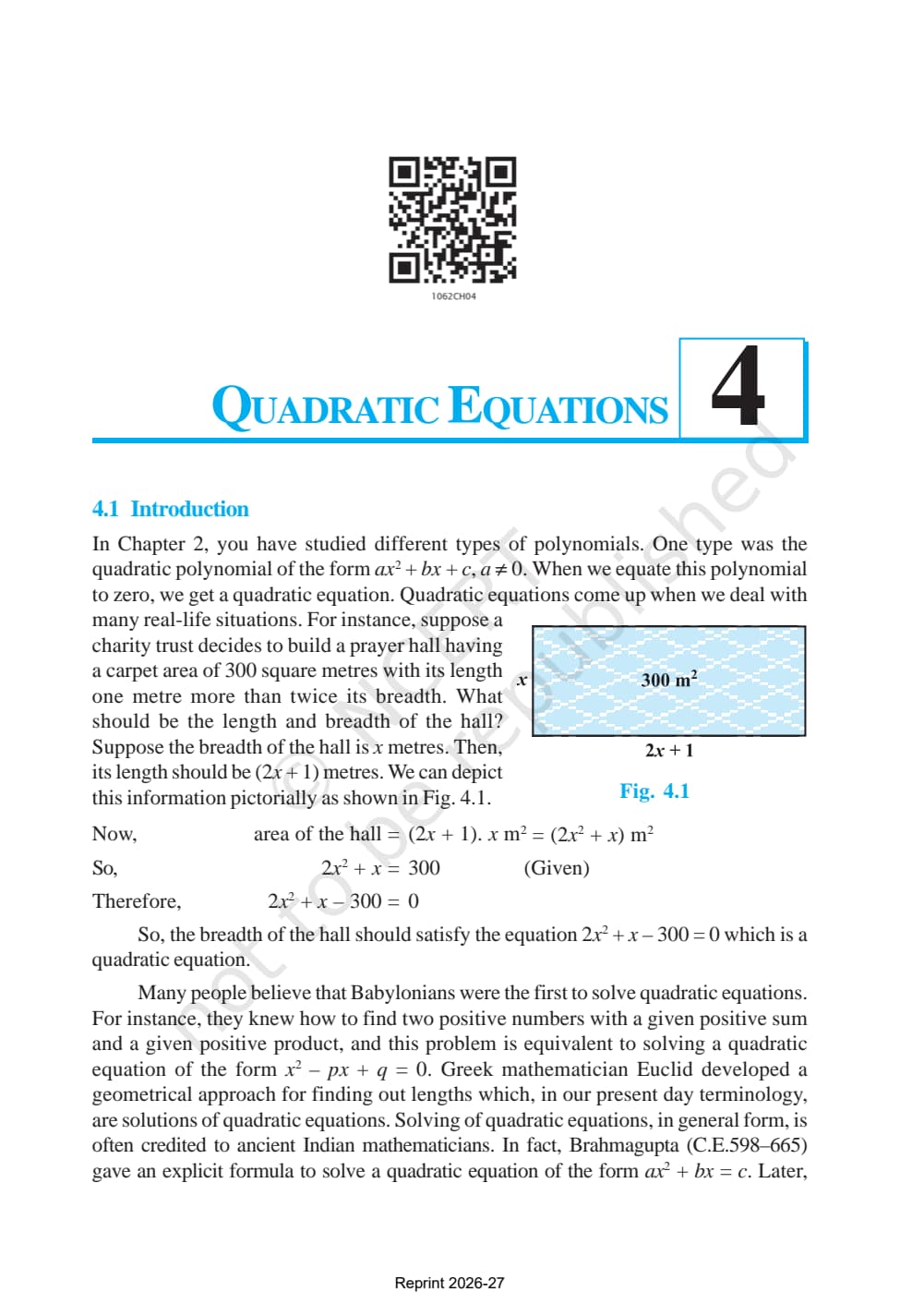
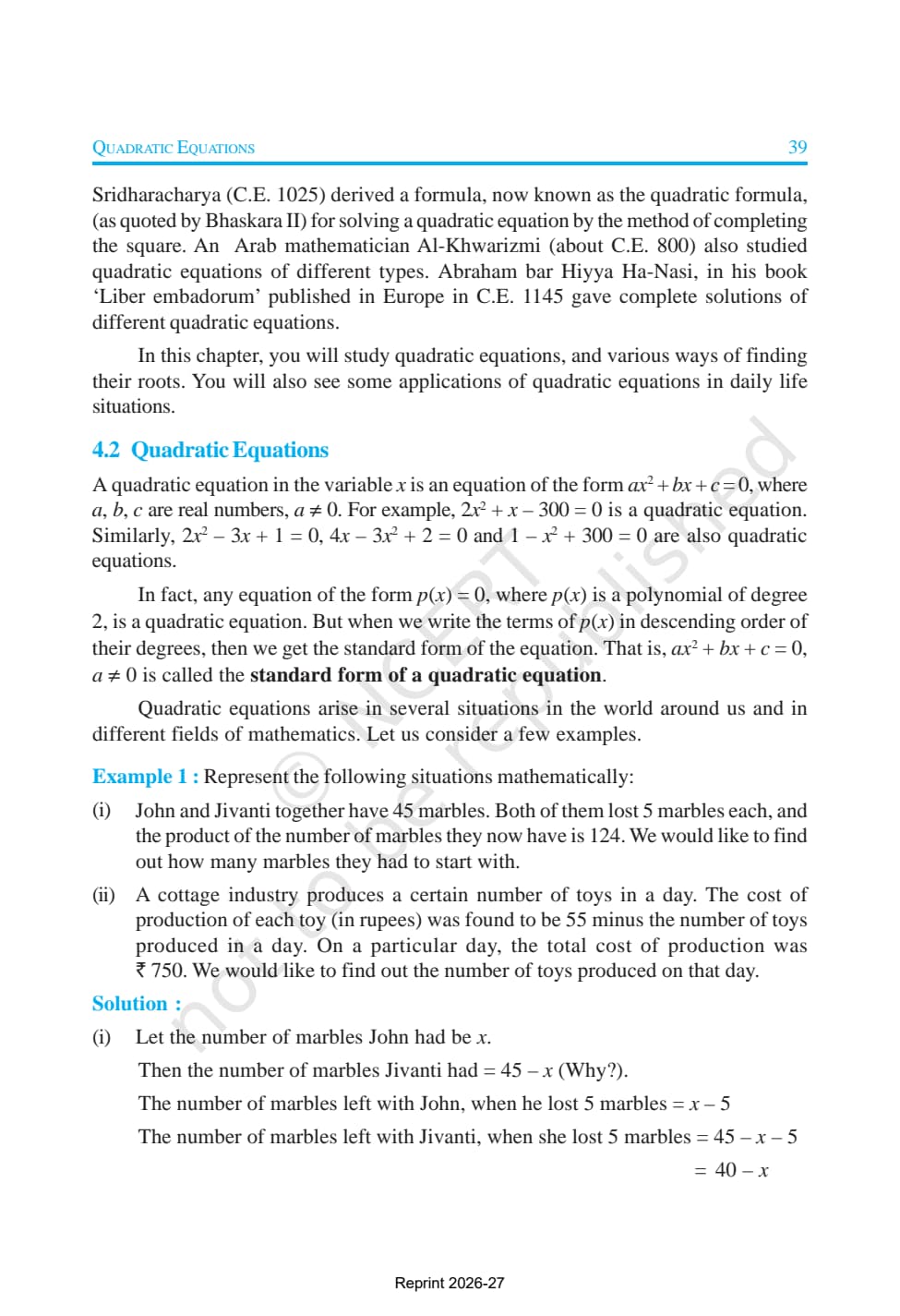
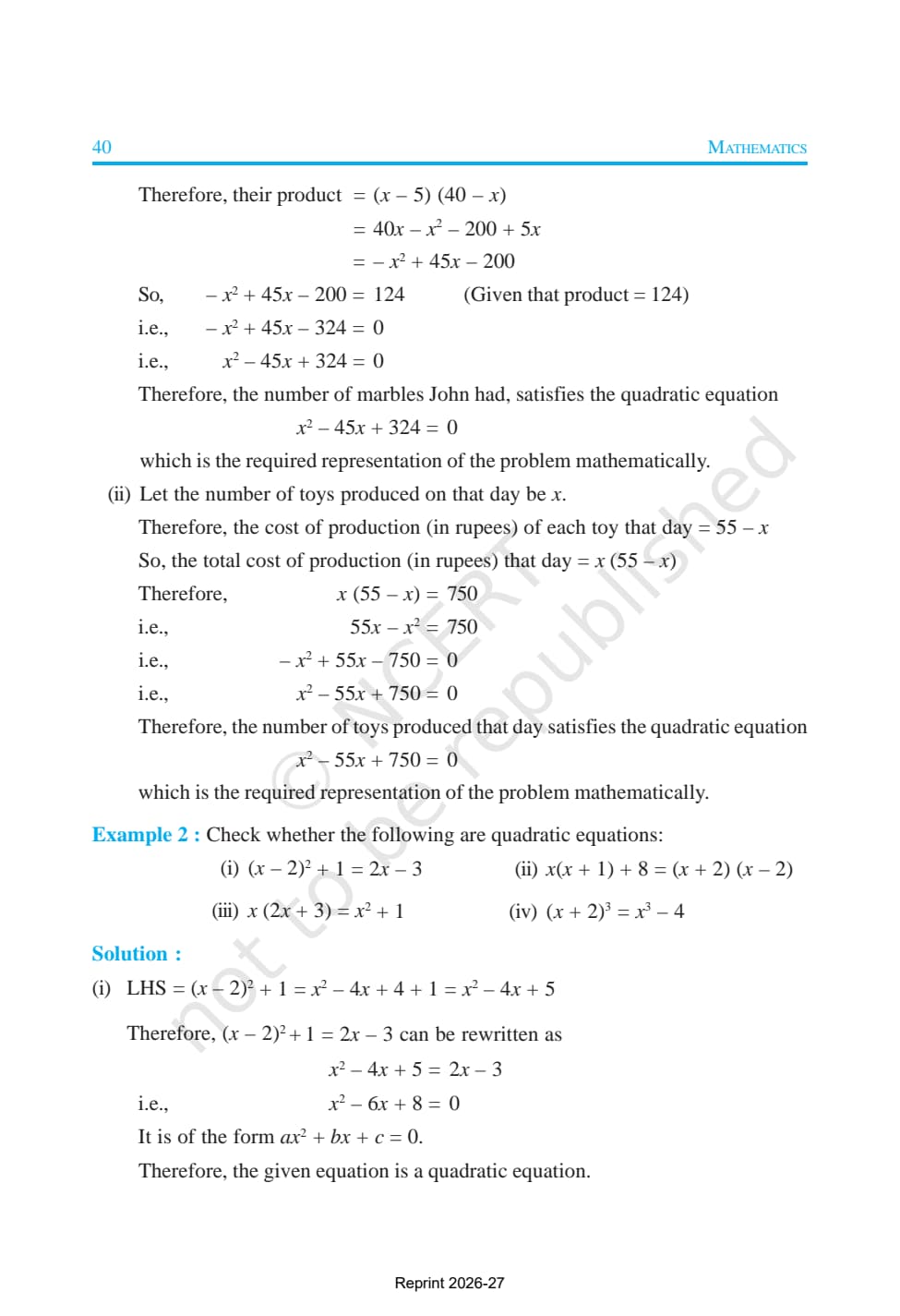
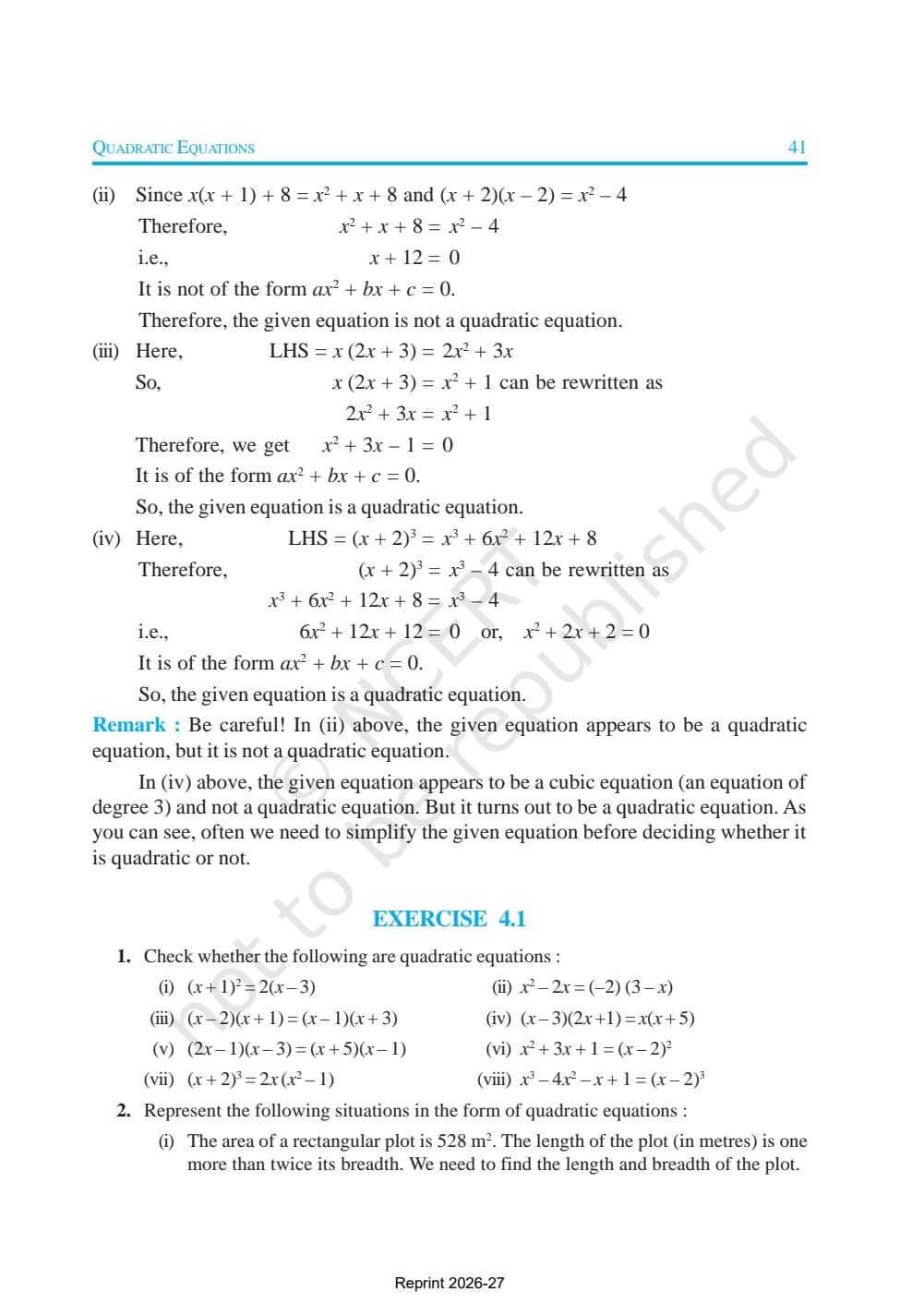
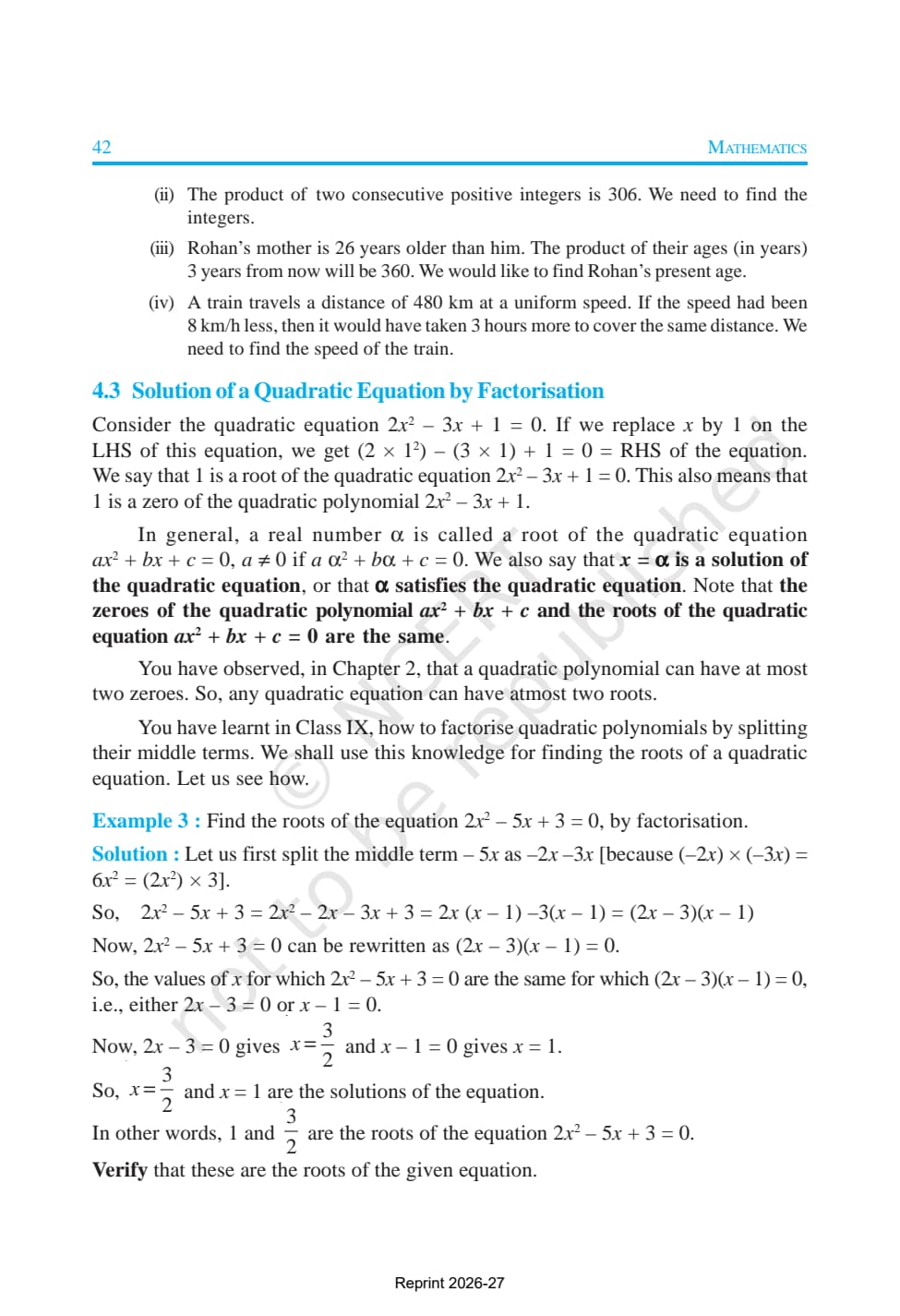
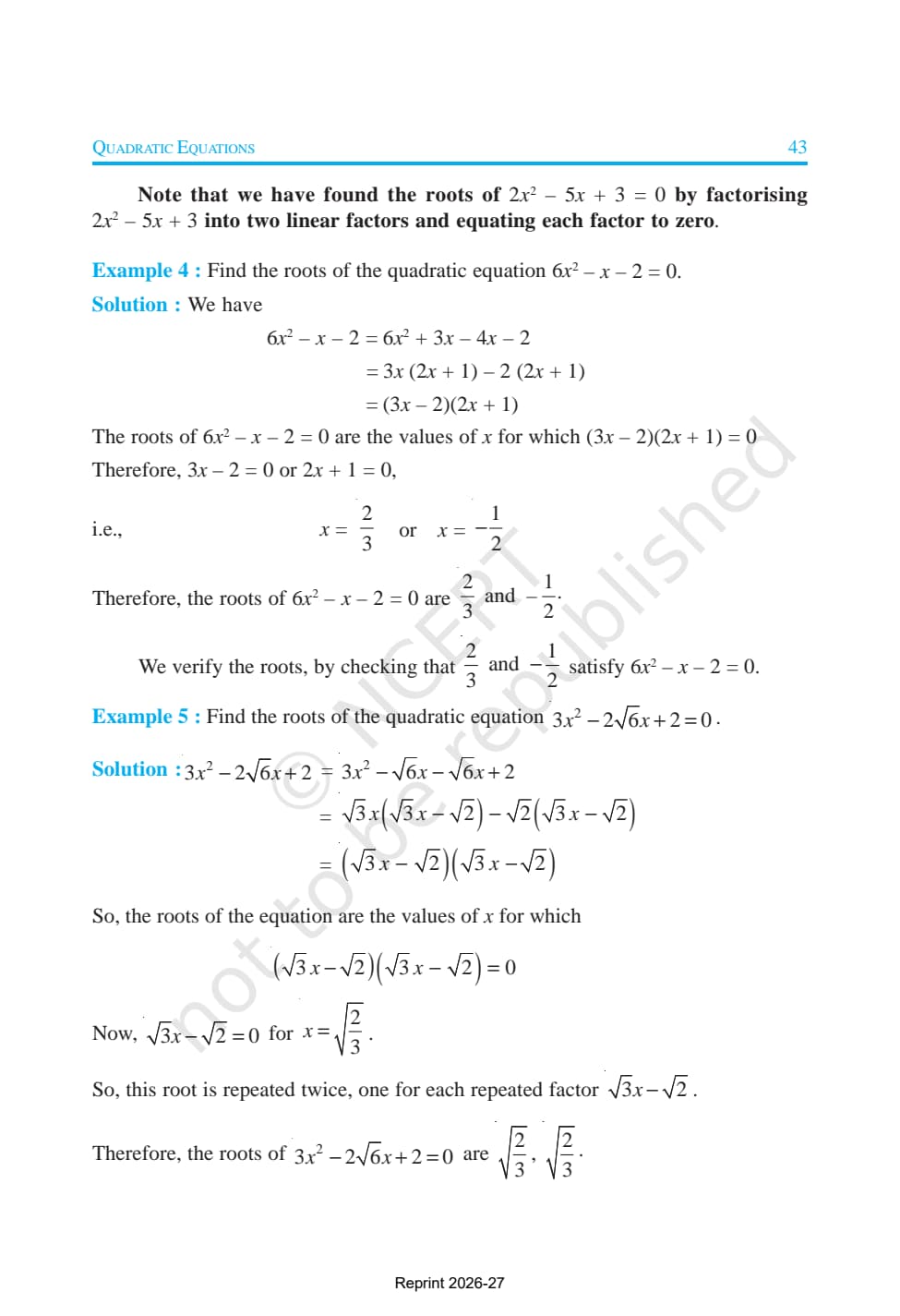
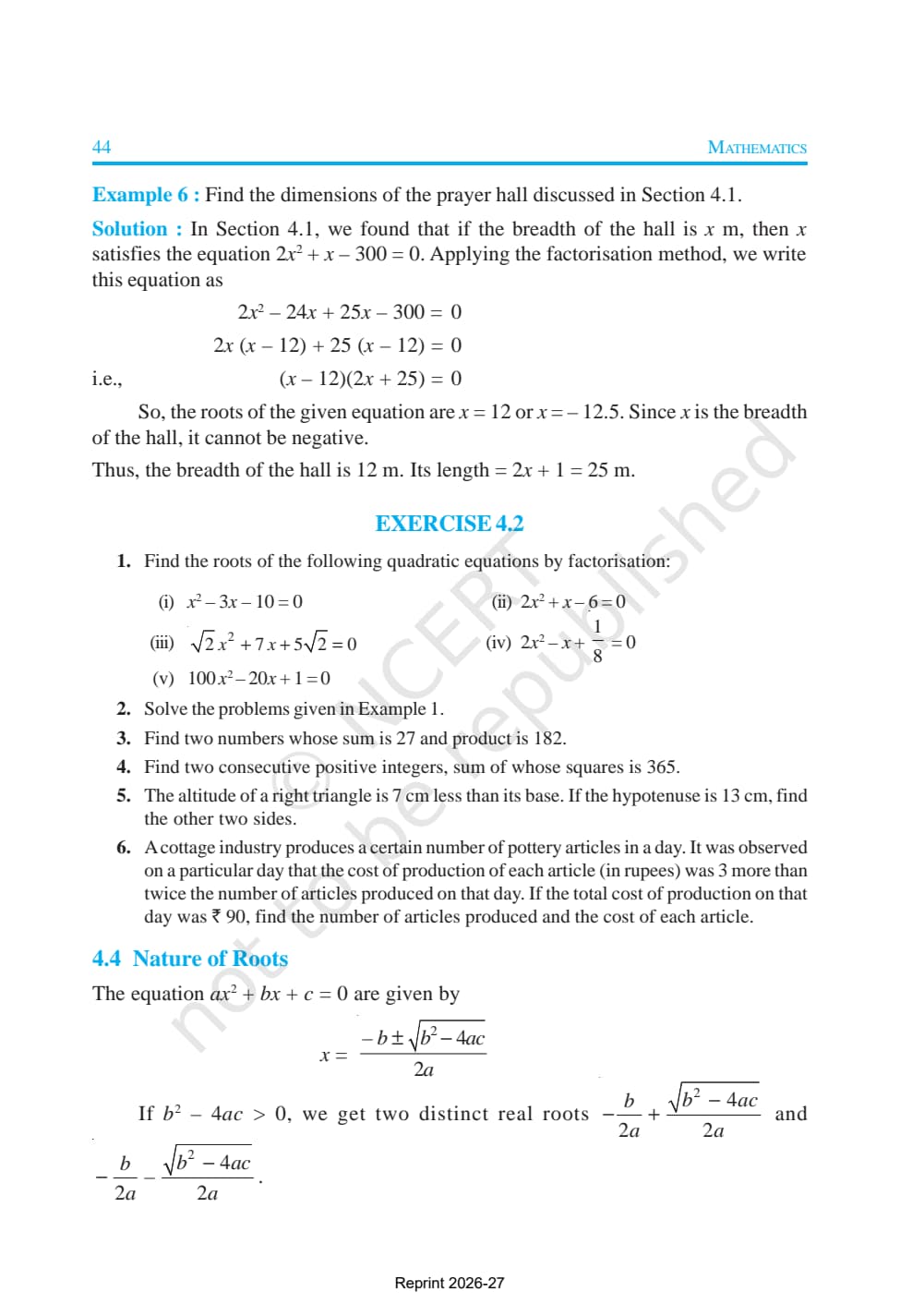
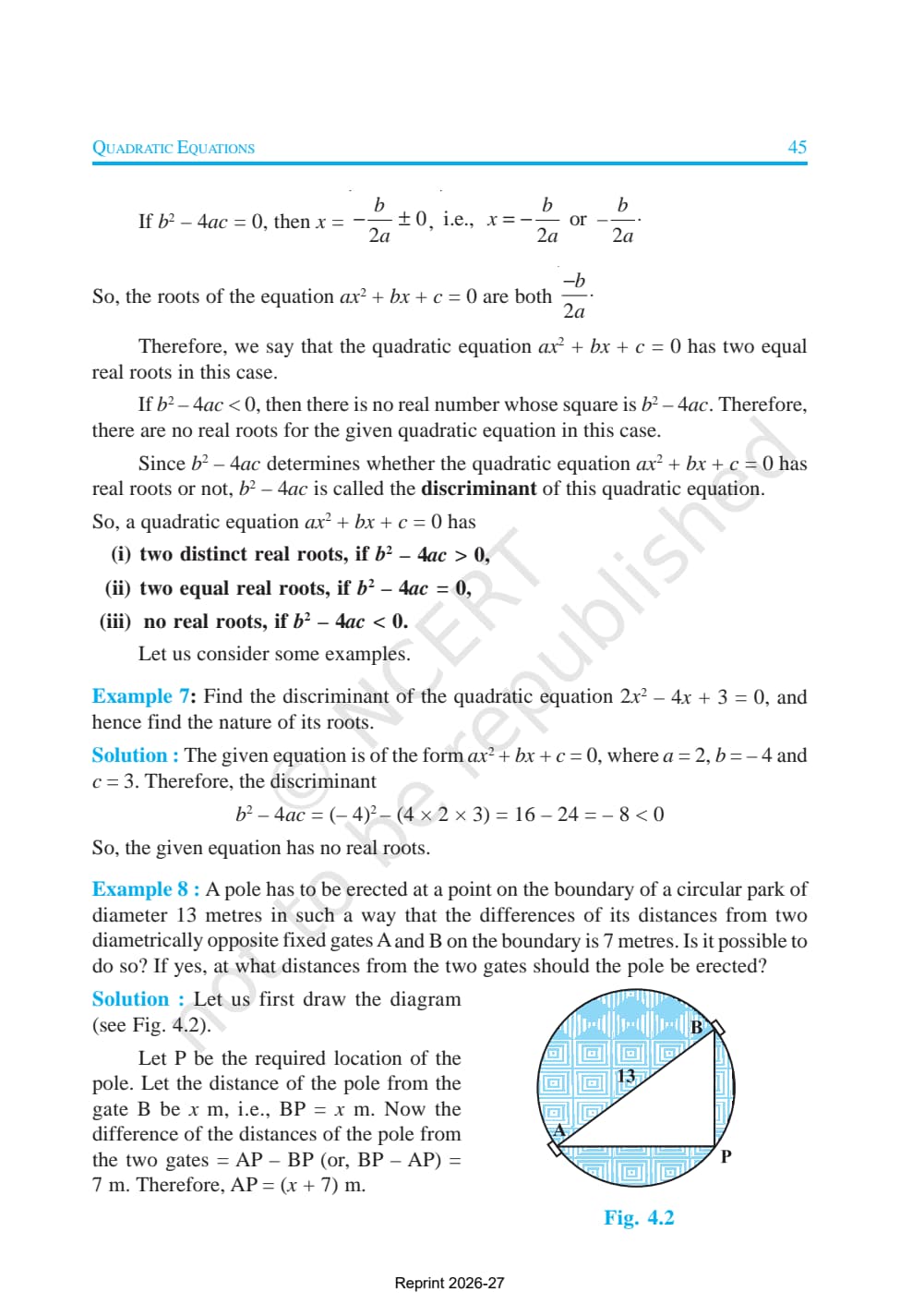
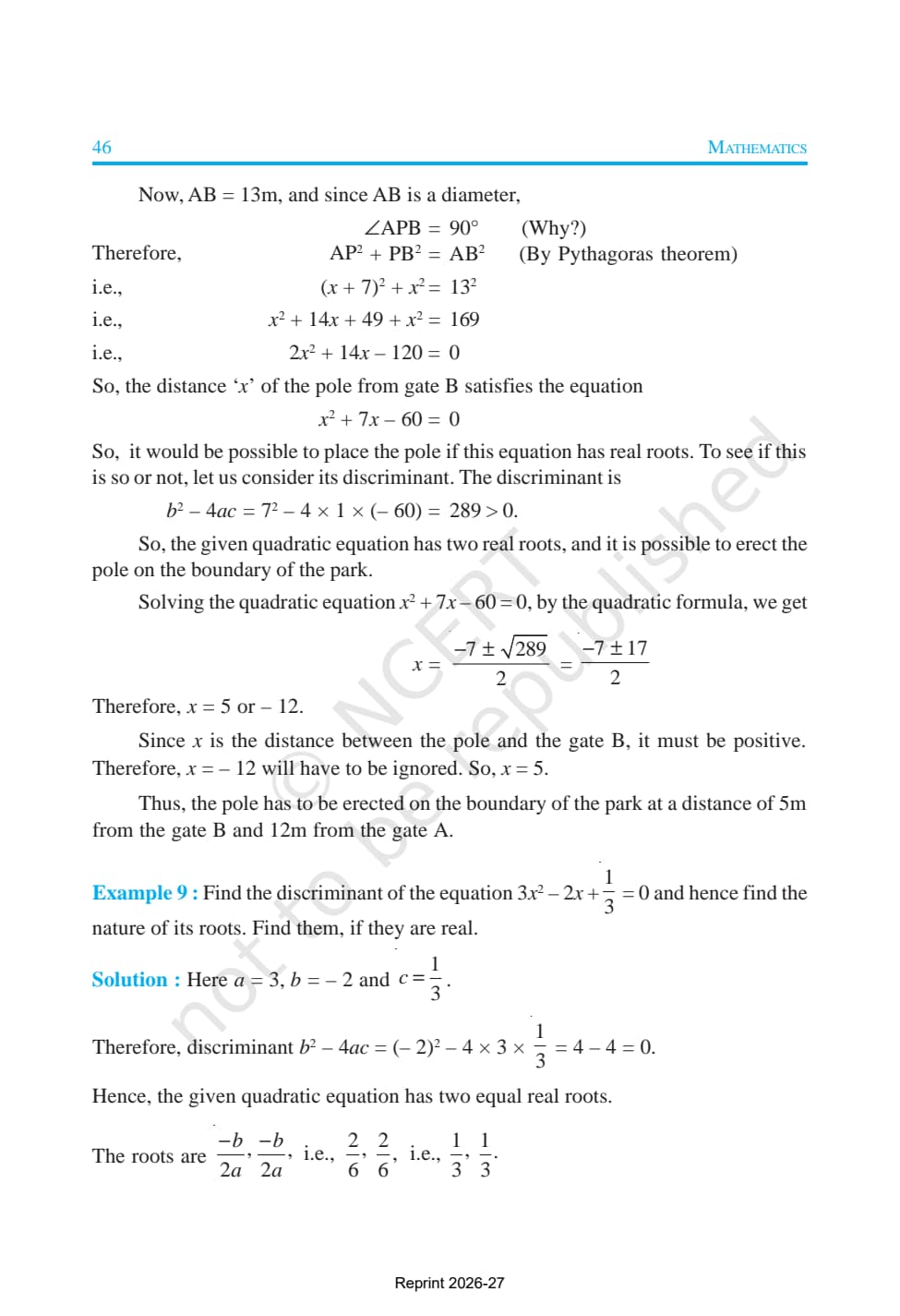
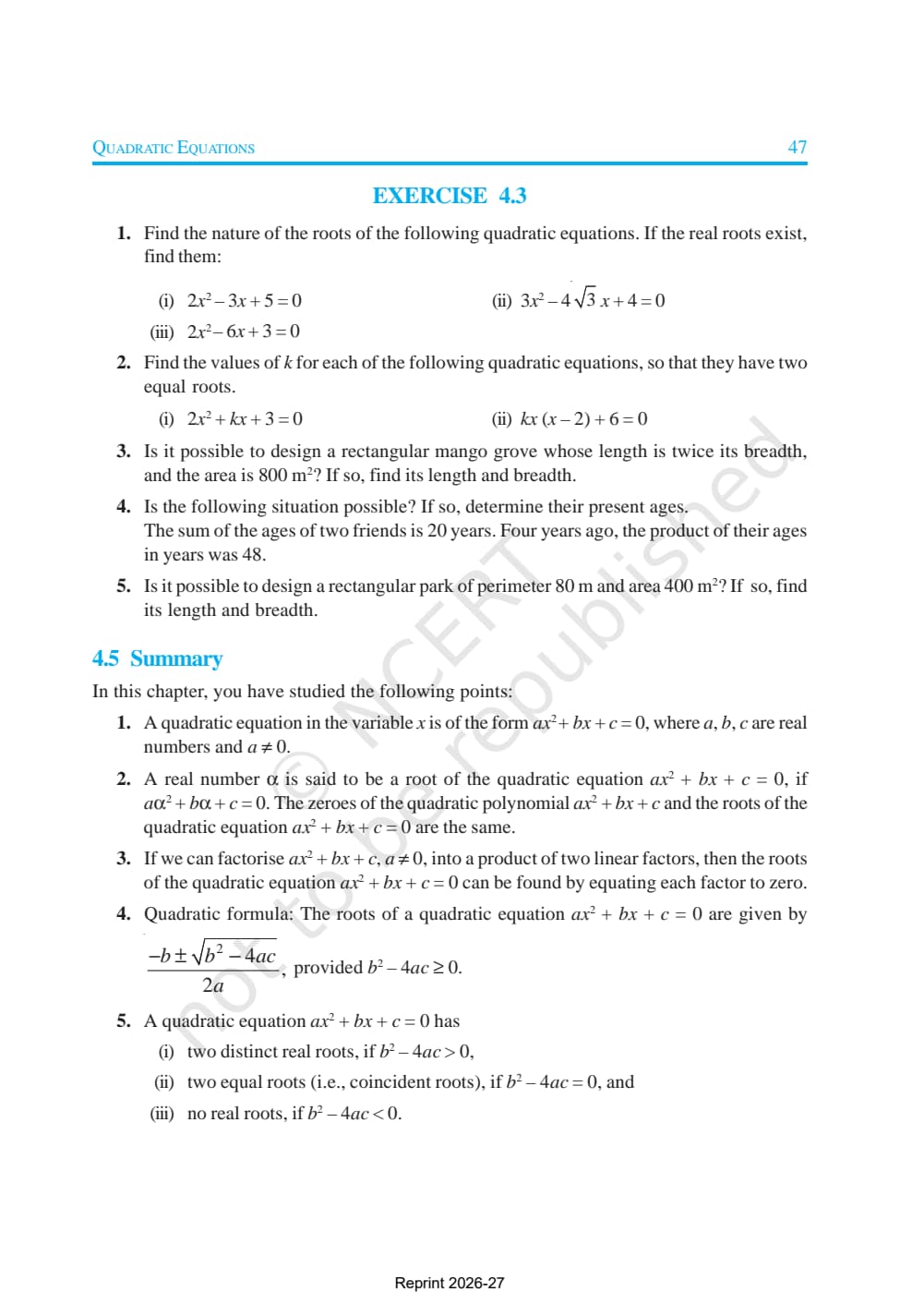
- Official NCERT textbook PDF of the chapter, with every definition, solved example and exercise as printed.
- Covers the standard form ax2 + bx + c = 0, the factorisation method, and the discriminant b2 − 4ac.
- Follows the 2026-27 CBSE syllabus. Use it for board revision and as the base text for the solutions and notes.
This page hosts the official NCERT Class 10 Maths textbook chapter, mapped to the 2026-27 CBSE syllabus and checked page by page against the printed Quadratic Equations chapter.
Watch Quadratic Equations Class 10 Maths Explained
Source: Magnet Brains on YouTube
What the NCERT Book Covers
The PDF above is the complete official chapter. It builds on the quadratic polynomial ax2 + bx + c from Chapter 2. The new idea is the quadratic equation: that polynomial set equal to zero.
- Standard form: writing any quadratic equation as ax2 + bx + c = 0 with a not 0.
- Roots: what a root means and why there are at most two.
- Factorisation method: splitting the middle term and equating each factor to zero.
- Nature of roots: the discriminant b2 − 4ac, plus Exercises 4.1, 4.2 and 4.3.
Standard Form of a Quadratic Equation
Section 4.1, Introduction, uses a real-life example. A prayer hall has a carpet area of 300 square metres, with length one metre more than twice the breadth. This gives 2x2 + x − 300 = 0, a quadratic equation.
Section 4.2, Quadratic Equations, gives the definition. A quadratic equation in x has the form ax2 + bx + c = 0, where a, b and c are real and a is not 0. Write terms in descending order to reach standard form first.
- a is the coefficient of x2 and can never be zero.
- b, the coefficient of x, can be zero (for example, x2 − 9 = 0).
- c, the constant term, can be zero (for example, x2 + 5x = 0).
Solution of a Quadratic Equation by Factorisation
Section 4.3, Solution by Factorisation, is the most exam-heavy part. A root is a number that satisfies the equation. The roots are the zeroes of ax2 + bx + c, which has at most two, so a quadratic equation has at most two roots.
The factorisation method splits the middle term, from Class 9. Write the quadratic as two linear factors. If a product is zero, one factor is zero, so set each to zero.
- Step 1: write in standard form and split the middle term so the two parts multiply to the product of the first and last terms.
- Step 2: factorise by grouping into two linear factors, such as (2x − 3)(x − 1).
- Step 3: set each factor to zero, solve, then verify both roots.
The book works through examples like 6x2 − x − 2 = 0, with roots 2/3 and −1/2, and irrational cases like 3x2 − 2√6 x + 2 = 0.
Nature of Roots and the Discriminant
The key tool is Section 4.4, Nature of Roots. The roots are x = ( −b ± √(b2 − 4ac) ) / 2a. The quantity under the root, b2 − 4ac, is the discriminant. Its sign tells you how many real roots there are.
The chapter sums this up in three cases to learn by heart, one for each sign of the discriminant.
| Discriminant b2 − 4ac | Nature of roots | Example |
|---|---|---|
| Greater than 0 | Two distinct real roots | x2 − 5x + 6 = 0 |
| Equal to 0 | Two equal real roots | x2 − 4x + 4 = 0 |
| Less than 0 | No real roots | 2x2 − 4x + 3 = 0 |
For example, the book checks 2x2 − 4x + 3 = 0, where b2 − 4ac is negative, so no real roots. This check saves time.
Solved Examples and Exercises
The chapter has eight worked examples across three exercises. They show how to form an equation from a word problem and lay out factorisation and the discriminant.
| Section | What it tests | Sample question |
|---|---|---|
| Exercise 4.1 | Identifying quadratic equations and forming them | The area of a rectangular plot is 528 m²; the length is one more than twice the breadth. Form the quadratic equation. |
| Exercise 4.2 | Finding roots by factorisation | Find the roots of x2 − 3x − 10 = 0 by factorisation. |
| Exercise 4.3 | Nature of roots using the discriminant | Find the nature of the roots of a given quadratic equation, and if real, find them. |
A favourite board question gives a real-life situation, like the speed of a train, and asks you to form and solve the quadratic. Example 6 solves 2x2 + x − 300 = 0, giving breadth 12 m and length 25 m once the negative root is rejected. Knowing when to reject a root is worth easy marks.
How to Use the NCERT Book PDF for Board Revision
The official textbook is the safest source. Use it in two passes, paired with the solutions and notes below.
- First pass: read Sections 4.1 to 4.4 in order. Try each solved example, then check it. Watch the discriminant cases in Section 4.4.
- Second pass: solve Exercises 4.1, 4.2 and 4.3 by hand. Use 4.1 to form equations, 4.2 for factorisation, 4.3 for the discriminant, and verify each root.
- Board angle: Forming a quadratic from a word problem, solving by factorisation, and using the discriminant come up almost yearly.
Student Feedback
68% of Class 10 students said the hardest first step was splitting the middle term while factorising. 3 out of 4 students said reading the chapter with the solved examples made the discriminant rule click.
Source: 2026-27 Class 10 Maths student poll, 9,100 students from CBSE schools in 12 states.
Other Resources for Quadratic Equations
Read the chapter above, then revise with the resources below.
| Resource | What it covers | Open |
|---|---|---|
| NCERT Book PDF | Official Class 10 Maths Chapter 4 textbook, with every definition, example and exercise. | Class 10 Maths Chapter 4 NCERT Book PDF |
| NCERT Solutions | Step-by-step answers to all exercise questions of the chapter. | Class 10 Maths Chapter 4 NCERT Solutions |
| Notes | Concept-first revision notes on standard form, factorisation and the discriminant. | Class 10 Maths Chapter 4 Notes |
| Formula Sheet | Quick reference of the standard form, the discriminant rule and method steps for fast revision. | Class 10 Maths Chapter 4 Formula Sheet |
| Handwritten Notes | Scanned-style handwritten pages for last-minute board revision. | Class 10 Maths Chapter 4 Handwritten Notes |
NCERT Book for Class 10 Maths: All Chapters
Related Links: Open the NCERT Book PDF for the other chapters of Class 10 Maths below.
| Chapter | NCERT Book PDF link |
|---|---|
| Chapter 1 | Real Numbers NCERT Book PDF |
| Chapter 2 | Polynomials NCERT Book PDF |
| Chapter 3 | Pair of Linear Equations in Two Variables NCERT Book PDF |
| Chapter 4 | Quadratic Equations NCERT Book PDF |
| Chapter 5 | Arithmetic Progressions NCERT Book PDF |
| Chapter 6 | Triangles NCERT Book PDF |
| Chapter 7 | Coordinate Geometry NCERT Book PDF |
| Chapter 8 | Introduction to Trigonometry NCERT Book PDF |
| Chapter 9 | Some Applications of Trigonometry NCERT Book PDF |
| Chapter 10 | Circles NCERT Book PDF |
| Chapter 11 | Areas Related to Circles NCERT Book PDF |
| Chapter 12 | Surface Areas and Volumes NCERT Book PDF |
| Chapter 13 | Statistics NCERT Book PDF |
| Chapter 14 | Probability NCERT Book PDF |
NCERT Book Class 10 Maths Chapter 4 Quadratic Equations FAQs
Ques. What does Chapter 4 Quadratic Equations cover in the Class 10 Maths NCERT Book?
Ans. Chapter 4 of the Class 10 Maths NCERT Book teaches you to work with quadratic equations. It begins with the standard form ax squared plus bx plus c equals 0, where a, b and c are real numbers and a is not zero, and explains what a root of the equation means. It then shows how to find the roots by factorisation, splitting the middle term and equating each factor to zero. The chapter ends with the nature of roots, using the discriminant b squared minus 4ac to decide whether the equation has two distinct, two equal, or no real roots. It has eight solved examples and three exercises, Exercise 4.1, Exercise 4.2 and Exercise 4.3, and is aligned with the 2026-27 CBSE syllabus.
Ques. What is the standard form of a quadratic equation in Class 10 Maths?
Ans. The standard form of a quadratic equation is ax squared plus bx plus c equals 0, where a, b and c are real numbers and a is not equal to 0. Here a is the coefficient of x squared, b is the coefficient of x, and c is the constant term. The condition that a is not zero is essential, because if a were zero the equation would become linear rather than quadratic. The NCERT Book stresses that you must simplify and write the terms in descending order of degree to reach this standard form before you solve, since some equations only look cubic until they are simplified.
Ques. How do you solve a quadratic equation by factorisation in Class 10?
Ans. To solve a quadratic equation by factorisation, you first write it in standard form, then split the middle term into two parts whose product equals the product of the first and last terms. You factorise by grouping to get two linear factors, for example writing 2x squared minus 5x plus 3 equals 0 as (2x minus 3)(x minus 1) equals 0. Because a product is zero only when at least one factor is zero, you set each factor equal to zero and solve. This gives the two roots, which for that example are 3 by 2 and 1. You should always verify both roots in the original equation.
Ques. What is the discriminant and how does it decide the nature of roots?
Ans. The discriminant of the quadratic equation ax squared plus bx plus c equals 0 is the quantity b squared minus 4ac, which sits under the square root in the quadratic formula. Its sign alone decides the nature of the roots. If b squared minus 4ac is greater than 0, the equation has two distinct real roots. If b squared minus 4ac equals 0, the equation has two equal real roots. If b squared minus 4ac is less than 0, the equation has no real roots, because no real number has a negative square. Checking the discriminant first lets you state the nature of the roots without fully solving the equation.
Ques. How many roots can a quadratic equation have?
Ans. A quadratic equation can have at most two roots. This is because the roots of ax squared plus bx plus c equals 0 are the same as the zeroes of the quadratic polynomial ax squared plus bx plus c, and you learnt in Chapter 2 that a quadratic polynomial has at most two zeroes. Depending on the discriminant, the equation may have two distinct real roots, two equal real roots, or no real roots at all. When the two linear factors are identical, such as in a perfect-square trinomial, the equation has two equal roots, which counts as a repeated root.
Ques. How many exercises are there in Class 10 Maths Chapter 4?
Ans. The Quadratic Equations chapter has three exercises. Exercise 4.1 asks you to check whether given equations are quadratic and to form quadratic equations from word problems. Exercise 4.2 asks you to find the roots of given quadratic equations by factorisation and to solve word problems using that method. Exercise 4.3 asks you to find the nature of the roots using the discriminant and, where the roots are real, to find them. All three exercises are fully worked in the linked NCERT Solutions for the chapter, so you can check both your answer and your layout.
Ques. Is the Class 10 Maths Chapter 4 NCERT Book PDF free to download for 2026-27?
Ans. Yes. The official NCERT Book PDF for Class 10 Maths Chapter 4 Quadratic Equations is free to read and download on this page for the 2026-27 session. It is the complete chapter as printed in the CBSE textbook, including the introduction, the standard form, the factorisation method, the nature of roots with the discriminant, the eight solved examples, and the end-of-chapter exercises 4.1, 4.2 and 4.3. You can pair the book with the linked NCERT Solutions and revision notes for the same chapter so that you read the textbook and revise from one place.



Comments