


The NCERT Book for Class 10 Maths Chapter 5 Arithmetic Progressions is the official CBSE textbook chapter, free to read and download for the 2026-27 session. It is in the Algebra unit and teaches you to spot an arithmetic progression, find any term, and add its terms.
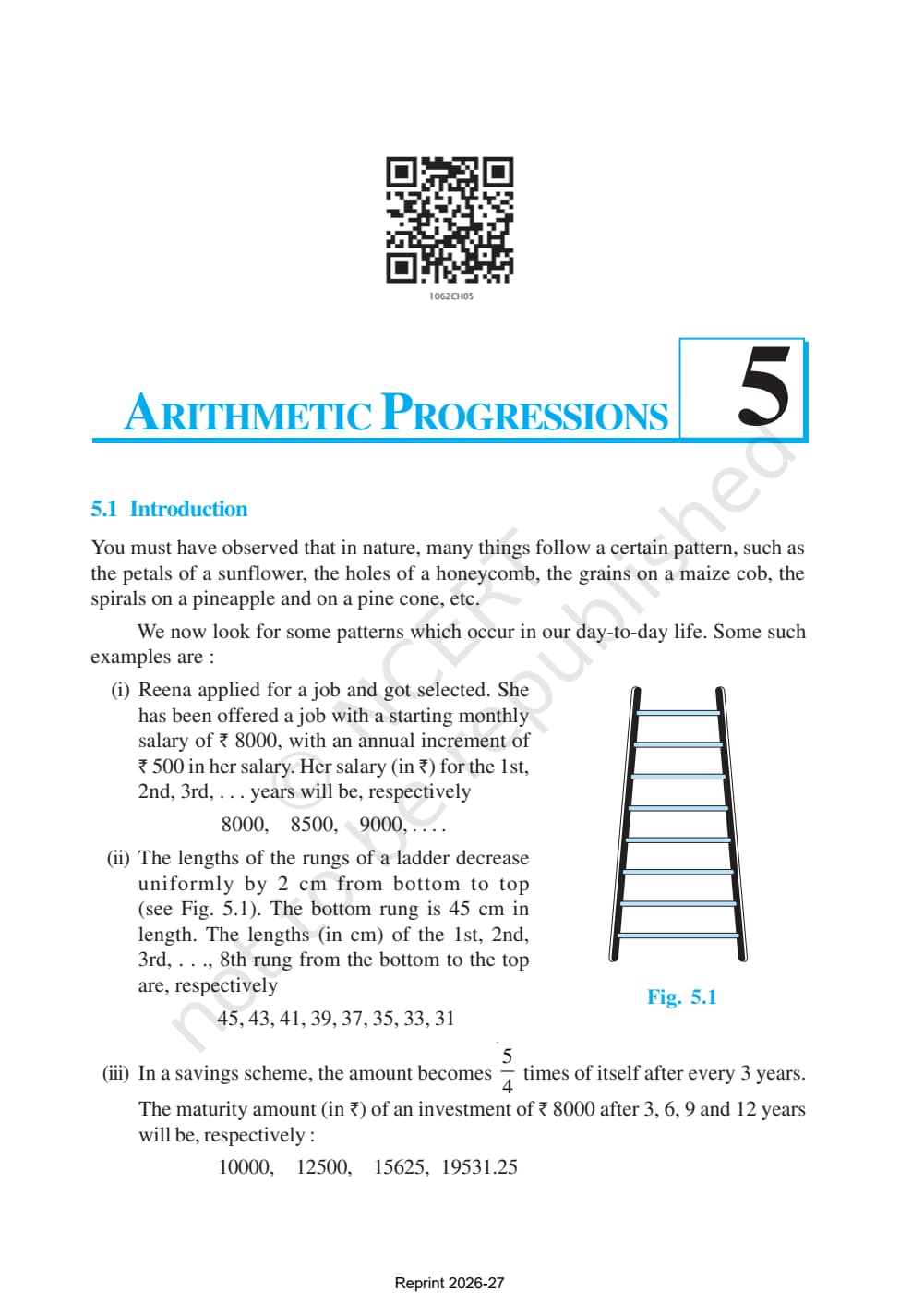
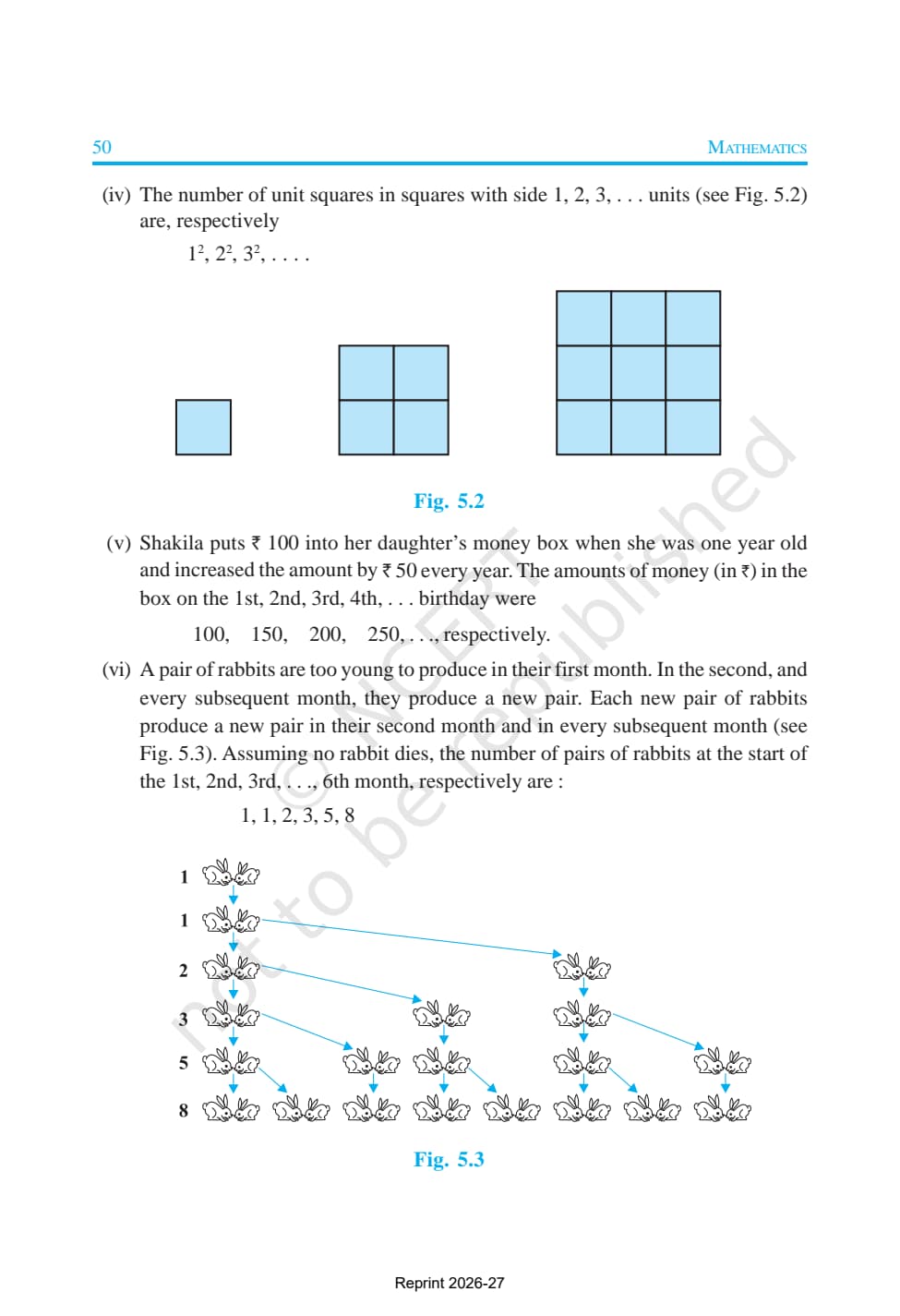
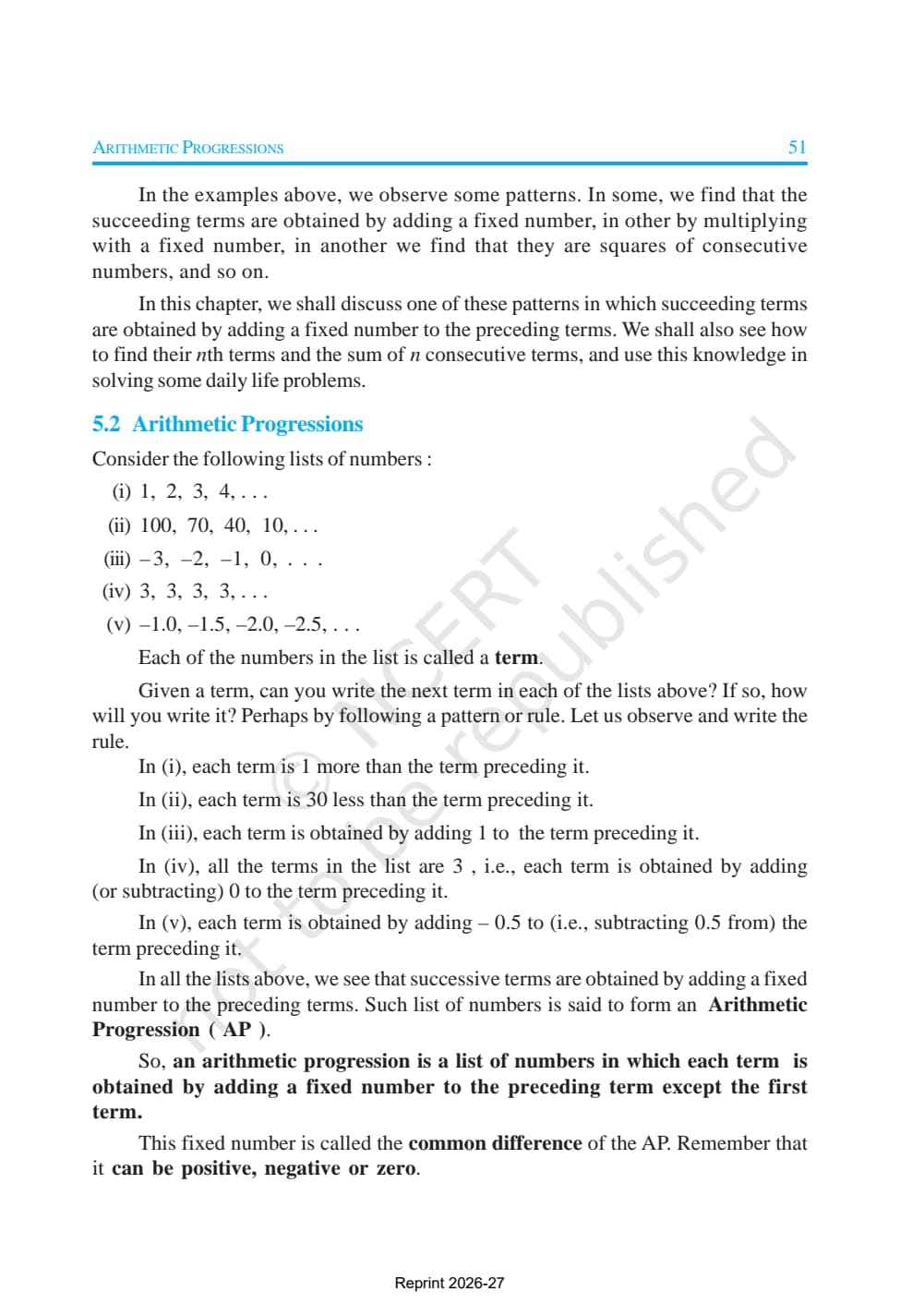
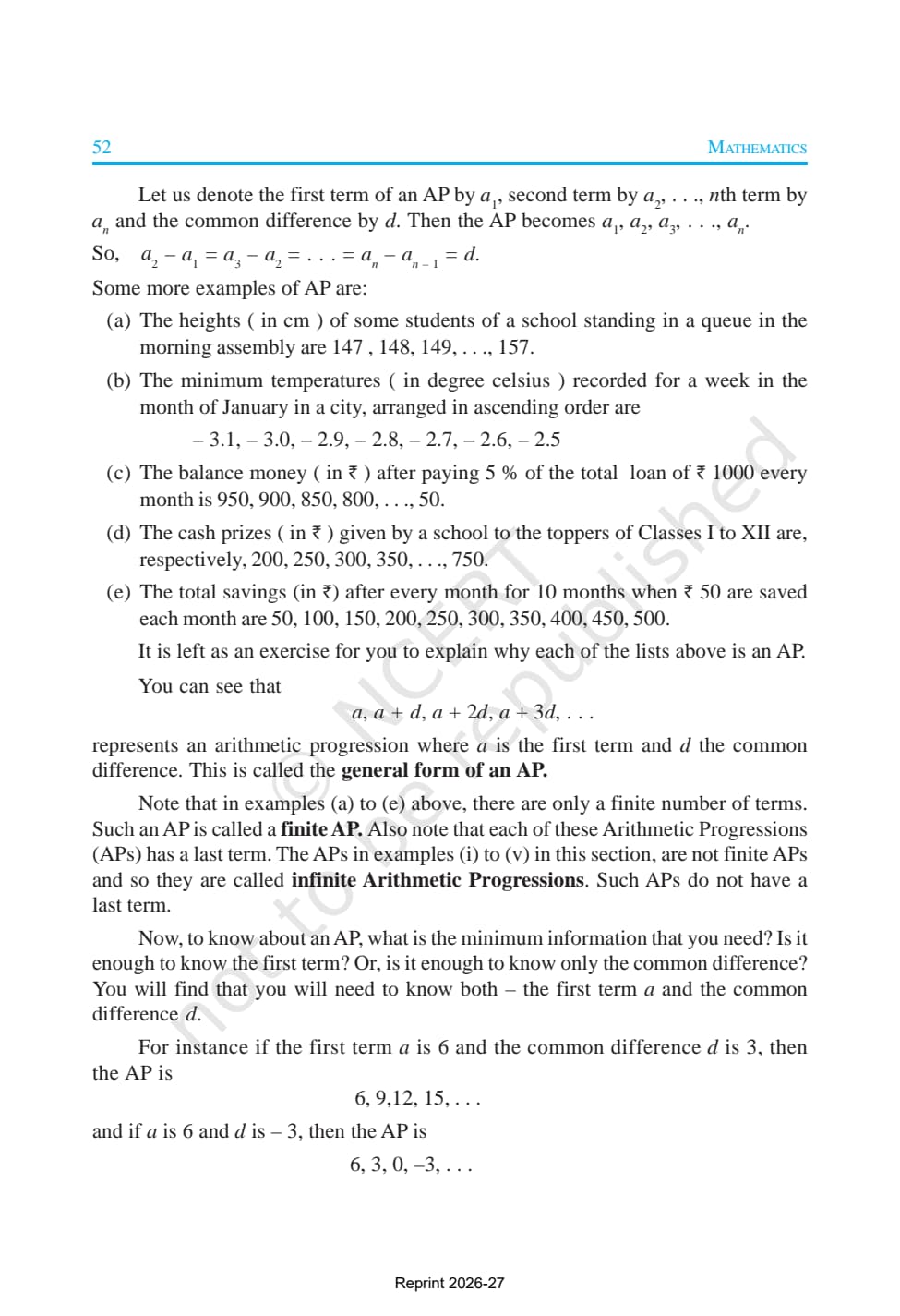
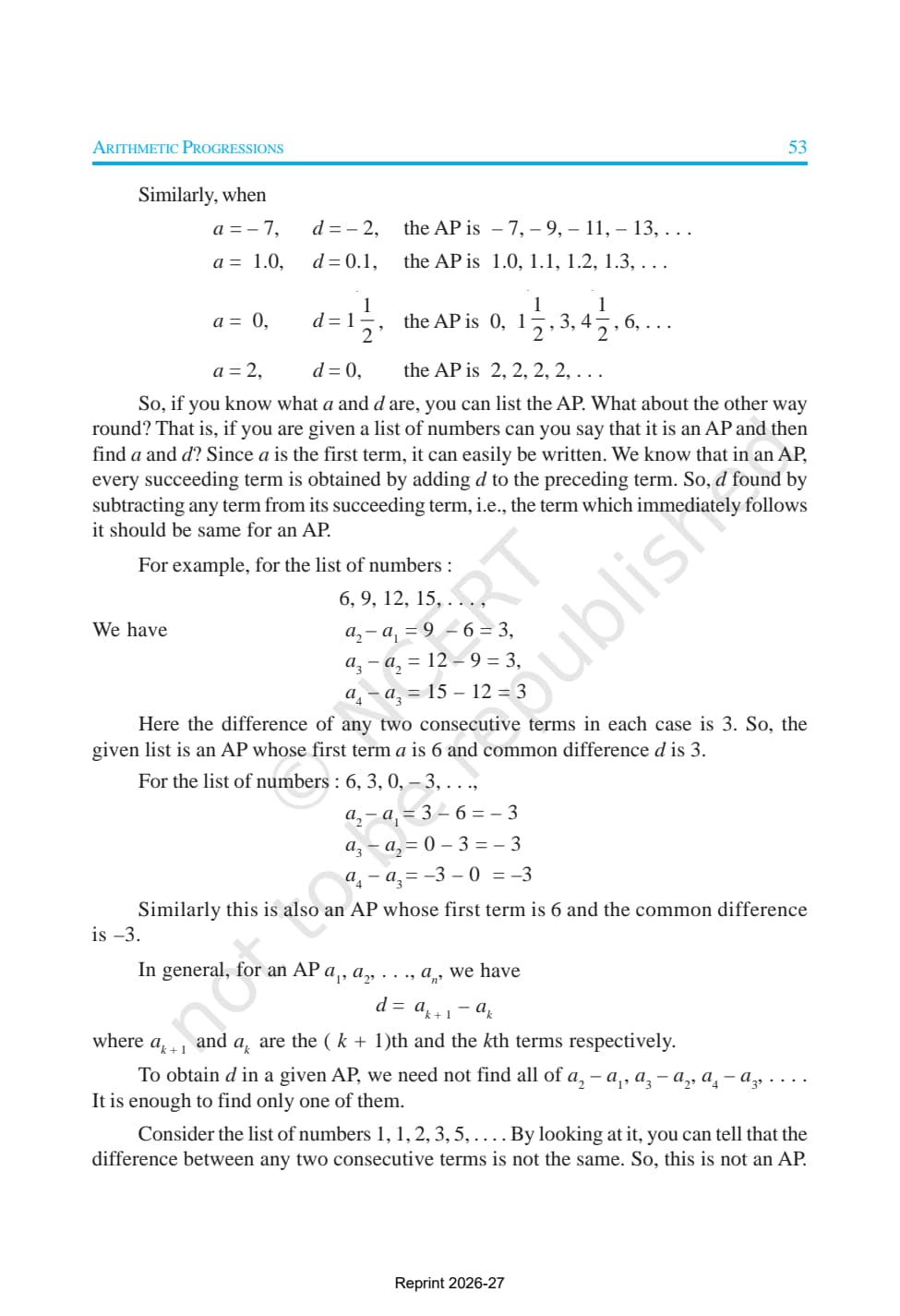
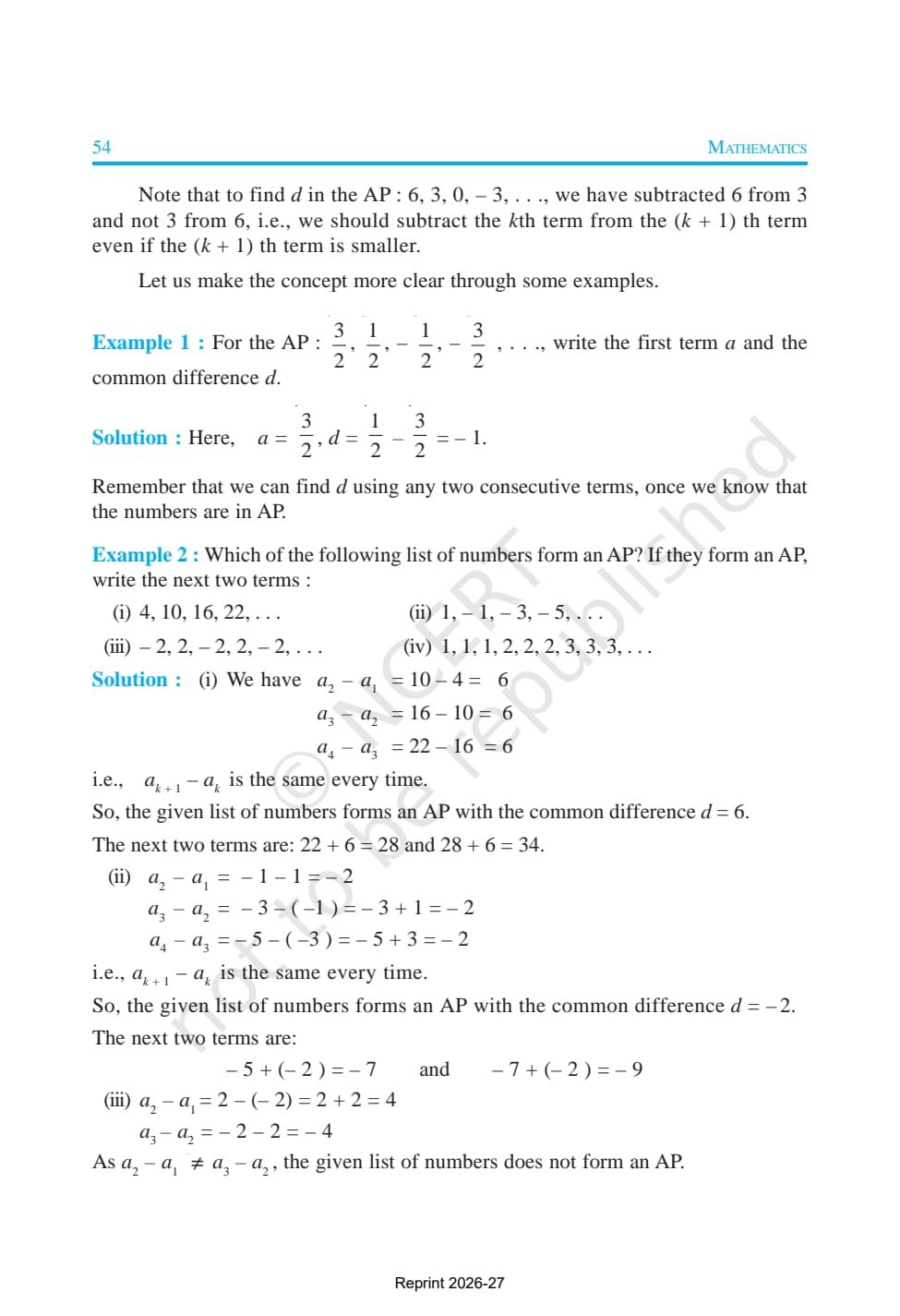
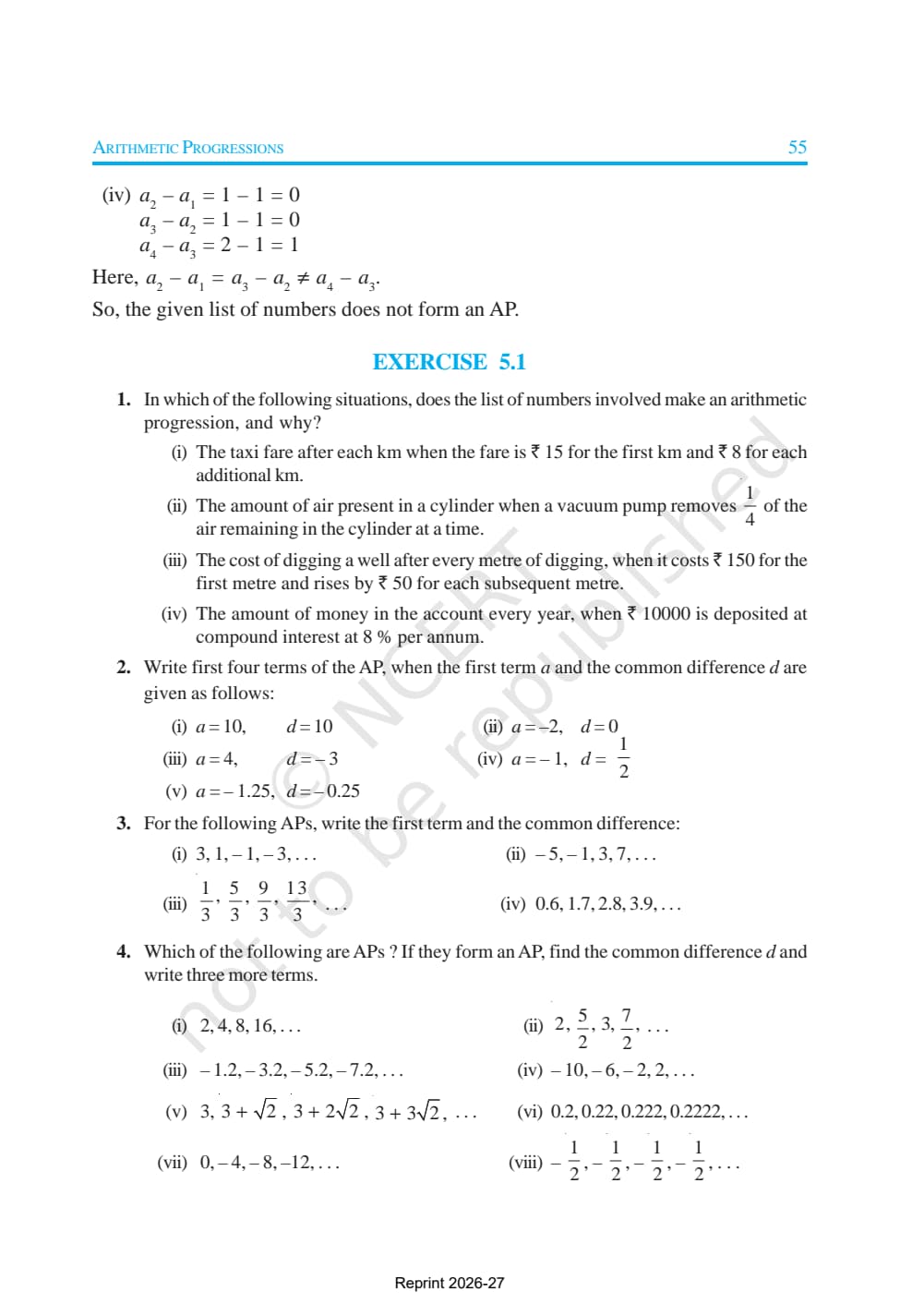
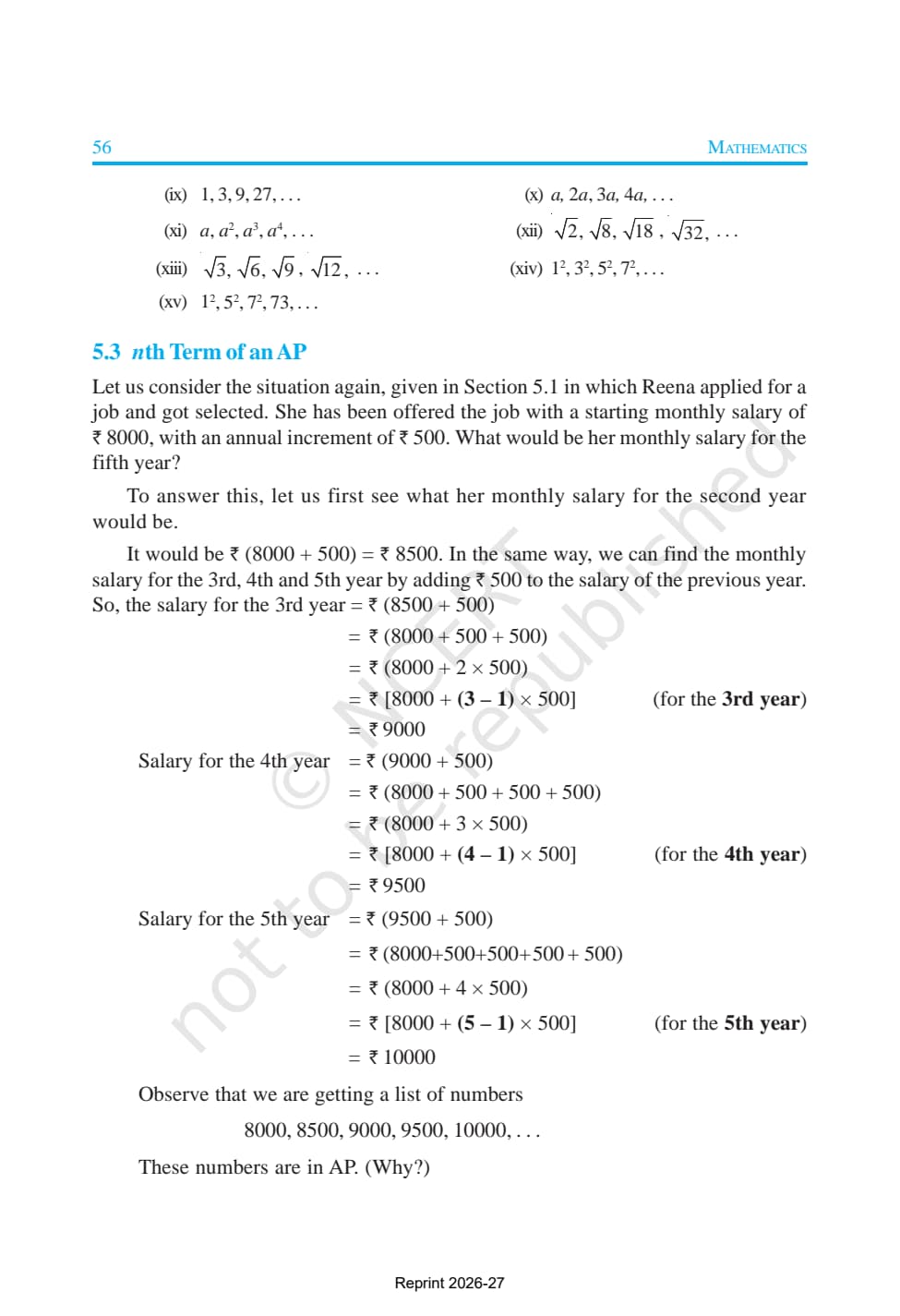
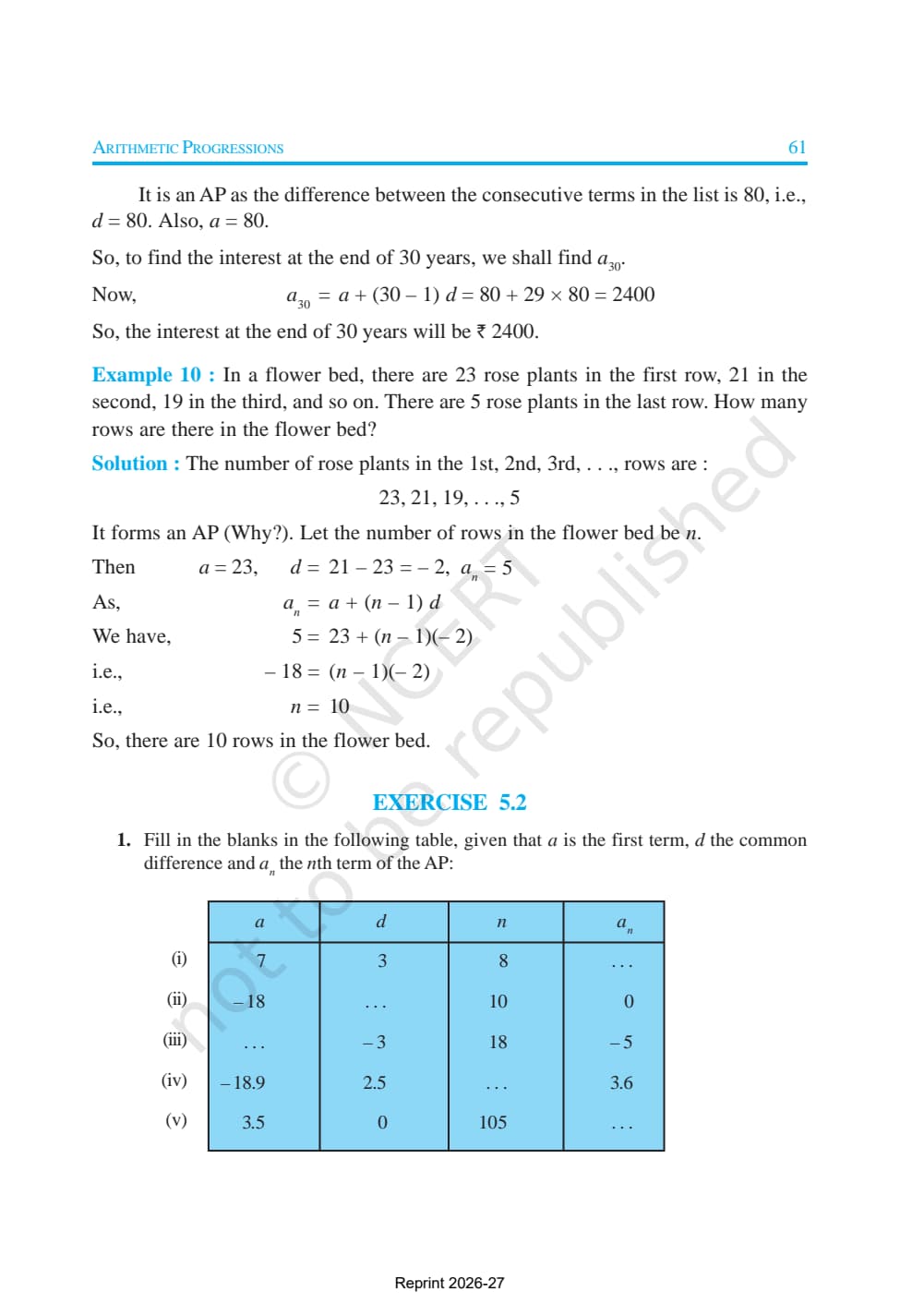
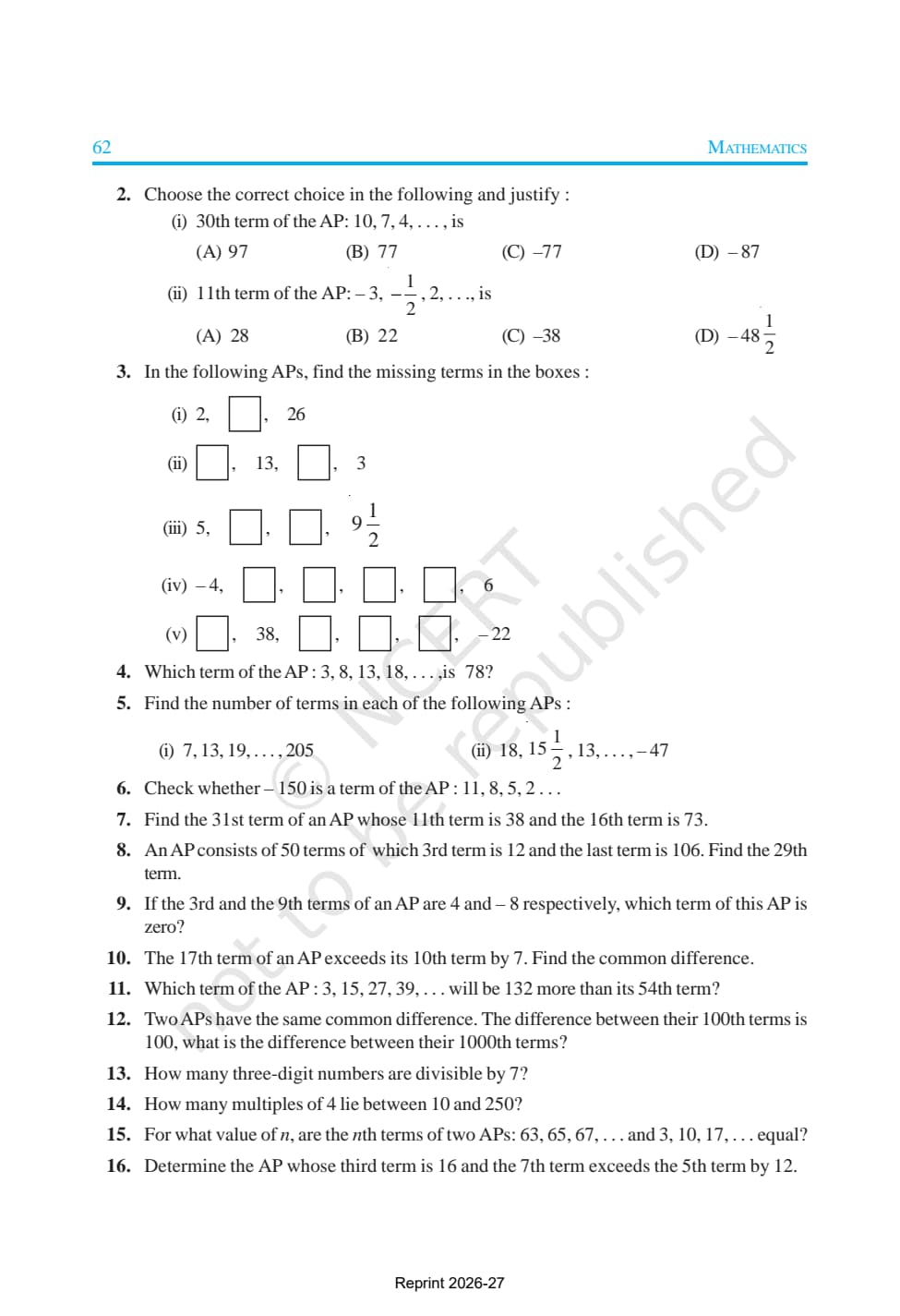
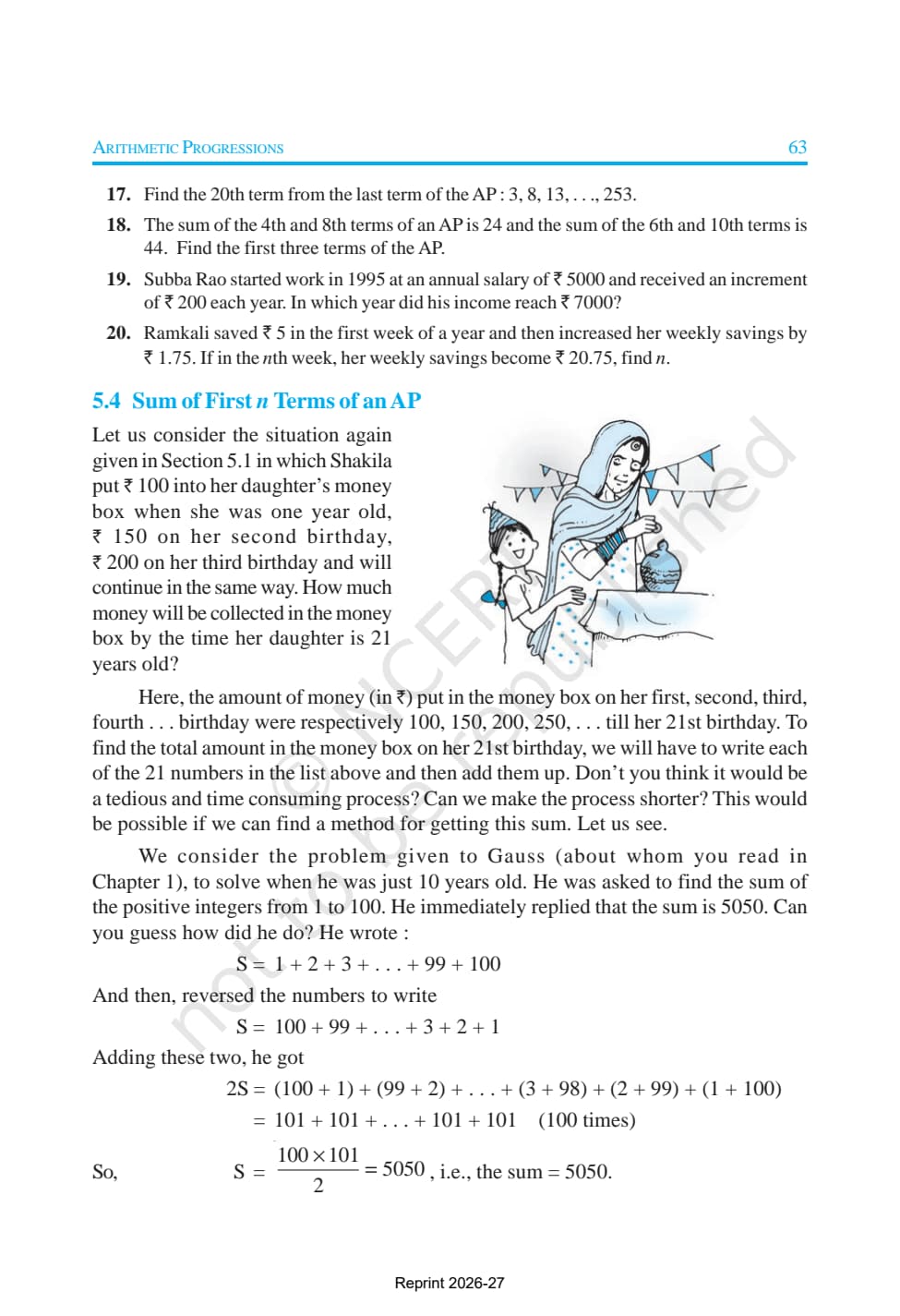
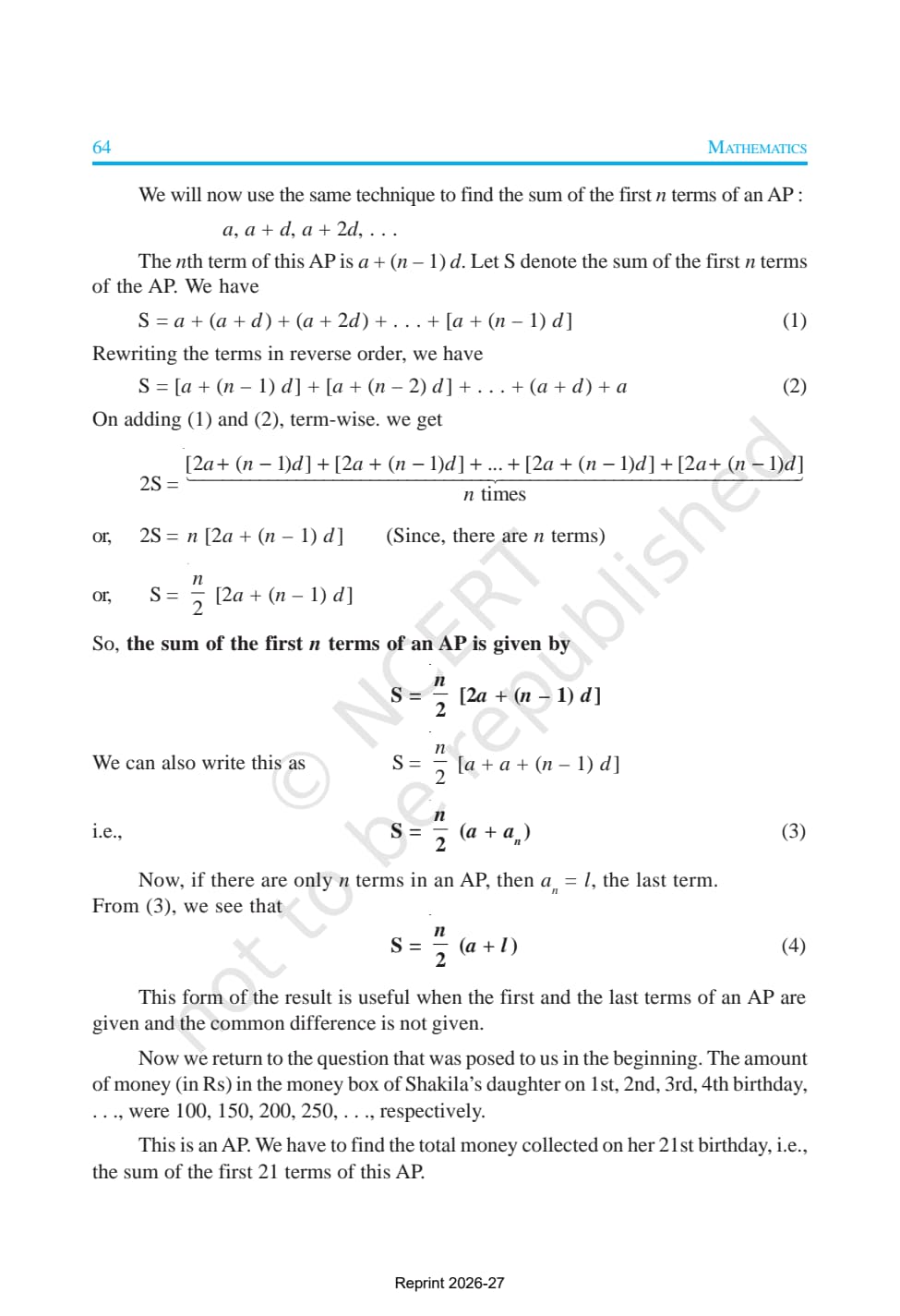
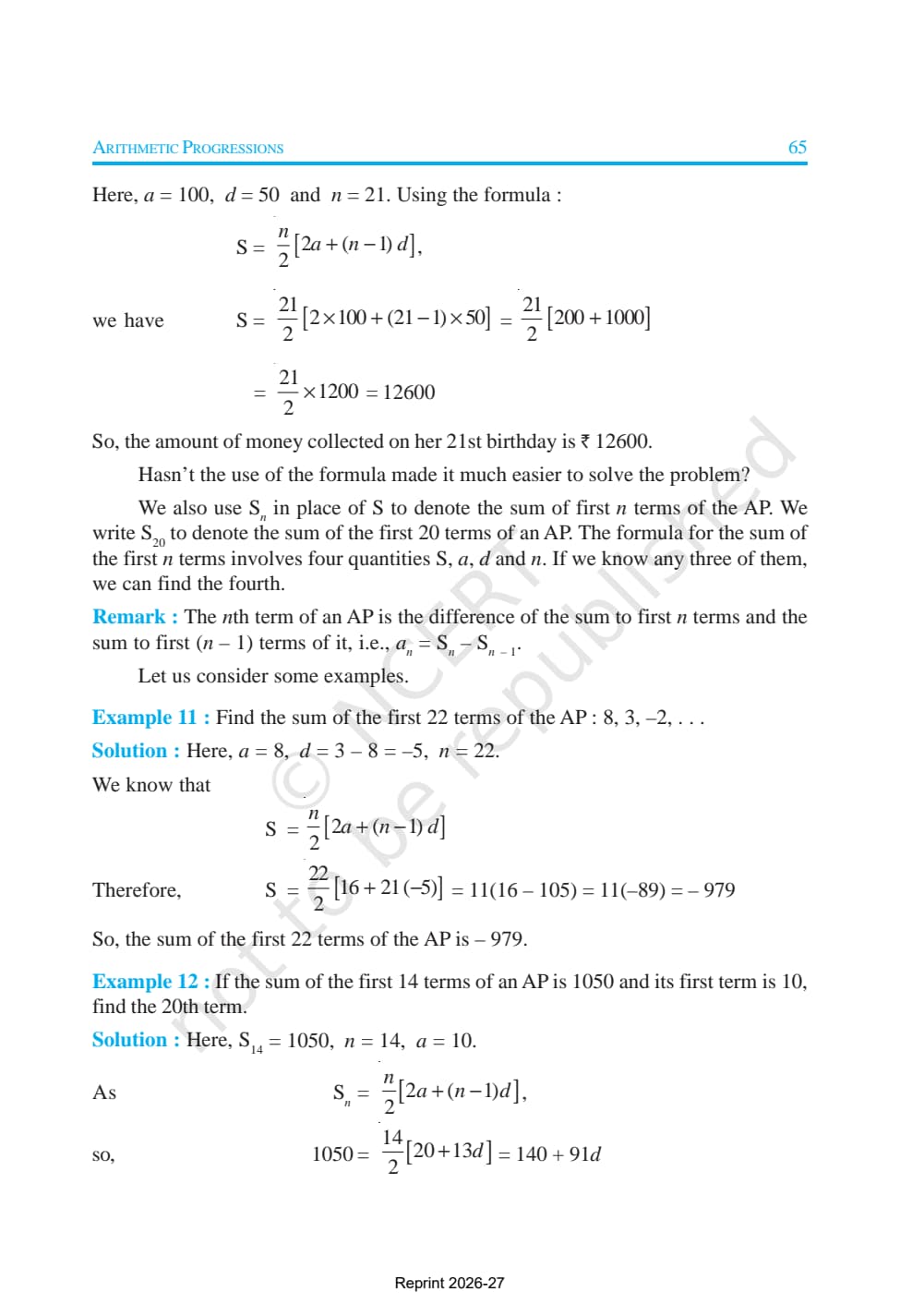
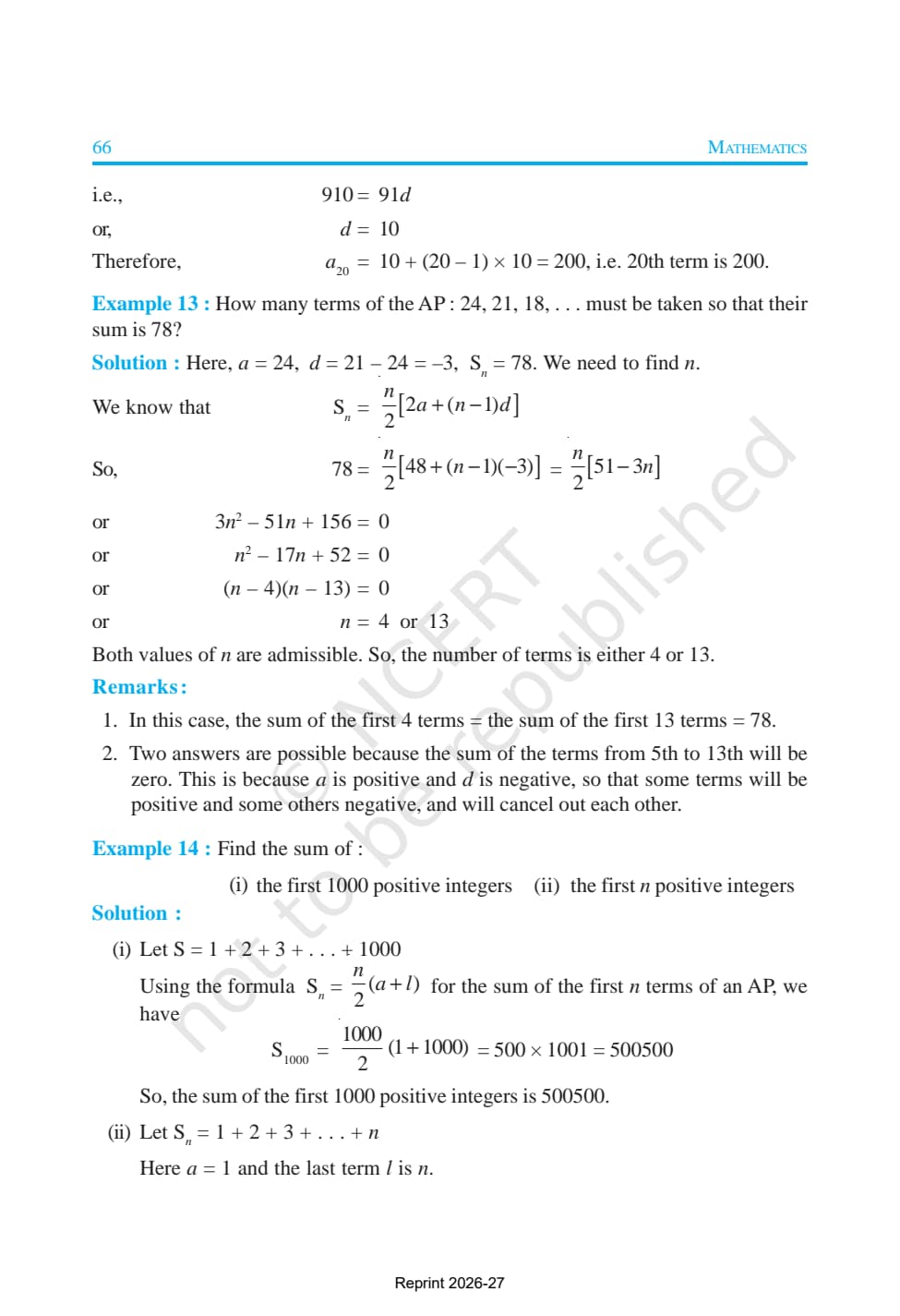
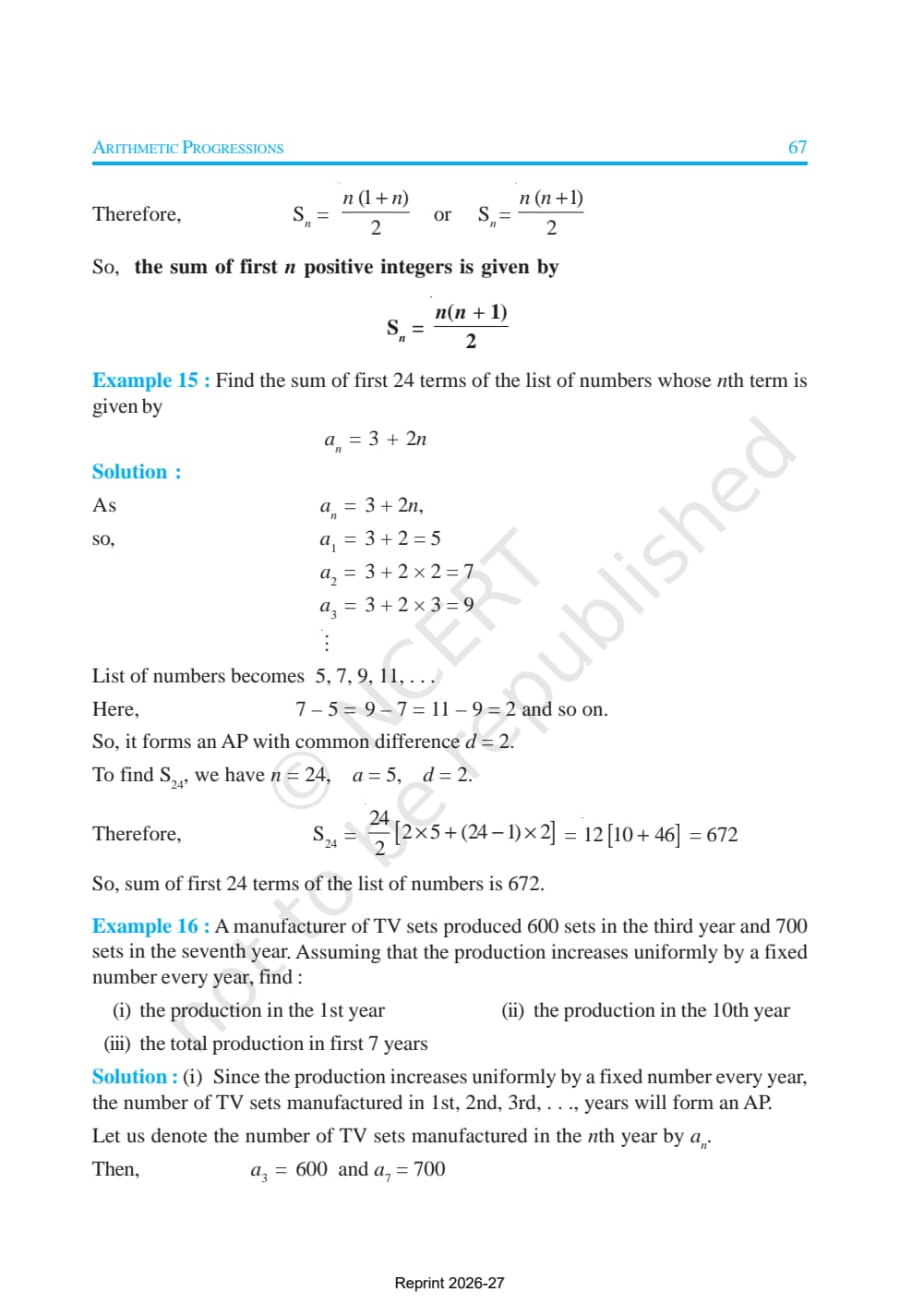
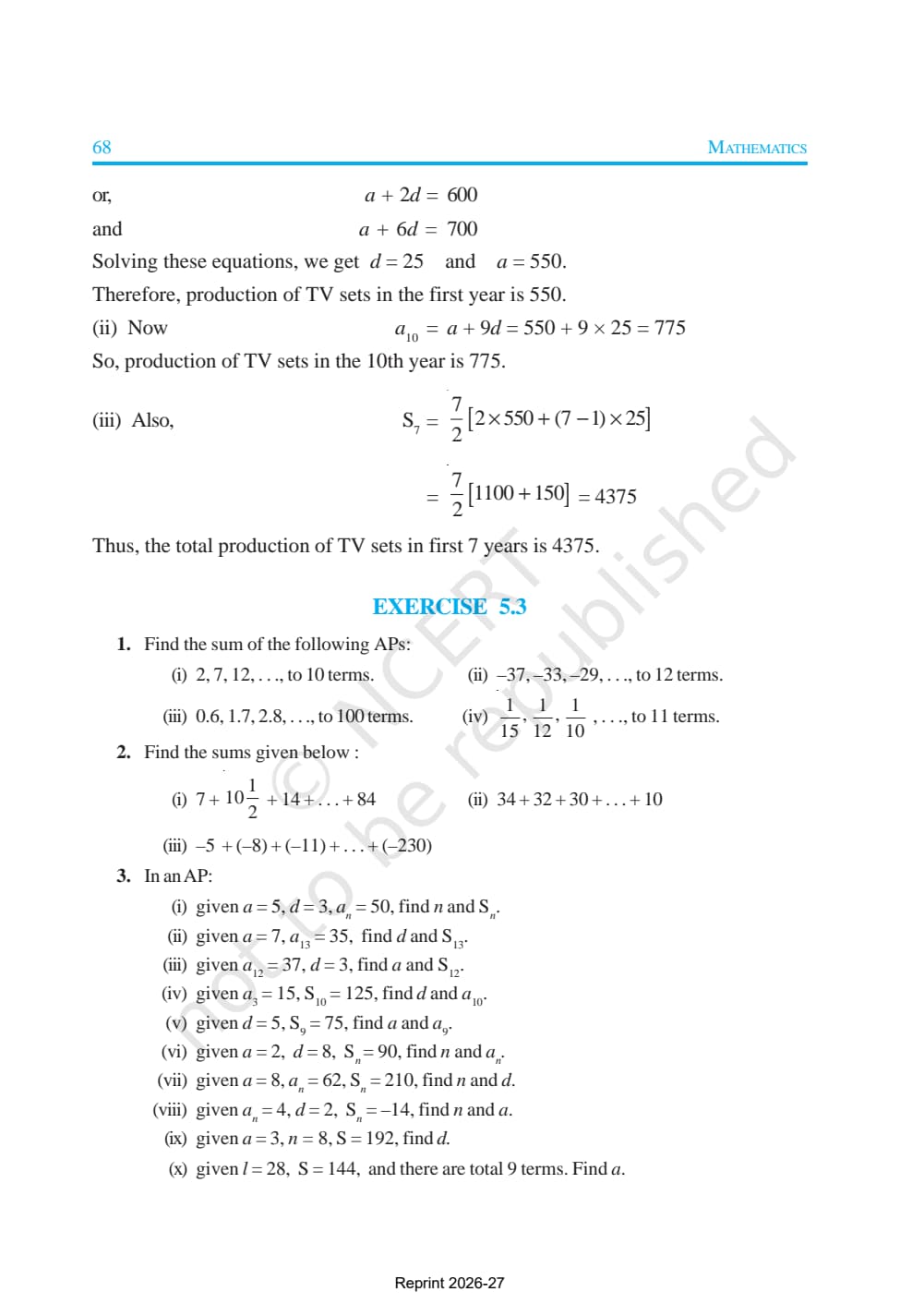
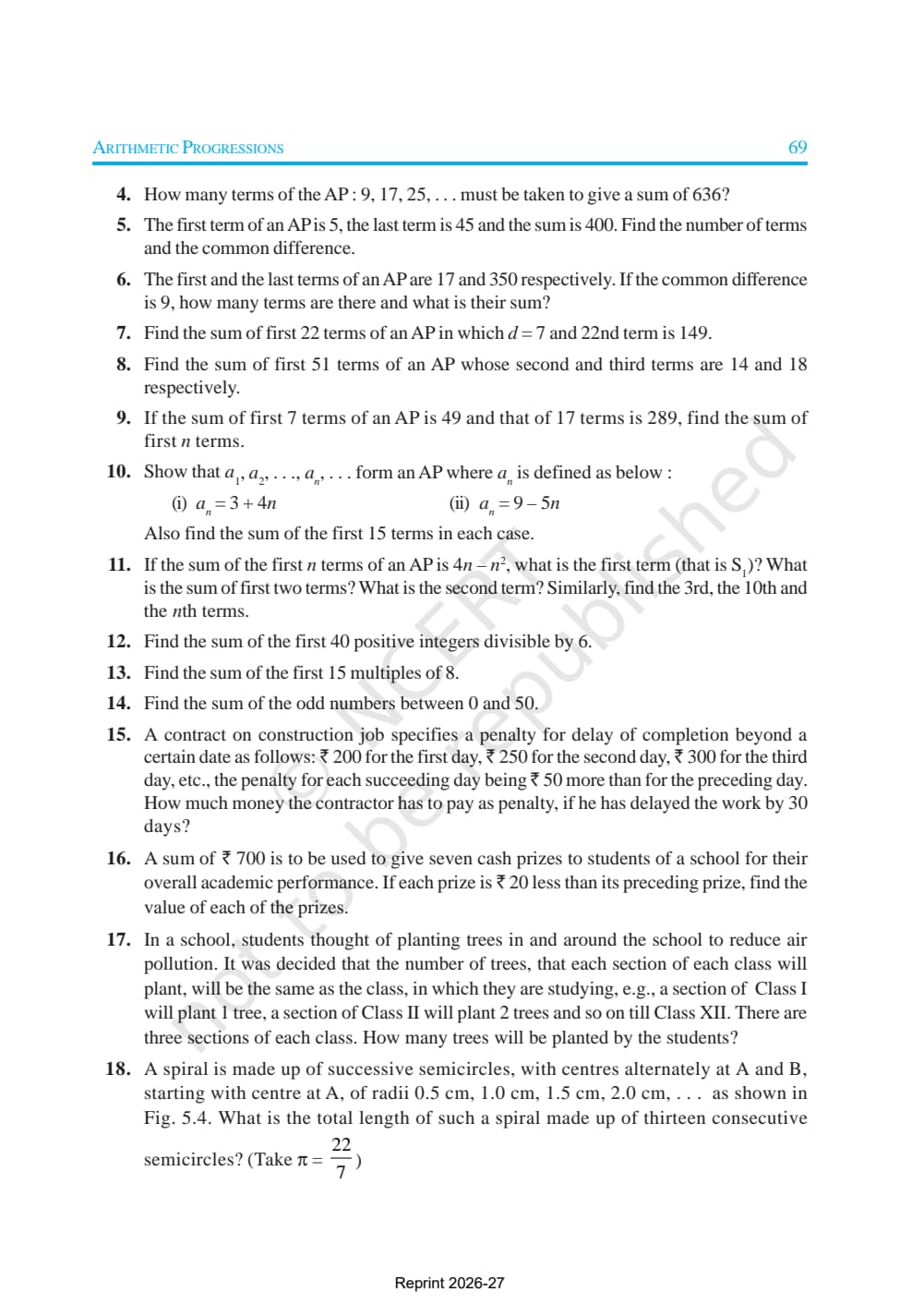
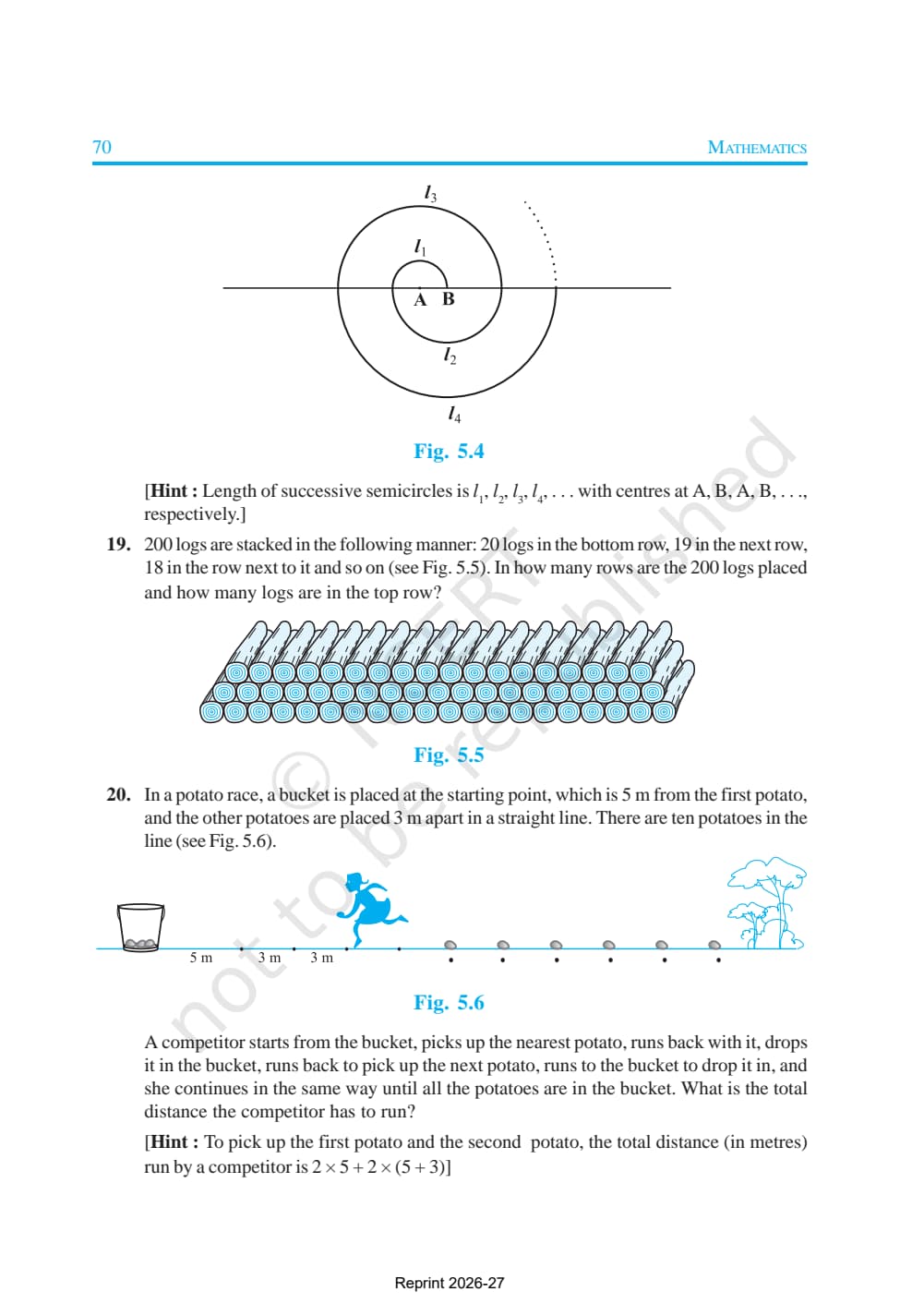
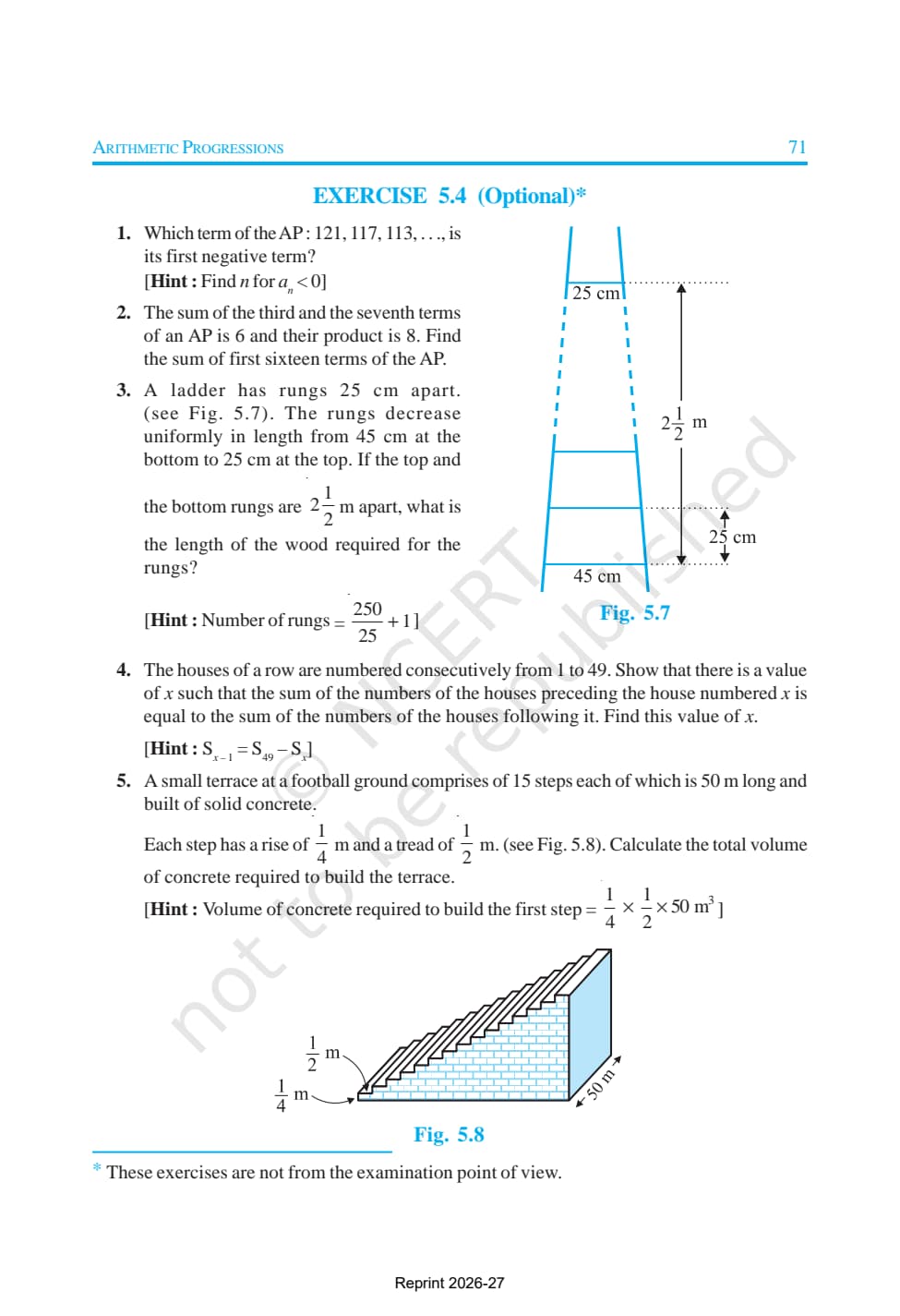
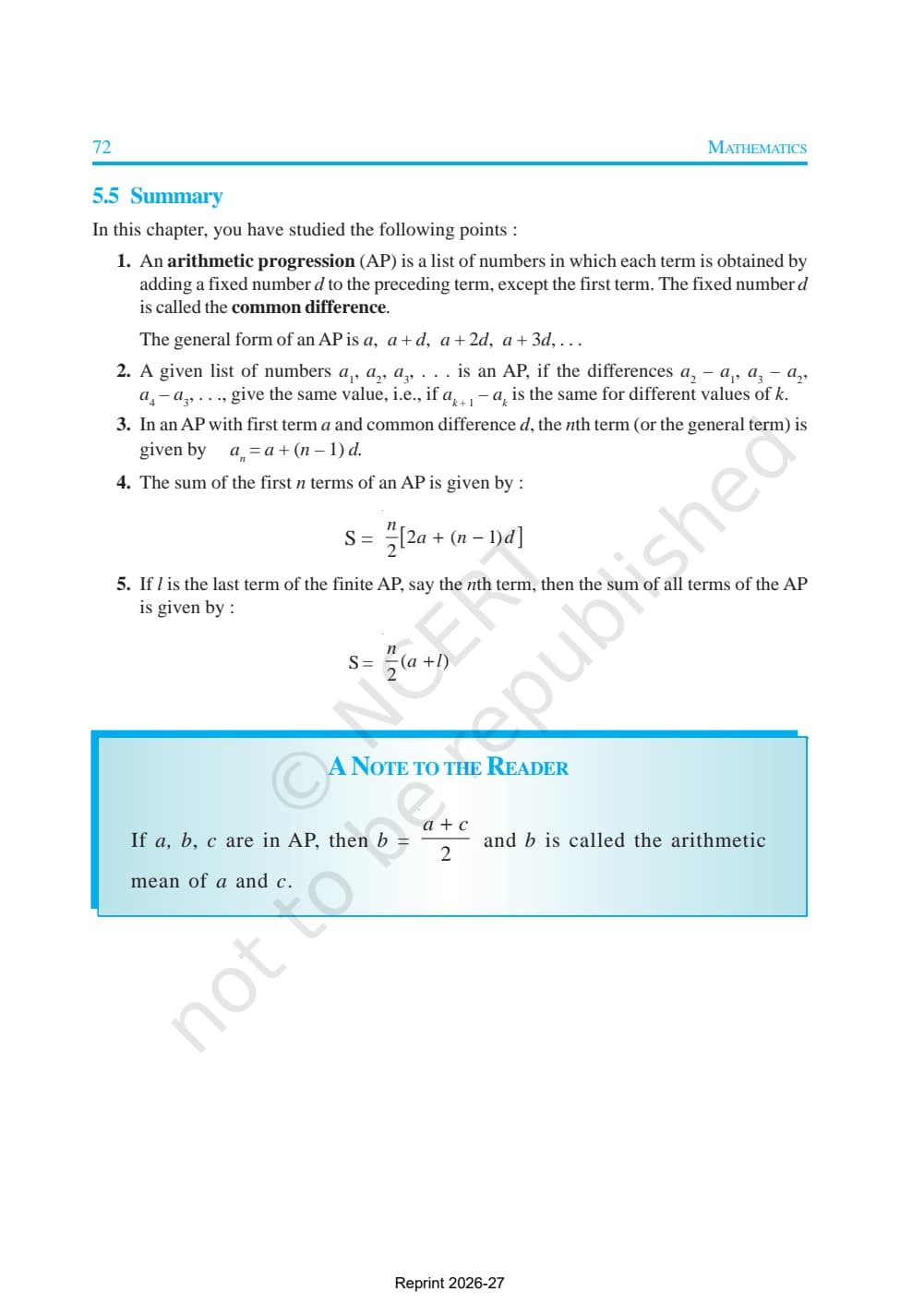
- Official NCERT textbook PDF of Chapter 5, with every definition, solved example, and exercise exactly as printed.
- Covers the general term formula an = a + (n−1)d and the sum formula Sn = n/2 [2a + (n−1)d].
- Aligned with the 2026-27 CBSE Class 10 Maths syllabus, useful for board revision and as the base text for solutions and notes.
This page hosts the official NCERT textbook chapter, mapped to the 2026-27 CBSE syllabus and checked page by page against the printed chapter.
Watch Arithmetic Progressions Class 10 Maths Explained
Source: Magnet Brains on YouTube
What the NCERT Book Covers
The PDF above is the complete official NCERT chapter, as printed in the 2026-27 textbook. Chapter 5 introduces the arithmetic progression (AP), a sequence where each term differs from the last by a fixed amount, the common difference. Read Sections 5.1 to 5.4 before the exercises.
- Introduction: real-life examples of APs, showing why a constant difference matters.
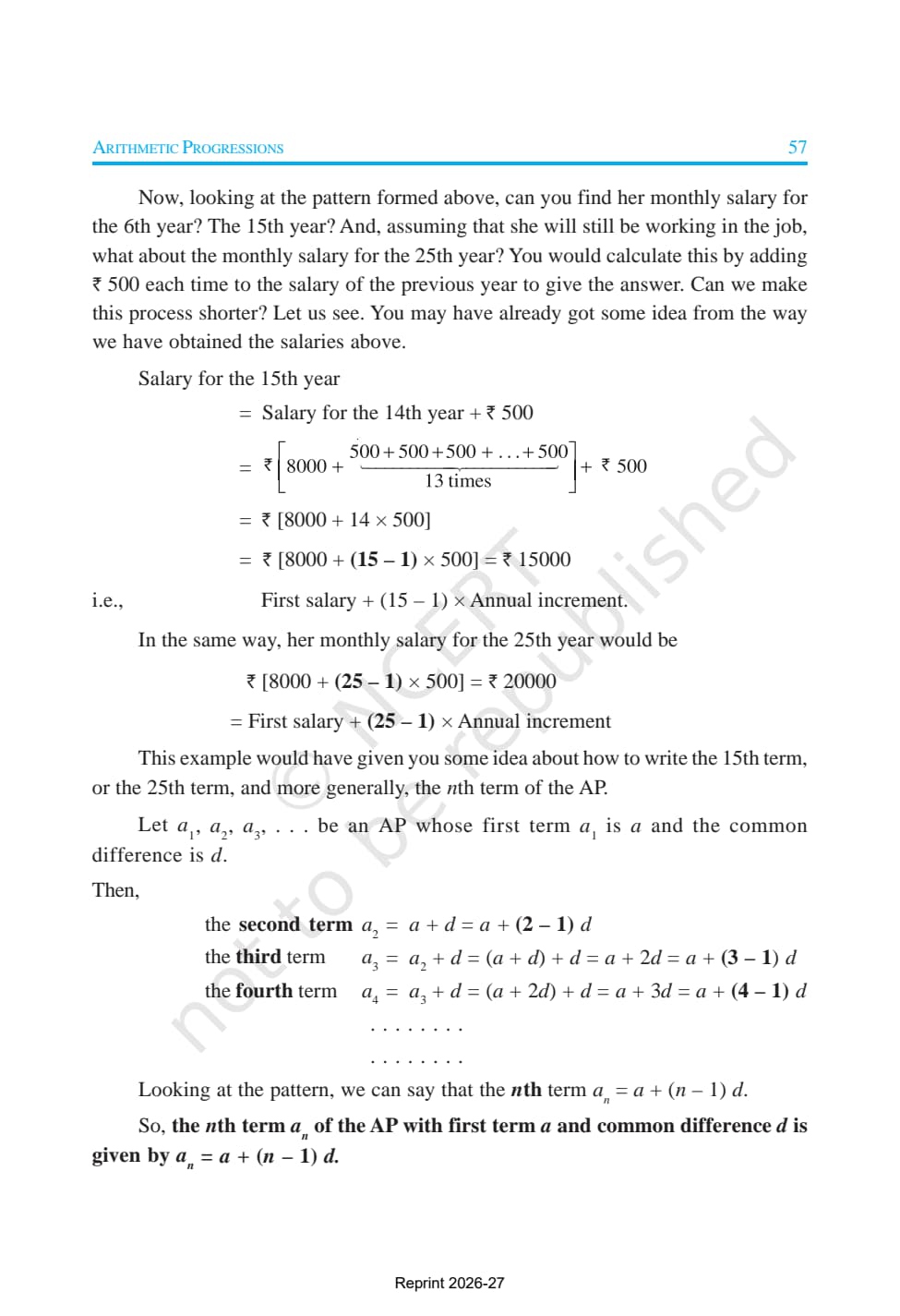
- nth term formula: find any term using an = a + (n−1)d.
- Sum formula: add the first n terms using Sn = n/2 [2a + (n−1)d].
- Four exercises: 5.1 to 5.4, covering identification, the nth term, sums, and word problems.
Introduction to Arithmetic Progressions
Section 5.1 opens with real-life situations that share one pattern. A taxi charges Rs 8 for the first kilometre and Rs 5 for each extra one, giving 8, 13, 18, 23, ... In each, the gap between consecutive terms is constant.
Section 5.2 gives the formal definition. A sequence a1, a2, a3, ... is an arithmetic progression if the difference ak+1 − ak is the same for every positive integer k. That constant is the common difference d.
- If d is positive, the AP is increasing (1, 4, 7, 10, ..., d = 3).
- If d is negative, the AP is decreasing (20, 17, 14, 11, ..., d = −3).
- If d equals zero, all terms are equal, a constant sequence (3, 3, 3, ...).
nth Term: General Term Formula
Section 5.3, nth Term of an AP, is the most tested part of the chapter. The general term formula finds any term without writing the whole sequence:
Each step adds one more d, so the nth term adds (n−1) copies of d to a. Here an is also the last term l when it ends a finite AP.
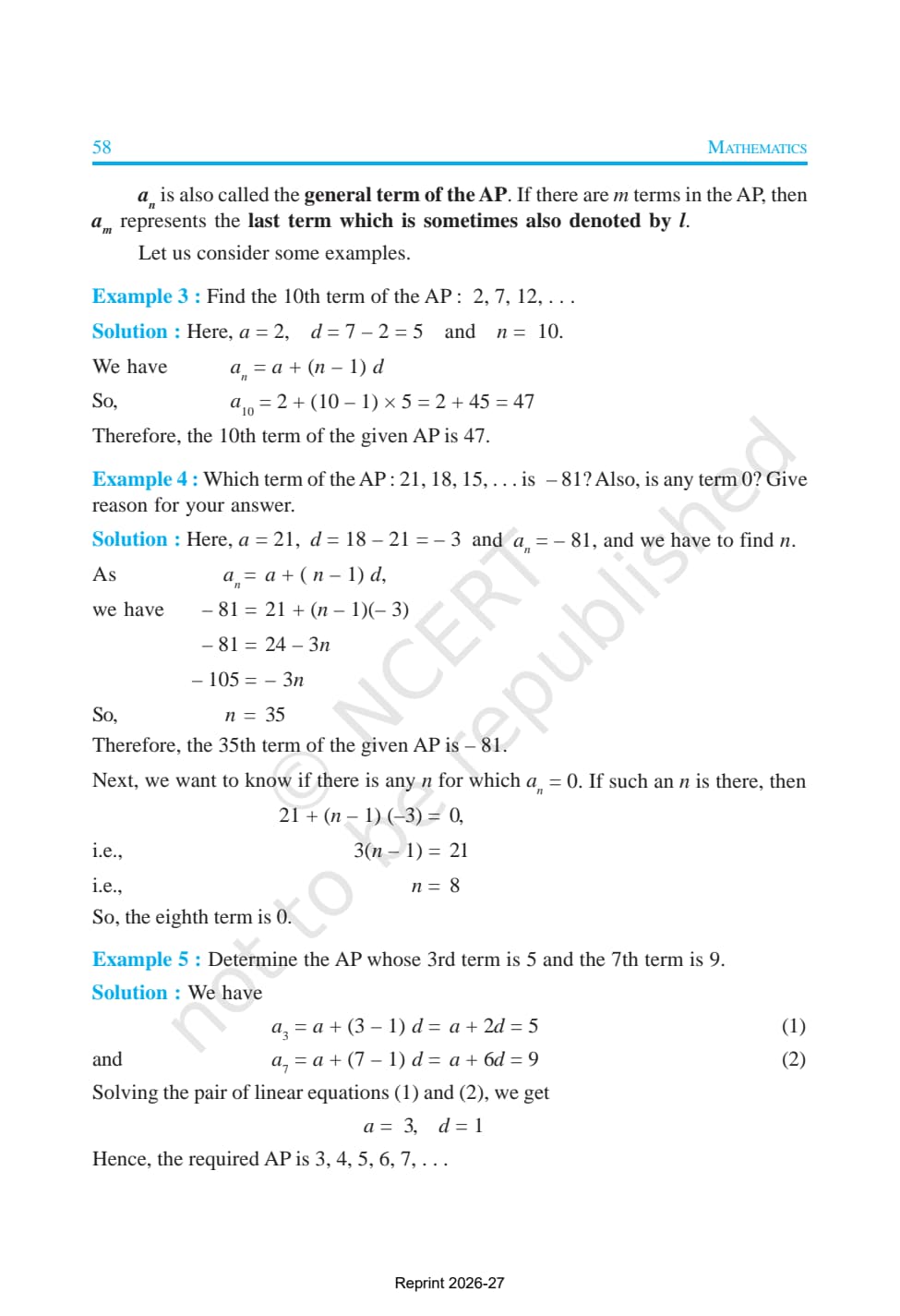
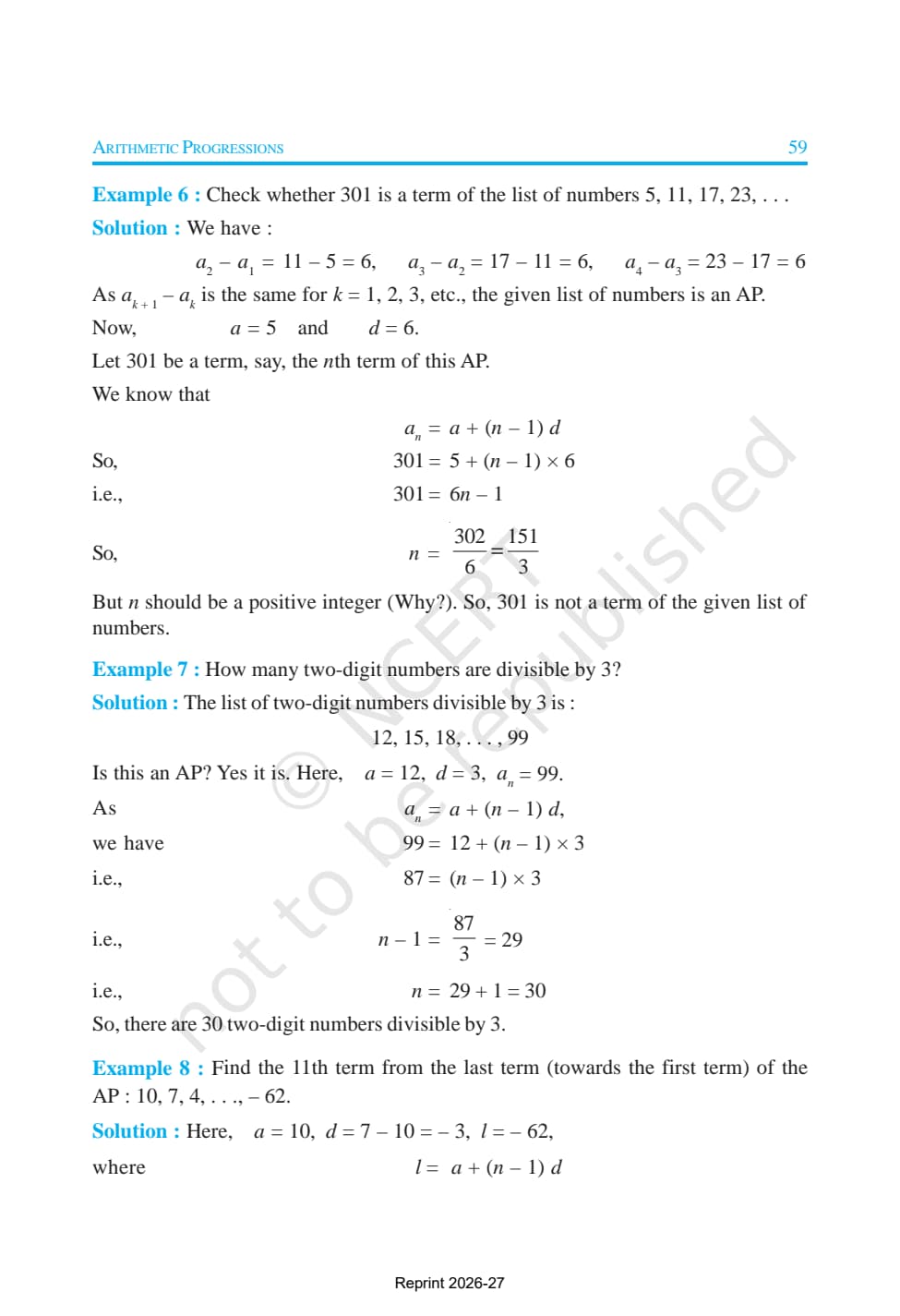
For 7, 13, 19, 25, ..., the 10th term is 7 + 9 × 6 = 61. To find which term of 3, 8, 13, 18, ... equals 78, solve 3 + (n−1) × 5 = 78 to get n = 16.
- To find a specific term: substitute a, n, and d into an = a + (n−1)d.
- To find which term equals a value: set an equal to it and solve for n.
- To find d from two known terms: use am − ak = (m−k)d.
Sum of First n Terms
Section 5.4, Sum of First n Terms of an AP, gives two useful forms. The book derives the first by writing Sn forward and in reverse, adding term by term, and dividing by 2:
When the last term l is known, this simplifies to:
The book also flags a key link: an = Sn − Sn−1. This lets you find a single term from the sum formula, a common board question.
A favourite board question gives Sn as an expression in n and asks for a term or the common difference. If Sn = 3n2 + 5n, then a1 = S1 = 8 and a2 = S2 − S1 = 14, so d = 6.
Solved Examples and Exercises
Chapter 5 is one of the most exercise-heavy chapters. Its four exercises and solved examples cover every board question type, in the exact layout examiners expect.
| Section | What it tests | Sample question type |
|---|---|---|
| Exercise 5.1 | Identifying APs; writing the first four terms; checking if a sequence is an AP | In which situations does the list of numbers form an AP? For example, the air in a cylinder when a pump removes 1/4 each time. |
| Exercise 5.2 | Finding the nth term; which term equals a value; forming equations with the general term | Find the 31st term of an AP whose 11th term is 38 and 16th term is 73. |
| Exercise 5.3 | Finding sums; using an = Sn − Sn−1; word problems on sums | How many terms of the AP 9, 17, 25, ... must be taken to give a sum of 636? |
| Exercise 5.4 | Mixed problems combining the nth term and sum formulas | The sum of the 3rd and 7th terms of an AP is 6 and their product is 8. Find the sum of the first 16 terms. |
In every word problem, the first step is to write the AP out and identify a and d. Build this habit before you attempt Exercise 5.3 and 5.4.
How to Use the PDF for Revision
The official textbook is the safest source, since every definition, example, and exercise is exam-correct. Use it in two passes, paired with the solutions and notes linked below.
- First pass: read Sections 5.1 to 5.4 in order. Learn how Section 5.4 derives both sum formulas by writing Sn forward and backward. That derivation is a two-mark board question.
- Second pass: work Exercise 5.1 to 5.4 by hand without checking answers first. Exercise 5.3 is the heaviest; Exercise 5.4 mixes both formulas. Always verify by substituting back.
- Board angle: AP gives two to three questions worth 4 to 8 marks. Common types are the nth term, the sum of n terms, and a pair of equations from a word problem.
Student Feedback
71% of Class 10 students said the hardest part was choosing between the general term and the sum formula in a word problem. 4 out of 5 said reading the textbook chapter first made both derivations easier to recall in the exam.
Source: 2026-27 Class 10 Maths student poll, 8,700 students from CBSE schools in 14 states, before the 2026 boards.
Other Resources for Chapter 5
Pair this chapter with the matching NCERT Solutions, notes, formula sheet, and handwritten notes, all linked below.
| Resource | What it covers | Open |
|---|---|---|
| NCERT Book PDF | Official Class 10 Maths Chapter 5 textbook, with every definition, example, and exercise. | Class 10 Maths Chapter 5 NCERT Book PDF |
| NCERT Solutions | Step-by-step answers to all exercise questions of the chapter. | Class 10 Maths Chapter 5 NCERT Solutions |
| Notes | Concept-first revision notes on AP definition, general term, and sum formula. | Class 10 Maths Chapter 5 Notes |
| Formula Sheet | Quick reference of the nth term formula, sum formula, and key AP relations for fast revision. | Class 10 Maths Chapter 5 Formula Sheet |
| Handwritten Notes | Scanned-style handwritten pages for last-minute board revision. | Class 10 Maths Chapter 5 Handwritten Notes |
NCERT Book for Class 10 Maths: All Chapters
Related Links: Open the official NCERT Book PDF for any other Class 10 Maths chapter below.
| Chapter | NCERT Book PDF link |
|---|---|
| Chapter 1 | Real Numbers NCERT Book PDF |
| Chapter 2 | Polynomials NCERT Book PDF |
| Chapter 3 | Pair of Linear Equations in Two Variables NCERT Book PDF |
| Chapter 4 | Quadratic Equations NCERT Book PDF |
| Chapter 5 | Arithmetic Progressions NCERT Book PDF |
| Chapter 6 | Triangles NCERT Book PDF |
| Chapter 7 | Coordinate Geometry NCERT Book PDF |
| Chapter 8 | Introduction to Trigonometry NCERT Book PDF |
| Chapter 9 | Some Applications of Trigonometry NCERT Book PDF |
| Chapter 10 | Circles NCERT Book PDF |
| Chapter 11 | Areas Related to Circles NCERT Book PDF |
| Chapter 12 | Surface Areas and Volumes NCERT Book PDF |
| Chapter 13 | Statistics NCERT Book PDF |
| Chapter 14 | Probability NCERT Book PDF |
NCERT Book Class 10 Maths Chapter 5 Arithmetic Progressions FAQs
Ques. What does Chapter 5 Arithmetic Progressions cover in the Class 10 Maths NCERT Book?
Ans. Chapter 5 of the Class 10 Maths NCERT Book teaches you to work with arithmetic progressions. It begins with the definition of an AP as a sequence where every consecutive pair of terms has the same difference, called the common difference d. It then derives the general term formula an = a + (n−1)d for the nth term, and the sum formula Sn = n/2 [2a + (n−1)d] for the sum of the first n terms. The chapter has four exercises, Exercise 5.1 through Exercise 5.4, covering identification of APs, finding specific terms, calculating sums, and solving word problems. It is aligned with the 2026-27 CBSE syllabus.
Ques. What is the formula for the nth term of an AP in Class 10 Maths?
Ans. The nth term of an arithmetic progression is given by the formula an = a + (n−1)d, where a is the first term, d is the common difference, and n is the position of the term you want to find. For example, in the AP 7, 13, 19, 25, ..., the first term a is 7 and the common difference d is 6. The 10th term is therefore 7 + (10−1) times 6, which equals 7 + 54 = 61. The formula also lets you find which term of an AP equals a given value by setting an equal to that value and solving for n. If n does not turn out to be a positive integer, the value is not a term of that AP.
Ques. What is the sum formula for an AP and how is it derived?
Ans. The sum of the first n terms of an AP is given by Sn = n/2 [2a + (n−1)d], where a is the first term and d is the common difference. When the last term l is known, this simplifies to Sn = n/2 (a + l). The NCERT book derives the formula by writing the sum Sn in two rows: one in the natural forward order and one in the reverse order. Adding the two rows term by term gives each pair summing to (2a + (n−1)d), and since there are n such pairs, 2Sn = n[2a + (n−1)d]. Dividing both sides by 2 gives the final formula. This derivation is itself a two-mark board question, so students should practice reproducing it step by step.
Ques. How many exercises are there in Class 10 Maths Chapter 5?
Ans. The Arithmetic Progressions chapter has four exercises. Exercise 5.1 covers identifying whether a given sequence or situation forms an AP and writing the first four terms of an AP when a and d are given. Exercise 5.2 covers finding the nth term, working out which term equals a given value, and forming equations using the general term. Exercise 5.3 is the longest exercise and covers the sum formula across a wide range of question types, including word problems. Exercise 5.4 combines the nth term and sum formulas in harder mixed problems. All four exercises are worked out in detail in the linked NCERT Solutions.
Ques. What is the common difference in an AP and how do you find it?
Ans. The common difference d in an arithmetic progression is the fixed amount by which each term increases or decreases from the previous one. Formally, d = ak+1 − ak for any positive integer k. To find d from a given AP, simply subtract the first term from the second term. For example, in the AP 5, 9, 13, 17, ..., d = 9 − 5 = 4. You can verify by checking the other consecutive differences: 13 − 9 = 4 and 17 − 13 = 4. If the differences are not all equal, the sequence is not an AP. When d is positive the AP is increasing, when d is negative the AP is decreasing, and when d is zero all terms are equal.
Ques. Is the Class 10 Maths Chapter 5 NCERT Book PDF free to download for 2026-27?
Ans. Yes. The official NCERT Book PDF for Class 10 Maths Chapter 5 Arithmetic Progressions is free to read and download on this page for the 2026-27 session. It is the complete chapter as printed in the CBSE textbook, including the introduction with real-life AP examples, the general term formula with its derivation, the sum formula derivation, all solved examples, and Exercise 5.1, Exercise 5.2, Exercise 5.3, and Exercise 5.4. You can pair the book with the linked NCERT Solutions and revision notes for the same chapter so that you read the textbook and revise from one place.
Ques. What is the relation between the nth term and the sum of an AP?
Ans. The nth term of an AP can be found from the sum formula using the relation an = Sn − Sn−1. This means the nth term equals the sum of the first n terms minus the sum of the first (n−1) terms. This relation is very useful when a board question gives Sn as an expression in n and asks you to find the nth term or the common difference. For example, if Sn = 3n2 + 5n, then an = Sn − Sn−1 = [3n2 + 5n] − [3(n−1)2 + 5(n−1)], which simplifies to 6n + 2. For n = 1, a1 = 8, and for n = 2, a2 = 14, giving d = 6.



Comments