


The NCERT Book for Class 10 Maths Chapter 7 Coordinate Geometry is the official CBSE textbook chapter, free to read and download for the 2026-27 session. It joins algebra and geometry, using coordinates to describe figures on a plane.
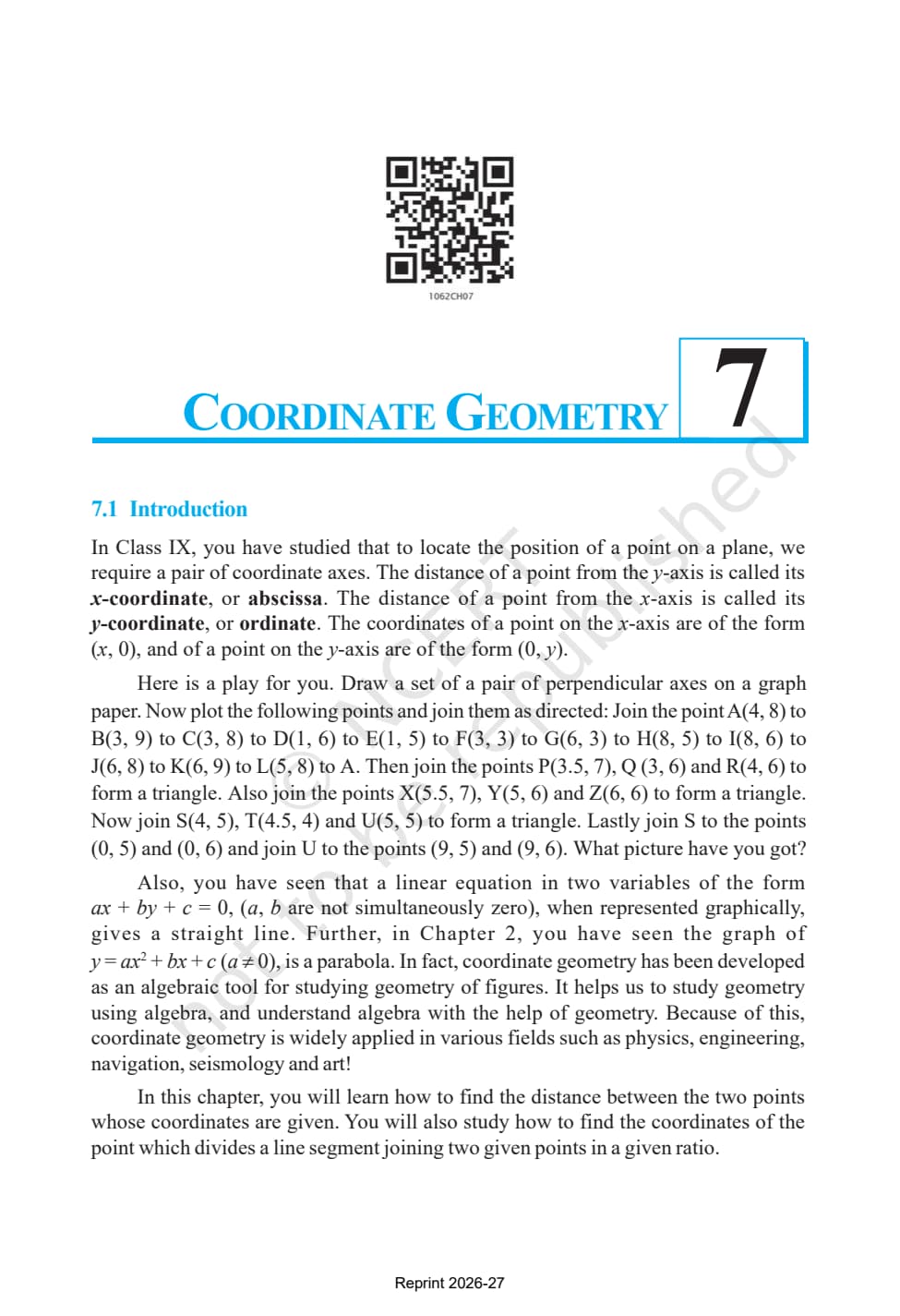
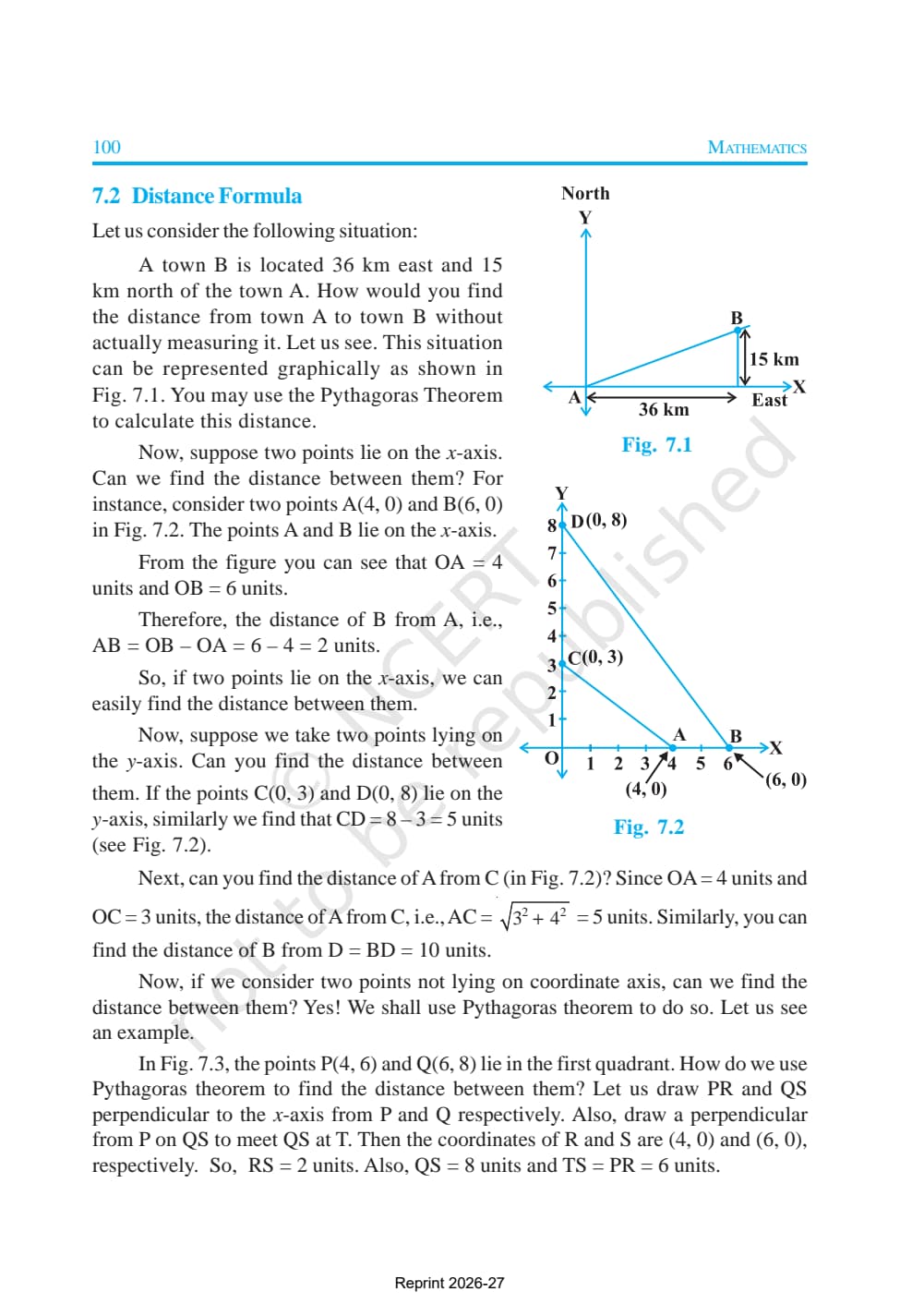
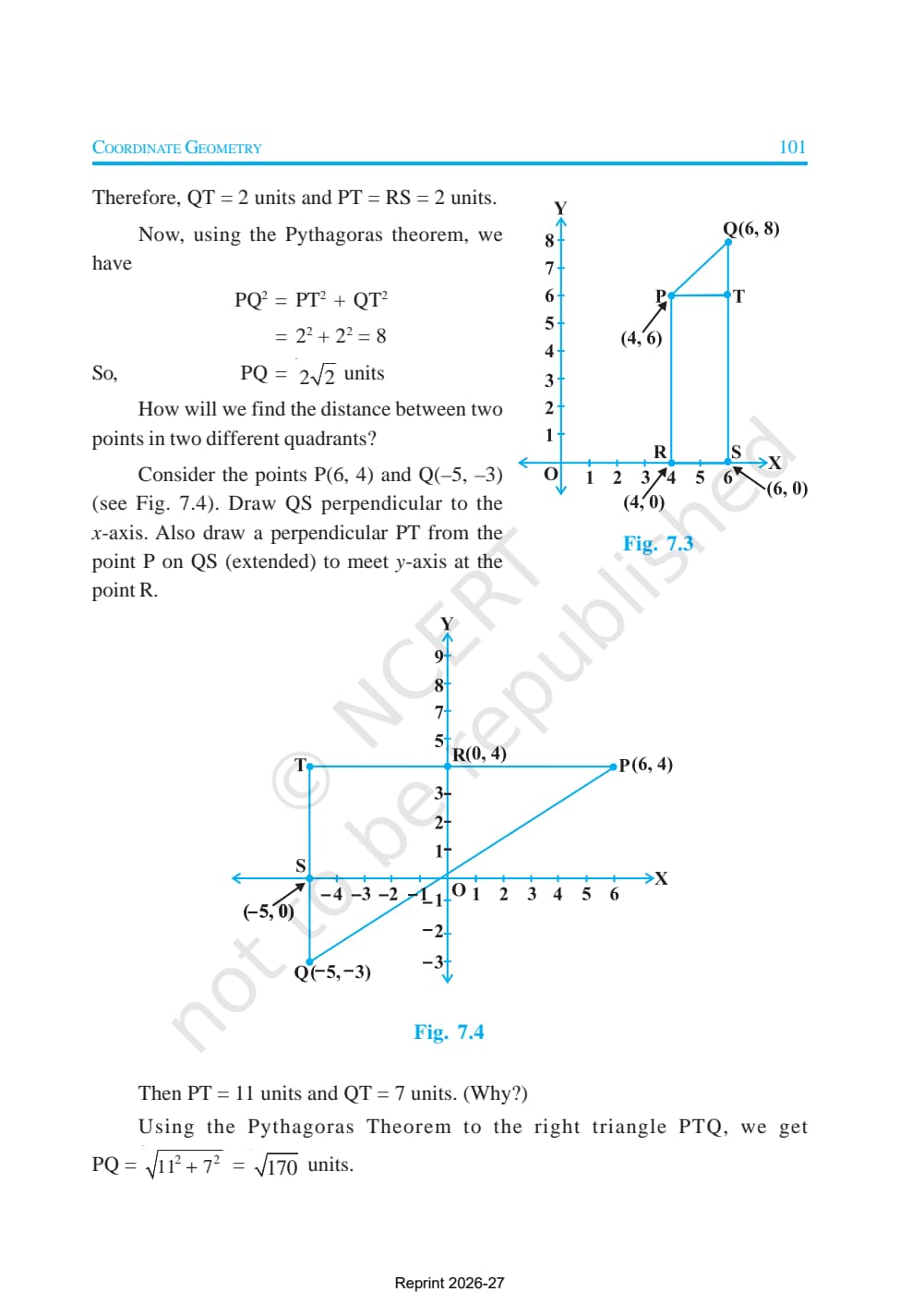
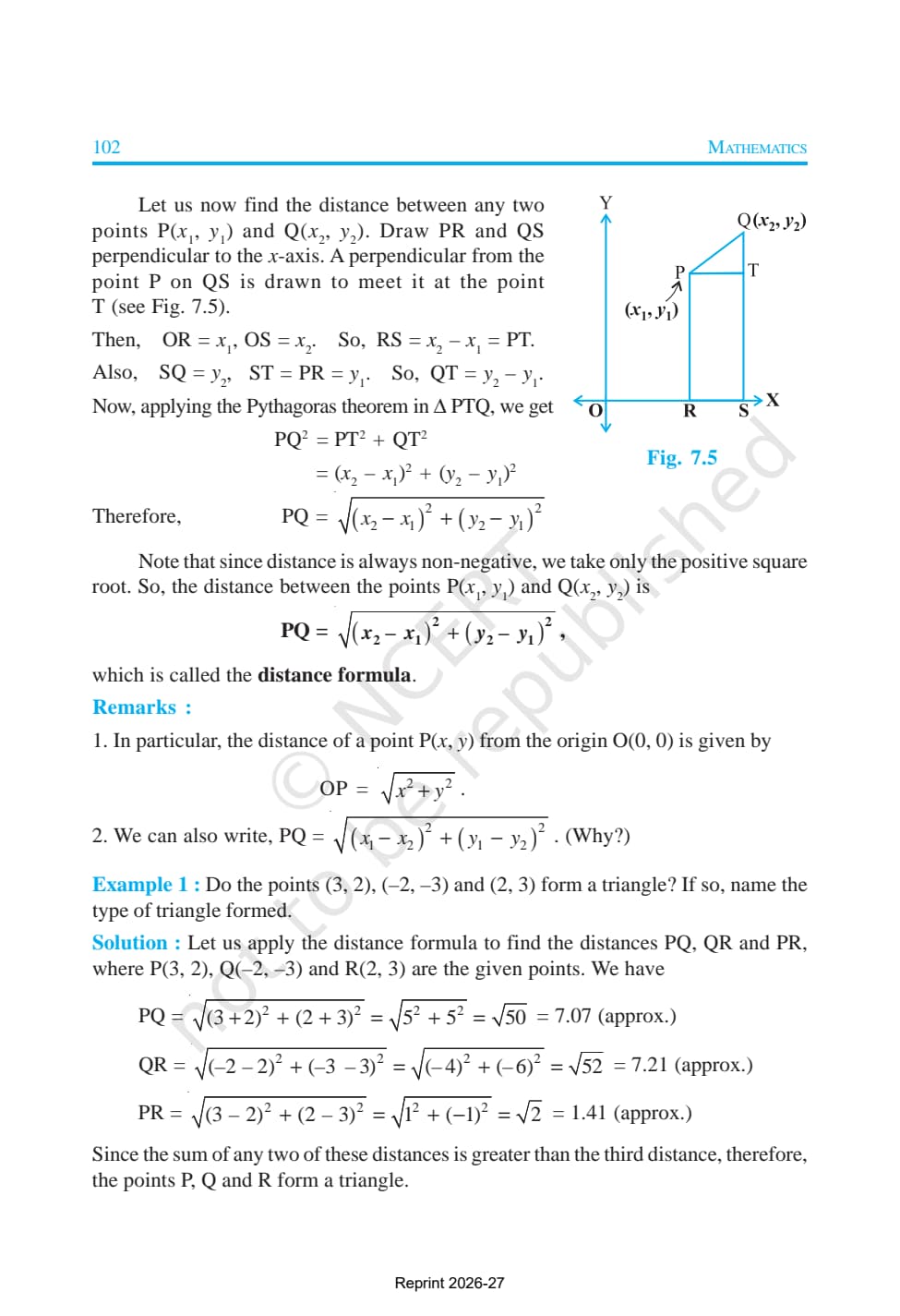
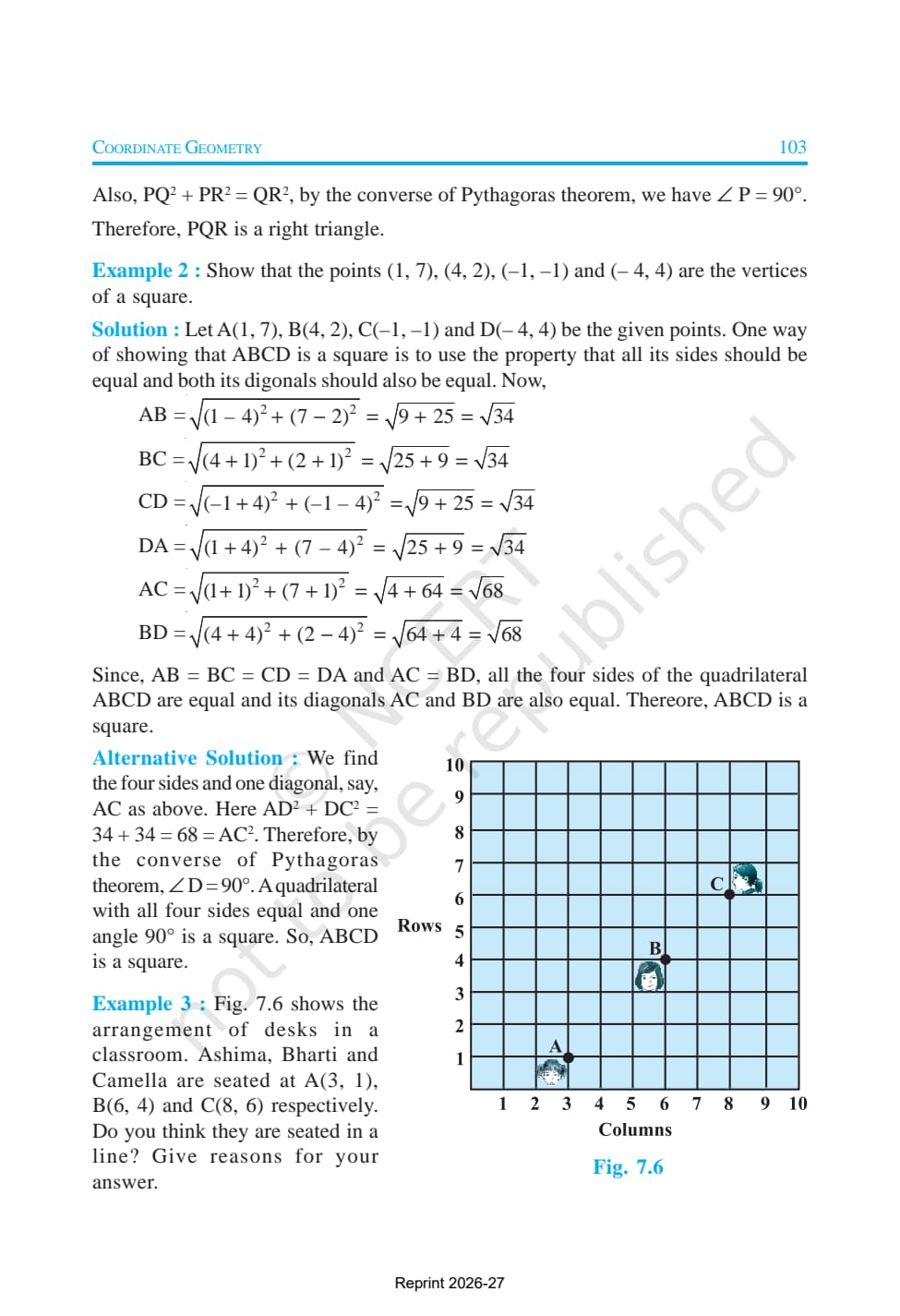
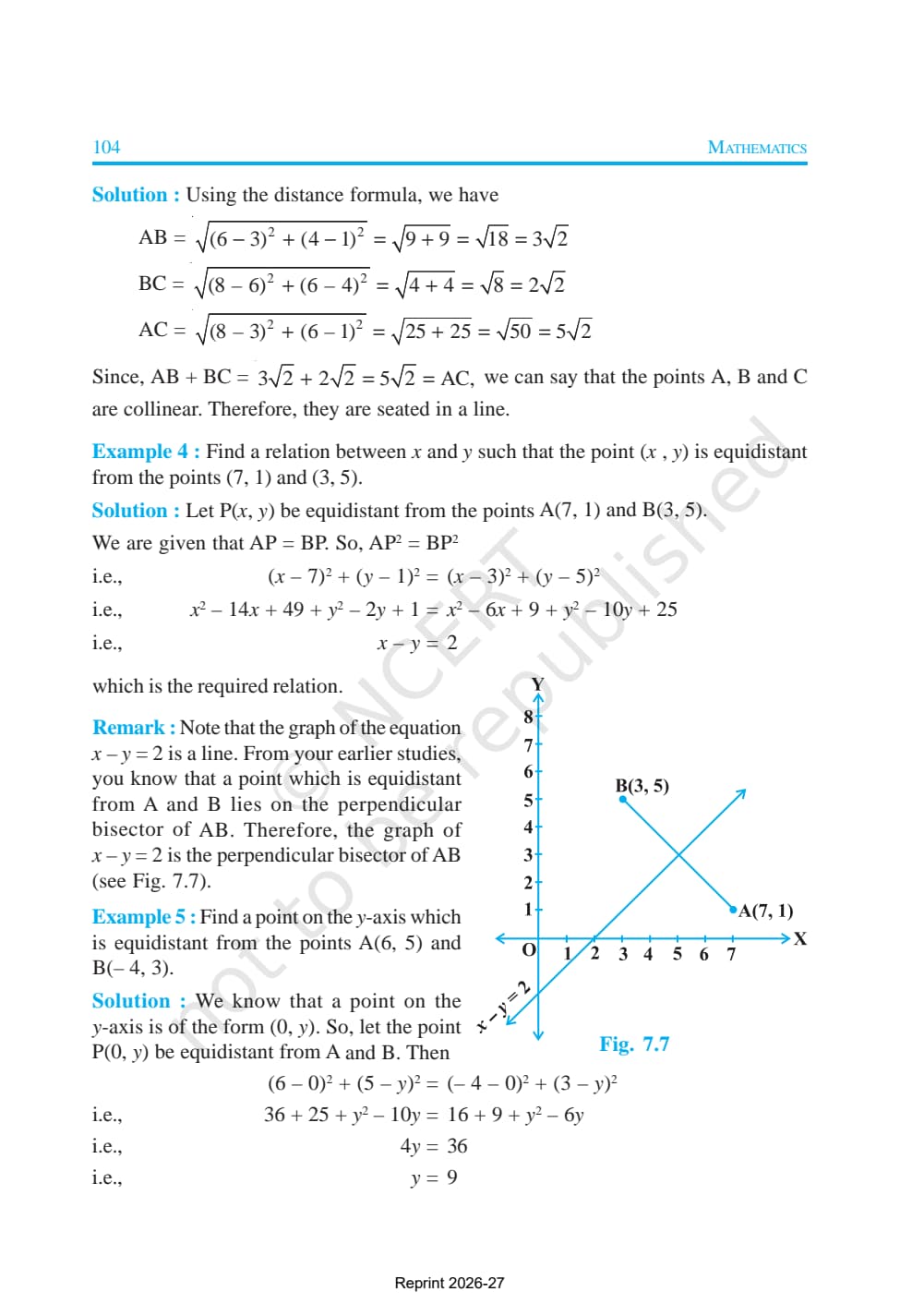
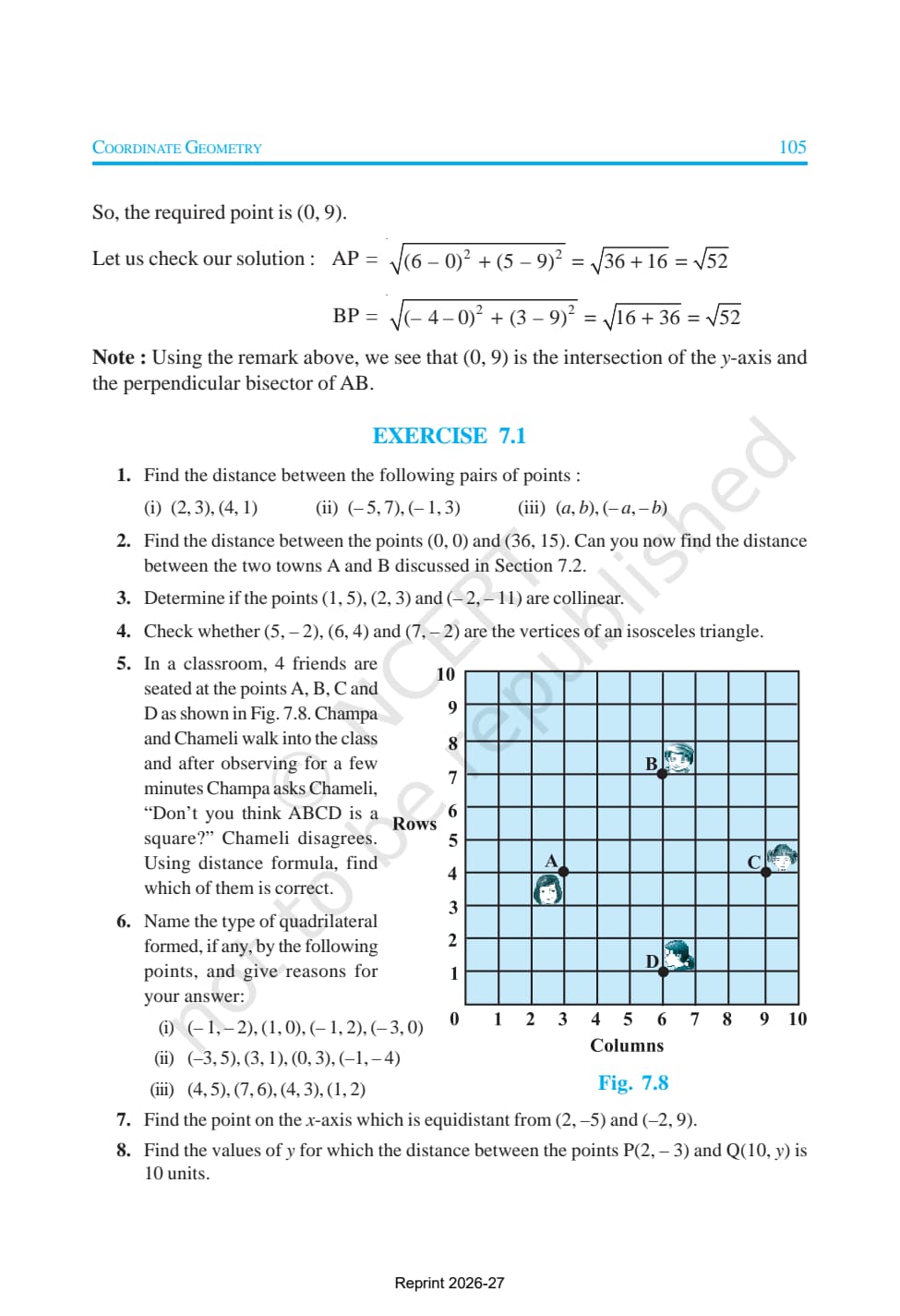
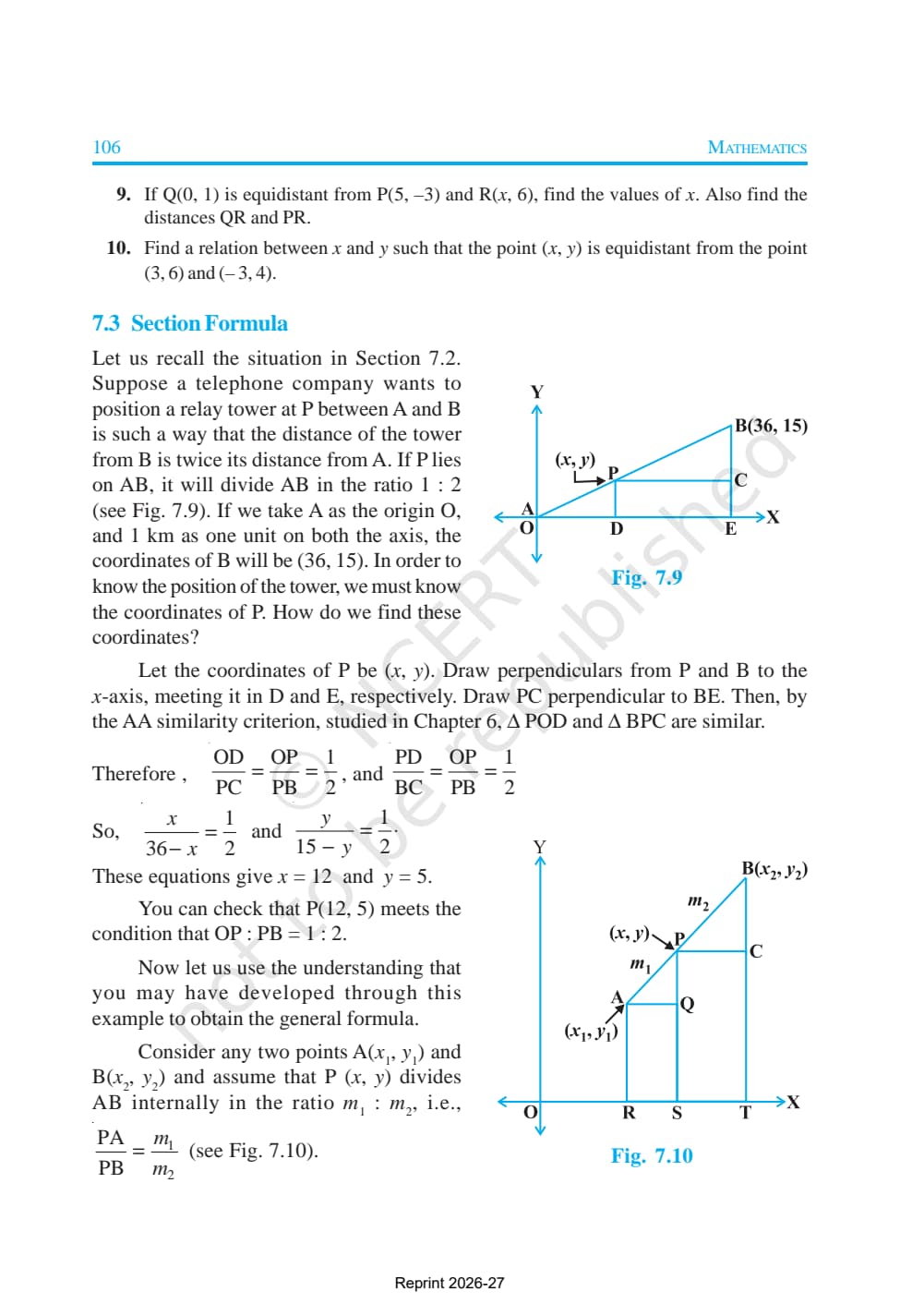
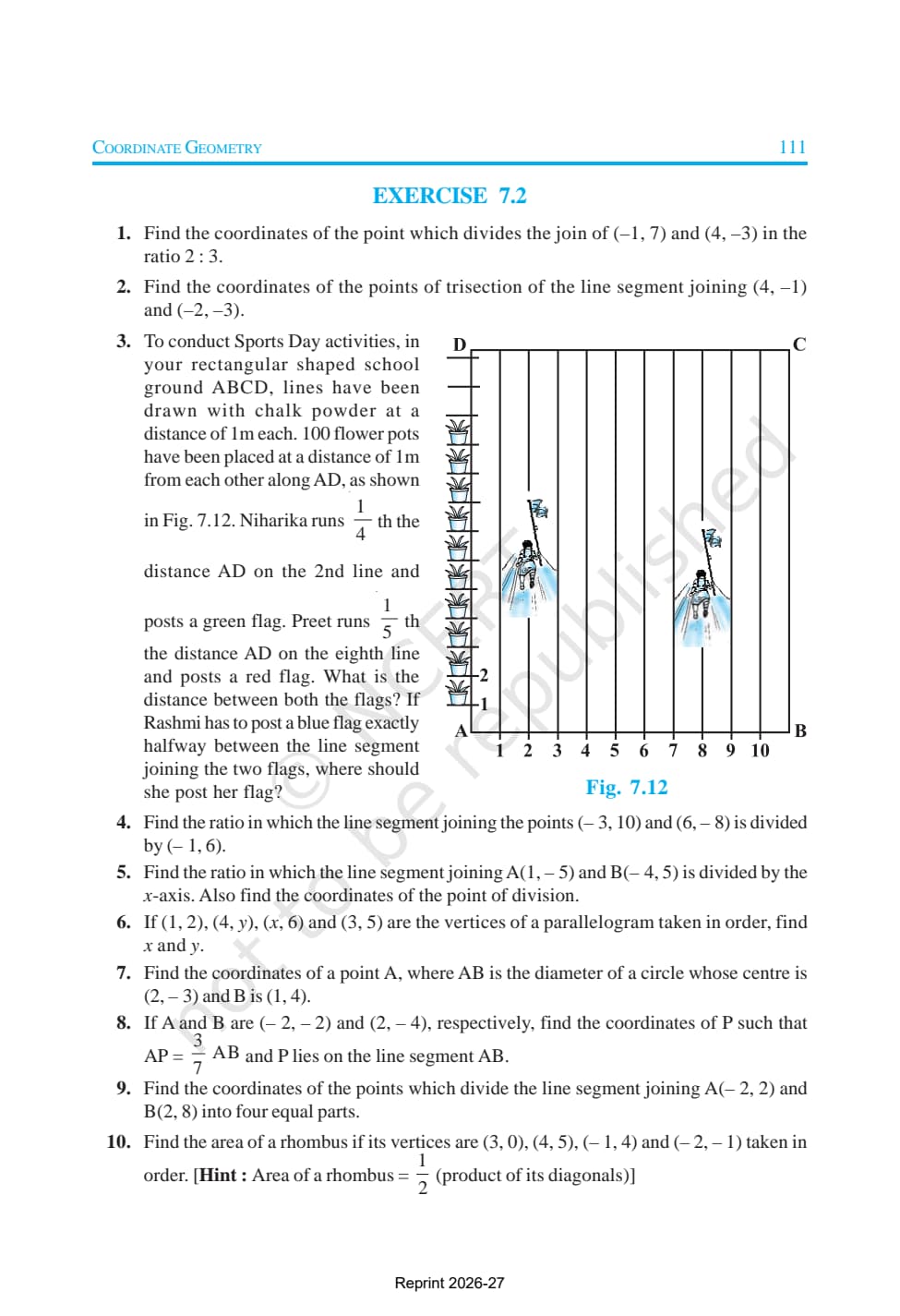
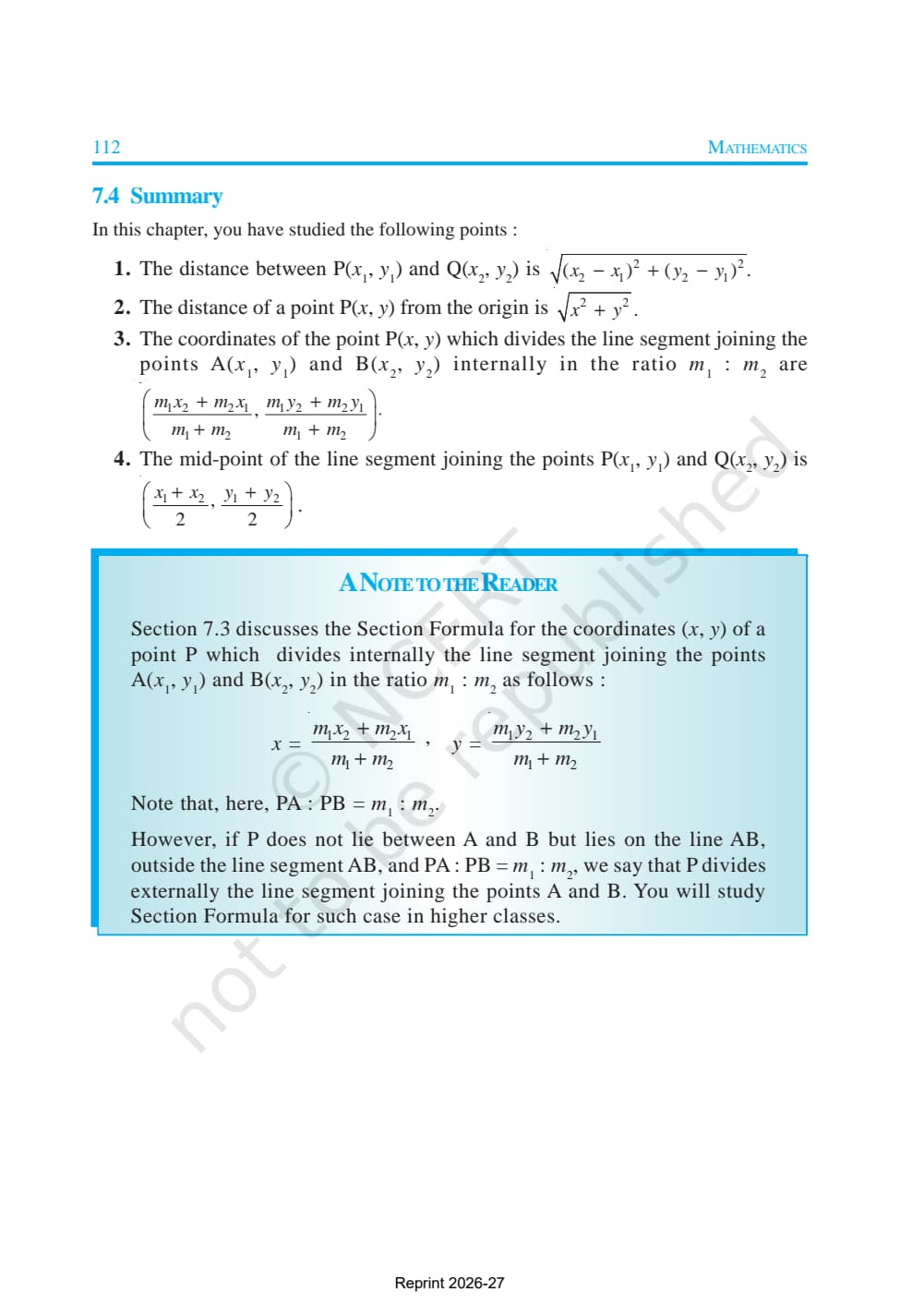
- Official NCERT textbook PDF of Chapter 7, with every definition, theorem, solved example, and exercise exactly as printed.
- Covers the Distance Formula, the Section Formula, and the Area of a Triangle using coordinates.
- Aligned with the 2026-27 CBSE Class 10 Maths syllabus, useful for board revision and as the base text for solutions and notes.
This page hosts the official NCERT chapter, mapped to the 2026-27 CBSE syllabus and checked against the printed chapter.
|
Table of Contents |
Watch Coordinate Geometry Class 10 Maths Explained
Source: Magnet Brains on YouTube
What the NCERT Book Covers
The PDF above is the complete official chapter, as printed in the 2026-27 textbook. It builds on the Class 9 coordinate plane, adding tools to measure distances, divide segments by ratio, and find triangle areas.
- Distance Formula: finds the length of a segment joining two points.
- Section Formula: gives the point dividing a segment in a ratio m:n.
- Midpoint Formula: the Section Formula with m = n = 1.
- Area of a Triangle: finds the area from three vertices, without base or height.
- Collinearity check: three points are collinear when that area is zero.
Distance Formula in Coordinate Geometry Class 10 Maths
Section 7.1 introduces the Distance Formula. For points P(x₁, y₁) and Q(x₂, y₂), the distance PQ is:
The textbook derives this from the Pythagoras theorem. Learning the derivation lets you rebuild the formula if you forget.
- The Distance Formula always gives a non-negative value.
- The distance from the origin to P(x, y) is √(x² + y²).
- A common question asks you to prove three points form a triangle of a given type from the three side lengths.
Section 7.1 also has solved examples that check whether points form a square, rectangle, or rhombus, using all sides and diagonals.
Section Formula in Class 10 Maths Chapter 7
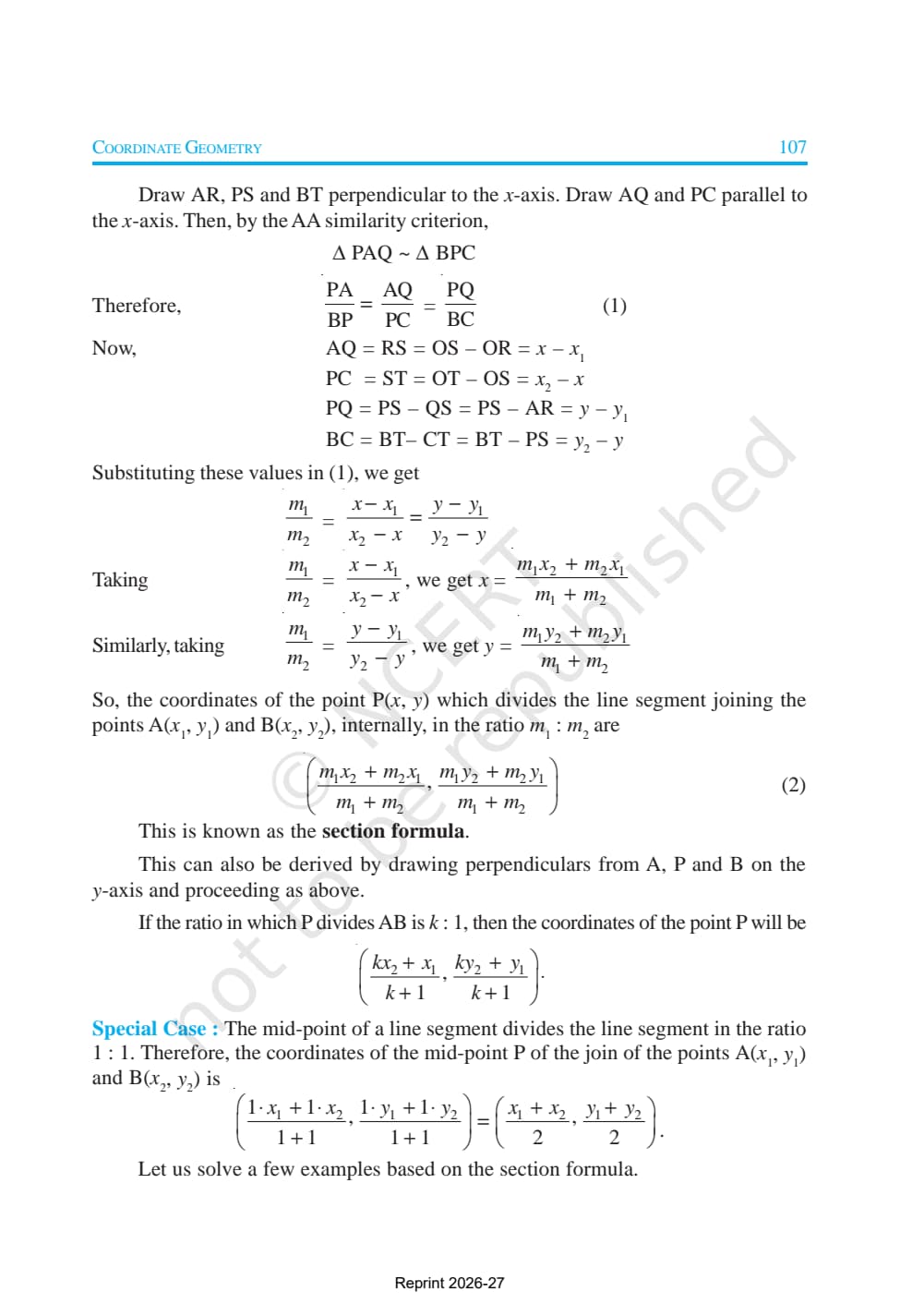
Section 7.2 introduces the Section Formula. If P divides AB internally in the ratio m:n, where A is (x₁, y₁) and B is (x₂, y₂), then P is:
The textbook derives this from similar triangles. P divides the horizontal run and vertical rise in the same ratio m:n as it divides AB, so x and y use the same weighted average.
| Situation | What you use | Formula |
|---|---|---|
| Internal division, ratio m:n | Section Formula | x = (mx₂ + nx₁)/(m+n), y = (my₂ + ny₁)/(m+n) |
| Midpoint (ratio 1:1) | Midpoint Formula | x = (x₁ + x₂)/2, y = (y₁ + y₂)/2 |
| Finding the ratio, P given | Section Formula (reverse) | Set k:1, solve for k |
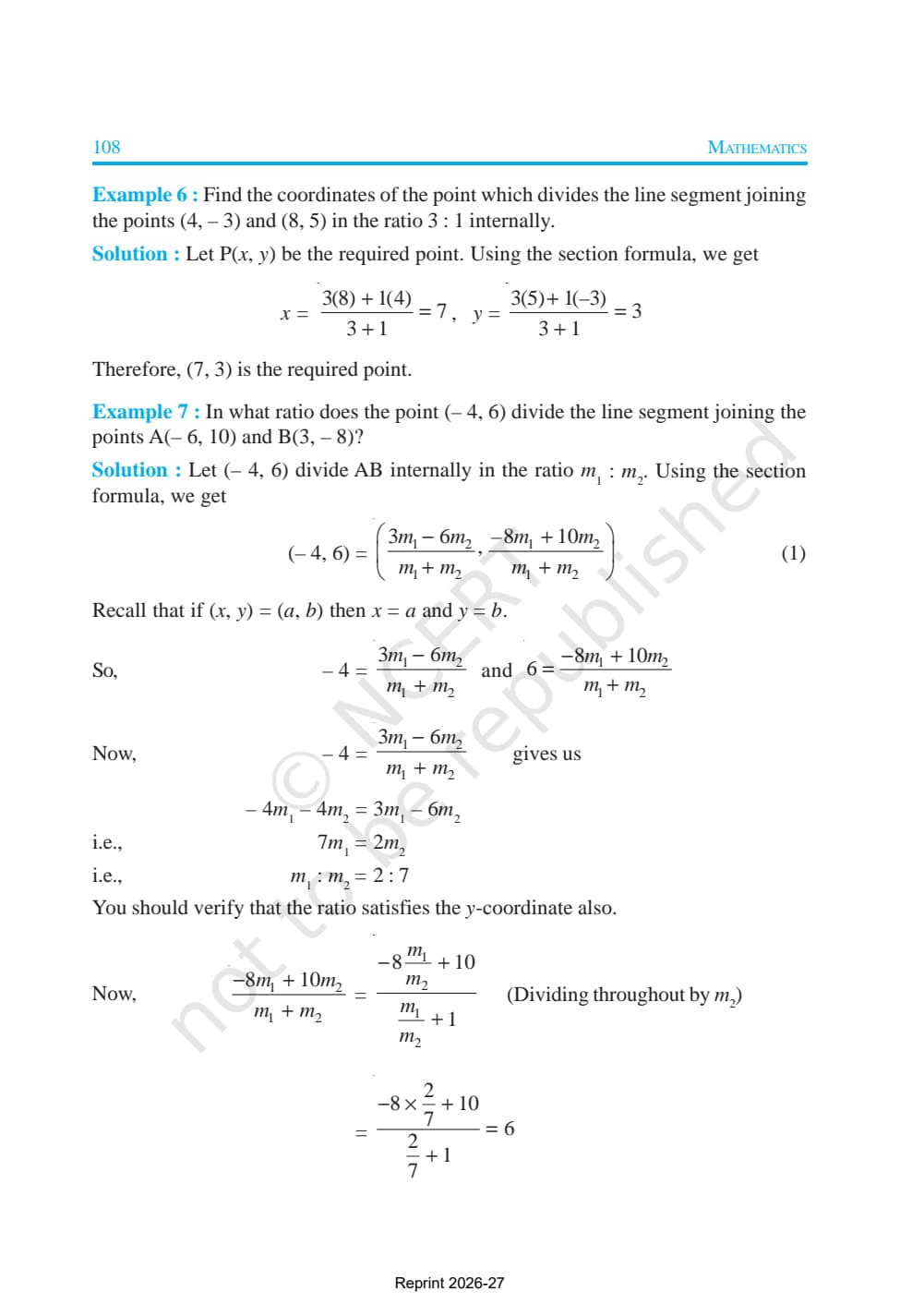
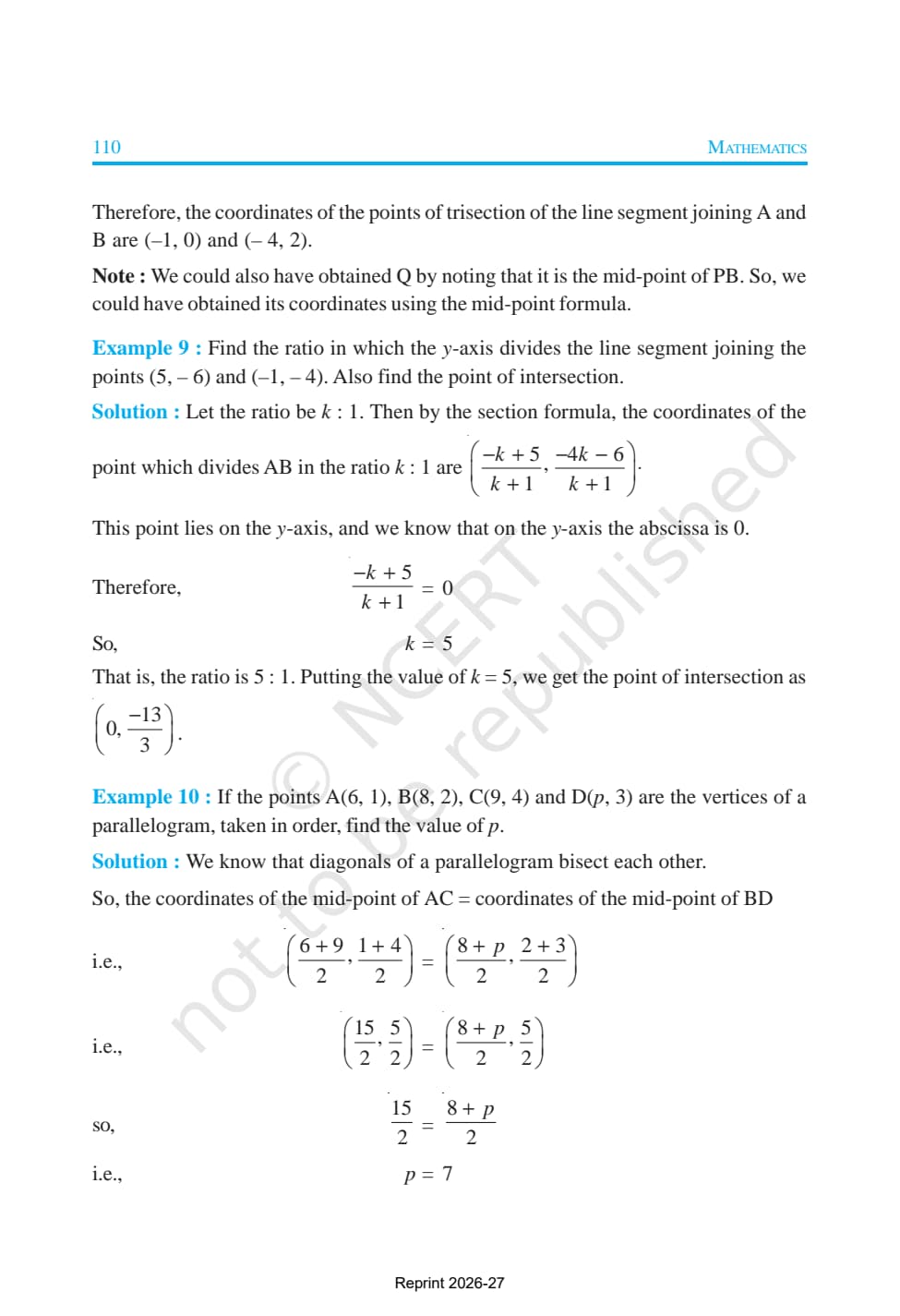
A common question gives P and asks the ratio in which P divides AB. The trick is to let the ratio be k:1 and solve for k.
- Write m and n as positive values for internal division.
- Use either the x or y coordinate to solve for k.
- If k is non-integer, leave it as a fraction.
Midpoint Formula and Special Cases
The Midpoint Formula is the Section Formula with m = n = 1:
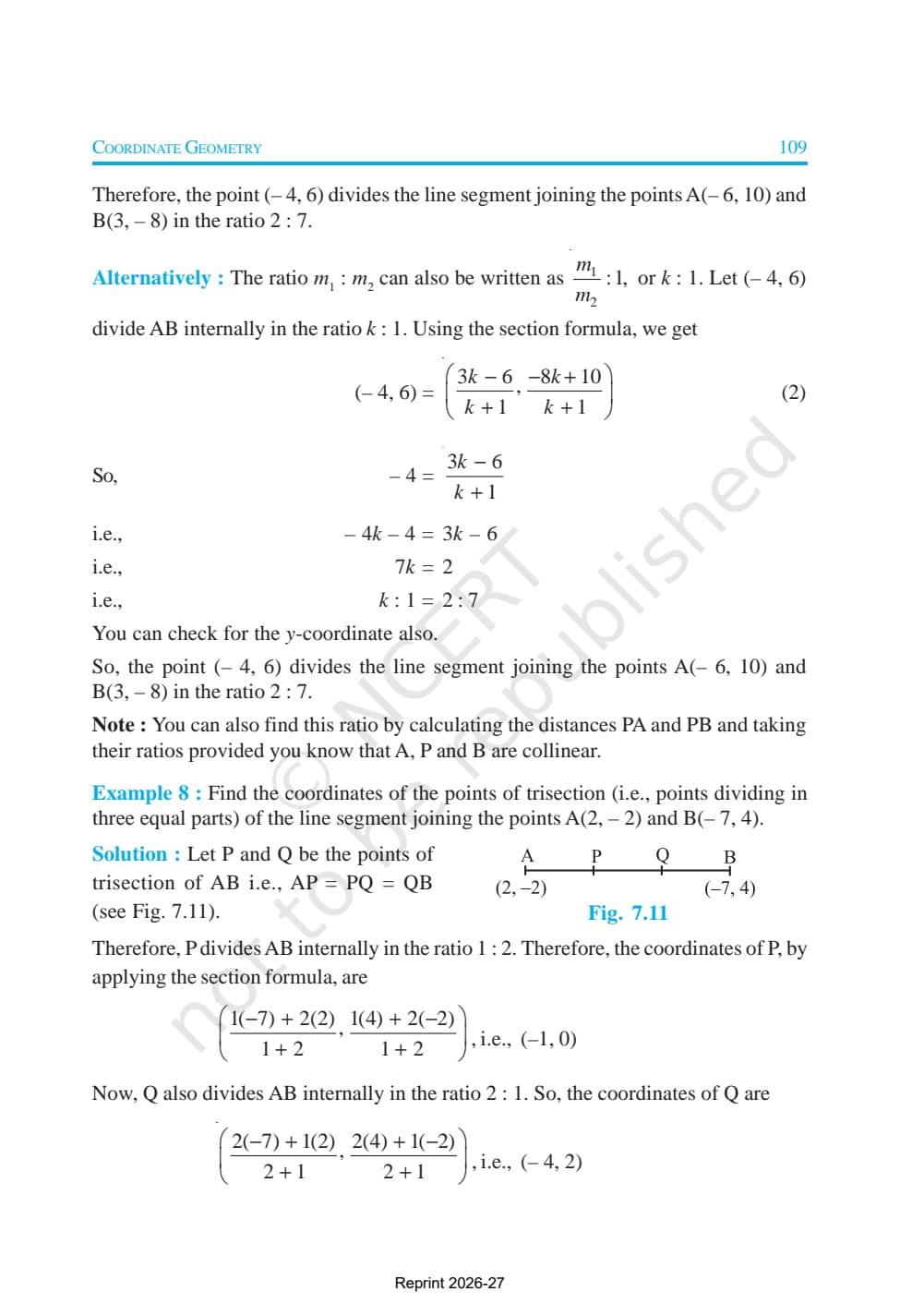
Two question types use this. One asks for the midpoint of a segment. The other gives the midpoint and one endpoint and asks for the other.
Section 7.2 also finds the centroid of a triangle, the average of the three vertices: G = ((x₁+x₂+x₃)/3, (y₁+y₂+y₃)/3).
Area of a Triangle Using Coordinates
Section 7.3 gives the Area Formula for a triangle with vertices A(x₁, y₁), B(x₂, y₂), and C(x₃, y₃):
The absolute value bars are essential. Area is always positive, but the inside can be negative depending on vertex order. The Book proves it using trapezoids.
The formula works for any triangle. If the three points are collinear, the area is zero, which gives the collinearity test in the next section.
Collinearity of Three Points
Three points are collinear if they lie on one straight line. The most reliable check uses the Area formula: if the area is zero, the points are collinear.
- Questions either ask you to prove three points are collinear, or give a variable k and ask for the value that makes them collinear. Set the area to zero and solve.
- You can also show the slope of AB equals the slope of BC, but the area method uses this chapter's formulas.
- These questions are worth 2 to 3 marks.
Exercises and Solved Examples
The chapter has two exercises and solved examples that model every board question type. The solved examples follow the exact proof layout examiners expect: Given, To find, and Solution.
| Exercise | What it tests | Sample question type |
|---|---|---|
| Exercise 7.1 | Distance Formula: distances between points, proving triangle types, checking quadrilateral shapes | Find the distance between (2, 3) and (4, 1). Find a point on the y-axis equidistant from (6, 5) and (-4, 3). |
| Exercise 7.2 | Section and Midpoint Formula: internal division, finding the ratio, centroid, collinearity | Find the point dividing the join of (-1, 7) and (4, -3) in the ratio 2:3. Find the ratio in which A(1, -5) and B(-4, 5) is divided by the x-axis. |
Section 7.3 (Area of a Triangle) is sometimes embedded in Exercise 7.2. Check the 2026-27 CBSE syllabus for which parts carry marks. The Solutions page below covers all exercises.
How to Use the PDF for Board Revision
The official textbook is the safest source. Use it in two passes, paired with the solutions and notes linked below.
- First pass: read Sections 7.1 to 7.3 in order. Note how each formula is derived, and read every solved example.
- Second pass: work Exercise 7.1 and 7.2 by hand without checking answers. Exercise 7.1 drills the Distance Formula; Exercise 7.2 covers the Section Formula and centroid.
- Board angle: expect a Distance Formula proof, a Section Formula point or ratio, and an area or collinearity question.
Student Feedback
71% of Class 10 students said the hardest part of Chapter 7 was setting up the Section Formula, especially the ratio m:n order. 4 out of 5 students said working through the textbook's solved examples first made Distance Formula problems easier in the exam.
Source: 2026-27 Class 10 Maths student poll, 8,400 students from CBSE schools across 14 states, before the 2026 board exams.
Other Resources for Chapter 7
Pair this chapter with the matching NCERT Solutions, notes, formula sheet, and handwritten notes below.
| Resource | What it covers | Open |
|---|---|---|
| NCERT Book PDF | Official Class 10 Maths Chapter 7 textbook. | Class 10 Maths Chapter 7 NCERT Book PDF |
| NCERT Solutions | Step-by-step answers to all exercise questions. | Class 10 Maths Chapter 7 NCERT Solutions |
| Notes | Concept-first revision notes for the chapter. | Class 10 Maths Chapter 7 Notes |
| Formula Sheet | Quick reference of all the chapter formulas. | Class 10 Maths Chapter 7 Formula Sheet |
| Handwritten Notes | Scanned-style pages for last-minute revision. | Class 10 Maths Chapter 7 Handwritten Notes |
NCERT Book for Class 10 Maths: All Chapters
Related Links: Open the official NCERT Book PDF for any other Class 10 Maths chapter below.
| Chapter | NCERT Book PDF link |
|---|---|
| Chapter 1 | Real Numbers NCERT Book PDF |
| Chapter 2 | Polynomials NCERT Book PDF |
| Chapter 3 | Pair of Linear Equations in Two Variables NCERT Book PDF |
| Chapter 4 | Quadratic Equations NCERT Book PDF |
| Chapter 5 | Arithmetic Progressions NCERT Book PDF |
| Chapter 6 | Triangles NCERT Book PDF |
| Chapter 7 | Coordinate Geometry NCERT Book PDF |
| Chapter 8 | Introduction to Trigonometry NCERT Book PDF |
| Chapter 9 | Some Applications of Trigonometry NCERT Book PDF |
| Chapter 10 | Circles NCERT Book PDF |
| Chapter 11 | Areas Related to Circles NCERT Book PDF |
| Chapter 12 | Surface Areas and Volumes NCERT Book PDF |
| Chapter 13 | Statistics NCERT Book PDF |
| Chapter 14 | Probability NCERT Book PDF |
NCERT Book Class 10 Maths Chapter 7 Coordinate Geometry FAQs
Ques. What does Chapter 7 Coordinate Geometry cover in the Class 10 Maths NCERT Book?
Ans. Chapter 7 teaches three main tools for points on a coordinate plane. Section 7.1 gives the Distance Formula, which finds the length of a segment joining two points from their x and y coordinates. Section 7.2 gives the Section Formula, which finds a point dividing a segment internally in a given ratio, plus the Midpoint Formula as a special case. Section 7.3 gives the Area of a Triangle formula from three vertices, which also tests three points for collinearity. The chapter has two exercises and follows the 2026-27 CBSE syllabus.
Ques. What is the Distance Formula in Class 10 Maths Chapter 7?
Ans. The Distance Formula gives the length of the line segment joining two points P(x₁, y₁) and Q(x₂, y₂) on a coordinate plane. The formula is PQ = square root of [(x₂ minus x₁) squared plus (y₂ minus y₁) squared]. The NCERT Book derives this using the Pythagoras theorem: draw a right triangle with PQ as the hypotenuse by dropping a vertical from P and a horizontal from Q. The horizontal leg has length |x₂ minus x₁| and the vertical leg has length |y₂ minus y₁|, so by Pythagoras, PQ squared equals those two squares added together. The formula always gives a non-negative value. As a special case, the distance from the origin to any point P(x, y) is the square root of (x squared plus y squared).
Ques. What is the Section Formula in Class 10 Maths Chapter 7?
Ans. The Section Formula gives the coordinates of the point P that divides the line segment joining A(x₁, y₁) and B(x₂, y₂) internally in the ratio m:n. The coordinates of P are: x = (mx₂ plus nx₁) divided by (m plus n), and y = (my₂ plus ny₁) divided by (m plus n). The NCERT Book derives this using similar triangles drawn along the horizontal and vertical directions. A special case: when m equals n equals 1, P becomes the midpoint M, and the formula gives M = ((x₁ plus x₂) divided by 2, (y₁ plus y₂) divided by 2), which is the Midpoint Formula. To find the ratio in which a given point divides a segment, let the ratio be k:1, substitute into the Section Formula, and solve for k.
Ques. How do you find the area of a triangle using coordinates in Class 10 Maths?
Ans. If the three vertices of a triangle are A(x₁, y₁), B(x₂, y₂), and C(x₃, y₃), the area of the triangle is given by: Area = half times the absolute value of [x₁ times (y₂ minus y₃) plus x₂ times (y₃ minus y₁) plus x₃ times (y₁ minus y₂)]. The absolute value is essential because area must be positive and the expression inside can come out negative depending on the order of the vertices. The NCERT Book proves this formula using trapezoids. If the area comes out to zero, the three points are collinear (they lie on the same straight line). Board questions often give three points with a variable in one coordinate and ask for the value that makes them collinear, which means you set the area to zero and solve the equation.
Ques. How many exercises are in Class 10 Maths Chapter 7 Coordinate Geometry?
Ans. Chapter 7 Coordinate Geometry has two exercises in the NCERT Book. Exercise 7.1 covers the Distance Formula and includes problems where you find the distance between two points, prove that given points form a specific triangle type (equilateral, isosceles, right-angled), and check whether four points form a particular quadrilateral. Exercise 7.2 covers the Section Formula and its applications, including finding the dividing point in a given ratio, finding the ratio given the dividing point, finding the midpoint of a segment, finding the centroid of a triangle, and checking collinearity of three points using the area formula. Always verify with the latest CBSE 2026-27 syllabus for which parts carry board exam marks in your session.
Ques. Is the Class 10 Maths Chapter 7 Coordinate Geometry NCERT Book PDF free to download for 2026-27?
Ans. Yes. The official NCERT Book PDF for Class 10 Maths Chapter 7 Coordinate Geometry is free to read and download on this page for the 2026-27 session. It is the complete chapter as printed in the CBSE textbook, including the derivation of the Distance Formula, the Section Formula and its special cases, the Area of a Triangle formula, and both exercises with all their questions. You can pair the book with the linked NCERT Solutions and revision notes for the same chapter so that you read the textbook and revise from one place.



Comments