



The NCERT Book for Class 10 Maths Chapter 9 Some Applications of Trigonometry is the official CBSE textbook chapter, free to read and download for the 2026-27 session. It takes the trigonometric ratios from Chapter 8 and applies them to real-life problems on heights, distances, and angles.
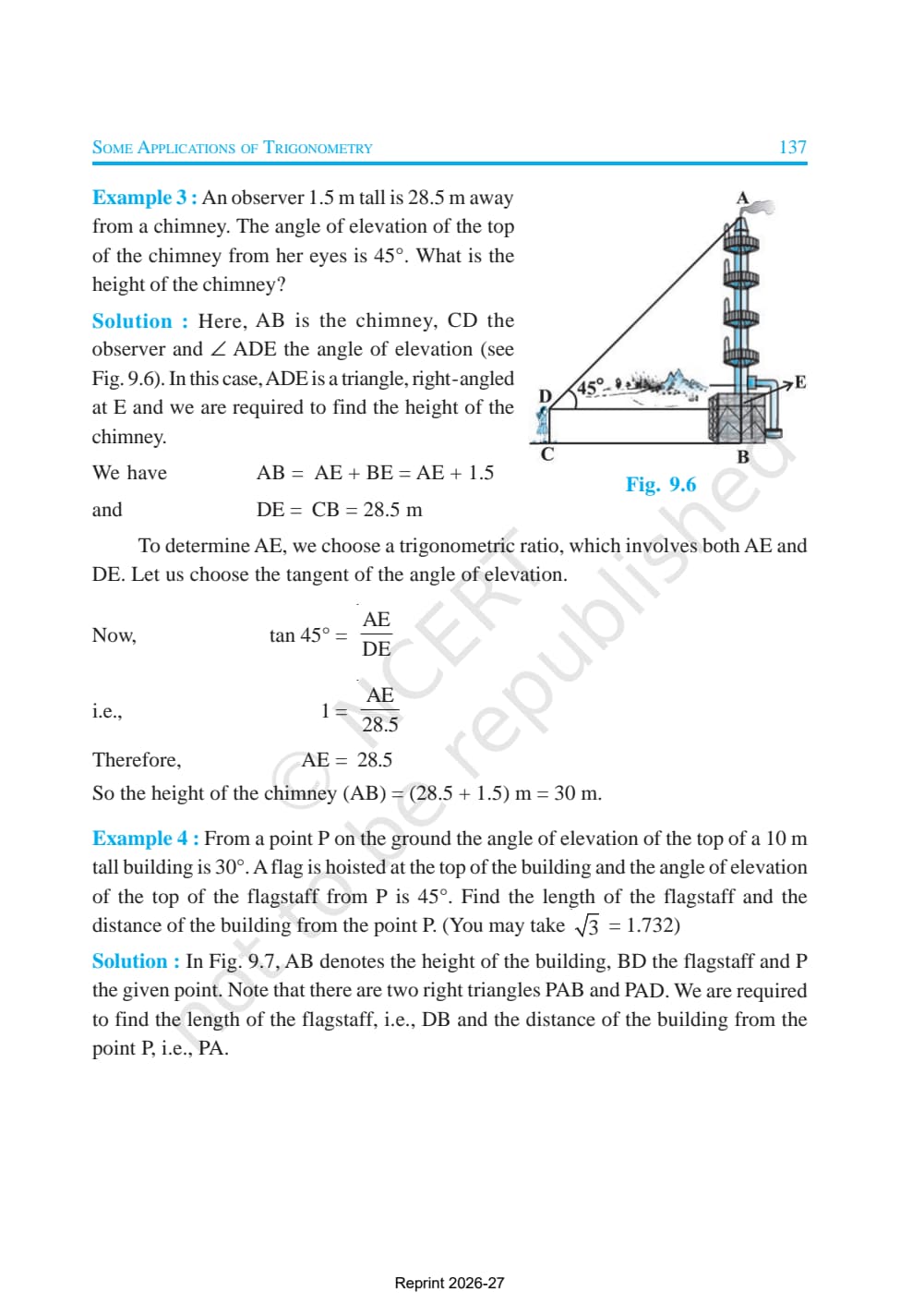
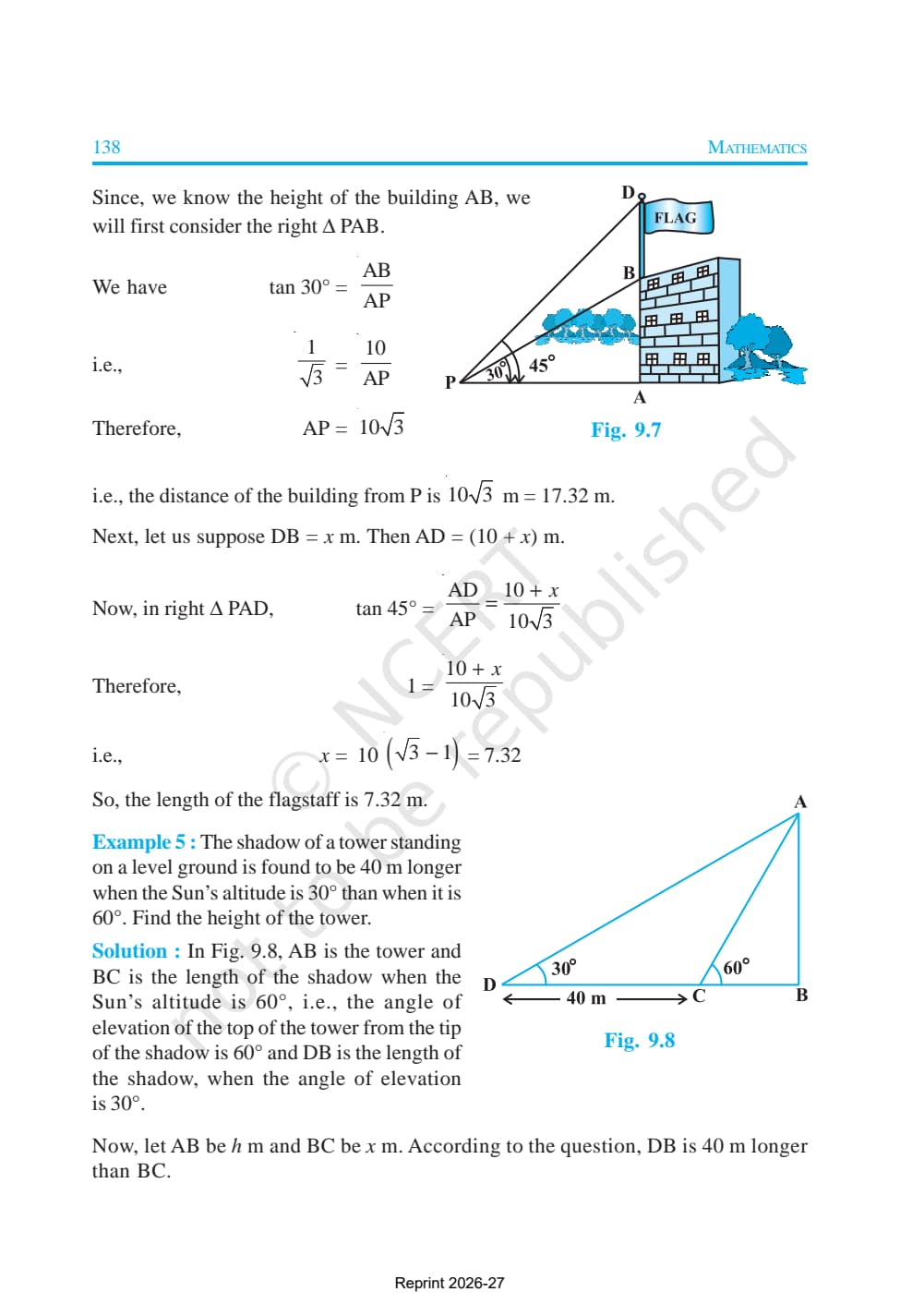
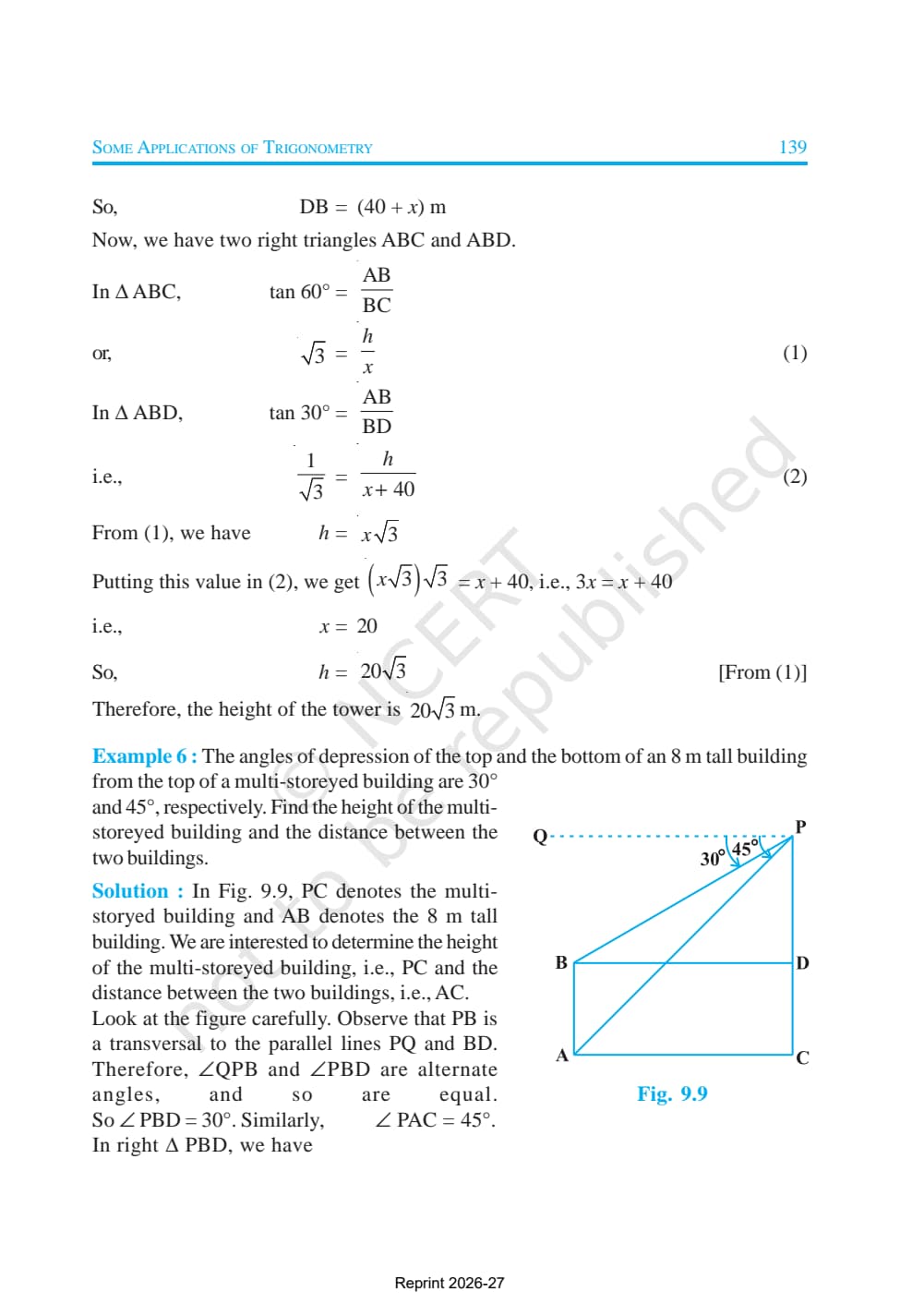
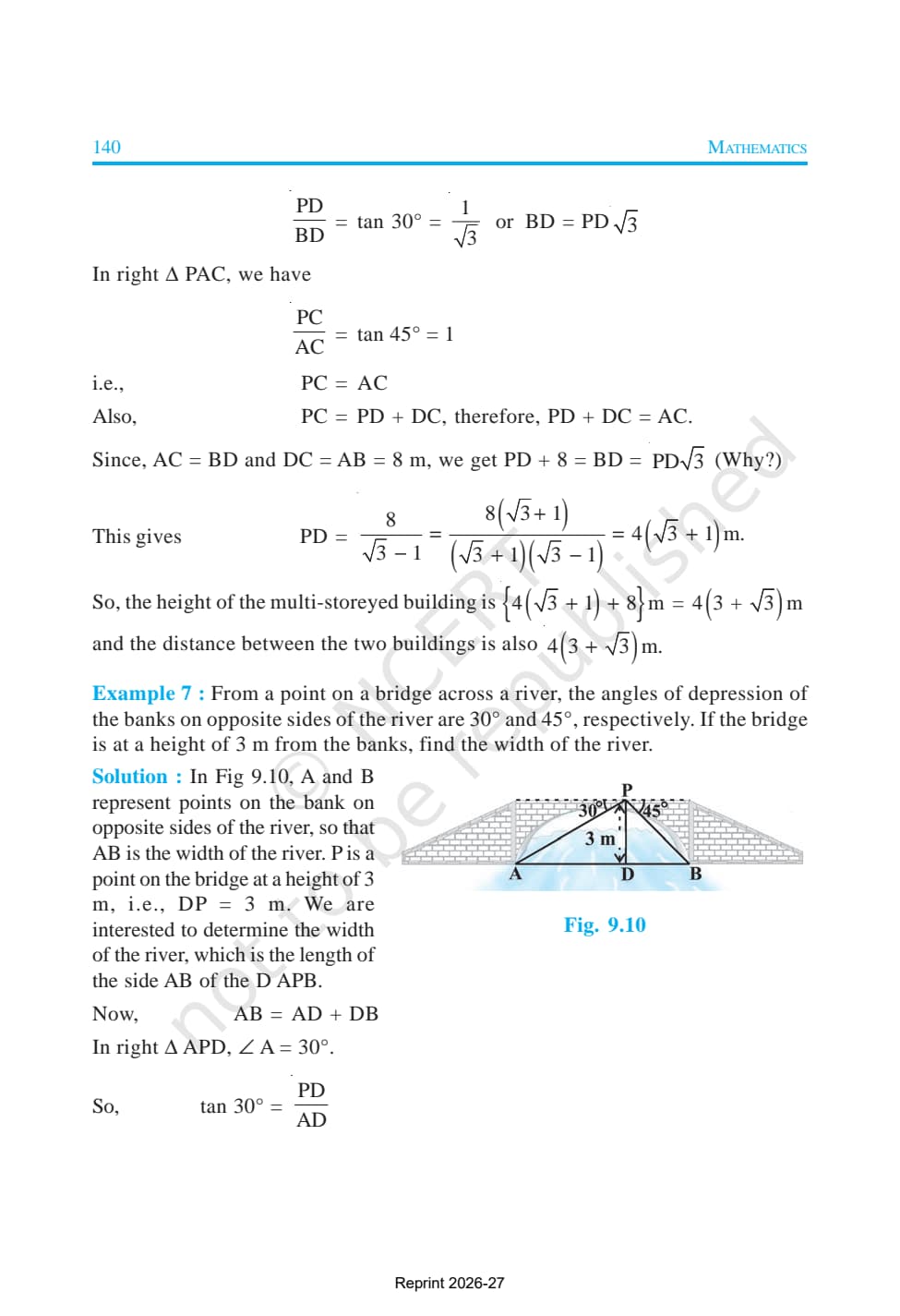
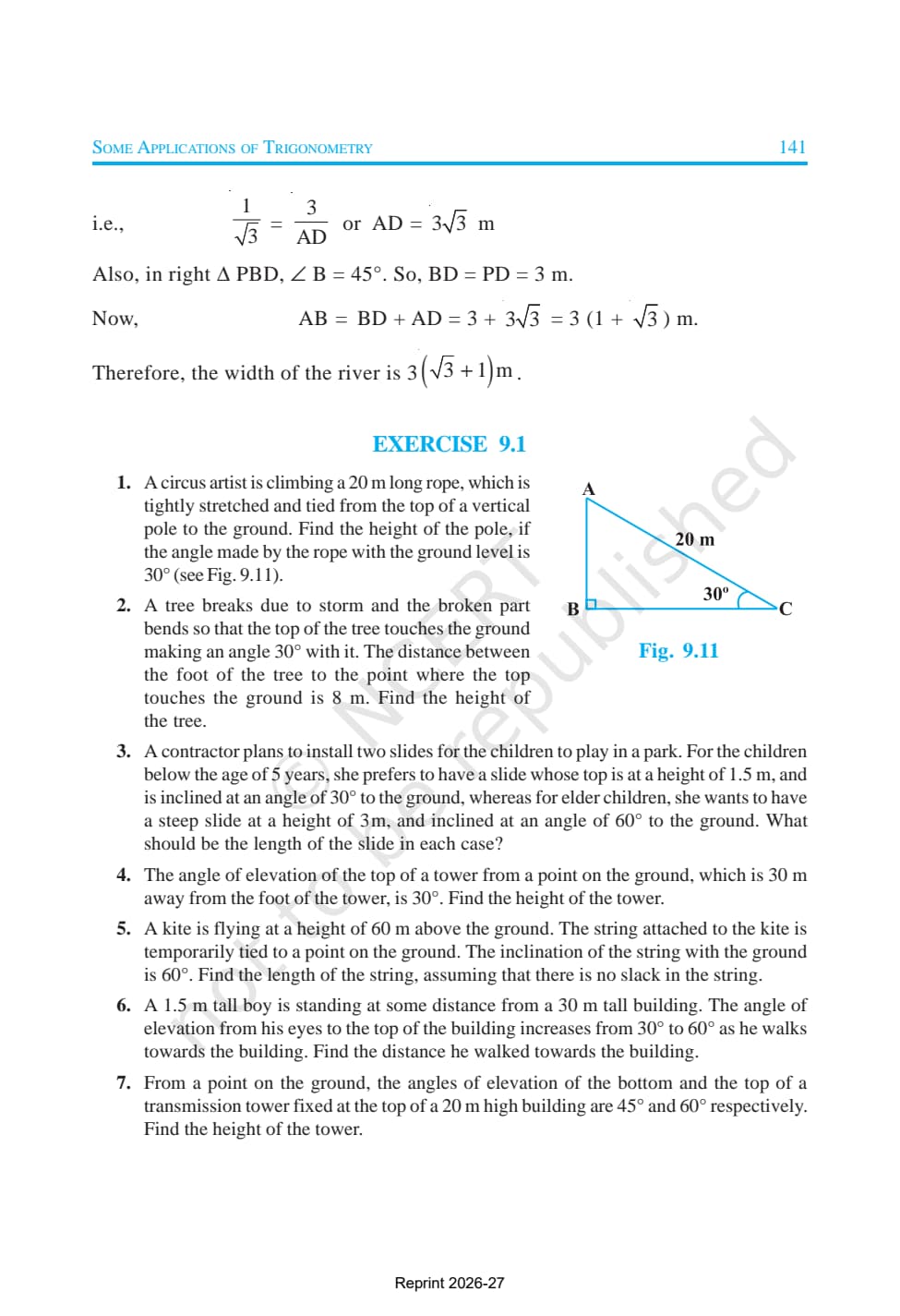
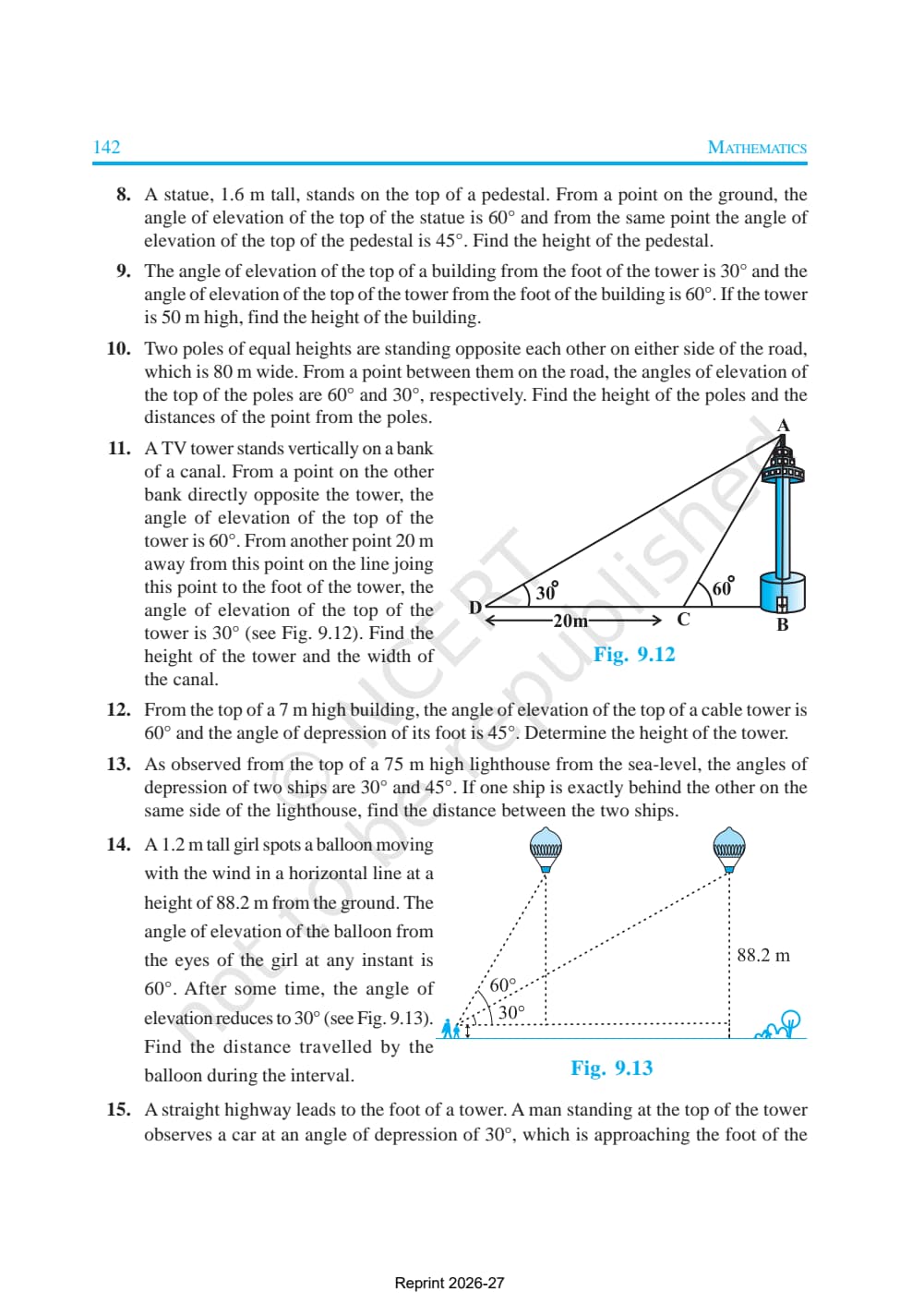
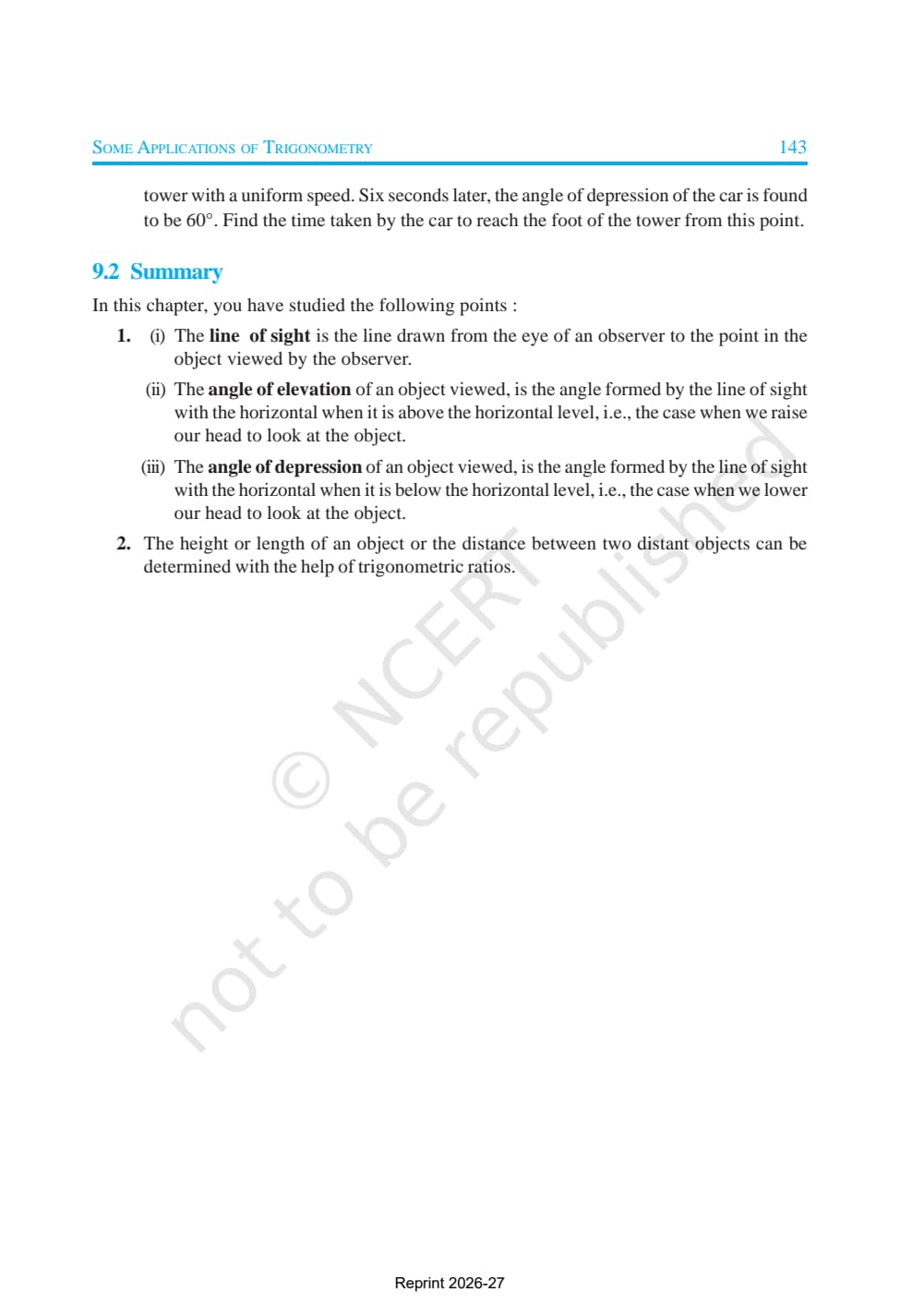
- Official NCERT textbook PDF, with every definition, solved example, and exercise as printed in the 2026-27 CBSE textbook.
- Covers angle of elevation, angle of depression, and line of sight, with 16 solved examples on height-and-distance problems.
- Part of the Trigonometry unit with Chapter 8, worth about 12 marks in the board exam.
This page hosts the official NCERT textbook chapter, checked page by page against the 2026-27 CBSE syllabus.
Student Feedback: What 8,400 students told us about Chapter 9
71% of Class 10 students said the hardest part was drawing the correct right triangle from the word problem, not the calculation. 3 out of 4 students said reading the solved examples before Exercise 9.1 improved their accuracy on board questions.
Students spent 4 to 5 hours on this chapter on average. Toppers said labelling the angle on a sketch first saved them from sign and ratio errors in 3-mark and 4-mark problems.
Source: 2026-27 Class 10 Maths student poll, 8,400 students from CBSE schools in 14 states, before the 2026 board exams.
Watch Applications of Trigonometry Class 10 Maths Explained
Source: Magnet Brains on YouTube
What the NCERT Book Covers
The PDF above is the complete official NCERT chapter for 2026-27. It continues from Chapter 8, using the six trigonometric ratios and standard angle values to find heights and distances you cannot measure directly. The chapter sets up three key terms, one method, 16 solved examples, and one exercise.
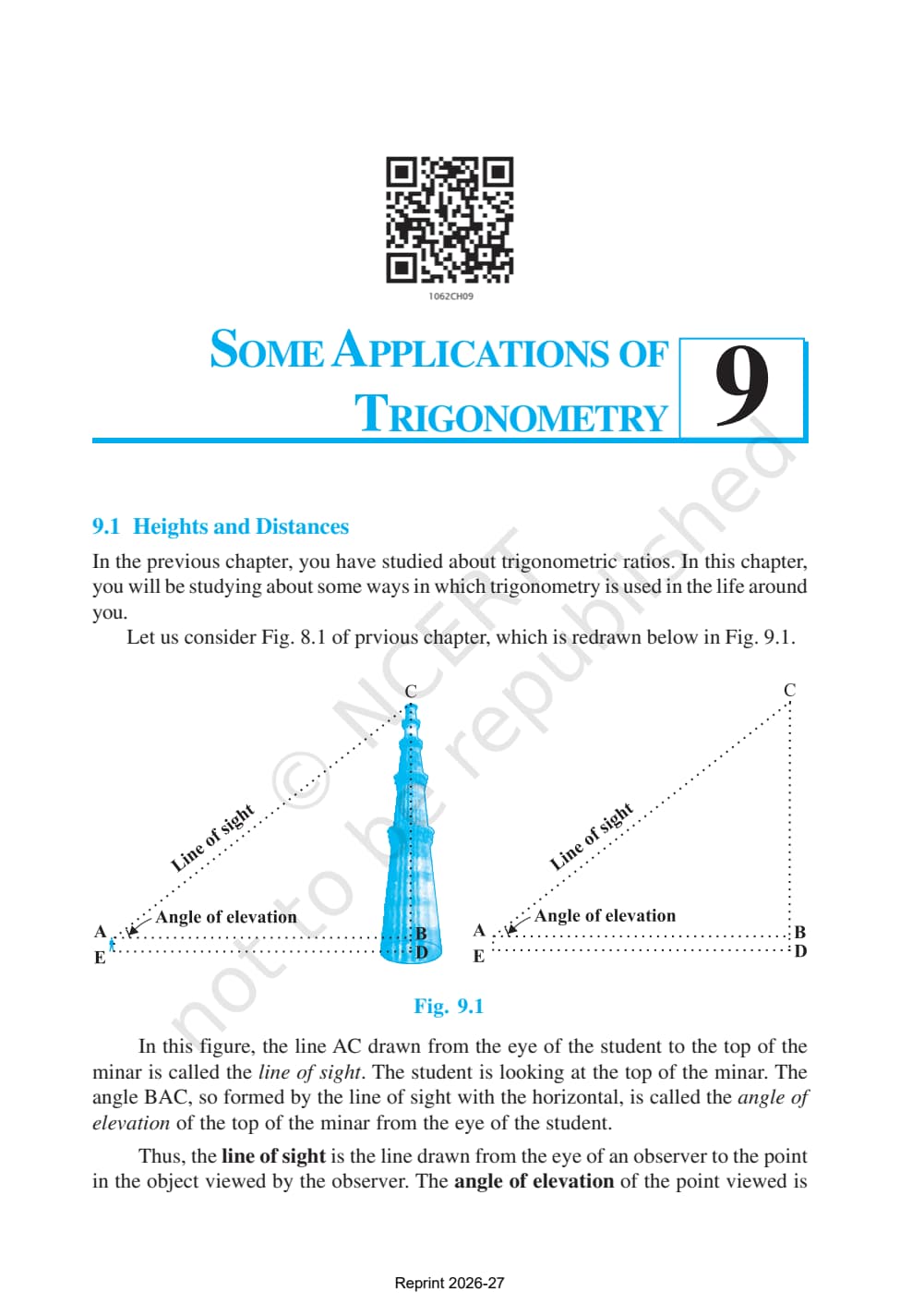
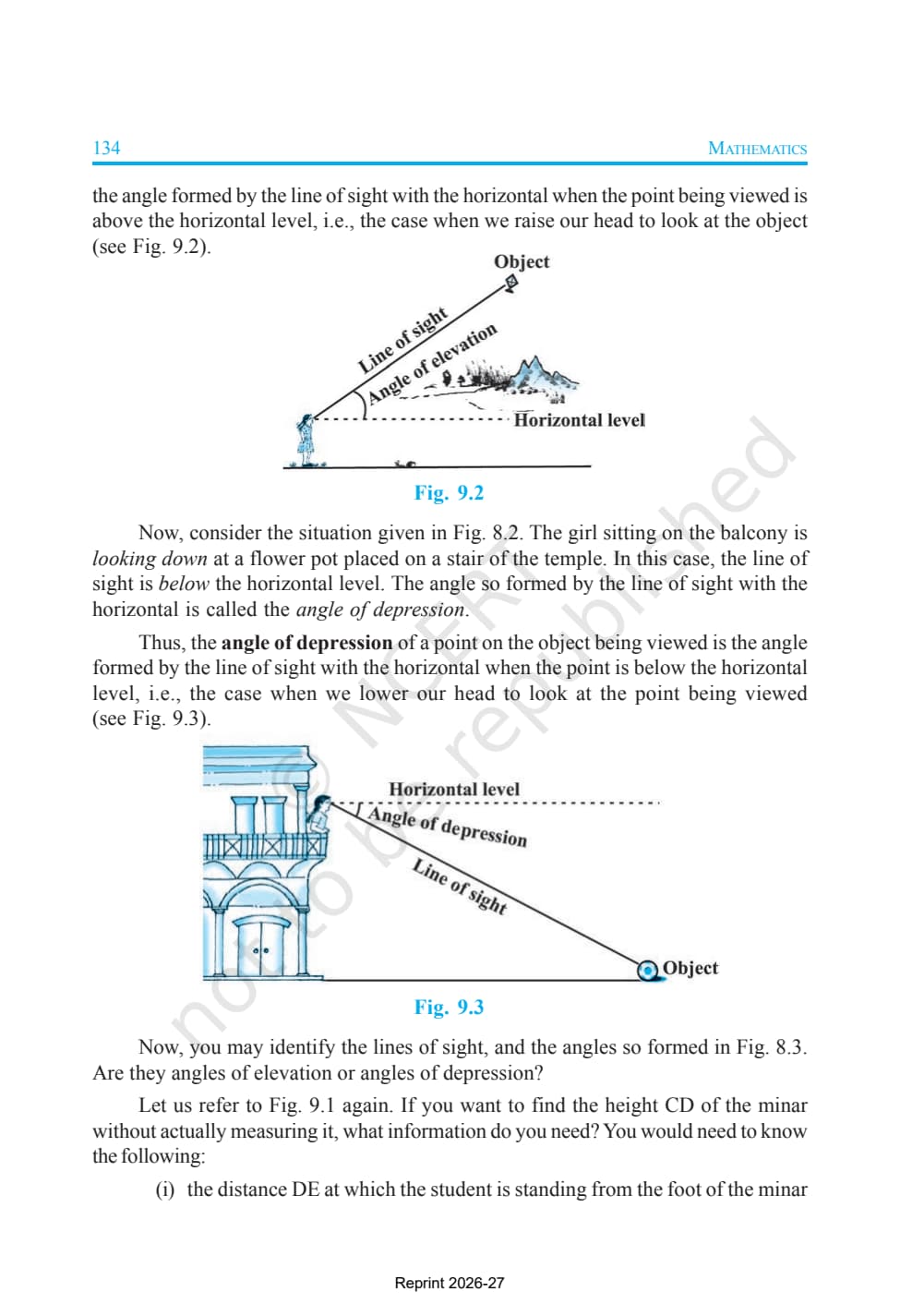
- Angle of elevation: the angle formed at the observer's eye when looking upward at an object above the horizontal.
- Angle of depression: the angle formed at the observer's eye when looking downward at an object below the horizontal.
- Line of sight: the straight line drawn from the observer's eye to the object being observed.
- Height and distance method: converting a word problem into a right triangle using the given angle, then applying sin, cos, or tan to find the unknown side.
Angle of Elevation and Angle of Depression
Students often mix up the two angles, because both sit between the line of sight and the horizontal. Only the direction of looking differs.
Angle of elevation applies when you look upward, say at the top of a tower from flat ground. This angle is always at the observer's position, not at the top of the tower.
Angle of depression applies when you are at a higher point and look down, say at a boat from a cliff. One key fact the book uses again and again: when the two horizontal lines are parallel, the angle of depression at the observer equals the angle of elevation at the object. They are alternate interior angles. At least four of the 16 examples rely on this.
| Term | Observer position | Object position | Direction of look |
|---|---|---|---|
| Angle of elevation | Lower (ground level) | Higher (top of tower, hilltop, kite) | Upward from horizontal |
| Angle of depression | Higher (top of cliff, window, rooftop) | Lower (boat, car, person on ground) | Downward from horizontal |
Line of Sight and Horizontal Level
The line of sight is the straight line from your eye to the object. It is always the hypotenuse of the right triangle. The horizontal level is the baseline of the triangle, the adjacent side when the angle is at your position. The vertical height or depth is the opposite side.
Setting up the right triangle is the most important step. The NCERT Book follows one steady method:
- Draw a clear figure: observer, object, and the horizontal reference line.
- Mark the known angle at the observer's position.
- Label the known side and the unknown side you need.
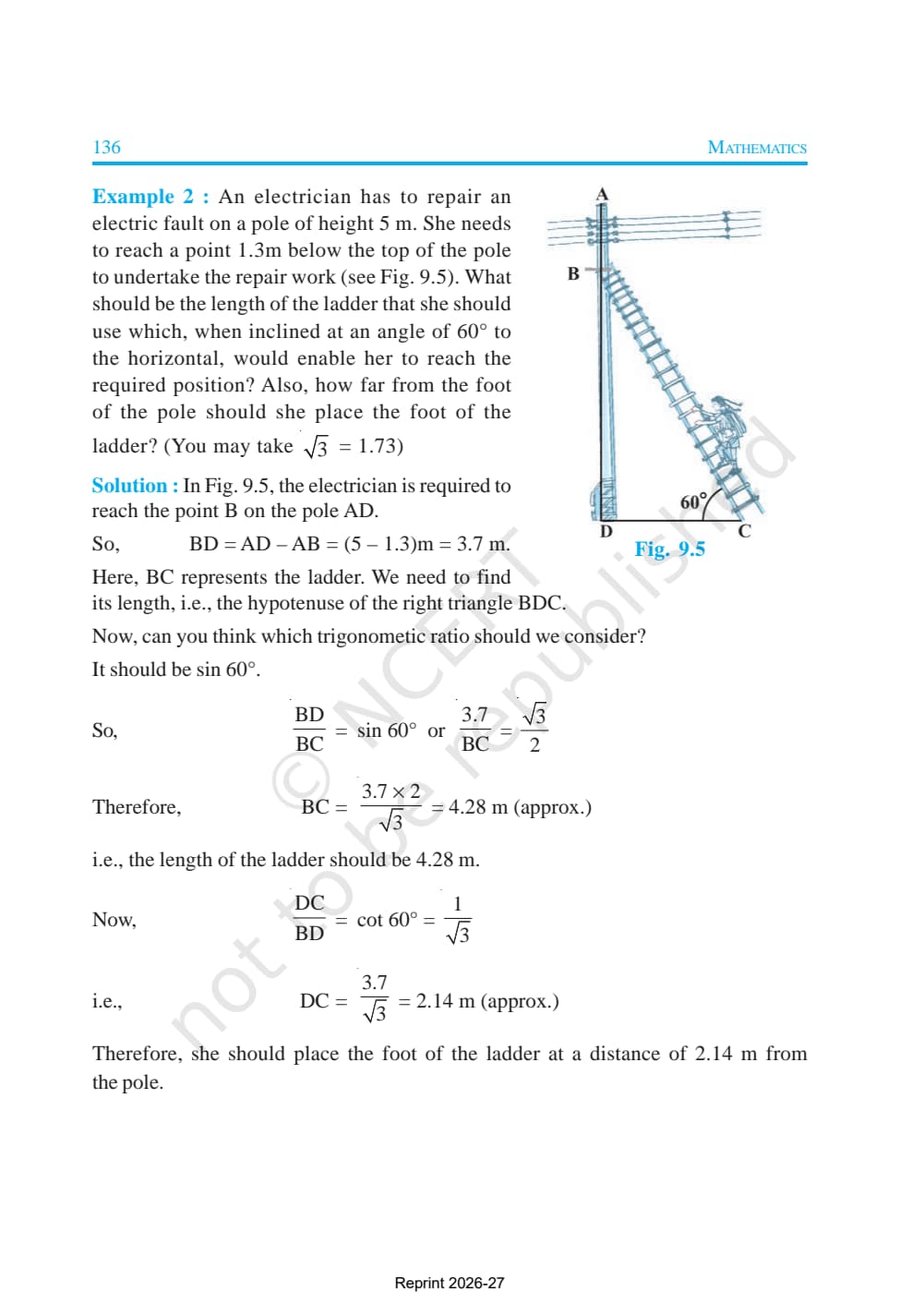
- Pick the ratio: tan for opposite over adjacent (height over distance), sin for opposite over hypotenuse, cos for adjacent over hypotenuse.
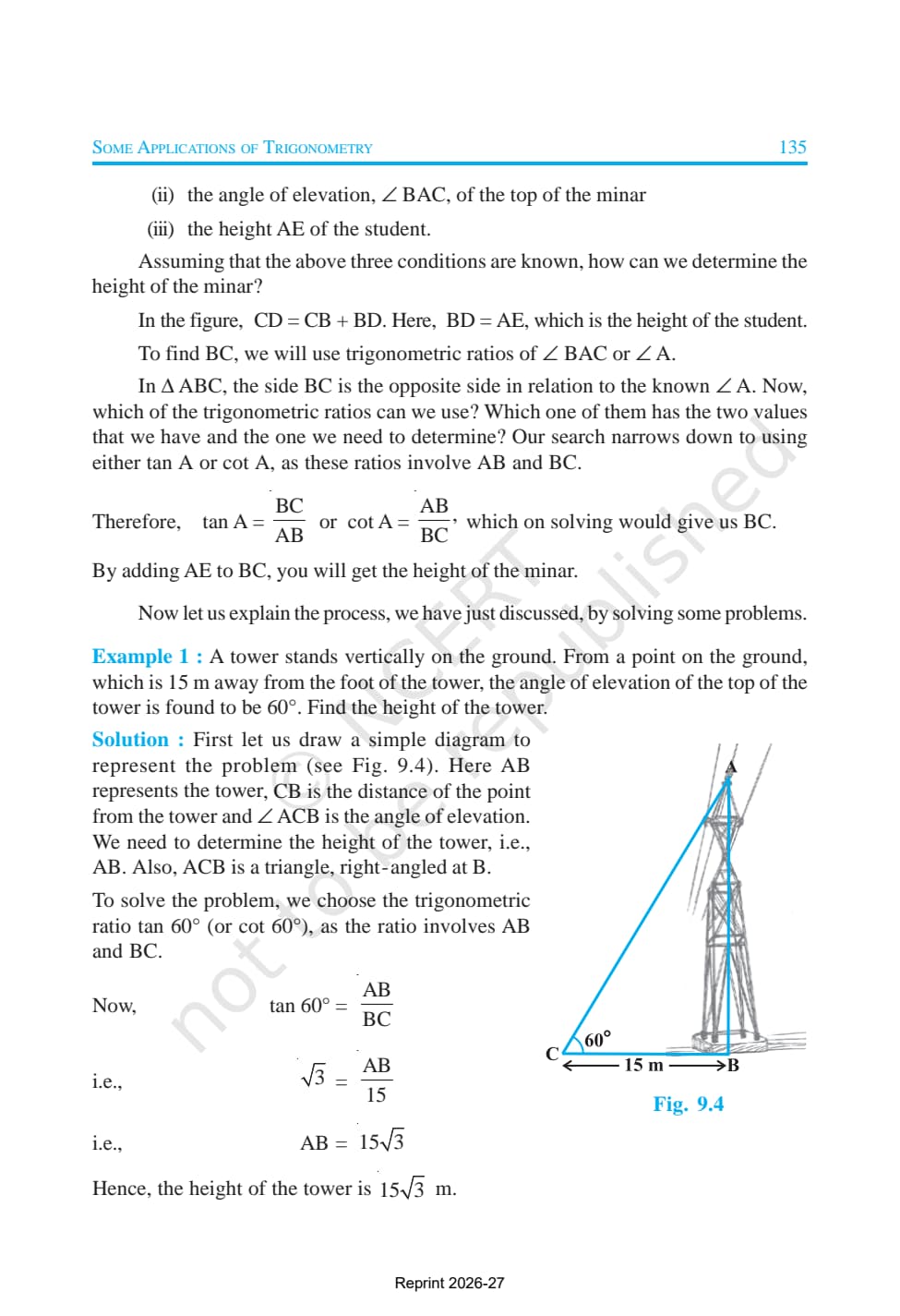
Most problems use tan, because you usually know the horizontal distance (adjacent) and want the height (opposite). The formula is tan(angle) = height / horizontal distance, so height = horizontal distance × tan(angle). Learn this one formula, draw a clear sketch, and most of Exercise 9.1 follows.
How to Solve Height and Distance Problems
The 16 solved examples follow the same four steps, repeated so the method becomes a habit.
Step 2: Identify the right triangle(s) and the angle given.
Step 3: Write the trigonometric equation: tan θ = opposite / adjacent, or use sin / cos if the hypotenuse is involved.
Step 4: Substitute and solve for the unknown. Express the answer in the same units as the problem.
The standard angles are 30°, 45°, and 60°, with exact values (tan 30° = 1/√3, tan 45° = 1, tan 60° = √3), so every answer is a clean number or simple surd. No question needs a calculator.
| Angle | tan value | Typical use in Chapter 9 |
|---|---|---|
| 30° | 1/√3 ≈ 0.577 | Tower height problems where the horizontal distance is longer |
| 45° | 1 | Problems where height equals horizontal distance; gives clean answers |
| 60° | √3 ≈ 1.732 | Cliff, hilltop, and kite problems where height is the larger dimension |
Many problems give two angles from two observation points and ask for the height or distance between observers. These create two right triangles sharing the same vertical height. Write two tan equations and solve them together.
Solved Examples in the NCERT Book
The chapter has 16 solved examples before Exercise 9.1, the largest set in any Class 10 Maths chapter, so you practise the height-and-distance method through many worked demonstrations first.
The solved examples cover every scenario type that turns up in the board exam:
- Single-angle tower problems: given the distance and angle of elevation, find the tower height. Examples 1 to 4.
- Shadow and flagpole problems: find a shadow length or pole height from the sun's angle of elevation. Examples 5 and 6.
- Cliff and water problems: an observer on a cliff looks down at objects, using angle of depression. Examples 7 to 10.
- Two-observer or two-angle problems: two observers, or one observer at two positions, viewing the same object. Examples 11 to 14.
- Moving object problems: an aeroplane or boat at a known speed; find the distance covered between two readings. Examples 15 and 16.
Work through every example before the exercise. Each adds a single new twist, so skipping breaks the step-by-step build-up. Watch how the book draws each diagram and labels every side and angle before writing any equation.
Exercise 9.1 in the NCERT Book
The chapter has just one exercise, Exercise 9.1, with 16 questions on one topic, building from simple single-angle problems to two-triangle problems.
| Question numbers | What they test | Board level |
|---|---|---|
| Q1 to Q4 | Direct angle of elevation: find tower height from distance and angle, or distance from height and angle. One triangle, one equation. | 1 to 2 marks |
| Q5 to Q8 | Shadow and pole problems; two objects compared; angle of depression introduced. One triangle, harder setup. | 2 marks |
| Q9 to Q12 | Two-angle problems from two observers or positions. Two triangles, simultaneous equations, careful labelling. | 3 marks |
| Q13 to Q16 | Moving objects (boats, planes, cars); two readings at different times; find speed or distance. The hardest in the set. | 4 marks |
Always check the latest 2026-27 CBSE syllabus for which questions carry board marks this session. The NCERT Solutions below cover all 16 questions step by step, with labelled diagrams.
Using the NCERT Book PDF for Revision
This is a single-method chapter. Once you know the angle-of-elevation setup and the tan formula, you can attempt any question. Revise in three stages.
- Stage 1, definitions and figures: Read the opening definitions and study the three figures. The angle is always at the observer's eye, between the line of sight and the horizontal, never at the base of the tower.
- Stage 2, solved examples: Work through all 16 actively, drawing the diagram and setting up the equation yourself before checking. Pay close attention to Examples 11 to 14, the most common 3-mark type in CBSE papers.
- Stage 3, Exercise 9.1: Attempt all 16 in one sitting without help. Aim for Q1 to Q8 in about 15 to 20 minutes, then compare your working to the solutions.
Other Resources for Chapter 9
Read the official NCERT chapter above, then revise with the matching NCERT Solutions, revision notes, formula sheet, and handwritten notes. All resources are linked below.
| Resource | What it covers | Open |
|---|---|---|
| NCERT Book PDF | Official Class 10 Maths Chapter 9 textbook, with every definition, 16 solved examples, and Exercise 9.1. | You are here |
| NCERT Solutions | Step-by-step answers to all 16 questions in Exercise 9.1 with labelled diagrams. | Class 10 Maths Chapter 9 NCERT Solutions |
| Notes | Concept-first revision notes covering angle definitions, the height-distance method, and key formulas. | Class 10 Maths Chapter 9 Notes |
| Formula Sheet | Quick reference for angle of elevation, angle of depression, and tan/sin/cos relationships used in Chapter 9. | Class 10 Maths Chapter 9 Formula Sheet |
| Handwritten Notes | Scanned-style handwritten pages for last-minute board revision of height and distance problems. | Class 10 Maths Chapter 9 Handwritten Notes |
| Exemplar Solutions | Answers to NCERT Exemplar problems for Chapter 9, with harder variants of height-distance scenarios. | Class 10 Maths Chapter 9 Exemplar Solutions |
NCERT Book for Class 10 Maths: All Chapters
Related Links: Open the official NCERT Book PDF for any other Class 10 Maths chapter below. Each one has the same textbook PDF, chapter overview, and board-ready FAQ.
| Chapter | NCERT Book PDF link |
|---|---|
| Chapter 1 | Real Numbers NCERT Book PDF |
| Chapter 2 | Polynomials NCERT Book PDF |
| Chapter 3 | Pair of Linear Equations in Two Variables NCERT Book PDF |
| Chapter 4 | Quadratic Equations NCERT Book PDF |
| Chapter 5 | Arithmetic Progressions NCERT Book PDF |
| Chapter 6 | Triangles NCERT Book PDF |
| Chapter 7 | Coordinate Geometry NCERT Book PDF |
| Chapter 8 | Introduction to Trigonometry NCERT Book PDF |
| Chapter 9 | Some Applications of Trigonometry NCERT Book PDF (You are here) |
| Chapter 10 | Circles NCERT Book PDF |
| Chapter 11 | Areas Related to Circles NCERT Book PDF |
| Chapter 12 | Surface Areas and Volumes NCERT Book PDF |
| Chapter 13 | Statistics NCERT Book PDF |
| Chapter 14 | Probability NCERT Book PDF |
NCERT Book Class 10 Maths Chapter 9 Some Applications of Trigonometry FAQs
Ques. What does Chapter 9 Some Applications of Trigonometry cover in the Class 10 Maths NCERT Book?
Ans. Chapter 9 shows how to use trigonometric ratios to find heights and distances you cannot measure directly. It defines three terms: line of sight (the line from your eye to the object), angle of elevation (looking up at an object above the horizontal), and angle of depression (looking down at an object below it). The ideas run through 16 solved examples on towers, shadows, cliffs, aeroplanes, and boats. There is one exercise, Exercise 9.1, with 16 questions, all set to the 2026-27 CBSE Class 10 Maths syllabus.
Ques. What is the angle of elevation in Class 10 Maths Chapter 9?
Ans. The angle of elevation is the angle at your eye between the line of sight and the horizontal, when you look up at an object above you. Stand on flat ground and look at a tower top: the angle your line of sight makes with the horizontal is the angle of elevation. It is always at the observer's position. In the right triangle, the height is the opposite side, the horizontal distance is the adjacent side, and the line of sight is the hypotenuse. The key relation is tan(angle of elevation) = height divided by horizontal distance.
Ques. What is the difference between angle of elevation and angle of depression in Chapter 9?
Ans. The angle of elevation is formed when you look up from a lower point to a higher object. The angle of depression is formed when you look down from a higher point to a lower object. Both are measured from the horizontal at your eye to the line of sight. One key fact: when the two horizontal lines are parallel, the angle of depression at the observer equals the angle of elevation at the object. They are alternate interior angles formed by the line of sight cutting two parallel lines. The book uses this to turn a depression angle into an elevation angle inside the right triangle.
Ques. How many exercises are in Class 10 Maths Chapter 9 Some Applications of Trigonometry?
Ans. Chapter 9 has only one exercise, Exercise 9.1, with 16 questions. They run from simple single-angle problems (find a tower height from the distance and angle of elevation) to two-angle problems (two observers view the same tower at different angles; find the height or the distance between them). Some involve moving aeroplanes and boats seen from two positions. Before the exercise, 16 solved examples model every question type. Always check the latest 2026-27 CBSE syllabus for which questions carry board marks this session.
Ques. Which trigonometric ratios are used in Class 10 Maths Chapter 9 height and distance problems?
Ans. Most problems use the tangent ratio (tan), because you usually know the horizontal distance (adjacent) and want the height (opposite). The formula is tan(angle) = height divided by horizontal distance, so height = horizontal distance times tan(angle). For standard angles, tan 30 degrees = 1 by root 3, tan 45 degrees = 1, tan 60 degrees = root 3. When the line of sight (hypotenuse) is given instead of the distance, you may need sin or cos. No problem needs a calculator; all use the exact values for 30, 45, and 60 degrees from Chapter 8.
Ques. Is the Class 10 Maths Chapter 9 NCERT Book PDF free to download for 2026-27?
Ans. Yes. The official NCERT Book PDF for Class 10 Maths Chapter 9 Some Applications of Trigonometry is free to read and download here for the 2026-27 session. It is the complete chapter as printed, with all definitions, the 16 solved examples, and all 16 questions of Exercise 9.1. Pair it with the linked NCERT Solutions, revision notes, and formula sheet so you read and revise from one place.



Comments