



The NCERT Book for Class 10 Science Chapter 11 Electricity is the official CBSE textbook chapter, free to read and download for the 2026-27 session. This chapter explains how charge flows in a circuit: electric current, potential difference, Ohm's law, the factors that decide resistance, resistors in series and parallel, and the heating effect and electric power that run our homes.
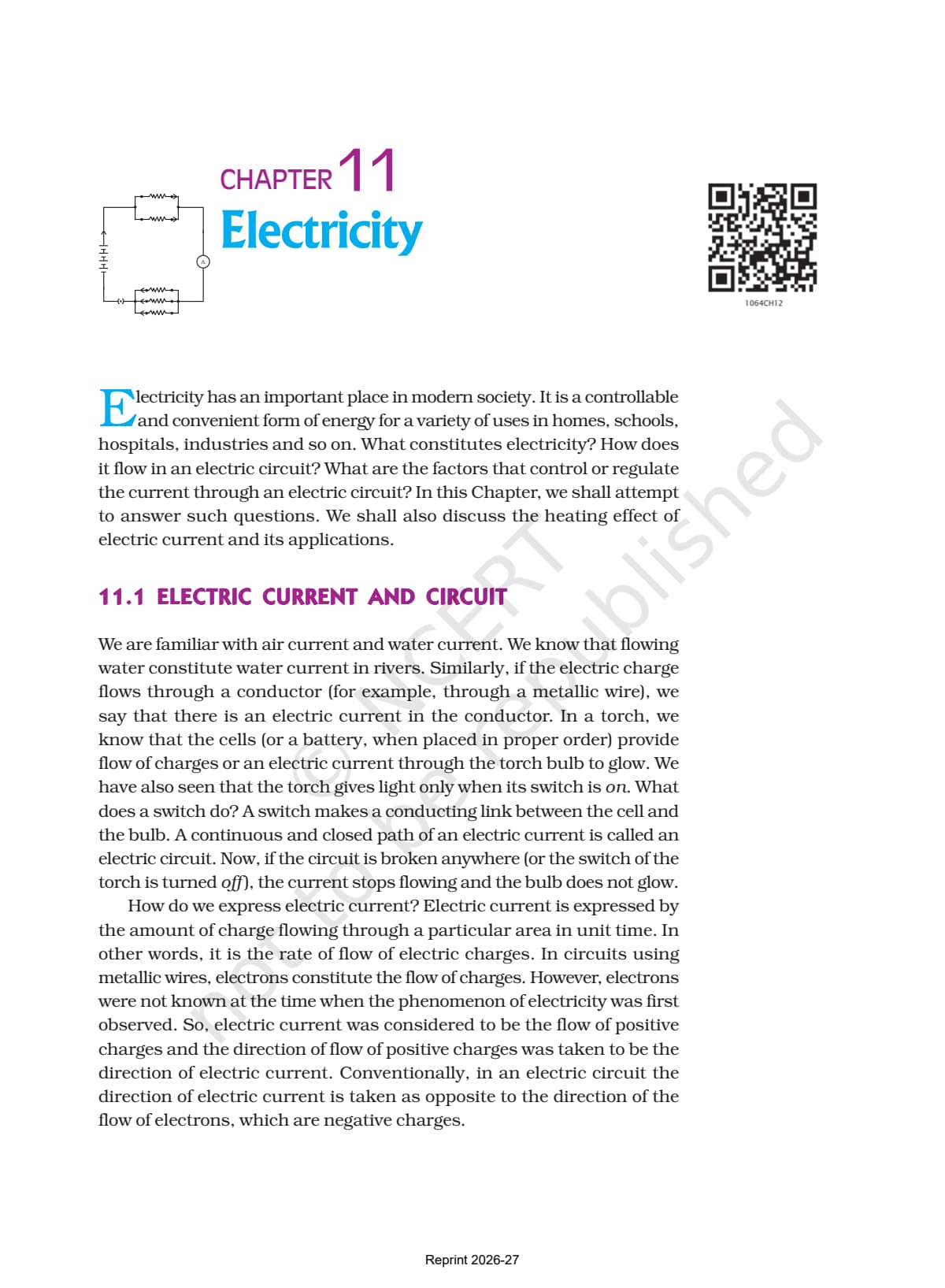
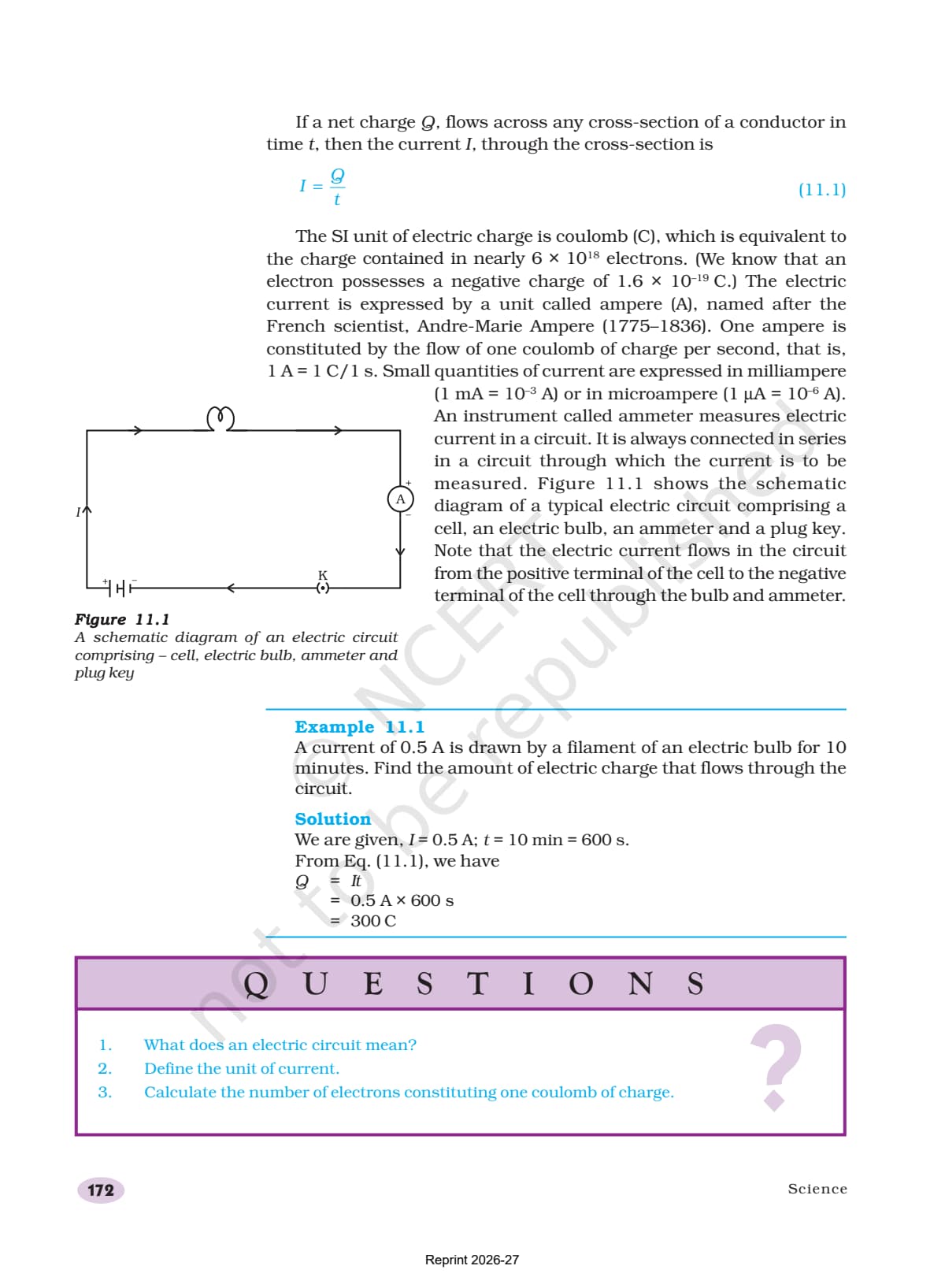
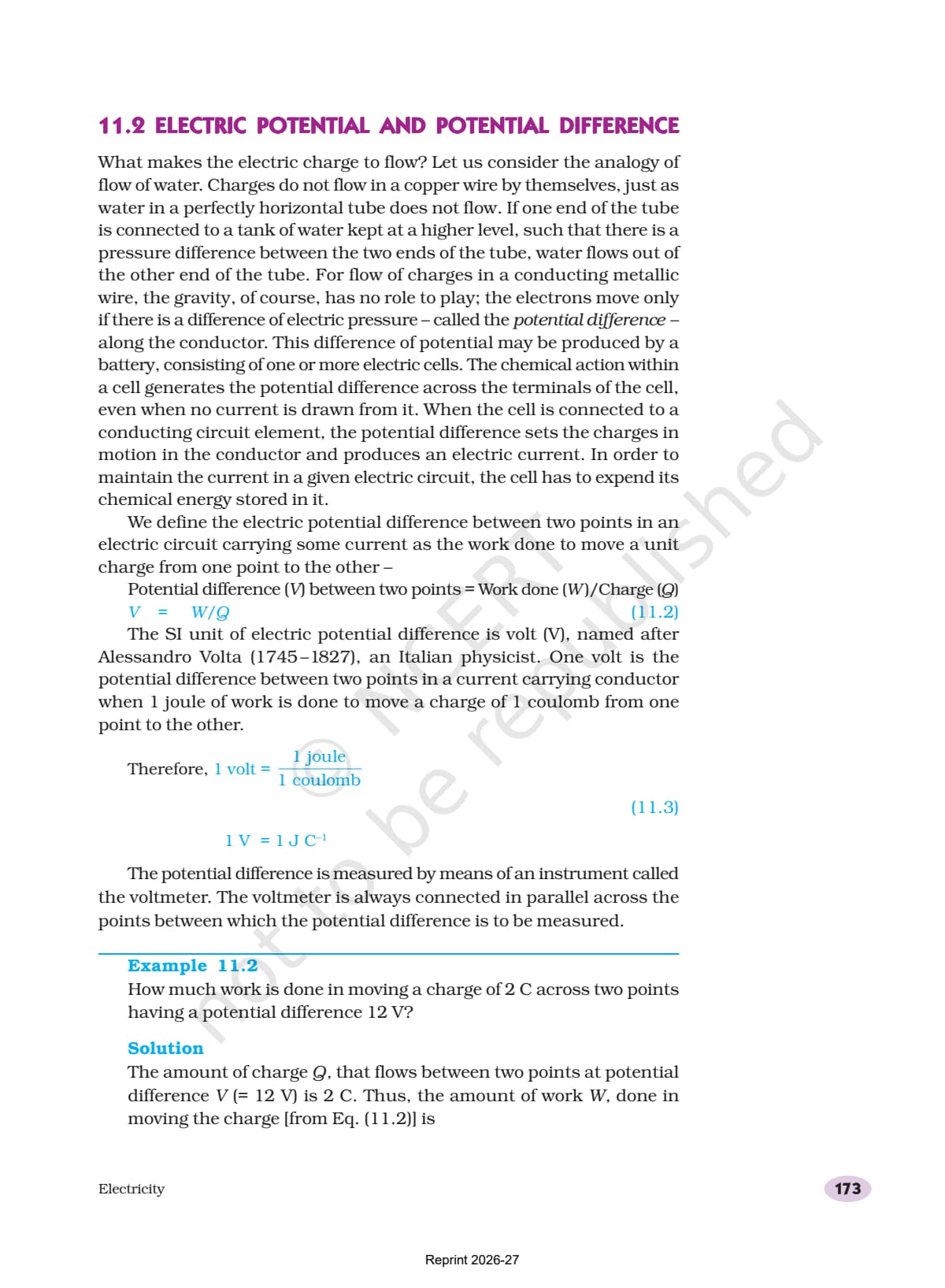
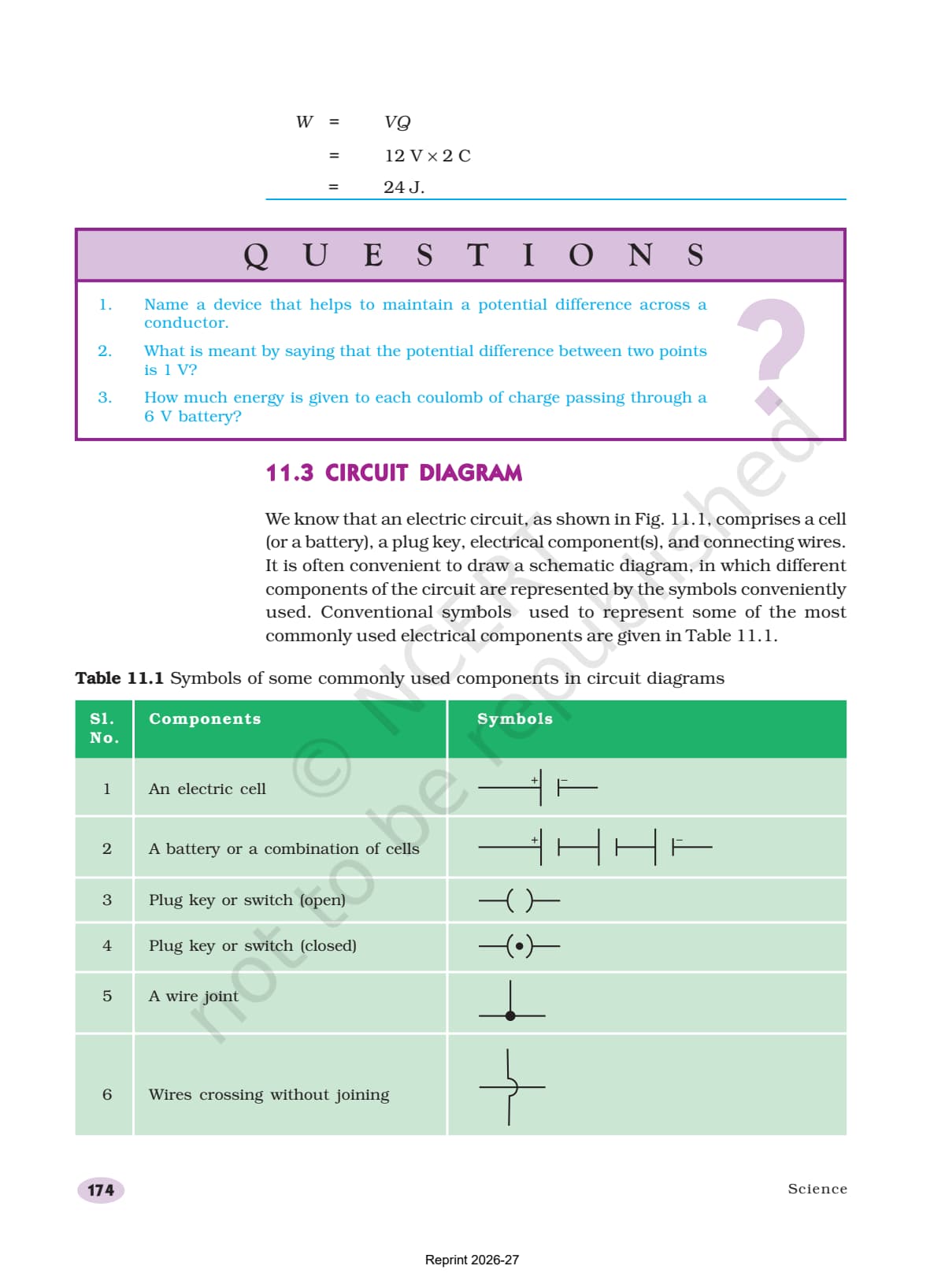
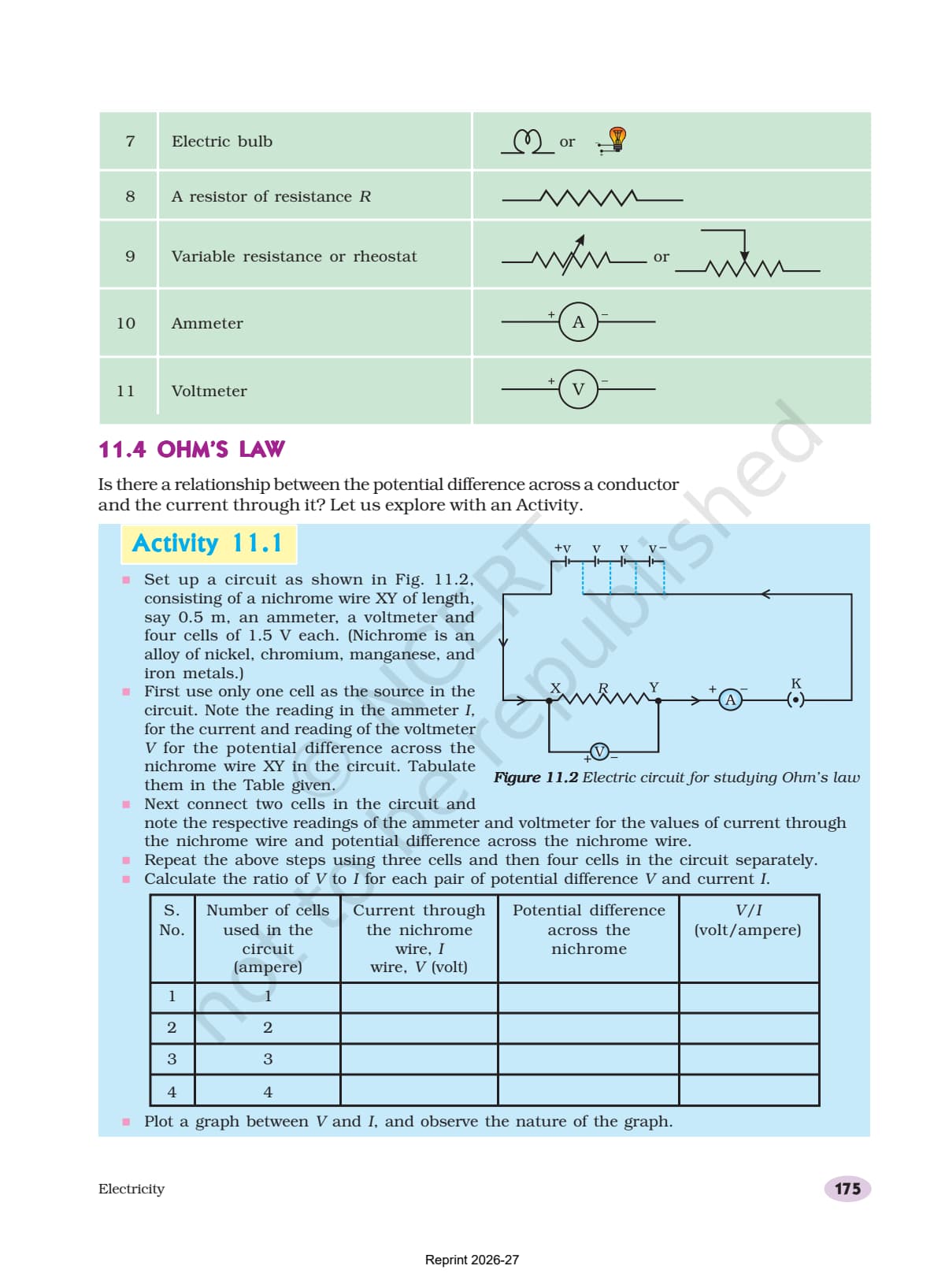
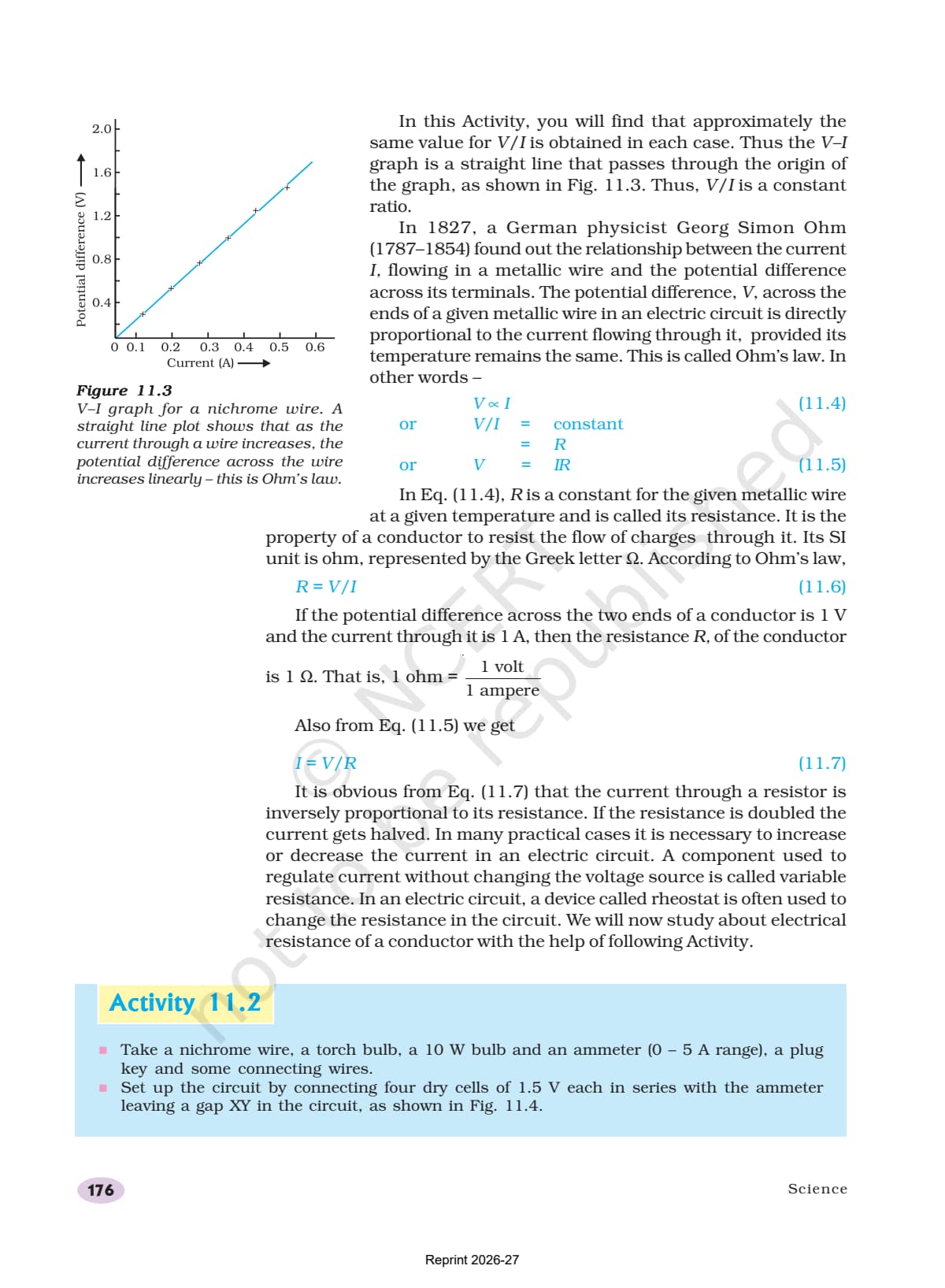
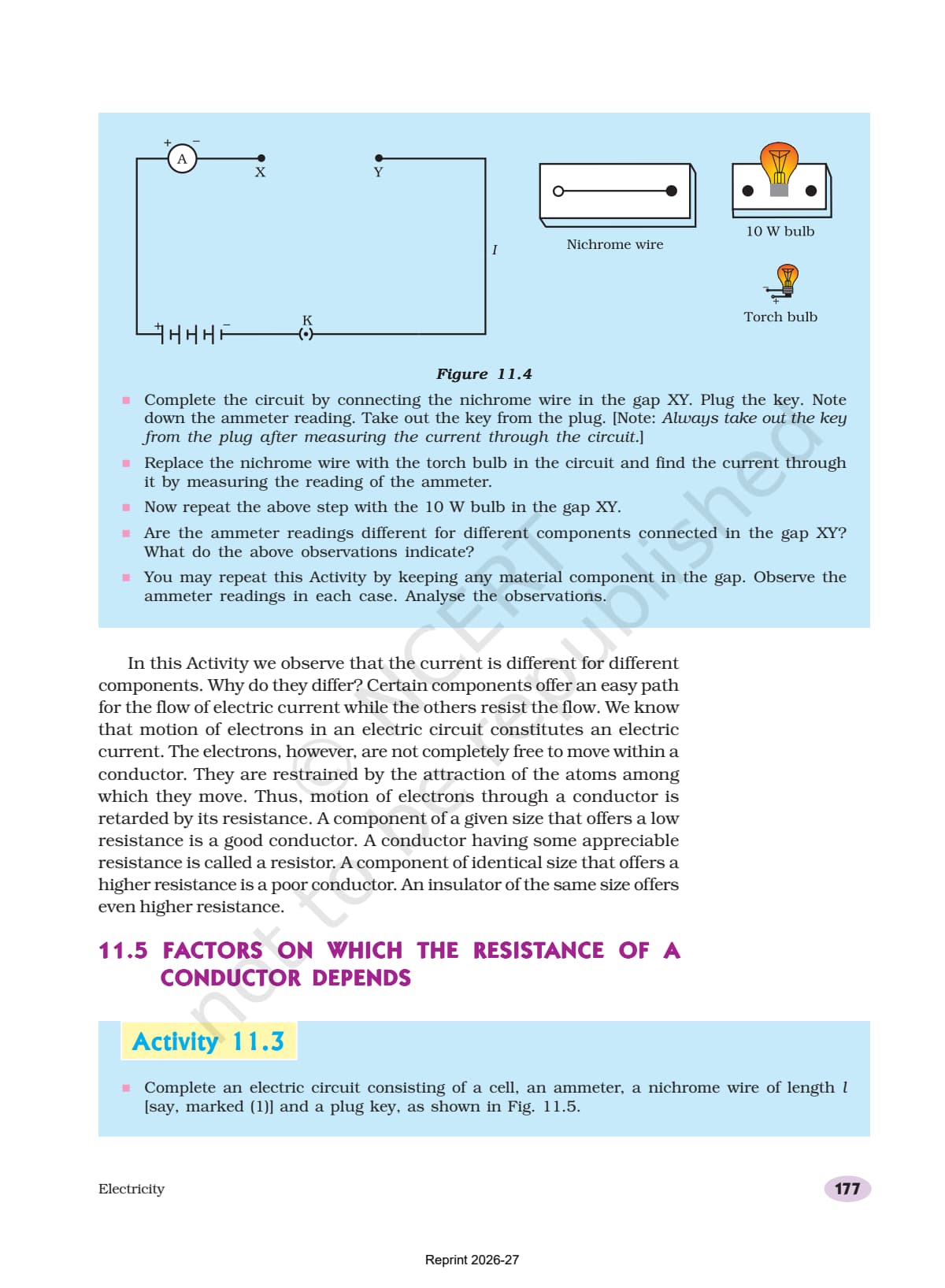
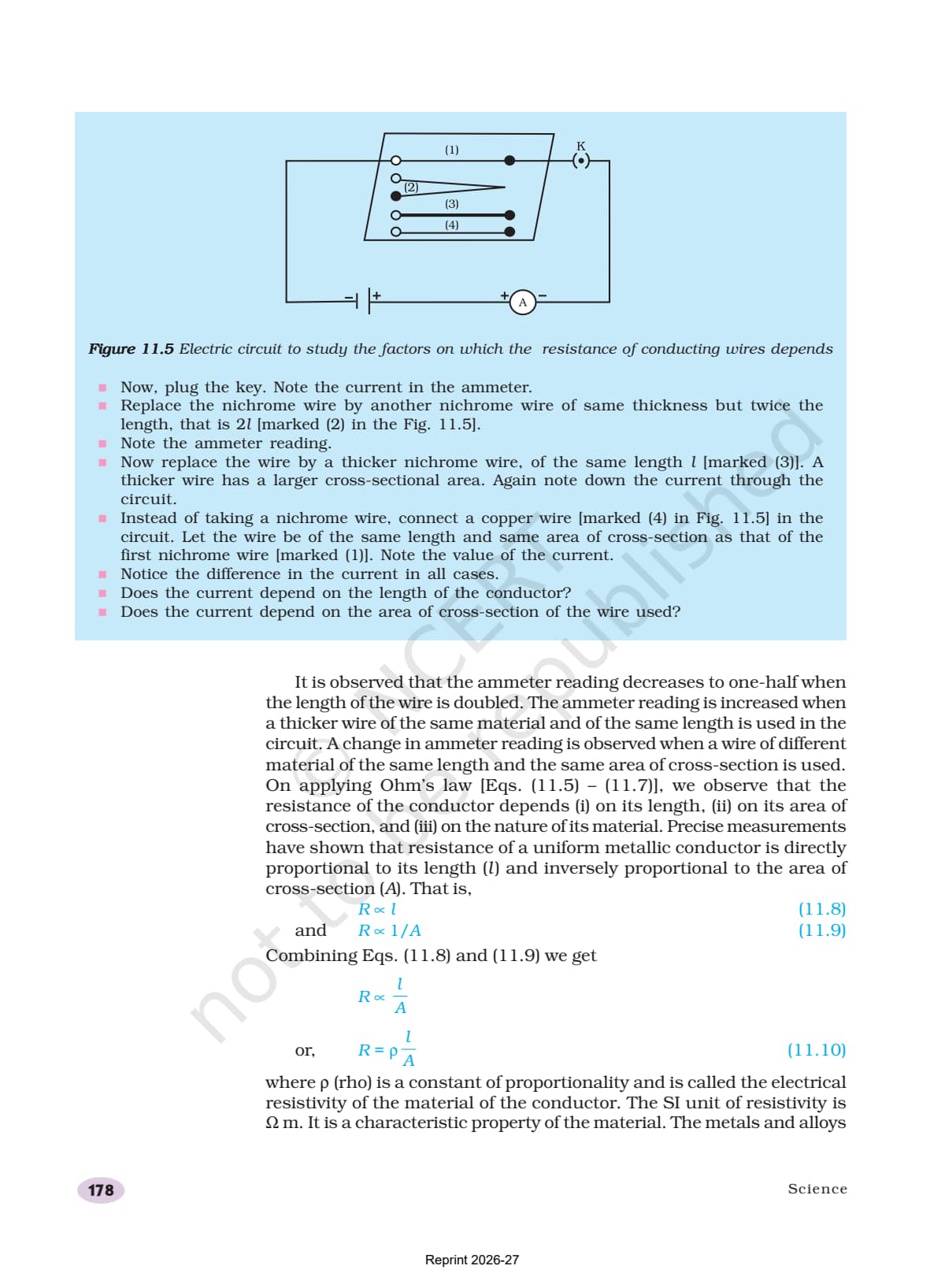
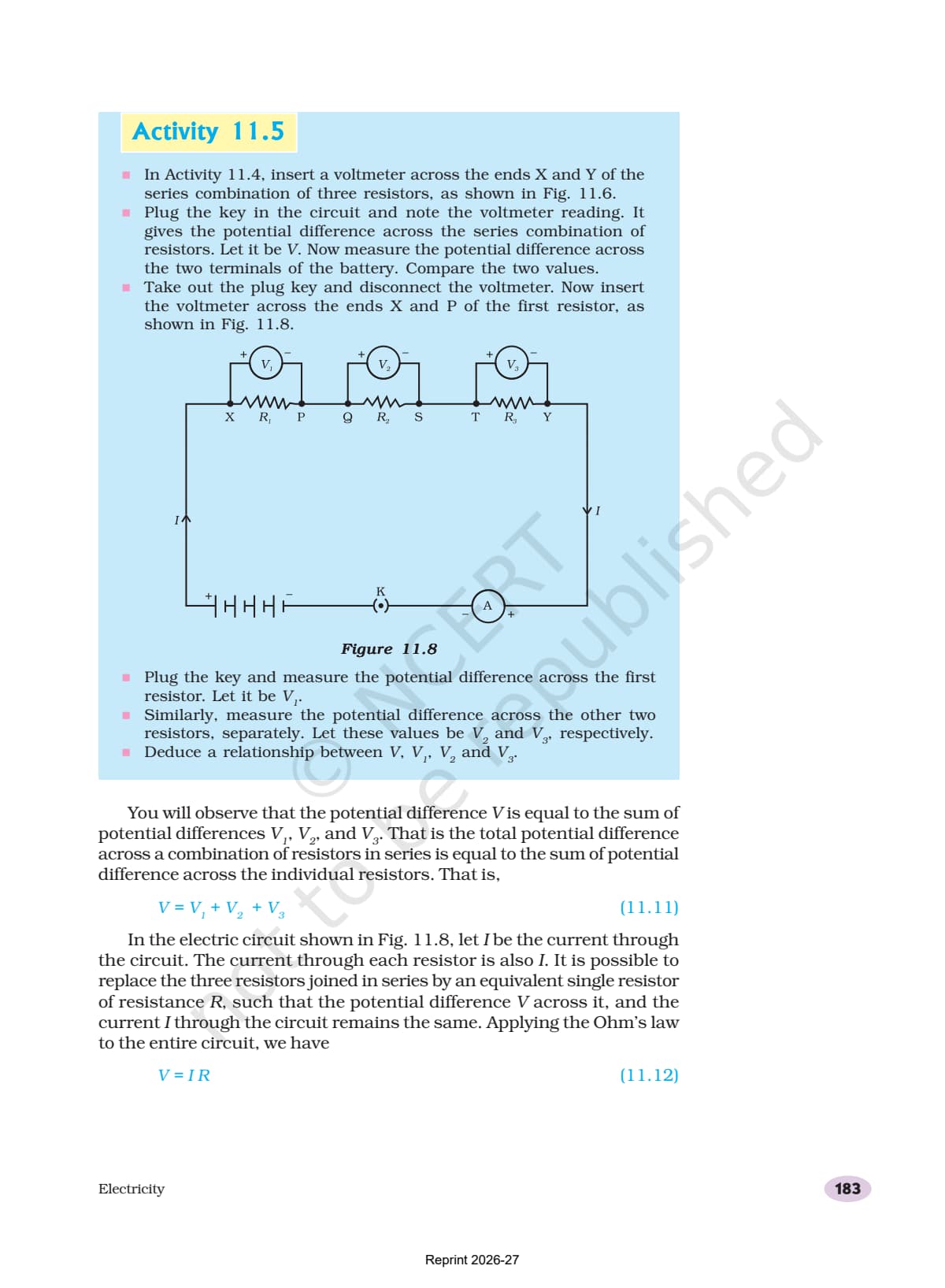
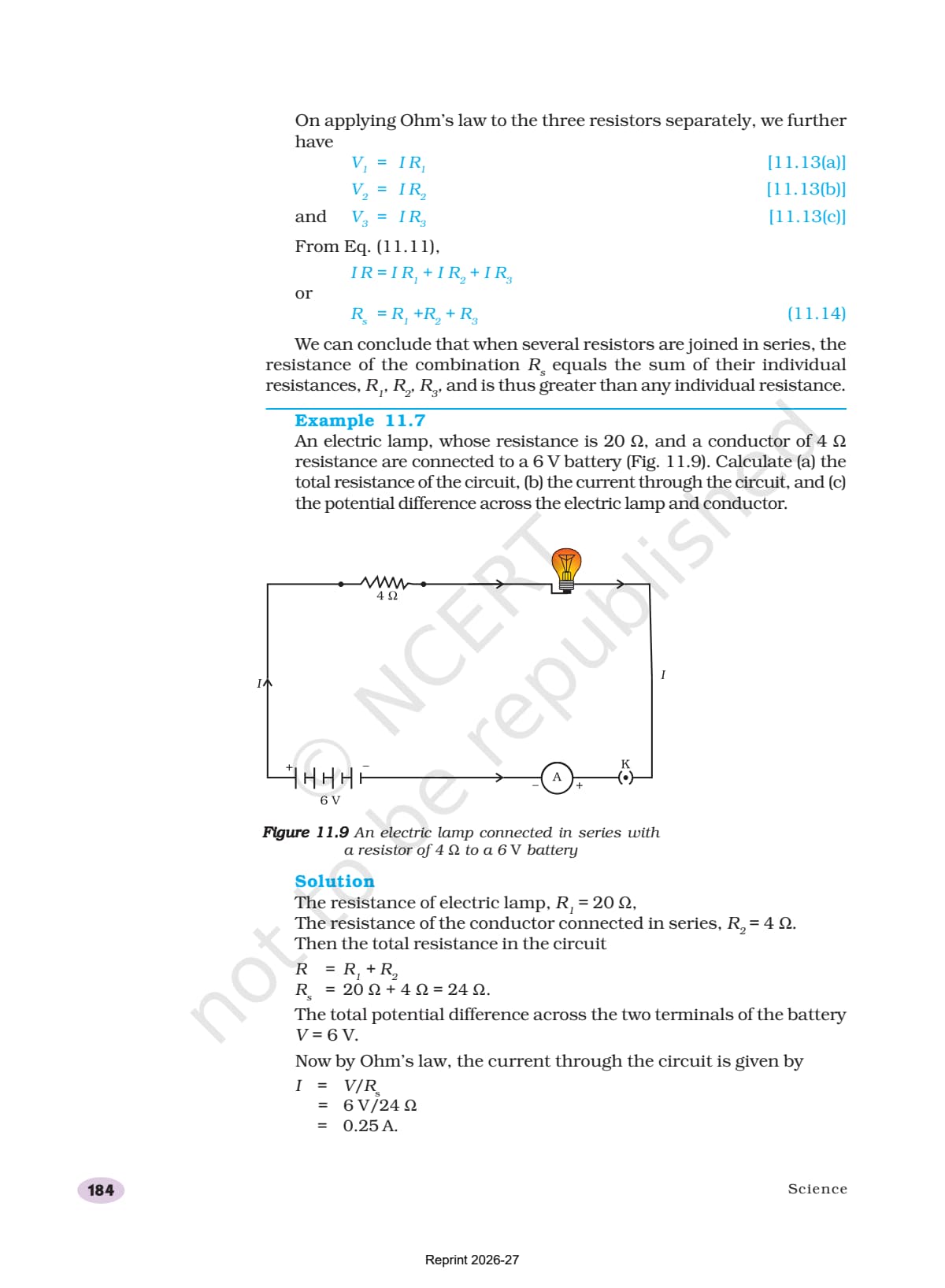
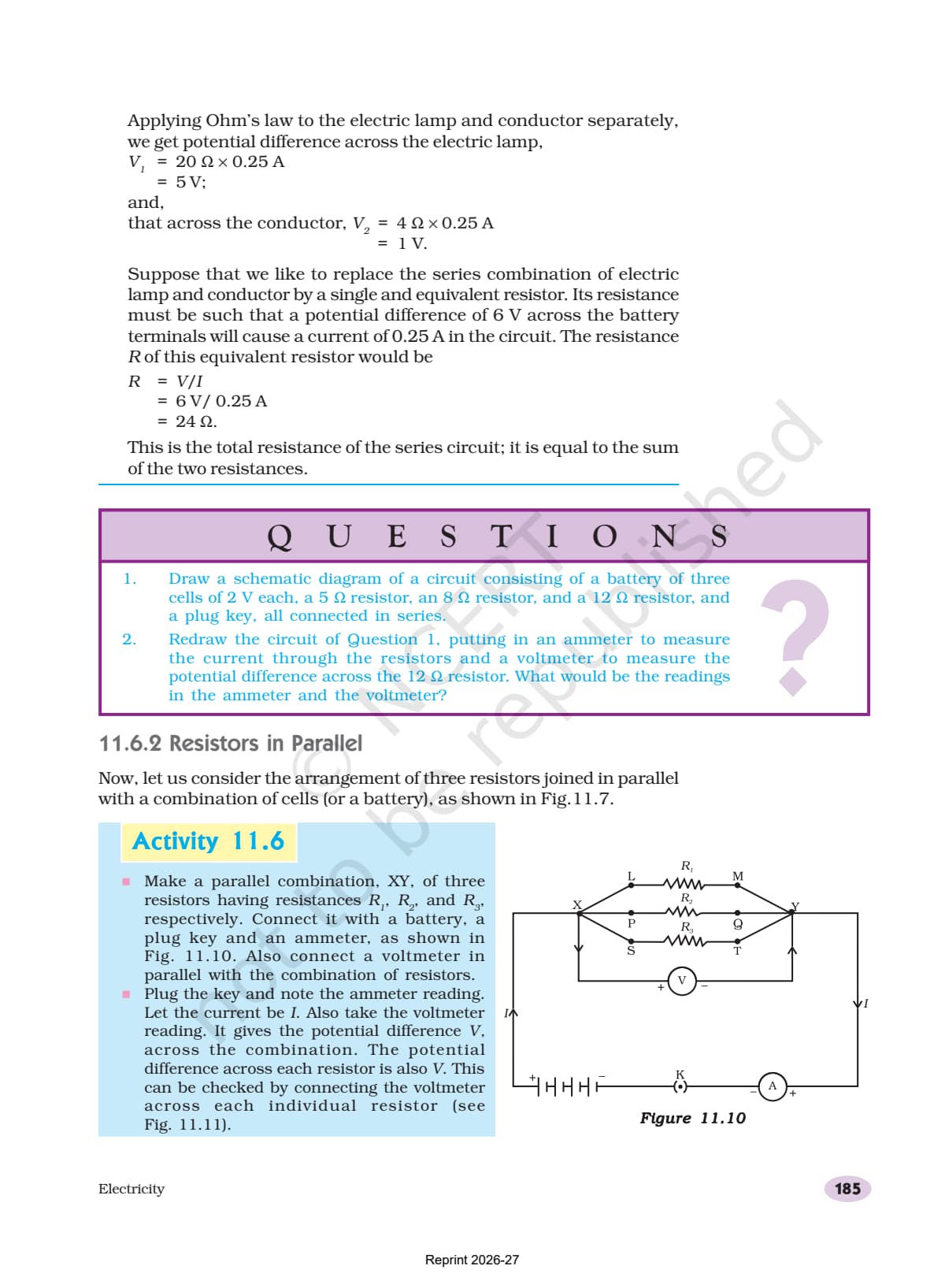
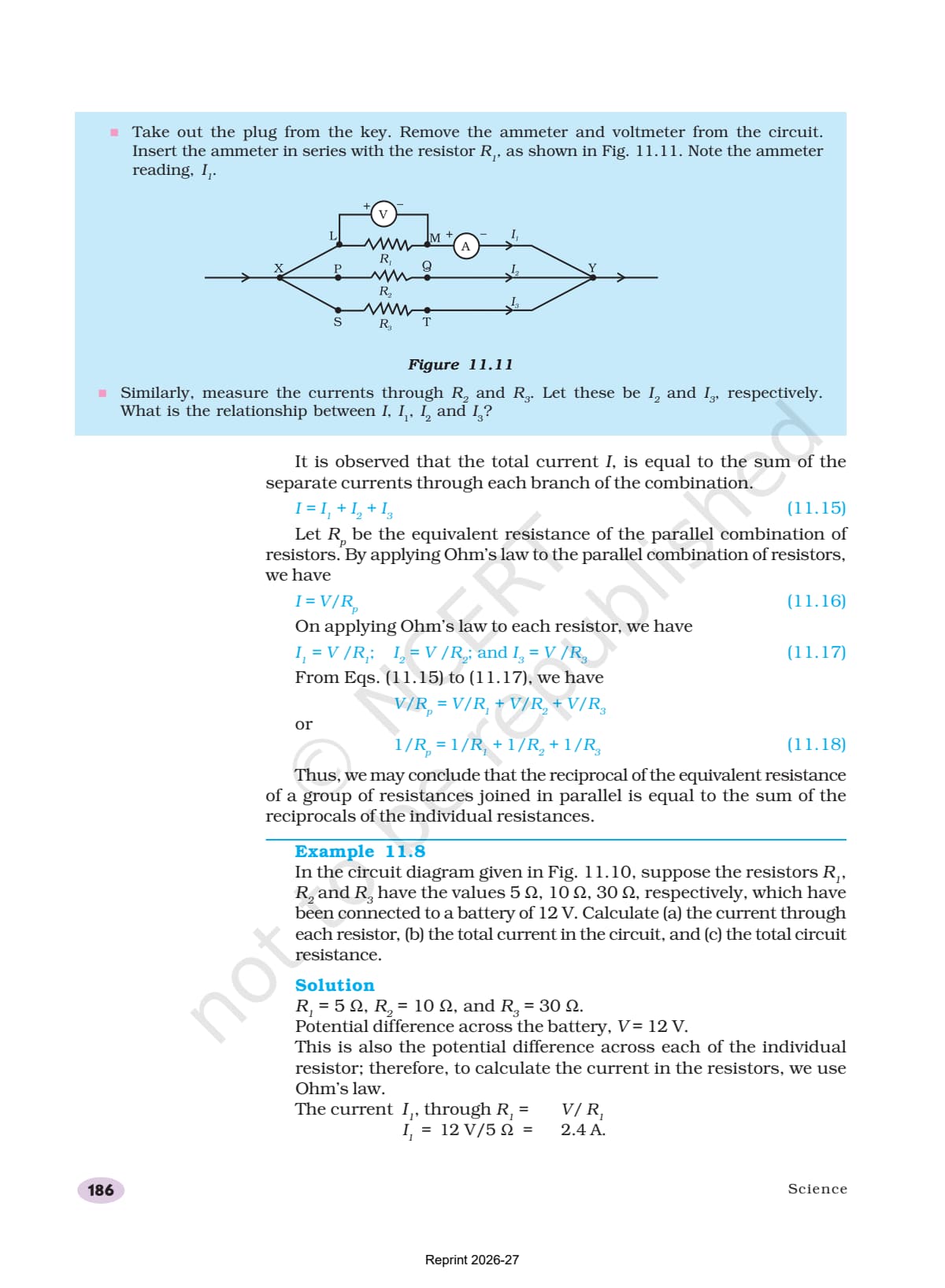
- Official NCERT textbook PDF of Chapter 11, with every activity, circuit diagram, in-text question and exercise exactly as printed.
- Covers electric current and circuit, potential difference, Ohm's law, resistance and resistivity, series and parallel combinations, the heating effect of current, Joule's law and electric power.
- Aligned with the 2026-27 CBSE Class 10 Science syllabus, useful for board exam revision and as the base text for the solutions and notes.
This page hosts the official NCERT Class 10 Science textbook chapter, mapped to the 2026-27 CBSE syllabus and checked page by page against the printed Electricity chapter.
Student Feedback: What 13,400 students told us about this chapter
79% of Class 10 students said the parts they struggled with most were the resistor combination formulae, the difference between series and parallel circuits, and the numericals on electric power and energy. 3 out of 5 students told us that learning Ohm's law and the resistance factors first, then drawing each circuit before solving, was what finally made the chapter click.
Students reported spending on average 5 to 7 hours on the full chapter across the first read and revision, and toppers said writing the correct formula at the top of every numerical, with units, stopped them from losing the easy marks in the board exam.
Source: 2026-27 Class 10 Science student poll. Sample of 13,400 students from CBSE schools across 13 states, taken before the 2026 board exams.
What the NCERT Book for Class 10 Science Chapter 11 Electricity Covers
The PDF above is the complete official NCERT chapter for 2026-27. It begins with electric current and the electric circuit, then potential difference, the central Ohm's law, and the factors that decide the resistance of a wire. The second half covers resistors in series and parallel, the heating effect with Joule's law, and electric power with the commercial unit of energy.
- Current and circuit: electric current, the ampere, and how a cell, ammeter and voltmeter connect.
- Potential difference and Ohm's law: the volt, V = IR, and ohmic conductors.
- Resistance and resistivity: how length, area and material change resistance.
- Power and heating effect: Joule's law H = I²Rt, power P = VI, and the kilowatt hour.
Electricity Class 10 Science Full Chapter Video
Source: Magnet Brains on YouTube
Electric Current and Electric Circuit in Class 10 Science Chapter 11
An electric current is a flow of electric charge through a conductor. Current is the rate of flow of charge, so current I is the charge Q across a cross-section divided by the time t. In symbols, I = Q/t.
Here charge Q is in coulomb (C), current I in ampere (A) and time t in second (s). One ampere is the current when one coulomb flows in one second, so 1 A = 1 C/s. Conventional current is taken as opposite to the electron flow, because the convention was fixed before the electron was discovered. An ammeter measures current and is connected in series, while a cell provides the push that keeps charge flowing.
Electric Potential and Potential Difference in Class 10 Science Chapter 11
Charges flow only when there is a difference of electric pressure, called the potential difference, set up by a cell. It is the work done to move a unit charge between two points, so V is the work W divided by the charge Q. In symbols, V = W/Q.
One volt is 1 joule of work to move 1 coulomb (1 V = 1 J/C). Potential difference is measured by a voltmeter, connected in parallel across the two points. The cell maintains the potential difference, the steady "electric pressure" that keeps the current going. Without a source of potential difference, the circuit carries no current.
- Ammeter: measures current, connected in series, ideally zero resistance.
- Voltmeter: measures potential difference, connected in parallel, ideally very high resistance.
- Cell or battery: sets up and maintains the potential difference.
Ohm's Law: Current, Voltage and Resistance in Class 10 Science
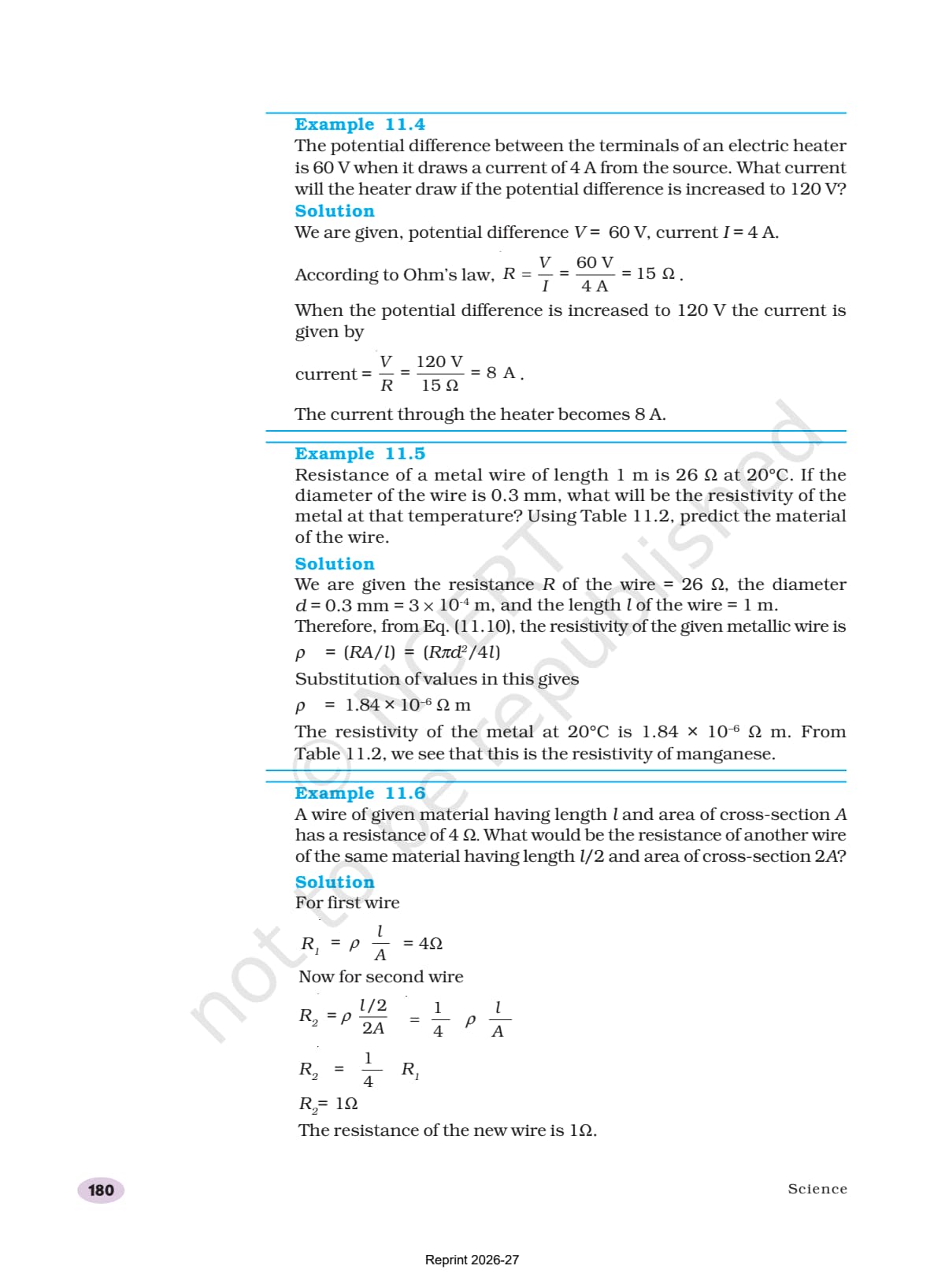
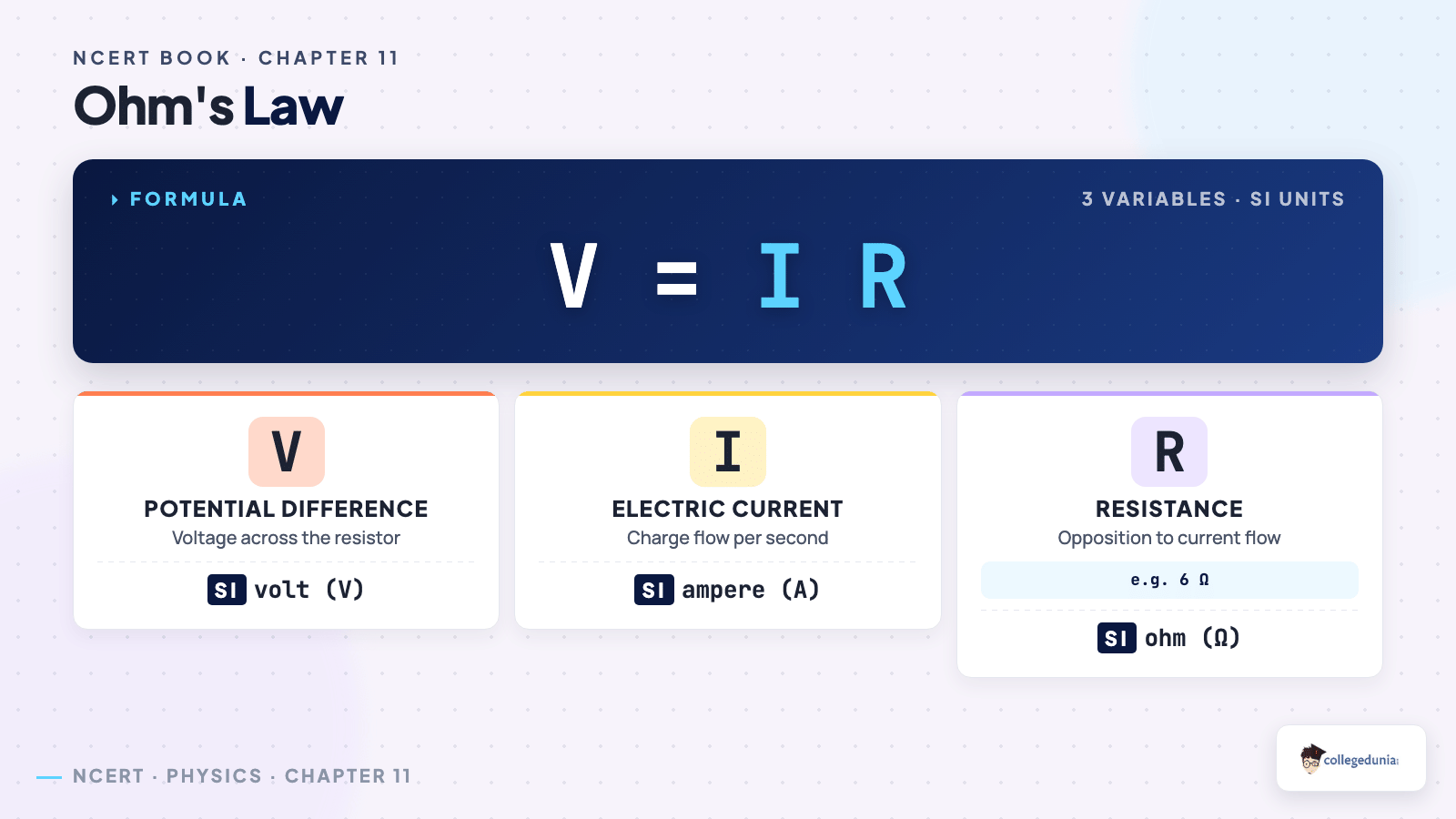
Ohm's law states that the current through a conductor is directly proportional to the potential difference across it, at constant temperature. It is written V = IR, where V is the potential difference, I the current, and R the resistance. R is the constant of proportionality, and its SI unit is the ohm (Ω).
A conductor that obeys Ohm's law is an ohmic conductor; its V-I graph is a straight line through the origin whose slope gives the resistance. One ohm is the resistance through which 1 ampere flows when 1 volt is applied. A larger resistance means a smaller current for the same voltage, the idea behind a rheostat.
Resistance, Resistivity and Their Factors in Class 10 Science Chapter 11
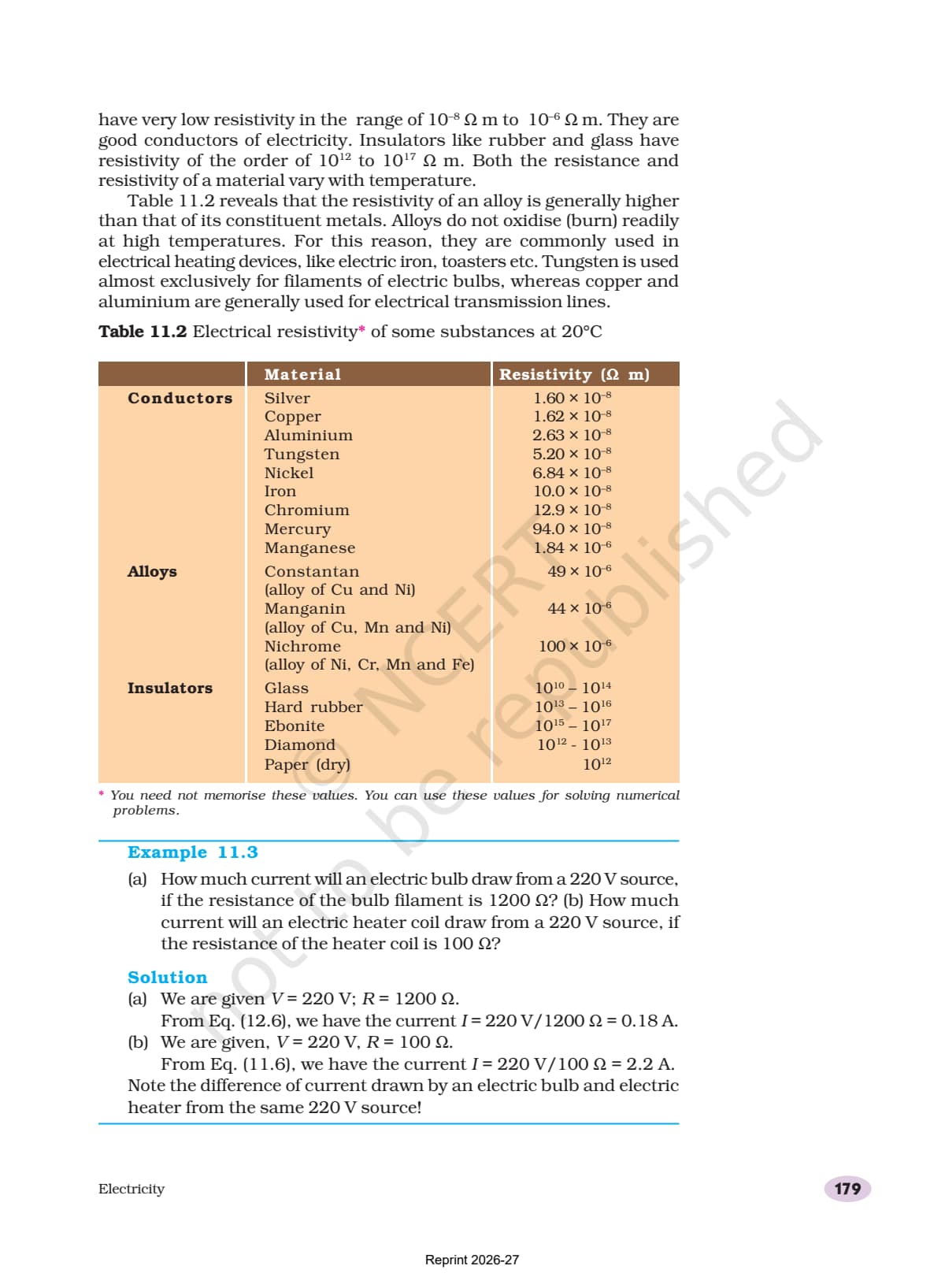
Resistance is the property that opposes the flow of current. The resistance of a conductor is directly proportional to its length, inversely proportional to its area of cross-section, and depends on the material. Together these give R = ρL/A.
| Factor | Effect on resistance R |
|---|---|
| Length (L) | R increases as the wire gets longer (directly proportional) |
| Area of cross-section (A) | R decreases as the wire gets thicker (inversely proportional) |
| Material (ρ) | Depends on the resistivity of the material |
| Temperature | R of a metal increases as the temperature rises |
The constant ρ (rho) is the resistivity, in ohm metre (Ω m), a property of the material alone. Alloys like nichrome have higher resistivity than pure metals, which is why nichrome is used in heating elements. Copper and aluminium, with very low resistivity, are used for home wiring.
- Good conductors: copper, silver, aluminium, very low resistivity.
- Alloys: nichrome, constantan, manganin, higher resistivity that barely changes with temperature.
- Insulators: rubber, glass, ebonite, extremely high resistivity.
Resistors in Series and in Parallel in Class 10 Science Chapter 11
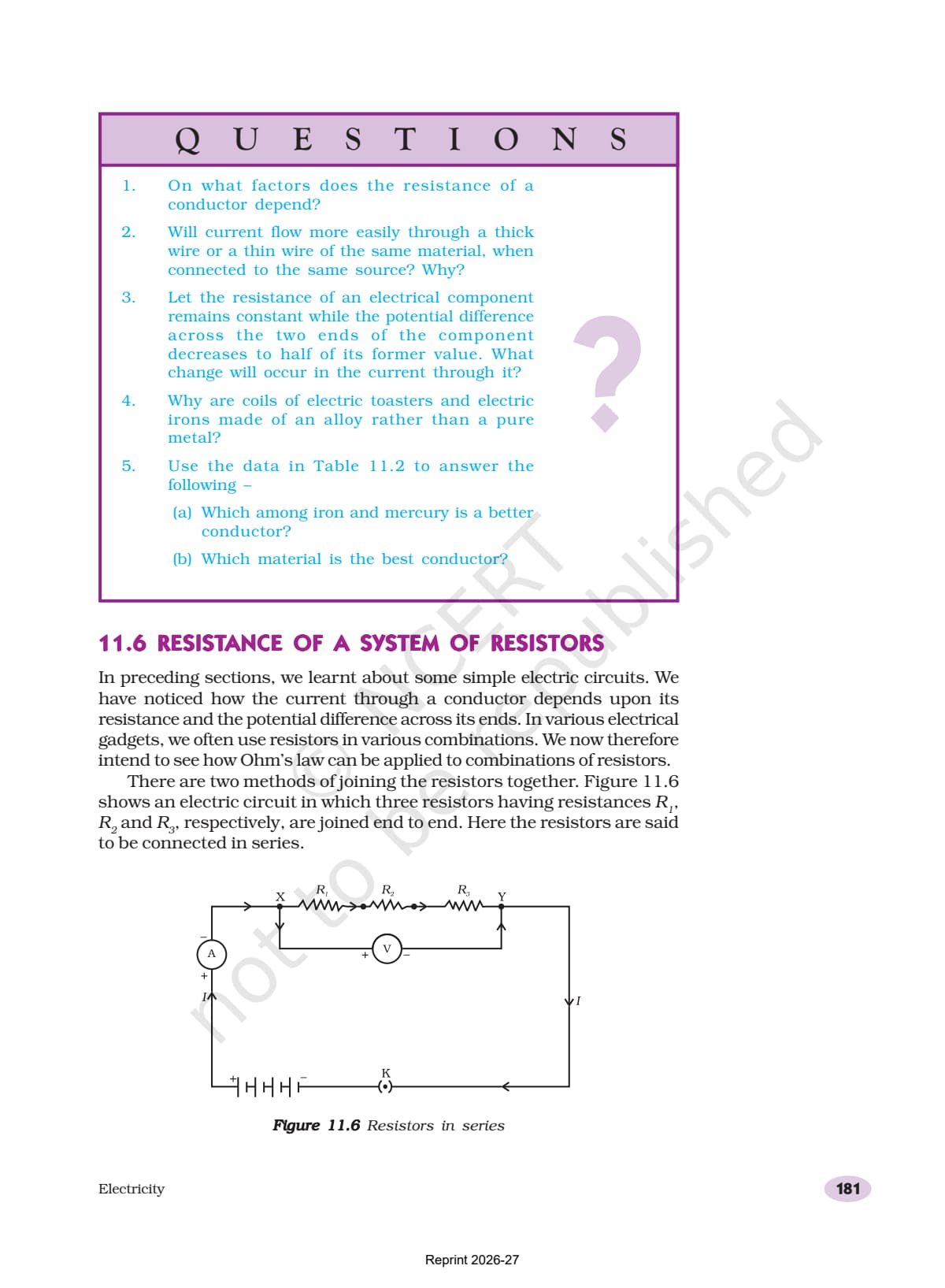
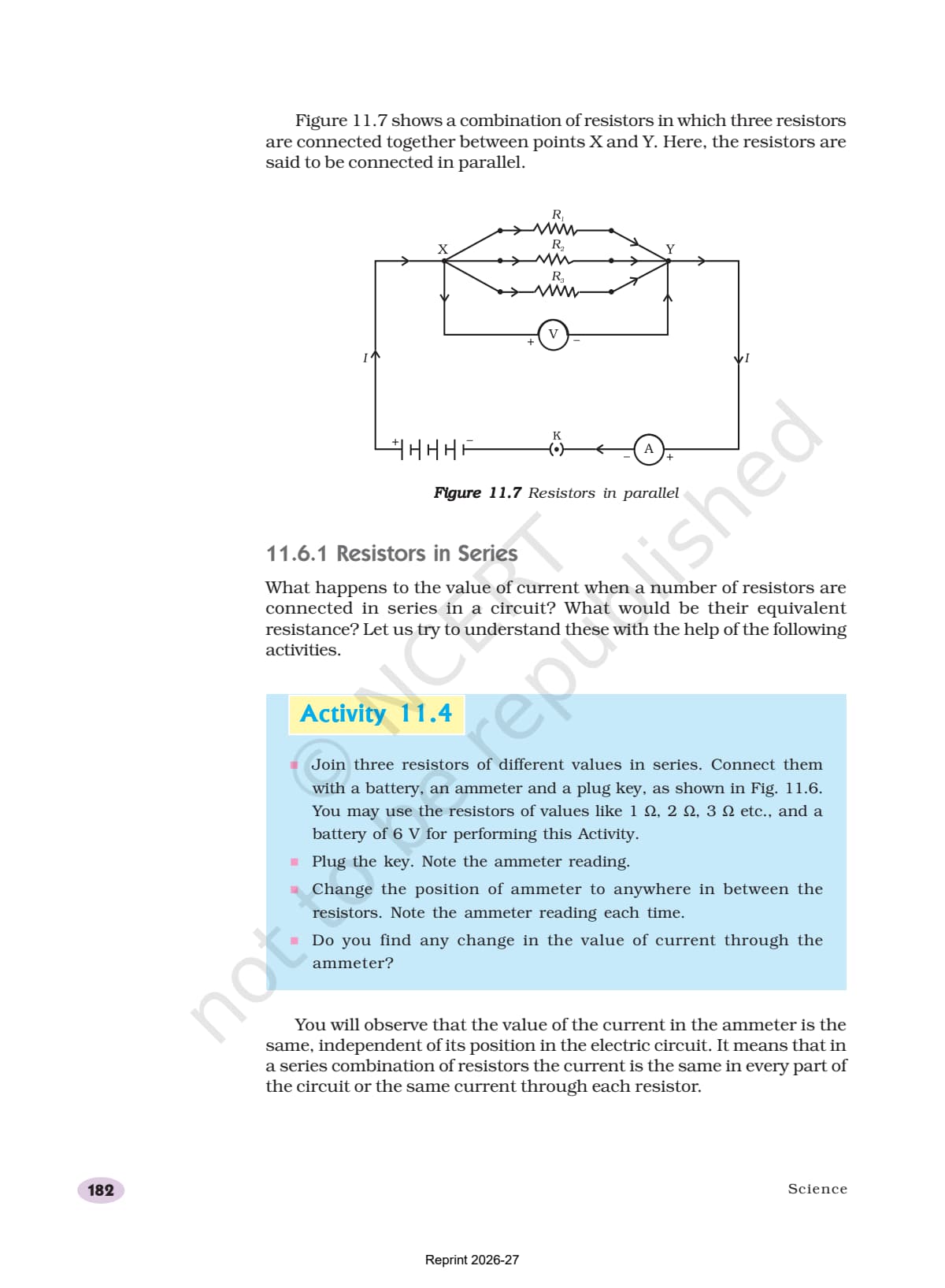
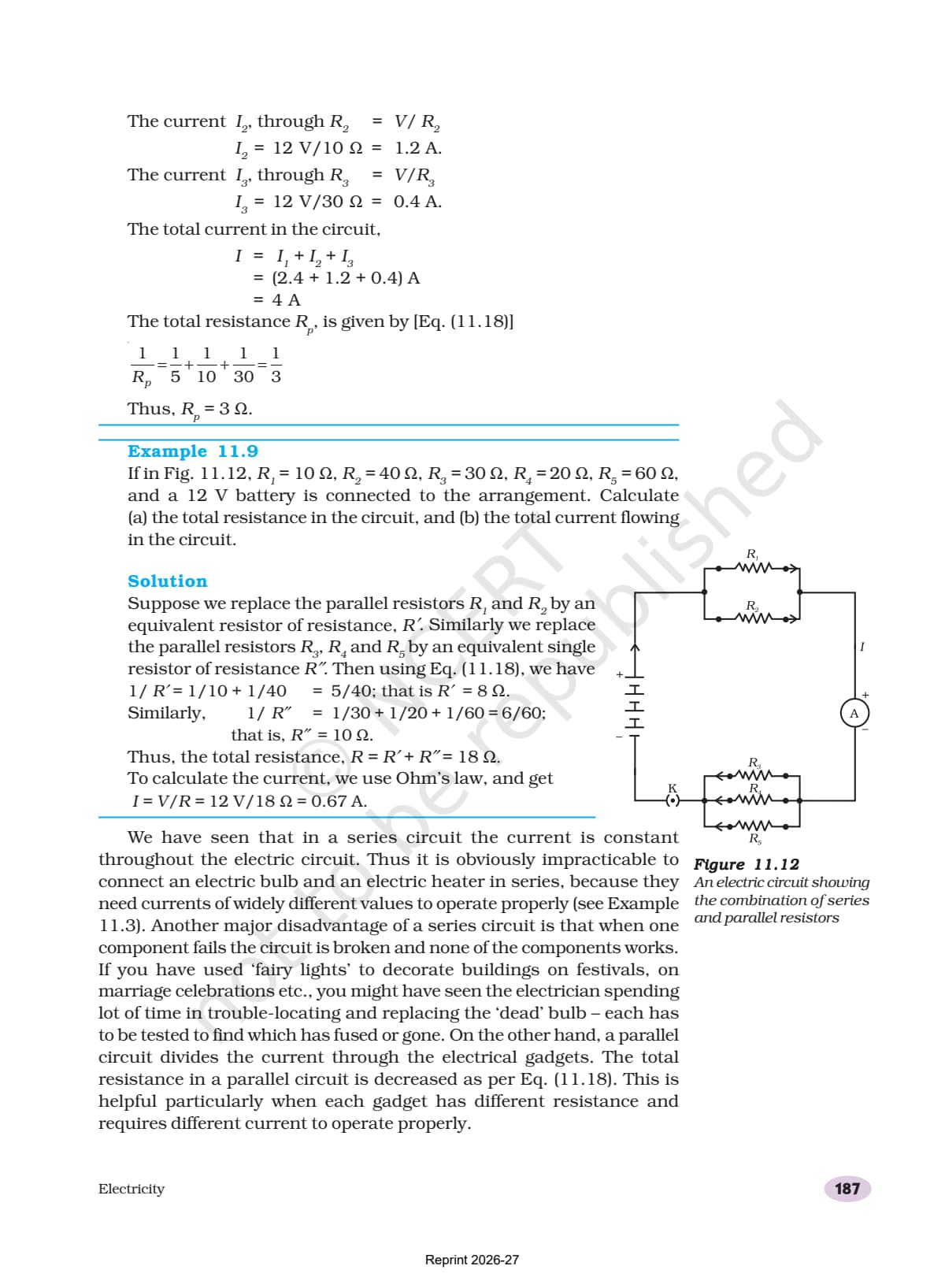
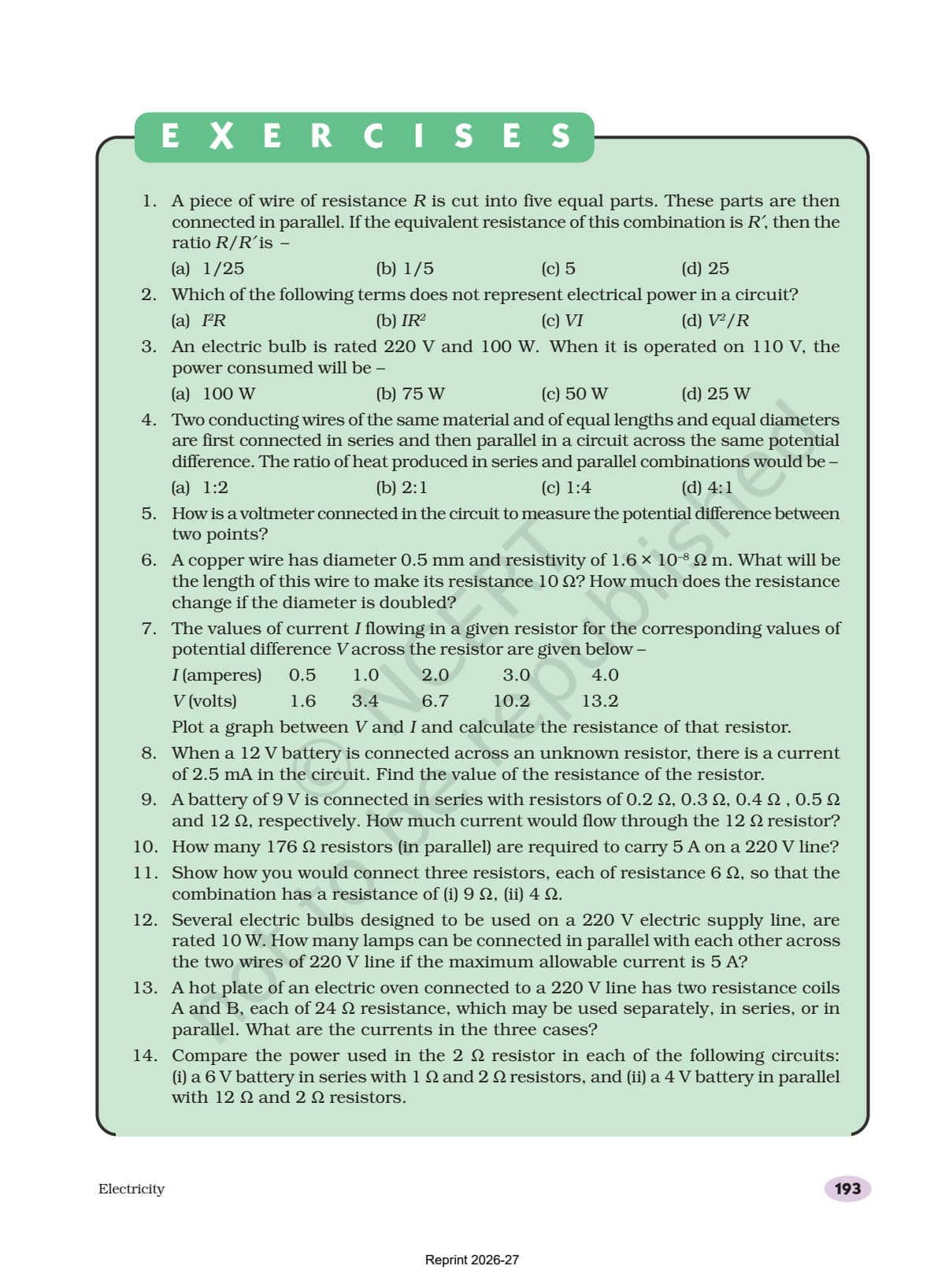
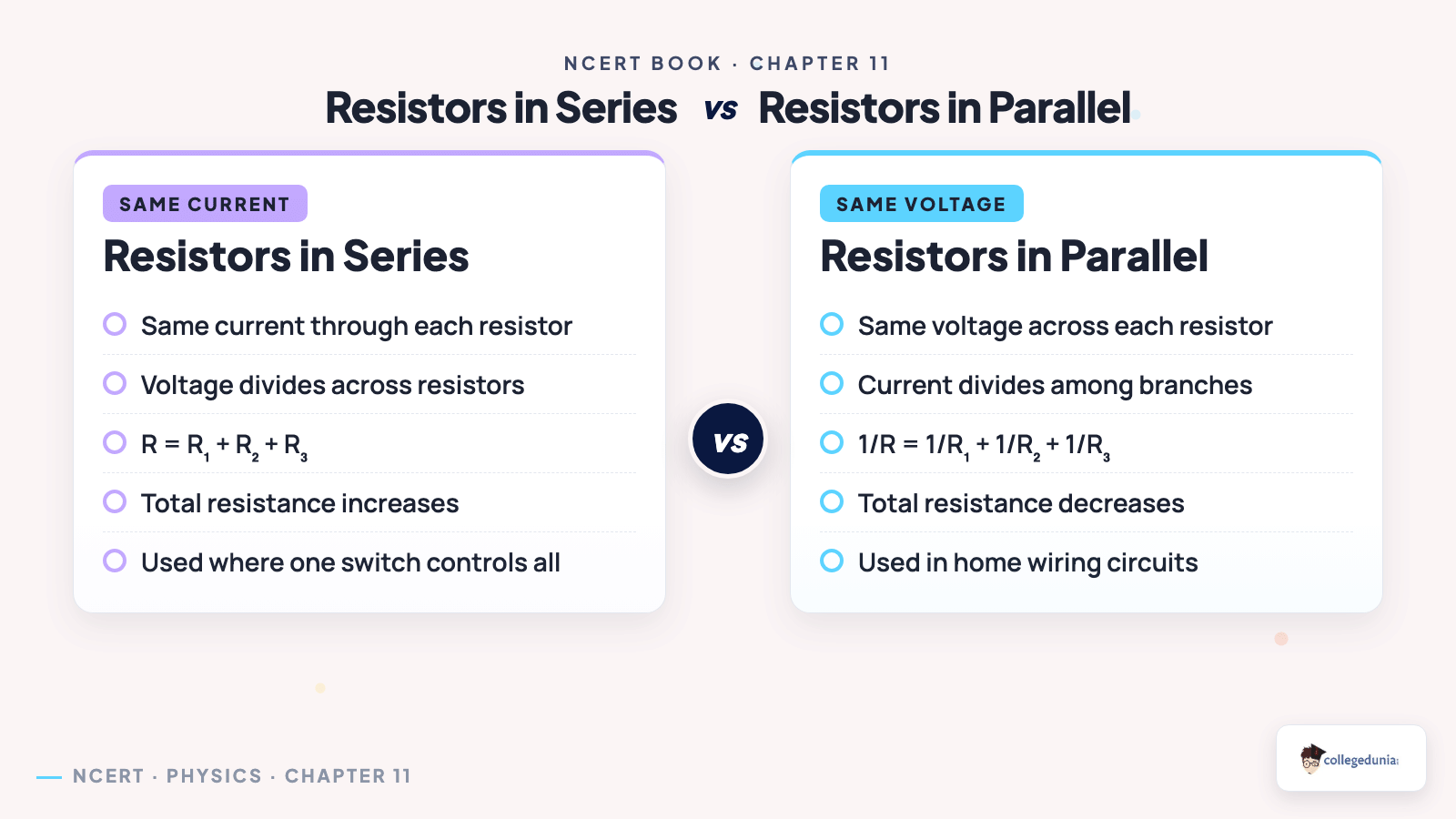
In a series combination the resistors are joined end to end, so the same current flows through each and the voltage is shared. In a parallel combination they are joined between the same two points, so each gets the full voltage and the current splits among the branches. These two rules are the most tested numerical idea in the chapter.
| Feature | Series combination | Parallel combination |
|---|---|---|
| Current | Same through every resistor | Divides among the branches |
| Voltage | Divides across the resistors | Same across every resistor |
| Equivalent resistance | R = R₁ + R₂ + R₃ | 1/R = 1/R₁ + 1/R₂ + 1/R₃ |
| Effect on total R | Larger than the biggest resistor | Smaller than the smallest resistor |
In series the equivalent resistance is the simple sum; in parallel the reciprocals add, so total resistance is less than the smallest branch. This is why home appliances are wired in parallel: each gets the full 220 V and keeps working even if another is switched off.
Heating Effect of Electric Current and Joule's Law in Class 10 Science
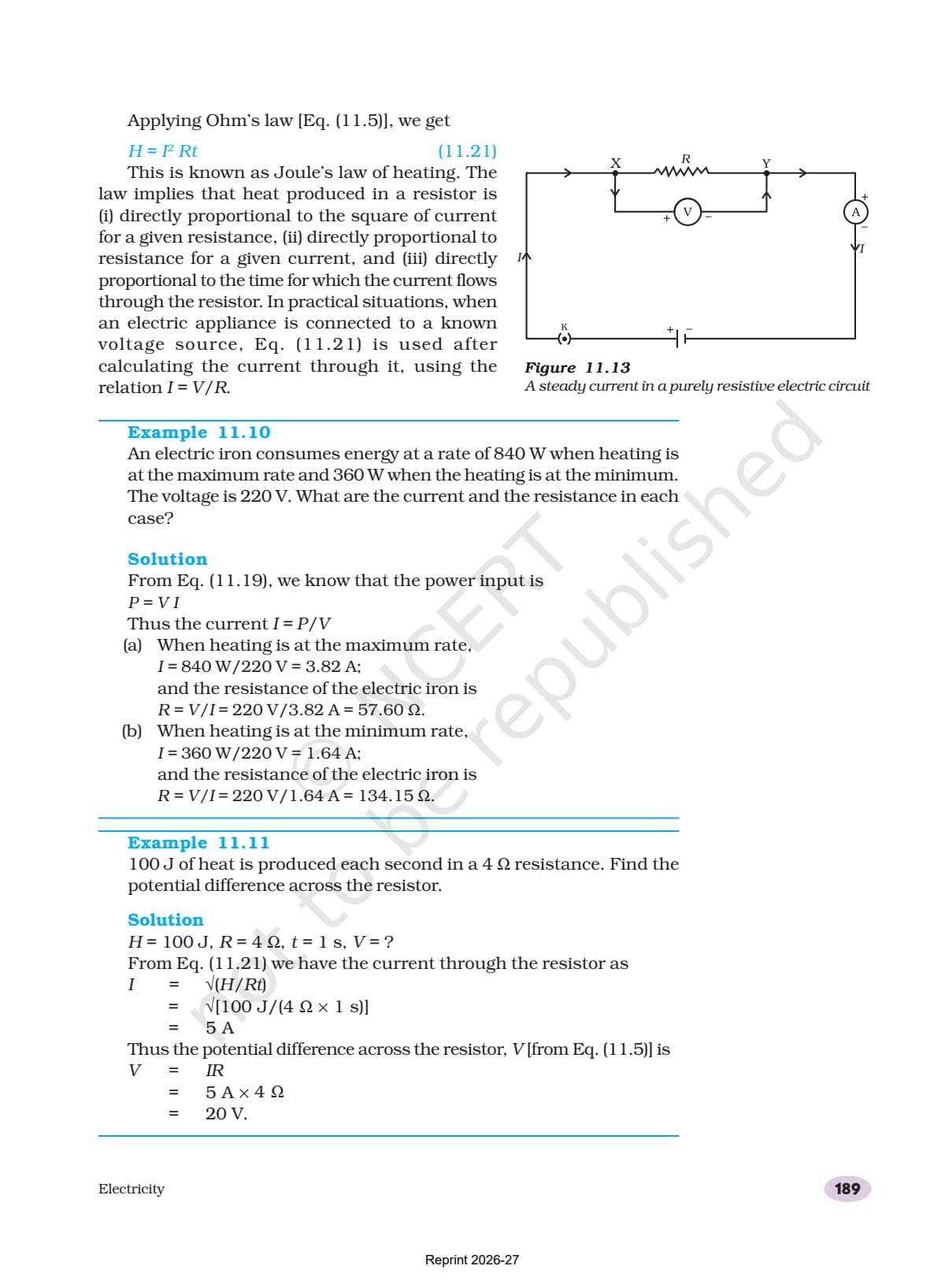
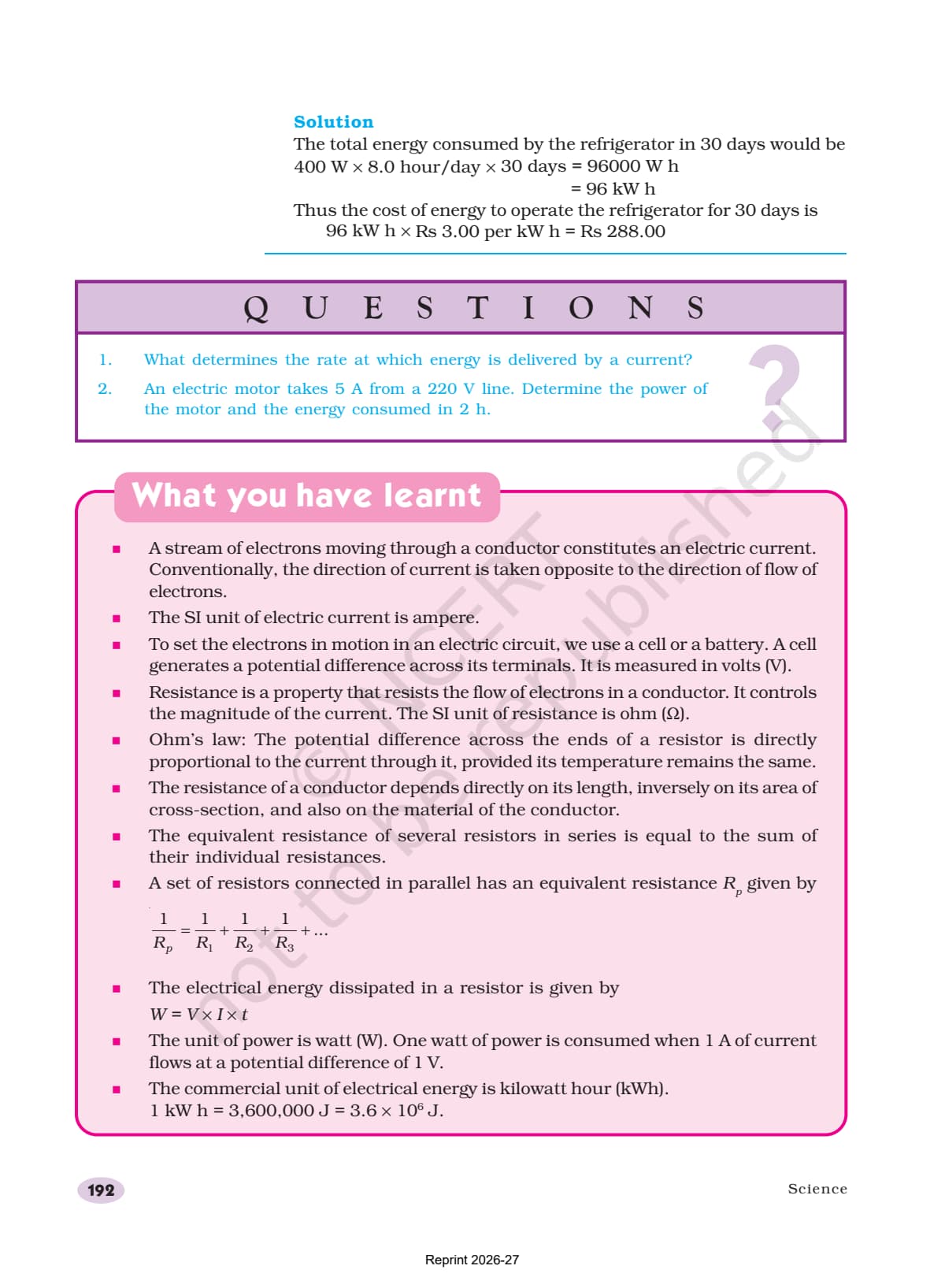
When current flows through a resistor, electrical energy is converted into heat, the heating effect of electric current. Joule's law states that the heat produced is directly proportional to the square of the current, the resistance, and the time. In symbols, H = I²Rt.
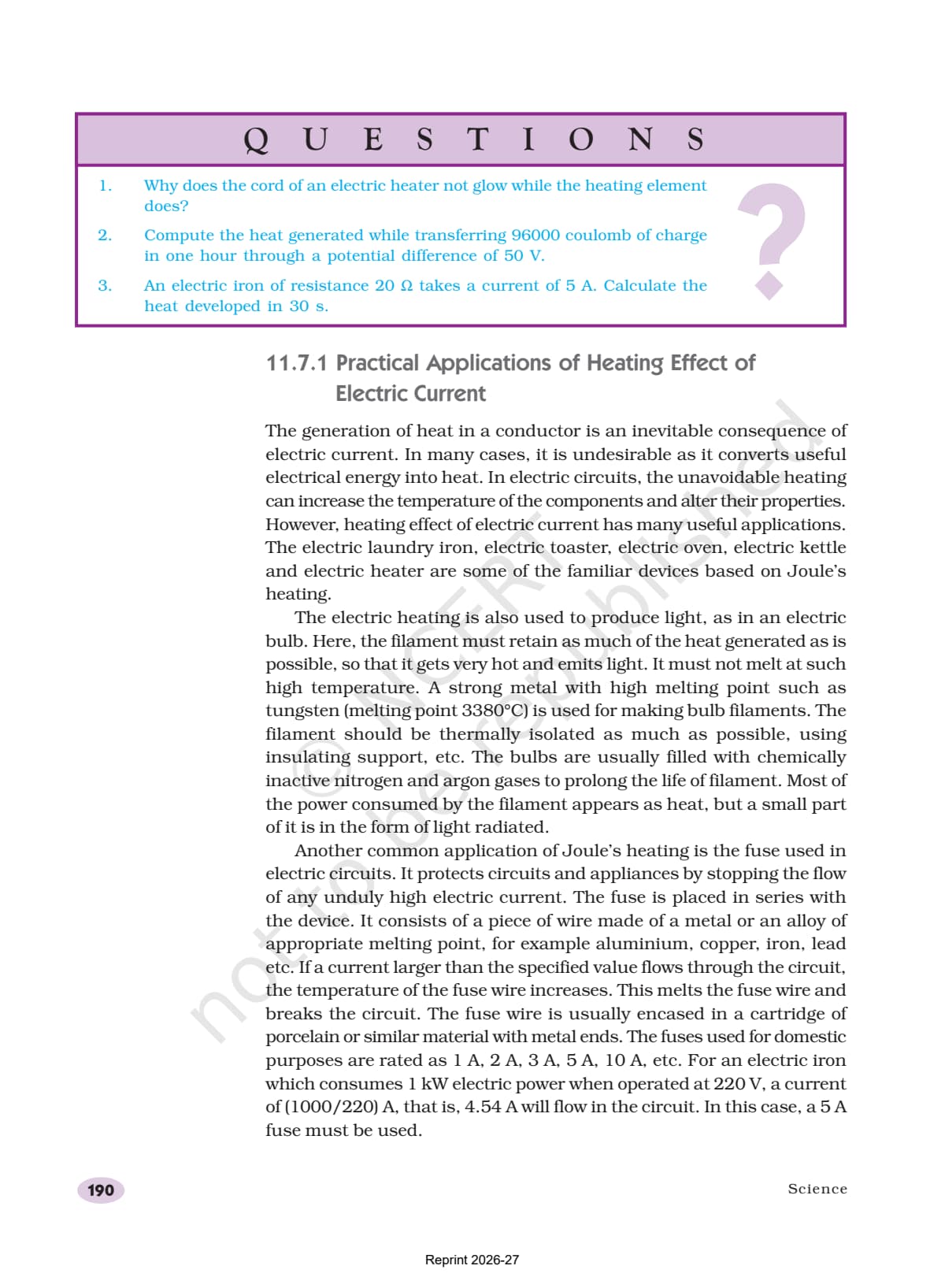
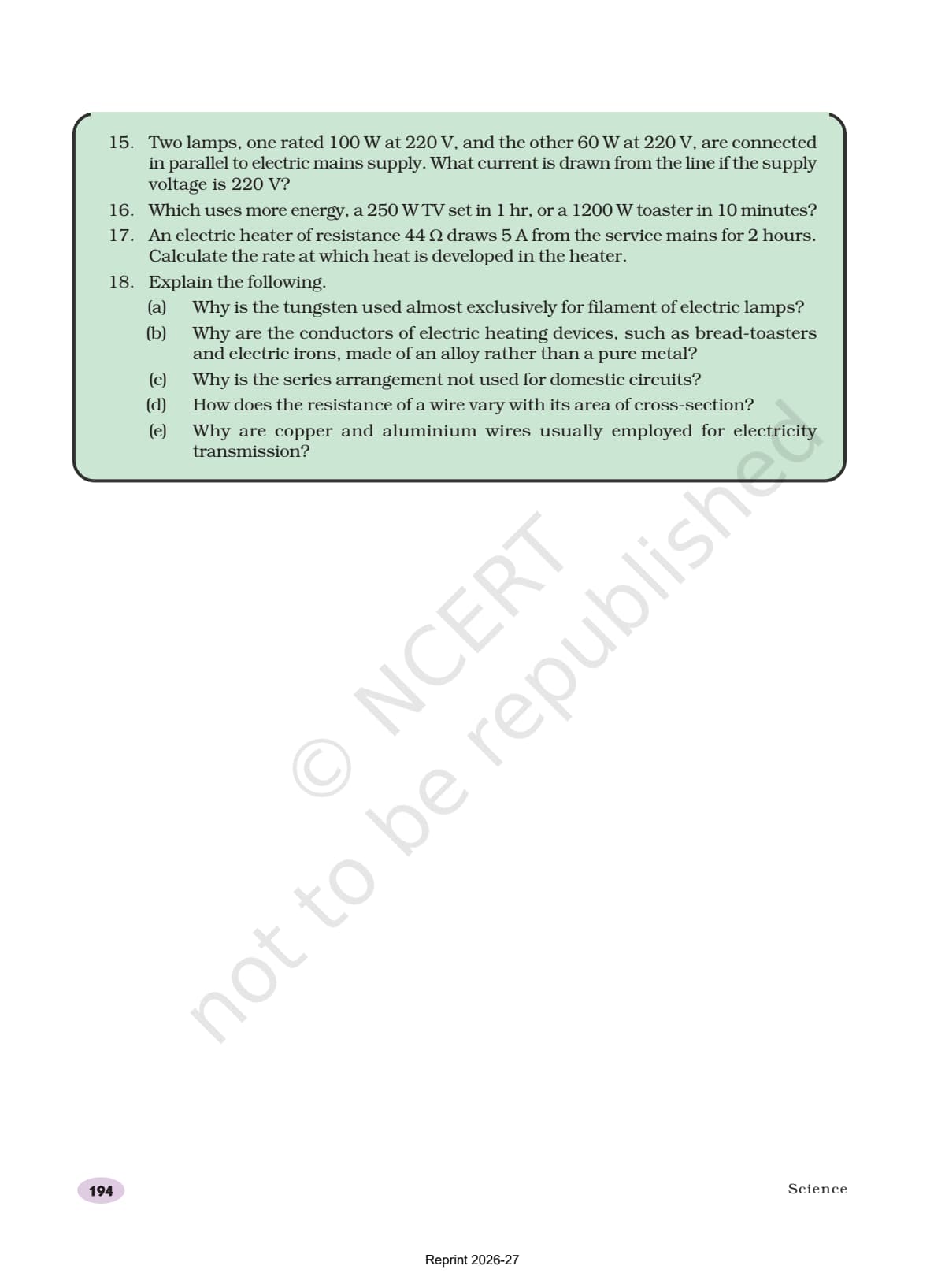
Here H is the heat in joule (J), I the current in ampere (A), R the resistance in ohm (Ω) and t the time in second (s). Electric heaters, irons, toasters, geysers and incandescent bulb filaments all work on the heating effect, using a coil of high-resistance, high-melting-point alloy like nichrome. The same effect runs an electric fuse, a thin low-melting-point wire that melts and breaks the circuit when the current rises too high, protecting the wiring.
Electric Power, Energy and Common Exam Traps in Class 10 Science Chapter 11
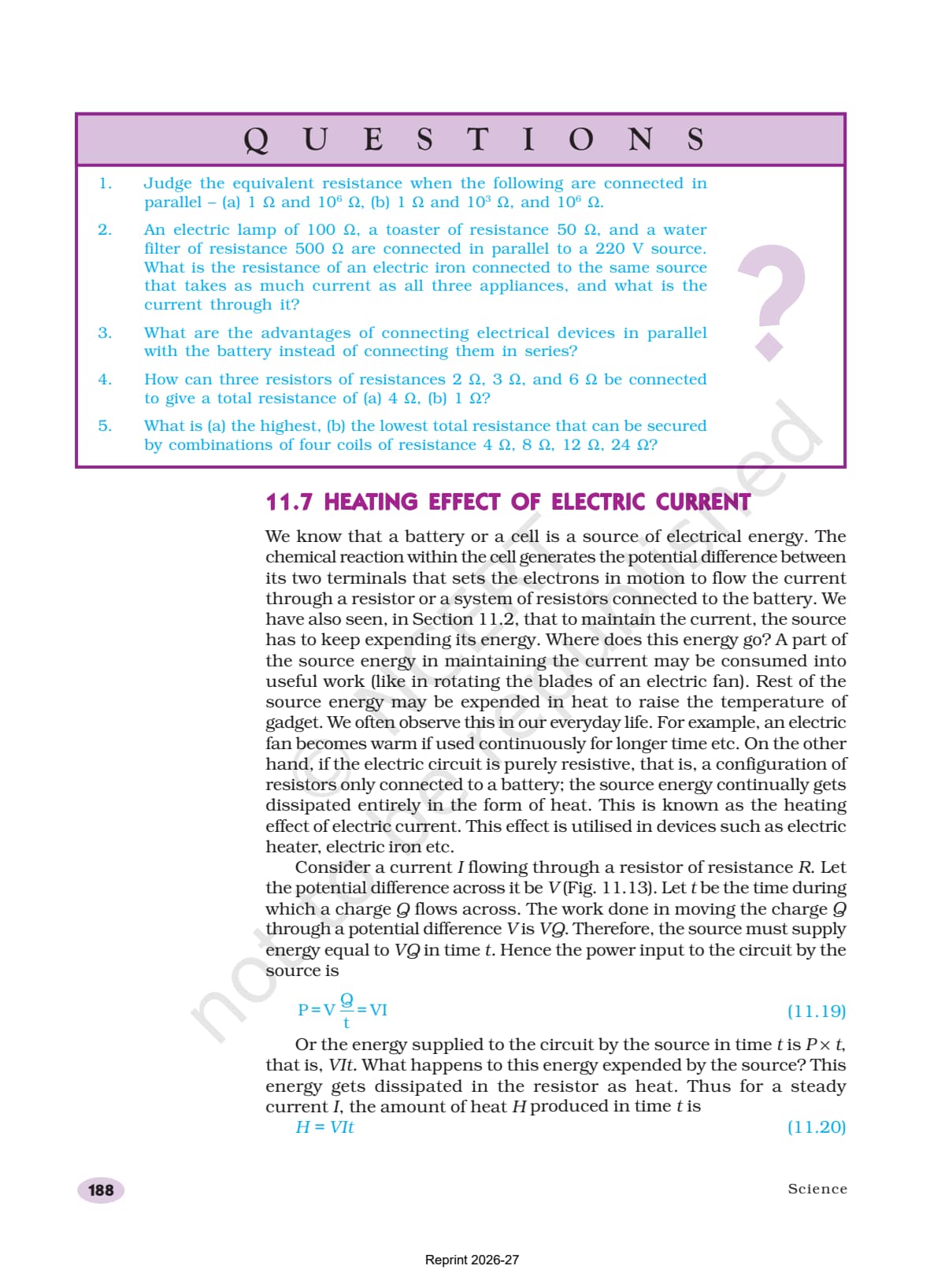
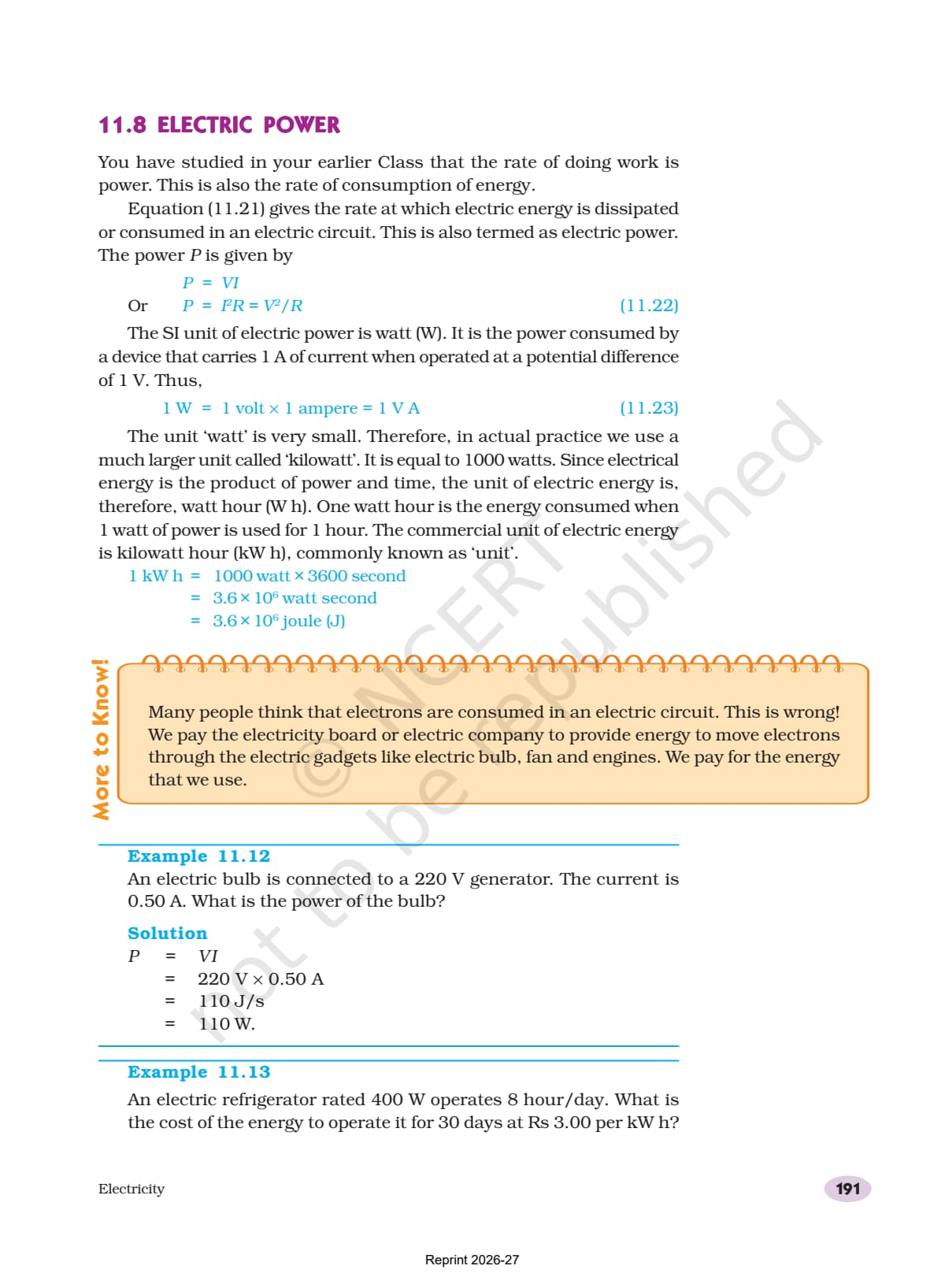
Electric power is the rate at which electrical energy is used. It is P = VI, and using Ohm's law also P = I²R or P = V²/R. The SI unit is the watt (W), one joule per second; a thousand watts make one kilowatt.
| Quantity | Formula | Unit |
|---|---|---|
| Electric power | P = VI = I²R = V²/R | watt (W) |
| Electrical energy | W = P × t = VIt | joule (J) |
| Commercial unit of energy | 1 kWh = 3.6 × 10⁶ J | kilowatt hour (kWh) |
The commercial unit of electrical energy is the kilowatt hour (kWh), one "unit" on the bill. One kWh is the energy used by a 1 kilowatt appliance running for 1 hour, equal to 3.6 million joules. A typical board numerical asks the cost of running an appliance at a given rate per unit.
Repeat-offender mistakes in Electricity board answers:
- Mixing series and parallel formulae: series resistances add, parallel reciprocals add; do not swap them.
- Wrong meter connection: ammeter in series, voltmeter in parallel.
- Forgetting to convert units: change minutes to seconds and kilowatt to watt before substituting.
Other Resources for Class 10 Science Chapter 11 Electricity
Read the official NCERT Book chapter above, then revise with the matching NCERT Solutions, revision notes, formula sheet and handwritten notes. All resources for Class 10 Science Chapter 11 Electricity are linked in the table below.
| Resource | What it covers | Open |
|---|---|---|
| NCERT Book PDF | Official Class 10 Science Chapter 11 textbook, with every activity, circuit diagram and exercise. | You are here |
| NCERT Solutions | Step-by-step answers to all in-text and exercise questions of the chapter. | Class 10 Science Chapter 11 NCERT Solutions |
| Notes | Concept-first revision notes on current, Ohm's law, resistance, combinations and electric power. | Class 10 Science Chapter 11 Notes |
| Formula Sheet | Quick reference of Ohm's law, resistance, series and parallel, Joule's law and power. | Class 10 Science Chapter 11 Formula Sheet |
| Handwritten Notes | Scanned-style handwritten pages for last-minute board revision. | Class 10 Science Chapter 11 Handwritten Notes |
NCERT Book for Class 10 Science: All Chapters
Related Links: Use the table below to open the official NCERT Book PDF for the other chapters of Class 10 Science. Every chapter ships with the same official textbook PDF, chapter overview, and board-ready FAQ.
| Chapter | NCERT Book PDF link |
|---|---|
| Chapter 1 | Chemical Reactions and Equations NCERT Book PDF |
| Chapter 2 | Acids, Bases and Salts NCERT Book PDF |
| Chapter 3 | Metals and Non-metals NCERT Book PDF |
| Chapter 4 | Carbon and its Compounds NCERT Book PDF |
| Chapter 5 | Life Processes NCERT Book PDF |
| Chapter 6 | Control and Coordination NCERT Book PDF |
| Chapter 7 | How do Organisms Reproduce NCERT Book PDF |
| Chapter 8 | Heredity NCERT Book PDF |
| Chapter 9 | Light Reflection and Refraction NCERT Book PDF |
| Chapter 10 | The Human Eye and the Colourful World NCERT Book PDF |
| Chapter 11 | Electricity NCERT Book PDF (You are here) |
| Chapter 12 | Magnetic Effects of Electric Current NCERT Book PDF |
| Chapter 13 | Our Environment NCERT Book PDF |
NCERT Book Class 10 Science Chapter 11 Electricity FAQs
Ques. What does Chapter 11 Electricity cover in the Class 10 Science NCERT Book?
Ans. Chapter 11 of the Class 10 Science NCERT Book covers how electric charge flows in a circuit. It begins with electric current and the parts of an electric circuit, then explains electric potential and potential difference, the meaning of the volt, and Ohm's law V = IR linking voltage, current and resistance. It goes on to the resistance of a conductor and the factors it depends on, namely length, area of cross-section and the resistivity of the material. The second half covers resistors in series and parallel, the heating effect of electric current with Joule's law H = I²Rt, and electric power P = VI with the kilowatt hour as the commercial unit of energy. It is aligned with the 2026-27 CBSE syllabus.
Ques. What is Ohm's law in Class 10 Science Chapter 11 Electricity?
Ans. Ohm's law states that the electric current flowing through a conductor is directly proportional to the potential difference across its ends, provided its temperature stays the same. It is written as V = IR, where V is the potential difference in volts, I is the current in amperes and R is the resistance in ohms. From this you can also write I = V/R and R = V/I. A conductor that obeys this law is called an ohmic conductor, and a graph of V against I for it is a straight line passing through the origin whose slope gives the resistance. Ohm's law is the central relation of the chapter and is used in almost every numerical.
Ques. On what factors does the resistance of a conductor depend?
Ans. The resistance of a conductor depends on three things: its length, its area of cross-section and the material it is made of, with temperature as an extra factor. Resistance is directly proportional to the length of the wire, so a longer wire has more resistance, and it is inversely proportional to the area of cross-section, so a thicker wire has less resistance. The material enters through its resistivity, written R = ρL/A, where ρ is the resistivity. Metals like copper have very low resistivity and are good conductors, while alloys like nichrome have higher resistivity and are used in heating elements. For most metals the resistance also rises as the temperature increases.
Ques. What is the difference between resistors in series and in parallel?
Ans. In a series combination the resistors are joined end to end, so the same current flows through each resistor and the total voltage is shared between them. The equivalent resistance is the simple sum, R = R₁ + R₂ + R₃, which is larger than the biggest resistor. In a parallel combination the resistors are joined between the same two points, so each resistor gets the full voltage and the current divides among the branches. Here the reciprocal of the equivalent resistance is the sum of the reciprocals, 1/R = 1/R₁ + 1/R₂ + 1/R₃, which is smaller than the smallest resistor. Home appliances are wired in parallel so each gets the full supply voltage and works independently.
Ques. What is the heating effect of electric current and Joule's law?
Ans. When an electric current flows through a resistor, the electrical energy is converted into heat, and this is the heating effect of electric current. Joule's law of heating states that the heat produced is directly proportional to the square of the current, to the resistance of the conductor and to the time for which the current flows, written as H = I²Rt. The heating effect is used in electric heaters, irons, toasters, geysers and the filament of an incandescent bulb, all of which use a high-resistance alloy such as nichrome. The same effect is used in an electric fuse, a thin wire of low melting point that melts and breaks the circuit when the current becomes too large.
Ques. What is electric power and how is it calculated in Class 10 Science Chapter 11?
Ans. Electric power is the rate at which electrical energy is consumed or converted in a circuit. It is given by P = VI, the product of the potential difference and the current, and using Ohm's law it can also be written as P = I²R or P = V²/R. The SI unit of power is the watt (W), where one watt is one joule per second, and one thousand watts make one kilowatt. The electrical energy used is the power multiplied by the time, W = P × t. These forms let you find the power or energy from whichever quantities a numerical provides, and they are the basis of the bill-calculation questions in the chapter.
Ques. What is the commercial unit of electrical energy and how is it related to the joule?
Ans. The commercial unit of electrical energy is the kilowatt hour (kWh), commonly called one unit on the electricity bill. One kilowatt hour is the amount of electrical energy used by an appliance of power one kilowatt when it runs for one hour. In SI units, one kilowatt hour equals 3.6 × 10⁶ joules, because 1 kW is 1000 watts and 1 hour is 3600 seconds, and multiplying the two gives 3,600,000 joules. The joule is the SI unit of energy but it is too small for everyday use, so the electricity meter in homes counts energy in kilowatt hours instead, which is why bill numericals are usually solved in kWh.
Ques. Is the Class 10 Science Chapter 11 Electricity NCERT Book PDF free to download for 2026-27?
Ans. Yes. The official NCERT Book PDF for Class 10 Science Chapter 11 Electricity is free to read and download on this page for the 2026-27 session. It is the complete chapter as printed in the CBSE textbook, including every activity, circuit diagram, in-text question and end-of-chapter exercise. You can pair the book with the linked NCERT Solutions and revision notes for the same chapter so that you read the textbook and revise from one place before the board exam.



Comments