


The NCERT Book for Class 10 Science Chapter 3 Metals and Non-metals is the official CBSE textbook chapter, free to read and download for the 2026-27 session. This chapter explains the physical and chemical properties of metals and non-metals, the reactivity series, how ionic compounds form, the steps used to extract metals from their ores, and the corrosion and prevention of metals.
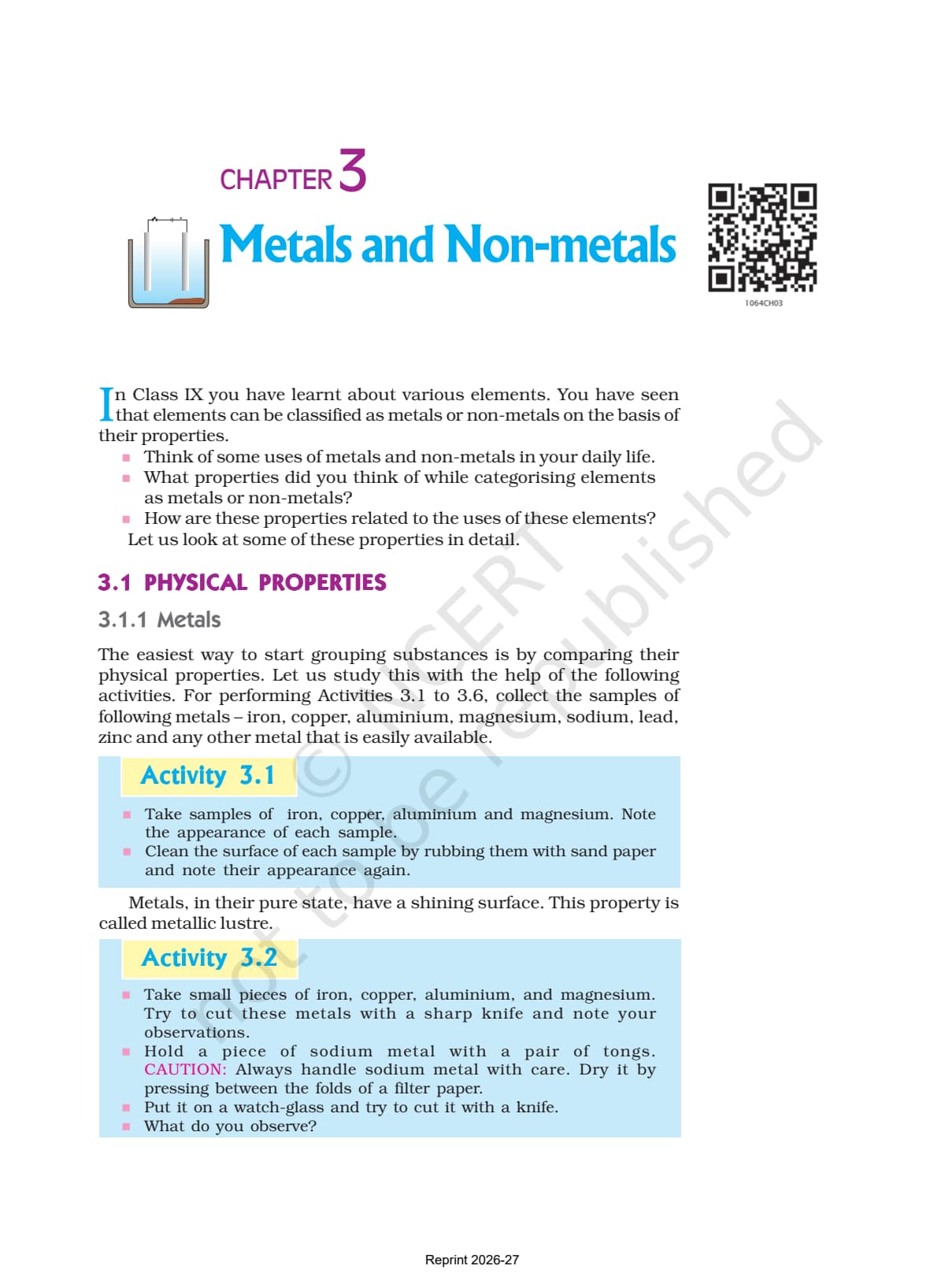
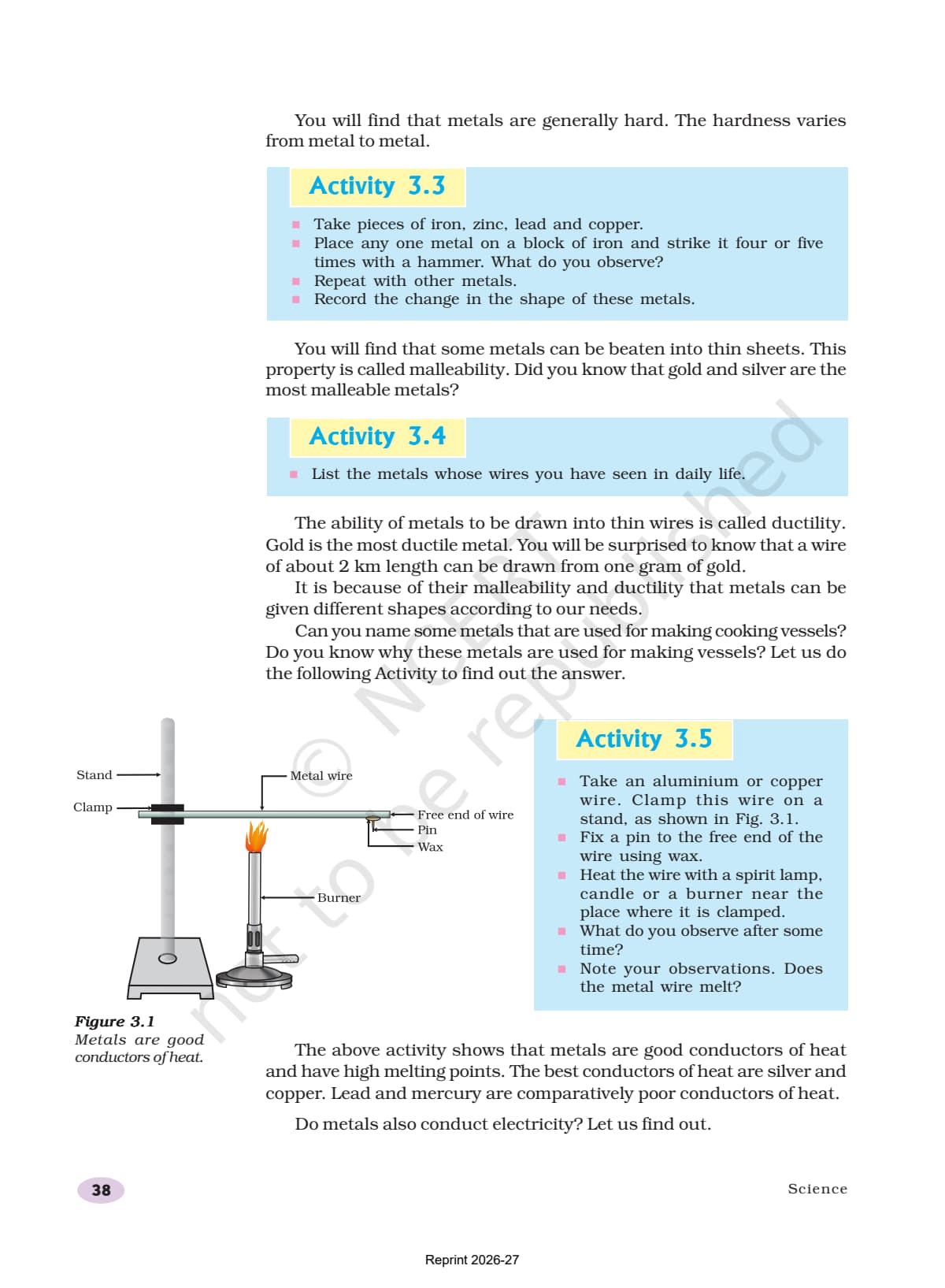
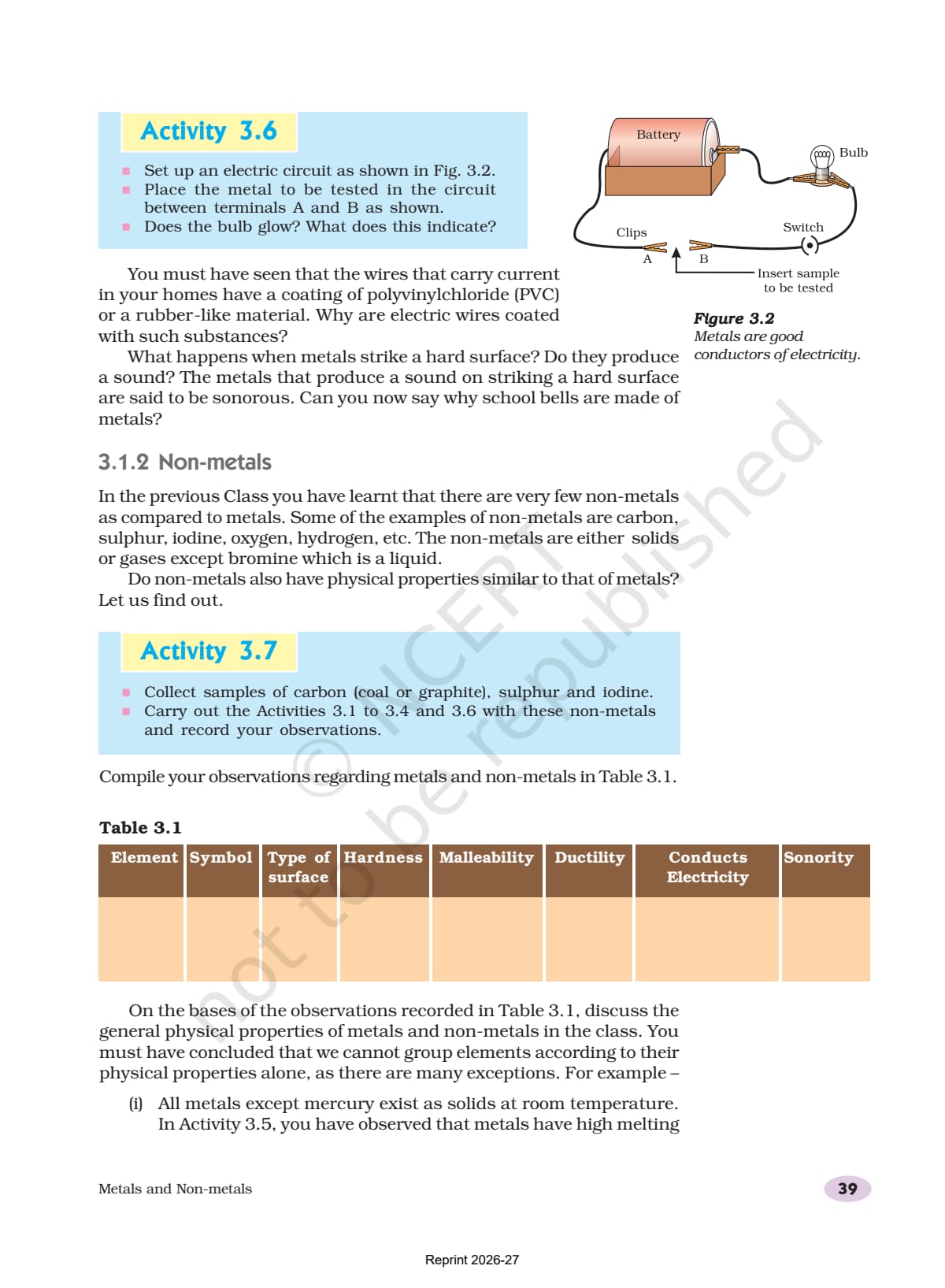
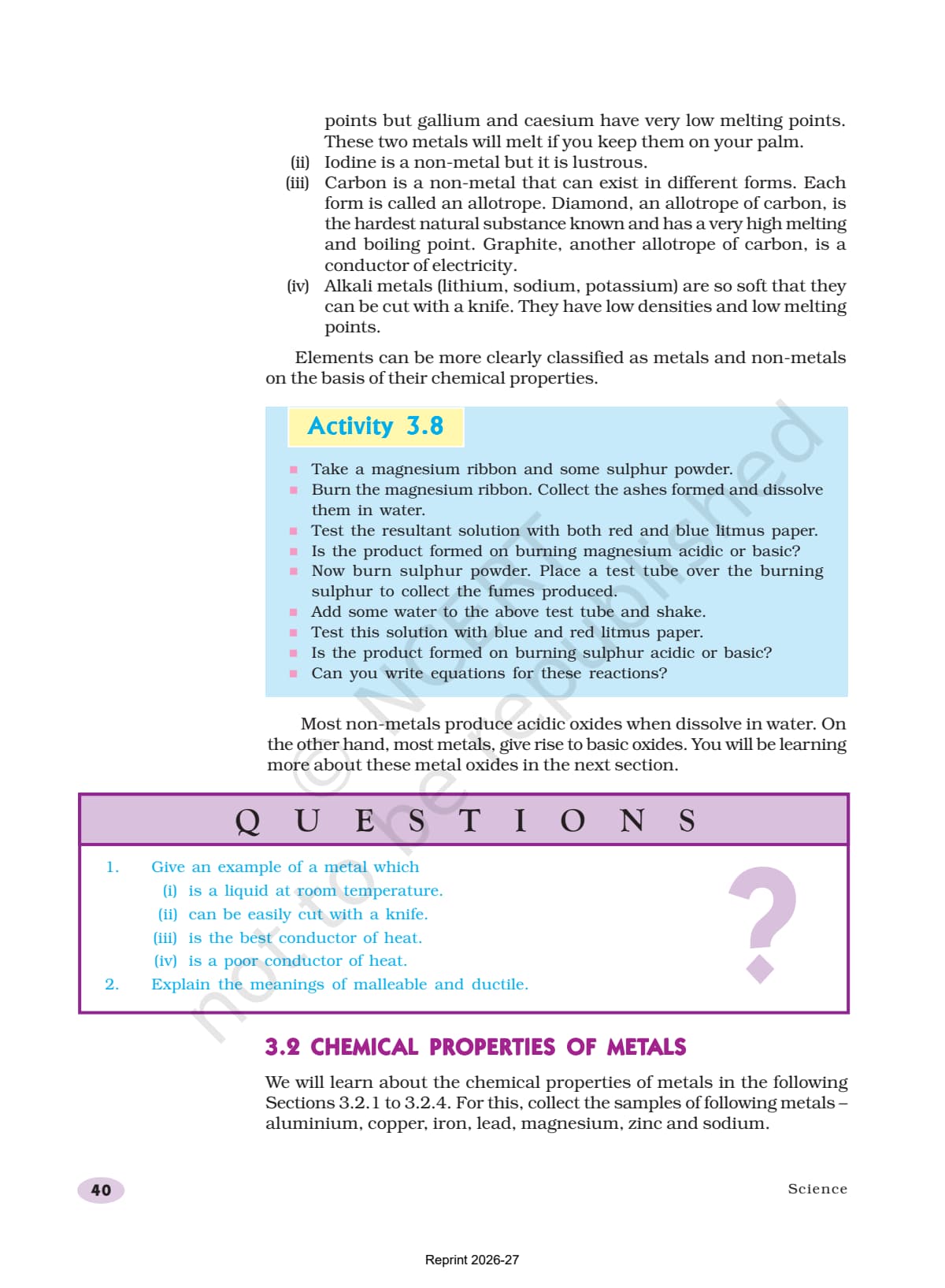
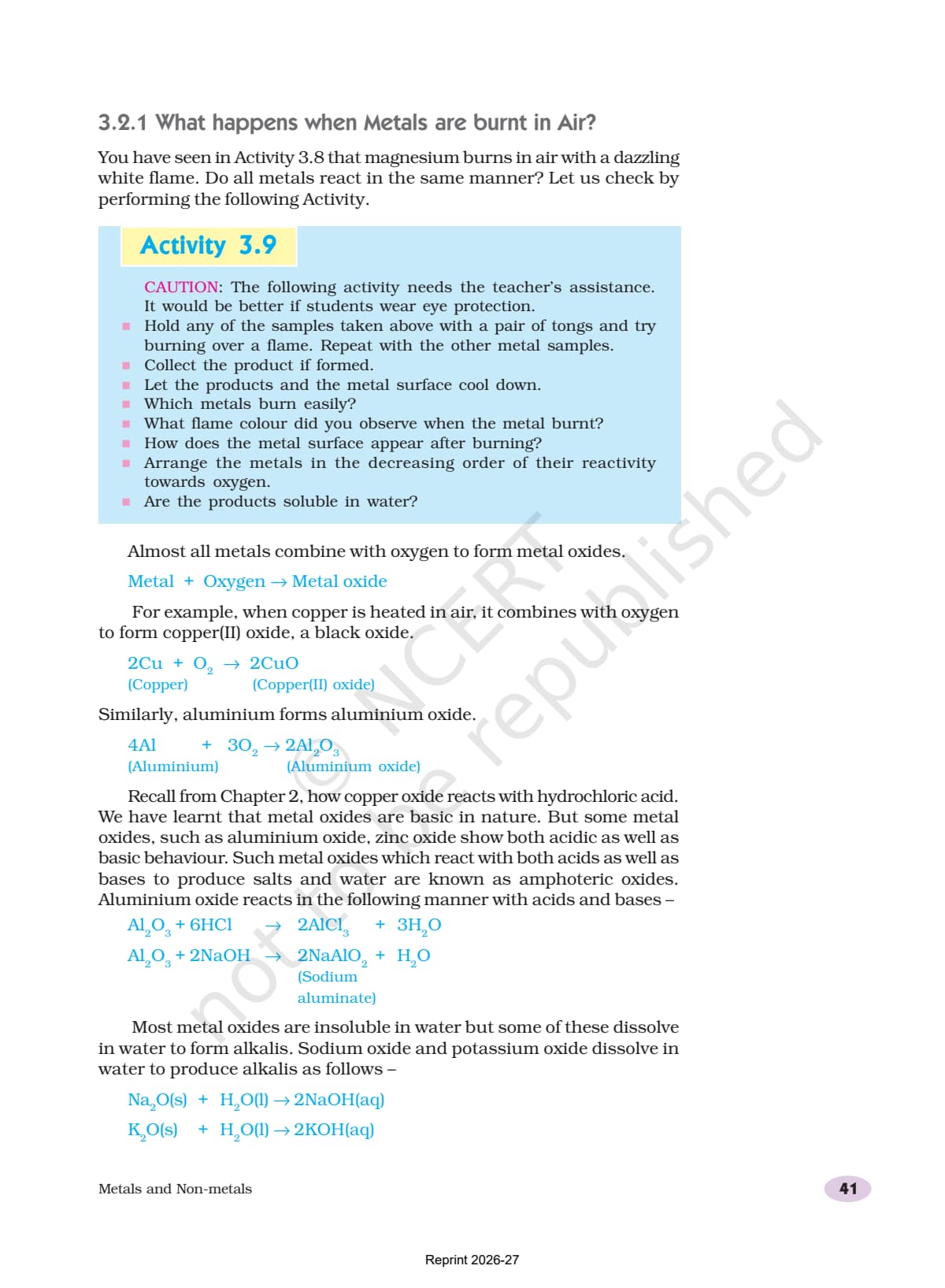
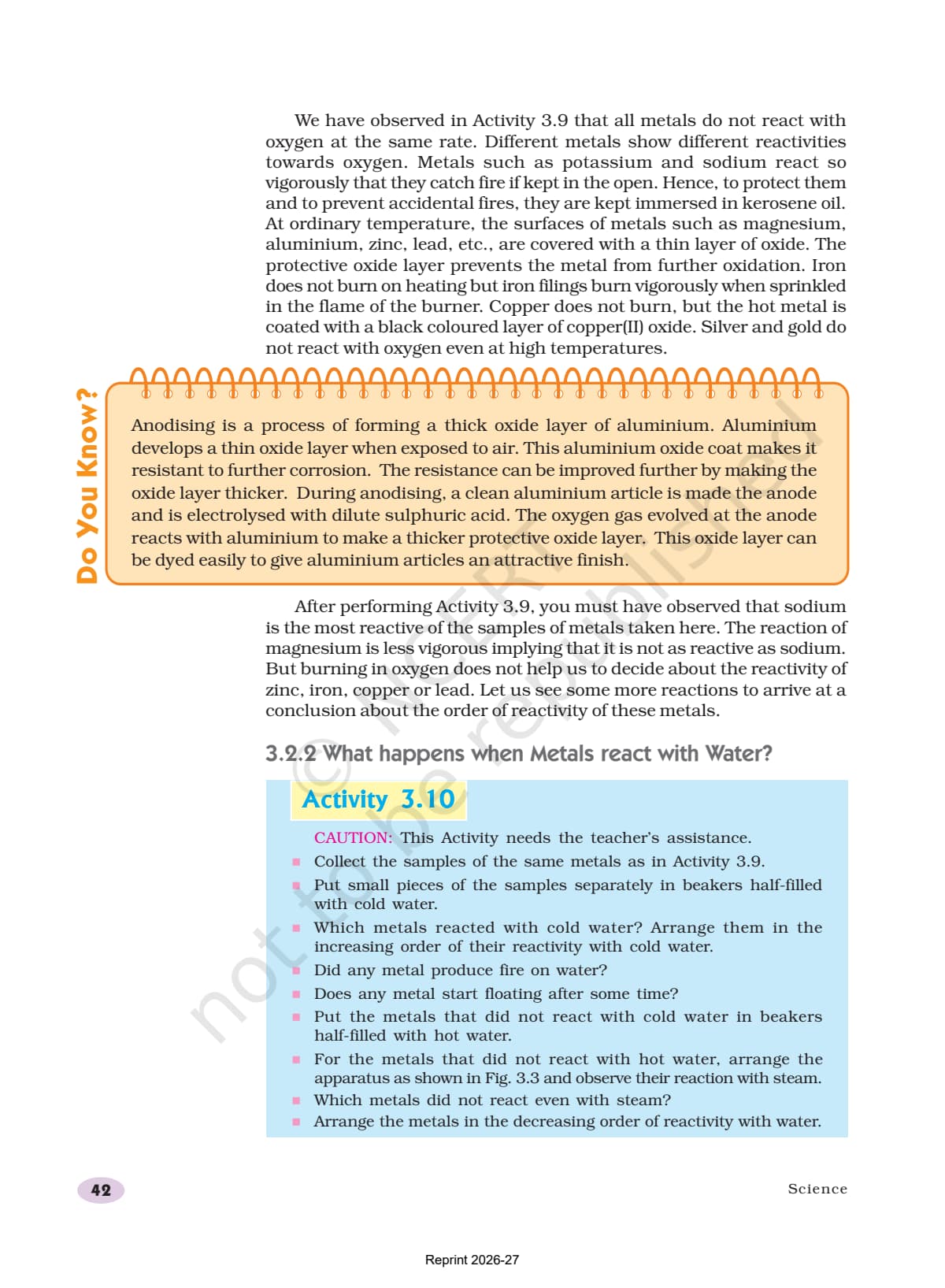
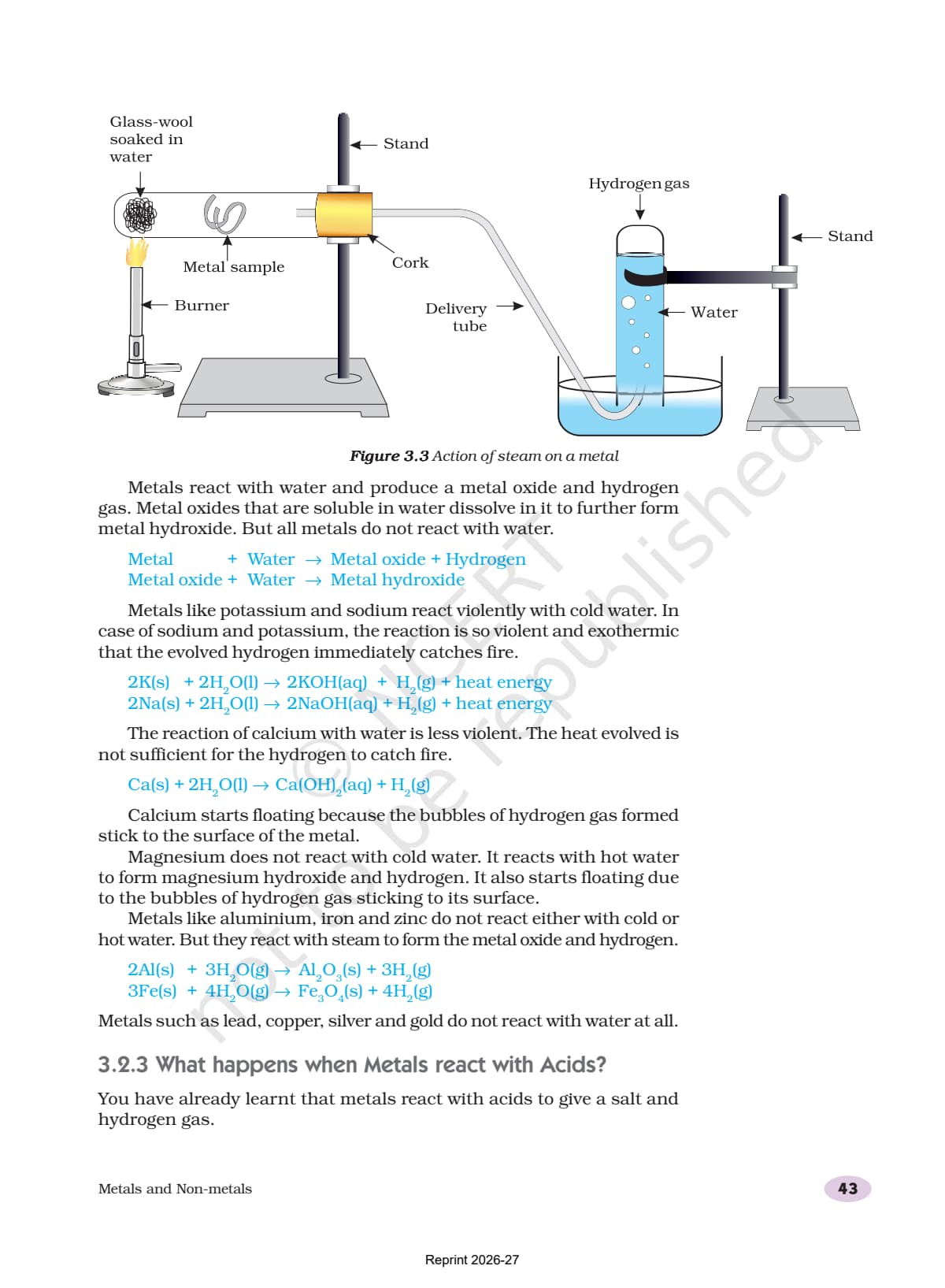
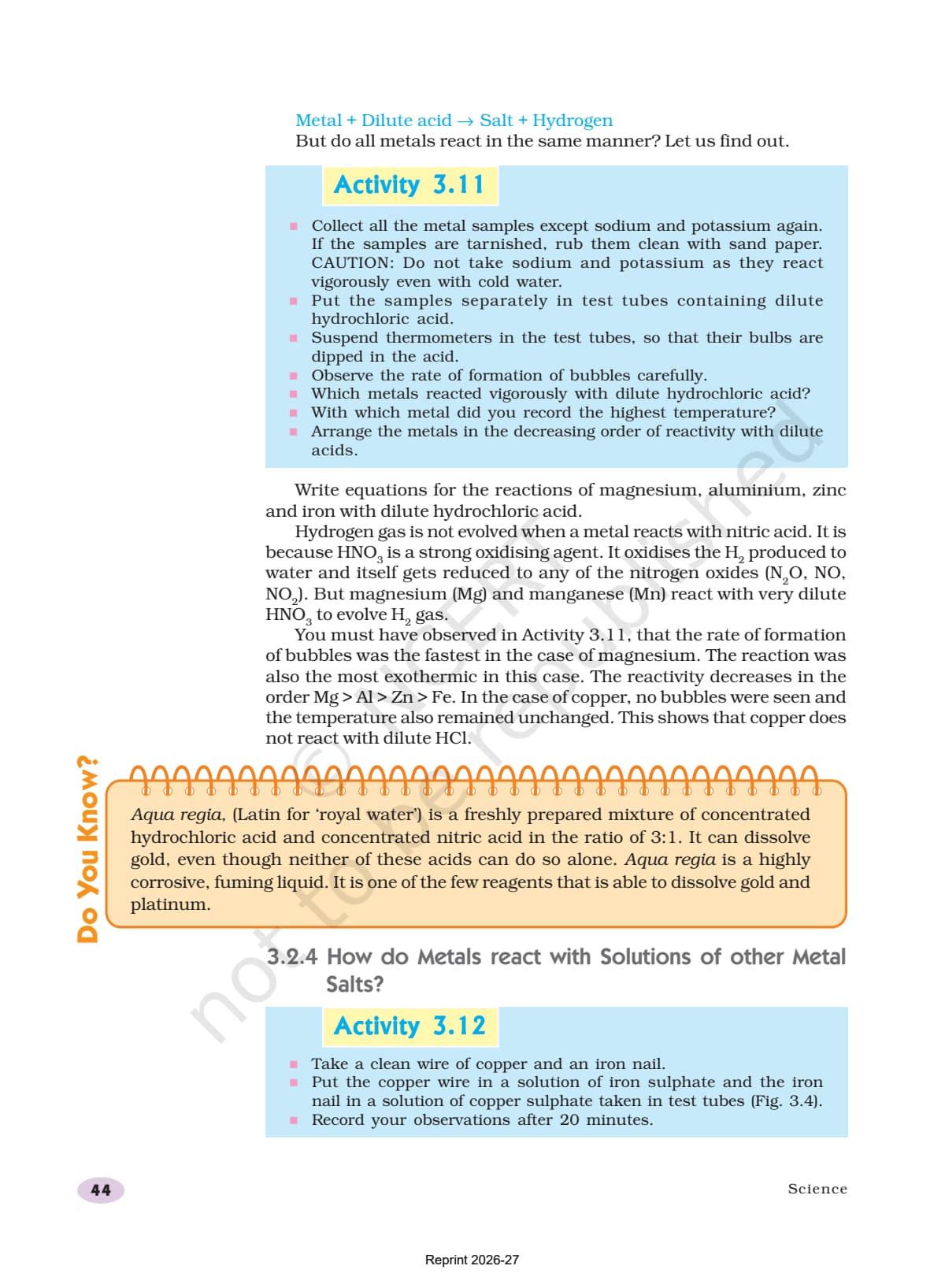
- Official NCERT textbook PDF of Chapter 3, with every activity, figure, in-text question and exercise exactly as printed.
- Covers metallic properties, reactions with oxygen, water and acids, the reactivity series, ionic bonding, and metallurgy: roasting, calcination, reduction and electrolytic refining.
- Aligned with the 2026-27 CBSE Class 10 Science syllabus, useful for board exam revision and as the base text for solutions and notes.
This page hosts the official NCERT Class 10 Science textbook chapter, mapped to the 2026-27 CBSE syllabus and checked page by page against the printed Metals and Non-metals chapter.
Student Feedback: What 10,400 students told us about this chapter
68% of Class 10 students said the reactivity series and the extraction steps were the parts of this chapter they mixed up most often in class tests. 3 out of 5 students told us reading the NCERT chapter directly, activity by activity, made the difference between metals and non-metals far easier to recall.
Students reported spending on average 2 to 3 hours on the full chapter across the first read and revision, and toppers said keeping the official book open beside their notes stopped them from learning the wrong order in the activity series.
Source: 2026-27 Class 10 Science student poll. Sample of 10,400 students from CBSE schools across 13 states, taken before the 2026 board exams.
What the NCERT Book for Class 10 Science Chapter 3 Metals and Non-metals Covers
The downloadable PDF above is the complete official NCERT chapter, exactly as printed in the 2026-27 textbook. It sorts elements into metals and non-metals by their properties, then builds to chemical reactions, the activity series, how compounds form, and how metals are extracted.
- Physical properties: lustre, hardness, malleability, ductility, sonority and conduction, with key exceptions.
- Chemical properties: reactions with oxygen, water, dilute acids and salt solutions, plus amphoteric oxides.
- Reactivity series: metals ranked most reactive (potassium) to least (gold), and what the order predicts.
- Occurrence and extraction: minerals and ores, roasting, calcination, reduction and refining.
Metals and Non-metals Class 10 Science Full Chapter Video
Source: Magnet Brains on YouTube
Physical Properties of Metals and Non-metals in Class 10 Science
Metals are generally hard, shiny, malleable, ductile, sonorous, and good conductors of heat and electricity. Non-metals are mostly the opposite: dull, brittle, and poor conductors. The table sets the two groups side by side, a direct one-mark question in the board paper.
| Property | Metals | Non-metals |
|---|---|---|
| Lustre | Shiny | Dull (except iodine) |
| State | Solid (except mercury) | Solid, liquid or gas (bromine liquid) |
| Malleability | Beaten into sheets | Brittle, break on hammering |
| Ductility | Drawn into wires | Not ductile |
| Conduction | Good conductors | Poor (except graphite) |
| Sonority | Ring when struck | Not sonorous |
The exceptions are where students lose marks. Mercury is a metal liquid at room temperature; gallium and caesium melt in the warmth of your hand; iodine is a lustrous non-metal; and graphite conducts electricity. Sodium, potassium and lithium are soft enough to cut with a knife. Gold and silver are the most malleable and ductile metals, and silver is the best conductor of heat and electricity.
Chemical Properties of Metals in Class 10 Science Chapter 3
Metals react with oxygen, water, dilute acids and salt solutions. Each reaction has a general rule and a standard example, since the board exam often gives reactants and asks for products.
| Reaction | General rule | Standard example |
|---|---|---|
| Metal + Oxygen | Gives a basic metal oxide | 2Cu + O2 → 2CuO |
| Metal + Water | Gives hydroxide (or oxide) and hydrogen | 2Na + 2H2O → 2NaOH + H2 |
| Metal + Dilute acid | Gives salt and hydrogen gas | Zn + 2HCl → ZnCl2 + H2 |
| Metal + Salt solution | More reactive metal displaces the less reactive | Fe + CuSO4 → FeSO4 + Cu |
Most metal oxides are basic, but some, such as aluminium oxide and zinc oxide, react with both acids and bases to give salt and water. These are amphoteric oxides. The two reactions of aluminium oxide are:
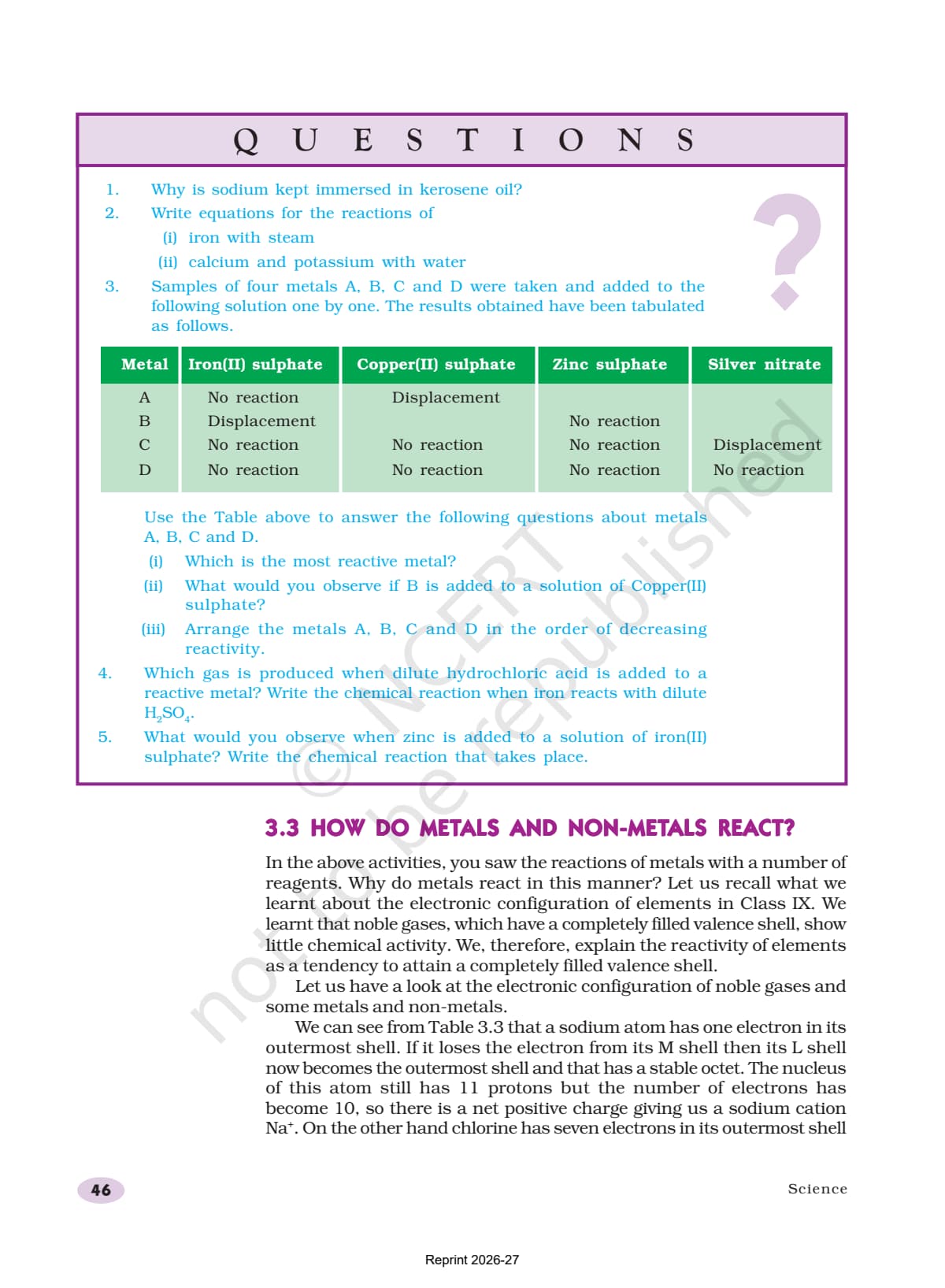
Metals do not react at the same rate. Sodium and potassium react with cold water so violently they catch fire, so they are stored under kerosene. Magnesium reacts only with hot water, iron with steam, and silver and gold not at all. This difference in vigour is what the reactivity series sets in order.
The Reactivity Series of Metals in Class 10 Science
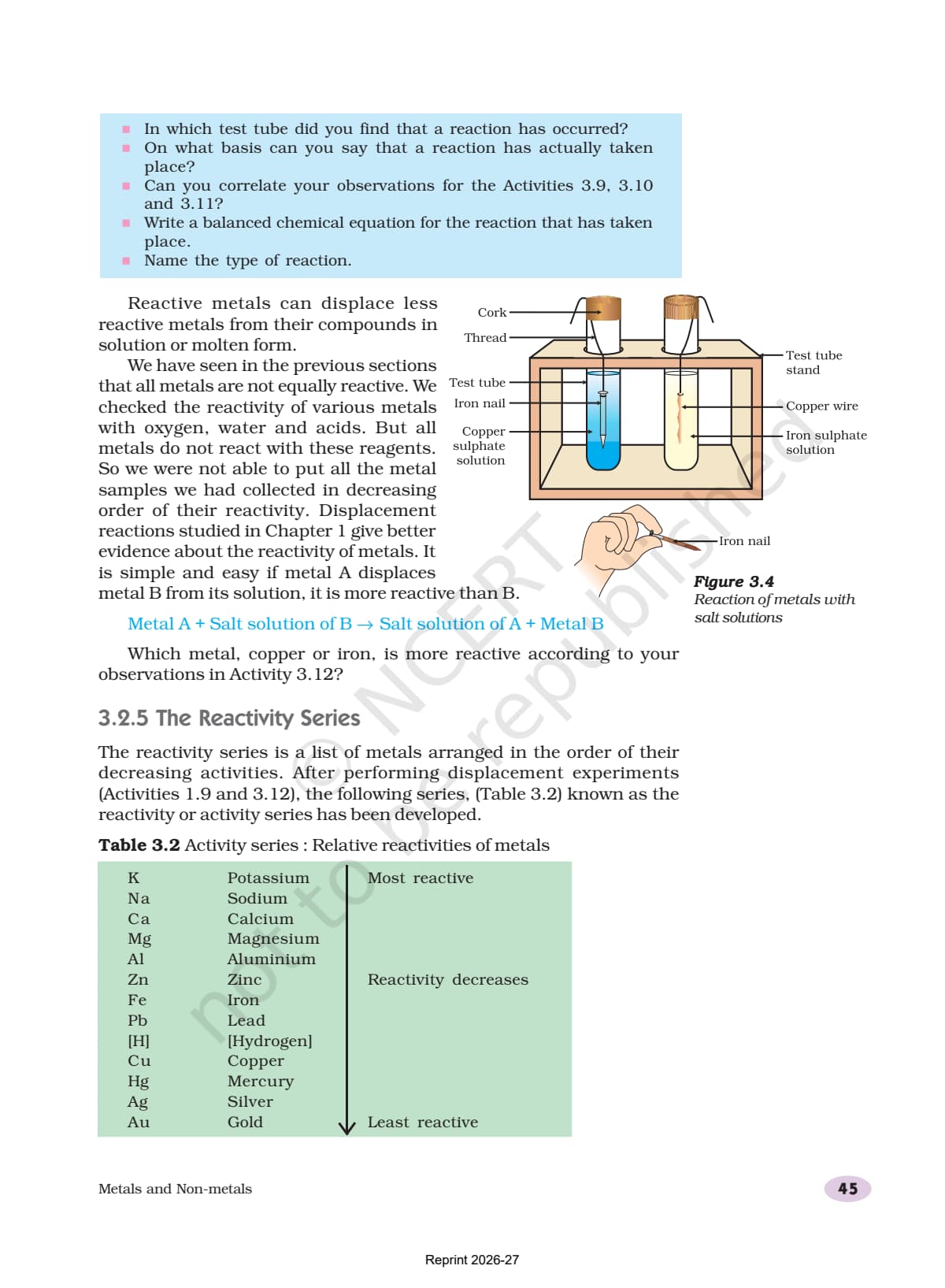
The reactivity series lists metals in decreasing order of reactivity. It predicts which metal will react with water or acid, which metal displaces another from its salt, and how a metal is extracted. The most reactive sit at the top, the least reactive at the bottom.
| Position | Metals | What the order predicts |
|---|---|---|
| Top (most reactive) | K, Na, Ca, Mg, Al | React with cold water/steam; extracted by electrolysis |
| Middle | Zn, Fe, Pb | React with acids/steam; reduced by carbon |
| Bottom (least reactive) | Cu, Ag, Au | Found native or as oxides; little reaction |
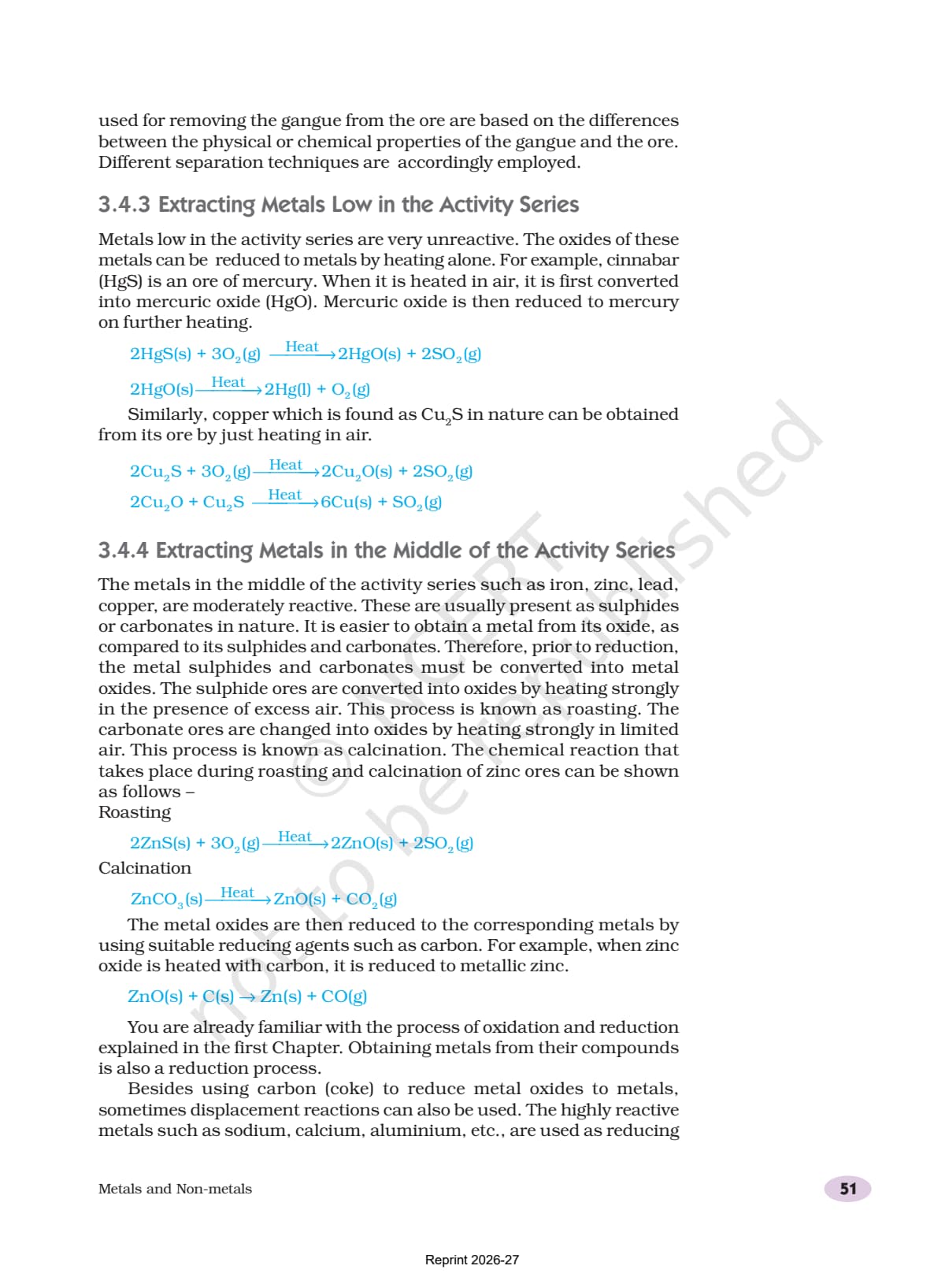
A displacement reaction proves the order: a more reactive metal pushes a less reactive one out of its salt solution. Iron displaces copper from copper sulphate, turning blue solution pale green. The same idea explains the thermit reaction:
A metal lower in the series can never displace one higher up, so copper cannot displace iron from iron sulphate. Always check the order before writing a displacement reaction.
How Metals and Non-metals React: Ionic Compounds in Class 10 Science
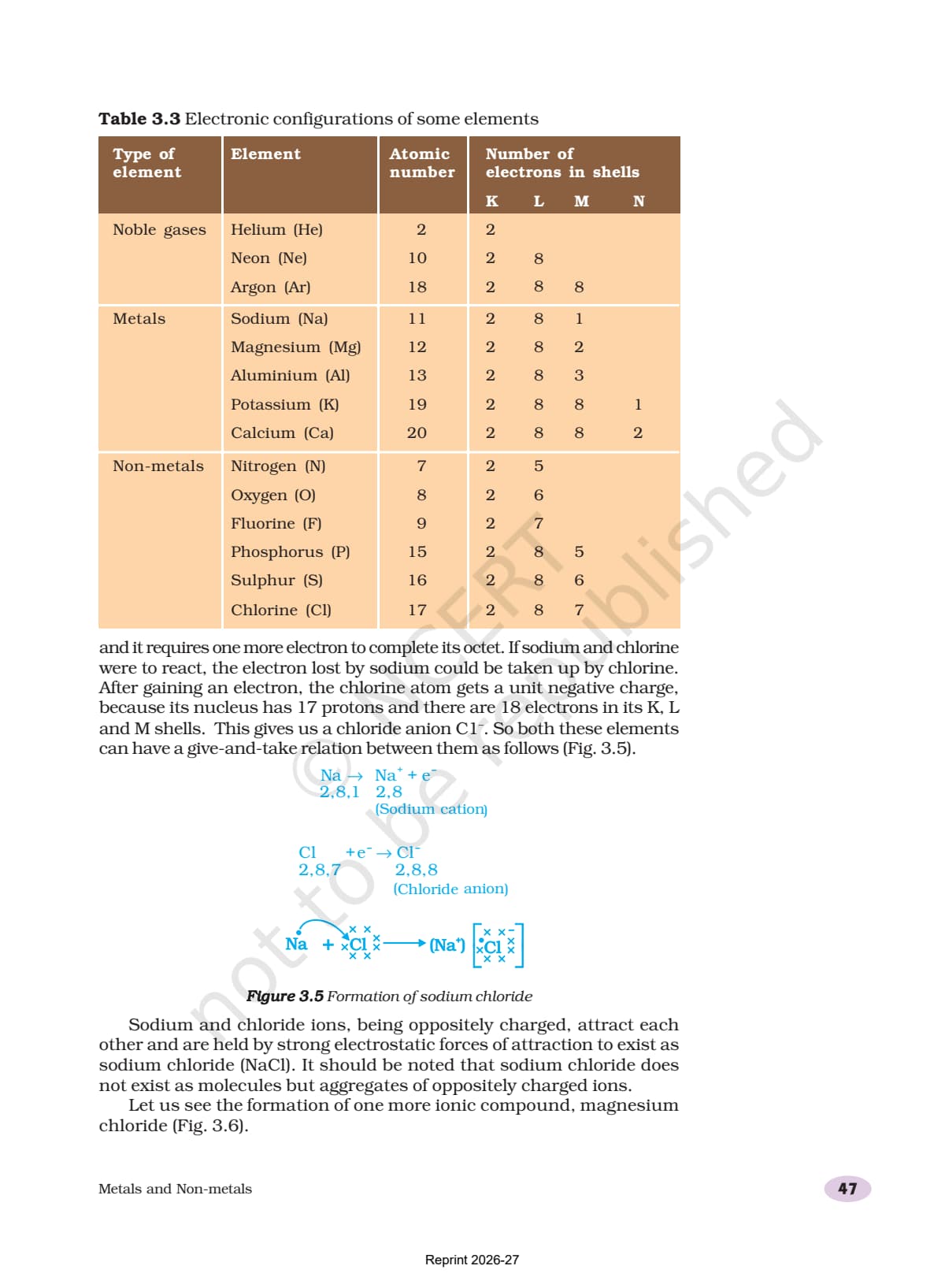
Metals lose electrons to form positive ions (cations), while non-metals gain them to form negative ions (anions). Both achieve the stable outer shell of the nearest noble gas. The compound formed by this transfer is an ionic compound or electrovalent compound.
The standard example is sodium chloride. Sodium (2,8,1) gives away one electron; chlorine (2,8,7) accepts it. The oppositely charged ions then attract strongly:
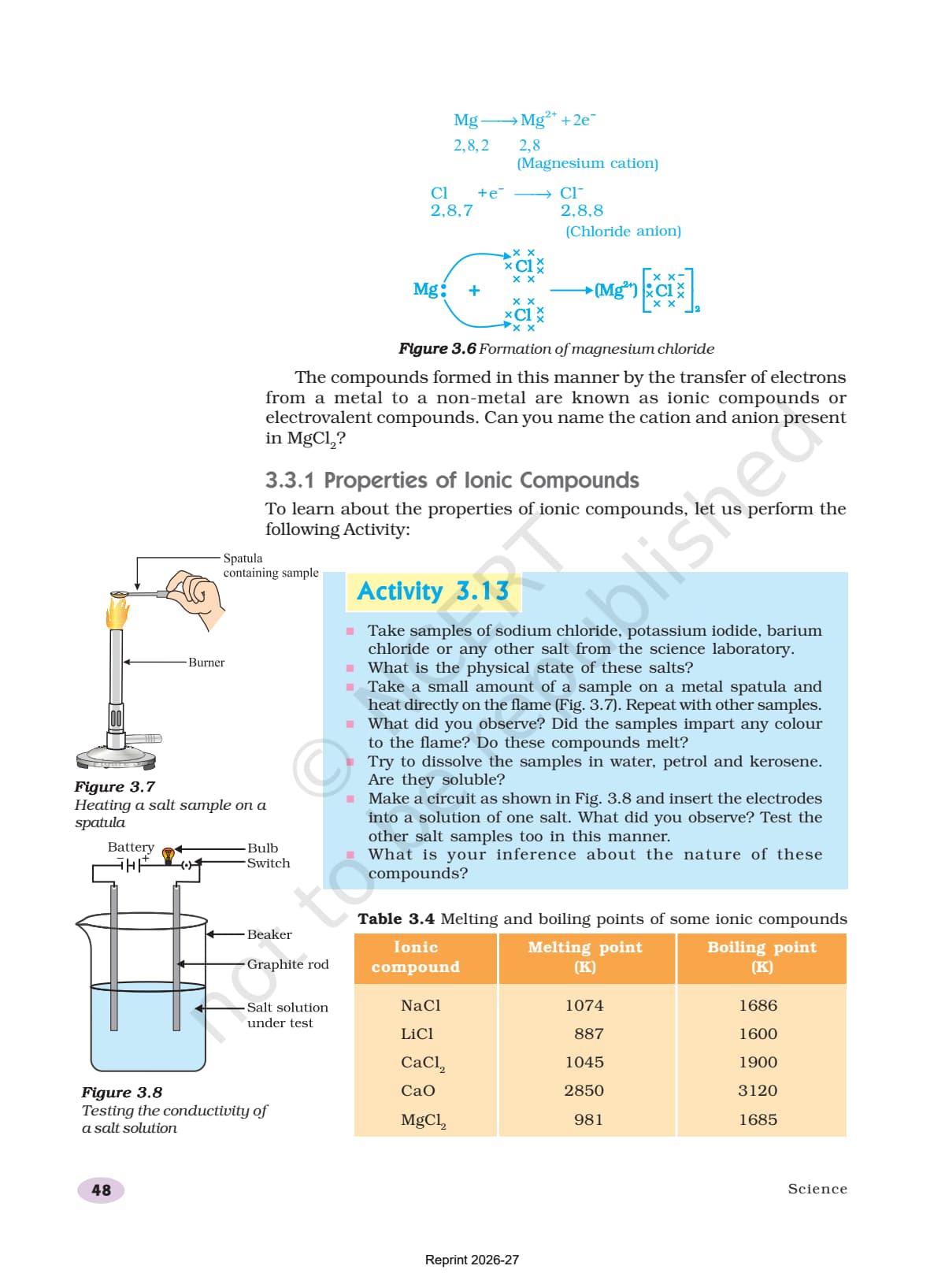
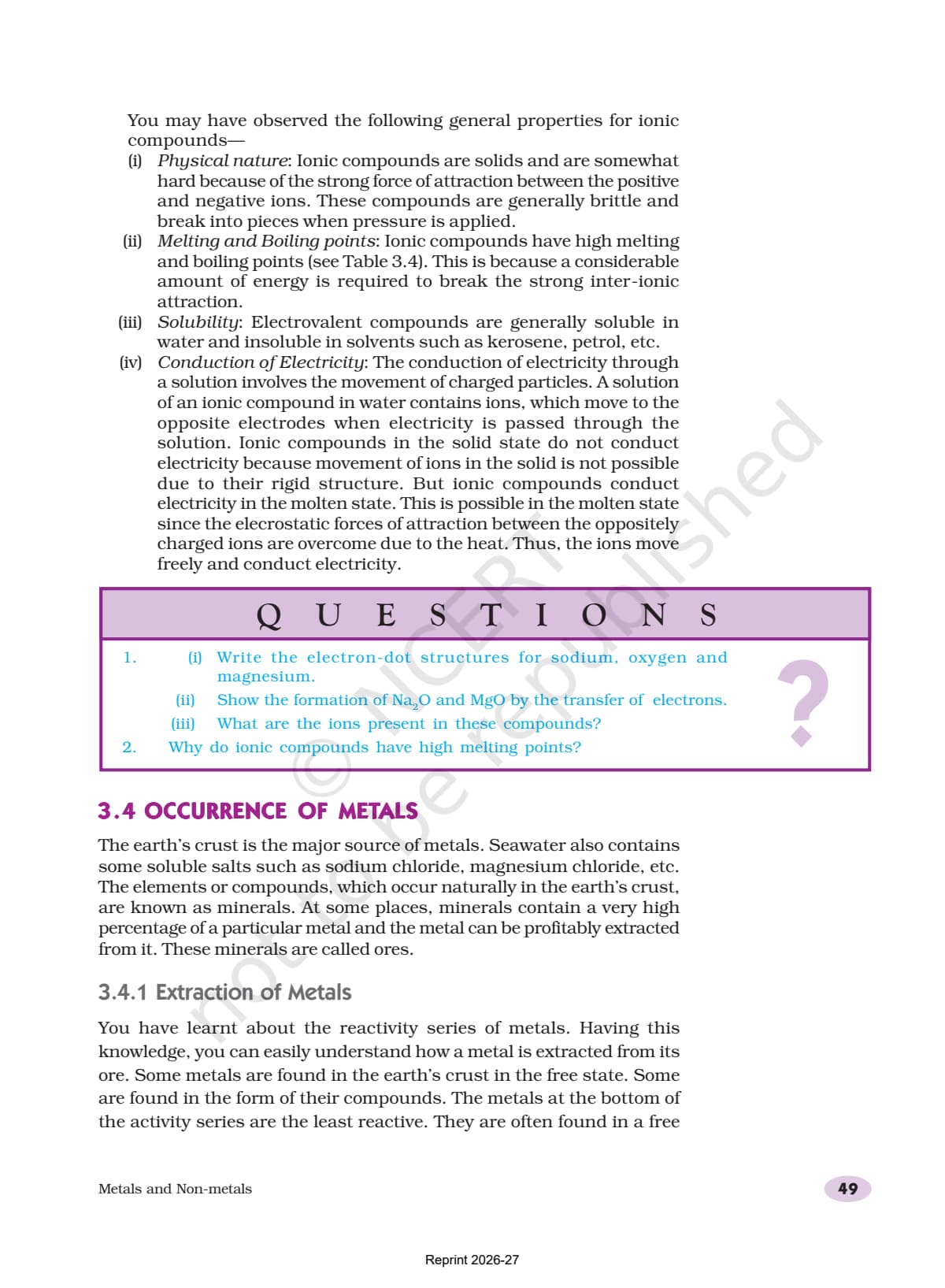
- High melting and boiling points: strong ion forces need much heat to break, so NaCl melts at 1074 K.
- Solubility: generally soluble in water but insoluble in kerosene and petrol.
- Conduction: conduct in the molten state or solution (ions free to move), not as solids.
- Physical nature: hard, crystalline solids that are brittle.
These four properties are a common short-answer question: the strong electrostatic attraction between ions explains the high melting points, brittleness, and why conduction needs free-moving ions.
Occurrence and Extraction of Metals in Class 10 Science Chapter 3
Occurrence of Metals is the most process-heavy, high-weight part of the chapter. A mineral is any naturally occurring element or compound; an ore is a mineral from which a metal can be profitably extracted; impurities mixed with an ore are gangue.
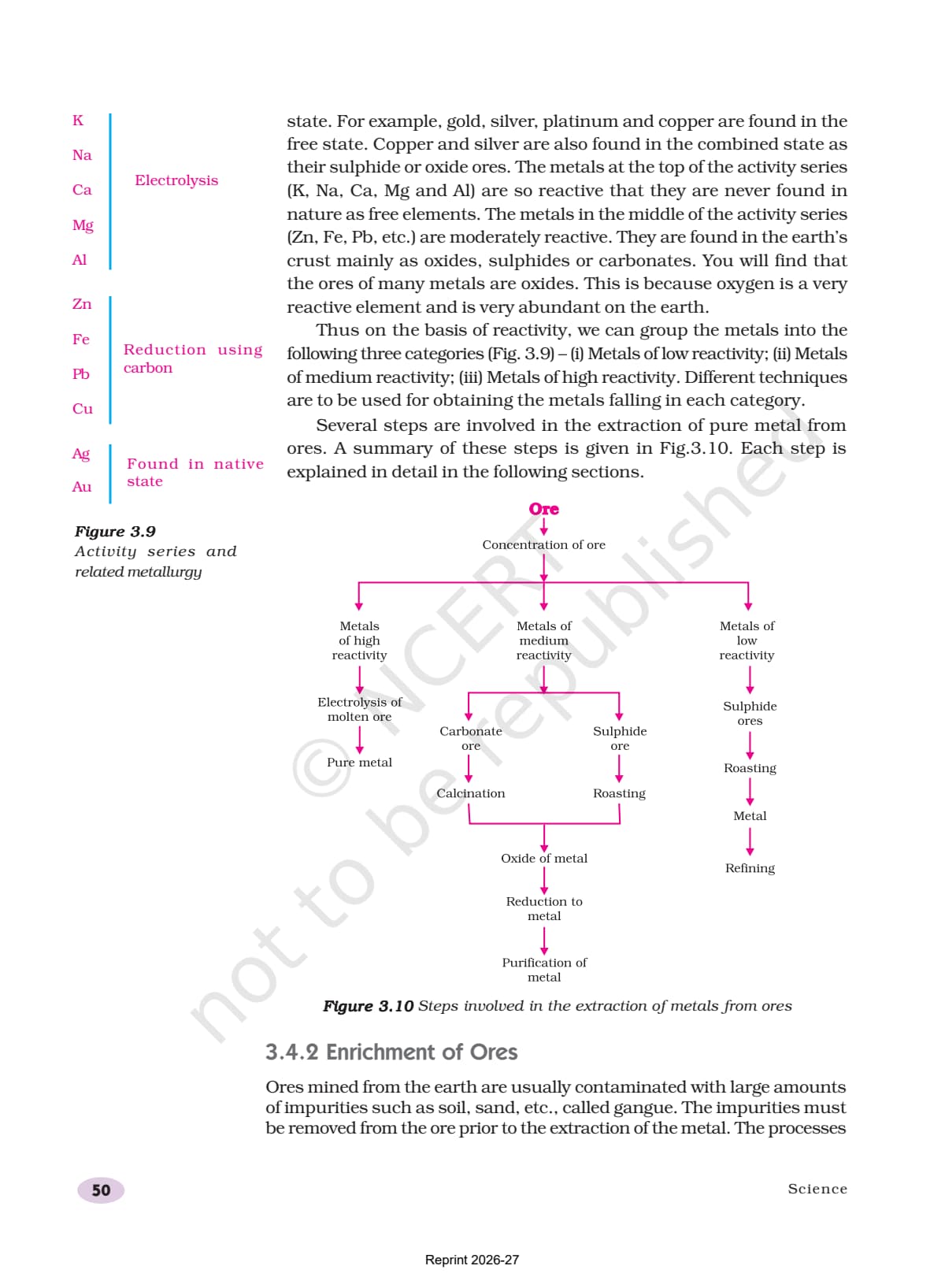
The extraction method depends on where the metal sits in the reactivity series: concentrate the ore, convert it to an oxide, reduce the oxide to metal, then refine. The table maps each group to its method:
| Reactivity group | Conversion to oxide | Reduction method |
|---|---|---|
| High (K, Na, Ca, Mg, Al) | Already reactive ores | Electrolysis of molten ore |
| Medium (Zn, Fe, Pb) | Roasting (sulphides) or calcination (carbonates) | Reduction with carbon (coke) |
| Low (Cu, Ag, Hg) | Heating sulphide in air | Heating alone, no reductant |
Roasting is heating a sulphide ore in excess air to give the oxide; calcination is heating a carbonate ore in limited air to give the oxide. The zinc reactions are:
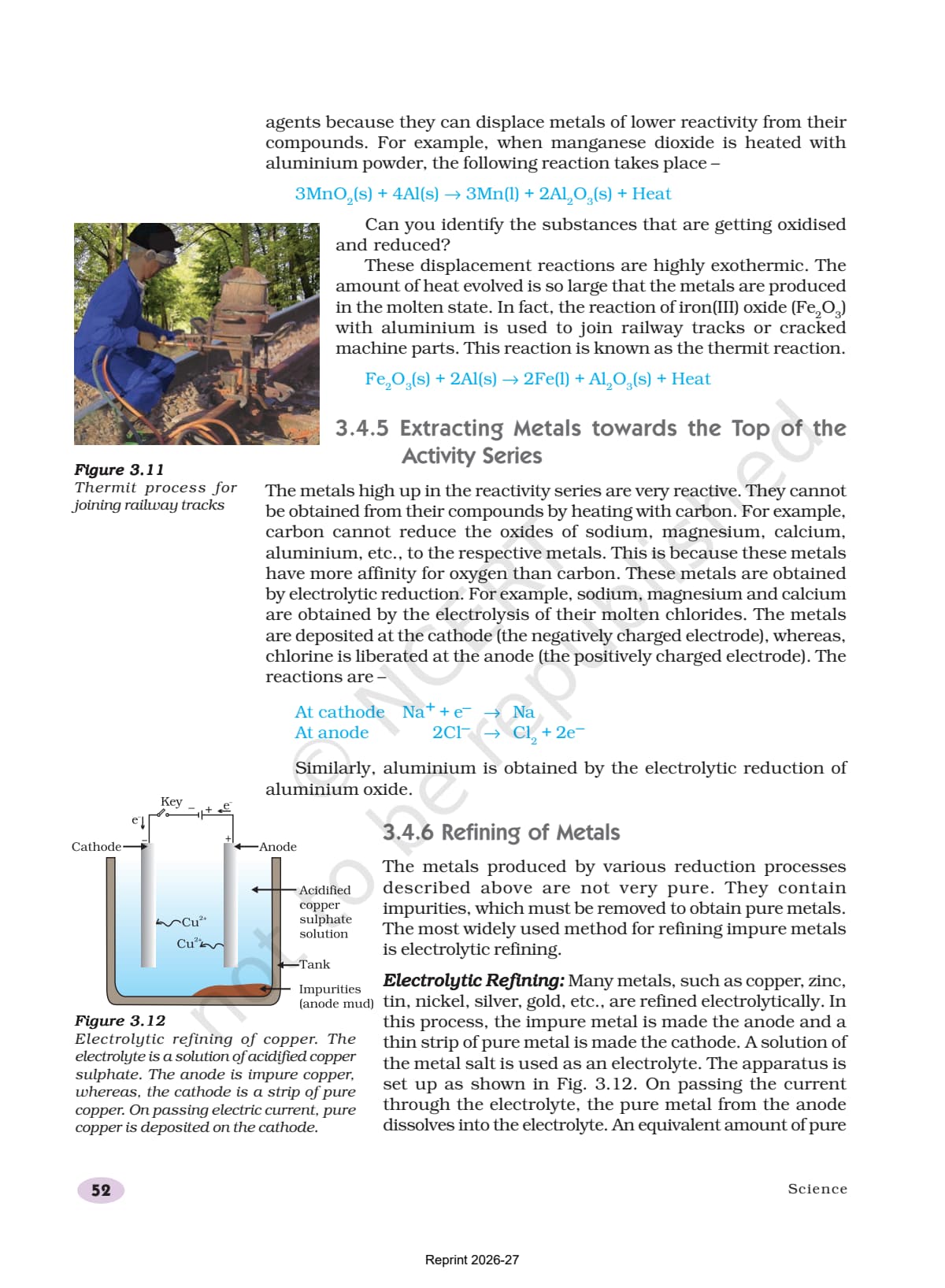
Top-of-series metals cannot be reduced by carbon, so they are obtained by electrolysis of their molten chlorides or oxides, with pure metal at the cathode. The final step for most metals is electrolytic refining: the impure metal is the anode and a thin strip of pure metal the cathode, so pure metal deposits on the cathode while impurities settle as anode mud. Remember: roasting is for sulphides (lots of air), calcination for carbonates (limited air).
Corrosion and Its Prevention in Class 10 Science Chapter 3
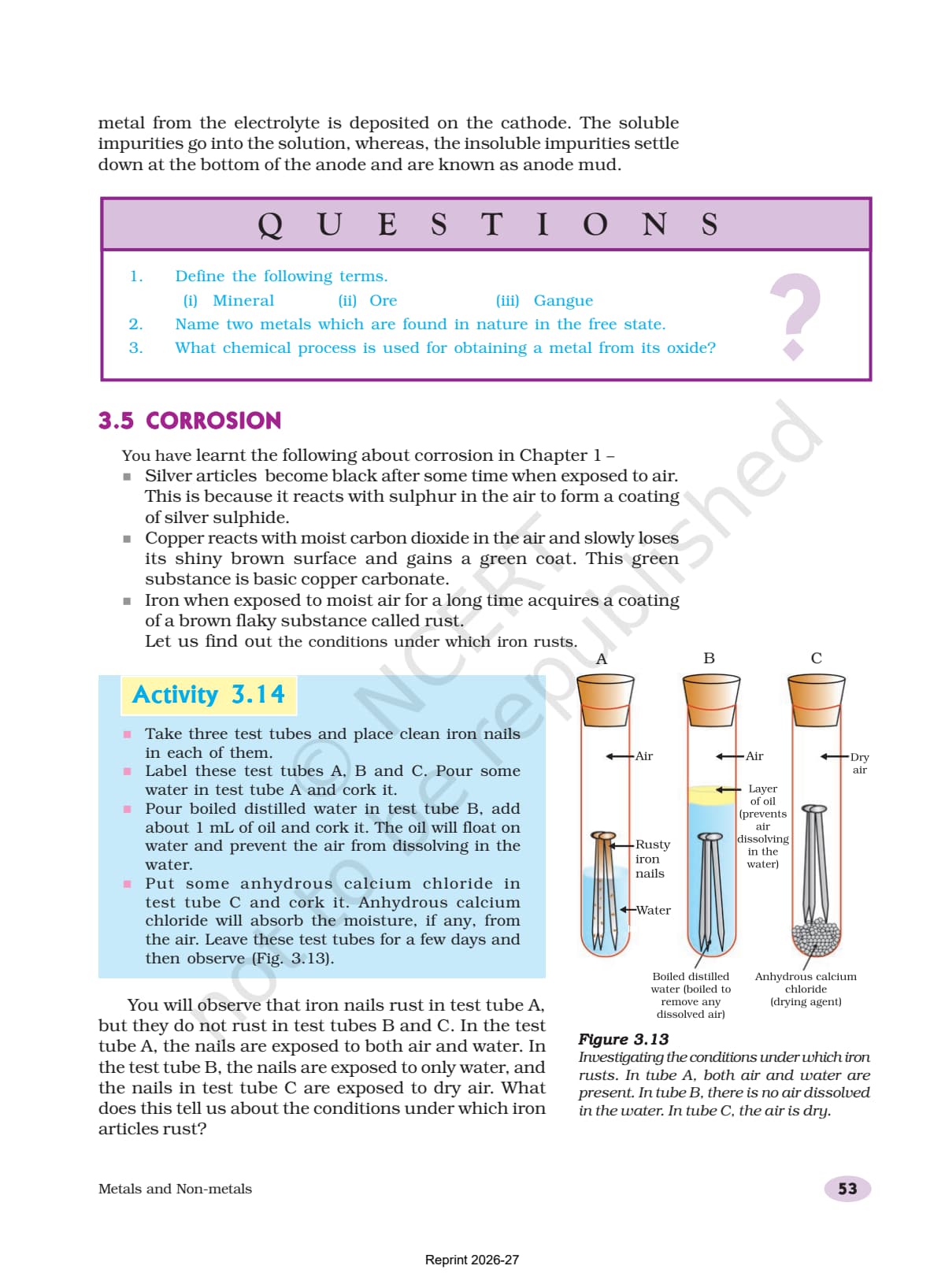
Corrosion is how metals slowly lose their shine and strength. Silver turns black, copper gains a green coat of basic copper carbonate, and iron forms a brown flaky rust. The NCERT iron-nail activity shows that iron needs both air (oxygen) and water (moisture) to rust; remove either and rusting stops. Ways to prevent it are a steady source of board questions:
- Painting, oiling and greasing: a barrier keeping air and water off the metal surface.
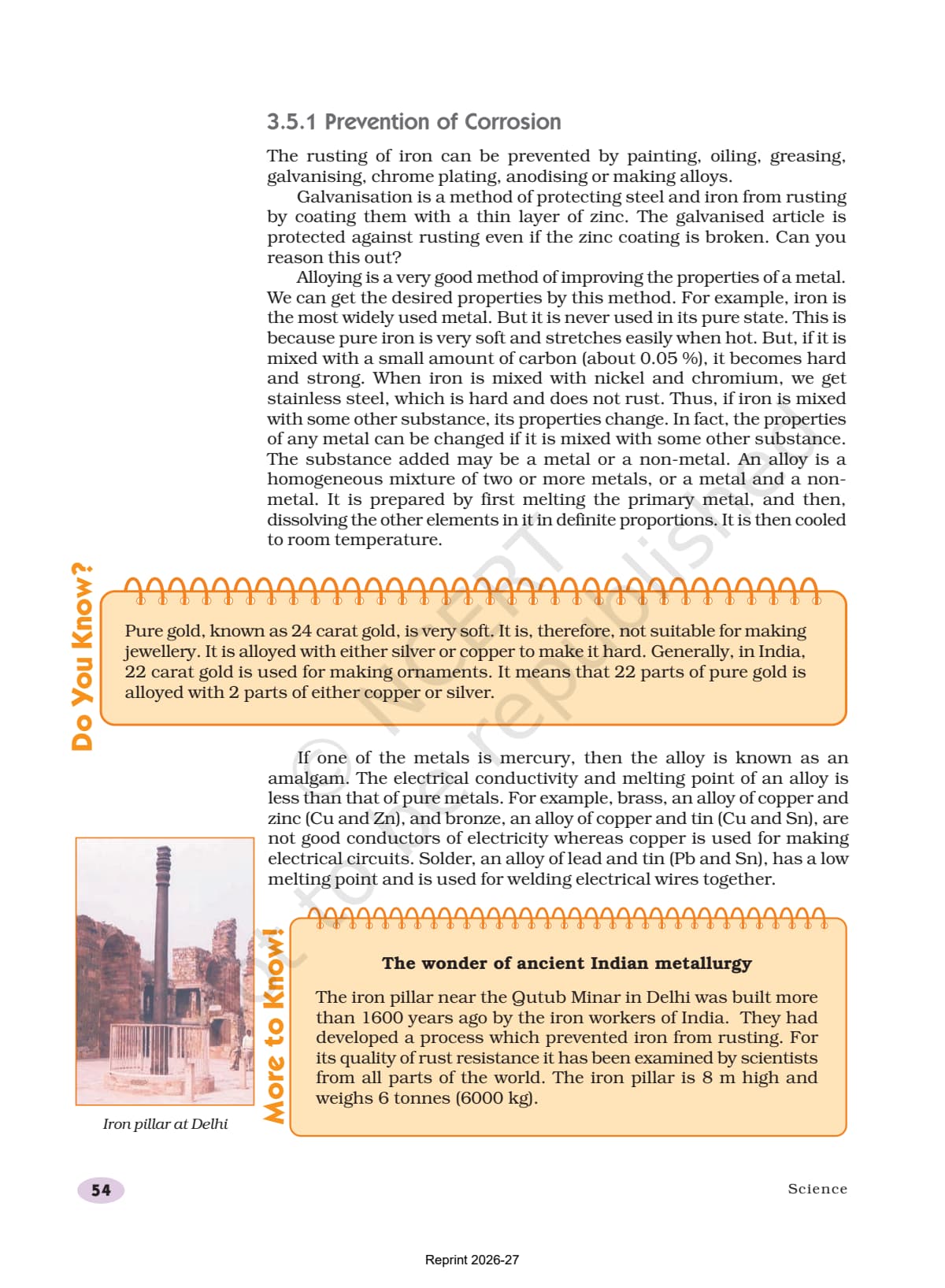
- Galvanisation: coating iron or steel with zinc, which protects even if scratched.
- Chrome plating and anodising: a tougher layer; anodising thickens aluminium's oxide coat.
- Alloying: iron with carbon, nickel and chromium gives stainless steel, hard and rust-free.
The chapter ends with alloys, a homogeneous mixture of two or more metals, or a metal and a non-metal. Examples: brass (copper, zinc), bronze (copper, tin), solder (lead, tin) and amalgam (containing mercury). Alloying improves hardness and corrosion resistance. Galvanisation protects iron because zinc is more reactive, so the zinc corrodes first even where the coating is broken.
Other Resources for Class 10 Science Chapter 3 Metals and Non-metals
Read the official NCERT Book chapter above, then revise with the matching NCERT Solutions, revision notes, formula sheet and handwritten notes. All resources for Class 10 Science Chapter 3 Metals and Non-metals are linked in the table below.
| Resource | What it covers | Open |
|---|---|---|
| NCERT Book PDF | Official Class 10 Science Chapter 3 textbook, with every activity, figure and exercise. | You are here |
| NCERT Solutions | Step-by-step answers to all in-text and exercise questions of the chapter. | Class 10 Science Chapter 3 NCERT Solutions |
| Notes | Concept-first revision notes on properties, the reactivity series and metallurgy. | Class 10 Science Chapter 3 Notes |
| Formula Sheet | Quick reference of key reactions, the reactivity series and extraction steps for fast revision. | Class 10 Science Chapter 3 Formula Sheet |
| Handwritten Notes | Scanned-style handwritten pages for last-minute board revision. | Class 10 Science Chapter 3 Handwritten Notes |
NCERT Book for Class 10 Science: All Chapters
Related Links: Use the table below to open the official NCERT Book PDF for the other chapters of Class 10 Science. Every chapter ships with the same official textbook PDF, chapter overview, and board-ready FAQ.
| Chapter | NCERT Book PDF link |
|---|---|
| Chapter 1 | Chemical Reactions and Equations NCERT Book PDF |
| Chapter 2 | Acids, Bases and Salts NCERT Book PDF |
| Chapter 3 | Metals and Non-metals NCERT Book PDF (You are here) |
| Chapter 4 | Carbon and its Compounds NCERT Book PDF |
| Chapter 5 | Life Processes NCERT Book PDF |
| Chapter 6 | Control and Coordination NCERT Book PDF |
| Chapter 7 | How do Organisms Reproduce NCERT Book PDF |
| Chapter 8 | Heredity NCERT Book PDF |
| Chapter 9 | Light Reflection and Refraction NCERT Book PDF |
| Chapter 10 | The Human Eye and the Colourful World NCERT Book PDF |
| Chapter 11 | Electricity NCERT Book PDF |
| Chapter 12 | Magnetic Effects of Electric Current NCERT Book PDF |
| Chapter 13 | Our Environment NCERT Book PDF |
NCERT Book Class 10 Science Chapter 3 Metals and Non-metals FAQs
Ques. What does Chapter 3 Metals and Non-metals cover in the Class 10 Science NCERT Book?
Ans. Chapter 3 of the Class 10 Science NCERT Book covers the properties and chemistry of metals and non-metals. It explains the physical properties such as lustre, malleability, ductility, sonority and conduction, along with their exceptions, and the chemical properties: how metals react with oxygen, water, dilute acids and salt solutions. It then introduces the reactivity series, the formation and properties of ionic compounds, the occurrence and extraction of metals through roasting, calcination, reduction and electrolytic refining, and finally corrosion and its prevention with alloys. The chapter is aligned with the 2026-27 CBSE syllabus.
Ques. What is the reactivity series in Class 10 Science Chapter 3?
Ans. The reactivity series, also called the activity series, is a list of metals arranged in the decreasing order of their chemical reactivity. The most reactive metals like potassium, sodium, calcium, magnesium and aluminium sit at the top, the moderately reactive metals like zinc, iron and lead in the middle, and the least reactive metals like copper, silver and gold at the bottom. The order is very useful because it predicts whether a metal will react with water or acid, whether a metal will displace another from its salt solution, and which method is used to extract the metal from its ore.
Ques. What is the difference between roasting and calcination in Class 10 Science?
Ans. Roasting and calcination are both ways of converting a concentrated ore into a metal oxide before reduction. Roasting is the heating of a sulphide ore strongly in the presence of excess air, for example 2ZnS plus 3O2 gives 2ZnO plus 2SO2. Calcination is the heating of a carbonate ore strongly in a limited supply of air, for example ZnCO3 gives ZnO plus CO2. The simple way to remember the split is that roasting is used for sulphide ores and calcination is used for carbonate ores, and both give the oxide that is later reduced to the metal.
Ques. What are amphoteric oxides, with examples from the chapter?
Ans. Amphoteric oxides are metal oxides that react with both acids and bases to produce salt and water. While most metal oxides are basic in nature, aluminium oxide and zinc oxide show both acidic and basic behaviour. For example, aluminium oxide reacts with hydrochloric acid to give aluminium chloride and water, and also reacts with sodium hydroxide to give sodium aluminate and water. Naming aluminium oxide and zinc oxide as amphoteric and writing both reactions is a common short-answer question in the CBSE board exam.
Ques. Why do ionic compounds have high melting and boiling points?
Ans. Ionic compounds have high melting and boiling points because of the strong electrostatic forces of attraction between their oppositely charged ions. A large amount of heat energy is needed to overcome this strong inter-ionic attraction, so the compound melts only at a high temperature. For example, sodium chloride melts at about 1074 K. The same strong attraction makes ionic compounds hard and brittle solids, and it is why they conduct electricity only in the molten state or in solution, where the ions become free to move.
Ques. Is the Class 10 Science Chapter 3 NCERT Book PDF free to download for 2026-27?
Ans. Yes. The official NCERT Book PDF for Class 10 Science Chapter 3 Metals and Non-metals is free to read and download on this page for the 2026-27 session. It is the complete chapter as printed in the CBSE textbook, including every activity, figure, in-text question and end-of-chapter exercise. You can pair the book with the linked NCERT Solutions and revision notes for the same chapter so that you read the textbook and revise from one place.
Ques. How does galvanisation prevent the corrosion of iron in Class 10 Science?
Ans. Galvanisation is the method of protecting iron and steel from rusting by coating them with a thin layer of zinc. The zinc layer keeps air and moisture away from the iron surface, and because zinc is more reactive than iron, the zinc corrodes in preference to the iron even if the coating is scratched or broken. This is why galvanised articles stay protected longer than simply painted iron. Other methods of preventing corrosion in the chapter include painting, oiling, greasing, chrome plating, anodising and alloying iron into stainless steel.
Ques. Are these NCERT Book contents aligned with the 2026-27 CBSE syllabus?
Ans. Yes. This page hosts the official NCERT Class 10 Science textbook chapter for the current 2026-27 CBSE syllabus. The Metals and Non-metals chapter is unchanged for this cycle, so the properties, reactions, reactivity series and extraction steps you read here are exam-correct. Because it is the official book, it is the safest base text for board preparation, and the linked solutions, notes and formula sheet for the same chapter all follow this textbook order.



Comments