



The NCERT Book for Class 10 Science Chapter 8 Heredity is the official CBSE textbook chapter, free to read and download for the 2026-27 session. This chapter explains how variations build up across generations, how traits pass from parents to children, the rules Gregor Mendel worked out from his pea-plant experiments, and how the sex of a baby is decided.
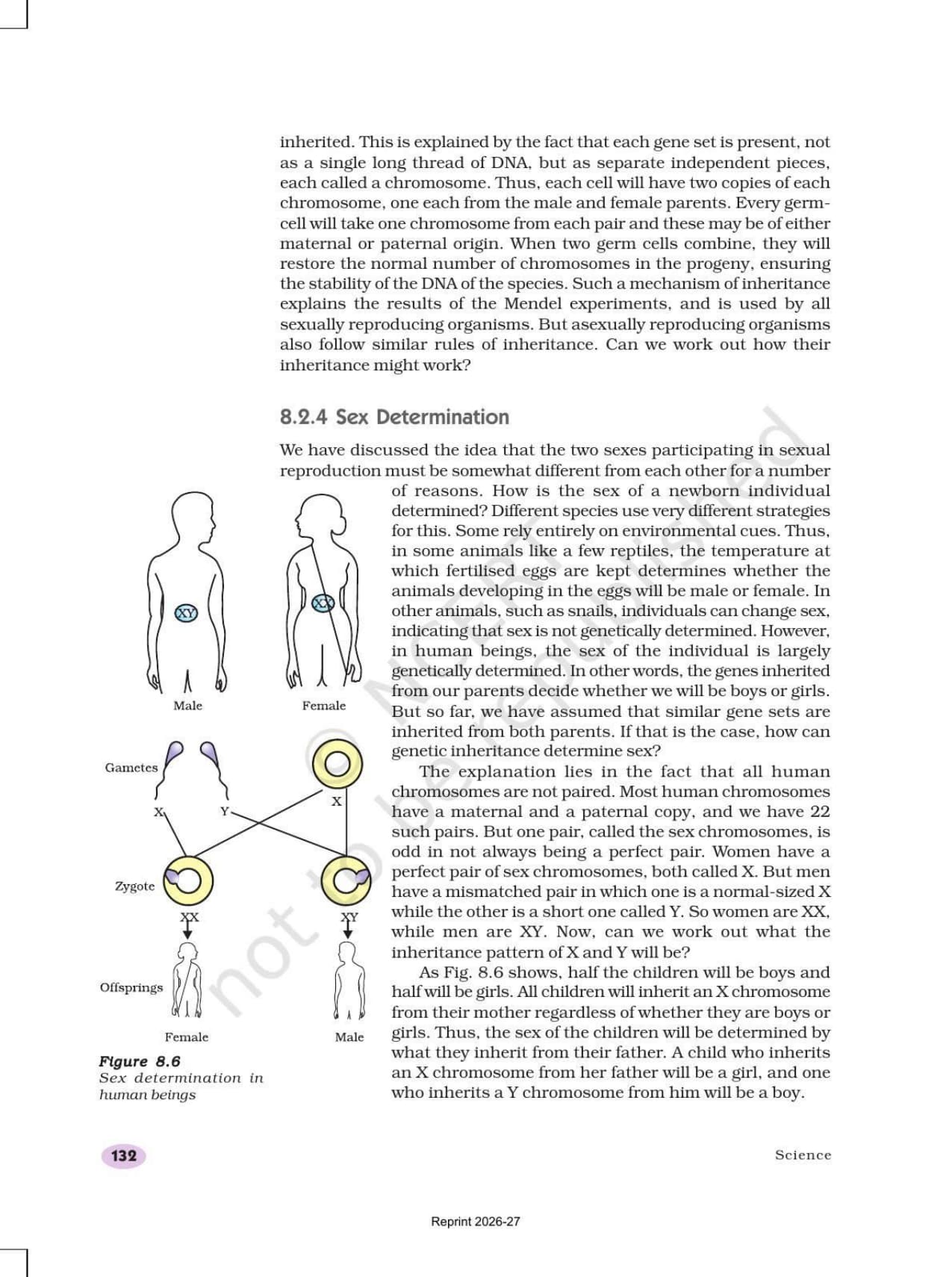
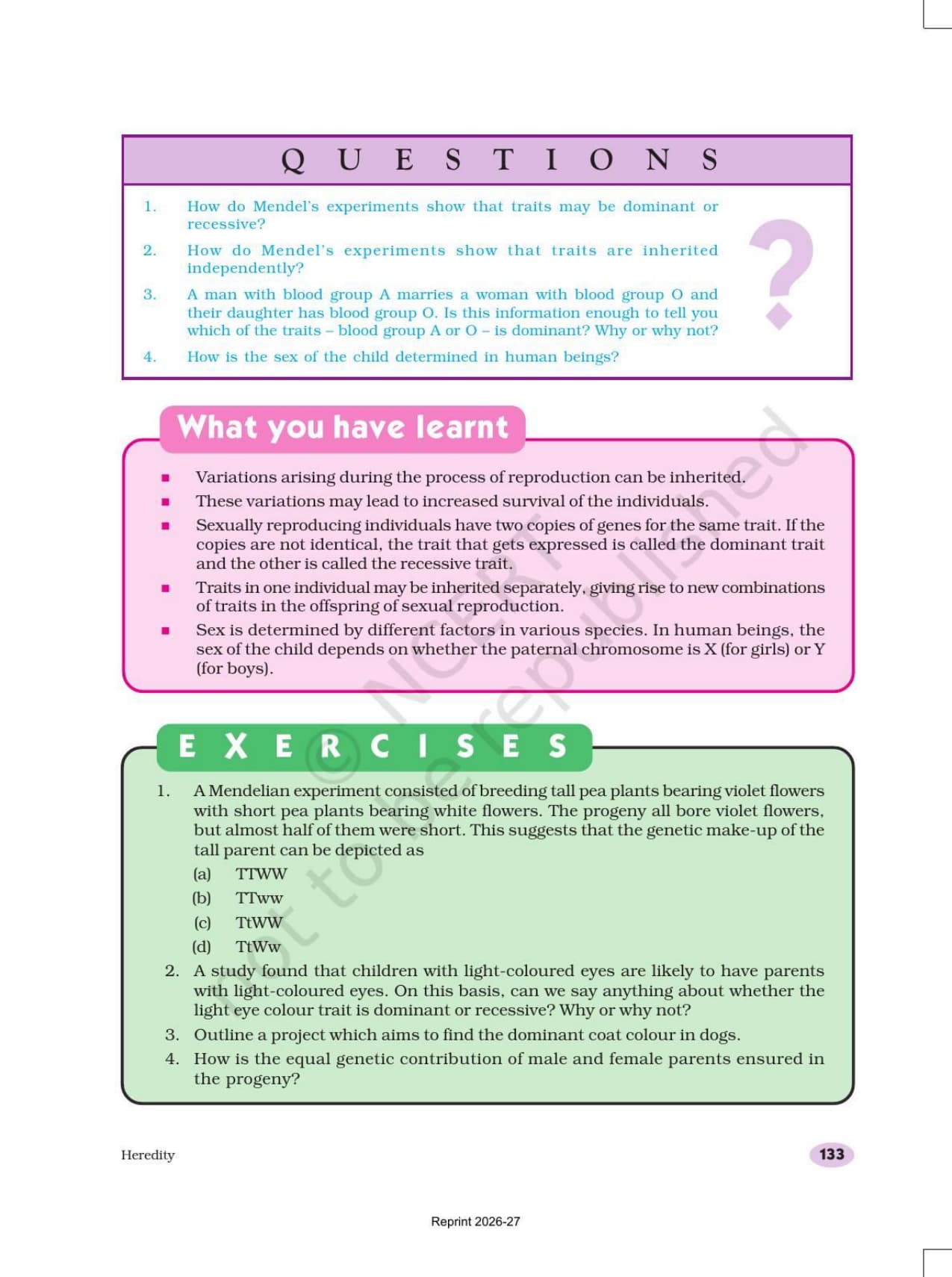
- Official NCERT textbook PDF of Chapter 8, with every activity, figure, in-text question and exercise exactly as printed.
- Covers accumulation of variation, inherited traits, dominant and recessive traits, Mendel's monohybrid and dihybrid crosses, how genes express traits, chromosomes and sex determination in human beings.
- Aligned with the 2026-27 CBSE Class 10 Science syllabus, useful for board exam revision and as the base text for the solutions and notes.
This page hosts the official NCERT Class 10 Science textbook chapter, mapped to the 2026-27 CBSE syllabus and checked page by page against the printed Heredity chapter.
Student Feedback: What 12,400 students told us about this chapter
74% of Class 10 students said the parts they mixed up most were dominant versus recessive traits, the F1 and F2 ratios in Mendel's crosses, and how the XX and XY chromosomes decide a baby's sex. 3 out of 5 students told us that drawing the cross diagrams (Fig. 8.3 and Fig. 8.6) by hand, instead of just reading them, was what finally made the chapter stick.
Students reported spending on average 4 to 5 hours on the full chapter across the first read and revision, and toppers said tracing the official textbook cross diagrams stopped them from writing the wrong ratio in the board exam.
Source: 2026-27 Class 10 Science student poll. Sample of 12,400 students from CBSE schools across 13 states, taken before the 2026 board exams.
What the NCERT Book for Class 10 Science Chapter 8 Heredity Covers
The downloadable PDF above is the complete official NCERT chapter, exactly as printed in the 2026-27 textbook. It covers how variations pile up across generations, inherited traits and Mendel's pea-plant rules, how genes express a trait, and how the X and Y chromosomes decide a baby's sex.
- Accumulation of variation: why sexual reproduction creates more variation than asexual reproduction.
- Inherited traits and Mendel: dominant and recessive traits, F1 and F2 generations, and the 3:1 and 9:3:3:1 ratios.
- How traits get expressed: a gene as a DNA section coding for a protein, with two copies on paired chromosomes.
- Sex determination: the XX and XY chromosomes, and how the father's chromosome decides the child's sex.
Heredity Class 10 Science Full Chapter Video
Source: Magnet Brains on YouTube
Accumulation of Variation During Reproduction in Class 10 Science Chapter 8
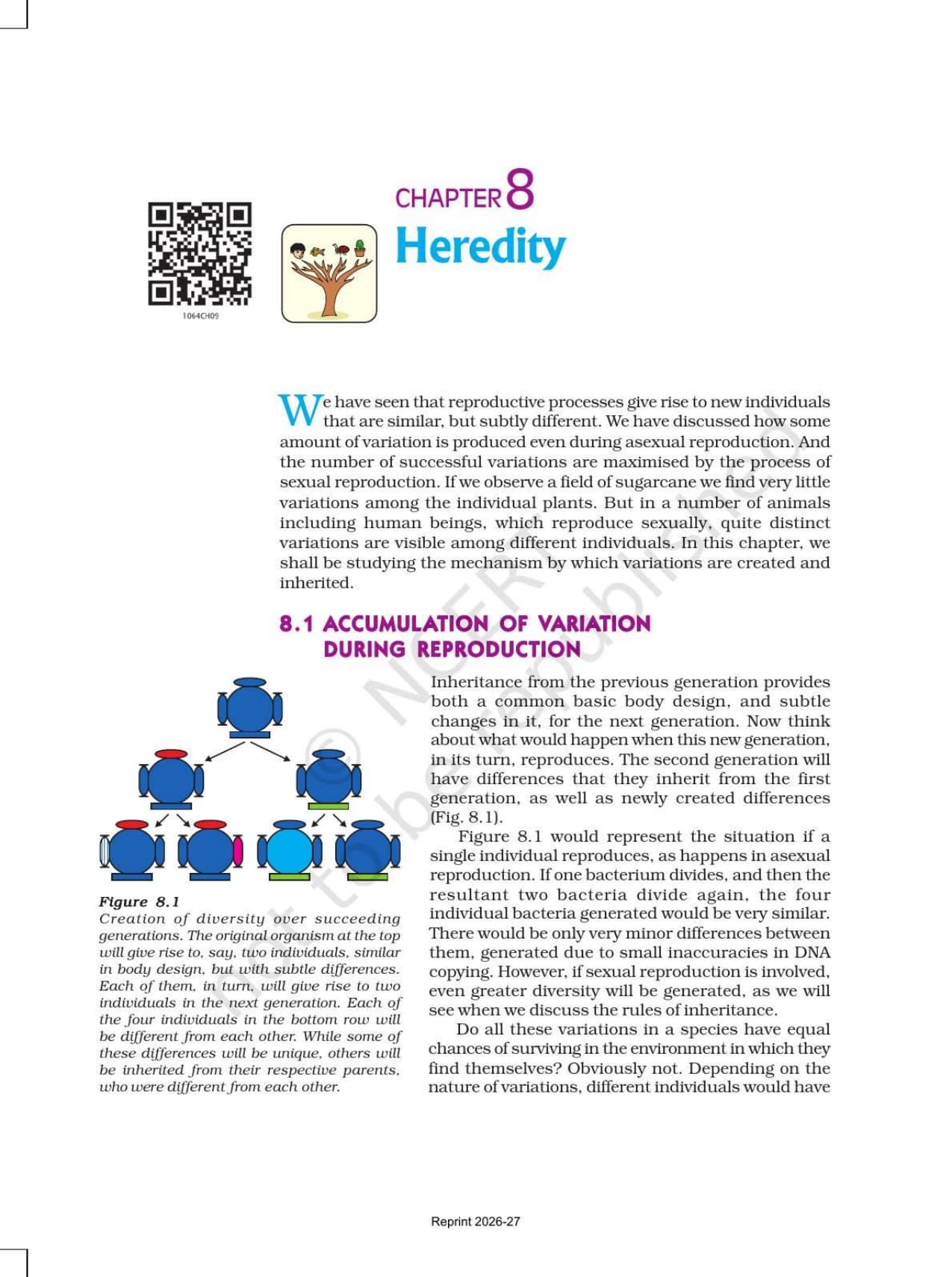
Every reproductive process gives new individuals that are similar but subtly different from the parent. Asexual reproduction produces a little variation, sexual reproduction a lot more. Each generation passes on a common body design plus the changes it inherits and creates.
| Idea | What the textbook says |
|---|---|
| Variation builds up | Each generation inherits old differences and adds new ones, so variation accumulates over time |
| Asexual vs sexual | Asexual reproduction (like one bacterium dividing) gives very minor differences; sexual reproduction gives far greater diversity |
| Survival value | Variations do not all have equal chances of survival; the environment selects the ones that fit it best |
An asexual sugarcane field looks alike, while humans show plenty of visible variation. Bacteria that withstand heat survive better in a heat wave, so selection of variants by the environment becomes the basis for evolution. A varied population is more likely to have individuals that cope when the environment changes.
Heredity and Inherited Traits in Class 10 Science Chapter 8
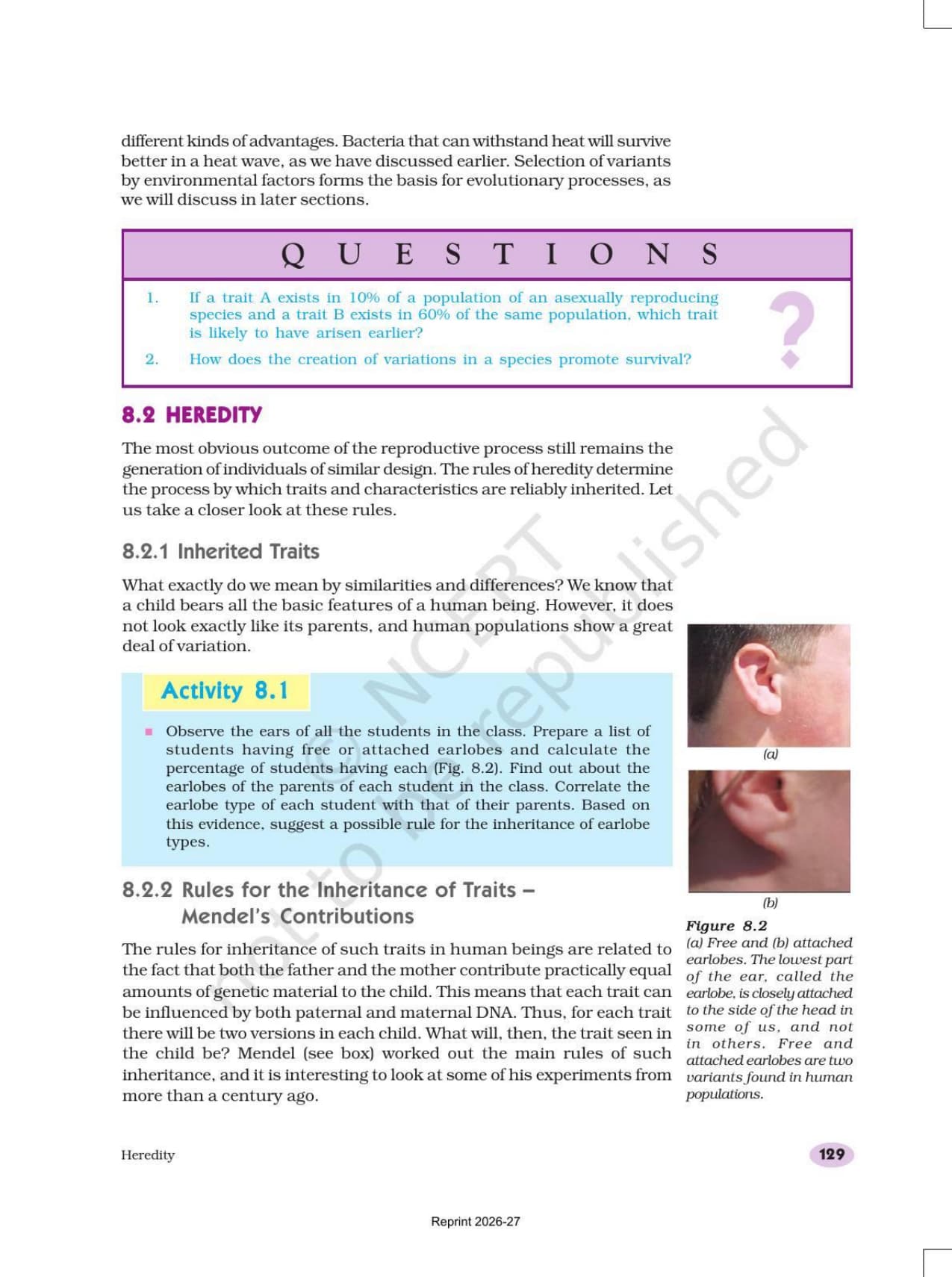
Heredity is the passing of traits from parents to offspring. An inherited trait is a feature passed on, like the free and attached earlobes (Fig. 8.2) of Activity 8.1. A child carries the basic features of a human yet does not look exactly like either parent. Both parents contribute equal genetic material, so every trait can be influenced by paternal and maternal DNA.
| Term | Meaning in Chapter 8 |
|---|---|
| Heredity | The passing of traits and characteristics from parents to offspring |
| Inherited trait | A feature, like free or attached earlobes, that a child gets from its parents |
| Variation | The differences seen among individuals of the same kind in a population |
Each trait comes in two versions, one from each parent, so the question is which version the child will show. Working out that rule is exactly what Gregor Mendel did, and the next section follows his experiments.
Mendel and the Rules for Inheritance of Traits in Class 10 Science
Gregor Johann Mendel grew garden peas and was the first to count how many individuals showed each trait in every generation. He used contrasting characters: round or wrinkled seeds, tall or short plants, white or violet flowers.
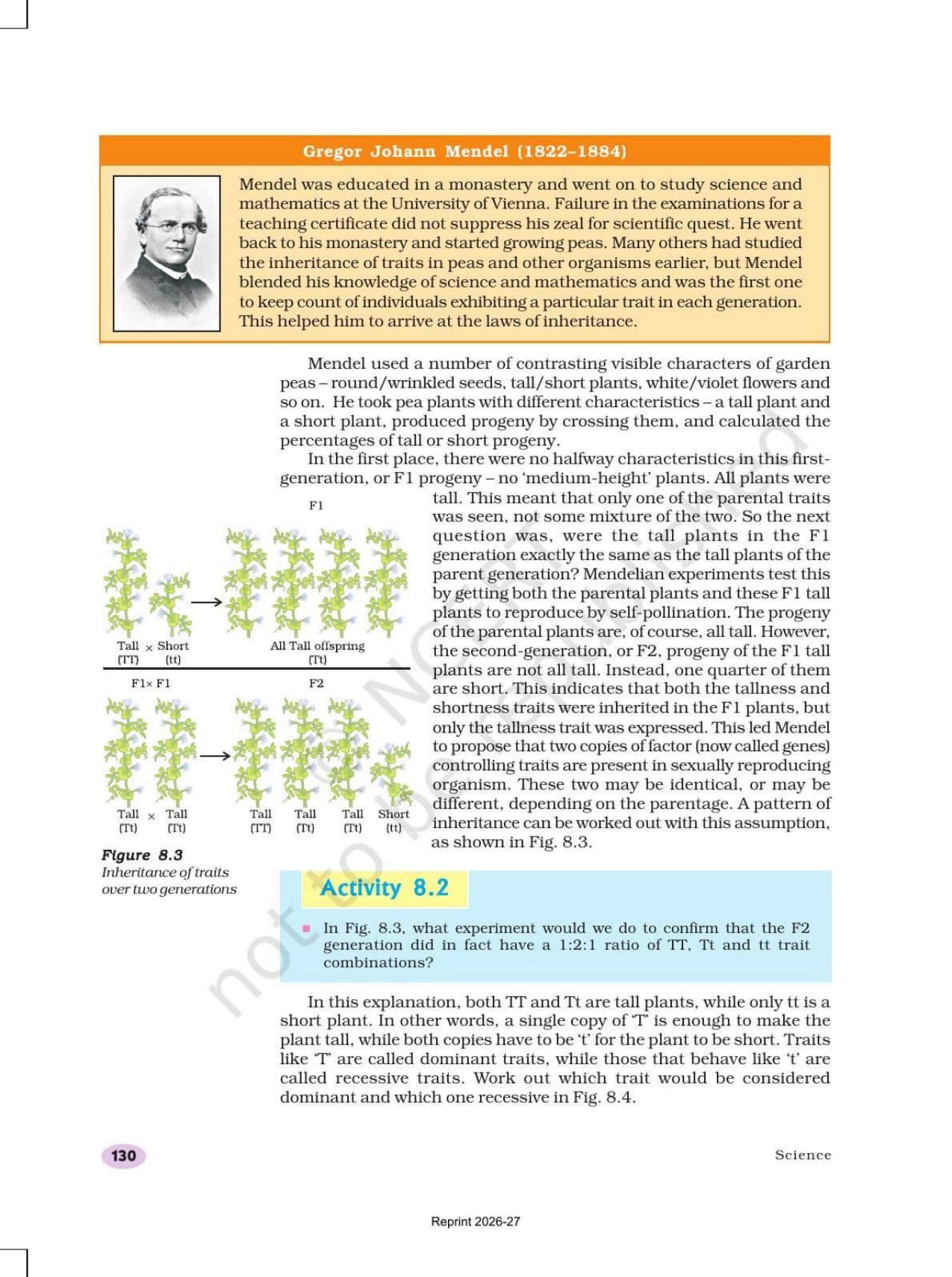
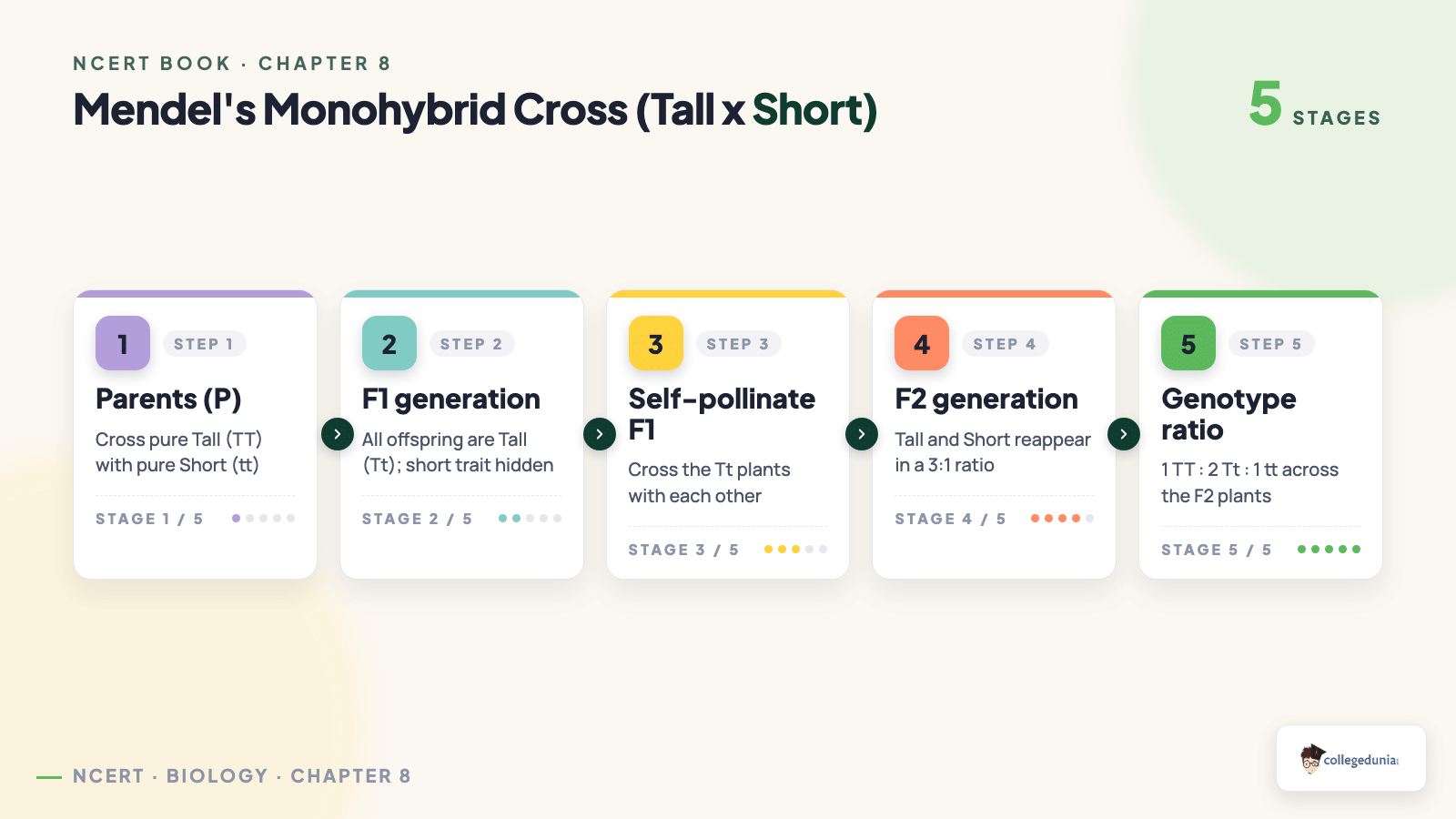
In the monohybrid cross (Fig. 8.3), Mendel crossed a tall plant (TT) with a short plant (tt). The whole F1 generation was tall (Tt). Self-pollinating the F1 gave an F2 generation where about one quarter were short. This 3:1 split proved both traits were present in F1, but only tall was expressed.
| Generation | What appears | Ratio |
|---|---|---|
| Parents (P) | Tall (TT) crossed with short (tt) | One pure tall, one pure short |
| F1 generation | All plants tall (Tt) | All tall |
| F2 generation | Tall and short plants reappear | 3 tall : 1 short (genotype 1 TT : 2 Tt : 1 tt) |
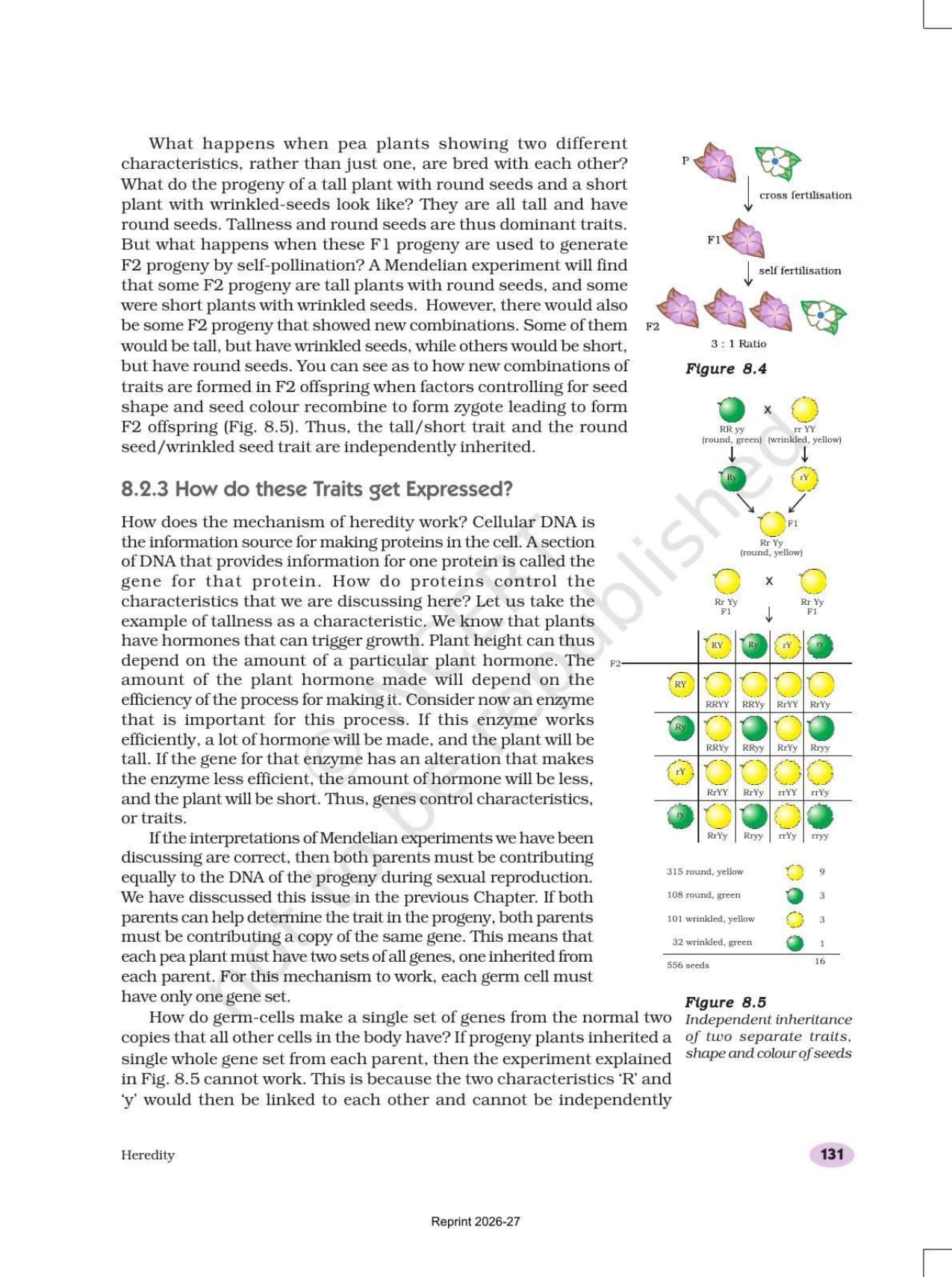
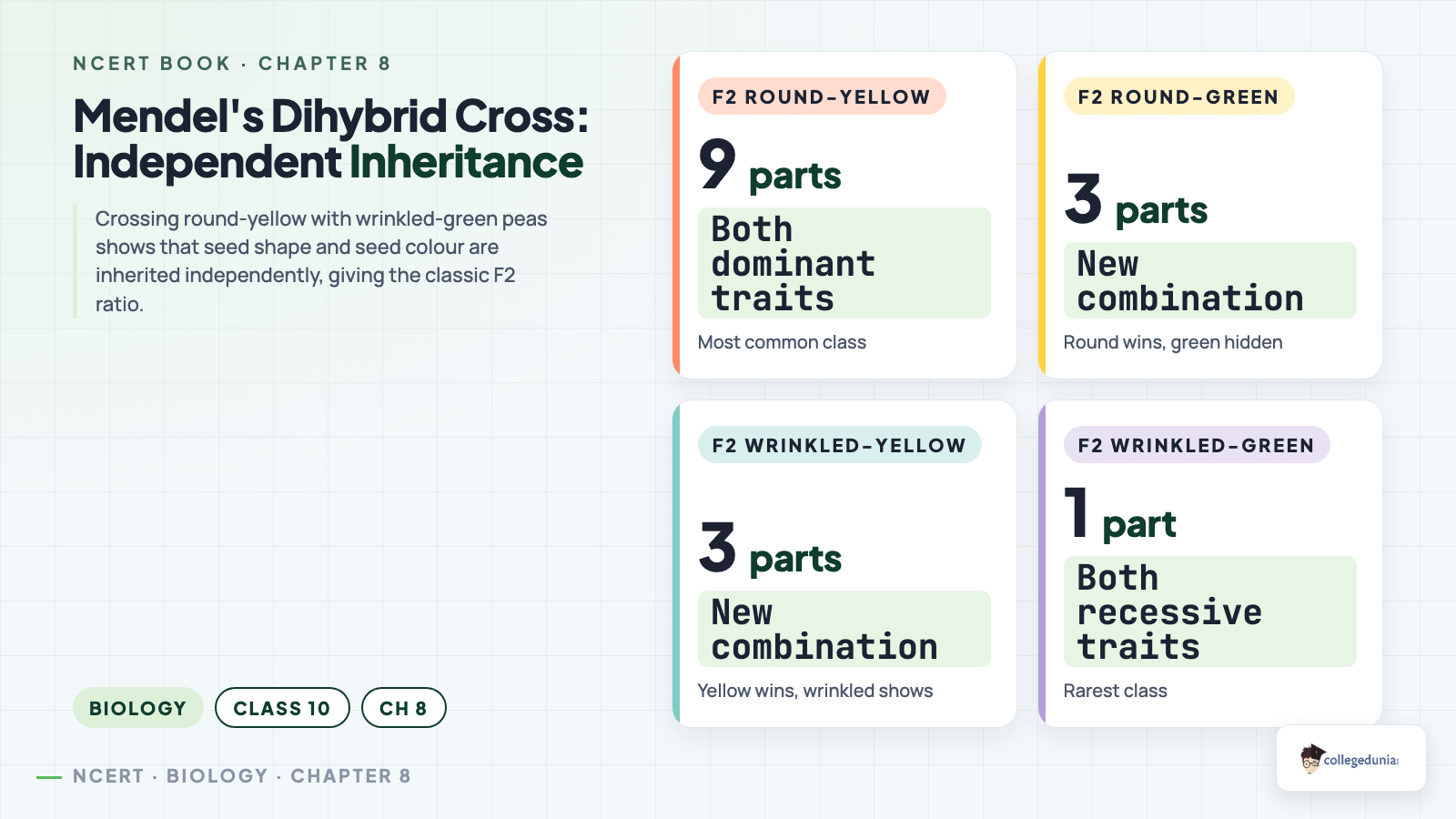
Mendel then tried a dihybrid cross with two characters at once: seed shape and colour (Fig. 8.5). Crossing round-yellow with wrinkled-green gave an all round-yellow F1, and the F2 showed the famous 9:3:3:1 ratio with new combinations like round-green and wrinkled-yellow. This proved the two traits are inherited independently. Learn both ratios together: 3:1 shows dominance, 9:3:3:1 shows independent inheritance.
Dominant and Recessive Traits Explained in Class 10 Science Chapter 8
Mendel proposed that two copies of a factor (now a gene) control each trait. Both TT and Tt plants are tall while only tt is short, so a single copy of T makes a plant tall.
- Dominant trait: expressed even with one copy, like T for tallness.
- Recessive trait: hidden unless both copies are present, like t for shortness (shows only in tt).
- Why F2 brings short back: the recessive t is carried silently in Tt plants and reappears when two t copies pair up.
This is why two parents showing a dominant trait can have a child with the recessive trait, if both secretly carry one recessive copy.
| Genotype | Copies of the gene | Trait shown |
|---|---|---|
| TT | Two dominant copies | Tall (pure) |
| Tt | One dominant, one recessive | Tall (carries shortness silently) |
| tt | Two recessive copies | Short |
How do These Traits get Expressed by Genes in Class 10 Science
Cellular DNA is the source for making proteins, and a section of DNA that codes for one protein is the gene for it. Take plant height: a hormone controls growth, an enzyme controls how much hormone is made, and the gene controls how well that enzyme works. An efficient enzyme makes more hormone and a tall plant; an altered gene makes a less efficient enzyme, less hormone, and a short plant.
Each plant carries two sets of all genes, and each germ cell (gamete) carries one set. A gene set sits on several pieces called chromosomes. Each cell has two copies of each chromosome, one from each parent, and every germ cell takes one from each pair, so fertilisation restores the normal number.
| Term | What it means in the chapter |
|---|---|
| Gene | A section of DNA that gives the information to make one protein |
| Chromosome | A separate piece of DNA; each cell has two copies of every chromosome |
| Germ cell (gamete) | Carries one chromosome from each pair, so it has a single gene set |
This explains why seed shape and colour are inherited independently: their genes sit on separate chromosomes, so they sort into gametes on their own. That is why new combinations appear in the F2 of the dihybrid cross.
Sex Determination in Human Beings in Class 10 Science Chapter 8
Different species decide the sex of a newborn differently: in some reptiles the egg temperature decides sex, and some snails can change sex. In human beings, sex is largely genetically determined by the chromosomes the child inherits.
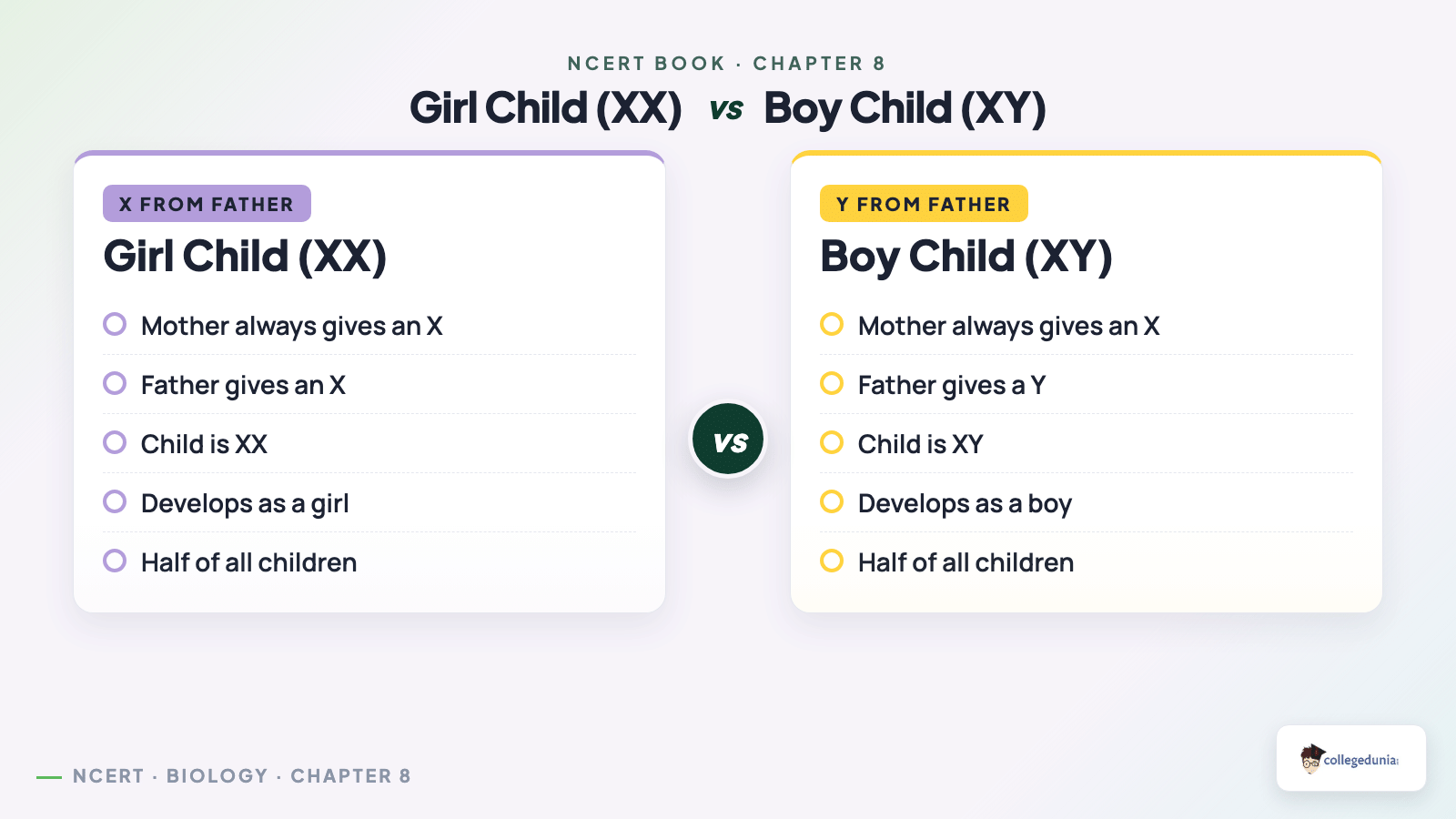
Humans have 23 pairs of chromosomes. Twenty-two pairs match, but one pair, the sex chromosomes, can be odd. Women have a pair of X chromosomes (XX), while men have one X and one shorter Y (XY). A mother always gives an X. The father can pass on either an X or a Y, so the father's chromosome decides the sex of the child.
| From mother | From father | Child |
|---|---|---|
| X | X | Girl (XX) |
| X | Y | Boy (XY) |
As Figure 8.6 shows, half the children are boys and half girls. An X from the father gives a girl, a Y gives a boy. The chapter corrects the common social myth that the mother decides the baby's sex.
What You Have Learnt and Common Exam Traps in Class 10 Science Chapter 8
The chapter ends with a summary box to read in the last minutes before the exam. The list below covers the traps that cost students marks every year.
The repeat-offender mistakes in Heredity chapter board answers:
- Swapping the ratios: monohybrid gives 3:1 in F2, dihybrid gives 9:3:3:1.
- Calling F1 plants pure: an F1 tall plant is Tt, not TT; it carries t silently, so shortness returns in F2.
- Saying the mother decides sex: the mother always gives an X, so the father's X or Y decides.
- Confusing gene and chromosome: a gene codes for one protein; a chromosome carries many genes.
- Forgetting why variation matters: it helps the species survive a changing environment, not always the individual.
Other Resources for Class 10 Science Chapter 8 Heredity
Read the official NCERT Book chapter above, then revise with the matching NCERT Solutions, revision notes, formula sheet and handwritten notes. All resources for Class 10 Science Chapter 8 Heredity are linked in the table below.
| Resource | What it covers | Open |
|---|---|---|
| NCERT Book PDF | Official Class 10 Science Chapter 8 textbook, with every activity, figure and exercise. | You are here |
| NCERT Solutions | Step-by-step answers to all in-text and exercise questions of the chapter. | Class 10 Science Chapter 8 NCERT Solutions |
| Notes | Concept-first revision notes on variation, Mendel's rules, genes and sex determination. | Class 10 Science Chapter 8 Notes |
| Formula Sheet | Quick reference of key terms, crosses, ratios and definitions for fast revision. | Class 10 Science Chapter 8 Formula Sheet |
| Handwritten Notes | Scanned-style handwritten pages for last-minute board revision. | Class 10 Science Chapter 8 Handwritten Notes |
NCERT Book for Class 10 Science: All Chapters
Related Links: Use the table below to open the official NCERT Book PDF for the other chapters of Class 10 Science. Every chapter ships with the same official textbook PDF, chapter overview, and board-ready FAQ.
| Chapter | NCERT Book PDF link |
|---|---|
| Chapter 1 | Chemical Reactions and Equations NCERT Book PDF |
| Chapter 2 | Acids, Bases and Salts NCERT Book PDF |
| Chapter 3 | Metals and Non-metals NCERT Book PDF |
| Chapter 4 | Carbon and its Compounds NCERT Book PDF |
| Chapter 5 | Life Processes NCERT Book PDF |
| Chapter 6 | Control and Coordination NCERT Book PDF |
| Chapter 7 | How do Organisms Reproduce NCERT Book PDF |
| Chapter 8 | Heredity NCERT Book PDF (You are here) |
| Chapter 9 | Light Reflection and Refraction NCERT Book PDF |
| Chapter 10 | The Human Eye and the Colourful World NCERT Book PDF |
| Chapter 11 | Electricity NCERT Book PDF |
| Chapter 12 | Magnetic Effects of Electric Current NCERT Book PDF |
| Chapter 13 | Our Environment NCERT Book PDF |
NCERT Book Class 10 Science Chapter 8 Heredity FAQs
Ques. What does Chapter 8 Heredity cover in the Class 10 Science NCERT Book?
Ans. Chapter 8 of the Class 10 Science NCERT Book covers how traits and characteristics pass from parents to offspring. It begins with the accumulation of variation during reproduction and explains that sexual reproduction creates more variation than asexual reproduction. It then covers heredity and inherited traits, using the free and attached earlobes activity, before moving to Gregor Mendel's pea-plant experiments, which gave the rules of dominant and recessive traits and the 3:1 and 9:3:3:1 ratios. The chapter also explains how genes express traits through proteins, how chromosomes carry the gene sets, and how the sex of a child is determined by the X and Y chromosomes. It is aligned with the 2026-27 CBSE syllabus.
Ques. What is the difference between a dominant trait and a recessive trait in Class 10 Science Chapter 8?
Ans. A dominant trait is the version of a trait that is expressed even when only one copy of its gene is present, such as tallness (T) in Mendel's pea plants, which shows in both TT and Tt plants. A recessive trait is the version that stays hidden unless both copies of its gene are present, such as shortness (t), which appears only in tt plants. In the F1 generation of a tall and short cross, all plants are tall (Tt) because the dominant T masks the recessive t. The recessive trait reappears in the F2 generation when two t copies pair up, which is why shortness comes back in about one quarter of the F2 plants.
Ques. What are the F2 ratios in Mendel's monohybrid and dihybrid crosses?
Ans. In Mendel's monohybrid cross, where one trait is followed, the F2 generation shows a 3:1 ratio. Crossing tall (TT) with short (tt) gives an all-tall F1 (Tt), and self-pollinating the F1 gives three tall plants for every one short plant, with the genotype ratio 1 TT : 2 Tt : 1 tt. In the dihybrid cross, where two traits are followed at once, such as seed shape and seed colour, the F2 generation shows a 9:3:3:1 ratio. This includes new combinations like round-green and wrinkled-yellow, which proves that the two traits are inherited independently of each other.
Ques. How is the sex of a child determined in human beings in Class 10 Science Chapter 8?
Ans. In human beings the sex of a child is decided by the sex chromosomes. Women have two X chromosomes (XX) and men have one X and one Y chromosome (XY). A mother can only pass on an X chromosome to the child, so her contribution is always X. The father, however, can pass on either an X or a Y chromosome. If the child inherits an X from the father it becomes a girl (XX), and if it inherits a Y from the father it becomes a boy (XY). This is why the sex of the child is determined by the father's chromosome and not the mother's, and why about half the children are boys and half are girls.
Ques. How do genes express traits in Class 10 Science Chapter 8 Heredity?
Ans. A gene is a section of cellular DNA that carries the information to make one protein. The textbook explains this using plant height: a plant hormone controls growth, an enzyme controls how much of that hormone is made, and a gene controls how well the enzyme works. If the gene makes an efficient enzyme, more hormone is produced and the plant grows tall; if the gene is altered and the enzyme works poorly, less hormone is made and the plant stays short. So genes control traits indirectly, by coding for the proteins, mostly enzymes, that carry out the actual work in the body.
Ques. Why does sexual reproduction create more variation than asexual reproduction?
Ans. In asexual reproduction a single parent passes on a copy of its DNA, so the offspring are very similar, with only the small differences that creep in during DNA copying. The textbook compares this to a field of sugarcane, where the plants look almost identical. In sexual reproduction the offspring get genetic material from two different parents, so the accumulated variations of both parents mix into fresh combinations in the child. This is why sexually reproducing organisms, such as human beings, show much greater variation. This larger pool of variation is useful for the survival of the species when the environment changes.
Ques. What is the role of chromosomes in inheritance in Class 10 Science?
Ans. A chromosome is a separate piece of DNA in the cell, and each gene set is carried not as one long thread but on several such chromosomes. Every body cell has two copies of each chromosome, one from the mother and one from the father, so it carries two copies of each gene. When germ cells (gametes) form, each one takes only one chromosome from every pair, so it carries a single gene set. When a male and a female germ cell combine during fertilisation, the normal number of chromosomes is restored in the new individual. Because genes for different traits sit on separate chromosomes, those traits can be inherited independently.
Ques. Is the Class 10 Science Chapter 8 NCERT Book PDF free to download for 2026-27?
Ans. Yes. The official NCERT Book PDF for Class 10 Science Chapter 8 Heredity is free to read and download on this page for the 2026-27 session. It is the complete chapter as printed in the CBSE textbook, including every activity, figure, in-text question and end-of-chapter exercise. You can pair the book with the linked NCERT Solutions and revision notes for the same chapter so that you read the textbook and revise from one place before the board exam.



Comments