



The NCERT Class 11 English Woven Words Chapter 10 Coming PDF gives students the official Philip Larkin poem for the 2026-27 session. Use it to read the poem, mark the spring images, and practise the NCERT questions printed after the chapter.
- Core focus: spring, renewal, bird-song, childhood and sudden happiness.
- Best use: read the PDF once, then underline every image of light and sound.
- Exam value: answers often ask how the thrush announces the arrival of spring.
NCERTBookChapter10Coming.pdf?page=1&dpi=150)
NCERTBookChapter10Coming.pdf?page=2&dpi=150)
NCERTBookChapter10Coming.pdf?page=3&dpi=150)
The official NCERT Class 11 English Woven Words Chapter 10 PDF helps students read Coming directly before revising Philip Larkin's images of spring, memory and wonder.
Student Feedback: In a Collegedunia check of 10,620 Class 11 English students, many students said Coming became easier after they linked the thrush's song with the speaker's child-like happiness.
What the Coming NCERT Book PDF Covers
NCERT prints Coming as the third poem in the Poetry section of Woven Words. The poem shows a speaker hearing a thrush in a bare garden. The sound makes him feel that spring is near.
The PDF also includes the About the Poet note and NCERT exercise. Students get questions on the bird's announcement, the title, childhood, surprise, comparison and the phrase fresh-peeled voice.
- Poem section: nineteen short lines on spring and sudden happiness.
- Poet note: Philip Larkin, The Movement and The Less Deceived.
- Exercise section: understanding questions, activity prompts and suggested reading.
Coming Class 11 Explanation Video
Source: Magnet Brains on YouTube
Spring and Bird-song in Coming
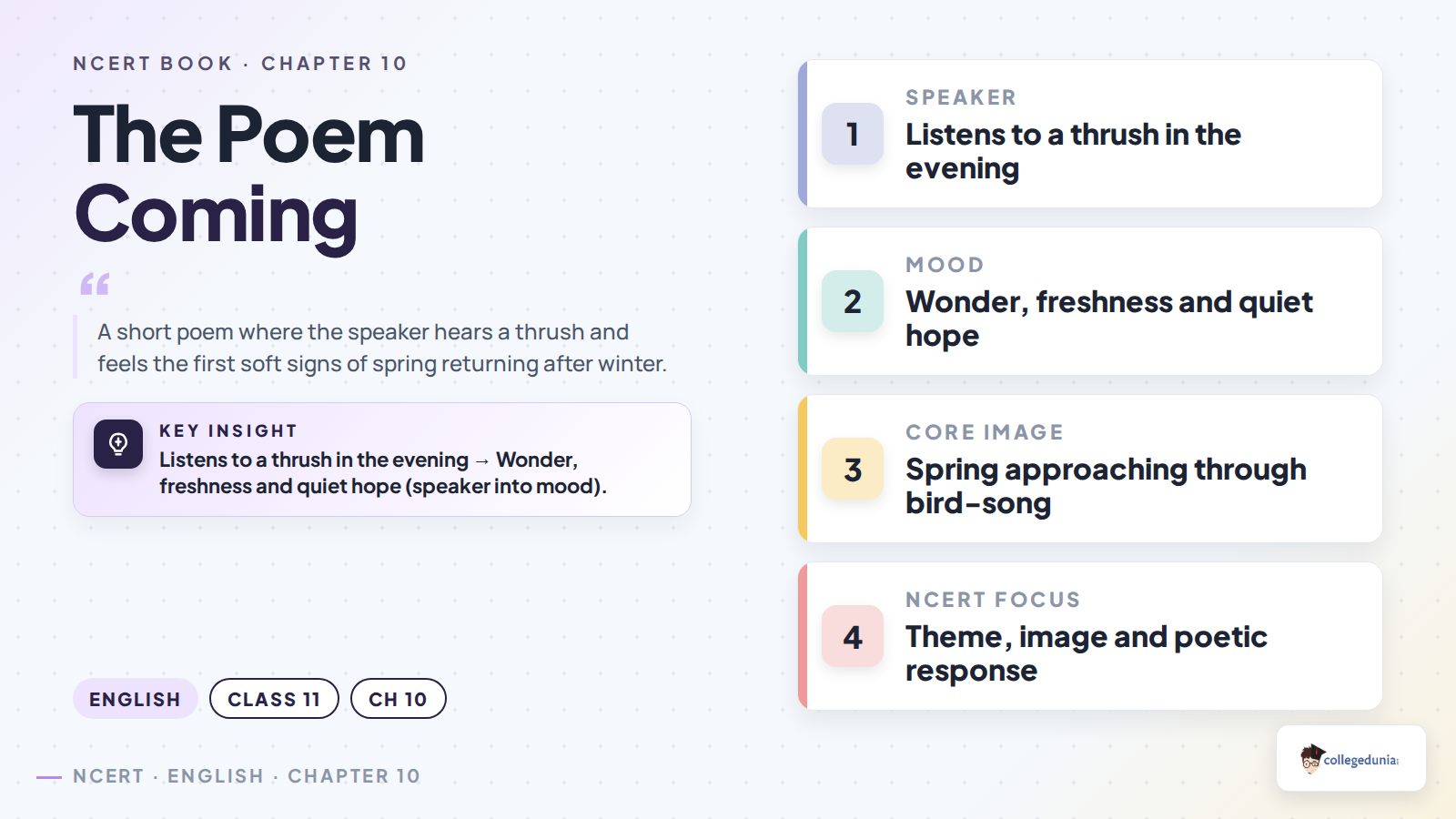
The thrush is the first clear sign of spring. It sings in a deep bare garden, so the season has not fully arrived. Still, the bird's voice makes the speaker feel that change has already begun.
Coming is not a loud celebration of spring. It is a quiet moment where a small sound changes the speaker's mood. This is why the title points to arrival, expectation and renewal.
- Longer evenings: show that winter is ending.
- Chill and yellow light: gives the scene a soft spring edge.
- Thrush song: announces spring before the garden becomes green.
Childhood Memory and Surprise in Coming
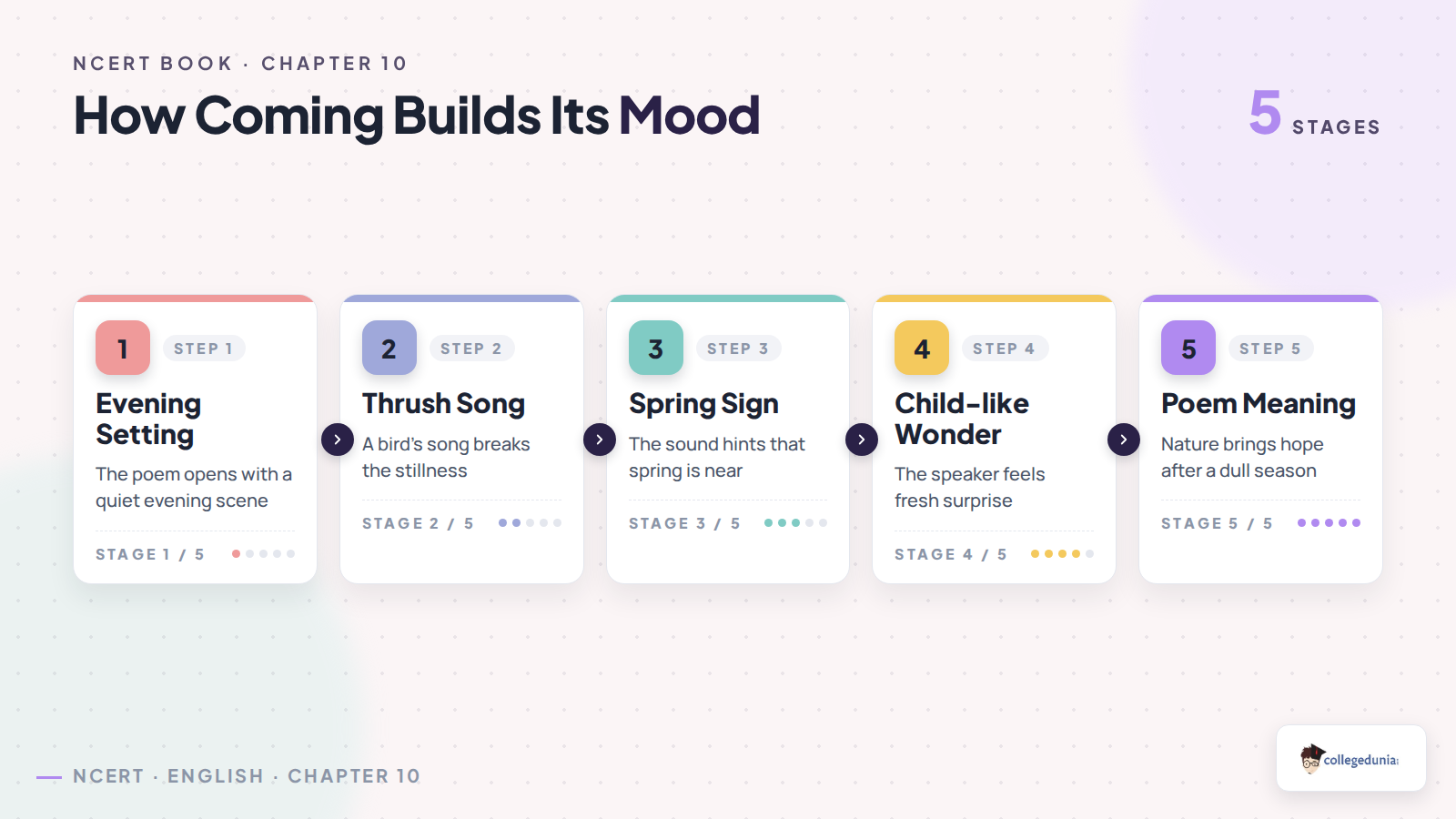
The speaker says his childhood is a forgotten boredom. He does not remember it as a clear happy period. Yet the bird's song makes him feel like a child again.
The child image explains the poem's surprise. A child who sees adult reconciling may not understand the full meaning, but senses unusual laughter. The speaker responds to spring in the same half-understood but happy way.
| Image | Meaning in the poem | Revision cue |
|---|---|---|
| Thrush | Nature announces spring through sound. | Use for title answers. |
| Fresh-peeled voice | The song sounds new, clean and bright. | Use for phrase explanation. |
| Adult reconciling | A child senses happiness without fully understanding it. | Use for comparison answers. |
NCERT Questions and the Haiku Note in the PDF
The official PDF keeps the poem, poet note, questions and haiku note together. After the main poem, NCERT asks students to think about spring signs in India and compare Coming with other spring poems.
Do not skip the haiku page. It explains a short Japanese three-line poem and gives examples such as Cobra, Night and Alone. This page helps students notice how a small image can carry a complete thought.
- Title question: connect Coming with spring's arrival.
- Childhood question: explain forgotten boredom and sudden happiness.
- Comparison question: compare the speaker with the child in the poem.
- Phrase question: explain why fresh-peeled voice suits the thrush.
How to Use the Chapter 10 Book PDF for Revision
Use the official PDF in three rounds. First, read the poem aloud and hear the rhythm. Second, underline the visual and sound images. Third, answer each NCERT question with one exact phrase from the poem.
- For theme answers: use spring, renewal and child-like wonder.
- For imagery answers: mention light, houses, garden and bird-song.
- For phrase answers: explain fresh-peeled as new and clean.
- For comparison answers: connect adult reconciling with partial understanding.
Coming Class 11 Related Resources
| Resource | Best use | Link |
|---|---|---|
| NCERT Solutions | Use for textbook answers and phrase explanations. | Coming NCERT Solutions (publishing soon) |
| Revision Notes | Use for summary, theme, images and answer cues. | Coming Notes |
| Handwritten Notes | Use for quick one-shot revision before class tests. | Coming Handwritten Notes |
All Class 11 English Woven Words NCERT Book Chapters
Coming Class 11 English NCERT Book FAQs
Ques. What is included in the Class 11 English Woven Words Chapter 10 NCERT PDF?
Ans. It includes Philip Larkin's poem Coming, the About the Poet note, NCERT understanding questions, Try This Out prompts, suggested reading and a short haiku note.
Ques. Who wrote Coming in Woven Words?
Ans. Coming was written by Philip Larkin. NCERT notes that the poem is taken from The Less Deceived.
Ques. What does the bird announce in Coming?
Ans. The thrush announces that spring is near. Its song changes the quiet evening scene into a moment of hope and renewal.
Ques. What does fresh-peeled voice mean in the poem?
Ans. Fresh-peeled voice suggests a clean, new and bright sound. It makes the bird's song feel like the first clear sign of spring.
Ques. How should students use this PDF for 2026-27 revision?
Ans. Students should read the poem, mark the images of spring and sound, then answer each NCERT question with one direct phrase from the text.



Comments