



The NCERT Class 11 English Woven Words Chapter 21 Patterns of Creativity PDF gives students the official S. Chandrasekhar essay for the 2026-27 session. Use it to read how the chapter compares scientific inquiry, poetic imagination, Shelley, Darwin and Faraday in one argument.
- Core focus: creativity in science, poetry and the inner life.
- Best use: read the PDF before writing appreciation answers.
- Exam value: the essay rewards examples, quoted references and clear argument flow.
NCERTBookChapter21PatternsofCreativity.pdf?page=1&dpi=150)
NCERTBookChapter21PatternsofCreativity.pdf?page=2&dpi=150)
NCERTBookChapter21PatternsofCreativity.pdf?page=3&dpi=150)
NCERTBookChapter21PatternsofCreativity.pdf?page=4&dpi=150)
NCERTBookChapter21PatternsofCreativity.pdf?page=5&dpi=150)
NCERTBookChapter21PatternsofCreativity.pdf?page=6&dpi=150)
NCERTBookChapter21PatternsofCreativity.pdf?page=7&dpi=150)
NCERTBookChapter21PatternsofCreativity.pdf?page=8&dpi=150)
Student Feedback: In a Collegedunia check of 11,680 Class 11 English students, many students said this essay became easier after they made a two-column list of poets and scientists mentioned by Chandrasekhar.
What the Patterns of Creativity NCERT Book PDF Covers
Patterns of Creativity is an essay by S. Chandrasekhar, the Nobel Prize winning astrophysicist. The chapter asks why the arts and the sciences seem to follow different creative patterns. Chandrasekhar does not give a simple definition. He builds the answer through literary examples, scientific examples and a final open question.
The chapter is not a simple science versus poetry debate. It shows where both fields compete, where they misunderstand one another, and where imagination joins them.
- Wordsworth and Keats are used to show suspicion of cold philosophy.
- Shelley is presented as a poet who welcomed scientific thought.
- Darwin and Faraday show two different pressures inside scientific creativity.
Patterns of Creativity Class 11 Video Explanation
Source: Magnet Brains on YouTube
Patterns of Creativity Chapter 21 Summary
Chandrasekhar begins with the question of why creative patterns differ in the arts and sciences. He first looks at how poets have often viewed science. Wordsworth and Keats suggest that analysis can damage beauty. Lowes Dickinson says that science expels literature. Peter Medawar answers from the other side and argues that literature can also push science away.
After setting up this conflict, Chandrasekhar turns to Shelley. Shelley becomes the bridge between poetic imagination and scientific curiosity. Shelley sees science as joy, peace and illumination. His poems on clouds, lightning and nature allow Chandrasekhar to show that poetry can include scientific wonder without losing beauty.
In the last part, Chandrasekhar brings in Darwin and Faraday. Darwin admits that years of scientific work made poetry, music and pictures lose their old charm for him. Faraday, on the other hand, creates new concepts such as lines of force and fields of force. Maxwell later sees the future value of Faraday's ideas. The essay closes by asking why science has no work equal to Shelley's A Defence of Poetry.
Science and Poetry in Patterns of Creativity
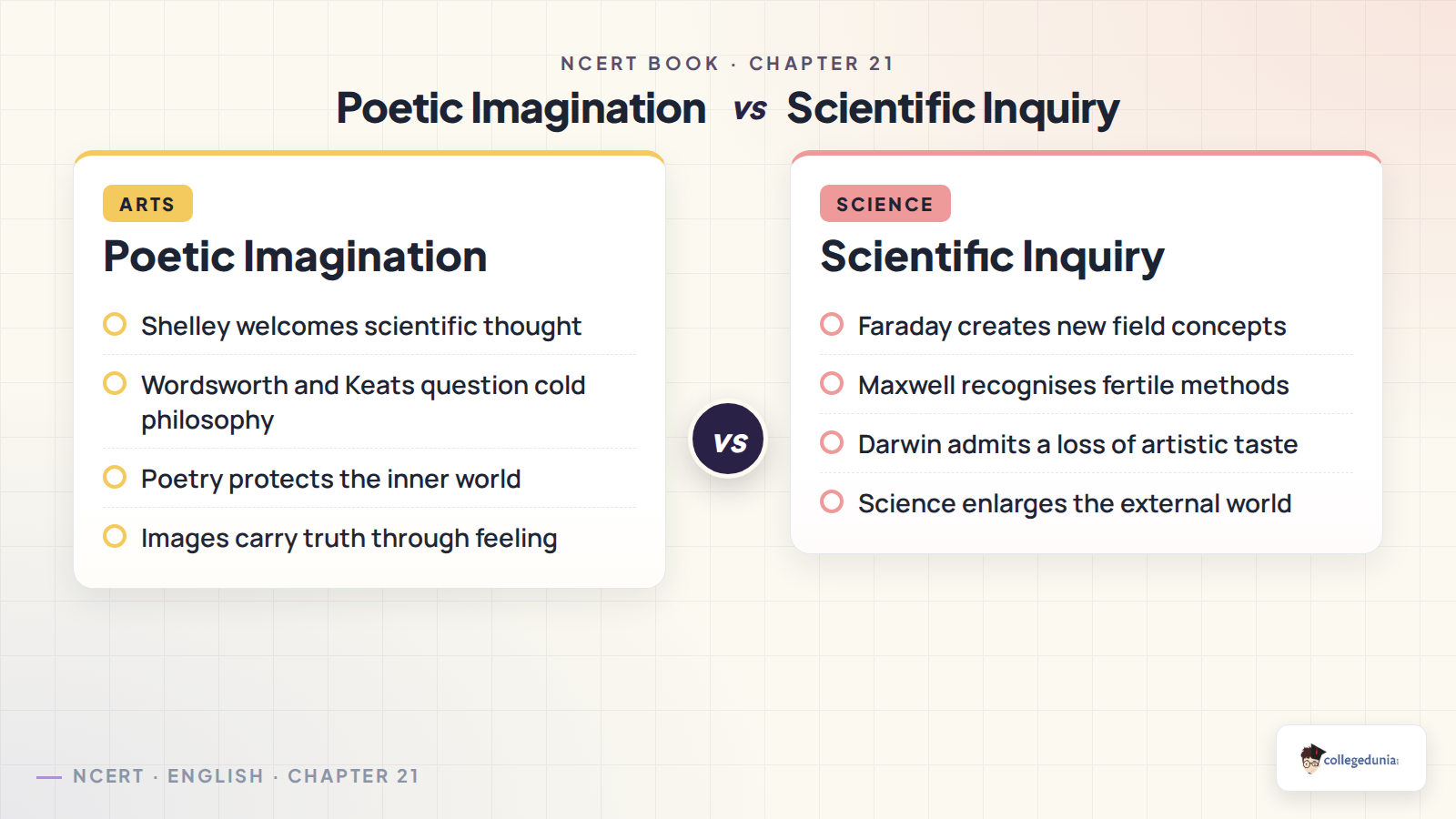
The chapter works because Chandrasekhar treats poets and scientists with care. He does not mock poets for distrusting science, and he does not reduce scientists to machines. Instead, he studies the creative habits behind both fields.
| Side | Examples in the essay | What students should notice |
|---|---|---|
| Poetry questioning science | Wordsworth, Keats, Lowes Dickinson | They fear that analysis can remove wonder. |
| Science answering back | Peter Medawar | He says literature and science can compete instead of support each other. |
| Poetry embracing science | Shelley, Whitehead, King-Hele | Shelley sees scientific ideas as sources of light and joy. |
| Science under pressure | Darwin, Faraday, Maxwell | Creative science can enlarge knowledge but may also narrow other tastes. |
How Chandrasekhar Builds the Argument
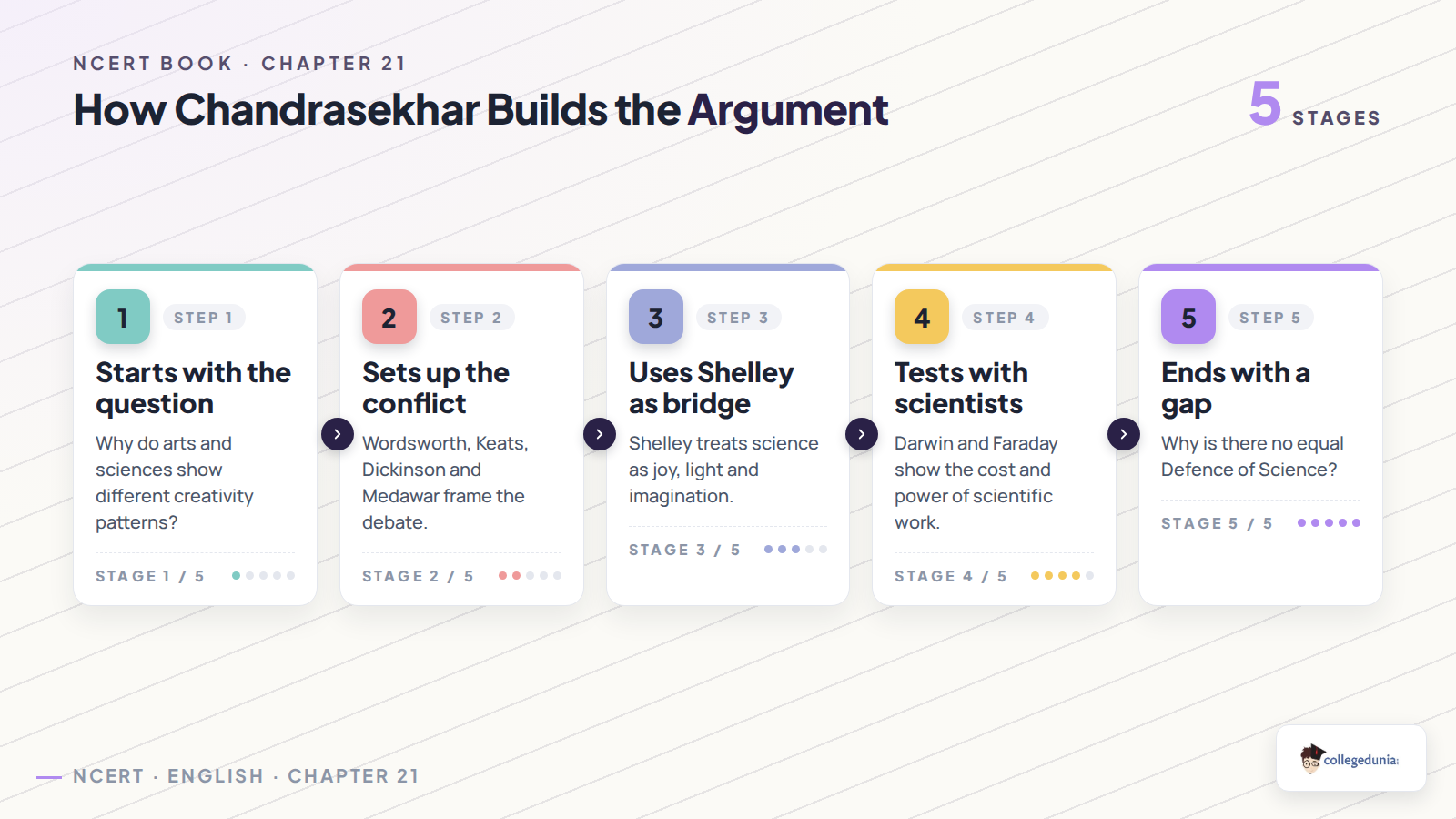
The essay is lecture-like, so students should track the movement of ideas. Chandrasekhar starts with a question, tests different voices, and then leaves students with a final challenge. This pattern matters because many answers in the exercise ask students to explain the structure of the argument.
- Question: why do the arts and sciences show different creative patterns?
- Conflict: poets and scientists often accuse one another.
- Bridge: Shelley shows that poetry can love science.
- Test: Darwin and Faraday reveal gains and losses in scientific life.
- Open end: Chandrasekhar asks why no scientist wrote a similar Defence of Science.
Shelley in Patterns of Creativity
Shelley is the most important literary figure in the chapter. Chandrasekhar calls him a scientist's poet because Shelley writes about natural forces with precision and excitement. Whitehead also says Shelley loved science and used it as a symbol of joy, peace and illumination.
Students should not treat Shelley as just another quoted poet. He changes the direction of the essay. Wordsworth and Keats help create the conflict, but Shelley shows a way beyond it.
- The Cloud mixes myth, science and movement.
- Prometheus Unbound presents intellectual light and spiritual freedom.
- A Defence of Poetry becomes the essay's final touchstone.
Darwin and Faraday in Patterns of Creativity
Darwin and Faraday help Chandrasekhar examine scientific creativity from inside science. Darwin's confession is painful because he says his mind became like a machine for grinding laws from facts. This does not mean science is wrong; it shows the cost of one-sided cultivation.
Faraday gives the other side. His ideas of lines of force and fields of force looked strange to some contemporaries, but Maxwell recognised their future value. Faraday's answer to Gladstone about taxing electricity also shows how new science may look useless before society understands it.
| Scientist | Role in the essay | Revision point |
|---|---|---|
| Darwin | Shows how intense scientific work can dull artistic pleasure. | Use him for answers on the inner world. |
| Faraday | Shows original scientific vision before public usefulness is clear. | Use him for answers on imagination in science. |
| Maxwell | Recognises the future value of Faraday's concepts. | Use him for answers on prophetic discernment. |
Important Vocabulary in Patterns of Creativity
The official PDF opens with a word-meaning activity. These words are useful because Chandrasekhar's essay carries many literary and philosophical references. Students should learn the words through context rather than memorising loose meanings.
| Expression | Simple meaning in context |
|---|---|
| Cold philosophy | Dry analysis that seems to remove wonder. |
| Mutually sustaining endeavours | Two efforts that support each other. |
| Picaresque tale | An adventurous story with movement and episodes. |
| Atrophy | Weakening or loss through lack of use. |
| Prophetic discernment | The ability to see future importance early. |
| Apposite | Suitable or exactly relevant. |
How to Use the Chapter 21 Book PDF for Revision
Use the official PDF in three passes. First, read it as an argument about science and poetry. Second, underline every person mentioned. Third, write a one-line role for each person, because most good answers depend on naming the correct example.
- For summary answers: explain the full movement from conflict to open question.
- For appreciation answers: focus on Shelley and the quoted poetry.
- For value-based answers: connect science, imagination and the inner world.
- For vocabulary: use the opening word list and sentences from the essay.
Patterns of Creativity Class 11 Related Resources
| Resource | Best use |
|---|---|
| Patterns of Creativity NCERT Solutions | Use for exercise answers and appreciation questions. |
| Patterns of Creativity Notes | Use for summary, themes and author references. |
| Patterns of Creativity Handwritten Notes | Use for quick one-shot revision. |
Class 11 English Woven Words NCERT Book Chapters
| Chapter | NCERT Book PDF link | Status |
|---|---|---|
| 17 | Felling of the Banyan Tree NCERT Book PDF | Live |
| 18 | Ode to a Nightingale NCERT Book PDF | Live |
| 19 | Ajamil and the Tigers NCERT Book PDF | Live |
| 20 | My Three Passions NCERT Book PDF | Previous |
| 21 | Patterns of Creativity NCERT Book PDF | Current chapter |
| 22 | Tribal Verse NCERT Book PDF | Next |
| 23 | What is a Good Book? NCERT Book PDF | Next |
Patterns of Creativity Class 11 English NCERT Book FAQs
Ques. What is included in the Class 11 English Woven Words Chapter 21 NCERT PDF?
Ans. It includes the official NCERT essay Patterns of Creativity by S. Chandrasekhar, the word list, author note and chapter exercises.
Ques. What is the main idea of Patterns of Creativity?
Ans. The essay studies why creativity in science and poetry seems different, while also showing that both need imagination and vision.
Ques. Why is Shelley important in Patterns of Creativity?
Ans. Shelley is important because Chandrasekhar presents him as a poet who loved science and turned scientific ideas into poetry.
Ques. How should students revise this chapter?
Ans. Students should track each quoted writer or scientist, write their role in the argument, and revise the vocabulary list from the PDF.



Comments