



The NCERT Class 11 English Woven Words Chapter 3 The Rocking-horse Winner PDF gives students the official textbook chapter for the 2026-27 session. Use it to read D. H. Lawrence's story, follow Paul's tragic chase for luck, and revise the NCERT exercise printed after the story.
- Core focus: luck, money, family pressure, childhood innocence and obsession.
- Best use: read the PDF once before solving the NCERT questions.
- Exam value: theme answers often ask how money pressure damages the home.
NCERTBookChapter3TheRocking-horseWinner.pdf?page=1&dpi=150)
NCERTBookChapter3TheRocking-horseWinner.pdf?page=2&dpi=150)
NCERTBookChapter3TheRocking-horseWinner.pdf?page=3&dpi=150)
NCERTBookChapter3TheRocking-horseWinner.pdf?page=4&dpi=150)
NCERTBookChapter3TheRocking-horseWinner.pdf?page=5&dpi=150)
NCERTBookChapter3TheRocking-horseWinner.pdf?page=6&dpi=150)
NCERTBookChapter3TheRocking-horseWinner.pdf?page=7&dpi=150)
NCERTBookChapter3TheRocking-horseWinner.pdf?page=8&dpi=150)
NCERTBookChapter3TheRocking-horseWinner.pdf?page=9&dpi=150)
NCERTBookChapter3TheRocking-horseWinner.pdf?page=10&dpi=150)
NCERTBookChapter3TheRocking-horseWinner.pdf?page=11&dpi=150)
NCERTBookChapter3TheRocking-horseWinner.pdf?page=12&dpi=150)
NCERTBookChapter3TheRocking-horseWinner.pdf?page=13&dpi=150)
NCERTBookChapter3TheRocking-horseWinner.pdf?page=14&dpi=150)
NCERTBookChapter3TheRocking-horseWinner.pdf?page=15&dpi=150)
NCERTBookChapter3TheRocking-horseWinner.pdf?page=16&dpi=150)
NCERTBookChapter3TheRocking-horseWinner.pdf?page=17&dpi=150)
NCERTBookChapter3TheRocking-horseWinner.pdf?page=18&dpi=150)
The official NCERT Class 11 English Woven Words Chapter 3 PDF helps students read The Rocking-horse Winner directly from the textbook before revising answers.
Student Feedback: In a Collegedunia check of 12,940 Class 11 English students, many students said The Rocking-horse Winner became easier after they tracked how each race win deepens Paul's pressure instead of solving it.
What the The Rocking-horse Winner NCERT Book PDF Covers
NCERT prints The Rocking-horse Winner as the third short story in Woven Words. The story follows Paul, a young boy who believes he can discover race winners by riding his rocking horse in a trance-like state.
The chapter is about money hunger inside a family. Paul's mother feels unlucky, the house seems to whisper for more money, and the child tries to fix adult unhappiness in a dangerous way.
- Story section: Paul, Hester, Uncle Oscar and Bassett drive the plot.
- Theme section: luck, greed, love and anxiety stand out.
- Exercise section: NCERT asks understanding, discussion and appreciation questions.
The Rocking-horse Winner Chapter Explanation
Source: Magnet Brains on YouTube
Paul and the House in The Rocking-horse Winner
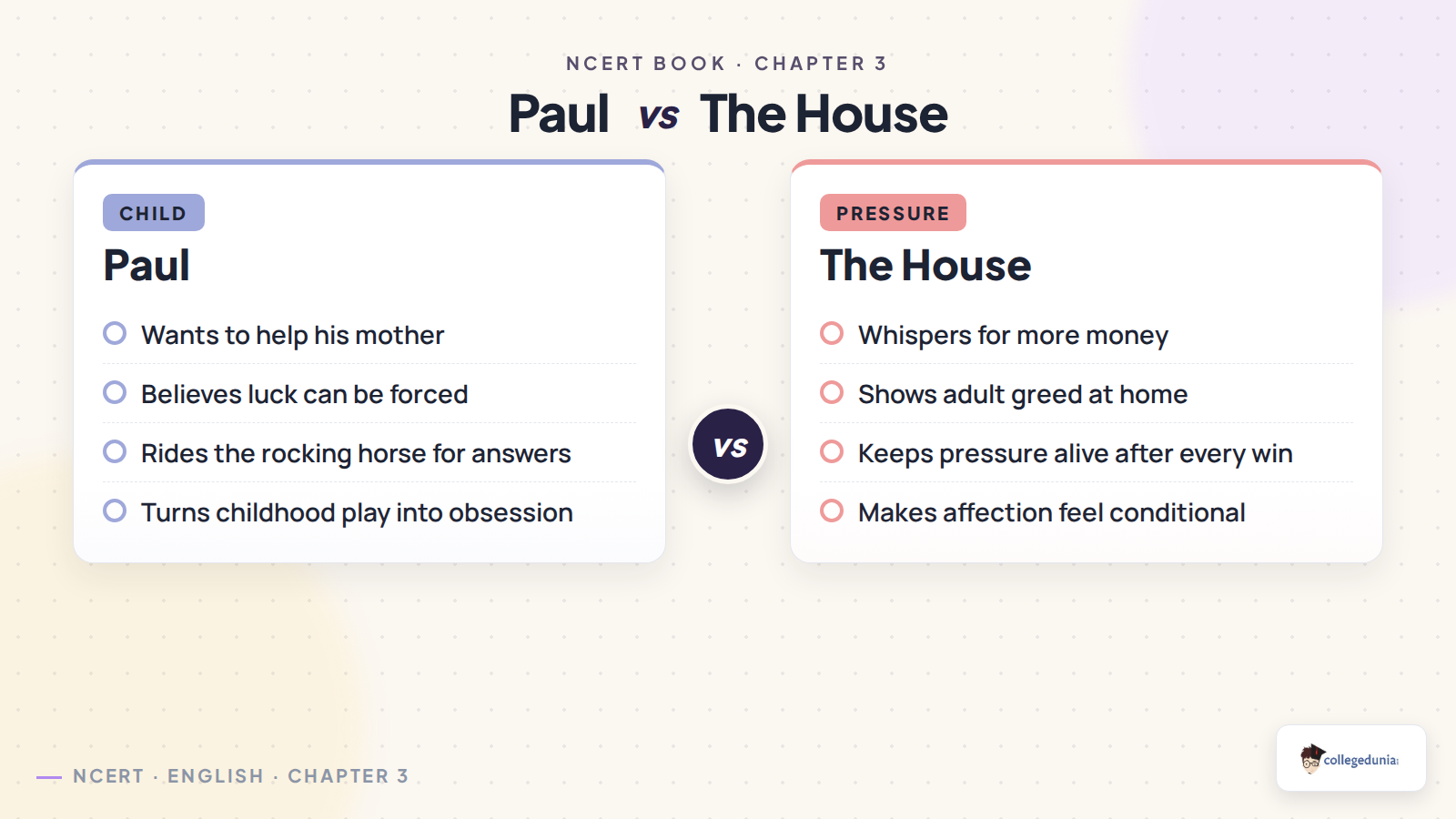
Paul wants to help his mother, but he is too young to understand the danger of her need. The house becomes a symbol of this pressure because it seems to repeat the demand for more money.
The whispering house matters because it turns family life into a place of anxiety. Good answers should explain that Paul is not greedy in the usual sense. He is trying to earn love and peace through luck.
Paul's Luck Chase and the Race-Winner Pattern
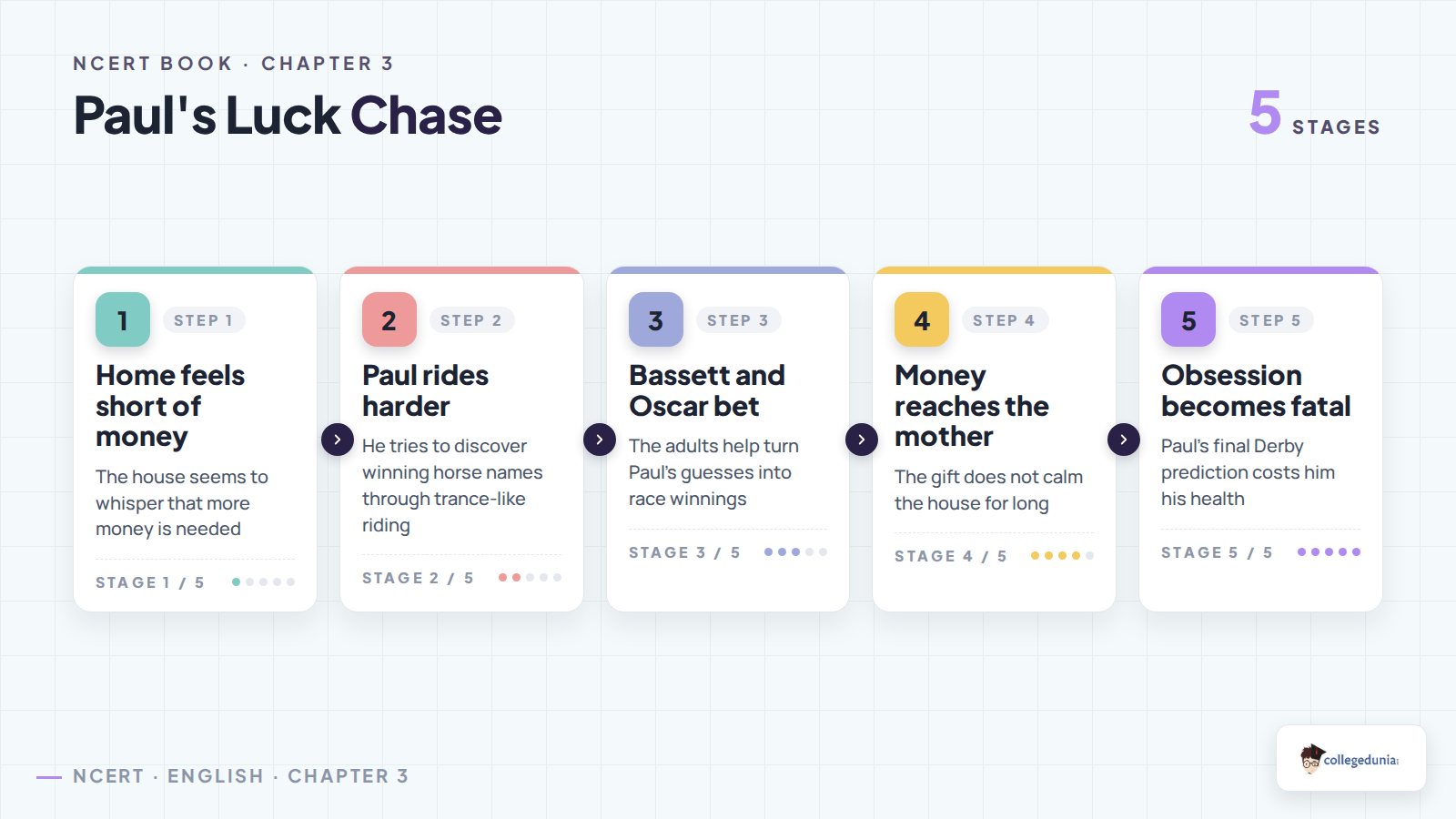
Paul's rocking horse starts as a child's toy, but it slowly becomes a tool of obsession. He rides harder when he wants the name of a winning horse. Bassett and Uncle Oscar then use his guesses for betting.
| Stage | What happens | Meaning in the story |
|---|---|---|
| Need | The family wants more money. | The home has emotional pressure. |
| Ride | Paul rides the rocking horse intensely. | Play turns into compulsion. |
| Bet | Bassett and Oscar act on Paul's predictions. | Adults help the obsession continue. |
| Cost | Paul's final effort breaks his health. | The chase for luck becomes tragic. |
Mother, Money and Love in The Rocking-horse Winner
Hester says she is unlucky because she married for love but feels that love has failed. This is one of the sharpest ideas in the chapter. Money does not remain outside the family. It enters the way people feel, speak and judge themselves.
Paul's tragedy begins when affection feels conditional. He thinks money can make his mother happy and can prove that he is lucky. The more he wins, the more the house demands.
- Hester's dissatisfaction: she feels unlucky and restless.
- Paul's response: he wants to prove that he has luck.
- The betting circle: Bassett and Oscar turn the gift into action.
- The ending: Paul wins money but loses his life.
Language Work and Appreciation Questions in the PDF
The official PDF keeps the story and the NCERT exercise together. After reading the chapter, students can move straight to questions on character, symbolism, narrative method and the meaning of luck in the story.
Do not skip the appreciation questions. They help students explain how Lawrence uses the whispering house, the rocking horse and the racing names to build tension.
- Understanding questions: check the events behind Paul's predictions.
- Discussion questions: connect the story with money pressure at home.
- Appreciation questions: focus on symbols, irony and tragedy.
- Language work: revises words linked to luck, anxiety and desire.
How to Use the Chapter 3 Book PDF for Revision
Use the official PDF in three rounds. First, read the story for plot. Second, mark each point where the house or money pressure appears. Third, write short answers that connect Paul's actions with the story's warning.
- For theme answers: write about greed, luck, love and family anxiety.
- For character answers: describe Paul as loving, innocent and obsessive.
- For symbol questions: explain the house and rocking horse clearly.
- For language work: revise phrases linked to luck, betting and pressure.
The Rocking-horse Winner Class 11 Related Resources
| Resource | Best use |
|---|---|
| The Rocking-horse Winner NCERT Solutions | Use for textbook answers and language-work questions. |
| The Rocking-horse Winner Notes | Use for theme, summary and character revision. |
| The Rocking-horse Winner Handwritten Notes | Use for quick one-shot revision. |
Class 11 English Woven Words NCERT Book Chapters
| Chapter | NCERT Book PDF link | Status |
|---|---|---|
| 1 | The Lament NCERT Book PDF | Live |
| 2 | A Pair of Mustachios NCERT Book PDF | Live |
| 3 | The Rocking-horse Winner NCERT Book PDF | Current chapter |
| 4 | The Adventure of the Three Garridebs NCERT Book PDF | Use for detective-fiction reading |
The Rocking-horse Winner Class 11 English NCERT Book FAQs
Ques. What is included in the Class 11 English Woven Words Chapter 3 NCERT PDF?
Ans. It includes the official NCERT story The Rocking-horse Winner by D. H. Lawrence and the exercise sections printed after the story.
Ques. Who is the main character in The Rocking-horse Winner?
Ans. The main character is Paul, a young boy who tries to prove that he is lucky by predicting race winners.
Ques. What is the main theme of The Rocking-horse Winner?
Ans. The main theme is the damage caused by greed and emotional pressure inside a family.
Ques. Why is the rocking horse important in the story?
Ans. The rocking horse shows how Paul's childhood play turns into obsession as he tries to find winning horse names.
Ques. How should students use this PDF for 2026-27 revision?
Ans. Students should read the story, mark the money-pressure scenes and practise NCERT questions with direct references to Paul, Hester and the house.



Comments