



The NCERT Class 11 English Woven Words Chapter 8 The Luncheon PDF gives students the official story text for the 2026-27 session. Use it to read W. Somerset Maugham's comic restaurant episode, revise the expensive Foyot's luncheon, and check the NCERT exercise printed after the chapter.
- Core focus: irony, social pretence, false restraint and delayed poetic justice.
- Best use: read the PDF once before solving the NCERT questions.
- Exam value: answers often ask how humour comes from the lady's words and actions.
NCERTBookChapter8TheLuncheon.pdf?page=1&dpi=150)
NCERTBookChapter8TheLuncheon.pdf?page=2&dpi=150)
NCERTBookChapter8TheLuncheon.pdf?page=3&dpi=150)
NCERTBookChapter8TheLuncheon.pdf?page=4&dpi=150)
NCERTBookChapter8TheLuncheon.pdf?page=5&dpi=150)
NCERTBookChapter8TheLuncheon.pdf?page=6&dpi=150)
NCERTBookChapter8TheLuncheon.pdf?page=7&dpi=150)
The official NCERT Class 11 English Woven Words Chapter 8 PDF helps students read The Luncheon directly before revising the story's irony and language work.
Student Feedback: In a Collegedunia check of 8,030 Class 11 English students, many students said The Luncheon became easier after they tracked each costly order against the lady's claim that she ate very little.
What The Luncheon NCERT Book PDF Covers
NCERT prints The Luncheon in the Short Stories section of Woven Words. The chapter follows a young writer who accepts an invitation to lunch with a lady admirer at Foyot's, an expensive Paris restaurant. He has very little money, but his pride keeps him from admitting it.
The comedy comes from contrast. The lady repeatedly says that she never eats much, but she orders costly dishes one after another. The narrator watches the bill rise while trying to remain polite. This makes the story useful for studying humour, irony and first person narration.
- Story section: the invitation, restaurant conversation, expensive orders and final bill.
- Theme section: social pretence, vanity, embarrassment and poetic justice.
- Exercise section: understanding, discussion, appreciation and phrase-based language work.
The Luncheon Class 11 Explanation Video
Source: Magnet Brains
Irony and Comic Contrast in The Luncheon
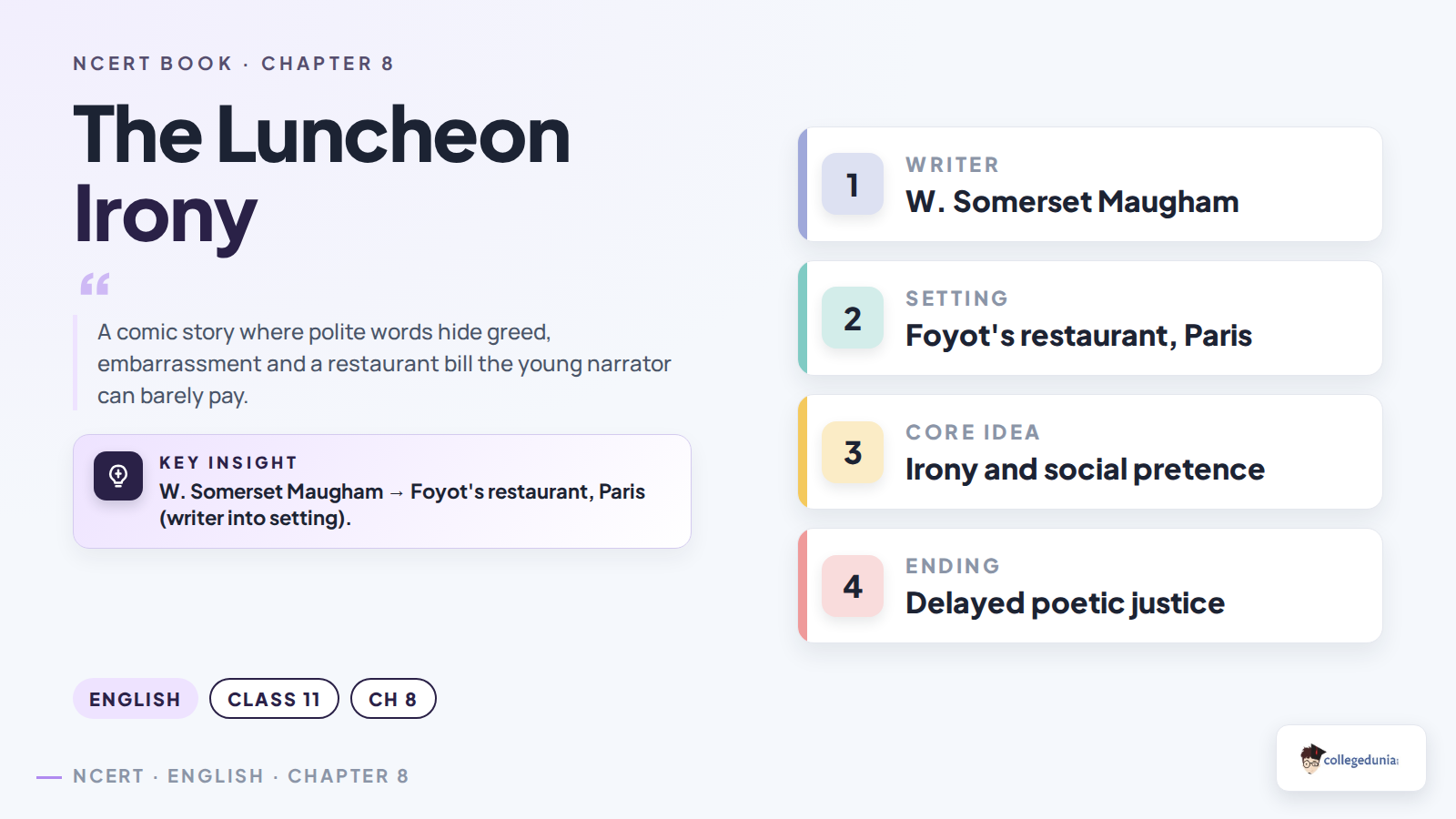
The central irony is simple and sharp. The lady speaks as if she is modest and restrained, but her choices at the table show the opposite. The narrator understands the problem, yet he cannot protest because he wants to appear courteous.
The humour depends on the gap between what the lady says and what she does. Good answers should quote or refer to her repeated claim that she eats very little, then connect it with salmon, caviare, champagne, asparagus and peaches.
Why the Restaurant Bill Matters
The bill is more than a money detail. It shows the narrator's poverty, his false pride and his helplessness in a social situation. Each new order increases the pressure because he must calculate whether he can still pay.
Students should read the PDF closely for price and food references. These details explain why the narrator feels anxious even when the conversation sounds polite. They also prepare students for questions about humour and embarrassment.
- Salmon and caviare: start the costly pattern despite the lady's claim of restraint.
- Champagne: makes the narrator's financial panic stronger.
- Asparagus and peaches: turn the lunch into a comic trap.
- Final revenge: the narrator later sees the lady has grown enormously fat.
Narrator and Lady Guest in The Luncheon
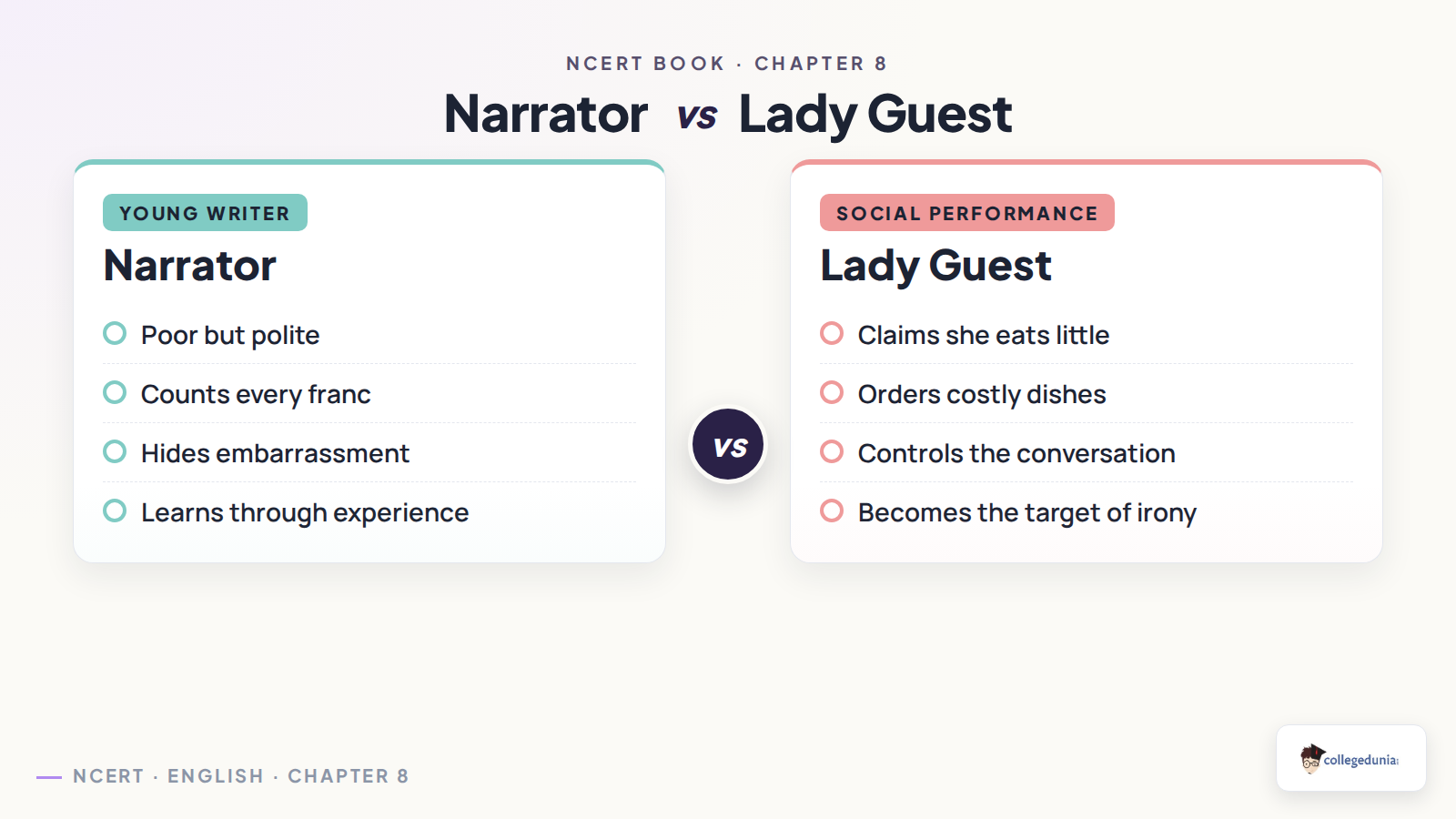
The narrator is young, poor and flattered by attention. He also wants to behave like a gentleman. The lady is socially confident and talks about restraint while enjoying the most expensive items on the menu.
The story becomes memorable because neither character says the truth plainly. The narrator hides his poverty, and the lady hides greed behind polite phrases. This makes the scene funny and uncomfortable at the same time.
| Character | What the PDF shows | Answer point |
|---|---|---|
| Narrator | Counts money silently and stays polite | His pride traps him in the lunch. |
| Lady guest | Claims she eats little but orders costly dishes | Her behaviour creates the main irony. |
| Older narrator | Looks back with humour after twenty years | The ending gives him comic revenge. |
Language Work and Appreciation Questions in the PDF
The official PDF keeps the story and exercise together. After reading the chapter, students can move to NCERT questions on revenge, foibles, humour, first person narration and phrases that show the narrator's poor financial state.
Do not skip the phrase-based language work. Words such as caviare, complacency, mortifying, ingratiating and vindictive help students understand the tone of the story and write sharper answers.
- Understanding questions: check the lunch sequence and ending.
- Discussion questions: ask students to judge foibles and social manners.
- Appreciation questions: focus on humour, narration and comic structure.
- Language work: builds vocabulary from the story context.
How to Use the Chapter 8 Book PDF for Revision
Use the official PDF in three rounds. First, read the full story without stopping. Second, underline every food order and every claim that the lady eats very little. Third, answer the NCERT questions with one direct story reference.
- For irony answers: compare the lady's words with her actions.
- For character answers: describe the narrator's pride and financial worry.
- For humour answers: connect the bill, the expensive menu and the ending.
- For vocabulary: revise meanings from the exact story context.
The Luncheon Class 11 Related Resources
| Resource | Best use | Link |
|---|---|---|
| NCERT Solutions | Use for textbook answers and language-work questions. | The Luncheon Solutions |
| Revision Notes | Use for summary, themes and answer cues. | The Luncheon Notes |
| Handwritten Notes | Use for one-shot visual revision before class tests. | The Luncheon Handwritten Notes |
All Class 11 English Woven Words NCERT Book Chapters
| Chapter | NCERT Book PDF |
|---|---|
| 1 | The Lament |
| 2 | A Pair of Mustachios |
| 3 | The Rocking-horse Winner |
| 4 | The Adventure of the Three Garridebs |
| 5 | Pappachi's Moth |
| 6 | The Third and Final Continent |
| 7 | Glory at Twilight |
| 8 | The Luncheon |
| 9 | Let Me Not to the Marriage of True Minds (Book PDF pending) |
The Luncheon Class 11 English NCERT Book FAQs
Ques. What is included in the Class 11 English Woven Words Chapter 8 NCERT PDF?
Ans. It includes the official NCERT story The Luncheon by W. Somerset Maugham and the exercise sections printed after the story.
Ques. Who wrote The Luncheon in Woven Words?
Ans. The Luncheon was written by W. Somerset Maugham and appears in the Short Stories section of Class 11 Woven Words.
Ques. What is the main irony in The Luncheon?
Ans. The lady says she eats very little, but she orders many expensive items while the young narrator silently worries about the bill.
Ques. Why is the ending of The Luncheon funny?
Ans. The narrator feels he has his revenge when he later sees that the lady, once proud of eating lightly, has become very fat.
Ques. How should students use this PDF for 2026-27 revision?
Ans. Students should read the story, mark the costly orders and then practise NCERT answers with direct references from the text.



Comments