




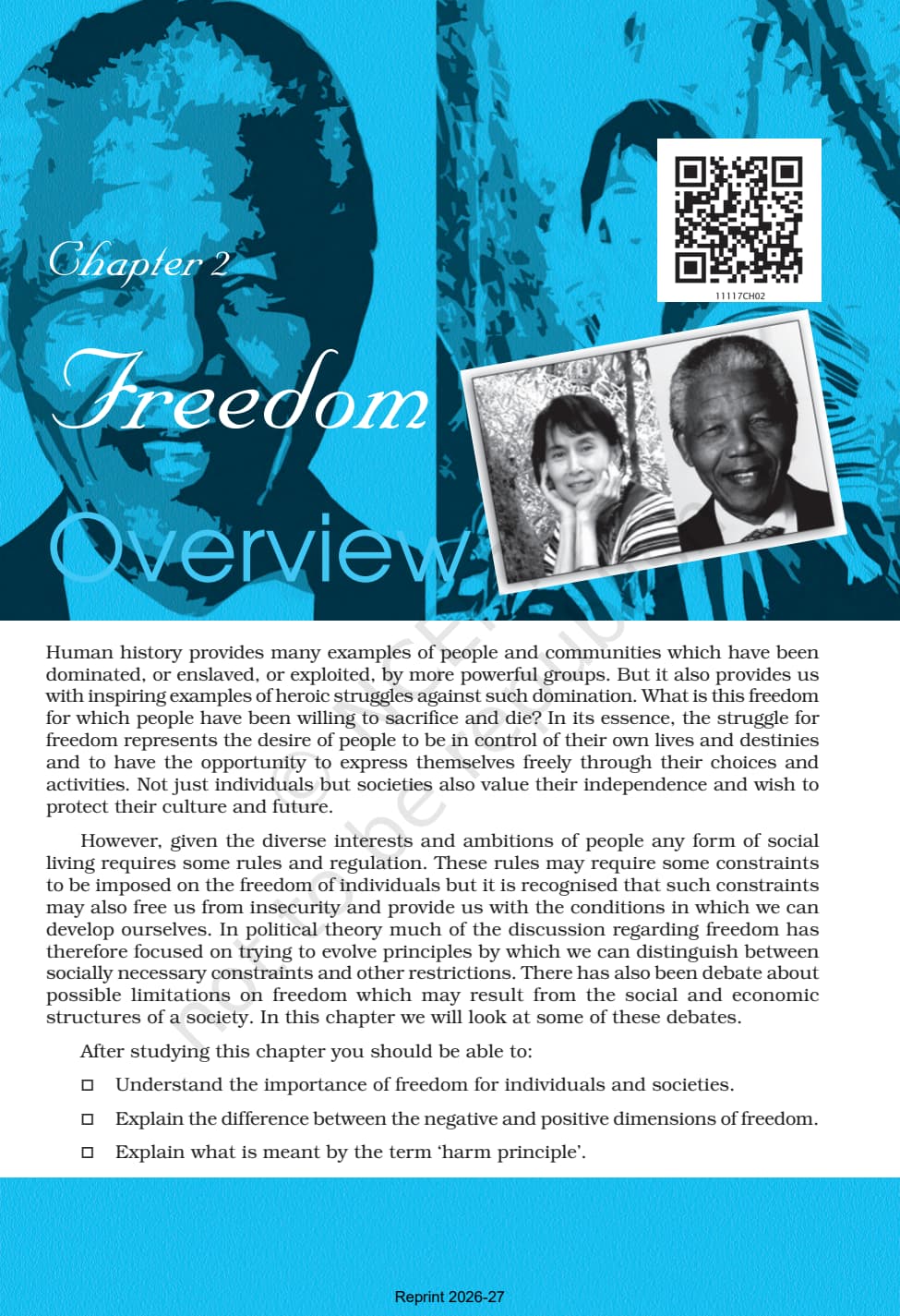
Freedom is the chapter where Class 11 Political Theory moves from Nelson Mandela's prison cell to John Stuart Mill's harm principle in the space of fourteen pages. The ncert book class 11 political science chapter 2 freedom file on this page is the official NCERT chapter for 2026-27. Download it for the Mandela and Aung San Suu Kyi extracts, the Swaraj and Liberalism boxes, and the closing set of five exercise questions.
- Chapter: Chapter 2, Freedom
- Book: Political Theory, the Class 11 NCERT textbook for 2026-27, 18 chapters
- File: 14 pages, printed pages 17 to 30, the complete official chapter
You can page through the Mandela and Suu Kyi overview, both boxed features and the closing exercises in the viewer above before downloading the file.
This is the official NCERT chapter file for the 2026-27 session, hosted by Collegedunia with no pages removed.
How the Freedom Chapter Is Laid Out
The chapter opens with an overview built around two life stories, then moves through five numbered sections. Each section adds one layer to the idea of freedom, and the closing pages tie the whole discussion back to the exercises.
| Section | What it covers |
|---|---|
| Overview | Nelson Mandela's Long Walk to Freedom and Aung San Suu Kyi's Freedom from Fear |
| 2.1 The Ideal of Freedom | the apartheid struggle, twenty-seven years in jail, and the Swaraj box on Gandhi and Tilak |
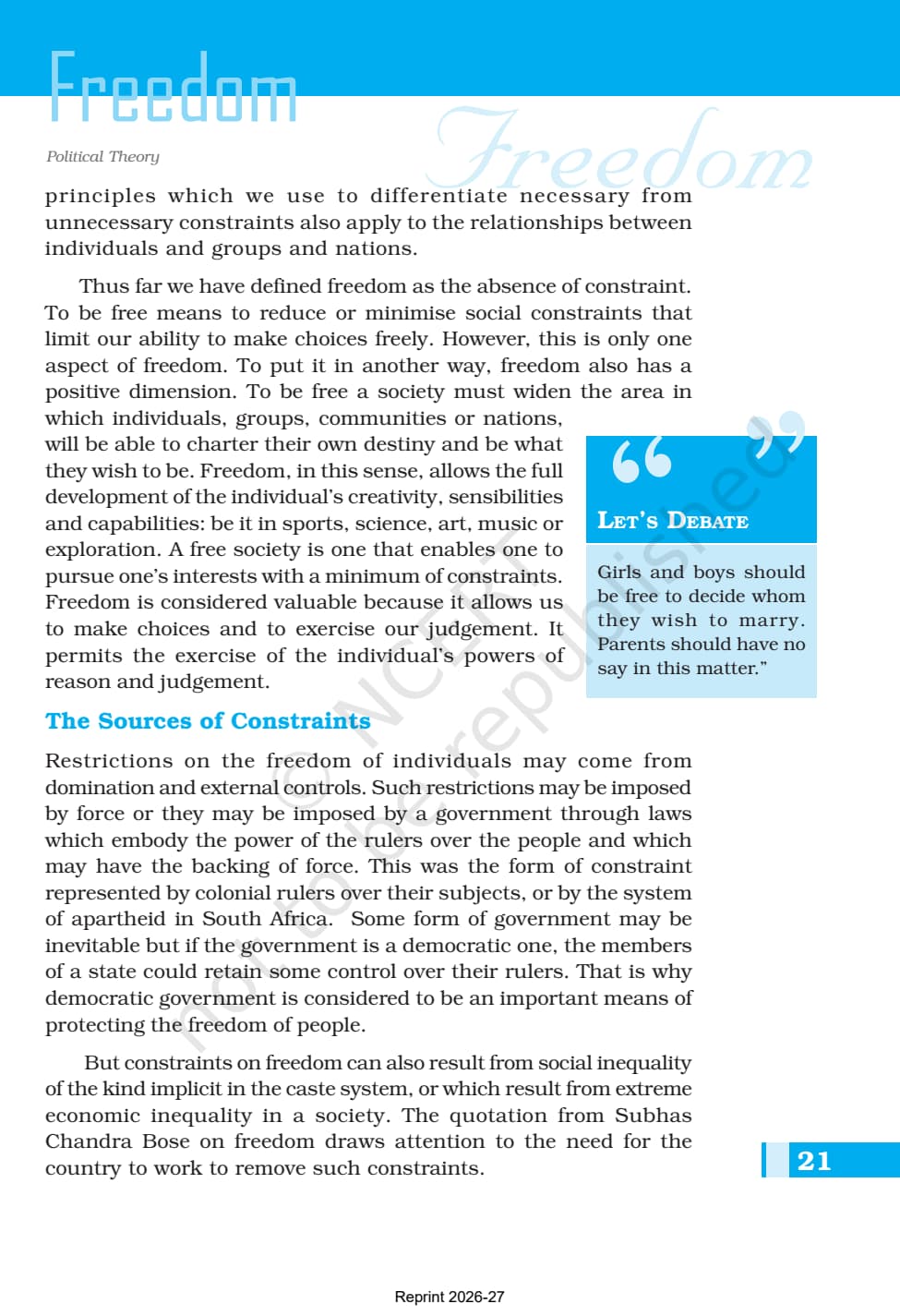
| 2.2 What is Freedom? | freedom as absence of constraint, the positive dimension, and the sources of constraints |
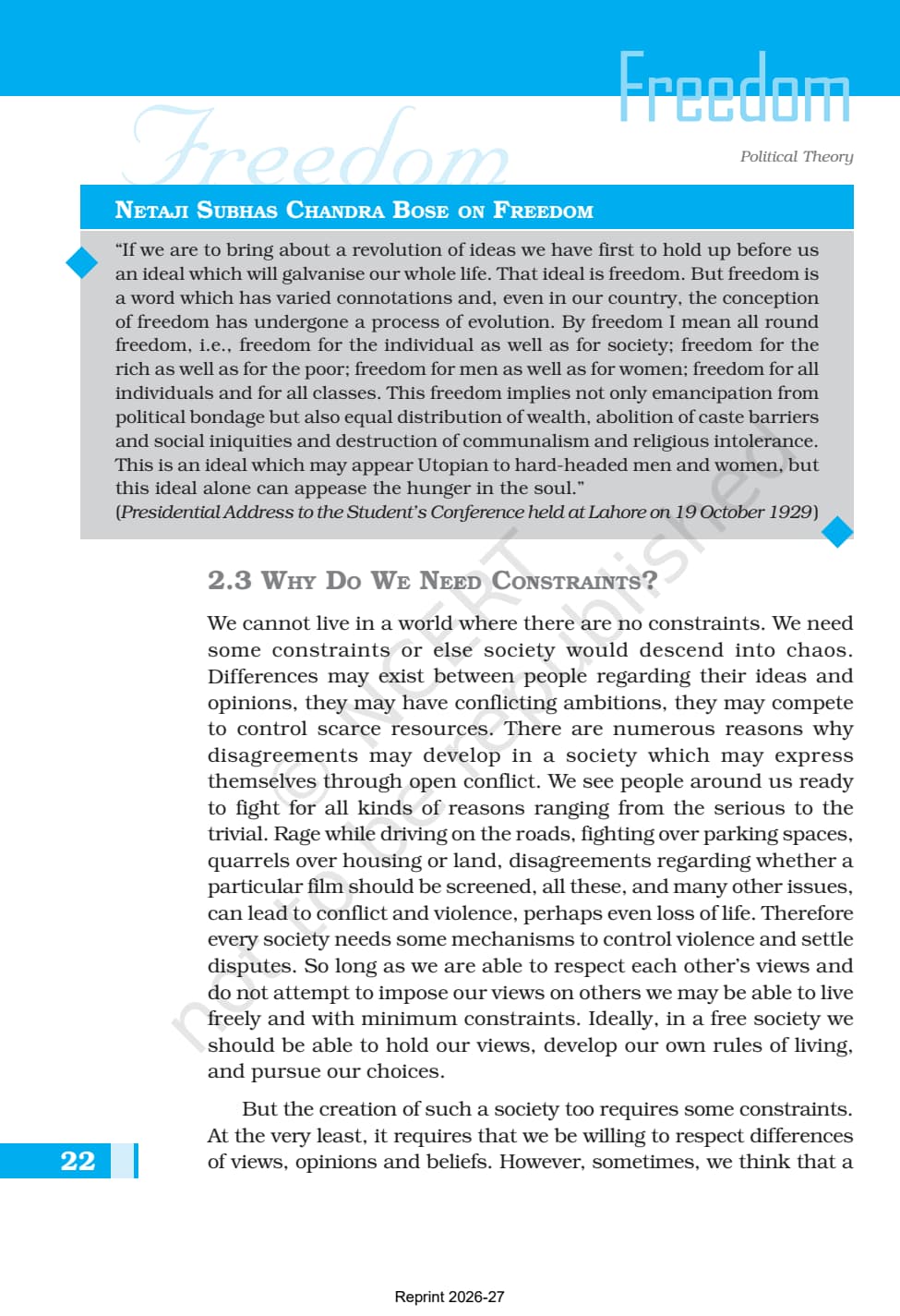
| 2.3 Why do we Need Constraints? | avoiding chaos, tolerance, and the Netaji Subhas Chandra Bose quote on freedom |
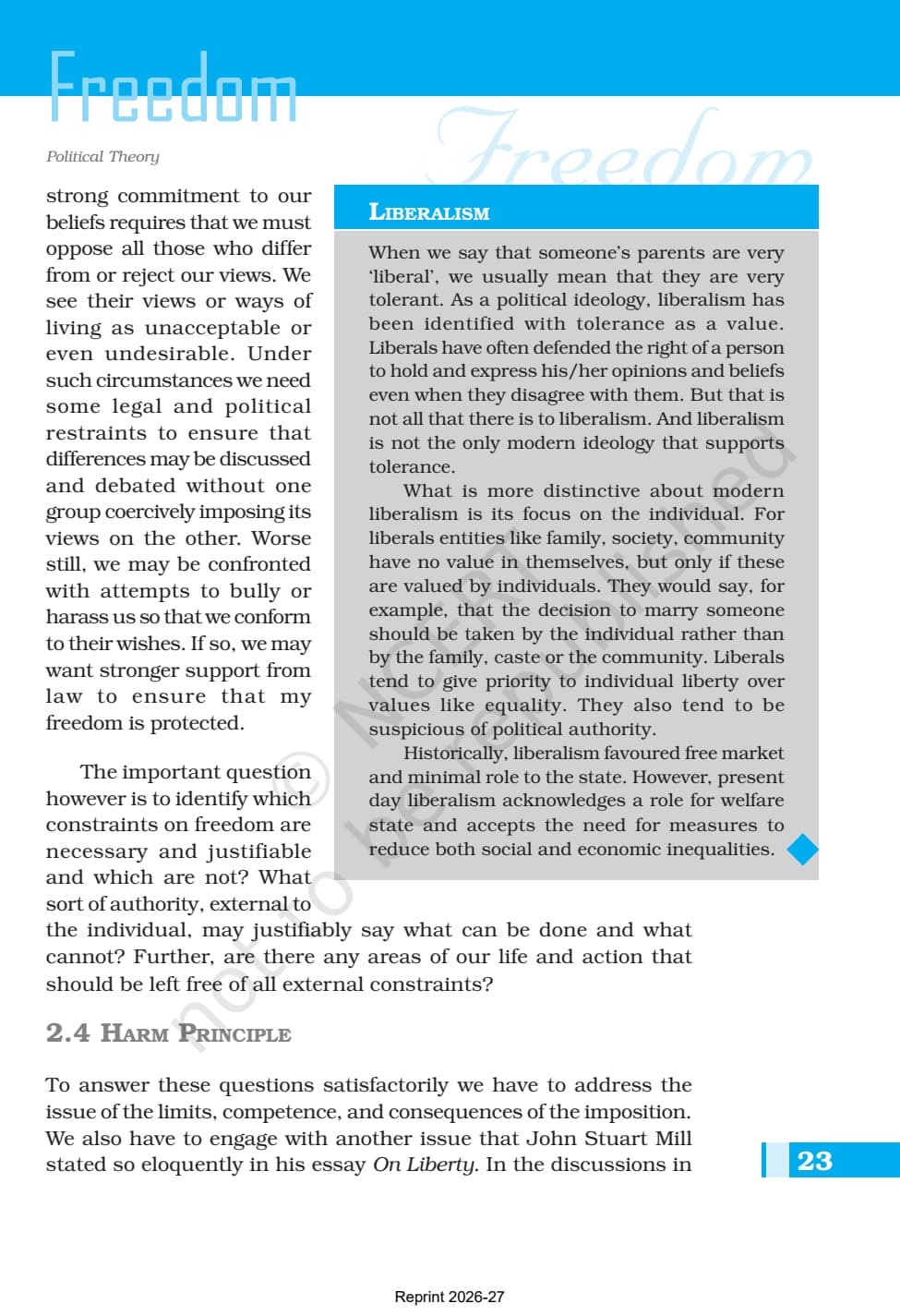
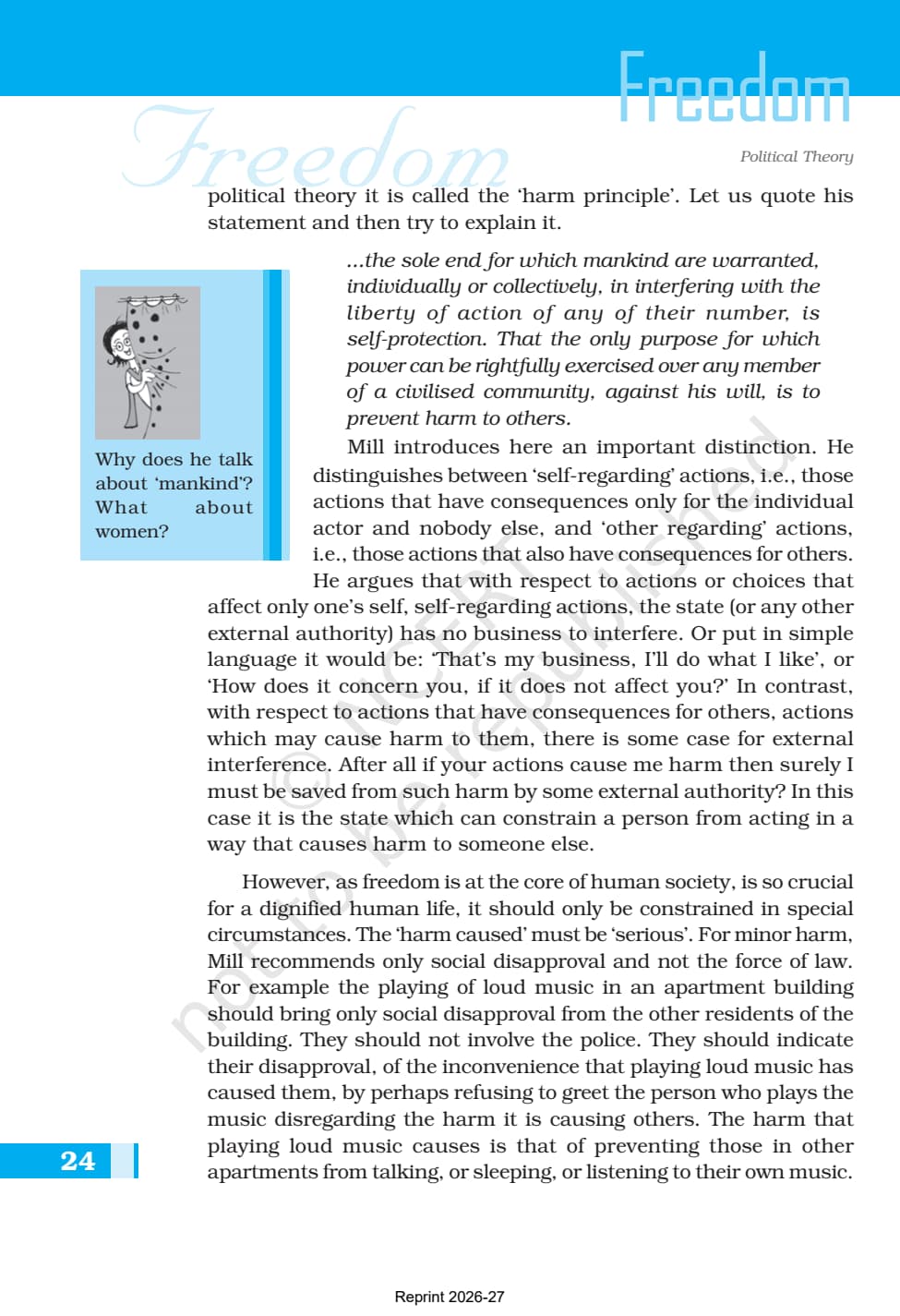
| 2.4 Harm Principle | Mill's On Liberty, self-regarding versus other-regarding actions, and the Liberalism box |
| 2.5 Negative and Positive Liberty | freedom from versus freedom to, plus the Freedom of Expression sub-section |
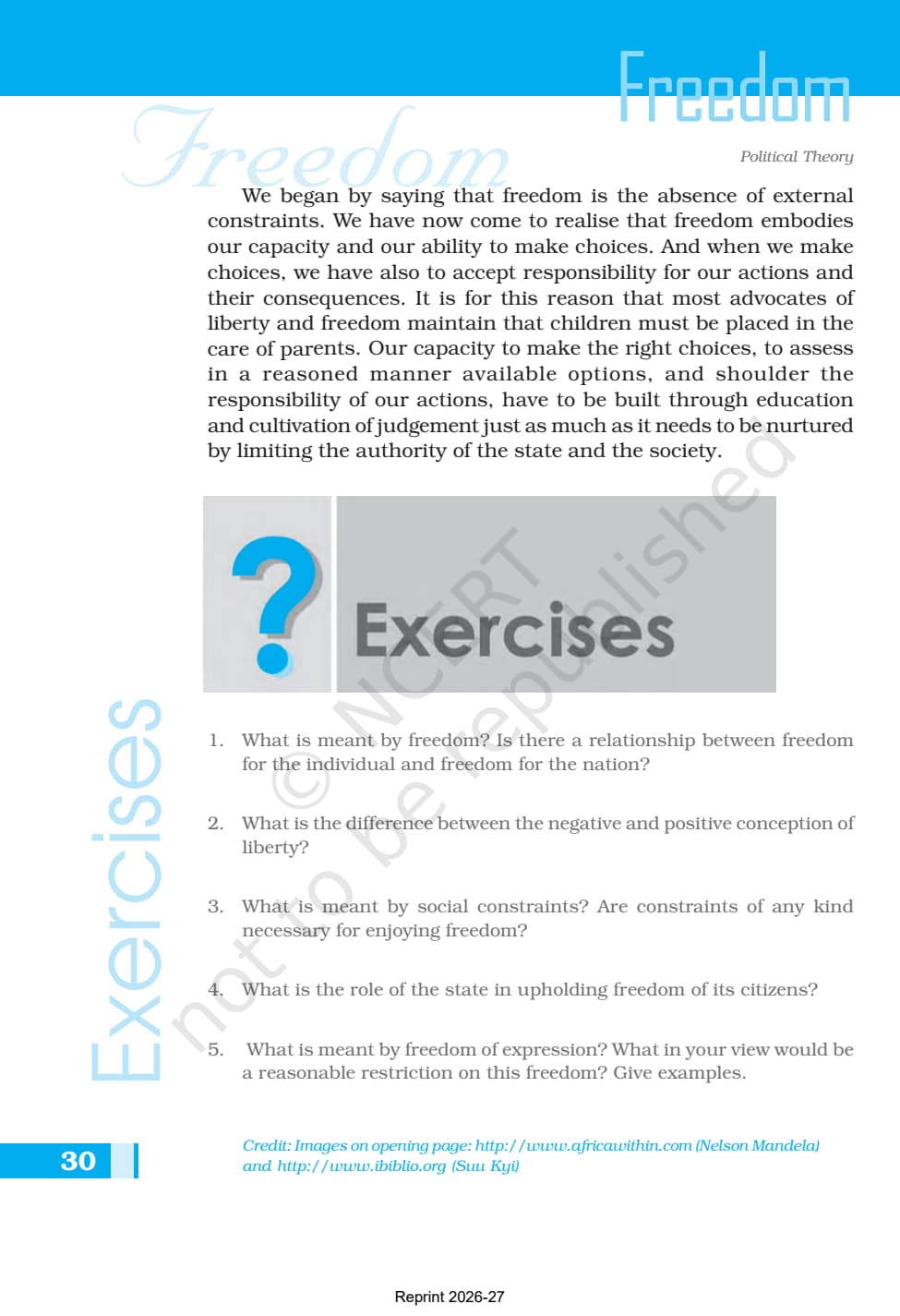
| Closing page and Exercises | a summary paragraph and 5 exercise questions |
Negative and Positive Liberty Explained on Video
Source: Magnet Brains on YouTube
What the Freedom Chapter PDF Contains
The PDF holds the whole chapter exactly as NCERT printed it, with nothing trimmed from either end.
- The opening overview with photographs of Nelson Mandela and Aung San Suu Kyi
- The Swaraj box on Gandhi's Hind Swaraj and Tilak's "birth right" statement
- The full text of the Netaji Subhas Chandra Bose speech on freedom from 1929
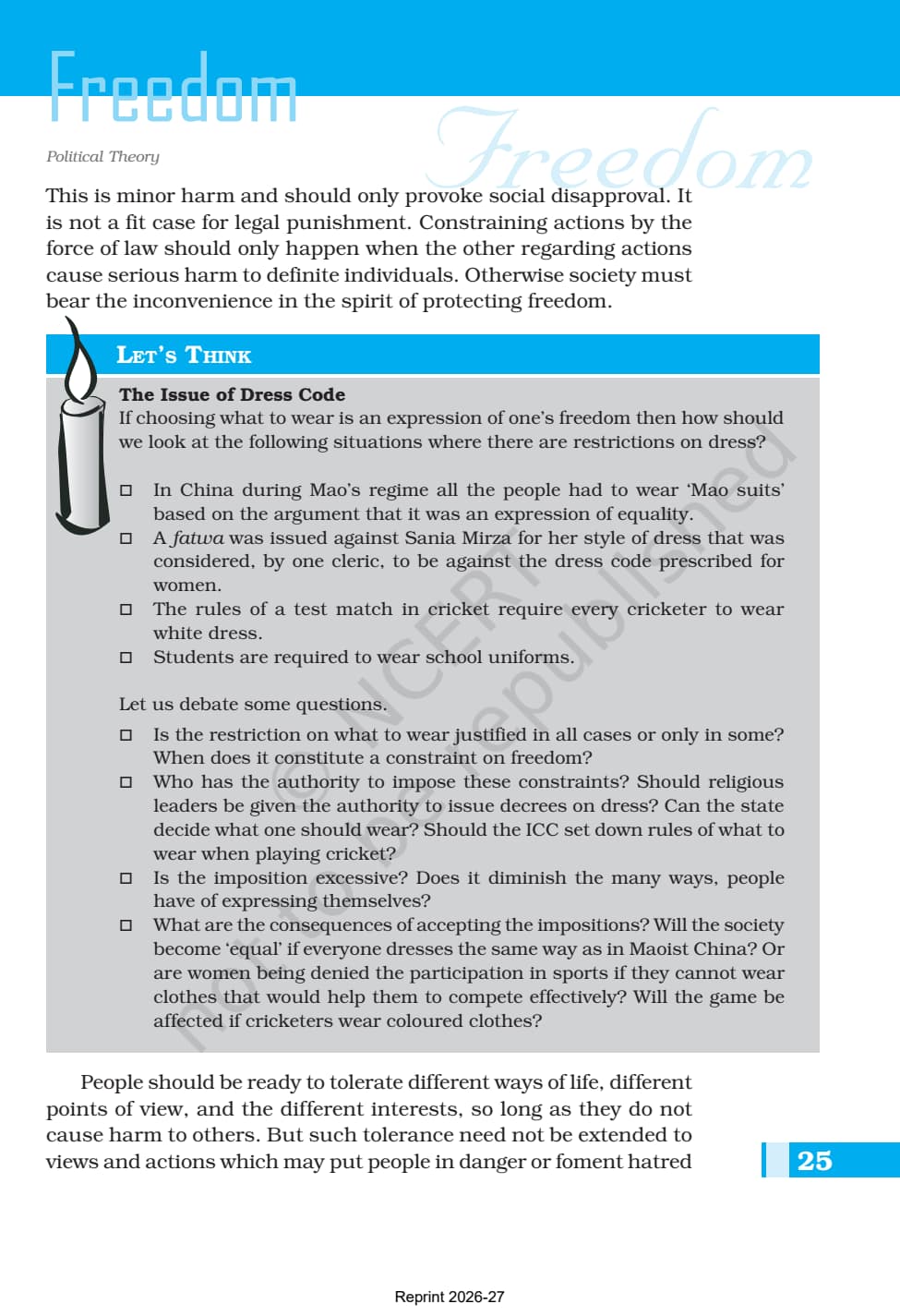
- The Liberalism box and the Let's Think box on dress codes, from Mao suits to school uniforms
- The Freedom of Expression box listing Mill's four reasons, and the closing page with all 5 exercise questions
The Ideal of Freedom: Mandela, Aung San Suu Kyi and Swaraj
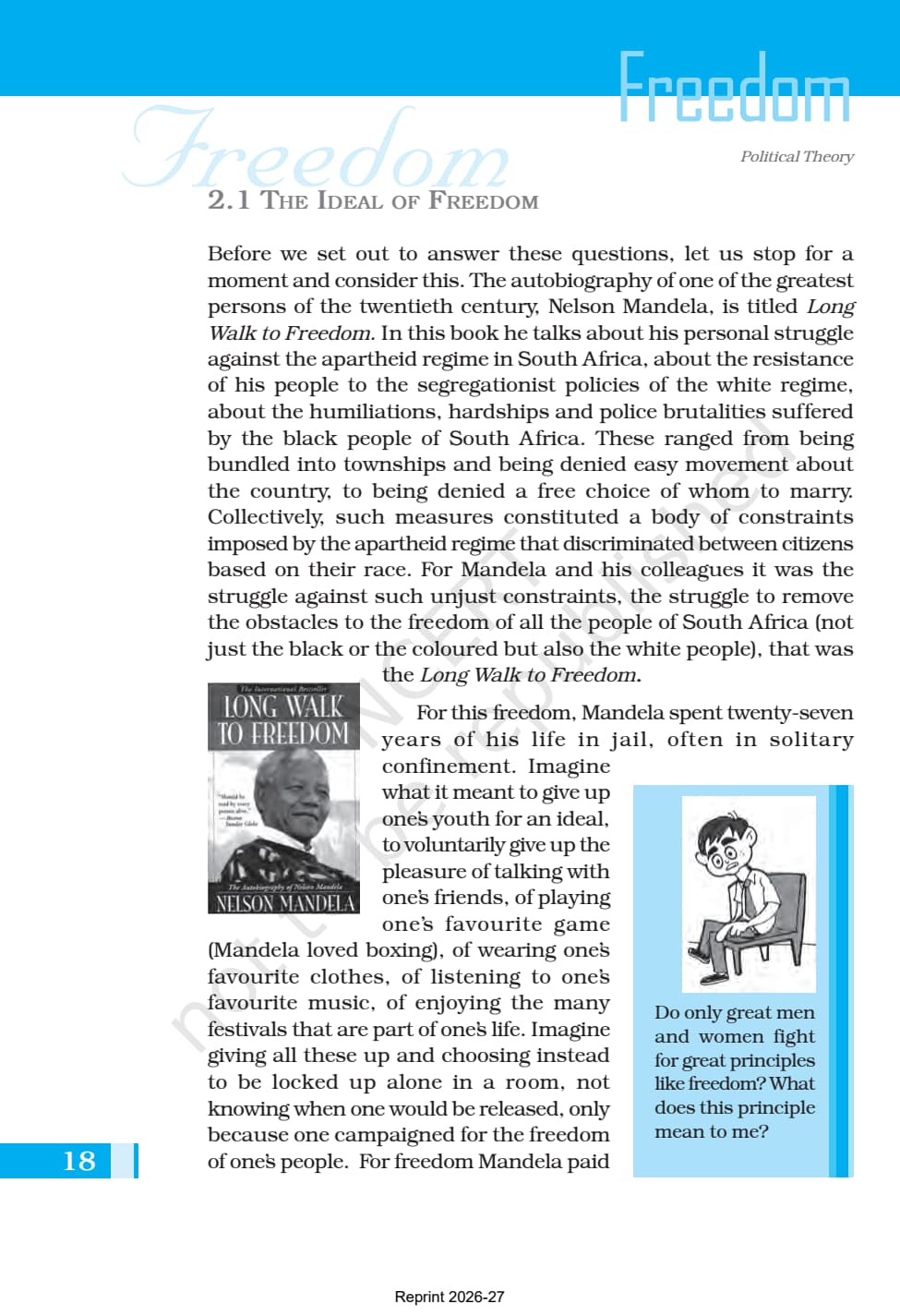
Section 2.1 opens with Nelson Mandela's autobiography, Long Walk to Freedom. It describes his fight against the apartheid regime in South Africa, a system that controlled where black citizens could live, travel and even whom they could marry. Mandela spent twenty-seven years in jail, much of it in solitary confinement, for campaigning against these restrictions.
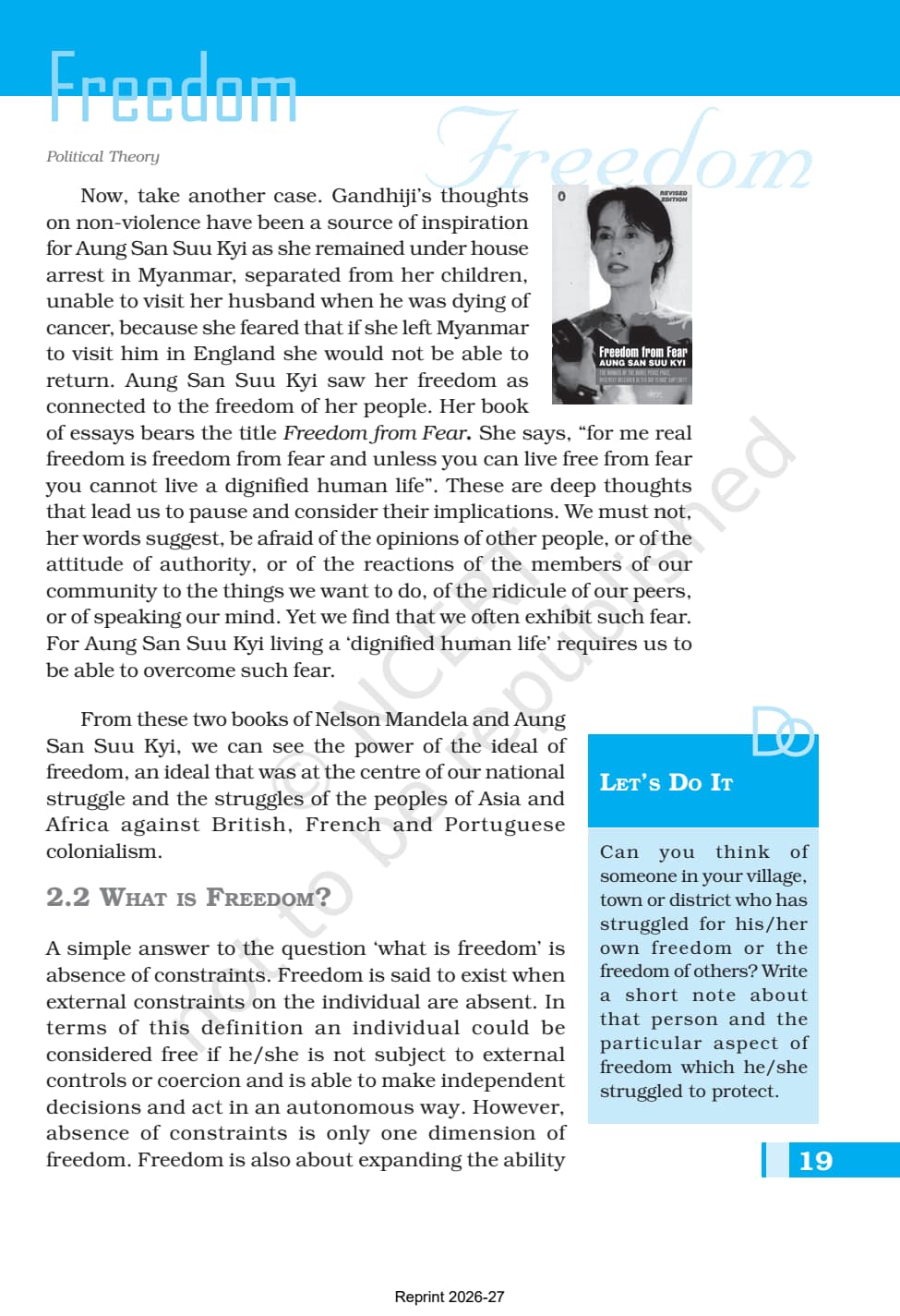
The chapter then turns to Aung San Suu Kyi, who lived under house arrest in Myanmar and titled her essay collection Freedom from Fear. She wrote that real freedom means living without fear of authority, of one's community, or of speaking one's mind. A separate box explains Swaraj, the Indian idea that combines Swa (self) and Raj (rule).
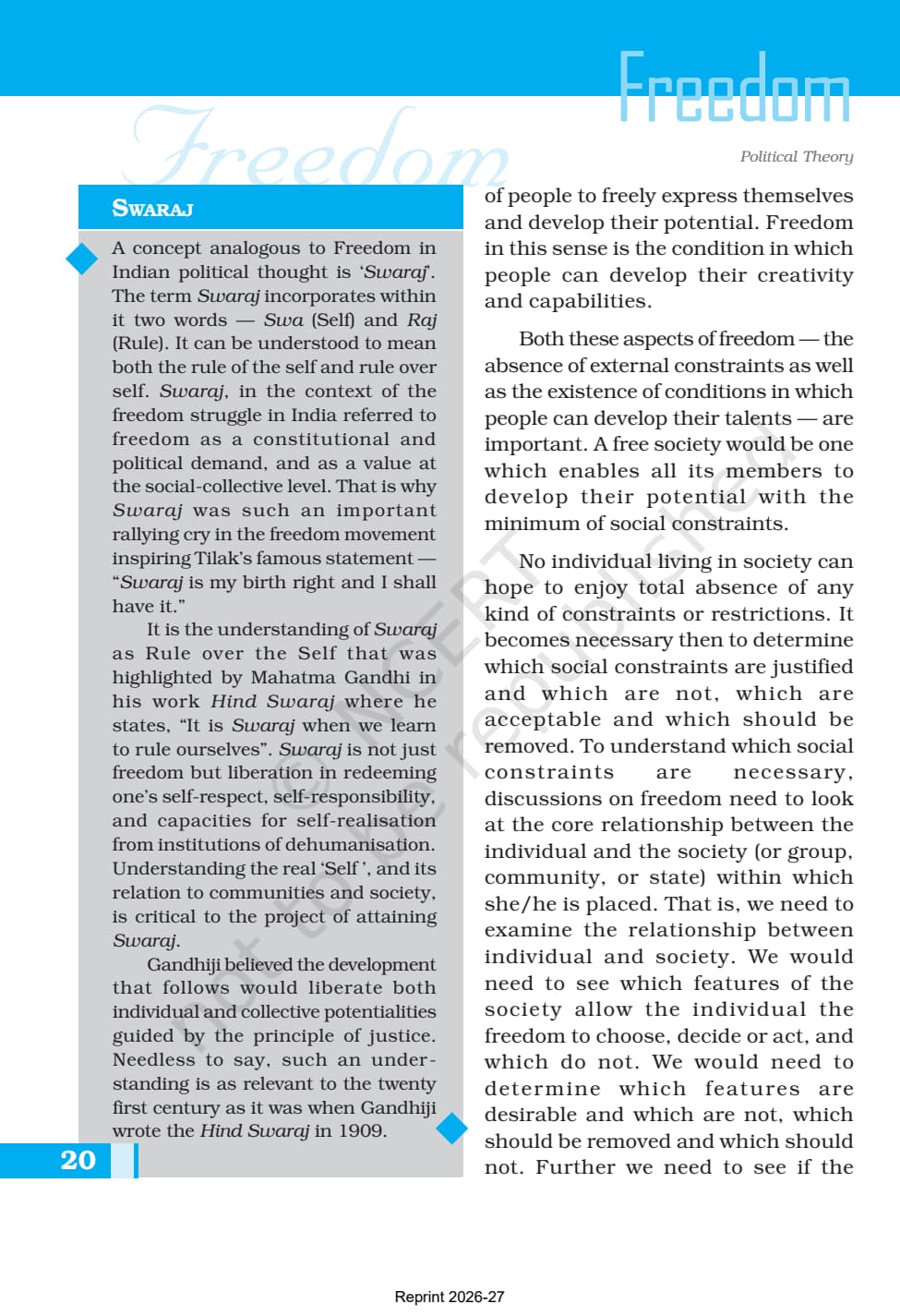
- Swaraj as a political demand: the rallying cry behind Tilak's line, "Swaraj is my birth right and I shall have it"
- Swaraj as rule over the self: Gandhi's Hind Swaraj argument that freedom starts with learning to govern one's own conduct
- Two struggles, one ideal: both Mandela and Suu Kyi tied their personal freedom to the freedom of their people
What Is Freedom: Negative Liberty and the Positive Dimension
Section 2.2 gives the chapter's working definition. Freedom is first described as the absence of external constraints. Under this idea, a person is free if nobody is controlling or coercing their choices. But the chapter is quick to add that this is only one half of the picture.
Freedom also has a positive dimension, which is the ability to develop one's talents and capabilities. A free society, the chapter argues, is one that removes unnecessary constraints while also giving people the conditions to grow. This section also introduces the idea of sources of constraints that limit freedom in practice.
| Source of constraint | How the chapter explains it |
|---|---|
| Domination and law | rulers imposing control by force, as under colonial rule or the apartheid system |
| Undemocratic government | a government whose citizens have no way to hold rulers accountable |
| Social inequality | constraints built into the caste system |
| Economic inequality | constraints that come from extreme gaps in wealth, referenced through the Bose quote |
Sources of Constraints and Why Every Society Needs Some
Section 2.3 asks a direct question: why can a society never have zero constraints? The chapter's answer is that people disagree over ideas, ambitions and scarce resources, and without some shared rules those disagreements turn into open conflict. It lists everyday examples, from road rage to quarrels over parking and land, to show how ordinary disputes can escalate.
The chapter also quotes Netaji Subhas Chandra Bose's 1929 address to the Student's Conference in Lahore, where he defines freedom as "all round freedom", covering the individual and society, the rich and the poor, and men and women equally. His speech ties freedom to ending caste barriers and social iniquities, which is why the chapter places it here.
- Tolerance first: people should be able to hold different views without one side forcing its will on another
- Legal backing when needed: if disagreement turns into bullying or harassment, the law may need to step in
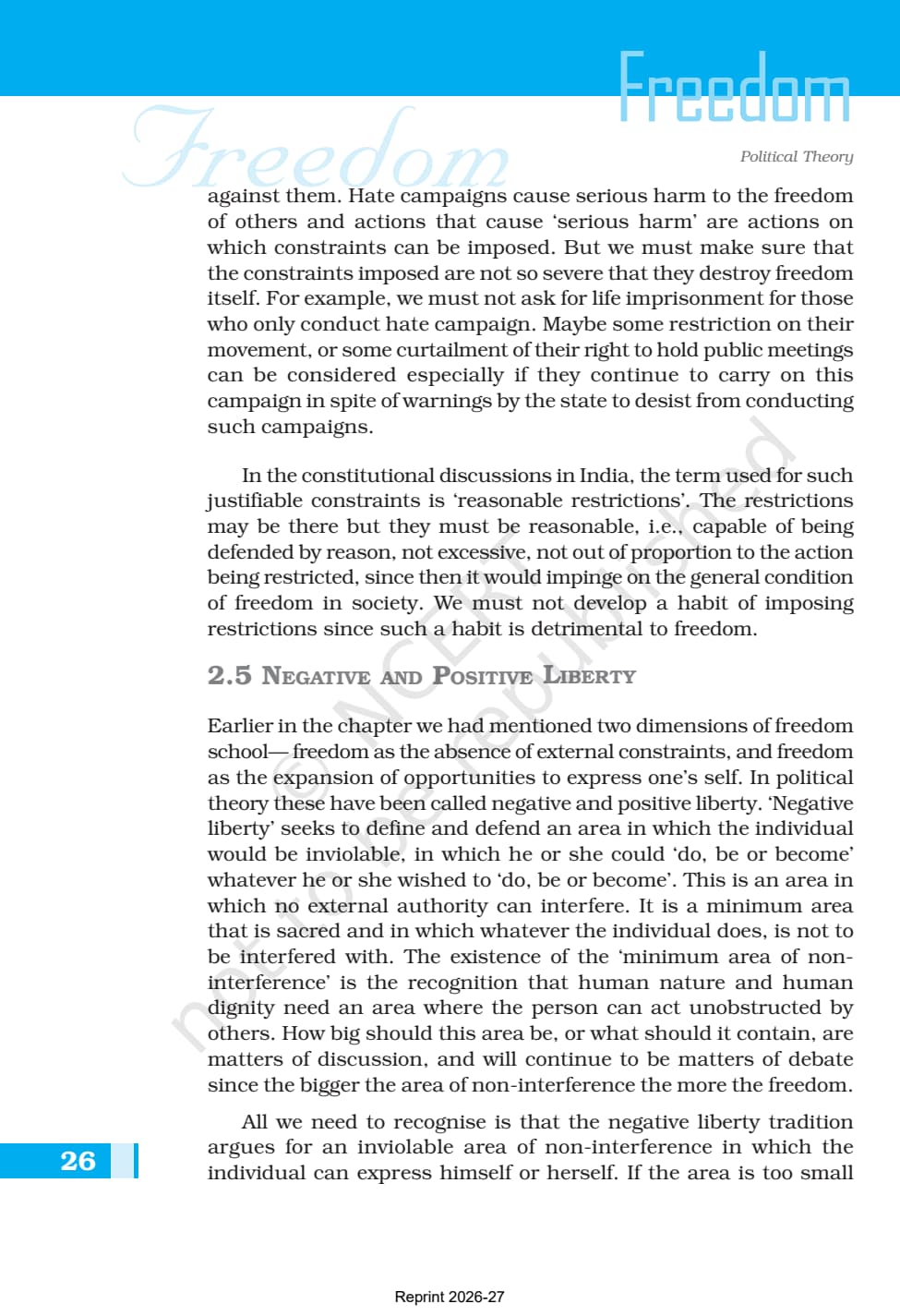
- Reasonable restrictions: the Indian Constitution's term for constraints that are justified by reason, not excessive
The Harm Principle: Self-Regarding and Other-Regarding Actions
Section 2.4 is built around a single quotation from John Stuart Mill's On Liberty: that the only reason society may interfere with a person's liberty is to prevent harm to others. The chapter explains this through Mill's distinction between two kinds of action.
| Type of action | Mill's rule |
|---|---|
| Self-regarding | affects only the individual, so the state has no business interfering |
| Other-regarding | affects other people, so there is some case for external interference |
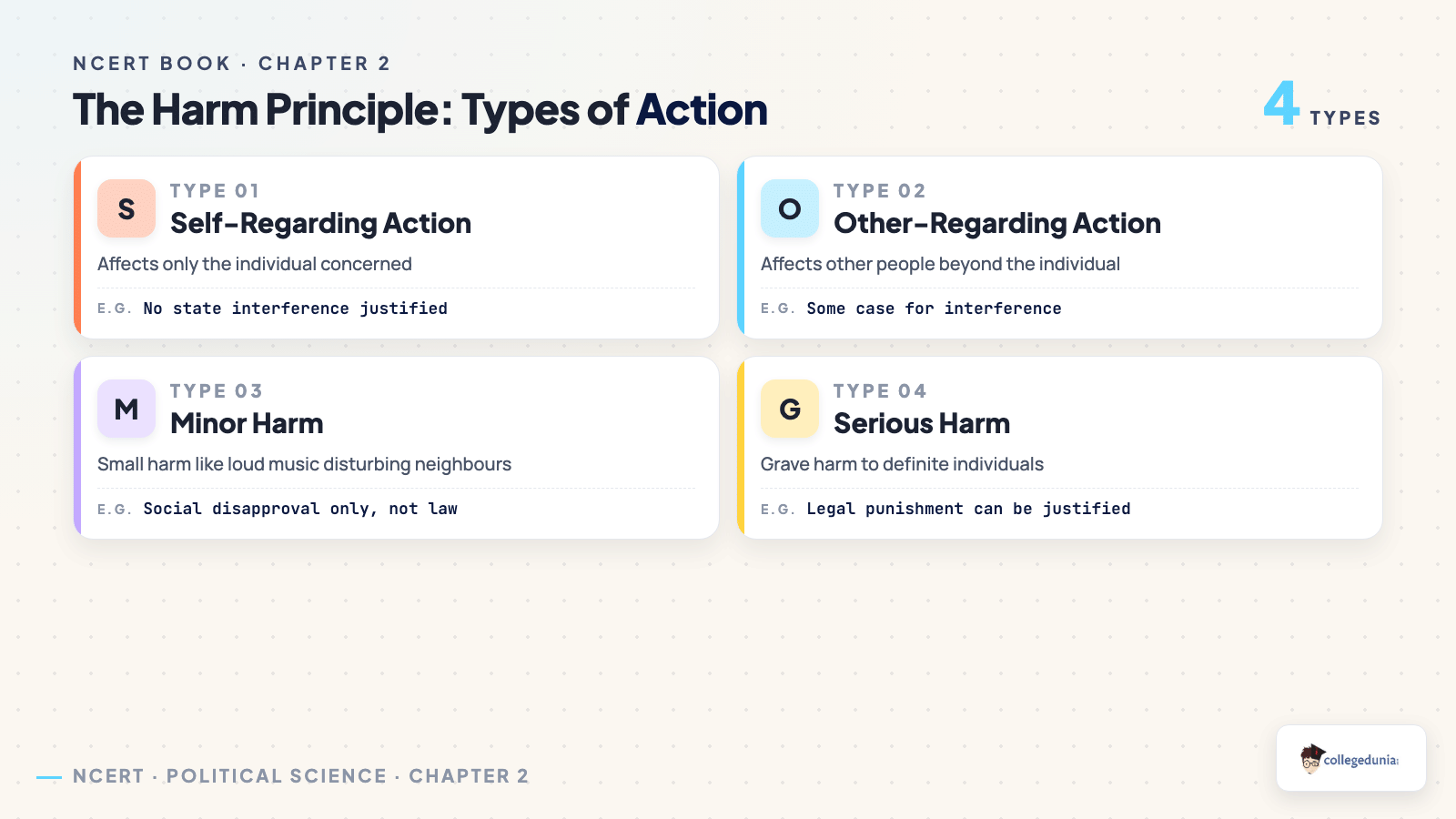
The chapter adds one more layer: even other-regarding harm is not always a matter for law. Minor harm, like loud music disturbing neighbours, should draw only social disapproval, not police action. Only serious harm to definite individuals justifies legal punishment, which is why the chapter warns against a "habit of imposing restrictions". A separate box on Liberalism explains that this ideology gives priority to the individual over institutions like family or caste, though it now also accepts a role for the welfare state.
Negative and Positive Liberty in Political Theory
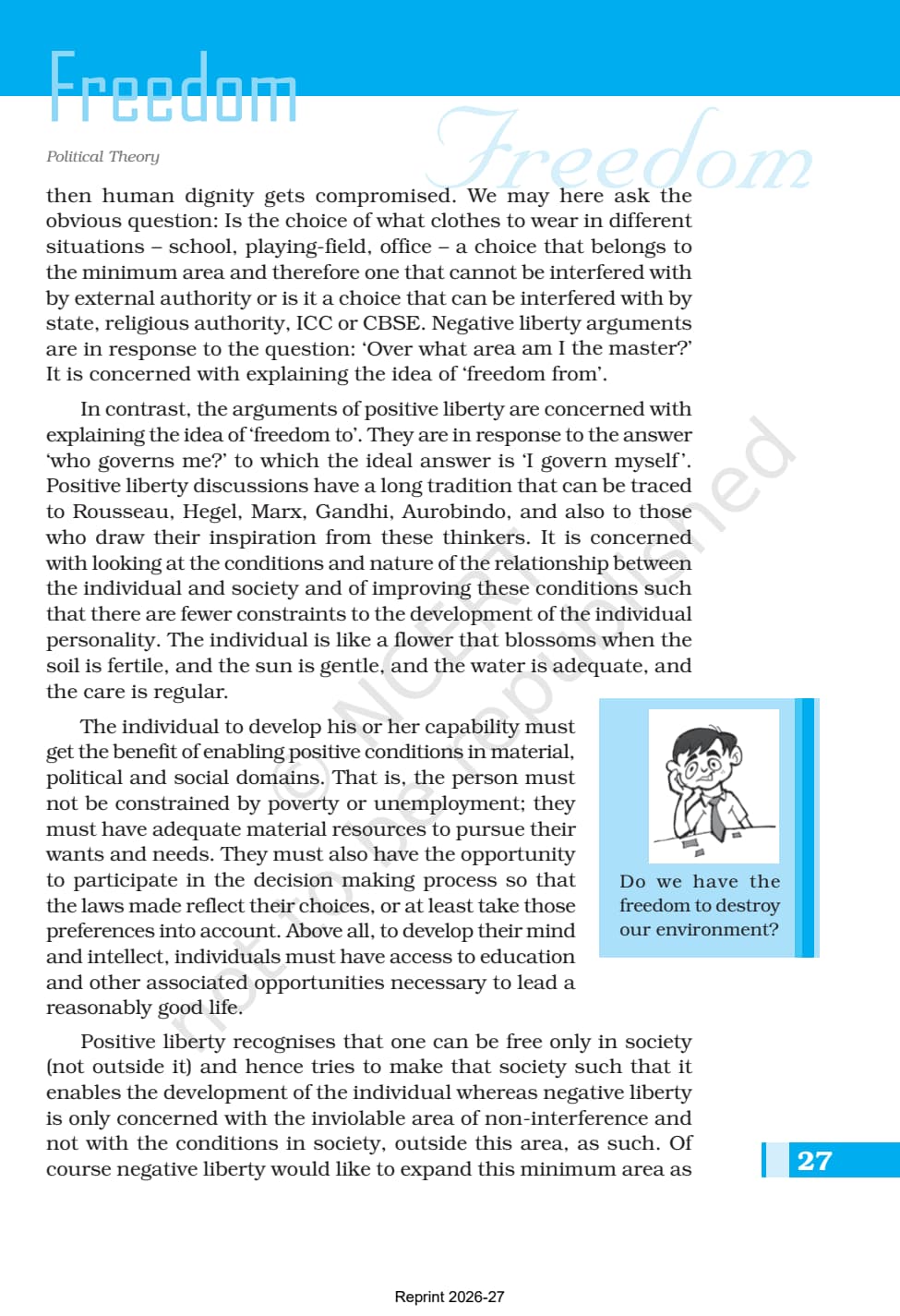
Section 2.5 names the two ideas the chapter has been building toward. Negative liberty defends a minimum area where no external authority can interfere, answering the question "over what area am I the master?" Positive liberty asks a different question, "who governs me?", and answers it with "I govern myself".
The chapter traces positive liberty to a line of thinkers that includes Rousseau, Hegel, Marx, Gandhi and Aurobindo. It compares an individual to a flower that blossoms only with fertile soil, gentle sun and regular care, meaning a person needs material security, political participation and access to education to truly develop.
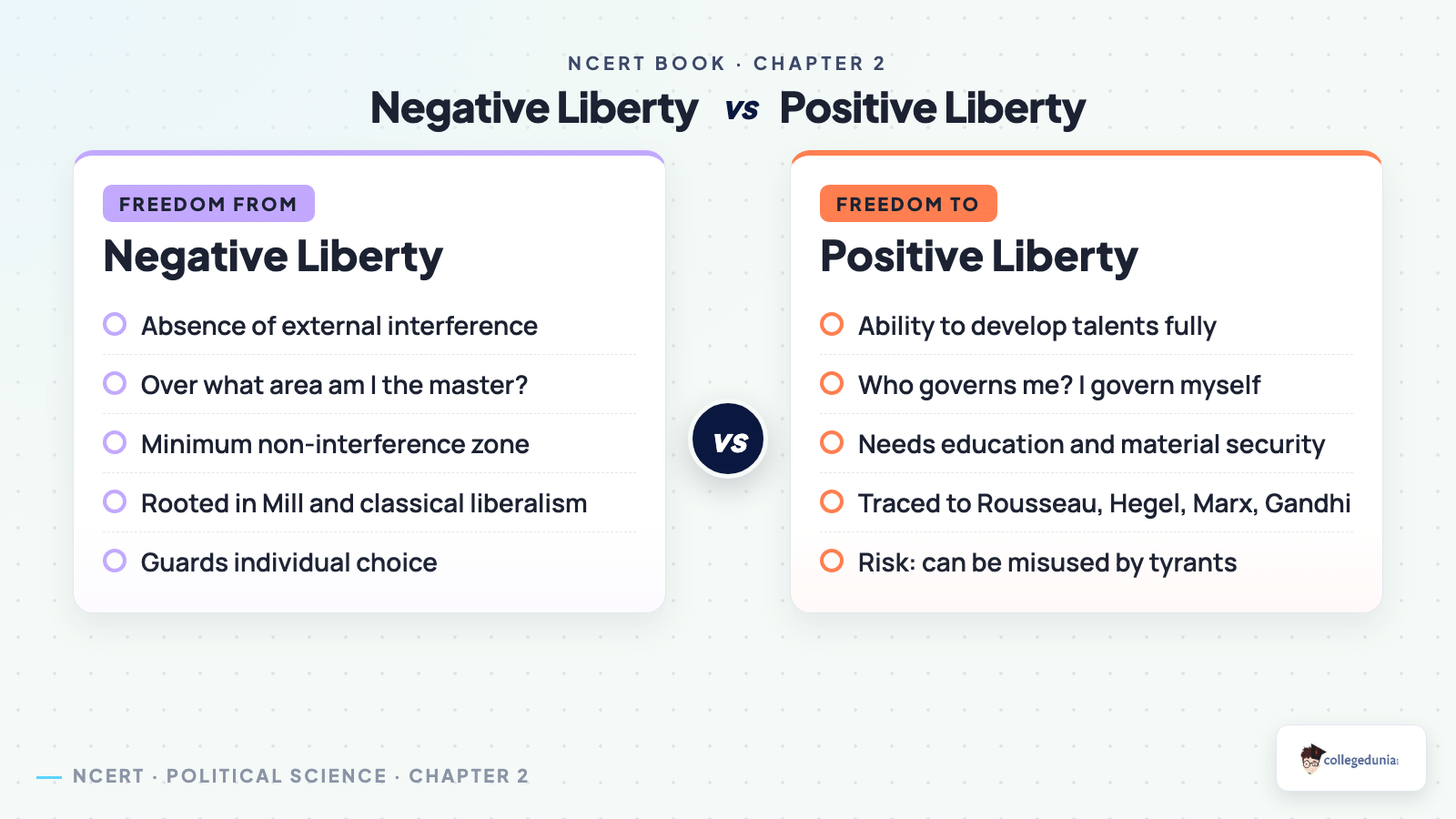
- Negative liberty: concerned with an inviolable area of non-interference around the individual
- Positive liberty: concerned with the conditions in society that let a person develop fully
- A shared risk: the chapter notes that tyrants can misuse positive liberty arguments to justify their rule
Freedom of Expression and Reasonable Restrictions
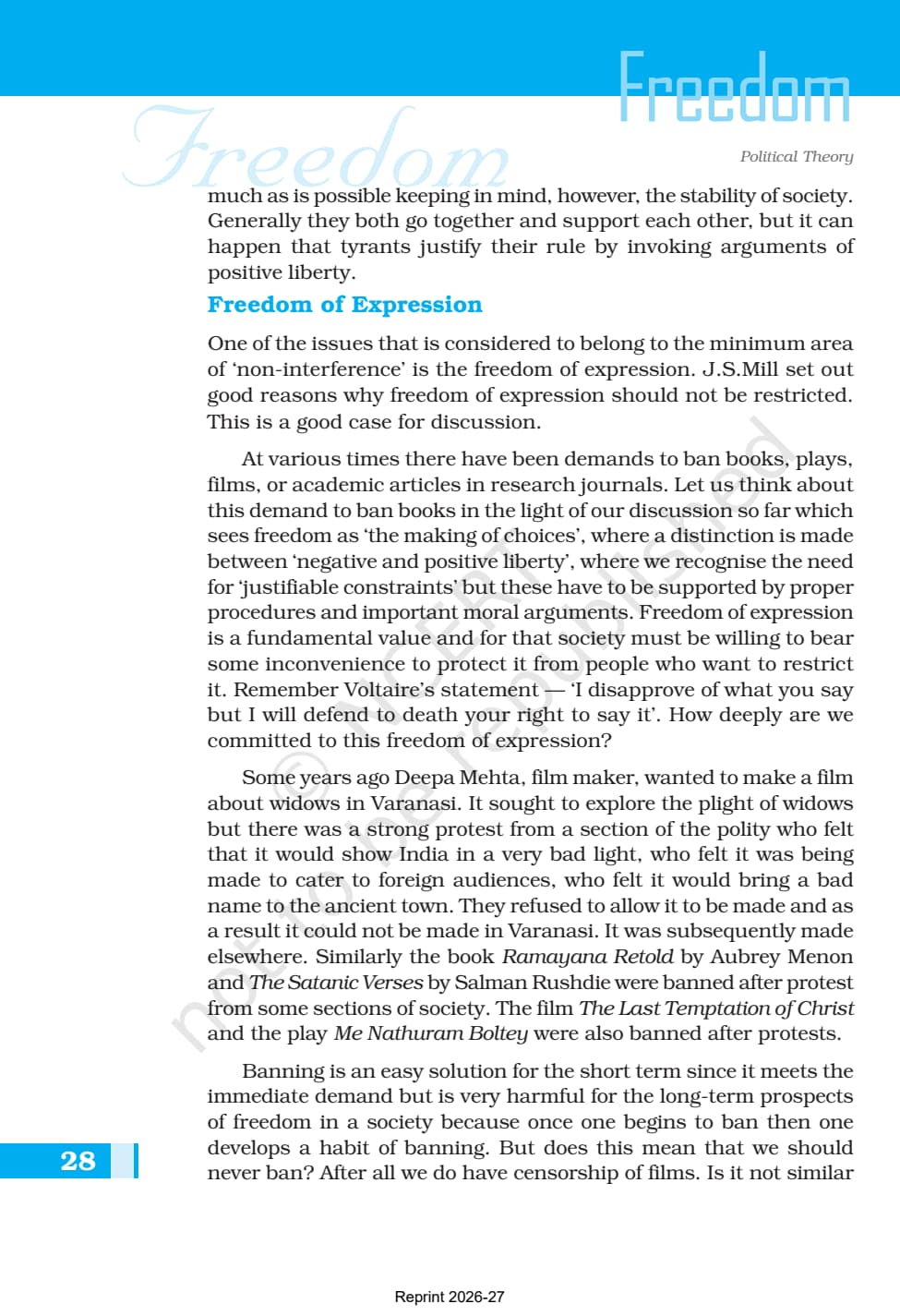
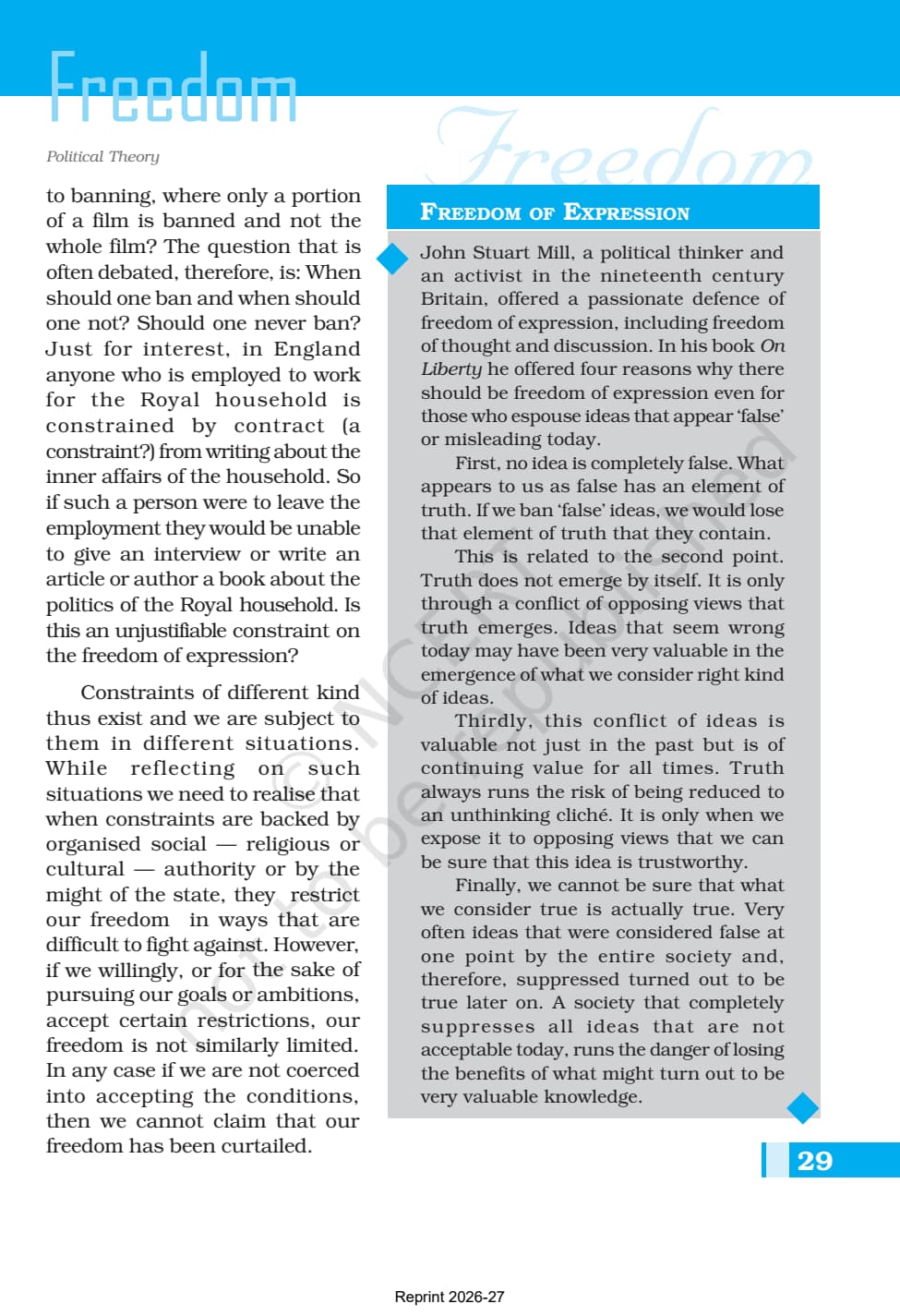
The final part of Section 2.5 applies negative liberty to one specific right, freedom of expression. A boxed feature lists Mill's four reasons for protecting even ideas that seem false: no idea is entirely false, truth needs the conflict of opposing views to emerge, that conflict stays valuable over time, and a society can never be fully certain that today's accepted view is correct.
The chapter illustrates the cost of banning with real examples: Deepa Mehta's film on Varanasi widows, Salman Rushdie's The Satanic Verses, and The Last Temptation of Christ were all blocked after protests. It quotes Voltaire's line, "I disapprove of what you say but I will defend to death your right to say it", and closes by tying freedom back to responsibility, noting that the ability to make good choices has to be built through education.
- Four reasons to protect speech: no idea is wholly false, truth needs debate, debate stays useful, certainty is never guaranteed
- Real ban examples: a Varanasi film, a retold Ramayana, and two banned books named in the chapter
- Reasonable restrictions: the constitutional standard used to judge whether a constraint on speech is justified
What Collegedunia Adds to This Chapter PDF
Collegedunia gives students the file plus a way into it. The chapter PDF itself is the official NCERT file, untouched.
- Official file: the exact NCERT chapter PDF, no pages removed
- Read in the browser: page through all 14 pages before downloading
- Chapter list: jump to any other chapter from one table
Also Check: the other Class 11 Political Science resources for this chapter.
| Resource | Link |
|---|---|
| Handwritten notes | Freedom Class 11 Handwritten Notes |
| Chapter notes | Freedom Class 11 Notes (coming soon) |
| Chapter solutions | Freedom Class 11 NCERT Solutions (coming soon) |
| Previous chapter book PDF | Political Theory Class 11 NCERT Book PDF (coming soon) |
| Next chapter book PDF | Equality Class 11 NCERT Book PDF (coming soon) |
Class 11 Political Science NCERT Book PDF: All Chapters
Every chapter of the book is on its own page. The 2026-27 Class 11 Political Science Political Theory textbook has 18 chapters, and the first eight form the Political Theory block that this chapter sits inside.
| Chapter | Download |
|---|---|
| Chapter 1 | Political Theory NCERT Book PDF (coming soon) |
| Chapter 2 | Freedom NCERT Book PDF |
| Chapter 3 | Equality NCERT Book PDF (coming soon) |
| Chapter 4 | Social Justice NCERT Book PDF (coming soon) |
| Chapter 5 | Rights NCERT Book PDF (coming soon) |
| Chapter 6 | Citizenship NCERT Book PDF (coming soon) |
| Chapter 7 | Nationalism NCERT Book PDF (coming soon) |
| Chapter 8 | Secularism NCERT Book PDF (coming soon) |
| Chapter 9 | Constitution Why and How NCERT Book PDF (coming soon) |
| Chapter 10 | Rights in the Indian Constitution NCERT Book PDF (coming soon) |
| Chapter 11 | Election and Representation NCERT Book PDF (coming soon) |
| Chapter 12 | Executive NCERT Book PDF (coming soon) |
| Chapter 13 | Legislature NCERT Book PDF (coming soon) |
| Chapter 14 | Judiciary NCERT Book PDF (coming soon) |
| Chapter 15 | Federalism NCERT Book PDF (coming soon) |
| Chapter 16 | Local Governments NCERT Book PDF (coming soon) |
| Chapter 17 | Constitution as a Living Document NCERT Book PDF (coming soon) |
| Chapter 18 | The Philosophy of the Constitution NCERT Book PDF (coming soon) |
Freedom Class 11 NCERT Book PDF FAQs
Common Student Questions on the Freedom Chapter File
Ques. Where can I download the Class 11 Political Science Chapter 2 NCERT Book PDF?
Ans. The official 14-page chapter file is on this page, free to download.
Ques. How many pages is the Freedom chapter?
Ans. 14 pages, printed pages 17 to 30 in the 2026-27 book, and this PDF is the complete chapter.
Ques. What is the difference between negative and positive liberty?
Ans. Negative liberty is freedom from external interference, an area where no authority can intervene. Positive liberty is freedom to develop one's abilities, which needs enabling conditions like education, political participation and material security.
Ques. What is the harm principle?
Ans. It is John Stuart Mill's rule that the only reason to restrict a person's liberty is to prevent serious harm to others. Self-regarding actions, which affect only the individual, should not be restricted at all.
Ques. What is Swaraj?
Ans. Swaraj combines Swa (self) and Raj (rule). It means both self-rule as a political demand and Gandhi's idea of rule over the self, as explained in the box in Section 2.1.
Ques. Why does the chapter say minor harm should not involve the law?
Ans. Mill argues that only serious harm to definite individuals justifies legal punishment. Minor harm, such as loud music disturbing neighbours, should draw social disapproval instead, so society does not develop a habit of imposing restrictions.
Ques. What reasons does the chapter give for protecting freedom of expression?
Ans. It lists four reasons from Mill: no idea is completely false, truth emerges only through conflicting views, that conflict remains valuable over time, and no society can be fully certain that its accepted views are correct.
Ques. Is this the official NCERT file?
Ans. Yes. It is the NCERT chapter PDF for 2026-27 hosted as published, with no pages removed or added.



Comments