



The NCERT Book PDF for Class 11 Political Science Chapter 3 Equality page brings together the complete 22-page chapter, from the fact sheet on global inequality to the three dimensions of equality and the closing exercise questions, for the 2026-27 session.
- Full 22-page chapter: sections 3.1 to 3.4, the fact sheet on global inequality and all 6 exercise questions
- Covers natural versus social inequality, the three dimensions of equality and affirmative action
- Free to read online or download, official NCERT print, no pages removed
- Chapter: Chapter 3, Equality
- Book: Political Theory, the Class 11 NCERT textbook for 2026-27
- File: 22 pages, printed pages 31 to 52, the complete official chapter
You can read the fact sheet on global inequality, the 2011 Census table and all four numbered sections in the viewer above before downloading the file.
This is the official NCERT chapter file for the 2026-27 session, hosted by Collegedunia exactly as printed, with no pages removed.
How the Equality Chapter Is Laid Out
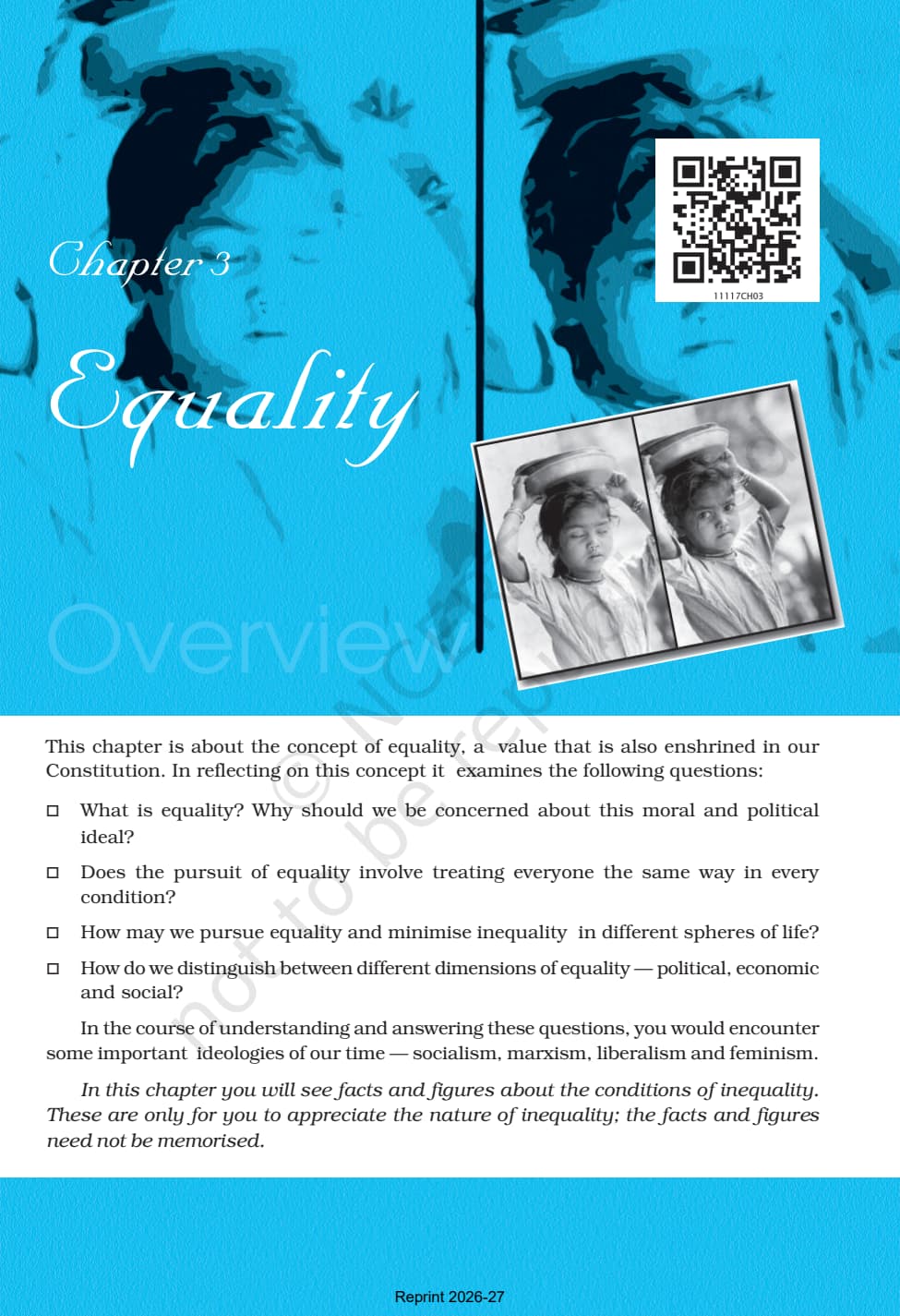
The chapter opens with two questions on its very first page: why should we care about equality, and does treating people equally mean treating them all the same way? Four numbered sections build the answer, moving from the moral case for equality to the practical question of how a state can promote it.
| Section | What it covers |
|---|---|
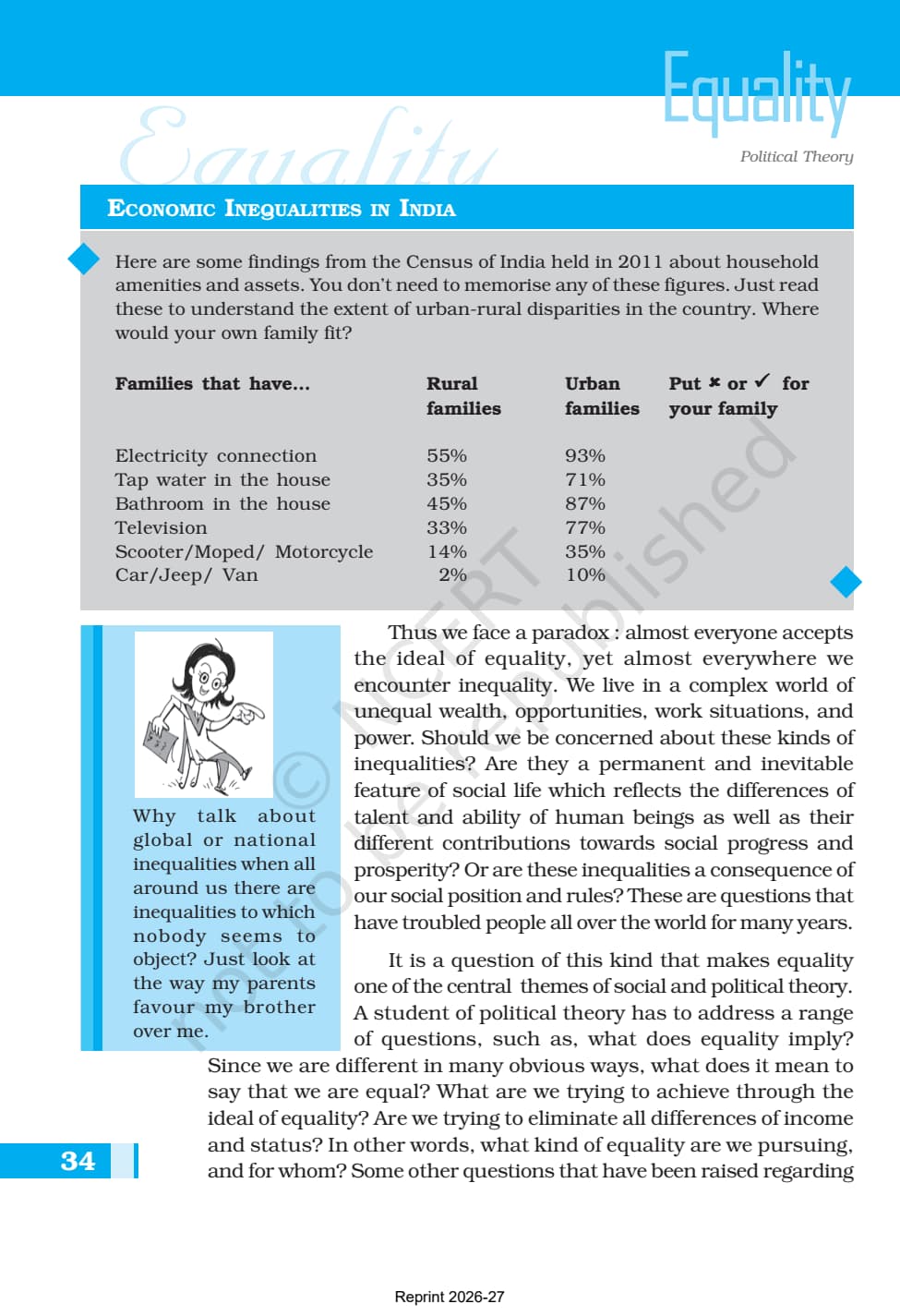
| 3.1 Why Does Equality Matter? | the moral and political case for equality, the fact sheet on global inequality, and the 2011 Census table on rural and urban household amenities |
| 3.2 What Is Equality? | the difference between equal respect and identical treatment, and the split between natural inequality and social inequality |
| 3.3 Three Dimensions of Equality | political, economic and social equality, alongside highlighted boxes on feminism and socialism and a running discussion of Marxism and liberal theory |
| 3.4 How Can We Promote Equality? | establishing formal equality, affirmative action, reservations, and the identical-treatment versus equal-treatment distinction |
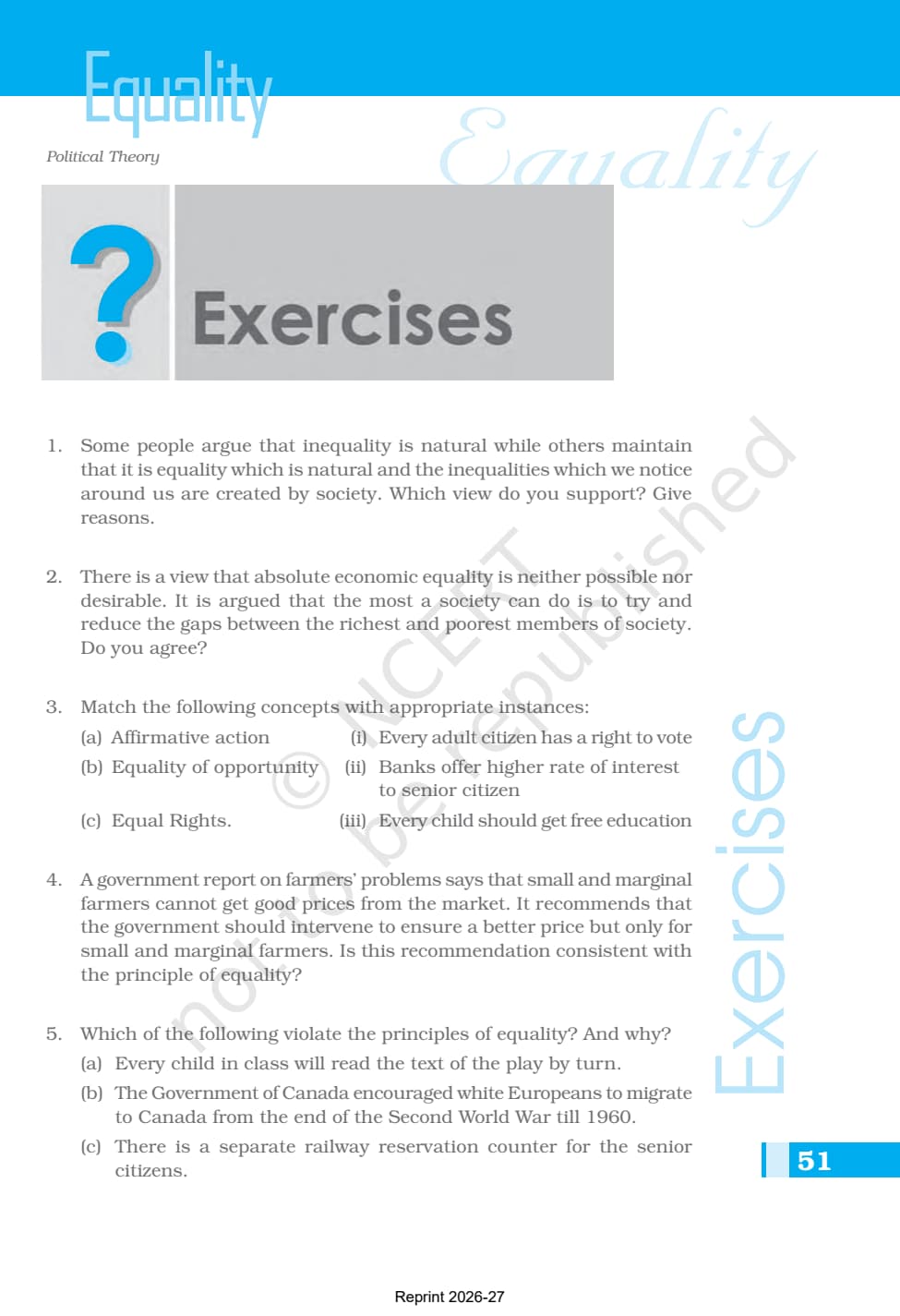
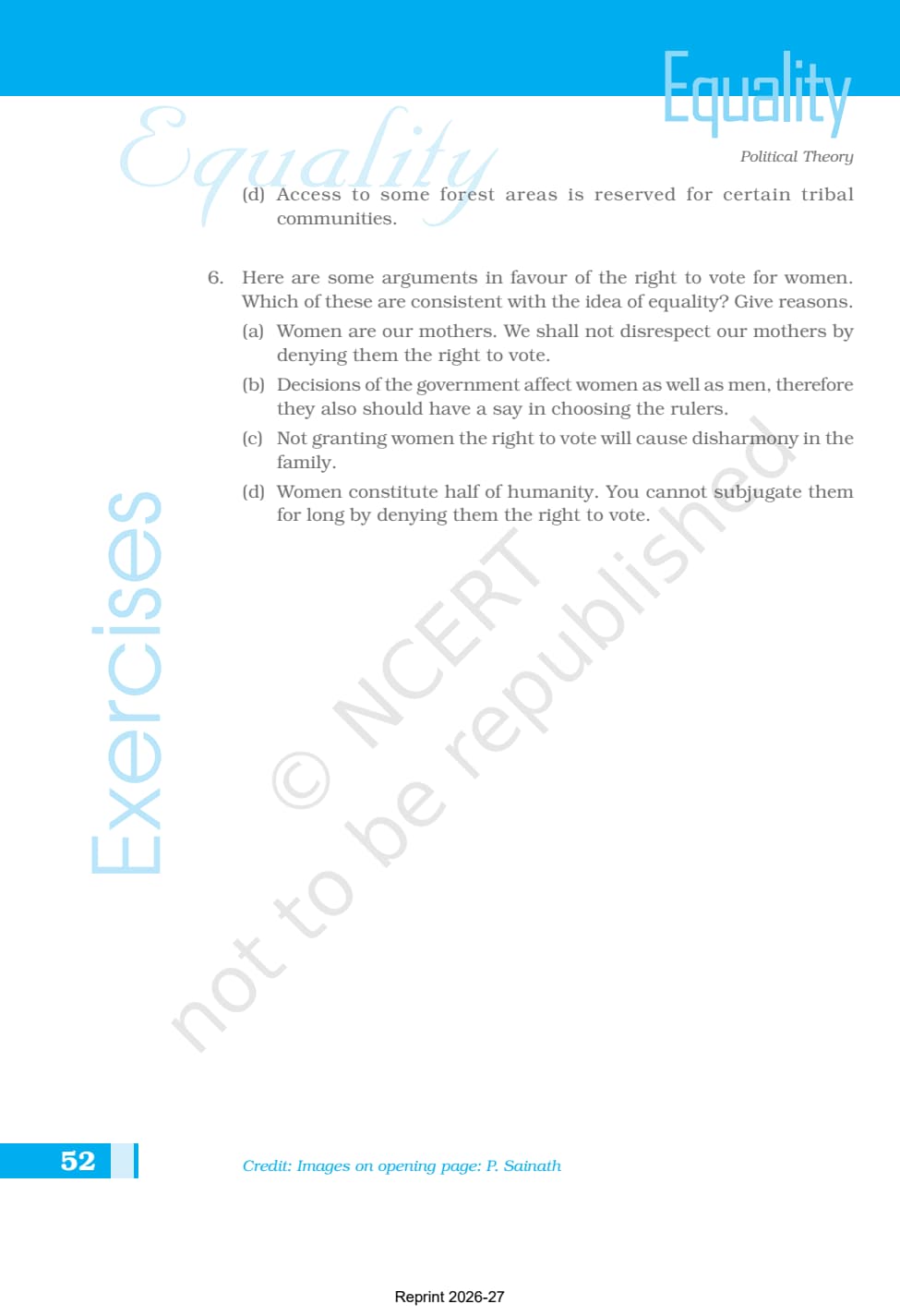
| Exercises | 6 questions, including one matching exercise and two scenario-based questions built around reservation policy |
What the Equality Chapter PDF Contains
The file holds the whole chapter exactly as NCERT printed it, opening page to closing page, with nothing trimmed from either end.
- All four numbered sections, from the meaning of equality to the policies that promote it
- The fact sheet on global inequality and the 2011 Census table comparing rural and urban households
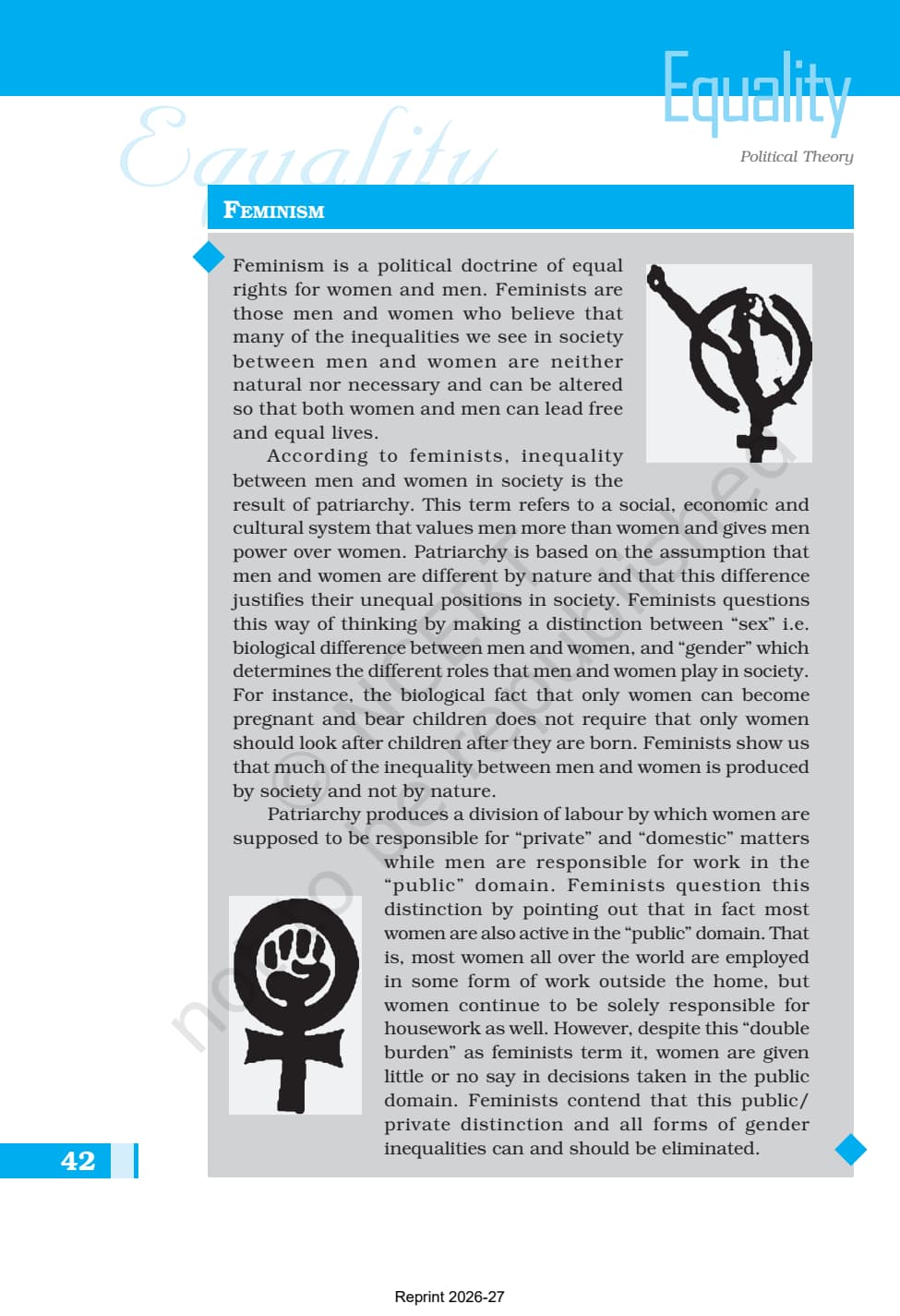
- Two highlighted ideology boxes, Feminism and Socialism, a running discussion of Marxism and liberal theory in the main text, and a Let's Debate box on women in combat roles
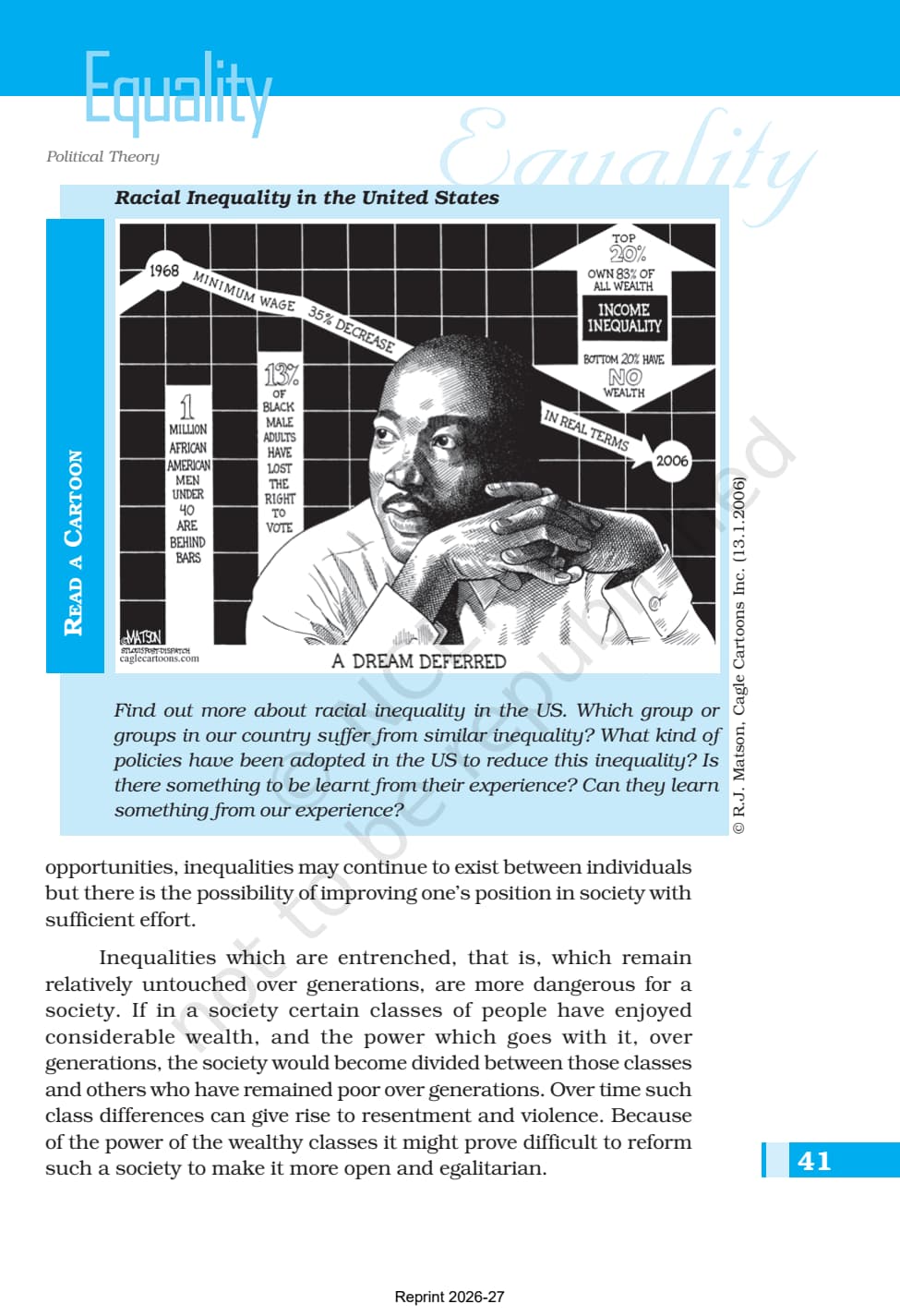
- The Let's Do It activity on facilities for students with disabilities, and the Read a Cartoon box on racial inequality in the United States
- All 6 exercise questions that close the chapter, including the matching exercise and two questions built around reservation policy
Equality Class 11 Explained: Political Theory NCERT
Source: Smart Tute on YouTube
What Is Equality: Natural Inequality and Social Inequality
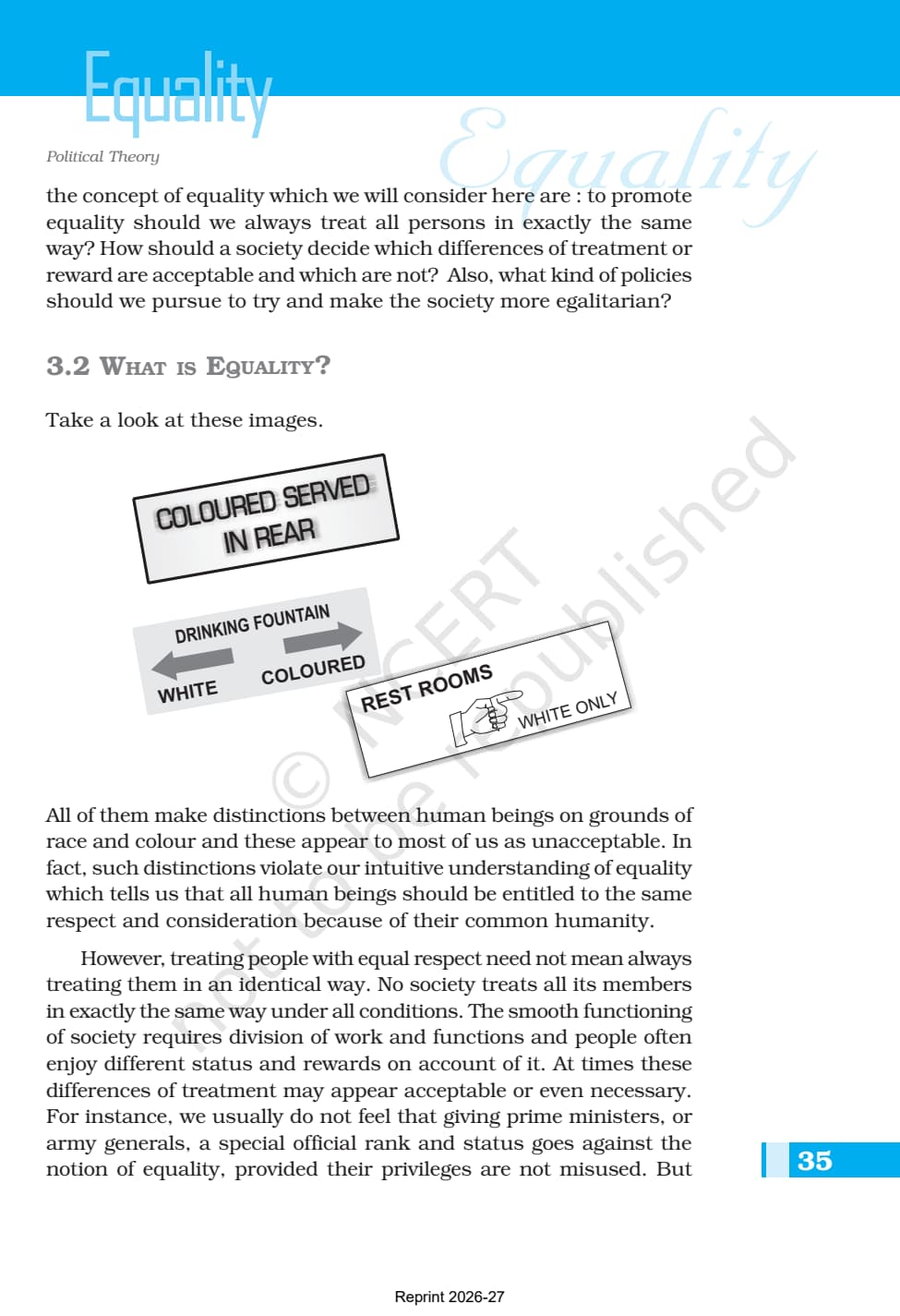
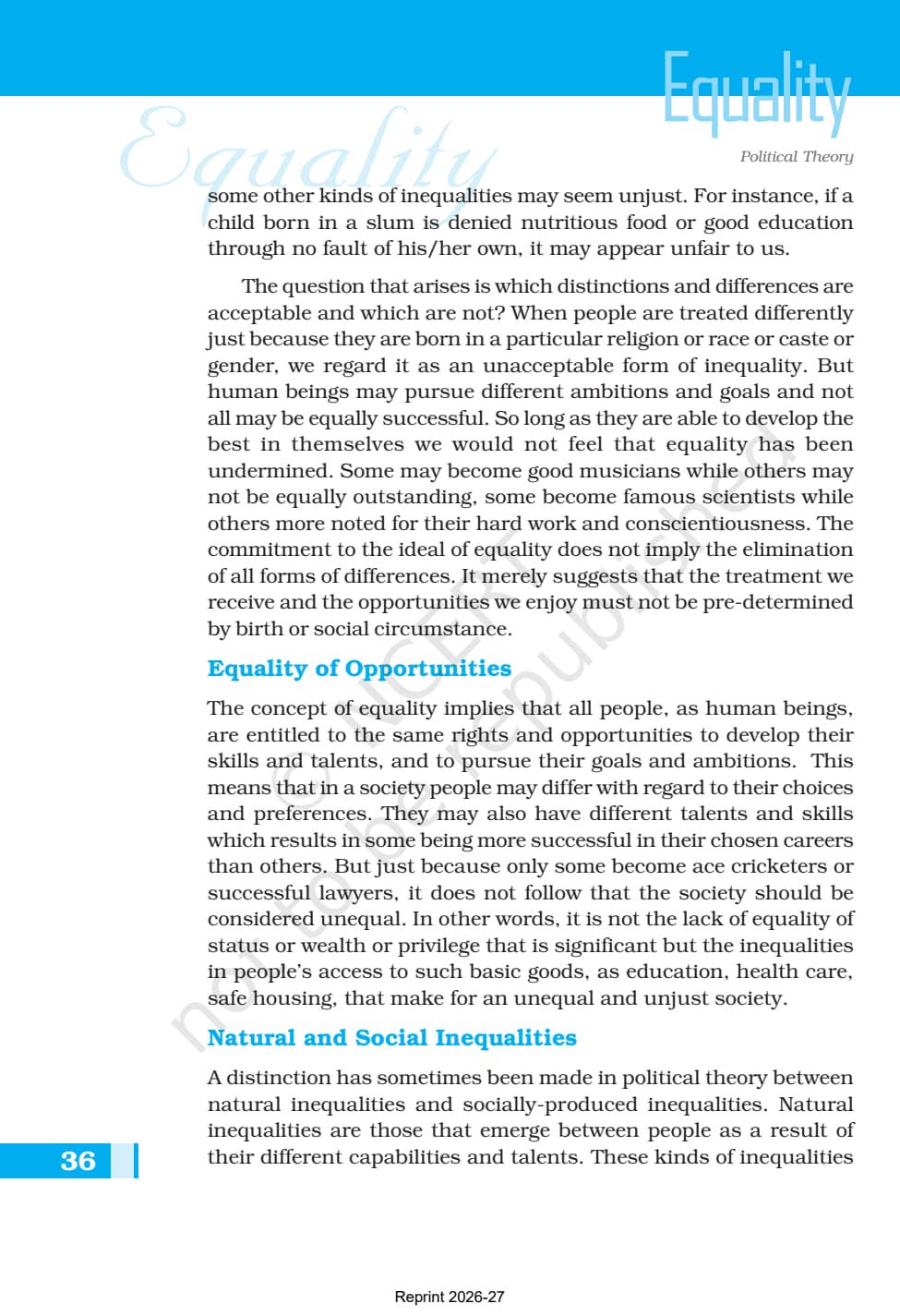
Section 3.2 makes one point before anything else: treating people with equal respect does not mean treating everyone in an identical way. No society treats every member exactly alike, yet some differences feel fair and others feel unjust. The chapter uses this discomfort to introduce a working distinction.
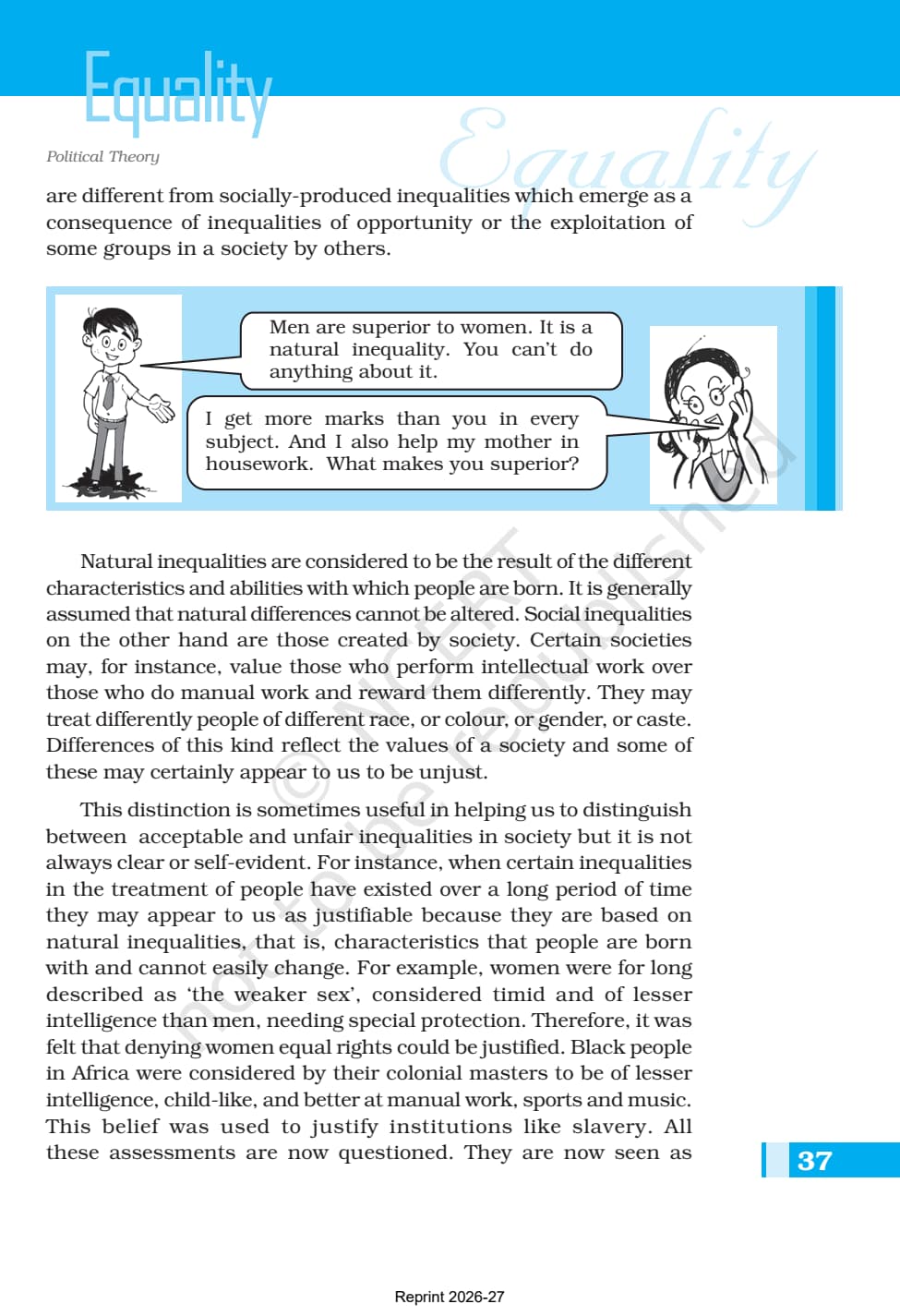
- Natural inequality: differences in ability or characteristic that people are born with, generally assumed hard to change
- Social inequality: differences created by society itself, such as valuing intellectual work over manual work, or treating people differently by caste, race or gender
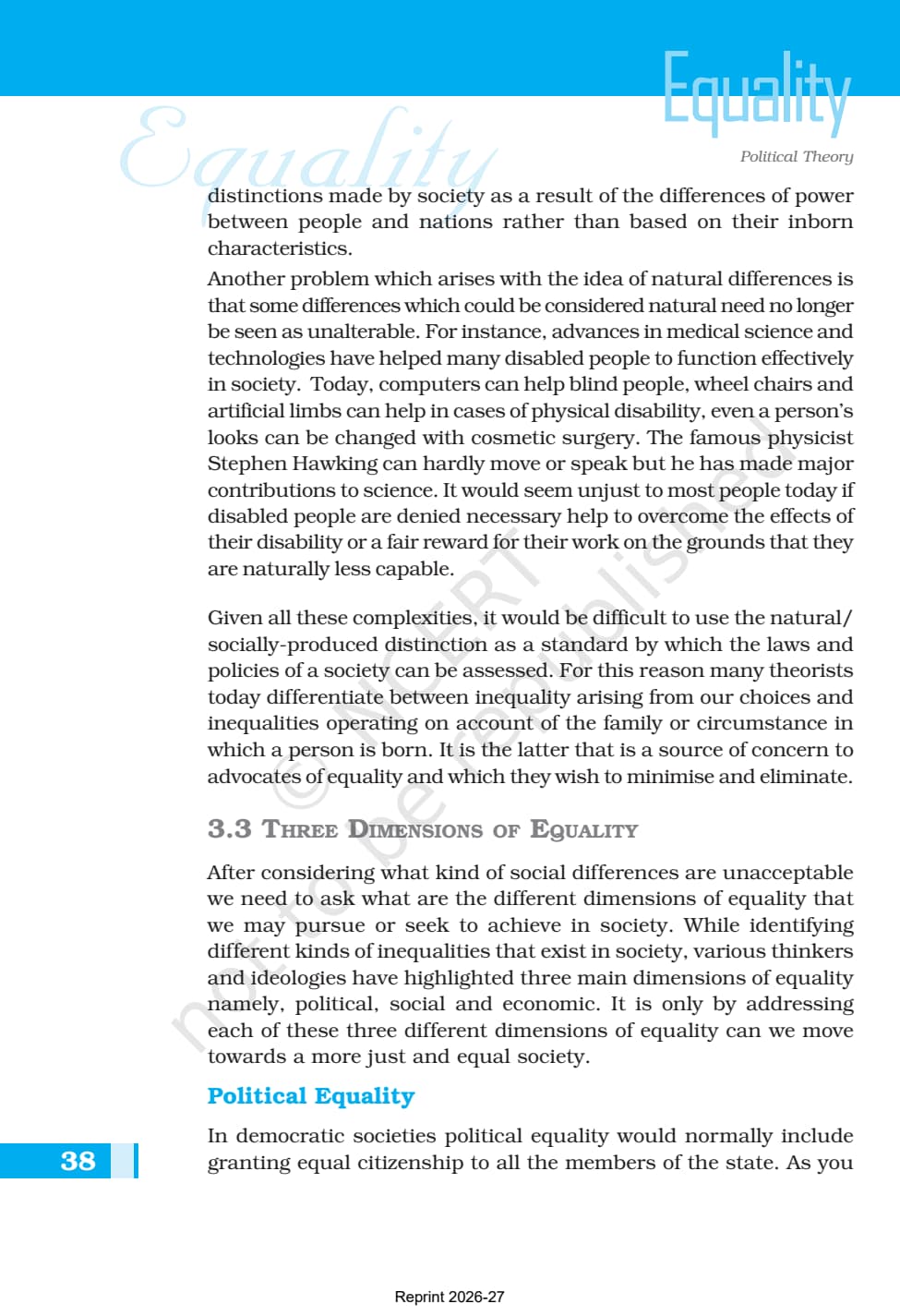
- The catch: some "natural" limits are not fixed at all. The chapter points to Stephen Hawking, who could barely move or speak yet made major contributions to physics, and to how wheelchairs, artificial limbs and computers now let many disabled people work on equal terms
Because medicine and technology keep shrinking what used to look like a fixed natural gap, the chapter argues that the natural-social split is useful for thinking but should not be used to excuse unfair treatment or deny people the support they need.
Three Dimensions of Equality: Political, Economic and Social
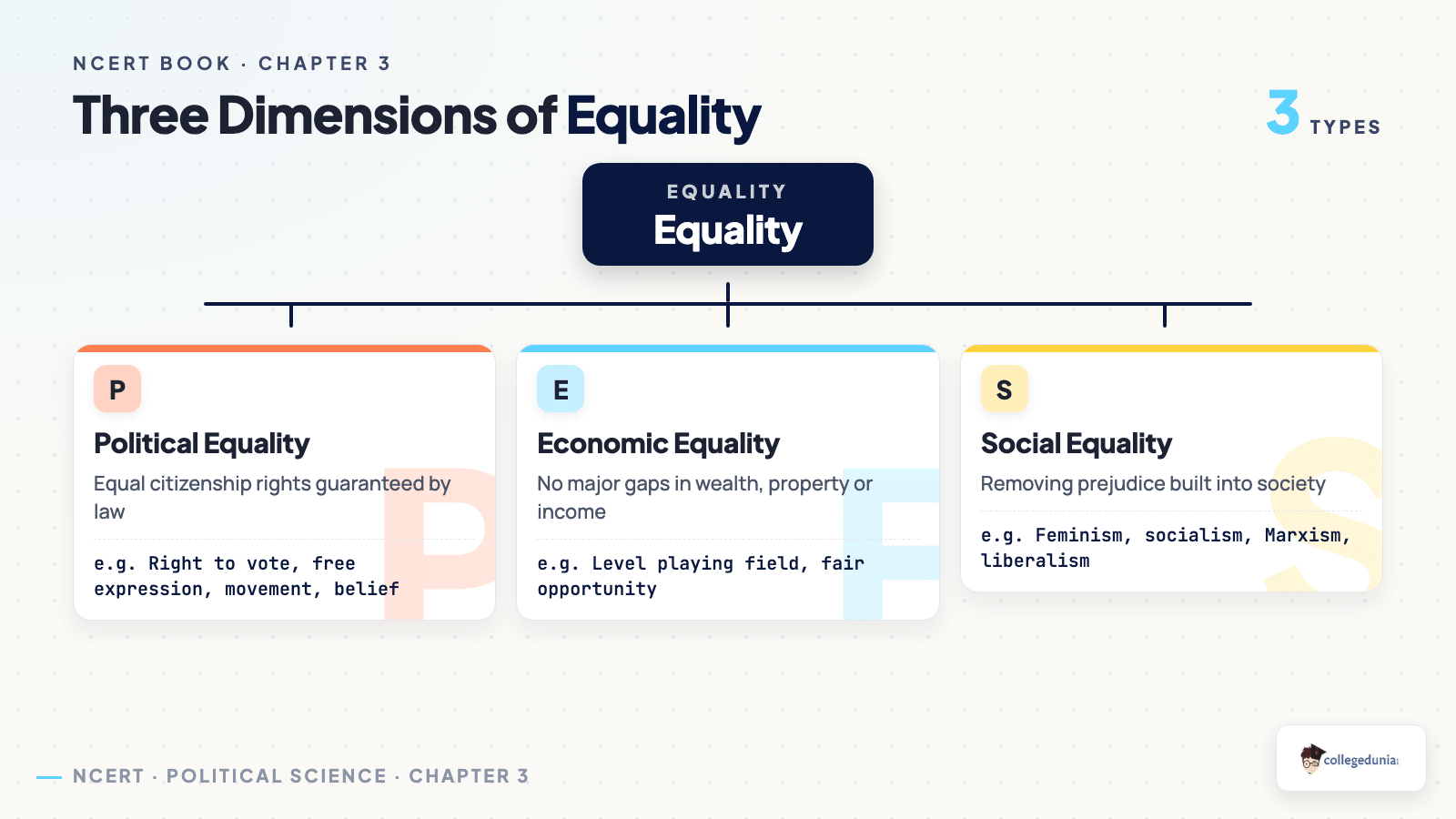
Section 3.3 splits equality into three dimensions and pairs each one with a political idea that grew out of debating it. Political equality covers equal citizenship rights; economic equality covers gaps in wealth, income and property; social equality runs through the ideology boxes that sit alongside the main text.
| Dimension | What the chapter says |
|---|---|
| Political equality | equal citizenship rights such as the right to vote, freedom of expression, movement, association and belief, all guaranteed by the constitution and laws |
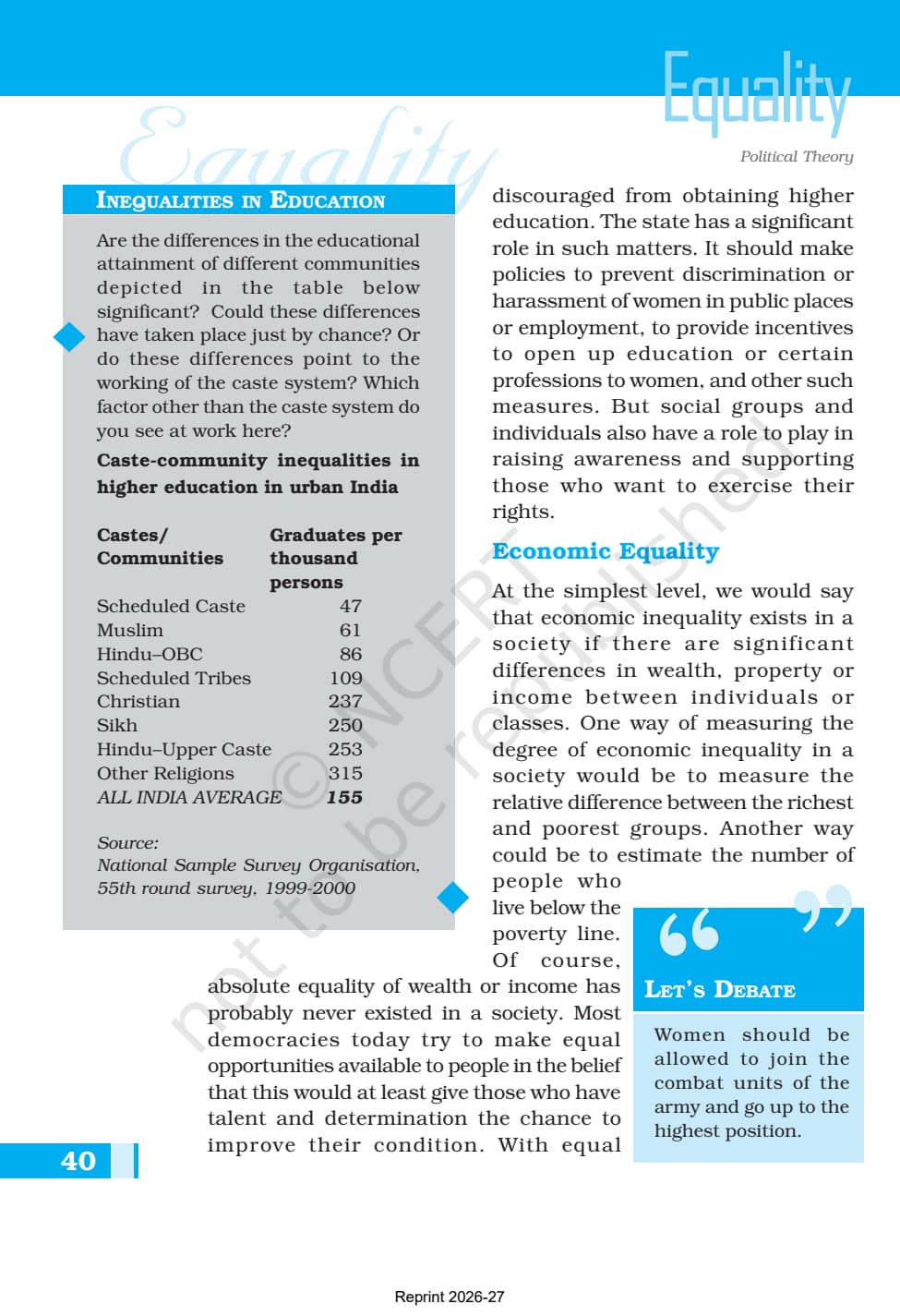
| Economic equality | exists in a society when there are no significant gaps in wealth, property or income between individuals or classes |
| Social equality | the ground covered by the Feminism and Socialism boxes and the chapter's discussion of Marxism and liberal theory, each proposing a different route to reducing entrenched social inequality |
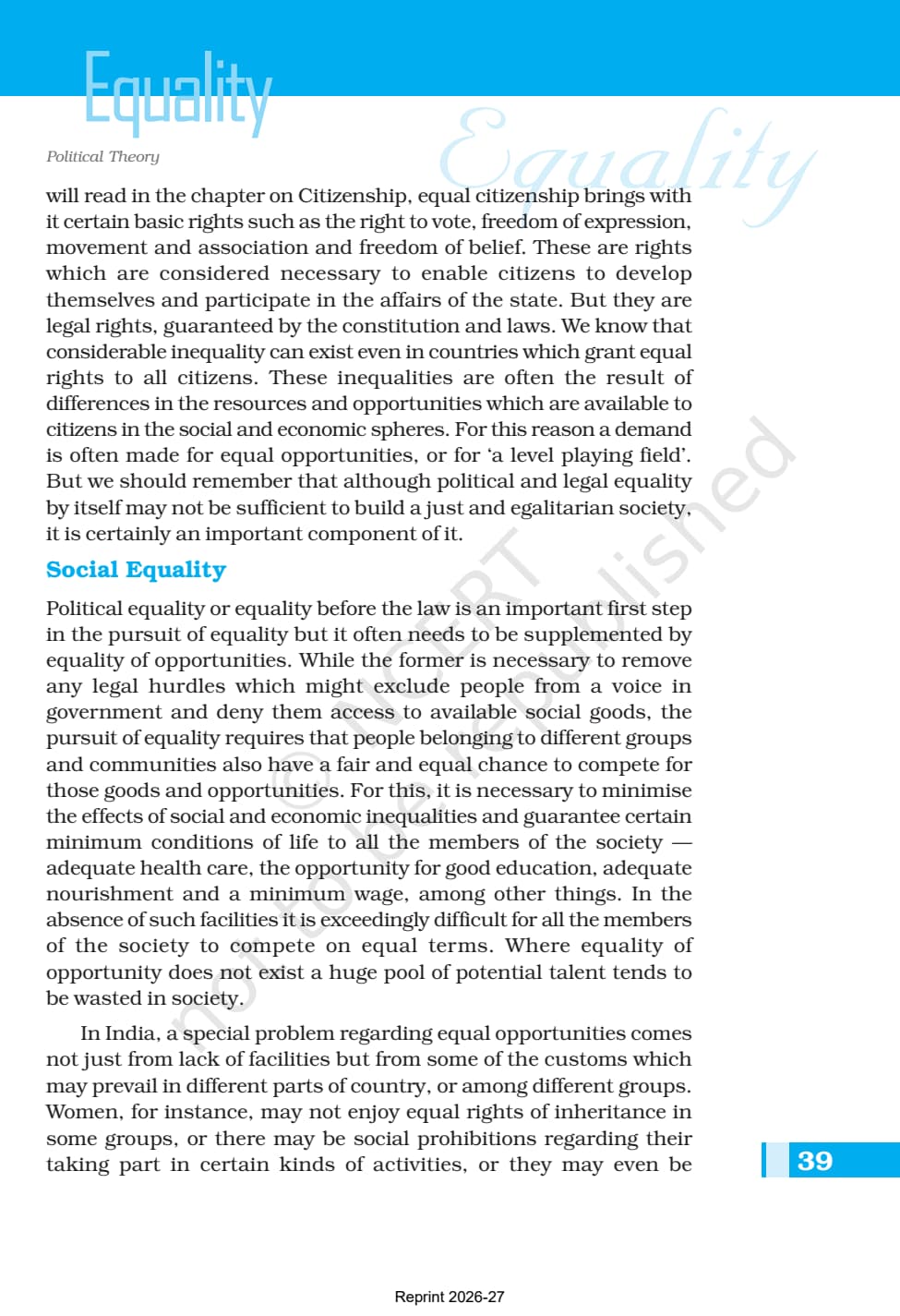
The chapter is careful to note that political and legal equality by itself may not be enough to build a genuinely equal society, because considerable inequality can still exist between citizens who all hold the same legal rights. That gap is exactly why the demand for economic and social equality follows political equality in the chapter's structure.
Arguments for Treating People as Equals
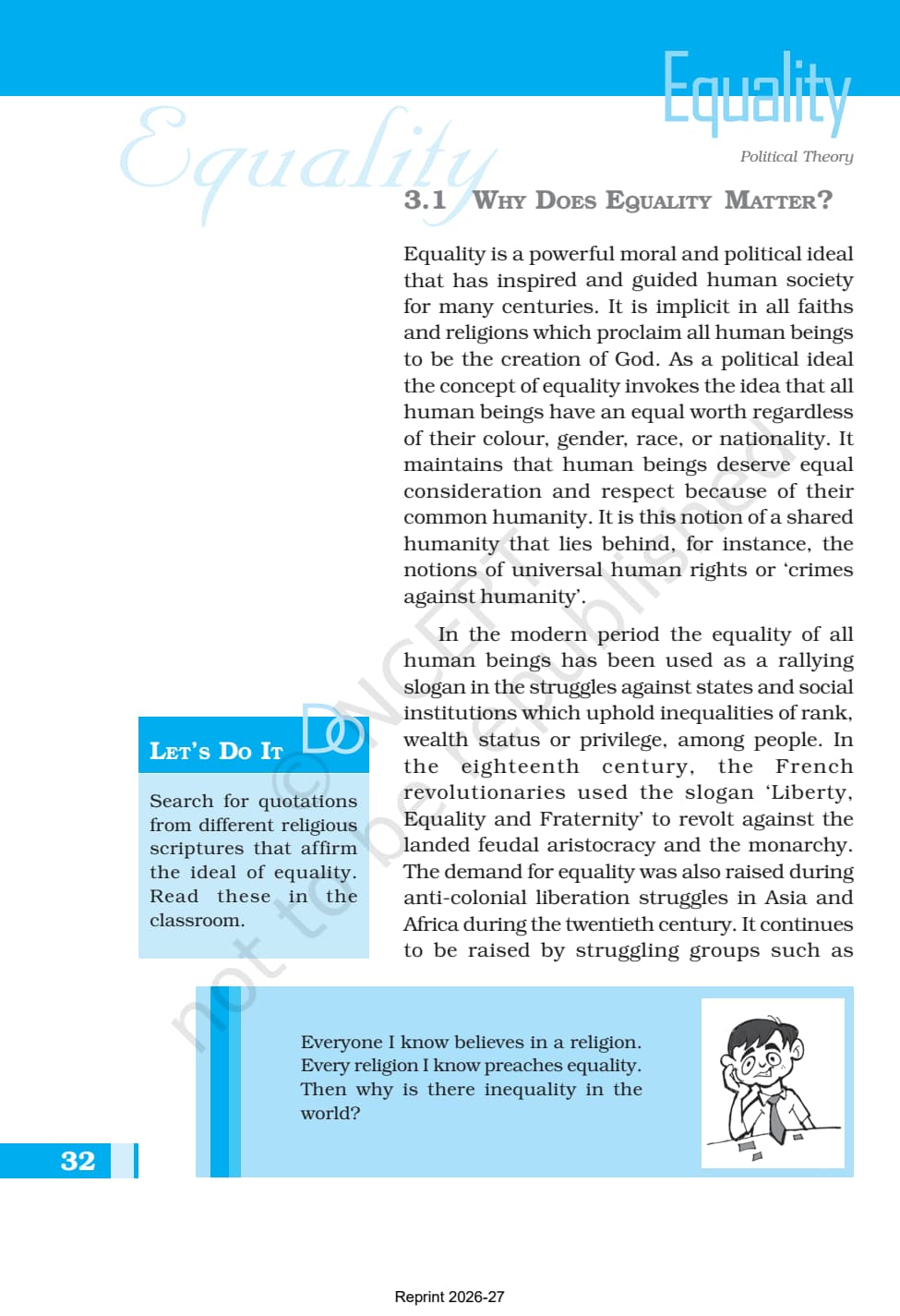
Section 3.1 opens with the case for equality before it gets to the complications. The chapter calls equality a moral and political ideal that appears in nearly every faith and religion, each of which treats human beings as having equal worth regardless of colour, gender, race or nationality.
- Human beings share a common humanity, which is the idea behind universal human rights and the phrase "crimes against humanity"
- Equality has been used as a rallying idea against states and institutions that protect inequalities of rank, wealth or privilege
- Today equality is a widely accepted ideal, written into the constitutions and laws of many countries
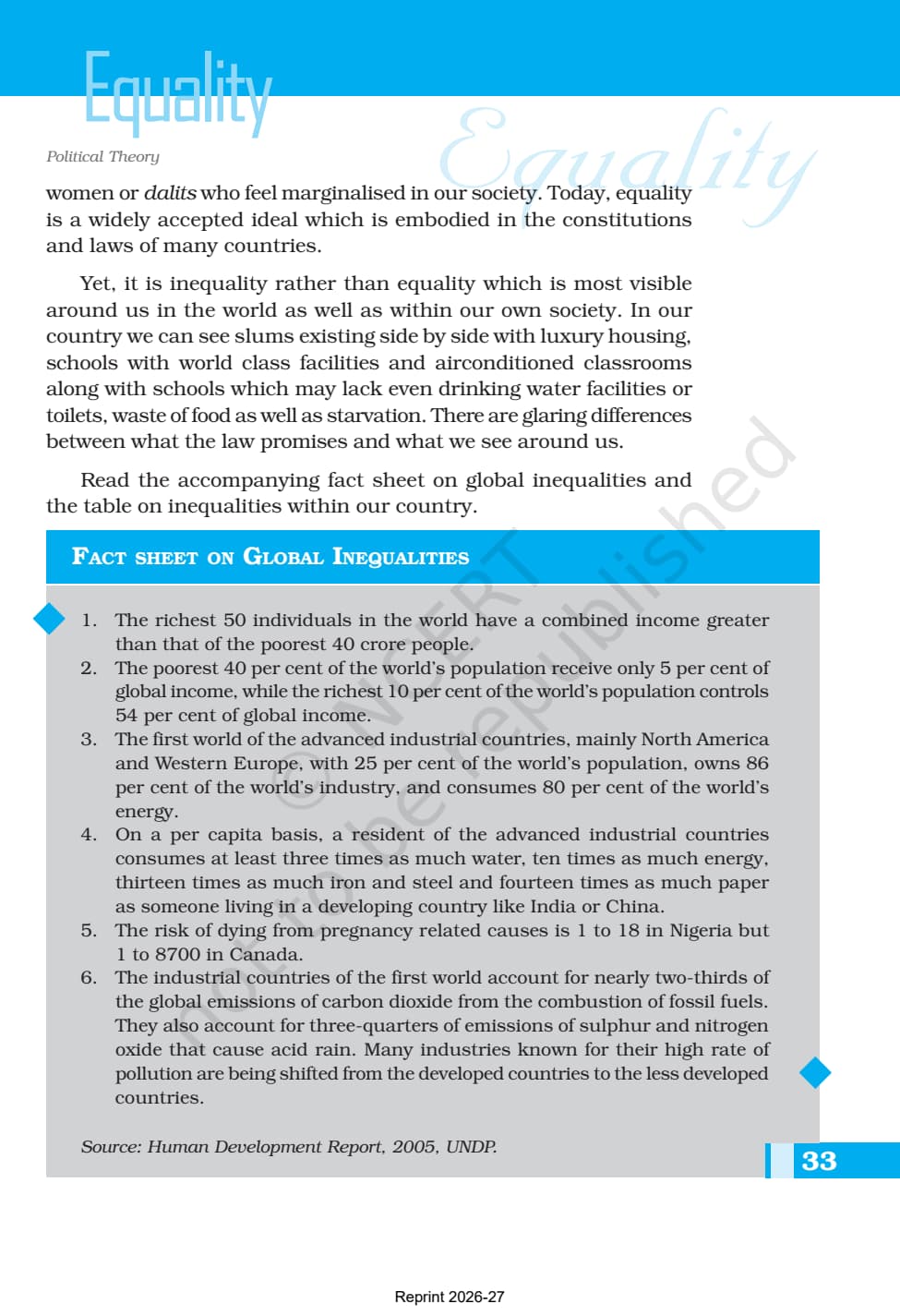
Yet the chapter is blunt about the gap between the ideal and daily life. It points to slums existing beside luxury housing, and schools with world-class facilities next to schools that lack drinking water or toilets. The accompanying fact sheet adds that the richest 50 individuals in the world earn a combined income greater than that of many of the world's poorest people, which is the kind of figure the chapter uses to argue that inequality, not equality, is what is actually visible around us.
Equal Treatment Is Not the Same as Identical Treatment
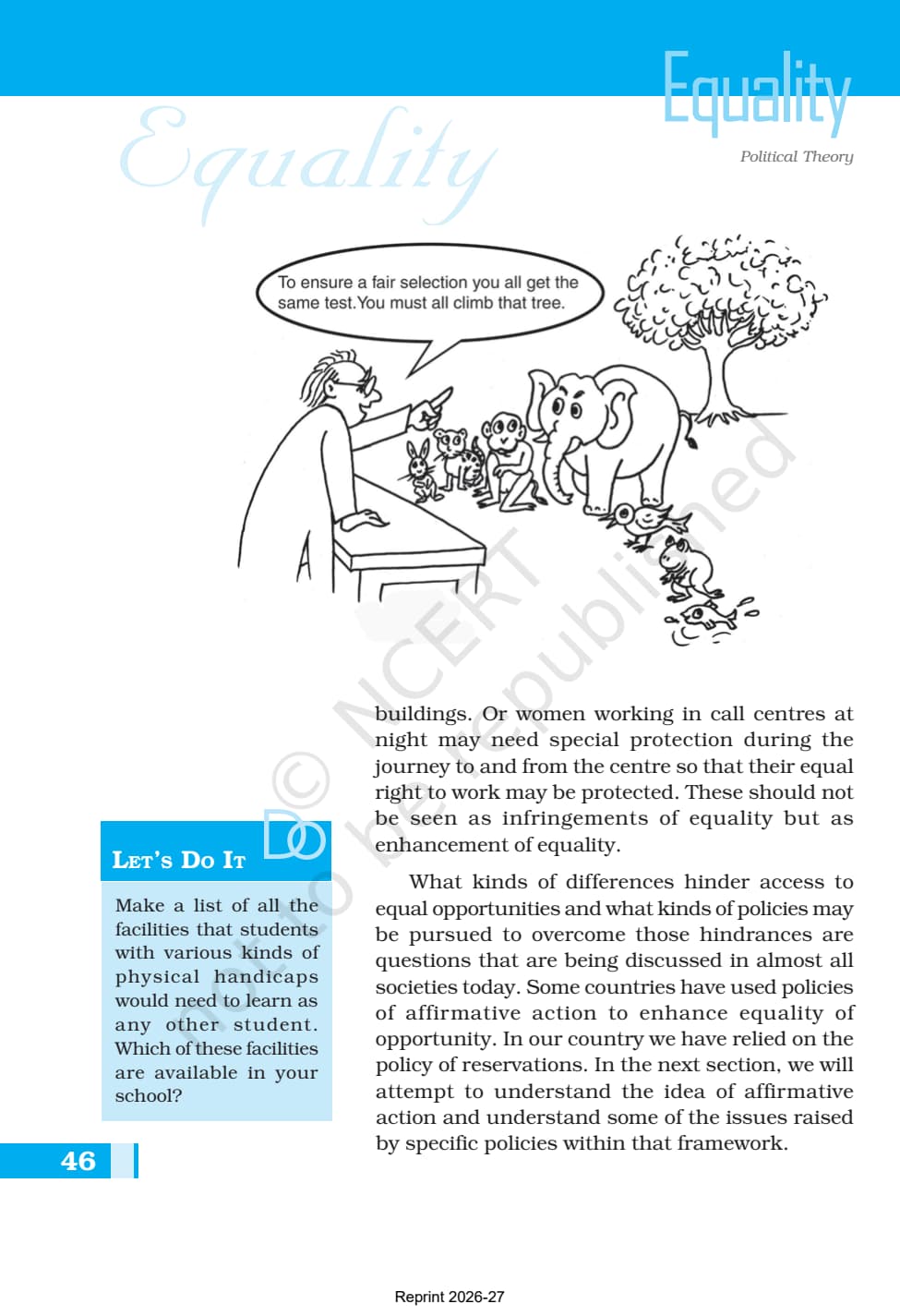
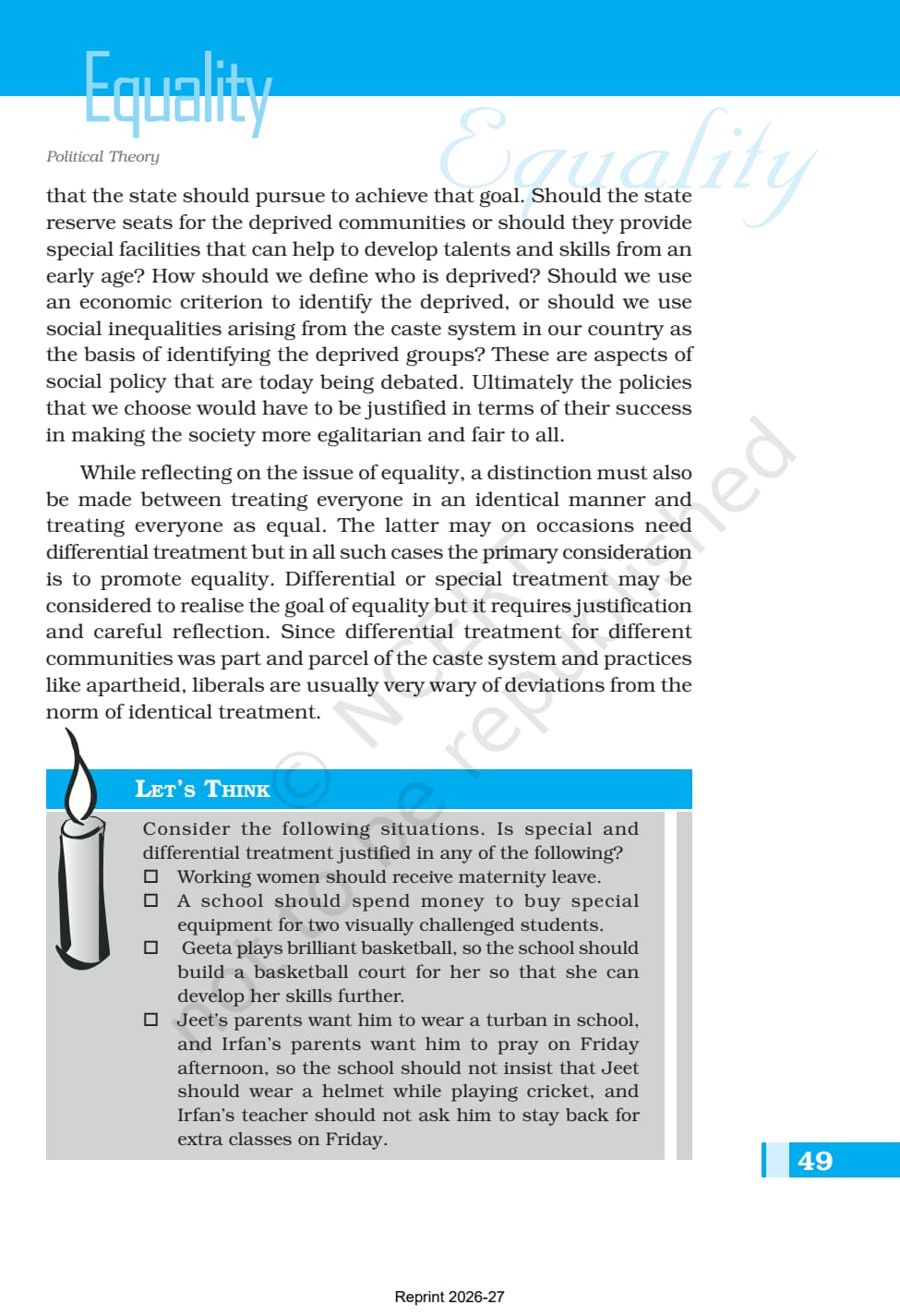
Section 3.4 draws a line the chapter keeps returning to: treating everyone in an identical manner and treating everyone as an equal are not the same goal. The second can, in some cases, require different treatment for different groups, as long as the aim is genuinely to promote equality rather than to create a new privilege.
| Example from the chapter | Why it counts as equal, not unequal |
|---|---|
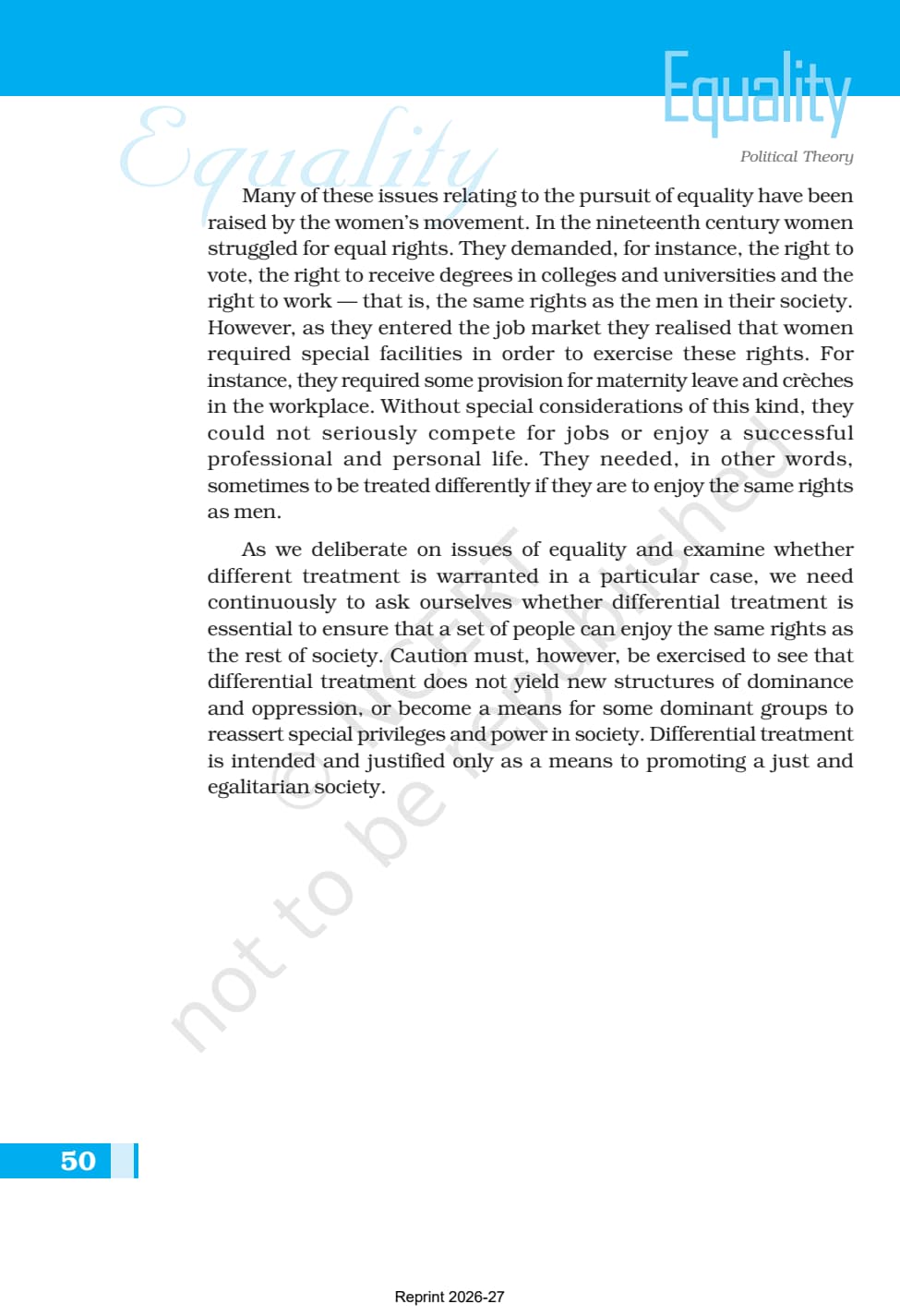
| Maternity leave and crèches at the workplace | without them, women could not compete for jobs or hold them on the same terms as men |
| Night-time travel protection for women in call centres | the special measure protects an equal right to work rather than restricting it |
| Access facilities for students with disabilities | removes a barrier so the student can learn on the same footing as classmates |
The chapter insists that any differential treatment still needs justification. The test it applies is whether the special measure helps a group enjoy the same rights that others already have, or whether it hands out an advantage unrelated to correcting a real disadvantage.
Affirmative Action and Special Provisions for Disadvantaged Groups
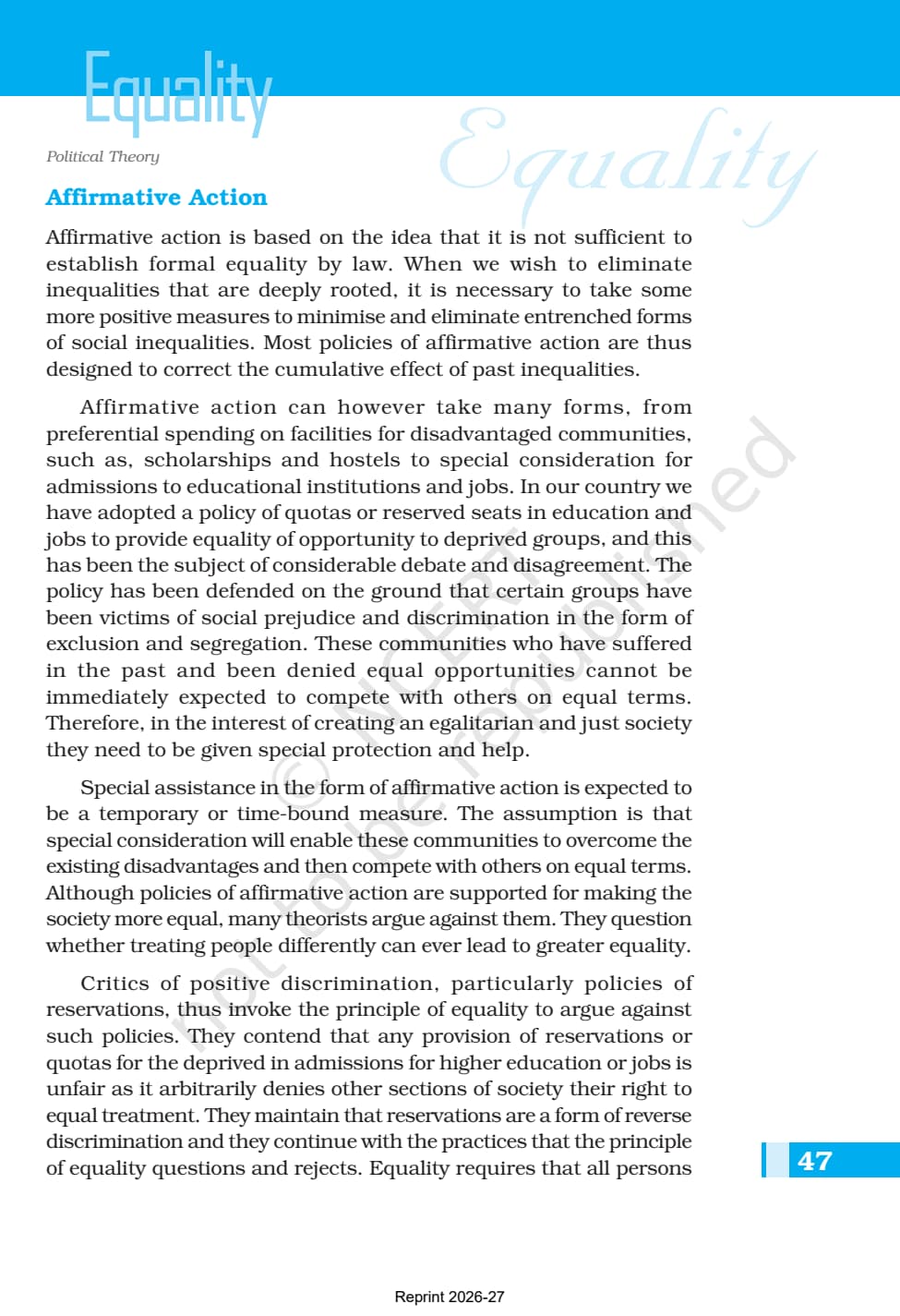
Section 3.4 also covers the two-step route the chapter lays out for pursuing equality: first end formal inequality, then use affirmative action where formal equality alone is not enough. Establishing formal equality means removing the customs and laws that once barred entire groups from opportunities, such as denying poor people the right to vote or preventing people from certain castes from doing anything but manual labour.
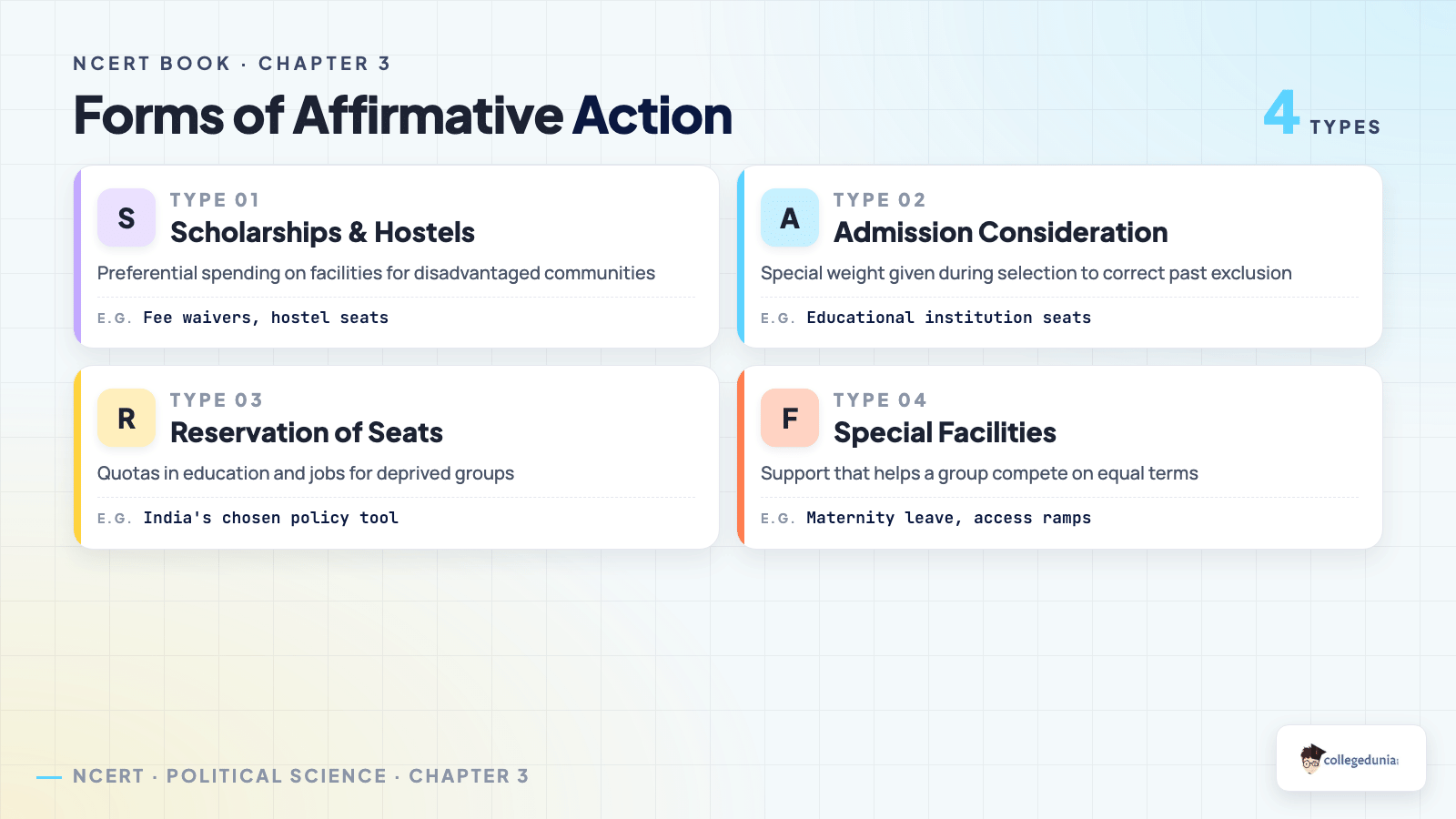
- Preferential spending: scholarships and hostel facilities for disadvantaged communities
- Admission and job consideration: special weight given during selection to correct the effect of past exclusion
- Reservation or quotas: reserved seats in education and jobs, the form of affirmative action India has relied on
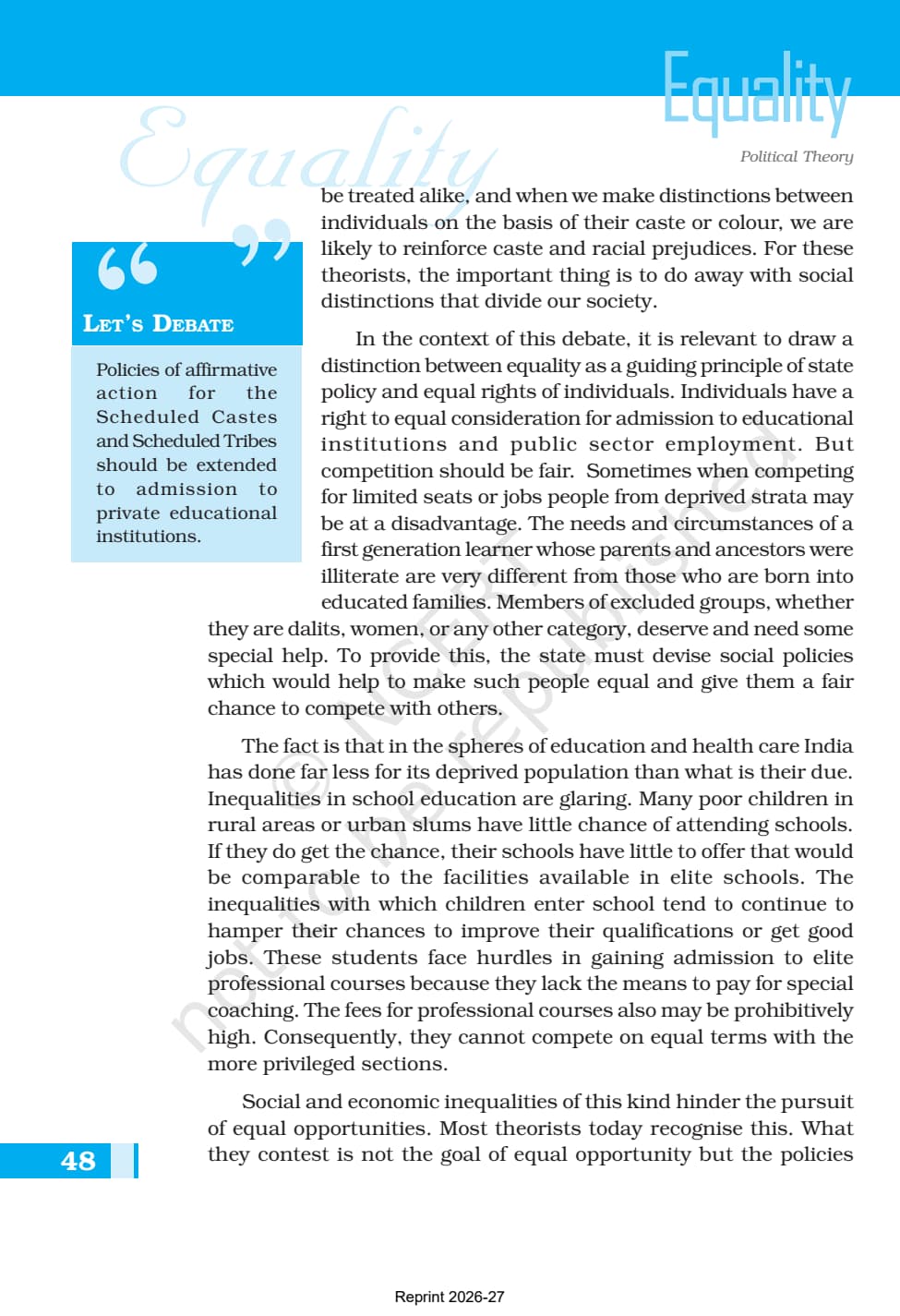
The chapter is upfront that this remains a subject of debate. Critics argue distinctions by caste or colour can reinforce the very prejudice they aim to fix, while supporters point out that a first-generation learner with illiterate parents does not compete on the same footing as someone from an educated family. The chapter leaves open how "deprived" should be defined, whether by economic criteria or by the social inequalities built into the caste system.
Equality as a Constitutional Value in India
The chapter's opening page frames equality as a value that is enshrined in our Constitution, and the chapter keeps returning to that constitutional thread as it moves through political, economic and social equality.
- Equal citizenship carries constitutionally guaranteed rights: the right to vote, and freedoms of expression, movement, association and belief
- These are described as rights citizens need to develop themselves and take part in the affairs of the state
- Legal and political equality can still coexist with real inequality when resources and opportunities are unevenly spread, which is why the demand for a "level playing field" comes up in the same section
Read alongside the chapters on Rights and Citizenship later in the book, this section is where the Class 11 Political Theory syllabus first ties the abstract idea of equality to the rights an Indian citizen actually holds under the Constitution.
Political Science Class 11 Resources for This Chapter
Also Check: the other Class 11 Political Science resources for this chapter.
| Resource | Link |
|---|---|
| Handwritten notes | Equality Class 11 Handwritten Notes |
| Chapter notes | Equality Class 11 Notes (coming soon) |
| Chapter solutions | Equality Class 11 NCERT Solutions (coming soon) |
| Previous chapter book PDF | Election and Representation Class 11 Book PDF (coming soon) |
| Next chapter book PDF | Executive Class 11 Book PDF (coming soon) |
The Handwritten Notes for this chapter are numbered differently from the Book PDF. Political Theory chapters run Election and Representation before Equality, but the Handwritten Notes series numbers this chapter 13 because it follows the Constitution-first order used across the notes.
Equality Class 11 NCERT Book PDF FAQs
Common Student Questions on the Equality Chapter File
Ques. Where can I download the Class 11 Political Science Chapter 3 NCERT Book PDF?
Ans. The official 22-page chapter file is on this page, free to download.
Ques. How many pages is the Equality chapter?
Ans. 22 pages, printed pages 31 to 52 in the 2026-27 book, and this PDF is the complete chapter.
Ques. What is the difference between natural inequality and social inequality?
Ans. Natural inequality refers to differences in ability that people are born with. Social inequality is created by society, such as treating people differently by caste, race or gender. The chapter also notes that some natural limits, such as physical disability, can be reduced through technology and support.
Ques. What are the three dimensions of equality according to this chapter?
Ans. Political equality, economic equality and social equality. Political equality covers rights such as voting and free expression. Economic equality concerns gaps in wealth and income. Social equality is explored through the Feminism and Socialism boxes and the chapter's discussion of Marxism and liberal theory.
Ques. Is treating everyone identically the same as treating everyone as equal?
Ans. No. The chapter explains that promoting equality can sometimes require differential treatment, such as maternity leave for women or access facilities for students with disabilities, as long as the differential treatment is genuinely aimed at helping a group enjoy the same rights as others.
Ques. What is affirmative action, according to the chapter?
Ans. Affirmative action is a set of positive measures, beyond formal equality, meant to correct the effect of past discrimination. The chapter lists scholarships, hostel facilities, special admission consideration and reservation of seats in education and jobs as examples used in India.
Ques. How does the chapter connect equality to the Indian Constitution?
Ans. The chapter opens by calling equality a value enshrined in the Constitution, and explains that equal citizenship carries constitutionally guaranteed rights such as the right to vote and freedoms of expression, movement, association and belief.
Ques. Is this the official NCERT file?
Ans. Yes. It is the NCERT chapter PDF for 2026-27 hosted as published, with no pages removed or added.



Comments