



The Host-Vector System chapter opens the tools-of-the-trade unit in Class 12 Biotechnology, explaining the two things every gene-cloning experiment needs: a compatible host and a vector. The ncert book class 12 biotechnology chapter 2 host-vector system file on this page is the official NCERT chapter for 2026-27, all 18 pages from the pBR322 vector map to the lambda phage life cycle.
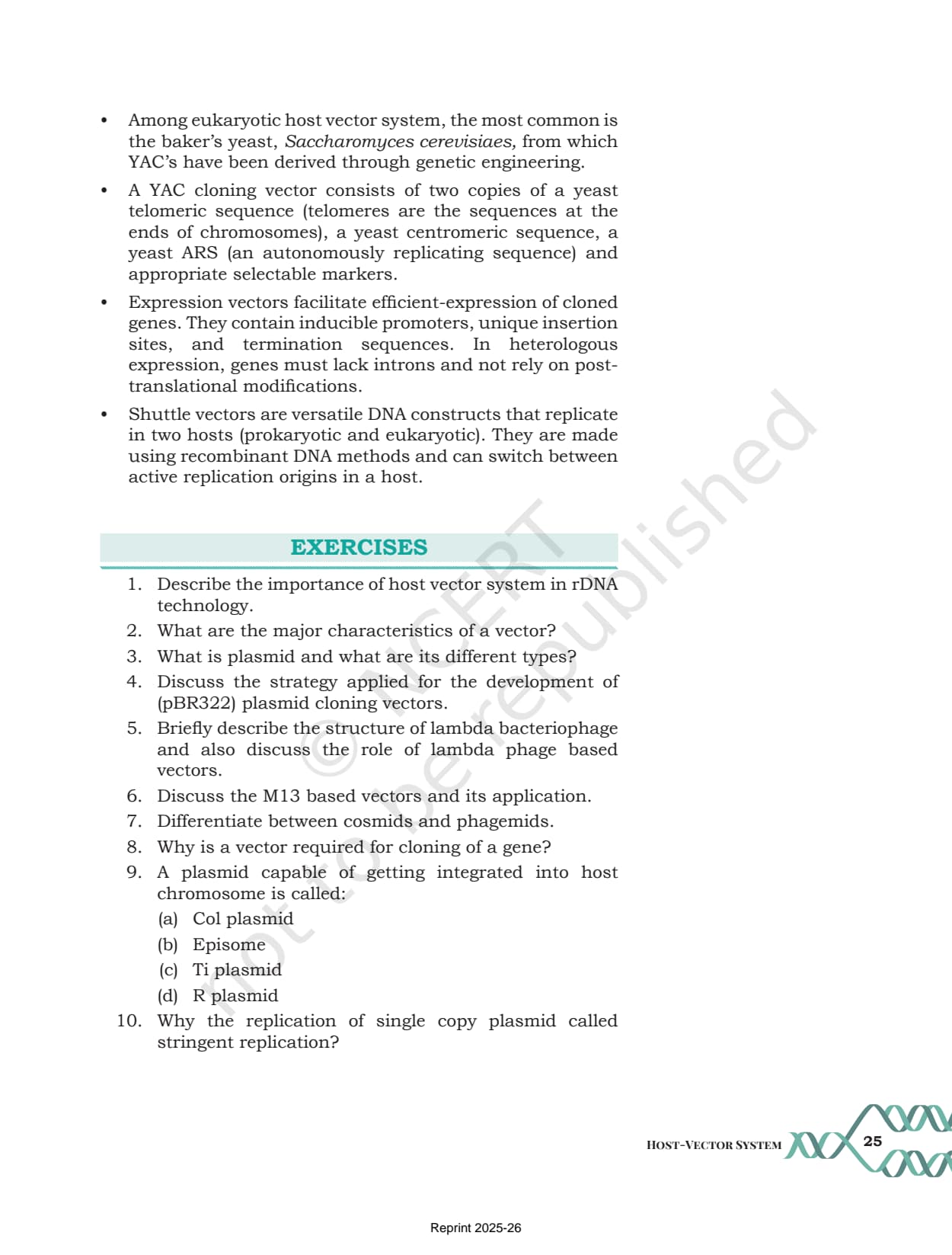
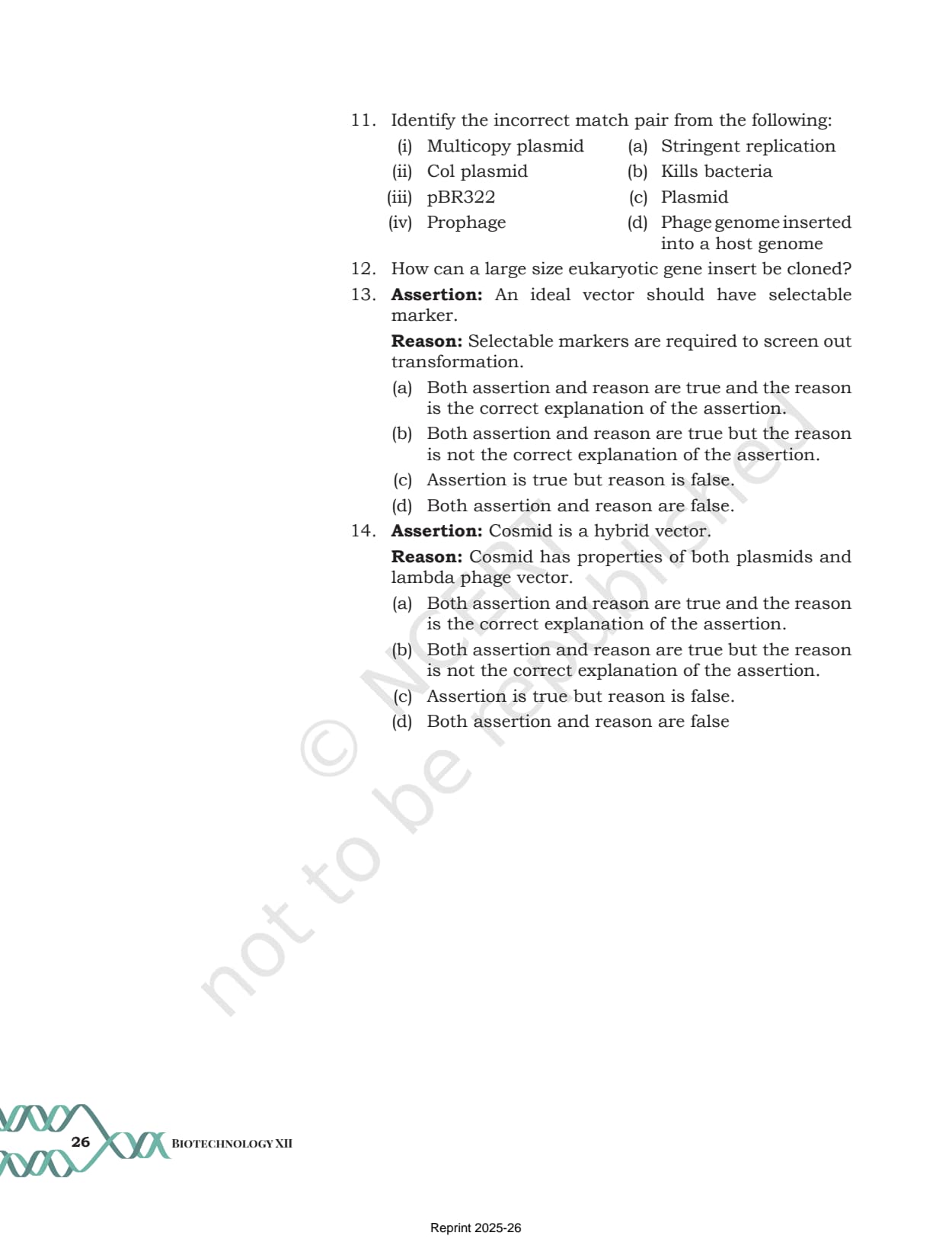
- All six sections, from the two-component host-vector idea through shuttle vectors, plus the Summary and 14 exercise questions
- Labelled vector maps of pBR322 and pUC19, the lambda phage life cycle diagram, and Table 2.2 comparing insert sizes across vectors
- Printed pages 9 to 26 of the 2026-27 Biotechnology textbook, with nothing removed
You can page through the vector maps and the phage diagrams in the viewer above before downloading the file.
This is the official NCERT chapter file for the 2026-27 session, hosted by Collegedunia with no pages removed.
How the Host-Vector System Chapter Is Laid Out
The chapter opens with a one-line reminder that gene cloning is always a two-component job: a compatible host and a vector. Six numbered sections then build on that idea, moving from the basic host-vector relationship to the specialised carriers used for very large eukaryotic genes.
| Section | What it covers |
|---|---|
| 2.1 Two Key Components of Recombinant DNA Technology | the insert, the vector, the host, and gene cloning as a two-component system |
| 2.2 Host | E. coli, Bacillus subtilis and yeast as host organisms |
| 2.3 Vector | origin of replication, restriction sites, selectable markers; plasmids, bacteriophages, cosmids and phasmids |
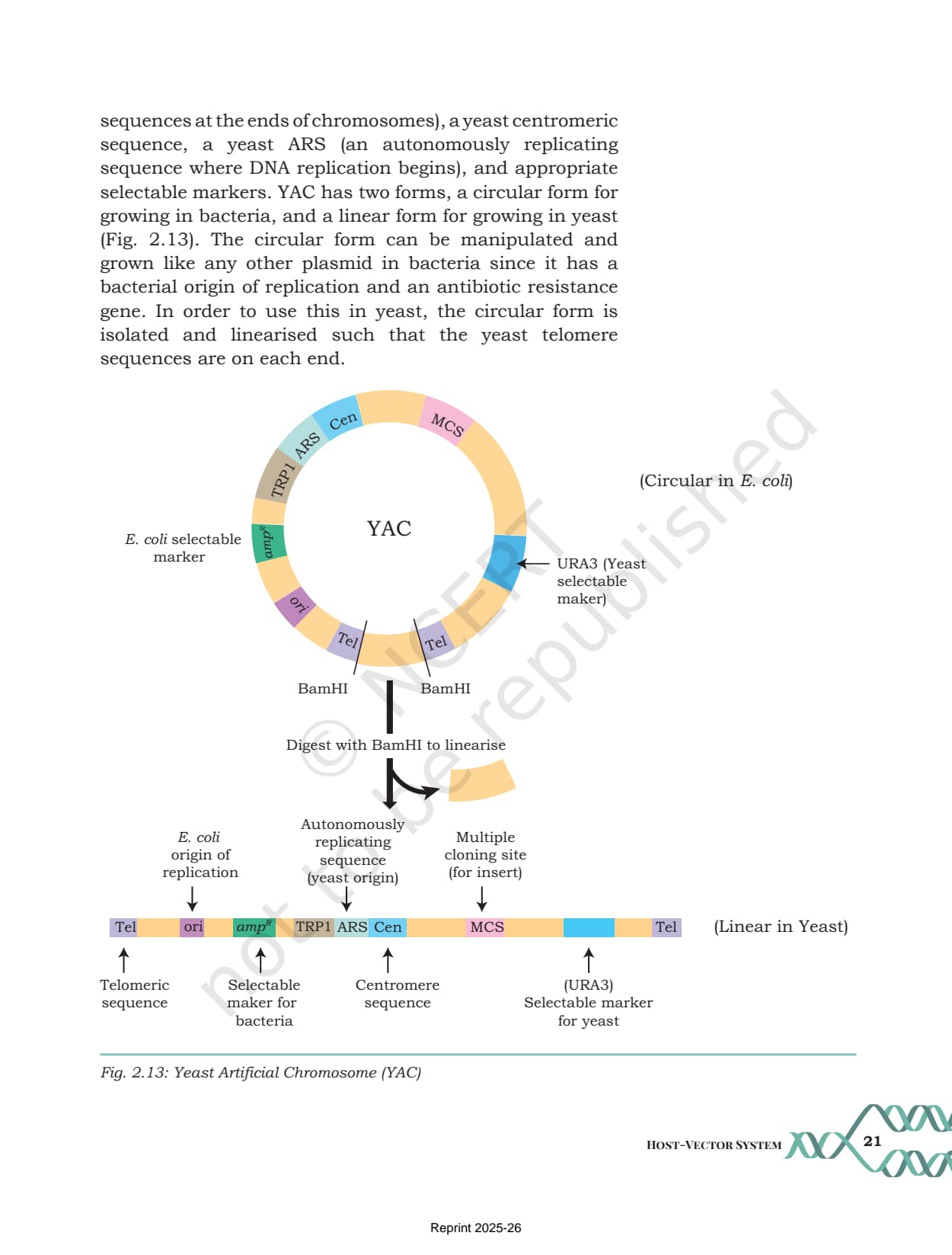
| 2.4 Eukaryotic Host Vector System | Saccharomyces cerevisiae and Yeast Artificial Chromosomes (YAC) |
| 2.5 Expression Vectors | promoters, the expression cassette and heterologous gene expression |
| 2.6 Shuttle Vectors | vectors built to replicate inside two different hosts |
| Summary and Exercises | a 10-point recap plus 14 exercise questions, including two assertion-reason items |
Host-Vector System Explained: Plasmids, Vectors and Cloning
Source: Let's Crack UPSC CSE on YouTube
What the Host-Vector System Chapter PDF Contains
The PDF carries the chapter exactly as NCERT printed it, spanning printed pages 9 to 26 of the 2026-27 Biotechnology textbook.
- All six sections, from the two-component host-vector idea to shuttle vectors
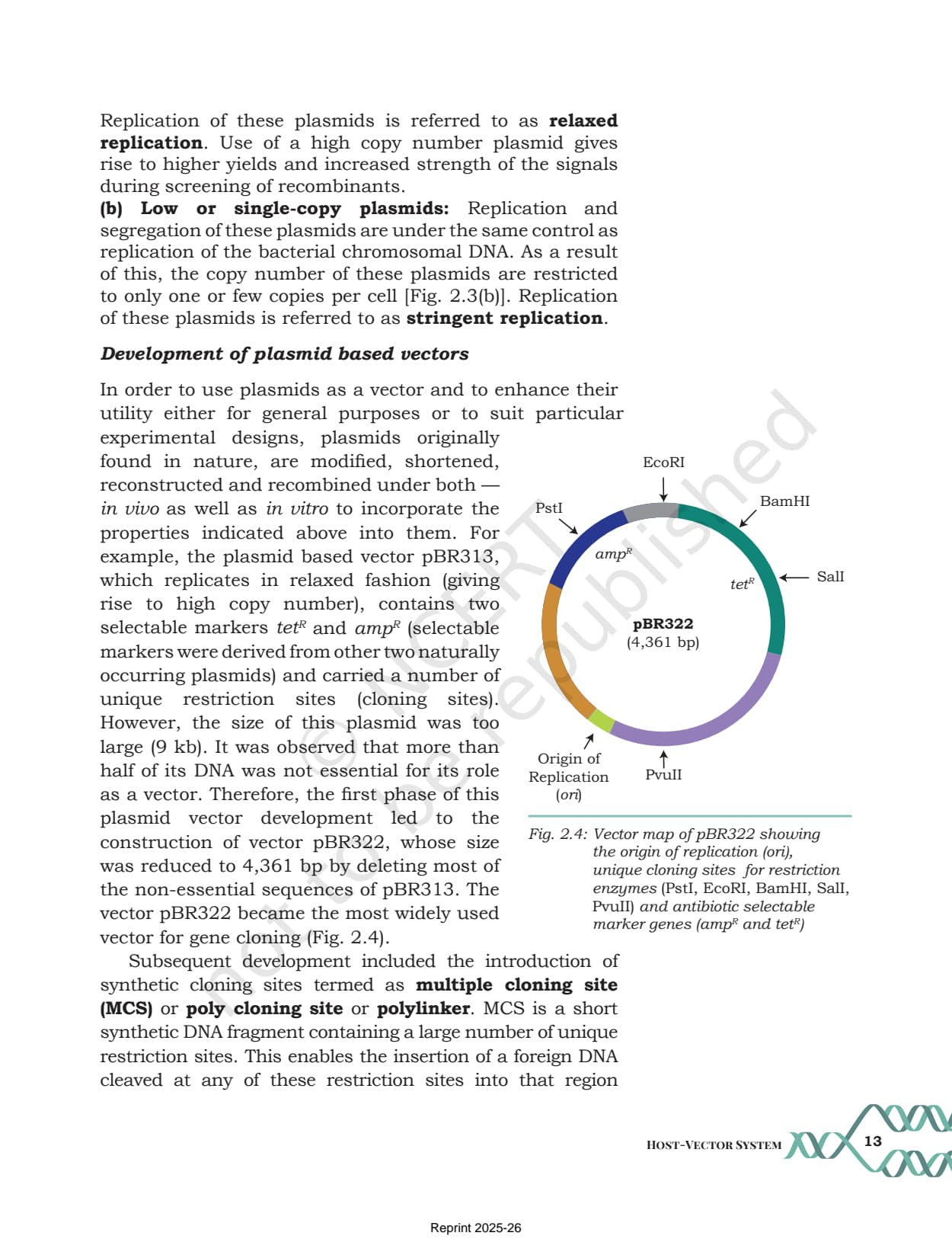
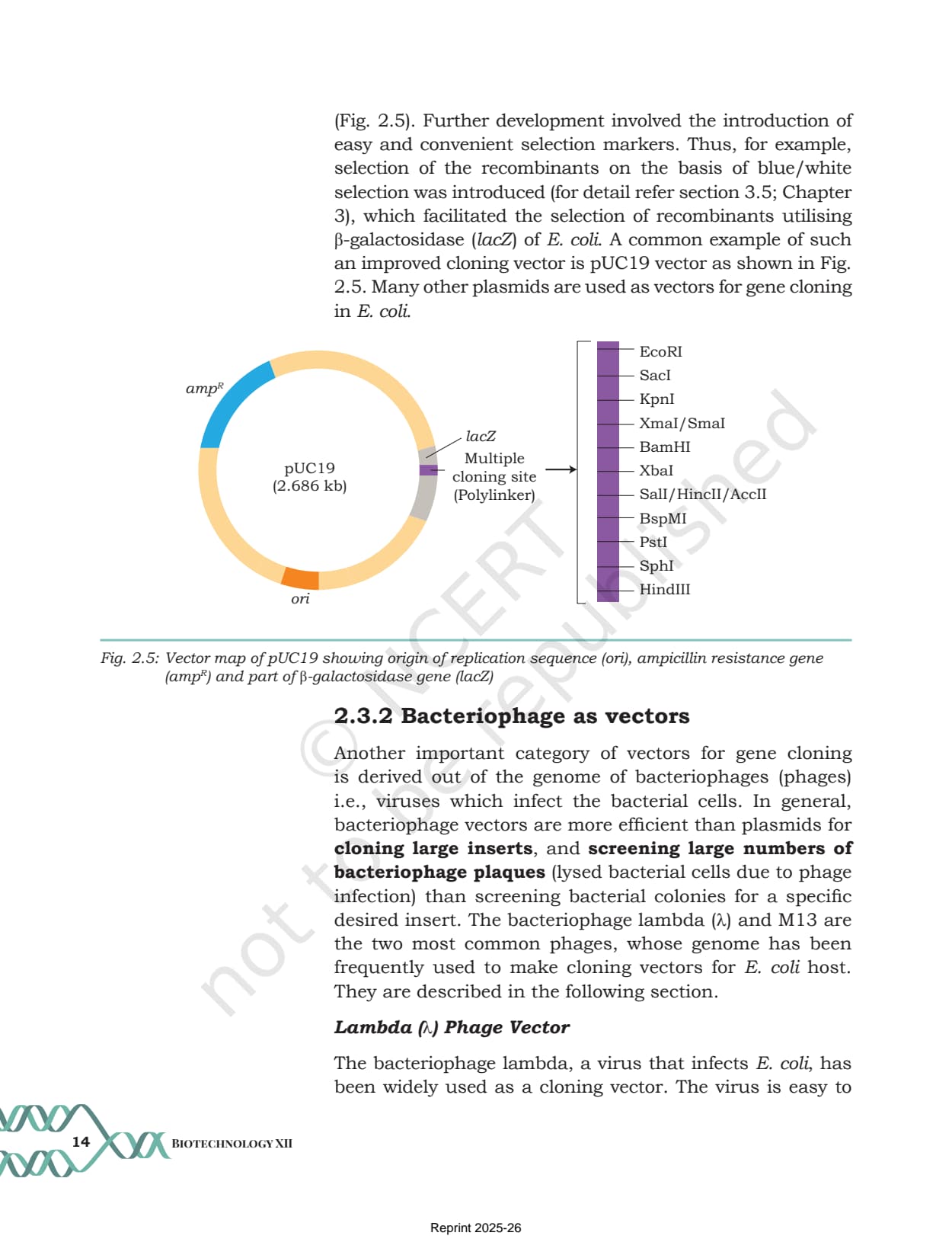
- Fig. 2.4 and Fig. 2.5, the labelled vector maps of pBR322 and pUC19 showing the origin of replication, cloning sites and antibiotic-resistance marker genes
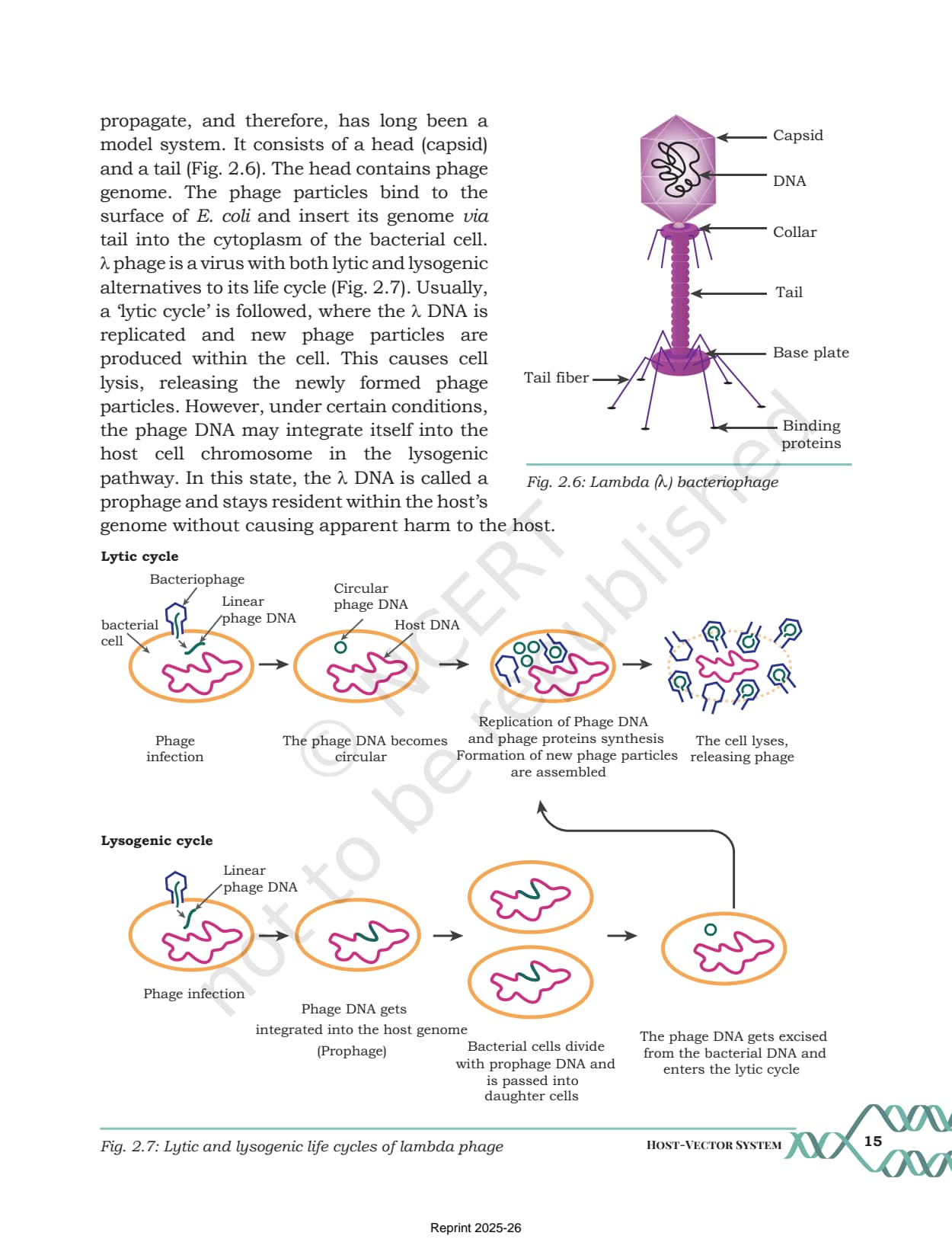
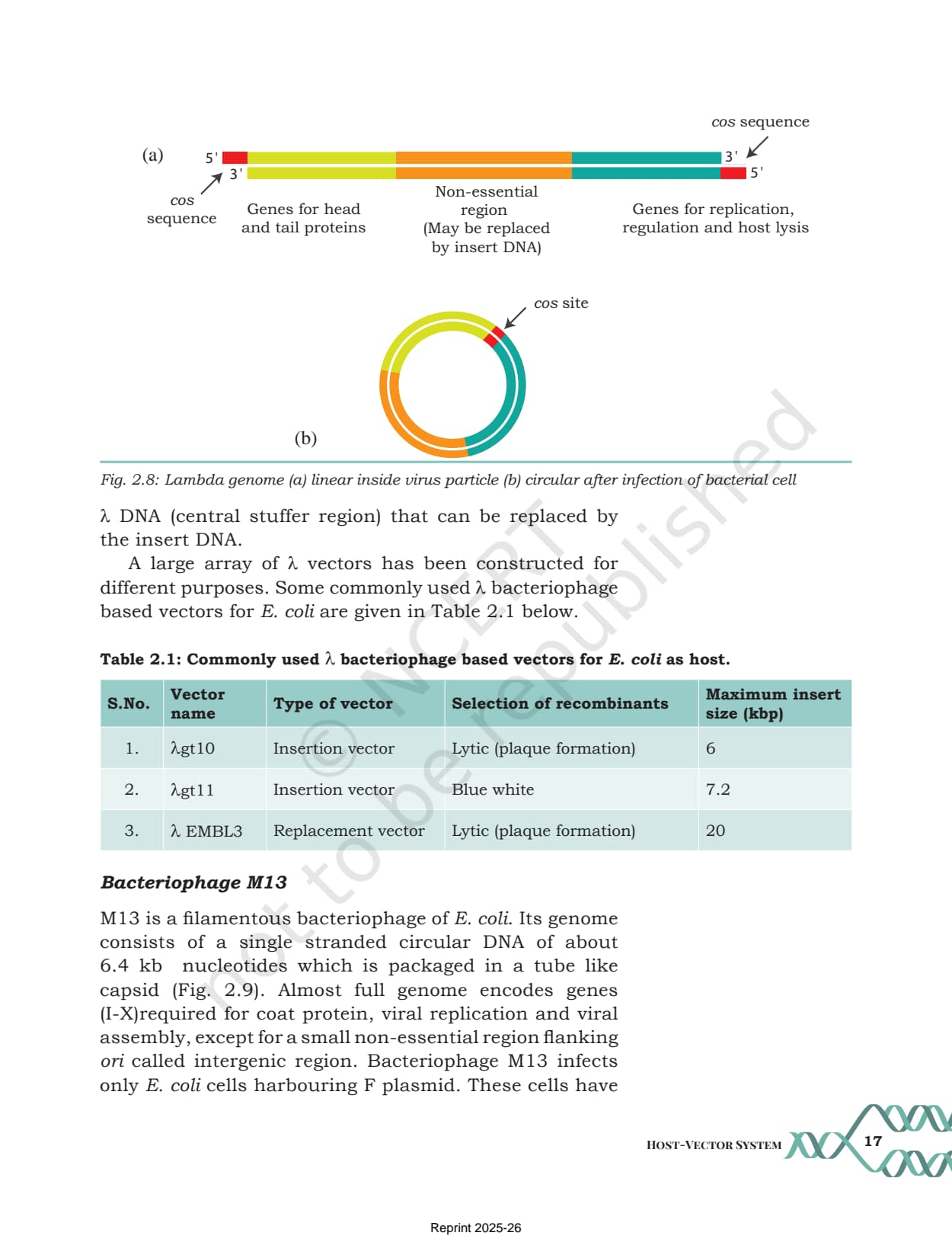
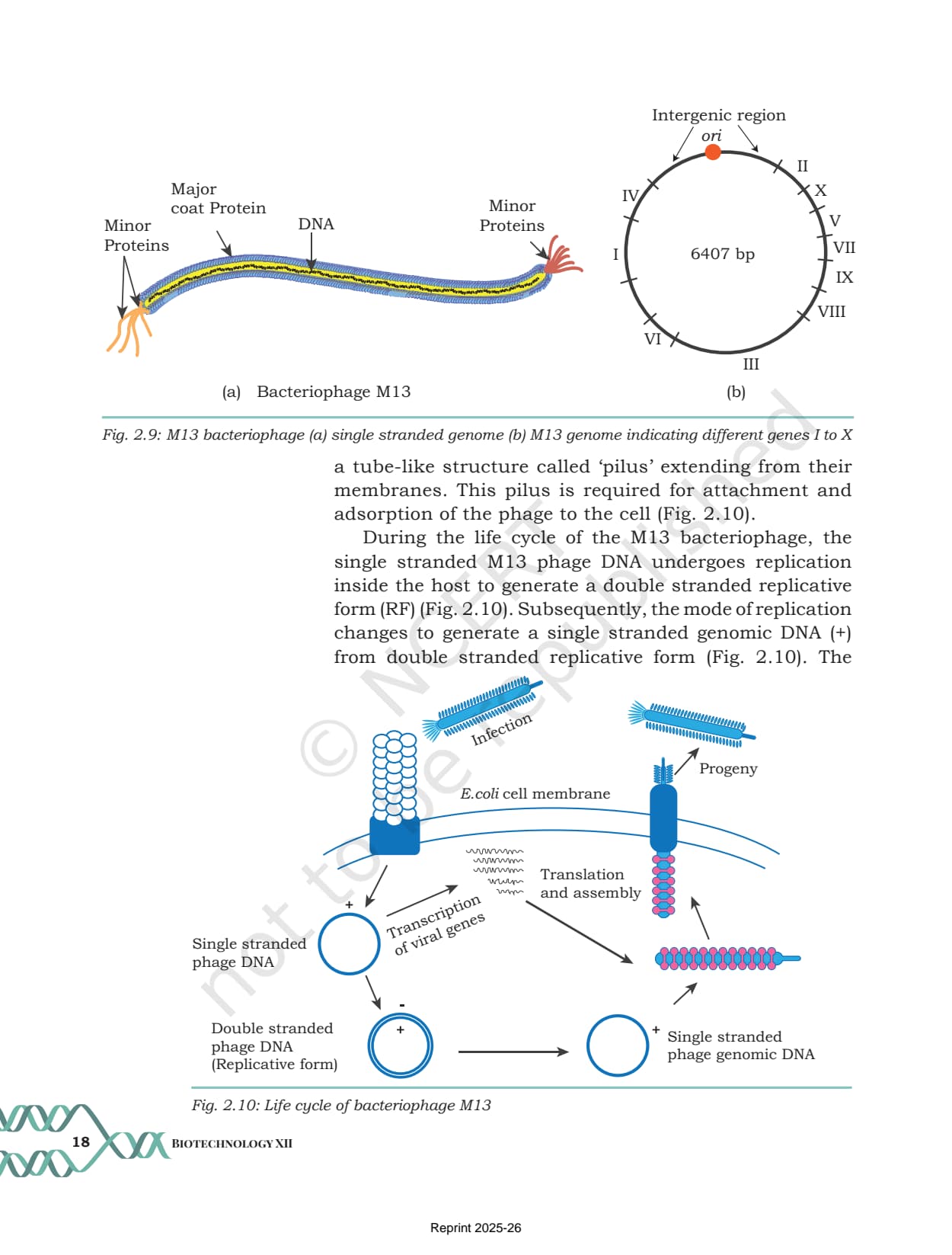
- Fig. 2.6 to Fig. 2.10, covering the lambda phage structure, its lytic and lysogenic life cycles, and the M13 bacteriophage life cycle
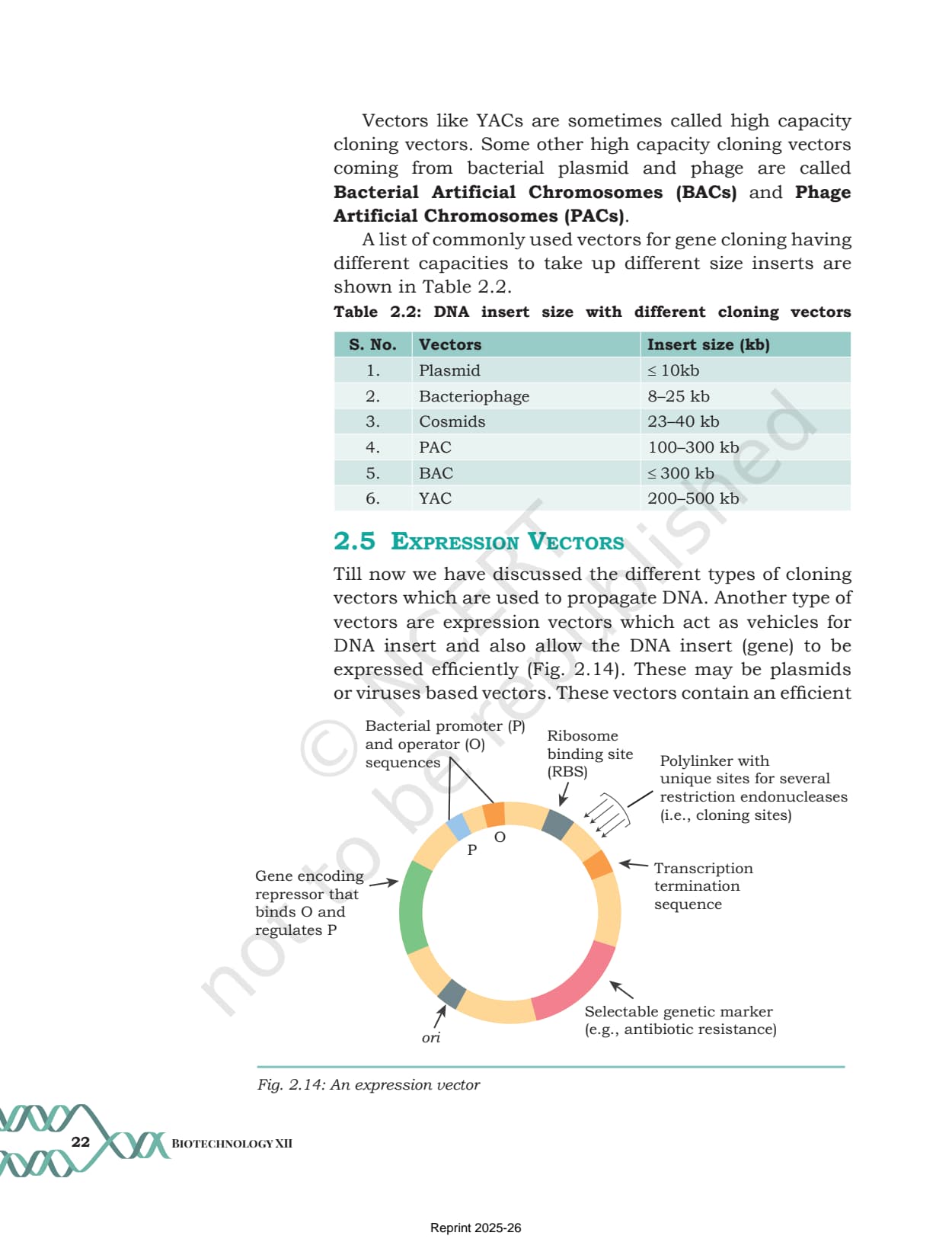
- Table 2.1 (lambda-based vectors for E. coli) and Table 2.2 (insert size by vector type, from plasmids up to Yeast Artificial Chromosomes)
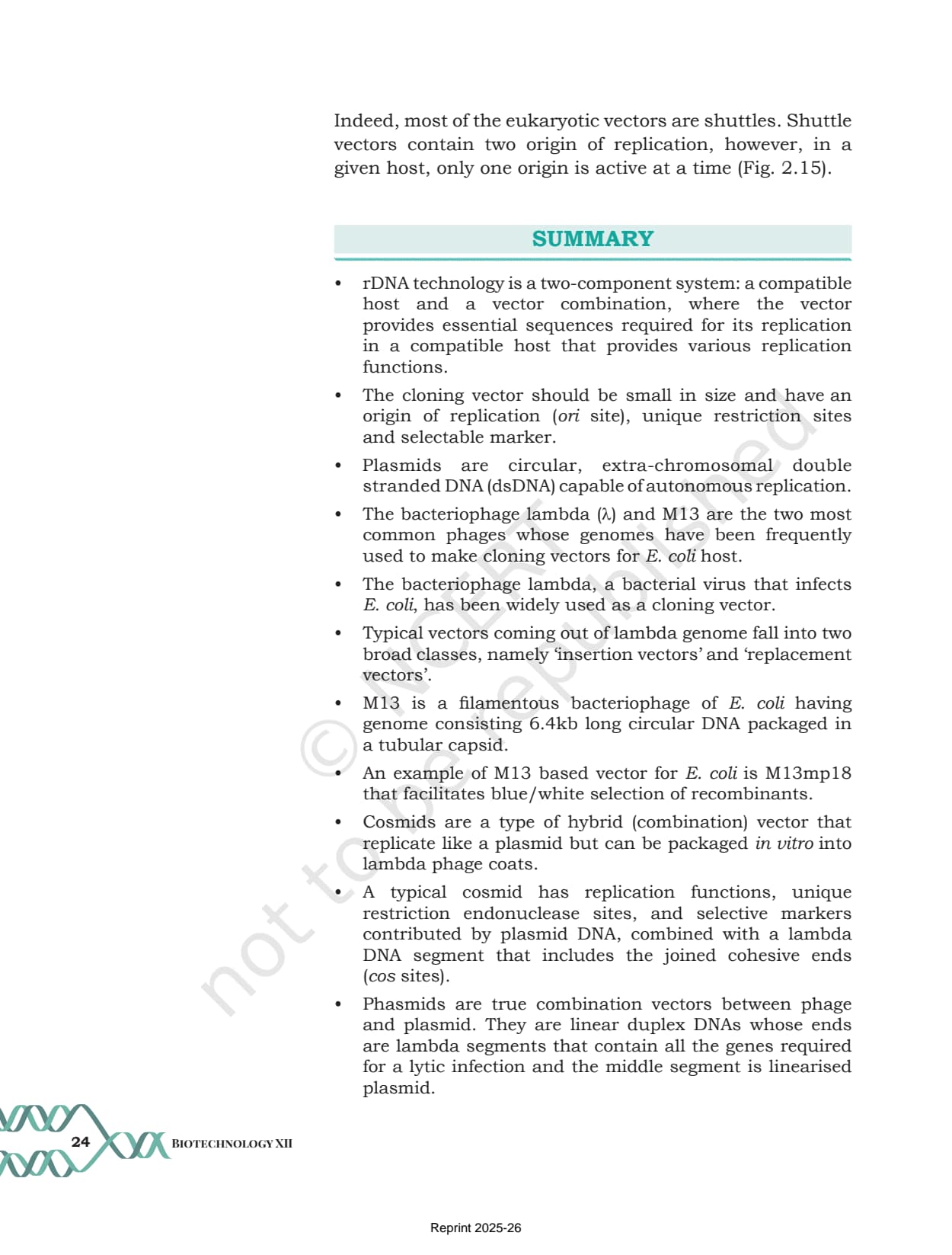
- The Summary page and all 14 exercise questions, including two assertion-reason items and one match-the-pair question
Host and Vector: The Two Key Components of Recombinant DNA Technology
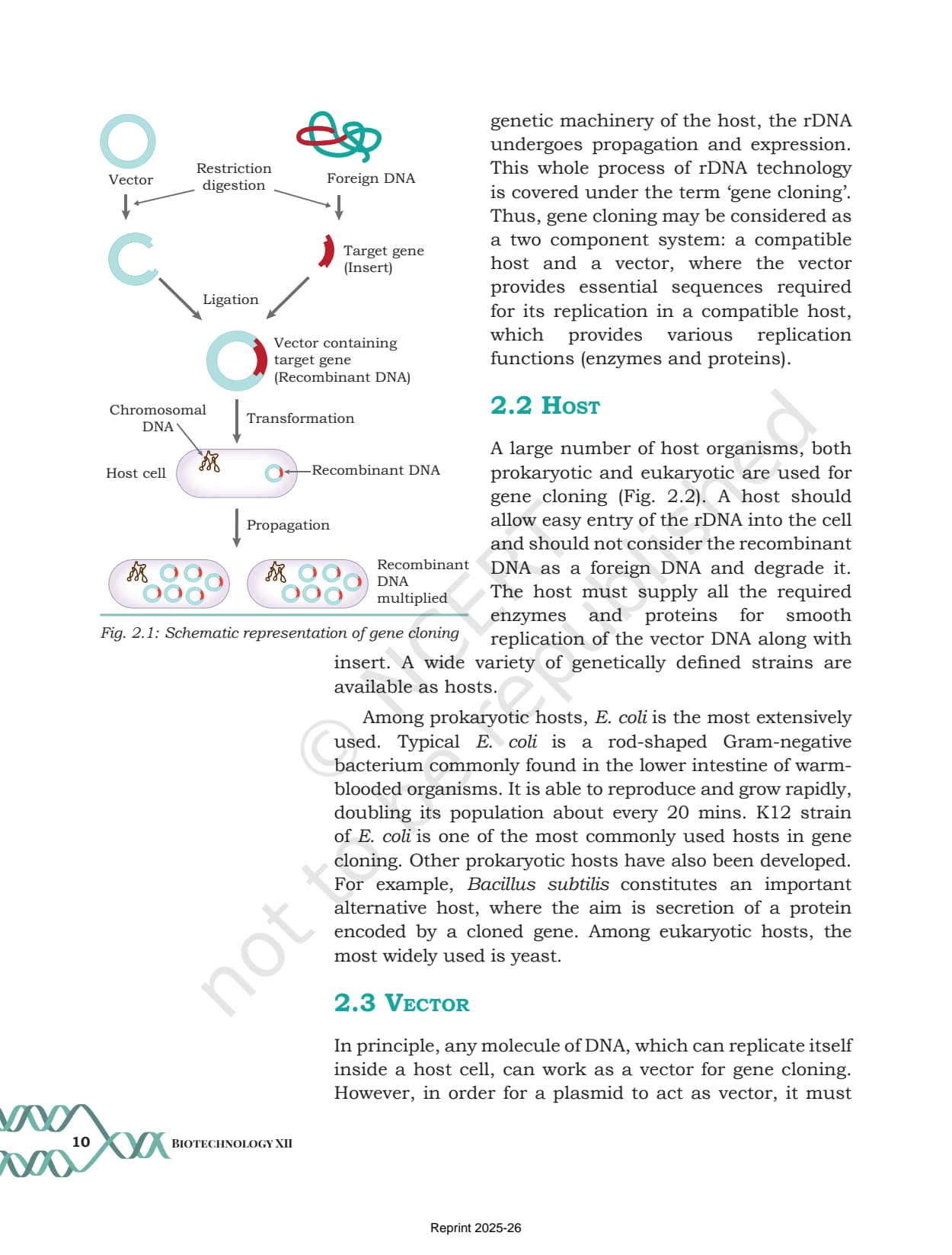
Section 2.1 explains why gene cloning is called a two-component system. In the first step, the desired DNA molecule, called the insert or target gene, is isolated from its source. In the second step, this gene is joined to a carrier DNA molecule, the vector, to form recombinant DNA (rDNA).
The rDNA is then introduced into a living cell, the host, through a process called transformation. Once inside, the host's own enzymes and proteins take over, replicating and expressing the rDNA. The vector supplies the sequences needed for its own replication, and the host supplies the replication machinery. Neither works alone, which is why NCERT frames this as a two-component system rather than describing the vector or the host in isolation.
Choosing a Host: Prokaryotic and Eukaryotic Cells Compared
Section 2.2 sets three conditions a good host must meet: it should let the rDNA enter easily, it should not treat the incoming DNA as foreign and degrade it, and it must supply every enzyme the vector needs for smooth replication.
Escherichia coli is the most widely used prokaryotic host. This rod-shaped, Gram-negative bacterium lives in the intestine of warm-blooded animals and doubles its population roughly every 20 minutes, which is why its K12 strain is the default lab choice. Bacillus subtilis is the alternative when the goal is secreting the cloned protein rather than just replicating it. Among eukaryotic hosts, yeast (Saccharomyces cerevisiae) is the most common, especially when the gene needs processing a bacterial host cannot provide.
| Host type | Example | Why it is chosen |
|---|---|---|
| Prokaryotic | E. coli, K12 strain | Fast doubling time (about 20 minutes), well-mapped genetics, most vectors are built to fit it |
| Prokaryotic | Bacillus subtilis | Secretes the cloned protein directly, useful for industrial-scale production |
| Eukaryotic | Saccharomyces cerevisiae (yeast) | Generally Recognised As Safe (GRAS); processes genes the way higher organisms do |
Plasmids and Bacteriophages: The Two Main Types of Vectors
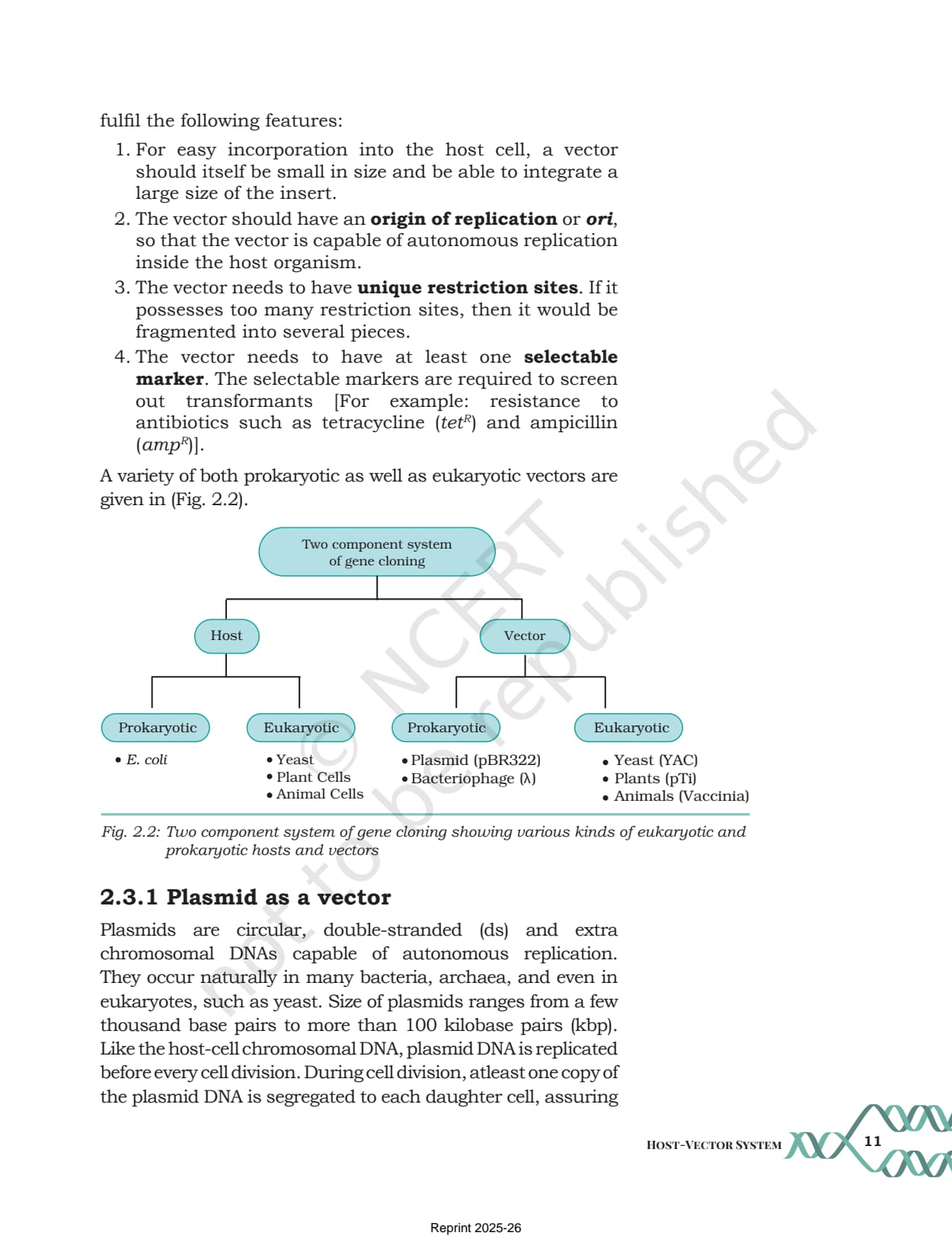
Section 2.3 lists what any DNA molecule needs before it can double as a vector, then walks through the two families NCERT tests most often: plasmids and bacteriophages.
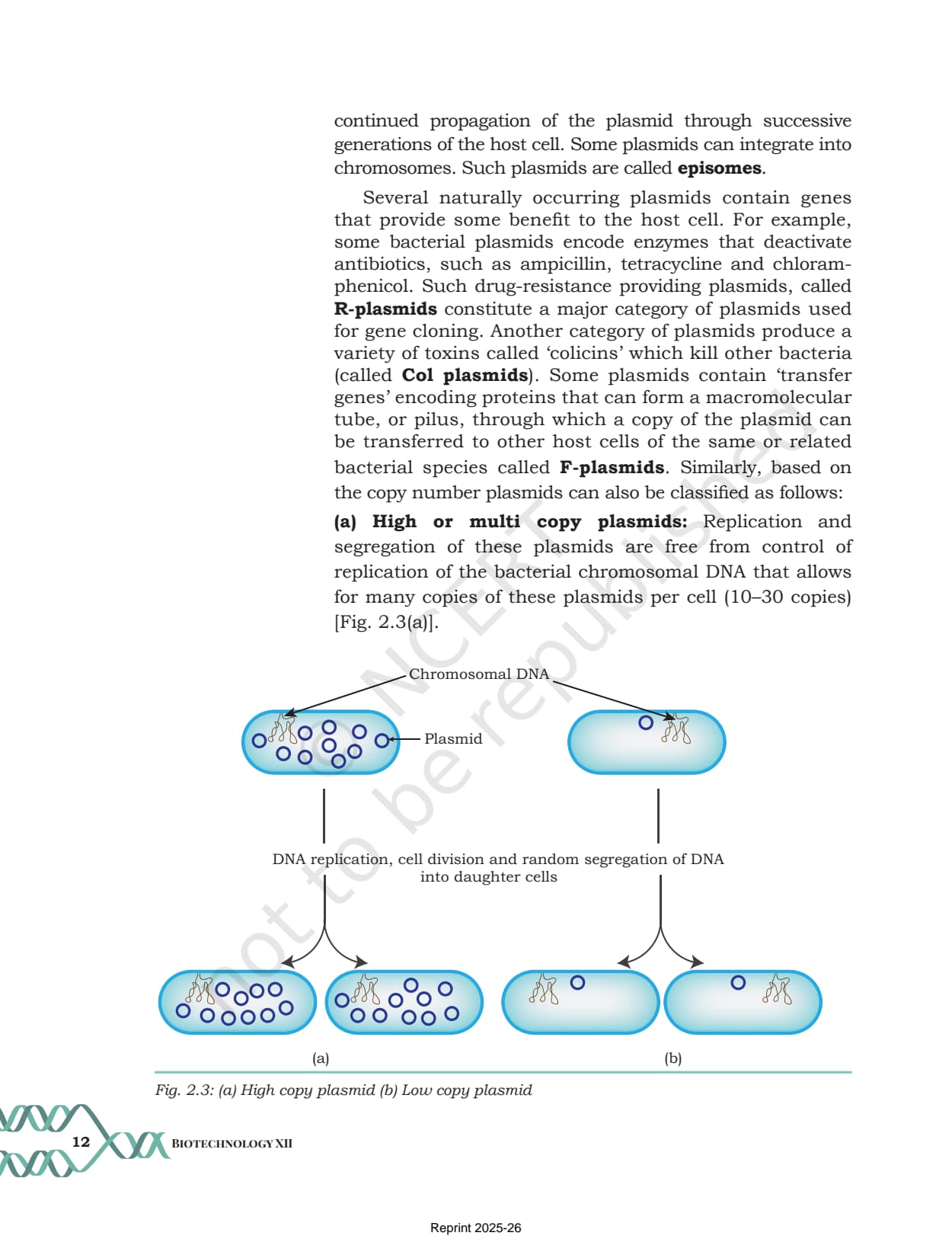
Plasmids are circular, double-stranded, extra-chromosomal DNA molecules that replicate on their own inside a bacterial cell. R-plasmids carry genes that deactivate antibiotics such as ampicillin and tetracycline, while Col plasmids produce colicins that kill other bacteria. High or multi-copy plasmids replicate independent of the host chromosome and can reach 10 to 30 copies per cell (relaxed replication); low-copy plasmids stay tied to the chromosome's own cycle at one or two copies (stringent replication). The workhorse vector pBR322, at just 4,361 base pairs, was built by trimming the larger pBR313 plasmid down to its essential origin of replication, cloning sites and two resistance markers, tetR and ampR.
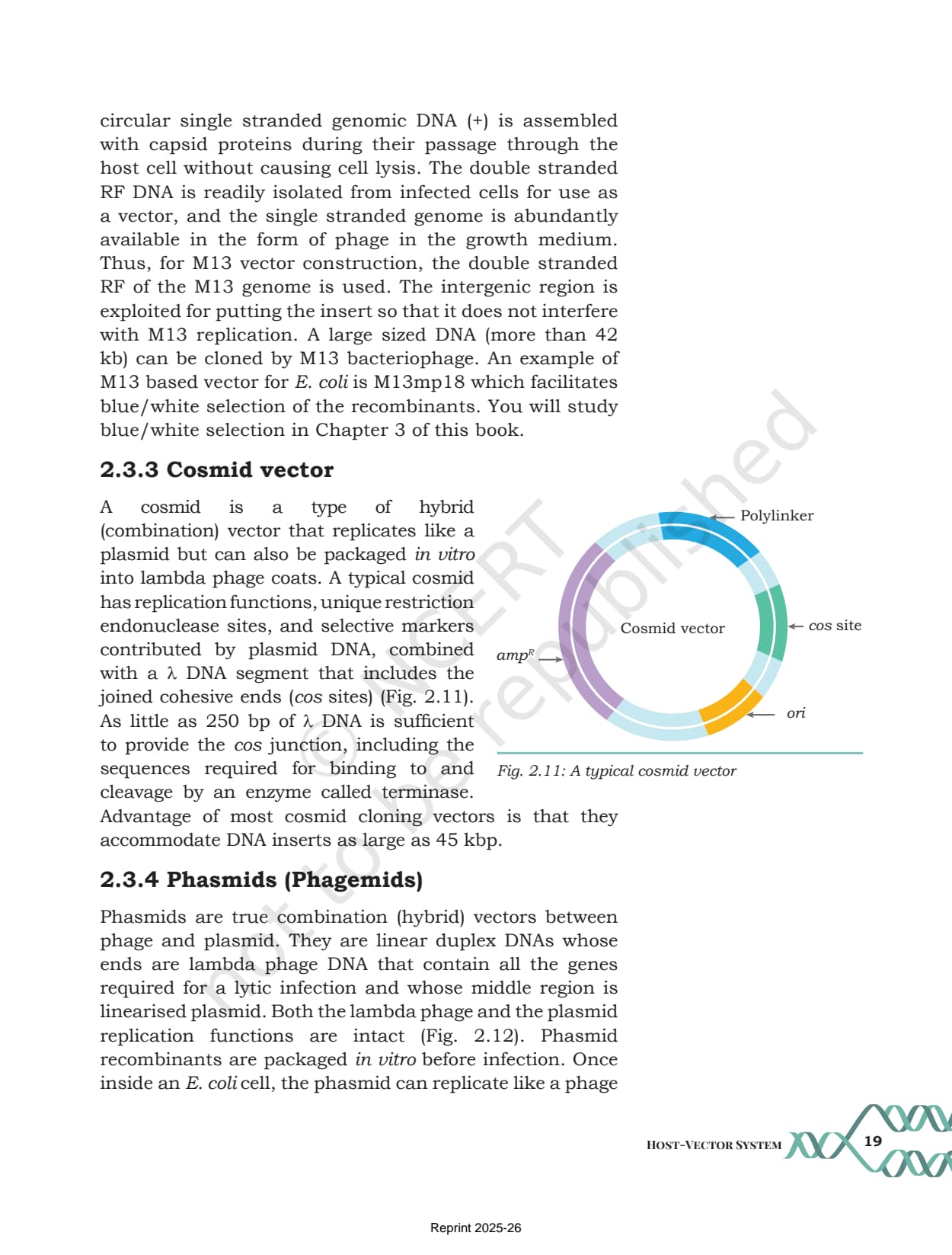
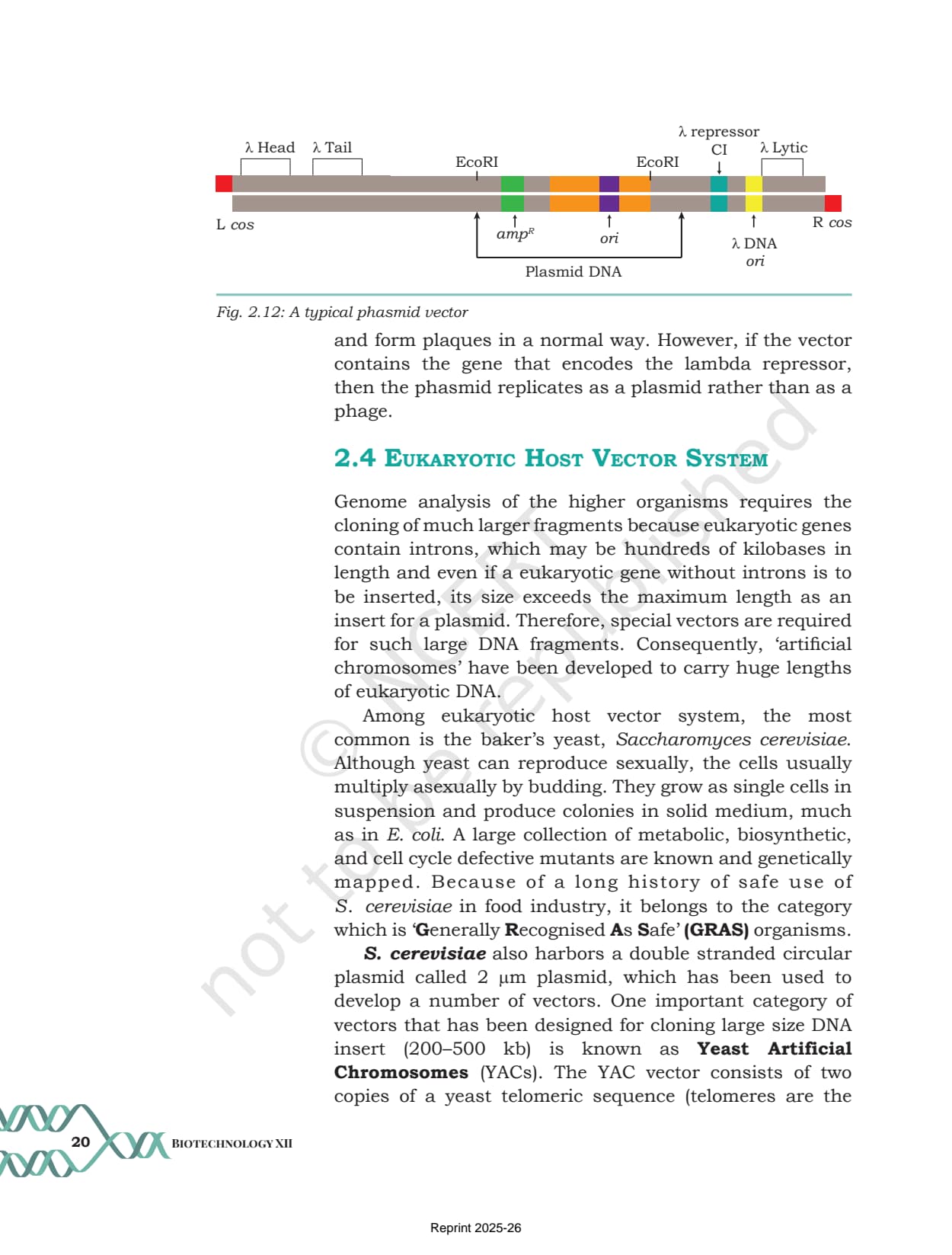
Bacteriophages, the viruses that infect bacteria, clone larger inserts more efficiently than plasmids do. The lambda (λ) phage genome either runs a lytic cycle, making new phage particles and bursting the cell, or a lysogenic cycle, integrating into the host chromosome as a dormant prophage. M13, a filamentous phage with a single-stranded circular genome, infects only E. coli cells carrying an F plasmid, and its double-stranded replicative form is what gets used as a vector. Cosmids and phasmids sit in between: a cosmid replicates like a plasmid but packages into a lambda phage coat, while a phasmid keeps the replication machinery of both a phage and a plasmid intact.
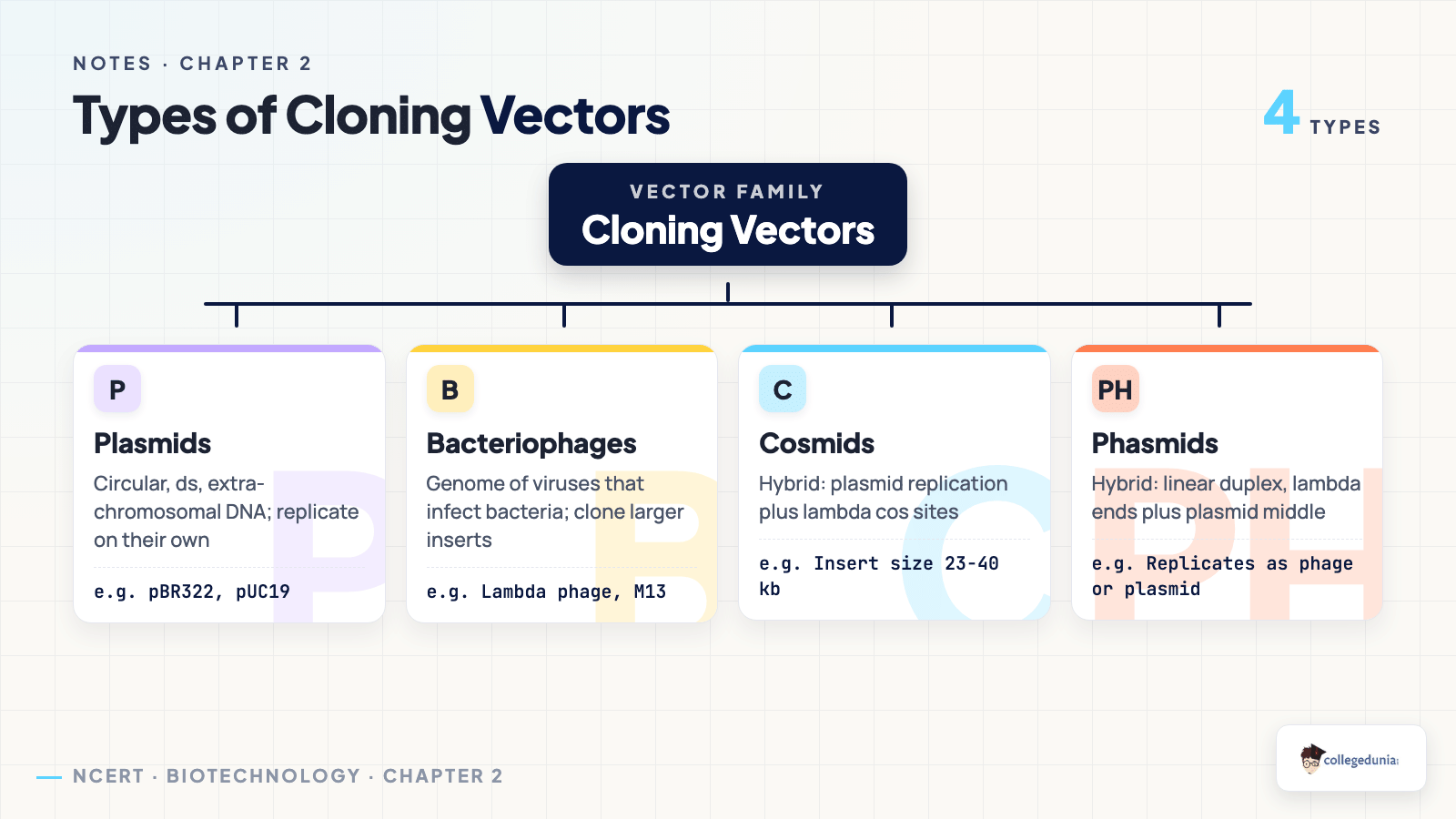
| Vector | Typical insert size | Built from |
|---|---|---|
| Plasmid | up to 10 kb | bacterial extra-chromosomal DNA |
| Bacteriophage | 8 to 25 kb | lambda or M13 phage genome |
| Cosmid | 23 to 40 kb | plasmid plus lambda cos sites (hybrid) |
| Bacterial Artificial Chromosome (BAC) | up to 300 kb | bacterial plasmid backbone |
| Yeast Artificial Chromosome (YAC) | 200 to 500 kb | yeast telomere, centromere and ARS elements |
Four Features Every Good Cloning Vector Needs
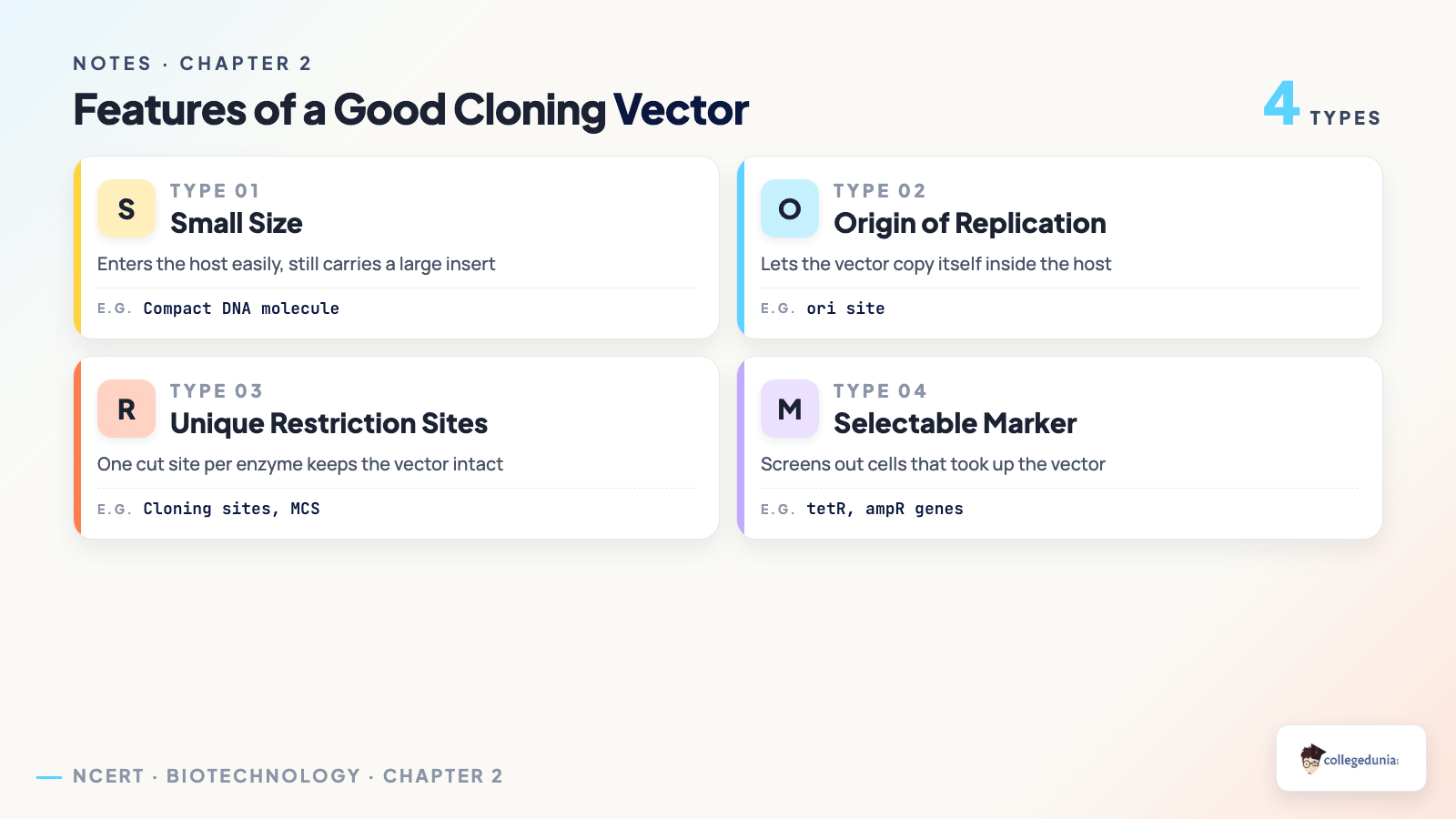
Before any DNA molecule can double as a vector, Section 2.3 sets four conditions it must satisfy.
- Small size: a compact vector enters the host cell easily while still carrying a reasonably large insert
- Origin of replication (ori): lets the vector copy itself inside the host without depending on the host chromosome
- Unique restriction sites: one cut site per enzyme keeps the vector intact after digestion; too many sites and it fragments into pieces
- A selectable marker: usually an antibiotic-resistance gene such as tetR or ampR, used to screen out the host cells that actually took up the recombinant vector
Later vectors such as pUC19 added a multiple cloning site (MCS), also called a polylinker: a short stretch of DNA packed with several unique restriction sites, so a foreign DNA fragment cut with any one of several enzymes can still be inserted at the same spot.
Eukaryotic Vectors, Expression Vectors and Shuttle Vectors
The last three sections move from routine cloning to specialised jobs. Section 2.4 explains why eukaryotic genes, often broken up by introns hundreds of kilobases long, need bigger carriers than a plasmid can offer. Yeast Artificial Chromosomes (YACs), built from yeast telomere, centromere and ARS sequences, can carry 200 to 500 kb of DNA, and Bacterial and Phage Artificial Chromosomes (BACs and PACs) serve the same purpose from a plasmid or phage backbone.
Section 2.5 covers expression vectors, which do more than carry DNA: they express it. An inducible promoter sits upstream of the insert and a transcription-termination sequence sits downstream, together forming what NCERT calls the expression cassette. When a eukaryotic gene is expressed inside a prokaryotic host, or the reverse, called heterologous expression, the gene must have no introns and its protein must not depend on modifications such as glycosylation.
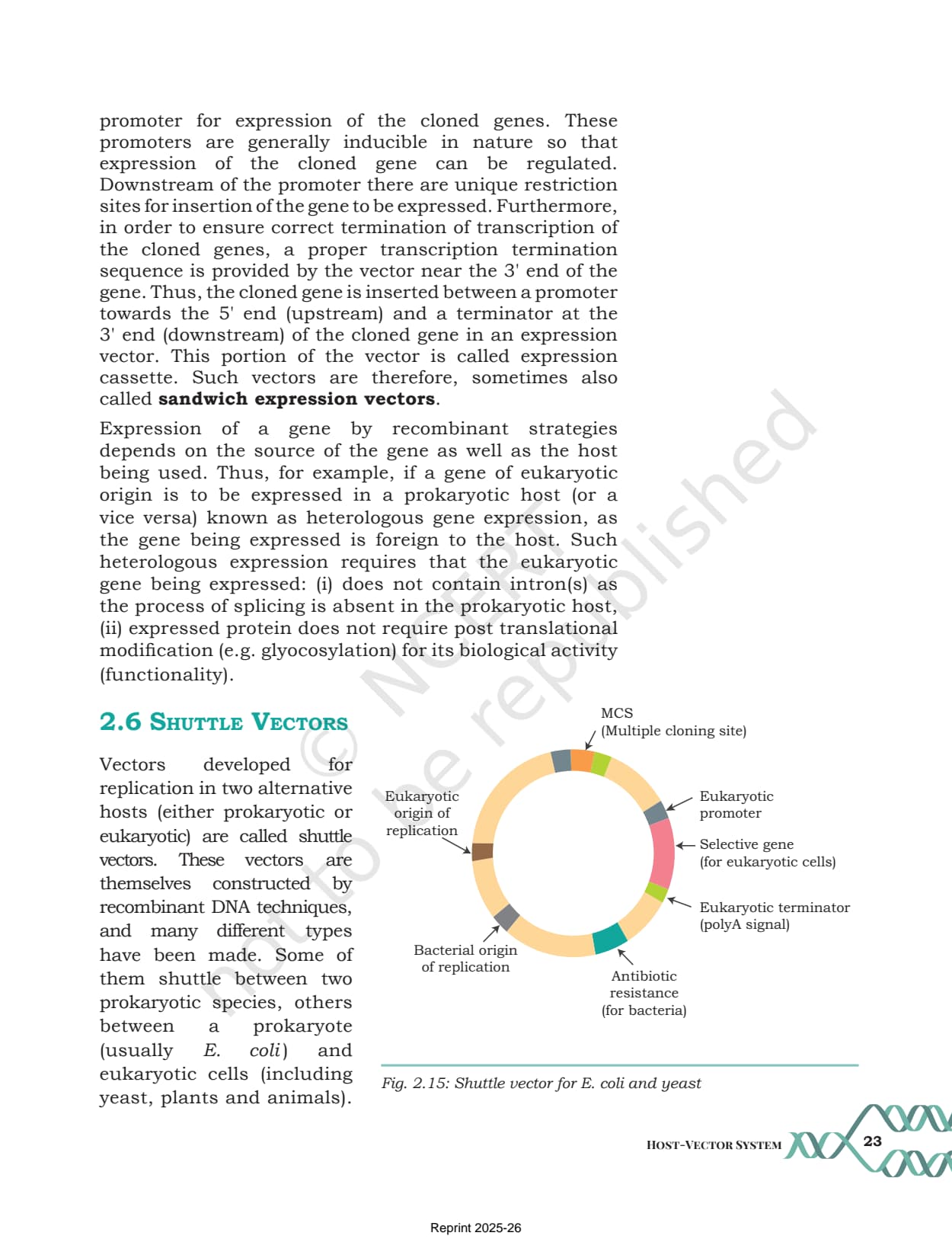
Section 2.6 closes the chapter with shuttle vectors, built to replicate inside two different hosts, typically E. coli paired with yeast, plant or animal cells. A shuttle vector carries two origins of replication, but only one stays active inside a given host at a time.
| Special vector | Job it does |
|---|---|
| Yeast Artificial Chromosome (YAC) | carries 200 to 500 kb eukaryotic DNA fragments |
| BAC / PAC | carries up to 300 kb from a plasmid or phage backbone |
| Expression vector | carries and expresses the cloned gene through a promoter-terminator cassette |
| Shuttle vector | replicates in two different hosts using two origins of replication |
What Collegedunia Adds to This Chapter PDF
Collegedunia gives students the official file plus a way to navigate it before committing to a download. The chapter PDF itself is the official NCERT file, untouched.
- Official file: the exact NCERT chapter PDF, no pages removed
- Read in the browser: page through all 18 pages before downloading
- Chapter list: jump to any other Class 12 Biotechnology chapter from one table
Also Check: the resources below cover the same rDNA technology fundamentals as this chapter.
| Resource | Link |
|---|---|
| Handwritten notes | Host-Vector System Class 12 Handwritten Notes (coming soon) |
| Chapter notes | Host-Vector System Class 12 Notes (coming soon) |
| Chapter solutions | Host-Vector System Class 12 NCERT Solutions (coming soon) |
| Previous chapter Book PDF | An Overview of Recombinant DNA Technology Class 12 Book PDF (coming soon) |
| Next chapter Book PDF | Gene Cloning Class 12 Book PDF (coming soon) |
| Related reading | Biotechnology: Principles and Processes Class 12 Biology Book PDF |
Class 12 Biotechnology NCERT Book PDF: All Chapters
Every chapter of the 2026-27 Class 12 Biotechnology textbook has 13 chapters in total, and this one sits right after the recombinant DNA overview that opens the book.
| Chapter | Download |
|---|---|
| Chapter 1 | An Overview of Recombinant DNA Technology NCERT Book PDF (coming soon) |
| Chapter 2 | Host-Vector System NCERT Book PDF |
| Chapter 3 | Gene Cloning NCERT Book PDF (coming soon) |
| Chapter 4 | Applications of Recombinant DNA Technology NCERT Book PDF (coming soon) |
| Chapter 5 | Genome Technology and Engineering NCERT Book PDF (coming soon) |
| Chapter 6 | Microbial Culture NCERT Book PDF (coming soon) |
| Chapter 7 | Plant Tissue Culture NCERT Book PDF (coming soon) |
| Chapter 8 | Animal Cell Culture NCERT Book PDF (coming soon) |
| Chapter 9 | Stem Cell Culture and Organ Culture NCERT Book PDF (coming soon) |
| Chapter 10 | Bioprocessing and Biomanufacturing NCERT Book PDF (coming soon) |
| Chapter 11 | Bioremediation NCERT Book PDF (coming soon) |
| Chapter 12 | Recent Innovations in Biotechnology NCERT Book PDF (coming soon) |
| Chapter 13 | Entrepreneurship NCERT Book PDF (coming soon) |
Host-Vector System Class 12 NCERT Book PDF FAQs
Common Student Questions on the Host-Vector System Chapter File
Ques. Where can I download the Class 12 Biotechnology Chapter 2 Host-Vector System NCERT Book PDF?
Ans. The official 18-page chapter file is on this page, free to download.
Ques. How many pages is the Host-Vector System chapter?
Ans. 18 pages, printed pages 9 to 26 in the 2026-27 Biotechnology textbook, and this PDF is the complete chapter.
Ques. What is the difference between a plasmid and a bacteriophage vector?
Ans. A plasmid is a circular, double-stranded, extra-chromosomal DNA molecule that replicates inside a bacterial cell on its own. A bacteriophage vector comes from the genome of a virus that infects bacteria, such as lambda or M13, and generally clones larger inserts more efficiently than a plasmid can.
Ques. What are the four features of a good cloning vector?
Ans. A small size, an origin of replication, unique restriction sites for inserting the foreign DNA, and at least one selectable marker such as an antibiotic-resistance gene to screen out cells that took up the vector.
Ques. Why is E. coli the most commonly used host for gene cloning?
Ans. E. coli doubles its population roughly every 20 minutes, its genetics are well mapped, and the K12 strain is genetically defined, which makes it easy to grow and screen for recombinants.
Ques. What is a shuttle vector?
Ans. A vector built to replicate inside two different hosts, usually a bacterium paired with yeast, plant or animal cells. It carries two origins of replication, though only one stays active inside any given host at a time.
Ques. Is this the official NCERT file?
Ans. Yes. It is the NCERT chapter PDF for 2026-27 hosted as published, with no pages removed or added.



Comments